PART2:For Three Days My Dying Husband Whispered One Name None of Us Recognized—Then a Stray Dog Walked Into His ICU Room and Broke Everyone’s Heart
PART2
Jon’s employer arrived that afternoon carrying a cardboard box.
His name was Frank Dwyer.
He owned the small machine-repair shop where Jon had worked for almost eleven years.
Inside the box were Jon’s work boots, his insulated lunch bag, a stack of paperwork, his reading glasses, and the battered blue thermos I had bought him six Christmases earlier.
“I thought you might want his things.”
I hated the wording.
His things.
As if Jon had already become somebody who owned objects in the past tense.
Frank must have seen my face.
“I mean until he gets back.”
I nodded.
“Thank you.”
He stepped into the room.
Emily sat near the window.
Michael stood beside Jon’s bed.
Frank looked uncomfortable around all the equipment.
Then Jon moved his lips.
The whisper came again.
Frank froze.
His face changed so quickly that I stood.
“What?”
He moved closer.
Jon whispered again.
Frank’s eyes filled.
“Oh, God.”
“What?”
He looked at me.
“He’s saying Rex.”
I stared.
“Who is Rex?”
Frank glanced at Jon.
Then back at me.
“His dog.”
I almost laughed from confusion.
“Jon doesn’t have a dog.”
Frank’s mouth trembled.
“Not at home.”
I said nothing.
Frank pulled a chair closer.
“For about five years there’s been this dog living behind the shop.”
“A stray?”
“Yes.”
“Jon never told me.”
“I don’t think he told anybody outside work.”
He smiled sadly.
“First winter, the dog was skin and bones. Wouldn’t let anyone near him. Jon started leaving food behind the dumpster.”
Emily stood.
“What kind of dog?”
“Some kind of shepherd mix. Brown and black. Scar on one ear.”
“And Dad named him Rex?”
Frank nodded.
“At first we made fun of him.”
Michael looked at Jon.
“Jon?”
Frank continued.
“Every morning Jon came in, Rex would be waiting near the back entrance.”
“What did he do?”
“Followed him everywhere outside.”
Frank smiled.
“If Jon worked on the loading dock, Rex lay under the steps. If Jon ate lunch outside, Rex sat beside him. If Jon was late, that dog would pace until his truck showed up.”
I sat down slowly.
“Five years?”
“Five.”
“And Jon never brought him home?”
Frank shook his head.
“He tried once.”
“What happened?”
“Rex panicked inside the truck.”
Frank looked embarrassed.
“He’s not really comfortable with enclosed spaces. Jon said maybe somebody had treated him badly before.”
Emily wiped her face.
“So Dad just left him there?”
“No.”
Frank answered immediately.
“Your dad built him a shelter behind the shop.”
My throat closed.
“He did what?”
“Insulated box. Raised floor. Heated water bowl in winter.”
That sounded exactly like Jon.
Quiet kindness nobody was supposed to applaud.
Frank continued.
“Jon paid for vaccinations through a mobile vet. Got him treated when he cut his paw. During bad storms, he’d sleep in the shop office.”
“Why didn’t he tell us?”
Frank looked at me.
“I asked him once.”
“What did he say?”
“He said…”
Frank paused.
“He said he didn’t want you thinking he’d brought home another responsibility without asking.”
That was so ridiculous and so completely my husband that I laughed.
Then I cried.
Emily asked:
“Where is Rex now?”
Frank’s face fell.
“Behind the shop.”
“Alone?”
“One of the guys is feeding him.”
Emily turned to Dr. Harrison, who had entered quietly during the conversation.
“Can we bring him here?”
The doctor blinked.
“A dog?”
“Yes.”
“Emily—”
“Dad has been calling him for three days.”
Dr. Harrison looked at Jon.
Then at the monitors.
Normally an animal would never simply be allowed into an intensive care unit.
Infection control.
Other patients.
Safety.
Hospital policy.
Reality.
But by then the medical team had already begun discussing whether Jon’s condition was approaching a point where family-centered exceptions might be considered.
Dr. Harrison did not promise anything.
He said:
“I’ll ask.”
Emily grabbed his hand.
“Please.”
He looked at her.
“I said I’ll ask.”
An hour later, infection-control staff laid out conditions.
The dog had to be examined briefly by a veterinarian.
Cleaned.
Vaccination status confirmed as best as possible.
No wandering through the unit.
Short visit.
Direct supervision.
If anything became unsafe, it ended immediately.
Frank called the shop.
One of Jon’s coworkers drove Rex to the veterinary clinic near the hospital.
Then we waited.
Jon’s blood pressure dropped again.
Nurses entered.
Medication adjusted.
I stood against the wall because there was nowhere useful for me to put my hands.
Emily whispered:
“Rex is coming.”
Jon did not move.
She leaned closer.
“Dad.”
Nothing.
“Your dog is coming.”
That word felt strange in my mouth.
Your dog.
The dog I did not know existed.
The dog my husband apparently loved enough to call for while unconscious.
I should have felt hurt.
Instead, I found myself praying for a stray dog.
Please come.
Please be something he recognizes.
Please give him one more reason.
At 6:12 that evening, the ICU doors opened.
Frank entered first.
Behind him came one of Jon’s coworkers holding a leash.
And then I saw Rex.
He was not beautiful.
At least not in the way people usually mean.
Medium-large.
Brown-black coat.
One ear bent permanently at the tip.
Old white scar near his muzzle.
His nails clicked nervously against the hospital floor.
He hated everything immediately.
The lights.
The smell.
The machines.
The strangers.
His tail disappeared beneath him.
He kept looking behind himself toward the elevator.
Then he stopped.
His nose lifted.
Once.
Twice.
His whole body changed.
Frank whispered:
“He smells him.”
Rex pulled forward.
The coworker tightened the leash.
The dog did not bark.
He simply pulled.
Harder.
His nose worked constantly.
Down the hall.
Past the nurses’ desk.
Toward Jon’s room.
When Rex reached the doorway, he froze.
I will never forget that.
He stood completely still.
Not one paw moved.
Jon lay beneath white sheets.
Tubes.
Tape.
Machines.
His face looked thinner than it had four days earlier.
Rex stared at him.
Then looked back at Frank.
As if asking whether that was really the man he knew.
Frank loosened the leash.
“Go ahead.”
Rex took one step.
Stopped.
Another.
Stopped.
He approached the bed like he was afraid of what he would discover.
Emily covered her mouth.
Michael turned away already crying.
I crouched beside Rex.
“Go see him.”
The dog looked at me.
Then at Jon.
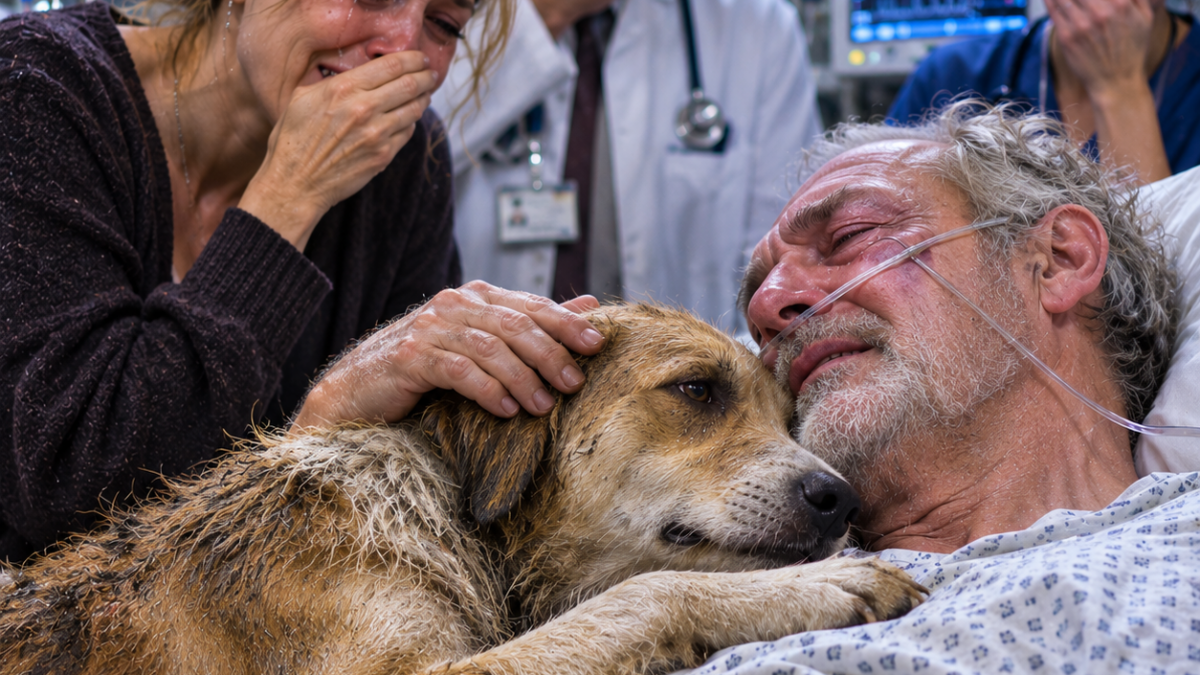
He placed his front paws carefully against the side of the mattress.
Dr. Harrison watched.
A nurse helped guide him so he would not disturb any lines.
Rex climbed onto the edge of the bed.
He was unbelievably gentle.
This seventy-pound animal folded himself smaller beside Jon.
Then stretched his neck.
His nose touched my husband’s cheek.
Once.
Jon did not move.
Rex pulled back.
Waited.
Then touched him again.
Nothing.
A third time.
Nothing.
The dog made a sound.
I had heard dogs whine before.
This was different.
Thin.
High.
Broken.
A sound almost too small for an animal that size.
Rex looked at Jon’s closed eyes.
Whined again.
Then pawed lightly at his hand.
Frank whispered:
“That’s what he does every morning.”
I looked at him.
“What?”
“When Jon eats lunch in the truck and falls asleep.”
Frank’s voice cracked.
“Rex paws his hand until he wakes up.”
Emily broke.
She buried her face against Michael.
Rex nudged Jon’s cheek again.
Waited.
Nothing.
The dog’s ears slowly lowered.
He lay down across the narrow space beside Jon, resting his head near Jon’s shoulder.
For several seconds, he was silent.
Then another whine escaped him.
Softer.
I cannot explain why that sound was harder to hear than the machines.
Maybe because the machines did not understand.
Rex did.
Not the coma.
Not the medicine.
Not death.
He only understood that the man who came every morning had disappeared.
And now he had found him.
But Jon would not wake up.
Rex licked his hand.
Waited.
Pawed.
Waited.
Nudged his face.
Waited.
Each time there was no response, his movements became slower.
Less certain.
It looked as if hope itself were exhausting him.
I put one hand over my mouth.
“Jon.”
Nothing.
“Please.”
Rex raised his head.
He looked at me.
I do not know what I expected to see in a dog’s face.
But there was confusion there.
And something that looked enough like fear that I had to sit down.
Emily whispered:
“He thinks Dad left him.”
That sentence shattered me.
Because suddenly I understood something my husband had probably understood long before any of us.
Rex had been abandoned once already.
Maybe more than once.
For five years, Jon had been the person who always returned.
Morning after morning.
Rain.
Snow.
Heat.
Jon came.
Food came.
That blue truck came.
Then one morning it did not.
Another morning.
Nothing.
Another.
Nothing.
Rex had waited behind the shop while Jon lay dying three miles away.
And now, after days of waiting, he had finally found him—
only to discover a body that smelled like Jon but did not move like Jon.
Rex pressed his forehead against Jon’s jaw.
The little broken sound came again.
Sarah—me, his wife of twenty-one years—stood three feet away realizing this animal understood a different version of my husband than I did.
Not a secret life.
A secret tenderness.
Jon had been loving something vulnerable every day without needing anyone to know.
I moved beside the bed.
“Rex.”
His ear twitched.
“You found him.”
The dog did not look at me.
“He knows you’re here.”
I did not know whether that was true.
But I needed it to be.
Emily came closer.
“Dad.”
Her voice shook.
“You can’t do this.”
Dr. Harrison looked toward her.
Emily kept talking.
“You cannot spend three days calling this dog and then leave when he finally gets here.”
Michael turned away completely.
I touched Jon’s arm.
“You hear her?”
No response.
Rex lifted one paw.
Placed it against Jon’s hand.
And held it there.
Five minutes passed.
Then ten.
Nobody spoke much.
Eventually Dr. Harrison quietly told the nurse they would need to end the visit soon.
Not because he was cruel.
Because Rex could not stay indefinitely in ICU.
I nodded.
I hated him for being right.
Frank reached for the leash.
Rex immediately pressed closer to Jon.
“No.”
Frank stopped.
The dog knew.
He knew someone was about to take him away again.
Frank whispered:
“Come on, buddy.”
Rex did not move.
His paw remained on Jon’s hand.
Then Jon’s index finger twitched.
Tiny.
So tiny I almost convinced myself I imagined it.
Rex did not.
His head snapped up.
I leaned over.
“Jon?”
Nothing.
Dr. Harrison stepped closer.
Another finger moved.
Emily gasped.
“Dad?”
Rex stood.
His tail made one uncertain movement.
Then stopped.
Jon’s eyelids fluttered.
Dr. Harrison immediately shifted into physician mode.
“Jonathan?”
A nurse checked the monitors.
“Jon, if you can hear me, open your eyes.”
Nothing.
Then—
slowly—
one eye opened.
Only a slit.
Then the other.
His gaze had no focus.
He looked at the ceiling.
At the light.
At nobody.
I could barely breathe.
“Jon.”
His eyes drifted toward my voice.
Past me.
Down.
Rex’s face was inches from his.
The dog became perfectly still.
Jon stared.
His lips moved.
No sound.
Rex leaned closer.
Jon tried again.
“Rex.”
The dog’s tail struck the mattress.
Once.
Jon’s hand lifted maybe half an inch.
Fell.
Then tried again.
Rex pushed his head underneath it.
Jon’s fingers closed weakly into the fur behind his ear.
And my husband whispered:
“You came.”
Rex exploded.
Not violently.
Joyfully.
His tail beat against the mattress.
He licked Jon’s fingers.
His chin.
The side of his face until the nurse laughed through tears and gently redirected him away from the oxygen equipment.
Jon’s eyes filled.
“I knew…”
His voice barely existed.
“I knew you’d come.”
I turned away because I could not see anymore.
Emily was sobbing.
Michael had both hands over his face.
Frank stood against the wall crying openly.
One nurse wiped her cheeks.
Another pretended to adjust tubing.
Even Dr. Harrison looked down for a moment before checking the monitor again.
Jon’s heart rate had increased modestly.
His blood pressure was improving with the treatment already being provided.
His oxygenation remained acceptable.
Later, when people told the story, they said the dog brought Jon back.
Dr. Harrison never said that.
Neither did I.
Medicine had been working.
Jon’s neurological recovery may already have been beginning.
Familiar voices, touch, smell, and emotional stimulation can sometimes coincide with improving consciousness, but no responsible doctor promised us that Rex had performed a miracle.
What Dr. Harrison said was:
“I can’t tell you what caused that moment.”
Then he looked at the dog.
“But I wouldn’t dismiss what familiar sensory cues can mean to a patient who is emerging.”
That was enough.
Rex did not cure Jon.
He reached him.
Sometimes that is miracle enough.
Jon did not suddenly sit up and walk.
He did not remove tubes.
He did not make a miraculous overnight recovery.
He slept again almost immediately.
His eyes opened briefly several more times that night.
The following morning, he followed simple commands.
Squeeze my hand.
Blink twice.
Move your toes.
The medical team cautiously reduced support as his condition allowed.
Every improvement felt enormous.
Every setback terrified us.
Rex was not allowed to live in the ICU.
Reality returned.
But the hospital made controlled exceptions.
Short visits.
Cleaned paws.
Supervised.
Never around other vulnerable patients.
Every morning Frank brought Rex.
And every morning something strange happened.
The dog would reach Jon’s room, stop outside the door, and wait until invited.
Then he would go directly to the bed.
No wandering.
No investigating trash bins.
No begging nurses.
Just Jon.
By day six, Jon was awake for longer periods.
He still struggled to speak.
His body was weak.
Memory came in pieces.
He remembered me.
Emily.
Michael.
Frank.
Then Rex.
Especially Rex.
One afternoon, I sat beside him while Rex slept curled near the foot of the bed.
Jon looked at me.
“I should’ve told you.”
“About your secret girlfriend?”
His eyes widened.
Then he realized.
“Very funny.”
“I’m furious.”
He smiled weakly.
“Sorry.”
“Five years?”
He nodded.
“Why?”
“Why what?”
“Why didn’t you tell me?”
He looked embarrassed.
“I don’t know.”
“That’s not an answer.”
He stared at Rex.
Then whispered:
“You already had enough.”
“What?”
“Emily.”
“Bills.”
“Your mom getting sick.”
“The roof.”
I shook my head.
“So?”
“I didn’t want to come home one night and say, ‘Hey, Sarah, there’s also a half-wild dog who needs us.’”
I laughed.
“You built him a heated house.”
His eyebrows lifted.
“Frank told you?”
“Frank told me everything.”
“Traitor.”
Rex opened one eye.
Jon looked at him.
Then his face changed.
Softened.
“I tried to take him home.”
“I know.”
“He panicked.”
“I know.”
“He threw up in the truck.”
“Frank skipped that.”
“He was ashamed.”
“Who?”
“Rex.”
I stared.
Jon smiled.
“Dogs can look ashamed.”
“No, husbands who hide dogs look ashamed.”
His smile faded.
He looked toward the window.
Then:
“He didn’t belong to anybody.”
I waited.
Jon’s fingers moved slowly through Rex’s fur.
“Every morning he looked surprised that I came back.”
That sentence hit me.
“What do you mean?”
“The first year.”
Jon swallowed.
“He’d eat, then back away.”
“If I moved too quickly, he’d flinch.”
“Sometimes I’d leave on Friday, and Monday morning he’d be waiting before sunrise.”
His eyes filled.
“It was like he never trusted that I’d return until he saw the truck.”
I looked at the dog.
“What happened eventually?”
“He stopped looking surprised.”
Jon smiled through tears.
“That was the best part.”
I understood then.
Jon had not simply been feeding Rex.
For five years, he had been teaching an abandoned animal that someone could leave and still come back.
And then Jon disappeared.
No blue truck.
No food.
No voice.
Nothing.
For three days, Rex must have waited behind the shop believing the old lesson had been a lie.
I looked at my husband.
“That’s why you were calling him.”
Jon frowned.
“Was I?”
“For three days.”
His eyes filled.
“I remember something.”
“What?”
“Dark.”
His breathing changed.
“Not dreaming exactly.”
I took his hand.
“You don’t have to.”
“I could hear something.”
“What?”
He stared at Rex.
“Breathing.”
I felt goosebumps rise.
“His?”
“I don’t know.”
“It didn’t make sense.”
His voice was weak.
“I kept thinking I had to get to work.”
“Why?”
“Because…”
He started crying.
Jon almost never cried.
I leaned closer.
“Because what?”
“Because if I didn’t go…”
He looked down at Rex.
“Who was going to feed him?”
I put my forehead against his shoulder and sobbed.
Not quietly.
Not gracefully.
Twenty-one years married to a man who had been fighting somewhere between consciousness and darkness, and one of the thoughts anchoring him had been that a stray dog might be waiting for breakfast.
Rex heard me crying.
He stood.
Walked awkwardly across the mattress.
Pressed his nose against my temple.
I laughed into Jon’s gown.
“Great.”
“What?”
“Now he’s taking care of me too.”
Jon smiled.
“Good dog.”
Rex’s tail moved.
The recovery took weeks.
Not days.
Jon developed severe weakness from critical illness.
Standing required help.
Walking five steps left him sweating.
His hands shook.
He hated physical therapy.
Then Rex became useful again.
A therapist discovered Jon would walk farther if Rex walked beside him.
At first:
Ten feet.
Then twenty.
Then down the hall.
Rex moved slowly as though he understood.
If Jon stopped, Rex stopped.
If Jon sat, Rex sat.
He never pulled.
Emily called him Dad’s furry drill sergeant.
Jon called her ungrateful.
Eventually Jon transferred out of intensive care.
Then to rehabilitation.
Rex could not stay continuously, but the facility permitted scheduled visits.
Frank brought him faithfully.
One morning, snow covered the parking lot.
Frank called.
“Roads are bad.”
Jon’s face fell.
He tried to hide it.
I said:
“Rex isn’t coming today.”
“I know.”
“You okay?”
“Fine.”
He was not.
At eleven, we heard barking outside the rehabilitation entrance.
I looked through the window.
Frank stood beside his truck.
Snow in his hair.
Rex bouncing beside him.
Jon started laughing.
“He came.”
“Of course he came.”
That became our family phrase.
Emily would say it every time.
Of course Rex came.
When Jon was discharged home six weeks after the crisis, we faced a problem.
Rex had never lived inside a house.
Frank assumed he would return to the shop.
Jon looked at me.
I knew that look.
“No.”
“I didn’t say anything.”
“You’re thinking.”
“Sarah.”
“No.”
“He saved my life.”
“You heard the doctor.”
“He emotionally saved my life.”
“That is manipulative wording.”
“Effective?”
I looked at Rex.
The dog sat beside Jon’s wheelchair.
Jon placed one hand on his head.
Rex closed his eyes.
I sighed.
“Fine.”
Jon blinked.
“Fine?”
“He comes home.”
Emily screamed from the hallway.
“I KNEW IT.”
“You were listening?”
“Yes.”
“Absolutely no one respects privacy in this family.”
Rex’s first hour in our house was a disaster.
He refused to cross the threshold.
Jon sat in his wheelchair inside.
Rex stood outside.
Snow behind him.
Warm living room ahead.
He trembled.
Jon called.
“Come on.”
Nothing.
He placed a biscuit on the floor.
Rex stared.
Emily whispered:
“He’s scared.”
Jon’s face fell.
For five years, the shop had been the safest place Rex knew.
Home was unknown.
So Jon did not force him.
He got up from the wheelchair despite my protests.
Used the walker.
Moved slowly to the doorway.
Then sat on the floor.
“Jon.”
“I’m fine.”
“You are absolutely not fine.”
He ignored me.
Sat with Rex at the threshold.
Ten minutes.
Twenty.
Jon did not pull.
Did not lure.
Did not command.
He simply waited.
Eventually Rex placed one paw inside.
Then another.
Then backed out.
Jon smiled.
“Good.”
Again.
One paw.
Two.
Then all four.
That night Rex slept directly beside the front door.
Not in the expensive dog bed Emily chose.
Not near Jon.
At the door.
As if guarding the exit so no one could disappear without him noticing.
It took months before he slept elsewhere.
At first, every morning when Jon came downstairs, Rex jumped up as if shocked.
Tail wild.
Whole body wriggling.
Jon would kneel slowly and say:
“I told you I’d come back.”
Every morning.
For months.
I heard those words so many times they became ordinary.
Then one day I understood what Jon was doing.
He was finishing the lesson.
I leave.
I come back.
I leave.
I come back.
I survive the night.
I come back.
You do not have to wait in fear forever.
Rex eventually believed him.
One morning he did not leap up.
He opened one eye from the rug.
Saw Jon.
Thumped his tail once.
Went back to sleep.
Jon stood in the doorway.
Then started crying.
I came behind him.
“What?”
“He knew.”
“What?”
“He knew I’d be here.”
I looked at Rex.
Jon whispered:
“He finally knew.”
That was one of the happiest days of my husband’s life.
Not the day he returned to work.
Not the day he drove again.
The morning a formerly abandoned dog stopped being surprised that Jon came home.
Jon never returned to his old workload.
His body had changed.
Recovery remained incomplete in small ways.
Fatigue.
Occasional tremor.
Medication.
Follow-up appointments.
Life did not reset.
It adjusted.
Frank gave him reduced hours.
Jon accepted reluctantly.
Rex went with him every day.
This time officially.
The shop put a small plaque on the back shelter:
REX MILLER — SECURITY, MORALE, AND LUNCH INSPECTION
Rex took the lunch-inspection portion seriously.
Emily graduated high school.
Rex attended the backyard party wearing a ridiculous blue bow tie.
Jon stood beside me.
Still thinner than before the hospital.
But standing.
When Emily walked toward him with her diploma, Jon hugged her.
Then Rex pushed between them.
Emily shouted:
“You had five years alone with him. He’s mine today.”
Rex ignored her.
That was life afterward.
Funny.
Ordinary.
Precious in ways ordinary things become after you almost lose them.
Years passed.
Rex aged faster than we wanted.
Dogs always do.
His muzzle turned white.
Stairs became difficult.
Jon built him a ramp.
Of course.
The heated shelter behind the shop remained empty because Rex now went home every night.
Eventually he stopped going to work daily.
He preferred sleeping in sunlight near our kitchen door.
Jon retired early.
Not because he wanted to.
Because his cardiologist and body slowly won the argument.
For the first time in his life, Jon had long mornings.
He and Rex took walks.
Every day.
Just as he had promised in that hospital room.
Rain.
Cold.
Snow.
Heat.
Sometimes Emily came when home from college.
Sometimes I joined.
Sometimes it was only the two of them.
Man and dog.
Both older.
Both rescued in ways neither could explain.
Rex was nearly thirteen, according to the veterinarian’s best estimate, when his back legs began failing.
We knew.
You always know before you admit it.
One October evening, he could not rise.
Jon lifted him.
Carried him outside.
Rex relieved himself, then simply lay in the grass.
Jon sat beside him.
I watched from the window.
They stayed there almost an hour.
When Jon came inside, his face looked the way it had in ICU when he told me about the darkness.
“He’s tired.”
I nodded.
“No.”
Jon’s voice cracked.
“Sarah.”
I went to him.
He buried his face against my shoulder.
“No.”
There was no argument to win.
No treatment left that would restore what age had taken.
The vet came to our house the next afternoon.
Emily drove home from three hours away.
Michael came.
Frank too.
Rex lay on his blanket in the living room.
The same front door he once guarded was open to the October air.
Jon sat on the floor.
Rex’s head rested in his lap.
Emily stroked the bent ear.
Frank scratched his chest.
I held Jon’s shoulder.
The veterinarian explained everything.
Jon nodded.
Then stopped her.
“One minute.”
She waited.
Jon leaned over Rex.
For a long time, he said nothing.
Then:
“You know what you did?”
Rex’s eyes moved toward him.
“You came.”
Jon’s voice broke.
“You came when I couldn’t come to you.”
The dog’s tail moved once.
“You waited five years for me every morning.”
Jon pressed his forehead against Rex’s.
“And then when I was the one who got lost…”
He started sobbing.
“You found me.”
Emily covered her face.
Michael turned away.
Frank cried without hiding it.
Jon whispered:
“I’m here now.”
Rex breathed slowly.
“You don’t have to wait anymore.”
Another breath.
“I’m not leaving you.”
Jon looked at the veterinarian.
Nodded.
She administered the medication gently.
Rex relaxed.
Jon kept speaking.
“Good boy.”
His hand never left Rex’s head.
“Good boy.”
Slower breathing.
“I’m right here.”
Then stillness.
No machines.
No alarm.
No hospital monitor.
Just the quiet sound of my husband crying over the dog he had once been ashamed to admit he loved.
Rex died knowing Jon was there.
That was the only gift we could give him that day.
We had his ashes placed in a simple wooden box.
Jon took part of them to the shop.
Behind the building, beside the little shelter where Rex had waited for five years, Frank installed a small stone.
Nothing dramatic.
It read:
REX
HE WAITED.
At home, Emily added a second line to the framed photograph beside Jon’s chair.
AND WHEN JON NEEDED HIM, HE CAME.
Jon kept Rex’s old collar.
For months, it stayed in the kitchen drawer.
Then one morning I found Jon holding it.
He looked at me.
“I still wake up expecting him.”
“I know.”
“Sometimes I think I hear his nails.”
“I know.”
Then:
“Was I stupid?”
“For loving him?”
Jon nodded.
“No.”
“For not telling us?”
He almost smiled.
“A little.”
He looked down.
“I thought you’d laugh.”
I sat beside him.
“Jon.”
“Yes?”
“I watched a room full of doctors and nurses cry because your dog touched your face.”
He laughed.
Then cried again.
“So no.”
I took his hand.
“You were never ridiculous for loving him.”
That may be the cruelest thing people teach men like my husband.
That tenderness is embarrassing.
That grief for an animal is childish.
That love needs a respectable category before it can be spoken aloud.
Jon had hidden five years of friendship because he thought we might laugh.
Instead, that friendship became one of the reasons his family understood him more deeply than ever before.
Years after Rex died, Jon still walked every morning.
Slower.
But every morning.
One winter sunrise, I went with him.
Snow covered the trail.
Jon stopped.
There were paw prints ahead of us.
Some neighbor’s dog.
Nothing more.
Jon stared at them.
Then smiled.
“What?”
“Nothing.”
“Jon.”
He looked toward the pale morning sky.
“I just remembered the first time he stopped looking surprised when I came back.”
I took his arm.
“He knew.”
“Eventually.”
We walked.
After a while, Jon said:
“You know what scared me most in the hospital?”
“You remember?”
“Pieces.”
“What?”
“That dark place.”
I waited.
“I couldn’t see you.”
My heart tightened.
“Couldn’t see Emily.”
He swallowed.
“But I kept feeling like somebody was waiting.”
“Rex?”
He nodded.
“I thought if I went too far away, he’d stand behind the shop forever.”
I squeezed his arm.
“Maybe he was waiting.”
Jon smiled.
“Maybe.”
Then:
“And maybe I was too.”
“For what?”
“For someone to come get me.”
We kept walking.
I do not believe Rex performed a medical miracle.
I believe physicians treated my husband.
Medication supported him.
His body recovered.
His brain slowly found its way back.
Science mattered.
Medicine mattered.
But love can matter without replacing science.
A familiar smell.
A known touch.
A sound the brain has heard every morning for five years.
Maybe Rex reached some part of Jon that was already climbing toward consciousness.
Maybe the timing was coincidence.
I no longer care which explanation satisfies strangers.
I know what I saw.
A dog walked into an ICU looking terrified.
He found the man who had fed him for five years.
He tried to wake him.
Again.
Again.
Again.
And when Jon finally opened his eyes, the first thing Rex did was forgive him for being gone.
No hesitation.
No question.
No anger.
Only joy.
That is what animals sometimes give us that humans make complicated.
Presence without accounting.
Love without humiliation.
Return without punishment.
Jon is older now.
So am I.
Emily has children of her own.
When they visit, they point at Rex’s photograph.
“That Grandpa’s dog?”
Jon always corrects them.
“My friend.”
And if they ask why Rex was important, Jon never starts with the hospital.
He says:
“He was alone.”
Then:
“So I fed him.”
That is Jon.
He still does not understand that the simplest parts are the parts that matter.
A hungry animal.
A man with an extra sandwich.
Five years of mornings.
Then one terrible week when the man did not come.
And a frightened dog who somehow found his way to the hospital because people finally realized who Jon had been calling.
For three days, I sat beside my dying husband wondering why he was reaching for someone I did not know.
I was hurt by it.
Jealous of it.
Afraid of it.
Then Rex entered the room.
And I understood.
Jon was not choosing a dog over his family.
Somewhere inside that darkness, my husband was still trying to keep a promise nobody else knew he had made.
I will come back tomorrow.
Rex had built his whole life around that promise.
When Jon could not keep it, the dog came looking for him.
And when Rex’s own final day arrived years later, Jon returned the promise.
He sat beside him.
Held him.
And stayed until the very end.
Sometimes love is not the grand thing we say at weddings.
Sometimes it is a bowl of food behind a machine shop.
Sometimes it is a dog waiting beside a truck every morning.
Sometimes it is a trembling paw resting on an unconscious man’s hand.
And sometimes it is a brokenhearted man whispering to an old dog who can no longer stand:
“You waited for me. Now I’ll wait with you.”
Rex had spent his life terrified that the people he loved would leave and never come back.
In the end, he closed his eyes with Jon’s hand resting on his head.
He did not have to wonder anymore.
This time, the person he loved was still there.








