PART2:For Four Years, an Old Dog Waited at the Airport for the Man Who Never Came Home—Then Marco Found a Letter Beneath His Collar
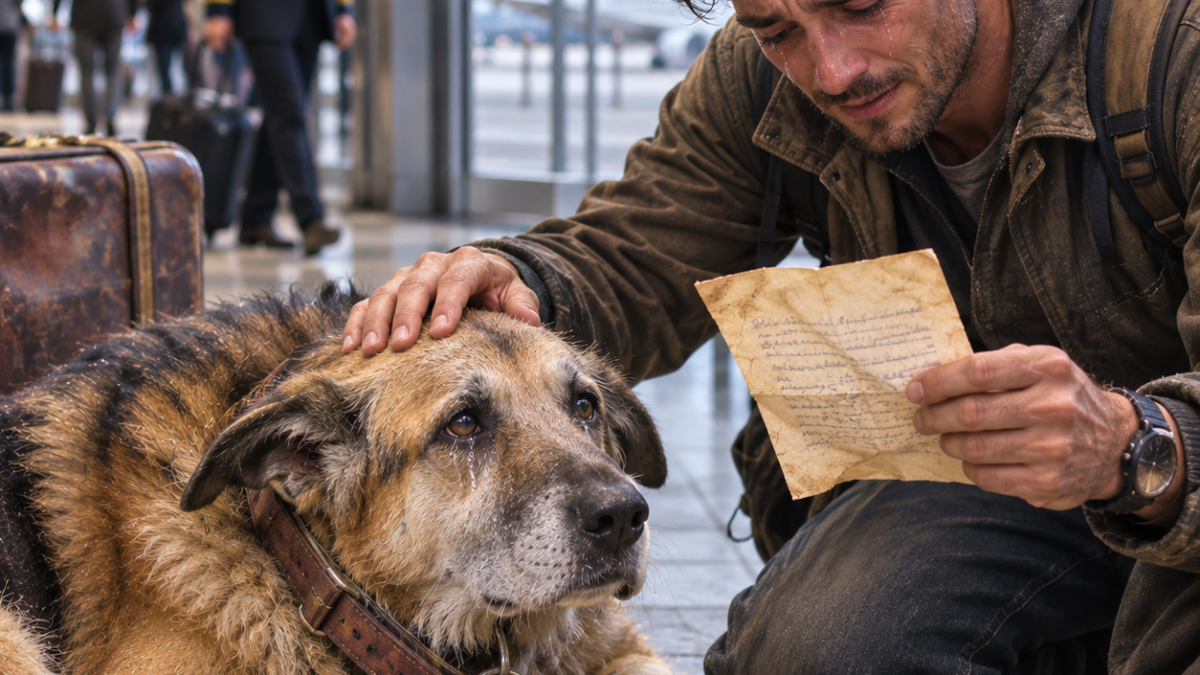
PART2
Marco,
If you are holding this letter, then Bruno was right and I was wrong.
His vision blurred.
He wiped his eyes.
Started again.
He never stopped believing you would come back.
For four years, almost every afternoon that I could manage it, we came to the airport and sat on the bench near arrivals. At first I thought it was ridiculous. Then it became our routine. Every time a plane landed, Bruno stood up. Every time the doors opened, he watched. Every time someone came through who wasn’t you, he sat down again.
Marco pressed one hand over his mouth.
Samuel looked away.
I used to tell him, “Not today, old man. Maybe tomorrow.”
Eventually I realized I was saying it to myself too.
Marco could barely continue.
I got sick last winter.
The pavement seemed to move beneath him.
At first we thought treatment might give us more time. It didn’t.
I’m at St. Catherine’s Hospital. Room 418.
The doctors have stopped talking about months.
Marco gasped.
“No.”
Bruno lifted his head.
I asked Samuel to bring Bruno here when flights from your last project started coming in. I don’t know the exact day you’re returning because you stopped answering long enough for pride to become a language between us. Maybe that was partly my fault too.
But I know your contract ended this week.
So I asked one last favor.
Let him wait.
He’s better at it than I am.
Marco’s tears fell onto the paper.
The final lines were uneven.
If you can forgive me for the things I said before you left, come.
If you cannot, come anyway.
You can be angry beside my bed.
Just don’t make me die wondering whether you ever came home.
Elena
Room 418.
Dated three days earlier.
Marco looked at Samuel.
“How long?”
“I don’t know.”
“How long has she—”
“Sir.”
Samuel stepped closer.
“She asked us not to tell you anything if you appeared.”
“What?”
“She said the letter had to come from her.”
Marco stood too quickly and nearly fell.
Bruno steadied himself beside him.
“My bag.”
“I’ll get it.”
“My dog.”
“Take him.”
“Is he allowed in the hospital?”
Samuel looked at Bruno.
“Something tells me they’ll figure it out.”
Marco laughed once through the tears.
Then grabbed his bag and ran.
Bruno tried to follow.
His back legs faltered.
Marco stopped immediately.
The dog stood there breathing hard.
Old.
So old.
Marco went back and lifted him.
Bruno had once weighed nearly seventy pounds.
Now he felt impossibly light.
“I’ve got you.”
Bruno rested his head over Marco’s shoulder.
This time Marco understood the roles had reversed.
Four years ago, Bruno had tried to follow him through the airport doors.
Marco had told Elena:
“Hold him.”
Now Marco carried him out.
A taxi driver took one look at the crying man and elderly dog and opened the back door without asking questions.
“St. Catherine’s.”
The driver nodded.
“How fast?”
“Please.”
That was enough.
During the ride, Marco held Bruno on the seat beside him.
The city passed outside.
Some buildings were new.
The old bakery near Fifth Street was gone.
The gas station where he and Elena used to buy terrible coffee was now a pharmacy.
Four years.
He had always imagined home would wait unchanged.
That was another arrogance.
Nothing waits unchanged.
Only people pretend they can.
Marco looked at Bruno.
“How many times did you come here?”
Bruno’s eyes were half closed.
“Every day?”
The dog breathed against his leg.
Marco remembered the last morning at home.
Elena standing beside the car.
Bruno circling his suitcase.
The argument from the night before still hanging between them.
“You’re running away,” Elena had said.
“I’m fixing what I broke.”
“You think money fixes everything.”
“You think staying here unemployed fixes anything?”
“I think marriage means you don’t disappear when you’re ashamed.”
“I am not disappearing.”
“You bought a one-way ticket.”
“My contract pays triple.”
“And when do you come back?”
“When we’re okay.”
Elena had stared at him.
“Marco, that is not a date.”
He left anyway.
Eight months, he told himself.
Before he got into the taxi that morning, Elena had said:
“If you leave angry, you’ll find a reason to stay angry.”
He answered:
“And if I stay, you’ll keep reminding me I failed.”
Bruno whined from beside her.
Elena gripped the dog’s collar.
“Go, then.”
Marco did.
He had replayed that moment for four years.
But memory is dishonest.
It keeps the words that protect you.
He had remembered Elena saying go.
He had conveniently forgotten how she cried after she said it.
The taxi stopped.
St. Catherine’s.
Marco paid without checking the amount.
He lifted Bruno again.
Inside, the receptionist saw the dog.
“Sir, animals normally—”
“Room 418.”
Something in his face stopped her.
She looked at the computer.
Then at Bruno.
Her expression softened.
“You’re Marco.”
He froze.
“Yes.”
She swallowed.
“Fourth floor.”
“Can he—”
“Go.”
The elevator took forever.
Marco stared at the numbers.
Doors opened.
A nurse approached before he even asked.
“Mr. Bellini?”
“Yes.”
“I’m Rachel.”
“How is she?”
Rachel’s eyes changed.
“We should talk before you go in.”
“No.”
“Mr. Bellini—”
“No.”
His voice cracked.
“I have spent four years talking before going in.”
He looked at Room 418.
“I’m going in.”
Rachel nodded.
“Okay.”
Marco reached the door.
His hand froze on the handle.
Bruno, standing beside him now, pushed his nose against the gap.
The door opened slightly.
The dog slipped inside.
Marco heard a woman gasp.
Then a weak voice.
“Oh.”
Silence.
Then:
“You found him.”
Marco could not move.
Bruno made a small sound.
Not a bark.
A cry.
The kind of sound dogs make when happiness hurts.
Marco pushed the door open.
Elena lay against white pillows.
For one terrible second, he did not recognize her.
She had always been small.
Now she seemed made of angles.
Cheekbones.
Wrists.
Collarbone.
Her dark hair had been cut short.
A nasal oxygen cannula rested beneath her nose.
The woman he loved had become fragile while he was somewhere else.
But her eyes—
Her eyes were unchanged.
Brown.
Sharp.
Alive.
Bruno placed his front paws against the bed.
A nurse moved to stop him.
Elena lifted one thin hand.
“Don’t.”
Bruno struggled.
Marco helped him onto the mattress.
The old dog immediately curled against Elena’s legs.
She buried her hand in his fur.
Then looked at Marco.
Neither spoke.
Four years became too large for language.
Marco walked toward the bed.
Stopped.
“Elena.”
She smiled.
Barely.
“You got old.”
He laughed and sobbed at the same time.
“So did you.”
“Rude.”
“Sorry.”
“You always were.”
The room blurred.
Marco sat on the edge of the chair.
Not the bed.
He did not know whether he still had the right.
Elena noticed.
“You can come closer.”
He moved the chair.
Still not enough.
She sighed.
“Marco.”
“What?”
“I’m dying.”
His face collapsed.
“Don’t waste the little time we have being polite.”
He sat on the bed.
Elena reached for his hand.
The moment their fingers touched, Marco bent forward and began crying.
Not quietly.
Not dignified.
His forehead fell against her hand.
“I’m sorry.”
Elena closed her eyes.
“I know.”
“I should have come home.”
“Yes.”
“I should have answered.”
“Yes.”
“I was ashamed.”
“I know.”
“I kept thinking one more job.”
“I know.”
“I thought if I came back with enough money—”
“Marco.”
He looked up.
“You didn’t owe me money.”
She swallowed.
“You owed me yourself.”
That hurt because it was true.
“I know.”
“No.”
Her voice was gentle.
“You know now.”
Bruno shifted between them.
Elena rubbed his ear.
“He knew before either of us.”
Marco looked at the dog.
“How long did you take him to the airport?”
Elena smiled.
“At first?”
“Yes.”
“Every Sunday.”
Marco breathed.
“Then he learned the route.”
“What?”
“If I drove past the airport road, he’d start whining.”
Her smile became sad.
“So eventually we went more.”
“How much more?”
“Most days.”
“For four years?”
“When I was healthy.”
Marco covered his face.
“Elena.”
“What?”
“You spent four years sitting at an airport waiting for a man who couldn’t answer a phone.”
“No.”
He looked at her.
“I spent maybe an hour a day sitting beside a dog who refused to believe you were gone.”
She smiled faintly.
“There’s a difference.”
“Why?”
“Because the rest of the day, I lived.”
Marco lowered his hands.
She continued.
“I worked.”
“I gardened.”
“I yelled at the neighbor’s cat.”
“Bruno got fat.”
Bruno’s tail moved.
Elena laughed softly.
“I didn’t spend four years standing at a window in a black dress.”
“I know.”
“I was angry with you.”
“I know.”
“I loved you too.”
Marco stared at her.
Both things could exist.
That was harder to accept than forgiveness.
The doctor came at 8:40.
Dr. Patel.
He asked whether Elena wanted Marco present.
“Yes.”
The doctor sat.
Marco hated that immediately.
Doctors sit when the news does not improve.
“Elena’s cancer has progressed despite treatment.”
Marco looked at Elena.
“What cancer?”
Her eyes lowered.
“Ovarian.”
“When?”
“Eight months ago.”
Marco could not process the number.
“Why didn’t you tell me?”
She stared at him.
“I tried once.”
“When?”
“February.”
Marco remembered.
A voicemail.
Call me when you can. It’s important.
He had been at a project site during a contract dispute.
He texted:
Can’t talk today. Everything’s exploding. Tomorrow?
Tomorrow became four days.
Then Elena replied:
Never mind. Handle your work.
He had let it go.
Marco’s chest tightened.
“Elena.”
She looked away.
“I was angry.”
“You were sick.”
“I was both.”
Dr. Patel let the silence settle.
“She underwent surgery and chemotherapy.”
Marco whispered:
“Without me.”
Elena looked at him.
“With people who were here.”
He deserved that too.
“Rachel drove me.”
The nurse stood near the door.
“My neighbor June came.”
“Samuel helped with Bruno.”
Elena took a breath.
“I wasn’t alone.”
Marco nodded.
Tears ran silently down his face.
The doctor continued.
“The disease has progressed.”
“How long?”
Dr. Patel looked at Elena.
She answered.
“They told me maybe days.”
Marco stopped breathing.
“No.”
Elena squeezed his hand.
“No.”
He stood.
“Another hospital.”
“Marco.”
“Clinical trials.”
“Marco.”
“New York.”
“Sit down.”
“I have money.”
The sentence came out with such desperation that Elena almost laughed.
“I have money now.”
Her eyes filled.
“Sweetheart.”
“No.”
“I can pay.”
She touched his face.
“That’s still what you think you’re supposed to bring home.”
He broke.
Elena pulled him toward her.
Weakly.
He bent.
She pressed her forehead against his.
“You came.”
He closed his eyes.
“Too late.”
“No.”
“Four years too late.”
“Yes.”
The truth was brutal.
Then she whispered:
“But not too late for this.”
Marco stayed.
Seventy-three hours.
He counted them afterward even though nobody asked him to.
The first night, they talked until Elena could not keep her eyes open.
Bruno slept across her feet.
Marco remained in the chair.
At 2:11 a.m., Elena woke.
“You’re still here.”
“Where would I go?”
She looked at him.
“Anywhere.”
He understood.
That had always been the danger.
“I’m not leaving.”
She stared a long time.
Then nodded.
At dawn, Elena asked him to open the blinds.
Sunlight filled the room.
For a few minutes she looked stronger.
Almost like the woman who used to drink coffee barefoot on their back steps.
“Tell me where you were.”
Marco frowned.
“What?”
“For four years.”
“You don’t want to hear that.”
“I do.”
So he told her.
Lima.
Quito.
A reconstruction contract outside Cartagena.
Flood damage.
Bridges.
Hospitals.
Hotels where the air conditioner rattled all night.
The old man who sold coffee outside a project gate.
The time Marco broke his wrist and never told her.
Elena became angry.
“You broke your wrist?”
“Two years ago.”
“And you didn’t tell me?”
“You had stopped telling me things.”
“So we became idiots together.”
“Yes.”
She smiled.
“Good.”
“What?”
“I didn’t want to die thinking you became smart.”
He laughed.
So did she.
Bruno opened one eye.
They laughed harder.
For ten minutes, they were married again.
Not estranged.
Not dying.
Just Marco and Elena irritating a dog.
Then Elena began coughing.
The laughter ended.
Marco held the cup while she drank.
Reality returned.
The second afternoon, June came.
Their neighbor.
Seventy-two.
Tiny woman with enormous sunglasses.
She entered.
Saw Marco.
Slapped him.
Hard.
Everyone froze.
Marco touched his cheek.
“Fair.”
June began crying.
Then hugged him.
“Idiot.”
“Yes.”
“She waited for you.”
“I know.”
“No, you don’t.”
June stepped back.
“She’d sit on that stupid airport bench in winter wearing two coats because Bruno wouldn’t leave.”
Elena protested.
“June.”
“No.”
She pointed at Marco.
“You should hear this.”
Marco nodded.
“Tell me.”
June cried harder.
“When chemo started, she stopped driving.”
Marco looked at Elena.
“She still wanted Bruno taken.”
Samuel did it.
Then another airport employee.
Then June.
The dog would sit at the arrivals fence for an hour.
Sometimes two.
Every landing made him stand.
Marco looked down at Bruno.
The old dog slept.
“How many times?”
June wiped her eyes.
“Hundreds.”
Marco could not speak.
That evening, he asked Elena:
“Why didn’t you divorce me?”
She looked toward the window.
“I almost did.”
“Why didn’t you?”
“Because paperwork felt too final.”
“That’s not a reason.”
“It was then.”
Silence.
Then she smiled.
“And I wanted the health insurance.”
Marco laughed unexpectedly.
“Seriously?”
“Partly.”
“Thank God.”
She turned back.
“Marco.”
“Yes?”
“I didn’t wait because I thought we’d become who we were.”
He listened.
“We couldn’t.”
“I know.”
“I waited because I did not want the last thing between us to be that morning.”
He swallowed.
“I don’t either.”
“I was cruel too.”
“No.”
“Yes.”
“Elena—”
“I used your shame against you.”
“You were angry.”
“So were you.”
She held his gaze.
“Love does not make only one person responsible for every wound.”
Marco shook his head.
“I left.”
“Yes.”
“For four years.”
“Yes.”
“You don’t have to make it equal.”
She smiled sadly.
“It isn’t equal.”
That was Elena.
Even dying, she would not lie just to soothe him.
“But forgiveness isn’t mathematics.”
Marco cried silently.
She continued.
“I forgive you.”
He covered his face.
“I don’t.”
“What?”
“Myself.”
“That part will take longer.”
“How much longer?”
Elena looked at Bruno.
“Ask him.”
The third day was worse.
Elena slept more.
Morphine made her words slower.
Her breathing changed.
Dr. Patel warned Marco privately that time was narrowing.
Marco hated the phrase.
As if time were a hallway whose walls moved inward.
At 4:00 p.m., Elena asked for Bruno beside her head.
Marco lifted him carefully.
The dog settled against her shoulder.
She stroked the white muzzle.
“You’re tired, old man.”
Bruno licked her wrist.
Elena cried.
It was the first time Marco had seen her cry since he arrived.
“Hey.”
She shook her head.
“I’m scared.”
Marco’s chest broke.
Not because she was dying.
Because Elena had always been the person who told other people not to be afraid.
He moved onto the bed.
“I’m here.”
“What happens to him?”
“Bruno?”
She nodded.
“I take him.”
“Promise.”
“I promise.”
“Not to some apartment.”
“No.”
“Home.”
“Yes.”
“Our house.”
Marco froze.
He had assumed she sold it.
She noticed.
“You thought I left?”
“I didn’t know.”
“I kept it.”
“How?”
“Your transfers.”
The money he had sent every month.
The thing he thought justified his absence.
She had used it to pay the mortgage.
Marco started crying again.
“Elena.”
“Don’t.”
“I thought I was helping.”
“You were.”
She looked around the hospital room.
“You just thought money was the whole job.”
He nodded.
She stroked Bruno.
“He already lost you once.”
Marco leaned closer.
“Don’t let him lose both of us.”
“I won’t.”
“Promise.”
“I swear.”
“And Marco?”
“Yes?”
“Don’t take him to the airport every day.”
Marco laughed through tears.
“Okay.”
“He’ll make you crazy.”
“Okay.”
“Maybe sometimes.”
“Sometimes.”
Her eyes closed.
“Sit on the bench.”
“I will.”
“Tell him I’m coming.”
Marco could not answer.
Elena opened her eyes.
“No.”
She corrected herself.
“Don’t do that.”
“What?”
“Don’t teach him to wait for someone who can’t come.”
Marco stared.
Elena’s voice weakened.
“Teach him that home can change and still be home.”
That was the last full sentence she spoke.
Night came.
June left.
Rachel dimmed the lights.
Marco remained beside the bed.
Bruno slept between them.
At 1:17 a.m., Elena whispered:
“Marco?”
“Yes.”
“Read to me.”
“What?”
“The letters.”
He frowned.
“What letters?”
“Home.”
She was confused.
“Drawer.”
Then her eyes closed.
Marco did not understand.
He held her hand.
At 4:52, her breathing became shallow.
Rachel came in.
Then Dr. Patel.
Nobody rushed.
That frightened Marco more than rushing would have.
He sat beside Elena.
“Hey.”
Her eyes opened once.
Marco leaned close.
“I’m home.”
A tear moved from the corner of Elena’s eye toward her temple.
Her fingers tightened around his.
Barely.
Bruno lifted his head.
At 5:06 a.m., Elena stopped breathing.
Marco knew before the monitor told anyone.
Bruno knew too.
The dog stood.
Pressed his nose against Elena’s hand.
Waited.
Licked her fingers.
Waited again.
Then made that same small sound he had made at the airport.
Only this time, there was no joy inside it.
Marco bent over Elena’s body.
He did not scream.
There was nothing in him large enough for screaming.
He kissed her forehead.
“I’m sorry.”
Then:
“Thank you.”
Bruno lay down against her hip.
The nurses gave them time.
Eventually Rachel entered.
“Marco.”
He nodded.
“We need to—”
“I know.”
He lifted Bruno.
The old dog fought him.
Not violently.
Just enough to make it clear he did not want to leave.
“Come on.”
Bruno stretched toward the bed.
“I promised her.”
The dog whined.
“I promised.”
Marco carried him out.
That was harder than carrying him into the hospital.
Outside, morning sunlight filled the parking lot.
People entered carrying coffee.
A delivery truck backed toward the loading dock.
Someone laughed near the entrance.
The world continued.
Marco hated everyone for it.
Then hated himself for hating them.
He placed Bruno in the back of June’s car.
June drove them home.
The house stood exactly where Marco remembered.
Pale blue siding.
White porch.
Hydrangeas along the fence.
Elena had planted more.
He stopped on the walkway.
Bruno went ahead.
Waited at the front door.
Marco could not move.
June placed the key in his hand.
“She kept your key too.”
He looked at her.
“Why?”
June shook her head.
“I stopped asking why Elena did things years ago.”
Marco unlocked the door.
Bruno entered.
The smell hit him.
Elena.
Coffee.
Old wood.
Lavender laundry detergent.
Bruno walked from room to room.
Kitchen.
Living room.
Hall.
Bedroom.
Then returned to the front door.
Sat.
Waited.
“No.”
Marco crouched.
“She’s not coming through there.”
Bruno stared at the door.
Marco’s voice broke.
“She’s not.”
The dog remained.
Marco sat beside him on the floor.
For almost two hours, neither moved.
Eventually Bruno rested his head on Marco’s thigh.
That was their first night home.
Not the reunion Marco imagined.
Just two abandoned creatures sitting beside a door neither of them could make open.
The letters were in Elena’s nightstand.
Second drawer.
Three bundles tied with string.
One labeled:
YEAR ONE
Another:
YEAR TWO
Another:
YEAR THREE / FOUR
There were more than two hundred.
Some only a paragraph.
Some pages.
None mailed.
Marco opened the first.
Dear Marco,
Bruno dragged me to the airport again. You owe me a new shoulder.
He laughed and cried.
Another:
A man came through arrivals wearing the same green jacket you used to wear. Bruno ran toward him so fast I nearly fell. The poor man looked terrified. I apologized. Bruno did not.
Another:
I hate you today. I want that written somewhere honest.
Marco stared.
I love you too. Both things are true. I wish they weren’t.
Year two.
Your transfer came. The mortgage is paid. Thank you. I would rather have heard your voice.
Another:
Bruno has started sitting before the planes land. I think he recognizes the change in the sound. Or maybe I have become the crazy woman assigning meaning to everything he does.
Another:
June says I should stop coming here. She’s right. We’ll be back tomorrow.
Year three.
Today I imagined what I would say if you walked through those doors. I had a speech. Very angry. Very impressive. Then I realized I would probably just cry.
Then the diagnosis.
The handwriting changed.
They found something. More tests Friday. I almost called you. I didn’t. I am still deciding whether that was strength or pride.
Marco covered his mouth.
Next:
Cancer. There. I wrote it. I hate the word.
Then:
I called. You were busy. That’s not fair—I know you didn’t know why I was calling. But I was so angry I could not call again. Maybe tomorrow.
There was no tomorrow.
Not for the call.
Marco read until sunrise.
On the final bundle, an envelope had his name in large letters.
He opened it.
Marco,
If I’m gone when you finally read these, please don’t turn my waiting into a punishment for yourself.
He stopped.
Continued.
I went to the airport because Bruno loved you.
Then I realized I still loved you too.
That does not mean what you did was okay.
It means life is irritatingly capable of holding love and anger in the same hand.
Marco smiled through tears.
I hope you come back before I die.
But if you don’t, live anyway.
Do not make a shrine out of guilt.
Do not sit on that airport bench for four years because you think symmetry is justice.
I waited because waiting was my choice.
You are allowed to choose something else.
Take care of Bruno.
Take care of yourself.
And if there is any part of you that still believes home is a place you must earn your way back into, please finally let that stupid idea die with me.
Home was never your success.
It was never your money.
It was us.
Elena
Marco folded the letter.
Then unfolded it.
Then pressed it against his chest.
Bruno slept at his feet.
For the first month, the dog woke every afternoon at 4:10.
He would walk to the front door.
Sit.
Wait.
Marco eventually learned why.
That was when Elena used to take him to the airport.
The first time, Marco said:
“No.”
Bruno remained.
The second day, same.
The third.
Finally, Marco put on his shoes.
“Okay.”
Bruno’s tail moved.
They drove to the airport.
Samuel saw them.
His face fell when Marco got out alone.
“Her?”
Marco shook his head.
Samuel closed his eyes.
“I’m sorry.”
Bruno walked slowly toward the bench.
The same bench from Elena’s letters.
He climbed onto the concrete pad.
Sat.
Looked toward arrivals.
Marco sat beside him.
One plane landed.
Passengers emerged.
Bruno stood.
Watched.
Nobody.
He sat.
Marco touched his back.
“She’s not coming.”
Bruno looked at him.
Marco cried.
“I know.”
They stayed twenty minutes.
Then Marco stood.
“Home.”
Bruno hesitated.
Marco waited.
Finally, the dog followed.
That became their compromise.
Not daily.
Once a week.
Sunday afternoons.
They sat on Elena’s bench.
Marco sometimes read one of her letters aloud.
Samuel brought coffee.
Airport employees stopped to pet Bruno.
Many knew him.
Marco began hearing stories Elena had never written.
“She brought muffins at Christmas.”
“She knew everybody’s birthdays.”
“She cried the first year every time the international flight landed.”
“By year three she stopped crying.”
One baggage handler said:
“She always told us you were coming back.”
Marco looked toward the runway.
“She had more faith than I deserved.”
The man shook his head.
“Maybe faith isn’t about deserving.”
Six months passed.
Bruno grew weaker.
He stopped eating everything except chicken.
His hind legs trembled.
Marco built a small ramp to the porch.
The veterinarian diagnosed advanced kidney disease and heart problems.
“How long?”
Dr. Evans sighed.
“Weeks, maybe a few months.”
Marco laughed bitterly.
“Everybody I love keeps giving me timelines.”
The veterinarian did not know what to say.
Marco apologized.
“No. I’m sorry.”
He rubbed Bruno’s head.
“What do I do?”
“Keep him comfortable.”
That phrase again.
Comfortable.
A word people use when fixing is no longer available.
Marco became good at comfort.
Medication.
Warm blankets.
Short walks.
Chicken.
Sitting on the floor.
One Sunday, Bruno could not climb into the car.
Marco lifted him.
The dog rested against his chest.
Airport.
Bench.
They sat.
A plane landed.
Bruno did not stand.
Marco noticed.
His throat tightened.
“Not today?”
Bruno remained with his head on Marco’s shoe.
Marco took Elena’s final letter from his pocket.
He read aloud.
When he reached:
Do not teach him to wait for someone who can’t come.
Marco stopped.
Bruno looked up.
Marco folded the letter.
“You heard her.”
The dog’s ears moved.
“She said no more.”
Marco leaned down.
“No more waiting.”
He kissed Bruno’s head.
“We’re going home.”
For the first time, Bruno did not look back at arrivals when they left.
Two nights later, he could not stand.
Marco called Dr. Evans.
The veterinarian came to the house.
Marco spread Elena’s old blue blanket in the living room.
Bruno lay on it.
His breathing was labored.
Marco sat beside him.
“You know, she told me you’d make me crazy.”
The tail moved faintly.
“You did.”
Marco cried.
“You waited four years.”
Bruno blinked slowly.
“I don’t know why.”
Marco stroked the white muzzle.
“She was right.”
His voice broke.
“I’m not asking you to wait anymore.”
Dr. Evans knelt nearby.
“Whenever you’re ready.”
Marco was not ready.
Nobody is.
He placed Elena’s old sweater beneath Bruno’s head.
The dog inhaled.
Perhaps he recognized the scent.
His eyes softened.
Marco pressed his forehead against Bruno’s.
“Go find her.”
Then immediately shook his head.
“No.”
Tears fell.
“Elena would yell at me for saying that.”
Dr. Evans smiled sadly.
Marco laughed through sobs.
“She said not to teach you to wait.”
He kissed Bruno.
“So don’t wait.”
His voice disappeared.
“Just rest.”
The medication went in.
Bruno relaxed.
Marco kept one hand over his chest.
The heartbeat slowed.
Then stopped.
His tail moved once.
Maybe reflex.
Maybe not.
Marco chose not to ask.
He sat on the floor long after Dr. Evans left.
Elena’s sweater.
Bruno’s collar.
Silence.
Seven months earlier he had believed coming home would end his loneliness.
Instead, home had given him two funerals.
At Bruno’s cremation, Marco requested the faded red collar back.
He placed it beside Elena’s letters.
For several weeks, he barely functioned.
He repaired things that did not need repairing.
Painted the garage.
Replaced porch boards.
Cleaned gutters twice.
Movement filled hours.
Nothing filled the house.
Then a recruiter called.
Overseas contract.
Eighteen months.
Excellent salary.
Marco almost laughed.
The universe had terrible taste.
He said yes.
At least at first.
He packed.
One bag.
Same as before.
On departure morning, the taxi stopped at the airport.
Marco entered.
Boarding pass in hand.
Then saw the bench.
He stopped.
Walked toward it.
Sat.
No Elena.
No Bruno.
Just Marco.
Passengers moved around him.
Announcements echoed.
His flight began boarding.
He looked at the ticket.
Then at Elena’s last letter on his phone.
Do not make a shrine out of guilt.
He could leave.
She had told him to live.
Leaving was not automatically running.
But Marco asked himself one question.
Why did he want to go?
Money?
No.
Adventure?
No.
Work?
Not really.
He wanted a place where nobody knew the empty rooms waiting behind his front door.
That was running.
Again.
The final boarding call came.
Marco tore the paper boarding pass in half.
Then laughed because the ticket was digital anyway.
“Dramatic idiot.”
Elena would have said that.
He opened the airline app.
Cancelled.
Then sat another ten minutes.
At home, he unpacked.
The next week, he accepted a local engineering position for less money.
Much less.
Enough.
He started restoring the backyard Elena had neglected during treatment.
He killed three rose bushes.
June insulted him.
He planted more.
One survived.
A year after Elena’s death, Marco went to the county shelter.
Not to adopt.
He told himself that repeatedly.
He donated Bruno’s unopened food.
Blankets.
Medication supplies the vet could redistribute legally.
Then he heard barking.
Rows of dogs.
Young.
Old.
Afraid.
Hopeful.
Marco walked until he reached an elderly black dog lying in the back of a kennel.
Card:
MABEL — 11 YEARS OLD — OWNER DECEASED
Marco stopped.
“No.”
Mabel looked up.
“Absolutely not.”
She stood.
Walked toward the gate.
“You’re not doing this.”
Her tail moved once.
Marco started crying.
A volunteer approached.
“Would you like to meet her?”
“No.”
The volunteer waited.
Marco wiped his face.
“Yes.”
They sat in the visiting room.
Mabel did not jump.
She simply walked over.
Placed her chin on Marco’s knee.
Marco laughed.
“Elena, this is not funny.”
Mabel looked up.
He stroked her head.
He did not believe Elena had sent the dog.
He did not believe Bruno arranged it.
Grief had not turned him into someone who needed magic.
He believed something simpler.
A lonely man had entered a room.
A lonely dog had noticed.
Once before, that had been enough to change a life.
Marco adopted her.
Mabel never replaced Bruno.
Nobody should ask one love to become another.
She had different habits.
She hated cars.
Loved thunder.
Snored like construction machinery.
And when Marco took her to the airport bench for the first time, she showed absolutely no interest in airplanes.
Marco laughed until he cried.
“Good girl.”
She looked at him.
“No waiting.”
He scratched her ears.
“None.”
The airport eventually installed a small plaque on the bench after Samuel and several employees asked permission.
Marco insisted the wording remain simple.
ELENA BELLINI & BRUNO
THEY WAITED HERE TOGETHER.
Nothing about perfect love.
Nothing about miracles.
Nothing about forever.
Because Marco had learned forever is too easy to promise and impossible to measure.
Four years was measurable.
Seventy-three hours was measurable.
One weekly airport visit.
One hand held at 5:06 in the morning.
One old dog’s final heartbeat beneath his palm.
Those were real.
On the fifth anniversary of Marco’s return, he sat on the bench with Mabel asleep at his feet.
A plane touched down.
Passengers came through.
A little boy noticed the plaque.
“Who were Elena and Bruno?”
His mother tried to pull him away.
“Sweetheart, don’t bother the man.”
“It’s okay.”
Marco smiled.
The boy pointed.
“Did they work here?”
“No.”
“Then why do they have a bench?”
Marco looked toward the runway.
How could he explain four years to a child?
“They were waiting for somebody.”
“Who?”
“Me.”
The boy’s eyes widened.
“Were you lost?”
Marco almost answered no.
Then stopped.
“Yes.”
The boy considered this.
“Did they find you?”
Marco looked at the plaque.
Then at Mabel.
Then at the city beyond the airport.
“Yes.”
The child smiled.
“Good.”
His mother apologized again and led him away.
Marco remained.
Were you lost?
He had spent years believing he had left because he failed financially.
Then years believing he stayed away because he needed to succeed before returning.
Elena had understood before he did.
He was ashamed.
And shame had convinced him distance was responsibility.
It wasn’t.
He could not recover the four years.
That truth never softened.
There would always be mornings when he woke and thought:
I could have been there.
Birthdays.
Christmases.
Elena’s diagnosis.
Her first chemotherapy session.
Nights she drove home alone.
Bruno standing at arrivals.
Love did not erase those absences.
Forgiveness did not erase them.
Life did not become fair because Marco finally learned the lesson.
That was what made the ending real.
Elena died.
Bruno died.
Time remained spent.
No miracle returned any of it.
But guilt was not the same as love.
Elena had taught him that too.
If Marco spent the rest of his life punishing himself, he would transform Elena’s forgiveness into another thing he refused to accept.
So he lived.
Not beautifully every day.
Some days poorly.
Some days he stayed in bed until noon.
Some anniversaries he cried while making coffee.
Some mornings he still reached toward the empty side of the bed.
But he lived.
He worked.
He planted roses badly.
He walked Mabel.
He visited June.
He answered the phone when people he loved called.
That last one became almost sacred.
If Marco’s phone rang during dinner, he answered.
During meetings, if it was family, he stepped outside.
Friends teased him.
He never explained.
Once you lose a person after repeatedly believing there will be another call, ringing phones sound different forever.
Years later, June died.
Marco sat beside her daughter at the funeral.
Samuel retired.
The airport changed terminals.
The observation fence moved.
But the bench remained.
Marco grew older.
Mabel died at fifteen.
Another loss.
Another goodbye.
He did not adopt immediately.
Then eventually he fostered senior dogs through the shelter.
One at a time.
Dogs nobody wanted because people feared loving something with too little time left.
Marco understood that fear.
He also understood its mistake.
Short love is not wasted love.
Seventy-three hours had taught him that.
Four years of Bruno waiting had taught him something else.
Love cannot control time.
It can only decide what to do while time is still available.
On what would have been Elena’s seventieth birthday, Marco brought her letters to the bench.
Not all of them.
Copies.
He had decided to donate the originals to a small family archive his niece maintained.
He read the first letter.
Then the last.
When he finished, he looked up.
Late-afternoon sunlight turned the runway gold.
Almost exactly like the evening he returned.
For one second, he could see it.
A twelve-year-old dog.
Red collar.
White muzzle.
Standing.
Waiting.
Not literally.
Memory.
That was enough.
Marco closed his eyes.
“I’m sorry it took me so long.”
Wind moved through the trees beyond the fence.
He smiled.
“I know.”
No voice answered.
He did not need one.
He had spent too many years thinking love required signs.
Money.
Success.
Grand returns.
Miracles.
It did not.
Sometimes love was a woman sitting on an airport bench even while she was angry.
Sometimes it was an old dog standing every time a plane landed.
Sometimes it was a letter telling a man to come even if he was still too proud to ask forgiveness.
Sometimes it was a dying woman refusing to tell him that everything was okay when it wasn’t.
And sometimes love was leaving the bench.
Going home.
Answering the next phone call.
Feeding the next old dog.
Living the life the dead could no longer live.
Marco stood.
His knees were stiff now.
He touched the plaque.
ELENA BELLINI & BRUNO
THEY WAITED HERE TOGETHER.
“I’m going home.”
The words came naturally.
For years, Bruno had heard those words and followed.
This time nobody followed.
Marco walked anyway.
He reached the parking lot.
Stopped once.
Looked back.
The bench was empty.
For the first time, that did not look tragic.
It looked finished.
Not forgotten.
Finished.
The people he loved were no longer waiting for him there.
And finally, after all those years, Marco was no longer waiting for them either.
He carried them with him.
That had to be enough.
It was.
And somewhere inside the home he once thought he needed to earn back, in a wooden box beside Elena’s letters, an old faded red collar remained folded exactly as he had left it.
No dog inside it.
No miracle.
No promise that love prevents loss.
Only proof that once, for four long years, a faithful old animal had believed in a man longer than that man believed in himself.
And when Marco finally came home, Bruno had done the one thing he had spent all those years waiting to do.
He brought him back to Elena.
After that, he could finally rest.








