PART2:For Five Days, Rex Refused to Leave His Dead Partner’s Patrol Car — But When the Retired K9 Officer Finally Sat Beside Him, the German Shepherd Pulled Out Something That Made the Old Man Break Down in Tears
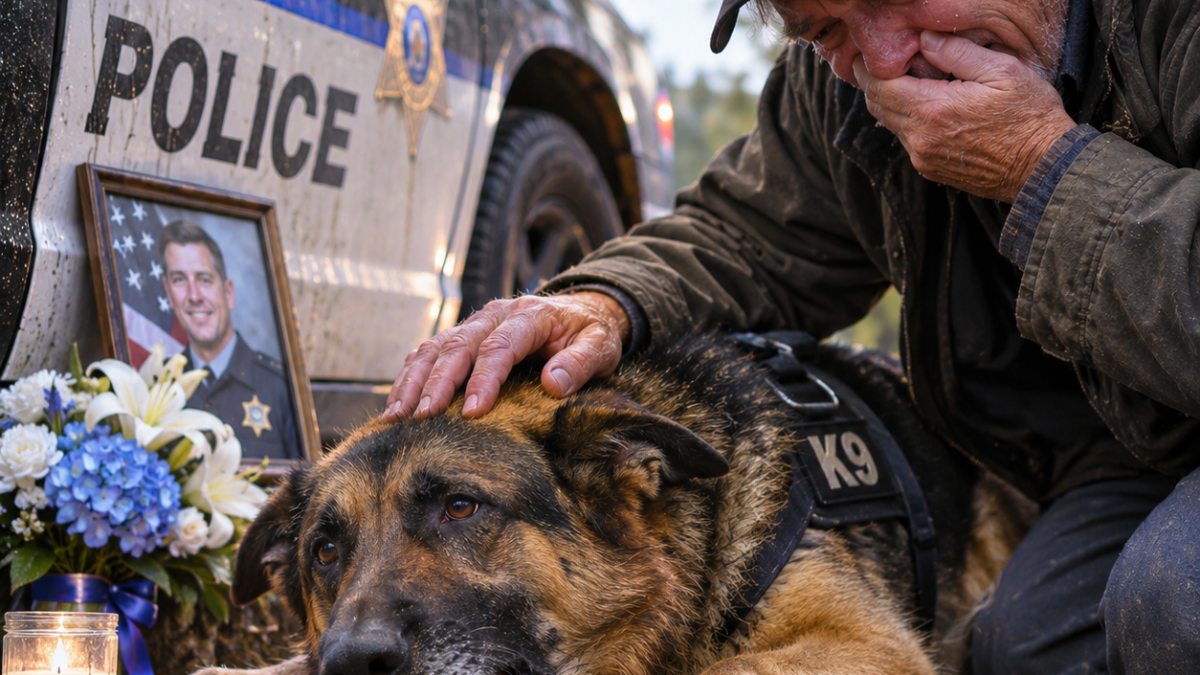
PART2
The next morning, I woke before the alarm.
That hadn’t happened in a long time.
Retirement had changed the rhythm of my days.
For thirty-four years, I’d lived according to shift schedules, radio calls, emergency responses, training sessions, and the unpredictable demands of police work.
After retiring, I imagined I would appreciate having nothing urgent to do.
For a while, I did.
I slept late.
Drank coffee on the porch.
Worked on the old farmhouse.
Walked the fields.
Then Margaret died, and time became something else entirely.
Empty hours.
Quiet rooms.
Meals eaten alone.
Sometimes I’d spend an entire afternoon repairing something that wasn’t broken simply because I couldn’t bear sitting in the house.
That morning, however, I had somewhere to go.
Someone was waiting.
Even if that someone didn’t yet know my name.
I made coffee, packed a thermos, and checked the weather.
Then I stood in the kitchen staring at the two empty spaces beside the back door.
One had belonged to Margaret’s gardening boots.
The other to Max’s dog bed.
I’d left both spaces unchanged for years.
People told me it was unhealthy.
Maybe it was.
But grief doesn’t always respond politely to advice.
I picked up my truck keys.
Then drove toward the police facility where Rex had remained beside Daniel Foster’s old cruiser.
As I approached the entrance, my stomach tightened.
I knew better than to expect a dramatic improvement overnight.
Rex had barely eaten.
He was exhausted.
His refusal to leave the vehicle was worrying, and his physical condition required continued veterinary attention.
But I hoped he would still be there.
And when I turned into the yard, I saw him.
Same patrol car.
Same rear wheel.
Same German Shepherd stretched along the pavement.
Only one thing had changed.
His head was raised.
And he was watching my truck.
I parked a short distance away and turned off the engine.
For several seconds, I watched Rex through the windshield.
He didn’t come running.
He didn’t bark.
But his eyes followed me when I opened the truck door.
I stepped onto the gravel.
“Morning, Rex.”
One ear moved.
I smiled faintly.
“Good to see you, too.”
Jackson was standing near the building with a paper cup of coffee.
He approached quietly.
“He’s been watching the driveway.”
I glanced at him.
“All morning?”
“Since I got here.”
I looked toward Rex.
“Maybe he recognizes the truck.”
Jackson’s face softened.
“I hope so.”
I noticed two bowls near the vehicle.
Food.
Water.
Both appeared almost full.
“Still not eating?”
Jackson shook his head.
“Not much. We’ve been working with the veterinary team, and we’re keeping a close eye on him.”
I nodded.
A dog refusing food or adequate water could deteriorate dangerously. I knew this wasn’t something patience alone could solve.
But veterinary care and emotional recovery weren’t opposing choices.
Rex needed both.
I asked Jackson to continue following the veterinarian’s instructions while I worked on helping him feel less threatened by unfamiliar people.
Then I walked toward the cruiser.
This time, I stopped about eight feet away.
Rex lifted his head a little higher.
I lowered myself to the pavement.
“Well, partner. Here we are again.”
He looked at me.
Then toward the driver’s door.
I followed his gaze.
The car had been cleaned and secured after Daniel’s death, but enough familiar scent might still remain for Rex to recognize it.
Dogs experience the world through smell in ways people can barely comprehend.
To Rex, the vehicle might carry countless reminders of Daniel.
His clothing.
His hands.
His equipment.
The particular mixture of scents from years of working together.
I couldn’t know what Rex expected when he watched the door.
But I understood why he kept returning.
It was familiar.
And after an enormous loss, familiar things can feel like the only solid ground remaining.
I sat with my legs stretched in front of me.
The pavement was cold.
My knees ached.
I didn’t move.
After a while, Jackson approached and quietly asked whether I needed anything.
“Tell me about Daniel,” I said.
Jackson looked surprised.
“Daniel?”
“Yeah. What kind of man was he?”
Jackson glanced toward Rex.
For a moment, he couldn’t speak.
Then he sat on the curb several feet behind me.
“He was good.”
I waited.
“Really good.”
His voice thickened.
“He wasn’t the loudest guy in the department. Didn’t brag. Didn’t talk much about himself.”
I smiled faintly.
“I knew a few like that.”
Jackson nodded.
“But when something went wrong, he was always the first person you wanted beside you.”
He looked toward the cruiser.
“He loved fishing.”
“That right?”
“Yeah. Grew up in Oklahoma. Always talked about going back and spending a week beside some lake with no radio calls.”
I glanced at Rex.
His ears moved at the sound of Jackson’s voice.
Jackson continued.
“Daniel used to say Rex was better company than most people.”
I laughed softly.
“Smart man.”
Jackson smiled through tears.
“They were inseparable.”
I looked toward the dog.
And for the first time, I began to understand something important.
Rex wasn’t the only one who needed the story of Daniel Foster to remain alive.
Jackson needed to talk about his friend.
The other officers needed to remember their colleague.
And perhaps, in our own imperfect human way, we needed to hear those memories aloud while sitting beside the animal who had shared so much of Daniel’s life.
So I began speaking.
Not commanding.
Not coaxing.
Just talking.
“Daniel liked fishing, huh?”
Rex glanced toward me.
“I knew a few officers like that. They’d work twelve hours and still get up before sunrise to stand in a river.”
His ears shifted.
I smiled.
“Your partner sounds like a good man, Rex.”
I paused.
“Jackson says he took good care of you.”
Rex remained still.
“Bet you two had some long nights together.”
His eyes rested on me.
“Bet he talked to you even when nobody else was around.”
I remembered doing exactly that with Max.
During night patrols, I’d tell him things I never said to another person.
Complaints about paperwork.
Worries about Margaret.
Stories from my childhood.
Max would sit beside me, looking out the windshield, occasionally shifting an ear at my voice.
He didn’t understand every word.
But he knew my tone.
And I knew I wasn’t alone.
I looked at Rex.
“Must be mighty quiet without him, buddy.”
For a long time, nothing happened.
Then Rex released a deep breath.
A long, trembling sigh.
His shoulders seemed to soften.
His head lowered.
And the very tip of his tail moved against the pavement.
Once.
Barely.
I stared.
Jackson leaned forward.
“Did you see that?”
I nodded.
“Yeah.”
“His tail moved.”
“I saw.”
Jackson covered his mouth.
Tears filled his eyes.
It was such a small thing.
An almost invisible movement.
But after days of watching Rex stare toward an empty car, it felt like a window opening in a room that had been dark too long.
I didn’t reach toward him.
I didn’t praise him loudly.
I simply remained where I was.
And after a while, Rex looked at me again.
This time, he held my gaze a little longer.
I stayed four hours that day.
When I left, Rex was still near Daniel’s car.
The food bowls remained mostly untouched.
He hadn’t stood to follow me.
But he watched me walk toward my truck.
I stopped beside the door.
“See you tomorrow, Rex.”
His ears lifted.
I raised one hand.
Then drove home.
The afternoon sunlight fell across the fields surrounding my farmhouse.
Normally, I would have turned on the radio.
That day, I drove in silence.
I kept thinking about Rex’s little tail movement.
Not because I believed it meant he had stopped grieving.
Because it reminded me that a living creature can still respond to kindness even when sadness seems to have taken over everything.
When I reached home, I made myself a sandwich.
Then sat at the kitchen table.
Across from me was Margaret’s old chair.
I still remembered the last time she sat there.
She had been tired.
Her hands trembled slightly as she lifted her tea.
She looked toward the window and said, “The roses need pruning.”
I laughed.
“Margaret, you’re supposed to be resting.”
She gave me that familiar look.
“William, the roses don’t care what the doctor said.”
I promised I’d prune them.
I did.
After she died, I kept tending them every spring.
Sometimes I thought it was because I loved roses.
Mostly, it was because she did.
I looked at the empty chair.
Then whispered, “There’s a dog who needs help, Maggie.”
The name caught in my throat.
I hadn’t called her Maggie aloud in weeks.
I swallowed.
“He’s lost his person.”
The house remained silent.
I looked toward Max’s old bed.
“And I think he understands something I never figured out.”
I sat there until my coffee turned cold.
Then I opened a cupboard and took out an old photograph.
Margaret stood in the backyard, laughing.
Max was beside her, his ears upright, his tongue hanging out.
I touched the edge of the frame.
“Maybe there’s still something useful this old man can do.”
On the third morning, Rex was lying beside the car when I arrived.
But he didn’t look away as I approached.
I stopped a little over five feet from him.
His ears rose.
He watched me lower myself to the ground.
“Morning.”
I pulled a folded blanket from under my arm.
It was dark blue, worn at the edges, with one corner stitched several times.
Max’s blanket.
For years, he’d slept on it beside my bed.
After he died, I’d washed and folded it carefully, then placed it in a cupboard.
I hadn’t been able to throw it away.
Now I spread it on the ground beside me.
Rex watched.
His nose moved.
He seemed interested in the unfamiliar scent.
“That belonged to a friend of mine,” I told him.
His ears shifted toward my voice.
“His name was Max.”
I sat beside the blanket.
“He worked with me a long time ago.”
Rex kept watching.
“Strong dog. Smart, too. Smarter than me most days.”
I smiled at the memory.
“Didn’t have much patience for fools.”
Jackson, listening from a distance, gave a small laugh.
I continued speaking softly.
“Max lost people he trusted, too. He knew what it was like when familiar faces stopped coming around.”
I paused.
“And when he got old, I sat with him through the difficult days.”
My throat tightened.
I looked down at the blanket.
“Sometimes that’s all anybody can do.”
Rex leaned his head forward slightly.
His nose moved again.
I didn’t bring the blanket closer.
I wanted him to decide whether to investigate it.
For several minutes, he simply watched.
Then his head lowered.
He remained beside the car.
But the tension in his body seemed a little less severe.
I took that as enough.
There was no reason to ask for more.
By the fifth day of my visits, Jackson reported that Rex had taken a little water overnight.
Not enough to end our concerns.
Not enough to pretend the medical risk was over.
But enough to encourage us while veterinary guidance continued.
I sat on the blanket that morning.
Rex was lying near the cruiser.
For the first time, his front legs were stretched comfortably rather than tucked rigidly beneath him.
Jackson joined me after a while.
“He’s letting you closer.”
I nodded.
“He’s getting used to me.”
Jackson looked toward Rex.
“Do you think he trusts you?”
I considered the question.
“Not the way he trusted Daniel.”
Jackson nodded sadly.
“Of course.”
“But I think he’s beginning to learn I’m not here to take something from him.”
We sat quietly.
Then Jackson said, “Everybody keeps asking why we can’t just put him in another vehicle and take him somewhere.”
I looked toward the dog.
“Sometimes people want pain to end because watching it makes them uncomfortable.”
Jackson stared at his hands.
“That’s what it feels like.”
I continued.
“Rex is a working dog. His entire life has been built around routines, commands, and cooperation with his handler.”
I watched the animal beside the wheel.
“Now those routines have been shattered.”
Jackson nodded.
“And he’s confused.”
“Probably. We can’t know exactly what he understands about Daniel’s death.”
I paused.
“But we can recognize that his behavior changed dramatically after losing someone he depended on.”
Jackson looked at the car.
“I keep thinking Daniel would know what to do.”
The words broke something open.
I turned toward him.
Jackson’s eyes filled.
“He always knew.”
I didn’t answer.
He swallowed.
“I was the younger guy. The one who asked stupid questions.”
I smiled gently.
“Every good officer asks questions.”
He shook his head.
“Daniel never made me feel stupid.”
His voice cracked.
“He’d just say, ‘Come on, Miller. I’ll show you.'”
A tear slipped down his cheek.
I looked away to give him a moment.
Then he whispered, “Now I don’t know what I’m doing.”
I reached over and rested a hand on his shoulder.
“You’re trying to help his dog.”
Jackson nodded.
“That’s not nothing.”
He covered his face.
And there we sat.
An old retired officer.
A younger officer grieving his friend.
And a German Shepherd lying beside an empty patrol car.
Nobody asking us to be brave.
Nobody telling us to move on.
Just three living creatures trying to understand how to continue after someone important was gone.
The eighth day of my visits began differently.
When I arrived, Rex was sitting.
Not lying.
Sitting beside the rear wheel.
I stopped beside my truck and stared.
His head was raised.
His ears weren’t completely flattened.
And his eyes followed me as I approached.
Jackson hurried over.
“William.”
I looked at him.
“I see.”
“He sat up before you arrived.”
I smiled.
“Well, look at that.”
I carried the blanket toward the cruiser.
Stopped several feet away.
Then lowered myself to the ground.
Rex watched.
“Morning, partner.”
His ears shifted.
I spread the blanket and waited.
Minutes passed.
Then I slowly extended one hand.
Palm upward.
Low.
Without reaching into his space.
Rex stared at it.
I kept still.
He leaned forward slightly.
His nose moved.
Then he stopped.
I waited.
He looked toward the patrol car.
Then back at my hand.
His body shifted.
One paw moved forward.
Then the other.
He rose.
My heart began pounding.
But I didn’t move.
Rex took a cautious step.
Then another.
He stopped just beyond my fingers.
His nose hovered in the air.
Then he leaned forward.
And touched my hand.
One brief contact.
His nose against my fingertips.
Warm.
Soft.
Uncertain.
I felt tears fill my eyes.
“Hello, Rex.”
My voice was barely audible.
He sniffed again.
Then withdrew.
I didn’t follow.
Didn’t try to pet him.
Didn’t make a fuss.
He needed to know that approaching me didn’t mean surrendering control of what happened next.
Rex stepped backward.
Looked toward the car.
Then did something that made my breath catch.
Instead of returning to the rear wheel, he lay down about three feet from me.
Close enough to hear my breathing.
Close enough to watch my hands.
But still with room to move away.
I lowered my eyes.
For a moment, I couldn’t speak.
Jackson stood behind us.
I heard him inhale sharply.
Then whisper, “He touched you.”
I nodded.
“Yeah.”
“He actually came to you.”
I swallowed.
“Just for a moment.”
Jackson began crying.
I kept my gaze on Rex.
The dog lay quietly.
His eyes moved between me and the car.
And I realized that, for the first time, he had chosen a place that wasn’t directly against Daniel’s vehicle.
Not far away.
Only a few feet.
But it was his choice.
And that was enough to make an old man cry on the pavement.
That night, I telephoned Linda Pruitt.
Linda had worked in animal control for years.
We’d known each other since our younger days in law enforcement, back when she was the person everyone called when an animal rescue became too complicated for a regular patrol unit.
She was practical.
Compassionate.
And completely unimpressed by my tendency to do things the hard way.
When she answered, I told her about Rex.
She listened carefully.
Then asked, “William, is this the German Shepherd from Daniel Foster’s unit?”
“Yeah.”
“I heard what happened.”
Her voice softened.
“Poor dog.”
I described his condition.
The refusal to leave the cruiser.
The limited eating and drinking.
The veterinary monitoring.
The gradual changes.
Linda was quiet for a moment.
Then she asked, “What’s the plan?”
I looked toward Max’s old blanket, which I’d brought home to clean.
“I’m trying to get him comfortable enough to leave without turning the experience into another frightening event.”
“That makes sense.”
She paused.
“But you know we can’t let him stay beside that car indefinitely.”
“I know.”
“Winter will be here before long, and his health matters now.”
“I know.”
She sighed.
“William.”
I smiled faintly.
“I can hear you thinking I’m stubborn.”
“You are stubborn.”
“Learned from the best.”
She ignored that.
“Listen. Give him time, but keep working with the veterinarian and the department on safe relocation. He doesn’t have to understand every step for us to protect him.”
I nodded.
“You’re right.”
“And don’t convince yourself that patience means doing nothing when an animal needs medical care.”
“I won’t.”
Her tone softened.
“Good.”
Then she asked, “Why are you doing this?”
I looked toward the empty kitchen.
For a long time, I didn’t answer.
Finally, I said, “Because nobody should have to lose somebody and then be punished for not knowing how to live without them.”
Linda was silent.
Then she whispered, “This is about Margaret, too, isn’t it?”
My throat tightened.
“And Max.”
I heard her exhale gently.
“William, you’re allowed to care about another dog.”
I looked down.
The words hurt more than I expected.
For years, I’d told myself that adopting another animal would feel like replacing Max.
As though loving again would diminish the love I’d already given.
I swallowed.
“I’m not trying to replace anybody.”
“I know.”
Her voice softened.
“That’s why I think you might be exactly what Rex needs.”
That evening, I sat in my living room holding Max’s old collar.
The brass nameplate was scratched.
The leather had softened with age.
I ran my thumb over the letters.
MAX.
He’d been my partner for years.
A strong, intelligent German Shepherd who could shift from focused work to ridiculous playfulness in seconds.
At the police station, everyone respected him.
At home, he liked stealing my slippers.
Margaret adored him.
She always claimed he listened to her better than he listened to me.
I disagreed.
Then she’d call his name.
He’d immediately leave my side and go to her.
She’d laugh.
“Case closed, Officer Carter.”
I smiled at the memory.
Then looked toward the empty dog bed.
When Max became old and frail, I cared for him through the difficult final months.
Some nights he couldn’t settle.
Other nights he seemed confused.
I slept on the floor beside him more than once.
After he died, I couldn’t bring myself to pack away his things.
The collar.
The blanket.
The old rubber toys.
The dishes.
They remained where they were.
Margaret had already been gone four years when Max died.
Losing him made the house feel empty in a new way.
He had been the last living creature who remembered our marriage from the inside.
He knew the sound of her footsteps.
The way she laughed.
The smell of her garden gloves.
The chair where she used to sit.
After he was gone, it sometimes felt as though another part of Margaret had disappeared with him.
I held the collar against my chest.
Then whispered, “I’m not forgetting you, boy.”
The house was quiet.
“I’m just trying to help somebody who needs me.”
I looked toward the back door.
The fields beyond it were dark.
And for the first time in three years, I imagined another dog walking through my kitchen.
The thought frightened me.
But it also brought a kind of warmth I hadn’t felt in a long time.
On the twelfth day of my visits, I arrived to find the driver’s door of Daniel’s old patrol car open.
I stopped immediately.
Jackson stood near the building.
He raised one hand, signaling that everything was under control.
I approached slowly.
Rex was standing beside the car.
His ears were forward.
His attention was fixed on the open door.
For a moment, I felt a familiar anxiety.
Was he becoming distressed again?
Would seeing the interior make him retreat further into the waiting?
But then he stepped closer.
He lifted one front paw.
Placed it inside the car.
Then climbed into the familiar space.
I stayed where I was.
Jackson moved beside me.
“He wanted to go in,” he whispered.
I nodded.
We watched quietly.
Rex stood inside the cruiser.
His nose moved over the seat.
The console.
The familiar areas where he’d traveled beside Daniel so many times.
He paused.
Then lowered his head.
For several moments, I couldn’t see what he was doing.
I stared toward the open door.
My heart was pounding.
Then Rex appeared again.
He stepped carefully out of the car.
And in his mouth was a little rubber ball.
Old.
Scuffed.
Chewed along one side.
The kind of toy that would have meant nothing to anyone else.
But Rex carried it gently.
Almost carefully.
Jackson made a sound behind me.
“Oh, God.”
I turned.
His eyes were filling.
“That’s Daniel’s.”
I looked at the ball.
“What?”
Jackson swallowed.
“Daniel kept that thing in the car. Rex loved it.”
He covered his mouth.
“Every time they finished a difficult training session, Daniel would bring it out.”
I stared at Rex.
He stood beside the open door holding the ball.
His eyes moved toward the driver’s seat.
Then toward me.
For a moment, nobody spoke.
Jackson whispered, “He hasn’t played with it since Daniel died.”
I felt tears building behind my eyes.
Rex took a step.
Then another.
He walked past the rear wheel.
Past the exact place where he’d spent so many days lying.
Then stopped a few feet from me.
The ball remained in his mouth.
He looked up.
I lowered myself slowly.
“Hey, buddy.”
He watched me.
I held out my hand.
Not reaching for the toy.
Just offering a place where he could come if he wanted.
Rex stepped closer.
His nose touched my fingers.
Then he turned toward my pickup.
I stared.
He walked to the passenger side.
Stopped beside the door.
And waited.
Jackson began crying openly.
I looked at him.
Then toward Rex.
The dog stood beside my truck with his ball.
For twelve days, I’d been visiting him beside Daniel’s patrol car.
Now he had walked away from it.
On his own.
I approached the passenger door carefully.
“Rex?”
His ears lifted.
I opened it.
He looked inside.
Then climbed onto the seat.
I stood frozen.
Jackson came beside me.
He was crying so hard he could barely speak.
“William.”
I turned.
“Yeah?”
“He’s never done that.”
I looked toward the truck.
Rex was sitting on the passenger seat, the ball still in his mouth.
He wasn’t watching the patrol car anymore.
He was watching me.
My throat closed.
I took a slow breath.
Then whispered, “Okay, partner.”
I climbed into the driver’s seat.
For a moment, neither of us moved.
Then Rex turned his head.
The rubber ball dropped gently onto my knee.
I stared at it.
The surface was rough with old bite marks.
There was a small split along one side.
A little piece of ordinary rubber, worn down by years of playing with a man who would never throw it again.
I picked it up.
Rex watched my hand.
I didn’t throw it.
I simply held it.
And suddenly I was crying.
Not quietly.
Not the restrained tears I sometimes allowed myself when nobody was looking.
I sat behind the steering wheel of my old pickup, holding Daniel Foster’s dog’s favorite toy, and cried as though three years of loneliness had finally found a way out.
Rex remained beside me.
He didn’t understand why I was crying.
But he stayed.
I looked toward Jackson through the windshield.
He raised a hand.
I nodded.
Then I placed the ball safely beside Rex.
Started the engine.
And drove toward home.
For the first time, the German Shepherd wasn’t riding beside Daniel Foster.
And for the first time since Margaret died, I wasn’t driving home alone.
The drive to my farm took forty minutes.
I remember almost every one of them.
The roads were familiar.
I’d traveled them for years, first in a patrol car and later in my old pickup.
But that afternoon, every ordinary detail felt different.
The sound of the tires.
The sunlight through the windshield.
The fields stretching beyond the highway.
The small roadside diner where Margaret and I used to stop for breakfast.
And beside me, a German Shepherd sitting quietly with a battered rubber ball near his paws.
At first, Rex remained rigid.
He watched the road.
Then the mirrors.
Then the passing trees.
Every few minutes, his ears moved toward a sound I barely noticed.
I didn’t touch him unnecessarily.
I didn’t try to convince him we were friends.
I simply drove.
Now and then, I spoke softly.
“Long way from the station, isn’t it?”
He glanced at me.
“Don’t worry. I’m not taking you anywhere fancy.”
His ears moved.
“Just an old farmhouse with a few acres of grass and a man who talks too much.”
I smiled faintly.
“Margaret used to say that last part.”
The name caught in my throat.
I glanced toward Rex.
He was looking out the window.
I continued.
“She would’ve liked you.”
His head turned slightly.
“She loved shepherds.”
I swallowed.
“Especially the stubborn ones.”
For a while, I let the silence return.
We passed a field where horses stood behind a white fence.
Then an old church.
A gas station.
A row of maples beginning to change color.
Rex watched everything.
I wondered what the journey meant to him.
Perhaps he was simply experiencing another car ride.
Perhaps he expected to return to the station.
Perhaps he recognized that the person driving wasn’t Daniel and felt uncertain about where he was going.
I couldn’t know.
But I knew he had chosen to climb into the truck.
And I was determined to make the destination safe.
When I turned into my driveway, Rex sat a little straighter.
The farmhouse stood beneath two large oak trees.
It was old.
White siding.
Green shutters.
A wide wooden porch that needed repainting.
Several acres of grass stretched behind it toward a line of trees.
Margaret had loved the place from the moment she saw it.
I remembered the first time we visited.
The previous owners warned us that the roof needed work and the barn required repairs.
I looked at the list of problems.
Margaret looked at the fields.
Then she smiled.
“William, imagine dogs running out there.”
I laughed.
“That’s what you’re worried about?”
She took my hand.
“Imagine how happy they’d be.”
We bought the farm.
Over the years, we’d shared it with working dogs, retired dogs, visiting family, and friends who stayed longer than they intended because Margaret always made people feel welcome.
After she died, the house became quiet.
After Max died, it became almost unbearable.
Now a new dog sat beside me.
I turned off the engine.
Rex studied the yard.
I waited.
Then opened my door.
“Well, buddy.”
I walked around to the passenger side.
“Let’s have a look.”
I opened the door.
Rex stared at the unfamiliar ground.
For a moment, he didn’t move.
Then he stepped down.
His paws touched the gravel.
He stood very still.
I gave him time to look around.
The wind moved through the trees.
A bird called near the barn.
Rex’s nose lifted.
He sniffed the air.
Then turned toward me.
I smiled.
“That’s home.”
The word surprised me.
Home.
I’d avoided using it for years.
The farmhouse was where I lived.
But after Margaret and Max died, I’d stopped describing it as home.
Now, standing beside a grieving dog who had lost everything familiar, the word came naturally.
I looked toward the porch.
“Come on, Rex.”
He didn’t move immediately.
I waited.
Then he followed.
One cautious step at a time.
The first thing Rex did when he entered the house was stop.
The floor was hardwood.
The air smelled of coffee, furniture polish, old books, and the faint traces of the animals who’d lived there before him.
He stood just inside the doorway.
His ears moved.
His nose worked constantly.
I closed the door gently.
“Take your time.”
He looked toward the living room.
Then the hallway.
Then the kitchen.
I had prepared a comfortable resting area and arranged his food and water where he could find them easily.
I also had the veterinary contact information nearby.
His recent refusal to eat and drink had been serious, and I wasn’t going to assume the problem had disappeared simply because he’d climbed into my truck.
The department and the appropriate people responsible for Rex had agreed to the transition, and we had a plan for monitoring his health.
He wasn’t merely a visitor I’d brought home on impulse.
He was a dog in need of a carefully managed change of environment.
I wanted to get that right.
Rex walked into the living room.
He sniffed the rug.
The table legs.
The chair beside the fireplace.
He paused near Margaret’s old chair.
For a moment, I couldn’t breathe.
That was where she’d sat with Max at her feet.
I watched Rex lower his nose toward the worn fabric.
Then move away.
He wasn’t remembering Margaret, of course.
He’d never met her.
But seeing a German Shepherd beside that chair brought back a memory so vivid I almost heard her laugh.
I steadied myself against the doorframe.
Rex looked toward me.
“I’m okay, boy.”
My voice shook.
“Just an old memory.”
He continued exploring.
Then he found the front door.
And lay down beside it.
His head faced the entrance.
His ears remained alert.
I looked at him.
There was room elsewhere.
A soft bed.
A quiet corner.
But he’d chosen the door.
I knew why that choice worried me.
He had spent days beside the place where Daniel might once have appeared.
Now he’d chosen another entrance.
Perhaps doors had become important to him.
Perhaps he was simply seeking a position where he could monitor the house.
I couldn’t know exactly.
But I recognized the behavior.
He wasn’t ready to relax.
Not yet.
I placed water nearby.
Made sure he had access to food.
Then sat in my chair.
“All right, Rex.”
I looked toward him.
“You can stay there.”
He watched the door.
I watched him.
And we spent our first evening together without either of us knowing quite what to do.
That first night, I barely slept.
I left my bedroom door open.
The house was quiet except for the ticking clock in the hallway.
Every so often, I heard Rex shift position.
His nails touched the hardwood floor.
Then silence returned.
At midnight, I got up.
Walked into the hall.
And found him lying beside the front door.
His eyes were open.
“Hey, partner.”
His ears moved.
I crouched nearby.
“Everything okay?”
He looked toward the door.
I sat on the floor.
My knees complained immediately.
“You know, I’m getting too old for this.”
He glanced at me.
I smiled.
“Don’t tell anybody.”
For a while, we sat quietly.
Then I began talking about the house.
“Margaret used to stay up late reading in that chair.”
I pointed toward the living room.
“Couldn’t get her to bed before midnight if she had a good book.”
Rex listened to the sound of my voice.
“Max slept right there by the fireplace.”
I paused.
“Biggest snorer you ever heard.”
I laughed softly.
“Margaret said I was worse. I never believed her.”
My smile faded.
I looked toward the kitchen.
“It’s been quiet since they left.”
For a moment, I forgot I was talking to a dog.
I was speaking the words I’d kept locked inside myself.
The loneliness.
The empty rooms.
The strange shame I felt whenever I admitted how much I missed having someone waiting for me.
I looked at Rex.
He was still watching the door.
“You’re allowed to miss him, buddy.”
My throat tightened.
“I miss my people, too.”
I stayed another twenty minutes.
Then stood carefully.
“Good night, Rex.”
He didn’t follow.
But when I reached the bedroom, I noticed his head was turned toward me.
That was enough.
The next morning, I found Rex in exactly the same place.
He lifted his head when I entered.
“Morning.”
His ears moved.
I checked his water and food.
There had been some improvement in his intake, though not enough for me to stop worrying.
I followed the veterinary plan and arranged continued monitoring.
Then I made breakfast.
Two eggs.
Toast.
Coffee.
I sat at the kitchen table.
Rex remained in the hallway, watching me.
For years, Max had sat beside that same table waiting for a chance to collect crumbs.
Margaret used to accuse me of encouraging him.
I always denied it.
Then I’d accidentally drop a piece of toast.
She would raise an eyebrow.
“Accident, William?”
“Tragic accident.”
Rex watched as I finished breakfast.
I looked toward him.
“You’re not getting eggs from my plate, partner.”
His ears lifted.
I smiled.
“That used to be a problem around here.”
He didn’t come closer.
But he remained interested.
And for a dog who had seemed almost unreachable beside the patrol car, interest was something worth noticing.
The second night, Rex moved from the front door into the hallway.
I discovered it around eleven.
I was heading to the bathroom when I saw him lying halfway between the entrance and my bedroom.
I stopped.
He lifted his head.
“Well, look at you.”
His ears moved.
I smiled.
“Getting tired of guarding the door?”
He lowered his head again.
I didn’t move his bedding.
Didn’t try to coax him closer.
He’d chosen the hallway.
That was his decision.
And I wanted the house to become a place where he could make ordinary choices without someone constantly directing him.
The third night, he moved farther.
He settled near my bedroom doorway.
I noticed when I switched off the bedside lamp.
His silhouette was visible in the dim hallway light.
I lay down.
Then whispered, “Good night, Rex.”
His ears shifted.
A few minutes later, I heard him sigh.
It was a quiet sound.
Nothing extraordinary.
But I smiled in the darkness.
For years, I’d fallen asleep listening to silence.
Now there was another living creature breathing somewhere nearby.
The fourth night, I woke around two in the morning.
For a moment, I didn’t know why.
Then I heard breathing beside my bed.
Slow.
Steady.
Deep.
I turned my head.
Rex was lying on the floor.
Near enough that I could see the rise and fall of his chest in the moonlight.
His eyes were closed.
His body looked relaxed.
Not rigid.
Not poised to spring up.
He was sleeping.
Really sleeping.
I stared.
Then carefully reached for my glasses.
The movement made the bed creak.
Rex didn’t startle awake.
He continued resting.
I felt tears gather.
I remembered Jackson telling me that Rex barely slept beside Daniel’s car.
How he’d remained watchful through the night.
How he’d seemed unable to settle.
Now he was sleeping beside my bed.
I lay quietly, afraid even to breathe too loudly.
Then I turned toward Margaret’s empty side of the mattress.
“Oh, Maggie,” I whispered.
My voice broke.
“Look who’s here.”
I cried silently in the darkness.
And for the first time in years, the tears didn’t come only from loneliness.
They came from gratitude.
The first weeks were not easy.
I wish I could say bringing Rex home immediately transformed both our lives.
That would make a simpler story.
But it wouldn’t be true.
He remained withdrawn.
Some days, he followed me from room to room.
Other days, he stayed near the front door.
He showed little interest in toys.
He didn’t ask to go outside.
And though his appetite gradually improved, I continued paying close attention to his eating, drinking, and general health.
There were moments when he seemed almost normal.
He would lift his head when I entered a room.
Follow me into the kitchen.
Watch a bird through the window.
Then something would remind him that his world had changed.
And he’d become quiet again.
I knew not to interpret every behavior as grief.
Dogs can have medical problems, stress responses, and changes in routine that require professional assessment.
But the overall pattern was unmistakable.
Rex was slowly adjusting to life without Daniel.
And that adjustment couldn’t be rushed.
One afternoon, I found him sitting beside the front window.
He was watching the driveway.
A delivery truck passed on the road.
Rex’s ears lifted sharply.
He stood.
For a moment, he seemed completely focused.
Then the truck disappeared.
He remained standing.
I watched from the kitchen.
My heart tightened.
I wondered whether the engine had sounded familiar.
Whether he’d expected a vehicle to arrive carrying someone he recognized.
Or whether I was simply projecting my own grief onto a dog responding to ordinary sounds.
I couldn’t know.
So I didn’t pretend I did.
I walked toward him.
“Just the mail truck, buddy.”
He looked at me.
Then toward the window.
I stood beside him.
“Nobody coming up the driveway right now.”
For a while, we watched the empty road together.
Then Rex turned and followed me back into the kitchen.
I began keeping a small notebook.
It was an old habit from my K9 days.
I recorded meals.
Water intake.
Sleep patterns.
Outdoor activity.
Signs of anxiety.
Moments of engagement.
The veterinarian found the observations useful.
But as the weeks passed, I noticed something else happening.
The notebook began containing little stories.
Tuesday: Rex followed me into the workshop and watched while I repaired a chair.
Wednesday: Stood near the back door for several minutes, sniffing the air.
Friday: Rested beside my chair during the evening news.
Sunday: Looked interested when I picked up Daniel’s old rubber ball.
I smiled whenever I read those entries.
They sounded insignificant.
Almost ridiculous.
A grown man recording that a dog had looked at a ball.
But to me, they represented a life slowly expanding.
In the beginning, Rex had barely seemed interested in anything beyond the patrol car.
Now there were moments when the world caught his attention.
A sound.
A smell.
A familiar routine.
A person moving through the house.
And sometimes, those moments lasted longer than the sadness.
I began looking forward to them.
One morning, I opened the back door.
The sun was bright.
The grass was wet with dew.
A light breeze moved through the fields.
I stepped onto the porch carrying my coffee.
Then turned toward Rex.
He stood just inside the doorway.
His ears were upright.
His nose lifted toward the air.
“Beautiful morning, isn’t it?”
He watched me.
I walked to the porch railing.
For a while, I said nothing.
Rex remained on the threshold.
Then he moved one paw forward.
Stopped.
Looked around.
And stepped outside.
I held my breath.
He stood on the wooden porch.
The sunlight touched his coat.
His nose moved as he sampled the unfamiliar scents.
I didn’t call him.
Didn’t clap.
Didn’t ask him to come farther.
He had stepped outside because something interested him.
That was enough.
After a moment, he walked toward the steps.
Paused.
Then descended into the yard.
I stared.
He lowered his nose to the grass.
Sniffed.
Moved a few feet.
Sniffed again.
Then looked toward the trees.
His tail wasn’t wagging wildly.
He wasn’t running.
But he was exploring.
I felt my eyes fill.
For the first time since bringing him home, Rex was moving through the world as though he wanted to discover what was there.
Not because I had given a command.
Not because somebody had opened a patrol car door.
Because the morning interested him.
I set down my coffee.
Walked slowly down the steps.
And stood beside him.
He looked up.
Then turned toward the dirt path leading into the field.
I smiled.
“You want to see what’s out there?”
He glanced toward me.
I retrieved the appropriate walking equipment and made sure we could explore safely.
Then we started down the path.
No training exercise.
No police radio.
No suspect to track.
Just an old man and a German Shepherd walking through morning sunlight.
We moved slowly.
Rex stopped often.
He examined clumps of grass.
Paused near an old fence post.
Lifted his head when birds called from the trees.
I let him take his time.
For years, he’d been trained to respond quickly to instructions.
To work with purpose.
To remain focused when the environment became chaotic.
Now I wanted him to experience ordinary curiosity without pressure.
He didn’t have to find anything.
Didn’t have to complete a task.
Didn’t have to prove he was still a good police dog.
He could simply sniff the grass.
That was enough.
We reached a small bend in the dirt path.
Beyond it, the field opened toward a grove of trees.
Rex stopped.
Looked around.
Then turned toward me.
I smiled.
“Pretty nice place, huh?”
He remained still.
I crouched carefully.
“My wife loved this field.”
His ears moved.
“She used to come out here in the evenings and tell me the whole world looked different when the sun was low.”
I looked across the grass.
“She was right.”
Rex stepped closer.
For a moment, his shoulder rested lightly against my knee.
I froze.
Then slowly lowered one hand.
He remained beside me.
I touched his neck gently.
Once.
A brief, careful stroke.
He didn’t move away.
I felt my throat tighten.
“That’s a good boy.”
He looked toward the field.
And we stood together in the sunshine.
I told Jackson about the walk that afternoon.
He answered on the second ring.
“Mr. Carter?”
“Hey, son.”
His voice immediately became anxious.
“Is Rex okay?”
I smiled.
“He’s fine.”
Jackson exhaled.
“Thank God.”
I looked toward the back porch.
Rex was lying near the open door.
“I thought you’d want to know he went outside this morning.”
There was a silence.
“Outside?”
“Into the yard.”
Jackson didn’t speak.
“Then we walked down the field path.”
I heard a broken breath.
“He walked with you?”
“Yeah.”
Jackson began crying.
I waited.
After a moment, he whispered, “Daniel would’ve loved that.”
I closed my eyes.
“I think so.”
Jackson swallowed.
“Before Daniel died, he’d been talking about taking Rex somewhere quiet on his next day off.”
I looked toward the field.
“Somewhere quiet?”
“Yeah. A place with grass and trees. He said Rex spent so much time working that he deserved a few hours just being a dog.”
I felt tears gather.
I looked at Rex resting near the doorway.
“Well, he’s got plenty of grass here.”
Jackson laughed through tears.
“Yeah.”
I continued.
“And nobody’s asking him to do anything impressive.”
His voice broke again.
“That sounds perfect.”
We stayed on the phone for a while.
He told me stories about Daniel.
How he’d brought coffee for the entire shift after difficult nights.
How he used to talk about fishing in Oklahoma.
How he always checked Rex’s paws after long operations.
How he’d saved the old rubber ball even after it became worn and ugly.
“Daniel said it was Rex’s favorite.”
I looked toward the toy lying on the living-room rug.
“Still is, I think.”
Jackson was quiet.
Then he asked, “Do you think Rex remembers him?”
I swallowed.
“Yes.”
The word came before I’d considered it.
Then I explained more carefully.
“I can’t tell you exactly what a dog remembers or experiences. But Rex’s routines, his familiarity with Daniel’s things, and the way he responded to that car all suggest the bond was deeply important.”
Jackson was silent.
I continued.
“And I don’t think a new home makes that bond disappear.”
He whispered, “Good.”
I looked toward the window.
“Daniel mattered to Rex.”
My voice softened.
“He always will.”
A month after Rex came home, I found him standing beside Margaret’s old chair.
The rubber ball lay on the floor near his paws.
He looked toward me.
Then at the ball.
I stopped in the doorway.
“What’s this?”
Rex lowered his head.
Sniffed the toy.
Then nudged it with his nose.
The ball rolled a few inches.
He watched it.
I smiled.
“Getting interested again?”
He looked up.
I crouched and picked it up.
The old rubber was rough beneath my fingers.
I remembered the day he’d placed it on my knee in the truck.
How emotional Jackson had become.
How I had cried.
Now Rex watched the toy with something that looked like anticipation.
I held it low.
“Want this?”
He leaned forward.
I let him take it.
He carried it to the rug.
Lay down.
Then began chewing gently.
I sat in my chair.
For a long time, I simply watched him.
It wasn’t much of a game.
No running.
No fetching.
No energetic play.
But he was engaging with something that had once been part of his life with Daniel.
And he didn’t seem overwhelmed by it.
I thought about how people sometimes handle grief.
We put photographs away because they hurt.
Avoid songs.
Close doors.
Stop visiting places where memories feel too strong.
Then one day, perhaps, we take out a photograph and smile before we cry.
We hear a song and remember happiness alongside loss.
We discover that a memory can still hurt without destroying us.
I wondered whether Rex’s experience contained anything comparable.
I couldn’t know.
But watching him quietly chew that old ball, I felt something settle inside my own chest.
Maybe the things left behind by someone we love don’t have to remain only reminders of absence.
Sometimes they can become part of the life we continue living.
That evening, I opened a drawer in the bedroom.
Inside was Margaret’s wedding photograph.
I’d kept it there because looking at it had been too painful.
She was twenty-two.
Her hair was dark.
Her smile was enormous.
I was standing beside her in a suit that didn’t fit properly.
She used to laugh whenever she saw the photograph.
“William, you look terrified.”
I always answered, “I was.”
“Of marriage?”
“Of your father.”
She’d laugh until her eyes watered.
I sat on the edge of the bed holding the frame.
Then I looked toward Rex.
He was lying nearby with his ball.
For the first time in years, I didn’t feel the need to put the photograph away immediately.
I placed it on the bedside table.
Beside a picture of Max.
Then I looked around the room.
Margaret was gone.
Max was gone.
Daniel was gone.
But their absence wasn’t the only thing filling the house anymore.
There was another dog sleeping on the floor.
A creature who had endured his own sudden loss.
And somehow, without either of us planning it, we were teaching each other that the presence of someone new didn’t erase the people we’d loved before.
I touched Margaret’s photograph.
“Good night, Maggie.”
Then I looked toward Rex.
“Good night, partner.”
His tail moved once against the floor.
I smiled.
And switched off the lamp.
The weeks became months.
Autumn deepened.
The trees turned gold.
Cool winds swept across the fields.
Rex began developing a routine.
In the mornings, he followed me into the kitchen.
He waited while I prepared coffee.
Sometimes he stood beside the back door before I was ready to go outside.
Other times, he carried his ball from the living room and placed it near my boots.
He still had quiet days.
Days when he seemed less interested in play.
Days when familiar sounds made him alert.
Days when he watched the driveway longer than usual.
I didn’t treat those moments as failures.
Recovery isn’t a straight line.
Neither is adjustment to a major loss.
But the overall change was unmistakable.
He was eating properly.
Sleeping more comfortably.
Exploring the property.
Seeking companionship.
And gradually rediscovering play.
One morning, he ran a short distance across the yard after a leaf blown by the wind.
I laughed aloud.
“Well, look at you!”
He stopped.
Turned.
Then looked at me.
I grinned.
“Don’t act like you didn’t just chase a leaf.”
His ears lifted.
For a moment, he seemed almost embarrassed.
Then he ran toward another moving leaf.
I laughed so hard I had to sit on the porch steps.
Rex turned back.
Trotted toward me.
And stood with his tongue hanging out.
I reached up and stroked his neck.
“Daniel would’ve laughed himself sick.”
The words came naturally.
I didn’t feel I had to avoid saying Daniel’s name.
He was part of Rex’s history.
And I wanted that history to remain welcome in our home.
One afternoon, Jackson came to visit.
He stood on the porch holding a small cardboard box.
When I opened the door, he looked nervous.
“Hope I’m not interrupting.”
I smiled.
“Not at all.”
He glanced past me.
“How’s Rex?”
“Come see.”
We walked into the living room.
Rex was resting beside the fireplace.
When he heard footsteps, he lifted his head.
His ears rose.
Then he saw Jackson.
For a moment, he remained still.
Jackson stopped.
“Hey, Rex.”
His voice broke.
Rex stood.
He moved toward Jackson.
Sniffed his hands.
Then his legs.
Jackson crouched.
“Hey, buddy.”
Rex leaned forward.
Jackson began crying.
I stood quietly nearby.
Rex had known this man.
Worked around him.
He recognized something familiar.
Jackson gently stroked his neck.
“You’re looking good, pal.”
His voice shook.
“Really good.”
Rex stood with him for a moment.
Then moved toward the rug.
Picked up his ball.
And carried it back.
Jackson stared.
“Oh, my God.”
He looked at me.
“William.”
I smiled.
“Yeah.”
“That’s the ball.”
I nodded.
“Still his favorite.”
Jackson lowered himself onto the floor.
Rex approached.
Then dropped the toy beside Jackson’s knee.
The younger officer covered his mouth.
I looked away.
For a moment, the room felt crowded with memories.
Daniel.
Max.
Margaret.
The old patrol car.
The days Rex spent waiting.
And now a dog standing in my living room offering his beloved toy to someone who remembered the man he’d lost.
Jackson picked up the ball.
His hands trembled.
“Daniel used to throw this thing every chance he got.”
I sat in my chair.
Jackson looked at Rex.
“Remember him, buddy?”
Rex watched the ball.
Jackson smiled through tears.
“He’d toss it down the hallway after training. You’d bring it back like you’d just won a trophy.”
Rex moved closer.
Jackson gently rolled the ball across the rug.
Rex followed.
Picked it up.
Then brought it back.
Jackson began laughing and crying at the same time.
I felt my own eyes fill.
Because there it was.
Not the old life restored.
That was impossible.
Daniel would never walk through the door again.
But Rex could still enjoy something they’d shared.
And Jackson could remember his friend without remembering only the day he died.
After a while, Jackson placed the cardboard box on the table.
“I brought something.”
I looked at it.
“What is it?”
He opened the flaps.
Inside were a few items connected to Rex’s working life.
A photograph of Daniel in uniform standing beside him.
A small piece of equipment that had been approved for Rex to keep.
And a folded note.
Jackson handed me the photograph first.
Daniel Foster stood beside the patrol car.
He was smiling.
Rex sat near his left leg, ears upright, posture proud.
I studied the image.
For the first time, I could see the man whose absence had shaped so much of the last several months.
He looked younger than I’d imagined.
Kind eyes.
An easy smile.
One hand resting on Rex’s shoulders.
I swallowed.
“That’s a good picture.”
Jackson nodded.
“Daniel loved it.”
He pointed toward Rex.
“That was after they finished a training course.”
I studied their faces.
I could almost see the pride in Daniel’s expression.
The satisfaction of working beside a partner he trusted.
Then Jackson handed me the note.
It was something Daniel had written about Rex during an earlier evaluation.
Not a dramatic farewell.
Not a message prepared for death.
Just a few observations about his partner’s training and temperament.
Daniel described Rex as loyal, intelligent, eager to work, and deeply responsive to familiar people.
Near the bottom, he’d written that Rex deserved the best care possible when his working career eventually ended.
I stared at the handwriting.
My throat closed.
Daniel had never expected to leave so soon.
But he’d wanted Rex cared for.
Jackson watched me.
“I thought you’d want to have it.”
I nodded.
“Thank you.”
He looked down.
“I wish Daniel could see him.”
I glanced toward Rex.
The dog was lying on the rug, chewing his ball.
“I do, too.”
Jackson’s eyes filled again.
“But I think he’d be glad.”
I looked at the photograph.
“Yeah, son.”
I swallowed.
“I think he would.”
After Jackson left, I placed the photograph on the living-room shelf.
Not beside Margaret and Max as though Daniel had belonged to my family in the same way.
But close enough that anyone entering the room could see him.
A police officer smiling beside his dog.
A partnership that had mattered.
A bond that hadn’t stopped mattering simply because one life ended.
Rex approached the shelf while I was arranging the frame.
He looked up.
Then toward me.
I smiled.
“That’s your partner, boy.”
His ears moved.
I didn’t pretend he understood the photograph as a person would.
But I liked having it there.
I liked being able to tell visitors who Daniel had been.
I liked knowing Rex’s story wouldn’t begin only with the day I met him beside the patrol car.
He had lived a life before my farm.
A meaningful life.
He had worked.
Played.
Trained.
Helped.
Been loved.
And lost someone important.
Those years mattered.
I wasn’t interested in becoming the man who replaced Daniel Foster.
I wanted to become the man who cared for the partner Daniel had left behind.
There was a difference.
And I intended never to forget it.
Winter arrived earlier than usual.
The first frost appeared on the fields before Thanksgiving.
By December, the old farmhouse creaked in the cold, and I spent my mornings carrying firewood from the shed to the living room.
Rex followed me everywhere.
Sometimes he watched from the porch.
Other times he stood beside the woodpile, inspecting each piece as though he had been assigned to make sure I wasn’t doing anything foolish.
I found myself talking to him constantly.
“That one’s too wet.”
He tilted his head.
“Don’t look at me. I didn’t stack it properly.”
His ears lifted.
“Yes, I know. Terrible workmanship.”
He followed me back inside.
I laughed.
There was something absurdly comforting about having another creature witness the ordinary details of my life.
For years, I’d eaten breakfast without speaking.
Worked in the yard without conversation.
Watched television with the volume too low because silence had become easier than hearing voices that weren’t Margaret’s.
Now I found myself explaining the weather to a dog.
Complaining about the price of groceries.
Asking whether he thought the porch needed painting.
He never answered.
But he listened.
And somehow, the silence between us wasn’t lonely anymore.
The first snowfall was the moment I realized how much Rex had changed.
I opened the back door one morning and discovered a thin blanket of snow covering the yard.
The grass had disappeared beneath white.
The fence posts wore little caps of frost.
The trees stood motionless against the gray sky.
I smiled.
“Well, look at that.”
Rex approached from the hallway.
He stopped beside me.
Sniffed the air.
Then stared outside.
I watched his expression.
For a moment, he seemed unsure.
Then he stepped onto the porch.
His paws left dark prints in the fresh snow.
He lowered his nose.
Sniffed.
Took another step.
Then another.
Suddenly he sprang forward.
Not far.
Just a quick, excited movement into the yard.
He stopped.
Turned.
Looked back at me.
I laughed.
“What’s the matter? Never seen snow before?”
Of course he had.
He’d worked through winters with Daniel.
But this was different.
There was no patrol.
No training exercise.
No urgent call.
He was simply outside on a snowy morning.
And after a moment, he started moving faster.
He trotted in a small circle.
Sniffed the ground.
Then ran toward the fence.
I stood on the porch laughing.
For a brief moment, his movements reminded me of Max when he was young.
The same excitement.
The same sudden bursts of energy.
The same ridiculous joy at discovering that the world had changed overnight.
Then Rex turned and ran back toward me.
He stopped at the steps.
Looked up.
And wagged his tail.
Not a tiny movement this time.
Not the almost invisible flick I’d watched beside the patrol car.
A real wag.
His whole rear end moved.
I stared.
Then laughed again.
“Well, there you are!”
He took another excited step.
I bent carefully.
“Come here, partner.”
He approached.
I stroked his neck.
Then his shoulders.
He leaned against me.
And I felt tears gathering.
I thought about the first time I’d seen him.
Lying beside a wheel.
Eyes empty.
Body tense.
Waiting.
Now snowflakes rested along his back, and his tail was moving because he was enjoying the morning.
I put my hand against his chest.
“You’re still here, buddy.”
His ears lifted.
“And I’m glad.”
That afternoon, I called Jackson.
“Got something to tell you.”
His voice immediately became alert.
“Is Rex okay?”
I smiled.
“He’s better than okay.”
“What happened?”
“It snowed.”
Jackson was silent.
Then he laughed.
“William, I know it snowed.”
“Well, your friend over here decided that was the greatest thing that’s happened all month.”
Jackson laughed again.
I told him how Rex had run into the yard.
How he’d circled near the fence.
How he’d returned to the porch wagging his tail.
For a moment, Jackson was quiet.
Then he whispered, “Daniel would’ve taken a hundred pictures.”
I smiled.
“Probably.”
“He was always taking pictures of Rex.”
I looked toward the living room.
The photograph of Daniel and Rex stood on the shelf.
Jackson continued.
“Sometimes we’d tease him about it.”
“What did he say?”
“He’d tell us Rex was the only one in the department who never complained about being photographed.”
I laughed.
Jackson’s voice grew softer.
“I miss him.”
I swallowed.
“I know.”
There was a long silence.
Then he said, “Hearing Rex is happy makes it hurt a little less.”
I looked toward the backyard.
Rex was sleeping beside the fireplace.
“Yeah.”
My voice broke.
“Me, too.”
Christmas had always been difficult after Margaret died.
She loved the holiday.
Decorated early.
Made too much food.
Invited neighbors who had nowhere else to go.
She had a habit of buying small gifts throughout the year and forgetting where she’d hidden them.
Every December, she’d search the house, laughing at herself.
“William, I know I bought something for you in July.”
I’d grin.
“Maybe you already gave it to me.”
She’d narrow her eyes.
“Don’t try to confuse me.”
One year, she found my Christmas present in the linen closet on New Year’s Day.
It was a pair of thick wool socks.
I wore them every winter until they finally wore through.
After Margaret died, I stopped decorating.
The tree stayed in the attic.
The ornaments remained in their boxes.
I told people I was too old for all that work.
The truth was simpler.
I couldn’t bear decorating without her.
But that December, I found myself looking toward the attic stairs.
Rex was lying in the hallway watching me.
I scratched my chin.
“What do you think, buddy?”
His ears lifted.
“Too early?”
He tilted his head.
I smiled faintly.
“Margaret would’ve had the tree up two weeks ago.”
I stood there for a moment.
Then climbed the stairs.
The boxes were dusty.
The artificial tree was folded inside its old cardboard container.
I carried everything downstairs carefully.
Rex followed me into the living room.
He watched as I assembled the tree.
Every time I moved a branch, he sniffed it.
When I opened the ornament box, he leaned closer.
“Easy, partner.”
He looked up.
“Some of these are older than you and me put together.”
I laughed at my own exaggeration.
Then lifted an ornament Margaret had bought during our first Christmas together.
A little wooden star.
The paint was chipped.
One corner had been repaired.
I held it in my palm.
For a moment, I couldn’t speak.
Then I hung it on the tree.
Rex stood beside me.
I looked down at him.
“Your new assignment.”
His ears moved.
“Keep me company while I make a fool of myself decorating.”
He wagged his tail.
I laughed.
“Good enough.”
That evening, I invited Jackson and Linda to dinner.
It was the first holiday gathering I’d hosted since Margaret died.
I nearly canceled twice.
The house felt too small for visitors.
Then too empty.
Then full of memories I wasn’t ready to share.
But I kept thinking about Rex.
How he’d approached me only after I stopped demanding that he change.
How he’d learned, slowly, that another person could be safe.
Perhaps I needed to practice the same thing.
Let people come closer.
Not to replace Margaret.
Not to erase the past.
Simply because life could still contain companionship.
I roasted a chicken.
Made potatoes.
Prepared Margaret’s green beans.
Then stood in the kitchen wondering whether I’d forgotten how to cook for more than one person.
Rex sat near the doorway.
I looked at him.
“If this turns out terrible, we’re blaming you.”
He wagged his tail.
When the doorbell rang, Rex stood.
His ears lifted.
For one brief moment, I saw the old working-dog alertness.
Then I opened the door.
Jackson and Linda stepped inside carrying dessert.
Rex approached.
Sniffed them.
Accepted a gentle greeting.
Then returned to the living room.
Jackson watched him.
His eyes filled.
“He’s really comfortable here.”
I nodded.
“Seems to be.”
Linda looked around the room.
The Christmas tree.
The framed photographs.
The warm fire.
Then she looked at me.
“William.”
I raised an eyebrow.
“What?”
She smiled.
“Margaret would’ve loved this.”
I felt my throat tighten.
I looked toward the tree.
“Yeah.”
Then I swallowed.
“She would’ve.”
Dinner was ordinary.
And that was what made it beautiful.
We talked about work.
Old stories.
Weather.
Neighbors.
Things that didn’t require us to explain our grief every few minutes.
Sometimes Daniel’s name came up.
Sometimes Margaret’s.
Sometimes Max’s.
Nobody changed the subject immediately.
Nobody apologized for mentioning them.
Nobody acted as though the evening had been ruined because someone remembered a person who was gone.
I hadn’t realized how much I needed that.
At one point, Jackson told a story about Daniel accidentally locking himself out of the patrol car while Rex sat inside watching him through the window.
Apparently, Daniel had tried everything before calling for help.
Rex remained completely calm.
Jackson laughed.
“Daniel swore the dog was enjoying every second.”
I laughed so hard I had to put down my fork.
Linda covered her mouth.
“That sounds exactly like something a shepherd would do.”
Jackson smiled.
“He said Rex looked at him like, ‘You gonna figure this out, boss?'”
I glanced toward the living room.
Rex was lying near the fireplace.
One ear moved at the sound of our laughter.
For a moment, I imagined Daniel sitting at the table with us.
Telling the story himself.
Laughing.
Maybe reaching down to scratch Rex behind the ears.
The thought hurt.
But it was a gentle pain.
One I could sit with.
And I realized that memories don’t have to be locked away to keep grief from overwhelming us.
Sometimes sharing them makes the room feel warmer.
After dinner, Jackson sat on the floor beside Rex.
The old ball lay nearby.
He picked it up.
Rolled it gently across the rug.
Rex stood.
Followed it.
Picked it up.
Then brought it back.
Jackson grinned.
“That’s my boy.”
He rolled it again.
Rex followed.
This time, his tail wagged.
Jackson looked toward me.
“William, I can’t believe it.”
I smiled.
“He’s doing pretty well.”
The younger officer shook his head.
“I remember standing beside that patrol car thinking we were going to lose him, too.”
My chest tightened.
“Yeah.”
He looked at Rex.
“I thought he was just going to give up.”
I studied the dog.
He dropped the ball and waited.
Then I looked at Jackson.
“He needed help.”
Jackson nodded.
“And time.”
“That, too.”
He gently stroked Rex’s head.
“Daniel would be so grateful.”
I looked toward the photograph on the shelf.
For a moment, I couldn’t speak.
Then I whispered, “I hope so.”
After everyone left, I stood in the doorway watching their cars disappear.
The night was cold.
A few snowflakes drifted through the porch light.
Rex stood beside me.
I looked down.
“Well, partner.”
His ears lifted.
“That wasn’t so bad.”
He wagged his tail.
I closed the door.
Then walked toward the Christmas tree.
The lights glowed softly.
Margaret’s wooden star hung near the top.
Daniel’s photograph stood on the shelf.
Max’s picture remained beside the fireplace.
And Rex settled onto his blanket.
I looked around.
For years, I’d avoided inviting people into the house because I thought their presence would make Margaret’s absence more obvious.
But that evening, I’d discovered something unexpected.
The people who came hadn’t taken her place.
They’d helped me remember her.
And the dog sleeping beside the fire hadn’t erased Max.
He’d reminded me how much I’d loved having a dog.
I sat in my chair.
For a moment, the grief returned.
I missed Margaret.
I missed Max.
I thought of Daniel, whose life had ended long before he could take all the fishing trips he planned.
I thought of Jackson, who would return to work without his friend.
And I looked toward Rex.
He was sleeping peacefully.
The old ball rested near his front paws.
I smiled through tears.
“Guess we’re all carrying somebody with us.”
His ears twitched.
I leaned back.
“But we’re still here.”
By January, Rex had begun bringing me the ball when he wanted to play.
The first time, I was reading the newspaper.
He approached quietly.
I didn’t notice until something damp touched my knee.
I lowered the paper.
Rex stood beside my chair.
The old rubber ball was in his mouth.
I stared.
“What’s this?”
His ears rose.
I smiled.
“You want something?”
He stepped closer.
Then placed the ball on my lap.
For a moment, I couldn’t move.
The memory of that first truck ride came rushing back.
Rex sitting beside me.
The ball placed carefully on my knee.
The grief I’d felt holding something Daniel had touched so many times.
Now Rex had done it again.
But his posture was different.
His tail moved.
His eyes seemed alert and interested.
He wanted me to participate.
I picked up the ball.
“Well.”
I looked toward the hallway.
“Let’s see what we’ve got.”
Rex stepped backward.
I rolled the ball gently across the rug.
He followed.
Picked it up.
Returned.
Then dropped it near my feet.
I laughed.
“Not bad.”
He wagged his tail.
I rolled it again.
This time, he moved faster.
When he returned, I scratched his neck.
“Good boy.”
He leaned toward me.
Then picked up the ball again.
I stared.
“Another round?”
He wagged harder.
I laughed.
“All right. One more.”
It became ten more.
Then fifteen.
By the time we stopped, I was laughing so hard my eyes watered.
Rex lay beside my chair, panting lightly.
His ball rested between his paws.
I looked down.
“You’re going to wear this old man out.”
He looked up.
Then rested his chin on my knee.
The warmth of his head against my leg made my throat close.
I stroked his ears.
“That’s okay, buddy.”
My voice trembled.
“I think I needed the exercise.”
There were still moments when grief appeared without warning.
One afternoon, I heard a police siren in the distance.
Rex stood immediately.
His ears snapped forward.
His body became alert.
For a moment, the old working-dog posture returned so completely that I could imagine him beside Daniel again.
He moved toward the window.
Watched the road.
Then stood still after the sound faded.
I remained in my chair.
I didn’t call him away.
Didn’t ask him to ignore the sound.
I waited.
After several minutes, he turned.
Walked back to the living room.
And lay beside me.
I reached down.
Touched his shoulder.
“Still remember the job, huh?”
His ears moved.
I smiled sadly.
“Nothing wrong with that.”
He settled.
I thought about my own years in uniform.
Even after retirement, I still noticed license plates.
Scanned unfamiliar rooms.
Listened differently when I heard a siren.
I sometimes woke expecting a radio call.
The work had shaped me.
It had shaped Rex, too.
And neither of us could simply turn off everything we’d learned.
But the job was no longer the center of our lives.
Rex didn’t need to respond to that siren.
I didn’t need to reach for a radio.
We could hear it.
Remember.
And remain at home.
I looked at him.
For a moment, I understood our companionship in a new way.
We weren’t forgetting our old lives.
We were learning that those lives could remain part of us without controlling every moment ahead.
A few weeks later, I visited the police station with Rex.
The visit had been arranged carefully.
I wanted him to see familiar people in a safe, manageable setting, without returning him to the confusion of his first days after Daniel’s death.
Jackson met us outside.
When Rex saw him, his tail began moving.
Jackson smiled.
“Hey, buddy.”
He crouched.
Rex approached.
Accepted his greeting.
Then looked around.
The building was familiar.
The smells.
The pavement.
The distant vehicle engines.
For a moment, I wondered whether it would be too much.
But Rex remained beside me.
He looked toward the parking area.
The place where Daniel’s cruiser once stood.
I watched carefully.
The old car was no longer parked there.
Rex paused.
Then glanced toward me.
I felt something tighten in my chest.
I didn’t know whether he was looking for the vehicle.
Or simply observing a familiar space.
I couldn’t ask.
So I didn’t invent an answer.
I stood beside him.
“All right, partner.”
He looked up.
“We’re okay.”
Jackson joined us.
Several officers came outside.
They greeted Rex gently.
Some became emotional.
One older sergeant wiped his eyes when he saw the dog standing comfortably beside me.
“That’s Daniel’s boy.”
I nodded.
“Yeah.”
The sergeant crouched.
“Hey, Rex.”
Rex sniffed his hand.
Then stood quietly while the man stroked his shoulder.
The sergeant looked up at me.
“Thank you for taking care of him.”
I swallowed.
“He’s taking care of me, too.”
The man smiled sadly.
“I believe that.”
Inside the station, a framed photograph of Daniel hung near a display honoring officers who had died.
I stood before it.
Rex remained near my side.
Jackson joined us.
For a moment, nobody spoke.
I studied Daniel’s face.
He looked confident.
Warm.
Alive.
The kind of young officer I would have liked to work beside.
I thought about how strange it was that I had come to know him through his absence.
Through Jackson’s stories.
Through Rex’s behavior.
Through the old rubber ball.
Through notes and photographs.
And through the love people continued carrying for him.
I looked toward Jackson.
“Tell me something about Daniel I haven’t heard.”
He smiled faintly.
“Something embarrassing?”
“Preferably.”
Jackson laughed.
Then told me about the time Daniel entered a fishing contest and spent the entire afternoon insisting he’d caught the biggest bass.
When the results were announced, his fish placed near the bottom.
Apparently, he’d blamed the scale.
Then the weather.
Then Jackson.
Then Rex.
I laughed.
“What did Rex do?”
Jackson grinned.
“Stole his sandwich.”
I laughed harder.
Jackson’s smile trembled.
“He was furious for about three seconds.”
Then his expression softened.
“He loved that dog.”
I looked down.
Rex was sitting calmly.
I placed a hand on his shoulders.
“Yeah.”
My throat tightened.
“I know he did.”
On the way home, Rex sat comfortably in the passenger seat.
His ball lay near him.
The countryside passed outside.
I glanced toward the road.
Then toward the dog.
“Pretty big day, huh?”
His ears moved.
“Lots of old friends.”
He looked toward the window.
I smiled.
“Bet Daniel had a few stories about you, too.”
For a while, I drove quietly.
Then I thought about the young officer’s photograph hanging at the station.
A man whose time had ended unexpectedly.
A dog whose life had been shaped by that loss.
And an older man who had nearly convinced himself there was nothing important left for him to do.
I looked toward Rex.
He turned his head.
For a brief moment, our eyes met.
I smiled.
“Guess none of us knows how much time we’ve got.”
He settled back against the seat.
I continued.
“Best make something of what we have.”
Spring came slowly.
The snow melted.
The grass returned.
The fields turned green again.
The roses Margaret had planted began pushing new growth through the soil.
One morning, I found Rex standing beside the garden fence.
He was watching me.
I held a pair of pruning shears.
“Well, here’s your chance to learn horticulture.”
He tilted his head.
I laughed.
“Don’t worry. I don’t know much either.”
I worked slowly.
Cutting away dead branches.
Checking the plants.
Clearing leaves from the flower beds.
Rex moved around the yard, occasionally returning to inspect what I was doing.
At one point, he stopped near Margaret’s favorite rosebush.
A large pink variety that had survived years of storms.
He lowered his nose.
Sniffed.
Then sneezed.
I laughed.
“She would’ve loved that.”
I looked toward the plant.
“Margaret used to spend hours out here.”
Rex glanced at me.
I continued.
“Sometimes I’d come home and find her sitting on the ground, covered in dirt, talking to the flowers.”
I smiled.
“I asked her once if they answered.”
Rex’s ears moved.
“She said they listened better than I did.”
I laughed softly.
Then the memory made my eyes fill.
For years, working in the garden had hurt because it reminded me of what I’d lost.
Now, with Rex exploring beside me, the garden seemed different.
Still full of memories.
Still connected to Margaret.
But alive.
The plants were growing.
The season was changing.
And the dog beside me was interested in a world he’d nearly stopped engaging with.
I stood quietly, looking across the yard.
Then whispered, “We made it through winter, buddy.”
Rex turned.
Trotted toward me.
And leaned against my leg.
I rested a hand on his head.
“Yeah.”
I smiled.
“We did.”
There was one evening that changed how I thought about everything.
It happened in early summer, almost a year after Daniel’s death.
The sun was sinking behind the trees.
The air smelled of warm grass.
I sat on the farmhouse porch with a glass of iced tea, listening to birds settling for the night.
Rex was somewhere in the field.
I could hear him moving through the grass.
Occasionally, his head appeared above the taller patches.
Then disappeared again.
I watched him with a smile.
He had become remarkably comfortable on the property.
He explored.
Played.
Rested.
Followed me around the house.
And slept beside my bed nearly every night.
Sometimes he still carried Daniel’s old ball from room to room.
Sometimes he placed it on my knee.
And whenever he did, I remembered the first time he’d offered it to me.
But that evening, something about the quiet felt different.
I looked toward the empty chair beside mine.
Margaret’s chair.
I’d placed it on the porch years earlier because she loved watching sunsets from that spot.
After she died, I rarely used the porch.
It hurt too much to sit beside the place where she should have been.
Now I was there almost every evening.
I looked toward the chair.
Then whispered, “You’d like him, Maggie.”
My throat tightened.
“He’s a good dog.”
A breeze moved across the porch.
I looked toward the field.
Rex was running.
Not because someone had given him a command.
Not because he was chasing a suspect.
Not because he was following Daniel’s instructions.
He was running because he wanted to.
His legs moved smoothly beneath him.
His ears lifted.
His tail followed the rhythm of his body.
He reached the edge of the field, turned, and ran back toward the house.
For a moment, I could hardly believe I was watching the same dog I’d found beside the patrol car.
I remembered his exhausted eyes.
His rigid body.
The untouched food.
The way he’d stared toward the driver’s door.
Then I looked at him now.
Running through sunlight.
Alive with movement.
And I began crying.
I didn’t try to stop.
I let the tears come.
Because something I had feared might never happen was happening right in front of me.
Rex was enjoying his life.
Not the same life he’d shared with Daniel.
That life was gone.
But another life.
One that included fields.
Sunshine.
A warm house.
A familiar voice.
And an old man who loved him.
Rex reached the porch.
He slowed.
Climbed the steps.
Then approached my chair.
His tail was moving.
He looked toward me.
I wiped my eyes.
“Hey, buddy.”
He stepped closer.
Then lowered his head.
And rested it on my knee.
I placed my hand against his cheek.
He didn’t move.
For a long time, we stayed that way.
The sunset spread gold across the fields.
The breeze moved softly through the trees.
I could hear insects beginning their evening chorus.
Rex’s breathing was steady.
His body was relaxed.
And his head remained against my knee.
I thought about all the things people had said after Margaret died.
That I needed to move on.
Find new hobbies.
Keep busy.
Stop spending so much time alone.
Some of that advice had been well intended.
Some of it might even have been useful.
But nobody could have persuaded me to stop missing her.
And I would never have wanted to.
Margaret had been my wife.
My friend.
My companion through decades of ordinary days.
Missing her wasn’t a mistake that needed correcting.
It was part of loving her.
I looked down at Rex.
He had loved Daniel, too.
Their bond had shaped four years of his young life.
Nothing about living with me could erase that history.
And I didn’t want it to.
I gently stroked his ears.
“You don’t have to forget him, boy.”
My voice broke.
“Not ever.”
Rex remained against my knee.
I looked toward the sunset.
“You can still have a good life.”
A tear fell onto my shirt.
“So can I.”
The next morning, I telephoned Jackson.
He answered with his usual question.
“How’s Rex?”
I looked through the kitchen window.
Rex was outside investigating something near the fence.
I smiled.
“He’s doing good.”
Jackson exhaled.
“Really?”
“Really.”
I paused.
“He’s running through the field like he owns the place.”
Jackson laughed.
“Sounds like him.”
“He still carries that old ball everywhere.”
His voice softened.
“Daniel’s ball.”
“Yeah.”
I looked toward the photograph on the shelf.
“He still has it.”
Jackson was quiet for a moment.
Then asked, “Do you think he’s happy?”
I watched Rex stop beside the fence.
He looked toward a bird landing in the grass.
His ears lifted.
Then he turned and began trotting toward the house.
I smiled.
“I can’t tell you everything he feels.”
I paused.
“But he’s eating, sleeping, playing, exploring, and choosing to spend time with people again.”
My throat tightened.
“And there are moments when he looks like he’s having the best day of his life.”
Jackson made a soft sound.
I heard him crying.
For a while, I remained quiet.
Then he whispered, “Thank you, William.”
I swallowed.
“For what?”
“For not giving up on him.”
I looked toward Rex.
He was approaching the porch.
I thought about those first days beside the patrol car.
The cold pavement.
The food bowls.
The long hours when nothing seemed to change.
Then I answered.
“Jackson, I think he helped me just as much.”
The younger man was silent.
I continued.
“After Margaret and Max died, I thought the happiest part of my life was over.”
I looked around the kitchen.
The flowers on the windowsill.
The framed photographs.
The sunlight.
The familiar dog bed near the fireplace.
“I didn’t realize I was still waiting for something, too.”
Jackson whispered, “What?”
I watched Rex step onto the porch.
Then look through the glass toward me.
I smiled.
“A reason to open the door in the morning and look forward to what might happen.”
That afternoon, Rex brought me his ball.
I was sitting on the porch, repairing a loose wooden handle on an old toolbox.
I heard his nails tapping against the floorboards.
Then something bumped my knee.
I looked down.
There he was.
The ball in his mouth.
His ears forward.
His eyes bright.
I laughed.
“Again?”
He stepped closer.
I set down the toolbox.
“You’re relentless, you know that?”
His tail wagged.
I held out my hand.
He placed the ball in my palm.
The rubber was warm and slightly damp.
I studied it for a moment.
The bite marks.
The worn patches.
The split along one side.
I thought about the man who’d probably thrown it hundreds of times.
Daniel Foster.
An officer who loved fishing.
Who looked after his partner.
Who brought coffee for coworkers.
Who had once locked himself out of his cruiser while Rex watched.
Who never knew that an old retired officer would someday sit beside his grieving dog for hours, trying to give him the courage to leave the car.
I held the ball against my palm.
Then looked toward Rex.
“Daniel loved you, buddy.”
My voice softened.
“I hope you knew that.”
His tail moved.
I smiled through tears.
“And I love you, too.”
For a moment, I was surprised by the words.
I hadn’t planned to say them.
They simply came.
As naturally as breathing.
Rex stepped forward.
Rested his muzzle against my hand.
And waited.
I laughed softly.
“All right.”
I stood.
My knees protested.
My back complained.
But I didn’t care.
“Let’s go.”
We walked down the porch steps.
Out across the yard.
Toward the field.
I carried the old ball.
Rex trotted beside me.
The grass was high.
The sunlight warm.
The sky impossibly blue.
At the edge of the field, I stopped.
Rex turned toward me.
His ears rose.
I lifted the ball.
“Ready?”
His tail wagged.
I smiled.
Then threw it.
The ball sailed through the golden afternoon light.
Rex ran.
And as I watched him chase it across the grass, I remembered the dog who had lain beside Daniel’s car for five days, refusing to leave the last place where his partner still seemed close.
That dog hadn’t disappeared.
He was still Rex.
Still carrying memories of the man he’d loved.
But now he could run toward something new without betraying what came before.
I watched him reach the ball.
Pick it up.
Turn.
Then begin running back toward me.
And I understood that the greatest gift I had given him wasn’t a farmhouse, a blanket, or another person to throw his toy.
It was the chance to experience love without being forced to erase loss.
And somehow, he’d given me the same thing.
I’m sixty-seven years old.
My knees hurt when the weather changes.
My hands aren’t as steady as they used to be.
Some mornings, I still reach toward Margaret’s side of the bed before I remember.
Some evenings, I look at Max’s photograph and feel that familiar ache.
And sometimes, when I see Daniel’s picture beside Rex’s favorite toy, I think about how much that young officer missed.
The fishing trips.
The years he should have had.
The ordinary mornings with his dog.
Those losses are real.
They always will be.
But so is the life in front of me.
The farmhouse.
The fields.
The roses Margaret planted.
The friends who visit.
The old stories we still tell.
And the German Shepherd who sleeps beside my bed, follows me into the kitchen, and reminds me every day that affection doesn’t become less meaningful because we have loved someone before.
Rex never forgot Daniel.
I don’t believe he needs to.
And I never forgot Margaret or Max.
I don’t need to.
We carry them with us.
In photographs.
In routines.
In familiar places.
In worn-out toys.
In the quiet moments when we remember how much somebody mattered.
But we also wake up.
We eat breakfast.
We walk outside.
We play.
We discover that the world hasn’t stopped offering beautiful things simply because someone we love is no longer here to see them.
And that discovery can hurt almost as much as it heals.
Because every new happiness reminds us of the person we wish could share it.
Yet it is still happiness.
And we are still allowed to feel it.
Sometimes people ask me how I helped Rex recover.
They expect a special training technique.
A command.
A secret method known only to experienced K9 officers.
But what mattered most wasn’t a command.
Rex received the care his health required, and we gave him a safe place, consistent routines, time, and the freedom to approach when he felt comfortable.
I sat near him when he wasn’t ready to come closer.
I let him keep Daniel’s ball.
I didn’t demand that he become affectionate before he was ready.
And when he finally approached me, I didn’t try to turn that moment into something bigger than it was.
I let it be his decision.
There were days when that felt painfully slow.
But grief doesn’t disappear simply because someone tells you the world is waiting.
Sometimes the first step toward a new life is no bigger than lifting your head.
Then taking a drink of water.
Then moving a little closer to someone kind.
Then leaving the place where you’ve been waiting.
Then finding enough comfort to sleep.
Then stepping outside.
Then walking.
Then running.
And one day, without realizing exactly when it happened, you discover you’re looking forward to tomorrow.
I learned that while caring for a German Shepherd who had lost his best friend.
And I think he learned something from me, too.
Not that Daniel could be replaced.
He couldn’t.
But that another person could care for him.
That another home could be safe.
That his favorite ball could still be thrown.
And that life could continue without diminishing the love he had already known.
Last night, Rex fell asleep beside my bed with his rubber ball resting between his front paws.
I turned off the lamp.
Then looked toward the framed photographs on the dresser.
Margaret.
Max.
Daniel.
Three lives that had shaped the quiet farmhouse in different ways.
For a moment, my eyes filled.
Then Rex sighed in his sleep.
A long, peaceful sigh.
I looked down.
His ears were relaxed.
His chest rose and fell steadily.
He wasn’t watching the front door.
He wasn’t staring toward an empty patrol car.
He wasn’t lying awake waiting for footsteps that would never come.
He was home.
I lay back against the pillow.
Then whispered, “Good night, partner.”
His tail moved once against the floor.
I smiled.
And for the first time in a long while, I fell asleep without feeling that I had to hold on to every memory so tightly that there was no room for tomorrow.
This morning, the sun rose over the fields.
The kitchen smelled of coffee.
The roses were blooming.
And Rex was waiting beside the back door with the old ball in his mouth.
I looked at him.
He wagged his tail.
I laughed.
“Already?”
He stepped closer.
I took the ball.
Opened the door.
And together we walked into the morning.
I don’t know how many more years I’ll have with Rex.
I don’t know what difficulties are waiting for either of us.
But I know this.
When Daniel Foster died, Rex lay beside his partner’s patrol car for days, seemingly unable to imagine a world without him.
When Margaret and Max died, I spent years inside a quiet house believing the best part of my life had ended.
Then one day, an old man sat on cold pavement beside a grieving dog.
Neither of us knew what the other needed.
We didn’t know how to fix the loss.
We couldn’t bring back the people we’d loved.
But we could stay.
We could listen.
We could learn to trust.
And eventually, we could walk away from the places where grief had kept us standing still.
Rex ran ahead of me into the field, the morning sunlight turning his dark coat gold along the edges.
He stopped.
Looked back.
And waited for me.
I smiled through tears.
“I’m coming, boy.”
Then I followed.
Because sometimes the most heartbreaking kind of loyalty is waiting for someone who will never come home—and sometimes the most beautiful kind of love is helping the one left behind discover that home can still exist somewhere new.








