PART2:For Days, My Father Whispered the Same Name in His Coma—Then We Brought an Old Golden Retriever Into His Hospital Room
PART2
At the main entrance, beside a hospital security officer, stood an old Golden Retriever.
His fur was pale gold, almost white around the muzzle and eyes.
He was large but thin through the hips.
A worn blue collar hung around his neck.
And the moment he saw my mother, he began to tremble.
My mother covered her mouth.
“Oh my God.”
I looked at her.
“What?”
She whispered:
“Charlie.”
The name punched through me.
Charlie.
My father had not been saying Mark.
Or Max.
Or Mac.
He had been calling:
Charlie.
I should have understood.
But the previous week had dismantled normal thought.
Charlie had belonged to my father for almost eleven years.
He was not merely the family dog.
He was my father’s shadow.
When Dad took his morning walk, Charlie went.
When Dad drove to Franklin Elementary, Charlie often rode in the back seat because the school had occasionally allowed him to visit during reading programs.
When Dad worked in the garden, Charlie lay beneath the maple tree.
When Dad watched baseball, Charlie slept with his head on Dad’s slipper.
At night, he slept on the floor beside my parents’ bed.
And in six days of panic, hospital rooms, phone calls, family coordination, doctors, forms, insurance questions, and fear—
I had barely thought about him.
That realization shamed me.
“Where has he been?”
Claire explained.
A neighbor had been feeding Charlie.
But the night before, he escaped through a loose section of backyard gate.
A maintenance worker found him near the school shortly after dawn.
The man recognized the tag and called the number on his collar.
When no one answered at home, he called Franklin Elementary.
Someone there knew what happened to Dad.
Then Charlie somehow ended up being transported to the hospital by one of Dad’s former coworkers.
Security almost turned them away.
Until Charlie began pulling toward the building.
My mother knelt.
Charlie pushed his head into her chest.
She hugged him.
Then he pulled away.
Immediately.
Looked toward the elevators.
Whined.
Not loud.
Urgent.
I felt my throat close.
“He knows.”
My mother nodded through tears.
“He knows where Thomas is.”
Hospital policy did not allow ordinary pets in intensive care.
That became the next problem.
Charlie was not a certified service animal.
Not part of a hospital therapy program.
He was simply an old dog desperate to find his person.
The charge nurse initially said no.
Politely.
Firmly.
My mother begged.
I hated hearing her beg.
“My husband has been calling his name for six days.”
The nurse softened.
“I understand.”
“No.”
My mother’s voice broke.
“I don’t think you do.”
I stepped in before grief turned into anger.
“We understand the infection concerns.”
“Is there someone we can speak with?”
That brought Dr. Harrison.
Head of the ICU.
He was a man in his late fifties with silver hair, tired eyes, and the disposition of someone who had spent decades making difficult decisions for frightened families.
He looked at Charlie.
Then at Dad’s chart.
Then at us.
“You believe your father has been vocalizing the dog’s name?”
“Yes.”
“Consistently?”
“For days.”
He looked at my mother.
“How old is the dog?”
“Almost eleven.”
“Vaccinated?”
“Yes.”
“Healthy?”
“Yes.”
Charlie chose that exact moment to sneeze.
Dr. Harrison stared at him.
I almost laughed.
Somewhere inside the worst week of my life, that tiny absurdity felt like oxygen.
Finally, Dr. Harrison said:
“Give us twenty minutes.”
They cleaned Charlie’s paws.
Wiped his coat.
Checked his vaccination records through our veterinarian.
Prepared a small clean bed on the floor beside Dad’s hospital bed.
Everyone assumed Charlie would lie there.
They did not understand.
When the ICU door opened, Charlie transformed.
For six days, Dad had been the center of our fear.
For Charlie, the entire hospital became irrelevant the second he saw him.
He stopped pulling.
Stopped whining.
Walked.
Slowly.
The way old dogs move when they are afraid sudden movement might break something fragile.
His paws touched each tile softly.
His eyes never left Dad.
My mother held my hand.
I remember her fingernails digging into my skin.
Charlie reached the bed.
Stopped.
His nose lifted.
He smelled the air.
The antiseptic.
Plastic tubing.
Medication.
Machines.
Then underneath all of it—
my father.
Charlie made one quiet sound.
A low breath.
Almost a moan.
I began crying before I realized it.
There are moments when an animal’s grief strips away every sophisticated thing adults use to protect themselves.
Charlie did not understand cardiac arrest.
Neurological injury.
Prognosis.
He understood only that the person who had slept beside him for eleven years was there but not returning to him.
He placed both front paws against the mattress.
A nurse moved toward him.
Dr. Harrison lifted one hand.
Wait.
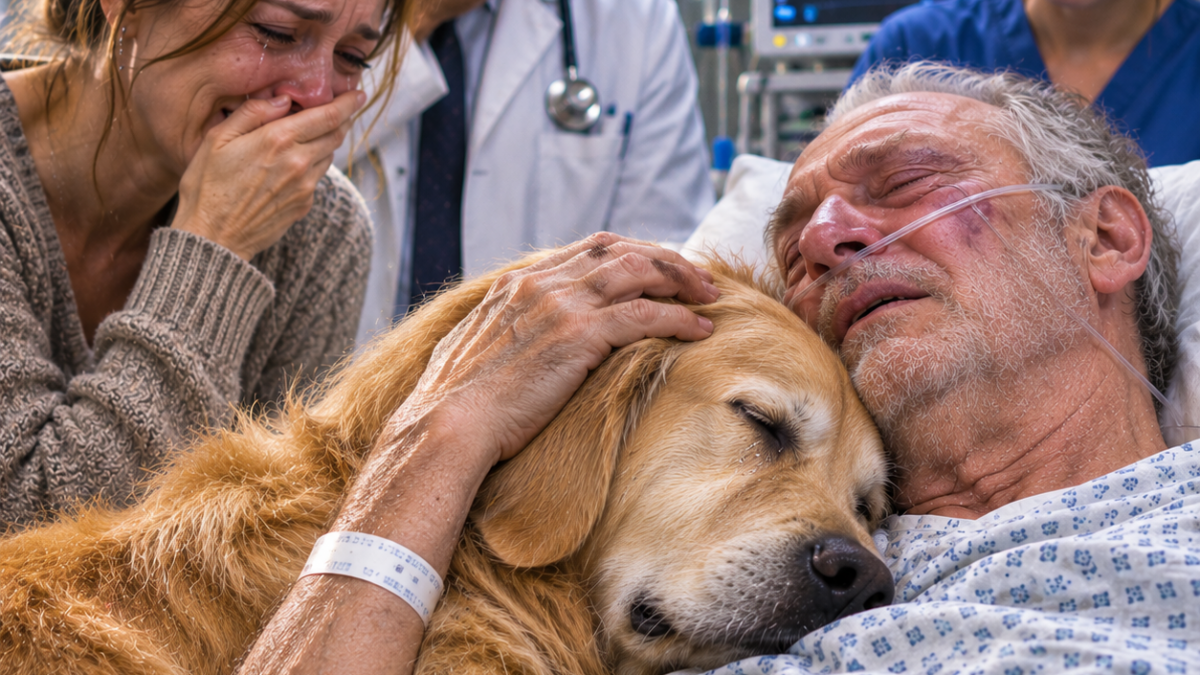
Charlie tried climbing.
He could not manage it.
His hips were too stiff.
I helped.
Carefully.
He stepped onto the mattress.
Then moved toward Dad.
Not across equipment.
Not carelessly.
Slowly.
He lowered himself directly against Dad’s upper body, his head near my father’s shoulder.
The nurses had prepared a clean bed on the floor.
Charlie never even looked at it.
His place had always been beside Dad.
Why would unconsciousness change that?
He sniffed my father’s cheek.
Then forehead.
Then mouth.
His tail did not move.
He nudged Dad once.
Nothing.
Again.
Nothing.
Then Charlie pressed his face against Dad’s neck.
And began to whine.
Quietly.
The sound was unbearable.
My mother turned her face into my shoulder.
Michael looked away.
One of the nurses wiped her eyes.
I crouched beside the bed.
“Charlie.”
He ignored me.
His entire body was oriented toward Dad.
He licked Dad’s chin.
Then his cheek.
Slow.
Patient.
Again.
And again.
As if cleaning sleep from the face of someone who had overslept.
That thought nearly destroyed me.
Because I had seen him do exactly that at home.
Dad would fall asleep in his recliner.
Charlie would eventually become impatient.
Nudge him.
Lick him.
Dad would say:
“All right, all right, I’m awake.”
Then Charlie would wag.
Now Charlie was doing the same thing.
But Dad did not say anything.
Charlie licked again.
Then he rested one paw near Dad’s hand.
That was when I saw it.
Dad’s index finger moved.
I froze.
“Mom.”
She did not hear.
“Mom.”
“What?”
“His hand.”
Everyone looked.
Nothing.
For two seconds I thought grief had created movement where none existed.
Then the finger moved again.
Barely.
A tiny curl.
Against Charlie’s paw.
Dr. Harrison stepped closer.
The monitor continued its steady rhythm.
Charlie stopped whining.
His head lifted.
He looked down at Dad’s hand.
Then moved closer.
Dad’s finger dragged weakly across the fur on Charlie’s leg.
Once.
I stopped breathing.
My mother whispered:
“Thomas?”
His eyelids fluttered.
No one moved.
No one spoke.
The whole room held itself still.
Then Dad opened his eyes.
Not fully.
Just enough.
His gaze wandered.
Ceiling.
Light.
Faces.
Confusion.
Then Charlie moved.
Dad’s eyes found him.
And something happened to my father’s face that I will remember long after I forget almost everything else.
Recognition.
Pure recognition.
His mouth trembled.
The faintest smile appeared.
Charlie’s tail moved once.
Then twice.
Then began thumping against the blanket.
Dad’s lips moved.
No sound.
Dr. Harrison bent closer.
Dad tried again.
This time we heard him.
“Charlie.”
My mother made a sound like somebody had struck her.
She collapsed against the bed rail.
I held her.
Charlie pressed his forehead against Dad’s.
And Dad whispered:
“You found me.”
The room dissolved.
That is the only way I can describe it.
Doctors still worked.
Nurses checked monitors.
No one forgot medicine.
But emotionally, whatever professional walls existed disappeared for a minute.
One nurse cried openly.
Michael covered his face.
My mother kissed Dad’s hand over and over.
I stood beside them unable to speak.
Dr. Harrison watched the monitors.
“Heart rate is settling.”
A nurse said:
“Oxygen saturation is improving.”
Nobody said:
The dog cured him.
Because that would not have been true.
Dad had received excellent emergency care.
CPR.
Cardiac treatment.
Constant monitoring.
Medications.
The recovery process had already been happening inside a body none of us could fully read.
But Charlie gave that recovery a doorway.
A familiar smell.
A familiar touch.
A name connected to something deeper than fear.
Dad knew Charlie.
And for the first time in six days, that recognition led him back toward us.
He did not wake completely that day.
That is important.
Stories often hurry miracles.
Life does not.
Dad opened his eyes.
Recognized Charlie.
Spoke several words.
Then exhaustion pulled him under again.
But this sleep looked different.
The doctors called it encouraging.
Over the next twenty-four hours, he woke more often.
Followed simple commands.
Moved both hands.
Recognized Mom.
Recognized me.
Recognized Michael.
The first name he said clearly remained:
“Charlie.”
Michael pretended to be offended.
“So the dog ranks above us?”
Dad’s mouth curved.
Barely.
“Yes.”
It was the first joke he made.
We laughed until we cried again.
Hospital administration eventually gave Charlie special permission to remain for extended visits.
Not twenty-four hours at first.
Then exceptions stretched.
Someone brought his favorite bed from home.
He ignored it and stayed near Dad whenever allowed.
Every morning, he entered the room and checked Dad first.
Not food.
Not us.
Dad.
Once satisfied, he would lie down.
At night, when Charlie had to leave, Dad sometimes became agitated.
So the staff worked with us.
The hospital was still a hospital.
Rules mattered.
Safety mattered.
But people began recognizing that the old dog was not a distraction from Dad’s care.
He had become part of what made Dad willing to participate in it.
Physical therapy started three days after Dad truly woke.
He hated it.
Of course.
Thomas Bennett had spent thirty-eight years telling children not to complain about difficult work.
The universe apparently wanted revenge.
A therapist named Daniel made him sit upright.
Dad grimaced.
“Are you trying to kill me?”
Daniel replied:
“No.”
“Charlie would object.”
Charlie was lying on the floor.
He lifted his head.
Daniel pointed.
“See?”
“He’s fine with it.”
Dad glared at the dog.
“Traitor.”
Charlie wagged.
The first time Dad stood, Charlie stood too.
Dad’s knees shook.
Two therapists supported him.
Mom stood behind them with both hands pressed against her mouth.
I held Charlie’s leash.
Dad looked down.
“Come here.”
Charlie moved closer.
Dad reached one hand.
Rested it on Charlie’s head.
Then took one step.
Just one.
After six days of believing I might never hear my father say my name again, I found myself cheering because he moved one foot eight inches across hospital flooring.
Grief changes your definition of victory.
So does recovery.
Dad remembered almost nothing about the first several hospital days.
He remembered darkness.
Voices.
Strange dreams.
My mother reading the newspaper.
Maybe.
Then:
Charlie.
He remembered the name.
Not saying it.
The need for him.
Dad told me later:
“I couldn’t find anybody.”
“What do you mean?”
“In my head.”
“I knew you were there.”
“Your mother.”
“Michael.”
“But you all felt far away.”
“Like voices in another room.”
“And Charlie?”
Dad’s eyes filled.
“Charlie felt like home.”
That sentence stayed with me.
People often think home is architecture.
Walls.
Kitchen.
Address.
Sometimes home has fur.
When Dad was stronger, he told us how Charlie entered his life.
I knew the broad version.
Not the details.
Eleven years earlier, Dad had gone to a shelter because one of his students was volunteering there.
He had no intention of adopting.
Mom had asked for a dog for years.
Dad always refused.
Too much hair.
Too expensive.
Travel complicated.
Then a seven-month-old Golden Retriever sat at the back of a kennel.
Quiet.
Not jumping.
Not barking.
Dad stopped.
The dog looked at him.
Dad crouched.
Charlie walked over and pressed one paw against the wire.
Dad came home two hours later with a leash.
Mom said:
“I thought we agreed no dog.”
Dad answered:
“We did.”
Then Charlie walked into the kitchen.
Mom fell in love immediately.
Their bond became ridiculous.
Dad took Charlie to school events.
Students read books to him.
Children who struggled speaking in front of classmates would read to Charlie because dogs never corrected pronunciation.
Dad joked that Charlie was the most popular faculty member who had never completed a background check.
When Dad retired, Charlie retired too.
They spent mornings at the park.
Afternoons in the garden.
Evenings in the same recliner arrangement.
Dad would read.
Charlie would sleep.
Two old men, according to Mom.
One hairier.
That history made the hospital scene hurt differently.
Charlie had spent nearly his entire life believing that where Dad went, he could follow.
Then one morning Dad left in an ambulance.
No explanation.
No goodbye.
For six days, Charlie had searched the house.
Waited near the door.
Refused meals.
Eventually escaped.
Went to the last place where Dad had collapsed.
The school.
If the maintenance worker had not found him—
I try not to finish that thought.
Coincidences can be terrifying once you realize how much they carry.
Dad’s recovery took weeks, not days.
The source of the story makes it sound almost immediate.
Reality was harder.
He became frustrated by words he could not retrieve.
His left leg was weaker.
He tired after twenty minutes.
Some mornings he could tell you exactly what happened.
Other afternoons he became confused.
My mother cried in hallways where he could not see.
I cried in my car.
Michael flew home twice and returned.
Charlie stayed.
That mattered precisely because recovery was not magical.
Every day looked different.
Charlie did not care.
Dad struggled to remember a word?
Charlie waited.
Dad could not walk far?
Charlie walked slowly.
Dad became angry?
Charlie lay down.
No disappointment.
No impatience.
No fear about whether the man returning from illness would be exactly the same man as before.
Dogs have an advantage there.
They do not require you to recover into the version they remember.
They meet the version that wakes up today.
One afternoon, Dad could not remember the word “window.”
He pointed.
Became frustrated.
“That.”
Mom tried helping.
“The window?”
Dad slammed his palm weakly against the bed.
“Yes.”
Then:
“I know that.”
“I know.”
“I’m not stupid.”
Mom’s eyes filled.
“I know.”
Charlie lifted his head.
Walked over.
Put his chin on Dad’s knee.
Dad looked down.
His anger disappeared.
“Dog.”
He laughed bitterly.
“At least I know that one.”
Mom sat beside him.
“You know more than you think.”
He stroked Charlie’s fur.
Then whispered:
“What if I don’t come all the way back?”
That was the first time he said the fear aloud.
Mom answered immediately.
“You come back as far as you can.”
Dad looked at her.
“And then?”
“We meet you there.”
I left the room.
Not because I wanted to.
Because I needed somewhere private to cry.
Charlie grew tired too.
He was almost eleven.
Hospital floors were hard on old hips.
The stress changed him.
He slept more deeply.
Sometimes we had to coax him outside.
A veterinarian checked him.
Nothing severe.
Age.
Stress.
My mother bought an orthopedic dog bed.
Charlie slept beside it.
Typical.
A nurse finally placed one of Dad’s old sweaters over the bed.
Charlie climbed onto it immediately.
Dad smiled.
“He has standards.”
The hospital staff began changing around us.
Nurses finishing shifts would stop by.
Residents asked about Charlie.
One custodian brought him biscuits.
Another patient’s family asked whether they could pet him.
Charlie somehow became the emotional center of a floor devoted to serious illness.
Not therapy-trained.
Just old.
Gentle.
Present.
That was enough.
A month after the collapse, Dad transferred to inpatient rehabilitation.
The hospital initially said Charlie could visit but not stay.
Dad responded:
“Then I’m not going.”
He was joking.
Mostly.
The rehab center made arrangements for extended visits.
Dad worked harder there.
Charlie became his goal.
The therapist would place him twenty feet away.
“Walk to Charlie.”
Dad walked.
Thirty feet.
Walk.
Hallway.
Walk.
Outdoor path.
Walk.
Dad complained every step.
Charlie waited at the end.
One day I arrived and found Dad sitting on the floor beside Charlie.
I panicked.
“What happened?”
The therapist laughed.
“He chose to sit.”
Dad said:
“I wanted to see if I could get back up.”
“Without telling anyone?”
“I had supervision.”
Charlie looked guilty.
“He’s not supervision.”
“He knows more than you think.”
Probably true.
By early summer, Dad could walk with a cane.
Speech nearly normal.
Memory improved.
Not perfect.
The neurologist warned there could be lasting deficits.
Dad accepted that poorly.
Then gradually.
He began carrying a small notebook.
Names.
Appointments.
Words he sometimes lost.
He joked:
“My external hard drive.”
Charlie still knew everything without writing it down.
The day Dad returned to Franklin Elementary became more emotional than his hospital awakening in a different way.
It had been nearly four months.
The principal arranged a small welcome.
Dad did not want one.
Therefore, obviously, they arranged a large one.
When the car turned into the school lot, children were already outside.
Hundreds.
Handmade signs.
WELCOME BACK MR. BENNETT
WE MISSED YOU
And one:
CHARLIE FOR PRINCIPAL
Dad laughed until he cried.
Charlie stood in the back seat wagging.
I parked.
Dad sat still.
“Dad?”
He looked through the windshield.
“I don’t know if I can do this.”
I understood.
The hospital had been private pain.
This was public return.
Children remembered him as strong.
Funny.
Certain.
What if they noticed hesitation?
What if he lost a word?
What if he needed the cane?
I said:
“They’re not waiting for the old version of you.”
He looked at me.
“They’re waiting for you.”
Charlie barked once from behind us.
Dad smiled.
“Outvoted.”
The moment his door opened, children began cheering.
Charlie jumped down first.
Then remembered Dad moved slowly and came back.
He stood beside the door.
Waiting.
Dad placed one hand on his cane.
One on my arm.
Then stepped out.
The cheering softened.
Not because the children were disappointed.
Because even children understand when joy should become gentle.
Dad walked toward them.
Charlie beside him.
A little boy broke from the line.
Ran forward.
Hugged Dad around the waist.
Then another child.
Then another.
Within seconds, Dad was surrounded.
Charlie disappeared beneath a forest of hands.
I stood behind them crying.
Mom beside me.
She whispered:
“I thought I lost him.”
I took her hand.
“So did I.”
Eventually Dad sat on his old courtyard bench.
Charlie lay at his feet.
Children played around them.
Sunlight came through the trees.
No hospital lights.
No machines.
No alarms.
I walked over.
Dad looked up.
“You okay?”
I nodded.
Then lied:
“Fine.”
He smiled.
“You always were a terrible liar.”
I sat beside him.
For several minutes, we watched Charlie.
Then I said:
“You know what I thought when he woke you?”
“What?”
“That he gave you back to me.”
Dad rubbed Charlie’s head.
“No.”
“What?”
“He gave me back to you.”
I looked at him.
Dad continued.
“I knew your voice.”
“Your mother’s.”
“Michael’s.”
“But I couldn’t get to you.”
“I didn’t know how.”
“Charlie…”
He paused.
“…he remembered the part of me I couldn’t reach.”
My throat closed.
Dad looked at the children.
“He didn’t heal my heart.”
“He didn’t fix my brain.”
“The doctors did what they could.”
“My body did what it could.”
“But when I felt him…”
He looked down.
“I remembered I was somebody’s person.”
That sentence stayed with me longer than any doctor’s explanation.
Dad went back to volunteering twice a week.
At first, only an hour.
Then two.
Charlie came whenever allowed.
Children read to him.
Dad helped.
The roles had changed.
Sometimes a child supplied a word Dad could not find.
He no longer hid it.
Once a girl said:
“Mr. Bennett, you forgot the word ‘photosynthesis.’”
Dad answered:
“I forgot where my glasses were this morning and they were on my face.”
The whole class laughed.
He laughed too.
Illness had taken some certainty.
It gave him humility he had not previously needed.
The hospital changed too.
Dr. Harrison began working with administration on a structured companion-animal visitation policy.
Not because Charlie performed a miracle.
He insisted on that distinction.
But because the team had seen how meaningful contact could affect a patient’s emotional state, motivation, orientation, and family connection.
Rules remained.
Vaccinations.
Screening.
Infection control.
Medical appropriateness.
Not every patient.
Not every animal.
But the answer stopped automatically being no.
That mattered.
A year after Dad’s hospitalization, the hospital invited him and Charlie back.
They had created a small courtyard sitting area near the rehabilitation wing.
Not a grand monument.
Dad would have hated that.
A bench.
Flowers.
Shade.
A small plaque:
FOR THE ONES WHO WAIT BESIDE US
Dad stared at it.
Then whispered:
“That’s too sentimental.”
Mom said:
“You cried during a dog-food commercial last week.”
“I had allergies.”
“In February?”
“Seasonal.”
Charlie peed near the plaque.
The ceremony ended quickly.
Dad had five good years after the hospital.
I say that because I want to be precise.
Not perfect years.
Good years.
He had another minor cardiac procedure.
He occasionally struggled with short-term memory.
His cane became permanent.
He stopped driving at night.
But he lived.
He taught.
He traveled with Mom.
He attended my daughter’s graduation.
He saw Michael’s son get married.
He complained about restaurant prices.
He planted tomatoes.
He watched baseball.
He loved Charlie.
Ordinary life.
The thing we had begged for while standing beside his hospital bed.
Charlie aged faster.
That is the cruelty built into loving a dog.
Human years continue.
Dogs race.
At thirteen, his muzzle became almost completely white.
At fourteen, stairs became difficult.
Dad installed ramps everywhere.
One into the house.
One near the porch.
One beside the car.
Mom said:
“You have turned our home into an airport.”
Dad answered:
“He carried me.”
“I can carry him a little.”
I had to leave the kitchen because that sentence hurt too much.
Charlie still followed Dad from room to room.
Slowly.
Dad would move to the kitchen.
Charlie stood.
Walked.
Dad to porch.
Charlie followed.
Dad once said:
“Sit down, you old fool.”
Charlie sat.
Dad laughed.
“Not you.”
Then realized he had been speaking to himself.
Their last visit to Franklin Elementary happened on a warm October afternoon.
Charlie was fourteen.
Dad was eighty.
A class of children sat outside.
Most had not been born when Dad first retired.
Yet they knew Charlie’s story.
The teacher asked whether Dad wanted to tell it.
He shook his head.
“No.”
Then looked at the children.
“Ask me what he taught me.”
A boy raised his hand.
“What did Charlie teach you?”
Dad thought.
Then:
“That loving someone is mostly showing up.”
The boy frowned.
“That’s it?”
Dad laughed.
“That’s plenty.”
He looked at Charlie.
“People think love is what you feel.”
“It is.”
“But feelings are easy when everything is good.”
“Love is also the boring part.”
“Waiting.”
“Walking slowly because someone else can’t walk fast.”
“Coming back.”
“Staying in the room.”
A girl asked:
“Did he really wake you up?”
Dad considered.
“Doctors woke my body.”
Then:
“Charlie reminded me why I wanted to stay awake.”
That was the most accurate version he ever gave.
That winter, Charlie’s health began declining.
Not dramatically.
Age.
Arthritis.
Kidneys beginning to struggle.
Dad administered medication with military seriousness.
He tracked appetite.
Water.
Walks.
Sleep.
Mom said:
“You never monitored your own health this carefully.”
Dad replied:
“I’m less interesting.”
Charlie agreed.
One February morning, Dad called me.
His voice sounded wrong.
Not medically.
Emotionally.
“Can you come?”
I drove over.
Charlie was lying beside the fireplace.
Dad sat on the floor.
He had not sat comfortably on floors in years.
I knew before anyone spoke.
The veterinarian had come that morning.
Charlie was in pain.
Treatment could give him days.
Maybe weeks.
But not good ones.
Dad stared at his dog.
“I’m not ready.”
Mom sat behind him.
“No one is.”
“I owe him.”
“You don’t owe him suffering.”
Dad’s face broke.
I had never seen my father cry like that.
Not in ICU.
Not during recovery.
Not when his own mother died.
He buried his face in Charlie’s neck.
“I’m sorry.”
Charlie lifted his head.
Licked Dad’s cheek.
Once.
That was all.
Dad spent the day with him.
No grand bucket list.
Charlie did not need a hamburger tour.
He needed Dad.
They sat on the porch.
Walked slowly to the mailbox.
Dad gave him scrambled eggs.
Charlie ate half.
Children from the neighborhood came by.
One girl read him a book.
At sunset, Dad carried Charlie into the living room.
That frightened me.
My eighty-year-old father lifting a seventy-pound dog.
I said:
“Dad.”
He shook his head.
“I’ve got him.”
Somehow, he did.
The veterinarian returned that evening.
Charlie lay with his head across Dad’s leg.
Mom held one paw.
I sat on the floor.
Dad whispered:
“Remember the hospital?”
Charlie’s eyes moved toward him.
“You climbed right up.”
Dad smiled through tears.
“Broke every rule.”
Charlie breathed.
Slow.
Dad continued:
“You found me.”
His voice cracked.
“So I’m staying with you now.”
The veterinarian gave him time.
No one rushed.
When Charlie’s breathing stopped, Dad kept one hand on his head.
A long time.
Then he whispered:
“Good boy.”
Two words.
That was all.
I thought losing Dad in the hospital had been the hardest thing I would ever witness.
Watching him survive only to eventually lose the creature who helped call him back was different.
Not worse.
Different.
Because this time there was no monitor we could stare at hoping for another number.
No doctor saying wait.
Love had reached the place where staying meant letting go.
Dad did not return to Franklin Elementary for almost two months.
He said he was tired.
We knew.
His routines had revolved around Charlie for fourteen years.
Morning walk.
Breakfast.
School.
Garden.
Evening television.
Grief empties time.
That may be one of its cruelest tricks.
It removes someone and leaves all the hours you used to spend loving them.
One afternoon I came over and found Dad sitting in his chair.
Charlie’s collar in his hand.
Blue.
Worn.
He said:
“I keep hearing him.”
“What?”
“His tags.”
I sat.
Dad looked embarrassed.
“I know he’s gone.”
“I know.”
“But sometimes when I wake…”
He stopped.
I took his hand.
“You spent fourteen years hearing those tags.”
“Your brain expects them.”
Dad nodded.
Then:
“Is this how it was for you?”
“When?”
“When I was in the hospital.”
I understood.
“You mean waiting?”
“Yes.”
I thought.
“Worse.”
He looked at me.
“Why?”
“Because you were still there.”
“I could touch your hand.”
“But I couldn’t reach you.”
Dad stared at Charlie’s collar.
Then whispered:
“That’s what Charlie was doing.”
“What?”
“Trying to reach me.”
“Yes.”
He closed his eyes.
For the first time, I think he understood the hospital from our side.
Eventually Dad returned to school.
Alone.
The children knew Charlie had died.
They made drawings.
Dozens.
Golden dogs.
Rainbows.
Stars.
One child drew Charlie beside a hospital bed with a speech bubble:
WAKE UP. WE HAVE THINGS TO DO.
Dad laughed.
Then cried.
He hung that one above his desk.
The hospital asked whether Dad wanted Charlie’s name added to the courtyard plaque.
He said no.
I was surprised.
“Why?”
He looked at me.
“Because it was never only about Charlie.”
“What do you mean?”
“Every family has someone who waits.”
He pointed toward the existing words.
FOR THE ONES WHO WAIT BESIDE US.
“That’s enough.”
He was right.
Years later, Dad’s health declined again.
This time age.
Nothing cinematic.
Nothing sudden.
His heart became weaker.
Walking became difficult.
Mom helped him.
Then I did.
Michael came more often.
One evening, Dad was admitted to the same hospital.
Different wing.
Different staff.
Same smell.
Same white lights.
I hated it instantly.
He remained conscious.
That mattered.
We sat beside him.
No Charlie.
His absence somehow filled the room anyway.
Dad looked toward the empty floor beside his bed.
Then smiled.
“What?”
I asked.
“He’d hate this bed.”
“Why?”
“No space.”
I laughed.
Dad closed his eyes.
Then:
“Do you think…”
He stopped.
“What?”
“Never mind.”
“Dad.”
His eyes opened.
“Do you think dogs remember?”
I swallowed.
“Yes.”
He smiled.
“Good.”
Dad did not die that night.
Or the next.
He returned home under hospice care several weeks later.
He wanted his own room.
His own window.
His own chair.
The photograph of Charlie sat beside the bed.
Not the dramatic hospital photograph.
A simple one.
Dad in the yard.
Charlie asleep against his shoe.
On Dad’s final afternoon, rain fell.
Soft.
Just like the week of his first collapse.
Mom sat beside him.
Michael on the other side.
I held his hand.
Dad had barely spoken that day.
Then his lips moved.
I leaned close.
“What?”
A whisper.
“Charlie.”
My chest broke open.
Mom began crying.
Dad smiled.
Not frightened.
Not confused.
Peaceful.
Then he whispered:
“He waited.”
I kissed his forehead.
“Yes.”
Dad took one more breath.
Then another.
And was gone.
At his funeral, Franklin Elementary filled an entire section.
Former students.
Teachers.
Children.
Adults who had been children.
Someone placed a photograph of Charlie near Dad’s casket without asking us.
Mom saw it.
Nodded.
No one removed it.
Afterward, we scattered a portion of Dad’s ashes beneath the maple tree where Charlie’s ashes had been buried years earlier.
Not because I believe everyone needs poetic endings.
Life is rarely so tidy.
But Dad had asked.
He wanted to be near the dog who had stayed near him.
Mom pressed her hand against the tree.
Michael stood beside her.
I looked up through the branches.
Sunlight came down in broken pieces.
And I remembered that hospital room.
Charlie climbing onto Dad’s chest.
That tiny movement of one finger.
The first fragile smile.
“You found me.”
For a long time, I told the story as though Charlie had brought my father back.
I understand it differently now.
Charlie did not defeat death.
He did not grant Dad immortality.
He did not cure his heart.
Eventually, we lost both of them.
That does not diminish what happened.
It makes it more meaningful.
Because love is not powerful because it prevents every ending.
Nothing can do that.
Love is powerful because it can bring someone back for another day.
Another year.
Another breakfast.
Another classroom.
Another argument.
Another Christmas.
Another ordinary afternoon in the yard.
Charlie did not give my father forever.
He gave us time.
Five years of it.
Five years in which Dad saw grandchildren grow.
Returned to school.
Annoyed my mother.
Taught children.
Held Charlie as he grew old.
Said goodbye.
Lived.
That is more miraculous to me now than any story where one dog somehow defeats biology.
I still visit Franklin Elementary sometimes.
The bench Dad used is still there.
New children sit on it.
Most never knew him.
That is how time works.
The school has a small framed photograph inside the library.
Dad sitting on the courtyard bench.
Charlie at his feet.
Under it are words from that last talk he gave:
LOVE IS MOSTLY SHOWING UP.
I used to think that sentence was too simple.
Now I know better.
My mother still has Charlie’s old blue collar.
She keeps it in Dad’s desk drawer.
Sometimes I catch her touching it.
She never explains.
She does not need to.
And occasionally, when a dog walks past me on a city sidewalk, I hear tags jingling.
For one second, I am back in that hospital room.
Machines.
White light.
My father motionless.
An old Golden Retriever climbing carefully onto his chest as though nothing in the world mattered more than getting close enough to say:
I’m here.
I found you.
Please come back.
Then my father’s hand moves.
His eyes open.
Recognition returns.
Not all of it.
Enough.
And he whispers the name none of us had understood for six days.
“Charlie.”
That was not the moment a dog performed a miracle.
It was the moment a man lost inside pain remembered the shape of home.
And years later, when both of them were gone, I finally understood something my father had spent the rest of his life trying to teach us.
The greatest healer was never the dog.
It was never the doctor.
It was never one single moment.
It was the bond that made a creature wait beside another through fear, weakness, confusion, age, recovery, and eventually death.
Charlie stayed when Dad could not answer.
Dad stayed when Charlie could no longer walk.
And when Dad’s own time finally came, the last name he whispered was the name of the friend who had once reminded him that there was still somewhere worth returning to.
Maybe that is all any of us can ask from love.
Not that it saves us forever.
Only that when we become lost—
someone remembers who we are,
someone stays close enough to call us home,
and when the day finally comes that we cannot return,
we leave knowing we were never abandoned.








