PART2:“FILL IT UP—I DON’T PAY HERE!” HOA Karen Stole Gas From My Station for Months—Then She Called 911 and Found Out Who Owned the Other 40%
PART2
The first time she stole gasoline was a Thursday afternoon.
Pump one was old.
Old enough that it still worked the way rural stations used to work before every machine demanded a card first.
Lift the nozzle.
Pump.
Walk inside.
Pay.
Pump two already had prepay installed.
Pump one’s upgraded reader was on backorder, and I did not have enough cash to rush the replacement.
Pamela noticed.
Of course she did.
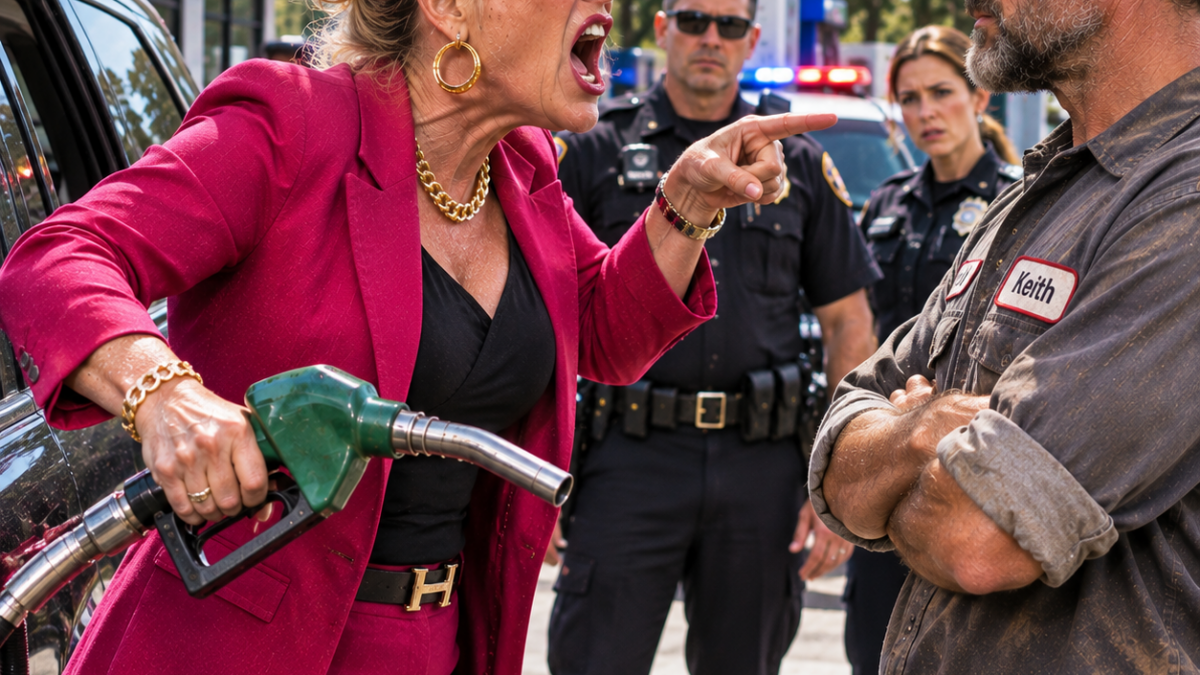
She pulled the Escalade beside pump one at 3:17 in the afternoon.
Filled the tank.
Thirty-eight dollars.
Returned the nozzle.
Climbed behind the wheel.
And drove away.
I watched through the store window.
For a second, I honestly thought she had forgotten.
People forgot.
I ran outside.
By the time I reached the pavement, the Cadillac was already turning onto County Road 16.
I checked the security footage.
Clear face.
Clear plate.
Her hand on the nozzle.
So I called.
Her number was publicly listed in the Briarstone HOA directory.
Third ring.
“Pamela, you drove away without paying for your gas.”
“I’ll settle it next time.”
Click.
There was no next time.
There was a second time.
Then a third.
Then a fourth.
Always pump one.
Always daylight at first.
Always no payment.
I called after every visit.
Twice she ignored me.
Once she answered and said:
“Send me an invoice.”
So I did.
She ignored that too.
Four fill-ups.
One hundred fifty-six dollars.
People later asked why I did not simply shut down pump one.
Because shutting it down meant hurting people who had done nothing wrong.
A lot of my regulars were retirees.
Cash customers.
Men who counted bills twice before putting ten dollars in the tank.
Women who bought exactly six gallons because that was what the weekly budget allowed.
Half my capacity mattered.
So instead of closing the pump, I bought another camera.
The original camera under the canopy showed the whole lot.
Good for license plates.
The new one I mounted low on the pump island facing the driver side and nozzle.
Close enough to see a wedding ring.
Then I bought a black-and-white composition notebook at the dollar store.
Two dollars.
I wrote everything in pencil.
Date.
Time.
Gallons.
Dollar amount.
What Pamela said.
What she did.
I had spent most of my working life fixing engines.
You learn something doing that.
Noise is not diagnosis.
Evidence is.
Three weeks after Pamela’s first unpaid fill-up, another HOA letter arrived.
This one was not a property notice.
It was a petition.
Pamela wanted Briarstone residents to demand county action declaring my station a public safety hazard and forcing it closed.
Twelve signatures appeared underneath.
I sat at the kitchen table after Sadie went to bed and checked every name.
Four belonged to nobody I could identify.
Not in the HOA directory.
Not in county records I could easily review.
Not in any local listing.
Three others belonged to neighbors I recognized.
I visited them.
First door:
“That isn’t my signature.”
Second:
“I never saw this petition.”
Third:
“Pamela told me we were discussing landscaping near the entrance. I didn’t sign anything about your station.”
Seven names out of twelve were either nonexistent or disputed by the people supposedly attached to them.
I photocopied everything.
Placed the original in a manila envelope.
Wrote the date on the front.
Locked it in the gun safe.
I still did not call Emmett.
That was pride.
Nothing more admirable.
I had bought the station.
I wanted to prove I could handle my own problems.
Pamela used my stubbornness against me without even knowing she was doing it.
Two days later, she held an emergency HOA meeting.
Then eighty-five flyers appeared across Briarstone.
Bright red headline.
UNSAFE FUEL STATION — PROTECT OUR CHILDREN.
Underneath was a photograph of my lot taken from the worst angle possible.
Trash cans out for collection.
Early-morning shadows making the canopy look crooked.
Dark patches on the old concrete.
The kind of photograph that could make a church picnic look contaminated.
Business dropped forty percent in two weeks.
Not all at once.
That would have been easier somehow.
It happened slowly.
Monday:
Two regulars missing.
Tuesday:
Three.
Wednesday:
A woman I knew drove past, looked toward the station, and kept going.
By the second Friday, I counted the register twice because I thought I had made a mistake.
I had not.
The bank payment was due on the fifteenth.
I could make it.
Next month?
Maybe not.
One person never stopped coming.
Darla Moore.
Sixty-eight years old.
Yellow house beside the Briarstone entrance.
Fifteen-year-old Ford Taurus.
Nineteen miles per gallon, and she was proud of knowing the exact number.
She leaned across my counter one afternoon.
“She’s fining people.”
I stopped counting cigarettes for inventory.
“Who?”
Darla gave me a look.
“Pamela.”
“For what?”
“Using your station.”
I stared.
“Two hundred fifty dollars.”
“That’s ridiculous.”
“Tell Doris on Birch Street.”
“Can she do that?”
Darla pushed her glasses up.
“Honey, she’s been doing whatever she wants for four years because nobody has made her prove she can.”
That sentence stayed with me.
That night, I reviewed camera footage.
I did it every few days by then.
11:14 p.m.
Empty road.
Dark station.
White Escalade.
Pamela got out.
Walked to pump one.
Filled her tank under the light from her phone.
Then left.
No payment.
Two nights later, she came again.
Same pump.
Same method.
She was telling Briarstone residents my station was too dangerous to use while sneaking over after dark to steal premium.
Running total:
Four hundred twelve dollars.
I bought a motion-activated floodlight.
Mounted it above pump one.
The next night, at 11:20, it triggered.
My apartment window behind the station faced the lot.
Light exploded across the concrete.
I heard the Escalade’s engine rev.
Tires on gravel.
When I reached the window, Pamela was already moving toward the county road.
But the nozzle lay on the pavement.
Fuel was still dripping.
Two gallons of premium spread across the slab.
I spent part of that night in rubber gloves covering the spill with absorbent material, then cleaning what remained.
Three in the morning.
Cold air.
Gasoline fumes.
Hands aching.
I wrote another entry.
11:20 p.m. — pump one. White Escalade. Floodlight triggered. Vehicle left abruptly. Nozzle dropped. Approx. two gallons spilled.
That week I finally called Emmett.
Voicemail.
He was in Nashville at mandatory police training.
“Hey, Em. We got a situation at the station.”
I looked through the glass at the empty pumps.
“Nothing urgent. Call me when you’re back.”
Nothing urgent.
Forty-percent revenue drop.
Unpaid fuel.
Questionable signatures.
Night theft.
Fuel spill.
Nothing urgent.
Some men will drown quietly before admitting they need somebody to throw a rope.
I was apparently one of them.
Pamela did not stop at my business.
She went after Sadie.
My daughter had sold lemonade from that same card table since she was twelve.
Cooler.
Cups.
Homemade sign.
One dollar.
That was the entire operation.
Pamela called county code enforcement.
Complaint:
Unlicensed food service using child labor on commercial property.
A county inspector arrived on a Monday.
Tired man in a county polo shirt.
He stared at the card table.
Then at Sadie.
Then at me.
“You selling lemonade?”
Sadie nodded.
“For your dad?”
“I keep the money.”
He almost smiled.
Twelve minutes later, he closed the complaint.
No meaningful violation.
But three of Sadie’s classmates rode past while the county vehicle sat outside.
Official seal on the door.
One girl slowed down.
Looked.
Did not wave.
That night, I found Sadie sitting on the edge of her bed.
Crying without making noise.
The way teenagers cry when they are too angry to admit they are hurt.
I stood in the doorway.
“What happened?”
“Nothing.”
I sat beside her.
She stared at the floor.
“People think we did something wrong.”
“No.”
“They saw the county truck.”
“The inspector cleared us.”
“That doesn’t matter at school.”
She wiped her face hard.
“Pamela told Mrs. Ridgeway we use kids because you can’t afford employees.”
I felt something close inside me.
Not explode.
Close.
A door.
For weeks I had tolerated Pamela insulting the station.
Insulting me.
Stealing gas.
Threatening business.
I could absorb that.
Watching my fourteen-year-old daughter cry because a grown woman with a clipboard needed to prove she could punish me?
That was different.
The next morning I called County Legal Aid.
Brenda Foster saw me two days later.
Forty-four.
Reading glasses hanging from a chain.
The exhausted patience of a woman who had explained the same laws to stubborn people for twenty years.
I carried the notebook.
Camera clips.
The petition.
Invoices.
Letters.
She spread everything across her desk.
Then said nothing for eleven minutes.
I counted.
Finally:
“You document compulsively.”
“I fix engines.”
“That explains it.”
She picked up the disputed petition.
“These signatures need to be verified.”
“I already talked to three people.”
“Write down what they told you. Don’t embellish.”
She looked at the fuel invoices.
“Four hundred twelve?”
“Currently.”
“Small enough for small claims.”
Then she raised one finger.
“But stop thinking only about the money.”
“I’m listening.”
“This pattern matters.”
Four days later, Pamela gave us something better than another video.
Certified mail.
Her name in the return address.
I opened it behind the counter.
Read it once.
Then again.
Then a third time.
She demanded twelve hundred dollars from me.
Not for damages.
Not for reimbursement.
She called it a:
Fuel Service Fee Credit Adjustment.
According to Pamela, she and I had supposedly entered a verbal agreement months earlier providing free gasoline because her presence had brought customers to my station.
There had been no agreement.
Ever.
She demanded that I recognize the arrangement retroactively, continue her fuel privilege, and pay her twelve hundred dollars for the inconvenience of being challenged.
Then she signed it.
Had it notarized.
Mailed it certified.
I called Brenda.
She read a scanned copy.
Long silence.
Then:
“Keith.”
“Yeah?”
“Put the original somewhere safe.”
“Already doing that.”
“She has now documented in writing that she has been obtaining fuel without ordinary payment.”
“Exactly.”
“Do not respond emotionally.”
“I wasn’t planning to.”
“You were absolutely planning to.”
“Maybe a little.”
“Don’t.”
I photocopied the letter.
Original into a plastic sleeve.
Safe.
Then I poured coffee.
And for the first time in weeks, I drank it slowly.
Emmett called that afternoon.
“I’m back Monday.”
“I have something you need to see.”
“What happened?”
“Bring strong coffee.”
He arrived Monday morning in his personal pickup.
Flannel shirt.
Thermos.
No uniform.
No visible badge.
I placed everything on the counter.
Notebook.
Laptop.
Camera footage.
Original petition.
Pamela’s certified letter.
Emmett watched the videos twice.
Read the letter three times.
Then held it up.
“She signed this?”
“And notarized it.”
“Good.”
One word.
He poured coffee.
Then pulled up a stool.
“She’s done this before.”
I stopped.
“What?”
“Hank’s Tire Shop.”
Hank lived inside Briarstone.
Pamela had been getting tire rotations and replacement work without proper payment while claiming it fell under HOA vendor arrangements.
When Hank pushed back, his house suddenly received three HOA violations.
Fence.
Mailbox.
Trash cans.
He stopped arguing.
Then Emmett mentioned Darla’s late husband.
Landscaping business.
HOA payments.
Invoices that did not match transfers.
“Residents complained?”
“Three.”
“What happened?”
“They wouldn’t sign statements.”
“Why?”
Emmett looked at me.
“They’re scared.”
I stared at my notebook.
“I’m not.”
“I know.”
Then he put down his cup.
“That’s why I’m telling you this next part.”
My stomach tightened.
“What?”
“Pamela called 911 last week.”
I looked up.
“About me?”
“She said you grabbed her arm and prevented her from leaving.”
The station went quiet except for the hum outside.
“I never touched her.”
“I know.”
“How?”
“Camera.”
Of course.
The footage showed me behind the counter the entire time.
Pamela arguing.
Pamela leaving.
No contact.
Emmett had also pulled the 911 recording after dispatch noticed his name on the station deed.
“She made the allegation on a recorded line.”
I looked toward the lot.
Pamela had threatened exactly that.
Then done it.
Emmett took out his phone.
“Another thing.”
He showed me a still image from my own nighttime footage.
Pamela at pump one.
Background:
Dark sedan parked along County Road 16.
I had never noticed it.
“Whose car?”
“Dale Whitfield.”
County councilman.
Zoning committee.
I looked at Emmett.
“What’s he doing outside my station at eleven at night?”
“I don’t know.”
“Guess.”
“I don’t guess professionally.”
Fair.
Then:
“But two months ago Whitfield submitted preliminary rezoning paperwork.”
My stomach dropped.
“For where?”
“This parcel.”
Commercial to residential.
The pieces shifted.
Boycott.
Safety campaign.
Petition.
Pamela’s pressure.
Whitfield’s car.
If the station lost viable commercial zoning or got tied up in enough hearings, my loan could collapse before I ever won.
“How long?”
“Zoning board meets in six weeks.”
I grabbed a sticky note.
Wrote:
6 WEEKS
Pressed it to the register.
Brenda became the legal center of everything after that.
Emmett did something even more important.
He recused himself.
Completely.
He was co-owner of the station.
He was police chief.
Any criminal investigation involving Pamela and my property created an obvious conflict.
So he carried the complaint package to the county district attorney, documented the referral, and stepped away.
No favors.
No chief arresting the woman who stole from his own business.
No shortcuts.
That mattered.
Because the easiest way to ruin good evidence is to handle it badly.
Brenda pulled Briarstone’s bylaws.
Public record.
Two provisions changed everything.
First:
Annual financial audit required.
Pamela had been president four years.
No audits.
Second:
Fifteen homeowners could call a special meeting by petition delivered to the HOA secretary.
Not Pamela.
Secretary.
At that meeting, the president could be removed under the bylaws if the required vote threshold was met.
Secretary’s name:
Ward Collins.
Darla took over the neighborhood side.
She had lived there thirty-one years.
She knew every resident.
Who had been fined.
Who was angry.
Who had been scared.
Who owed whom a casserole.
She knocked on doors.
“I need fifteen signatures for a lawful special meeting.”
Some people signed immediately.
Some hesitated.
Three shut the door.
By the end of the week, Darla had twenty-two.
Ward counted them.
Confirmed them.
Scheduled the special meeting for the last Saturday of the month.
Same day as Briarstone’s annual block party.
Pamela’s favorite event.
She treated that party like a coronation.
Meanwhile, her Escalade began appearing behind me.
Grocery store.
School pickup.
County road.
Maybe coincidence once.
Not twice.
I bought a thirty-five-dollar dashboard camera.
Stuck it to the windshield.
Let it run.
Then I made a sign.
White poster board.
Black marker.
ALL CUSTOMERS PAY.
NO EXCEPTIONS.
NO HOA DISCOUNTS.
SMILE. YOU’RE ON CAMERA.
I taped it beside pump one.
Six photographs hit the Briarstone Facebook group before lunch.
Darla’s comment:
Three laughing emojis.
About time.
Pamela received formal notice of the special meeting Friday at 9:15 a.m.
By 9:18, according to people on the board, she was calling everyone.
Two board members told her:
“We’re done.”
A third stopped answering.
Four nights later, somebody sabotaged pump one.
I opened at five.
Activated it.
The motor made a grinding sound that turned my stomach.
Display flickered.
Then died.
Technician arrived.
Twenty minutes later:
“Sugar.”
“What?”
“Granulated sugar in the system.”
Repair:
Nozzle assembly.
Filter.
Metering components.
Labor.
Twelve hundred dollars.
My only reliable working pump was now pump two.
Half capacity.
I checked video.
Hooded figure.
No usable face.
But one block away, at the edge of the frame, sat a white Cadillac Escalade.
That was not enough for me to stand there and claim Pamela personally poured the sugar.
Evidence matters both ways.
I reported what the camera showed.
Nothing more.
County sheriff’s office handled it because Emmett had recused his department.
That same weekend, Pamela posted online:
Keith Granger’s station failed inspection.
False.
Contaminated fuel damaged multiple vehicles.
False.
Protect your engines and your families.
Also false.
My station had passed its most recent inspection.
No customers had reported damaged vehicles.
I screenshotted everything.
Brenda sent a cease-and-desist letter.
Then the bank called.
That call scared me more than Pamela ever had.
Two missed loan payments.
Sixty days delinquent.
Thirty days to bring the account current before foreclosure procedures could begin under my loan documents.
The bank employee was polite.
Professional.
Completely uninterested in HOA politics.
That night I sat at my kitchen table.
Notebook open.
Calculator.
Bills.
The numbers did not work.
I had enough savings for one payment.
Not two.
Not with a twelve-hundred-dollar repair.
Not with revenue still crippled.
Emmett called.
“I’ll put up the difference.”
“No.”
“Keith.”
“Your retirement money.”
“It’s my station too.”
“I can fix this.”
“You’ve been saying that for a month.”
I said nothing.
He softened.
“Let me help.”
“Give me a week.”
Sadie found me at five the next morning standing beside the dead pump.
Still dark.
Concrete smelling faintly of diesel and cleaning solvent.
She did not ask what was wrong.
Just handed me coffee.
Black.
No sugar.
I laughed despite myself.
“What?”
“Nothing.”
She looked at the pump.
“Are we losing the station?”
Kids hear everything adults try to hide.
I looked at her.
“I don’t know.”
Her face changed.
Not panic.
Worse.
She nodded like she was trying to be older for me.
“I can stop selling lemonade.”
That nearly broke me.
“Sadie.”
“It doesn’t make much.”
“This is not because of your lemonade.”
“I could help inside more.”
“No.”
“You wouldn’t have to pay someone—”
I crouched enough to look her directly in the face.
“You are fourteen.”
Her eyes filled.
“This is my problem.”
“But it’s our station.”
That stopped me.
She was right.
I hugged her.
For months I had thought refusing help meant being strong.
Maybe strength was making sure my daughter never thought her childhood had to become collateral for my pride.
Five days before the block party, Pamela arrived at ten in the morning.
Broad daylight.
Pressed blouse.
Sunglasses.
Parked correctly for once.
She walked inside.
Placed five hundred dollars on the counter.
“Five hundred.”
I looked at it.
“That covers the gasoline.”
“No.”
Her eyebrows lifted.
“All of it.”
“You owe four hundred twelve for fuel alone.”
“There. Covered.”
“No.”
Her lips tightened.
“What else do you want?”
I thought about the pump.
Boycott.
False report.
Sadie crying.
But I did not rant.
“This is not between you and me anymore.”
She removed her sunglasses.
“What does that mean?”
“It means you need to talk to the people handling it.”
“Keith.”
I said nothing.
She stared for three seconds.
Picked up the money.
Put it back in her purse.
Then walked out.
No slammed door.
She closed it gently.
That controlled kind of anger was worse.
I wrote it down.
10:02 a.m. Pamela offered $500. Claimed it covered gas. Declined.
Two days later she canceled the block party by email.
Subject:
BLOCK PARTY CANCELED — SAFETY CONCERNS
She blamed my station.
This time Briarstone did not obey.
Reply all.
One resident:
We want the party.
Another:
Who authorized you to cancel this?
Another:
The gas station has nothing to do with our park.
Then Darla replied to all eighty-nine addresses.
Four words.
The party is on.
Pamela had spent four years speaking for Briarstone.
For the first time, Briarstone answered for itself.
Thursday night my phone rang at 10:15.
Pamela.
Brenda had previously explained the recording rules applicable to me and told me to preserve communications lawfully.
I followed her advice.
Answered.
Pamela skipped hello.
“If you show up Saturday, I will make sure you never sell another gallon in this town.”
I could hear her breathing.
Fast.
Like she had been pacing.
I said:
“Goodnight, ma’am.”
Hung up.
Saved the recording.
Sent it to Brenda.
Texted Emmett:
Got it.
His reply:
Good.
Friday morning, Brenda called.
“The DA approved charges.”
I leaned against the register.
“What charges?”
“Theft-related offense. False police report. Fraud-related allegations involving the petition are moving forward.”
My mouth went dry.
“Warrant?”
“Yes.”
“When?”
“They tried her residence this morning. She wasn’t home.”
I looked through the window.
A red pickup was using pump two.
Normal man.
Normal gas.
Normal morning.
“Tomorrow?”
“Likely.”
Saturday.
Block party at noon.
Special HOA meeting at 12:30.
I thanked her.
Then stood behind the register for several minutes staring at my sign.
ALL CUSTOMERS PAY.
I thought about Dad.
About Emmett standing beside his coffin.
About Sadie handing me coffee at five in the morning.
About Darla knocking on twenty-two doors.
Months of Pamela making everyone feel like isolated problems were finally converging into one record.
Saturday arrived warm.
Seventy-eight degrees.
Fresh grass.
Charcoal smoke.
Country music drifting from Briarstone’s community park.
Sixty-three residents showed up.
More than usual.
Pamela’s attempt to cancel the party had made everybody curious.
Sadie came with me.
She carried a cooler.
Lemonade.
I asked twice whether she was sure.
The second time she rolled her eyes.
“Dad.”
That meant yes.
Pamela was already there.
White dress.
Heels sinking slightly into the grass.
Wireless microphone.
Two women beside her laughing too loudly.
She either had not noticed me or was pretending.
At 12:30, Darla stood.
She had brought her own battery-powered megaphone from a yard sale.
The feedback squeal killed the music.
“Good afternoon.”
Pamela turned so fast one earring swung.
Darla held up the petition.
“Twenty-two homeowners properly requested a special meeting under Section Four, Paragraph Two.”
Pamela reached for her microphone.
“That is not on my agenda.”
Darla looked directly at her.
“It doesn’t need to be.”
The park quieted.
“Fifteen signatures are required.”
She held up the paper.
“We have twenty-two.”
Ward Collins stepped forward.
“I received the petition. The meeting is valid.”
Pamela’s face hardened.
“You cannot hijack my event.”
Darla smiled.
“It’s the community’s event.”
Then came the motions.
Independent financial audit covering four years.
Removal of Pamela Sutton as HOA president.
Pamela gripped the microphone.
“This is ridiculous.”
Nobody interrupted.
“You people have no idea what I have done for this neighborhood.”
A man near the grill said:
“That’s what we’re trying to find out.”
A few people laughed.
Pamela glared.
Darla called for the vote.
Hands rose.
Slowly at first.
Then more.
I counted from the back.
Thirty-eight of forty-four eligible residents present supported removal and audit.
Pamela watched every hand.
The woman who had spent four years distributing fines and deadlines suddenly stood in front of a community refusing to be afraid of her paperwork.
Her microphone lowered.
For a moment, nobody said anything.
Then a county sheriff’s vehicle turned into the parking area.
No lights.
No siren.
Deputy Holt stepped out.
He had apparently gone to Pamela’s house earlier.
No answer.
Neighbor said she was at the block party.
So he came here.
He crossed the grass.
Past Hank’s grill.
Past folding tables.
Past the cooler Sadie had set beside Darla.
Past forty-four residents who had just voted.
He stopped in front of Pamela.
“Pamela Sutton?”
“Yes?”
“I have a warrant for your arrest.”
The first sound out of her mouth was almost a laugh.
“What?”
He stated the charges.
Theft-related conduct.
Fraud-related allegations.
Filing a false police report.
Her voice cracked.
“This is insane.”
Then she looked around.
“Call the chief.”
Nobody moved.
“Call Emmett Dawson. He knows me.”
Deputy Holt stayed calm.
“Ma’am, Chief Dawson recused himself from this case.”
Pamela blinked.
“Why?”
Then Holt said the sentence that changed the entire expression on her face.
“Because he is co-owner of the gas station involved.”
Silence.
Pure silence.
Sixty-three people.
No music.
No talking.
Just ice settling inside coolers.
Pamela looked at me.
Then at Holt.
Then back.
“What?”
“Chief Dawson owns an interest in Mr. Granger’s station.”
The whispers began.
Pamela had stolen fuel from a business partly owned by the police chief.
Then called his department claiming I assaulted her.
And because Emmett had done the ethical thing, he had removed himself from the investigation entirely.
Pamela’s face went pale.
“That’s impossible.”
Deputy Holt did not argue.
He simply told her she needed to come with him.
As he guided her toward the cruiser, she passed the deviled eggs she had brought.
Potato salad.
Custom Briarstone napkins.
Her own microphone lying on the speaker table.
Nobody cheered.
I was glad.
Justice and humiliation are not the same thing.
Sadie stood beside me.
Her hand found mine.
“Dad?”
“Yeah?”
“Is she going to jail?”
“I don’t know.”
“What do you mean?”
“It means arrest is not conviction.”
She looked surprised.
I squeezed her hand.
“Evidence still has to hold up.”
Five minutes later, Emmett arrived.
Civilian clothes.
No badge.
He picked up a paper plate.
Sat beside me at Darla’s table.
Looked toward the grill.
“Brisket looks good.”
I stared at him.
“That’s what you’ve got?”
“I skipped breakfast.”
Sadie poured him lemonade.
He drank.
Around us, sixty-three residents began talking at once.
For the first time in months, it sounded less like gossip and more like people comparing notes.
That mattered.
Because Pamela’s power had depended on isolation.
Hank thought the tire arrangement was his private problem.
Darla thought the landscaping discrepancies were old history.
Doris thought her fuel fine was only hers.
I thought the stolen gas was between Pamela and me.
The moment everyone placed their stories beside one another, a pattern appeared.
The HOA audit started soon afterward.
Four years.
Accounts.
Vendor payments.
Board expenses.
It found eleven thousand four hundred dollars in misallocated funds.
Fake or unsupported landscaping charges.
Inflated vendor payments.
Board expenses that did not withstand scrutiny.
The new board worked to recover the money.
They used recovered funds for things residents had actually requested.
Playground improvements.
New swings.
Slide.
Safer surface.
Twelve LED streetlights on streets that had asked for them long before Pamela became president.
That felt right.
Money that had disappeared into power games finally became something ordinary people could use.
Pamela’s criminal case was less theatrical than the block party.
No microphones.
No white dress.
No crowd.
County courtroom on a Wednesday.
She ultimately pleaded guilty to misdemeanor theft-related conduct involving the gasoline and to filing a false police report.
The disputed petition and signature allegations were referred for further investigation at the state level.
The judge imposed eighteen months of probation.
One hundred twenty hours of community service.
Restitution.
Sixteen hundred twelve dollars.
Four hundred twelve for unpaid gasoline.
Twelve hundred related to the pump damage according to the case resolution reflected in the source story.
People asked whether that felt satisfying.
Honestly?
Not the way they imagined.
I did not walk out of court pumping my fist.
I thought about three in the morning.
Gasoline on concrete.
Sadie crying.
The bank call.
That money did not purchase those hours back.
But consequences mattered.
Pamela had spent months acting as if the word “HOA” erased the word “no.”
The court reminded her it did not.
Dale Whitfield resigned from the zoning committee three days after Pamela’s arrest.
No criminal conviction against him at that point.
No fantasy ending where everybody I suspected went to prison.
The rezoning proposal disappeared.
His sedan stopped showing up late at night.
That was what the evidence supported.
So that was enough.
Pamela sold her Briarstone home six weeks after sentencing.
The white Escalade with the “Blessed” bumper sticker disappeared from the neighborhood on a Tuesday.
A family of four moved into the house later.
The first time they stopped at my station, the father filled pump one.
Walked inside.
Put money on the counter.
I stared at him longer than necessary.
He laughed.
“Something wrong?”
“No.”
He looked at the amount.
“Did I underpay?”
“No.”
I smiled.
“Perfect customer.”
He left confused.
The bank was still waiting.
Pamela’s arrest did not erase my delinquency.
The station needed money.
Revenue.
Customers.
Darla solved that problem the way Darla solved everything.
She started knocking on doors again.
Then posted online:
BOYCOTT’S OVER. FILL-UP FRIDAY. KEITH NEEDS CUSTOMERS.
The first Friday, twenty-two cars lined up at pump two.
One working pump.
Cars stretching along the lot.
Hank brought biscuits.
Darla directed traffic like she had been trained at an airport.
Sadie worked the register.
A woman who had stopped coming because of Pamela’s threats walked inside.
She kept her eyes down.
“I’m sorry.”
I said:
“You don’t owe me anything.”
“I believed some of those flyers.”
“Okay.”
“She made it sound like your station was dangerous.”
I looked toward the bathroom.
“Well, one part is questionable.”
She laughed.
That was the first laugh I had heard from a Briarstone resident inside my store in months.
The pump technician finished repairing pump one the following Saturday.
When the motor started, I stood outside and listened.
Low electric hum.
Normal.
Nothing impressive.
To me it sounded like a heartbeat.
Darla’s Ford Taurus was the first car to pull in.
She rolled down the window.
“Fill it.”
I leaned toward her.
“You paying?”
Her eyes narrowed.
“Keith Granger.”
I laughed so hard I had to step away.
Three weeks later, the bank account was current.
Partly because business returned.
Partly because I finally stopped being an idiot about Emmett’s partnership.
He owned forty percent.
The station was his investment too.
We documented an additional partner contribution properly.
No secret rescue.
No pride.
Just business.
That lesson hurt.
I had spent months refusing help because I confused independence with strength.
Sadie understood better at fourteen.
One morning she asked:
“Why wouldn’t you let Uncle Emmett help before?”
“He isn’t your uncle.”
“He’s basically my uncle.”
Fair.
I looked at her.
“I wanted to prove I could do it.”
“To who?”
I opened my mouth.
Closed it.
She waited.
“I don’t know.”
She returned to her homework.
Teenagers are cruelly efficient therapists.
We changed the station after everything.
Not immediately.
First, bills.
Then upgrades.
Eventually I painted the canopy.
Dark blue.
Sadie chose it.
Darla drove in the next morning.
Stopped.
Looked up.
Then looked at me.
“Oh, no.”
“What?”
“Pamela won.”
I stared.
Then realized what she meant.
Pamela had demanded I repaint.
I almost laughed myself sick.
“No.”
Darla pointed.
“She wanted the canopy painted.”
“I chose to paint it.”
“Still blue.”
“She wanted white.”
“Then you win.”
That was the difference.
The problem had never been landscaping.
Paint.
Hedges.
Clean concrete.
The problem was Pamela believing she could order improvements on property outside her authority.
So yes.
I painted.
Pressure-washed.
Eventually planted three shrubs.
Because they were my choices.
Boundaries do not mean doing the opposite of whatever an unreasonable person demands.
They mean the choice remains yours.
The new Briarstone board became boring.
I mean that as praise.
Budget meetings.
Playground repairs.
Insurance.
Drainage.
Reserve funds.
Mailbox rules discussed through actual procedures.
Nobody using fines as personal leverage.
Darla attended every meeting.
She sat second row.
Asked one question constantly.
“Where is that in the bylaws?”
The new president started carrying extra copies just for her.
Hank stopped providing free tires to anyone unless he chose to.
One Christmas, he gave three widows free rotations.
Pamela would have called that a vendor arrangement.
Hank called it helping neighbors.
Consent.
That was the word underneath everything.
Pamela took.
Hank gave.
Difference.
We started a community fuel day.
First Saturday of each month at the beginning.
Limited free gasoline for selected single parents and seniors.
Not unlimited.
Not vague.
Budget.
Receipts.
Clear criteria.
Darla ran the table.
Sadie sold lemonade nearby.
First month:
Eleven vehicles.
Second:
Nineteen.
Emmett stood beside me one morning watching the line.
“You realize the station almost died because someone wanted free gas.”
“And now we’re giving some away.”
“Exactly.”
I looked at him.
“Difference?”
He smiled.
“You tell me.”
“Permission.”
“Good.”
That was the whole thing.
Pamela’s greatest mistake was not believing gas should sometimes be free.
I believed that too now.
Her mistake was believing she alone got to decide whose property became her privilege.
We also started the Granger Family Trade Fund.
Five hundred dollars from quarterly profit.
Small scholarship.
Local high-school student headed toward plumbing, welding, electrical work, automotive, diesel mechanics—anything where skill lives partly in your hands.
Dad had been a welder.
Emmett’s brother an electrician.
The first recipient was Ellis Dawson.
No relation.
Just coincidence.
He wanted to repair diesel engines.
Sadie read his essay twice.
“He writes better than me.”
“He probably doesn’t.”
“Dad.”
“Okay, he does.”
She rolled her eyes.
Life became normal.
That was the real victory.
Not Pamela leaving.
Normal.
Customers complaining about fuel prices instead of HOA threats.
Sadie complaining about homework.
Darla complaining about her new phone.
Emmett complaining I made coffee too weak.
Hank complaining about everybody.
Normal is underrated after somebody spends months making every day feel like a legal ambush.
The composition notebook stayed in the register drawer.
Half full.
Edges curled.
Pencil faded slightly.
I stopped adding to it after the case ended.
Never threw it away.
Occasionally, when somebody told me:
“Man, I would have just confronted her.”
I opened that notebook.
Confrontation feels satisfying.
Documentation wins slower.
Pamela expected anger.
She knew how to use anger.
She wanted me yelling.
Touching her.
Threatening.
Anything that would support the story she had already decided to tell about me.
Pump jockey.
Dangerous.
Unstable.
Problem.
The camera denied her that story.
The notebook denied her that story.
Her own certified letter denied her that story.
Evidence is boring until somebody lies.
Then boring becomes powerful.
Sadie grew older.
Lemonade stayed one dollar longer than economics justified.
At sixteen she raised it to two.
Darla objected.
“Robbery.”
Sadie said:
“Inflation.”
Darla paid five anyway.
The summer before college, Sadie packed away the card table.
I watched.
“You done?”
“With lemonade?”
“Yeah.”
She shrugged.
“Maybe.”
That word hurt unexpectedly.
That table had been part of the station almost as long as she had.
I remembered her at twelve.
At fourteen.
Crying because classmates saw a county vehicle.
Then standing at the block party beside me with lemonade while Pamela was removed.
I asked:
“What are you studying?”
“Business.”
I groaned.
“Why?”
“So I can fix your inventory system.”
“I raised you badly.”
“Obviously.”
She went to community college first.
Then transferred.
Every time she came home, she found something new to criticize.
Pricing.
Stock.
Accounting.
My handwriting.
Especially my handwriting.
One afternoon she pulled the old notebook from the register.
“This is terrifying.”
“It worked.”
“You write like a doctor during an earthquake.”
“Dates are readable.”
“Barely.”
She flipped through.
Then became quiet.
“What?”
She pointed to one entry.
The morning after the bank called.
I had written:
Cash short. One payment available. Pump one dead.
Underneath, in different handwriting:
Coffee delivered. No sugar. — S
I had forgotten.
Sadie had written that.
She looked at me.
“You kept this?”
“Yeah.”
She swallowed.
“Why?”
“Because it reminds me we made it.”
She closed the notebook.
Put it back carefully.
Years later, she stopped at pump two wearing office clothes.
Filled her car.
Walked inside.
Set money on the counter.
I said:
“Family discount?”
Her expression became mock-horrified.
“All customers pay.”
Then she pointed at the old sign still hanging near pump one.
“You taught me that.”
The sign had faded.
I kept it anyway.
ALL CUSTOMERS PAY. NO EXCEPTIONS.
It became funny after a while.
A local boy once asked why we had it.
His father said:
“Long story.”
Darla shouted from near the coffee machine:
“I have time.”
I stopped her.
Nobody needed the full Pamela Sutton saga while buying beef jerky.
But the story spread.
And like all small-town stories, it got bigger every time.
Somebody said Pamela stole ten thousand dollars in gas.
False.
Someone said she tried to burn down the station.
False.
Someone said Emmett personally arrested her.
Absolutely false.
Someone said Dale Whitfield went to federal prison.
No.
I started correcting people.
They hated that.
Truth is less satisfying than legend.
But I had learned too much to let exaggeration become evidence.
Pamela took $412 in fuel according to my records.
A pump was sabotaged.
A white Escalade appeared in relevant footage, but a hood concealed the person’s identity.
The criminal case resolved certain counts.
Other allegations remained separate.
The HOA audit found $11,400 in misallocated money.
Whitfield resigned from zoning.
Those facts were enough.
Reality did not need decorations.
One young homeowner came into my station years later carrying an HOA letter.
“You Keith?”
“Depends.”
He showed me the notice.
Fence color.
I read it.
“What do you want me to do?”
“Tell me how to beat them.”
“Beat who?”
“The HOA.”
I looked again.
“You agreed to architectural rules when you bought?”
“Yes.”
“Color is listed?”
“Yes.”
“You painted outside the approved list?”
“Yes.”
“Then repaint.”
His face fell.
“What?”
“I thought you hated HOAs.”
“No.”
“You fought Briarstone.”
“I fought someone pretending the HOA controlled property outside its boundary and using authority improperly.”
“So I’m wrong?”
“Looks like it.”
He left disappointed.
That became another lesson.
Being against abuse of power does not mean every rule is abuse.
Pamela had made me suspicious of authority.
Brenda taught me to distinguish lawful authority from invented authority.
That mattered.
Years after Pamela moved, I ran into her once.
Grocery store outside Macon.
Coffee aisle.
I turned a corner.
There she was.
Older.
Hair less carefully maintained.
No giant sunglasses.
No white Escalade visible outside.
She stopped.
“Keith.”
“Pamela.”
Neither of us knew what came next.
She looked at the shelf.
“I heard the station’s doing well.”
“It is.”
“Sadie?”
“Good.”
Silence.
Then:
“I’m sorry about your daughter.”
I stared.
“For what specifically?”
Her jaw tightened.
Then relaxed.
“Calling code enforcement.”
I waited.
“She was a child.”
“Yes.”
“I was angry.”
“Yes.”
“I should not have involved her.”
That was probably the first apology I had ever heard from Pamela Sutton.
Not enough.
But real enough to recognize.
I asked:
“Why did you do all of it?”
She frowned.
“The station?”
“Yeah.”
She looked at me.
Then gave the most honest answer she had ever given.
“Because you wouldn’t listen to me.”
I almost smiled.
“There it is.”
“What?”
“You thought not obeying you was disrespect.”
She said nothing.
“You weren’t really angry about paint.”
“No.”
“Or hedges.”
“No.”
“You were angry because I could say no.”
Her eyes filled slightly.
“I was used to people cooperating.”
“People were afraid.”
“That too.”
We stood there beside coffee filters.
No crowd.
No judge.
No camera.
She said:
“I lost a lot.”
I thought about correcting her.
She had sold her home.
Lost the HOA position.
Paid restitution.
Her reputation changed.
But she had not lost everything.
So I simply said:
“Consequences are not the same thing as someone taking from you.”
She looked at me for a long time.
“Do you forgive me?”
I had never expected that question.
I thought of Sadie.
The bank.
Three in the morning.
The pump.
Darla.
The notebook.
Then something surprised me.
I realized I had gone months without thinking about Pamela.
Maybe longer.
“I don’t know.”
She nodded.
Then I added:
“But I don’t hate you.”
Her eyes lifted.
“I just don’t think about you much anymore.”
That hurt her more than anger would have.
I could see it.
Not my goal.
Just truth.
We walked opposite directions.
I never saw her again.
People sometimes ask what moment felt best.
They expect:
The arrest.
Deputy Holt saying Emmett owned forty percent.
Pamela’s face.
The HOA vote.
Court.
Restitution.
No.
The moment I remember most happened months afterward.
Five-thirty in the morning.
Both pumps working.
Cold enough that my breath showed.
I flipped the switch inside.
Pump one hummed.
Pump two answered.
Three vehicles waited outside.
One belonged to Darla.
I stood behind the register.
Sadie carried out her lemonade table.
She was reading a different book every week back then.
She placed the cooler down.
Straightened the handwritten sign.
Looked toward the road.
Nobody called code enforcement.
Nobody drove away because of a boycott flyer.
Nobody threatened her.
She was just fourteen again.
That was justice.
Not Pamela hurting.
Sadie being allowed to stop hurting.
There is a difference.
I learned it slowly.
Revenge asks:
How much did the other person lose?
Justice asks:
What can the people they hurt get back?
Briarstone got its board back.
Residents got audited finances.
The playground got repaired.
Streetlights finally went up.
Hank got to run his tire shop without buying protection through free service.
Darla got to ask annoying questions at every HOA meeting.
I got my customers.
My station.
My loan out of immediate danger.
Sadie got her table.
Those things mattered more than watching Pamela leave in a patrol car.
Emmett retired eventually.
The worst thing that happened to the station after that was he became an active partner.
First morning after retirement, he came behind my counter.
Moved the gum display.
“Why is this here?”
“Because people buy gum.”
“Bad layout.”
“You’ve been an active partner twelve minutes.”
“Productive twelve minutes.”
I threatened to buy him out.
He threatened to repaint the bathroom.
We compromised by doing neither.
One afternoon we stood beside pump one.
He asked:
“Do you ever think about what would’ve happened if my name wasn’t on that deed?”
I looked at him.
“Yeah.”
“And?”
“Same camera.”
He nodded.
“Same notebook.”
“Same Brenda.”
“Good.”
He smiled.
That mattered to him.
The town loved the dramatic version:
Pamela called the chief and discovered she was stealing from his station.
But Emmett wanted people to understand something.
He did not save me with a badge.
His badge actually required him to step away.
The system worked because he respected that boundary.
If he had taken over the investigation, Pamela’s lawyer would have had a conflict argument before lunch.
The most useful thing the police chief did was refuse to act like the police chief when his own money was involved.
That taught me something too.
Power is not proved by using it.
Sometimes it is proved by knowing when not to.
Darla remained Darla.
Years later, she came in with a new Honda.
I stared.
“Where’s the Taurus?”
“Dead.”
“Sorry.”
“It had 246,000 miles.”
“Still.”
She looked at the new dashboard.
“I hate this thing.”
“Why?”
“It beeps.”
“For safety.”
“It judges me.”
“Like Pamela?”
She narrowed her eyes.
“Don’t ruin my morning.”
She filled up.
Paid.
Always paid.
The neighborhood improved.
Not magically.
People still argued.
Fences.
Dogs.
Parking.
Pool hours.
One meeting nearly became a civil war over holiday-light colors.
Human beings apparently require conflict.
But rules became rules again.
Not weapons.
The new board published financial summaries.
Held elections.
Completed audits.
That was the part most people ignored when retelling the story.
Removing Pamela was dramatic.
Building boring governance afterward was harder.
Darla refused to run for president.
“I already raised children.”
She pointed around the room during one meeting.
“I’m not raising these people.”
They elected a retired accountant named Helen Morris.
Helen’s first policy was simple:
Board members could not accept personal benefits from HOA vendors.
Hank framed the policy and hung it in his shop.
I started documenting my own business better too.
Written partner contributions.
Vendor agreements.
Camera maintenance schedule.
Insurance records.
No handshake deals big enough to matter.
Pamela had accidentally made me a better businessman.
I resent giving her credit.
But facts are facts.
The old pump-one faceplate stayed when we eventually replaced the manual unit.
Sadie wanted to throw it away.
I kept it.
Mounted it inside the office.
Next to it:
Pamela’s certified letter.
Framed.
Brenda came by years later.
Saw it.
“You framed this?”
“Historical document.”
“That letter was a gift.”
“She wanted twelve hundred dollars.”
“She gave you admissions.”
“True.”
Brenda tapped the frame.
“I have clients who spend ten thousand dollars trying to get the opposing party to write something this useful.”
“Pamela mailed mine certified.”
“With a notary.”
“Professional.”
We laughed.
Then Brenda became serious.
“You know the notebook mattered more.”
I nodded.
“Why?”
“Because one piece of evidence tells a moment.”
She pointed toward the register.
“A record tells a pattern.”
That sentence belongs on a wall somewhere.
Not mine.
Too much like HOA signage.
The scholarship grew.
Other businesses added money.
The Granger Family Trade Fund eventually covered tools and tuition assistance for more than one student a year.
The first student, Ellis, came back after technical school.
Diesel mechanic.
He pulled into the station driving a work truck.
“Mr. Granger?”
“Keith.”
He handed me an envelope.
“What’s this?”
“First contribution.”
“You don’t owe us.”
“I know.”
Inside:
One hundred dollars.
“I want the next kid to have it.”
I looked toward the old photograph of my father behind the counter.
Welder.
Hands permanently scarred.
He would have liked that.
Pamela had tried to turn the station into a symbol of everything ugly beside Briarstone.
Cracked pavement.
Rust.
Old pumps.
Instead, it became a place funding trades.
Fuel assistance.
A kid’s lemonade table.
Sometimes communities are built from the places people are embarrassed by.
Years later, Sadie asked me:
“If Pamela had paid the first thirty-eight dollars, would any of this have happened?”
We were closing.
Sunset across the pumps.
I thought.
“Probably not like this.”
“No arrest?”
“Not from our situation.”
“No audit?”
“Maybe eventually.”
“No Fill-Up Friday?”
“Probably not.”
She smiled.
“So everything happened because she wouldn’t pay thirty-eight bucks.”
I shook my head.
“No.”
She waited.
“It happened because she thought thirty-eight dollars was proof she could take anything she wanted.”
Sadie leaned against the counter.
“That sounds dramatic.”
“It’s true.”
The fuel was small.
The belief was large.
Pamela did not wake up one morning and decide to create a criminal case out of four hundred twelve dollars.
She had spent years learning that pressure worked.
Letters worked.
Fines worked.
People backed down.
Hank backed down.
Residents backed down.
So when I did not, she escalated.
Parking.
Gas.
Petition.
Boycott.
Code complaint.
Threats.
Every escalation was an attempt to restore the old rule:
Pamela says it.
Everybody else adjusts.
That rule finally broke.
Not because I was tougher.
Because evidence accumulated faster than intimidation could erase it.
That is what I tell people now.
When somebody in power behaves badly, do not assume one confrontation will fix it.
Save letters.
Read rules.
Keep dates.
Use cameras lawfully.
Document money.
Talk to other affected people.
Get actual legal advice when necessary.
And most importantly:
Do not invent facts just because the real ones are frustratingly small.
Small facts stack.
Thirty-eight dollars.
Another fill-up.
A forged-looking signature.
A letter.
A recorded call.
A bank statement.
A bylaw clause.
A camera frame.
No single thing looked like a movie.
Together, they ended four years of fear.
One day, a high-school student interviewing me for a civics project asked:
“Who defeated Pamela Sutton?”
I almost answered:
Me.
That would have made a better quote.
But it would have been false.
“Darla.”
The girl wrote.
“Who else?”
“Brenda.”
She wrote.
“Emmett?”
“Yes, but mostly by stepping back.”
She frowned.
“What does that mean?”
I explained recusal.
She wrote more.
“Hank?”
“Yes.”
“Ward?”
“Yes.”
“The residents?”
“Yes.”
“Your daughter?”
I looked toward Sadie’s old stool behind the register.
“Yes.”
Then she asked:
“What did you do?”
I laughed.
“Kept receipts.”
She did not like that answer.
Too boring for a school article.
But it was true.
Pamela’s power depended on everyone feeling alone.
The moment the stories connected, she was simply one woman standing in front of a room full of people holding records.
That is why the block-party vote mattered more to me than the cruiser.
Before Deputy Holt arrived, Briarstone had already removed Pamela from power.
The residents did that.
Using their own bylaws.
No handcuffs required.
The criminal case handled crimes.
The community handled governance.
Separate things.
Both necessary.
The station is still ugly in places.
The canopy is better.
Concrete still cracked.
I could replace it.
Maybe someday.
I like some of the cracks.
They remind me that something can be worn without being worthless.
That applies to places.
People too.
I still open early, though five a.m. has become closer to five-thirty as I get older.
The motion floodlight remains above pump one.
Sometimes a cat triggers it.
Every time, for half a second, my body remembers a white Escalade.
Then I remember she is gone.
The notebook still sits in the register drawer.
I do not write in it anymore.
I do not need to.
But I keep it.
Not as a trophy.
As proof.
Proof that calm is not weakness.
Proof that documentation is not cowardice.
Proof that asking for help before the bank threatens foreclosure is probably wise.
Proof that a fourteen-year-old can understand community better than adults twice her age.
And proof that the loudest person in the room is not automatically the person with authority.
Sometimes authority is a county plat.
Sometimes a bylaw.
Sometimes a deed.
Sometimes a camera.
Sometimes twenty-two signatures delivered to the correct secretary.
And sometimes it is a quiet man behind a gas-station counter saying:
“No, ma’am. Everybody pays.”
The last thing Pamela ever told me at the station before everything collapsed was:
“You won’t sell another gallon in this town.”
Years later, I thought about that sentence while watching a line of cars during community fill-up day.
Darla at the table.
A senior citizen in an old pickup.
A single mother with two kids in the back.
Sadie home from college pouring lemonade for old times’ sake.
Emmett arguing with somebody about brisket.
Both pumps running.
One gallon after another.
Paid fuel.
Free fuel we chose to give.
Every transaction ours to decide.
That was the part Pamela never understood.
Ownership is not only about who holds the deed.
It is about who gets to say yes.
And who gets to say no.
She believed the letters HOA meant her yes could replace everyone else’s.
They could not.
Not on my station.
Not in Hank’s shop.
Not in residents’ wallets.
Not forever inside Briarstone.
Pamela called me a pump jockey on cracked concrete.
Fine.
I have been called worse.
She said the station was ugly.
Also fair.
She said nobody used it until she showed up.
That one still makes me laugh.
Because long after her Escalade disappeared, people kept coming.
At five-thirty in the morning.
At noon.
After church.
After school.
On payday.
During Fill-Up Friday.
For coffee.
For gasoline.
For Darla’s gossip.
For Sadie’s lemonade.
Pamela thought community was something you controlled.
I learned it was something people returned to willingly.
And every morning when I switch on those old pumps and hear that low electric hum rising beneath the canopy, I remember the day she called 911 believing one lie could shut me down.
She had a phone.
A title.
An HOA letterhead.
A white Cadillac.
And years of people being afraid to challenge her.
I had two cameras.
A two-dollar notebook.
A fourteen-year-old daughter.
A legal-aid lawyer.
A stubborn old woman named Darla.
Twenty-two homeowners who finally stopped whispering.
And one silent partner whose badge mattered most because he knew when not to use it.
Pamela thought nobody was keeping score.
We were.
Not with revenge.
With evidence.
And in the end, evidence cost her more than free gas ever saved her.








