PART2:“DUMP IT ON HIS ROAD—HE CAN CLEAN IT UP!” HOA Karen Buried My Only Driveway in Tree Debris—Then Her Own Paperwork Turned the Neighborhood Against Her
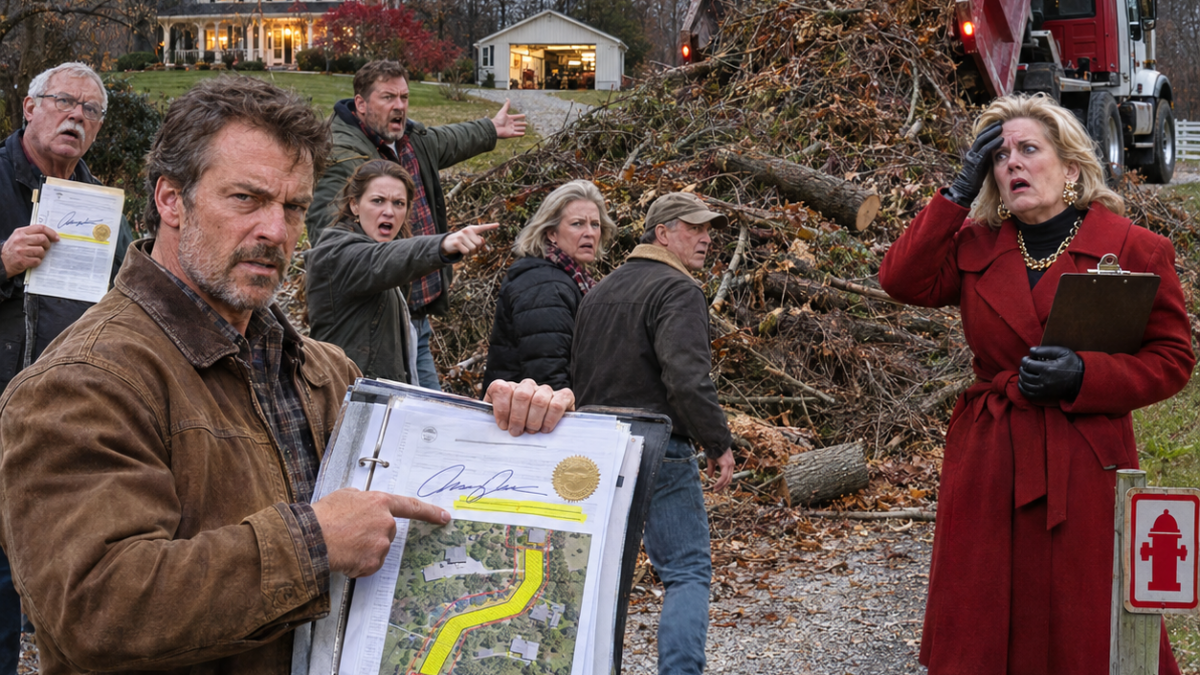
PART2
I photographed everything before touching a single branch.
That was habit.
Thirty-eight years around machinery, maintenance, and repair had taught me that when a job goes wrong, the first explanation people give is usually simple.
The paperwork is where simple stories become complicated.
Wide shot.
Road entrance.
Branch pile.
Ditch.
Truck position.
Colleen’s note.
Close-up of the fresh cuts.
Then I called her.
She answered quickly.
“The trimming is complete.”
“You blocked my road.”
“The debris came from vegetation extending over your property.”
“The trees belong to the HOA.”
“The branches were over your access.”
“That doesn’t turn them into my property.”
Silence.
Then:
“They’re on your land now.”
I looked back at Elaine.
Groceries beside her.
Cane resting against the seat.
“Come down here.”
“I have another appointment.”
“My wife cannot walk through this.”
“There should be room along the edge.”
“There isn’t.”
“Well, Ray, you rejected the association’s plan.”
“I rejected dumping branches on my road.”
“We are not doing this again.”
“No. We are.”
My voice stayed level.
“Do not send anyone else onto my property without calling me first.”
I ended the call.
I could not force Colleen to return.
I could get Elaine home.
I began pulling the smaller limbs away from one edge.
Every branch seemed tied to three others.
Oak snagged maple.
Maple snagged hedge.
Fresh leaves brushed against my face.
After twenty minutes, I had opened a narrow walking strip.
Elaine got out.
“I can manage.”
“I know.”
“I’m not helpless.”
“I know.”
“Then stop looking at me like I’m ninety.”
“I’m carrying the groceries.”
She almost smiled.
I took the bags to the house.
Returned.
Then walked beside her.
Her cane found the firmest parts of the gravel.
Halfway down, she stopped.
Her hand tightened on my forearm.
“Give me a minute.”
I did.
Neither of us spoke.
The summer heat pressed down.
Branches surrounded us.
I could smell sap.
Elaine breathed slowly until the ache eased.
Then she kept walking.
That was when the dispute stopped being irritating.
Before that, Colleen had been another HOA president who mistook authority for ownership.
Now my wife was standing in the middle of our private lane, in pain, because someone had decided a physical obstacle was an acceptable way to punish me for saying no.
Once Elaine was inside, I called Ben.
He had not seen the photographs yet.
“I’m looking now.”
I heard his keyboard.
Then silence.
“What happened?”
“You tell me.”
“The work order was trimming and haul-away.”
“Then why is the haul-away lying across my driveway?”
“I’ll call the contractor.”
“Keep the original work order.”
“I will.”
“Keep every change.”
“Ray—”
“Ben.”
He stopped.
“Do not let anybody rewrite this after the fact.”
“I understand.”
I called the sheriff’s non-emergency number next.
A deputy arrived that afternoon.
Young guy named Mason Fuller.
He photographed the obstruction.
Read Colleen’s note.
Looked toward the house.
“This is your only vehicle access?”
“Yes.”
“Any easement?”
“The HOA has no easement over the lane. Their trees are uphill.”
He wrote.
“Anyone trapped?”
“My wife had to walk.”
“Medical condition?”
“Recent knee surgery.”
He nodded.
“I’ll note it.”
He did not magically order the branches away.
Real life rarely gives you that satisfying shortcut.
He gave me a report number and told me to document what it cost to restore access.
That was useful.
I called two removal companies.
One could not come for almost a week.
The other quoted roughly $1,100 depending on how much material was farther downhill.
It was Wednesday.
My truck sat near the county road.
Tools, fuel, equipment, everything I used around the house and workshop were on the wrong side of the pile.
At four, a pickup stopped near my truck.
A man stepped out wearing the trimming company’s shirt.
“Mr. Foster?”
“Yes.”
“I’m Aaron Wells. Ben called our office.”
He walked toward the pile.
His expression changed.
“We weren’t supposed to leave it like this.”
“Where were you supposed to leave it?”
“Original order said remove all debris.”
“Then why didn’t you?”
He took out his phone.
“Our foreman received a change.”
He scrolled.
Then looked uncomfortable.
“What?”
“Mrs. Hart told him the lower access lane would be the disposal point.”
I held out my hand.
“Show me.”
He hesitated.
Then turned the phone enough for me to read.
Leave cut material on lower access lane. Property owner responsible for disposal.
I looked at him.
“Did anyone ask the property owner?”
“No.”
“Did anyone speak to me?”
“I don’t believe so.”
“Your man met me yesterday.”
“Doug?”
“Yes.”
“I heard about that.”
“What did he tell your office?”
“That you refused storage on the lane.”
I stared at Aaron.
“And your crew dumped it anyway?”
He exhaled.
“I’m not going to argue with you.”
“Good.”
“I need authorization before giving you company records.”
“Preserve them.”
“We will.”
“Every text.”
“Yes.”
“Every change order.”
“Yes.”
“Every load sheet.”
He nodded.
Then he did something useful.
“We can bring two men back tonight and open one vehicle-width path.”
“Without shoving everything into my ditch?”
“Without touching the ditch.”
“Do it.”
The crew returned before dark.
I watched.
Did not interfere.
Did not thank them for solving a problem their own trucks helped create.
But when Aaron personally guided my truck through the reopened strip, I did say:
“Thanks for coming back.”
He nodded.
“I’m sorry you had to call.”
That was the first apology anyone had offered.
Not from the HOA.
From the contractor.
The road was passable.
Not restored.
Branches still covered both shoulders.
Some gravel had been crushed toward the ditch.
But Elaine could get to therapy without walking half a mile.
That mattered.
Thursday morning I called Dale Porter.
Dale ran a small tree-service business.
We had known each other from the farm supply yard where I spent most of my working life maintaining equipment.
I had repaired his trailer brakes enough times that he claimed I owned part of the trailer.
I told him what happened.
He laughed once.
Then realized I wasn’t joking.
“How much brush?”
“A lot.”
“What kind?”
“Oak. Maple. Maybe hedge.”
“You thinking removal?”
“Maybe chipping.”
“I can rent you my smaller tow-behind machine Saturday.”
“I don’t want to run something I haven’t used.”
“I’ll run it.”
That was Dale.
Blunt.
Practical.
He came at lunch.
Walked the lane.
Pulled at branches.
Checked for wire, stones, metal, trash.
“This needs sorting first.”
“I figured.”
“Small material chips fine.”
He kicked a larger limb.
“These become firewood.”
“How much mulch?”
Dale looked toward the house.
“More than Elaine’s beds will ever need.”
That gave me the idea.
Not revenge.
Not yet.
Just usefulness.
If I had to pay to process branches somebody dumped on my property, at least I could turn them into something.
As Dale drove away, Joyce Miller came down the lane carrying an empty grocery bag.
She lived two houses up inside the HOA.
Late sixties.
Her husband had been sick all winter.
Joyce brought Elaine tomatoes every summer.
She stopped.
“I wondered what all that noise was.”
I told her.
She stared at the piles.
“Colleen told people you asked to keep the branches.”
I laughed.
“Of course she did.”
Joyce looked embarrassed.
“I didn’t believe it.”
“You didn’t know.”
Then she glanced toward the house.
“Are you really turning this into mulch?”
“Saturday.”
“Could I buy some?”
“No.”
Her face fell slightly.
“You can have some.”
“Ray.”
“What?”
“I’m not taking advantage.”
“You’re not.”
She hesitated.
Then reached into the grocery bag.
“I brought something Elaine wanted to see.”
She unfolded an HOA notice.
Yard-care deadlines.
Bare flower beds.
Mulch requirements.
Then I saw the second page.
A separate charge had been added to each household’s account for the tree project.
Description:
PRUNING, DEBRIS REMOVAL, AND OFFSITE DISPOSAL.
I read it twice.
“Joyce.”
“Yes?”
“You already paid this?”
“It came out with dues.”
“How much?”
She told me.
I looked up the lane.
Branches.
Everywhere.
The HOA had told me I was responsible for disposal.
At the same time, its members had been billed for disposal.
That did not automatically mean theft.
I knew better than to jump that far.
Maybe the contractor had not been paid.
Maybe a credit would be issued.
Maybe the accounting description was stale.
But it was a question.
A very good question.
“Can I photograph this?”
Joyce covered her account number with one hand.
“Only this part.”
“Exactly.”
She looked at me.
“Did Colleen steal the money?”
“I don’t know.”
“That sounds disappointing.”
“It’s accurate.”
I pointed to the description.
“What I know is you were charged for hauling and I was told to pay for the same hauling again.”
“What should I do?”
“Ask for the invoice.”
“Can I?”
“You’re a member.”
Joyce folded the notice.
“I’m going to.”
That evening I showed Elaine the photograph.
She read it.
Then looked at me.
“Send Ben the question.”
“I’m going to.”
“Ask what happened.”
“Yes.”
“Don’t tell him what happened.”
I smiled.
“You’ve been married to me too long.”
“Long enough to know when you’re about to start proving things.”
I sent Ben a short email.
Was the contractor’s original invoice reduced when the hauling was canceled?
If yes, where was the credit?
Had homeowners already been billed for a service no longer performed?
I also informed him that Dale and I planned to process the remaining material Saturday because I needed my road restored.
Before chipping anything, I wanted ownership clarified.
Colleen had called the debris my responsibility.
Fine.
But I wanted that position in writing before I spent money turning it into something valuable.
Friday morning Dale and I began sorting.
No machine yet.
Just preparation.
We separated oversized pieces.
Checked for wire.
Pulled trash.
Set a safe chipper area near my workshop.
Halfway through, Dale stopped.
“This isn’t all from those trees.”
“What?”
He lifted a bundle of narrow green cuttings.
“You got this hedge?”
“No.”
“Then where’d it come from?”
I recognized it.
Tall ornamental hedge around the HOA clubhouse parking lot.
I walked through the piles.
Found more.
Two full bundles at least.
My irritation changed.
This wasn’t only boundary trimming debris.
My road had become their dumping site for unrelated clubhouse cleanup too.
I photographed everything.
Then called Aaron.
“Did your crew bring clubhouse hedge cuttings down here?”
Pause.
“I need to check.”
“Please.”
“I’ll call you.”
Dale and I continued.
At noon he left for another job.
Elaine came outside with her cane.
She stopped near the cleared path.
“Move.”
“What?”
“You’re standing in my test lane.”
I stepped aside.
She walked from the house.
Across the footbridge.
Down the gravel.
Turned.
Came back.
Slow.
Careful.
But no stop.
She smiled.
“That’s better.”
I watched her go inside.
For two days, everything had become Colleen.
That little walk reminded me of the actual goal.
My road.
My wife.
Our ordinary life.
Aaron called after lunch.
“The hedge material did come from the clubhouse.”
“Who sent it here?”
“Mrs. Hart.”
“Did she tell the crew I agreed?”
“Yes.”
I closed my eyes.
He kept talking.
“The original job included removal and offsite disposal.”
“Then?”
“After the change order, our company removed that portion of the charge.”
“So the HOA received a credit?”
“Yes.”
“How much?”
“I can’t give you billing details unless authorized.”
“Fine.”
“The revised invoice is with Ben.”
“Good.”
I thanked him.
That answer mattered.
The contractor had not charged for disposal it didn’t perform.
The remaining issue was the HOA.
Ben called an hour later.
“I have both invoices.”
“And?”
“The contractor credited the hauling portion.”
“Were homeowners already charged?”
“Yes.”
“Do they know about the credit?”
“Not yet.”
“Why?”
“The homeowner charges were prepared before the change.”
“So the money is sitting with the HOA.”
“Yes.”
“What happens to it?”
“I’m taking it to Susan.”
Susan Keller was the treasurer.
“And the branches?”
Ben sighed.
“Colleen still says they became your responsibility once left on your property.”
“Fine.”
“Fine?”
“Put it in writing.”
“Ray—”
“I’m going to chip them. Some mulch will stay here. Some may go to neighbors. I do not want her claiming ownership after I spend money turning brush into usable material.”
Ben was quiet.
“That’s reasonable.”
One hour later, he forwarded Colleen’s response.
It was perfect.
Not because it was fair.
Because it was clear.
Mr. Foster may arrange disposal of the material at his own expense. The association will not retrieve it and makes no ownership claim to any debris left on his property.
I printed it.
Elaine read the last sentence.
Then tapped the paper.
“Put it with the note.”
I did.
One envelope.
Colleen’s first position:
You own the problem.
Colleen’s second position:
We claim nothing in it.
Saturday morning Dale arrived at eight.
I wrote a small cardboard sign:
FREE WOOD CHIPS — ASK BEFORE LOADING.
Not at the county road.
Not advertising.
Just beside the finished pile where Joyce and a couple neighbors could find us.
Dale ran the machine.
I fed material under his direction.
Fresh branches disappeared into a roaring chamber.
Wood chips sprayed into a growing mound.
The smell was good.
Oak.
Maple.
Leaves.
Every hour, more of my lane returned.
At eleven-thirty, I could finally see all the way to the bend.
I shut my eyes for a second.
Three days earlier, that same view had been blocked.
Dale shut down the machine.
“Break.”
I walked the road.
Picked up sticks.
Found where a dump truck had pushed gravel into the drainage edge.
Photographed it.
Measured it.
Added it to my folder.
Cleaning up damage does not erase that damage happened.
Joyce arrived just after noon with a wheelbarrow.
Beverly Crane followed with two feed bags.
Beverly lived three houses beyond Joyce.
Her husband had been laid off after surgery.
She looked embarrassed.
“Joyce said you might have extra.”
“We do.”
“How much?”
“What you can use.”
“I can pay.”
“No.”
Her eyes filled slightly.
“This helps more than you think.”
“I know.”
I did.
There had been years when fifty dollars felt like five hundred.
We waited until Dale shut down.
Safety first.
Then loaded a modest amount.
Joyce reached into her pocket.
I held up my hand.
“You already paid someone to haul it away.”
She laughed.
Then stopped.
“Ben called me.”
“What’d he say?”
“The invoice was reduced.”
“Good.”
“But the credit hasn’t come back.”
“Ask Susan.”
“I did.”
Beverly tied one bag.
Then another.
“Thank you.”
I shrugged.
“It was dumped here. Might as well help somebody.”
Dale restarted the chipper.
By early afternoon, the final pile had shrunk.
More neighbors stopped at the bend.
Two asked if there would be extra later.
“Yes.”
One man, Stan Brewer, offered to bring his small tractor and repair the damaged shoulder.
“Not yet.”
He looked surprised.
“I’m documenting first.”
He nodded.
“Fair.”
That was when Colleen arrived.
Her car stopped hard at the bend.
She got out before the engine fully settled.
“What is going on?”
I waved to Dale.
He shut down the chipper.
Joyce had just returned for a second small load.
Her wheelbarrow was half full.
Colleen marched toward her.
Then stepped directly in front of it.
“Put that back.”
Joyce blinked.
“What?”
“That material belongs to the association.”
For a moment, nobody moved.
Then I reached into my shirt pocket.
I kept Colleen’s first note there because something told me I might need it.
Before I could unfold it, Joyce reached beneath her gardening gloves.
She had brought her HOA billing notice.
“Then why did you charge us to haul it away?”
Colleen’s eyes moved to the page.
Then to me.
“The billing is none of his concern.”
Joyce tightened both hands on the wheelbarrow.
“It’s my bill.”
I opened Colleen’s note.
“You left this on my road.”
“That refers to disposal responsibility.”
“You wrote yesterday that the association makes no claim to the material.”
“Because it was debris.”
“And now?”
“You processed association vegetation.”
“On my property.”
“With commercial equipment.”
I almost smiled.
There it was.
New story.
The debris had transformed into HOA property the moment it became useful.
I held up her email.
“Your words.”
Colleen looked toward the chipper.
The cardboard sign.
The waiting neighbors.
“You’re operating a business.”
“No.”
“You’re distributing landscaping material.”
“No one is paying me.”
“You brought commercial machinery to residential property.”
“I hired a tree-service operator to clear branches your contractor dumped across my only road.”
She took photographs of the chipper.
Then my sign.
I let her.
“Take as many as you want.”
She turned toward Joyce.
“If you put that material on your flower beds, do not expect it to satisfy your compliance notice.”
Joyce stared.
“It’s wood chips.”
“It isn’t an approved product.”
“Show me the rule.”
Colleen pulled out her pen.
“We have landscaping standards.”
“Which standard says I can’t use these?”
“I am not debating landscaping with you.”
Joyce looked down at the wheelbarrow.
“You’re standing in front of it.”
Even Dale smiled at that.
Colleen did not.
“If you take that home, your property remains noncompliant.”
I watched Joyce’s face change.
Fear.
Not of Colleen personally.
Of a fine.
A letter.
An escalating balance.
The kind of pressure HOAs know how to create without raising their voices.
Beverly stood nearby holding empty bags.
“I can’t afford a fine.”
“You don’t have to take anything,” I told her.
Her face fell.
“I’m sorry.”
“Don’t be.”
I put her bags on our porch so they wouldn’t blow away.
Colleen looked satisfied.
That irritated me more than if she had shouted.
Then Elaine came down from the house.
Cane.
Careful steps.
I wished she had stayed inside.
She stopped on the level gravel.
Looked at Joyce.
“Leave your wheelbarrow here if you want to check the rules first.”
Colleen’s face relaxed.
She thought Elaine was giving Joyce a polite exit.
Joyce shook her head.
“No.”
She lifted the handles.
“I’m taking it.”
Colleen did not move.
Joyce stared.
“You’re blocking my wheelbarrow.”
For several seconds, they stood there.
Then Colleen stepped aside.
Joyce pushed past.
Up the lane.
No cheering.
No speech.
Just an older woman taking home free mulch she had already paid to have removed once.
Colleen watched her go.
Then photographed my cardboard sign again.
“This will be reported.”
“Include the branch pile.”
She turned.
“And the note you taped to it.”
No answer.
She got in her car.
Drove away.
Dale looked at me.
“That woman’s going to file something.”
“I know.”
“How much longer?”
“An hour?”
“About that.”
“Finish.”
We finished.
By midafternoon, the lane was open end to end.
I drove my truck from the workshop to the county road and back.
No folded mirrors.
No branches against glass.
No stopping.
When I returned, Elaine stood near the house.
“How does it feel?”
“Boring.”
She smiled.
“Perfect.”
Dale handed me his invoice.
Machine.
Labor.
Exactly as agreed.
“Keep a copy.”
“I have a folder big enough to kill a man.”
“Good.”
He looked toward Elaine.
“Worth it?”
I followed his eyes.
She had her leg raised on a porch chair.
“Yes.”
That evening Joyce texted a photograph.
Fresh wood chips around her shrubs.
Neat.
Pulled away from the stems.
Covered exactly the bare soil described in the HOA notice.
Message:
Before-and-after pictures saved. Learning from you.
I laughed.
Sunday morning, she sent another photograph.
Fresh violation notice.
Signed by Colleen.
LANDSCAPING REMAINS OUT OF COMPLIANCE DUE TO MATERIAL FROM AN UNAPPROVED ROADSIDE PROCESSING OPERATION.
Deadline:
Wednesday.
I read it twice.
Joyce called.
“Do I have to remove everything?”
“What do your rules say?”
“I read them.”
“And?”
“Bare beds must be covered with mulch or another approved ground cover.”
“Does it identify suppliers?”
“No.”
“Material?”
“Mulch.”
“What did you use?”
“Wood chips.”
“Then send Ben the rule and notice.”
“What if she fines me?”
“Document first.”
Joyce was quiet.
“Are you helping me fight her?”
“I’ll give you records that involve my property.”
“That’s not what I asked.”
“I know.”
I looked toward Elaine.
She was drinking coffee.
“This is your house, Joyce. Your decision.”
“I’m tired of being scared of letters.”
That sentence told me she had already decided.
I sent her:
Photographs of the original pile.
Colleen’s written statement disclaiming ownership.
County report number.
Dale’s invoice identifying the clean tree material.
Then I stopped.
Her yard could not become my second battlefield.
Around lunch, Ben called.
“I received a complaint regarding commercial activity on your property.”
“From Colleen.”
“Yes.”
“No one paid.”
“I understand.”
“She knows that.”
“The complaint says multiple residents collected landscaping material.”
“They did.”
“Donations?”
“No.”
“Delivery charge?”
“No.”
“Sales?”
“No.”
“Business advertising?”
“No.”
He sighed.
“She also sent it to county land use.”
I looked at the workshop.
Chipper gone.
Branches gone.
One mulch pile left.
“What do you need from me?”
“County may call.”
“They will get documents.”
Then:
“What about Joyce?”
“I asked Colleen to identify the violated rule.”
“And?”
“No response yet.”
“If she can’t?”
“The notice should be withdrawn.”
“Should?”
“Ray.”
“Fine.”
Monday morning, I called county land use myself.
Teresa Nolan answered.
I gave the address.
Explained the one-day cleanup.
The blocked access.
The rented chipper.
Free distribution to several neighbors.
She asked for:
Photographs.
Dale’s bill.
Colleen’s disposal message.
I sent everything.
Then I went outside with a measuring tape.
Stan walked down.
“No tractor?”
“You told me to wait.”
“Good.”
He crouched near the ditch.
“They crushed this shoulder.”
“I know.”
“If we get heavy rain, water might wash across the lane.”
He pointed farther down.
Truck tires had cut into another edge I missed.
I measured.
Photographed.
Sketched.
Stan offered to prepare a written repair estimate.
This time I accepted.
It was one thing to say damage existed.
Another to show:
Location.
Measurement.
Repair method.
Cost.
Tuesday, Teresa came from the county.
Another staff member joined her.
They walked the lane.
Looked at the workshop.
Remaining wood chips.
No customers.
No sign.
No ongoing machinery.
She asked:
“Do you intend to bring brush here regularly?”
“No.”
“Sell chips?”
“No.”
“Accept future materials from tree companies?”
“Absolutely not.”
She almost smiled.
I gave her Dale’s invoice.
“This was one day?”
“Yes.”
She compared dates.
“Purpose?”
“To clear my only road.”
I pointed.
“The material had been dumped across it.”
She photographed the lane.
“We’ll send a written determination.”
“Please include that the original material obstructed vehicle access.”
She wrote it down.
By then, I had lost another morning.
Calls.
Records.
Waiting.
That was part of Colleen’s power too.
Not just fines.
Time.
Every unnecessary notice stole hours.
I finally understood why people signed things they disagreed with.
Fatigue is a compliance tool.
That afternoon, Elaine found me staring at the folder.
“You’re doing it again.”
“What?”
“Living at the kitchen table.”
“I have calls.”
“Twenty minutes.”
“What?”
“Lake.”
She picked up her cane.
“Walk with me.”
We went down the cleared lane.
Across the footbridge.
To the dock.
She moved slowly.
But without stopping.
We sat on cushions.
Small fishing boat crossed the far water.
For a while, nothing.
Then Elaine said:
“I don’t want you spending all summer watching the road.”
“Neither do I.”
“Then ask for something that ends it.”
That sentence changed my approach.
I had been responding.
Branch pile.
Notice.
Complaint.
Mulch threat.
Each new problem demanded another document.
But clearing the road did not stop the person who believed she could use it.
So Wednesday morning, I called attorney Martin Hale.
Not to destroy the HOA.
Not to sue for millions.
I paid for one hour.
Brought:
Survey.
Refusal email.
Ben’s receipt.
Colleen’s dumping note.
Her no-ownership email.
Sheriff report.
Dale invoice.
Stan estimate.
Photographs.
Martin read quietly.
Then:
“What do you want?”
“Costs paid.”
“Okay.”
“My road repaired.”
“Okay.”
“Written agreement that the HOA doesn’t use my lane for dumping, staging, or storage without permission.”
He nodded.
“And Joyce’s notice removed.”
“That part is hers.”
“I know.”
“We can provide supporting evidence. She makes her own challenge.”
“Fair.”
“Do you want to sue?”
“No.”
“Good.”
I looked at him.
“Why good?”
“Because lawsuits are expensive ways to force people to do things they may agree to once their board understands the record.”
“May.”
“May.”
He helped draft a short demand.
Documented costs.
Chipper.
Dale’s labor.
Road repair.
Legal consultation.
Written access protections.
No emotional damages.
No punitive fantasy.
Just what happened.
What it cost.
What needed to stop.
Ben forwarded it to the board.
That afternoon he called.
“Special meeting Thursday.”
“Why?”
“Treasurer wants to review the contractor credit.”
“Good.”
“Another board member wants to review the road obstruction and homeowner mulch notices.”
“Can I attend?”
“Yes.”
“Elaine?”
“Of course.”
Then Ben hesitated.
“What?”
“Colleen says you agreed to receive the debris.”
I looked at the folder.
My email sat on top.
“You have my refusal.”
“I know.”
“She left a note afterward.”
“I know.”
“That is not agreement.”
“I know.”
“Then why are we discussing it?”
Silence.
I answered my own question.
“Because knowing it and putting it into a board decision are different things.”
“Exactly.”
Joyce came that evening.
Beverly with her.
Joyce carried:
Original yard rule.
First compliance notice.
Second mulch notice.
Billing statement.
Beverly carried her own original yard notice.
“I didn’t take the mulch,” Beverly said.
“You didn’t need to come.”
“Yes, I did.”
“Why?”
She held up the billing statement.
“I already paid to have those branches hauled to your road.”
She said it without anger.
That made it stronger.
We copied documents.
Blocked account numbers.
Joyce highlighted the landscaping rule.
No supplier restriction.
No “approved roadside processing” language.
No prohibited source.
Thursday morning, Teresa emailed the county response.
No ongoing commercial activity found. No land-use enforcement action warranted. Complaint closed.
I printed it.
Did not send it to Colleen.
No victory message.
No sarcastic subject line.
Folder.
Meeting.
At five, Aaron called.
“Our owner authorized the original work order, change messages, and revised invoice for the board.”
“Your foreman?”
“Joining by phone.”
“One question.”
“What?”
“Did Colleen tell you to place brush beside my lane or on it?”
Pause.
“On it.”
“How clearly?”
“You should hear the entire chain.”
The HOA meeting room was crowded.
Not mobbed.
But fuller than normal.
Joyce beside Beverly.
Stan near the back with his road estimate.
Aaron at the front holding a folder.
Elaine and I sat on the aisle because she needed space for her leg.
Colleen opened.
Of course she did.
“What began as a simple maintenance project has been intentionally escalated by a non-member property owner who distributed association material without authorization—”
Susan Keller interrupted.
“Stop.”
Colleen blinked.
Susan was the treasurer.
Quiet woman.
Numbers person.
Rarely confrontational.
“I have your email saying the association made no claim to the material.”
“That was in the context of disposal.”
“Then he could dispose of it.”
“He commercialized it.”
“No one paid him,” Joyce said.
Susan held up one hand.
“One at a time.”
She looked at the room.
“Before anything else, the billing issue.”
Papers moved.
“The contractor originally invoiced hauling and offsite disposal.”
She held up invoice one.
“After President Hart changed the work order, the contractor issued a credit.”
Invoice two.
“The household charges had already been assessed using the original project description.”
Beverly asked:
“So where is the credit?”
Susan answered:
“In the operating account.”
Colleen leaned forward.
“We can use that amount for future landscaping.”
Susan turned.
“Not without a board decision.”
“It came from landscaping funds.”
“It came from homeowners who were told they were paying for disposal.”
Colleen’s jaw tightened.
“Same category.”
“No.”
Susan’s voice remained calm.
“Different service.”
That answered the money question.
No stolen bag of cash.
No personal embezzlement.
Something more ordinary.
Homeowners paid for a service.
Service was canceled.
Credit remained with the association.
Colleen wanted to keep and redirect it without telling them.
That was enough.
Then Aaron stood.
He placed the original work order on the table.
Trim.
Remove.
Haul.
Dispose.
Then the change message.
Leave cut material on lower access lane. Property owner responsible.
Colleen nodded.
“Correct.”
Aaron added another page.
“Our foreman asked whether there was room to leave material without blocking vehicle access.”
Susan read it.
Then Colleen’s response.
Her face changed.
Ben asked:
“Read it aloud.”
Susan did.
Use the gravel lane. Mr. Foster can move it when he’s ready to take responsibility.
Nobody spoke.
I looked at Elaine.
Her hand tightened around the cane.
Then Aaron placed a final message on the table.
The foreman joined by phone.
Ben asked:
“What happened after the first load?”
The foreman answered:
“We told Mrs. Hart it was closing the lane.”
Susan looked at Colleen.
“And what instruction did you give?”
Aaron slid the final page toward her.
I could see it upside down.
Two words.
Then close it.
The room went completely quiet.
Colleen leaned forward.
“That is out of context.”
Susan did not move.
“Explain the context.”
“The crew had a schedule.”
“Did Ray tell you before work began not to store material there?”
“He refused every reasonable option.”
I spoke for the first time.
“I refused one option.”
Everyone looked at me.
“Blocking my road.”
Colleen’s face reddened.
“You would not cooperate.”
Aaron turned toward the phone.
“Can you explain the clubhouse material?”
The foreman spoke.
“We had two loads from the hedge cleanup.”
Susan frowned.
“Why did that go to Mr. Foster’s property?”
“Mrs. Hart told us to bring it down.”
Colleen said:
“That saved hauling costs.”
Bill Mercer, another board member, stared at her.
“By moving the cost to Ray.”
She opened her mouth.
He continued.
“We saved association money because he paid to clean it?”
“That isn’t—”
“Isn’t that exactly what happened?”
No answer.
Then the foreman said:
“We should have stopped.”
Everyone turned toward the speaker.
“I asked twice about access. When the lane closed, we should have called our office instead of continuing.”
Aaron nodded.
“Our company accepts that.”
That mattered to me.
The contractor was not hiding completely behind Colleen.
They had followed bad instructions.
But they had still seen the road close.
Elaine shifted her leg.
Susan noticed.
“Mrs. Foster?”
Elaine looked up.
“Did the obstruction prevent you from reaching your house by vehicle?”
“Yes.”
“What happened?”
“Ray cleared a walking strip.”
“Could you walk normally?”
“I had knee surgery.”
“How far?”
“Far enough.”
Colleen started:
“There was room along—”
Susan raised her hand.
“Let her finish.”
Elaine looked at Colleen.
“I do not want special treatment.”
Her voice was quiet.
“I want the road to my house left open.”
That was it.
No performance.
No tears.
No accusation.
Just the simplest truth in the room.
I saw three board members look down.
Ben placed my original email on the table.
Sent before trimming.
No storage.
No staging.
Lane must remain open.
Then Colleen’s paper note.
Disposal is responsibility of property owner.
Then her later email.
Association makes no ownership claim.
The sequence did more than anger ever could.
Before work:
I said no.
During work:
She ordered closure.
After work:
She told me the debris was mine.
After I turned it useful:
She claimed it belonged to the HOA.
Susan asked:
“Did the board authorize storing debris on Ray’s property?”
No one raised a hand.
“Did the board authorize closure of the lane?”
No.
“Did the board approve clubhouse hedge debris being dumped there?”
No.
Bill looked at Colleen.
“We approved trimming and disposal.”
“The contractor credited the disposal,” she said.
“That doesn’t authorize dumping.”
“It reduced costs.”
Bill looked toward Elaine.
“It transferred costs.”
Again.
Plain language.
Hard to escape.
Then Joyce stood.
“I’d like my notice reviewed.”
She brought her folder forward.
First yard notice.
Rule requiring bare soil to be covered.
Photo showing the mulch.
Second notice calling it material from an unapproved roadside operation.
Susan read both.
“Colleen, what rule did Joyce violate?”
“The chips came from unapproved processing.”
“What rule?”
“The association has landscaping standards.”
“Which one?”
Colleen looked at Ben.
He shook his head.
No such language.
I handed him the county determination.
No commercial operation.
Complaint closed.
Colleen said:
“That doesn’t prove the material is suitable.”
Aaron spoke before I could.
“We cut it.”
Everyone looked.
“Clean oak, maple, and hedge material.”
I added Dale’s written description.
Sorted.
No treated wood.
No trash.
No wire.
Clean chips.
Still, I did not say:
Therefore Joyce wins.
I said:
“If she violated a written rule, show it.”
I looked at Colleen.
“Don’t invent one because she took something from me.”
Beverly stood.
“I left my bags behind because I was scared of being fined.”
Her voice shook.
“That is why I’m here.”
She held up her own original compliance notice.
“I was trying to do what you told me.”
She looked toward me.
“Ray offered help.”
Then back at Colleen.
“And you made the help feel dangerous.”
That was the moment Colleen lost the room.
Not because I defeated her.
Because her own neighbors began describing what her decisions felt like from their side.
Susan called for a vote.
Withdraw Joyce’s second notice.
Passed.
Apply existing landscaping rules exactly as written.
Passed.
No resident to be cited merely for using clean wood chips from my property.
Passed.
Return the contractor’s disposal credit proportionally to households charged.
Passed.
Colleen objected to every one.
Her objections went into the minutes.
Then Susan addressed my demand.
“Road repair and reimbursement require attorney and contractor review.”
I did not love that.
But it was proper.
“When?”
Ben answered.
“Written response by next Wednesday.”
“Put that in the minutes.”
He did.
Then Bill made another motion.
Pending review, Colleen Hart would no longer direct contractors or issue compliance notices.
Colleen stared.
“You cannot be serious.”
Bill did not look away.
“We have written evidence you ordered a private access road closed after the owner refused storage.”
“I was managing a project.”
“You told the crew ‘then close it.’”
“That language is being weaponized.”
Susan said:
“Your authority is suspended until review.”
Vote.
Passed.
For the first time since Wednesday, I left an HOA meeting knowing Colleen could not wake up Friday morning and create a new violation to keep the fight alive.
Outside, Aaron stopped beside my truck.
“Our owner wants to cover the road damage caused by our vehicles.”
“Talk to Martin and Ben.”
“We will.”
“Written.”
“Yes.”
Elaine climbed into the passenger seat.
Aaron looked at her.
“I’m sorry you had to walk.”
She paused.
Then:
“Next time someone tells your crew to block a road, call the person who lives on it.”
Aaron nodded.
“We will.”
Friday morning, Joyce came to my workshop.
She held up her phone.
Email.
Violation withdrawn.
“Written down.”
I smiled.
“Best kind.”
Then she pointed to Beverly’s bags.
“Can we finish?”
I looked toward the house.
Elaine waved through the kitchen window.
We filled the bags.
Joyce carried two.
I carried the rest to her car.
At Beverly’s house, we unloaded beside the flower bed.
She looked at the bags.
“I thought I missed my chance.”
“You left your name.”
“I’ve been afraid to check my email.”
“Why?”
“Because every time the HOA sends something, I assume I owe money.”
That sentence stayed with me.
She asked:
“What do I owe you?”
“Nothing.”
She looked at Joyce.
“He keeps saying that.”
Joyce smiled.
“Eventually you’ll have to believe him.”
Over the next days, the remaining chips went to neighbors.
No parade.
No revenge giveaway.
People called first.
One man brought a trailer.
A younger couple borrowed plastic tubs.
Stan took enough for shrubs near his shed.
I kept some.
Elaine wanted a path around the raised beds.
The pile disappeared gradually.
Useful.
Quiet.
Exactly the opposite of how it arrived.
Wednesday, Ben emailed the settlement proposal.
Martin and I reviewed it.
The HOA would reimburse:
Dale.
Chipper expense.
Reasonable legal consultation.
The trimming contractor would pay:
Road shoulder repair.
Ditch damage.
No charge for opening the emergency vehicle path.
Then the important section.
Future association tree work:
No storage on my lane.
No dumping.
No equipment staging.
No access beyond the existing limited boundary arrangements without written permission.
Any trimming affecting my lane had to be coordinated in advance through management.
Not whichever board member happened to be standing beside a truck.
Martin read it twice.
“You happy?”
I looked at the cost list.
Matched receipts.
Matched Stan’s estimate.
No imaginary damages.
“Yes.”
“Sure?”
“I wanted the road protected.”
“It is.”
We signed.
No lawsuit.
No giant award.
No courtroom speech.
But I got the thing Elaine had asked me to demand.
Something that ended it.
Stan repaired the shoulder the following week.
Fresh gravel.
Drainage restored.
Material pulled out of the ditch.
After the next heavy rain, I walked down with him.
Water moved where it should.
No wash across the lane.
“No puddle,” he said.
“No washout.”
“Looks right.”
“It does.”
The next properly announced HOA meeting removed Colleen as president.
I did not attend.
People later asked why.
Because I had nothing left to prove.
Susan became interim president.
Ben sent homeowners a written explanation.
Contractor credit refunded.
Project description corrected.
Future contractor-control procedures changed.
Most important to me:
The notice explicitly stated I had never agreed to accept or store the debris.
That mattered.
Not because neighbors needed to think I was right.
Because records matter longer than gossip.
Joyce showed me the credit on her account.
Covered the private numbers with her hand.
“See?”
“I believe you.”
“No. Look.”
I looked.
She smiled.
“I learned.”
That afternoon, while Colleen lost her position, I was beside Elaine’s footbridge installing a simple handrail.
She said:
“I don’t need that.”
“I might.”
“You’re not the one using the cane.”
“I’m emotionally fragile.”
She laughed.
“Fine.”
I kept building.
Colleen drove past once.
Her car slowed near the entrance.
I saw her through the trees.
Then she continued.
No apology.
For a while, I thought I wanted one.
Then I realized I didn’t.
An apology would not make the lane clearer.
Would not refund Joyce.
Would not repair the ditch.
Would not give Elaine back the walk she should never have had to make.
I already had what mattered.
Records corrected.
Costs covered.
Authority limited.
Neighbors protected from invented violations.
A road that belonged to me treated like it belonged to me.
A few weeks later, Aaron returned.
He parked on the HOA side.
Walked down.
“There’s a cracked limb above the boundary.”
I looked up.
Large maple branch.
Definitely dangerous.
“What do you want?”
“Thursday morning.”
“Access?”
“From the HOA road.”
“Debris?”
“Loaded out.”
“Anything touching my lane?”
“One ground worker may stand near the edge.”
“Fine.”
He handed me the work order.
I read it.
ALL CUT MATERIAL TO BE REMOVED FROM SITE. PRIVATE LANE TO REMAIN OPEN AT ALL TIMES.
I looked at him.
“You wrote that?”
“Office did.”
“Good.”
Thursday, they arrived.
Trimmed the limb.
Lowered it safely.
Loaded everything.
Before leaving, Aaron walked the lane with me.
“No debris.”
“No debris.”
“No damage.”
“No damage.”
He held out the completion sheet.
I signed only to confirm the site was left clear.
Nothing else.
Ordinary.
I had never appreciated ordinary so much.
By early summer, Joyce’s flower beds looked good.
Beverly brought Elaine a photograph of her flowers.
Stan said his chips survived two hard rains.
The mulch Colleen once claimed was a disposal problem now sat beneath shrubs all over the neighborhood.
That gave me quiet satisfaction.
Not because it embarrassed her.
Because waste became useful.
But what mattered most happened at home.
One evening, Elaine walked across the finished footbridge carrying bean seeds.
Her cane tapped lightly against the boards.
She set it beside the raised bed.
Then began pressing seeds into the soil.
I brought the watering can.
“Don’t drown them.”
“I’ve planted beans before.”
“I’ve watched you water things.”
“That sounds accusatory.”
“It is.”
I handed her the can.
She smiled.
Afterward, we walked toward the dock.
At the bend, I stopped.
Looked back.
Truck beside the workshop.
Footbridge.
Garden beds.
Clear gravel lane all the way to the county road.
Along the edge, a strip of the same wood chips covered the soil beneath Elaine’s flowers.
We had kept enough for ourselves.
Funny how that worked.
Colleen dumped branches on my road to make refusal expensive.
Then tried to reclaim them when I made them useful.
Then threatened neighbors who benefited.
Then discovered that every change in her story had created another piece of evidence.
I did not beat her with money.
Did not expose some hidden crime.
Did not discover she secretly owned the contractor.
None of that happened.
The truth was simpler.
She had authority over HOA trees.
She confused that with authority over my land.
I said no.
She decided my no was inconvenient.
So she ordered the road blocked.
That decision started everything.
The contractor should have stopped.
They admitted it.
Management should have made sure my email reached the people directing the work.
Ben admitted that.
The board should have known the hauling credit existed before homeowners asked.
Susan corrected it.
Different people.
Different responsibility.
Colleen’s failure was different because the records showed she knew.
She knew I refused storage.
She knew the crew warned the road would close.
She answered:
Then close it.
That sentence ended her presidency more effectively than anything I could have shouted.
For months afterward, neighbors stopped me occasionally.
Some apologized.
Some admitted they had believed Colleen when she said I was difficult.
One man said:
“I thought you just hated the HOA.”
“I don’t live in the HOA.”
He laughed.
“That should’ve been a clue.”
Another asked why I had not sued.
“What would I sue for?”
“Everything.”
“That’s not a number.”
He looked disappointed.
People like dramatic revenge.
I understand.
A lawsuit.
A huge award.
Karen dragged away from the clubhouse.
That did not happen.
What happened was better for me.
My wife could drive home.
The road got repaired.
My expenses came back.
Her authority over my property ended in writing.
Her neighbors got their money credited.
False landscaping notices disappeared.
The board changed procedure.
Colleen lost the position she had been using to punish people.
Justice does not have to be spectacular to be satisfying.
Sometimes it looks like a reimbursement check and a paragraph in a signed agreement.
Sometimes it looks like a wheelbarrow full of free mulch rolling past the person who tried to stop it.
The biggest change in the neighborhood came slowly.
People started asking for documents.
Not accusing.
Asking.
When a new landscaping charge appeared the next year, Joyce requested the invoice before paying.
Susan sent it.
No fight.
When a contractor planned drainage work, homeowners asked to see the scope.
Ben posted it.
No fight.
When somebody complained about a yard notice, the board cited the exact rule.
No improvisation.
No:
We have standards.
No:
That’s how we do things here.
Rule number.
Section.
Deadline.
Appeal.
Boring.
Wonderful.
Colleen had taught the neighborhood something useful without intending to.
Authority that cannot show its paperwork is often just confidence wearing a badge.
Elaine recovered well.
Not perfectly.
Rainy days made her knee ache.
She hated that I noticed.
One evening she walked from the house to the county road and back without the cane.
I followed at a respectful distance.
She turned.
“Are you timing me?”
“No.”
“You’re staring.”
“I’m married to you.”
“That isn’t an answer.”
“I’m admiring.”
“Worse.”
She kept walking.
At the bend where the branch wall had once stood, she stopped.
Not because of pain.
She looked around.
“You remember?”
“Yes.”
“I hated that walk.”
“I know.”
“I hated needing help.”
“I know.”
She looked at me.
“But I’m glad you didn’t turn it into a war.”
I laughed.
“You may be the only person who thinks I didn’t.”
“You made folders.”
“That’s not war.”
“You hired a lawyer.”
“One hour.”
“You trapped a woman with her own emails.”
“I asked questions.”
Elaine smiled.
“Exactly.”
We kept walking.
That fall, I burned some of the larger oak pieces in the workshop stove.
Every time I put one in, I remembered the original wall of brush.
Not angrily.
Just memory.
That is how problems become history.
Not when you forget.
When remembering no longer controls the day.
The following spring, Ben called before another tree project.
Not Aaron.
Different company.
He sent the work plan first.
I reviewed it.
One limb hung over my lane.
“Can the crew use the lower shoulder for fifteen minutes?”
“Which part?”
He sent a marked photograph.
“No storage?”
“No.”
“Debris?”
“Removed.”
“Lane open?”
“Yes.”
“Fine.”
Work happened.
No problem.
That became normal.
Permission did not make me weak.
Coordination did not mean the HOA controlled my land.
Saying yes meant more once everyone finally understood I had the right to say no.
That was perhaps the largest lesson.
Communities talk constantly about cooperation.
Most people mean compliance when they use that word.
Real cooperation requires the possibility of refusal.
Otherwise it is obedience.
Colleen believed my refusal made me unreasonable.
Because her project would be easier if I agreed.
That is a dangerous way to measure reasonableness.
Your convenience does not create my obligation.
The HOA had the right to trim its trees.
I never disputed that.
It did not have the right to use my only driveway as a landfill because hauling was expensive.
Simple.
The fact that it took weeks, documents, a special meeting, county review, contractor records, a lawyer, and a board vote to restore that simplicity was the ridiculous part.
Years after the dispute, Joyce still jokes about the mulch.
Her shrubs became enormous.
She once told me:
“Colleen should get credit.”
“For what?”
“Best mulch I ever had.”
“Do not tell her that.”
Joyce laughed.
Beverly’s husband found work again.
They stopped worrying quite so much about HOA letters.
Stan eventually became a board member.
He claimed I caused it.
“You made me attend meetings.”
“I did no such thing.”
“You showed me the road estimate would matter.”
“That sounds like your problem.”
He became the board member most likely to ask:
“Who owns the ground?”
Every project.
Every time.
Good question.
Susan later won a regular election for president.
She was not exciting.
That was a compliment.
Her meetings began on time.
Ended on time.
Financial reports matched invoices.
Homeowners received credits when contractors issued them.
Nobody called her a hero.
Nobody needed to.
Good administration is invisible most days.
Elaine’s beans did well that first summer.
Too well.
We had beans everywhere.
Joyce got some.
Beverly got some.
Stan got some.
Even Ben took a bag.
I told Elaine:
“You planted too many.”
She said:
“You watered them.”
“Once.”
“Too much.”
I laughed.
The little handrail beside the footbridge stayed.
Elaine eventually stopped needing it.
I did not remove it.
Maybe I really built it for myself.
When I turned sixty-eight, my balance became less impressive than my opinions.
One evening, I used the rail without thinking.
Elaine saw.
Said nothing.
That was kindness.
The folder from the branch dispute lives in my workshop cabinet.
Survey.
Emails.
Invoices.
Photographs.
Meeting minutes.
Settlement.
County determination.
I rarely open it.
But I kept it.
Not because I expect another fight.
Because records are memory without ego.
If I ever tell the story wrong, the papers can correct me.
They show Colleen was not accused of stealing money.
She did not pocket homeowner payments.
The contractor credit remained in the association account.
The board returned it.
Important distinction.
The papers show the contractor admitted its own mistake.
They did not pretend Colleen forced them physically to keep dumping.
They had a duty to stop when the access closed.
Important distinction.
The records show I incurred actual costs.
Not imaginary millions.
Important.
Facts do not become less satisfying because they are precise.
If anything, precision is what makes justice durable.
Once, someone online heard a shortened version of the story and said:
“You should’ve sued for emotional distress and taken the HOA for everything.”
I laughed.
Taken what?
My neighbors’ money?
Joyce’s money?
Beverly’s?
Stan’s?
An HOA is not a magical villain bank.
Much of its money comes from people living there.
I wanted the organization to pay the documented costs caused by its decisions.
It did.
I wanted the contractor to repair damage caused by its trucks.
It did.
I wanted Colleen stopped from using authority recklessly.
She was.
Anything beyond that would need a reason.
Anger is not always a reason.
That is where some revenge stories lose me.
Justice is not:
Make everyone suffer because I suffered.
Justice is:
Put responsibility where it belongs.
That is enough.
One autumn afternoon, Colleen came down the lane on foot.
Years after the dispute.
I was replacing a latch on the workshop door.
She stopped several yards away.
“Ray.”
I looked up.
“Colleen.”
She did not have a clipboard.
That alone made the moment strange.
“I’m moving.”
I nodded.
“I heard.”
“Joyce told you?”
“No. Stan.”
“Of course.”
Silence.
She looked toward the lane.
Then toward Elaine’s flower beds.
The mulch had long since broken down into dark soil.
“I handled that badly.”
I set the screwdriver down.
“Yes.”
She smiled faintly.
“I expected a longer answer.”
“You already know the long version.”
“I thought you hated me.”
“I was angry.”
“Same thing.”
“No.”
She looked at me.
“Difference?”
“Hate would require more time than I wanted to spend on you.”
That surprised a laugh out of her.
Then she became serious.
“I thought you were trying to make the trimming impossible.”
“I said trim the trees.”
“I know.”
“Then why?”
She looked uphill.
“Because hauling cost more.”
“That’s all?”
“At first.”
I waited.
“Then you refused.”
“There it is.”
She nodded slowly.
“I took it personally.”
“Why?”
“I was president.”
“That isn’t an answer.”
“No.”
She sighed.
“I got used to people doing what I asked.”
“That’s closer.”
She looked toward the county road.
“When you gave mulch away…”
“You got angry.”
“I felt mocked.”
“I wasn’t thinking about you.”
“That made it worse.”
I laughed.
At least she was honest.
Then she said:
“I’m sorry Elaine had to walk.”
My expression changed.
Of everything, that was the right thing to apologize for.
“Thank you.”
She nodded.
“I should never have told them to close the road.”
“No.”
“I know.”
That was the end.
No hug.
No friendship.
No invitation inside.
She walked uphill.
I went back to the latch.
When Elaine came out later, I told her.
“What did you say?”
“Thank you.”
“Good.”
“You don’t want more?”
Elaine shrugged.
“She finally said the right sentence.”
That was enough for her.
Eventually enough for me.
The lake changed through the seasons.
Storms.
Low water.
High water.
Some trees the HOA trimmed grew new branches.
Others had to be removed.
Every project was coordinated afterward.
I occasionally watched crews work and thought about the original argument.
The strangest part was how unnecessary all of it had been.
If Colleen had said:
“The crew needs a place for debris.”
I would have said:
“Not the road.”
Then:
“Can we stage it on HOA land?”
“Yes.
Done.
No sheriff report.
No lawyer.
No board crisis.
No neighbors frightened.
No presidency lost.
No folder in my workshop.
Most abuse of authority is not required by circumstances.
It happens because someone cannot tolerate being told no.
That is what I remembered.
One spring, a storm dropped a large maple limb partly across my lane.
Not HOA work.
Nature.
I stood there laughing.
Elaine came outside.
“What?”
I pointed.
“Branches.”
She stared at me.
Then started laughing too.
We called Dale.
He came.
Chipped it.
I kept the mulch.
Joyce took some.
Nobody filed a complaint.
That might be my favorite ending.
The same physical problem.
Tree limb.
Blocked road.
Chipper.
Mulch.
Neighbors.
No conflict.
Because nobody needed to control anybody else.
The problem itself was never complicated.
People made it complicated.
My workshop is quieter now.
I retired fully from machine repair.
Dale still stops by.
Usually pretending he needs advice when he actually wants coffee.
Joyce brings tomatoes.
Beverly brings flowers sometimes.
Stan complains about board meetings.
Susan sends notices that nobody fears.
Elaine tends the beds beside the footbridge.
The handrail remains.
Our truck sits near the workshop.
And the gravel lane stays open.
Every time I turn from the county road and see a clear path down toward the lake, I remember that branch wall.
The note.
Disposal is the responsibility of the property owner.
I remember Elaine leaning on her cane halfway home.
I remember Colleen blocking Joyce’s wheelbarrow.
Put that back.
I remember Joyce answering:
Then why did you charge us to haul it away?
That was the moment the dispute stopped belonging only to me.
Colleen had treated my road like a convenient dumping ground.
Then treated her neighbors’ money like a convenient project fund.
Then treated their landscaping rules like a convenient weapon.
Every convenience worked until somebody asked for the document underneath it.
What did the work order say?
What did the invoice say?
What did the rule say?
What did the email say?
What did the county say?
What did the board actually approve?
Those questions ended the fight.
Not shouting.
Not threats.
Not revenge.
Questions.
That is why, if somebody asks me what I learned from dealing with an HOA president who thought she could bury my only road in branches and make me pay to clean it, my answer is not:
Never trust an HOA.
That would be too simple.
My answer is:
Never confuse a person’s confidence with their authority.
Ask where the authority comes from.
Ask for it in writing.
Keep the first version.
Keep the revised version.
Keep the invoice.
Keep the photograph.
And when somebody changes their story after the facts become inconvenient, do not argue louder.
Put the two versions beside each other.
Let everyone read them.
Colleen told me the branches were mine.
Then told Joyce they belonged to the HOA.
She told homeowners they had paid for disposal.
Then wanted to keep the credit after disposal was canceled.
She told the contractor I agreed.
Then the contractor’s own messages showed she knew I refused.
She said the lane could remain open.
Then wrote:
Then close it.
I did not need to call her a liar.
Her paperwork spoke better than I ever could.
That is what finally cost her the position.
Not me.
Not Elaine.
Not Joyce.
Her own decisions.
Years later, one of the young couples who had taken mulch stopped by with their little boy.
He had no idea about the old dispute.
He ran down the lane toward the lake.
His mother shouted:
“Stay where we can see you!”
He stopped at Elaine’s garden.
“Can I pick a bean?”
Elaine said:
“Ask Mr. Foster.”
He looked at me.
“Can I?”
“Take two.”
He took four.
Criminal.
I watched him run back toward his parents.
Elaine leaned against the handrail.
“Road looks good.”
“It does.”
“You going to inspect it all evening?”
“Probably.”
“Come down to the dock.”
I looked once more toward the county road.
Clear gravel.
No debris.
No pink flags.
No note taped to a branch.
Nothing dramatic.
Ordinary.
I turned.
Walked beside my wife toward the water.
At the bend, she reached for my arm.
Not because her knee hurt badly.
Just because she wanted to.
We passed the raised beds.
Fresh mulch beneath the flowers.
Some of it still came from that original pile.
Years of weather had darkened it.
Broken it down.
Mixed it into the soil.
That felt right.
Something dumped there to become a problem had become part of the garden.
Not because Colleen intended anything good.
Because we decided what happened next.
And that, more than her losing the presidency, more than the reimbursement, more than the board vote, was the part that satisfied me.
She could control where the branches landed for one afternoon.
She never got to control what we turned them into.








