PART2:“DROP THE KID OR WE’LL BREAK YOU NEXT!” Eleven of My Ex’s Relatives Surrounded My SUV After His Brother Hurt My 7-Year-Old—They Forgot What I Did for Sixteen Years
PART2
There were too many cars outside his house.
That was the first thing I noticed.
Grant’s pickup.
Diane’s Lexus.
Caleb’s black truck.
Owen’s sedan.
Three vehicles belonging to cousins.
Another belonging to Grant’s aunt.
The Ellison family had gathered.
Before I arrived.
That meant whatever happened had already become a group problem.
And group problems create group stories.
I parked on the street instead of the driveway.
Clear exit.
Habit.
My phone remained connected to dispatch.
I slipped one earbud under my hair.
The dispatcher said:
“Officers are approximately six minutes out.”
“Understood.”
“Mara, if you feel unsafe, stay in the vehicle.”
“My daughter is inside.”
Silence.
Then:
“Do not physically engage anyone unless necessary to protect yourself or the child.”
“I understand.”
I did.
Better than most people.
I had spent sixteen years entering situations where adrenaline made otherwise intelligent people catastrophically stupid.
My job had taught me that the strongest person in a confrontation was often the one least interested in proving it.
I walked to the front door.
It was unlocked.
I entered.
Heat hit me first.
Then noise.
Aunts.
Uncles.
Cousins.
Everyone speaking too loudly.
Nobody saying anything useful.
And then I saw Sophie.
On the floor beside the fireplace.
Knees to her chest.
Hair tangled against her cheek.
Blood dried near her chin.
Left side of her face swollen.
Her jaw held strangely.
“Sophie.”
Her eyes found mine.
Everything else disappeared.
I crossed the room.
Dropped to my knees.
“Baby.”
Her hand reached for my sleeve.
Not my neck.
Not my hand.
My sleeve.
As if even touching me too tightly might be forbidden.
“Mom.”
The sound came out distorted.
Barely understandable.
I touched her shoulder.
Not her face.
“I’m here.”
Grant stood six feet away.
“Mara, before you freak out—”
“Who called medical?”
Silence.
I looked around.
“Who called an ambulance?”
Nobody answered.
Caleb leaned against the fireplace.
“She doesn’t need an ambulance.”
I turned toward him.
He was thirty-five.
Six-foot-two.
Former high-school football player who had somehow spent the next seventeen years expecting strangers to remain impressed.
“What happened?”
“She got mouthy.”
Grant cut in:
“She fell.”
I looked at Caleb.
Then Grant.
Two answers.
“Which one?”
Caleb folded his arms.
“She threw a tantrum.”
Grant said:
“She slipped near the hearth.”
Owen stood near the kitchen doorway.
He looked sick.
I asked him:
“Did you see it?”
Grant snapped:
“Owen, don’t.”
That was answer number three.
I turned back to Sophie.
“Baby, can you tell me where it hurts?”
She pointed weakly at her jaw.
“Did you fall?”
Her eyes moved toward Caleb.
His face changed.
Not much.
Enough.
Sophie began shaking harder.
I did not ask another question.
Not there.
Children should not be interrogated in rooms full of adults who frighten them.
I slid one arm behind her back, one beneath her knees.
“I’m taking her to the hospital.”
Grant stepped forward.
“Wait.”
“No.”
“We need to talk.”
“No.”
“Mara, you cannot just walk into my house and take her.”
“She needs medical care.”
“We share custody.”
“And our custody order does not give either parent authority to delay emergency treatment.”
His jaw tightened.
Caleb laughed.
“What she needs is discipline.”
I looked at him.
Sophie felt me tense.
Her fingers clutched my jacket.
That touch decided everything.
The old Mara—the operative, the woman who knew exactly how to put a much larger man on the floor—had no role here.
Sophie did not need to watch her mother become violent.
She needed to watch her mother become safe.
I carried her toward the door.
Grant said:
“Mara.”
I kept walking.
Caleb shouted:
“She hit me first!”
I stopped.
Turned.
Not because I believed him.
Because he had just admitted contact.
“What did you say?”
His face changed.
Grant looked at him.
“Caleb.”
Too late.
Caleb pointed toward Sophie.
“She kicked me when I took her tablet.”
Grant swore.
Diane Ellison, my former mother-in-law, said:
“You’re twisting things.”
I nodded slowly.
“Thank you.”
“For what?”
“For talking.”
Then I walked outside.
Behind me came footsteps.
Many.
The porch vibrated beneath them.
I reached my SUV.
Opened the passenger door.
Sophie whimpered when I lowered her into the seat.
“Easy.”
I supported her head without touching the injured side.
“Mommy?”
“I’m here.”
“Don’t go.”
“I’m not leaving you.”
I buckled her.
Closed the door gently.
Then turned.
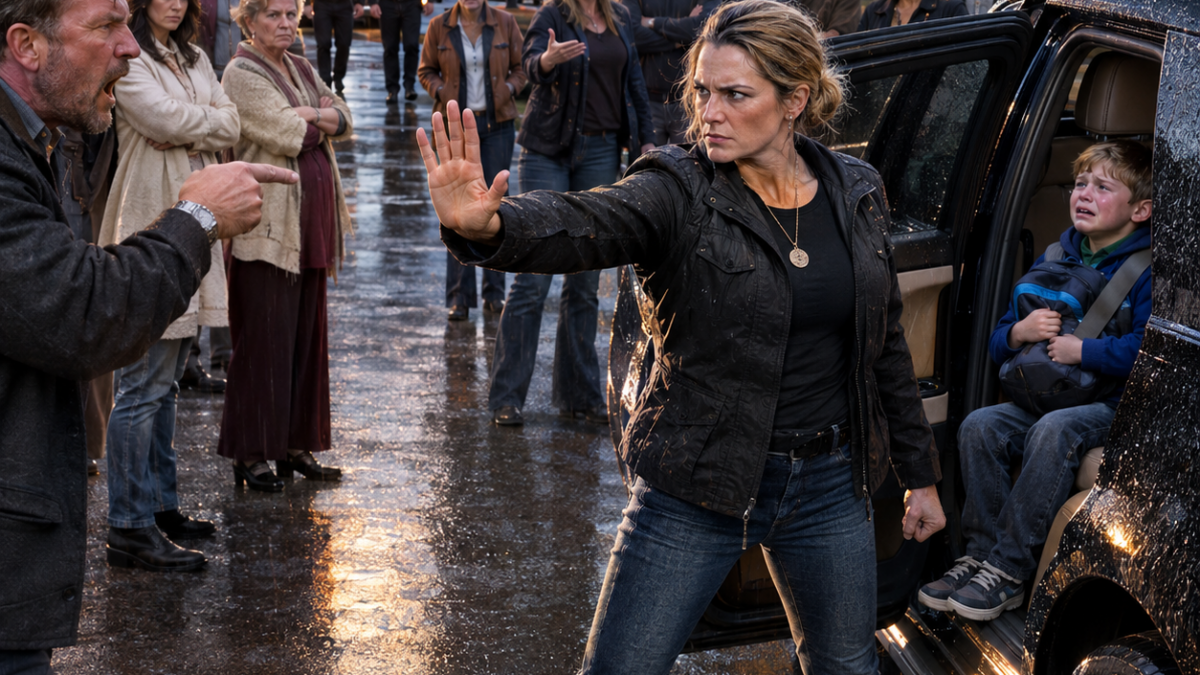
Eleven adults had spread around my SUV.
Grant at the driver’s side.
Caleb near the hood.
Diane and two aunts near Sophie’s door.
Cousins along the front bumper.
Owen stood farther back.
He did not look like he belonged with them anymore.
Nobody spoke for several seconds.
Then Grant said:
“You’re not taking her.”
I looked at him.
“Yes, I am.”
“We have joint custody.”
“She needs emergency medical evaluation.”
“You always do this.”
“Do what?”
“Turn everything into a crisis.”
From the hood, Caleb said:
“Drop the kid and stop acting tough.”
I looked at him.
“She is already in the vehicle.”
He smiled.
“You know what I mean.”
Then one cousin said:
“Maybe somebody needs to teach you some respect too.”
Grant did not correct him.
That mattered.
I shifted my coat.
Grant saw the movement.
His eyes dropped toward my hand.
For the first time, uncertainty entered his face.
He knew pieces of my past.
Not details.
Grant had spent most of our marriage irritated by the parts of my former career I could not discuss.
He liked telling people I had been “basically military intelligence,” which was wrong but sounded impressive at dinner parties.
Now Caleb grinned.
“What are you reaching for?”
I pulled out my emergency phone.
Screen illuminated.
Call active.
Recording icon visible.
The dispatcher’s voice came through the speaker.
“Mara, officers are arriving now.”
Nobody moved.
Then red and blue light washed across the houses.
Caleb stepped away from the hood.
Two cousins moved automatically from the bumper.
Diane whispered:
“Oh, for God’s sake.”
I held the phone up.
“The last eight minutes have been transmitted.”
Grant’s face drained.
“What?”
“The call.”
“The threats.”
“Caleb admitting physical contact.”
“Everything.”
Caleb pointed at me.
“You recorded us without permission.”
The first patrol car stopped behind mine.
I said:
“You can explain that concern to the officer.”
Two officers approached.
One went directly toward the adults.
The other toward me.
“Ma’am?”
“My daughter is inside the passenger seat.”
“Seven years old.”
“Facial injury.”
“Possible jaw injury.”
“Medical has been called.”
He looked through the window.
His expression changed.
“EMS is thirty seconds out.”
Grant stepped toward us.
“I’m her father.”
The officer held a hand out.
“Stay there.”
“This is a custody dispute.”
“No.”
I said it before the officer could.
Grant looked at me.
“This stopped being a custody dispute when medical care was delayed.”
The ambulance arrived.
Paramedics moved fast.
The second one saw Sophie’s face and immediately called for pediatric trauma notification.
They asked me questions.
Conscious?
Yes.
Loss of consciousness?
Unknown.
Vomiting?
No.
Mechanism of injury?
Unknown.
Possible assault.
Caleb shouted:
“She fell!”
Owen said:
“No, she didn’t.”
Everything stopped again.
Grant spun toward him.
“Owen.”
Owen was crying.
Not loudly.
He looked at the officer.
“She didn’t fall.”
Caleb charged one step toward him.
The officer moved between them.
“Back up.”
Owen continued.
“He hit her.”
Diane said:
“Stop talking.”
Owen looked at his mother.
“Mom.”
“She needs a lawyer before—”
“She’s seven.”
His voice cracked.
“She’s seven years old.”
The driveway went silent.
I wanted to ask everything.
Exactly what happened?
How many times?
How long had this been going on?
Instead, I stayed beside Sophie.
That was my job now.
The police could ask questions.
The hospital could document injuries.
Child investigators could interview her properly.
I was her mother.
I did not need to become every professional in the system.
The paramedics transferred Sophie onto a pediatric stretcher.
She panicked when they tried to move me aside.
“No!”
Her voice barely worked.
I climbed into the ambulance.
“I’m going with you.”
Grant shouted:
“I’m her father! I have a right to—”
The officer stopped him.
“You’re staying here until we finish speaking with everyone.”
The ambulance doors closed.
Sophie grabbed my fingers.
Then finally cried.
Not loudly.
Her jaw hurt too much.
Tears simply streamed down her face while her body shook.
I leaned close.
“You can cry.”
Her eyes searched mine.
“You’re allowed to cry.”
She broke.
And I broke with her.
Quietly.
The trauma center took us immediately.
Imaging.
Pediatric specialist.
Pain control.
Questions.
Her jaw was badly injured but treatable.
There was significant swelling and bruising.
No brain bleed.
No spinal injury.
Those words became the first air I had taken in hours.
The specialist explained treatment.
Possible surgery.
Recovery.
Soft foods.
Follow-up.
I heard all of it.
Wrote everything down.
Then a nurse named Rebecca asked:
“Would you step outside for a moment while our child advocate speaks with Sophie?”
Every instinct screamed:
No.
I had just found her.
She had begged me not to leave.
Rebecca saw my face.
“You’ll be right outside the glass.”
I crouched beside Sophie.
“Baby, this woman needs to ask you some questions.”
Sophie gripped my hand.
“You leaving?”
“Right there.”
I pointed.
“You’ll see me.”
“Promise?”
“Yes.”
That promise I could make.
The child advocate was trained.
No leading.
No accusations.
Simple questions.
I watched through the glass.
Sophie spoke slowly because of pain.
Some answers were written.
Some nodded.
Some shook.
The story emerged in fragments.
Grant had hosted a family dinner.
Sophie asked to call me.
Grant said later.
She asked again.
Caleb called her spoiled.
He took her tablet.
Sophie reached for it.
Caleb grabbed her arm.
She kicked his shin trying to get away.
He struck her.
Once.
Then again after she screamed.
She fell near the hearth.
Grant saw at least part of it.
Diane entered immediately afterward.
Nobody called for help.
They argued about what to do.
Sophie asked for me.
Grant told her to stop crying.
Then filmed her.
That video.
The one he sent.
Why?
I still do not understand.
Maybe he wanted to hurt me.
Maybe he thought humiliating Sophie would prove she was manipulative.
Abusive people often believe their own cruelty looks reasonable from the inside.
Owen was the only one who called.
He had waited too long.
But he called.
That mattered.
A detective arrived at the hospital.
Then a child-protection investigator.
The emergency custody process began that night.
My attorney, Julia Mercer, answered on the third ring despite the hour.
I had hired her during the divorce because she specialized in high-conflict custody.
She listened.
Then said:
“Do not contact Grant.”
“Wasn’t planning to.”
“Do not contact Caleb.”
“No.”
“Do not post anything.”
“I know.”
“And Mara?”
“Yes?”
“This is not a mission.”
I closed my eyes.
“I know.”
“No, listen.”
Her voice softened.
“You do not need to solve the entire case tonight.”
That landed harder than I expected.
For sixteen years, crises had been my profession.
Identify threat.
Control scene.
Recover person.
Preserve evidence.
Move.
But Sophie’s life was not an operation.
There would be doctors.
Courts.
Therapists.
School.
Nightmares.
Custody hearings.
Recovery.
No extraction helicopter.
No clean ending.
“I understand.”
“Good.”
Then Julia added:
“Right now, your job is to be her mother.”
I looked through the doorway.
Sophie slept.
“Yes.”
That night I sat beside her bed.
At 2:14 a.m., she woke.
“Mom?”
“I’m here.”
Her eyes moved toward the door.
“Is Daddy coming?”
“No.”
“Caleb?”
“No.”
“Grandma?”
“No.”
She relaxed slightly.
Then:
“Are they mad at me?”
I felt something inside me tear open.
“No.”
She blinked.
“Daddy said I ruin everything.”
I took her hand.
“Adults are responsible for what adults do.”
“He said if I listened—”
“No.”
I kept my voice gentle.
“If an adult hurts a child because the child does something they don’t like, the adult is still responsible.”
She started crying.
“I kicked Uncle Caleb.”
“You were trying to get away.”
“He said I’m bad.”
“You are not bad.”
“He said you make me weak.”
That sentence almost made me physically ill.
I leaned closer.
“Sophie.”
She looked at me.
“Being scared does not make you weak.”
“Crying does not make you weak.”
“Asking for your mother does not make you weak.”
“And nobody gets to hurt you because you miss me.”
She held my fingers.
Then slept.
I stayed awake until sunrise.
Grant texted at 6:02.
You are blowing this out of proportion.
6:07:
Caleb made a mistake. Sophie provoked him.
6:11:
If you destroy this family over one accident, that’s on you.
I screenshot everything.
Sent it to Julia.
No response.
At 7:30, another message.
At least answer me like an adult.
I laughed.
Quietly.
The man who had filmed his injured daughter was requesting maturity.
Julia filed for emergency temporary custody.
The judge granted an immediate interim order based on the medical records, police report, video, and pending child-safety investigation.
Grant’s unsupervised parenting time was suspended pending hearing.
Caleb was ordered to have no contact with Sophie.
Grant was prohibited from facilitating contact between them.
I read the order twice.
Then a third time.
Paper felt inadequate.
A piece of paper could not undo Sophie’s fear.
But paper creates boundaries.
Boundaries matter.
Caleb was arrested after investigators reviewed witness statements, medical evidence, Grant’s video, driveway recordings, and Owen’s account.
I did not attend the arrest.
Did not watch.
Did not celebrate.
I was making applesauce.
Sophie could barely eat.
That became my world.
Applesauce.
Soup.
Yogurt.
Medication schedule.
Cold packs.
Follow-up appointments.
Night light.
Sleeping beside her bed when she woke screaming.
The first week home, she refused to close her bedroom door.
Second week, she refused to enter our backyard alone.
Third week, she had a panic attack when a man in a grocery store laughed loudly behind us.
Trauma does not care that the danger is gone.
The body keeps checking.
Her therapist, Dr. Naomi Feld, explained it carefully.
“Sophie’s nervous system learned that ordinary family space was unsafe.”
“How do we fix that?”
“We don’t force it to forget.”
I hated that answer.
“What do we do?”
“We teach it something new.”
“What?”
“That safe experiences can happen repeatedly.”
Repeatedly.
Not once.
Not dramatically.
Again.
And again.
And again.
That was harder than rescuing her.
Rescue happened in one afternoon.
Recovery took years.
Owen contacted Julia.
He wanted to provide a formal statement.
I did not meet him.
Not yet.
His statement explained more.
Grant’s family had been gathering for Diane’s birthday.
Sophie had become upset because Grant refused to let her call me.
Caleb mocked her.
She yelled that she wanted to go home.
Caleb took the tablet.
Sophie tried to recover it.
He grabbed her.
She kicked.
He lost his temper.
Owen said the first strike shocked everyone.
The second changed the room.
Then Sophie fell.
For approximately six minutes, nobody helped.
Six minutes.
That number haunted me.
Not because six minutes is long.
Because eleven adults were present.
Eleven.
Owen eventually knelt beside her.
Grant ordered him away.
Diane said they needed to “get the story straight before Mara arrived.”
That sentence became important later.
Grant insisted they should say Sophie tripped.
Caleb agreed.
One aunt objected.
Then backed down.
Owen went into the kitchen and called me quietly.
Why had eleven people surrounded my SUV?
According to Owen:
Grant panicked when I carried Sophie out.
Diane said if I took her directly to the hospital, “everything would become official.”
Everything.
As though the injury became real only when documented.
So the family tried to delay me.
Some believed they were protecting Caleb.
Some believed they were protecting Grant’s custody.
Some simply followed the strongest voice in the group.
That may have been the ugliest lesson of all.
Most terrible group decisions do not require eleven terrible people.
They require one or two aggressive people and enough frightened people willing to become furniture.
The driveway recording captured Grant saying:
“You’re not leaving with the girl.”
Caleb:
“Drop the kid.”
One cousin:
“We’ll break you next.”
Diane saying:
“Take the phone from her.”
Owen saying:
“Stop.”
Then police sirens.
Julia called the recording “devastating.”
I called it exactly what happened.
The temporary custody hearing came three weeks later.
Grant arrived with a lawyer.
Gray suit.
Conservative tie.
He looked like the man I had married.
That hurt more than expected.
We had not begun badly.
People always assume abusive dynamics must have been obvious from the first date.
Ours were not.
Grant had been funny.
Attentive.
Wonderful with children.
He sent flowers to my mother.
Cooked breakfast.
He loved telling people he was proud of my career.
Then gradually, my independence became something he competed with.
My classified travel annoyed him.
My calmness angered him during arguments.
He said it made him feel “interrogated.”
After Sophie was born, he wanted me to leave federal service.
I eventually did.
Partly for Sophie.
Partly because I was tired.
Partly for the marriage.
It did not fix us.
Nothing ever fixed the fact that Grant needed every disagreement to end with somebody losing.
We divorced when Sophie was five.
Shared custody had been the compromise.
I had spent two years being careful not to make Sophie feel caught between parents.
That restraint now became part of Grant’s defense.
His attorney argued:
Mara had never previously alleged physical abuse.
True.
Mara had trusted Grant with overnight custody.
True.
The Ellisons were a close family.
True.
Caleb’s conduct had been isolated.
Maybe.
Grant had not struck Sophie.
Also true.
Then Julia stood.
She did not call Grant a monster.
She did not need to.
She played his video.
Eight seconds.
The courtroom watched Sophie sitting injured on the floor.
Then Grant’s voice:
“At least now the useless brat finally stopped begging for her mommy.”
Silence afterward.
The judge asked:
“Mr. Ellison, why did you send this video?”
Grant looked at his attorney.
Then:
“I was angry.”
“At your seven-year-old daughter?”
“At Mara.”
“So you filmed your injured daughter to hurt her mother.”
Grant swallowed.
“I made a bad decision.”
Julia then presented the texts.
Sophie provoked him.
Another bad decision.
Then the driveway audio.
Another.
Then Owen’s sworn statement explaining that Grant participated in the decision not to call EMS immediately.
By the time Julia sat down, there was nothing theatrical left.
Just choices.
The judge extended my temporary sole physical custody.
Grant received supervised contact only after meeting conditions established through the child-safety process.
No contact between Sophie and Caleb.
Family members who had participated in obstructing medical care could not supervise visits.
Parenting evaluation.
Therapy.
Further review later.
Grant looked at me as we left.
I did not look back.
For the first time in my life, victory felt like grief.
Because every restriction protecting Sophie also confirmed something I had desperately wanted not to be true:
Her father had failed her.
Children do not celebrate that.
They mourn it.
Sophie asked about Grant almost every day.
“Does Daddy love me?”
The hardest question.
I asked Dr. Feld how to answer.
“Do not lie.”
“But don’t make her responsible for adult behavior.”
So I said:
“I believe Daddy has feelings for you that he calls love.”
“That does not mean everything he did was safe or right.”
She frowned.
“Can someone love you and be bad?”
“Someone can love you and still make harmful choices.”
“Then love isn’t enough?”
Seven years old.
Already asking questions adults avoid for decades.
“No.”
I kissed her hair.
“Love also has to be safe.”
She thought about that for a long time.
Caleb’s criminal case moved slower.
Months.
Witness interviews.
Medical experts.
Defense arguments.
Plea negotiations.
At one point his attorney suggested Sophie’s injury occurred partly when she fell.
That may have been physically true.
It did not erase why she fell.
The prosecution ultimately presented sufficient evidence that Caleb had intentionally struck her during the confrontation.
He eventually accepted a plea involving felony child abuse and assault-related charges, with incarceration, probation after release, required intervention programming, and a long-term protective order.
Some relatives thought the sentence was too harsh.
Others thought too light.
I did not measure justice by years.
I measured it by whether Sophie had to see him again.
She did not.
Grant’s family fractured.
Owen stopped speaking to Caleb.
Two aunts apologized through Julia.
One cousin who had threatened me in the driveway sent a letter.
I did not read it for six months.
When I did, it said:
I thought we were protecting the family. I understand now that we were protecting the adult who caused harm instead of the child who needed protection.
That was one of the few apologies that mattered.
Diane never apologized.
She blamed me.
Said I had “weaponized the system.”
Eventually, Julia asked whether I wanted to respond to one of her letters.
“No.”
“Good.”
“Why good?”
“Because I was worried you were going to say yes.”
I laughed.
Therapy helped me too.
I resisted at first.
My career had trained me to process after-action reports.
Not feelings.
My therapist, Dr. Adrian Ross, did not care about my résumé.
Our third session, he said:
“You keep describing the driveway like a tactical perimeter.”
“It was.”
“No.”
I stared.
“Eleven adults blocked my vehicle.”
“Yes.”
“But what frightened you most?”
“That they might stop me reaching Sophie.”
“You had already reached her.”
Silence.
He continued.
“What frightened you?”
I hated him.
Then I knew.
“That I might become what they expected.”
“What did they expect?”
“Violence.”
The word tasted strange.
“They wanted me angry.”
“Why?”
“Because then Grant could say I was unstable.”
“Dangerous.”
“Exactly.”
“And were you?”
I thought about Caleb’s face.
The way he laughed.
The years of training stored inside my body.
“Yes.”
Dr. Ross waited.
“I was capable of hurting them.”
“But you didn’t.”
“No.”
“Why?”
“Sophie was watching.”
There it was.
The deepest truth.
I did not remain calm because I was tougher than eleven people.
I remained calm because my daughter needed one adult in that driveway whose behavior she did not have to fear.
That became the part of myself I was proud of.
Not my old unit.
Not tactical skill.
Restraint.
People confuse strength with what someone can do.
Often it is what they choose not to do.
Six months after the incident, Sophie’s jaw had healed physically.
She hated dental appointments.
Did not like anyone touching her face.
But she smiled again.
Slowly.
At first, photos showed a cautious smile.
Lips closed.
Then one afternoon at the park, she laughed so hard at a dog stealing a child’s sandwich that I saw every tooth.
I cried.
Sophie stared.
“Why are you crying?”
“Because you’re funny.”
“The dog was funny.”
“Same thing.”
She rolled her eyes.
Seven going on forty.
School became complicated.
Another child asked why she had missed classes.
Sophie said:
“My uncle hurt me.”
The teacher called me.
Not because Sophie had done anything wrong.
Because children were asking questions.
We worked with the school counselor.
Sophie decided she wanted a simple sentence.
I got hurt, adults handled it, and I’m safe now.
That became her answer.
She did not owe classmates her trauma.
Another lesson adults could learn.
Grant complied with supervised visits for four months.
Then missed one.
Then another.
Sophie noticed.
“Why didn’t Daddy come?”
“I don’t know.”
“Did I do something?”
“No.”
“Maybe he’s mad because I told.”
“No.”
“You sure?”
“Yes.”
That one I knew.
Telling the truth was not betrayal.
Grant eventually resumed.
The visits were awkward.
Sophie wanted him.
Feared him.
Loved him.
Resented him.
All at once.
The supervisor’s notes reflected that.
Grant apologized during one session.
He said:
“I’m sorry I didn’t protect you.”
Sophie asked:
“Why didn’t you?”
There are no good answers to some questions.
Grant cried.
Sophie did not comfort him.
I was proud of that too.
Children should not be forced to rescue adults from guilt.
A year after the incident, the custody case reached final modification.
The evidence was extensive.
Medical records.
Police reports.
Child-safety findings.
Grant’s texts.
Video.
Supervised visitation reports.
Therapist recommendations.
The court granted me primary legal and physical custody.
Grant received structured parenting time subject to continuing safeguards.
No overnight visits initially.
No contact with Caleb.
Clear medical decision requirements.
No interference with Sophie contacting me during parenting time.
Grant’s family members had no independent rights to override those restrictions.
When the judge finished, I expected relief.
Instead, I remembered the first custody order after our divorce.
We had sat beside each other then.
Grant had whispered:
“We can still be good parents.”
I had believed him.
Maybe he had believed himself.
I cried in the courthouse bathroom.
Julia found me.
She did not say:
You won.
She handed me tissues.
“Grieving?”
“Yes.”
“Good.”
I looked at her.
“Good?”
“It means you understand what this cost.”
She was right.
The first birthday after everything, Sophie turned eight.
No Ellison gathering.
No big party.
She wanted six friends.
Pizza.
A magician.
Chocolate cake.
Before guests arrived, she asked:
“Can Uncle Owen come?”
I froze.
Owen had visited once with a child therapist present.
Sophie remembered that he was the person who called me.
She also remembered he waited.
Children can hold both.
“Do you want him here?”
“Yes.”
“Then I’ll ask your therapist.”
Dr. Feld supported a short visit.
Owen came early.
He stood at the doorway holding a gift.
Could barely look at me.
Sophie ran toward him.
Then stopped halfway.
Her body remembered.
Owen noticed.
He did not move closer.
“Hi, Soph.”
“Hi.”
“I brought you something.”
She approached slowly.
Opened the bag.
A telescope.
She smiled.
“I wanted one.”
“I remember.”
Then she asked:
“Why didn’t you stop Caleb?”
The entire room changed.
Owen put the gift down.
Kneeling would have brought him closer, so he remained where he was.
“I was scared.”
Sophie frowned.
“You’re a grown-up.”
“Yes.”
“You were supposed to help.”
“Yes.”
His eyes filled.
“I should have.”
“Why did you call Mommy?”
“Because I finally stopped being scared enough to do one right thing.”
Sophie considered.
Then:
“You should’ve done it faster.”
“Yes.”
No excuses.
That mattered.
She hugged him.
Briefly.
Then ran to show me the telescope.
Owen cried after she left.
“I don’t deserve that.”
I said:
“She didn’t hug you because you deserved something.”
“She hugged you because she wanted to.”
He nodded.
“I’m sorry, Mara.”
“I know.”
“You forgive me?”
“No.”
His face fell.
“Not yet.”
I looked toward Sophie.
“But I believe you’re trying to become somebody she can safely know.”
That was more honest than easy forgiveness.
He accepted it.
Over the next several years, Owen became the only Ellison relative Sophie chose to maintain regular contact with outside Grant.
Not because I pushed.
Because he did the work.
Therapy.
Boundaries.
Testimony.
He refused family pressure to retract.
He lost relationships over it.
He never complained to Sophie about that cost.
That is what accountability looked like.
Grant changed more slowly.
For a while, he blamed Caleb privately.
Then Diane.
Then alcohol at the birthday dinner.
Then me.
Eventually, therapy forced him toward himself.
At one supervised parenting review, he told the evaluator:
“I thought keeping my family together meant making Mara the enemy.”
That sentence eventually reached me through the report.
Then:
“I did not realize Sophie understood that meant she had to choose sides too.”
Progress.
Not absolution.
Years later, Grant’s parenting time expanded modestly.
Never back to what it had been.
Trust does not reset because someone attends therapy.
It grows according to evidence.
Sophie decided what she wanted as she became old enough to speak more clearly for herself.
At ten, she agreed to unsupervised daytime visits.
At eleven, she asked to stop them for two months after Grant defended Diane during an argument.
We listened.
At twelve, she tried again.
Not linear.
Healing rarely is.
Caleb remained outside her life.
When he was eventually released, the protective restrictions stayed.
He wrote Sophie a letter through counsel.
She was thirteen.
Julia asked what I wanted.
“Her therapist decides whether she should even know.”
Good.
Dr. Feld discussed it with Sophie without giving her the letter.
Sophie asked:
“Do I have to read it?”
“No.”
“Can I later?”
“Yes.”
“Then later.”
She never asked again.
The letter remains sealed in Julia’s archive.
That is also power.
Not every apology deserves an audience.
My own career history became something Sophie understood gradually.
At seven:
“Mom used to help people.”
At ten:
“Mom worked for the government.”
At thirteen:
“Mom had a very weird job and won’t tell me anything.”
At sixteen, she asked:
“Could you really have beaten up everybody in the driveway?”
I nearly choked on coffee.
“Who told you that?”
“Uncle Owen said Dad’s family was terrified when you reached into your coat.”
“I pulled out a phone.”
“I know.”
She grinned.
“But could you?”
I looked at her.
“The point is that I didn’t.”
She became serious.
“Because of me?”
“Partly.”
“What was the other part?”
“Because hurting people when I had another safe option would have been wrong.”
She nodded.
Then:
“Good.”
That one word mattered more than every commendation I ever received professionally.
Sophie eventually watched the driveway recording.
At seventeen.
Her choice.
We had kept the original evidence secured.
Dr. Feld and I both recommended against casual viewing.
Sophie insisted.
She wanted to understand what happened from outside her seven-year-old memory.
We watched together.
Grant blocking my door.
Caleb by the hood.
Diane.
The cousins.
My voice.
Calm.
Then Sophie’s faint voice from inside:
“Mommy, please don’t leave me here.”
Seventeen-year-old Sophie paused the video.
She cried.
I reached toward her.
Stopped.
“Can I hug you?”
“Yes.”
I held her.
After a while, she said:
“I remember thinking you might have to leave because there were too many of them.”
“I wasn’t leaving.”
“I know now.”
She wiped her face.
Then looked at the screen.
“You didn’t even yell.”
“I was terrified.”
“You don’t look terrified.”
“That doesn’t mean anything.”
She stared at me.
“You always tell me being brave doesn’t mean not being afraid.”
“Yes.”
“I thought that was just parent stuff.”
I laughed.
“It usually is.”
She restarted the video.
When the sirens appeared, she whispered:
“That was when I knew.”
“Knew what?”
“That they couldn’t keep me.”
I did not sleep much that night.
Not because of the recording.
Because I finally understood something.
For years, I had remembered the driveway as the moment I almost lost control.
Sophie remembered it as the moment she realized she was leaving.
Same event.
Different memory.
Maybe that was healing.
At eighteen, Sophie graduated high school.
Grant attended.
Owen attended.
Diane did not.
Her choice.
Mine too.
There had been no contact for years.
After the ceremony, Grant approached me.
Gray hair at his temples now.
Older.
Softer.
“Mara.”
“Grant.”
He looked toward Sophie taking pictures with friends.
“You did a good job.”
I hated the sentence.
Not because it was untrue.
Because parenting Sophie should never have become my solo victory.
“We did what she needed.”
He nodded.
“I should’ve done more.”
“Yes.”
No comforting lie.
He swallowed.
“I know.”
Then:
“Thank you for not taking her away from me completely.”
I looked at him.
“The court set the restrictions.”
“You could’ve made it worse.”
“No.”
He waited.
“I could’ve fought harder.”
“Maybe.”
“But I was never going to use Sophie to punish you.”
His eyes filled.
“That’s what I did to you.”
“Yes.”
He nodded.
“I’m sorry.”
I believed him.
That did not erase anything.
But I believed him.
“Take care, Grant.”
“You too.”
That was our ending.
Not reconciliation.
Not hatred.
A boundary.
Sophie went to college three states away.
Psychology.
Of course.
I joked that raising her had been expensive enough without funding graduate school too.
She replied:
“Think of how much therapy you’ll save other people.”
Fair.
Her freshman year, she called at 1:13 a.m.
“Mom?”
I sat up instantly.
“What happened?”
“Nothing.”
My heart took several seconds to believe her.
“I’m having a bad night.”
“Want me to come?”
“No.”
Progress.
“Want me to stay on the phone?”
“Yes.”
So I did.
Two hours.
She talked about classes.
A boy.
Dorm drama.
Then, quietly:
“I had the dream again.”
The house.
The fireplace.
The locked jaw.
The adults.
“Did you use what Dr. Feld taught you?”
“Yes.”
“Help?”
“A little.”
“That’s enough.”
She went silent.
Then:
“Mom?”
“Yeah?”
“Thank you for coming.”
Twenty years of crisis work could not have prepared me for that sentence.
I closed my eyes.
“Always.”
The word came automatically.
Then I corrected myself.
“I will always do everything I can.”
Sophie laughed softly.
“Therapy ruined you.”
“Completely.”
She graduated four years later.
Then completed clinical training.
Her specialty became children recovering from family violence.
I worried.
Of course I worried.
Was she choosing it because she was healed?
Or because she was still trapped?
She answered before I asked.
“Both can be true.”
Dr. Feld had apparently done excellent work.
Sophie eventually joined a child-advocacy center.
She never told children:
“I know exactly how you feel.”
Because nobody does.
She told them:
“You get to tell the truth at your own speed.”
I heard her say that once during an interview about her work.
I cried in my kitchen.
Again.
Apparently age had not improved my dignity.
At twenty-nine, Sophie married.
A woman named Rachel.
Teacher.
Funny.
Gentle.
The first time Rachel met me, she shook my hand and said:
“Sophie says you’re intimidating.”
Sophie shouted from the kitchen:
“I SAID CAPABLE.”
Rachel whispered:
“She said both.”
I liked her immediately.
At the wedding, Owen sat in the fourth row.
Grant sat in the second.
They did not sit together.
Some fractures remain.
That is okay.
During the reception, Sophie asked me to dance.
Halfway through, she said:
“Do you remember the driveway?”
“Every day.”
“I don’t.”
That stopped me.
“What?”
“Not every day anymore.”
She smiled through tears.
“Sometimes months.”
I understood.
That was better than forgetting.
Trauma had stopped being the calendar.
Later that night, she gave me a small box.
Inside was the old emergency phone.
Decommissioned.
I had stored it with case materials after investigators released it.
She had asked Julia for it.
“What am I supposed to do with this?”
“Keep it.”
“Why?”
She smiled.
“Because everybody thinks the story is about the scary thing you reached for.”
I looked at her.
“And it wasn’t.”
“No.”
“What was it about?”
She took my hand.
“You chose the thing that called for help instead of the thing that could hurt them.”
I could not speak.
Sophie continued.
“That’s what I remember now.”
Not the swelling.
Not Caleb.
Not Grant’s video.
Not eleven adults.
A phone.
A mother.
Sirens.
Leaving.
I held the box against my chest.
Years earlier, standing inside that circle of people, I had thought the most important decision of my life was whether I could physically get through them.
It wasn’t.
The important decision had been what kind of mother Sophie would see when I did.
The Ellisons expected fury.
They expected panic.
Maybe they even expected violence, because violence would have rescued their story.
They could have said:
See?
Mara is unstable.
Mara is dangerous.
Mara is the problem.
Instead, I gave them documentation.
Dispatch.
Witnesses.
Medical records.
Police.
Courts.
Therapists.
Time.
The truth is less cinematic than revenge.
It is also harder to defeat.
Caleb eventually became a man Sophie barely remembered.
Grant became a complicated father she chose to know within boundaries.
Owen became the uncle who failed once, then spent years refusing to fail the same way again.
Diane became a name.
And Sophie became herself.
Not “the child who was hurt.”
Not “the survivor.”
Not my mission.
Sophie.
A woman who laughs loudly.
Cries when she needs to.
Calls people she loves.
Leaves rooms that become unsafe.
And never apologizes for asking for her mother.
That is the justice I wanted.
Not eleven frightened people staring at me while I revealed some secret weapon.
Not Caleb lying injured on concrete.
Not Grant losing everything.
I wanted my daughter to grow old without believing that love required silence.
She did.
And that is why, when people hear the dramatic version of what happened and ask me the same question—
“What did you pull from your coat?”
—I tell them the truth.
A phone.
Just a phone.
Already connected to people whose job was to help.
Because after sixteen years working in dangerous places, I had learned something the Ellison family had not:
the strongest person in a hostile circle is not always the one who can hurt the most people.
Sometimes it is the one who can stand there terrified, refuse to become violent, preserve the truth, and make sure the smallest person in the entire scene gets safely home.
That afternoon, the Ellisons thought they had surrounded me.
They were wrong.
By the time Grant told me I was not leaving with my daughter, the perimeter had already changed.
Dispatch was listening.
Cameras were recording.
Police were coming.
The hospital was waiting.
And Sophie was finally on the side of the door where someone believed her.
So when Caleb smiled and said they would “break me next,” I smiled back.
Not because I was fearless.
Not because I had a secret military weapon.
Not because I wanted a fight.
I smiled because for the first time that day, I knew something they did not.
They had spent hours trying to keep what happened inside their family.
I had just opened the door.
And once the truth walked out with Sophie in my arms, none of them were strong enough to drag it back inside.








