PART2:“DON’T SAY GOODBYE YET, COLONEL—HE’S STILL FIGHTING!” A Decorated Soldier Broke Down Holding His Dying Military K9—Then the Veterinarian Whispered Something That Changed Everything
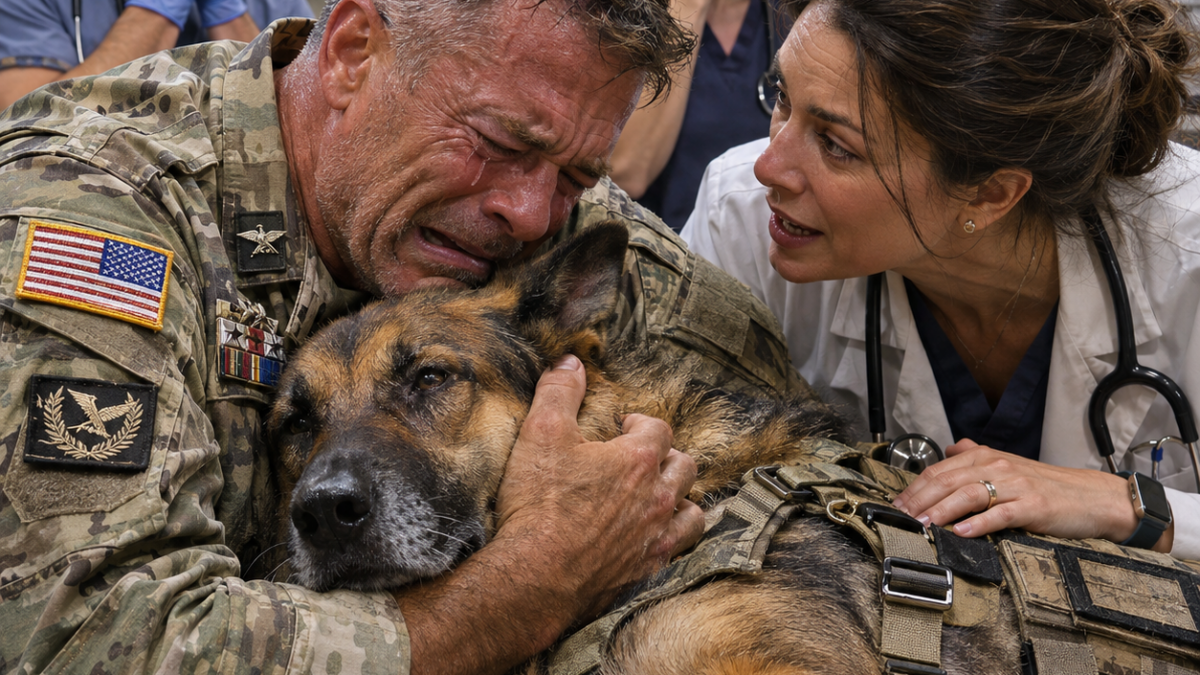
The first time Rex saved Edward’s life, nobody realized it until the danger was already behind them.
Their unit was moving through a rocky mountain pass during a difficult overseas operation.
The terrain was narrow.
Uneven.
Strewn with loose stones and sharp ridges.
The soldiers were tired.
Visibility was poor.
And the route ahead appeared clear.
Edward walked near the front.
Rex moved slightly ahead under his handler’s control.
Everything seemed routine.
Then Rex stopped.
Abruptly.
His body stiffened.
Ears rose.
Tail became still.
Edward noticed immediately.
“Rex?”
The dog didn’t move.
He stared toward a narrow section of the trail.
Then gave the trained indication that something was wrong.
Edward raised his hand.
The unit halted.
A younger officer behind him whispered:
“Sir?”
Edward didn’t answer.
He watched Rex.
The dog remained focused.
Edward signaled the team to maintain distance and requested the appropriate specialists to assess the route.
Minutes later, they confirmed the danger.
The apparently ordinary path concealed a deadly threat.
Had the soldiers continued without stopping, several might have been killed or wounded.
The route was secured through established procedures.
The team moved safely.
And when they reached their next position, Edward crouched beside Rex.
For several seconds, he said nothing.
Then rested both hands on the dog’s shoulders.
“You knew.”
Rex looked up.
Edward smiled.
“You knew before any of us.”
The dog licked his wrist.
Edward laughed.
“Don’t let it go to your head.”
That evening, he gave Rex an extra portion of his approved food.
Thomas Reed noticed.
“Special occasion, sir?”
Edward looked toward the dog.
“He earned it.”
Thomas smiled.
“So did the rest of us.”
Edward nodded.
“Yes.”
“Because he was paying attention.”
From that day forward, Edward never treated Rex as equipment.
He was a partner.
A living, breathing member of the team.
And in the years that followed, that distinction would save more than one life.
The second time Rex saved Edward, there was no warning.
Only darkness.
Noise.
Pain.
And then nothing.
The mission had begun badly.
Weather complicated movement.
Communications became unreliable.
The unit was operating under extreme pressure.
Edward remembered giving instructions.
Remembered moving toward a covered position.
Then an explosion.
He never remembered the exact moment he fell.
Later, medics explained that he had suffered serious injuries and lost consciousness.
The blast separated him from several members of the team.
Visibility deteriorated.
The immediate area remained dangerous.
For a time, no one could reach him.
Rex was with him.
The dog had survived the initial blast.
He was shaken and injured by debris, but still mobile.
And when Edward collapsed, Rex stayed.
At first, he tried to rouse him.
Pressed his muzzle against the colonel’s shoulder.
Moved around his body.
Whined.
Edward didn’t respond.
Rex settled beside him.
Then waited.
The night grew colder.
Wind swept through the surrounding terrain.
Somewhere in the darkness, distant gunfire echoed.
Rex remained alert.
When movement approached, he raised his head.
Listened.
Watched.
Then returned to Edward’s side.
Hours passed.
Later, one of the rescuers would say:
“We might have passed that position if the dog hadn’t alerted us.”
The recovery team was searching in difficult conditions.
Their lights moved across broken terrain.
They called names.
Listened.
Then heard barking.
Not frantic, random barking.
A focused signal from a trained dog.
The team followed the sound.
And found Rex standing beside Edward.
The colonel was alive.
Barely conscious.
Seriously injured.
But alive.
A medic knelt immediately.
Checked his breathing.
Called for evacuation support.
Rex remained so close that the medic had to gently guide him aside.
“Easy, boy.”
The dog resisted at first.
Then watched as the medical team worked.
When Edward was moved, Rex followed.
He did not leave.
Not during the evacuation.
Not when they reached the treatment area.
Not until someone finally assured him that his partner was being cared for.
When Edward opened his eyes later, the first thing he felt was warmth against his hand.
He turned his head.
Rex was there.
Lying beside the bed.
His eyes fixed on Edward’s face.
Edward tried to speak.
His throat was dry.
His body hurt.
But he managed one word.
“Rex.”
The dog lifted his head immediately.
His tail began moving.
Edward smiled weakly.
“Good boy.”
Rex leaned forward and touched his nose to the colonel’s fingers.
A nurse standing nearby began crying.
She had been told how the dog refused to leave.
How he stayed in the cold.
How his alerts helped rescuers locate the wounded officer.
She watched Edward close his eyes while holding Rex’s collar.
And understood that she was witnessing something far deeper than a handler comforting a working dog.
It was a man thanking the creature who had refused to let him disappear into the dark.
Edward spent weeks recovering.
The injuries left scars.
Pain.
A stiffness in his shoulder that never completely went away.
But he survived.
Rex recovered too.
The dog had suffered cuts and bruising, but no lasting injury prevented him from continuing after veterinary clearance.
During rehabilitation, Edward asked that Rex be allowed to visit whenever possible.
The medical staff agreed within the facility’s rules.
The first time Rex entered the room, Edward was sitting in a chair beside the window.
He looked tired.
Pale.
His right arm supported.
Rex stopped at the doorway.
Ears raised.
Then walked toward him.
Edward smiled.
“Hey, soldier.”
The dog placed his head against Edward’s knee.
Edward’s expression changed.
He touched the thick fur around Rex’s neck.
Then whispered:
“They told me you stayed.”
Rex looked up.
Edward swallowed.
“All night.”
The dog moved closer.
Edward closed his eyes.
“They said you wouldn’t leave.”
His voice broke.
He wrapped his good arm around Rex.
Then began crying.
Not loudly.
Not dramatically.
But with the quiet, exhausted grief of a man who had come close enough to death to understand what survival really meant.
Rex stood motionless.
Let Edward hold him.
The colonel pressed his forehead against the dog’s neck.
Then whispered:
“I owe you my life.”
A military physician standing near the door looked away respectfully.
Edward didn’t notice.
He was holding the one friend who had remained beside him when everything else disappeared.
Later, he began telling people something that became familiar throughout the unit.
“I was given my life twice.”
They would ask:
“What do you mean, sir?”
Edward would smile toward Rex.
“Once when I was born.”
“And once when that dog refused to leave me behind.”
For years, the story followed them.
The colonel and the German Shepherd.
The officer whose career involved commanding men.
And the animal who had quietly taught him what loyalty looked like without a single word.
The years brought other missions.
Other dangers.
Other soldiers who came home because Rex noticed something before anyone else.
A suspicious object near a roadside.
A hidden threat beyond a structure.
A person concealed where visibility was poor.
Details varied.
But the pattern remained.
Rex paid attention.
Edward trusted him.
And other soldiers learned to trust him too.
Captain Michael Turner was one of them.
Michael had been twenty-four during an operation in which Rex’s alert prevented the team from entering a dangerous area.
He later told Edward:
“Sir, I didn’t understand why you stopped us.”
Edward replied:
“That’s why we have the dog.”
Michael looked toward Rex.
The German Shepherd was drinking water.
Completely unconcerned with the conversation.
Michael smiled.
“Does he know what he just did?”
Edward watched him.
“I don’t think he understands medals.”
“Or promotions.”
“Or reports.”
Michael laughed.
“Then what does he understand?”
Edward considered.
Then answered:
“His people.”
Over the years, Michael married.
Had two daughters.
Left active duty.
Built a quiet life in Virginia.
But every Christmas, he sent Edward a photograph.
The girls growing older.
A decorated tree.
A smiling family.
And beneath the photograph, usually the same words.
Tell Rex those girls are here because he kept their father alive.
Edward saved every card.
Not in a military file.
In a wooden box at home.
Because some records mattered too much to be reduced to reports.
Sergeant Thomas Reed had his own story.
He remembered the day a young Rex refused to cooperate during an endurance exercise.
The dog had been restless.
Difficult.
Eager to run.
Thomas complained that he might never become reliable.
Edward had laughed.
“Give him time.”
Thomas shook his head.
“You’re awfully patient with him.”
Edward looked at Rex.
Then said:
“Maybe because he’s patient with me.”
Thomas remembered that line years later.
By then, Edward had become a colonel.
Rex had become one of the unit’s most respected working dogs.
And Thomas had come to understand that their relationship was not built through fear.
Edward set boundaries.
Expected discipline.
Maintained training.
But he also listened.
When Rex was tired, he noticed.
When Rex became uncertain, he didn’t simply shout louder.
When the dog worked well, he rewarded him.
And when Rex made a mistake, Edward corrected it without treating the animal as disposable.
That consistency built trust.
And that trust became invaluable when conditions were dangerous.
Thomas eventually told younger handlers:
“Watch Colonel Hayes with Rex.”
“Not just when the dog obeys.”
“Watch what happens when something goes wrong.”
Because good partnerships aren’t proven only on good days.
They’re proven when something becomes difficult.
The trouble with time is that it rarely announces itself.
It doesn’t arrive one morning wearing a uniform and declare that everything is about to change.
It moves quietly.
A little gray fur around the eyes.
A longer pause before standing.
A shorter walk.
A day when the stairs become harder.
Then another.
Edward noticed the first signs when Rex was nine.
He no longer jumped into the truck without hesitation.
At ten, he began sleeping more deeply.
At eleven, his once-powerful stride shortened slightly during cold weather.
Then came the morning when Edward stood near the front door holding Rex’s leash.
“Ready?”
The dog looked up.
Wagged his tail.
Tried to stand.
But his hind legs were stiff.
He managed it after a moment.
Edward froze.
Not because the dog had fallen.
He hadn’t.
Because for the first time, Rex looked old.
Truly old.
Edward crouched.
“Easy, buddy.”
Rex leaned into his hand.
Edward helped him toward the door.
They walked slowly.
Only a short distance.
The old routes they once covered effortlessly now required pauses.
Edward adjusted without complaint.
He shortened their walks.
Bought better bedding.
Followed veterinary guidance.
Made changes to the house so Rex could move safely.
No dramatic announcement.
No self-pity.
Just a man quietly changing his life around an aging friend.
Then came the veterinary appointment that changed everything.
Dr. Daniel Morgan had been caring for military working dogs for nearly twenty years.
He knew Rex.
Had treated him after injuries.
Checked him through retirement.
Monitored his joints and general health.
He was not easily alarmed.
That was why Edward became frightened when the veterinarian listened to Rex’s chest longer than usual.
The examination room was quiet.
Rex stood on a padded mat.
His gray muzzle rested near Edward’s hand.
Dr. Morgan moved the stethoscope.
Listened.
Shifted position.
Listened again.
Edward watched.
“Doctor?”
“One moment.”
The veterinarian continued.
Then removed the stethoscope.
Looked at his notes.
And said:
“I’d like to run additional cardiac tests.”
Edward’s chest tightened.
“Why?”
“I’m hearing changes that need investigation.”
“Is it serious?”
“We need more information.”
Edward stared.
The veterinarian softened.
“Colonel, Rex is twelve.”
“I know.”
“He has given you many extraordinary years.”
Edward didn’t like the direction of the conversation.
“Don’t talk about him like he’s already gone.”
Dr. Morgan paused.
Then nodded.
“Fair.”
He looked toward Rex.
“We’re going to assess what’s happening and what care may help him.”
Edward swallowed.
“Okay.”
The tests showed heart disease requiring ongoing management.
The veterinarian explained the findings.
The monitoring.
Possible treatment.
Limits on activity.
Symptoms that would require urgent evaluation.
He spoke carefully.
There was no certainty about how quickly the disease would progress.
Some dogs remained stable for meaningful periods with appropriate care.
Others deteriorated sooner.
The prognosis depended on the specific condition and response to treatment.
Edward listened.
Asked questions.
Wrote down instructions.
The professional side of him took over.
Medication schedules.
Follow-up appointments.
Exercise limits.
Emergency signs.
Then he brought Rex home.
Closed the front door.
Sat down on the couch.
And stared at the wall for nearly an hour.
He had faced danger without freezing.
Made decisions when lives depended on him.
Endured wounds.
Carried the names of men who never came home.
Yet this diagnosis left him feeling helpless.
Because there was nothing he could command away.
Rex’s heart was aging.
And Edward could not order time to stand still.
The sleepless nights began.
Edward would wake and listen to Rex breathe.
Sometimes he crossed the room just to place a hand against the dog’s side.
Sometimes he turned on the lamp and checked whether Rex was resting comfortably.
Once, at three in the morning, Rex opened his eyes to find Edward crouching beside him.
The dog tilted his head.
Edward gave a tired smile.
“Sorry.”
He rubbed the dog’s shoulder.
“Just checking.”
Rex moved closer.
Rested his chin on Edward’s knee.
Then fell asleep again.
Edward stayed there.
The old rug beneath him.
His back aching.
His hand resting against the dog’s fur.
He knew this couldn’t continue forever.
Rex needed care.
Edward needed sleep.
Fear wasn’t a treatment.
But grief often starts before a loss occurs.
And the anticipation can consume a person quietly.
One afternoon, Thomas Reed visited.
He found Edward at the kitchen table surrounded by medication schedules and veterinary documents.
Thomas looked at him.
“Sir.”
“Thomas.”
“You look terrible.”
Edward smiled weakly.
“Always appreciated your tact.”
Thomas sat.
“How’s Rex?”
“Stable today.”
“Good.”
Edward stared at the papers.
Then said:
“I don’t think I can do this.”
Thomas looked up.
“Do what?”
“Lose him.”
Silence.
Edward continued.
“I’ve buried soldiers.”
“Friends.”
“People who were younger than me.”
“I’ve stood beside families and told them their sons and daughters served with honor.”
“I know the words.”
His voice shook.
“But this dog…”
He stopped.
Thomas waited.
Edward finally whispered:
“He was there when nobody else could be.”
Thomas looked toward Rex sleeping near the fireplace.
Then back.
“I know.”
Edward pressed his hands together.
“He stayed beside me that night.”
“When I couldn’t move.”
“When I couldn’t help myself.”
“He stayed.”
Thomas nodded.
“And now he’s getting old.”
Edward looked down.
“I can’t make it stop.”
Thomas leaned forward.
“No.”
The word was gentle.
“But you can stay beside him.”
Edward looked up.
Thomas continued.
“Like he stayed beside you.”
The colonel closed his eyes.
A tear slid down his face.
For a long time, neither spoke.
Then Edward whispered:
“That’s what I intend to do.”
The idea for the beach ceremony came from Michael Turner.
He called after learning Rex’s health had become a concern.
Edward tried to keep the conversation light.
“It’s age, Michael.”
“Everybody gets old.”
Michael didn’t laugh.
“Sir, I’d like to come see him.”
“You don’t have to travel.”
“I know.”
“Your family—”
“My daughters want to meet the dog whose photograph has been in our house their whole lives.”
Edward went quiet.
Michael continued.
“Colonel, you don’t understand.”
“What?”
“Rex isn’t just your dog to some of us.”
Edward looked toward the old German Shepherd.
Michael’s voice softened.
“He’s part of why we’re here.”
The conversation led to another.
Then another.
Former soldiers called.
Handlers.
Veterans.
Men and women whose lives had intersected with Rex’s service.
Some wanted to visit.
Others sent messages.
A few offered to help with medical expenses.
Edward declined the financial assistance, explaining that Rex’s care was covered and arranged.
But the affection overwhelmed him.
Finally Thomas suggested:
“Why don’t we bring everybody together?”
Edward frowned.
“For what?”
“To honor him.”
Edward looked toward Rex.
“He isn’t gone.”
Thomas shook his head.
“Exactly.”
“Let’s not wait until he is.”
That sentence stayed with Edward.
For too many years, he had attended memorial services for people who never heard what others wanted to say about them.
Praise after death.
Gratitude too late.
Stories told to empty chairs.
Why should Rex receive his greatest recognition only after he was gone?
The dog was still alive.
Still capable of enjoying familiar voices.
Gentle touch.
A short walk beside the sea.
Why not let him experience the affection while he could?
Edward agreed.
On one condition.
“No funeral atmosphere.”
Thomas nodded.
“Understood.”
“No one acts like we’re burying him.”
“Understood.”
“He’s alive.”
Thomas smiled.
“Yes, sir.”
“That’s the point.”
The ceremony was scheduled for a quiet evening at the coastal military installation.
The beach was familiar to Rex.
For years, Edward had taken him there after difficult assignments.
Sometimes they walked along the water.
Sometimes they sat watching waves.
The sound of the sea seemed to calm them both.
Now the same beach would become the place where people gathered to thank Rex for twelve years of service.
Dr. Morgan approved a carefully managed visit based on Rex’s condition at the time.
Short activity.
Rest available.
No strenuous exertion.
Water.
Monitoring.
A comfortable way to transport him if he became tired.
Edward agreed to everything.
He even agreed to let Thomas coordinate the ceremony.
Something Thomas considered a greater miracle than any military achievement.
“Colonel Hayes surrendering event planning authority,” he told the younger soldiers.
“Historic day.”
Edward heard him.
“Sergeant.”
Thomas turned.
“Yes, sir?”
“Don’t make me regret it.”
Thomas smiled.
“Already too late, sir.”
For the first time in weeks, Edward laughed without immediately feeling guilty.
The evening arrived clear and cool.
The ocean was calm.
The horizon stretched beneath a pale blue sky.
A gentle breeze carried the smell of saltwater across the sand.
Rex arrived beside Edward in a military utility vehicle.
The dog wore a comfortable harness.
His coat had been brushed.
The gray around his eyes looked silver in the fading light.
Edward helped him down.
Rex placed his paws on the sand.
Lifted his head.
Sniffed the air.
Then his tail began moving.
Edward smiled.
“Remember this place?”
Rex took two slow steps.
Looked toward the water.
Then back at Edward.
“Yeah,” the colonel whispered.
“Me too.”
Nearby stood soldiers in uniform.
Some still serving.
Some retired.
Others wearing civilian coats over old military shirts.
Michael Turner had arrived with his wife and two daughters.
The girls stood near their father holding a small framed photograph.
In it, Rex was younger.
Standing beside a group of soldiers.
Michael was among them.
The older daughter, Emily, whispered:
“Dad, is that really him?”
Michael nodded.
“Yes.”
“He looks different.”
“He’s older.”
Emily looked toward Rex.
Then said:
“That’s okay.”
Michael swallowed.
“Yes, sweetheart.”
“It is.”
Thomas approached Edward.
“Sir.”
Edward looked at the gathering.
His eyes widened slightly.
“How many came?”
“More than expected.”
“Thomas—”
“They wanted to be here.”
Edward looked toward the soldiers.
Some had traveled hundreds of miles.
Others had rearranged schedules.
Some brought families.
All for an aging German Shepherd.
Edward’s throat tightened.
“Thank you.”
Thomas smiled.
“Don’t thank me.”
Then looked toward Rex.
“Thank him.”
The ceremony began without a band.
No dramatic soundtrack.
Only the ocean.
The wind.
And the quiet movement of people settling into place.
Thomas stood before the group.
He held a small folder.
“Thank you for coming.”
He paused.
“Today isn’t a funeral.”
Several people smiled.
Thomas continued.
“It isn’t a farewell.”
“Rex is here.”
He gestured toward the old dog standing beside Edward.
“Alive.”
“Alert.”
“And probably wondering why nobody has given him dinner yet.”
Soft laughter moved through the gathering.
Rex’s tail wagged.
Edward smiled.
Thomas continued.
“We’re here because we have something too many people wait too long to say.”
He looked toward Rex.
“Thank you.”
The beach grew quiet.
Thomas described Rex’s years of service.
His training.
His alertness.
His loyalty.
The missions in which his work contributed to protecting soldiers.
Then he called Michael Turner forward.
Michael stood.
For a moment, he seemed unable to speak.
He looked toward Rex.
Then at his daughters.
Finally he said:
“I was twenty-four when I first met this dog.”
He smiled faintly.
“I thought I knew everything.”
A few soldiers laughed.
“I was wrong.”
Michael looked at Edward.
“Colonel Hayes taught me discipline.”
“Responsibility.”
“How to make decisions under pressure.”
He paused.
“But Rex taught me something else.”
He looked toward the old dog.
“Pay attention.”
The gathering quieted.
“On a mission years ago, Rex stopped us before we entered a dangerous area.”
“We didn’t understand why.”
“We were tired.”
“We wanted to finish.”
“But he knew something was wrong.”
Michael swallowed.
“We listened.”
He looked toward his daughters.
“Because we listened, I came home.”
His voice broke.
He continued.
“I got married.”
“I held my daughters when they were born.”
“I watched them take their first steps.”
“Today, they’re standing right there.”
Emily and her younger sister began crying.
Michael wiped his face.
“Rex doesn’t know what those things mean.”
“He doesn’t know their birthdays.”
“He doesn’t know how many nights I’ve sat beside their beds thanking God I lived long enough to become their father.”
Michael’s voice shook.
“But I know.”
He stepped toward Edward.
Then crouched a respectful distance from Rex.
“Thank you, buddy.”
The dog looked at him.
Wagged his tail.
Michael laughed through tears.
“Yeah.”
“That’s about what I expected.”
Another veteran spoke.
Then another.
They told stories of Rex detecting danger.
Finding people.
Remaining calm when frightened soldiers weren’t.
One remembered a night when Rex lay beside a wounded man until help arrived.
Another recalled the dog refusing to move forward when something on the route felt wrong.
A third told a simple story.
Not heroic in the usual sense.
He had been suffering after returning from deployment.
Unable to sleep.
Angry.
Withdrawn.
One afternoon, Edward had brought Rex to visit him.
The dog walked into the room.
Sat beside his chair.
And rested his head on the man’s knee.
“For twenty minutes,” the veteran said, “I didn’t think about the things that kept me awake.”
He swallowed.
“I just scratched a dog’s ears.”
The group remained quiet.
Then he smiled.
“Sometimes that was enough to get through the afternoon.”
Edward looked down at Rex.
The old dog was sitting now.
Resting.
Comfortable.
Unaware that people were explaining the ways he had changed their lives.
For him, it was a beach.
Familiar smells.
Familiar voices.
His person beside him.
That was enough.
Then Thomas called Edward forward.
The colonel hesitated.
He had spoken before hundreds of people.
Delivered difficult briefings.
Addressed grieving families.
Stood at ceremonies where every eye turned toward him.
But this was different.
He wasn’t being asked to speak as a commander.
He was being asked to speak as a man who loved his dog.
Edward stepped forward with Rex beside him.
The ocean moved quietly behind them.
He looked at the gathering.
Then at Thomas.
Then down at Rex.
For a long moment, he said nothing.
Finally:
“I’ve written this speech six times.”
A few people smiled.
Edward lifted a folded paper.
Then looked at it.
Shook his head.
And put it away.
“I don’t think I need it.”
The gathering grew silent.
Edward swallowed.
“Twelve years ago, I met a dog who wouldn’t stop staring at me.”
Soft laughter.
“He was stubborn.”
“Impatient.”
“Too clever for his own good.”
The colonel smiled.
“And apparently convinced I was the one who needed training.”
More laughter.
Edward looked down.
Rex’s ears moved at the sound of his voice.
“He was right.”
Edward’s smile faded.
He continued.
“I spent most of my life believing strength meant control.”
“Knowing what to do.”
“Staying calm.”
“Never allowing fear to interfere with duty.”
He paused.
“Then this dog entered my life.”
His voice softened.
“And he taught me that trust doesn’t come from controlling everything.”
“It comes from knowing somebody will stay.”
Edward looked toward the sea.
Then continued.
“There was a night when I nearly died.”
The soldiers quieted.
“Many of you know the story.”
“I was injured.”
“Unconscious.”
“Unable to move.”
“Unable to help myself.”
He looked down at Rex.
“And he stayed.”
Edward’s voice broke.
He tried to continue.
Couldn’t.
He swallowed.
Then whispered:
“He stayed when I couldn’t even call his name.”
A tear moved down his cheek.
He wiped it quickly.
Then shook his head.
“No.”
He looked toward the gathering.
“I’m not going to hide it tonight.”
His eyes filled again.
“I spent years asking soldiers to be brave.”
“Today, I’m standing here terrified.”
A few people lowered their heads.
Edward continued.
“Because Rex is getting older.”
“His heart isn’t as strong as it used to be.”
“And someday…”
He stopped.
The words wouldn’t come.
He looked at Rex.
Then whispered:
“Someday I may have to walk into a room without him.”
The beach was completely silent.
Edward slowly knelt.
His knees pressed into the cool sand.
Rex turned toward him.
Edward wrapped both arms around the dog’s neck.
Then buried his face in the familiar fur.
And cried.
Nobody moved.
Nobody spoke.
The waves continued their gentle rhythm.
Edward held Rex tightly, careful not to cause him discomfort.
His shoulders shook.
For years, the colonel had kept his emotions controlled.
Pain.
Loss.
Fear.
Gratitude.
All contained behind a disciplined expression.
Now everything emerged at once.
The night of the explosion.
The hospital recovery.
The long missions.
The quiet evenings.
The familiar sound of paws on the floor.
The way Rex always looked for him when he returned home.
Every memory seemed to gather in that single embrace.
Edward pressed his forehead against Rex’s shoulder.
Then whispered:
“You saved me.”
His voice broke.
“You saved me, old boy.”
Rex stood quietly.
Then moved his head.
Slowly.
Gently.
He pressed his muzzle against Edward’s cheek.
A small movement.
Almost nothing.
But Edward felt it.
The wet nose.
The familiar warmth.
The gentle insistence of a dog who wanted his person to look at him.
Edward lifted his head.
Rex touched his cheek again.
The colonel laughed through tears.
“Yeah.”
He stroked the dog’s neck.
“I’m here.”
Rex’s tail moved against the sand.
Edward kissed the top of his head.
Then whispered:
“You don’t have to do anything else.”
“You hear me?”
The dog’s ears shifted.
“You’ve already given enough.”
Edward held him closer.
“You can rest.”
Across the beach, Michael Turner covered his mouth.
Thomas Reed stared toward the water.
Several soldiers openly wiped tears from their faces.
Nobody cared.
They were watching a man thank the friend who had stood beside him through twelve years of danger, survival, and ordinary life.
And for the first time, Edward was not ashamed of how much he loved him.
Dr. Morgan stepped forward.
He had been observing Rex throughout the ceremony.
The veterinarian had agreed to attend because of the dog’s medical condition.
He approached calmly.
“Colonel?”
Edward looked up.
His face was wet.
“Yes?”
“May I check him?”
Edward nodded immediately.
“Of course.”
He loosened his embrace.
Dr. Morgan crouched beside Rex.
The dog stood patiently.
The veterinarian examined his breathing.
Checked his pulse.
Listened carefully to his heart.
Then looked toward the colonel.
Edward felt fear strike again.
“Doctor?”
Dr. Morgan continued the assessment.
Then smiled gently.
“His condition is stable right now.”
Edward stared.
“What?”
“He’s showing no signs of immediate distress.”
The colonel swallowed.
“But his heart…”
“His disease still needs treatment and monitoring.”
Dr. Morgan spoke carefully.
“But stable doesn’t mean we should treat tonight as a final goodbye.”
Edward looked at him.
The veterinarian continued.
“He has responded to care.”
“We’ll continue adjusting the plan based on follow-up tests.”
“And if he remains comfortable, he may still have meaningful time ahead.”
Edward stopped breathing for a moment.
“How much?”
Dr. Morgan shook his head.
“I can’t promise a number.”
“Months?”
“Possibly.”
“Longer?”
“It’s possible, depending on how he progresses.”
The veterinarian rested a hand against Rex’s shoulder.
“What I can tell you is that he’s here today.”
“Comfortable.”
“Interested in what’s happening.”
“And very much enjoying being with you.”
Edward looked down.
Rex’s tail was moving.
Slowly.
Steadily.
Dr. Morgan smiled.
“Colonel, this dog doesn’t need you to begin saying goodbye every morning.”
“He needs you to keep helping him live the days he has.”
Edward stared.
Then covered his face with one hand.
A different kind of tears came.
Relief.
Not certainty.
Not a miracle cure.
But hope grounded in the fact that Rex was still here.
The colonel looked toward the dog.
Then smiled.
“Did you hear that, buddy?”
Rex looked up.
Edward laughed through tears.
“We’re not finished yet.”
The ceremony changed after that.
Nobody declared that Rex’s illness had disappeared.
Nobody pretended the veterinarian had reversed aging.
But the atmosphere shifted.
The soldiers were no longer standing beside a farewell they believed had already arrived.
They were celebrating a life still being lived.
Thomas approached Edward.
“Sir.”
The colonel looked up.
“Yes?”
“Would you like to finish the ceremony?”
Edward smiled.
“I think Rex would prefer dinner.”
The soldiers laughed.
Thomas nodded.
“Excellent tactical assessment, sir.”
Rex wagged his tail as if agreeing.
Michael brought his daughters closer.
After asking permission, they gently greeted Rex.
Emily crouched.
The dog sniffed her hand.
Then leaned toward her.
She smiled.
“Hi, Rex.”
Michael watched.
His eyes filled again.
Emily looked up.
“Dad?”
“Yes?”
“Is this the dog who saved you?”
Michael nodded.
“Yes.”
She looked at Rex.
Then wrapped her arms gently around her father’s waist.
“Thank you,” she whispered to the dog.
Edward watched.
And understood something he had never fully considered.
Rex’s life had touched people who weren’t even born when he first began serving.
Children.
Families.
Friends.
Lives continuing because of moments in which one attentive dog had made a difference.
Time had changed Rex.
But it had also allowed the consequences of his loyalty to grow.
And that was worth celebrating.
After the ceremony, Edward arranged a rehabilitation and supportive-care program for Rex.
A specialized veterinary facility provided monitoring, supervised therapeutic exercise, medication management, and pain-control support appropriate to his conditions.
Edward made sure the care remained focused on comfort and quality of life.
Not forcing an elderly dog to perform for people’s emotions.
Not chasing impossible milestones.
Just helping Rex move safely.
Rest well.
Enjoy gentle activity.
And maintain as much independence as his body allowed.
The first week was difficult.
Rex didn’t like being away from Edward.
Even for brief treatment sessions.
When the colonel arrived to visit, the dog’s ears lifted immediately.
His tail moved.
And he tried to stand faster than the therapist wanted.
“Easy, Rex.”
Edward crouched.
“I’m here.”
The dog leaned forward.
The therapist smiled.
“He knows your voice from the other end of the corridor.”
Edward scratched behind his ears.
“That’s because he knows I bring the good treats.”
Rex sniffed his pocket.
The therapist laughed.
“Apparently.”
Over time, Rex adjusted.
Gentle assisted movement.
Short, carefully monitored walks.
Rest breaks.
Comfortable bedding.
Regular reassessment.
He didn’t become young again.
His gray muzzle stayed gray.
His joints remained old.
His heart disease didn’t vanish.
But his comfort and mobility improved.
Some days were better than others.
On difficult days, Edward sat beside him without asking for more.
On good days, they walked in the facility’s garden.
A few steps farther.
A little more confidence.
A tail wag.
Small victories.
The kind that don’t make military history.
But can mean everything to someone who loves an aging animal.
The soldiers continued visiting.
Thomas came most Fridays.
He brought stories from the unit.
Complaints about younger handlers.
Photographs.
Occasionally a new toy approved by the veterinary team.
Rex greeted him with a slow wag.
Thomas always pretended to be offended.
“Twelve years, and I still rank below the colonel.”
Edward smiled.
“Correct.”
Michael visited with his family whenever possible.
His daughters grew more comfortable around Rex.
They learned not to overwhelm him.
To let him rest.
To approach gently.
To respect when he wanted quiet.
One afternoon, Emily sat beside him reading aloud from a children’s book.
Rex lay on his blanket.
His eyes half closed.
Edward stood in the doorway listening.
The girl’s voice was soft.
The pages turned slowly.
The dog breathed calmly.
Edward thought about the younger Rex.
The explosive detection exercises.
The helicopter noise.
The dangerous missions.
The night he saved Edward’s life.
Then he looked at this peaceful scene.
A child reading.
An old dog sleeping.
And realized that perhaps this was one of the greatest rewards service could bring.
Not another deployment.
Not another medal.
Not another dangerous assignment.
Just a quiet afternoon that existed because people had survived.
One day, Dr. Morgan called Edward into his office.
The colonel sat.
Prepared himself.
Old habits.
Expecting difficult news.
The veterinarian opened the latest evaluation.
“Rex has been responding reasonably well to the treatment plan.”
Edward exhaled slowly.
“Good.”
“His condition still requires close monitoring.”
“I understand.”
“But I’d like to discuss his next stage of care.”
Edward frowned.
“What do you mean?”
“Home.”
The colonel stared.
“Home?”
Dr. Morgan smiled.
“If we can maintain the necessary follow-up and care at your residence, I believe he may be happier spending more of his time with you.”
Edward’s eyes filled.
He looked down.
Then asked:
“Are you sure?”
“We’ll make the decision based on his ongoing clinical status.”
“And we’ll put a careful plan in place.”
Edward nodded.
The veterinarian continued.
“Colonel, Rex isn’t a patient who needs to spend every remaining day surrounded by machines.”
“He’s a dog.”
“He loves familiar routines.”
“Gentle walks.”
“Rest.”
“And you.”
Edward swallowed.
“Yes.”
“I know.”
Dr. Morgan leaned back.
“Then let’s give him that safely.”
The day Rex returned home, Edward prepared everything.
Soft bedding beside the couch.
Non-slip rugs.
Water near his resting area.
Medication schedule.
A ramp for the porch step.
A comfortable place to watch the garden.
No unnecessary stairs.
No long walks.
No expectation that he should behave like the young working dog he’d once been.
Edward opened the front door.
Rex stepped inside.
Paused.
Sniffed.
Then slowly walked toward the living room.
He found his old blanket.
Lowered himself onto it.
Let out a long sigh.
Edward stood in the doorway.
For a moment, he couldn’t move.
The house had felt different while Rex was receiving care.
Too quiet.
Too large.
Every sound reminded Edward of what was missing.
Now the dog was back.
Not cured.
Not guaranteed years.
But home.
Edward crouched.
“Hey, buddy.”
Rex lifted his head.
Edward smiled.
“Welcome home.”
The dog stretched one paw toward him.
Edward took it gently.
Then whispered:
“I’m glad you’re here.”
The months that followed were not dramatic.
That was their beauty.
Morning light through the kitchen window.
Edward preparing breakfast while Rex rested near the table.
Medication given on schedule.
Short walks through the garden.
Afternoon naps.
Occasional visits from soldiers.
Quiet evenings beside the fireplace.
Sometimes Rex felt energetic enough to trot a few steps across the lawn.
Edward would laugh.
“Look at you.”
Then slow him gently.
“Easy, old man.”
Other days, Rex seemed tired.
Edward adjusted.
They rested.
No disappointment.
No pressure.
Just care.
One morning, Rex found an old training ball in a basket near the porch.
He picked it up.
Carried it three slow steps.
Then dropped it beside Edward’s boots.
The colonel stared.
For a moment, he saw the young dog from twelve years earlier.
The oversized paws.
The stubborn eyes.
The leash carried across the room.
Edward bent.
Picked up the ball.
Then smiled.
“Still giving orders?”
Rex wagged his tail.
Edward rolled the ball gently across the grass.
Only a short distance.
Rex walked after it.
Picked it up.
Returned.
Edward crouched.
Accepted the ball.
Then scratched the dog’s ears.
“Good boy.”
Rex leaned against him.
The game lasted barely two minutes.
But Edward thought about it all day.
Because he had finally learned not to measure joy by its duration.
One evening, Thomas came over with an old photograph.
He placed it on the table.
Edward looked down.
A younger Rex.
Standing beside Edward at the training facility.
Both facing the camera.
Edward’s expression severe.
Rex’s ears comically large.
The colonel laughed.
“Look at him.”
Thomas smiled.
“Look at you.”
Edward stared.
“I was younger.”
“You were meaner.”
“I was not.”
Thomas raised one eyebrow.
Edward laughed.
“Fine.”
“Maybe a little.”
They sat together.
Rex slept beside the fireplace.
Thomas looked toward him.
Then said:
“You know, sir, that night on the beach changed a lot of people.”
Edward nodded.
“I know.”
“No.”
Thomas leaned forward.
“I don’t think you do.”
Edward looked up.
Thomas continued.
“Some of the younger soldiers saw you crying.”
Edward stiffened.
For a moment, the old discomfort returned.
Thomas noticed.
Then smiled.
“Don’t worry.”
“They didn’t lose respect for you.”
Edward looked away.
Thomas continued.
“A few told me it was the first time they’d seen a senior officer show that kind of emotion.”
“Without apologizing.”
Edward remained quiet.
Thomas said:
“One of them called his father after the ceremony.”
“Hadn’t spoken to him in almost a year.”
Edward turned.
“What?”
“He said watching you hold Rex made him realize he was tired of pretending he didn’t miss his family.”
The colonel stared.
Thomas continued.
“Another soldier asked for help because he was struggling after deployment.”
“He told his supervisor that if Colonel Hayes could admit he was scared, maybe he could too.”
Edward closed his eyes.
He had spent the whole ceremony worrying about losing control.
About appearing weak.
About showing grief in front of people who had once followed his orders.
He never imagined the moment might help someone else.
Thomas looked toward Rex.
“That dog’s still teaching lessons.”
Edward smiled through tears.
“Yes.”
“He is.”
A few months later, the weather turned warm.
The coast became quieter.
The sky cleared.
And Edward decided to take Rex back to the beach.
Not for a ceremony.
Not for photographs.
Not for a speech.
Just the two of them.
Dr. Morgan reviewed the plan and agreed that a short, carefully managed outing was reasonable given Rex’s condition at that time.
Edward packed water.
A portable resting mat.
The dog’s medication information.
Everything he might need.
He drove slowly along the coast.
The same road they’d traveled so many times over the years.
Rex rested comfortably in the back.
Every now and then, Edward glanced toward the mirror.
The dog looked out the window.
His ears moved.
His eyes followed familiar scenery.
Edward smiled.
“Recognize it?”
Rex’s tail tapped gently.
Edward laughed.
“Thought so.”
They arrived in the late morning.
The sea was calm.
The beach nearly empty.
Blue sky stretched toward the horizon.
A few birds moved along the waterline.
Edward helped Rex out.
They walked slowly onto the sand.
Not far.
Just enough to reach a comfortable spot where the ground was firm.
Edward unfolded the mat.
Sat down.
Rex settled beside him.
For several minutes, neither moved.
The waves whispered against the shore.
Edward rested one hand against Rex’s head.
The dog looked toward the water.
Then back at him.
His tail moved once.
Edward smiled.
No tears.
Not this time.
Only gratitude.
He watched the horizon.
Thought about the night of the explosion.
The rescue.
The missions.
The thousands of ordinary moments that had filled twelve years.
Then the frightening veterinary appointment.
The beach ceremony.
The moment he thought he was saying goodbye.
The veterinarian’s quiet reassurance.
The slow recovery.
The return home.
Edward looked down at Rex.
“I thought that evening was the end.”
The dog lifted his head slightly.
Edward smiled.
“Guess I was wrong.”
Rex leaned against his leg.
Edward scratched behind his ears.
“I’ve spent my whole life preparing for the worst.”
He paused.
“Maybe I forgot how to enjoy what’s still here.”
The sea moved gently before them.
The sunlight warmed the sand.
Edward closed his eyes.
And for once, he didn’t count Rex’s breaths.
He simply listened to them.
Time continued.
It always would.
Rex remained an old dog.
His health still required attention.
There would be future checkups.
Changes in care.
Days of worry.
Eventually, a final goodbye that neither of them could avoid forever.
Edward understood that now.
But he also understood something he hadn’t understood the night he sat trembling over the veterinary report.
Love wasn’t a promise that no one would ever leave.
It wasn’t a shield against illness.
Or aging.
Or loss.
Love was the decision to remain present while life was still happening.
To notice the good morning.
The tail wag.
The gentle pressure of a familiar head against your knee.
The quiet afternoon.
The ordinary walk.
The simple fact of being together.
Rex had taught Edward that years earlier.
The night the colonel was wounded.
When he couldn’t move.
Couldn’t speak.
Couldn’t offer anything in return.
Rex stayed.
Now Edward could do the same.
Not out of duty.
Not because of an order.
Because he loved him.
And sometimes, that was enough.
As the afternoon light shifted, Edward rose carefully.
Rex looked up.
The colonel smiled.
“Ready to go home?”
The dog stood slowly.
Edward gave him time.
Then they walked side by side.
No military formation.
No ceremony.
No crowd watching.
Just an aging soldier and an aging German Shepherd moving across a quiet beach.
Their steps were slower than they had been twelve years earlier.
But they still moved together.
At the edge of the sand, Rex paused.
Looked back toward the sea.
Edward stopped beside him.
For a moment, he remembered standing there with dozens of soldiers, believing he was about to lose his best friend.
He remembered the tears.
The embrace.
The fear.
And the gentle touch of Rex’s muzzle against his cheek.
Then Edward looked down.
“Come on, buddy.”
Rex turned.
Wagged his tail.
And followed him toward the car.
That was the whole miracle.
Not that time had stopped.
Not that illness had vanished.
Not that a veterinarian had promised forever.
But that after everything they had endured, there was still another walk.
Another evening.
Another ride home.
Another day to be grateful.
That night, Edward sat on his porch watching the sun disappear beyond the sea.
Rex lay beside his chair.
The house behind them glowed warmly.
A soft breeze moved through the garden.
Edward held an old photograph in his hands.
The young German Shepherd.
The serious lieutenant colonel.
Two beings who had no idea how much they would come to mean to one another.
He smiled.
Then looked toward Rex.
“You know something?”
The dog lifted one ear.
Edward laughed.
“You were never just my service dog.”
Rex turned his head.
Edward leaned down.
Rested his palm against the familiar gray fur.
“You were my partner.”
His voice softened.
“My friend.”
The old dog moved closer.
Edward swallowed.
“And when I couldn’t find my way back to myself…”
He stopped for a moment.
Then whispered:
“You stayed until I did.”
Rex rested his head against Edward’s boot.
The colonel smiled through tears.
Not the desperate tears from the ceremony.
Different ones.
Soft.
Grateful.
Peaceful.
Then he placed the photograph on the table and leaned back.
The sky darkened.
Stars appeared.
The sea continued its endless rhythm beyond the dunes.
For years, Edward had thought courage meant standing tall when everything hurt.
Rex taught him that sometimes courage looked very different.
Sometimes it was a dog refusing to abandon an injured man in the darkness.
Sometimes it was an old colonel admitting he was afraid.
Sometimes it was choosing another day of care rather than surrendering to the fear of tomorrow.
And sometimes it was simply sitting beside the one you loved, with no need to fill the silence.
Edward looked down at Rex.
The dog was asleep.
His breathing slow.
Comfortable.
His body relaxed against the blanket.
Edward reached out and gently touched his shoulder.
“Good night, old friend.”
Rex’s tail moved once.
Then became still again.
Edward smiled.
And for the first time in months, he didn’t sit awake imagining the day the blanket would be empty.
He watched the stars.
Listened to the sea.
And allowed himself to feel the happiness of having Rex beside him.
Because the ceremony on the beach had never truly been the end.
It had been the moment Edward finally understood that his faithful companion didn’t need another medal, another mission, or another heroic act.
He needed kindness.
Rest.
Care.
And the familiar presence of the man he’d loved for twelve years.
The same man he had once kept alive through a terrible night.
Now that man would spend every day he could returning the gift.
Not by defeating time.
But by refusing to let fear steal the moments time still offered.
And as the old soldier and his beloved German Shepherd rested beneath the evening sky, Edward knew one thing with absolute certainty.
Rex had already saved his life once by refusing to leave him in the darkness—but now, by simply staying beside him for one more day, he was teaching Edward how to live again.








