PART2:“CUT THAT LOCK AND YOU’RE GOING TO JAIL!” HOA Patrol Karen Seized My 640-Acre Ranch Road—Then Her Own Camera Helped Cost the HOA $486,000
PART2
I walked around the back of my truck.
Marissa followed, phone raised.
“Mr. Whitmore, I’m warning you.”
I opened the toolbox.
“Good.”
“If you damage HOA property, I will call law enforcement.”
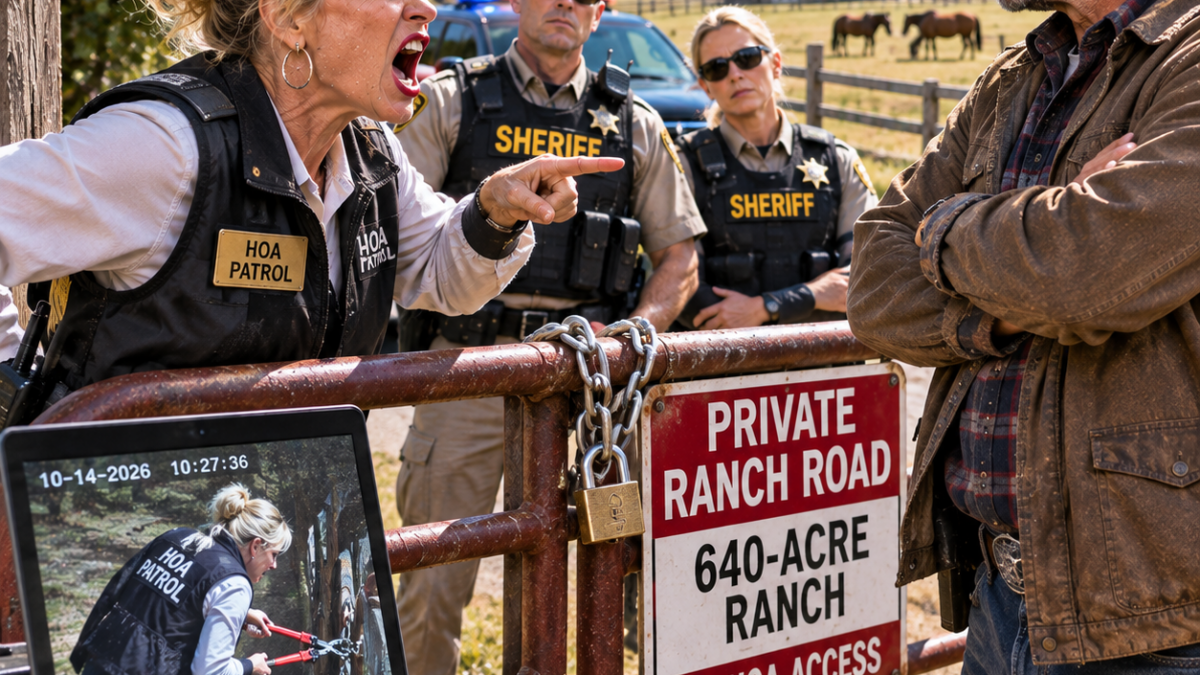
I lifted out my bolt cutters.
The handles were scratched from years of fence repairs.
The cutting head was still sharp enough to make quick work of a padlock.
Marissa’s voice rose.
“YOU CUT THAT LOCK AND YOU’RE GOING TO JAIL.”
I turned toward her.
“Are you finished?”
“You have been formally warned.”
“Then you’ve done your job.”
I walked to the gate.
The young patrol officer nearest the SUV looked uncomfortable.
“Ma’am,” he said quietly, “maybe we should let the sheriff handle this.”
Marissa snapped:
“Keep filming.”
I positioned the cutting head around the shackle.
The gate was mine.
The chain was mine.
The post was mine.
The gravel beneath my boots was mine.
And a woman who had apparently never read my deed was telling me I could be arrested for opening it.
I squeezed.
The lock broke.
A sharp metallic crack echoed through the morning air.
It dropped into the dirt.
Marissa gasped.
Then smiled.
A real smile.
Triumphant.
Like she had spent all morning hoping I would do exactly that.
“Got it.”
She spoke toward her phone.
“Six twenty-three a.m.”
“Caleb Whitmore has deliberately destroyed association property.”
I tossed the broken lock beside the fence.
“You can add the weather report.”
“What?”
“Clear skies.”
“Light wind.”
“Owner opened his own gate.”
She ignored me.
Then called 911.
I pushed the gate open.
Before I could drive through, Marissa moved her SUV across the entrance.
Blocked it.
The two patrol officers began photographing my plates.
One raised a camera toward my face.
I leaned against my truck.
Waited.
Marissa was speaking loudly enough for people in the next county to hear.
“Yes, dispatcher.”
“Active trespassing.”
“Property destruction.”
“A hostile landowner.”
“He forced entry into a restricted HOA access route.”
I stared at her.
Hostile landowner.
That was a new one.
A few minutes later she ended the call.
“Sheriff’s coming.”
“Good.”
“You should’ve thought about that before destroying a lock.”
I looked at my watch.
“I’ve got cattle waiting.”
She smirked.
“You should have thought of that before refusing to cooperate.”
I said nothing.
That bothered her.
People like Marissa needed an argument.
An argument could be edited.
A raised voice could be described as threatening.
An angry gesture could be called aggressive.
Silence left her with only her own words.
So I waited.
The morning sun climbed.
Dust drifted down the road.
A meadowlark called somewhere beyond the fence.
Marissa paced.
Then rehearsed.
I could actually hear her telling the younger officers what to say.
“He approached aggressively.”
“He refused verbal warnings.”
“He destroyed the lock deliberately.”
One young man frowned.
“Ma’am, he didn’t approach us.”
She stared.
“What?”
“He walked from his truck to the gate.”
“Keep your opinions to yourself.”
The young officer looked down.
I made a mental note of his face.
I had a feeling he might become important later.
Sheriff Nolan Mercer arrived at 6:48.
Nolan was fifty-eight.
Broad-shouldered.
Gray at the temples.
A man who had been county sheriff long enough to recognize when someone called the police because they needed protection and when they called because they needed an audience.
He stepped from the vehicle.
Marissa nearly ran to him.
“Sheriff!”
“Morning, Marissa.”
“I need this man arrested.”
Nolan looked past her.
Saw me.
Saw the open gate.
Saw the broken lock.
Then looked at Marissa again.
“For what?”
“He destroyed HOA security equipment.”
“Installed where?”
“At our western access point.”
Nolan turned toward me.
“Caleb.”
“Morning.”
“Is this your gate?”
“Yes.”
Marissa snapped:
“That’s disputed.”
Nolan held up a hand.
“Who owns the ground?”
Marissa answered:
“Silvercrest controls the road.”
“That wasn’t my question.”
She hesitated.
Nolan looked at me.
“I own the gate, the road, and the land on both sides.”
“Paperwork?”
“In the truck.”
“Get it.”
Marissa folded her arms.
“Sheriff, he’s trying to confuse a simple enforcement matter.”
Nolan looked at her.
“If it’s simple, you won’t mind us checking.”
I retrieved the deed from a waterproof folder behind my seat.
My father had taught me to keep copies in the truck.
At twelve, I thought that was ridiculous.
At forty-three, I was grateful.
Nolan examined the legal description.
The parcel boundaries.
The road alignment.
Then asked Marissa:
“Where’s the recorded easement?”
She lifted Resolution 24B.
He read it.
For perhaps ten seconds.
Then handed it back.
“That’s an HOA resolution.”
“Yes.”
“Where’s the easement?”
She stared.
“The resolution grants control.”
“Your board can adopt rules for property it lawfully governs.”
“Yes.”
“It cannot vote itself ownership of a neighboring ranch.”
Marissa’s face reddened.
“This is an emergency route.”
“Approved by whom?”
“The board.”
“County?”
“No.”
“Property owner?”
“No.”
“Court?”
“No.”
Nolan looked at me.
Then back.
“Then you have a problem.”
Marissa shifted tactics.
“The association has a prescriptive easement.”
I almost laughed.
There it was.
A legal phrase.
Maybe she had learned it the night before.
Nolan asked:
“How long has the community used this road?”
“Years.”
I answered:
“Eight months.”
Marissa snapped:
“That’s false.”
I turned toward Nolan.
“I sent written objections the first week.”
“Then every month afterward.”
“Certified mail.”
“Emails.”
“Photographs.”
“I can show you.”
Nolan nodded.
“Do that.”
Marissa stared.
“I want him detained.”
Nolan finally looked directly at her.
“No.”
The word landed.
Hard.
“He destroyed association property.”
“He removed a lock placed on his gate.”
“That is disputed.”
“Then your association can take it to court.”
“But I am not arresting a landowner because your HOA printed a resolution.”
Marissa’s lips tightened.
“Sheriff, are you refusing to enforce our security policy?”
Nolan stared.
“Yes.”
I almost smiled.
Marissa looked genuinely shocked.
As though nobody had ever told her an HOA policy was not criminal law.
Nolan continued:
“Move your SUVs.”
“Clear the entrance.”
“Do not put another lock on this gate without legal authority.”
Marissa looked toward her camera.
I realized she had kept filming.
Perfect.
She turned back.
“This isn’t over.”
I nodded.
“I didn’t think it was.”
Before leaving, she pointed at me.
“Tomorrow morning there will be another lock.”
I looked at the broken one in the dirt.
“Bring a stronger one.”
Her face twisted.
She climbed into the SUV.
The younger officers followed.
Engines started.
Gravel cracked beneath tires.
Then they were gone.
Nolan remained.
His expression changed after the last vehicle disappeared.
“Caleb.”
“Yeah?”
“We need to talk.”
He walked beside me to the gate.
Lowered his voice.
“For three months, somebody from Silvercrest has been contacting county dispatch about this road.”
I frowned.
“What about it?”
“They’ve been describing it as an association-controlled emergency access route.”
My stomach tightened.
“Who?”
“We’re checking.”
“Does dispatch believe them?”
“They have an entry in supplemental routing notes.”
Nolan rubbed his jaw.
“It’s not a deed.”
“It doesn’t establish an easement.”
“But the fact that someone got that description into emergency-routing information worries me.”
I looked toward the development.
Beyond the ridge, sunlight had reached the roofs.
“What are they planning?”
“That’s what you need to find out.”
Nolan looked at the road.
“Don’t make this a fight about who can cut more locks.”
“Get a lawyer.”
I nodded.
“Already thinking that.”
“One more thing.”
“What?”
“HOA people like this don’t always back down after the first confrontation.”
“Why?”
“Because admitting they were wrong is harder than doubling down.”
He looked at the gate.
“Protect yourself with paperwork.”
“Not just tools.”
I remembered Grandpa.
Permission.
Authority.
People who confuse the two.
“Thanks, Nolan.”
He shook my hand.
Then left.
I stood alone beside the broken lock.
It was barely seven-thirty.
And I already knew my day had become expensive.
I spent the rest of the morning checking the road.
Not because I doubted where it was.
Because I wanted to look at everything with fresh eyes.
Fence posts.
Survey pins.
Drainage ditches.
Tire marks.
Evidence that equipment larger than passenger vehicles had begun traveling through.
Near the west bend, I found fresh gravel spread along a section I had not repaired.
At the second cattle guard, someone had installed a small reflector.
Near the culvert, I found orange paint marking the road shoulder.
Not mine.
The paint looked like construction layout marks.
I photographed everything.
Then drove into town.
Meredith Pike worked above a title office on Main Street.
Her father had been a rancher.
She had grown up watching neighbors lose access rights because they trusted verbal agreements that were never recorded.
She had become the kind of real-estate attorney who kept historic county maps in cabinets and could explain property law without making every sentence sound like a threat.
I had used her years earlier for a boundary adjustment.
She remembered me.
“Caleb.”
“You look terrible.”
“Good morning to you too.”
She pointed at my boots.
“Coffee?”
“Yes.”
“Emergency?”
“Possibly.”
I placed Resolution 24B on her desk.
Then the deed.
Then photographs.
Then told her what happened.
She listened.
No interruptions.
When I finished, she looked at the resolution.
Then back at me.
“Who wrote this?”
“Apparently Silvercrest.”
“I can read the logo.”
“I mean who thought it did anything?”
I shrugged.
“Marissa Keen.”
Meredith leaned back.
“Oh.”
“You know her?”
“Reputation.”
“Wonderful.”
Meredith reviewed the road description.
Then opened the county mapping system.
High Mesa Ranch.
Silvercrest Estates.
Proposed western expansion.
She zoomed in.
Then stopped.
“Caleb.”
“What?”
“Have you seen this?”
The screen displayed a development map.
Silvercrest Phase West.
Dozens of planned residential lots.
Large parcels.
Expensive views.
A new cul-de-sac network.
And running along the western side, connecting to a county road:
My road.
Not as High Mesa Road.
As SILVERCREST WESTERN ACCESS.
I stared.
“What is that?”
Meredith looked at me.
“I think it’s your motive.”
The expansion had a problem.
Its existing entrance connected to a narrow county route.
Adequate for current traffic.
Questionable for additional construction vehicles, emergency access needs, and the volume projected for the new western subdivision.
The developers had considered a secondary access route.
Building one independently would require major grading and a costly crossing.
My road already existed.
It was wide enough for ranch equipment.
It connected to another route beyond the property.
And, most importantly, it saved construction traffic an eleven-mile detour.
Meredith opened another filing.
“This is preliminary marketing material.”
She showed me glossy renderings.
Luxury homes.
Mountain sunsets.
Two attractive entry routes.
One of them mine.
I stared at the blue line.
“Those houses haven’t even been built.”
“Some lots have already been marketed.”
“How can they sell access over land they don’t own?”
“That is an excellent question.”
She printed the map.
Then another document.
And another.
Within forty minutes, we had a stack.
The association had already labeled my road as part of the development’s access network.
Contractors had apparently received instructions treating it as available.
Prospective buyers were being told about western access.
The lock was not a random act.
It was enforcement of a story the HOA had been telling for months.
Meredith tapped the map.
“This isn’t about your gate.”
“It’s about whether the development can keep presenting that road as an available entrance.”
I looked at her.
“What do they need?”
“An easement.”
“From me.”
“Yes.”
“They never asked.”
“That may be because they suspected you’d refuse.”
I stared.
She continued:
“Or because the costs of acquiring a proper route made the expansion less attractive.”
I sat back.
“Then they decided to take it.”
Meredith considered.
“We need evidence of what they decided.”
I pointed at the map.
“Isn’t that enough?”
“It is important.”
“But we need to establish their knowledge, conduct, and how they represented the road.”
She folded her hands.
“Caleb, I want you to stop thinking about that first lock as the whole case.”
“Why?”
“Because if they are doing what I suspect, the lock is only the beginning.”
I asked her whether I should keep cutting whatever they installed.
She shook her head.
“Not as a strategy.”
“It’s my gate.”
“I know.”
“And you may have lawful options to protect access.”
“But I want you to give us something stronger than another argument on video.”
“What?”
“A record.”
“Emails.”
“Photographs.”
“Survey.”
“Certified objections.”
“Every contractor.”
“Every vehicle.”
“Every claim.”
“Everything.”
She looked at the photographs.
“Let them prove what they think they own.”
I remembered Marissa filming me.
“She’s already helping.”
Meredith smiled.
“Yes.”
“And something tells me she will continue.”
I returned to High Mesa before sunset.
First, I installed a new lock.
My lock.
Then a weatherproof camera above the gate.
Wide angle.
Timestamped recording.
Night vision.
Audio capture near the entrance.
I mounted a sign beside it.
PRIVATE RANCH — NO HOA EASEMENT — ACCESS BY OWNER PERMISSION ONLY.
I photographed it.
Sent copies to Meredith.
Then drove to the house.
The kitchen smelled faintly of coffee and hay dust.
My father’s old hat still hung beside the pantry.
I had never moved it.
My wife, Hannah, had died four years earlier after a brief illness.
The house had been quieter since.
We never had children.
That sometimes made the ranch feel too big.
But it also made everything my family had built feel strangely fragile.
My grandfather’s fence.
My father’s pump station.
Hannah’s rosebush beside the porch.
I was the one left caring for it.
Some nights that responsibility felt like purpose.
Other nights it felt like a weight.
Now a homeowners association wanted to turn the road through the middle of that life into a subdivision shortcut.
And they had not even bothered to ask.
I made coffee.
Opened the folder.
Read the deed again.
Then called Meredith.
“I’m not selling them that road.”
She did not sound surprised.
“Not even if they offer?”
“No.”
“Good to know.”
“Why?”
“Because I suspect an offer is coming.”
Two days later, Marissa returned.
Not alone.
A locksmith.
Two patrol SUVs.
One young officer with a clipboard.
My camera caught them at 8:14 a.m.
I was repairing fencing near the entrance when I heard engines.
Marissa stepped out.
Saw the sign.
Laughed.
“Cute.”
I stood by the fence.
“Morning.”
She ignored me.
Pointed toward the lock.
“Remove it.”
The locksmith hesitated.
“Ma’am, whose property is this?”
Marissa answered:
“Association-controlled access.”
He looked at my sign.
“Private ranch?”
“Disputed.”
I walked closer.
“You know this is my property.”
Marissa raised her phone.
“Caleb.”
“Please stay back.”
I stopped.
“Are you going to remove my lock?”
“Yes.”
“Under what authority?”
“Resolution 24B.”
I almost smiled.
“Still using that?”
She ignored me.
The locksmith looked at her.
“Do you have an easement document?”
Marissa turned.
“You were hired to replace a lock.”
“Not offer legal opinions.”
He looked toward me.
“I don’t want to be in the middle of something.”
I said:
“Then don’t remove it.”
Marissa snapped:
“I am instructing you as the association’s authorized representative.”
The locksmith paused.
Then began working.
I stayed where I was.
Camera recording.
Phone recording.
The young patrol officer looked deeply uncomfortable.
Marissa noticed.
“Keep filming.”
He lifted the camera.
The locksmith cut my lock.
Metal dropped.
Marissa stepped forward.
“Excellent.”
Then she looked directly into her own phone and said:
“Once we control this gate long enough, Whitmore won’t have any way to get the road back.”
I felt my entire body go still.
Not because of fear.
Because she had finally said the quiet part aloud.
The locksmith looked at her.
Even he seemed shocked.
I did not respond.
Marissa installed the new lock.
Checked it.
Smiled.
Then turned toward me.
“You can send your complaints to the board.”
“I will.”
“Good.”
“Maybe they’ll explain how things work.”
I nodded.
“Maybe.”
She climbed into her SUV.
The younger officers followed.
The locksmith stood beside his truck for a moment.
Then approached.
“Sir.”
“Yes?”
“I didn’t know this was…”
He stopped.
I looked at him.
“You have an invoice?”
He blinked.
“What?”
“Send me a copy of whatever she gave you.”
“I can’t share a client invoice.”
“Then preserve your records.”
He nodded.
I gave him Meredith’s card.
“Call my lawyer if you want to make sure you don’t get dragged into something worse.”
He looked at the gate.
Then took the card.
“Thank you.”
I watched him leave.
Then sent Meredith the footage.
She called two minutes later.
“Caleb.”
“Yes?”
“Please tell me the audio is real.”
“Every word.”
She laughed once.
Not joyfully.
More like a person who had just been handed the perfect answer to a difficult question.
“Do not delete anything.”
“I won’t.”
“Send me the original file.”
“Already did.”
“Good.”
Then she said:
“Marissa Keen may have just become our most useful witness.”
The following weeks were infuriating.
Not because we lacked evidence.
Because Silvercrest behaved as if evidence meant nothing.
Their contractors continued entering.
Maintenance vehicles passed.
Landscaping trucks used the road.
At least three prospective buyers drove to the gate and asked why their real-estate agent had given them instructions to use Western Access.
I sent each incident to Meredith.
Photographs.
License plates.
Dates.
Times.
I kept a handwritten log.
My father had taught me that.
A notebook beside the kitchen telephone.
Every unusual event.
Every repair.
Every expense.
The ranch had already trained me to document.
Now that habit became evidence.
I walked the fence line daily.
Recorded disturbed gravel.
Tire damage.
Tracks from heavy equipment.
One Saturday, a contractor drove a flatbed hauling construction materials across the culvert.
I heard the sound from the pasture.
Not an explosion.
A deep cracking noise.
Then the truck dipped.
Its rear wheels slammed into the roadway.
Dust rose.
I drove toward it.
The culvert had partially collapsed.
The road surface sagged.
The drainage structure beneath had fractured.
The driver stood beside his truck looking terrified.
“I followed the HOA directions.”
I stared at the damage.
“That road isn’t built for your loaded truck.”
He looked at his paperwork.
“It says approved construction access.”
“Who approved it?”
“Silvercrest.”
I took photographs.
Asked for the delivery instructions.
He showed me.
USE WESTERN ACCESS / HIGH MESA ROAD.
I sent the files to Meredith.
The repair estimate eventually exceeded $38,000.
Thirty-eight thousand dollars.
A ranch culvert my father and I had maintained for years.
Destroyed because somebody wanted to save an eleven-mile drive.
When Meredith notified Silvercrest, Marissa replied by email.
Silvercrest cannot be held liable for damage occurring on a route under Silvercrest’s own management.
Meredith called me.
“Read that sentence again.”
I did.
Then:
“She thinks saying it belongs to them helps.”
Meredith replied:
“Exactly.”
“She has admitted the association was exercising management control.”
“Without permission.”
“Without an easement.”
“And now we’re documenting resulting damage.”
I looked out the kitchen window.
The sun was dropping.
The damaged road lay beyond the trees.
“So we have them?”
“We have an excellent beginning.”
I groaned.
Meredith laughed.
“I know.”
“You want the ending.”
“Yes.”
“Then keep giving me evidence.”
We hired Everett Sloan.
County surveyor.
Thirty-two years of tracing boundaries.
The kind of man who could explain the history of a fencepost with more enthusiasm than most people brought to their wedding vows.
He arrived in a dusty truck carrying field equipment and an old folder of maps.
I showed him the disputed stretch.
He looked at the lock.
Then the HOA sign.
Then me.
“Interesting.”
“That’s one word for it.”
He spent days verifying monuments.
Historical deeds.
Recorded plats.
Old boundary descriptions.
The original survey calls.
The culvert alignment.
The drainage ditches.
The full 1.8-mile road.
When he finished, he called Meredith and me into his office.
He laid out a large survey.
High Mesa Ranch.
Recorded boundaries.
Road entirely inside.
Gate entirely inside.
Ditches entirely inside.
No shared parcel.
No HOA annexation.
No public dedication.
No recorded easement for Silvercrest.
Everett tapped the paper.
“Caleb.”
“Yes?”
“Your grandfather knew exactly where he was putting those fence posts.”
I laughed.
“He usually did.”
Everett smiled.
“Silvercrest has a problem.”
Then his smile disappeared.
“But I found something else.”
He pulled out the expansion plat.
Near my road, a dotted line ran through my property.
Label:
EXISTING ACCESS EASEMENT.
Everett pointed.
“Where is the document creating this?”
Meredith answered:
“We haven’t found one.”
Everett frowned.
“Because I don’t think one exists.”
He looked at me.
“Somebody drew an easement onto a planning map as though it had been recorded.”
I stared.
“Can they do that?”
“They can draw whatever they want.”
“Whether it means anything legally is another matter.”
“Who signed it?”
Everett turned the page.
Approval block.
LORETTA VANCE — PRESIDENT, SILVERCREST HOA.
I had never met Loretta.
Not in person.
I knew her name.
Everybody did.
Silvercrest’s president.
Nine years.
Former real-estate executive.
Elegant.
Careful.
Known for speaking as though every sentence had been reviewed by an attorney.
Her name appeared on the planning submission.
The roadmap.
The nonexistent easement.
Now the lock started making even more sense.
Marissa was not inventing a fantasy independently.
Someone above her had been feeding it.
Meredith leaned back.
“Caleb.”
“Yes?”
“We’re going to meet the board.”
The meeting took place in Silvercrest’s clubhouse.
A building with polished stone floors, modern furniture, and a chandelier large enough to illuminate my entire workshop.
I arrived in clean jeans.
Boots.
Button-down shirt.
Meredith wore a charcoal suit and carried two folders.
One thin.
One very thick.
I asked:
“Why two?”
“The thin one is what I hope we need.”
“And the thick one?”
“What we use when they insult your intelligence.”
Good answer.
Loretta Vance sat at the head of a long table.
Silver hair.
Cream blouse.
Pearl earrings.
Perfect posture.
Beside her were four board members, their association attorney, and Marissa.
Marissa looked delighted to see me.
“Mr. Whitmore.”
I ignored her.
Loretta stood.
“Caleb.”
She extended one hand.
“Thank you for coming.”
I shook it.
She smiled.
“It’s unfortunate this has become so adversarial.”
I stared.
“Someone locked me out of my ranch.”
Her smile remained.
“We can debate the characterization.”
“No.”
“We can debate the authority.”
She sat.
Meredith placed the thin folder on the table.
Loretta began.
“Our association has invested considerable funds maintaining the road.”
I looked at her.
“Why?”
She paused.
“Because it serves the community.”
“Did I ask you to maintain it?”
“No.”
“Did I give permission?”
“Not formally.”
“Informally?”
Loretta frowned.
“You didn’t object to every maintenance activity in person.”
Meredith opened the folder.
“Actually, he objected in writing.”
She placed four certified-mail receipts on the table.
January.
February.
March.
April.
Each signed.
Each received by Silvercrest.
One board member leaned closer.
Loretta’s smile thinned.
“Those were generalized objections.”
Meredith laid down the letters.
Every one identified High Mesa Road.
Every one denied HOA access rights.
Every one requested that contractors stop using it.
I watched Loretta read.
She did not look surprised.
That told me more than her words.
She knew.
Then she said:
“Caleb, practical realities require compromise.”
I folded my arms.
“What practical realities?”
“Public safety.”
“Emergency access.”
“Property values.”
“Future development.”
“Those are your problems.”
“They affect the whole community.”
“My ranch isn’t part of your community.”
She smiled coldly.
“One man’s preference should not prevent hundreds of families from enjoying safe access.”
I looked at Meredith.
She said nothing.
Let Loretta finish.
Loretta continued:
“The association has gained an equitable interest through expenditure and use.”
Meredith asked:
“On what recorded instrument are you relying?”
Loretta looked toward her attorney.
He cleared his throat.
“An equitable theory based on circumstances.”
Meredith nodded.
“Not a recorded easement.”
“Not at present.”
“Not an agreement signed by my client.”
“No.”
“Not a dedication.”
“No.”
“Not ownership.”
Loretta interrupted.
“We are trying to reach a sensible solution.”
I leaned forward.
“Then take my road off your maps.”
Silence.
Loretta looked at me.
“That isn’t realistic.”
“Why?”
“The western expansion requires functional access.”
I nodded.
“Then build it.”
“That would be unnecessarily expensive.”
“For you.”
“For the homeowners.”
“Then maybe you shouldn’t have sold them a road you didn’t own.”
Her face tightened.
For the first time, the polished calm cracked.
“Mr. Whitmore, I don’t appreciate your tone.”
I looked around the room.
“Someone from your association cut my lock.”
“Used my road.”
“Damaged my culvert.”
“And told the sheriff to arrest me.”
“What tone would you prefer?”
Marissa leaned forward.
“Your conduct was provocative from the beginning.”
Meredith turned toward her.
“Ms. Keen, are you still maintaining that my client had no right to open his own gate?”
Marissa smiled.
“The association’s access resolution—”
Loretta raised one hand.
“Marissa.”
She stopped.
Interesting.
Loretta knew when to silence her.
Then Loretta offered money.
“Seventy-five thousand dollars for a permanent easement.”
I stared.
“No.”
“One hundred fifty thousand.”
“No.”
“Two hundred fifty thousand.”
I looked at her.
“Are you listening?”
Her smile disappeared.
“Everybody has a price.”
I thought of Grandpa.
Dad.
Hannah.
The pump station.
Cattle moving across the road.
Heavy trucks roaring past the barn.
“Not this.”
Loretta leaned forward.
“That road is too important to be controlled by one man’s decision.”
The room went silent.
I felt Meredith turn slightly.
She knew it mattered.
I answered:
“Then you should have thought about that before building a community that depends on another man’s land.”
Loretta slammed her palm against the table.
Not hard.
Enough.
“Silvercrest will continue using that road until a court tells us otherwise.”
I stood.
“Understood.”
She blinked.
“What?”
“I understand perfectly.”
Meredith gathered the folder.
Loretta stared as though she expected an argument.
I gave her none.
We left.
In the parking lot, I asked Meredith:
“Now what?”
She opened her car door.
“Court.”
“How soon?”
She smiled.
“Sooner than Loretta expects.”
Within hours, Meredith filed for temporary relief.
The petition included:
The deed.
Survey.
Certified objections.
Videos.
Photographs.
The locksmith incident.
Road damage.
Marketing materials.
The nonexistent easement label.
And Marissa’s recorded statement about controlling the gate long enough to prevent me from getting it back.
The judge reviewed the evidence.
The association had an opportunity to respond as required by the process.
The court issued a temporary order prohibiting Silvercrest and those acting for it from entering the ranch road without lawful permission, changing locks, or using the gate as an HOA checkpoint while the dispute proceeded.
I read the order three times.
Then again.
For months, Silvercrest had used its own paperwork to pretend it controlled my road.
Now a real court order existed.
And this one actually had authority.
I rebuilt the gate.
Replaced damaged chain.
Installed new hardware.
Mounted a waterproof case containing a copy of the order beside the latch.
Then photographed everything.
For three days, nobody came.
The road was quiet.
No SUVs.
No construction trucks.
No landscapers.
No mysterious survey stakes.
Just ranch traffic.
Dust.
Sun.
Cattle.
I began to believe that maybe the order would end the immediate trouble.
Then came the fourth morning.
And Marissa Keen made the mistake that changed the entire case.
At 7:11 a.m., my camera detected movement.
Three HOA Patrol vehicles.
Marissa in front.
Two younger officers behind her.
She stepped out.
Looked at the gate.
Then saw the laminated order.
She walked over.
Read it.
Out loud.
My camera recorded every word.
The younger officer who had hesitated during the first confrontation spoke.
“Ma’am.”
“I think this applies to us.”
Marissa turned.
“It applies to the board.”
He frowned.
“We work for the association.”
“We’re patrol.”
“That is a separate security function.”
The young man stared.
“I don’t think that makes us separate from the order.”
Marissa pointed toward his vehicle.
“Are you refusing an instruction?”
“No, ma’am.”
“Then stay back.”
She retrieved bolt cutters.
My lock.
Brand-new.
Mine.
The young officer said:
“Ma’am, the sheriff—”
Marissa snapped:
“The sheriff doesn’t understand HOA authority.”
She positioned the cutters.
One squeeze.
The lock broke.
My camera captured it.
So did hers.
She pushed the gate open.
Climbed into her SUV.
Then drove onto High Mesa Road.
Followed by two patrol vehicles.
She had not simply entered after seeing the injunction.
She had read it.
Argued it did not apply to her.
Cut the lock anyway.
Then drove nearly half a mile into the ranch.
Meredith had anticipated exactly that possibility.
Nolan Mercer was waiting.
Two sheriff vehicles stood beside the road beyond the bend.
Marissa rounded it.
Braked hard.
Dust rose.
Sheriff Nolan stepped out.
Marissa climbed from her SUV looking furious.
“What is this?”
Nolan pointed toward the gate behind her.
“I was going to ask you the same thing.”
She folded her arms.
“We’re conducting lawful security operations.”
“On whose land?”
“An access corridor.”
“Did you read the court order?”
“Yes.”
“Did you cut the lock?”
“Yes.”
“Did you enter the property?”
“Yes.”
Nolan stared.
“Then you knowingly did what the order says not to do.”
Marissa shook her head.
“No.”
“The order applies to the board.”
“Patrol falls under independent security authority.”
“Who told you that?”
“Our operating structure.”
“An attorney?”
Silence.
“A judge?”
“No.”
“Then get off the property.”
Marissa laughed.
“This is a civil dispute.”
Nolan’s expression hardened.
“A court has issued an order.”
“You don’t get to redefine it with an HOA job title.”
She looked toward her officers.
One was staring at the ground.
The other looked frightened.
Marissa said:
“Sheriff, you’re overstepping.”
Nolan answered:
“I’m documenting your violation and directing you to leave.”
“The court will decide what further consequences follow.”
That was important.
Nolan did not claim he could personally decide contempt or settle the property dispute on the roadside.
He documented.
Collected evidence.
Directed the vehicles away.
Then contacted Meredith.
Marissa left furious.
Her broken lock went into the evidence record.
And for the first time, she could not make the problem disappear by reporting to Loretta.
Because Loretta stopped answering.
For three days, Marissa called.
Left messages.
Sent emails.
Requested meetings.
No response.
At first she told herself Loretta was busy.
Then she noticed her name disappeared from planning discussions.
The patrol company reassigned some of her responsibilities.
Board members stopped responding individually.
The woman who had confidently threatened to arrest me now discovered that the people who benefited from her aggression were preparing to distance themselves from it.
She was not ready to accept that.
Neither was Loretta.
But the emails told a different story.
Discovery changed everything.
Internal communications.
Board meeting notes.
Patrol instructions.
Development materials.
Contractor correspondence.
Assessment records.
Meredith and her team examined documents for weeks.
Some were mundane.
Maintenance schedules.
Landscaping invoices.
Meeting reminders.
Then came the messages.
Loretta to a board member:
If Whitmore tolerates the lock long enough, our position improves.
Another:
We need an established access pattern before final western expansion review.
Marissa:
Patrol can establish physical control immediately.
Then the one Meredith printed and placed in a separate folder:
Loretta:
We need to create a reality on the ground before anyone starts asking too many questions about paperwork.
I read that sentence three times.
Create a reality.
On the ground.
Before paperwork.
My grandfather would have laughed.
Then probably reached for his shotgun, which was why Meredith and I were doing things differently.
I looked at her.
“She knew.”
Meredith nodded.
“From the beginning.”
“She knew there was no easement.”
“Yes.”
“And told Marissa to do it anyway.”
“The communications support a coordinated strategy.”
I stared at the page.
For months, they had called this a misunderstanding.
A disagreement.
A shared-access dispute.
A safety concern.
Now their own emails showed an intentional plan to establish control before legal rights existed.
The locks were not confusion.
They were tactics.
The signs were tactics.
The patrol vehicles were tactics.
The maps were tactics.
They hoped repeated use would become accepted reality.
And they had written it down.
Then Meredith found the assessments.
Silvercrest residents had been paying a special road infrastructure charge.
Earmarked for the western access route.
My road.
Homeowners had received statements describing maintenance and access improvements.
The association had collected money for a road it had no legal right to use.
Not one cent came to me.
Not that I would have accepted it in exchange for permission.
But residents were paying for something they had been told the HOA controlled.
That created a second group of victims.
The homeowners themselves.
Meredith showed me the documents.
“What happens to them?”
“Potentially refunds.”
“Accounting review.”
“Claims against the association or individual decision-makers depending on facts and law.”
I stared.
“These people didn’t know?”
“Some likely didn’t.”
I thought of Linda, the retired teacher.
Her house.
Her fixed income.
She probably paid the same assessment as everyone else.
Loretta had used community money to finance a takeover of neighboring private property.
Then she had threatened me for objecting.
It was uglier than I expected.
I told Meredith:
“I don’t want innocent families losing their homes over this.”
She nodded.
“Then we pursue documented recovery through the court and let the association address its obligations.”
“I want what I’m owed.”
“I know.”
“But I don’t want to turn into them.”
She looked at me.
“Good.”
“Keep remembering that.”
The first special homeowners meeting was explosive.
I did not attend.
Meredith advised against turning it into a confrontation between me and the community.
But Linda called afterward.
“Caleb.”
“Yes?”
“You won’t believe what happened.”
“Try me.”
She told me the room was packed.
People standing.
Parents.
Retirees.
Homeowners who had never attended a board meeting in their lives.
They demanded to know why their assessments funded a road outside the development.
Loretta opened with a prepared statement.
“Silvercrest’s western access strategy was undertaken in the best interests of community safety and long-term property value.”
A man near the back stood.
“Do we own the road?”
Loretta paused.
“Access rights are disputed.”
Another homeowner:
“Did we pay for it?”
“The association funded necessary improvements.”
“Did the owner authorize them?”
Silence.
Then Linda stood.
“Loretta.”
Her voice shook.
“I paid my assessment.”
“So did my neighbors.”
“You told us Western Access was part of the approved development.”
“Was that true?”
Loretta looked toward the attorney.
Then back.
“Some of the implementation decisions were made by patrol.”
There it was.
Marissa.
Under the bus.
Loretta continued:
“Certain field operations may have exceeded the original board’s intentions.”
One homeowner shouted:
“Then why is your signature on the planning map?”
Applause.
Angry.
Sharp.
Loretta tried again.
“Marissa Keen was responsible for access enforcement.”
At that moment, Marissa stood.
Linda described it perfectly.
Like a bomb had just decided to introduce itself.
Marissa held up her phone.
“No.”
Loretta stared.
“Marissa, sit down.”
Marissa smiled coldly.
“You told me to keep the road under continuous control.”
The room went silent.
Loretta’s face changed.
“That is not accurate.”
Marissa opened an email.
Read it.
Loretta’s words.
Physical control.
Expansion timing.
Use patterns.
The owners began shouting.
Loretta reached for the microphone.
Marissa continued.
“I didn’t invent Resolution 24B.”
“You approved it.”
“I didn’t invent Western Access.”
“You signed the map.”
“I didn’t tell myself to install those locks.”
The room erupted.
And the two women who had stood together against me started destroying each other in front of the people who paid their salaries.
Linda said:
“Caleb, I have never heard a room go so quiet and so loud at the same time.”
I almost laughed.
Then asked:
“Did anybody mention the road damage?”
“Yes.”
“And the lawsuit?”
“Everybody.”
Linda paused.
“I’m sorry.”
I frowned.
“For what?”
“I didn’t know.”
“I believed what they told us.”
I looked toward my kitchen window.
The hills beyond.
“I know.”
She whispered:
“We never should have taken your road.”
I said:
“You didn’t.”
“Loretta and Marissa tried.”
That distinction mattered.
I was not fighting every Silvercrest homeowner.
I was fighting people who had decided homeowners were useful cover for an unlawful plan.
The insurance situation made everything worse for the HOA leadership.
Silvercrest’s insurance counsel warned that certain deliberate acts could fall outside coverage.
Not every claim.
Not automatically.
But enough uncertainty to frighten board members who previously treated the association as a shield protecting every decision.
Personal exposure became a possibility.
Suddenly, people who had said nothing during meetings began writing letters.
“I objected to the access strategy.”
“I did not approve changing private locks.”
“I believed a recorded easement existed.”
“I relied on information from the president.”
Meeting minutes became valuable.
The missing pages became suspicious.
Two board members resigned in one week.
Publicly:
Personal reasons.
Privately:
They did not want to stay attached to a case that could threaten their finances.
Loretta grew isolated.
Marissa remained employed for a short time but lost influence.
The development attorney stopped taking her calls.
And Meredith kept building the damage calculation.
The financial side became another kind of battle.
The culvert:
More than $38,000 to restore correctly.
The road surface:
Additional repairs because heavy construction loads had damaged areas designed for ranch traffic.
Gate hardware.
Chains.
Locks.
Survey costs.
Fencing.
Lost operational time.
Work disrupted because I had to inspect contractors and repair damage.
Then the marketing issue.
Silvercrest had promoted lots using an access route it did not possess.
Meredith hired an independent appraiser to analyze the financial effect of that representation.
The association disputed the method.
Of course.
But the difference between marketing a lot with convenient second access and marketing it without that access was real.
We gathered sales brochures.
Listing descriptions.
Buyer disclosures.
Development projections.
Roadwork invoices.
Construction schedules.
Every relevant number needed a source.
I asked Meredith why she spent so much time separating expenses.
“Because judges don’t award damages because somebody made you angry.”
“I was pretty angry.”
She smiled.
“I noticed.”
“Then what?”
“We show measurable loss.”
“And any other remedies legally supported.”
She opened a binder.
“Here is the culvert estimate.”
“Here are repair invoices.”
“Here is the survey.”
“Here are the hours you spent dealing with disruptions.”
“Here is the expert analysis of the development’s benefit from its misrepresentation.”
“Then we ask the court to determine what is recoverable.”
I looked at the stack.
“That’s a lot of paper.”
“Yes.”
“Grandpa would approve.”
“He sounds smart.”
“He was.”
Then I said:
“He also would have cut every lock they put up.”
Meredith laughed.
“Let’s be grateful he’s not our client.”
The formal hearing began on a cold Monday.
I arrived early.
The courthouse was smaller than people imagine when they hear about a nearly half-million-dollar judgment.
Wood benches.
Old carpet.
A flag.
A judge who looked more tired than impressed.
There were no television cameras.
No dramatic crowd chanting justice.
A handful of reporters waited outside.
Inside, Loretta sat upright in a navy suit.
Hands folded.
Face controlled.
Marissa sat two rows behind.
She avoided looking at me.
Meredith placed the binders on counsel table.
Everett Sloan sat nearby.
Sheriff Nolan Mercer had already submitted reports and was available regarding the enforcement incidents.
The HOA’s attorney opened.
Public safety.
Community benefit.
Emergency access.
Investment.
Practical necessity.
The words sounded reasonable until you remembered the missing easement.
Meredith stood.
“Your Honor, nobody disputes that Silvercrest would find this road convenient.”
She paused.
“The question is whether convenience creates a legal right to enter and control a neighbor’s land.”
The judge looked toward the HOA attorney.
“Show me the recorded easement.”
Silence.
Then documents.
Resolution 24B.
Planning map.
Maintenance records.
Claims of historical use.
The judge examined them.
Then:
“Where is the instrument?”
The attorney explained equitable arguments.
Meredith responded with the deed.
Survey.
Historic plat.
County archive search.
The judge looked at Everett.
“Mr. Sloan, do your findings identify any portion of this road outside the Whitmore parcel?”
“No, Your Honor.”
“Any recorded easement benefiting Silvercrest?”
“No.”
“Any annexation of High Mesa Ranch into the HOA?”
“No.”
“Any owner-authorized dedication?”
“No.”
Everett spoke clearly.
“No such instrument appears in the records reviewed.”
Loretta shifted.
The judge looked down at the map.
“What does ‘existing access easement’ mean here?”
The HOA attorney hesitated.
“It reflects the association’s understanding.”
“Based on what?”
Silence.
I looked at Meredith.
She did not smile.
She did not need to.
Then came the videos.
The first:
Marissa at my gate.
Phone raised.
My truck arriving.
Her warning.
My bolt cutters.
The lock snapping.
Her calling the sheriff.
The courtroom watched.
I remembered how furious she had looked.
At the time, she seemed powerful.
On the screen, she looked like a woman claiming authority without answering a single question about its source.
Then came the locksmith video.
Marissa ordering removal of my lock.
The locksmith hesitating.
My sign visible.
My camera capturing the entire event.
Then her voice:
Once we control this gate long enough, Whitmore won’t have any way to get the road back.
The judge looked up.
“Who is speaking?”
Meredith answered.
“Ms. Keen.”
Marissa stared at the floor.
The judge made a note.
Then the third video.
After the temporary order.
Marissa reading it aloud.
The younger officer questioning her interpretation.
Marissa cutting my lock anyway.
Driving onto the ranch.
Sheriff vehicles waiting.
The courtroom stayed silent.
The judge paused the footage.
Then looked toward Marissa.
“Ms. Keen, you read the order?”
She hesitated.
“Yes.”
“And you understood the order prohibited unauthorized entry?”
“I believed patrol was separate.”
“Who gave you that legal interpretation?”
She looked toward Loretta.
Loretta looked straight ahead.
“No attorney told you that?”
Marissa whispered:
“No.”
“No court?”
“No.”
The judge nodded slowly.
“Thank you.”
That was worse than yelling.
There are moments when the most frightening thing in a courtroom is a calm question that leaves nowhere to hide.
The emails followed.
Loretta’s words.
Control.
Continuous use.
Create a reality on the ground.
Strengthen negotiating position.
Western Access.
No recorded instrument.
A board member warning there was no easement.
Loretta answering that they needed the physical arrangement in place first.
The judge read several aloud.
One at a time.
The attorney for Silvercrest requested a recess.
When everyone returned, his questioning became shorter.
Loretta remained composed.
Mostly.
Until Meredith asked:
“Mrs. Vance, did you know High Mesa Ranch was not part of Silvercrest?”
“Yes.”
“Did you know the road sat inside Mr. Whitmore’s recorded boundaries?”
“I understood there was a dispute.”
“Did you have a recorded easement?”
“No.”
“Did you receive his certified objections?”
“Yes.”
“Then why did you continue advertising Western Access?”
Loretta looked toward the judge.
“Because we believed continued use benefited the community.”
Meredith nodded.
“Did benefit create ownership?”
“No.”
“Did benefit create an easement?”
Loretta’s jaw tightened.
“Not automatically.”
“Did you tell prospective buyers the access was disputed?”
She paused.
“Marketing documents were prepared by others.”
“Under your approval?”
Silence.
Meredith placed the planning map on the screen.
Loretta’s signature.
“Yours?”
“Yes.”
“Did you tell patrol to establish physical control?”
“That language was operational.”
“Did you write that the association needed to create a reality on the ground before people asked about paperwork?”
Loretta stared.
“Yes.”
“Do you consider another person’s property rights a paperwork inconvenience?”
The HOA attorney objected.
The judge directed Meredith to rephrase.
She did.
Calmly.
“Did you obtain Mr. Whitmore’s permission before instructing employees or contractors to control his gate?”
“No.”
That was the answer.
The whole case reduced to one word.
No.
Marissa testified next.
She looked smaller without her patrol uniform.
No tactical polo.
No radio.
No SUV.
No phone held at eye level.
Just a woman in a chair answering questions.
Meredith asked:
“Did you tell my client he’d be arrested for cutting the first lock?”
“Yes.”
“Were you a sworn law-enforcement officer?”
“No.”
“Did you know the lock was attached to his privately owned gate?”
“I knew ownership was disputed.”
“Had any court granted Silvercrest possession of that gate?”
“No.”
“Had he consented?”
“No.”
“Did you instruct the locksmith to remove his lock?”
“Yes.”
“Did you state that if the association controlled the gate long enough, he would have no way to get the road back?”
She swallowed.
“I may have.”
Meredith played the clip.
Her own voice.
Clear.
Confident.
Marissa looked down.
Then Meredith asked about the court order.
“You read it?”
“Yes.”
“You cut the lock anyway?”
“Yes.”
“Why?”
“I believed I was carrying out security duties.”
“Did you seek legal advice?”
“No.”
“Did Loretta Vance instruct you to continue using the road?”
Marissa looked toward Loretta.
For several seconds, neither woman moved.
Then:
“Yes.”
Loretta’s head turned.
Marissa continued:
“She told me the expansion depended on access.”
“She said we couldn’t let Whitmore establish exclusive control.”
The courtroom stayed silent.
The judge took notes.
Marissa had finally learned the difference between giving orders from an SUV and answering questions under oath.
When the judge addressed the property issue, there was little mystery left.
High Mesa Road belonged to High Mesa Ranch.
The gate belonged to me.
The ditches.
The culvert.
The full disputed 1.8-mile section.
Silvercrest held no recorded easement or ownership interest permitting the conduct at issue.
The association had no authority to lock my gate, operate a checkpoint, advertise the road as its access, or direct contractors to use it without lawful permission.
The court ordered corrective action.
Maps.
Marketing.
Signs.
Access instructions.
The false representation of Western Access had to stop.
But the money question remained.
Meredith opened the thick binder.
I had seen it grow over months.
Invoices.
Logs.
Expert reports.
Photographs.
Survey.
Repair estimates.
Records of lost ranch time.
Documentation of damage to the road and culvert.
The court reviewed the damage categories.
The association contested portions.
The judge required support for each item.
No dramatic number pulled from the air.
No arbitrary punishment simply because Marissa had been rude.
It was an accounting of what their conduct cost.
Physical repair.
Survey.
Gate hardware.
Operational losses.
Legally recoverable fees and other proven damages.
The court also considered evidence concerning the association’s wrongful marketing and resulting financial effects to the extent supported under the claims before it.
When the final judgment was entered, the combined amount came to approximately:
$486,000.
I stared.
Not because I was surprised by the size.
Meredith had prepared me for the range.
Because the whole thing had begun with a lock.
One woman.
One camera.
One threat.
And now an association that believed it could take my road for free faced nearly half a million dollars in liability and related relief.
Loretta sat motionless.
Marissa’s face had gone white.
The judge continued with the required corrective measures.
The association had to remove its access signage.
Correct maps and marketing documents.
Notify contractors.
Stop directing vehicles onto my land.
Address the disputed homeowner infrastructure assessments through the required accounting and refund process.
And comply with the court’s restrictions on any further unauthorized access.
Meredith requested permanent injunctive relief.
Specific language.
No more locks.
No checkpoints.
No association patrol entry.
No cameras installed on my property.
No use without my written consent unless some separate lawful authority independently applied.
The court granted the permanent protection in the final disposition.
I sat still.
For months, people had told me the HOA was too powerful.
Too connected.
Too wealthy.
Too determined.
Now a judge had written what I had been saying from the beginning.
The ranch belonged to me.
The road did too.
And nobody could manufacture ownership by printing a resolution.
Outside court, reporters waited.
One asked:
“Mr. Whitmore, how does it feel to win?”
I thought about the culvert.
The damaged road.
The months of conflict.
The time away from cattle.
The cost of defending land my family already owned.
“Expensive.”
The reporter blinked.
“Excuse me?”
“Winning cost time.”
“Work.”
“Stress.”
“Lawyers.”
“Repairs.”
“I didn’t ask for any of this.”
Then:
“I would have preferred they left my gate alone.”
Another reporter asked:
“Do you think Loretta should resign?”
“I think the homeowners should decide who they trust.”
“Marissa?”
I looked toward the courthouse doors.
“She made choices.”
“The evidence shows them.”
“I don’t need to add anything.”
The cameras disappointed me by staying.
One asked:
“What message do you have for other homeowners associations?”
I smiled faintly.
“Read the deed.”
That clip spread.
Of course.
Within weeks, Silvercrest’s board removed Loretta from the presidency.
The association ordered an internal financial review.
Assessment funds.
Western expansion expenses.
Patrol contracts.
Legal bills.
Road-maintenance payments.
Everything.
Marissa lost supervisory authority.
The patrol contract was restructured.
Two members had already resigned.
Others faced angry residents who wanted answers about how a privately funded community organization had spent so much money fighting over land it never possessed.
Linda called again.
“Caleb.”
“Yes?”
“They’re reprinting the maps.”
“Good.”
“Western Access is gone.”
“Better.”
“They’re saying the expansion might need major redesign.”
“Sounds like a planning problem.”
Linda laughed.
Then:
“Loretta’s house is for sale.”
I said nothing.
Linda continued:
“People are furious.”
“I know.”
“Some want her personally sued.”
“Some want criminal charges.”
“Others just want their assessment money back.”
I leaned against the kitchen counter.
“What do you want?”
“A board that stops lying.”
That sounded reasonable.
Then she said:
“I am sorry it took this much.”
“Me too.”
Payment and compliance took additional work.
Judgments do not transform instantly into checks.
There were deadlines.
Legal discussions.
Accounting.
Insurance questions.
Requests to clarify allocations.
Repair invoices.
Association finances.
Meredith handled most of it.
Thank God.
I focused on the ranch.
A contractor rebuilt the culvert properly.
We restored drainage.
Regraded damaged sections.
Repaired disturbed fencing.
High Mesa Road slowly returned to the road I remembered.
No construction trucks.
No unauthorized patrols.
No mysterious access signs.
The evenings became quiet again.
But I kept the cameras.
Not because I enjoyed surveillance.
Because I had learned that documentation can make the difference between a private owner’s word and an organization determined to overwhelm him with its own paperwork.
I also kept the first broken lock.
The black industrial one.
Marissa’s.
I stored it in my workshop.
Not on a shelf like a trophy.
In a box with the old chain.
Every time I saw it, I remembered her smile when it broke.
She truly believed she was capturing my defeat.
She never considered she was recording her own conduct.
Two months after the judgment, Meredith visited the ranch.
She brought final documents.
The recorded permanent injunction.
Updated property records.
Correspondence confirming revised Silvercrest materials.
The homeowners had started receiving notices regarding disputed assessments.
The county planning office required corrected access documentation before related western lots could proceed under the representations previously made.
Meredith placed the folder on my kitchen table.
“Done.”
I stared.
“Really?”
“On the major property issues, yes.”
“Financial administration may continue.”
“But the road?”
“Protected.”
I exhaled.
It felt like holding my breath for months and finally remembering how to let it go.
Meredith looked out the window.
“You could replace the gate.”
“Why?”
“It’s scratched.”
“Damaged.”
“Not especially attractive.”
I smiled.
“It’s a ranch gate.”
“Still.”
“New one wouldn’t cost much.”
I shook my head.
“No.”
She raised an eyebrow.
“Why?”
I thought about Grandpa.
My father.
The morning Marissa filmed me.
The locksmith.
The second lock.
The court order.
The scars across the metal.
“Because I want people to ask what happened.”
Meredith smiled.
“Fair.”
“And when they do?”
“I’ll tell them.”
She leaned back.
“What will you say?”
I looked at the gate beyond the yard.
“That somebody thought confidence could replace ownership.”
Meredith nodded.
“Good answer.”
Three weeks later, I was repairing fence near the entrance when a white SUV slowed outside.
My stomach tightened automatically.
Old instinct.
Then I saw the logo.
Silvercrest HOA Patrol.
Different driver.
Different posture.
The SUV stopped beyond the fence line.
A woman stepped out.
No tactical performance.
No sunglasses.
No phone filming.
She stood outside the gate.
“Mr. Whitmore?”
I rested my tool against the fence.
“Yes?”
“My name is Erin Wallace.”
“I’m the new patrol supervisor.”
I looked at the SUV.
Then her.
“Congratulations.”
She smiled cautiously.
“I realize that’s probably not your favorite title.”
“Depends who’s wearing it.”
“Fair.”
She pointed down the road.
“One of our contractors took a wrong turn.”
“Large truck.”
“He needs room to turn around.”
I looked past her.
A delivery vehicle waited near the shoulder.
Erin continued:
“Would you be willing to let him use the gravel just inside your gate?”
I stared.
Not because it was a difficult request.
Because it was the first time in months someone from Silvercrest had asked.
Not demanded.
Not threatened.
Not waved a resolution.
Asked.
“Does he need to cross the cattle guard?”
“No.”
“Just the turning area.”
I considered.
Then nodded.
“Fine.”
“Thank you.”
I opened the gate myself.
Moved the chain.
The truck turned around.
Slow.
Careful.
No damage.
Then left.
I closed the gate.
Locked it.
Erin stayed on the other side.
“Thank you, Mr. Whitmore.”
“You’re welcome.”
She hesitated.
“I read the case file.”
I looked at her.
“That sounds exhausting.”
She smiled.
“A little.”
Then:
“I understand why you don’t trust our vehicles.”
I said nothing.
She continued:
“I can’t undo what happened.”
“But I can promise my officers won’t enter this property without a lawful reason or permission.”
I looked at the gate.
“That would be a good start.”
She nodded.
Then walked back to her SUV.
No threat.
No camera.
No demand.
Just a respectful request.
The difference felt enormous.
Word of the ruling spread beyond Silvercrest.
At first, local ranchers called out of curiosity.
Then neighbors from other communities.
One family had discovered a development map labeling part of their driveway as an existing easement.
Another found a shared-access claim where no recorded document appeared to exist.
I sent both to Meredith.
She took the cases.
They resolved without anything like our confrontation.
Once the associations saw the evidence and the court’s treatment of unsupported access claims, they became much more willing to negotiate.
I did not feel heroic.
I felt tired.
And relieved.
I also felt angry sometimes.
Not as often.
But when I drove past the repaired culvert, I remembered the damage.
When I saw tire ruts in an old turnout, I remembered construction trucks.
When I opened the gate, I remembered Marissa filming.
Anger does not vanish because a judge signs an order.
It simply stops being the only thing you carry.
One evening Linda brought over a pie.
Apple.
Homemade.
She stood on the porch.
“I’ve got something to tell you.”
I looked at the pie.
“Is it poisoned?”
She laughed.
“Not this time.”
I waved her inside.
She placed it on the table.
Then pulled out a printed notice.
New Silvercrest board policies.
Access claims required legal verification.
Recorded easements had to be checked.
Major property-related expenditures reviewed independently.
Residents received clearer assessment disclosures.
Contractors instructed not to enter neighboring private land without permission.
I read it.
Then handed it back.
“Good.”
Linda smiled.
“You know what the funny part is?”
“What?”
“These rules should’ve existed already.”
I laughed.
“Most useful rules seem obvious after somebody pays to learn them.”
She nodded.
Then looked around my kitchen.
My father’s hat.
Old photographs.
Hannah’s coffee mug still hanging by the sink.
“This place means a lot to you.”
“Yes.”
“I think people in Silvercrest forgot there were lives on the other side of their maps.”
That sentence stayed with me.
Because she was right.
To Loretta, my road was a line on a development plan.
To Marissa, my gate was a checkpoint.
To contractors, the road was a shortcut.
To buyers, it was a sales feature.
To me, it was home.
Grandpa taught me to drive on that road.
Dad taught me to repair culverts beneath it.
Hannah learned to ride a horse along its shoulder.
We buried two family dogs near the junipers.
I had hauled feed, lumber, cattle, firewood, and medical supplies across it.
I had driven that road in joy.
In exhaustion.
In grief.
The morning Dad died, I drove home on it with both hands shaking so badly I had to pull over.
No marketing map showed any of that.
It never would.
But it mattered.
Property rights are not sentimental merely because land carries memories.
The law does not require you to prove that you love your land before it protects it.
The deed should have been enough.
That was the point.
Late that summer, I found an old photograph in Grandpa’s desk.
High Mesa’s original gate.
Freshly installed.
Grandpa standing beside it.
Dad younger than I had ever remembered him.
Both grinning.
The road behind them looked almost identical.
No Silvercrest.
No stone monuments.
No suburban rooftops.
Just open land.
I held the photograph against the kitchen window.
Nearly forty years.
Same entrance.
Same line.
The world had changed around it.
The owner had changed.
But ownership itself had never magically jumped across the ridge because someone built attractive houses nearby.
I placed the photograph in a new frame.
Hung it beside the ranch map.
Then went outside.
The sun was dropping behind the western hills.
Cattle moved slowly across the distant pasture.
The repaired culvert held.
The water pumps worked.
No unfamiliar trucks.
I drove to the gate.
Stopped.
Got out.
Put one hand on the scarred steel.
Some marks came from Grandpa’s welding.
Some from years of weather.
Some from my own repairs.
Some from the locks Silvercrest destroyed.
I could have ground them smooth.
Painted over everything.
Pretended the conflict had never happened.
I didn’t.
Because some marks deserve to remain.
Not to celebrate suffering.
To remember what it costs when people with titles begin believing titles are deeds.
I closed the gate.
Slid my lock through the chain.
Turned the key.
The mechanism clicked.
Simple.
Certain.
Mine.
People sometimes ask whether I regret cutting Marissa’s first lock.
I think about that.
The scene could have gone differently.
I could have driven straight to town.
Called Meredith first.
Waited.
Perhaps avoided the first confrontation.
There are always alternate routes through a bad day.
But I do not regret refusing to accept the premise that Silvercrest’s private patrol had authority over land it could not prove any right to control.
I do not regret making them explain themselves.
I do not regret documenting every step afterward.
And I certainly do not regret pursuing the case through proper legal channels once it became clear how coordinated the plan had been.
What I learned is that defending what belongs to you requires more than anger.
Anger gets you out of the truck.
Patience builds the record.
A deed explains ownership.
A survey confirms boundaries.
Certified letters prove objections.
Videos preserve conduct.
Emails reveal knowledge.
Court orders establish enforceable limits.
And a person willing to keep showing up, even when exhausted, makes sure none of those things get buried beneath intimidation.
Marissa believed her uniform made her the authority.
Loretta believed her presidency made her the authority.
Their association believed its resolution made it the authority.
But authority over property does not come from speaking loudly.
It does not come from installing a larger lock.
It does not come from putting a blue line across somebody else’s road on a glossy map.
And it does not come from telling enough buyers the same false story until everyone begins repeating it.
You need an actual legal right.
Silvercrest never had one.
That was true at six-twenty in the morning when I first saw the lock.
It was true when Marissa called the sheriff.
It was true when the locksmith cut my chain.
It was true when their trucks damaged my culvert.
It was true when Loretta offered a quarter-million dollars for rights she had already pretended to possess.
It was true when Marissa violated a signed court order.
And it remained true when the judge entered a judgment of approximately $486,000 and permanently barred the association from treating High Mesa Road as its own.
The facts had not changed.
Only the number of people forced to acknowledge them.
A year after everything ended, I received a letter forwarded through Meredith.
No return address I recognized.
Inside was a single page.
From a former Silvercrest patrol officer.
One of the younger men present on that first morning.
He wrote that he had been uncomfortable when Marissa ordered him to record me as a trespasser.
He had joined the patrol company expecting to assist residents, report suspicious activity, and help with traffic during events.
He had not expected to be instructed to claim a ranch owner’s gate belonged to someone else.
He apologized for staying silent.
Then thanked me for not treating the younger officers as if they personally invented the plan.
I read the letter twice.
He ended with:
I learned that wearing a uniform doesn’t mean the person giving orders is right. Sometimes the most important part of the job is knowing when to ask what authority you actually have.
I folded the page.
Placed it in the box with the original broken lock.
That seemed appropriate.
Marissa’s lesson.
In the words of someone who watched her get it wrong.
Another year passed.
The Silvercrest western expansion continued in revised form.
Smaller.
Slower.
Without my road.
The development had to address access using property rights and infrastructure it could lawfully obtain.
Some lots were redesigned.
Some construction schedules changed.
I was not involved.
I did not need to be.
Nobody asked me to solve their planning mistakes.
That was the way it should have been from the start.
Silvercrest residents continued living their lives.
Children went to school.
Families moved in.
People walked their dogs.
Linda still brought pie.
The new HOA board became less dramatic.
And High Mesa Ranch remained High Mesa Ranch.
Sometimes I passed the old stone entrance sign for Silvercrest while driving to town.
I rarely thought about Loretta.
Or Marissa.
I thought about how easily their certainty had spread through an organization.
One person makes an unsupported claim.
Another repeats it.
A third builds a policy around it.
Someone prints a map.
Someone sends an invoice.
Someone installs a lock.
By the time the property owner objects, the entire group acts offended that reality has interrupted the plan.
That was the strangest part.
The people claiming my road seemed genuinely angry that I would not cooperate with them taking it.
As though they were the injured party.
I suspect that happens more often than people want to admit.
Near the fifth anniversary of Dad’s death, I took the old photograph of the gate outside.
Sat on a fence rail.
Looked at the original posts.
Grandpa had set them deep.
Dad had welded the hinges.
I had replaced the chain.
Three generations.
One gate.
I thought about what they would say if they knew the entire fight.
Grandpa would probably ask why I let Marissa talk so long.
Dad would want to examine the culvert repairs before discussing anything else.
Hannah would have laughed herself sick at the idea of an HOA patrol supervisor threatening to arrest me for using my own driveway.
Then she would have asked whether I had eaten.
I missed them all.
But the land still held parts of them.
That was enough for that evening.
I walked down the road.
Past the pump station.
Past the restored culvert.
Past the bend where Marissa once drove straight toward Nolan’s waiting sheriff vehicles.
Then back to the gate.
A plain wooden sign stood beside it now.
HIGH MESA RANCH — PRIVATE PROPERTY — NO HOA ACCESS.
Nothing fancy.
No legal lecture.
No threat.
Just truth.
Across the fence, an SUV drove past on the county road.
No flashing yellow lights.
No stopping.
No camera.
It disappeared over the hill.
I smiled.
For months, peace had been the thing I wanted most.
Not revenge.
Not humiliation.
Not a viral video.
Not to destroy somebody’s career for entertainment.
Peace.
The ability to open my gate without negotiating with a woman in a polo shirt.
The ability to move cattle without asking an HOA for permission.
The ability to repair my own road without strangers telling me their association managed it.
The ability to live on land my family lawfully owned.
Not much to ask.
Apparently it had cost Silvercrest hundreds of thousands of dollars to learn that.
I still have Marissa’s original video.
Meredith kept the evidentiary copy.
I have another.
Occasionally, when an old ranching friend asks what happened, I show him the first thirty seconds.
Marissa in sunglasses.
Phone raised.
Confidence dripping from every word.
Cut that lock and you’re going to jail.
Then me.
Bolt cutters.
One sharp snap.
Lock falling.
Her smile.
That smile always gets people.
Because she truly believed she had won.
She thought the camera would prove I had no authority.
She did not recognize that her own recording preserved a claim the law did not support.
Later, her second video recorded her supervisor’s strategy.
Her voice established intent.
Her emails showed coordination.
Her decision to cut my lock after reading a court order showed deliberate defiance.
The tools she used to intimidate me became the tools that helped expose the truth.
There is something almost poetic about that.
But the real ending is quieter.
A gate.
A key.
An owner.
No patrol.
No argument.
No one standing beside an SUV pretending a clipboard can rewrite decades of property records.
Just me.
Turning the key.
Doing what my grandfather did.
What my father did.
What I had done thousands of times before Silvercrest appeared.
Opening the road to my home.
And closing it again when I chose.
Because High Mesa Ranch had never belonged to Marissa Keen.
It had never belonged to Loretta Vance.
And it had never belonged to Silvercrest HOA.
The only thing those people truly owned was the evidence they created while trying to steal control of it.








