PART2:“CRUSH THEM ALL—THE CITY ALREADY SHUT YOU DOWN!” HOA Karen Destroyed My 60 Handmade Christmas Worlds—Then the Inspector Asked Who Gave Her Permission
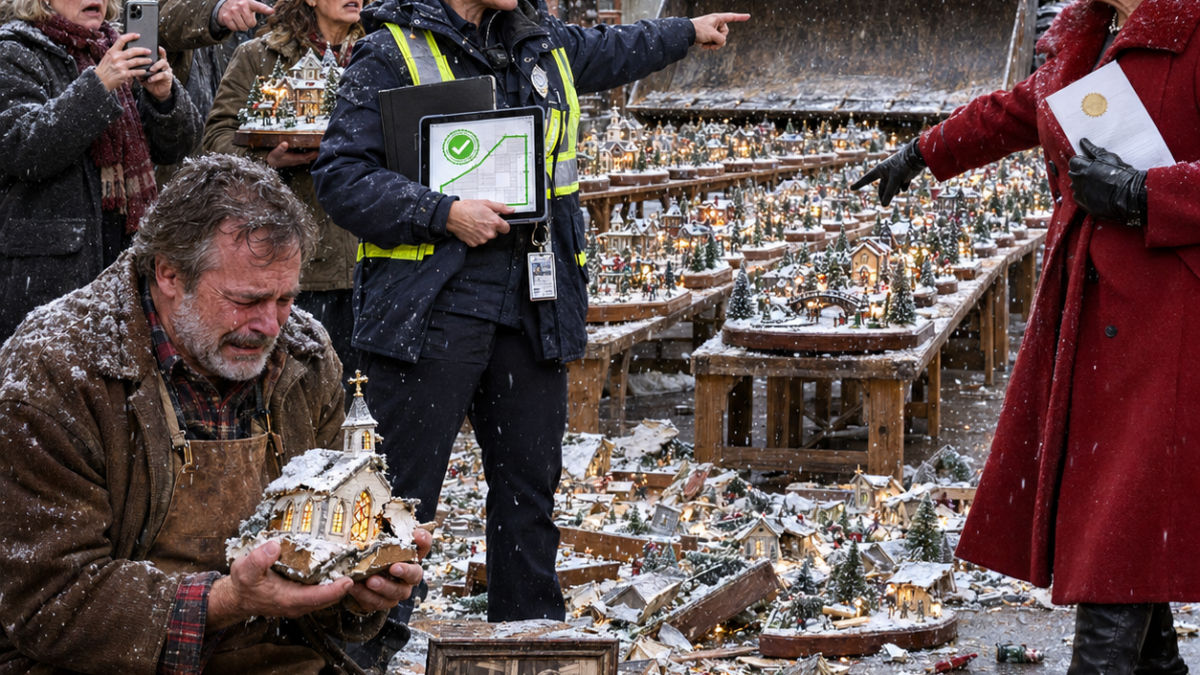
PART2
Nine days earlier, the depot had smelled of fresh paint, pine boards, and machine oil.
I had spent eight years building the collection.
I called it 60 Winters.
Not because there were sixty Christmases in my life.
Because each piece represented a winter place that existed somewhere between memory and imagination.
An old clockmaker’s shop.
A frozen train platform.
A bridge over a silver river.
A church with a bell that rang when you pulled a cord.
A glassblower’s workshop with amber lights in the windows.
A row of craftsmen bent over miniature benches.
Some globes were small enough to hold in both hands.
Others stood almost three feet high.
Inside each one were hand-cast brass mechanisms, tiny gear trains, miniature lamps, hand-painted structures, and glass I had commissioned from specialist blowers across three states.
I was thirty-nine.
Professionally, I restored historic glasswork.
Museum domes.
Stained glass.
Scientific instruments.
Architectural pieces.
Privately, I built winter worlds.
My father had been a watchmaker.
Not famous.
Not wealthy.
Patient.
When I was ten, I broke one of his clock springs trying to “help.”
I cried because I thought he would be furious.
Instead he placed the snapped spring in my hand.
“Now you know what too much force feels like.”
That sentence stayed with me.
He died when I was twenty-seven.
Cancer.
Fast.
I started building the first globe the following winter because I wanted a place where small things still worked the way they were supposed to.
That first piece eventually became number one in the collection.
The Clockmaker’s Snow.
By year eight, I had sixty.
Each had a provenance certificate.
Build journal.
Photographs from every stage.
Independent appraisal.
Mechanical diagrams.
Material records.
I was meticulous because restorers survive on documentation.
Memory is emotional.
Insurance companies are not.
Hearthstone Arts Depot had leased me its main exhibition hall through the holidays.
The depot was a converted rail station managed by the nonprofit Willow Mere Cultural Trust.
My opening was scheduled for December twenty-fourth.
Collectors were coming.
Regional arts foundations.
Traditional craft organizations.
Tourists.
All ticket revenue would be split between me and a program funding apprenticeships in endangered handcraft trades.
The Evergreen Terrace HOA’s commercial Christmas festival operated next door.
The festival used a rear service lane that happened to run beside the depot loading area.
That connection was how Karen Stroud entered my life.
She arrived during the installation inspection.
Two HOA board members followed her.
Karen walked slowly through the exhibition hall.
To my surprise, she seemed genuinely impressed.
She stopped beside Last Train Home.
Turned the brass crank.
The tiny passenger car moved.
Lights appeared in the village windows.
Karen smiled.
“This could be enormous.”
“I hope people enjoy it.”
“No.”
She looked at me.
“I mean commercially.”
That should have warned me.
She explained the Evergreen Terrace Festival had added a luxury VIP pavilion.
Corporate guests.
Hotel sponsors.
Premium dining.
She wanted 60 Winters moved there.
“All sixty?”
“Yes.”
“That’s not practical.”
“We’ll pay professional movers.”
“The depot has the lease.”
“We can solve that.”
I asked what she meant.
She handed me a contract.
I read it twice.
Stroud Holiday Productions would control ticket prices.
Image rights.
Presentation.
Marketing.
Exclusive seasonal exhibition rights.
My collection would become a headline feature inside the festival.
In exchange, Karen promised access to wealthy collectors.
“You could sell half these pieces before New Year’s.”
“I’m not selling half the collection.”
“Why?”
“Because it’s a collection.”
She smiled.
“That’s sentimental.”
“No.”
I handed the contract back.
“It’s intentional.”
Her warmth disappeared.
“You’re rejecting the offer?”
“Yes.”
She looked around the hall.
“These are extremely large glass objects.”
“Some are.”
“Children will be nearby.”
“This is an adult exhibition with controlled access.”
“Glass breaks.”
“Which is why the cases are reinforced.”
“Liquid leaks.”
“The fluid is purified water and glycerin.”
“Electricity?”
“Low-voltage isolated circuits.”
She stared at me.
Every safety concern she raised already had documentation.
Finally:
“You may own the artwork, Thomas.”
She buttoned her coat.
“But you don’t control what happens around it.”
She left.
Two mornings later, an enormous Evergreen Terrace festival billboard appeared directly in front of the depot’s primary entrance sign.
SILVER WINTER NIGHTS
AN EXCLUSIVE CHRISTMAS EXPERIENCE
It blocked most of the words 60 Winters.
I asked depot management to have it relocated.
Karen did not respond.
Instead, I received:
HOLIDAY SAFETY COMPLIANCE REVIEW
The HOA claimed the shared service lane created potential safety concerns.
They had no authority inside Hearthstone.
But they could complain.
And complain they did.
City safety office.
Fire marshal.
Insurance liaison.
Event permitting office.
One complaint became five.
Then eight.
Karen understood bureaucracy.
If she could not control my exhibit directly, she could surround it with questions.
I responded with documents.
Display-case structural certificates.
Glass specifications.
Electrical inspection.
Fluid composition.
Emergency access plan.
Visitor capacity.
Fire exits.
Graham Sutter came out personally.
He walked the entire hall.
Opened cases.
Read certificates.
Checked electrical panels.
“No problem from my side.”
For the first time, I believed the fight might be finished.
That evening, I was adjusting lighting inside Harbor at Dusk when I saw two workers in festival jackets pushing a snow-making machine through the depot’s rear loading area.
I barely noticed.
Festival staging happened constantly.
Forklifts.
Food trucks.
Generators.
Snow machines.
The workers disappeared around the loading corner.
I went back to soldering.
That small moment would later become one of the most important memories in the entire case.
Three days before opening, Karen called an emergency HOA board meeting.
I learned the details months later.
She told directors my exhibit posed a chemical hazard.
Two board members objected.
The depot was not HOA property.
Karen argued the shared rear lane gave the association a duty to protect festival guests from anything that could spill beyond the building.
The board did not authorize demolition.
It did not authorize removal.
It did not authorize touching my property.
But Karen left the meeting with enough procedural noise around her to create the impression that something official had happened.
December twenty-third.
7:40 a.m.
A janitor found a pale puddle near the loading bay.
Sharp smell.
Unknown chemical.
Graham arrived within an hour.
He did exactly what he was supposed to do.
Temporary visitor closure.
Clean the spill.
Identify source.
Re-inspect.
His written order said nothing about removing art.
Nothing about contamination inside the hall.
Nothing about destruction.
Karen circulated a community bulletin within forty minutes.
CITY DECLARES CHRISTMAS EXHIBIT DANGEROUS
That was not what the city had done.
I emailed the HOA board.
The Cultural Trust.
Graham.
Karen.
I attached the actual notice.
I hired a professional remediation company.
Requested re-inspection for Christmas Eve morning.
Then Karen sent me an email demanding that I remove all sixty globes from the depot immediately.
I answered at 6:12 p.m.
Every artwork remains my private property. No item may be moved without a trained art-handling team, condition documentation, and my written authorization. No person, vendor, contractor, board member, or event representative has permission to relocate, dismantle, dispose of, or otherwise disturb the collection.
Delivery receipt.
Opened at 6:19.
I went home.
At 5:05 the next morning, someone entered the loading-bay access code.
Three trucks came in.
Then Callaway Industrial Services.
Hydraulic crusher.
Walt was told the city had ordered emergency disposal.
Nobody called me.
At 6:52, my monitoring system sent:
UNSCHEDULED HEAVY EQUIPMENT DETECTED
I called the depot.
No answer.
Then I heard glass breaking.
By 7:14, the first globe was gone.
At 7:38, all sixty were destroyed.
Graham Sutter arrived minutes later.
Now he stood in the frozen yard looking at Karen.
“Who told you my closure notice authorized demolition?”
Karen recovered quickly.
“The contractor misunderstood the emergency scope.”
The contractor manager stepped forward.
His name was Reed Callaway.
Forty-three.
Work gloves.
Expression already defensive.
“We followed the work order we were given.”
Karen turned.
“You were instructed to remove hazardous material.”
“We were instructed to destroy decorative materials before event operations began.”
Her face changed.
Reed continued.
“We did exactly what the order said.”
Police arrived.
I asked them to stop anyone from touching the remaining fragments.
The officers documented the scene.
They did not arrest Karen.
That disappointed people later when the story became public.
Real life does not move like television.
There were competing documents.
Property rights.
Contractor instructions.
A real city closure.
Claims of emergency action.
The officers told me responsibility would require investigation.
I understood.
Karen exploited the uncertainty immediately.
Two days after Christmas, the HOA mailed me an invoice.
$18,400.
HAZARDOUS MATERIAL DISPOSAL AND SANITATION
Attached:
Settlement agreement.
If I acknowledged that the collection had been properly destroyed for public safety and waived all claims, Evergreen Terrace would waive the $18,400 charge.
I read the document three times.
Then laughed.
Not because it was funny.
Because the audacity was almost architectural.
Karen had destroyed my work.
Then billed me for the machine that destroyed it.
Then offered to forgive the bill if I agreed she had been right.
I called Maris Pritchard.
Maris was forty-two.
Litigator.
Property disputes.
Art claims.
No patience for emotional storytelling without evidence.
She came to Hearthstone that afternoon.
Walked the entire yard.
Then told me:
“Do not throw away anything.”
“It’s broken glass.”
“It’s evidence.”
We photographed every section.
Time stamps.
Location data.
Crusher tracks.
Display cases.
Broken mechanisms.
Numbered fragments.
Fluid samples.
We sent preservation demands to:
Evergreen Terrace HOA.
Stroud Holiday Productions.
Callaway Industrial.
Willow Mere Cultural Trust.
Festival vendors.
Hotel sponsor.
Security provider.
Maris brought in Nadine Mercer.
No relation.
Art conservator.
Forty-seven.
She spent two days with the wreckage.
Her conclusion was devastating.
Most pieces could not be restored.
The hand-blown glass had shattered beyond reconstruction.
Gear mechanisms were compressed and twisted.
Miniature structures crushed.
But Nadine noticed something.
“All the display cases were opened.”
“Yes.”
“Carefully.”
“Yes.”
She walked toward one stacked case.
“Emergency disposal doesn’t look like this.”
“What do you mean?”
“If they believed the globes themselves were leaking hazardous material, why remove every reinforced outer case first?”
I stared.
“The cases would contain the spill.”
“Exactly.”
She pointed at the latches.
“No pry damage.”
“Workers unlatch them.”
“One by one.”
“Yes.”
“Then carried the globes outside.”
“Yes.”
“Then crushed them.”
I felt cold despite the heated hall.
Nadine looked at me.
“That’s not panic.”
“What is it?”
“Planning.”
Karen kept talking publicly.
She told festival sponsors I had created an unsafe attraction.
She described the globes as cheap holiday decorations.
She told local business owners I was using the dispute to demand an inflated insurance payout.
Two exhibition partners suspended upcoming agreements.
A gallery canceled a spring booking.
A craft foundation delayed its sponsorship.
The damage moved beyond broken art.
My professional name had become attached to the word hazard.
One gray January afternoon, I returned to my studio and found an envelope under the door.
No return address.
Inside:
One page from a pitch presentation.
Silver Grand Hotel logo.
Across the top, handwritten:
Find out what Karen promised the hotel.
The slide showed:
SNOW GLASS NIGHTS
Luxury winter experience.
Illuminated glass domes.
Miniature villages.
Artificial snow.
The visual language was uncomfortably close to 60 Winters.
I began searching public business records.
That was when I learned Karen Stroud had another title besides HOA president.
Owner:
Stroud Holiday Productions LLC
Private event company.
Paid festival producer.
Contract holder with Silver Grand Hotel.
The HOA festival and Karen’s private company were intertwined in ways residents had never fully understood.
I called Maris.
“This wasn’t just about the HOA.”
“What did you find?”
I sent the slide.
She went quiet.
Then:
“Do not contact Karen.”
“I wasn’t going to.”
“Good.”
We requested a meeting with Silver Grand’s general manager.
Daphne Ellery.
Forty-five.
Professional enough to make even bad news sound organized.
She initially refused to discuss the contract.
Then I laid photographs of sixty destroyed globes across the table.
One after another.
Daphne stopped speaking.
I placed the brass snowflake beside them.
37 of 60.
She looked at it.
Then at me.
“What exactly are you asking?”
“Did Karen promise my exhibit wouldn’t operate?”
Her face changed.
That was enough.
Daphne eventually admitted Karen had personally guaranteed the hotel there would be no competing winter-glass exhibition near the resort during Snow Glass Nights.
“Did your hotel request that?”
“No.”
“Did you ask her to shut me down?”
“Absolutely not.”
“Did you authorize anyone to destroy anything?”
“No.”
“Would my exhibit have violated your contract?”
Daphne hesitated.
“The contract includes an exclusivity representation.”
“Meaning?”
“Stroud Holiday Productions represented that no competing glass-based winter attraction would operate within the designated event zone during our opening season.”
“What happens if that representation is false?”
“Potential breach.”
“Money?”
“Potential reimbursement, termination rights, sponsor damages.”
The puzzle assembled itself.
Karen offered to control my exhibit.
I refused.
My exhibit threatened her exclusivity promise.
Complaints began.
A mysterious chemical spill appeared.
The city temporarily closed the hall.
Before the re-inspection could occur, my collection was destroyed.
Karen’s private event company retained its exclusive attraction.
Maris was careful.
“Motive is not proof.”
“I know.”
“We need who ordered the crusher.”
“I know.”
“And we need evidence she knew she lacked authority.”
“We have my email.”
“Good.”
Then Karen called me.
First direct call since Christmas.
“Thomas.”
“What?”
“I think this has gone far enough.”
“Interesting.”
“We should resolve it privately.”
“How?”
“Seventy-five thousand.”
I almost laughed.
“For sixty pieces?”
“For avoiding years of legal expenses.”
“Confidentiality?”
“Yes.”
“Admission?”
“No.”
“Correction of what you told sponsors?”
“No.”
“Then no.”
Her voice cooled.
“You should take the money while I’m offering it.”
I ended the call.
One hour later, Nadine called.
“Thomas.”
Her voice was different.
“I have the lab report.”
“And?”
“The loading-bay liquid was not from your globes.”
I sat down.
“What?”
“Your fluid is purified water and glycerin.”
“I know.”
“This sample contains dyes, surfactants, stabilizers, and an additive profile not present anywhere in your formula.”
“What is it?”
“Commercial event solution.”
“For?”
“Artificial snow systems.”
I closed my eyes.
Two workers.
Festival jackets.
Snow-making unit.
Late evening.
I pulled Hearthstone’s archived footage.
Six hours later, I found the van.
2:03 a.m.
December twenty-third.
Festival contractor vehicle.
Two workers.
Large container moved into the logistics area.
Eleven minutes.
Then gone.
The camera did not show anyone pouring liquid.
Maris stopped me before I could make assumptions.
“This does not prove who spilled it.”
“I know.”
“Do not say it does.”
“I know.”
“But it gives us legitimate discovery.”
Equipment logs.
Chemical inventory.
Shift assignments.
Access codes.
A technician agreed to speak.
He confirmed he had been instructed to stage winter-event equipment in the depot logistics area even though the official festival plan placed that equipment elsewhere.
He would not guess who spilled anything.
Good.
We didn’t need guesses.
Maris explained the case carefully.
“The city closure was lawful.”
“Yes.”
“Graham responded correctly.”
“Yes.”
“The spill may have been deliberately created.”
“Maybe.”
“But even if we never prove that, your destruction claim does not depend on it.”
“Who ordered the crusher.”
“Exactly.”
That became our focus.
Preservation order.
Subpoenas.
Dispatch records.
Emails.
Access logs.
Work orders.
Electronic signatures.
Karen fought every step.
She told Evergreen Terrace residents the lawsuit was an attack on the HOA.
She demanded association funds pay for her defense.
At a board meeting, treasurer Lydia Fenwick finally asked:
“Where is the board resolution authorizing destruction of Thomas Brantley’s property?”
Karen said:
“The emergency made formal authorization impossible.”
Lydia repeated:
“Where is the resolution?”
There wasn’t one.
“Minutes?”
None.
“Legal opinion?”
None.
“Insurance approval?”
None.
Lydia had spent six years avoiding direct conflict with Karen.
That night, she stopped.
Callaway Industrial received a subpoena.
Reed cooperated.
His company had a problem.
If Karen had lied about ownership, he did not intend to become the person financially responsible for pretending he never asked.
During deposition, Reed said one of his crew members questioned the order before the first globe was crushed.
“Why?”
“Because the pieces looked expensive.”
“What did he ask?”
“Whether they belonged to the HOA.”
“And?”
“Dispatch called the client.”
“Who?”
“Karen Stroud.”
My attorney leaned forward.
“What did she say?”
Reed paused.
“Our safety calls are recorded.”
The room went still.
Weeks later, Maris called me.
“Thomas.”
“Yes?”
“We found who ordered the crusher.”
“The HOA?”
“No.”
My stomach tightened.
“Who?”
“Stroud Holiday Productions.”
Karen’s private company.
The contract carried her electronic signature.
Client:
STROUD HOLIDAY PRODUCTIONS LLC
Scope:
Removal and destruction of decorative materials no longer permitted on site prior to event operation.
No signature from me.
None from Willow Mere Cultural Trust.
No city authorization.
Then the dispatch log.
A worker asked whether the globes belonged to Evergreen Terrace.
Coordinator contacted Karen.
Her recorded response:
She had verified disposal rights.
Proceed.
That was the crack.
The one no explanation could weld closed.
Karen had told the public the contractor made an emergency decision.
The contractor had records showing Karen personally confirmed authority and ordered them forward.
Lydia called a special HOA board meeting.
Karen entered expecting support.
She did not get it.
Directors confirmed there had been no vote to destroy anything.
No authority granted.
No ownership claim over my collection.
Then the HOA’s attorney explained something Karen had apparently never seriously considered.
Using the title HOA president did not transform private business conduct into official association action.
And intentional destruction might not be covered by HOA insurance.
Karen stared at him.
“You’re refusing to defend the president?”
“I’m saying we need to determine whether the association authorized the conduct.”
“I was acting to protect the festival.”
Lydia asked:
“Which company hired the crusher?”
Silence.
“Evergreen Terrace?”
No answer.
“Or Stroud Holiday Productions?”
Karen looked away.
That was the moment the board stopped being her shield.
Her own structure betrayed her.
She had used the HOA title to create authority.
Used her private company to sign the contract.
Used the city closure as justification.
Used association paperwork afterward to invoice me.
Every layer she built to blur responsibility now made the pattern easier to prove.
Karen offered $175,000.
Confidential settlement.
Documents sealed.
Case dismissed.
No admission.
For one night, I considered it.
I was tired.
I had spent months surrounded by broken pieces.
Evidence boxes.
Legal bills.
Cancelled contracts.
Every morning I entered the studio and saw fragments of eight years.
$175,000 would not restore the work.
But it might end the fight.
Maris came the next morning.
She placed my original appraisals on the table.
Dated before the destruction.
Then the signed exhibition contracts.
Insurance valuation.
Repair-system costs.
Lost-profit analysis.
“Thomas.”
I looked at her.
“You don’t have to go to trial because you hate Karen.”
“I don’t.”
“You also don’t have to settle because you’re exhausted.”
I looked toward the evidence boxes.
“What would you do?”
“Not relevant.”
“Maris.”
She sighed.
“I would ask whether the settlement reflects the actual documented loss.”
“It doesn’t.”
“No.”
“Then if I accept, she buys her way out below cost.”
“Yes.”
I thought about the brass snowflake.
37 of 60.
Then:
“Trial.”
Eight months after Christmas Eve, we entered Judge Judith Waverly’s courtroom.
Karen wore charcoal gray.
No red coat.
No silver pine brooch.
Her defense had three pillars.
The exhibit was dangerous.
Destruction was necessary.
My damages were inflated.
Maris attacked none of them emotionally.
She started with documents.
Graham Sutter testified first.
“Did you order Hearthstone closed?”
“Temporarily.”
“Why?”
“Unknown liquid hazard in the loading area.”
“Did you order destruction of the snow globes?”
“No.”
“Removal?”
“No.”
“Did your notice authorize Karen Stroud to destroy third-party property?”
“No.”
“Any ambiguity?”
“No.”
Karen’s emergency-authority defense weakened before lunch.
Nadine testified next.
Fluid composition.
My documented glycerin mixture.
Loading-bay solution.
Different chemistry.
Artificial-snow additives.
Karen’s attorney attacked inference.
“No witness saw anyone pour liquid, correct?”
“Correct.”
“You cannot say Ms. Stroud created the spill.”
“Correct.”
That was fine.
Maris stood afterward.
“The plaintiff is not asking this court to infer that Ms. Stroud personally poured anything.”
She turned toward the judge.
“The issue is whether the defendant knowingly ordered private artwork destroyed without authority.”
Reed Callaway testified.
Contract.
Private company.
Work order.
Dispatch log.
Then the recording.
The courtroom heard the coordinator ask:
Crew is concerned these items may belong to a third party. Please confirm disposal authority.
Karen’s voice:
Authority has been verified. Proceed as instructed. Everything must be cleared before event operation.
I watched Karen.
Her face did not move.
Maris entered my December twenty-third email.
Private property.
No authorization to move.
No authorization to destroy.
Email opened by Karen.
Time stamped.
The misunderstanding defense collapsed.
Then value.
Karen’s attorney called the globes holiday decorations.
Maris presented:
Three independent appraisals.
All completed before the dispute.
Detailed provenance.
Build journals.
Photographs.
Material invoices.
Traveling-exhibition contracts.
Collector offers.
Insurance valuation.
I testified last.
I carried one small wooden box.
Opened it.
Brass snowflake.
37 of 60.
Judge Waverly looked at it.
“What is that?”
“Part of Last Train Home.”
I explained the piece.
The tiny passenger car.
The village.
My father’s gear ratio.
Then stopped.
I had promised myself I would not turn grief into a damages figure.
“I’m not asking the court to price what this meant to me.”
Karen’s attorney looked up.
“I don’t think memory has a market value.”
I placed the snowflake down.
“I am asking for the value of documented property and losses.”
The numbers were specific.
$612,000 for the sixty destroyed works based on prior appraisals.
$88,000 for display systems, reinforced cases, mounts, and related components.
$22,000 for mandatory cleanup and remediation.
$58,000 in separately calculated lost net profit from signed exhibition contracts.
Total:
$780,000.
No emotional multiplier.
No invented future fame.
No request for millions because I was angry.
Karen’s attorney stood.
“You never sold any of these globes, correct?”
“Correct.”
“So no buyer ever established these prices.”
“They were not individually offered for sale.”
“Then the valuations are opinions.”
“Professional appraisals are opinions.”
He smiled.
“Exactly.”
Maris then introduced three written collector offers made before Christmas.
Each for individual works.
Each within the appraisal range.
The smile vanished.
Karen took the stand.
At first, she was controlled.
She described public safety.
Festival congestion.
The chemical spill.
The urgency.
Then Maris asked:
“Who owned the snow globes?”
“Mr. Brantley.”
“Did Evergreen Terrace own them?”
“No.”
“Did Stroud Holiday Productions?”
“No.”
“Did the city?”
“No.”
“Did Mr. Brantley authorize their destruction?”
“No.”
“Did the Cultural Trust?”
“No.”
“Did the HOA board?”
Karen hesitated.
“No formal vote.”
“Any vote?”
“No.”
“Yet you signed the destruction order.”
“I believed the hazard required action.”
“You received Mr. Brantley’s email forbidding anyone to move the collection.”
“Yes.”
“You opened it.”
“Yes.”
“And hours later, you authorized a private contractor to destroy the collection.”
“I believed—”
Maris held up the Stroud Holiday Productions contract.
“Through your private company.”
Karen’s composure broke.
“I was trying to save Christmas.”
The courtroom went still.
Maris did not raise her voice.
“Whose Christmas?”
Karen stared at her.
No answer.
“Evergreen Terrace residents?”
Silence.
“Silver Grand Hotel?”
Nothing.
“Your private event company?”
Karen looked toward her attorney.
Maris placed the hotel contract beside the crusher order.
“You guaranteed no competing winter-glass exhibit would operate nearby.”
Karen’s attorney objected.
Judge Waverly allowed the limited questioning.
Maris continued.
“If 60 Winters opened on December twenty-fourth, your company risked breaching that representation.”
“I was protecting the festival.”
“You were protecting your contract.”
“No.”
“You first offered to take control of Mr. Brantley’s exhibition.”
“Yes.”
“He refused.”
“Yes.”
“You began safety complaints.”
“I reported legitimate concerns.”
“The city found the exhibit itself compliant.”
“The spill changed that.”
“A spill that did not come from his globes.”
“I didn’t know that then.”
“Correct.”
Maris paused.
“So without knowing where the spill came from, you destroyed every artwork anyway.”
Karen lost control.
“He was going to ruin everything!”
The words echoed.
Her attorney closed his eyes.
Judge Waverly stared.
Maris said:
“Everything meaning your festival contract?”
Karen stopped.
Too late.
That sentence became the emotional center of the case.
Not because it proved every allegation.
Because it exposed the motive she had spent months disguising as public safety.
After closing arguments, Judge Waverly took the matter under advisement.
The ruling came two weeks later.
I sat beside Maris.
Karen sat across the aisle.
The judge spoke for nearly forty minutes.
She separated speculation from proof.
The court did not make a definitive finding about who created the original spill.
There was insufficient direct evidence for that conclusion.
That mattered.
Truth mattered more than narrative convenience.
But the destruction required no speculation.
Karen knew I owned the artwork.
She had received explicit written notice that nobody had authority to move it.
No city order authorized demolition.
No HOA resolution authorized demolition.
No Cultural Trust authorization existed.
Her private company hired the crusher.
Her electronic signature appeared on the order.
The dispatch log showed she personally confirmed disposal authority after the contractor questioned ownership.
Judge Waverly found Karen Stroud personally liable.
Then she read the amount.
“Judgment for the plaintiff in the amount of seven hundred eighty thousand dollars.”
Karen did not move.
No gasp.
No dramatic scream.
Just stillness.
I closed my hand around the brass snowflake.
I did not feel triumphant.
The original sixty were still gone.
A judgment cannot restore eight years.
It cannot reproduce my father’s mechanical drawings in the exact object where I first used them.
It cannot put shattered glass back into the shape it had before.
Justice is not time travel.
It is accountability.
Outside the courtroom, reporters waited.
I declined interviews.
Karen’s attorneys reviewed post-trial options.
Evergreen Terrace removed her as president.
The association formally stated it had never authorized the destruction.
Its insurer denied portions of coverage tied to intentional conduct.
Stroud Holiday Productions lost several contracts.
Silver Grand terminated its agreement.
Judgment enforcement proceeded through ordinary legal channels.
Liens.
Asset review.
Negotiated payments.
Sale of part of Karen’s personal property.
No instant mansion seizure.
No police dragging her away.
No crowd cheering while she begged.
That would have been spectacle.
What happened was slower.
More painful.
More real.
The title that had once opened doors no longer protected her from a document bearing her own signature.
Three weeks after the ruling, an envelope arrived at my studio.
Silver Grand Hotel crest.
Inside:
Proposal for Next Christmas
Daphne wanted the hotel to sponsor rebuilding 60 Winters.
Premium event.
Major budget.
National promotion.
Exclusive presentation rights.
I read the contract.
Then called her.
“I’m not doing exclusivity.”
Silence.
“Thomas, that’s one of the main reasons we can fund this.”
“Then don’t fund it.”
She paused.
“What do you want?”
“A traveling exhibit.”
“Where?”
“Independent art spaces.”
“Regional museums.”
“Craft schools.”
“Community admission days.”
“No venue owns the collection.”
“No sponsor controls where it can go.”
Daphne laughed softly.
“You learned something.”
“I already knew it.”
A pause.
“I just paid a lot to prove it.”
She agreed.
The rebuilding began in spring.
I did not recreate the originals.
That surprised people.
“Why not make Last Train Home again?”
Because it would not be Last Train Home.
The original existed.
Then it was destroyed.
Pretending otherwise felt dishonest.
So I built forward.
New mechanisms.
New villages.
New winter scenes.
Number one became:
After the Storm.
Number seventeen:
The Unbroken Window.
Number twenty-eight:
Inspection Day.
Maris laughed at that one.
Number forty-two showed craftsmen rebuilding a bridge beneath falling snow.
Daphne bought the first sponsorship slot.
No naming rights.
The Cultural Trust reopened Hearthstone.
Evergreen Terrace’s new board president sent a formal apology.
Lydia Fenwick personally delivered it.
“I should have challenged Karen sooner.”
“You challenged her when it mattered.”
“Late.”
“Yes.”
She appreciated that I did not lie to comfort her.
“I’m sorry.”
“Thank you.”
Then she looked around the studio.
“Will there really be sixty again?”
“Yes.”
One year after the destruction, Hearthstone Arts Depot opened its doors.
December twenty-fourth.
Snow fell lightly.
Fifty-nine new globes filled the hall.
Tiny trains moved.
Chapels chimed.
Village windows glowed.
People leaned close to the cases.
The sixtieth pedestal stood at the far end.
On it sat one globe of perfectly clear glass.
Inside:
Dark stone base.
One bent brass snowflake.
37 OF 60
Nothing else.
The work was titled:
The Winter That Could Not Be Erased
A small plaque beneath it read:
You can break the glass. You cannot erase the hands that made it.
I had rewritten that sentence twelve times.
Almost removed it.
Then left it.
My father would have called it dramatic.
He would have been right.
Opening night was full.
Not because of Karen.
Not because of the lawsuit.
Because the new work deserved to be seen.
Craft students came free.
Families from Hearthstone.
Collectors.
Restorers.
Glassblowers.
Metalworkers.
People who had followed the case.
And people who had never heard of it.
That last group mattered most.
A reporter asked:
“Do you feel victorious?”
I looked across the hall.
“No.”
She seemed surprised.
“Karen was ordered to pay $780,000.”
“Yes.”
“You rebuilt.”
“Yes.”
“Her company lost contracts.”
“Yes.”
“So why not victory?”
I thought about the question.
“Because the goal was never to destroy her life.”
The reporter waited.
“I wanted my work left alone.”
I looked toward the clear globe.
“When she made that impossible, I wanted the truth documented so she could never call destruction public service.”
The reporter wrote that down.
Later, after the hall emptied, I walked alone through the exhibition.
Number twelve chimed.
Number twenty-one’s train moved.
Number fifty-nine lit one window at a time.
Then I stopped at sixty.
The brass snowflake looked tiny inside the glass.
I remembered Christmas Eve.
The crusher.
Karen’s red coat.
Her words.
Your little snow globes are gone.
I had spent months believing the most satisfying answer would be proving her wrong.
But standing there, I understood something different.
She had been right about one thing.
Those sixty originals were gone.
Justice did not mean pretending otherwise.
The greater victory was that destruction had not been allowed to define the ending.
The collection had changed.
So had I.
Before Karen, I had thought protecting art meant cases.
Locks.
Climate control.
Insurance.
After Karen, I understood protection also meant contracts.
Records.
Boundaries.
And the willingness to enforce them without becoming the thing you hated.
That part mattered because anger can imitate justice very convincingly.
There were nights I wanted Karen ruined.
Completely.
House gone.
Business gone.
Reputation gone.
Everything.
Then I would look at the numbers.
$612,000.
$88,000.
$22,000.
$58,000.
I would remind myself:
That is the documented loss.
Not her whole life.
Justice ends somewhere.
Revenge does not.
Months after the verdict, I learned Karen had sold her vacation property and refinanced her home to satisfy part of the judgment.
She began making payments under the enforcement arrangement.
I felt nothing like satisfaction.
Only finality.
Then something unexpected happened.
A letter arrived.
From Karen.
Maris asked whether I wanted her to read it first.
“No.”
The letter was handwritten.
Short.
Thomas,
I spent months telling myself I was protecting a festival, the neighborhood, the hotel contract, the people depending on me, and eventually I used all of those reasons to avoid saying the simplest truth: you told me no, and I decided your no mattered less than what I wanted.
I stopped reading.
Continued.
I believed being president meant I understood what was best for everyone in the room. Then I began using that belief outside every room I actually had authority over.
I cannot restore your work. I know money does not do that.
I am sorry.
Karen
No request for forgiveness.
No excuse.
No mention of the spill.
No claim she had been misunderstood.
I put the letter in the same archive box as the court judgment.
Not because I forgave her immediately.
Because accountability deserved to be preserved too.
The second year of the rebuilt exhibition, we traveled to six venues.
Denver.
Bozeman.
Santa Fe.
Portland.
Minneapolis.
Chicago.
Every stop included one free admission day.
Craft schools received workshop grants.
Glass apprentices worked with Nadine.
Mechanical students studied the internal gear systems.
The collection became larger than anything Karen’s exclusive festival contract could have created.
That irony pleased Daphne more than it pleased me.
At the Chicago opening, she stood beside me.
“You know, if you had taken Karen’s original deal, this probably would have stayed one holiday attraction.”
“Probably.”
“And because she destroyed it—”
I looked at her.
“Careful.”
She stopped.
“You’re right.”
“Karen didn’t create this.”
“No.”
“We did.”
Daphne smiled.
“Fair.”
That distinction became important.
I refused to make Karen the secret author of my success.
She caused damage.
She did not get credit for what I built afterward.
People love saying:
Your enemies make you stronger.
Sometimes.
But the stronger version of yourself still belongs to you.
Karen did not rebuild the collection.
I did.
Nadine did.
Daphne helped fund it.
Craft students contributed.
The Cultural Trust gave us space.
Collectors came back.
Karen’s role ended at the damage.
I would not let her own the recovery too.
Five years later, the original brass snowflake still sat inside globe sixty.
The writing on its base had not changed.
The clear dome became the most photographed piece in the exhibition.
Ironically, it was the simplest.
No gears.
No lights.
No artificial snow.
Just one damaged object preserved instead of discarded.
A young restoration student once asked:
“Why didn’t you straighten it?”
“The snowflake?”
“Yes.”
“The edges are bent.”
“I know.”
“You could repair it.”
“I could.”
“Then why not?”
I thought about my father.
The broken clock spring when I was ten.
Now you know what too much force feels like.
I smiled.
“Because repair isn’t always returning something to the shape it had before.”
She stared at the snowflake.
“Sometimes repair is making sure the damage stops there.”
She wrote that down.
I pretended not to notice.
By then, Evergreen Terrace had changed too.
New board procedures.
Conflict-of-interest disclosures.
No president could approve vendor work unilaterally above a set threshold.
Private business interests had to be disclosed.
The festival continued.
Smaller.
Less glamorous.
More transparent.
Lydia eventually became president.
The first year, she invited Hearthstone to participate.
I declined.
Politely.
The second year, she asked whether they could advertise the depot as a nearby independent attraction.
I said yes.
One condition.
“Use exactly the wording I approve.”
“Of course.”
The advertisement read:
Nearby: 60 Winters at Hearthstone Arts Depot. Independently operated. Separate admission.
Boring.
Accurate.
Perfect.
I attended the festival once.
Not officially.
I bought hot cider.
Walked among families.
No one recognized me.
That was pleasant.
Near the main pavilion stood a snow-making machine.
Same type as the one I had seen years earlier.
I looked at it longer than I expected.
Then moved on.
The unresolved question of the original spill remained unresolved.
Authorities investigated.
The evidence established suspicious staging and chemical similarities.
But no witness or recording proved who intentionally placed the liquid on the floor.
No criminal case was built around that theory.
People found that unsatisfying.
I did not.
Evidence has limits.
Justice becomes dangerous when we fill those limits with whatever story feels best.
Karen was held responsible for what we could prove she did.
She ordered the destruction.
That was enough.
More than enough.
Over time, the lawsuit stopped being the first thing people mentioned when they met me.
That was good.
I became Thomas Brantley, the glass restorer again.
Not “the snow globe guy who sued the HOA Karen.”
I restored a nineteenth-century greenhouse ceiling.
A museum instrument case.
A stained-glass railway window.
Built new winter pieces.
Taught.
Lived.
Then, almost eight years after Christmas Eve, my father’s old workbench finally cracked.
Not dramatically.
One morning I noticed a split in the oak top.
I ran my hand over it.
For an hour, I considered replacing the entire surface.
Instead, I stabilized the crack.
Butterfly joints.
Resin.
No attempt to hide it completely.
When I finished, the bench remained the same bench.
Changed.
Still useful.
Still his.
Still mine.
I laughed when I realized what I had done.
The same lesson again.
Not everything damaged needs to look untouched afterward.
Sometimes survival should remain visible.
That Christmas, I built a new globe.
Not part of 60 Winters.
Just for myself.
A tiny workshop.
Old man at a bench.
Young boy beside him holding a broken spring.
Outside the miniature window, snow fell over a quiet street.
The boy’s hand was open.
Inside it:
One tiny piece of brass.
I called it:
Too Much Force
I never exhibited it.
It stayed in my studio.
Some things do not need an audience to matter.
On Christmas Eve each year, Hearthstone still opens late.
Visitors walk through sixty winter worlds.
At closing, the staff dims the hall.
The mechanisms stop one by one.
Trains settle.
Church bells go quiet.
Village windows fade.
The last light always remains over globe sixty.
Clear glass.
Dark stone.
Brass snowflake.
37 of 60.
One evening, years after the trial, I stood beside it while snow collected outside the depot doors.
A child pressed both hands to the case.
His father whispered:
“That’s the one that survived.”
I almost corrected him.
Technically, dozens of fragments survived.
But I understood what he meant.
The child asked:
“Why didn’t the bad lady break that part?”
His father looked embarrassed.
I knelt slightly.
“She did.”
The boy frowned.
“Then how is it here?”
“Because broken and gone are not the same thing.”
He thought about that.
Then nodded with the solemn confidence children reserve for ideas they plan to remember.
They walked away.
I remained beside the globe.
Karen had once stood in that frozen loading yard and told me my little snow globes were gone.
For a long time, I wanted the ending of the story to be:
No, Karen. You were wrong.
But that was too simple.
Some things were gone.
Forever.
That deserved honesty.
The real ending was better.
She broke sixty works of art.
She did not erase the work.
She did not erase the records.
She did not erase the hands that made them.
And once the truth was documented, she could no longer erase responsibility either.
Outside, snow fell over Hearthstone.
Inside, fifty-nine new winter worlds glowed.
At the end of the hall, one damaged snowflake rested beneath clear glass.
I looked at it.
Then switched off the final light.
Not because the story was forgotten.
Because it was finished.








