PART2:“COME TAKE YOUR USELESS DAUGHTER HOME!” My Mother-in-Law Laughed After My Husband Knocked Out My Tooth—She Had No Idea Who My Mother Used to Be
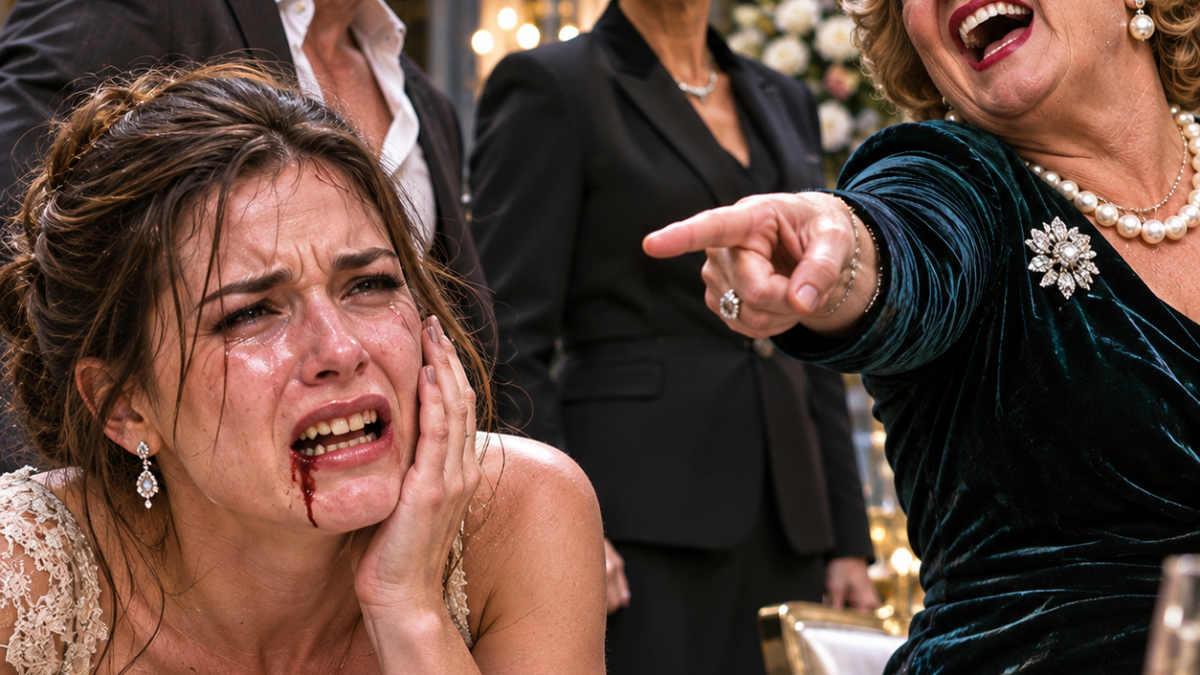
PART2
I landed on the tile hard enough to bruise my hip.
For several seconds, I could not breathe properly.
Then the sobbing started.
Silent first.
Then shaking.
I pressed both hands against my ribs and tried not to look at the mirror.
Eventually I did.
My upper lip was swelling.
Blood had dried toward my chin.
The edge of my front tooth was gone.
There was already redness spreading across my cheek.
That face in the mirror belonged to a woman I barely recognized.
But the worst part was not the injury.
It was the sudden collapse of the story I had been telling myself for eight years.
Evan had never hit me.
That sentence had protected him for years.
He had never hit me when he smashed a coffee mug against the wall beside my head.
He had never hit me when he squeezed my wrist until bruises appeared.
He had never hit me when he blocked the bedroom door because I tried to leave an argument.
He had never hit me when he punched a hole in the laundry-room door after I questioned a credit-card charge.
He had never hit me when he grabbed my upper arms and shook me while insisting I was “making him crazy.”
So technically, I had told myself, he had never crossed the line.
That night, a piece of my tooth was sitting on Diane Caldwell’s kitchen floor.
There was no line left to negotiate.
My phone buzzed.
Mom.
I answered.
“Mom.”
“Rachel.”
Her voice had softened.
“Is the door locked?”
“Yes.”
“Are you alone?”
“Yes.”
“Where?”
“Guest bathroom.”
“Good.”
Then:
“Do not wash your face.”
I stared at the blood in the sink basin where one drop had fallen.
“What?”
“Do not rinse the blood off your clothes. Don’t throw anything away. Take photographs.”
“Mom, it hurts.”
“I know.”
Her voice caught just slightly.
Then steadied.
“I know, sweetheart.”
I began crying again.
“I don’t know what to do.”
“Yes, you do.”
“No, I don’t.”
“We’re going one step at a time.”
That was my mother.
She could reduce disaster into sequence.
“First, photographs.”
My hands shook.
“Front of your face.”
I took one.
“Both sides.”
Two more.
“Your mouth if you can do it safely.”
I did.
“Any other marks?”
“My shoulder hurts.”
“Photograph what you can see. Don’t force anything.”
I documented the redness.
My shirt.
Blood.
Then Mom said:
“Upload them somewhere Evan cannot access.”
I used the cloud folder she had helped me create months earlier for tax records.
“Done.”
“Now call 911.”
My stomach dropped.
“Mom.”
“Call.”
“If I call police, everything is over.”
A pause.
Then my mother said something I would remember for the rest of my life.
“Rachel, the marriage did not end because you called for help.”
I closed my eyes.
“It ended when he decided he was entitled to hurt you for saying no.”
The sentence cut cleanly through every excuse I had built.
Outside, footsteps approached.
Evan knocked.
“Rachel?”
His voice was soft now.
Careful.
“Come out.”
I stayed silent.
“Let me look at you.”
No answer.
“Please.”
Then:
“I lost my temper.”
I looked down at the phone.
“I didn’t mean to hurt you.”
I had heard that sentence before.
Not after a slap.
After the mug.
After the wrist.
After the door.
Always some version.
I didn’t mean it.
You scared me.
You wouldn’t stop.
You pushed.
I reacted.
You know how I get when you corner me.
Evan continued.
“You were yelling.”
I had not been yelling.
“Mom was stressing everyone.”
Diane was his mother.
“You know I love you.”
My thumb hovered over the emergency-call button.
Then the doorknob rattled.
“Rachel.”
Harder.
“I know you have your phone.”
I dialed.
“911, what is the address of your emergency?”
“My name is Rachel Mercer Caldwell.”
My voice sounded calmer than I felt.
“I’m at 1412 Heritage Way in Chesapeake.”
“What happened?”
“My husband hit me in the face.”
I swallowed.
“My tooth is broken. I’m bleeding.”
“Are you safe right now?”
“I’m locked inside a downstairs bathroom.”
“Is your husband still there?”
“Yes.”
Through the door:
“Rachel!”
The dispatcher heard him.
“What is his name?”
“Evan Caldwell.”
“Any weapons?”
“There are firearms in the house.”
That was true.
Evan’s father hunted.
Several locked firearms were stored upstairs.
“I don’t believe Evan has one with him.”
“Do not leave the bathroom.”
“I won’t.”
“We have officers and EMS responding.”
Evan pounded on the door.
“Have you lost your mind?”
I flinched.
The dispatcher’s voice became firmer.
“Stay with me.”
Diane joined him.
“You’re going to destroy his career!”
That sentence stunned me.
Not:
Are you okay?
Not:
We’re sorry.
His career.
Evan was a regional operations director for a defense logistics company.
He liked telling people his security clearance made him important.
For years, that job had been one of his favorite weapons.
A police report could hurt me.
A divorce could embarrass him.
An accusation could affect his career.
Therefore I needed to keep everything private.
Diane hit the door.
“Rachel, open this right now!”
Then silence.
A small metallic sound.
The emergency key.
My chest tightened.
“Dispatcher.”
“Yes, Rachel?”
“They have the bathroom key.”
“Move away from the door.”
I stood.
Backed toward the tub.
“Officers are very close.”
The lock turned.
The door opened three inches.
I held up the phone.
“Evan, don’t come in.”
He pushed.
“Stop this.”
“Don’t.”
Then a man’s voice thundered from somewhere beyond the hallway.
“CHESAPEAKE POLICE. STEP AWAY FROM THE DOOR.”
Everything stopped.
Evan’s hand disappeared.
Another voice:
“Hands where I can see them.”
Diane started talking immediately.
“There has been a misunderstanding.”
“Ma’am, step back.”
“This is our home.”
“Step back.”
I heard movement.
Then:
“Rachel?”
A woman’s voice.
“Chesapeake Police. Are you able to unlock the door?”
I looked at the dispatcher.
She said:
“You can open it when you are comfortable and officers have identified themselves.”
I opened the door.
The female officer’s face changed when she saw me.
Not dramatically.
Just enough.
Her name was Officer Torres.
She held out one hand.
“Come with me.”
Behind her, another officer stood with Evan several yards away.
His face had changed completely.
No rage.
No sneer.
He looked frightened.
Diane kept talking.
“She fell into the island.”
Officer Torres turned toward her.
“Ma’am, please stop discussing the incident until an officer speaks with you separately.”
“She is emotional.”
“Stop.”
Diane stopped.
That mattered more to me than it should have.
For eight years, almost nobody had ever told Diane Caldwell to stop talking.
EMS examined me in the dining room.
My blood pressure was high.
My face hurt.
The exposed tooth sent electric pain through my jaw.
Officer Torres asked:
“Do you want medical transport?”
“Yes.”
Evan stared.
I had never said yes that quickly to anything that might make him angry.
The paramedic photographed nothing.
He documented clinically.
The police photographed injuries with my consent.
I gave the officer the piece of tooth after asking whether I should preserve it.
She looked surprised.
“Where is it?”
“In the kitchen.”
Diane had already tried cleaning the floor.
But the tooth fragment was still near the island.
The officer photographed it in place.
Then bagged it after coordinating with me.
Diane protested.
“That’s disgusting.”
Officer Torres looked at her.
“It may be relevant evidence.”
For the first time, Diane seemed to understand this was no longer a family argument she could control through volume.
Then my mother arrived.
Not in a convoy.
Not with armed friends.
Not in tactical gear.
She pulled up in a twelve-year-old blue Toyota Tacoma.
The same “rusty pickup” Evan had mocked.
Gray hair.
Dark jeans.
Navy windbreaker.
She stepped out slowly.
Officer Torres met her near the driveway.
Mom identified herself.
Then waited.
She did not storm through the door.
Did not threaten Evan.
Did not touch anyone.
When Torres brought her to me, my mother stopped three feet away.
Her face went completely still.
I saw her eyes take in everything.
Lip.
Cheek.
Tooth.
Blood.
My shaking hands.
Then she asked:
“Can I hug you?”
That question nearly broke me.
“Yes.”
She held me.
Not tightly.
Just enough.
I buried my face against her shoulder.
“I’m sorry.”
She pulled back immediately.
“For what?”
“I should have told you.”
Her expression changed.
Not anger at me.
Something worse.
Grief.
“You’re telling me now.”
Behind us, Diane laughed bitterly.
“Here comes the cavalry.”
My mother looked over.
Officer Torres moved slightly, ready for conflict.
Mom said only:
“Diane, I’m not speaking to you tonight.”
Then turned back to me.
That was it.
No threats.
No dramatic revelation.
Diane seemed almost disappointed.
She wanted my mother angry.
Anger would have let her say we were the dangerous family.
Mom refused to give her that.
At the hospital, I learned I had a fractured incisor, significant facial bruising, a cut inside my lip, and a shoulder contusion from hitting the counter.
No facial fracture.
No concussion identified, though the doctor gave me clear return precautions.
A dentist on call performed temporary stabilization.
The permanent repair would come later.
My mother sat beside the bed taking notes.
Time.
Doctor names.
Discharge instructions.
Case number.
Follow-up.
At one point I laughed weakly.
“You really are treating this like an operation.”
She looked at me.
“No.”
“What’s the difference?”
“In an operation I’m responsible for the plan.”
She took my hand.
“Here, you are.”
That was important.
For years, Evan had made decisions for me.
Then Diane.
Even people trying to save someone can accidentally do the same thing.
My mother never did.
She gave options.
I chose.
The police arrested Evan that night based on the circumstances officers documented and the applicable process.
I did not celebrate.
When Officer Torres told me, I started crying.
Mom did not say:
Good.
She did not say:
He deserves it.
She simply handed me tissues.
“I still love him.”
“I know.”
“How can I?”
“Eight years doesn’t disappear in one evening.”
“I feel stupid.”
“You’re injured.”
She squeezed my hand.
“That’s enough to carry tonight.”
I spent the night at Mom’s house in Virginia Beach.
The hydrangeas Diane had mocked were dormant.
Mom made tea.
I could barely drink it through a straw.
At 3:00 a.m., I woke screaming.
For a few seconds, I thought Evan was outside the bedroom.
Mom appeared in the doorway.
She did not turn on the bright light.
“Rachel.”
“I’m okay.”
“You’re not required to be.”
She sat in the chair near the bed.
I cried.
Then I finally told her the truth.
Not just the slap.
Everything.
The smashed mug.
The wrist bruises.
The time Evan took my car keys because I tried to leave an argument.
The passwords he demanded.
The way he monitored our joint account.
The way Diane called me “unstable” whenever I complained.
The night Evan stood in front of the bedroom door for nearly three hours while telling me I was incapable of surviving without him.
Mom listened.
At the end, she asked:
“Has he ever strangled you?”
“No.”
“Threatened to kill you?”
“No.”
“Threatened himself if you leave?”
“Once.”
Mom wrote that down.
“Any weapons he can access?”
“His father owns them. Evan knows the safe combination.”
She nodded.
“We tell the advocate.”
“What advocate?”
“The hospital gave you a domestic-violence resource number.”
I stared at her.
“You already called?”
“No.”
She held up the paper.
“You decide.”
Again.
My decision.
I called the next morning.
The advocate’s name was Megan.
She helped me build a safety plan.
Change passwords.
Freeze credit.
Redirect mail.
Preserve documents.
Consider a protective order.
Separate finances lawfully.
Retrieve belongings only through a safe process.
I learned how much of my life Evan could access.
Phone plan.
Email recovery.
Cloud backups.
Banking.
Insurance.
Smart-home applications.
The violence was one night.
The control was everywhere.
By noon, my mother had made one request.
“Can I show you something?”
“What?”
She opened her office closet.
Inside were storage boxes I had seen my entire childhood.
She pulled out one.
Photographs.
Awards.
Old Navy paperwork.
A framed insignia.
One photograph showed my mother decades younger beside a group of service members.
Different world.
Different version of her.
“You never talk about this.”
“No.”
“Why now?”
“Because Evan and Diane think strength means frightening people.”
She placed the photograph down.
“It doesn’t.”
I waited.
“Real discipline is knowing what you are capable of and not using more force than the situation requires.”
She looked at me.
“I spent years around people trained to do dangerous things.”
Then:
“The best of them were the hardest people in the room to provoke.”
I understood.
This was why she had not marched into Diane’s house.
Why she had waited for officers.
Why she had asked permission to hug me.
Why she had told me to preserve evidence instead of threatening revenge.
Mom’s history mattered.
But not because she could beat Evan.
It mattered because she understood something he never had.
Control over yourself is more powerful than control over another person.
Three days later, Evan was released under conditions imposed through the legal process.
He could not contact me directly.
That did not stop Diane.
My phone filled with messages from unfamiliar numbers.
You ruined his life.
He made one mistake.
Families solve problems privately.
Do you understand what this could do to his clearance?
He loves you.
Then:
You provoked him.
Mom wanted all of them preserved.
I did.
I did not respond.
Diane sent an email.
Three pages.
She described the slap as “an unfortunate reflex during an emotionally charged domestic dispute.”
She said I had weaponized police.
She accused my mother of “military intimidation.”
Mom laughed when she read that.
“You said twelve words to her.”
“Apparently devastating words.”
“Good genes.”
That was the first real joke I made.
Then Diane made a mistake.
She wrote:
If you had simply signed the refinance documents like Evan asked, none of this would have happened.
My attorney circled that sentence.
Her name was Laura Chen.
Family-law attorney.
Former prosecutor.
Small office.
Very direct.
“This helps establish context.”
“What context?”
“That the physical assault occurred during a dispute over financial documents.”
I had almost forgotten the refinance.
Violence had swallowed the reason the argument started.
Laura requested the paperwork.
That opened another problem.
The proposed refinance was larger than Evan had told me.
Much larger.
He intended to draw cash from home equity.
For what?
At first I assumed debt.
I was partly right.
Credit cards.
A business investment with a friend.
And nearly $38,000 I could not immediately explain.
Laura told me:
“Do not turn this into detective work.”
“I want to know.”
“I understand.”
She tapped the file.
“But we follow documents.”
We followed them.
The money trail eventually showed Evan had been covering losses from a speculative side venture.
Nothing criminal on its face.
Just reckless.
He had hidden it because he knew I would refuse to put the house at risk.
That was why my “no” mattered so much that night.
Not because he needed a signature on a trivial form.
Because he needed me to surrender control over the largest asset we owned together.
And for the first time in years, I had refused without softening it.
That did not cause him to hit me.
His choice caused him to hit me.
But it explained why his need for control intensified.
The protective-order hearing was the first time I saw him afterward.
My stomach turned the moment he entered.
He looked smaller.
That shocked me.
Same height.
Same shoulders.
Same expensive suit.
But I had spent eight years experiencing him through fear.
Fear had made him enormous.
In a courtroom, sitting beside his attorney, he looked like a man.
Just a man.
Diane sat behind him.
She glared at me.
My mother sat on my other side.
Plain navy blazer.
No medals.
No uniform.
No theatrical display of who she had been.
Evan’s attorney tried to characterize the incident as isolated.
One slap.
Immediate remorse.
No history of documented violence.
Laura did not exaggerate.
She presented photographs.
Medical records.
911 audio.
Police body-camera observations.
My prior texts to a friend after the wrist incident.
A photograph from six months earlier showing bruises I had explained away at the time.
The refinance documents.
Diane’s email.
Then the recording from the original call.
I had forgotten that my mother’s phone automatically retained voicemails but not ordinary calls.
However, Diane had called from my phone on speaker, and my home smartwatch had captured part of the conversation through a voice memo I had accidentally left running after making grocery notes earlier.
The quality was imperfect.
But the exchange was audible.
Diane:
“Come pick up your useless daughter.”
Me:
“My tooth is broken.”
My mother:
“If my daughter has one untreated injury when I arrive…”
Then Diane hanging up.
More important than Mom’s warning was what followed.
Evan laughing.
“What’s that broken-down old pensioner going to do?”
Then Diane:
“Maybe she can take Rachel home permanently.”
No concern.
No surprise.
No one asking whether I needed care.
The judge listened.
Evan looked at the table.
The temporary protective order was continued according to the court’s findings and applicable terms.
I walked outside shaking.
Mom waited until we reached the parking lot.
Then:
“You did well.”
“I barely spoke.”
“You told the truth.”
That was enough.
The criminal case did not produce some television-style courtroom explosion.
There were negotiations.
Evidence review.
Attorneys.
Hearings.
Evan eventually entered a plea resolving the assault charge under terms that included legal consequences, court-ordered intervention requirements, and continued compliance with protective conditions.
I am deliberately not turning his sentence into the climax of my life.
Because the hardest consequences happened elsewhere.
His employer conducted its own review.
Not because I called them.
I did not.
The arrest and subsequent legal proceedings triggered reporting obligations associated with his position.
He was placed on leave.
Later, he lost the role he had spent years telling me I could never jeopardize.
Diane blamed me.
She left one voicemail before Laura’s office blocked further contact.
“You destroyed everything he worked for.”
I listened once.
Then deleted it after it was preserved.
No.
Evan’s hand had not destroyed everything either.
His choices did.
The violence.
The financial deception.
The pressure.
The refusal to accept no.
For years, I had carried responsibility for his emotions because he trained me to.
Recovery required learning to put responsibility back where it belonged.
The divorce came next.
I filed.
Evan contested almost everything.
House.
Savings.
Furniture.
Even a set of kitchen knives my mother had given me before the wedding.
At first, I thought he wanted the property.
Then Laura said:
“This is not about the knives.”
I knew.
Every disagreement created another opportunity to force contact through lawyers.
Another delay.
Another demand.
We stopped reacting emotionally.
Inventory.
Receipts.
Appraisals.
Statements.
Documents.
Again, Mom’s philosophy.
Sequence.
Evidence.
No unnecessary force.
The house became the largest issue.
Evan wanted to keep it.
I could not imagine living there again.
Too many doors.
Too many memories.
So I surprised everyone.
“Sell it.”
Laura looked at me.
“You’re certain?”
“Yes.”
Evan objected.
Then demanded a buyout below market value.
We obtained an independent appraisal.
He refused.
A second appraisal.
Numbers converged.
Eventually, through the divorce process, the house was sold.
I never went inside alone.
The day I collected my belongings, Officer Torres happened not to be involved; a neutral civil standby and my attorney’s arranged process ensured the retrieval stayed controlled.
Mom came.
She waited outside.
“I can carry boxes.”
“I know.”
“You don’t need to prove anything.”
“I know.”
“But?”
“I need to walk out myself.”
She nodded.
That day, I entered the bedroom I had shared with Evan.
The room looked normal.
That offended me.
Bed.
Nightstands.
Wedding photograph still on the dresser.
The same door he had once blocked.
I picked up the photograph.
For a moment, I remembered our wedding.
He cried when I walked down the aisle.
He danced with my mother.
He whispered that he could not believe I had chosen him.
Those memories were real.
So was what happened later.
One does not cancel the other.
I put the photograph in a box.
Not to display.
Not to destroy.
Because I refused to rewrite my life into a lie simply to make leaving easier.
I had loved him.
Then he became unsafe.
Both could be true.
As we carried boxes out, Diane appeared at the far end of the driveway.
She had been specifically told not to interfere.
She stopped outside the boundary established for the exchange.
Her face looked older.
“Rachel.”
I kept walking.
“Rachel, please.”
Mom stopped beside the truck.
She looked at me.
My choice.
I turned.
“What?”
Diane’s eyes moved toward my repaired tooth.
The permanent crown had been installed two weeks earlier.
“You look better.”
I almost laughed.
“Is that what you wanted to say?”
She swallowed.
“No.”
Silence.
Then:
“I’m sorry.”
My body reacted before my mind did.
Heart racing.
Hands cold.
I waited.
Diane continued.
“I should have helped you.”
“Yes.”
“I panicked.”
“You asked if Evan was okay.”
She closed her eyes.
“I know.”
“You tried to clean the blood.”
“I know.”
“You called my mother to humiliate me.”
“I know.”
“And after police came, you told them I fell.”
Her face tightened.
“Yes.”
I looked at her.
“Why?”
“He’s my son.”
“That doesn’t answer it.”
She whispered:
“I spent his whole life protecting him from consequences.”
There it was.
Maybe the first honest thing Diane Caldwell had ever said to me.
“When he got into fights at school, I blamed the other boys.”
She looked down.
“When he wrecked his first car, I told his father the road was icy.”
Another breath.
“When he screamed at his first girlfriend, I said she was dramatic.”
I listened.
“I thought protecting him meant loving him.”
Her eyes filled.
“I think I taught him that whatever he did, a woman would stand nearby and explain why it wasn’t really his fault.”
I had not expected that.
Neither had Mom.
Diane looked toward her.
“You were right.”
Mom answered quietly.
“This isn’t about me being right.”
“No.”
Diane looked at me again.
“I’m sorry.”
I did not say I forgave her.
I wasn’t ready.
“I hope you mean it.”
“I do.”
I nodded.
Then turned back toward the truck.
Diane did not follow.
That conversation stayed with me.
Not because it redeemed her.
An apology cannot erase standing beside your injured daughter-in-law and protecting the person who hurt her.
But it made something clearer.
Evan had agency.
He was responsible for his actions.
Still, his behavior had grown in an environment where accountability was constantly redirected.
Mom had raised me differently.
When I was twelve, I broke a neighbor’s window with a softball.
I lied.
Mom knew.
She made me walk across the street, tell the truth, apologize, and spend three Saturdays helping pay for the replacement.
I thought she was cruel.
Years later, I understood.
Love that removes every consequence is not always kindness.
Sometimes it is training.
Months passed.
My face healed.
The tooth took longer.
The dentist rebuilt it beautifully, but for almost a year I could feel the difference every time my tongue touched the back edge.
At first I hated that.
Then I stopped.
It became a reminder not of Evan’s strength.
Of my survival.
Therapy helped.
I resisted it initially.
“I’m not crazy.”
Mom answered:
“Dentists are not only for people who intentionally break their teeth.”
Fair.
My therapist, Dr. Naomi Brooks, never pushed me to hate Evan.
That surprised me.
She asked about fear.
Shame.
Responsibility.
The patterns I normalized.
The first time she asked:
“When did you start changing your behavior to manage his anger?”
I said:
“I don’t know.”
Then spent forty minutes remembering.
The honeymoon.
Evan got angry because I changed restaurant reservations without asking.
He did not yell.
He became cold.
Punished me with silence for a day.
Year one:
I stopped making plans without checking.
Year two:
He criticized my friends.
I saw them less.
Year three:
He took control of finances because he was “better with money.”
He wasn’t.
Year four:
Diane started calling me too sensitive.
Year five:
First broken object.
Year six:
First bruised wrist.
Year seven:
Door blocking.
Year eight:
My tooth.
Abuse had not arrived wearing a sign.
It had arrived as adjustments.
Tiny.
Reasonable-looking.
One concession at a time.
Recovery happened similarly.
One decision.
My own bank account.
A new apartment.
Seeing friends.
Changing my hair because I wanted to.
Buying a bright yellow chair Evan would have hated.
Sleeping diagonally across the bed.
Saying no without explaining.
That last one took practice.
Mom helped.
One Saturday she asked:
“Dinner tonight?”
“No.”
She nodded.
“Okay.”
I stared.
“What?”
“Nothing.”
“Why did you ask?”
“Because I wanted dinner.”
“You’re not going to ask why?”
“No.”
That made me cry.
Mom looked alarmed.
“What did I do?”
I laughed while crying.
“Nothing.”
Exactly.
No did not have to become a hearing.
No did not require evidence.
No was a complete answer.
My mother eventually told me more about her career.
Not operational secrets.
Just pieces.
How often the strongest person in a room was the one who remained clear-headed.
How leadership meant preserving options.
How panic narrows judgment.
How good teams plan exits before they need them.
Then she said:
“I wish I had taught you more about relationships.”
“You taught me plenty.”
“Apparently not enough.”
“Mom.”
She looked at me.
“You taught me to be independent.”
“Yes.”
“I just didn’t understand emotional independence.”
She nodded slowly.
“Neither did I at your age.”
That surprised me.
“You?”
She smiled.
“You think Master Chiefs are born sixty-three?”
I laughed.
Mom had been married to my father for thirty-one years until he died.
Good marriage.
Not perfect.
She admitted there had been years when both of them confused stubbornness with strength.
They learned.
They apologized.
They changed.
“Difference is not never doing harm,” she said.
“It’s what you do when someone tells you that you hurt them.”
Evan’s answer had always been:
You made me.
That was the difference.
Almost a year after the assault, I received an envelope forwarded through Laura.
From Evan.
I nearly threw it away.
Laura said:
“You don’t need to read it.”
“I know.”
“Want me to?”
“No.”
I opened it alone.
Three pages.
The first page made excuses.
Stress.
Money.
His mother.
Pressure at work.
I nearly stopped.
Then midway through page two, the language changed.
None of those things moved my hand.
I stared at the sentence.
I did.
Then:
For years I believed that because I had not punched you, I was not abusive. I used that technicality to avoid looking at everything else I did. I controlled money. I blocked doors. I broke things to frighten you. I grabbed you and then told myself grabbing was not hitting.
My eyes filled.
When you finally said no and did not back down, I hit you. Then I blamed you before you had even stopped bleeding.
I put the letter down.
Walked around my apartment.
Then came back.
I do not expect forgiveness. My counselor asked me what I would say if I could talk to the version of you standing in my mother’s kitchen. I think I would tell her to lock the bathroom door sooner.
I cried.
Not because I wanted him back.
Because accountability from the person who harmed you can feel like someone finally confirming you were not imagining gravity.
The last paragraph:
Your mother did not destroy my life. You did not destroy my life. Calling the police did not destroy my life. My choices changed my life. I am trying to understand that before I ever ask anyone to trust me again.
I folded the letter.
Put it away.
I never responded.
I hope he changed.
Truly.
Not for me.
For whoever he might become around in the future.
But change did not entitle him to return to my life.
That was another lesson I had to learn.
Forgiveness, if it comes, is not reinstatement.
Understanding is not access.
Regret is not a key.
The divorce became final fourteen months after the night in Diane’s kitchen.
Laura called at 4:12 p.m.
“It’s entered.”
I sat at my desk.
My new apartment overlooked a small park.
Children were throwing a football below.
“That’s it?”
“That’s it.”
I expected something dramatic.
Relief.
Joy.
Grief.
Instead:
Silence.
The kind that follows the closing of a door when you know nobody is coming through it again.
Mom came over with takeout.
No champagne.
No divorce cake.
Just noodles.
We ate on the floor because I had not bought a dining table yet.
At one point Mom raised her soda.
“To Rachel.”
I rolled my eyes.
“Please don’t.”
“To saying no.”
That stopped me.
I raised mine.
“To saying no.”
We drank.
Then she added:
“And to better furniture.”
I threw a napkin at her.
Two years later, the yellow chair still sat in my living room.
So did a photograph of my parents.
One of Mom in uniform stayed in a drawer.
Not because I was ashamed.
Because I did not need it on display to know who she was.
People who heard pieces of my story often focused on that detail.
“Your mom was a Special Warfare Master Chief?”
Yes.
“Evan must have been terrified when he found out.”
Probably eventually.
“But didn’t she want to kill him?”
No.
That question always bothered me.
My mother’s greatest act of strength that night was not hurting Evan.
It was refusing to.
She could have arrived angry and made herself the center.
Instead, she helped me document injuries.
Called nobody she shouldn’t.
Interfered with no officer.
Made no threat she could not defend.
Asked permission before touching me.
Sat beside my hospital bed.
Connected me to professionals.
Then spent more than a year teaching me that being protected was not the same as being controlled.
That is what I remember.
Not an old warrior arriving for revenge.
A mother arriving with discipline.
Diane eventually wrote again.
One Christmas card.
I hope you are safe and happy. I am sorry for the part I played in making my son believe love meant protection from consequences.
No request.
I sent no reply that year.
The next Christmas, I sent:
I’m well. I hope you are too.
That was all.
Maybe one day it becomes more.
Maybe not.
Both are acceptable.
I never returned to Heritage Way.
The Caldwell house was eventually sold.
I heard that through mutual acquaintances.
The quartz kitchen island remained.
Someone else probably stands beside it now making coffee.
They will never know a broken piece of tooth once lay on that floor.
That is strangely comforting.
Places do not have to remember everything for us.
I do.
But differently now.
The memory no longer begins with the slap.
It begins with:
“No.”
One syllable.
The first clean boundary I had spoken in years.
Evan reacted with violence because he could not tolerate that boundary.
But he did not erase it.
If anything, everything that followed made it permanent.
No, you may not put the house at risk without my informed consent.
No, you may not hit me.
No, you may not blame me for your hand.
No, your mother may not decide whether my injury matters.
No, your career does not matter more than my safety.
No, marriage does not require silence.
No, love does not excuse fear.
No, remorse does not guarantee another chance.
The word became bigger every time I used it.
On the third anniversary of the assault, Mom and I drove to Chesapeake.
Not to the house.
To a small dental clinic.
My dentist had referred me to a nonprofit program providing restorative dental care for survivors of domestic violence who could not afford treatment.
I had donated quietly for a year.
Mom found out.
Of course.
“What are we doing here?” she asked.
“Meeting the director.”
“Why?”
“You ask too many questions.”
“Occupational habit.”
The program director showed us the treatment rooms.
She explained how dental trauma often carries shame far beyond physical pain.
Missing teeth.
Broken crowns.
Jaw injuries.
People stop smiling.
Stop interviewing.
Stop dating.
Stop seeing themselves.
That hit me hard.
I remembered the first weeks after Evan hit me.
I covered my mouth when I laughed.
Even after repair.
My body had learned hiding before my mind caught up.
I funded a small emergency restorative-care grant.
Not fifty million dollars.
Not some enormous charity story.
Enough to help a handful of people each year.
I named it:
The Evelyn Fund.
Mom stared at me.
“No.”
“Yes.”
“Absolutely not.”
“Too late.”
“Rachel.”
“The paperwork is signed.”
She narrowed her eyes.
“You weaponized bureaucracy against me.”
“I learned from professionals.”
She laughed.
Then cried.
The fund did not mention Special Warfare.
No rank.
Just:
For immediate dental care following interpersonal violence.
Mom read the plaque.
“I didn’t fix your tooth.”
“No.”
“The dentist did.”
“I know.”
“Then why my name?”
“Because you taught me evidence mattered before shame could erase it.”
She shook her head.
“That’s a terrible slogan.”
“Good thing I didn’t put it on the plaque.”
We stood there together.
No dramatic music.
No revenge.
Just something useful growing from something terrible.
A year later, Officer Torres attended the clinic’s fundraiser.
I recognized her instantly.
She took longer.
Then:
“Rachel?”
“Yes.”
She looked at my smile.
“You look good.”
“Thank you.”
We talked.
I finally asked:
“Do you remember that night?”
She considered.
“Yes.”
“Why?”
“I remember your mother.”
I laughed.
“Of course.”
“No.”
Torres shook her head.
“Not because of who she was.”
“What then?”
“She asked you before she hugged you.”
I stared.
Torres continued.
“People don’t always think about consent when someone is hurt. Everyone wants to grab them, move them, decide things.”
She smiled.
“Your mom asked.”
That was exactly it.
Evan had hit me because I said no.
My mother began helping me heal by showing me that my yes mattered.
Years later, that difference still feels enormous.
Mom is seventy now.
Retirement has finally convinced her she cannot repair every fence herself, though she continues trying.
The hydrangeas remain absurdly healthy.
Her pickup finally died.
She replaced it with another used truck.
When I tease her, she says:
“I have standards.”
Apparently none involving vehicles manufactured this decade.
Sometimes we sit on her porch.
She asks whether I’m dating.
I tell her to mind her business.
She listens.
Mostly.
I eventually dated again.
Slowly.
The first man I had dinner with after the divorce was perfectly nice.
When I told him I did not want a second date, he said:
“No problem. It was nice meeting you.”
Then left.
I sat in my car afterward and cried for twenty minutes.
Not because I liked him.
Because I had said no and nothing bad happened.
Healing is strange that way.
Ordinary kindness can expose how abnormal your normal used to be.
Later, I met someone named Ben.
We were friends first.
Months.
When we argued for the first time, I felt my body prepare.
Shoulders tight.
Heart racing.
I began explaining too much.
Ben stopped.
“Rachel.”
“What?”
“You already said you disagree.”
“Yes.”
“Okay.”
I stared.
“That’s it?”
“What else?”
I laughed.
Then cried.
Poor man thought he had done something wrong.
I explained later.
He listened.
He never tried to become my rescuer.
That mattered.
When Mom met him, she asked twelve questions in five minutes.
Afterward Ben whispered:
“Your mother is terrifying.”
“She likes you.”
“How do you know?”
“She only asked twelve.”
He stared.
“How many if she doesn’t?”
“Classified.”
That was the first time Mom’s past became genuinely funny to me.
Not a threat.
Not a weapon.
Just part of our family.
I never told Ben every detail of her career.
Neither did she.
He knew enough.
More importantly, he knew me.
The woman I became afterward.
Not the woman Evan defined.
That may be the greatest justice I received.
Not Evan losing a job.
Not the protective order.
Not Diane’s apology.
Not the divorce decree.
Those things mattered.
But consequences belong to the past.
My life belongs to the future.
The tooth Evan broke is repaired.
The faint scar inside my lip is almost invisible.
My shoulder healed completely.
The fear took longer.
Sometimes a slammed cabinet still startles me.
Sometimes a raised male voice in a restaurant sends adrenaline through my body before my brain catches up.
I do not consider that weakness.
Bodies remember danger because remembering once kept us alive.
Now I simply remind mine:
We are safe.
One Christmas, Mom asked whether I ever wished she had done what Diane expected.
“What?”
“Shown up and scared the hell out of them.”
I smiled.
“You did.”
“No.”
She shook her head.
“I mean really scared them.”
“I know what you mean.”
We were wrapping presents.
“You know what would have happened?”
“What?”
“If you had punched Evan?”
Mom raised an eyebrow.
“Hypothetically?”
“Hypothetically.”
“You would have become part of the police report.”
“Yes.”
“Maybe arrested.”
“Possibly.”
“Diane would have called you violent.”
“Definitely.”
“And suddenly the story would have been two families fighting instead of a husband assaulting his wife.”
Mom nodded.
“That is why training matters.”
I looked at her.
“People think training teaches you when to fight.”
She folded paper neatly around a box.
“The important part is knowing when not to.”
I thought about Evan.
He had believed strength was making people afraid to challenge him.
Mom believed strength was being challenged without losing control of herself.
The difference changed my life.
That night, after gifts were wrapped, I found the small box where I had kept the original broken tooth fragment after the case no longer required it.
I had not looked at it in years.
A tiny piece of white enamel.
So small.
It once felt like the center of my world.
I held it.
Then carried it to Mom.
“What do I do with this?”
She looked at the box.
“What do you want to do?”
Of course.
Always my choice.
I thought.
Then walked to the trash.
Opened the lid.
Stopped.
Closed it again.
Mom said nothing.
“I’m not ready.”
“Then don’t.”
Another year passed.
Then another.
Eventually, one summer afternoon, I found the box while moving apartments.
This time I opened it.
Looked once.
Then threw it away.
No ceremony.
No photograph.
No dramatic speech.
I took the trash downstairs.
That was all.
Some endings are quiet.
The important thing is that you choose them.
People sometimes ask what happened “two hours later” after Diane mocked my mother as a frail old pensioner.
They expect a scene.
Master Chief Evelyn Mercer kicking down a door.
Evan trembling.
Diane begging.
That would make a satisfying movie.
It is not what happened.
Two hours later, my mother was sitting beside me under hospital fluorescent lights while a doctor documented my injuries, police preserved evidence, an advocate helped me build a safety plan, and Evan finally faced a world where my pain could not be explained away by his mother.
My mother never needed to strike him.
She never needed to threaten Diane.
She did something far more devastating to the system they had built around themselves.
She refused to participate in their version of reality.
She treated my injury as real.
She treated my word as enough to seek help.
She treated evidence as something worth preserving.
She treated my decisions as mine.
And she made sure I understood that no uniform, marriage certificate, salary, family reputation, or frightened mother-in-law could transform violence into something I was required to tolerate.
Diane had called her expecting an old woman she could intimidate.
Instead, she reached someone who understood exactly what dangerous situations become when people stop thinking clearly.
Mom did not bring war into that house.
She brought discipline.
The police brought authority.
The doctors brought documentation.
My lawyer brought process.
My therapist brought language for things I had never known how to name.
And eventually, I brought myself.
That last part took longest.
On the fifth anniversary of the night Evan hit me, I drove to Mom’s house.
She was outside arguing with a sprinkler.
“Need help?”
“No.”
The sprinkler sprayed her in the face.
I laughed.
She glared.
“Not one word.”
“Special Warfare, huh?”
“Rachel.”
I laughed harder.
Eventually we sat on the porch with iced tea.
She looked at me.
“You okay?”
“Yes.”
She meant more than the sprinkler.
I knew.
“I’m really okay.”
She nodded.
Then looked toward the hydrangeas.
“Good.”
We sat quietly.
No need to revisit the kitchen.
No need to say Evan’s name.
No need to make survival the only thing we talked about.
The evening sun moved through the trees.
A neighbor walked a dog.
Someone started a lawn mower.
Normal life.
Once, I believed normal was boring.
Now I know better.
Normal is sleeping without listening for footsteps.
Normal is having your own passwords.
Normal is saying no.
Normal is disagreement without fear.
Normal is a mother asking before she hugs you.
Normal is a door you can open or close because you decide who comes through it.
I touched the repaired edge of my front tooth with my tongue.
Barely noticed it anymore.
Mom looked over.
“What?”
“Nothing.”
I smiled.
A real smile.
No hand covering my mouth.
No checking whether anyone approved.
Just mine.
And that, more than anything that happened to Evan or Diane afterward, was the ending I wanted.
Because the night my husband knocked out my tooth, I thought he had broken something in me too.
He hadn’t.
He had only made it impossible for me to keep pretending I was safe with him.
The rest—calling 911, leaving, documenting, healing, starting again—was not my mother’s revenge.
It was my return.
And the woman who once whispered “no” in a kitchen where nobody respected her answer eventually built an entire life around never apologizing for that word again.








