PART2:“CHILDREN FROM MOMMY’S CHEATING DON’T CALL ME GRANDMA!” My MIL Humiliated My 6-Year-Old at Christmas—Then My Husband Dropped One Envelope in Her Lap
PART2
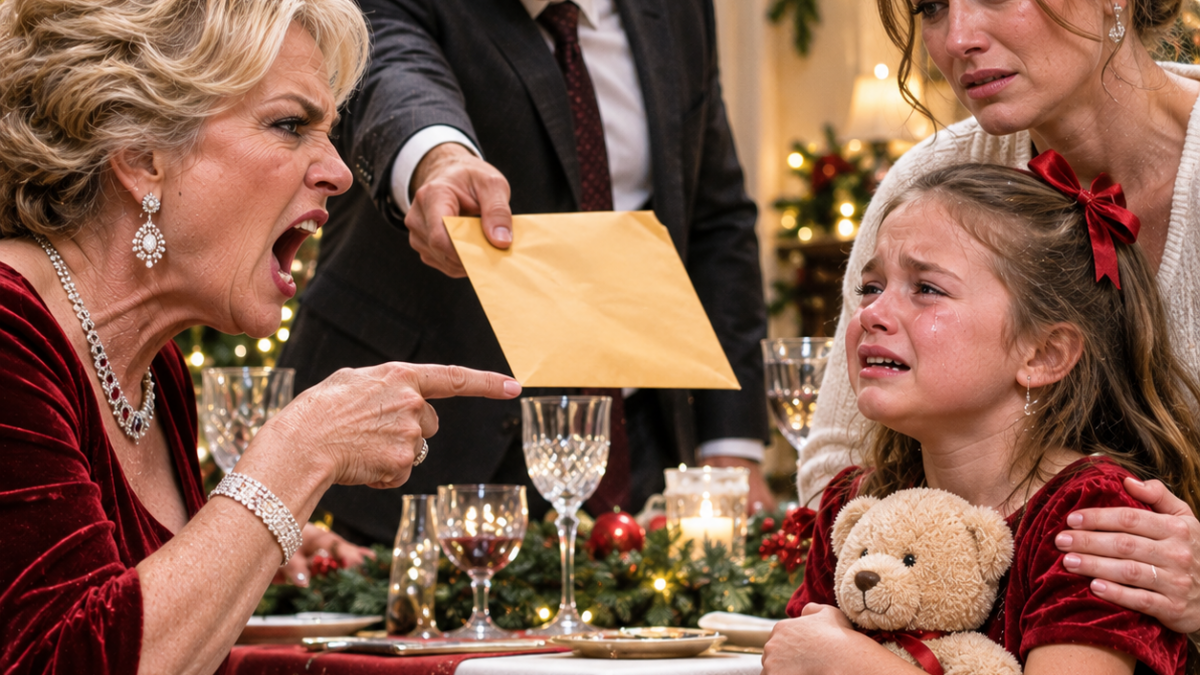
Sharon stared at the envelope.
Nobody moved.
Thomas continued.
“Mia is my daughter.”
Sharon’s fingers trembled.
“You don’t understand what I was shown.”
“I understand exactly what you were shown.”
He pointed at the envelope.
“That is a legally documented paternity test.”
“Thomas—”
“99.9998 percent.”
Sharon looked toward me.
I had not known he had done the test.
That hurt.
Not because I feared the result.
Because somewhere inside our marriage, his mother had managed to make my husband believe certainty required a laboratory.
Thomas saw my face.
His own collapsed.
“Emily…”
I said nothing.
Not there.
Not in front of the children.
Noah was holding Mia against his chest.
Mia had stopped crying loudly.
That was worse.
Silent tears.
Sharon tried again.
“That doesn’t explain the photographs.”
“What photographs?” I asked.
Thomas looked sick.
“Mother gave me an envelope before dinner.”
Sharon snapped:
“Because someone had to protect you.”
“From what?”
“Being robbed blind.”
That word.
Robbed.
Not betrayed.
Not heartbroken.
Robbed.
Thomas noticed too.
“What exactly are you afraid Emily will take?”
Sharon opened her mouth.
Closed it.
Thomas answered for her.
“The patent distribution.”
Melissa looked up sharply.
“What patent distribution?”
Sharon turned toward her daughter.
“Not now.”
Thomas laughed.
It was not a pleasant laugh.
“You told Melissa?”
“No.”
“Then how do you know about the payout?”
Sharon’s eyes moved.
That was enough.
Thomas stared at her.
“I never told you the closing date.”
“I’m your mother.”
“That isn’t an answer.”
“You’ve mentioned the project.”
“I’ve mentioned the research.”
“You said there could be licensing.”
“I never said how much.”
Sharon looked toward the fireplace.
“Thomas, this is not the place.”
“You made my six-year-old cry in front of everyone.”
His voice rose for the first time.
“You decided this was the place.”
Mia flinched.
I touched Thomas’s arm.
“Enough.”
He stopped.
Immediately.
That told me something too.
He could control himself.
He simply had never learned to control himself around his mother.
I said:
“We’re leaving.”
Sharon pointed at me.
“Of course you are.”
Noah stepped forward.
I caught his shoulder before he could speak.
I did not want my eight-year-old fighting adults for us.
He had already done enough.
We left.
The temperature outside was below freezing.
Inside the car, nobody spoke for five minutes.
Thomas drove.
Too stiff.
Too straight.
Hands locked at ten and two.
Noah sat beside Mia.
She had her head on his shoulder.
The handmade card remained behind.
That detail tore at me.
A week of her work.
Her stars.
Hydrangeas.
On Sharon’s rug.
Finally, I said:
“How long were you going to wait before telling me you had our daughter tested?”
Thomas swallowed.
“Emily…”
“How long?”
“I got the result yesterday.”
“That wasn’t my question.”
“I ordered it three weeks ago.”
I looked out the window.
Three weeks.
Three weeks of breakfast.
School pickup.
Laundry.
Sleeping beside me.
Three weeks while my husband quietly arranged to prove whether our child belonged to him.
Noah heard.
Of course he did.
“Dad tested Mia?”
Thomas looked in the rearview mirror.
“Noah—”
“Why?”
“Adult stuff.”
“That’s not an answer.”
He sounded exactly like me.
I said:
“Not tonight.”
Noah turned back toward Mia.
Thomas whispered:
“I’m sorry.”
I did not respond.
Then he said:
“Mother started pushing harder about Mia three months ago.”
“She’s been making jokes for six years.”
“I know.”
“No.”
I turned.
“You tolerated jokes.”
“There’s a difference.”
He flinched.
Good.
“She implied the mailman was Mia’s father at Thanksgiving when Mia was two.”
“I know.”
“She gave Noah a family signet necklace and told Mia she’d get something similar if she ever ‘proved she was a Whitaker.’”
“I know.”
“She cropped Mia out of your father’s memorial photo collage.”
“I know.”
“She told your aunt my daughter’s grey eyes came from somebody I was sleeping with.”
“I didn’t know about that.”
“Well, congratulations.”
My voice cracked.
“You missed one.”
Thomas’s eyes filled.
“Emily.”
“What changed three months ago?”
He took a breath.
“She showed me pictures.”
“Of?”
“You with Daniel Mercer.”
I stared.
Then understood.
Daniel.
My former colleague from the accounting firm.
Gay.
Married.
Godfather to Mia.
He had been photographed hugging me outside a restaurant after his mother’s funeral.
Another picture showed us entering a hotel lobby during a conference.
Separate rooms.
Thirty accountants.
Corporate event.
Sharon had apparently received cropped photographs.
Thomas continued.
“She said they came anonymously.”
“Of course they did.”
“She said someone had contacted her.”
“Did you believe her?”
“I didn’t know.”
“That means yes.”
“No.”
“It means enough.”
He closed his eyes briefly.
“That’s why I ordered the test.”
I laughed.
Bitter.
“You could have asked me.”
“I was ashamed.”
“So you did it secretly.”
“Yes.”
“And then planned to tell me after?”
“Yes.”
“When?”
He had no answer.
Mia whispered from the back:
“Mommy?”
I turned.
“Yes, baby?”
“Is Grandma mad because of me?”
My anger vanished.
“No.”
“Then why doesn’t she like me?”
Six years old.
There are questions no parent should have to answer.
I unbuckled when Thomas stopped at a red light and twisted around as far as I could.
“This is not about you.”
“She said I’m not family.”
“She was wrong.”
“Daddy said the test?”
Thomas made a sound like he had been hit.
I said:
“Daddy had a test because grown-ups sometimes get scared and make bad choices.”
Thomas looked at me.
I continued for Mia.
“The test proved something we already knew.”
“What?”
“Your daddy is your daddy.”
She thought.
Then:
“Was he not sure?”
Thomas pulled the car into a gas station.
Parked.
Turned around.
His face was wet.
“Mia.”
She looked at him.
“I was wrong to ever let anybody make me wonder.”
“Grandma?”
“Yes.”
“Why?”
“Because Grandma said things she should never have said.”
Mia frowned.
“Did Mommy cheat?”
“No.”
He answered instantly.
“Mommy did nothing wrong.”
That mattered.
Mia looked at me.
“Then Grandma lied?”
Thomas closed his eyes.
“Yes.”
Noah said:
“I knew it.”
Of course he did.
Children often recognize cruelty before adults finish rationalizing it.
We got home shortly after ten.
I put Mia in our bed.
She asked Noah to stay.
He climbed under the blanket beside her.
I let them.
No Christmas Eve rules mattered anymore.
When they finally slept, I went downstairs.
Thomas was in his office.
Coat still on.
Lights off.
Two computer monitors glowing.
On the right:
A spreadsheet.
Years of financial transfers.
His parents.
Melissa.
Mortgage payments.
Property tax.
Insurance.
Medical bills.
Credit cards.
Vacation expenses.
On the left:
Banking portal.
Recurring transfer.
PARENTS — PRIMARY MORTGAGE ASSISTANCE
Monthly amount:
$6,800.
I stopped in the doorway.
Thomas looked at me.
His finger rested on the mouse.
A confirmation box filled the screen.
TERMINATE RECURRING AUTHORIZATION?
I said:
“Do it.”
He clicked.
Another recurring transfer.
MOTHER — HOUSEHOLD SUPPORT
$2,500.
Terminate.
Another.
MELISSA — PERSONAL ASSISTANCE
$1,800.
He stopped.
I said:
“Melissa didn’t attack Mia.”
“No.”
“Then don’t punish her because you’re angry.”
Thomas sat back.
“You’re right.”
He looked exhausted.
“Jesus.”
I walked toward the spreadsheet.
“How much?”
“What?”
“All of it.”
He looked away.
“How much have you given them?”
“Emily—”
“How much?”
He highlighted the total.
I stared.
Nine years.
$1,147,382.
I sat down.
Not all charity.
Some mortgage principal had created equity in Sharon’s house.
Some payments covered emergencies.
Some were loans never repaid.
Still.
More than one million dollars.
Our children had 529 accounts that were healthy but not fully funded.
We still had a mortgage.
Thomas drove an eleven-year-old Volvo because he hated wasting money.
I bought clothes on sale.
And his mother’s household had received seven figures.
“How did I not know?”
“You knew pieces.”
“Not this.”
“No.”
“Why?”
He looked at his hands.
“Because every time I added it up, I felt sick.”
“That isn’t an answer.”
“It’s the answer.”
He whispered:
“I knew you’d ask me to stop.”
“And?”
“I didn’t know how.”
There it was.
Not generosity.
Fear.
Thomas had been financing obedience.
I opened my phone.
Pulled up the encrypted ledger I had created three months earlier.
His eyes moved to it.
“What is that?”
“Your mother.”
He stared.
“I started tracking her spending.”
“Why?”
“Because she called me in September asking whether the patent distribution would be marital property.”
Thomas went completely still.
“What?”
“She pretended it was casual.”
“She asked?”
“Yes.”
“Why didn’t you tell me?”
I looked at him.
“We’re apparently a family of people who hide alarming information because we think we can handle it alone.”
That landed.
He nodded.
Fair.
I opened my notes.
September 14.
Sharon called.
Asked whether patent proceeds were salary, separate property, marital asset, deferred compensation.
September 19.
She asked whether Thomas had updated his will.
October 2.
She asked whether the children’s trusts divided assets equally.
October 8.
She asked whether paternity could affect inheritance rights.
Thomas put both hands over his mouth.
“You wrote all this down?”
“Yes.”
“Why?”
“Because I’m an accountant.”
That almost made him smile.
Almost.
I continued.
“Then I started checking what I could legally access.”
Joint accounts Thomas and I shared.
Payments he had told me about.
Transfers.
Family LLC distributions.
Sharon’s mortgage.
Property taxes.
Melissa’s spending.
I found something else.
Three months before Christmas, Sharon had refinanced the Colonial.
Thomas looked up.
“What?”
“Cash-out refinance.”
“No.”
“Yes.”
“She couldn’t.”
“Apparently she did.”
“How much?”
“Four hundred twenty thousand.”
His face emptied.
“What happened to it?”
“I don’t know all of it.”
“Emily.”
“I know at least one hundred fifty thousand went to Melissa.”
“Why?”
“Business investment.”
Thomas laughed once.
Melissa had launched four businesses in seven years.
Luxury candles.
Wellness coaching.
Boutique travel consulting.
A subscription box for “intentional living” that lasted five months.
All funded partly by Thomas.
He looked at the banking screen.
“I paid down that mortgage.”
“Yes.”
“For years.”
“Yes.”
“And she pulled equity back out.”
“Yes.”
“Without telling me.”
“Yes.”
His voice went quiet.
“That’s why she’s panicking.”
I nodded.
“If the patent payout arrives and you stop funding her, she cannot maintain the house.”
Thomas stared at the spreadsheet.
Then:
“The paternity thing.”
“Control.”
“She thought if she convinced me Mia wasn’t mine…”
“You’d separate.”
“Prenup.”
“Yes.”
Thomas and I had signed one.
Not because either of us expected divorce.
Because his research had preexisting intellectual property interests and I had inherited a small commercial property with my sister.
Our prenup protected premarital assets and specified certain future IP proceeds.
But it also contained family-support provisions and estate-planning clauses Thomas had updated after each child was born.
If we divorced because of proven infidelity?
Some support provisions changed.
Not dramatically enough to make me poor.
But enough to shift leverage.
Sharon did not need to understand every detail.
She only needed to believe scandal could separate us before the patent money arrived.
Thomas whispered:
“She wanted me to leave you.”
“Yes.”
“And keep Mia out.”
“Yes.”
“Because she thought that protects the payout.”
“Yes.”
He looked at me.
“Why would she hate Mia specifically?”
“I don’t think she does.”
His face twisted.
“How can you say that after tonight?”
“Because hate is personal.”
I pointed toward the ledger.
“Mia was useful.”
That was worse.
Thomas stood.
Paced.
“She’s six.”
“I know.”
“She used my daughter.”
“I know.”
He slammed his palm against the desk.
I flinched.
He stopped immediately.
“I’m sorry.”
“Don’t apologize to the furniture.”
He sat.
Then his phone rang.
MOTHER
He stared.
I said:
“Answer.”
He put it on speaker.
“Thomas.”
Sharon sounded breathless.
“You left without hearing me.”
“No.”
“I heard enough.”
“That test proves nothing about Emily’s conduct.”
“It proves you humiliated my daughter with a lie.”
“I was protecting you.”
“From my six-year-old?”
“From losing everything.”
Thomas looked at me.
“What exactly do you think I’m losing?”
Sharon went quiet.
He continued.
“My marriage?”
“You don’t know what she—”
“My patents?”
Silence.
“My money?”
“Thomas.”
“The house?”
Another silence.
That one mattered.
Thomas closed his eyes.
“You refinanced.”
Sharon stopped breathing for half a second.
“How do you know?”
“Emily.”
My name came out like poison.
I laughed.
Sharon snapped:
“She has no right digging into my private finances.”
Thomas said:
“I have paid your mortgage for nine years.”
“That does not mean you own me.”
“No.”
He was calm now.
“But it means you could have told me you took four hundred twenty thousand dollars back out.”
“I needed liquidity.”
“For what?”
“That is none of your business.”
“Then paying it is no longer mine.”
Sharon gasped.
“What?”
“I canceled the mortgage transfer.”
“You cannot do that.”
Thomas looked at the screen.
“I just did.”
“Thomas.”
“No.”
“You are emotional.”
“My daughter asked if you hated her.”
“That child—”
Thomas stood.
“Say her name.”
Silence.
“Say her name.”
Sharon said nothing.
Thomas’s voice dropped.
“Her name is Mia.”
“Thomas, please.”
“You called her illegitimate in front of the family.”
“I said what I believed.”
“No.”
“You said what you wanted me to believe.”
Sharon’s voice hardened.
“Emily has been turning you against us for years.”
I leaned toward the phone.
“I didn’t need to.”
She snapped:
“Stay out of this.”
Thomas said:
“No.”
Long pause.
“No?”
“She is my wife.”
“You used to understand family.”
“She is my family.”
“And I’m not?”
“You are.”
He swallowed.
“But family is not a license to hurt my children.”
Sharon changed tactics.
Immediately.
Crying.
“After everything I sacrificed for you.”
Thomas closed his eyes.
There it was.
The oldest hook.
“I paid for tutoring.”
“You were a gifted child and I drove you everywhere.”
“I worked two jobs.”
“I gave you everything.”
Thomas listened.
Then:
“And I have spent adulthood trying to repay a debt you never let me finish.”
Sharon stopped crying.
“What did she tell you?”
“Nothing.”
His voice broke.
“That’s the worst part.”
“I knew.”
He looked at the million-dollar total.
“I just kept pretending I didn’t.”
Sharon whispered:
“You will regret this.”
Thomas ended the call.
For a long time, neither of us spoke.
Then I said:
“You tested Mia.”
His shoulders dropped.
“Yes.”
Now we had reached our own problem.
Not Sharon.
Us.
“Why didn’t you tell me when your mother showed you those photos?”
“I was afraid.”
“Of what?”
“That some piece of the story might be true.”
“After eleven years?”
“I know.”
“No.”
I stood.
“You don’t get to say ‘I know’ and make this smaller.”
He nodded.
“You’re right.”
“I have never cheated.”
“I believe you.”
“Now.”
“I believed you before.”
“You ordered a paternity test.”
He had no defense.
Good.
“I looked at Mia tonight,” I said, “and she asked whether her father wasn’t sure she was his.”
Thomas cried.
“I know.”
“Stop saying that.”
“I’m sorry.”
“That I can use.”
He wiped his face.
“I’m sorry.”
“Better.”
I sat across from him.
“If we stay married after this—”
His eyes widened.
“If?”
“Yes.”
He looked terrified.
Good again.
Not because I wanted him suffering.
Because for the first time, losing his marriage felt more dangerous than disappointing his mother.
“If we stay married, there are conditions.”
“Anything.”
“Don’t say anything.”
He stopped.
“One: therapy.”
“Yes.”
“Individual for you.”
“Yes.”
“Couples for us.”
“Yes.”
“Two: no financial support to your mother without us discussing it.”
“Yes.”
“Three: nobody gets access to our children who humiliates them.”
“Yes.”
“Four: you apologize to Mia without making her comfort you.”
His face crumpled.
“Yes.”
“Five: I see every photograph, message, document, and accusation Sharon gave you.”
“Yes.”
“Six.”
I waited.
“You never secretly test one of our children again.”
“Never.”
“If you doubt me, you speak to me.”
“I will.”
“If you cannot trust me, leave.”
He flinched.
I meant it.
“Do not turn our children into evidence.”
“I won’t.”
That was the beginning of repairing us.
Not the end.
Christmas morning was awful.
Mia woke first.
Looked toward our bedroom door.
Then asked:
“Are we still doing Christmas?”
I almost cried.
“Yes.”
“Even without Grandma?”
“Especially without Grandma.”
We made pancakes.
Noah burned one deliberately and claimed it looked like South America.
Mia opened presents slowly.
Then found something outside her bedroom door.
A new card.
Not from Sharon.
From Thomas.
He had made it himself.
Badly.
Crayon hydrangeas.
Misshapen stars.
Inside:
TO MIA
I AM PROUD TO BE YOUR DAD.
YOU NEVER HAVE TO PROVE YOU BELONG TO ME.
He knelt beside her.
Did not cry dramatically.
Did not ask forgiveness.
He said:
“I made a bad choice because I let somebody else make me afraid.”
Mia listened.
“I should have known better.”
She nodded.
“I am sorry.”
“Did you think Mommy lied?”
Thomas glanced at me.
Then back at her.
“For a little while, I let myself wonder.”
Mia considered.
“That was dumb.”
Noah laughed so hard milk came out his nose.
Thomas nodded.
“It was.”
Mia hugged him.
Children forgive with terrifying generosity.
Adults have to be more careful.
At noon, Melissa called.
I almost ignored it.
Thomas answered.
She was crying.
“Mom says you cut her off.”
“I stopped paying the mortgage.”
“She says she’ll lose the house.”
“She refinanced it.”
Silence.
“You knew?”
“No.”
“You received one hundred fifty thousand.”
Another silence.
Thomas’s face changed.
“How much did she tell you?”
Melissa whispered:
“She said it was her money.”
“From where?”
“The house.”
“Who paid the house down?”
Melissa started crying harder.
“I didn’t know.”
I believed her.
Thomas asked:
“What did you use it for?”
“Business.”
“How much is left?”
“Thomas—”
“How much?”
“Thirty-eight.”
Out of one hundred fifty.
He closed his eyes.
Melissa said:
“I’ll pay it back.”
“With what?”
“I don’t know.”
“Then don’t promise.”
She sniffed.
“Are you cutting me off too?”
Thomas looked at me.
I shook my head slightly.
Not because Melissa deserved endless funding.
Because today was not the day to make every financial decision in anger.
He said:
“We’re going to review everything.”
Her voice sharpened.
“That means Emily.”
“That means me.”
“Thomas—”
“No.”
His tone changed.
“You don’t get to blame my wife because I finally looked at my own bank statements.”
Melissa went quiet.
Good.
That sentence became important.
For years, Sharon had made me the explanation for every boundary Thomas attempted.
If Thomas said no:
Emily.
If we missed a holiday:
Emily.
If support decreased:
Emily.
If we vacationed instead of visiting:
Emily.
If the children had schedules:
Emily.
Now Thomas stopped allowing it.
Two days after Christmas, he called a family meeting.
Not at Sharon’s house.
Our attorney’s conference room.
That was my idea.
No children.
Sharon.
Melissa.
Eric.
Thomas.
Me.
Attorney named Rachel Cohen.
Estate and family financial planning.
Sharon arrived furious.
“Why is there a lawyer?”
Rachel answered:
“Because financial matters will be discussed.”
“I’m speaking to my son.”
Thomas said:
“You’re speaking to both of us.”
Sharon looked at me.
“Of course.”
Thomas did not take the bait.
Rachel opened a folder.
First issue:
Mortgage.
Thomas had no legal obligation to continue paying.
Second:
Cash-out refinance.
Sharon had done it lawfully because title was hers.
But Thomas had not guaranteed the new debt.
Third:
Family support.
No written agreements.
Voluntary.
Fourth:
Estate planning.
Thomas and I had updated trusts years earlier.
Both children were equally protected.
DNA did not change anything because Mia had always been legally his child regardless.
That made Sharon uncomfortable.
She had assumed a paternity scandal could alter everything instantly.
It could not.
Rachel explained calmly:
“Even if biological paternity had been different, legal parentage and estate documents do not simply disappear because a relative produces an accusation.”
Sharon said:
“I was protecting Thomas.”
Rachel did not respond.
Lawyers know when silence is useful.
Thomas placed an envelope on the table.
Not DNA.
Photographs.
The ones Sharon had given him.
“Where did these come from?”
“Anonymous source.”
“Who?”
“I don’t know.”
“Email?”
“Yes.”
“Show me.”
“I deleted it.”
Thomas nodded.
“Convenient.”
Sharon stiffened.
“I didn’t fabricate those.”
“I didn’t say you did.”
“You implied it.”
“Who sent them?”
“I told you.”
“Then what email address?”
She looked away.
I said:
“Daniel Mercer.”
Sharon turned.
“You admit it.”
I almost smiled.
“He’s gay.”
Melissa blinked.
Eric looked at Sharon.
I continued.
“Married twelve years.”
I pulled up his wedding photo.
Daniel and his husband Michael.
Thomas had already verified.
The hotel photograph?
Annual National Association of Healthcare Finance conference.
Three hundred attendees.
My employer had booked the room block.
The restaurant hug?
Daniel’s mother had died.
I attended the funeral luncheon.
Context destroyed the accusation.
Sharon said:
“Gay men can still—”
Melissa slammed her hand on the table.
“Mom.”
Everyone looked.
She was pale.
“Stop.”
Sharon stared at her daughter.
“You stay out of this.”
“No.”
Melissa’s voice shook.
“You used my money too.”
“What?”
“The refinance.”
Sharon looked at Thomas.
He said nothing.
Melissa continued.
“You told me the money came from Dad’s old investments.”
“I said family assets.”
“You said it was mine eventually anyway.”
Sharon’s face hardened.
“I helped you.”
“You made me dependent.”
That surprised all of us.
Melissa started crying.
“I kept starting businesses because every time one failed you said Thomas would help.”
Thomas looked devastated.
Melissa looked at him.
“I thought you knew.”
“I didn’t.”
“I’m sorry.”
He nodded.
Not forgiveness.
Acknowledgment.
Then Sharon said the sentence that ended any chance of a quiet resolution.
“You’re all acting like Emily hasn’t benefited.”
I stared.
She pointed at me.
“Look at your house.”
“Your vacations.”
“Your clothes.”
Thomas laughed.
Not loudly.
“You mean my wife lives in the house we bought together?”
“You know what I mean.”
“No.”
He leaned forward.
“Explain it.”
Sharon started.
Then stopped.
Thomas continued.
“Emily worked until Mia was born.”
“She returned part-time.”
“She manages our household finances.”
“She inherited commercial property.”
“She contributes.”
“She is my partner.”
Then:
“You received more than a million dollars from me.”
Sharon’s face changed.
Melissa whispered:
“What?”
Thomas slid the spreadsheet.
Sharon tried to cover it with her hand.
He pulled it back.
“No.”
“Everyone sees it.”
One million.
One hundred forty-seven thousand.
Melissa looked sick.
Eric stared at his wife.
Sharon said:
“That includes things for the whole family.”
“Yes.”
Thomas nodded.
“And I’m not asking for it back.”
That surprised her.
“I’m ending the pattern.”
“What does that mean?”
“No more mortgage.”
“No household allowance.”
“No emergency credit-card payments unless there is a true medical crisis and Emily and I agree.”
“No more business bailouts.”
“No more luxury spending funded through guilt.”
Sharon stood.
“You selfish bastard.”
Thomas went still.
I had never heard her call him anything like that.
She continued.
“After everything I did.”
Thomas looked at her.
Then said very quietly:
“That sentence has cost me a million dollars.”
Nobody spoke.
He continued.
“I love you.”
Sharon’s face shifted.
Hope.
Then:
“But love is not a payment plan.”
She sat.
That was the moment Thomas changed.
Not when he cut the transfer.
Not when he confronted the DNA lie.
When he said:
I love you.
And still said no.
People like Sharon survive because their children confuse boundaries with cruelty.
Thomas finally separated them.
She left without apologizing.
Of course.
For three weeks, silence.
Then letters.
First:
Angry.
Then wounded.
Then medical.
Sharon claimed stress was causing heart palpitations.
Thomas arranged a cardiology appointment.
Paid directly.
Not cash.
Doctor found benign premature beats.
She was fine.
Then she said the house needed emergency plumbing.
Thomas sent a licensed plumber.
Problem:
Running toilet.
$186.
Sharon called him humiliating.
He said:
“I handled the emergency.”
She hung up.
Therapy started.
Thomas hated it.
First session with Dr. Aaron Feldman, he came home angry.
“He says my mother trained me to manage her emotions.”
I looked up.
“Sounds right.”
“He doesn’t even know her.”
“He knows you.”
“That’s different.”
“Yes.”
Two weeks later:
“She parentified me.”
I smiled.
“What?”
“Nothing.”
“You know that word.”
“I have the internet.”
He glared.
A month later:
“She made money equal loyalty.”
That one hurt him.
He finally told me things I had never known.
At twelve, Sharon made him feel responsible for family bills when Richard’s business struggled.
At fifteen, she told him his sister might lose dance lessons if Thomas did not win a scholarship.
At nineteen, she cried because he chose MIT over a school closer to home.
When he received his first six-figure salary, Sharon said:
“Now the sacrifices were worth it.”
Worth it.
Not:
I’m proud of you.
A transaction.
Thomas had spent adulthood buying proof that he was a good son.
No amount was enough because the debt had never been financial.
Our couples therapy was harder.
I was furious.
Not only because of the DNA test.
Because I realized how many years I had participated in pretending Thomas’s family dynamic was merely annoying.
I protected peace too.
I told Mia:
“Grandma is old-fashioned.”
I told Noah:
“Don’t argue.”
I laughed off insults.
I left dinners early instead of confronting.
Why?
Because Thomas begged me.
I had sacrificed my daughter’s emotional safety to protect my husband’s comfort.
That realization crushed me.
I apologized to Mia too.
Six-year-olds deserve adults who admit mistakes.
“I should have stopped Grandma sooner.”
Mia asked:
“Why didn’t you?”
“Because I thought keeping everyone calm was helping.”
“Was it?”
“No.”
She nodded.
Simple.
Children.
Sharon’s financial reality arrived by spring.
She could not maintain the Colonial.
Mortgage after refinance:
Nearly $9,000 monthly including tax and insurance.
She had savings.
Not enough.
She listed the house.
That triggered family outrage.
Aunt Claire called Thomas.
“Your mother is selling because of you.”
Thomas answered:
“She refinanced because of herself.”
“She raised you.”
“Yes.”
“You can afford it.”
“Yes.”
“Then why make her move?”
“Because affordability is not obligation.”
Claire called me next.
I blocked her.
Growth.
Sharon eventually accepted an offer.
Smaller townhouse.
Still beautiful.
Still comfortable.
Paid down debt significantly.
She did not become homeless.
Nobody took away heat.
Food.
Healthcare.
She lost scale.
That distinction mattered because Sharon told everyone Thomas had “thrown his mother into poverty.”
Her new townhouse cost more than our first house.
Poverty had apparently become subjective.
Melissa downsized too.
Sold a leased luxury SUV.
Closed the failed wellness company.
Took a job with an event-planning firm.
She was good at it.
Actually good.
Six months later, she called me.
“I got promoted.”
“That’s great.”
“I haven’t asked Thomas for money in eight months.”
She sounded proud.
“You should be.”
“I’m thirty-eight.”
“You can still be proud.”
She laughed.
Then said:
“I think Mom liked us needing him.”
I waited.
“Why?”
“Because if we needed Thomas, she controlled the traffic.”
That was exactly it.
Dependency made Sharon central.
Emily? Me.
I had disrupted that architecture simply by becoming Thomas’s primary family.
Mia threatened it even more because daughters can have a strange emotional power over fathers.
Sharon had adored Noah because he reflected Thomas.
Mia resembled me.
Grey eyes.
Light hair.
My grandmother’s expressions.
She represented the family Thomas had chosen, not the one Sharon built.
The paternity accusation gave Sharon a fantasy:
Remove Mia psychologically.
Remove me legally.
Pull Thomas back toward his original family before the biggest financial event of his life.
Cruel.
But coherent.
We still did not know who sent the photographs.
That bothered me.
Then, in April, Thomas received an email from an address he did not recognize.
Subject:
I AM SORRY.
The sender was Sharon’s friend Elaine Patterson.
Elaine had known her twenty years.
The email said:
I took the photographs. Sharon asked me to.
Thomas called me from work.
I went cold.
Elaine requested a meeting.
Public café.
We brought Rachel.
Elaine looked terrified.
She explained.
Sharon knew Daniel from my social media.
Had asked Elaine, who lived near my former office, to photograph us if she saw us together.
Elaine thought Sharon suspected an affair.
At first, she considered it helping a friend protect her son.
She captured the restaurant hug.
Then searched conference photos online and found a picture of Daniel and me entering the hotel lobby.
Cropped other people.
Sent everything to Sharon.
“What about the anonymous email?”
Elaine looked down.
“Sharon created it.”
There.
Proof.
“Did she ask you to lie?”
“She told me if Thomas asked, say you didn’t know.”
Elaine cried.
“I watched what happened at Christmas.”
“You were there?”
“No.”
“Sharon called me afterward.”
“What did she say?”
Elaine’s face twisted.
“That Thomas had finally seen what kind of woman you were.”
I sat back.
Not anger.
Something cleaner.
Finality.
Elaine continued.
“Then Melissa told me what Sharon said to Mia.”
“I couldn’t live with it.”
Thomas looked sick.
“Did my mother know Daniel was gay?”
Elaine hesitated.
“Yes.”
That changed everything.
“She knew?”
“She found out before Christmas.”
“How?”
“I told her.”
“When?”
“December seventeenth.”
One week before she accused me publicly.
Thomas closed his eyes.
So Sharon had known the photographs did not support the affair story.
She used them anyway.
Not mistake.
Not fear.
Choice.
Rachel asked:
“Would you be willing to put this in writing?”
Elaine nodded.
“Yes.”
We never sued Sharon.
People expected us to.
Defamation.
Emotional distress.
Financial interference.
Maybe claims existed.
Rachel explained difficulties.
Family communications.
Damages.
Costs.
Proof.
We had enough resources to fight.
I did not want another year of Sharon occupying our lives.
So we did something she hated more.
We stopped participating.
No invitations.
No unsupervised contact with children.
No financial dependence.
No arguments.
No explaining.
No long messages.
Silence with boundaries.
Sharon sent birthday gifts.
We returned some.
Accepted others only if appropriate and no emotional strings were attached.
Mia refused them for a while.
Her choice.
Noah remained furious.
One afternoon he asked:
“Do I have to forgive Grandma?”
I said:
“No.”
Thomas looked at me.
I continued.
“You also don’t have to hate her forever.”
Noah thought.
“What do I have to do?”
“Be respectful if you see her.”
“Why?”
“Because respect can describe how you behave.”
“It doesn’t mean trust.”
He nodded.
“I don’t trust her.”
“Then don’t pretend.”
That lesson was for all of us.
The patent transaction closed in May.
Thomas’s distribution was substantial.
More than Sharon had guessed.
We paid off our mortgage.
Fully funded both college plans.
Set aside retirement.
Created a charitable fund supporting girls in STEM and reentry vocational programs.
Thomas’s idea.
The family asked how much he received.
He answered:
“Enough.”
That was all.
Sharon learned the exact number from nobody.
For the first time, Thomas understood privacy.
Money stopped being family news.
His success stopped being collective property.
We also changed the estate plan.
Not to punish Sharon.
To protect our children.
Independent trustees.
Clear instructions.
Equal treatment.
No relative could challenge distributions based on biological claims without extraordinary legal basis.
Rachel called it over-engineered.
Thomas said:
“I’m an engineer.”
She said:
“Unfortunately.”
Our marriage survived.
That sentence is too easy.
It makes survival sound passive.
We rebuilt.
For almost a year.
There were nights I still looked at Thomas and remembered the secret DNA test.
Sometimes during ordinary moments.
Him loading dishwasher.
Driving.
Helping Mia with math.
Suddenly the betrayal returned.
He never told me to get over it.
That mattered.
Once I said:
“I hate that I can’t just be done being angry.”
Thomas answered:
“You don’t owe me a deadline.”
That was therapy talking.
Good therapy.
I said:
“What if I never fully trust you again?”
He was quiet.
“Then I’ll spend however long I have being trustworthy anyway.”
That answer saved something.
Not grand gestures.
Consistency.
He stopped hiding.
If Sharon called, he told me.
If family asked for money, we discussed.
If he felt guilty, he said:
“I feel guilty.”
Not:
We should pay.
Emotion stopped becoming instruction.
That was progress.
Mia recovered differently.
For months, she stopped drawing cards for adults.
Teachers got store-bought cards.
Birthdays:
Nothing handmade.
I noticed.
Asked gently.
She said:
“People can throw drawings away.”
I went upstairs and cried where she could not see.
Then Noah did something.
Her seventh birthday approached.
He spent three nights making a terrible card.
Dinosaurs.
Stars.
One hydrangea that looked like broccoli.
Inside:
TO MIA
I KEEP EVERYTHING YOU MAKE ME.
She cried.
Then made him a card back.
That was the first handmade card after Christmas.
It still hangs over his desk.
Children repair each other in ways adults cannot manufacture.
Sharon missed Mia’s seventh birthday.
Then Noah’s ninth.
She mailed letters.
We read them first.
Most were about herself.
How lonely she was.
How cruel Thomas had become.
How she could not understand why one mistake erased a lifetime.
Then, nine months after Christmas, a different letter arrived.
No excuses.
Thomas read it twice.
Handed it to me.
Sharon wrote:
Mia, what I said to you was cruel. You did nothing wrong. I knew you were Thomas’s daughter before Christmas, and I used words meant to hurt your mother even though I knew they would hurt you too. That was unforgivable behavior from an adult. You do not owe me a hug, a visit, a phone call, or forgiveness. I am sorry.
I stared at the sentence.
I knew.
No passive language.
No:
I was confused.
No:
If you were hurt.
It was the first honest thing Sharon had done.
Mia was seven.
We debated whether to show her.
Therapist said yes, with context.
Mia read slowly.
Then:
“She knew Daddy was my daddy?”
“Yes.”
“And said it anyway?”
“Yes.”
“Why?”
I answered:
“She was angry at grown-up things and used you to hurt me.”
Mia frowned.
“That’s mean.”
“Yes.”
“Do I have to answer?”
“No.”
She folded the letter.
Put it in her desk.
Three weeks later, she drew something.
A small card.
No hydrangeas.
Just one star.
Inside:
I AM NOT READY YET.
Thomas mailed it.
Sharon never pressured again.
At least not directly.
A year passed.
Then two.
Sharon began therapy.
Melissa told us.
I did not care initially.
People love announcing therapy as if attendance is transformation.
Change is behavior.
But Sharon changed slowly.
She stopped calling relatives to recruit them.
Stopped asking about money.
Sold jewelry she did not wear to cover townhouse expenses.
Joined a garden club.
Volunteered at a literacy program.
Learned to live within her own income plus retirement.
Apparently humans can survive without professionally rotated seasonal gardens.
Who knew.
The first supervised meeting with the children happened almost three years after Christmas.
Neutral place.
Public botanical garden.
Mia was nine.
Noah eleven.
Their choice.
Sharon arrived early.
No gifts.
That was intentional.
She looked smaller.
Not physically.
Less constructed.
Mia stayed beside me.
Noah beside Thomas.
Sharon said:
“Hello.”
Noah nodded.
Mia said nothing.
We walked.
Hydrangeas were blooming.
Of course.
At one point, Sharon stopped.
Looked at them.
Then Mia.
“I still have your Christmas card.”
I froze.
Mia stared.
“What?”
“The one you made.”
“You threw it down.”
“Yes.”
“I picked it up after you left.”
“Why?”
Sharon’s eyes filled.
“Because after everyone went home, I read it again.”
Mia said nothing.
Sharon continued.
“I kept it because it showed me exactly what I had broken.”
I did not love that sentence.
It put too much emotional weight on a child’s card.
But Sharon did not ask Mia to comfort her.
Good.
Mia finally said:
“Can I have it back?”
Sharon looked surprised.
Then nodded.
“Yes.”
Next visit, she brought the card.
Protected in a clear sleeve.
No speech.
Mia took it.
That night, she showed me.
The crease from where it fell.
Sharon had flattened it.
Mia said:
“I’m keeping it.”
“For what?”
“To remember.”
“What?”
She thought.
“That I didn’t do anything wrong.”
I hugged her.
That was the right reason.
Noah’s relationship with Sharon recovered differently.
He remained suspicious.
At eleven, he had discovered sarcasm.
Dangerous.
Sharon once told him:
“You’re getting tall.”
He answered:
“DNA confirmed.”
Thomas nearly choked.
I said:
“Noah.”
“What?”
“Funny is not always kind.”
He sighed.
“Fine.”
Later Sharon told Thomas she deserved it.
Maybe.
Still.
We taught Noah not to become cruel merely because he had once been brave.
That matters.
The seven words he spoke at eight became family legend.
People still repeated them.
Then you don’t get to be mine.
But I did not want Noah believing love was something you withdraw every time someone fails.
What he did that night was a boundary.
Not a permanent worldview.
Family is complicated.
Sometimes leaving is necessary.
Sometimes returning carefully is possible.
Both can be true.
The financial transformation lasted.
Thomas never resumed Sharon’s mortgage payments.
Never needed to.
She sold.
Adjusted.
Survived.
Melissa eventually repaid part of the refinance money to Sharon voluntarily.
Not all.
Sharon told her to keep the rest.
That surprised us.
Melissa’s job became a career.
No fifth startup.
She laughs about it now.
Eric says he keeps emergency holy water whenever she says the word entrepreneur.
Thomas and Melissa became siblings for the first time instead of two children orbiting Sharon’s needs.
She admitted something to him years later.
“I resented Emily because you stopped needing me.”
Thomas said:
“I still needed you.”
“No.”
Sharon shook her head.
“You loved me.”
“I confused those things.”
That might be the most important sentence she ever said.
Need is not love.
Financial dependence is not closeness.
Obedience is not loyalty.
Control is not care.
Sharon spent years mixing them.
Thomas inherited the mixture.
Then passed some of it into our marriage.
Breaking that pattern was more valuable than the patent money.
The money was nice.
I am not going to pretend otherwise.
Being debt-free feels excellent.
College accounts feel excellent.
Retirement security feels excellent.
But the most important change cost nothing.
Thomas learned to say:
“No.”
Without explanation.
Without apology.
Without sending money afterward to soften it.
Sometimes Sharon would ask:
“Can you help with this?”
He would say:
“No.”
She would answer:
“Okay.”
The first time that happened, he called me afterward.
“She said okay.”
“Yes.”
“That’s it.”
“Yes.”
“She didn’t cry.”
“No.”
He sounded almost disappointed.
“What am I supposed to do with all this adrenaline?”
“Unload the dishwasher.”
Growth.
Years later, Thomas told me the full truth about Christmas.
There was one detail he had withheld.
Not because he was still hiding.
Because he had forgotten how much it mattered.
When Sharon gave him the photographs before dinner, she had also handed him a draft letter from a family-law attorney.
Not retained counsel.
A generic consultation memo.
It outlined possible financial consequences of divorce involving marital misconduct, patent proceeds, trusts, and paternity disputes.
Sharon had apparently paid for a consultation months earlier.
Without Thomas.
About Thomas’s marriage.
That explained her sophistication.
She had been preparing.
Rachel later reviewed the document.
Said much of Sharon’s interpretation was wrong.
But the intent was obvious.
She was planning a legal narrative before Thomas had even confronted me.
That realization reopened old anger.
I asked Thomas:
“How did you not walk out immediately?”
He answered:
“Because she was my mother.”
I said:
“That isn’t enough.”
He nodded.
“I know.”
Then corrected himself.
“Sorry.”
I smiled despite myself.
“Good catch.”
We had learned.
By our fifteenth anniversary, Thomas and I renewed our vows.
Not a huge ceremony.
Backyard.
Children.
A few friends.
Daniel and Michael came.
When Sharon arrived, she greeted Daniel.
“Daniel.”
He smiled.
“Sharon.”
Awkward.
Then he said:
“I hear I almost ruined a marriage by attending a conference.”
Sharon turned red.
I wanted the earth to swallow me.
Daniel laughed.
“I’m joking.”
Then:
“Mostly.”
Michael elbowed him.
Sharon said:
“I owe you an apology.”
Daniel shrugged.
“You owe Emily more.”
“I know.”
That was it.
No dramatic reconciliation.
The ceremony happened under string lights.
Mia, ten now, carried flowers.
Noah held the rings.
Thomas read vows he wrote himself.
One line nearly broke me.
I promise that when fear asks me to doubt you, I will speak to you before I listen to anyone speaking about you.
That was the marriage we should have had from the start.
Mine said:
I promise not to call silence peace when silence requires our children to absorb what adults refuse to confront.
Mia looked at me.
She knew.
Sharon sat in the second row.
Cried.
Quietly.
No performance.
At dinner afterward, Mia handed her something.
A small envelope.
Sharon opened it.
A card.
Hydrangeas.
Stars.
Not identical to the Christmas card.
New.
Inside:
I LOVE YOU, GRANDMA. PLEASE BE NICE WITH IT.
Sharon covered her mouth.
Mia said:
“I’m serious.”
Sharon nodded.
“So am I.”
She hugged Mia only after Mia stepped forward first.
That mattered.
Forgiveness should not erase consent.
Our family never returned to what it had been.
Thank God.
The old family required children to protect adults.
The new one required adults to protect children.
The old one treated Thomas’s money as proof of love.
The new one treated money as money.
The old one let Sharon’s emotions become everybody’s emergency.
The new one let her have feelings without making them commands.
The old one told me to keep peace.
The new one understood peace without safety is only silence.
Noah is older now.
He barely remembers throwing the truck.
He remembers the sentence.
Mostly because everybody else does.
Mia remembers the card.
She keeps both versions.
The original Sharon rejected.
The later one she gave willingly.
She once told me:
“The first one is sad.”
“And the second?”
“Better.”
Then:
“But I don’t want to throw the sad one away.”
“Why?”
“Because then it’s like it didn’t happen.”
That girl.
Slate-grey eyes.
My grandmother’s eyes.
The eyes Sharon once treated as evidence against her.
Now Sharon tells people they are beautiful.
Mia rolls them.
Perfect.
Thomas eventually told both children about the DNA test when they were old enough to understand.
He insisted.
No secrets.
No future discovery in an old file.
He told them:
“I made a decision I regret.”
No excuses.
No blaming Sharon.
He explained fear.
Manipulation.
Trust.
Noah asked:
“So Grandma tricked you?”
Thomas said:
“She influenced me.”
“But you chose.”
Thomas nodded.
“Yes.”
I loved him more for that answer than for a thousand apologies.
Accountability is choosing the active voice.
I did.
I allowed too much.
Thomas tested.
Sharon lied.
Melissa accepted money she should have questioned.
Elaine took photographs she should not have taken.
Every adult owned a verb.
That is how families stop repeating damage.
Sharon’s townhouse has hydrangeas now.
Small patch.
She plants them herself.
No professional rotation.
The first summer they bloomed, she sent Mia a photograph.
No caption.
Mia replied:
Pretty.
That was enough.
The patent money did not destroy our family.
It revealed it.
Money often does that.
People say wealth changes people.
Sometimes it simply makes existing relationships impossible to pretend about.
Sharon had been controlling before the patent deal.
Thomas had been compliant.
I had been resentful but accommodating.
Melissa had been dependent.
The coming money raised the stakes until every hidden structure became visible.
The lie about Mia was not created from nothing.
It grew from years of tolerated jokes.
Every time Sharon insulted my daughter and nobody forced a consequence, she learned the boundary could move.
A joke about the mailman.
No consequence.
A comment about grey eyes.
No consequence.
Unequal gifts.
No consequence.
Excluding Mia from a photo.
No consequence.
Then Christmas.
Public rejection.
The cruelty felt sudden.
It was not.
It was escalation.
That lesson changed how I parent.
When Noah teases Mia too hard, I intervene.
When Mia crosses a boundary, we address it.
Not because every mistake requires punishment.
Because small patterns become family culture when adults keep calling them small.
Sharon taught us that accidentally.
Thomas still works in science.
The patent platform grew.
He could probably retire.
Won’t.
He loves the work.
I returned to consulting more after the children got older.
I also started volunteering with a financial-literacy program for women leaving controlling relationships.
Not because my marriage was financially abusive.
It was not.
But I learned how invisible money systems can become inside families.
Automatic transfers.
Unspoken obligations.
Parents who treat adult children’s salaries as communal property.
Spouses who hide support because they know it would cause conflict.
Money has emotional architecture.
If you do not inspect it, somebody else may design your life.
I tell participants one thing repeatedly:
A number in a spreadsheet is never “just money” when somebody uses it to buy obedience.
Thomas’s million-dollar total was not proof he loved his mother too much.
It was proof he had never learned that saying no would not make him a bad son.
The first canceled $6,800 transfer was worth more psychologically than the entire patent distribution.
That click changed our family.
Not because Sharon lost money.
Because Thomas discovered nothing catastrophic happened when he stopped paying.
His mother survived.
Their relationship eventually survived.
The world did not end.
People who control through guilt depend on convincing you that boundaries are fatal.
Usually they are not.
They are uncomfortable.
That is different.
Sharon once admitted this to me directly.
We were alone in her townhouse kitchen.
Years after Christmas.
Mia and Noah were outside with Thomas.
She said:
“I thought if he stopped taking care of me, I would disappear from his life.”
I looked at her.
“So you made yourself impossible to leave.”
She winced.
“That sounds awful.”
“It was.”
She nodded.
“I know.”
Then:
“I thought you were replacing me.”
“I was his wife.”
“I know.”
“You were supposed to be replaced.”
She actually laughed.
A little.
“That took me years to understand.”
There it was.
Mothers raise sons to leave.
Not abandon.
Leave.
Build.
Choose.
Love.
Return freely.
Sharon wanted Thomas’s adult life to remain proof of her importance.
I became competition.
Our children became evidence that he belonged somewhere else.
No amount of money could fix that fear.
Only acceptance.
She learned late.
Still learned.
People ask whether I would have stayed married if Thomas had defended Sharon that Christmas.
No.
I know that now.
If he had taken her side after watching Mia cry?
If he had used the DNA test as an accusation instead of proof against Sharon?
If he had asked me to apologize?
Marriage would have ended.
Not that night perhaps.
But something irreversible would have broken.
Instead, Thomas turned around.
That envelope mattered symbolically.
Not because DNA made Mia worthy.
She was worthy before any laboratory touched a sample.
The report mattered because it forced Thomas to choose what he would do with certainty.
For six years, Sharon had built a story.
Christmas night, Thomas finally had the document disproving it.
Then he had to decide:
Would he protect the person who lied?
Or the child she harmed?
He chose Mia.
Late.
Imperfectly.
But clearly.
That gave us something to rebuild on.
Noah chose faster.
Seven words.
Children can be brutal with clarity.
Then you don’t get to be mine.
He did not mean forever.
He meant:
If you reject my sister, you do not get to use me as your favorite.
That was the real wound Sharon had created.
She had been dividing the children.
Golden grandson.
Questionable granddaughter.
One child rewarded for resemblance.
Another punished for difference.
Noah refused the role.
At eight.
Adults often underestimate what children understand about favoritism.
They may not know the words.
They know the temperature.
Who gets praised.
Who gets watched.
Whose mistakes are funny.
Whose are evidence.
Who receives expensive gifts.
Who receives suspicion.
Noah had been watching for years.
Christmas was simply the first time somebody handed him a choice publicly.
He chose his sister.
I am proud of him.
I am also careful not to make his childhood courage his identity.
He does not need to be Mia’s permanent protector.
She learned to protect herself.
That may be Sharon’s most unexpected legacy.
Mia is not timid anymore.
At twelve, a teacher once mispronounced her surname three times.
Mia corrected him.
He said:
“Close enough.”
She answered:
“No, it’s my name.”
When she told me, I laughed.
Thomas said:
“Where did she get that?”
I stared at him.
He nodded.
“Right.”
She got it from surviving adults who tried to define her.
Christmas photos from that year still exist.
Not Sharon’s house.
Our kitchen.
Pancakes.
Noah with milk on his shirt.
Mia wearing mismatched pajamas.
Thomas exhausted.
Me holding coffee.
No perfect tree.
No formal china.
No velvet chair.
It is my favorite Christmas picture.
Because everybody in it was safe.
Years later, Sharon asked for a copy.
I gave her one.
She framed it.
Not as proof she belonged.
As a reminder of the Christmas she almost lost them all.
There is a difference.
I sometimes think about Mia’s first handmade card.
The sentence:
I love you more than all the stars in the sky.
Children believe love is infinite.
Adults teach them conditions.
You belong if.
You are lovable if.
You are family if.
You look like us.
Behave like us.
Pay for us.
Obey us.
Protect our secrets.
Absorb our fear.
That Christmas, Sharon tried to attach an if to Mia’s right to call her Grandma.
Mia was too young to fight back.
Noah did it for her.
Thomas did it late.
I did it permanently.
Years later, Sharon finally understood what none of us had said clearly enough before:
Grandmother was not a title Mia had to earn.
It was a relationship Sharon had to deserve.
And for a while, she did not.
That was the consequence.
Not losing a mansion.
Not losing Thomas’s money.
Not selling a house.
The consequence was sitting in a smaller townhouse with a handmade card in a plastic sleeve and knowing the child who once loved her more than all the stars was no longer sure she wanted to see her.
Money can be recovered.
Trust has its own schedule.
Sharon waited.
That was the first truly loving thing she did for Mia.
She waited without demanding payment.
No guilt.
No gifts.
No pressure.
Eventually, Mia opened the door.
Not all the way.
Enough.
That is where our story ended.
Not with revenge.
With boundaries strong enough to make reconciliation optional instead of compulsory.
Thomas remained a son.
But stopped being a bank account.
Melissa remained a sister.
But became responsible for herself.
Sharon remained a mother.
But stopped treating motherhood as ownership.
I remained a wife.
But stopped mistaking silence for loyalty.
Noah remained a brother.
But did not have to spend childhood fighting battles adults should handle.
And Mia?
Mia remained exactly what she had been from the beginning.
Our daughter.
Our family.
No laboratory created that.
No grandmother could revoke it.
No photograph could erase it.
No inheritance could define it.
The last time Sharon came for Christmas, years later, Mia walked toward her carrying another handmade card.
Sharon saw it.
Her face changed.
She stood slowly.
Mia held the card out.
Sharon did not grab it.
Did not make a speech.
She simply took it carefully in both hands.
Opened it.
Read.
Then looked at Mia.
“May I hug you?”
Mia thought for a second.
“Yes.”
Sharon hugged her.
No one clapped.
No music.
No dramatic announcement.
Thomas reached under the table and squeezed my hand.
Noah whispered:
“Did she pass the test?”
I whispered back:
“Which one?”
He grinned.
“The Grandma test.”
I looked across the room.
Sharon had released Mia first.
No squeezing too long.
No tears designed to make the child comfort her.
No comment about grey eyes.
No mention of DNA.
Just:
“Thank you for making this.”
Mia smiled.
“For real?”
“For real.”
I looked at Noah.
“She’s improving.”
He nodded solemnly.
“Conditional pass.”
I almost laughed into my wine.
Later that night, after everyone left, Thomas found me cleaning the kitchen.
He wrapped his arms around me from behind.
“Good Christmas?”
“Better.”
He rested his chin on my shoulder.
“You ever think about that envelope?”
“Unfortunately.”
“I almost lost you.”
“Yes.”
He did not ask me to soften it.
Then:
“I’m glad you didn’t let me hide from what I did.”
I turned.
“I almost did.”
“What?”
“For years.”
I looked toward the hallway where the children had disappeared upstairs.
“I let your mother say things because confronting her upset you.”
Thomas nodded.
“We both changed.”
“Yes.”
He smiled.
“Expensive lesson.”
“Your mother’s mortgage was the expensive lesson.”
He laughed.
Then became serious.
“Do you know the thing I regret most?”
“The test?”
“No.”
I waited.
“Freezing.”
“At Christmas?”
“Yes.”
He looked down.
“When Mia cried, I knew instantly what Mom said was wrong.”
“But I still froze.”
“Because some part of me was waiting for Mom to explain herself.”
I understood.
“That’s how deep it was.”
“Yes.”
He looked at me.
“I don’t freeze anymore.”
He didn’t.
That was true.
And that, more than any DNA report, settlement, patent payout, canceled mortgage payment, or financial ledger, was why we were still married.
Thomas finally learned that when cruelty enters a room, neutrality is not peace.
Silence chooses a side.
On Christmas Eve, our eight-year-old son understood it before any adult did.
He stood beside his crying little sister, threw away the gift that represented Sharon’s favoritism, and told a woman who had controlled our family for decades exactly where love ended and loyalty began.
Seven words.
Then you don’t get to be mine.
Sharon thought those words were the punishment.
They were not.
They were the warning.
The real consequence came seconds later when Thomas placed the DNA envelope on her lap and, for the first time in his life, stopped asking how to keep his mother happy.
He started asking who she had been willing to hurt to stay in control.
Six years of lies answered that question.
The financial ledger answered another.
And the little girl standing in our hallway years later with a new handmade card answered the last one.
People can change.
But only after the people they hurt stop protecting them from consequences.
That Christmas, we finally did.








