PART2:“CALL YOUR DOG BACK! HE’S LEADING US AWAY FROM THE BOY!” The Search Team Refused to Follow My Pit Bull—But 45 Minutes Later, Rudy Found Something Beneath a Snow-Covered Tree That Left Us Speechless
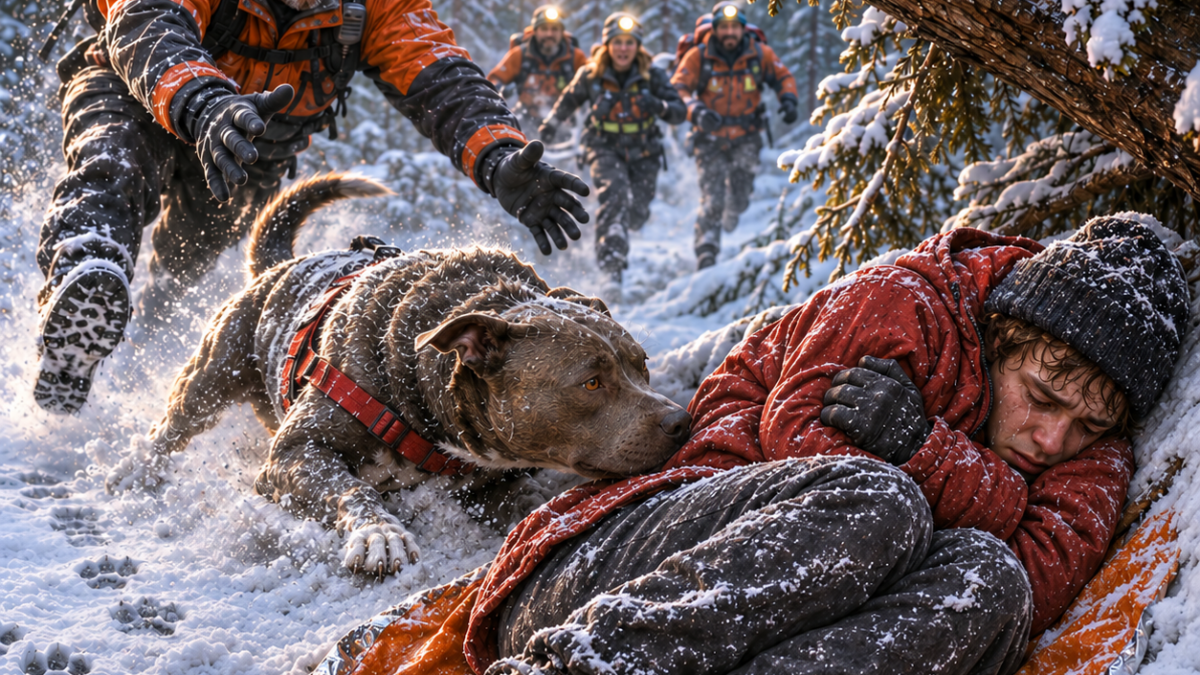
Theo disappeared on a Thursday afternoon.
The Foster family had driven into the mountains outside Silver Ridge for an early winter hiking trip.
Nothing extreme.
A marked trail.
Parents.
Their seven-year-old son.
Theo’s older sister, Madison.
They had done the walk before.
The weather forecast had called for cold but manageable temperatures.
Then the mountain weather changed.
Snow arrived several hours earlier than expected.
Visibility dropped.
And sometime shortly before four in the afternoon, Theo became separated.
The family’s account was simple and devastating.
They had stopped near a bend where two trails crossed.
Madison needed help adjusting her boot.
Theo had been standing perhaps thirty feet ahead, throwing little clumps of snow at a pine tree.
His mother looked down.
His father helped Madison.
They looked up.
Theo was gone.
Thirty seconds.
Maybe forty-five.
That was all.
They called.
No answer.
They followed the trail.
Nothing.
Theo’s father ran back.
Mother forward.
Still nothing.
At 4:31 p.m., emergency services received the call.
By five, our first team was on the mountain.
By six, snow had covered much of the fresh ground sign.
By eight, temperatures had dropped well below freezing.
By midnight, more than fifty people were involved.
Sheriff’s deputies.
Volunteer search teams.
Firefighters.
Two certified dog teams from neighboring counties.
Drones when weather allowed.
Thermal equipment.
ATVs.
Local mountain guides.
Everybody.
I joined at 7:20 that first evening.
Rudy stayed home.
He had nothing to do with police work.
At least, that is what I believed then.
The first night was terrible.
People imagine search operations as constant movement.
Often they are slow.
Maps.
Grid assignments.
Radio reports.
Backtracking.
Calling.
Listening.
Checking places that seem impossible because children do impossible things when frightened.
Theo wore a blue winter jacket.
Gray knit cap.
Black snow pants.
Small red backpack.
Inside the backpack, his mother said, were two granola bars, a child’s water bottle, a plastic dinosaur, and one pair of extra socks.
That little dinosaur haunted me.
His mother described it as green.
A T. rex named Mr. Pickles.
Every time I heard another team radio in:
“Nothing found.”
I imagined a seven-year-old somewhere in the dark holding a plastic dinosaur because it was the only familiar thing he had left.
By sunrise Friday, we had not found him.
Children in cold weather create a terrible equation.
Small body.
Heat loss.
Fear.
Fatigue.
Dehydration.
Time.
The longer we went without finding Theo, the quieter people became.
Nobody said the worst possibilities aloud.
You do not need to.
They stand beside you anyway.
His mother, Caroline, stayed at command post.
She had barely slept.
Every time a radio cracked, her entire body turned toward it.
Every time it was nothing, she seemed to shrink.
Theo’s father, Michael, insisted on searching.
We eventually had to sit him down because exhausted family members can become additional rescue victims.
“I should be out there.”
He told Lieutenant Sarah Meadow.
Sarah answered calmly:
“You will be here when we bring him back.”
Not if.
When.
That mattered.
Sarah Meadow had twenty-three years in search and rescue.
She had found living people.
Bodies.
Children.
Hunters.
Climbers.
People who made miraculous recoveries.
People who did not.
She never promised outcomes.
But she understood families need something to stand on.
So she said when.
It was Friday night when Rudy entered the story.
I had been awake close to thirty hours.
Sarah sent me home for four.
I protested.
Lost.
She stared at me.
“Wesley.”
“Yes, ma’am.”
“You’re useless tired.”
“I’m fine.”
“You just poured coffee into an empty cup because you forgot the cup.”
Fair.
I drove home.
Rudy met me at the door.
Normally he greeted me with enough enthusiasm to suggest I had returned from war even if I had only been gone twenty minutes.
That night he stopped.
Sniffed my trousers.
Boots.
Jacket.
Then froze.
He became unusually focused.
His nose returned to my sleeve.
The same sleeve I had used while helping Theo’s mother sort several pieces of her son’s clothing for scent teams.
I did not think much of it initially.
Rudy sniffed.
Then walked toward the door.
Looked back.
“No.”
He waited.
“I’m going to sleep.”
He whined.
That was unusual.
Rudy almost never whined.
I crouched.
“What?”
He pressed his nose into my jacket again.
Then door.
Something moved in my tired brain.
No.
Ridiculous.
He had no training.
Still, four hours later, when I returned to command post—
Rudy came with me.
PART2
Henry Blackwell saw him first.
Henry had fifteen years of organized search experience and exactly zero patience for sentimental thinking during active operations.
He looked at Rudy.
Then me.
“Why is your dog here?”
“Moral support.”
Henry stared.
“That better be a joke.”
“Mostly.”
Rudy stood beside my leg.
Calm.
Lieutenant Meadow walked over.
She knew Rudy.
Everyone at the department did.
Rudy had become an unofficial station visitor over the years because I sometimes brought him in after shifts, particularly during community events.
Kids loved him.
Rudy loved kids more.
A child could pull his ear accidentally and Rudy would simply look offended.
An adult he did not trust could move too quickly and receive a very different expression.
Sarah crouched.
“Hey, Rudy.”
His tail moved.
Then he sniffed her gloves.
She looked at me.
“You expecting him to search?”
“No.”
“Good.”
I hesitated.
“He reacted to my clothes.”
Sarah’s eyes narrowed slightly.
“How?”
I explained.
Henry shook his head before I finished.
“Every dog reacts to scent.”
“I know.”
“He’s never tracked.”
“I know.”
“Then don’t turn him into something he isn’t because we’re desperate.”
That stung because it was true.
Desperation makes people see signs everywhere.
I did not want to become the deputy who risked time on magical thinking because his pet acted interesting.
So Rudy stayed at command post.
For several hours.
He greeted volunteers.
Sat beside Caroline.
That was when I noticed something else.
Theo’s mother had been shaking most of the morning.
Rudy walked toward her.
No invitation.
No command.
He sat beside her chair.
Then placed his head on her knee.
Caroline stopped moving.
Her hand descended slowly.
Touched his head.
Then she broke.
Not hysterically.
Quietly.
She bent over Rudy and cried into his neck.
Rudy did not move.
He simply stayed.
That was what Rudy did.
He stayed.
I should explain how I found him.
Three years earlier, I had responded to a complaint behind an abandoned auto repair garage outside Piedra Vista.
The caller reported barking.
I expected stray dogs.
Instead, behind a collapsing fence, I found Rudy.
Young.
Maybe two.
Brown-and-white pit bull.
Skinny.
Chain around his neck attached to a rusted wheel rim.
The chain was so short he could stand.
Lie awkwardly.
But not properly sit without the collar pulling into his throat.
No food.
Green water.
Old scars.
Nobody knew who had left him.
Garage owner had disappeared months before.
I approached.
Rudy watched.
No bark.
No growl.
I remember thinking that was worse.
I had bolt cutters in patrol vehicle.
I came back.
Crouched.
“Buddy.”
Rudy did not move.
I cut chain.
Metal hit ground.
And then I stepped back because I expected him to run.
He didn’t.
He walked toward me.
Sat at my boots for the first time he had probably been able to sit comfortably in months.
Then placed his head on my knees.
No drama.
No fear.
Just weight.
Trust.
I remember thinking:
You have absolutely no reason to do that.
But he did.
I fostered him.
Then failed at fostering spectacularly.
Two weeks later, adoption papers.
Three years later, Rudy slept in my bed, stole the left side of the couch and had somehow become the dog children in our neighborhood came looking for when they were upset.
Maybe that mattered.
Maybe not.
But Saturday morning, everything changed.
Theo had now been missing thirty-six hours.
Snowfall had stopped.
Temperature remained dangerous.
One certified dog team had followed a scent trail south until it vanished near a rocky slope.
Another found nothing useful.
Our focus shifted toward drainage areas and lower elevation routes where a frightened child might naturally descend.
At 9:10 a.m., I received an assignment with Henry and four others to sweep a narrow trail east of the original disappearance point.
Rudy was supposed to remain at command.
He did not.
When I started walking, he followed.
I stopped.
“Stay.”
He sat.
I walked again.
Rudy remained.
Good.
Then Caroline came up behind me.
“Take him.”
I turned.
“What?”
She looked exhausted.
Eyes swollen.
Her hand rested on Rudy’s head.
“Take him with you.”
“Caroline, he’s not trained.”
“I know.”
“He may slow us down.”
She nodded.
Then whispered:
“Theo loves dogs.”
That was not operational reasoning.
Still.
Something about her voice.
I looked toward Sarah.
Lieutenant Meadow thought for a moment.
Then said:
“Keep him leashed.”
Henry sighed.
“Fine.”
Rudy joined.
For nearly two hours, nothing happened.
He behaved like Rudy.
Sniffing trees.
Snow.
Occasionally looking toward us.
No indication he was following Theo.
Henry relaxed enough to say:
“See?”
I smiled.
“I told you I wasn’t claiming anything.”
We moved along the planned route.
Then, at 11:17, Rudy stopped.
Not to sniff.
Stopped.
Head raised.
His entire posture changed.
I noticed immediately because I knew him.
Ears forward.
Nose working.
Tail still.
He looked left.
There was no trail left.
Only dense timber.
Dark.
Steep.
Snow deeper between trees.
I tugged lightly.
“Come on.”
Rudy did not move.
Then he stepped off the route.
Into the forest.
“Rudy.”
He continued.
I tightened leash.
He pulled.
Not wildly.
Purposefully.
Henry said:
“Wesley.”
“I know.”
Rudy pulled again.
I called:
“Rudy, here.”
Nothing.
That was unusual.
He knew recall.
Not competition-level.
But good.
I called again.
“Rudy.”
He walked.
Slow.
Certain.
I followed several steps because of leash.
Then stopped.
Rudy reached the end.
Looked back.
He did not bark.
Did not whine.
Just waited.
Twenty yards later, after I lengthened the line, same.
Move.
Stop.
Look back.
Wait.
Henry shook his head.
“This is exactly what we cannot do.”
“What?”
“Let an untrained dog pull us off assigned grid.”
I knew.
He was right.
Every search operation depends on discipline.
Random intuition can waste lives.
“There’s no indication Theo went this direction.”
Henry continued.
“Terrain is worse.”
One rescuer added:
“And we have teams south.”
Rudy stared at me.
That certainty.
I hate describing it that way because afterward everything seems meaningful.
But in the moment?
It was simply different from every time Rudy had chased a smell.
He was not excited.
No frantic sniffing.
No pulling toward wildlife.
He looked like he expected me to understand.
And I remembered the garage.
The chain hitting ground.
Rudy sitting.
Trust.
I had once cut him free and expected him to run.
He had trusted me instead.
A ridiculous thought came.
Maybe I owed him one.
Not blind trust.
One look.
One chance.
I grabbed radio.
“Lieutenant Meadow, Grant.”
“Go ahead.”
“My dog is indicating off route.”
Pause.
Henry stared.
I clarified quickly.
“He is not certified.”
“I know.”
“He’s giving me behavior I’ve never seen.”
Wind hissed through radio.
Then Sarah asked one question.
“Is your dog sure?”
I looked at Rudy.
He stood still.
Waiting.
“Yes.”
Sarah answered:
“Mark your current position.”
“Henry maintains the assigned route with main group.”
“You and one additional rescuer can check for fifteen minutes.”
“Do not lose radio contact.”
A compromise.
Professional.
Not faith over evidence.
A limited check.
I said:
“Copy.”
Henry muttered:
“This is a bad idea.”
Maybe.
One volunteer, Maria Lopez, joined me.
Rudy started moving before I gave command.
Fifteen minutes passed.
Nothing.
Dense timber.
Branches hit faces.
Snow knee-deep in pockets.
Rudy continued.
Sarah radioed.
“Status?”
“No contact.”
“Any objective indication?”
I looked at Rudy.
“No.”
“Return.”
I should have.
I stopped.
Rudy continued to leash limit.
Then looked back.
I called:
“Rudy.”
He turned toward forest.
Pulled again.
Maria said quietly:
“He really wants this direction.”
I radioed.
“Request ten more.”
Long silence.
Then:
“Ten.”
Henry would later tell me Sarah lost sleep over granting that.
I understand.
Ten became twenty.
Terrain curved downward unexpectedly.
That mattered.
A child leaving trail might follow natural drainage.
We found a broken branch.
Could mean anything.
Then another.
No clear footprint.
Snow had covered most signs.
Rudy kept moving.
Not nose buried continuously like trained tracker.
Sometimes he sniffed.
Sometimes he stopped and listened.
Was he following scent?
Sound?
Wildlife?
Chance?
I do not know.
Anyone who claims certainty is inventing.
But he kept going.
At thirty minutes, Maria said:
“If he’s wrong, we turn.”
“Yes.”
I meant it.
At forty-five, my fingers were becoming numb despite gloves.
Rudy suddenly stopped.
Completely.
His ears rose.
Head tilted left.
I froze.
“What?”
Rudy moved three yards.
Stopped near large spruce.
Sniffed.
Then began digging.
Not frantic.
Careful.
Paw.
Pause.
Paw.
Snow shifted.
Maria hurried forward.
I dropped to knees.
“Rudy, back.”
He backed slightly.
I dug with gloved hands.
Snow.
Branches.
Roots.
Then blue fabric.
Everything inside me stopped.
“Maria.”
She saw.
“Oh God.”
We cleared more.
A small body was curled in a hollow between the spruce roots.
Blue winter jacket.
Gray cap partly off.
Red backpack.
Theo.
His face pale.
Lips bluish.
Eyes closed.
No movement.
For one second, fear froze me harder than the mountain.
Then training took over.
Airway.
Breathing.
Pulse.
“He’s breathing.”
Maria exhaled so hard it sounded like a sob.
I stripped my outer jacket.
Covered him.
We assessed carefully.
Cold.
Very cold.
But alive.
I grabbed radio.
I had imagined if we found Theo I would say something eloquent.
Nothing came.
Three words.
“We found him.”
The radio exploded with voices.
Sarah:
“Repeat.”
“We found him.”
“Alive?”
“Yes.”
That word traveled through the mountain.
Alive.
Rudy sat beside Theo.
No licking.
No jumping.
No barking.
He moved close.
Lowered his head.
Placed it gently against Theo’s chest.
Exactly the way he had once placed his head on my knees behind that garage.
Maria looked at me.
I could not speak.
Theo’s eyelids fluttered.
Barely.
I said his name.
“Theo.”
Nothing.
Again.
“Buddy, you’re safe.”
A tiny sound.
Not word.
Enough.
We kept him insulated.
No unnecessary movement.
Sarah coordinated helicopter extraction to nearest safe clearing.
Twenty minutes.
Longest twenty minutes of my career.
Theo’s backpack was still on him.
Later we found one granola wrapper.
Water bottle nearly empty.
The green plastic dinosaur, Mr. Pickles, inside his coat.
He had wedged himself beneath spruce roots to escape wind.
That likely saved him.
The hollow was small.
Snow formed insulation.
Had Rudy not turned toward that forest—
I do not finish that sentence often.
There is no benefit.
The flight medic said Theo was severely hypothermic but had stable enough vital signs for transport.
He was taken to regional hospital.
I stayed at landing zone.
Rudy watched helicopter lift.
Then looked at me.
I knelt.
Held his face.
“What did you do?”
Tail moved.
I laughed and cried at the same time.
Maria hugged me.
Then Rudy.
Henry arrived later.
First thing he did was crouch in front of Rudy.
“I was wrong.”
Rudy licked his glove.
Henry shook his head.
“Don’t make this weird.”
I laughed.
At command post, Caroline learned Theo was alive before helicopter even left mountain.
I was not there.
Sarah told me later.
Caroline collapsed into Michael’s arms.
Not fainted.
Legs simply stopped.
Michael cried so hard he could not speak.
When I returned with Rudy, Caroline saw us.
She ran.
Past me.
Straight to Rudy.
Dropped into snow.
Wrapped both arms around him.
Rudy pressed against her.
Michael knelt beside them.
I stepped away.
That moment belonged to them.
Theo spent three days in hospital.
Doctors said his condition had been dangerous.
His core temperature was low.
Hands and feet showed cold injury, but no major permanent damage.
One physician told Michael:
“Another hour could have changed the conversation.”
People repeated that line afterward.
I wish they hadn’t.
It made Rudy sound supernatural.
Truth is enough.
Theo survived thirty-six hours because he did several things right without knowing they were right.
He found shelter.
Stayed relatively still.
Kept his jacket on.
Used backpack as insulation beneath part of his body.
Ate one bar.
Drank sparingly.
Search teams narrowed possibilities.
Weather cleared.
And yes—
my untrained dog went into the right patch of forest.
Many things saved Theo.
Rudy was one.
A big one.
But not magic.
People asked how Rudy knew.
Again.
Again.
Again.
News crews.
Neighbors.
Deputies.
I had no answer.
Maybe he caught scent.
Theo’s family had been around Rudy at command post.
Rudy had sniffed Theo’s clothing indirectly on mine.
Maybe the wind carried something.
Maybe he heard a faint sound we could not.
Maybe his path was partly coincidence reinforced by something later.
Nobody can prove it.
The part I know is behavioral.
Rudy behaved differently.
I noticed.
Sarah allowed a controlled deviation.
That decision mattered.
Trust without discipline would have been reckless.
Discipline without flexibility might have failed too.
We needed both.
I visited Theo on day two.
Rudy was allowed after hospital approved a brief visit.
Theo looked impossibly small in bed.
Color returning.
Hands bandaged lightly.
His mother sat beside him.
When Rudy entered, Theo’s eyes widened.
“That him?”
Caroline nodded.
“That’s Rudy.”
Theo smiled.
First real smile I saw.
Rudy walked to bedside.
I held leash loose.
Theo reached.
Rudy put his head on mattress.
Theo touched one ear.
Then whispered:
“He was warm.”
I froze.
“What?”
Theo looked at Rudy.
“When you found me.”
“He put his head here.”
Theo touched his chest.
“I thought he was my dog.”
His voice tired.
“I thought I was home.”
Caroline turned away crying.
I could not speak.
Rudy stayed.
Head under Theo’s hand.
Theo asked a strange question.
“Was he lost before?”
I looked at his mother.
Then him.
“Yes.”
“Really lost?”
“Different kind.”
I told him a simplified version.
Chain.
Garage.
Found.
Home.
Theo listened.
Then said:
“So he knew.”
“What?”
“What being alone feels like.”
There are moments adults overcomplicate because we want accuracy.
A seven-year-old gives meaning directly.
I said:
“Maybe.”
Theo stroked Rudy.
“He knew.”
I let him have it.
After Theo came home, he wrote Rudy a letter.
Not me.
Rudy.
It said, in large uneven letters:
DEAR RUDY
THANK YOU FOR FINDING ME. I WAS VERY COLD. I LIKE YOUR EARS. MOM SAYS YOU ARE A HERO BUT I THINK YOU ARE MY FRIEND. LOVE THEO.
At the bottom:
A drawing.
Huge brown dog.
Tiny boy.
Tree.
Helicopter much too large.
I framed it.
Rudy tried to eat corner.
Heroes remain dogs.
Another letter arrived a month later.
Then another.
Theo drew Rudy wearing sunglasses.
Rudy driving police car.
Rudy rescuing dinosaur.
One drawing showed Rudy beside Theo’s bed.
Head on knees.
The letters became routine.
Every month.
Some addressed:
OFFICER RUDY
Others:
DEPUTY RUDY
One:
MR. RUDY GRANT
I liked that one.
The department invited Theo and family to station.
Small ceremony.
No huge spectacle.
Lieutenant Meadow spoke.
Henry gave Theo a search-team patch.
Then sheriff presented something ridiculous and wonderful.
A small badge-shaped tag for Rudy’s collar.
Not police certification.
Not K9 designation.
It said:
RUDY
COMFORT TEAM
Because after the rescue, we had started bringing Rudy to certain community events and child interviews where appropriate.
Not evidence searches.
Not arrests.
Comfort.
He was good at that.
Better than many of us.
The first time Rudy officially sat with a frightened child at station, I nearly cried.
A nine-year-old witness to a car accident.
Shaking.
Would not speak.
Rudy entered.
No command.
Sat.
Head on child’s knee.
Same.
Always.
The boy touched him.
Breathing slowed.
Then talked.
That was Rudy’s real talent.
Maybe Theo’s rescue made everyone notice it.
Rudy did not need to be search dog.
He needed to be Rudy.
Henry became his biggest fan.
The man who had warned me not to follow him started carrying treats.
Rudy noticed immediately.
One morning Henry said:
“He likes me better.”
“No.”
“He came to my desk.”
“You had chicken.”
“Relationship is relationship.”
Fair.
Sarah Meadow kept the search map.
Years later, she showed it during training.
The point where Rudy left route.
The path into forest.
Theo location.
She never taught:
“Always follow the dog.”
She taught:
“Notice anomalies.”
“Use limited probes.”
“Balance experience with new information.”
“Don’t become so attached to a plan that you stop observing reality.”
That was a better lesson.
Theo’s rescue deserved professionalism, not mythology.
Still, privately, Sarah once said:
“When I asked if he was sure, I was really asking if you knew your dog.”
I nodded.
“And?”
“I did.”
That was the difference.
Rudy had spent three years teaching me his normal behavior.
Squirrels.
Food.
Fear.
Curiosity.
Boredom.
Excitement.
When he became something else, I saw it.
Relationship is data.
Love does not replace observation.
Sometimes it sharpens it.
Theo visited us every few months.
Rudy adored him.
At eight, Theo was taller.
Still small.
No lasting major physical injury.
He remained nervous in heavy snow.
Understandable.
Therapy helped.
His parents did not force mountain trips.
Good.
People love dramatic “return to scene” stories.
Children do not owe anyone symbolic closure.
Theo healed at his pace.
One winter he asked to visit a snowy park near town.
Not mountain.
Flat.
Safe.
Rudy came.
Theo held leash.
Snow started lightly.
I watched him tense.
Rudy stopped.
Looked up.
Then sat against Theo’s leg.
Theo put hand on his head.
They stood.
After a minute, Theo said:
“Okay.”
We walked.
Ten minutes.
Then went home.
That was enough.
Courage does not have to look cinematic.
Sometimes it is ten minutes in snow beside a dog.
Rudy grew older.
Gray came around muzzle.
His hips stiffened.
Comfort visits shortened.
No more mountain searches.
Not that there ever had been another.
People kept asking if we trained him for search afterward.
No.
We did scent games for enrichment.
He enjoyed them.
But I refused to turn one extraordinary event into a job he had to keep proving.
Rudy did not owe anyone another miracle.
He had already lived through enough expectations.
Theo understood that better than adults.
When a reporter asked him at age nine:
“Do you think Rudy could find another lost child?”
Theo frowned.
Then said:
“He’s old.”
Reporter laughed.
Theo did not.
“He already found me.”
I wanted to hug him.
Exactly.
Rudy’s badge tag became scratched.
Theo noticed.
He made a replacement on cardboard.
Huge.
Gold marker.
BEST DOG OFFISER
Misspelled.
Perfect.
We kept both.
At ten, Theo wrote less frequently.
Normal.
Life expanded.
School.
Friends.
Soccer.
Letters became every few months.
Then birthdays.
I was glad.
Children should not remain forever defined by worst event.
Neither should dogs.
Theo was not “lost boy.”
Rudy not “rescue dog.”
They were Theo and Rudy.
One spring, Theo’s family came to my house for barbecue.
Theo was ten.
Rudy eleven.
The boy sat on porch.
Rudy placed head on lap automatically.
Theo laughed.
“He still does it.”
“Always.”
Theo looked down.
“Do you think he remembers finding me?”
“I don’t know.”
“He remembers me.”
“Yes.”
That was enough.
Memory does not need exact scene.
Connection remained.
Michael Foster told me something that day.
“For a year after Theo came home, I woke every night at four.”
“Why four?”
“That’s around when we realized first night he wasn’t coming back quickly.”
He looked toward his son.
“I’d check bedroom.”
“Make sure.”
I understood.
After Rudy had been chained, for months I checked his collar too often.
After losing someone—or almost losing them—your brain becomes suspicious of ordinary silence.
Michael continued:
“Rudy helped.”
“How?”
“Theo slept better after visits.”
He smiled.
“Honestly, so did we.”
A dog cannot erase trauma.
But nervous systems borrow calm from each other.
I had seen it.
Rudy eventually retired unofficially from comfort work.
Arthritis.
Long hallways tired him.
Station staff came to him instead.
On his thirteenth birthday, Henry brought steak.
Sarah brought a ridiculous blue bandana that said:
SEARCH LEGEND
I objected.
Rudy did not.
Steak.
Theo came.
Now eleven.
He sat on floor beside Rudy.
I took photo.
Boy taller.
Dog grayer.
Head still on knees.
Same pose.
Different years.
That image remains my favorite.
Not rescue.
Not snow.
Home.
At fourteen, Rudy developed heart disease.
Manageable initially.
Medication.
Short walks.
No stairs if possible.
I built ramp.
He refused it.
Of course.
Used steps until one bad slip.
Then accepted ramp with expression of personal betrayal.
Old dogs and old men hate accommodations.
Necessary anyway.
Theo visited after hearing.
He was twelve.
He sat with Rudy for an hour.
No talk about mountain.
Just school.
Soccer.
A girl he liked but insisted he did not like.
Rudy slept.
Theo scratched ears.
Before leaving, he whispered something.
I did not hear.
Did not ask.
Private.
Later, Caroline told me Theo had said:
“You can rest when you need to. You already found me.”
I cried that night.
Rudy’s decline accelerated at fifteen.
Appetite.
Breathing.
Mobility.
Veterinarian said we were nearing decisions.
I hated it.
Rudy had taught me trust.
Now I had to return it.
Not force him to stay because I could not let go.
I called Foster family.
Not because they needed to come.
Because they deserved choice.
Theo was thirteen.
They arrived Saturday.
Rudy lay on porch in sunlight.
He lifted head when Theo approached.
Tail moved.
Once.
Twice.
Theo knelt.
Rudy tried to stand.
Could not.
Theo said quickly:
“No.”
“Stay.”
He sat.
Rudy put head on his knees.
Still.
After all those years.
Theo began crying.
Quiet.
He stroked gray muzzle.
“Hey.”
Rudy’s eyes closed.
Theo looked at me.
“He’s tired.”
“Yes.”
The boy who once nearly froze to death had grown old enough to recognize another body reaching its limit.
“He’s not scared?”
“I don’t think so.”
Theo nodded.
Then said:
“I was.”
I sat beside him.
“In the tree.”
“Yes.”
“Until he came.”
My throat closed.
Theo looked down at Rudy.
“He made it stop.”
I said carefully:
“He made you feel less alone.”
Theo nodded.
“That.”
We decided on home euthanasia two days later.
Rudy stopped eating.
Breathing hard.
I knew.
Theo asked to come.
His parents left decision to him.
He came.
So did Sarah.
Henry.
Not crowd.
Family.
Rudy lay on his favorite blanket in living room.
His original cut chain link hung on wall nearby.
The piece I had kept.
Theo sat on floor.
Rudy’s head on his lap.
Of course.
I knelt on other side.
The veterinarian explained.
We nodded.
First medication relaxed him.
Rudy sighed.
Deep.
Like years leaving.
I touched his shoulder.
“You did good.”
Henry turned away.
Sarah cried openly.
Theo kept stroking.
Then he said something I will carry forever.
“You found me.”
His voice broke.
“So now you don’t have to look anymore.”
Rudy’s ear moved.
Maybe reflex.
Maybe recognition.
Doesn’t matter.
The room went still.
The final injection.
Breathing slowed.
One.
Another.
Then stop.
Theo’s hand remained on his head.
I put mine beside his.
No hero speech.
No miracle.
Just goodbye.
Afterward, Theo hugged me.
Hard.
Then looked at Rudy.
“Can I have his badge?”
I froze.
The Comfort Team tag.
Scratched.
Old.
I had planned to keep it.
Then understood.
I removed collar tag.
Put in Theo’s palm.
“Yes.”
He closed fingers around it.
“I’ll keep it safe.”
I knew he would.
I kept Rudy’s collar.
The cardboard badge Theo made years earlier.
The cut chain link.
His bed for months.
Not because I could not let go.
Because objects sometimes need time to become memory instead of pain.
Eventually I donated bed.
Kept collar.
Chain.
Cardboard badge.
Enough.
Theo still writes sometimes.
He is older now.
Not monthly.
But on anniversary of rescue, a message arrives.
Usually short.
Thinking of Rudy today.
One year:
Snowed here. I’m okay.
That one meant everything.
The Sheriff’s Office keeps Rudy’s photo in community room.
Not framed like fallen officer.
He was not police dog.
We respect categories.
Just a photograph.
Brown-and-white pit bull.
Head tilted.
Badge tag visible.
Underneath:
RUDY — COMFORT TEAM
Nothing about miracle.
No inflated title.
Enough.
Henry retired before me.
At his party, he raised glass.
“To the only search dog who wasn’t a search dog.”
Everyone laughed.
Then he added:
“And to Wesley for being stubborn enough to listen.”
I corrected:
“Sarah approved it.”
Sarah shouted from table:
“Don’t drag me into your bad decisions.”
Laughter.
Then quieter she said:
“Best bad decision I ever signed off on.”
I retired three years later.
Moved nowhere.
Stayed in same house.
Empty without Rudy.
For months I still looked toward dog bed.
Reached for leash.
Listened for nails.
Grief is muscle memory.
I did not adopt immediately.
People asked.
No.
Then one year later, a shelter called.
Because apparently I had become known for pit bulls.
There was a six-year-old female named June.
Quiet.
Overlooked.
I visited.
She did not place head on knees.
Good.
She ignored me.
Better.
I sat.
She eventually sniffed my shoe.
Different dog.
Different story.
I adopted her two weeks later.
Not replacement.
Never.
Theo met her.
He smiled.
“Rudy would like her.”
I said:
“You don’t know that.”
He laughed.
“No.”
“Probably not.”
June hated other dogs.
Rudy loved everybody.
Different.
That was healthy.
The first time it snowed after June arrived, I watched her run in yard.
No memories of mountain attached.
Just snow.
Play.
I realized how much of Rudy’s life had become tied in people’s minds to Theo.
But Rudy had been more than rescue.
He hated cucumbers.
Loved socks.
Snored.
Was terrified of vacuum.
Stole one entire birthday cake.
Refused baths.
Would sit on feet.
Had zero sense of personal space.
Those details matter more now.
Heroism is one moment.
Life is thousands of stupid ones.
Theo grew.
College.
Environmental science, last I heard.
Makes sense.
Mountains did not own his fear forever.
He eventually returned to hiking as teenager.
Slowly.
With family.
Then friends.
He sent me photo once.
Standing near a trail marker.
Snow in distance.
Rudy’s old tag on keychain.
Caption:
Not lost this time.
I cried.
Of course.
People still ask if dogs know things humans don’t.
Yes and no.
Dogs know smells we cannot.
Sounds we miss.
Body language we overlook.
They also get distracted by garbage.
Do not turn them into mystics.
Rudy was a dog.
Extraordinary because he was a dog.
Not despite it.
His nose.
Attention.
Attachment.
Persistence.
Whatever he detected that day came through those things.
And because I knew him well enough, I noticed.
That is beautiful without supernatural explanation.
I think the deeper miracle happened before the mountain.
Behind that garage.
Rudy had every reason not to trust.
Yet after I cut chain, he placed head on my knees.
That act shaped everything after.
I learned his language.
He learned mine.
Three years later, when he looked back from dark forest, waiting—
I understood it as clearly as words.
Come.
So I went.
Trust is not blind.
That lesson matters.
I did not hand entire search to Rudy.
Sarah limited deviation.
We maintained radio contact.
Other teams continued assigned grids.
We checked.
Evidence appeared.
Good decisions combine instinct with structure.
Rudy’s story should never become:
“Ignore experts and follow your feelings.”
Henry’s caution was valid.
Sarah’s flexibility was valid.
My knowledge of Rudy mattered.
All pieces.
People want simple morality.
Life rarely provides it.
The part that remains simple is what happened under spruce.
A child alone.
Dog beside.
Head on chest.
Stay.
No training manual required.
That was Rudy’s gift.
He knew how to stay.
Perhaps because someone once left him.
Maybe.
Or maybe because that was simply his nature.
Either way, when Theo needed warmth and calm, Rudy gave both.
Theo once asked me as adult:
“Do you think I would’ve died?”
I hated question.
I said:
“I don’t know.”
Doctors had said risk high.
But certainty impossible.
He nodded.
“Good.”
“What?”
“I hate when people tell me Rudy definitely saved my life.”
I understood.
“It makes everything feel like I owe being alive.”
That broke my heart.
“You don’t.”
He looked at me.
“Rudy did not find you so you could owe him.”
“He found you because you were there.”
“Your life afterward is yours.”
Theo smiled.
“Thanks.”
Another important correction.
Rescue should not become burden.
The next year, he sent photo of Rudy’s tag no longer on keychain.
Instead, in small frame on his desk.
“Was afraid I’d lose it.”
Smart.
He had learned something about keeping versus carrying.
I keep Rudy’s first cut chain link in drawer.
Sometimes I take it out.
Heavy.
Rust remains.
It once limited him to few feet.
Then bolt cutter.
Freedom.
Years later, Rudy walked forty-five minutes into a forest because nothing held him.
That contrast still gets me.
A dog once unable to choose where to sit became the creature we followed when nobody knew where to go.
There is poetry there.
I try not to overstate it.
Still.
There.
If I could speak to the person who chained him, I do not know what I would say.
Anger faded.
Mostly.
What matters is they failed to define him.
Cruelty did not become identity.
Rudy became household nuisance.
Friend.
Comfort dog.
Mountain search anomaly.
Theo’s pen pal.
My family.
The chain was something that happened to him.
Not who he was.
That distinction matters for people too.
Sometimes in rescue work we meet survivors and tell story only through suffering.
Bad.
Rudy deserved to be remembered for joy.
The way his entire back end wagged when happy.
The ridiculous snort when asleep.
How he hated rain but loved snow.
How he would sit beside children before adults.
How he once stole Henry’s sandwich at station.
Henry blamed me.
Rudy had no remorse.
Those are the memories that make grief livable.
The search day remains sharp.
Wind.
Snow.
Rudy twenty yards ahead.
Henry saying call him back.
Radio.
Sarah asking:
“Is your dog sure?”
Me saying yes.
Sometimes I imagine other answer.
No.
If I had said no, Sarah would have ordered return.
Would another team find Theo?
Maybe.
Would he have survived until then?
Maybe.
Useless.
Alternate timelines are traps.
We live in one that happened.
Rudy went left.
We followed.
Theo came home.
Enough.
Caroline Foster sent Christmas card every year while Rudy lived.
Always addressed:
Wesley & Rudy
After Rudy died, first card said:
Wesley, June, & forever Rudy
I sat at kitchen table holding it too long.
June chewed envelope.
Good.
Grief interrupted.
Michael once mailed me small wooden carving.
A dog sitting beside tree roots.
He made it himself.
Not perfect.
Beautiful.
It sits on shelf.
No plaque.
No explanation.
Visitors ask.
I tell story if I feel like it.
Sometimes I don’t.
Some memories belong privately too.
Rudy’s official-ish comfort tag sparked county program later.
Certified therapy teams, unlike Rudy’s informal role.
Proper training.
Insurance.
Protocols.
Good.
People sometimes credit Rudy.
Fine.
But program succeeded because professionals built it.
Rudy was inspiration, not curriculum.
Again, reality better than myth.
Theo volunteered with therapy-dog group in high school.
Not because anyone pushed.
He told me animals helped with anxiety.
He worked with a golden retriever named Sunny.
I teased:
“Rudy would be offended.”
Theo smiled.
“Rudy couldn’t pass the test.”
True.
Food distraction alone disqualifying.
We laughed.
That felt healthy.
Years after rescue, Theo and I returned near mountain.
Not exact spruce.
Trail area.
Summer.
No snow.
He was eighteen.
He wanted to.
His choice.
We walked short distance.
At one junction, he stopped.
Looked into trees.
“Was it that way?”
I pointed.
“More east.”
He nodded.
No drama.
Then:
“Rudy really just went in?”
“Yes.”
“And everyone thought you were nuts?”
“Mostly Henry.”
Theo smiled.
“I’m glad you were nuts.”
We walked.
He did not ask to see hollow.
I did not suggest.
You do not need to revisit exact wound to prove healing.
We sat near viewpoint.
Theo took out Rudy’s old tag—he had brought it.
Held.
Then placed back pocket.
No ceremony.
We ate sandwiches.
Normal.
That was better.
Sometimes stories become more powerful when they stop trying to be powerful.
A sandwich on mountain with grown boy who once almost died there.
That is enough.
If Rudy taught me anything, it was that competence is not only technical.
Technical skill matters enormously.
Henry’s fifteen years mattered.
Sarah’s judgment mattered.
The certified teams mattered.
But another kind of competence exists.
Knowing one being deeply.
Knowing what normal looks like.
Recognizing change.
Trust built over ordinary days.
That saved us time that morning.
Maybe saved Theo.
Relationship can become expertise.
And Rudy’s greatest skill?
People say finding.
I disagree.
He found Theo once.
He stayed countless times.
At garage.
By Caroline.
Beside frightened children.
Under Theo’s hospital hand.
On porch when I grieved.
Near my bed.
Stay was his gift.
Finding was one extraordinary expression of it.
The last morning of Rudy’s life, before veterinarian came, he did what he had always done.
He shuffled toward me.
Slow.
Sat badly because hips hurt.
Placed head on knees.
Exactly first day.
Chain gone.
Years passed.
Gray muzzle.
Same gesture.
I put both hands on his face.
“You really only have one move, don’t you?”
Tail.
I cried.
Then laughed.
That is how I prefer remembering goodbye.
Not only death.
Familiarity.
Maybe Rudy remembered the garage.
Maybe not.
Maybe body did.
But I remembered.
That was enough for both.
There is a phrase search teams use informally:
“Stay found.”
Meaning if you know rescuers are looking and location is safe, do not keep wandering.
Children are taught.
Theo did not know phrase.
But under spruce, he stayed.
Rudy found.
Then stayed too.
Two survivors meeting in a hole beneath snow.
One human.
One dog.
Both once needing someone to come.
That image remains.
If you tell this story, please do not say Rudy had mystical powers.
He didn’t.
Do not say experience was useless.
It wasn’t.
Do not say Henry was villain.
He wasn’t.
He cared about Theo enough to oppose wasted time.
Do not say Sarah “believed in magic.”
She didn’t.
She made controlled decision based on new information.
Truth is more interesting.
A rescued dog behaved differently.
His person noticed.
A leader allowed a limited deviation.
The path was right.
A child lived.
Then love did rest.
And if you ask what Rudy himself thought about becoming famous?
Nothing.
He cared about treats.
Theo.
Sleeping.
Probably in that order depending on day.
He did not know newspaper articles.
Badge.
Letters.
He knew boy smelled familiar and scratched behind ears correctly.
Enough.
When people praised him at station ceremony, Rudy yawned.
Then attempted to eat microphone foam.
Hero.
That is why I resist grand language.
Rudy was wonderful because he remained ordinary after extraordinary event.
He still stole socks.
Still rolled in dead things.
Still refused to come in from yard if squirrel possibility existed.
Still farted during serious meetings.
Life continued.
Thank God.
Theo continued too.
That is the best ending.
Not permanently fragile.
Not permanently “miracle boy.”
Grew.
Changed.
Made mistakes.
Had acne.
Failed driving test first time.
Went to college.
Loved.
Laughed.
Normal life.
Rudy’s rescue did not make him special.
It gave him chance to become ordinary.
That is what rescue should do.
I am older now.
June sleeps where Rudy used to.
Different posture.
She snores louder.
I walk slower.
Theo sometimes calls.
Sarah retired.
Henry moved to Arizona and complains about heat after complaining about snow entire career.
People continue.
Rudy’s photograph remains.
Mountain remains.
Spruce likely remains.
Life does not freeze around meaningful events.
Good.
One early winter morning recently, frost covered yard.
June stopped by fence.
Stared into trees beyond property.
For one ridiculous second, my chest tightened.
Rudy.
Then June lunged after squirrel.
No mysticism.
I laughed.
“Come back, idiot.”
She ignored.
Some things never change.
I went inside.
Made coffee.
Rudy’s collar hung by door.
Not because I am stuck.
Because he belongs there.
June’s leash beside.
Past and present.
No competition.
On my desk sits Theo’s first letter.
I LIKE YOUR EARS.
I read it when story feels too heavy.
Because that is what seven-year-old remembered.
Not hero.
Ears.
Perfect.
Children return everything to proper scale.
Rudy did not need medals.
If he had understood, he probably would have traded badge for cheese.
What he needed was exactly what he received after garage.
A home.
Couch.
Food.
Someone who knew him well enough to notice when he was trying to say something.
And years later, that knowledge mattered.
Maybe that is the final lesson.
We spend so much time asking animals to understand us.
Sit.
Stay.
Come.
Leave it.
Heal.
Trust.
Behave.
Rudy taught me responsibility goes both directions.
Learn them.
Their signals.
Normal.
Fear.
Joy.
Certainty.
Relationship is translation.
On mountain, Rudy spoke.
I happened to understand one sentence.
This way.
Then beneath spruce, without command, he spoke another to Theo.
Head against chest.
Warmth.
Stillness.
I’m here.
That was Rudy’s language all along.
Three years before Theo disappeared, Rudy had needed somebody to come behind an abandoned garage, cut the chain and say without words:
You are not staying here alone.
Thirty-six hours into Theo’s disappearance, Rudy returned that gift.
Maybe not consciously.
Maybe dogs do not build stories the way we do.
Humans do.
I am comfortable with that.
Because sometimes stories help us understand what actions mean after the fact.
Rudy’s action meant this to me:
Being saved does not obligate you to save anyone else.
But sometimes kindness changes what becomes possible in you.
Rudy received trust.
He learned closeness.
Then when another frightened creature needed it, he had some to give.
That is enough.
When I touch the rusted chain link, I think about movement.
From three feet of chain.
To forty-five minutes through forest.
From waiting to be found.
To finding.
From abandoned dog.
To someone’s family.
That arc is real.
No mythology required.
And when I think of Theo, I do not see blue lips anymore.
I see him at eighteen eating sandwich on mountain.
Healthy.
Annoyed because mustard got on sleeve.
Laughing.
Rudy’s tag in pocket.
That is rescue fulfilled.
Not the moment found.
The years afterward.
The rescue lasted thirty-six hours.
The consequences lasted a lifetime.
For Theo.
His parents.
Me.
Even search protocol.
Rudy got his tag.
Children at station got comfort.
Maybe that is how one event matters.
Not by becoming legend.
By changing small things after.
At Rudy’s memorial—if you can call five people in backyard a memorial—Theo said only one sentence.
He was thirteen.
He stood beside small box of ashes.
Looked at me.
Then said:
“He came when I couldn’t.”
I did not understand immediately.
Theo explained:
“I couldn’t get out.”
“He came.”
That was all.
I cried.
Rudy came.
Behind garage, I came for him.
In mountain, he came for Theo.
At end, Theo came for Rudy.
Circle.
Not destiny.
Relationship.
Enough.
If there is an afterlife, I hope Rudy is not working.
No searches.
No comfort duty.
No badges.
No children to rescue.
Just somewhere warm.
Maybe grass.
Squirrel he is finally allowed to catch.
Endless snacks despite veterinary objections.
And perhaps someday, very far from now, Theo walks toward him.
Rudy will do what he always did.
Sit.
Head on knees.
Stay.
Until then, we stay.
That is the harder part.
Living.
Remembering.
Moving.
Trusting new dogs.
Walking mountains again.
Letting snow become weather instead of only trauma.
Theo did that.
I did too.
Rudy taught both.
People tell me that the most important moment of that search was when Rudy turned left into the trees.
Maybe.
For me, the most important moment happened three years earlier.
A chain hit dirt.
A frightened dog chose not to run.
He sat at my feet.
Placed his head on my knees.
And trusted me.
Everything else grew from that.
Because on the mountain, when everyone was telling me to trust training, maps, grids and experience—and they were right to—
I also had one piece of information nobody else possessed.
I knew Rudy.
And for the first time since I cut that chain, he looked at me as though he needed me to trust him.
So I did.
Not forever.
Not blindly.
Just far enough.
Far enough to reach the spruce.
Far enough to find a small blue jacket under snow.
Far enough to hear a child breathe.
Far enough to radio three words that changed an entire family:
We found him.
And beside Theo, Rudy did what he had always done best.
He stayed.








