PART2:“BE GRATEFUL I CLEANED OUT THAT DEATH TRAP!” HOA Karen Stripped My Family’s 1890 Chapel—Then I Found Every Piece for Sale at Her Estate Auction
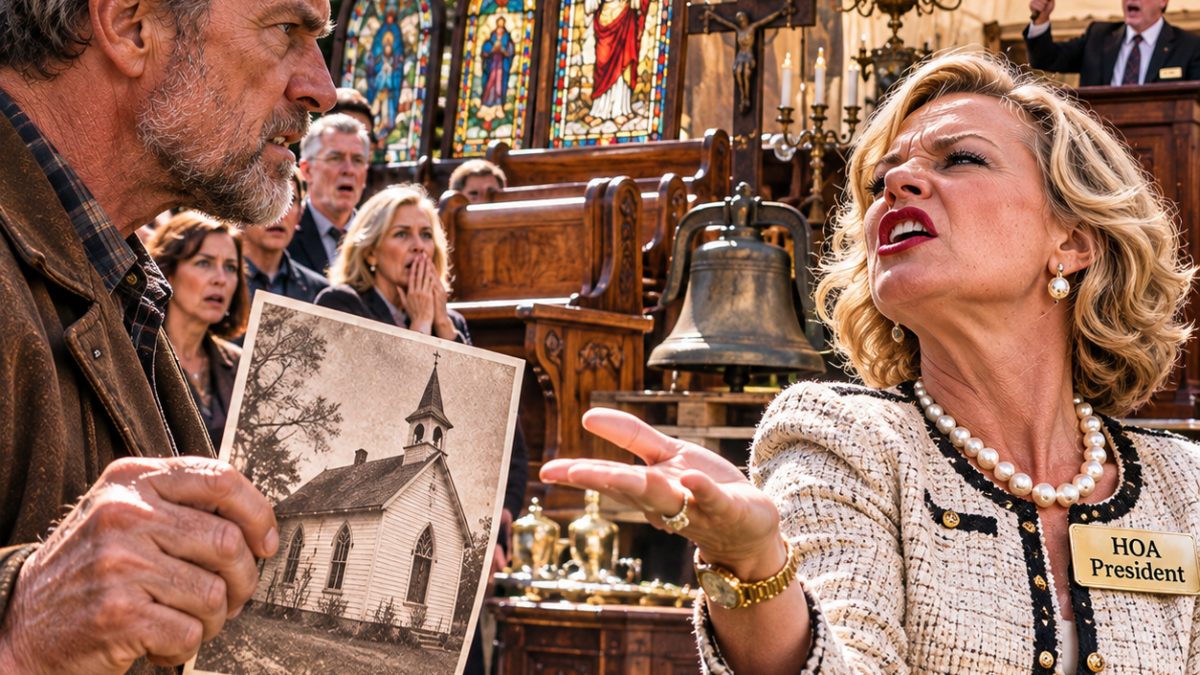
PART2
I kept evidence bags in my truck because old-building restoration teaches you quickly that loose fragments matter.
I slipped the tag inside one.
Then turned toward the east wall.
That was when I saw the empty screw holes where the brass donor plaques had been.
Every plaque.
Gone.
A safety crew might remove loose wood.
A compromised fixture.
A falling object.
Nobody removes engraved family names from a wall because of structural risk.
The plaques had value only if someone wanted the history to travel with the objects.
Karen noticed where I was looking.
For the first time, something flickered behind her confidence.
I said:
“You took the donor plaques.”
She folded her arms.
“Anything removed was handled according to procedure.”
“What procedure?”
“You’ll receive documentation.”
“I’m asking now.”
Her jaw tightened.
One of the security guards looked uncomfortable.
The other stared straight ahead.
I asked:
“Where are my things?”
“Processed.”
“You keep using that word.”
“Because that is what happened.”
“Processed where?”
She gave me a small shrug.
“That is no longer your concern.”
I remember that sentence almost better than anything else.
No longer your concern.
As though ownership could expire because Karen Whitford had printed a form.
Detective Reed Callahan arrived within the hour.
Broad shoulders.
Gray beginning at his temples.
Notebook in hand.
An actual paper notebook.
Reed did not arrive ready to arrest anybody.
That frustrated me at first.
Later, I appreciated it.
He walked the chapel slowly.
Photographed the scrape marks.
The plywood.
The new door hardware.
The empty bell yoke.
He asked me:
“Do you have records establishing the chapel contents?”
“Yes.”
“What kind?”
“Photographs.”
“Insurance appraisals.”
“Restoration invoices.”
“Ownership records.”
“Good.”
Karen immediately stepped forward.
“I have the authorization.”
Of course she did.
She produced a document with the ceremonial confidence of somebody revealing a royal decree.
The heading read:
EMERGENCY HERITAGE HAZARD REMOVAL NOTICE
County seal reproduced at the top.
Case number.
Language claiming the county building department had requested urgent action.
Reed photographed it.
He did not react.
Karen looked almost disappointed.
I asked:
“Is that real?”
Reed said:
“I’ll verify it.”
Then he looked at me.
“For theft, we need to establish two things clearly.”
“That the property belonged to you.”
“And that it was removed without lawful authority.”
“I can establish the first.”
“We’ll work on the second.”
Karen smiled.
That smile lasted less than twenty-four hours.
The following morning, my attorney, Fay Kessler, met me at the county building office.
Fay was forty-three and had the unsettling ability to read bureaucratic documents as though she expected every comma to confess.
A clerk searched Holloway Chapel.
Nothing.
No emergency order.
No inspection.
No active complaint.
No hazard notice.
Fay slid Karen’s paper across the counter.
“What about this case number?”
The clerk typed it.
Paused.
Typed again.
Then frowned.
“That number is real.”
For half a second, my stomach dropped.
Then she continued.
“But it belongs to a collapsed residential garage.”
“Where?”
“Other side of the county.”
“When?”
“Two years ago.”
Fay looked at me.
Someone had borrowed a legitimate county case number and attached it to a fake notice.
That changed the atmosphere instantly.
Before lunch, I gave Reed copies of:
The deed.
Eleven years of restoration invoices.
Insurance schedules.
Photo archives.
And a complete interior set I had photographed only nine days before returning.
Every pew.
Every window.
Every carved panel.
Organ.
Bell.
Pulpit.
Plaques.
I document old buildings compulsively.
That habit was about to save my family history.
Karen moved faster than we did.
By evening, the Bell Ridge Community Newsletter published a front-page warning.
UNSAFE HISTORIC STRUCTURE NEAR COMMUNITY BOUNDARY
No name.
No direct accusation.
But everybody knew.
It described an “uncooperative property owner” who had resisted reasonable safety measures.
Two days later, neighbors who normally waved when I passed stopped looking at me.
A retired couple who had attended my Christmas organ recital every December did not answer when I called.
Karen had performed one of her favorite tricks.
Turn the victim into the danger.
Then came the letter.
Bell Ridge offered to waive the entire $18,400 “emergency removal charge.”
One condition.
I had to sign a release waiving any claim relating to items “relocated from the property.”
I read it in Fay’s office.
Then pushed it back.
“What happens if I sign?”
“You acknowledge the removal as resolved.”
“And my property?”
“You would be giving up claims.”
I stared.
“She’s trying to make me authorize it afterward.”
“Yes.”
“Then no.”
Fay nodded.
“I thought so.”
That night she called me just before midnight.
“Graham.”
“You found something?”
“One phrase.”
She read from Karen’s notice.
Released for secondary disposition.
I sat up.
“What does that mean?”
“Debris gets disposed.”
“Secondary disposition means someone anticipated another destination.”
Sale.
Transfer.
Resale.
Something.
Anything except landfill.
I looked at the Lot 47 tag on my desk.
The whole shape of the thing became clearer.
They had not hauled my chapel apart like trash.
They had cataloged it.
I began thinking like a restoration contractor.
Eighteen pews.
Nearly twelve feet long each.
Six stained-glass windows.
One pump organ.
A heavy carved pulpit.
Bronze bell over six hundred pounds.
You do not move those items with a pickup and two men.
You need:
Multiple trucks.
Hydraulic lifting equipment.
Padding.
Crates.
Labor.
Time.
A route.
There was only one public road.
It passed Dale Pickett’s farm equipment repair shop.
Dale had a camera over his service bays.
The following morning, he pulled the footage.
Three box trucks.
Two consecutive days.
Driving toward Holloway Chapel in the morning.
Returning later riding low.
Same logo on all three.
RIDGEWAY ARCHITECTURAL SALVAGE
That was the first physical trail.
Ridgeway operated forty minutes south.
I drove there.
Dustin Mallory, the foreman, met me outside.
Arms folded.
Polite.
Guarded.
“We received valid authorization.”
“From whom?”
“I’m not discussing clients.”
“This is stolen property.”
“As far as I understand it, this is an HOA dispute.”
I opened my folder.
Placed three things on the hood of my truck.
My deed.
A photo of the complete chapel taken nine days earlier.
The sheriff’s case number.
Dustin’s eyes moved between them.
Then stopped on the photograph.
I opened another image.
The east window after removal.
Lead channel bent.
Stone edge scarred.
Dustin stared.
His shoulders lowered.
He had seen that damage happen.
Finally, he said:
“My men were told everything had been cleared.”
“By whom?”
“A woman from the association.”
“Karen?”
He hesitated.
Then nodded.
“She walked the site with a clipboard.”
“Were the pieces thrown away?”
Dustin looked at me.
“No.”
“What happened?”
“Everything was tagged.”
My stomach tightened.
“Numbered?”
“Yes.”
“Wrapped.”
“Loaded in a specific order.”
He looked genuinely disturbed now.
“It didn’t feel like a demolition.”
“What did it feel like?”
“A move.”
The Lot 47 tag suddenly became louder in my mind.
When I got home, an email from Bell Ridge’s lawyer was waiting.
Stop contacting association contractors.
Further contact could constitute interference with legitimate business operations.
I forwarded it to Fay and Reed.
No response.
That evening, at 9:40, Dustin called Reed himself.
He had found the original bill of lading.
Every piece removed from Holloway Chapel was described as belonging to:
AN INHERITED ESTATE IN BELL RIDGE
That phrase opened the next door.
I spent the following morning searching regional estate-sale listings.
Antique auctions.
Liquidations.
Historic furnishings.
It took less than an hour.
THE WHITFORD ESTATE COLLECTION
Saturday.
Whitford House.
A Victorian mansion on the hill above Bell Ridge.
Managed by Hearth and Hollow Estate Liquidators.
I clicked the catalog.
The first photo loaded.
My pump organ.
Polished.
Beautiful.
Photographed beneath a crystal chandelier.
I stopped breathing.
Next:
Oak pews.
Lined in a grand parlor.
Then the six stained-glass windows.
Mounted against wainscoting.
Backlit so the colors spilled onto polished floors.
The description:
Historic architectural furnishings from a distinguished private family collection spanning more than a century.
I zoomed in.
Third pew.
Hairline crack in the armrest.
I had stabilized it with a walnut butterfly key in my fourth year.
Organ.
Replacement stop knob I turned on my own lathe.
Second stained-glass window.
Pale amber pane I had sourced in Ohio after hail damage.
Mine.
Every one.
Then I reached:
LOT 47
The bronze bell.
Displayed on a padded stand under studio lights.
ORIGINAL ESTATE BELL FROM PRIVATE COUNTRY MANOR
Below it:
A provenance statement.
All items had belonged to the Whitford family for generations.
Signed:
Karen Whitford.
I sat back.
Until then, I thought she had stripped the chapel because she hated me.
Three years earlier, Karen proposed turning Holloway Chapel into a Bell Ridge commercial event venue.
Weddings.
Galas.
Private dinners.
The HOA collecting fees.
I refused.
First politely.
Then repeatedly.
I believed this was revenge.
I was wrong.
Revenge destroys.
Karen had harvested.
Fay and I built a comparison chart.
Twenty-nine cataloged items.
Twenty-nine confirmed matches.
Archival photo beside auction image.
Repair marks.
Cracks.
Tool signatures.
Dimensions.
Hardware.
Unique joinery.
We estimated the listed value between $312,000 and $460,000.
Then we delivered everything to Reed.
The danger was immediate.
An estate sale can scatter a collection across the country in hours.
One pew to Virginia.
A window to New York.
Organ to a private collector.
Bell onto a freight truck.
Recovery could take years.
If recovery happened at all.
So I called Hearth and Hollow.
Miriam Slade answered.
Professional.
Careful.
She said buyer interest was extraordinary.
Deposits already existed.
One out-of-state collector had arranged immediate freight pickup of the bronze bell after payment.
My stomach turned.
Fay and I drove to Miriam’s Main Street office.
I laid out:
The deed.
Sheriff case number.
Comparison chart.
Restoration photographs.
Miriam studied everything.
For a long time.
Then said:
“Your evidence is concerning.”
“Then stop the sale.”
“I cannot cancel a client’s sale based solely on a competing ownership claim.”
Fay said:
“You have notice.”
“I understand.”
“Continuing now creates risk.”
“I also have signed provenance and transfer documentation.”
Before Fay could answer, the office door opened.
Karen walked in.
Cream blouse.
Pearls.
No surprise in her face.
She had been waiting.
She told Miriam:
“This man is trying to sabotage my family’s estate.”
I almost laughed.
Family estate.
My great-great-grandfather’s pews were sitting in her auction.
Karen pulled out another document.
Set it on the desk.
TRANSFER AGREEMENT
Owner:
Graham Holloway.
Authorization to release chapel contents for liquidation.
Signature at the bottom:
Mine.
Almost.
I picked it up.
My signature has a sharp G.
The loop on my H never closes.
This one was rounded.
Slow.
Copied.
“I never signed this.”
Karen scoffed.
“Of course you did.”
“No.”
Fay immediately asked Miriam:
“Preserve the original.”
Miriam locked it in her office safe.
But she still would not cancel without legal authority.
That was fair, even if I hated it.
Fay needed an order.
Reed needed enough probable cause.
And Karen knew the clock was running.
I drove directly to Emmett Rollins.
Sixty-seven.
Antique specialist.
Had appraised the chapel organ eight years earlier.
His dining table disappeared beneath photographs.
Within twenty minutes, he identified:
Replacement bellows leather.
Reinforcement brackets beneath the pulpit.
An internal organ-builder’s mark.
Then he examined high-resolution images of the windows.
Window four had a distinctive repair along the lower lead joints.
I made that repair in 2018 after a storm.
I designed the profile myself.
There was no second one like it.
Emmett wrote a formal opinion.
Signed it.
Sent it to Reed.
That was when Reed stopped treating the case as something that might still collapse into a civil argument.
Forged signature.
Fake county order.
Professional transport crew misled by false paperwork.
Unique stolen objects listed under invented provenance.
That was not an HOA misunderstanding.
It was a crime pattern.
He began preparing a warrant.
Karen responded by speeding up the sale.
The next morning, Lot 47 changed online.
PRIVATE OFFER PENDING
The bell collector wanted to buy before Saturday.
If the deal closed, my family bell could be on an interstate before the public sale opened.
I sent Reed:
Foundry marks.
Maintenance records.
Close-up photos.
The 2015 shipping invoice from the Pennsylvania specialist who retuned the bell.
Every identifying feature.
Reed called Miriam.
Formally requested a hold.
She agreed.
Karen called Miriam three times that evening demanding the private sale proceed.
Threatened lawsuit.
Lost revenue.
Breach of contract.
That was when Miriam began questioning her client.
Not because I had convinced her.
Because Karen’s desperation did.
Honest sellers do not usually threaten an auctioneer three times in one night to move disputed property before police finish examining it.
Meanwhile, Holloway Chapel itself was getting worse.
The structural engineer arrived.
Inspected the window openings.
His report made me sick.
When Ridgeway removed the windows, workers had cut through original timber supports carrying part of the masonry load above the openings.
The plywood was not sealed.
Rain was coming.
If water entered the walls, old mortar and timber could deteriorate rapidly.
Initial restoration estimate:
More than $600,000.
And rising.
That was the cruelest part of the entire case.
I had to choose where to spend my time.
Chase the stolen pieces?
Or prevent the building they belonged to from collapsing?
I chose both.
Shoring crew.
Steel supports.
Weather membranes.
Temporary framing.
I stayed until two in the morning.
We photographed every fresh cut before covering it.
Saved damaged timber.
Bagged fragments.
Recorded saw marks.
Evidence.
Everything became evidence.
The following day, Bell Ridge’s newsletter accused me of causing the structural damage myself to inflate an insurance claim.
That one almost broke my restraint.
Almost.
Fay handled it.
The engineer’s report documented fresh cuts.
Exposed wood not weathered.
Tool patterns consistent with professional reciprocating saws.
She sent the report to Bell Ridge’s board with a defamation warning.
Then Dustin walked into Reed’s office with his own lawyer.
He brought:
Truck GPS data.
Written work instructions.
Pickup schedule.
Authorization forms.
Karen’s signature.
And one more surprise.
The same disposition form had been used before.
Seven times.
Reed cross-referenced the addresses.
All inside Bell Ridge Estates.
All over eighteen months.
Old architectural pieces removed.
Carved doors.
Antique cabinets.
Bronze fixtures.
Marble mantel.
Each job authorized by an HOA “disposition” notice.
Then came the detail that changed the investigation.
Every homeowner had been enrolled in Bell Ridge’s:
VACATION PROPERTY WATCH PROGRAM
Karen’s signature initiative.
Residents submitted travel dates.
HOA patrol checked their houses while they were away.
A useful program.
Unless somebody wanted a list of empty homes.
Then it was perfect.
I remembered Beverly Stroud.
Seventy-four.
Widow.
Two years earlier, she complained about antique oak entry doors disappearing while she visited her sister in Arizona.
Karen said they were warped.
Unsafe.
Removed under association maintenance authority.
Beverly eventually gave up.
I showed her the document from my chapel.
Her face went pale.
“Same form.”
Exactly.
Her original doors had been replaced with cheap ones.
She thought it was an HOA dispute she could not afford to fight.
Harold Bishop had a similar story.
Retired engineer.
Away for Christmas.
Returned to find antique bronze lights and a nineteenth-century walnut cabinet gone.
HOA claimed code violation.
Reed checked historical auction records.
He found Harold’s cabinet.
Sold eleven months earlier.
Nine thousand dollars.
That was when I stopped seeing my chapel as the center of the case.
It was simply the largest thing Karen had tried to take.
The vacation database was controlled by Vernon Hale.
Bell Ridge operations manager.
Soft-spoken.
Dependable.
He lasted less than thirty minutes in interview.
Yes, he sent absence lists to Karen.
Regularly.
No, he claimed he did not know why she wanted them.
She said patrol coordination.
He believed her.
My chapel was not inside Bell Ridge.
So how did Karen know I would be away exactly eight days?
Embarrassingly simple.
My restoration consultancy posted project calendars publicly.
The courthouse project.
Dates.
Location.
Two months online.
Karen had only needed a browser.
That frightened me more than I expected.
Not because my schedule was secret.
Because she had watched.
Waited.
Then timed the removal for when I could not interrupt it.
Reed brought in financial-crimes investigators.
Payments from old estate sales.
Removal invoices.
Consignment records.
Bank deposits.
What began as my missing bell became something larger.
A theft operation disguised as community maintenance.
Victims had been trained to believe the HOA was too powerful to question.
Then Miriam called.
8:15 in the evening.
Her voice was no longer professional-calm.
It was frightened.
“I reviewed the Whitford file.”
“What did you find?”
“I don’t think Karen owns the estate either.”
That sentence nearly made me laugh from disbelief.
Karen had stolen my chapel.
Hidden it inside an estate sale.
And now the estate itself might be fake.
Fay and I were at county probate when the records room opened.
Whitford House had belonged to Dorothea Whitford.
Karen’s aunt by marriage.
Retired schoolteacher.
Died fourteen months earlier at ninety-one.
No children.
Her will was clear.
Whitford House and all contents went to:
BELL RIDGE ARCHITECTURAL PRESERVATION TRUST
A nonprofit.
Purpose:
Protect historic structures.
Train restoration craftspeople.
Preserve regional architectural history.
Executor:
Adeline Pruitt.
Probate attorney.
Karen appeared once in the will.
She could check the furnace.
Collect mail.
Watch the roof.
Caretaker.
Nothing more.
No right to sell.
No authority over contents.
No authority to hire Miriam.
Fay called Adeline from the courthouse steps.
By noon, Adeline was furious.
By afternoon, she had reviewed Karen’s claimed paperwork.
Karen’s authority rested on an old power of attorney Dorothea signed years earlier during hospitalization.
It expired automatically when Dorothea died.
Attached pages supposedly extended Karen’s power.
Adeline examined them under light.
Wrong paper weight.
Notary stamp from a notary who had retired before the listed date.
Dorothea signature inconsistent with genuine records.
Then the full architecture of Karen’s scheme became visible.
Whitford House was not merely where she sold stolen property.
It was the laundering mechanism.
A grand Victorian mansion.
Respectable family name.
Authentic antiques already inside.
Blend stolen church furniture and household items among genuine estate pieces.
Give everything one clean provenance.
Buyers would never know.
She was not only laundering money.
She was laundering history.
Adeline sent an immediate demand:
Stop all sales.
Preserve all contents.
No transfer.
Karen answered by claiming certain items—including my bell, organ, and windows—were not estate property after all.
They were supposedly her own personal property.
That contradicted her original catalog provenance.
Miriam had seen enough.
She delivered everything to Reed.
Contracts.
Emails.
Catalog photos.
Buyer lists.
Consignment forms.
Karen was listed personally as consignor for every chapel item.
By midnight, Reed had sworn statements from:
Me.
Dustin.
Miriam.
Adeline.
Emmett.
The pieces fit.
He obtained the warrant.
I had one concern.
Whitford House was full of antiques.
A warrant means very little if deputies cannot tell my pew from another antique bench.
So I built an identification guide.
One page per item.
Archival photograph.
Dimensions.
Repairs.
Cracks.
Carving patterns.
Hardware.
Tool marks.
Lot number.
Bell foundry stamp.
Window lead repair.
Organ builder’s mark.
Every page designed so an officer could identify an object in seconds.
Restoration had taught me something useful.
History leaves fingerprints.
Saturday morning.
Eight o’clock.
Whitford House gates opened.
Gold-on-black sign:
WHITFORD ESTATE SALE — EVERYTHING MUST GO
Cars lined the road.
Dealers from three states.
Collectors.
Architectural salvage buyers.
Restoration firms.
By nine, the mansion was crowded.
Old wood.
Wax.
Perfume.
Money.
Karen moved through the rooms wearing cream silk and pearls.
Smiling.
Laughing.
Playing heiress.
My chapel was everywhere.
Eighteen pews in the ballroom.
Freshly waxed.
Pump organ in the music room beneath a chandelier.
Six stained-glass windows on custom easels in the main hall.
Backlit.
Beautiful.
Stripped donor plaques gone.
New lot tags hanging where family names used to be.
And beneath a spotlight at the foot of the staircase:
My bell.
Lot 47.
Crown jewel.
I walked in at 9:15.
Emmett on one side.
Adeline on the other.
Identification portfolio in my hand.
Miriam stood at registration.
I gave her the final list.
“Please do not let these items leave.”
She nodded.
Karen saw me.
Her smile vanished.
She snapped toward security.
“Remove him.”
Two guards approached.
I stayed still.
“I am the documented owner of items subject to an active sheriff’s investigation.”
Several buyers heard me.
Karen raised her voice.
“This man is a disgruntled neighbor trying to destroy my family’s estate settlement.”
Adeline stepped forward.
Her voice was calm.
Carried through the hall.
“My name is Adeline Pruitt.”
People turned.
“I am the court-appointed executor of Dorothea Whitford’s estate.”
Karen froze.
Adeline continued:
“Karen Whitford has no legal authority to sell the contents of this house.”
Silence.
Then movement.
A dealer put down a candelabra.
Another stepped away from one of my pews.
Several people went straight toward the registration desk asking about deposits.
Karen tried to recover.
“Certain items are my personal property.”
Nobody moved toward them.
That was when I saw the bell moving.
Two hired men had lifted it onto a furniture dolly.
They were pushing it toward a side corridor.
Service entrance.
Van outside.
I took out my phone.
Texted Reed:
Bell moving toward west service door.
I did not chase.
Did not block the workers.
Did not touch the dolly.
Because Reed had positioned deputies on the grounds.
Seconds later, two officers appeared at the service entrance.
Stopped the bell.
Then the front doors opened.
Detective Reed Callahan entered.
Signed warrant in his hand.
Four deputies behind him.
His voice carried through the mansion.
“We are executing a court-authorized search and seizure warrant concerning suspected stolen property.”
Nobody moved.
At the bell, I showed Reed the foundry mark.
Then the small chisel scratch on the crown.
Old initials.
Same as my maintenance photographs.
Match.
Dustin confirmed his crew had lowered that exact bell.
Miriam handed Reed the consignment form.
Karen’s name.
Seller.
Reed walked toward her.
“Karen Whitford.”
Her face changed.
“You are under arrest on suspicion of grand theft, forgery, fraudulent-document offenses, and fraud-related conduct.”
Karen did not wait.
She turned toward the side hallway.
Two deputies stepped into her path.
For the first time since I had known her, authority did not move out of her way.
They took her arms.
Placed her in handcuffs.
She kept talking.
“I am the president of Bell Ridge Estates.”
“This is association business.”
“I acted for community safety.”
I looked at her.
Not triumphant.
Just tired.
“You called it a cleanup.”
She stared.
I nodded toward my bell.
“You priced every piece of my chapel.”
Then:
“Explain the price tags to the police.”
The sale shut down.
My property was sealed as evidence.
Then Reed told Karen the investigation now included the prior Bell Ridge removals.
That was the moment she finally stopped talking.
Not when she saw the warrant.
Not when cuffs closed.
When she understood Beverly.
Harold.
The other homes.
The pattern had been found.
Returning my bell would not make it disappear.
Writing a check would not make it disappear.
The chapel had opened the door.
Everything else was coming through.
As Karen was led outside, Adeline touched my arm.
“Graham.”
I looked at her.
“There is something in Dorothea’s estate plan you should see.”
We went into the Whitford House library.
Leather.
Dark wood.
Old pipe smoke embedded in shelves.
Adeline opened the will.
Dorothea did not simply want her mansion preserved.
She wanted it transformed.
A regional center for architectural restoration.
Craft training.
Conservation.
A place where damaged historic pieces could be repaired.
Young craftspeople could learn old methods.
For fourteen months, the preservation trust had struggled to choose its first major project.
Adeline looked at me.
“I think Dorothea just chose one.”
I stared.
“What?”
“Holloway Chapel.”
The same mansion Karen used to launder the chapel’s history could become the workshop that restored it.
I did not answer immediately.
The symmetry felt almost too neat.
Then I thought about Dorothea.
A retired schoolteacher.
A woman whose will Karen had also tried to steal.
Maybe restoration was exactly what should happen there.
Justice moved slowly after that.
Real justice usually does.
Evidence first.
Ownership verification.
Item by item.
Once investigators finished documentation, my property was scheduled for return.
The bell survived.
Two stained-glass windows had cracked panes.
Several pews carried gouges from dollies.
Organ damaged but repairable.
Pulpit scratched.
Plaques recovered from boxed inventory.
Nothing beyond repair.
Karen faced the charges prosecutors could actually prove.
Civil claims came from me.
Beverly.
Harold.
Five other homeowners.
Financial investigators traced sale proceeds.
Removal costs.
Deposits.
Vernon was suspended while his role was reviewed.
Bell Ridge held an emergency meeting.
Standing room only.
Karen removed from the presidency unanimously.
Then removed from leadership entirely.
Independent audit ordered for her tenure.
Vacation-watch procedures rebuilt.
No single officer could access absence information without oversight.
No property removal without verified owner consent and legal review.
People who had once looked away when my truck passed came to apologize.
Some I forgave quickly.
Others took longer.
That is honest.
Karen’s lawyer approached Fay with a settlement offer.
Substantial cash.
In exchange, I would resolve my private civil claims.
Fay asked:
“What do you want?”
I looked toward the empty chapel.
“Everything back.”
“Anything else?”
“Every damaged beam assessed.”
“Every broken pane.”
“Every gouge.”
“Every missing plaque.”
“Every repair.”
“Money alone?”
“No.”
The chapel was not a pile of antiques.
You cannot calculate history by adding auction estimates.
I wanted restoration.
The preservation trust made its offer soon afterward.
Carriage House workshop behind Whitford House.
Free use.
Glass conservators.
Organ builder.
Wood specialists.
Apprentices.
Access to conservation resources I could never have afforded alone.
I accepted.
That winter, Whitford House changed.
Instead of antique dealers carrying pieces out, craftspeople carried damaged pieces in.
My pews went into the carriage house.
We cleaned old wax.
Stabilized splits.
Filled dolly gouges carefully without erasing age.
The stained-glass windows were placed on light tables.
Broken panes mapped.
Lead cames documented.
On window four, the repair pattern I had used to identify it remained visible.
Evidence became history.
We preserved both.
Emmett came every Thursday.
Coffee.
Opinions.
Usually more opinions than coffee.
Apprentices asked questions.
Why save a scar?
Why not replace the entire rail?
Why use old joinery?
I told them:
“Restoration is not making something look new.”
“It is allowing old material to keep telling the truth.”
That lesson applied to more than wood.
The organ took months.
Bellows rebuilt.
Stops cleaned.
Internal builder’s mark preserved.
One apprentice asked:
“Why does this matter so much?”
I opened the old donor ledger.
Pointed to names.
“These people paid for something they expected to outlive them.”
Then:
“Karen tried to separate the objects from the people who made them matter.”
“That’s why she took the plaques.”
The apprentice nodded.
History becomes easier to sell when you remove the names.
That realization stayed with me.
My family had always told a story about Great-Great-Grandfather Holloway helping raise the chapel walls.
I used to think family history survived naturally.
It does not.
It survives because somebody decides to keep records.
Repair.
Protect.
Retell.
Karen had nearly proved how fragile that chain can be.
One week away.
A few trucks.
Some forged paper.
Suddenly 136 years scattered into auction lots.
That frightened me long after the bell came back.
Beverly visited the carriage house one afternoon.
She brought photographs of her missing oak doors.
Investigators had traced them to a private buyer.
Recovery took longer.
Harold’s cabinet too.
Not everything returned quickly.
Some pieces had already crossed state lines.
Some buyers had purchased in good faith.
Courts and insurers had to untangle ownership.
Beverly looked at my pews.
“You got lucky.”
“Yes.”
Then she shook her head.
“No.”
“You documented.”
That was true too.
She touched one repaired armrest.
“I thought I was crazy.”
“What?”
“When Karen told me those doors were unsafe.”
“I knew they weren’t.”
“But everybody acted like HOA paperwork meant I must be wrong.”
I understood.
That was one of Karen’s strongest weapons.
Not law.
Confidence.
She made people believe resistance meant ignorance.
Beverly said:
“I wish I had fought sooner.”
I told her:
“You’re fighting now.”
Sometimes that is enough.
Vernon came to see me months later.
I did not expect him.
He stood outside the workshop.
Hands in his coat pockets.
“I wanted to apologize.”
I waited.
“I gave Karen the vacation lists.”
“Yes.”
“I didn’t know.”
“I believe you.”
He looked surprised.
“That doesn’t mean it was okay.”
His face tightened.
“I know.”
That distinction mattered.
Intent is not the only measure of responsibility.
He had handled sensitive information.
He trusted authority instead of asking why.
Bell Ridge eventually required two-person access controls.
Data logs.
Purpose restrictions.
Homeowners could opt out.
Boring safeguards.
Useful ones.
I told Vernon:
“Learn from it.”
He nodded.
That was all I wanted from him.
Karen was different.
She knew.
Court proceedings stretched across months.
I attended when needed.
Not every hearing.
I did not make Karen’s prosecution my new occupation.
The state handled criminal matters.
My lawyers handled civil restoration costs.
The preservation trust handled conservation.
My job was the chapel.
I had already lost enough time to Karen.
I refused to give her the rest voluntarily.
That became another form of justice.
Returning to work.
Spring arrived.
Stone walls dried.
New timber supports were fitted where the removal crew cut through originals.
We did not hide every intervention.
Small dated marks documented new material.
The windows returned one by one.
First east.
Then west.
Amber.
Blue.
Red.
Sunlight came back into the nave.
The first time it crossed the floor again, I stood there alone.
I thought I would feel triumphant.
Instead, I cried.
Quietly.
Not because they looked perfect.
They did not.
Two panes were new.
Lead lines showed repair.
But the light was home.
Sometimes restoration gives you back a thing you thought was gone.
Sometimes it gives you permission to grieve what did not return exactly the same.
Both can be true.
The pews came next.
All eighteen.
Same places.
I had kept measured floor plans.
Each one returned to its original position.
Brass donor plaques screwed back where they belonged.
Names again.
Then the pulpit.
Organ.
Finally, the bell.
A rigging crew brought it to the tower.
Six hundred pounds of bronze.
Inspected.
Certified.
No structural crack.
Foundry mark still sharp.
Old initials on the crown.
I climbed with the riggers.
Watched them set the bell into its repaired yoke.
For months, Lot 47 had existed in my mind as an auction number.
Now the number was gone.
It was simply the Holloway bell again.
That mattered more than I can explain.
The chapel reopened the following spring.
Evening organ concert.
No tickets.
No gala tables.
No HOA branding.
No commercial packages.
Neighbors came.
Preservation trust members.
Apprentices.
Beverly.
Harold.
Miriam.
Dustin.
Even Reed stood in the back near the door.
Fay sat beside Emmett.
The retired couple who had stopped answering my calls came too.
They apologized before the concert.
I accepted.
Not because what happened did not hurt.
Because I was tired of carrying it.
At seven o’clock, we rang the bell.
One pull.
The bronze voice moved over the road.
Through white oaks.
Across Bell Ridge.
People outside stopped.
I stood beneath the tower and listened.
For eight months, I had heard that bell in my head as evidence.
Lot 47.
Foundry mark.
Maintenance invoice.
Warrant item.
Now it was sound again.
That was the restoration I had been waiting for.
Afterward, people lingered.
Light came through the windows.
Amber across stone.
Blue over old pews.
The organ still smelled faintly of leather and shellac.
A young apprentice ran one hand along the back of a repaired pew.
He asked:
“How do you know when restoration is finished?”
I looked around.
“You don’t.”
He frowned.
“Buildings keep needing care.”
“Then what was tonight?”
“A return.”
He thought.
Then nodded.
That felt right.
Return.
Not erasure.
Not pretending Karen never happened.
The chapel carried new scars.
So did Bell Ridge.
So did I.
History had not been reset.
It had survived.
Miriam rebuilt her business reputation by cooperating completely.
That was difficult for her.
Some buyers sued over canceled deposits.
Insurance got involved.
She lost money.
But she gave investigators every record.
Changed provenance verification.
Required independent proof of estate authority.
No consignment relying solely on a client’s declaration for major historic pieces.
She told me once:
“I thought signed paperwork meant due diligence.”
“It means somebody signed paperwork.”
She nodded.
“Expensive lesson.”
Yes.
But learned.
Dustin’s company changed too.
Owner authorization had to be verified independently for historic removals.
No HOA form by itself.
No “client says it’s fine.”
Photo documentation before work.
Crew stop authority if site conditions contradict paperwork.
His men had damaged my chapel.
That fact remained.
But Dustin cooperated when he realized he had been deceived.
Truth does not require flattening everybody into villain or hero.
People make mistakes.
Then they choose what happens after.
Karen kept choosing concealment.
That was the difference.
Bell Ridge eventually published an independent audit summary.
Not gossip.
Records.
Karen’s use of association authority.
Vendor contacts.
Vacation data.
Property-disposition forms.
Financial transactions linked to earlier sales.
The residents read about their own community in black and white.
Some were furious.
Some embarrassed.
Some defensive.
A few said they had always suspected.
People like saying that afterward.
What mattered was what changed.
Vacation data controls.
No private entry authorizations from a single president.
No heritage-removal action without owner documentation.
No conflict-of-interest transactions without board disclosure.
Outside legal review for unusual property action.
Normal governance.
Again, boring can be beautiful.
Karen was convicted only on the charges prosecutors could prove beyond the required standard.
Civil cases handled other losses.
I did not need every accusation transformed into a maximum sentence.
The evidence mattered more than mythology.
She lost the presidency.
Lost control of the association.
Faced criminal consequences.
Faced civil claims.
Her scheme ended.
Property returned where possible.
Victims learned the truth.
That was enough.
I have seen people ruin strong stories by adding consequences that never happened.
Reality was already serious.
No exaggeration needed.
The most painful discovery for Bell Ridge residents was not that Karen stole valuable antiques.
It was that she used trust to identify vulnerability.
The vacation program existed because people wanted neighbors to watch their homes.
She turned that list into an opportunity schedule.
That betrayal changed how residents saw community itself.
Mara from Silverbrook never entered this story.
Different place.
Different case.
But I learned something similar to what every good treasurer or board member eventually learns:
Authority should not depend on trusting one personality.
Systems should make abuse difficult even when the person in charge appears respectable.
Karen looked respectable.
That was part of the camouflage.
People asked how she managed it for eighteen months.
Simple.
Most theft is not dramatic when disguised as procedure.
A resident leaves.
Contractor arrives.
HOA form exists.
Old door removed.
Cheap replacement installed.
Resident complains.
President says code issue.
Resident gets tired.
Moves on.
Then months later, an antique door appears in a sale under another name.
No single moment looks like a grand conspiracy.
That is why documentation across victims mattered.
One form.
Then another.
Then seven.
Pattern transforms isolated confusion into evidence.
My chapel broke the pattern because it was too much.
Eighteen pews.
Six windows.
Organ.
Bell.
Pulpit.
Plaques.
Professional trucks.
Large catalog.
Too many identifiable pieces.
Too much history.
Too much evidence.
Karen became ambitious.
Ambition made her visible.
She did not steal one cabinet.
She tried to strip an entire family chapel and sell it under spotlights.
That arrogance ended her scheme.
I sometimes think about the moment she stood on my steps and said:
“You should be grateful.”
That sentence reveals more than she intended.
She truly believed power could redefine harm.
If she called it safety, I was supposed to be grateful.
If she called theft disposition, I was supposed to sign.
If she called stolen antiques estate property, buyers were supposed to trust her.
If she called me dangerous, neighbors were supposed to stop listening.
Language was one of her tools.
That is why I became obsessive about naming things correctly.
My chapel was not an unsafe structure subject to HOA cleanup.
It was private property.
My pews were not disposed assets.
They were stolen furnishings.
The bell was not estate property.
It was Holloway Chapel’s bell.
Karen was not an executor.
She was a caretaker.
A narrow access role is not ownership.
A community title is not permission.
Names matter.
Dorothea Whitford never met me.
At least not knowingly.
Maybe we crossed paths in town.
I will never know.
But her will helped save my chapel.
Not directly.
By creating the preservation trust that later became part of the restoration.
I liked that.
Karen used Dorothea’s name to create a false estate history.
Dorothea’s actual wishes ultimately helped restore the history Karen tried to sell.
Justice sometimes has an elegance nobody planned.
The trust’s restoration center opened officially the following year.
Whitford House remained intact.
Carriage house became workshop space.
Apprentices learned:
Window glazing.
Historic mortar.
Wood conservation.
Metalwork.
Documentation.
The first display inside the workshop showed one of the damaged fragments from Holloway Chapel.
Not as a trophy.
As a teaching piece.
Beside it:
Photograph before removal.
Damage after.
Repair method.
I asked them not to mention Karen prominently.
The project did not need to become her monument.
The chapel existed before her.
It would exist after.
My own restoration business changed too.
I added stronger archival services.
Every project client now receives:
Full photographic inventory.
Cloud backup.
Serial and foundry records where applicable.
Repair maps.
Provenance documentation.
Not because I expect theft.
Because history becomes harder to erase when it is well described.
People think documentation is boring until something disappears.
Then the boring file becomes the path home.
Beverly eventually recovered one of her oak doors.
The other had been altered by a buyer and could not be returned intact.
A conservator reproduced missing elements based on photographs.
Harold’s cabinet came back after litigation with the buyer and insurer.
His bronze fixtures were never all located.
Other victims had mixed outcomes.
That matters.
Justice did not magically rewind every theft.
Some objects disappear.
Some are changed.
Some owners receive compensation instead of restoration.
That is why early documentation matters.
And why preventing abuse matters more than punishing it afterward.
Beverly once stood inside Holloway Chapel after reopening.
She touched the donor plaque nearest the entrance.
“Do you ever wish you had just taken Karen’s settlement?”
“No.”
“You didn’t even hesitate.”
“No.”
“Why?”
I looked at the pews.
“What would I have bought with it?”
She shrugged.
“Repairs.”
“Yes.”
“But money alone would have let the objects remain separated.”
I pointed around us.
“This is what I wanted.”
She nodded.
“So did I.”
People whose history has been removed understand that.
Compensation can address value.
It cannot always restore place.
The bell became my favorite symbol of that.
At Whitford House, under a spotlight, it was potentially worth a great deal to a collector.
Inside Holloway Chapel, it was not merchandise.
Its value was relational.
Bell.
Tower.
Rope.
Road.
People who knew the sound.
Take it away, and you can price the bronze.
Put it back, and price becomes almost meaningless.
Karen understood market value.
She never understood belonging.
That was her deepest mistake.
She believed if an object could be sold, ownership was merely a paperwork problem.
Create enough forms.
Invent enough provenance.
Attach respectable names.
The market would do the rest.
But history leaves traces.
Cracks.
Repairs.
Tool marks.
Foundry stamps.
Photographs.
People.
And eventually those traces tell on you.
Fay once joked that I defeated Karen with woodworking.
Not exactly.
But my restoration habits did become evidence.
Walnut butterfly key.
Turned organ knob.
Lead-joint pattern.
Builder’s mark.
Bell scratch.
None of those details looked important when I made or recorded them.
Years later, each became an identification fingerprint.
Craft remembers.
That is one reason I love old work.
Hands leave records even when paperwork lies.
I visited Whitford House on the anniversary of the auction.
No sale banner.
No buyers lining the road.
Instead, apprentice conservators worked inside.
One young woman was restoring an old sash window.
She asked:
“Were you scared that day?”
“At the auction?”
“Yes.”
I thought about it.
“Very.”
“You didn’t look scared in the photos.”
“That isn’t the same thing.”
She smiled.
Then:
“What were you afraid of?”
“That the warrant would come too late.”
“The bell?”
“All of it.”
She nodded.
I watched her fit old glass into new putty.
Then said:
“Courage is mostly doing accurate work while scared.”
She wrote that down.
I told her not to.
She did anyway.
Reed retired several years later.
At his retirement dinner, someone mentioned the Whitford case.
He told the story differently.
Not about the handcuffs.
Not about the warrant.
He talked about the identification guide.
“The owner handed us a binder where every stolen object had a photograph, measurement, repair mark, and lot number.”
Then Reed looked at me.
“He made our job possible.”
I shook my head.
“You did the warrant.”
He smiled.
“Evidence needs both sides.”
He was right.
Documentation means nothing if nobody acts on it.
Authority means nothing if it is not constrained by evidence.
That case required:
Owners.
Contractors.
Auctioneer.
Executor.
Experts.
Attorney.
Police.
Residents.
Each piece mattered.
People still occasionally call me asking about “the HOA chapel theft.”
I correct them.
Not because the phrase is wrong.
Because Bell Ridge itself did not vote to steal my chapel.
Karen used the HOA’s identity and tools.
That distinction matters when assigning blame.
The board failed oversight.
Some residents ignored warning signs.
But most homeowners did not authorize theft.
When Karen was removed, the association changed.
I refused to treat ninety-two families as one person.
Justice becomes dangerous when responsibility expands simply because anger wants a larger target.
The same reason I did not blame Ridgeway’s workers as if they had knowingly robbed me.
They had been misled.
They caused real damage.
Their company faced responsibility for that.
But once Dustin understood, he cooperated.
That mattered.
Miriam too.
She initially resisted canceling.
Then she preserved documents.
Held the bell.
Turned over files.
That mattered.
Adeline moved immediately.
Emmett gave expertise.
Beverly and Harold found the courage to reopen old wounds.
That mattered.
Karen’s scheme survived because people were isolated.
It collapsed because records connected them.
Holloway Chapel holds one annual preservation lecture now.
No gala.
No wedding venue.
I still refuse commercial event conversion.
Some people think that is stubborn.
Maybe.
The chapel works best as a chapel.
Concerts.
Historical talks.
Occasional memorials.
Community events.
Free.
Simple.
The preservation trust helps with major maintenance under written agreements.
Clear.
Specific.
Limited.
Nothing vague.
I learned enough about vague authority for one lifetime.
One winter evening after a concert, I stood outside with Fay.
Snow on the road.
Bell quiet above us.
She asked:
“Do you ever wonder what would’ve happened if you had signed the release?”
“Yes.”
“And?”
“I probably would have spent years trying to prove I didn’t mean it.”
She nodded.
“That was the point.”
Karen’s $18,400 fee had never been about collecting money.
It was leverage.
Waive the fee.
Get the signature.
Turn theft into consent retroactively.
That was sophisticated.
Cruel.
And almost effective.
If I had been frightened enough by the bill.
If I lacked counsel.
If the chapel had fewer records.
Maybe.
That thought made me understand Beverly differently.
People do not always surrender because they are weak.
Sometimes systems are designed to exhaust them.
That realization changed how I talk to people facing property disputes.
I never say:
“Why didn’t you fight?”
I ask:
“What did they show you?”
“What did you know at the time?”
“What did it cost to resist?”
Those questions are fairer.
Karen had spent years weaponizing certainty.
Residents did not know building codes.
She claimed she did.
Residents did not know HOA procedure.
She claimed she did.
Contractors assumed the HOA president had authority.
Auctioneers assumed estate documents were legitimate.
Buyers assumed provenance.
Each person held one small reason to trust her.
She combined those pieces into something powerful.
That is how institutional abuse often works.
Not because everybody is stupid.
Because everybody sees only one slice.
The scheme collapses when slices become one picture.
The vacation-watch list still bothers me most.
A security program.
People gave dates because they wanted protection.
Karen converted protection into targeting.
That betrayal is difficult to repair.
Bell Ridge now uses an outside security service.
Board officers cannot access exact travel schedules except under limited circumstances.
Records expire.
Requests logged.
Again:
Boring.
Good.
Several residents asked whether I would ever join Bell Ridge after everything.
I laughed.
The chapel property is outside the boundary.
Always has been.
Always will be.
That fact was one reason Karen resented it.
She could see it from the community road.
Residents loved it.
But she could not regulate it.
Three years before the theft, when she proposed the event venue, she said:
“Something this important should benefit the community.”
I answered:
“It already does.”
She meant financially.
I meant by existing.
We never agreed on that distinction.
Karen’s desire to monetize the chapel did not excuse theft.
But it did reveal her worldview.
If something had cultural value, somebody should package it.
Ticket it.
Rent it.
Sell it.
She looked at 136 years of family history and saw an asset class.
I am not against commerce.
I run a business.
I bill clients.
I understand money.
But some things change meaning when you convert them into inventory.
A chapel pew is furniture in an auction catalog.
Inside the chapel, it is the place four generations of the same family sat for funerals.
Context is value too.
The donor plaques taught me that.
Karen removed them because names complicated the lie.
A pew with HENRY AND MARGARET LYLE, 1890 screwed to the end does not look like Whitford estate furniture.
Remove the plaque and suddenly provenance becomes easier to rewrite.
Erasing names is often the first step in stealing history.
So when we reinstalled the plaques, I spent an entire afternoon polishing each one.
Not bright.
Just legible.
Then screwed them back into the same holes where possible.
Names home.
The final plaque belonged to Sarah Morrow.
The widow who gave twelve dollars.
Family ledger said she paid in installments.
Twenty-five cents some weeks.
Fifty cents others.
It took almost a year.
Karen’s auction estimate valued that window at more than twenty thousand dollars.
Sarah Morrow would have laughed at the number.
Her twelve dollars bought something she expected to belong to the chapel.
That promise lasted 136 years until Karen tried to interrupt it.
Then we restored it.
That is why I could not take a check and walk away.
Years after the case, someone offered to buy the bell.
Legitimately.
Collector.
Large number.
I declined.
He asked:
“Sentimental?”
“Yes.”
He looked almost disappointed by the answer.
I did not care.
Sentiment is not a defect.
Not every asset must maximize market value.
Sometimes the highest value of a thing is staying exactly where it belongs.
The bell rings every Christmas Eve now.
Not long.
One sequence.
People from Bell Ridge sometimes walk down the road to listen.
Nobody needs a ticket.
No VIP package.
No sponsor backdrop.
No one owns the sound once it leaves the tower.
That feels right.
The bell itself belongs to the chapel.
The sound can belong to everyone.
That is a much healthier form of sharing than Karen’s.
When I think about the estate-sale morning, I no longer picture the handcuffs first.
I picture the buyer from Virginia putting down the candelabra after Adeline spoke.
Why?
Because that was the moment legitimacy vanished.
Karen still had the house.
The clothes.
The printed catalog.
Security.
Auction setup.
Buyers.
But once the real executor said:
“She has no authority,”
all the theater stopped working.
Authority is not how convincingly you perform it.
It comes from something real.
Ownership.
Appointment.
Consent.
Law.
Karen confused presentation with legitimacy.
That mistake defined her entire scheme.
The officers found more documents at Whitford House.
Records linking earlier items.
Correspondence.
Consignment material.
Financial records.
Those supported cases beyond mine.
I did not need every detail to feel vindicated.
What mattered was that Beverly no longer had to wonder whether she had imagined what happened.
Harold no longer had to accept that his cabinet simply disappeared under “code enforcement.”
Victims got their stories back.
That mattered almost as much as objects.
Karen’s attorney once tried to characterize everything as an overzealous preservation effort.
Fay’s response was short.
“Preservation efforts generally do not include forged owner signatures, false county case numbers, private estate consignment forms, and price tags.”
I wish I could say that sentence ended the litigation.
Nothing ends litigation that quickly.
But it captured the absurdity.
I did eventually recover the $18,400 notice too.
Framed?
Absolutely not.
Filed.
Evidence should not become décor.
I have enough history on the walls already.
My great-great-grandfather’s name appears on one interior stone near the entry.
Small.
Easy to miss.
After reopening, I stood there one evening tracing the letters.
I wondered what he would think.
Probably that I spent too much money on restoration.
Farmers in 1890 were practical people.
Then I looked toward the bell rope.
Maybe he would understand.
People build things because they hope somebody later will decide they are worth keeping.
That is the entire bargain between generations.
Karen broke it.
We repaired it.
One apprentice asked me whether restoration is always worth the cost.
“No.”
He looked shocked.
I continued:
“Not everything can or should be saved.”
“Then how do you decide?”
“Significance.”
“Integrity.”
“Use.”
“History.”
“Community.”
“Resources.”
Then:
“And ownership.”
He nodded.
Karen had skipped that final word every time.
The chapel’s total restoration cost after the theft became substantial.
More than the original $600,000 early estimate once specialist work was included.
Insurance, responsible parties, civil recovery, and preservation support covered portions according to actual responsibility.
The trust helped.
I contributed too.
I do not collapse those amounts into one dramatic number because different costs belonged to different people.
Accounting matters.
Especially when anger is involved.
The lesson from Karen was partly that vague money creates opportunity for abuse.
So we kept every invoice.
Every funding source.
Every repair.
Transparent.
If somebody wanted to know where a dollar went, we could show them.
That was another way of undoing her damage.
Bell Ridge eventually invited me to speak at a governance meeting.
I almost declined.
Then Beverly asked me to go.
I stood at the clubhouse where Karen once presided.
Looked at homeowners.
Said:
“I’m not here to tell you HOAs are bad.”
Some people looked surprised.
I continued:
“I’m here to tell you unchecked authority is bad.”
Then I explained what mattered.
Independent records.
Conflict review.
Data protection.
Owner consent.
Board oversight.
Clear limits.
“Never let one person’s confidence substitute for documents.”
Mara—wrong story, wrong HOA—would have appreciated that principle.
Beverly smiled.
I finished:
“And if someone tells you they removed your property for your own good, ask where it went.”
That earned a few uncomfortable laughs.
Good.
Sometimes discomfort is useful.
The retired couple who had stopped answering my calls eventually returned for every Christmas concert.
The husband apologized twice.
I told him once was enough.
He said:
“I believed the newsletter.”
“I know.”
“I should’ve called you.”
“Yes.”
He nodded.
That was all.
Forgiveness does not require pretending the failure did not happen.
It means deciding the failure will not own the next interaction.
Miriam later hosted a seminar for auctioneers on fraudulent provenance.
She asked permission to use redacted images from my case.
I agreed.
Her opening slide:
A SIGNED STORY IS NOT THE SAME AS A VERIFIED HISTORY
Good title.
She invited me.
I sat in the back.
Auctioneers discussed:
Chain of title.
Estate authority.
Executor verification.
High-value religious and institutional artifacts.
Red flags when provenance appears too convenient.
Karen inadvertently improved an entire profession’s caution.
Not the legacy she intended.
Dustin’s company eventually helped us reinstall the bell at reduced cost.
He offered.
I considered saying no.
Then accepted.
Not because debt erased damage.
Because repair can include the people who made mistakes if they accept responsibility.
His crew was careful.
Almost painfully careful.
When the bell reached its yoke, Dustin stood beside me.
“I’m sorry.”
“I know.”
“I should have questioned the job.”
“Yes.”
He nodded.
No excuse.
That made the apology useful.
I never received one from Karen.
Not a real one.
At one hearing, she said:
“I regret how events developed.”
That is not an apology.
I did not need more.
Closure that depends on a dishonest person finally becoming emotionally honest can keep you trapped forever.
I found closure elsewhere.
In the returned pews.
The windows.
The bell.
The people she hurt speaking openly.
The systems changed.
The chapel standing.
That was enough.
Years later, I saw Karen once outside a courthouse.
Older.
Smaller somehow.
Not physically.
Without the HOA presidency around her, she looked like an ordinary woman carrying a folder.
She saw me.
I saw her.
Neither approached.
For a second, I remembered the camel coat.
The two security guards.
“You should be grateful.”
Then the feeling passed.
I walked to my truck.
That surprised me.
I had imagined for years that seeing her would reopen everything.
Instead, there was nothing left I needed from her.
That was freedom.
Back at Holloway Chapel, the evening sun came through the six windows.
I had repaired one section that week.
Normal maintenance.
No crisis.
No police.
No lawyers.
Just old glass needing care.
I climbed down the ladder.
Sat in the last pew.
Listened to the building.
Old structures are never truly silent.
Timber settles.
Wind touches the tower.
Stone releases heat.
That evening, the chapel sounded normal.
Normal can be a beautiful sound after chaos.
I thought about Lot 47.
The tiny torn tag beneath the altar.
If I had not seen it?
Maybe we still would have found Ridgeway.
Maybe.
But the tag told me one critical thing immediately.
The removal had a destination.
Someone had numbered my history.
Turned it into inventory.
That scrap of paper redirected the entire investigation.
Evidence is often small.
People expect truth to arrive dramatically.
Sometimes it sits in sawdust.
I kept the tag.
In an archival sleeve now.
Not displayed.
Filed with the case.
LOT 47.
One number.
Behind it:
A bell.
A family.
A fraud.
A network of victims.
A fake estate.
A preservation trust.
A restored chapel.
The difference between losing history and recovering it can begin with noticing one torn piece of paper.
That is why restoration work trains your eyes.
Nothing is just debris until you know what it belonged to.
The preservation center at Whitford House now teaches apprentices that principle.
One instructor uses the phrase:
Context before removal.
I like that.
Before you take something apart, understand what it is.
Who owns it.
How it fits.
What supports it.
What evidence it carries.
Karen did the opposite.
Remove first.
Invent context later.
That is destruction disguised as management.
Holloway Chapel still belongs to my family trust.
Bell Ridge has no authority over it.
The preservation nonprofit has no ownership either.
Our agreements are written.
Specific.
Revocable according to terms.
Everybody knows their role.
After Karen, I became almost annoyingly precise.
Fay says I was already that way.
She is probably right.
The annual organ recital returned.
The pump organ never sounded exactly the same after restoration.
A few notes respond differently.
Bellows feel new.
At first that bothered me.
Emmett said:
“You’re listening for the loss.”
“What should I listen for?”
“The music.”
He was right.
Restoration is not time travel.
You repair enough for the story to continue.
That is different from pretending nothing happened.
The chapel carries the theft in its history now.
I no longer hate that.
Survival deserves documentation too.
One Christmas, Beverly sat in the first pew.
Harold behind her.
Several of the other homeowners whose property had been removed sat nearby.
After the concert, Beverly looked at the windows.
Then said:
“Funny.”
“What?”
“She thought she was taking things from people one at a time.”
I waited.
Beverly smiled faintly.
“All she did was introduce us.”
That was true.
Karen’s victims had been isolated.
Afterward they knew each other.
Shared lawyers.
Shared records.
Shared experience.
The scheme that depended on silence created a community she never intended.
Another irony.
I sometimes wonder what Karen thought when she saw the restored chapel in photographs.
If she saw them.
Maybe anger.
Maybe regret.
Maybe nothing.
Does not matter.
The building does not need her reaction to be whole.
What mattered was the sound at seven o’clock on opening night.
The bell rang.
People stopped on the road.
Colored light crossed the floor.
Every pew was back.
Every donor name visible.
The organ filled the nave.
And for the first time since I came home from that eight-day trip, I stood inside Holloway Chapel without mentally cataloging what was missing.
That was when I knew restoration had succeeded.
Not when the court ruled.
Not when Karen was arrested.
Not when the board removed her.
When absence stopped being the first thing I saw.
That is the ending people often misunderstand.
Justice was not Karen in handcuffs.
That was accountability.
Necessary.
Justice was the chapel existing afterward.
Beverly learning she had not been crazy.
Harold recovering his cabinet.
Residents seeing what their vacation data had been used for.
Whitford House becoming the preservation center Dorothea actually wanted.
Apprentices learning restoration in the same carriage house beside the mansion Karen used to sell stolen history.
The bell returning to its tower.
Names returning to pews.
Light returning through glass.
That was justice.
Punishment stops wrongdoing.
Restoration answers it.
Karen had put prices on everything.
Pews.
Windows.
Organ.
Bell.
Pulpit.
Doors.
Cabinets.
Mantels.
She believed a successful sale could convert theft into ownership.
But she could never price the thing that defeated her.
Proof.
A crack I repaired.
A lead joint I redesigned.
A foundry stamp.
A donor name.
A photograph.
A retired woman who remembered her missing doors.
A contractor who decided to tell the truth.
An executor who opened the real probate file.
A detective willing to connect seven separate complaints.
History had witnesses.
Karen simply assumed none of them would meet.
She was wrong.
And every Christmas when the bronze bell rings over the white oaks, I remember the day I came home to an empty tower.
I remember Karen standing on my steps telling me I should be grateful.
I remember Lot 47.
The estate catalog.
The mansion.
The warrant.
But mostly, I remember what I learned after all of it.
You can steal an object.
You can forge a document.
You can rewrite a catalog description.
You can remove the nameplate.
You can even convince people for a while that the owner is the problem.
But history is stubborn.
It survives in records.
In repairs.
In scars.
In people who remember where things belong.
Karen Whitford put a price on every piece of my family’s chapel.
She almost sold all of it.
But the one thing she could never sell was the right to call any of it hers.








