PART 2:“YOU’LL BE BEGGING ME BEFORE THAT BABY IS BORN!” My Husband Took Our Home, the Company I Helped Build, and Nearly Every Dollar in Divorce Court While I Was 34 Weeks Pregnant—Then a Billionaire Walked Through the Courtroom Doors, Looked Straight at Me, and Declared: “My Daughter and Grandchild Will Never Beg You for Anything!”
He glanced at my stomach.
“Looks like I was right.”
I said nothing.
“Before me, you had nothing.”
Nora said sharply:
“Preston.”
He ignored her.
“You were a charity case.”
My throat tightened.
He knew exactly which wound to touch.
“And now the court has officially confirmed it.”
He leaned closer.
His voice dropped.
“Let’s see how you and that bastard baby survive without my money.”
My entire body went cold.
The baby was his.
He knew she was his.
But since I filed for divorce, Preston had begun referring to her as your baby.
As though fatherhood could be switched off by irritation.
“My guess?”
His smile widened.
“A week before you’re living in some shelter and begging me for help.”
I wanted to slap him.
Instead, I cried.
One tear.
I hated him for seeing it.
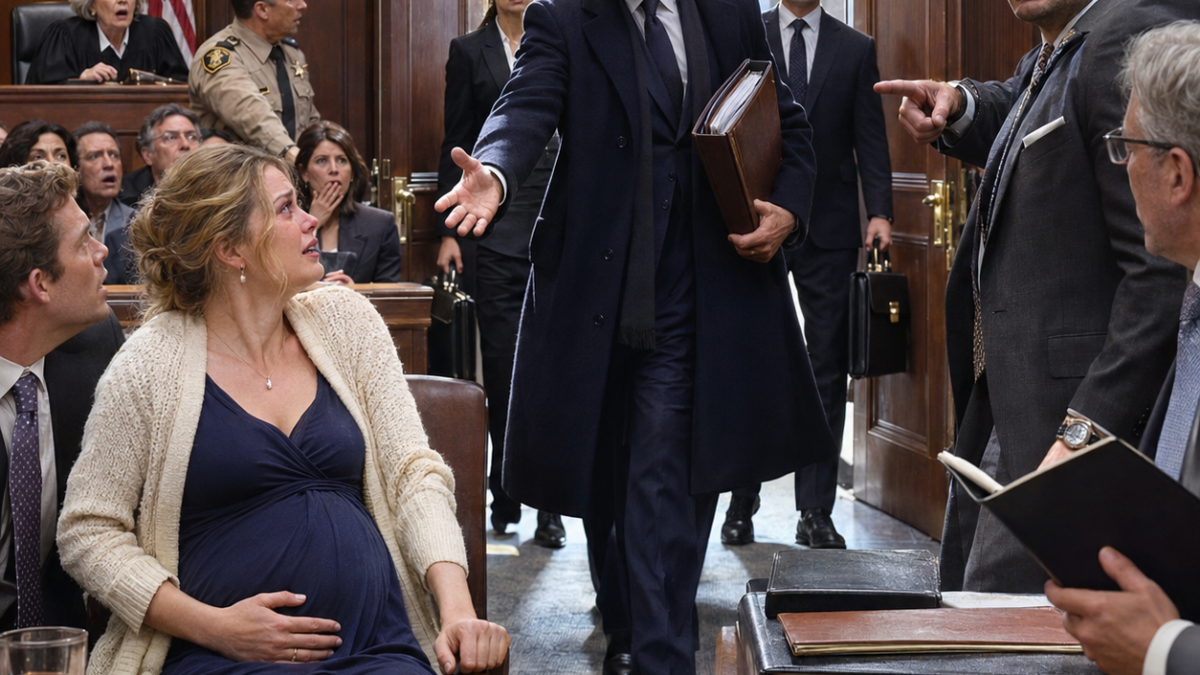
Then something slammed against the rear wall.
BANG.
Everybody turned.
The courtroom doors had opened hard enough to strike the stops.
The bailiff moved instinctively.
Then stopped.
A tall older man stood in the doorway.
Silver hair.
Dark charcoal suit.
A polished cane in one hand.
Two security professionals remained several steps behind him, while a group of attorneys entered more quietly.
I recognized him.
Everyone did.
Gregory Sterling.
Founder and chairman of Meridian Global.
Hotels.
Infrastructure.
Medical technology.
Freight.
Renewable energy.
A private company empire business magazines estimated in the billions.
His photograph appeared in airports and financial publications.
Why he had just walked into my divorce hearing made absolutely no sense.
Then he looked at me.
Not Preston.
Not the lawyers.
Me.
His expression changed.
Pain crossed his face.
Raw enough that for one second, he did not look powerful at all.
He looked old.
He walked toward me.
His cane struck the floor.
Once.
Twice.
Three times.
Preston recovered first.
“Mr. Sterling?”
Gregory stopped between us.
Preston forced a smile.
“There must be some confusion.”
Gregory finally looked at him.
“Apparently there has been a great deal of confusion.”
His voice was low.
Controlled.
Then he turned back to me.
My heart began pounding.
I had never met this man.
I was certain.
Gregory’s eyes filled.
And he said:
“My daughter and my grandchild will never have to worry about money again.”
PART2
Nobody spoke.
I honestly thought I had misunderstood him.
I looked behind me.
No one.
Then back.
“Excuse me?”
Gregory swallowed.
His hand tightened around his cane.
“I’m sorry.”
I stared.
“I think you have the wrong person.”
“No.”
One of his attorneys stepped forward.
A woman in her fifties with gray-blond hair and a leather portfolio.
“My name is Margaret Sloan. I represent Mr. Sterling personally.”
She placed a folder on Nora’s table.
Not Preston’s.
Mine.
Nora immediately put one hand over it.
“Before my client reviews anything, I’d like to know exactly what this is.”
Margaret nodded.
“Of course.”
Professional.
Calm.
No theatrical dossier.
No public reveal for entertainment.
“This contains the results of a court-authorized records investigation, archived hospital documentation, adoption records that became available through lawful proceedings, and two independent DNA reports.”
My hearing sharpened on one word.
“DNA?”
Gregory looked at me.
“Tessa.”
His voice cracked.
“I have been looking for you for twenty-three years.”
The room moved.
Not literally.
It felt that way.
I gripped the back of a chair.
“No.”
Gregory stopped himself from approaching.
Good.
Some part of him understood that I did not belong to him just because he had walked into a courtroom with evidence.
“I know.”
He said it quietly.
“I know how impossible this sounds.”
Preston laughed.
Not because it was funny.
Because panic sometimes sounds like laughter.
“This is ridiculous.”
Gregory ignored him.
I looked toward Nora.
She had opened the folder.
Her eyes moved rapidly.
Page.
Page.
Another page.
Then she looked at me differently.
“Tessa.”
“What?”
“We should speak privately.”
That frightened me more than Gregory’s announcement.
“Is it real?”
Nora hesitated.
“I need time to review it.”
“Is it real?”
Margaret answered carefully.
“The DNA testing indicates a greater than 99.9 percent probability that Mr. Sterling is your biological father.”
I stopped breathing.
No.
I had spent twenty-four years without a father.
Without a mother.
Without anybody who could be described as mine.
I had been born Theresa Morgan according to the state records.
Mother listed as Leah Morgan.
Father blank.
Leah died of an overdose when I was fourteen months old.
That was what I had been told.
No relatives came.
No grandparents.
No aunt.
No father.
Foster placement.
Then another.
Then another.
At seven, I lived with a couple who locked cereal in their bedroom because they believed children ate too much.
At eleven, I lived with a woman who returned my birthday presents to stores for cash.
At fifteen, I spent eight months in a group home.
At eighteen, a caseworker gave me two trash bags, a list of transitional programs, and a hug.
That was family.
And now a billionaire was standing in front of me claiming he had been searching since I was one.
Anger arrived before hope.
It came so fast it frightened me.
“Where were you?”
Gregory’s face crumpled.
Preston shifted uncomfortably.
Everyone else disappeared.
I stepped toward Gregory.
“Twenty-three years.”
“I know.”
“Where were you?”
His voice broke.
“I didn’t know where you were.”
“You’re Gregory Sterling.”
My laugh sounded ugly.
“You can find companies on three continents.”
“I know.”
“You can buy hotels.”
“I know.”
“But you couldn’t find one little girl?”
“Tessa—”
“Don’t call me that like you know me.”
He stopped.
Good.
Tears stood in his eyes.
“You’re right.”
That answer disarmed me.
Not enough.
But a little.
“I don’t know you.”
His voice shook.
“I know facts.”
“Dates.”
“Photographs.”
“Records.”
“I know you won a county art prize at twelve.”
My chest tightened.
“I know you worked two jobs after leaving foster care.”
“How?”
“Investigators.”
“That’s creepy.”
“Yes.”
He closed his eyes briefly.
“It probably is.”
“I know that now.”
His honesty made me angrier because I could not dismiss him as easily.
“I know those things.”
He continued.
“But I don’t know what coffee you drink.”
“I don’t know what makes you laugh.”
“I don’t know what you needed when you were seven.”
His voice failed.
“And I should have.”
The entire courtroom had gone silent.
Then Preston stepped in.
“This is touching.”
I turned toward him.
He smiled too broadly.
“But we’re done here.”
Gregory looked at him.
“No.”
Preston’s smile faltered.
“The divorce ruling has been made.”
Gregory’s expression became cold.
“I did not come to reverse your divorce ruling.”
That was important.
I looked at Gregory.
He continued.
“I came because my attorneys learned yesterday that my daughter was being removed from her residence today while heavily pregnant.”
My daughter.
Still too strange.
“And because certain documents connected to that residence and Mr. Hale’s company contain representations my counsel believes deserve closer examination.”
Preston went still.
Bianca stopped smiling.
Nora looked at Margaret.
“What documents?”
Margaret opened a second folder.
“A separate matter.”
Preston’s attorney stood.
“If you intend to make accusations—”
Margaret turned.
“I intend to make none without evidence.”
Then she looked toward Nora.
“But your client’s prenuptial agreement may not be the only contract relevant to the property Mr. Hale just retained.”
Preston’s face changed.
Very slightly.
Enough.
I saw it.
And for the first time that morning, I wondered whether Preston was afraid.
Judge Whitmore had already left the bench, so nobody was reopening anything that minute.
The bailiff finally cleared the courtroom.
Nora took me into a private conference room.
Gregory did not follow.
I noticed.
He waited outside.
Margaret came in only after Nora agreed.
I sat.
My hands shook.
The baby moved again.
Nora looked at me.
“First things first.”
“What?”
“The ruling this morning does not mean Preston has no financial obligations to your child.”
I blinked.
“What?”
“The prenup addressed spousal support and property rights.”
She spoke slowly.
“Child support is a separate issue governed by the child’s rights and applicable law. He does not get to sign away a child’s support before birth through a prenuptial agreement.”
I stared at her.
“Then why did he say—”
“Because Preston says many things.”
Nora’s voice sharpened.
“You are not going to be homeless because a judge ordered you out of that residence today.”
I looked down.
“I don’t have anywhere else.”
“You do now.”
Margaret said it gently.
I looked at her.
“Mr. Sterling owns a furnished residence ten minutes from your hospital.”
“No.”
Margaret stopped.
“I don’t want his house.”
“Okay.”
She did not argue.
That surprised me.
Nora said:
“I have a short-term rental arrangement through a client assistance network.”
“I can pay for a hotel.”
“With what?”
I opened my mouth.
Closed it.
My personal account had $2,840.
Preston had closed the joint credit cards after I filed.
The court had just ruled most major property separate.
Three weeks of hotel plus a newborn could erase what I had.
Nora leaned closer.
“Tessa.”
“There is no prize for suffering inefficiently.”
I almost laughed.
Margaret slid a business card toward Nora.
“Mr. Sterling is prepared to place funds in escrow for Tessa’s immediate living, medical, and legal expenses without requiring her to meet him, speak with him, change her name, or acknowledge any relationship.”
I stared.
“That sounds like buying me.”
Margaret nodded.
“It could.”
Her answer surprised me.
“That is why he asked me to make the offer through your attorney rather than directly.”
“What does he want?”
“Nothing today.”
“Nobody wants nothing.”
Margaret’s expression softened.
“He wants a chance.”
“There it is.”
“Eventually.”
She nodded.
“But he understands he may not get one.”
I looked away.
My whole life had taught me people gave things because they expected access.
Food meant gratitude.
A bed meant obedience.
Marriage meant dependence.
Now a man with billions was saying he would help whether I loved him or not.
I did not know how to process that.
So I changed subjects.
“What did you mean about Preston’s company?”
Margaret glanced at Nora.
Nora nodded.
Margaret opened the second folder.
“Mr. Sterling’s family office invested in a predecessor company connected to Hale Meridian Systems five years ago.”
Preston had told me his company was self-funded.
Built from nothing.
I almost laughed.
“Of course.”
Margaret continued.
“The investment was indirect.”
“Through a venture fund.”
“Mr. Sterling was not personally involved at the time.”
“But during our investigation into your identity, we reviewed public and private records lawfully available to the Sterling entities.”
She turned a page.
“We discovered a licensing arrangement involving intellectual property originally held by a Meridian Global subsidiary.”
I stared.
“What does that mean?”
“It means Mr. Hale’s company depends heavily on technology it does not own outright.”
Nora looked sharply at her.
“Is the license terminable?”
“Under certain conditions.”
Preston’s voice echoed in my head.
By the end of the week you’ll be begging.
Margaret continued.
“We are not threatening termination as retaliation for a divorce.”
Important.
“However, we discovered representations made during a financing round that may have overstated Hale Meridian’s ownership rights.”
I knew enough from three years married to Preston to understand the danger.
Investors hate uncertainty.
Lenders hate misrepresentation.
Boards hate surprise.
“You think he lied?”
“We think his documents need review.”
Margaret closed the folder.
“And Mr. Sterling has directed his companies not to conceal problems merely because the person involved happens to be your husband.”
That was colder than revenge.
It was process.
Preston had spent years surviving because people believed his version first.
For once, someone with more resources than him was going to read the paperwork.
Then Margaret opened the folder about me.
Photographs.
Records.
A hospital bracelet copy.
A woman.
Young.
Dark-haired.
Smiling at somebody outside the frame.
My mother.
Biological mother.
Leah Morgan.
I had one photograph of her from childhood.
A photocopy a caseworker gave me.
In that one, she looked exhausted.
This woman looked alive.
My hand shook.
“How did she know Gregory?”
Margaret looked toward the door.
“He would prefer to tell you himself.”
I almost refused.
Then looked at the photograph again.
“Five minutes.”
Gregory entered alone.
No cane this time.
He had left it outside.
I noticed that too.
He sat across from me.
Not beside.
“Tessa.”
I said nothing.
He corrected himself.
“Ms. Hale.”
That hurt strangely.
“Tell me.”
He nodded.
“Your mother’s name was Leah Morgan.”
“I know.”
“She worked for Meridian before it was Meridian.”
I frowned.
“At the original freight company.”
Gregory smiled sadly.
“I was thirty.”
“Married?”
“No.”
“Engaged?”
He looked down.
“Yes.”
There it was.
A rich man.
Young employee.
Pregnancy hidden.
I felt myself harden.
“Did you abandon her?”
“No.”
“Be careful.”
His eyes lifted.
“I loved her.”
The answer came without hesitation.
“I was also a coward.”
Better.
“Her pregnancy became known to my father.”
“Your father?”
“Charles Sterling.”
I knew the name.
Old money.
Industrialist.
Dead almost fifteen years.
Gregory’s jaw tightened.
“My father believed Leah was trying to trap me.”
“Was she?”
“No.”
“He offered her money.”
“She refused.”
“He threatened her job.”
My stomach turned.
“What did you do?”
“I fought him.”
Gregory looked ashamed.
“Badly.”
“What does that mean?”
“I told myself I was protecting Leah by keeping her away from him while I found a solution.”
“Meaning?”
“I arranged an apartment for her in another city.”
“She was seven months pregnant.”
“I planned to join her.”
“Did you?”
“No.”
“Why?”
“My father suffered a stroke.”
I laughed bitterly.
“There’s always something.”
“Yes.”
He did not defend himself.
“There is.”
He swallowed.
“I stayed forty-eight hours.”
“By the time I reached the apartment, Leah was gone.”
“Gone where?”
“I didn’t know.”
“She left a note.”
“What did it say?”
Gregory’s face tightened.
“That she would not raise her child as somebody’s shame.”
I looked away.
That sounded like a woman I wished I had known.
“I searched.”
“How?”
“Private investigators.”
“Police?”
“She was an adult.”
“No crime.”
“No missing-person status.”
“Her name was common.”
“She used cash.”
“Then?”
“Your birth record initially listed Theresa Morgan.”
“Yes.”
“I found that.”
“Why didn’t you find me?”
His eyes filled.
“Because two weeks after you were born, Leah used a different last name when she entered a residential recovery program.”
My chest tightened.
“Recovery.”
“She had addiction problems before she met me.”
I knew that much.
“She relapsed after the birth.”
Gregory’s voice shook.
“She left you temporarily with a friend.”
“That friend later surrendered you to county services under the belief Leah was your only parent.”
“And you?”
“I did not know.”
He looked at his hands.
“By the time my investigators located Leah again, she had died.”
“When?”
“I was almost two.”
I knew.
Overdose.
“I found the county.”
Gregory continued.
“But your file had been moved after placement.”
“Then another jurisdiction.”
“Then sealed under child-protection rules.”
“Are you telling me billionaire money couldn’t get through sealed records?”
“I’m telling you it shouldn’t have.”
That answer surprised me.
“My lawyers told me what I could do legally.”
“I did that.”
“I also did things I’m ashamed of.”
“Like?”
“Paid investigators to follow leads that should have been left private.”
“Pressure people.”
“Offer money.”
“Did you find me?”
“No.”
His voice broke.
“I found dozens of girls who were not you.”
He looked at me.
“One of them spent a weekend believing I might be her father.”
“I will regret that until I die.”
The anger inside me shifted.
Not gone.
Changed.
“When did you find me?”
“Six weeks ago.”
I stared.
“What?”
“Why didn’t you come?”
Gregory looked toward Nora.
“Because the first DNA comparison was indirect.”
“How did you get my DNA?”
My body went cold.
Margaret answered immediately.
“A genealogy database match through a relative of yours, not through covert collection.”
I relaxed slightly.
Gregory continued.
“It suggested the connection.”
“I refused to approach until we had a lawful basis and confirmation.”
“How did you confirm?”
“Your mother had stored medical samples from childbirth.”
Margaret explained:
“Preserved pathology samples associated with Leah’s care were still held under archival protocols. Court approval was obtained for limited testing after the preliminary genealogical match.”
I stared.
“You tested dead tissue to find me.”
Gregory flinched.
“Yes.”
Then:
“When that established Leah’s connection to the Sterling family line, we approached your attorney.”
Nora nodded.
“They contacted me yesterday.”
I turned on her.
“You knew?”
“For less than twenty-four hours.”
“And you didn’t tell me?”
“I was trying to verify before dropping a biological father into your life on the morning of your divorce hearing.”
Fair.
Still infuriating.
Gregory said quietly:
“Then this morning, Margaret learned what was happening here.”
“So you stormed into court.”
His mouth tightened.
“Yes.”
“That was dramatic.”
“Yes.”
“Stupid.”
“Probably.”
Despite myself, I almost smiled.
He noticed.
Did not exploit it.
Good.
I left the courthouse through a side entrance.
Gregory did not ask me to go with him.
Margaret gave Nora the escrow documents.
I refused to sign anything that day.
Nora arranged a furnished two-bedroom apartment through a professional housing service.
I paid the first week from my own money because pride is not always intelligent.
Then I went back to Preston’s house to collect my things.
Not our house anymore.
Legally, perhaps it had never been.
Preston arrived before I finished.
Bianca came with him.
Of course.
She walked into the bedroom while I was packing.
Looked at my suitcase.
Then at my stomach.
“I didn’t know he was going to say that to you.”
I stared.
“What?”
“At court.”
“Which part?”
Her face reddened.
“The baby.”
I laughed without humor.
“You’re pregnant with his baby too.”
She looked away.
That was the first crack I saw.
Not remorse.
Fear.
Preston appeared behind her.
“What are you doing upstairs?”
“Collecting my clothes.”
“The judge said personal effects.”
“Yes.”
“This furniture stays.”
I looked at the dresser.
“Congratulations.”
His expression tightened.
“You think Sterling changes everything.”
“No.”
I folded another sweater.
“I think he changes some things.”
Preston stepped closer.
“You have no idea what kind of man Gregory Sterling is.”
“And you do?”
“Men like him don’t find daughters after twenty-four years because they suddenly grow hearts.”
Bianca looked at Preston.
I noticed.
He continued.
“He wants something.”
“Maybe.”
“You should ask yourself what.”
“I am.”
I zipped the suitcase.
“But at least I’m asking now.”
That irritated him.
“Meaning?”
“Meaning I stopped believing men simply because they sounded certain.”
His face hardened.
I lifted my suitcase.
The baby kicked again.
Preston stared at my stomach.
For one second, something human crossed his face.
Then disappeared.
“When she’s born, I want a paternity test.”
I stopped.
Nora had warned me he might do this.
“Fine.”
That startled him.
“You’re not going to fight me?”
“No.”
“You know she’s yours.”
His jaw tightened.
“Then the test will show that.”
I walked past him.
At the bedroom door, I stopped.
“Preston?”
He turned.
“You were right about one thing.”
“What?”
“I did have nothing before you.”
His smugness began returning.
Then I finished.
“And I survived.”
The smile vanished.
I left.
The apartment was small.
Not poor.
Not luxurious.
Ordinary.
I loved it immediately.
Two bedrooms.
White walls.
A balcony overlooking a parking garage.
A refrigerator that hummed too loudly.
I sat on the floor that first night because I had not yet unpacked the folding chair Nora’s assistant brought.
Then I cried.
Not because I had lost the mansion.
I had never loved that house.
I cried because for three years, I had allowed Preston to convince me that dependence was proof of love.
I met him when I was twenty.
I had aged out of foster care two years earlier.
I worked reception at a dental office in the morning and took bookkeeping classes at night.
Preston was twenty-eight.
He came in for an emergency crown.
Charming.
Funny.
He tipped the receptionist.
Remembered my name.
Sent lunch to the office.
No man had ever pursued me like that.
No family had ever chosen me.
So when Preston said:
“I want you safe.”
I heard:
I want you.
When he said:
“You don’t need to work once we’re married.”
I heard:
I will never abandon you.
When his attorney put a prenup in front of me two weeks before the wedding, I barely read it.
The attorney said:
“Mr. Hale has substantial preexisting business interests.”
Preston squeezed my hand.
“It’s just paperwork.”
I signed.
Nobody insisted I have independent counsel.
That issue would later matter.
But at twenty-one, I did not need a lawyer.
I had love.
Or so I thought.
Two days after the hearing, Gregory asked through Nora whether I would meet him.
I said no.
He sent nothing.
No flowers.
No letters.
No guilt.
A week passed.
Then he asked again.
I said yes.
Public restaurant.
Lunch.
No security sitting beside us.
He agreed.
When Gregory arrived, he wore no tie.
He looked nervous.
Billionaires apparently sweat.
That helped.
We sat.
Neither knew how to begin.
Finally he said:
“I brought you something.”
I stiffened.
He immediately corrected himself.
“Not money.”
He slid an envelope across the table.
I opened it.
Photographs.
Leah.
Pregnant.
Laughing.
Leah beside an old truck.
Leah sitting on a dock.
Gregory younger.
Not billionaire Gregory.
Just a skinny man with terrible hair.
One photograph showed him kneeling beside Leah, one hand against her stomach.
I stared.
“You knew I was a girl?”
“Yes.”
“What did she want to name me?”
His eyes filled.
“Tessa.”
My breath stopped.
“What?”
“She hated Theresa.”
I stared at him.
My foster records said Theresa until I was six.
I had started insisting teachers call me Tessa because I hated the full name.
Nobody told me Leah had used it.
Gregory smiled through tears.
“She said Theresa sounded like somebody’s aunt who collected porcelain dolls.”
I laughed.
I did not mean to.
It escaped.
Gregory laughed too.
Then covered his mouth.
For thirty seconds, we were not billionaire and abandoned daughter.
We were two people who knew the same dead woman differently.
That frightened me more than anger.
Because connection creates risk.
I asked him about his family.
His father was dead.
His mother had died years earlier.
Gregory had married once.
No children.
Divorced after four years.
“You never tried again?”
“No.”
“Because of Leah?”
“Partly.”
“Because of me?”
He looked down.
“Partly.”
I hated the weight of that.
“Don’t make your life my responsibility.”
His eyes lifted.
“I won’t.”
Good answer.
Then I asked:
“Why Meridian?”
He smiled faintly.
“Leah chose the name.”
That startled me.
“What?”
“The original company was Sterling Freight Holdings.”
“Terrible name.”
“Yes.”
“She said if I ever turned it into something bigger, I needed a name that didn’t sound like a warehouse full of men named Charles.”
I laughed again.
“Meridian?”
“She liked maps.”
The company I had seen on towers, hotels, shipping containers, medical devices—
named partly by my mother.
I looked out the window before Gregory could see my tears.
That afternoon, he asked whether I needed anything.
“No.”
He nodded.
Then:
“May I ask one question?”
“What?”
“Are you eating enough?”
I stared.
Of all the things.
Not the apartment.
Money.
Lawyers.
Food.
I almost cried.
“I’m pregnant.”
“I eat constantly.”
He smiled.
“Good.”
Then we separated.
He did not ask for a hug.
That helped more than he knew.
The divorce case did not end with the first hearing.
Nora filed motions challenging several provisions of the prenup.
Not because Gregory demanded it.
Because new facts and closer review justified it.
At the time I signed, I had no independent attorney.
The agreement had been presented shortly before the wedding.
There were questions about financial disclosure.
Those issues did not automatically make it invalid.
But they created arguments worth presenting.
More importantly, documents from Hale Meridian Systems raised another problem.
I had worked for the company.
Preston liked telling people I “never had a career.”
Not true.
After we married, I spent nearly two years doing bookkeeping, vendor reconciliation, and operations support for Hale Meridian.
Unpaid.
“Helping my husband.”
Emails showed me resolving accounts.
Reviewing contracts.
Building the client-tracking system.
Coordinating two office moves.
Preston had described it during divorce discovery as “occasional spousal assistance.”
Nora stared at the emails.
“Occasional?”
There were thousands.
My name appeared everywhere.
I had worked.
I simply had not been paid.
Again.
A different kind of foster home.
A different lock on the cereal cabinet.
Meanwhile, Meridian Global’s separate review of Hale Meridian’s technology license uncovered serious problems.
Preston had represented certain software modules as wholly owned by his company during a financing round.
They were not.
They were derivatives of licensed technology subject to restrictions.
No one destroyed his company overnight.
No billionaire snapped his fingers.
Reality is not that satisfying.
Instead, auditors came.
Then outside counsel.
Then investors asked questions.
One lender delayed financing.
Preston’s board formed a special committee.
And suddenly the man who had told me I could not survive without his money was spending every day proving to other people that his company could survive his decisions.
I did not celebrate.
At least not initially.
Then Nora showed me one email.
Preston to his CFO.
Written eight months earlier.
If Tessa ever leaves, scrub her access trail. We don’t need her claiming she built any of this.
I read it twice.
My hands went cold.
He had been preparing for divorce before I knew Bianca existed.
He had known I worked.
He had planned to erase it.
That one hurt worse than the affair.
Bianca called me three weeks later.
I almost did not answer.
Then curiosity won.
“Tessa?”
“Yes.”
“It’s Bianca.”
“I know.”
Silence.
Then:
“I need to ask you something.”
“No.”
She paused.
“I haven’t asked yet.”
“I know.”
“Tessa, please.”
I should have hung up.
Instead, I said:
“One question.”
“Did Preston ever ask you to sign something without letting you read it?”
My body changed.
Every instinct sharpened.
“Why?”
She started crying.
I closed my eyes.
Of course.
“What did he give you?”
“An employment amendment.”
“Did you sign it?”
“Yes.”
“What else?”
“I don’t know.”
“Bianca.”
“He said it was because we’re having a baby.”
My anger shifted.
Not toward her.
Not exactly.
“Get a lawyer.”
“I can’t afford—”
“Get one anyway.”
“He says you’re trying to destroy him.”
“I am divorcing him.”
“There’s a difference.”
She was silent.
Then whispered:
“He said the same things about you.”
“What things?”
“That you were unstable.”
“Ungrateful.”
“Obsessed with money.”
I almost laughed.
Of course.
“He said you stopped being a wife after you got pregnant.”
I touched my stomach.
“That’s when he began sleeping with you?”
She cried harder.
“I’m sorry.”
For months I had imagined this moment.
Bianca apologizing.
Me destroying her.
Telling her she deserved whatever came.
Instead, I heard a pregnant woman realizing the man who chose her had used the same script before.
“Get a lawyer, Bianca.”
Then I hung up.
Gregory found out because I told him.
Our third lunch.
By then I had agreed to call him Gregory instead of Mr. Sterling.
Not Dad.
Not even close.
He listened.
Then said:
“Do you want my legal team to help her?”
“No.”
Immediate.
He nodded.
“Okay.”
I stared.
“You’re not going to tell me I should be generous?”
“No.”
“Why?”
“Because you spent your life being told what a good girl should tolerate in exchange for shelter.”
The sentence hit me hard.
Gregory looked uncomfortable.
“Margaret explained foster-care dynamics to me.”
“I asked her to.”
I looked away.
Then asked:
“Can you give Bianca the name of an independent attorney?”
“Yes.”
“Without saying it came from me?”
“Yes.”
That was enough.
I was not ready to forgive Bianca.
But I did not want Preston’s second pregnant partner signing blind documents because nobody warned her.
Pain did not need to multiply to prove mine was real.
My daughter was born six weeks after the first hearing.
Three weeks early.
Labor began at 2:14 in the morning.
I called Nora first.
Because apparently divorce attorneys become emergency contacts when your life becomes absurd.
She shouted:
“Call the hospital!”
Then Gregory.
I hesitated.
The contraction answered for me.
I called.
He picked up on the first ring.
“Tessa?”
“I think the baby is coming.”
Silence.
Then chaos.
“What hospital?”
“I know the hospital.”
“I’m not asking you—”
Another contraction.
I nearly dropped the phone.
Gregory’s voice changed.
Calm.
“Breathe.”
“Don’t tell me to breathe.”
“Right.”
“Terrible advice.”
I laughed and cried.
He stayed on the phone while I waited for a rideshare because I refused to call an ambulance until Nora threatened to have one sent herself.
Gregory reached the hospital before I did.
Of course.
He was standing outside the emergency entrance when the ambulance arrived.
He started toward me.
Then stopped.
“Can I?”
I nodded.
One word.
Permission.
He took my hand.
Preston came two hours later.
His attorney probably told him not to miss the birth.
He entered the labor room with flowers.
I stared.
“No.”
He stopped.
“Tessa.”
“No.”
“This is my child.”
“Yes.”
“You do not get to make me emotionally manage you while I’m in labor.”
His face tightened.
The nurse looked ready to remove him.
I continued.
“You can receive appropriate medical updates and see your child according to hospital rules after she is born.”
“But you are not standing beside my bed.”
Preston glanced at Gregory.
Gregory said nothing.
That was important.
This was my room.
Not his battle.
Preston looked toward me again.
“You’re letting him stay?”
I gripped Gregory’s hand through another contraction.
“Yes.”
Preston’s face changed.
Not jealousy exactly.
Something more primitive.
Replacement.
He had always believed family roles were property.
Husband.
Father.
Provider.
Owner.
Now he saw another man standing in a space he had abandoned long before physically leaving.
“You’re doing this to punish me.”
“No.”
I breathed.
“I’m doing it because he asked permission.”
The nurse escorted Preston out.
My daughter was born at 9:42 a.m.
Six pounds, one ounce.
Black hair.
Furious lungs.
Perfect.
When they placed her against my chest, I stopped understanding language.
Everything became warmth.
Skin.
Crying.
Her tiny mouth.
Her fist beneath my collarbone.
I sobbed.
Not delicate tears.
Years.
Every foster placement.
Every goodbye.
Every time someone told me not to get attached.
Every locked cabinet.
Every birthday nobody remembered.
Every promise Preston made.
Every lie.
And now this little person belonged to herself but had come through me.
My family.
Not because a court assigned her.
Not because a man allowed it.
Because she was here.
I whispered:
“Hi, Amelia.”
I had chosen the name months earlier.
Amelia Leah Morgan.
Not Hale.
Morgan.
My mother’s name returned through her.
Gregory stood near the wall.
Crying silently.
I looked at him.
For a moment, I saw the thirty-year-old man in the old photograph.
The one with his hand on Leah’s pregnant stomach.
Twenty-four years late.
Maybe more.
I whispered:
“Come here.”
He froze.
“Me?”
“No, the anesthesiologist.”
The nurse laughed.
Gregory approached.
I shifted Amelia slightly.
“Your granddaughter.”
He covered his mouth.
Then stopped.
“Can I touch her?”
That question.
Always asking.
I nodded.
One finger touched Amelia’s tiny hand.
She closed her fist around it.
Gregory broke.
He bent his head and sobbed.
I cried too.
Not because twenty-four lost years had disappeared.
They had not.
Nothing erases childhood.
But for the first time, I understood that finding someone late is not the same as never being found.
Preston met Amelia later that afternoon.
Supervised only by normal hospital procedure.
No drama.
He stood beside the bassinet.
His face softened.
For several seconds, I saw the man I once loved.
“She looks like you.”
He whispered.
“Maybe.”
He touched one tiny foot.
Then looked at me.
“Did you really give her Morgan?”
“Yes.”
His face tightened.
“She’s my daughter.”
“Yes.”
“Why not Hale?”
“Because that is the name I wanted her to have.”
He started to argue.
Then stopped.
Maybe because of the nurse.
Maybe because he finally understood I was done asking permission.
The paternity test later confirmed what both of us already knew.
Preston was Amelia’s father.
Which meant support obligations became formal.
The man who had said your bastard baby now had a court order reminding him that fatherhood did not disappear when affection did.
Bianca gave birth seven weeks later.
A boy.
I learned through Nora because Preston requested a scheduling adjustment for one hearing.
I sent nothing.
No gift.
No congratulations.
Some boundaries do not need cruelty.
They just need distance.
Then Bianca’s attorney contacted Nora.
She had left Preston.
The employment amendment she signed included a broad confidentiality clause and provisions attempting to assign rights to work product beyond what she understood.
Her attorney was challenging it.
More importantly, Bianca had emails.
Lots of them.
Including messages Preston sent discussing me.
One read:
Once the baby is here, Tessa won’t leave. Girls like her don’t walk away from houses this big.
Another:
If she does, the prenup wipes her out.
Another:
She has no family and no career left. She’ll cave.
I read those words while holding Amelia.
My daughter slept against my chest.
Something inside me finally detached.
I had spent months asking when Preston stopped loving me.
Wrong question.
Maybe he had loved me in the way he understood love.
But he had also selected my vulnerabilities.
Orphan.
Young.
Poor.
No independent counsel.
No family.
Then gradually removed the parts that made leaving possible.
Career.
Income.
Professional network.
Financial knowledge.
He called that protection.
Wendell had called control discipline in another story; Preston called it provision.
The costumes change.
The mechanism often doesn’t.
The divorce litigation changed after Bianca’s evidence and the employment records.
Judge Whitmore did not suddenly hand me Preston’s entire company.
That would have been fantasy.
But the earlier ruling was not the final end of every issue.
The court reconsidered specific matters after additional evidence and motions.
The prenup survived in part.
Failed in part.
Certain separate property remained Preston’s.
But Nora successfully established that my labor contributions and several financial representations required accounting.
A settlement became more attractive to Preston’s attorneys.
Especially because the company was already under investor scrutiny.
Preston did not want more internal records exposed through extended litigation.
Negotiations began.
He offered one million.
I nearly fell off my chair.
Nora said:
“No.”
I stared at her.
After the meeting:
“Why did you say no?”
“Because his first offer is not philanthropy.”
“I could live on that.”
“You are not negotiating only for survival anymore.”
That sentence changed something.
Foster children learn to accept enough.
Enough food.
Enough safety.
Enough attention.
Enough money to avoid homelessness.
Nora was teaching me to evaluate value instead of desperation.
We did not demand revenge numbers.
We documented labor.
Financial contributions.
Contract issues.
Legal risk.
Child-related obligations separately.
The final settlement took months.
I received $2.8 million in combined property and compensation terms, plus separate court-ordered child support calculated under the applicable framework and Preston’s income, with additional provisions for Amelia’s health and educational expenses.
Preston retained his company interests.
The house.
Most of what he had entered the marriage owning.
I left without his empire.
But not with nothing.
More importantly—
I left with my name on every dollar I received.
Then came the company.
Hale Meridian’s board investigation concluded that Preston had materially overstated ownership of certain licensed intellectual property during financing discussions.
He was not marched from the building in handcuffs.
No dramatic collapse.
But he lost something almost as important to him.
Control.
The board placed him on leave.
Then negotiated his resignation as CEO.
He retained shares.
He remained wealthy.
That mattered.
I did not need Preston living under a bridge to feel justice.
I needed the world to stop rewarding the exact behavior he used against me.
He had treated certainty like truth.
For years, it worked.
Then people read the documents.
He asked to meet me after his resignation.
I almost said no.
Then agreed.
Public park.
Daylight.
No Amelia.
He arrived without a suit.
Jeans.
Gray sweater.
He looked younger.
And older.
Less armored.
We sat on opposite ends of a bench.
For a while neither spoke.
Then:
“I lost the company.”
“No.”
I looked toward him.
“You lost the CEO position.”
His mouth tightened.
“Is that what Sterling told you?”
“No.”
“I read.”
That bothered him more.
I continued.
“You still have money.”
“Stock.”
“Options.”
“Probably more money than most people see in their entire lives.”
Preston stared at the ground.
“You sound like a lawyer.”
“I spent a year around them.”
He almost smiled.
Then:
“Are you happy?”
I thought about the apartment.
Amelia.
Gregory.
Therapy.
The business course I had started.
“No.”
That surprised him.
“Not all the time.”
I continued.
“I’m peaceful more often.”
His eyes filled.
“Were you ever peaceful with me?”
The question was almost unfair.
“Yes.”
He looked up.
“At first.”
Silence.
Then I asked:
“Why did you marry me?”
He stared.
“Because I loved you.”
“Only that?”
His face tightened.
“What do you want me to say?”
“The truth.”
He rubbed his palms together.
“I liked that you needed me.”
There.
No billionaire entrance.
No courtroom.
No board investigation.
That sentence was the final verdict.
“I knew what to be with you.”
He continued.
“Provider.”
“Protector.”
“You looked at me like I could fix things.”
“And when I stopped needing that?”
“You didn’t.”
He laughed bitterly.
“I made sure you didn’t.”
His eyes filled.
“I know that now.”
I looked away.
“Bianca?”
He closed his eyes.
“I did it again.”
“Yes.”
“She left.”
“I know.”
“I wasn’t going to marry her.”
“That isn’t my problem.”
“I know.”
Then he whispered:
“I’m sorry about what I said about Amelia.”
My jaw tightened.
“Which time?”
“At court.”
“You called your unborn daughter a bastard because you wanted to hurt me.”
He nodded.
Tears fell.
“I know.”
“Do you?”
“Yes.”
I looked at him.
“You will never say anything like that around her.”
“I won’t.”
“You will never use money to make her afraid of losing you.”
His face crumpled.
“I won’t.”
“You will never make her earn your care.”
He covered his mouth.
“I won’t.”
I believed he meant it.
Whether he could live it was another question.
That would be his work.
Not mine.
Preston became a decent father slowly.
Not instantly.
At first, he treated custody schedules like corporate appointments.
Arrived exactly on time.
Sent overly formal updates.
Bought Amelia absurdly expensive things she could not use.
A cashmere blanket for a four-month-old.
I returned it.
He complained.
I said:
“She spits up.”
That ended the debate.
Therapy helped him.
I knew because eventually he stopped telling me about therapy.
People who are performing growth usually announce it.
People actually doing it become quieter.
He attended parenting classes voluntarily.
Learned to change diapers without acting like he deserved a medal.
Kept appointments.
When Amelia developed a fever at eighteen months, he called me and said:
“I’m scared.”
Not:
Fix it.
Not:
You need to do something.
Just truth.
“I know.”
We took her to the pediatrician together.
That was probably the first day I believed he might eventually become a father different from the husband he had been.
Not because I forgave him.
Because Amelia deserved the possibility.
Bianca and I met once.
Two years after everything.
Her son, Oliver, and Amelia were half-siblings.
Eventually that reality mattered more than our history.
We met at a children’s museum.
Awkward.
Terrible coffee.
Two toddlers ignoring adult trauma completely.
Oliver handed Amelia a plastic dinosaur.
She hit him with it.
Sibling bond established.
Bianca looked at me.
“I’m sorry.”
I had heard it before.
This time felt different.
“I know.”
She swallowed.
“I knew you were married.”
“Yes.”
“I let him tell me your marriage was over.”
“It wasn’t.”
“I know.”
She looked toward Oliver.
“I was wrong.”
I nodded.
I did not rescue her from the discomfort.
“I hated you.”
I said.
Her eyes filled.
“I know.”
“For a long time.”
“I understand.”
“Then I realized you got the same Preston after me.”
She laughed sadly.
“Maybe worse.”
“Not a competition.”
“No.”
We watched the children.
Finally she asked:
“Do you forgive me?”
I thought.
“I don’t want your life to go badly anymore.”
She looked at me.
“That’s the most honest answer I have.”
She nodded.
“I’ll take it.”
So did I.
Gregory and I took longer.
Money would have made it easy to fake closeness.
I refused.
For almost a year, I lived from the divorce settlement and my own income, not his personal transfers.
Yes.
My own income.
I went back to work.
Not for Hale Meridian.
Never again.
I finished the bookkeeping certification I abandoned after marrying Preston.
Then added courses in forensic accounting.
Nora laughed when I told her.
“Trauma career.”
“Maybe.”
“I spent years having men tell me paperwork meant whatever they said it meant.”
I shrugged.
“I got curious.”
Gregory offered me a role at Meridian.
I refused.
He looked disappointed.
Then said:
“Good.”
“What?”
“You shouldn’t work for me because I’m your father.”
I studied him.
“Were you testing me?”
“No.”
He smiled.
“But I’m proud of the answer.”
I hated how much I liked hearing that.
I joined a midsize forensic accounting firm.
Entry-level compared with Gregory’s world.
Perfect.
I worked.
Made mistakes.
Learned.
Built something nobody could claim had been handed to me.
Three years later, I became a senior investigator.
Five years later, I led a team specializing in financial coercion and contract irregularities affecting family-owned businesses.
Funny.
Or inevitable.
Gregory learned how to be in my life without buying it.
That was harder for him than writing checks.
At first he sent gifts.
Ridiculous gifts.
A stroller that cost more than my first car.
I sent it back.
A baby grand piano when Amelia was three.
I called him.
“She cannot read.”
“She might learn.”
“She is three.”
“I’ll return it.”
He did.
Eventually he learned.
Books.
Photographs.
Lunch.
Showing up.
He told Amelia stories about Leah.
Never made himself the hero.
That mattered.
On Amelia’s fourth birthday, he gave her a wooden box.
Inside was Leah’s old compass.
Cheap brass.
Scratched.
“She loved maps.”
Gregory told her.
Amelia asked:
“Was Grandma Leah an explorer?”
Gregory looked at me.
Then smiled.
“She wanted to be.”
Amelia held the compass all afternoon.
That gift mattered more than anything he could have bought.
He had finally learned that wealth and value were not synonyms.
I did eventually call him Dad.
Not in a dramatic hospital scene.
Not at Christmas.
Not after some grand sacrifice.
It happened on a Tuesday.
Amelia was six.
Gregory and I were in my kitchen.
My house.
Yes.
My house.
Not a mansion.
A three-bedroom brick home with a crooked maple tree and a mortgage I chose even though I could have paid cash.
I wanted normal payments.
Normal problems.
Gregory was trying to repair a cabinet hinge.
Badly.
Extremely badly.
I walked in.
“Dad, you’re making it worse.”
We both froze.
The screwdriver stopped in his hand.
I froze too.
Amelia looked up from the table.
“What?”
Neither of us answered.
Gregory’s eyes filled instantly.
I looked away.
“Don’t make it weird.”
His voice cracked.
“I wouldn’t dream of it.”
Then he bent over the cabinet so Amelia would not see him cry.
I saw.
I let him.
Gregory never got the twenty-three years back.
Neither did I.
That is important.
Finding biological family does not magically heal foster care.
Money does not retroactively provide birthday cakes.
DNA does not sit beside a terrified seven-year-old during her first night in another stranger’s house.
I went to therapy.
Years.
Still do sometimes.
I learned why Preston had felt so irresistible.
He offered certainty to a girl raised inside temporary arrangements.
He said:
Forever.
I never asked whether forever had conditions.
I learned why Gregory’s money initially frightened me.
Money had always been tied to control.
Foster stipends.
Household rules.
Preston.
Dependency.
It took years to believe someone could help without owning me.
Even now, I prefer contracts.
Clear terms.
Written consent.
Ironically, paperwork became comforting once I learned to read it.
The prenup that once terrified me remained in a box for years.
One afternoon, I took it out.
I read every page.
Slowly.
Not as the twenty-one-year-old girl signing because she wanted a wedding.
As a professional.
There were clauses I understood now.
Words I should have questioned.
Disclosure schedules.
Waivers.
Property definitions.
I did not blame my younger self.
That was new.
For years I wanted to shake her.
Why didn’t you get a lawyer?
Why did you quit work?
Why did you believe him?
Then I remembered.
She was twenty-one.
Had spent eighteen years learning that homes could disappear.
A man told her:
“I will take care of you forever.”
Of course she wanted to believe him.
Trusting was not her crime.
Exploiting it was his.
Judge Whitmore crossed paths with me years later at a legal-aid fundraiser.
I almost avoided her.
She recognized me.
“Ms. Morgan?”
I had legally returned to Morgan after the divorce.
“Yes.”
She smiled.
“How are you?”
“Good.”
Then I surprised both of us.
“I hated you for a while.”
Her expression remained calm.
“I imagined you might.”
“You left me with nothing.”
She shook her head.
“I ruled on the evidence and agreement before me that day.”
“I know.”
“I also remember what happened afterward.”
I nodded.
She continued.
“Courts see snapshots.”
Her voice softened.
“Lives continue outside them.”
I thought about that.
The first ruling had felt like the end.
It wasn’t.
Not legally.
Not personally.
One bad day can sound like a final sentence when you are sitting inside it.
Often it is only a paragraph.
Preston eventually rebuilt a career.
Not CEO.
Not billionaire.
Still rich.
Still smart.
Less publicly adored.
That may have been healthy for him.
He never recovered the legend he once believed about himself.
By then, he did not seem to want it.
When Amelia was eight, she had a school project.
MY FAMILY
She drew me.
Preston.
Gregory.
Bianca.
Oliver.
A dog I did not own.
Apparently artistic license.
Then she wrote one sentence beneath each person.
Under me:
MY MOM FINDS MISSING MONEY FOR WORK.
Reasonable.
Under Gregory:
MY GRANDPA HAS TOO MANY BUILDINGS.
Accurate.
Under Preston:
MY DAD USED TO BE A BOSS AND NOW HE HELPS COMPANIES.
I stared at that one.
No shame.
No scandal.
Just Dad.
Amelia did not need to inherit our war.
That might have been the greatest victory of all.
At ten, she asked why Preston and I divorced.
I had planned that conversation for years.
Every possible speech.
Then she asked while eating cereal.
“Why didn’t you stay married to Dad?”
I looked at her.
“Because we hurt each other.”
She frowned.
“Did he cheat?”
Children have the internet.
“Yes.”
“With Bianca?”
“Yes.”
She thought.
“That was bad.”
“Yes.”
“Do you hate her?”
“No.”
“Did you?”
“Yes.”
She nodded.
Then:
“Did Dad hurt you?”
“Yes.”
“Did you hurt Dad?”
Probably.
“Sometimes.”
“Then why are you nice now?”
I looked toward the cereal bowl.
“Because being angry forever would make you carry something that belongs to us.”
Amelia thought for almost ten seconds.
Then asked for more cereal.
That was enough.
Gregory retired from Meridian Global when Amelia was eleven.
He claimed it was time.
I suspected she had more to do with it.
He moved closer.
Not next door.
I threatened him.
Twenty minutes away.
Reasonable.
He spent mornings volunteering with an organization supporting older foster youth transitioning into adulthood.
The first time he told me, I felt something complicated.
“You don’t have to repay my childhood to strangers.”
“I know.”
“Do you?”
He looked at me.
“No.”
Then:
“I can’t repair yours.”
“But I can make one part of somebody else’s transition easier.”
That answer satisfied me.
He never put his name on the program.
I liked that even more.
The strangest full-circle moment came at Amelia’s high-school graduation.
Eighteen.
She walked across the stage.
Preston sat two seats from me.
Bianca on his other side because Oliver was also graduating from the same school the following year and she had become family-adjacent through sheer persistence.
Gregory sat beside me.
Older.
Cane again.
This time he actually needed it.
When Amelia’s name was called, every adult in our row stood.
Too loudly.
She looked toward us.
Mortified.
Perfect.
Afterward she hugged everyone.
Then Gregory.
He whispered something.
She cried.
Later I asked what he said.
Amelia shrugged.
“He said Grandma Leah would’ve liked my stubbornness.”
I laughed.
“She would.”
“How do you know?”
I looked at Gregory.
He answered.
“Because your mother inherited it honestly.”
That evening, Gregory sat on my porch.
Sun going down.
Amelia inside with friends.
Preston had already left.
Gregory looked tired.
“You know.”
“What?”
“The first time I saw you.”
I knew what he meant.
Courtroom.
“I thought if I walked in and solved everything, maybe you’d forgive me for being late.”
I smiled sadly.
“You were very dramatic.”
“Terribly.”
“Four lawyers?”
“Three.”
“Felt like twelve.”
He laughed.
Then became quiet.
“I thought money could bridge twenty-three years.”
“I know.”
“I was wrong.”
“Yes.”
He nodded.
“What did?”
I thought about the cabinet hinge.
Leah’s photographs.
The compass.
Hospital waiting rooms.
Lunches.
His ridiculous gifts being returned without sulking.
Years of asking before touching.
“Time.”
His eyes filled.
“Mostly time.”
He nodded.
That was the answer.
Gregory died when I was forty-nine.
Heart failure.
Not sudden.
We had time.
Enough to hate that it was happening.
Not enough to make it fair.
Amelia was twenty-five.
She sat beside his bed with her head on his shoulder.
I sat on the other side.
Gregory looked at me.
“Tessa.”
“Yes?”
“I’m sorry.”
I knew which apology.
The oldest one.
Twenty-three years.
“You’ve said it.”
“I know.”
“You don’t have to keep saying it.”
He smiled faintly.
“Father’s privilege.”
I laughed through tears.
“You abused privileges.”
“Frequently.”
Then he looked toward Amelia.
“My granddaughter.”
“She’s right there.”
“I know.”
His hand found mine.
“I spent half my life looking for family.”
His breathing was shallow.
“Then spent the other half learning family is not something you find.”
Tears ran down my face.
“What is it?”
“Something you keep showing up for.”
That was probably the wisest thing a billionaire ever told me.
He died the following morning.
Holding my hand.
His will made headlines.
Of course.
Meridian Global shares.
Foundation assets.
Property.
Trusts.
Reporters camped outside.
The woman who had once been called a charity case inherited wealth beyond anything I could have imagined at twenty-four.
But by then, money was no longer the surprising part.
Gregory left me a letter.
Handwritten.
Not lawyer language.
Tessa,
When I found you, I thought I was bringing you security.
You taught me that security without choice can become another cage.
I had to stop reading.
Then:
Do whatever you want with the money.
Keep it. Give it away. Build something. Build nothing.
It is not payment for childhood. No fortune can purchase the right to call lost years settled.
The only thing I hope you keep is the knowledge that I loved you before I knew how to find you, and I loved you much better after you taught me how to stay.
Dad
I cried harder at that letter than I had at the will reading.
I kept part of the inheritance.
Of course I did.
Pretending money cannot create safety would have been dishonest.
But most of Gregory’s personal stake eventually went into a foundation I created with Amelia.
The Leah Morgan Initiative.
Not the Sterling Foundation.
Leah.
We funded legal aid and financial education for young adults aging out of foster care.
Independent legal review for major contracts.
Housing assistance.
Job training.
Emergency support that did not require recipients to surrender control of their bank accounts or personal decisions.
The first rule I wrote for the program was simple:
Help must increase a person’s choices, not purchase obedience.
That sentence came from my entire life.
Foster homes.
Preston.
Gregory’s early mistakes.
My recovery.
Years after the divorce, Nora invited me to speak to a group of young women leaving foster care.
I hated public speaking outside work.
Still did it.
I told them part of my story.
Not the billionaire part first.
Because that was the least useful part.
I told them about signing a contract I did not understand.
Quitting work because someone promised forever.
Not knowing where my own financial records were.
Confusing being provided for with being secure.
Then one girl raised her hand.
Nineteen.
Bright purple braids.
“So your billionaire dad saved you?”
The room went quiet.
I smiled.
“No.”
She looked confused.
“He helped.”
“Absolutely.”
“His money mattered.”
“Lawyers mattered.”
“Timing mattered.”
“But he did not save me.”
“Who did?”
I thought.
“Nora.”
Nora laughed from the back.
I shook my head.
“No.”
“Not Nora either.”
Then I said:
“I had help.”
“A lot of it.”
“But the day I stopped believing that losing one man meant losing my entire life—that was when things changed.”
The girl nodded slowly.
“So the money wasn’t the ending?”
“No.”
I smiled.
“The money just made a very good courtroom entrance.”
Everyone laughed.
That was the truth.
People loved telling the story a certain way.
Pregnant orphan loses everything.
Cruel husband laughs.
Billionaire father bursts into court.
Husband turns pale.
Perfect viral ending.
Except life kept going after the doors opened.
The billionaire did not erase the prenup with a checkbook.
The judge did not reverse herself because a rich man entered the room.
Preston did not become poor overnight.
I did not wake up healed because DNA gave me a father.
Bianca did not instantly become my friend.
Gregory did not instantly become Dad.
And I did not become safe simply because money appeared.
Real endings take longer.
They involve paperwork.
Boundaries.
Employment.
Therapy.
Child-support schedules.
Forgiveness you do not owe.
Forgiveness you choose anyway.
People changing.
People failing to change.
Children growing up.
Parents getting old.
Showing up.
Again.
Again.
Again.
But if you want to know whether Preston’s sentence came true—
the one he whispered in court—
I can answer that.
“Let’s see how you and that baby survive without my money.”
We survived beautifully.
Not because Gregory Sterling was rich.
That helped.
I will never pretend otherwise.
But Amelia and I were already survivors before Gregory walked through those doors.
I had survived foster care.
Aging out.
Working two jobs.
Loneliness.
A marriage that turned security into dependence.
And Amelia entered the world fighting three weeks early and immediately screamed loudly enough to terrify a nurse.
We did not need Preston’s money to have worth.
We needed time to remember that.
Years later, Preston and I stood together at Amelia’s wedding.
Yes.
Her wedding.
She was twenty-eight.
Smart.
Stubborn.
Financially independent to an almost annoying degree.
Before marrying her partner, she hired her own attorney to review the prenuptial agreement they both wanted.
When she told me, I laughed.
“What?”
She asked.
“Nothing.”
“Mom.”
“I’m proud of you.”
“For prenup negotiations?”
“For having your own lawyer.”
She rolled her eyes.
Then hugged me.
At the wedding, Preston stood beside me before the ceremony.
Gray hair now.
Less arrogance.
More lines.
He looked at our daughter.
“She’s incredible.”
“Yes.”
“You did a good job.”
“We did.”
He looked surprised.
I meant it.
Whatever else Preston had been, he had become a father who showed up.
That mattered.
Not enough to rewrite our marriage.
Enough to honor reality.
He looked toward me.
“You know what I think about sometimes?”
“What?”
“The courthouse.”
I smiled.
“I try not to.”
“I was cruel.”
“Yes.”
“No argument?”
“You’re old enough for truth.”
He laughed softly.
Then his eyes filled.
“I really thought money was why you stayed.”
I looked at him.
“I thought money was why I couldn’t leave.”
We both went quiet.
Then he said:
“We were both wrong.”
“Yes.”
The music started.
Our daughter appeared.
Conversation over.
As it should be.
Some relationships do not need perfect closure.
They need enough peace to stand in the same room while someone you both love begins her own life.
After the wedding, Amelia found me alone on the terrace.
“Crying?”
“No.”
“Your mascara disagrees.”
She handed me a tissue.
Then leaned beside me.
“Grandpa would’ve been unbearable today.”
I laughed.
“He’d have bought the venue.”
“He would have tried.”
“I would have returned it.”
“I know.”
We looked toward the reception.
“You ever think about that court day?”
She asked.
“Sometimes.”
“Were you scared?”
“Yes.”
“How scared?”
I thought about twenty-four-year-old me.
Thirty-four weeks pregnant.
Two thousand eight hundred forty dollars.
No house.
No job.
No parents.
A husband calling my baby a bastard.
“More scared than I’ve ever been.”
Amelia was quiet.
“Then the doors opened.”
I smiled.
“Yes.”
“Grand dramatic entrance.”
“Your grandfather did not understand subtlety yet.”
She laughed.
Then asked:
“Did you know immediately that he was telling the truth?”
“No.”
“Did you want him to be?”
That question surprised me.
I thought.
“Yes.”
Tears came.
“I think some part of me had spent my whole life wanting somebody to walk through a door and say, ‘I was looking for you.’”
Amelia rested her head against my shoulder.
“He did.”
“Yes.”
“Late.”
“Very.”
“But he did.”
I kissed her hair.
“Yes.”
That is the memory I allow myself now.
Not billionaire Gregory Sterling.
Not the security.
Not the attorneys.
A father who spent twenty-three years looking badly, imperfectly, sometimes selfishly, but kept looking.
A daughter who made him earn the word Dad.
A granddaughter who taught both of us that family could move forward without pretending the past had not happened.
And the courtroom?
I returned once.
Many years later.
Not for my divorce.
For a legal-aid program ceremony.
Same courthouse.
Different room.
I walked past the doors where Gregory had entered.
Stopped.
For a second, I saw everything.
Preston’s smirk.
Bianca.
My hands over my belly.
The judge’s ruling.
That one tear.
Then the doors opening.
I smiled.
Not because Gregory came.
Because I remembered who I had been before he did.
Twenty-four.
Terrified.
Pregnant.
Certain I had lost everything.
And still standing.
Gregory did not create that woman.
Preston did not destroy her.
She was already there.
I just had not learned to recognize her.
When Preston leaned toward me that morning and whispered:
“Let’s see how you and that baby survive without my money,”
he thought he was delivering a final sentence.
He wasn’t.
He was revealing the one lie our entire marriage had been built around.
That his money was the reason I could survive.
Years later, I finally understood the truth.
Money can buy shelter.
Medicine.
Education.
Lawyers.
Time.
It matters.
Anyone who says otherwise has probably never been afraid of rent.
But money cannot give you a self.
It cannot create dignity.
It cannot purchase genuine love.
And when somebody uses it to convince you that you cannot live without them, what they are offering is not security.
It is dependence wearing a beautiful suit.
Gregory walked into that courtroom and told Preston:
“My daughter and grandchild will never have to worry about money again.”
At the time, I thought that was the line that changed my life.
It wasn’t.
The more important thing Gregory eventually taught me came years later.
Security without choice can still become a cage.
So he stopped trying to rescue me.
He learned to stand nearby.
To offer.
To ask.
To wait.
That is how a billionaire became my father.
Not by proving he could provide more than Preston.
By learning that love was not a competition over who controlled my future.
And that is how I became the mother I wanted Amelia to have.
I never told her:
“You owe me because I sacrificed for you.”
Never told her money made my opinion final.
Never made help conditional on obedience.
When she left for college, I cried for three days.
Then did not call her every hour.
Mostly.
When she chose a career I did not understand, I asked questions.
When she married, I told her to have her own lawyer.
Then kept my mouth shut about the flowers.
Growth.
My story did not end when a billionaire opened a courtroom door.
That was only the moment I discovered the world was larger than the cage I thought I had been thrown out of.
The real ending took years.
Preston lost his position but eventually found enough humility to become a father.
Bianca stopped being my enemy and became the mother of my daughter’s brother.
Gregory stopped trying to purchase twenty-three lost years and learned to show up for the years we had left.
I rebuilt a career.
Learned contracts.
Bought my own house.
Raised my daughter.
Then helped create a foundation so another eighteen-year-old leaving foster care might understand her first lease, employment agreement, prenup, loan, or bank statement before signing.
Not because paper controls everything.
Because nobody should have to trade understanding for belonging.
And Preston’s mansion?
I drove past it once after Amelia was grown.
He had sold it years earlier.
Different family lived there.
Children’s bicycles on the driveway.
A basketball hoop.
Curtains I would never have chosen.
I felt almost nothing.
That surprised me.
For months after the divorce, that house represented everything I believed had been taken.
Then one day it was simply bricks.
A building.
Home was never the thing the judge ordered me to leave.
Home became the small apartment where I brought Amelia after the hospital.
The kitchen where Gregory broke a cabinet hinge.
The brick house with the crooked maple.
The people who showed up without asking me to become smaller first.
That was home.
Preston once told me that before him, I had been nothing.
He was wrong.
Before Preston, I was a girl who had survived eighteen years of people deciding where she belonged.
With Preston, I became a woman who temporarily forgot that survival was already one of her skills.
After Preston, I learned survival was not enough.
I wanted choice.
Work.
Love without debt.
Family without ownership.
Safety without surrender.
And I built those things.
With help.
Never alone.
But still mine.
So if you want the satisfying ending, it is not that Preston became poor.
He didn’t.
It is not that I became richer than him.
Eventually, technically, I did.
But by then, that comparison meant almost nothing.
It is not that Gregory’s lawyers destroyed Hale Meridian.
They didn’t.
It is not even that Judge Whitmore later approved a settlement that gave me far more than Preston expected.
Those things mattered.
They were not the ending.
The satisfying ending came years later, when my daughter sat across from me with her own lawyer’s marked-up copy of a prenuptial agreement and said:
“I don’t understand paragraph twelve.”
And instead of somebody telling her:
“It’s just paperwork. Sign here.”
Her attorney said:
“Good. Let’s go through it.”
Amelia asked questions.
Changed language.
Rejected a clause.
Kept another.
Then signed only when she understood exactly what her name meant on the page.
I sat quietly.
No advice unless she asked.
No fear disguised as control.
And I thought about twenty-one-year-old me.
The girl who had signed because a man promised never to leave.
I wished I could reach backward through time and tell her:
One day your daughter will know better.
One day you will too.
That night, after Amelia left, I opened Gregory’s old letter.
The paper had softened at the folds.
I read the final lines again.
The only thing I hope you keep is the knowledge that I loved you before I knew how to find you, and I loved you much better after you taught me how to stay.
I cried.
Then smiled.
Because staying had turned out to be the thing every person in my life had to learn differently.
Preston learned it as a father.
Gregory learned it as a parent who arrived twenty-three years late.
Bianca learned it for Oliver.
I learned it for myself.
Sometimes staying means not leaving someone.
Sometimes it means not abandoning yourself to keep somebody else.
And sometimes the bravest thing you can do is leave the place where somebody insists you cannot survive without them.
On the worst morning of my life, I sat in court believing I had lost everything.
No house.
No career.
No family.
A baby coming.
A husband smiling because he believed fear would eventually drag me back.
Then courtroom doors opened.
A stranger walked toward me.
He called me his daughter.
And everybody remembers that part.
But I remember something else.
Before Gregory Sterling entered—
before the lawyers—
before the DNA—
before anybody promised me money—
I had already made one decision Preston never expected.
I had filed for divorce while pregnant, knowing I might lose the house.
I had chosen uncertainty over being owned.
That was the first time I saved myself.
Everything after that was help.
Beautiful help.
Necessary help.
Life-changing help.
But help.
And that distinction matters.
Preston once asked me, years after the divorce, when I knew I was really free.
I could have said the settlement.
His resignation.
Gregory calling me daughter.
Buying my house.
My first promotion.
I told him the truth.
“The day you told me I’d come crawling back.”
He stared.
“That day?”
“Yes.”
“But you were terrified.”
“I was.”
“Then why?”
“Because I didn’t.”
He looked at me for a long time.
Then nodded.
He understood.
Freedom is not the absence of fear.
Sometimes freedom is being terrified and refusing to return to the cage anyway.
That is the ending.
Not billionaire money.
Not revenge.
Not the husband’s pale face.
A woman who once thought being chosen was the highest form of safety finally learning that she had the right to choose too.
A daughter who grew up knowing love did not require financial dependence.
A father who arrived impossibly late and spent the years he had left learning not to confuse giving with owning.
A former husband who lost the right to control and slowly learned how to care without it.
And a little girl named Amelia Leah Morgan whose life began in the middle of all that wreckage and somehow became proof that families do not have to repeat themselves.
If Gregory were alive, he would probably hate that I no longer tell the courtroom story as his heroic entrance.
He liked drama more than he admitted.
But he would understand.
Because eventually he learned too.
He did not rescue me when he walked through those doors.
He gave me resources.
Truth.
A history.
A chance.
And then, when he finally became the father I needed, he did the hardest thing a powerful man can do.
He stopped standing in front of me.
He stood beside me.
And Preston?
The last time he ever joked about that courthouse was at Amelia’s wedding.
He looked across the reception hall at Gregory’s empty chair.
Gregory had died three years earlier.
Then he looked at me.
“You know, when those doors opened, I thought my life was over.”
I smiled.
“So did I.”
Preston laughed softly.
“We were both wrong.”
“Yes.”
He looked toward our daughter dancing.
“Maybe yours was starting.”
I thought about it.
Then shook my head.
“No.”
He looked surprised.
“It had already started.”
And that was true.
My life did not begin when a billionaire claimed me.
It did not begin when a husband married me.
It did not begin when a court awarded me money.
It had always been mine.
I just spent too many years believing belonging meant somebody else had to authorize it.
I don’t believe that anymore.
And neither does my daughter.
That, more than the money, the house, the company, the settlement, or the Sterling name, is what I inherited.
The right to say:
This is my life.
I will read what I sign.
I will know what I own.
I will accept help without surrendering myself.
I will love without becoming property.
And if anyone ever leans close and tells me I cannot survive without them—
I already know the answer.
I survived before them.
I survived after them.
And I built something better.
Not because a billionaire opened a door.
Because once the door opened, I finally understood I was allowed to walk through it on my own.








