PART 2:“THEY DIDN’T KNOW HIM—BUT THEY STOOD BETWEEN HIM AND THE WOLVES ALL NIGHT.” I Woke Up After a Terrible Crash to Learn Three Stray Dogs Had Refused to Let Me Die
 Thank you

The nearest security camera belonged to Howard Clark.
Howard owned the old gas station at the bend.
One camera pointed toward the road because people had been stealing fuel from the pumps after closing hours.
The image quality was not cinematic.
Grainy.
Black and white in sections.
Rain distorted parts.
But it captured enough.
My crash occurred at 10:18 p.m.
For almost fifteen minutes afterward, nothing moved.
My car lay upside down.
One headlight still glowing into the trees.
Rainwater ran down the ravine.
My body did not move.
Then, at 10:33, shadows appeared near the tree line.
Four.
Then five.
Wolves.
That is what investigators and local wildlife officers later identified them as.
They moved cautiously.
Not charging.
Not attacking.
Just approaching.
Curious.
Hungry perhaps.
Wild animals assessing an unfamiliar situation.
I was injured.
Bleeding.
Unconscious.
Cold.
Completely defenseless.
The camera showed them moving closer.
One stopped.
Another circled left.
Then something came running into the frame from the opposite direction.
A dog.
Large.
Dark gray coat.
Thin.
Mud-covered.
Behind him came two others.
One lighter-colored.
One smaller.
They had no collars.
No people.
Nothing.
Just three stray dogs living somewhere beyond the road.
They ran between me and the wolves.
That was the first miracle.
The second was that they stayed.
PART2
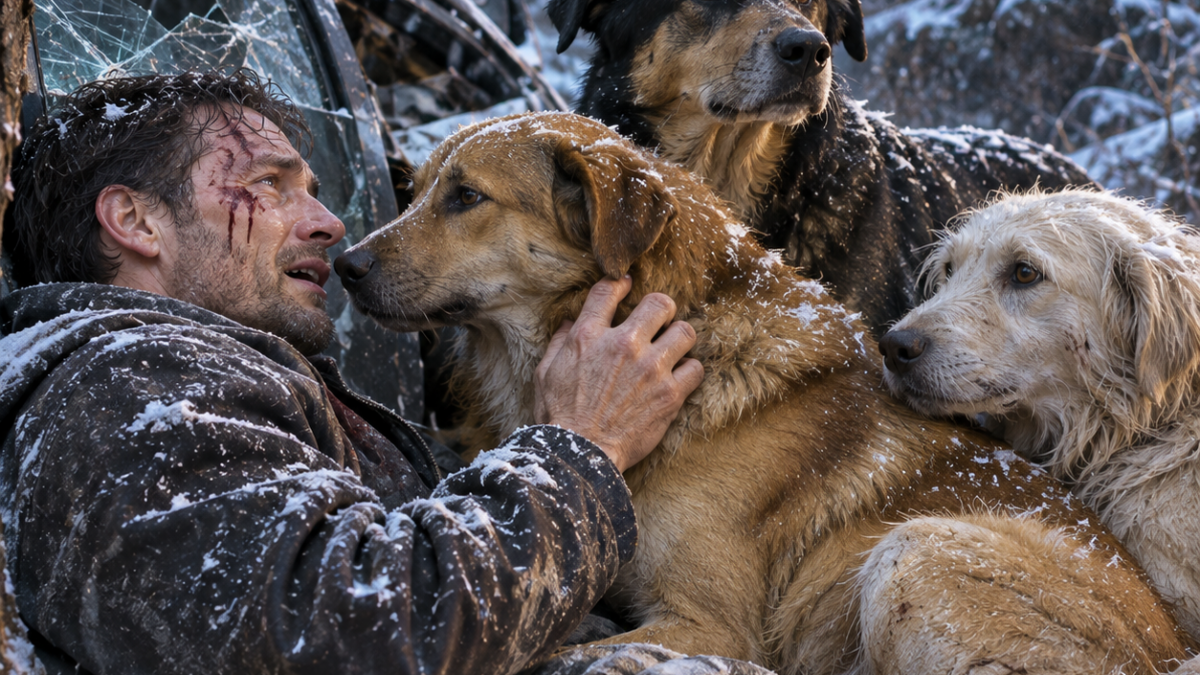
The largest dog positioned himself directly in front of my body.
The shelter would later name him Max.
That night, he had no name anyone knew.
He lowered his head and barked.
Not once.
Again and again.
The lighter dog—later Charlie—moved toward Max’s left.
The smallest—Rocky—covered the right.
Three dogs.
Five wolves.
The footage had no clean audio from the ravine, but Howard’s microphone recorded faint barking through the rain.
Max stepped forward.
Barked.
Retreated.
Stepped forward again.
Charlie followed.
Rocky moved with him.
The wolves spread into a loose semicircle.
For several minutes, nothing happened.
That may not sound long.
Watch a clock for three minutes while imagining an injured man behind you and wild animals in front of you.
Three minutes becomes enormous.
One wolf moved closer.
Max lunged forward barking.
Rocky followed so quickly that the smaller dog almost reached the wolf first.
Charlie stayed near my body.
Then the wolves shifted again.
Nobody knows exactly why they finally retreated.
Maybe the dogs made the confrontation not worth the risk.
Maybe the noise.
Movement.
Headlights occasionally passing above.
Whatever the reason, one wolf turned.
Then another.
Slowly, the entire pack moved back into the trees.
The dogs did not chase.
That matters to me.
They were not trying to fight.
They were protecting.
Max watched until the final shadow disappeared.
Then he turned around.
Walked back toward me.
And lay down beside my shoulder.
The wolves were only the beginning.
Temperature dropped through the night.
Not deep winter.
But close enough to freezing that a wet, injured person on the ground faced serious hypothermia.
Charlie and Rocky lay against me.
Max remained slightly above my head.
Sometimes standing.
Sometimes sitting.
Sometimes pacing.
Then Charlie started running to the road.
The camera captured it.
Every few minutes, the lighter-colored dog climbed the embankment.
Stood near the shoulder.
Barked at passing headlights.
Cars went by.
One.
Then another.
No one stopped.
From a moving vehicle in rain, he probably looked like any stray dog.
Charlie would run back down.
Check me.
Then return to the road.
Again.
Again.
Again.
At one point, he chased a vehicle for several yards.
It never slowed.
He returned.
The camera showed Max lifting his head when Charlie came back.
Rocky stayed pressed against my ribs.
Three homeless animals had somehow divided responsibilities.
One guarded.
One shared warmth.
One searched for help.
People later tried to make this mystical.
I do not.
Dogs are social animals.
Intelligent.
Observant.
They did not need a meeting.
They did what seemed necessary.
That is extraordinary enough.
Around two in the morning, rain stopped.
The temperature continued falling.
My breath sometimes appeared faintly in the camera.
Then not.
Then again.
I later asked Dr. Emily Stone whether that meant I was close to dying.
She answered carefully.
“It means you were cold.”
“How cold?”
“Cold enough that another few hours could have changed the outcome.”
Doctors hate giving dramatic answers.
That was dramatic enough.
At 4:58 a.m., James Carter drove toward the morning livestock market.
James was fifty-nine.
Farmer.
Lived six miles away.
He had passed that road thousands of times.
His truck headlights caught Charlie standing near the shoulder.
Charlie barked.
James slowed.
The dog did not run.
That interested him.
Most strays either retreat or approach.
Charlie did neither.
He ran toward the ravine.
Stopped.
Looked back.
Ran to James.
Then back again.
James parked.
Opened the door.
“What do you want?”
Charlie barked.
Ran toward the edge.
James later told me:
“I’ve lived around animals my whole life. That dog wasn’t asking for food.”
He followed.
When he looked down the ravine, he saw my upside-down car first.
Then Max.
Rocky.
Then me.
“Oh God.”
James slid down the muddy slope.
Max stood.
Not aggressive.
Watchful.
James held up his hands.
“It’s okay.”
Max did not leave my side.
Rocky did not either.
Charlie followed James as though delivering him.
James knelt beside me.
Touched my neck.
Pulse.
Weak.
He called emergency services.
The dogs remained.
When James pulled off his jacket and covered part of my chest, Rocky moved only enough to let him.
Then pressed himself back against my side.
Twenty minutes later, sirens approached.
Charlie ran toward them.
The first paramedic down the slope was a woman named Sarah Nolan.
She later told me she expected the dogs to become defensive.
Instead, Max moved back when she knelt.
Not far.
Enough.
“I think he understood.”
She told me.
“What?”
“That we were helping.”
They stabilized my neck.
Started warming measures.
Lifted me toward the stretcher.
As soon as they moved me, all three dogs became agitated.
Charlie followed.
Rocky whined.
Max walked beside the stretcher until a firefighter blocked him from the ambulance.
Then the doors closed.
The dogs were left standing in the rain-dark parking area.
That part of the footage hurts me almost as much as everything before.
Three dogs spent an entire night refusing to leave me.
Then, the moment help arrived, the humans took me away.
They did not know whether I was alive.
They did not know where I went.
And because they belonged to nobody, nobody thought to explain.
James did.
He stayed behind.
He tried approaching them.
Max allowed him within several feet.
Then the dogs retreated toward the woods.
James brought food from his truck.
Left it.
They ate only after he backed away.
Before animal control arrived, the three dogs disappeared.
Back into the trees.
As if their job had ended.
I woke nearly a day later.
Hospital.
Bright ceiling.
Pain.
A breathing exercise device on the table.
My left leg immobilized.
Three broken ribs.
Complex fracture of the leg.
Cuts.
Bruises.
Mild hypothermia.
Concussion.
No life-threatening internal injuries.
Lucky.
Doctors used that word repeatedly.
Lucky.
I remember asking:
“What happened?”
A nurse told me I had crashed.
“Anyone else?”
“No.”
I closed my eyes.
Then she said:
“There’s something strange about your rescue.”
“What?”
She smiled.
“I think somebody else should explain.”
I assumed police.
Maybe another driver.
I had no idea she meant dogs.
Amanda arrived that afternoon.
She flew from Oregon the moment the hospital reached her.
She walked into my room, saw me, and started crying.
I tried joking.
“Plane ticket expensive?”
She hit my shoulder.
Wrong shoulder.
I yelled.
She apologized while laughing and crying.
Then hugged me carefully.
“Dad.”
“I’m okay.”
“You rolled a car twice.”
“Minor inconvenience.”
“You were unconscious in a ditch all night.”
“I noticed eventually.”
She stared at me.
“You almost died.”
That sentence silenced me.
Because before Amanda arrived, everyone had spoken clinically.
Stable.
Injury.
Recovery.
Almost died belonged to family.
I looked away.
“I know.”
Amanda sat.
Then said:
“There are dogs.”
I frowned.
“What?”
“The farmer who found you.”
“He says there were three dogs with you.”
“Whose?”
“No one knows.”
I stared.
“Dogs?”
She nodded.
“He says one brought him from the road.”
I laughed because the alternative was believing something impossible.
“I think James needs sleep.”
“Dad.”
“What?”
“There’s video.”
Howard Clark came two days later.
Gas-station owner.
He carried a laptop.
Hospital staff almost refused to let him in because I was exhausted.
Amanda insisted.
“You need to see this.”
I wish somebody had prepared me.
Maybe there was no way.
Howard placed the laptop on the table.
“I reviewed my camera after James told me where he found you.”
He looked uncomfortable.
“I thought maybe it caught the crash.”
“It did.”
Then he pressed play.
I watched myself die.
At least that is what it felt like.
Car leaves road.
Roll.
Body falls.
Nothing.
I gripped the blanket.
Amanda took my hand.
Then the wolves appeared.
“What are those?”
Howard paused.
“Wildlife officer says wolves.”
My mouth went dry.
“How close did they get?”
“Watch.”
Then the dogs.
Three shadows running.
Max first.
Charlie.
Rocky.
They formed the line.
I stopped breathing.
The video continued.
One dog barking.
The others moving.
Wolves retreating.
Then the dogs returning to me.
I started crying.
Not quietly.
I had not cried since Helen’s funeral.
Not really.
The sound came from somewhere deep.
Amanda paused the video.
“No.”
I said.
“Dad.”
“Play it.”
She hesitated.
“Please.”
She continued.
Dogs beside my body.
Charlie running to the road.
Returning.
Running again.
Hours.
Then James.
Charlie bringing him down.
Max and Rocky beside me.
My whole body shook.
“Who are they?”
Howard looked at me.
“No one knows.”
“What do you mean?”
“They’re strays.”
“No.”
I pointed at the screen.
“They belong to somebody.”
“We checked.”
“Local shelter doesn’t know them.”
“No collars.”
“No chips that anyone knows of because they disappeared before officers could get close.”
I stared.
“They stayed with me all night.”
“Yes.”
“Then left?”
“After the ambulance.”
I could barely speak.
“Find them.”
Amanda touched my arm.
“Dad—”
“Find them.”
Howard nodded.
“We’re trying.”
The story hit the Meadowbrook Gazette four days later.
THREE UNKNOWN DOGS PROTECT INJURED DRIVER THROUGH NIGHT
Then another headline:
THE THREE HEROES OF LINDEN ROAD
Howard gave the footage to investigators, then the local news with my permission.
I agreed because I wanted the dogs found.
Nothing else mattered.
Screenshots spread online.
Dark gray Max.
Light-colored Charlie.
Small Rocky.
People made guesses.
Strays from a farm.
Abandoned hunting dogs.
Someone’s missing pets.
The shelter received hundreds of calls.
Most were wrong.
A dog three counties away.
A shepherd mix in Milwaukee.
A pit bull in another state.
People wanted to help.
That became its own miracle.
Farmers checked barns.
Drivers watched ditches.
Schoolchildren made signs.
FIND ROBERT’S HEROES
I hated the wording.
They were not mine.
Not yet.
At St. Luke’s Elementary, children drew three dogs around a man beneath a blanket of stars.
Amanda brought me the drawings.
I cried again.
Apparently near-death had destroyed my emotional defenses.
My recovery was slow.
That part never makes the newspaper.
Surgery on my leg.
Pain.
Breathing exercises because broken ribs make deep breaths miserable.
Physical therapy.
Learning to transfer from bed to wheelchair.
Learning to ask nurses for help.
I hated all of it.
I had been independent since I was seventeen.
Now a twenty-five-year-old physical therapist named Megan had to explain how to stand safely.
“I know how to stand.”
“Not currently.”
I glared.
She smiled.
“I’ve met your type.”
“What type?”
“Man who thinks stubbornness is a medical treatment.”
Amanda laughed from the corner.
I betrayed them both by eventually liking Megan.
At night, the crash returned.
Not the actual memory.
I remembered almost nothing.
My brain invented versions.
Wolves.
Darkness.
Dogs barking.
Sometimes I dreamed Helen was calling from the ravine.
I would wake shaking.
Amanda started sleeping in the hospital recliner even after I told her to go back to the hotel.
“You don’t need to stay.”
“Neither did three stray dogs.”
That ended the argument.
Three weeks after the crash, Luke Harrison found them.
Luke was seventeen.
He was riding an ATV near an abandoned agricultural warehouse about three miles from the accident site.
He saw movement beneath part of the collapsed roof.
Then a large gray dog.
Luke recognized Max from the newspaper.
He stopped.
Did not approach.
Called the Meadowbrook Animal Rescue.
Megan—different Megan from my physical therapist; apparently the universe had too many Megans—came with two volunteers.
They found all three dogs.
Together.
Max near the opening.
Charlie farther inside.
Rocky curled against him.
Thin.
Dirty.
No collars.
No obvious severe injuries.
Alive.
When the shelter director called Amanda, she screamed so loudly that a nurse ran into my hospital room.
“What happened?”
“They found them!”
I sat upright too fast.
Pain exploded through my ribs.
“Who?”
“THE DOGS.”
Everything stopped.
“Where?”
“Abandoned warehouse.”
“All three?”
“All three.”
I covered my face.
For some reason, the fact they had remained together devastated me.
Of course they had.
They had survived before me together.
They survived after me together.
I had merely been one stranger they chose not to abandon.
The shelter examined them.
No microchips.
No owners came forward.
Max was estimated at six.
Charlie perhaps four.
Rocky around three.
All three underweight.
Old scars.
No sign of recent severe abuse.
No way to know their full history.
They had likely been living stray for months, perhaps longer.
The shelter initially housed them separately for medical observation.
Max stopped eating.
Charlie paced.
Rocky barked constantly.
Within hours, staff moved them to adjacent runs.
They calmed.
The next day they tried supervised time together.
The dogs immediately curled into one pile.
After that, no one talked seriously about separating them.
I was still in rehabilitation when the shelter called.
“Mr. Wilson?”
“Yes.”
“This is David Richards.”
“The dogs?”
“They’re doing well.”
“Can I see them?”
There was a pause.
“Soon.”
“I’m in a wheelchair.”
“That’s not what I mean.”
“What?”
“They’ve been through a lot.”
“They may not react the way people expect.”
I understood.
The newspapers had created a reunion scene already.
Dogs running.
Man crying.
Perfect ending.
Real animals do not read newspapers.
“What if they don’t remember me?”
David said gently:
“That doesn’t change what they did.”
I knew.
But I wanted them to.
I hated myself for wanting it.
I left inpatient rehabilitation after almost seven weeks.
Walker first.
Then wheelchair for longer distances.
Amanda took leave from work and stayed.
I fought her.
She ignored me.
“You have a job.”
“I have vacation.”
“You’ve used all your vacation.”
“I have family leave.”
“You’re wasting it on me.”
Amanda’s face changed.
“Don’t ever say that again.”
I stared.
She took a breath.
“Mom died.”
“I live two thousand miles away.”
“You keep telling me you’re fine because you think needing me is some kind of moral failure.”
Her eyes filled.
“You almost died in a ditch alone.”
I looked away.
“You weren’t alone.”
She continued.
“Apparently three dogs understood something you still don’t.”
“What?”
“Let people stay.”
That sentence hurt.
Because she was right.
Helen died.
I decided I would never need anyone that much again.
Then called it independence.
The shelter reunion happened in December.
Clear morning.
Cold.
Amanda pushed my wheelchair because my leg was still in a rigid brace.
I carried nothing.
No treats.
No leash.
Nothing that might influence them.
David met us.
Megan stood nearby.
“Ready?”
“No.”
He smiled.
“That’s probably honest.”
He opened the interior door.
Max came first.
Gray.
Larger than he looked on video.
Old scar over one eyebrow.
Charlie followed.
Cream-and-tan coat.
Alert eyes.
Then Rocky.
Smaller.
Black and brown.
The three stopped.
They looked at me.
My heart started pounding.
Nothing happened for two seconds.
Three.
Then Max moved.
Straight toward me.
Not cautiously.
Not sniffing the room.
Toward me.
He reached the wheelchair.
Put his head on my knees.
Exactly where, according to James, he had placed his nose against me after the wolves left.
I broke.
Completely.
I bent forward as far as my ribs allowed.
“Oh, buddy.”
Max leaned harder.
Charlie came around the right side.
Tail hitting the wheel.
Rocky pushed between my feet.
Amanda was crying behind me.
Megan wiped her face.
David turned toward the window.
I put one hand on Max.
One on Charlie.
Rocky climbed his front paws onto the wheelchair footrest.
“Why?”
My voice broke.
“Why did you do that for me?”
Obviously, they did not answer.
That may be why animals are sometimes easier to love.
They do not demand explanations for their goodness.
I visited every day for a week.
Then I told David:
“I want them.”
He looked at me.
“All three?”
“Yes.”
“You’re recovering from a major accident.”
“I know.”
“Three dogs is a lot.”
“I know.”
“Your house has steps.”
“I have a ramp now.”
“That’s for you.”
“Multi-purpose.”
Amanda crossed her arms.
“Dad.”
I looked at her.
“You said let people stay.”
“I meant people.”
“Too late.”
David laughed.
Then became serious.
“These three are bonded.”
“If one adoption fails—”
“It won’t.”
“You cannot guarantee that.”
He was right.
So we planned.
Home visit.
Fencing.
Veterinary arrangements.
Training support.
Feeding.
Costs.
Amanda made spreadsheets.
I complained.
She ignored me.
Three weeks later, Max, Charlie, and Rocky came home.
My house had not contained that much life since Helen.
Possibly ever.
The first night was chaos.
Charlie discovered the trash can.
Rocky hated the vacuum.
Max stood in the hallway and stared at every room as if conducting an inspection.
Amanda had bought three expensive beds.
All three dogs slept together on Helen’s old living-room rug.
I sat in my recliner.
Looked at them.
Then at the photograph of Helen on the mantel.
“You would think I’ve lost my mind.”
Max opened one eye.
I smiled.
“She would have loved you.”
That realization hurt.
Then comforted.
My house changed.
There were leashes by the door.
Food containers.
Paw prints.
Dog hair everywhere.
Amanda said I had officially become “that old man with too many dogs.”
I accepted the title.
Max slept outside my bedroom.
Charlie slept near the front window.
Rocky slept wherever Max was.
If I went to the kitchen, three shadows followed.
Bathroom?
Three.
Porch?
Three.
Physical therapy exercises?
An audience.
Megan came once for a home session and nearly tripped over Rocky.
“This is medically irresponsible.”
“He’s motivational.”
“He’s lying on your resistance band.”
“Motivation looks different for everyone.”
The surprising thing was how the dogs reacted to my injuries.
Max moved slowly around my left leg.
Never bumped it.
Charlie watched whenever I used the walker.
Rocky brought me a tennis ball while I was trying to stand.
Not all support is sophisticated.
Still counted.
My first major setback came in January.
I fell.
Not badly.
The walker caught on a rug.
I went down hard enough to scare myself.
Before I could call Amanda, Max was beside me.
Charlie began barking.
Rocky ran toward the back door and back again.
The exact pattern from the ravine.
Guard.
Alert.
Return.
I sat on the floor.
Suddenly, I was not in my living room.
I was in the mud.
Dark.
Wolves.
Video.
I began shaking.
Max pressed against my shoulder.
Charlie stopped barking and came closer.
Rocky crawled into my lap despite having no concept of appropriate size.
I cried.
Not because I was hurt.
Because they remembered how to help.
Or maybe they simply did what they always did.
Stayed.
Amanda found me fifteen minutes later.
Three dogs around me.
“What happened?”
“I fell.”
“Are you hurt?”
“Pride.”
She knelt.
Then saw my face.
“Dad?”
I looked at Max.
“They did it again.”
Amanda understood.
She sat on the floor beside me.
For a while, nobody got up.
I started therapy after that.
Human therapy.
Not physical.
Amanda arranged it.
I resisted.
Of course.
Dr. Samuel Green was sixty.
Beard.
Annoyingly patient.
First session, he asked:
“What bothers you most about the crash?”
“I almost died.”
“Is that what bothers you?”
“Yes.”
He waited.
I hated him immediately.
Then I said:
“I don’t remember it.”
There.
“The dogs remember more of my worst night than I do.”
“Why does that bother you?”
“Because I owe them.”
He leaned back.
“For what?”
“My life.”
“Can you repay that?”
“No.”
“Then maybe stop treating gratitude like debt.”
I did not go back for two weeks.
Then I did.
Therapy taught me something uncomfortable.
I had spent four years after Helen’s death refusing to need anyone because I believed dependence created future grief.
If I did not need Amanda nearby, losing distance with her would not hurt.
If I did not make new friends, nobody else could disappear.
If I kept my routines narrow enough, grief had fewer entrances.
Then three dogs arrived and made my entire strategy impossible.
They needed food.
Walks.
Appointments.
Affection.
But they also gave things without asking permission.
Company.
Noise.
Responsibility.
Joy.
They did not care whether I felt emotionally prepared.
Perhaps that was exactly what I needed.
Max became the leader naturally.
Not aggressive.
Calm.
If another dog barked behind a fence, Max looked and kept walking.
Charlie was motion.
Everything interested him.
Birds.
Mail trucks.
Plastic bags.
Children.
Rocky was courage without planning.
If Max investigated something, Rocky arrived first and figured out the danger later.
Watching them together made the nighttime footage make more sense.
They were not three random strays who suddenly became coordinated.
They already had a system.
Max decided.
Charlie searched.
Rocky followed anyone he loved into trouble.
I had simply been fortunate enough to become their problem for one night.
Spring came.
My cast came off.
Physical therapy intensified.
Walking hurt.
My left leg had healed, but not perfectly.
I would always limp slightly.
I hated the cane.
Max did not.
He walked exactly at cane speed.
Charlie hated cane speed.
Rocky did not understand speed as a concept.
We adapted.
James Carter visited for the first time after I brought the dogs home.
The farmer who had followed Charlie.
He stood in my driveway.
Charlie recognized him before I did.
The dog exploded forward.
Tail whipping.
James laughed.
“Well, hello to you too.”
Then he looked at me.
We had spoken by phone but never met properly.
I held out my hand.
James ignored it and hugged me.
Old farmers apparently have their own rules.
“You look better.”
“Than unconscious in mud?”
“Considerably.”
We went inside.
Max approached slowly.
Then rested his head against James’s leg.
James looked away.
His eyes filled.
“I thought about you boys every day.”
I noticed he said boys.
Not dogs.
Good man.
James told me details the camera could not.
“Max wouldn’t leave you.”
“He stayed between you and everything.”
“Rocky was pressed against your side.”
“Charlie kept going up that hill.”
“How many times?”
“I don’t know.”
“More than I’d have.”
He laughed softly.
“Charlie looked at my truck like I was personally disappointing him when I didn’t stop fast enough.”
I looked at Charlie.
He wagged.
Heroism apparently did not create humility.
Howard Clark came too.
Gas-station owner.
He apologized.
“For what?”
“I drove past that road at midnight.”
I stared.
“Camera shows my truck.”
“I was going home.”
“I didn’t see anything.”
“Howard.”
He looked ashamed.
“I keep thinking if I had looked down the ravine…”
“No.”
“Robert—”
“No.”
I had spent enough therapy learning this.
“You did not know.”
“But—”
“Charlie tried.”
“Yes.”
“And eventually James stopped.”
Howard nodded.
“Then that’s the story.”
Guilt always wants to write itself into the center.
I would not let Howard do that.
I understood too well.
By summer, I could walk two miles.
Slowly.
Max left.
Charlie right.
Rocky everywhere.
People stopped me constantly.
“Are those the dogs?”
I began answering:
“They have names.”
That changed the conversation.
Max.
Charlie.
Rocky.
Not heroes.
Dogs.
Individuals.
Lives.
That mattered to me.
The community wanted a ceremony.
I refused three times.
Then elementary-school children wrote again.
I surrendered.
The town placed a small plaque near the gas station.
Not where I crashed.
Near the road.
It read:
MAX, CHARLIE & ROCKY
THREE STRAY DOGS WHO CHOSE TO STAY
OCTOBER 14
I liked chose to stay.
That was accurate.
The mayor gave a speech too long for any living creature.
Rocky tried to eat the ribbon.
Charlie barked at applause.
Max fell asleep.
Perfect.
The best part came afterward.
The shelter received more foster applications.
People who had never considered adopting adult strays visited.
One family adopted a seven-year-old shepherd who had been overlooked for months.
A retired teacher adopted two bonded hounds.
A mechanic took home an injured mixed-breed dog nobody wanted.
David told me:
“Your three changed things.”
I corrected him.
“They changed things themselves.”
He smiled.
“Fine.”
Semantics mattered to me.
Maybe too much.
Amanda returned to Oregon after four months.
The morning she left, she stood in the kitchen crying.
“I hate this.”
“I’ll visit.”
“You say that.”
“I have three travel supervisors now.”
Charlie barked.
“See?”
Amanda hugged me.
Then knelt beside Max.
“You keep him alive.”
Max licked her cheek.
She pointed at Charlie.
“You too.”
Charlie sneezed.
Then Rocky.
“Especially you.”
Rocky rolled over for belly rubs.
No dignity.
Amanda laughed.
When her car disappeared, the house felt empty for thirty seconds.
Then Charlie knocked over the water bowl.
Life resumed.
That evening, Amanda called.
“You okay?”
“I’m fine.”
She went quiet.
I laughed.
“What?”
“You said it.”
“Said what?”
“I’m fine.”
The old phrase.
The shield.
I looked at three dogs sleeping around my chair.
“I’m lonely.”
Amanda’s voice softened.
“Thank you.”
“For what?”
“For not lying.”
I swallowed.
“I miss you.”
“I miss you too.”
That conversation mattered.
Three dogs had saved me from a ravine.
They were still saving me from smaller things.
The anniversary of the crash came.
I did not want to go to the ravine.
Then Max stood beside the door that morning.
Of course he had no idea what date it was.
I took it as a command anyway.
We drove.
The car had been removed long before.
Trees remained.
Guardrail repaired.
The gas station still there.
I parked.
Walked carefully down part of the slope.
Not all the way.
Max stopped.
Charlie sniffed everything.
Rocky chased a leaf.
I looked toward the muddy ground where James said I had been.
Nothing marked it.
Good.
Trauma does not need monuments everywhere.
I whispered:
“Thank you.”
Max looked at me.
Charlie did not.
Rocky was still fighting the leaf.
I laughed.
Then cried.
Then went home.
Years began passing faster.
That is one cruelty of aging.
Childhood summers last forever.
Old age arrives in seasons.
Max turned nine.
Charlie seven.
Rocky six.
Then ten, eight, seven.
Gray appeared around Max’s muzzle.
Charlie remained convinced he was a puppy.
Rocky matured only enough to stop eating socks.
Mostly.
I started volunteering at the shelter.
One afternoon a week.
Then two.
I specialized unofficially in dogs people described as “difficult.”
Fearful.
Withdrawn.
Older.
Bonded pairs.
I told David:
“I don’t train dogs.”
“Good.”
“What?”
“You wait.”
Sometimes waiting is the most important skill.
I learned that from grief too.
One dog named Pearl refused to leave the back corner of her kennel.
White shepherd mix.
Nobody could touch her.
For three weeks, I sat outside reading newspapers.
No eye contact.
No reaching.
Week four, she ate a treat from the floor near me.
Week six, she sniffed my shoe.
Week eight, she rested her head against my knee.
I cried.
David said:
“You cry a lot now.”
“I had a backlog.”
Fair.
Pearl was adopted by a widow named Sarah.
Six months later, Sarah sent a photograph of Pearl asleep on her bed.
I framed it beside the first screenshot of Max, Charlie, and Rocky.
Not because I saved Pearl.
Because patience did.
At seventy-two, I underwent knee surgery on the uninjured leg.
Ridiculous.
I told Max:
“You people broke the good one too.”
He stared.
By then, Max was slowing significantly.
He slept beside my recliner while I recovered.
Charlie still patrolled windows.
Rocky brought toys.
History repeating more gently.
Then Max got sick.
It began with appetite.
He stopped finishing breakfast.
Max never skipped food.
Elise examined him.
Bloodwork.
Ultrasound.
Cancer.
Spleen.
Aggressive.
My mouth went numb.
“How long?”
“We can discuss surgery.”
“How long?”
“With surgery, maybe months.”
“Without?”
“Possibly weeks.”
I looked at Max.
He stood beside Elise.
Tail moving.
Trusting us.
I hated the world.
I called Amanda.
She flew in.
No debate.
We chose surgery because Max was otherwise strong and Elise believed he could recover comfortably.
He did.
For a while.
Four good months.
Walks.
Porch.
Food.
He returned to the ravine once.
Then the cancer returned.
There are battles love cannot win by effort.
That was one.
Max’s final morning was quiet.
He could no longer stand without pain.
I sat beside him on Helen’s old rug.
Charlie lay on one side.
Rocky on the other.
The exact formation they had made around me in the ravine.
That detail destroyed me.
Elise came to the house.
Amanda sat behind me.
I put my hand on Max’s head.
“You stood guard.”
His eyes lifted.
“You can stop now.”
Charlie whined.
Rocky pressed closer.
I cried.
“You did enough.”
Max’s breathing softened.
Elise helped him go peacefully.
Charlie licked his face once.
Rocky pushed his head beneath Max’s neck.
I made a sound I had not made since Helen.
The sound of something being torn out.
After Max was gone, Charlie stopped eating.
History.
Again.
I panicked.
“Elise.”
“He’s grieving.”
“He’ll die.”
“No.”
“He won’t eat.”
“Give him time.”
“Max had time.”
“Robert.”
Her voice sharpened.
“You cannot prevent every loss by panicking faster.”
I hated her for saying it.
Then loved her for being right.
Charlie ate from my hand on day three.
Rocky slept pressed against him.
We survived.
Not healed.
Survived.
I buried Max’s ashes beneath an oak tree behind the house.
Not at the ravine.
Home.
Amanda made a small stone.
MAX
HE STOOD HIS GROUND
That was enough.
Charlie changed after Max.
He became quieter.
Less frantic.
Almost as though he had inherited some of Max’s job.
On walks, Charlie moved closer to my left side.
Rocky still ran ahead.
Then returned.
Check everyone.
Always.
The three had become two.
A shape missing.
Dogs feel absence physically.
So do humans.
Charlie lived another three years.
He was twelve when his heart began failing.
Irony.
The dog who spent one whole night running to the road for help eventually developed a heart too tired to run.
Medication helped.
For months.
Then one evening he collapsed near the kitchen.
I knew that scene.
Too well.
Elise said we could give him a little more time.
This time, I understood the question better.
Not how many days.
What kind.
I chose comfort.
Charlie had given enough of himself to urgency.
His last week was slow.
Good food.
Sunlight.
Short walks.
Amanda came.
James came.
David from the shelter.
Charlie greeted everyone.
Then went to the front window.
His old post.
The dog who had once barked at passing headlights.
Still waiting.
Still watching.
On his final morning, I sat with him there.
“Someone finally stopped.”
I whispered.
Charlie’s tail moved.
“James stopped.”
His breathing was shallow.
“You did it.”
I kissed his head.
Elise came later.
Charlie died with my hand over his chest.
Rocky lay beside us.
Afterward, Rocky would not leave the window for two days.
Two dogs gone.
One remained.
The smallest.
The bravest, according to Howard’s footage.
Rocky.
The dog who had stood closest to Max when the wolves approached.
Now he followed me everywhere.
No independence.
Bathroom guard.
Kitchen guard.
Sleep guard.
I understood.
Everyone he loved was disappearing.
So I let him follow.
Sometimes love becomes permission to be afraid.
Rocky lived until sixteen.
Outlasted everyone.
He became almost completely gray.
Hard of hearing.
Half blind.
Still ridiculous.
He forgot where toys were but remembered exactly when dinner should happen.
I built ramps.
Covered floors.
Lifted him into the car.
The smallest dog became the final keeper of our shared history.
Sometimes I wondered whether he remembered the ravine.
Probably not like I did.
Dogs do not sit around narrating their pasts.
Maybe that is mercy.
At fifteen, Rocky met my first granddaughter.
Amanda’s daughter, Emily.
Yes.
Life surprised us.
Amanda had married late.
Had a child at forty.
When she placed newborn Emily near Rocky, the old dog sniffed her blanket.
Then lay beside the bassinet.
Guard position.
I had to leave the room.
Amanda found me crying on the porch.
“Dad.”
“He’s doing it again.”
“What?”
“Guarding.”
Amanda looked through the window.
Rocky beside the baby.
Her face collapsed.
She cried too.
History had become tenderness instead of terror.
Rocky’s last summer, I took him to the road.
Not the ravine.
The little plaque.
I carried him from the truck because his legs were weak.
Set him down near the words.
THREE STRAY DOGS WHO CHOSE TO STAY.
Rocky sniffed the grass.
Then sat.
I lowered myself beside him.
“Max is waiting.”
No response.
“Charlie too.”
Rocky looked toward me.
I put my hand on his back.
“Helen will pretend she doesn’t like dogs.”
His tail moved.
“Don’t believe her.”
I laughed and cried.
Then took him home.
Rocky died in his sleep.
That was his final gift to me.
No decision.
No appointment.
No moment of choosing.
I went downstairs one morning and found him on Helen’s rug.
Curled.
Peaceful.
For one terrible second, I thought he was sleeping.
Then knew.
I sat beside him.
Touched his side.
Cold.
The house became silent in a way I had not heard in almost twenty years.
First Helen.
Then three dogs.
Now nothing.
I leaned over Rocky.
“Thank you for staying.”
That sentence held all of it.
I buried Rocky’s ashes beside Max and Charlie.
Three stones.
MAX — HE STOOD HIS GROUND
CHARLIE — HE FOUND HELP
ROCKY — HE NEVER BACKED AWAY
Below them, Amanda later added a fourth stone.
For Helen.
HELEN — SHE TAUGHT ROBERT HOW TO LOVE THEM
I protested.
She ignored me.
Correctly.
The house after Rocky was brutal.
No water bowls.
No nails on floors.
No bodies blocking hallways.
I thought about adopting again.
Went to the shelter.
Sat with dogs.
Loved some.
But I was eighty-two.
I knew my limits.
I began fostering instead.
Short-term.
Older dogs.
Recovery cases.
The first was a twelve-year-old beagle named Henry who snored louder than a chainsaw.
He stayed six weeks.
Then went to a retired couple.
I cried when he left.
That was okay.
The point was leaving.
A safe departure.
Not every bond must end in death to matter.
The shelter eventually renamed its bonded-dog program.
The Max, Charlie & Rocky Promise.
If bonded animals arrived together, the shelter made extraordinary effort to place them together whenever appropriate.
David called.
“You approve?”
I cried before answering.
“Yes.”
Three dogs who had once belonged nowhere were now helping other dogs stay together.
There are kinds of legacy money cannot buy.
James Carter died before I turned eighty.
Heart attack.
His wife asked me to speak at the funeral.
I said I couldn’t.
Then did.
I told everyone James saved my life.
His wife corrected from the front pew:
“The dogs saved you.”
Everyone laughed.
I smiled.
“The dogs started the job.”
“James finished it.”
Then I told them Charlie had asked hundreds of drivers for help.
James was the one who listened.
That matters.
Sometimes the difference between tragedy and survival is simply somebody paying attention to what everyone else drives past.
Howard Clark sold the gas station.
The new owner kept the camera.
Replaced it with a better one.
When Howard retired, he gave me a copy of the original footage on a drive.
I kept it in a drawer.
For years, I watched it every anniversary.
Then stopped.
I did not need to watch three dogs prove their love anymore.
I had lived it.
The Meadowbrook Gazette occasionally reprinted the story.
Every few years.
Anniversaries.
Animal-rescue month.
People online argued whether wolves would behave exactly as the video showed.
Whether the dogs were truly stray.
Whether this or that detail had been exaggerated.
I stopped reading comments.
The footage existed.
James existed.
The dogs existed.
My scars existed.
I did not need strangers to certify my life.
That was another lesson aging gave me.
At eighty-three, I returned to the ravine alone.
No dogs.
No Amanda.
No reporters.
I walked slowly with a cane.
Reached the plaque.
Then the edge.
The slope had grown over.
Grass.
Young trees.
Nature had softened the place.
I thought about the unconscious man lying there.
Cold.
Bleeding.
Unaware that his life was being guarded by three animals who had less security than he did.
No house.
No owner.
No guarantee of tomorrow.
Yet they gave me their night.
I sat on a bench.
Then said aloud:
“I hope I gave you enough back.”
Wind.
Nothing else.
Maybe that was the wrong question.
Love is not accounting.
The dogs never submitted an invoice.
They did not save me because they expected adoption.
They did not know I had a house.
Food.
Warm beds.
They saved a stranger.
Later, I had the privilege of loving them.
That was not repayment.
That was another gift.
Amanda eventually convinced me to move closer to her.
I sold the Linden house.
That was difficult.
I took Helen’s picture.
The four stones could not come.
I left them beneath the oak.
The new owners were a young couple with two rescue dogs.
When I told them about the stones, the woman cried.
“We’ll take care of them.”
That was enough.
I moved west.
Not because I surrendered independence.
Because I finally understood proximity can be chosen without becoming weakness.
Amanda had spent decades asking me to let her stay.
I finally did.
In Oregon, I began telling Emily stories.
My granddaughter loved the dogs.
“Did Max bite the wolves?”
“I don’t know.”
“Did Rocky fight them?”
“He barked.”
“Charlie really ran to the road all night?”
“Yes.”
“Were they scared?”
“Probably.”
Then she asked the best question.
“Why did they help you if they didn’t know you?”
I looked at her.
“I don’t know.”
She frowned.
“There has to be a reason.”
Maybe children believe goodness needs explanation.
Adults too.
I said:
“Maybe they saw someone who needed help.”
Emily thought.
“That’s enough?”
I smiled.
“Sometimes.”
When she was eight, Emily asked for a dog.
Amanda looked at me.
“No.”
I raised my hands.
“I said nothing.”
“You’re thinking loudly.”
Eventually, they adopted one.
Older shepherd mix.
Shelter name Daisy.
Emily wanted to rename her Max.
I stopped her.
“Max was Max.”
“So?”
“Let Daisy be Daisy.”
She accepted that.
Identity matters.
Even to dogs.
Daisy slept beside my chair whenever I visited.
The first time she put her head on my knee, I cried.
Emily panicked.
“Grandpa, are you sad?”
“Yes.”
“Do you want her to stop?”
“No.”
That confused her.
So I explained.
“Some sadness is love remembering.”
Emily climbed into the other chair.
We sat.
Daisy’s head on my knee.
Max somewhere in memory.
Charlie.
Rocky.
Helen.
The heart learns to carry many absences without dropping the present.
It takes time.
People ask whether the three dogs saved me from loneliness too.
Yes.
But not in the simple way the newspaper wrote.
They did not make loneliness disappear.
Nothing does.
Helen remained dead.
Amanda remained far away for years.
Some nights were quiet.
But Max, Charlie, and Rocky gave loneliness movement.
Feeding times.
Walks.
Vet appointments.
Muddy floors.
Someone waiting near the door.
Grief becomes dangerous when nothing interrupts it.
Dogs interrupt beautifully.
Max taught me steadiness.
Charlie taught me persistence.
Rocky taught me courage does not require size.
Helen taught me love before all of them.
Amanda taught me staying can happen across distance.
James taught me to stop for the dog beside the road.
Howard taught me cameras sometimes see what humans miss.
Maybe a life is simply all the people and animals whose lessons survive after they are gone.
I am eighty-six now.
I walk slowly.
My left leg still aches when weather changes.
Three broken ribs left no permanent issue.
The scars faded.
The crash is now something I can speak about without feeling the car roll again.
Mostly.
I keep one photograph on my bedroom wall.
Not the famous screenshot.
Not wolves.
Not the ravine.
It is the reunion at the shelter.
I am in the wheelchair.
Max’s head on my knees.
Charlie beside my right wheel.
Rocky with paws on the footrest.
Amanda behind me crying.
Every face is turned inward.
Toward one another.
That photograph is what family looks like to me.
Not blood.
Not paperwork.
Not ownership.
Recognition.
There you are.
I stayed.
You came back.
The last time a reporter called, she asked:
“What was the most heroic thing those dogs did?”
I expected myself to say the wolves.
Or warmth.
Or Charlie getting James.
Instead, I answered:
“They stayed after I woke up.”
She went quiet.
“What do you mean?”
“The rescue was one night.”
I looked at the reunion photograph.
“They gave me years.”
That was the whole truth.
Heroism makes headlines.
Staying builds a life.
If all I had ever known were the camera footage, Max, Charlie, and Rocky would be legends to me.
But I knew how Max snored when he slept on his back.
I knew Charlie hated the mail truck but adored the mail carrier.
I knew Rocky would refuse expensive treats and then eat cardboard.
I knew Max liked his ears scratched from behind.
Charlie slept with one paw against furniture.
Rocky dreamed violently and kicked whoever lay beside him.
Those things matter more to me than wolves.
Because rescue gave us the beginning.
Ordinary life gave us everything else.
I still think about those first fifteen minutes.
The road empty.
Rain.
My overturned car.
My unconscious body.
No one coming.
Then three shapes emerging.
If they had continued walking, no human being would have blamed them.
They were animals.
Strays.
They owed me nothing.
That is precisely why I will never understand what happened without crying.
They owed me nothing.
And they gave me everything they had.
Noise.
Teeth.
Warmth.
Time.
Persistence.
Presence.
Maybe Max, Charlie, and Rocky had been abandoned before.
Maybe they knew what it meant to be left somewhere frightened.
That thought has occurred to me.
I do not know if it is true.
I will not invent a history just because it makes the story prettier.
What I know is enough.
When they saw someone helpless—
they did not leave.
That became the rule I tried to live by afterward.
If someone is hurting, do not automatically ask whether they deserve help.
If a frightened animal is beside the road, slow down.
If your daughter says she worries, listen.
If a friend keeps saying “I’m fine,” sometimes ask again.
If a dog is barking desperately near a ravine, stop the truck.
You do not always need the whole story before becoming kind.
On my eighty-sixth birthday, Amanda gave me something.
A framed copy of the original newspaper front page.
THE THREE UNKNOWN HEROES
Below it, she added another photograph.
The three stones beneath the old oak.
Max.
Charlie.
Rocky.
I cried.
Of course.
Emily rolled her eyes.
“Grandpa cries at everything.”
Amanda laughed.
“He earned it.”
Maybe.
That evening, Emily asked:
“Do you think you’ll see them again?”
Children ask questions adults avoid.
I looked toward the photograph.
“I hope so.”
“What do you think happens?”
“I don’t know.”
“If there is heaven, do dogs go?”
“If dogs don’t, I’m not interested.”
She laughed.
Then became serious.
“Do you think they’ll remember you?”
That question lodged in my chest.
I thought about the shelter door opening.
Max seeing me.
Running.
Head on my knees.
No hesitation.
“Yes.”
I whispered.
“I think they’ll remember.”
If I am lucky enough to have one final memory when my own time comes, I know what I want.
Not the crash.
Not the wolves.
Not the hospital.
I want the shelter.
Cold December morning.
Door opening.
Three dogs coming out together.
Max sees me.
Charlie’s tail starts moving.
Rocky runs.
Then that impossible moment when I realize they know exactly who I am.
I want to hear myself say:
“There you are.”
Maybe somewhere, somehow, they will answer the only way they ever needed to.
By staying.
Robert Wilson remembered almost nothing about the night his car rolled into that ravine.
Rain.
Metal.
Darkness.
That was all.
The camera remembered everything else.
It remembered the wolves appearing from the trees.
It remembered Max standing between them and an unconscious stranger.
It remembered Rocky moving beside him.
It remembered Charlie running to the road again and again.
It remembered three homeless dogs sharing their body heat through the coldest hours.
It remembered Charlie finally convincing James Carter to stop.
The video told me how I survived.
But it did not tell me the most important part.
I learned that later.
At home.
Over years.
Max, Charlie, and Rocky did not only save me from wolves.
They saved me from the life I had been quietly accepting after Helen died.
A life small enough to avoid loss.
A life with no new attachments.
No dependence.
No one close enough to break my heart.
The dogs destroyed that plan beautifully.
They gave me love.
Then eventually made me lose them too.
That sounds cruel.
It wasn’t.
Because grief is not proof that love was a mistake.
Grief is the receipt.
You loved something real.
That is what it costs.
I would pay it again.
Every time.
People sometimes say:
“After everything you went through, weren’t you afraid to love three dogs knowing you’d probably outlive them?”
Yes.
I was.
And I did.
All three.
It hurt exactly as badly as I feared.
I would still adopt them again tomorrow.
That is the strange mathematics of love.
The ending does not erase the middle.
Death does not retroactively make joy foolish.
The empty house does not make the years of noise a mistake.
The grave does not cancel the rescue.
Max stood against wolves.
Charlie ran until somebody listened.
Rocky refused to abandon either of them.
Then all three walked into my home and taught a lonely widower how to need something again.
I cannot imagine a greater gift.
And if someone ever tells you stray animals have nothing to offer—
that they are disposable—
dangerous—
unwanted—
show them the photograph.
Not the wolves.
The reunion.
An old man in a wheelchair.
Three dogs who once belonged nowhere surrounding him like they had finally discovered where they were supposed to be.
Then tell them this:
Those dogs had no home when they found me.
No names.
No owners.
No guarantees.
They still looked at an unconscious stranger in the mud and decided his life mattered.
When danger came, they stood.
When cold came, they stayed.
When no one stopped, they kept asking.
And when help finally arrived, they disappeared without expecting a reward.
Weeks later, when I found them again, they did not ask whether I deserved what they had done.
They simply recognized me.
That was enough.
I thought I adopted Max, Charlie, and Rocky.
Technically, I did.
There were forms.
Fees.
Signatures.
Vaccinations.
Three names written on three adoption records.
But I have never believed those papers told the truth.
The truth happened weeks earlier.
On a cold, wet night when I was unconscious and unable to choose anything.
Three dogs chose me first.
And for the rest of their lives, I spent every day trying to be worthy of that choice.
I do not know exactly how many years I have left.
That no longer frightens me much.
When you are eighty-six, the future becomes less about quantity and more about gratitude.
I have Amanda.
Emily.
Friends.
Memories.
A limp.
A ridiculous number of photographs of dogs.
Somewhere in Wisconsin, beneath an oak tree near a house that no longer belongs to me, there are four stones.
Helen.
Max.
Charlie.
Rocky.
The family that taught me nearly everything important.
I imagine the new owners’ dogs running past them.
Sniffing.
Unconcerned.
That seems right.
Life continuing.
The camera showed who saved me that night.
But cameras cannot show everything.
They cannot record the years after.
They cannot measure the moment a lonely house stops feeling empty because three dogs are asleep on the rug.
They cannot measure a daughter’s relief when her father finally admits he needs people.
They cannot record grief becoming gratitude.
They cannot calculate how one act of compassion travels outward into shelters, adoptions, foster homes, children’s drawings, emergency funds, and another frightened dog eventually finding a bed.
Cameras record events.
Love records itself in lives.
Max, Charlie, and Rocky had no idea what they started when they ran into that ravine.
They were simply three dogs.
Wet.
Cold.
Homeless.
They saw a man who could not protect himself.
So they did it for him.
No questions.
No conditions.
No guarantee I would ever wake up.
That is the part that still makes me cry.
Because all my life I thought love was something built slowly between people who knew one another.
Then three strangers taught me there is another kind.
The kind that appears in the dark.
Stands between you and danger.
Lies beside you in the cold.
Runs for help even after car after car refuses to stop.
And remains until somebody finally comes.
So when people ask me what happened that night, I no longer say:
“I crashed.”
I say:
“I was found.”
Not by James first.
Not by paramedics.
By three dogs who had once been lost themselves.
And when I think about it that way, maybe the whole story makes sense.
Lost things recognize one another.
I was lying in that ravine with a broken body.
But long before the accident, part of me had already been lost.
Helen was gone.
My daughter was far away.
I had mistaken isolation for independence and surviving for living.
Max, Charlie, and Rocky found both versions of me.
The man in the mud.
And the man who had been disappearing quietly for years.
They brought both home.
That is why, even now, when someone calls them my rescue dogs, I smile.
Because the phrase is correct.
Just not in the way they mean.
I signed the adoption papers.
They rescued me.
And they did it long before I understood I needed saving.
If there is an ending to our story, it is this:
A rainy night.
A ruined car.
An unconscious stranger.
Wolves emerging from the trees.
Three dogs with nowhere to sleep.
And one choice.
Stay.
They stayed.
Through danger.
Through cold.
Through the long dark hours when nobody else knew I was there.
Then years later, when each of them reached the end of his own life, I had the privilege of returning the favor.
I stayed with Max.
I stayed with Charlie.
I stayed with Rocky.
No one left alone.
That became the promise between us.
Not spoken.
Never needed to be.
You stayed for me.
I will stay for you.
And we kept it.
Every one of us.








