PART 2:“ON THE 23RD MORNING, I OPENED THE DOOR… AND HE DID SOMETHING I’LL NEVER FORGET.” My K9 Partner Died Saving Me, but a Tiny German Shepherd Puppy Had Refused to Give Up on Me for 22 Days
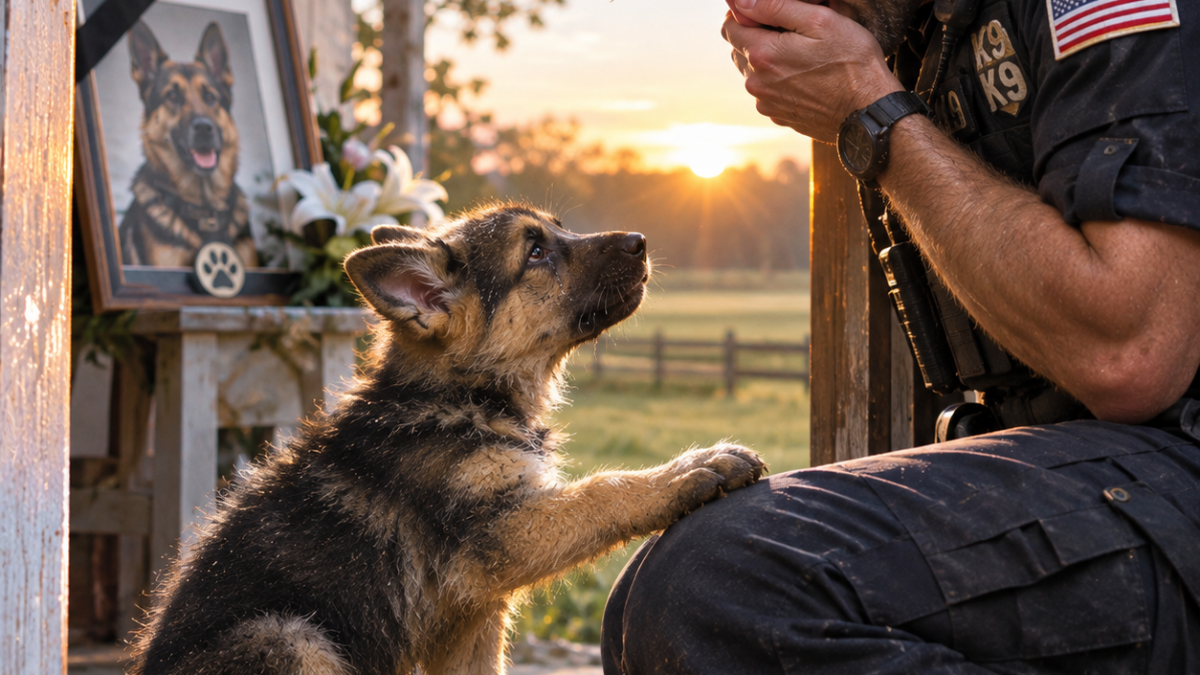
FULL ENDING
His breathing was wrong.
“Come on, buddy.”
Someone was saying my name.
Someone else was calling for help.
I heard none of it properly.
Rex looked at me.
There was no fear in his face.
That was what haunted me.
No accusation either.
Just trust.
Still.
After everything.
I put my forehead against his.
“I’m here.”
His tail moved once against the concrete.
One small movement.
Then it stopped.
I remember saying his name afterward.
Again.
Again.
As if maybe the first twenty times had been insufficiently clear.
Rex.
Rex.
Rex.
My partner was gone, and I was still giving him commands.
PART2
They took my service weapon before they let me leave the scene.
Not because I had done anything wrong.
Procedure.
Captain Morrison drove me home himself.
Rex did not come with me.
That was the first thing my house noticed.
I opened the door and automatically stepped aside to let him enter first.
Nothing moved.
His water bowl was beside the kitchen wall.
Half full.
His bed in the living room.
A tennis ball beneath the coffee table.
His collar was not there because it had been removed at the veterinary hospital.
I stood inside the doorway for almost ten minutes.
Then Morrison said quietly:
“Nathan.”
I closed the door.
I did not sleep.
At 4:45 the next morning, I woke anyway.
For eight years, Rex had been my alarm clock.
I lay there.
Waiting.
No tail against cabinet.
No nails across the hallway.
No low whine.
Nothing.
At 4:52, I got out of bed.
Went into the kitchen.
Then forgot why.
His bowl was there.
I picked it up.
Put it in the cupboard.
Immediately took it back out.
I could not bear either option.
That was how the first week went.
Everything was impossible in two directions.
His bed hurt to see.
Moving it hurt worse.
Leaving his hair in the truck felt pathetic.
Vacuuming it felt like betrayal.
I washed one of his blankets.
Then cried because it no longer smelled like him.
Grief makes ordinary decisions feel morally important.
The department held a memorial.
Full honors.
Officers.
Handlers from surrounding agencies.
A row of K9 units.
Someone placed Rex’s photograph beside his collar.
There were flowers.
Speeches.
Captain Morrison talked about eight years of service.
Commendations.
Successful searches.
Arrests.
Community events.
Lives protected.
I heard almost none of it.
I stared at the collar.
Black leather.
Worn edge.
His identification tag catching the light.
For eight years, that collar had meant work.
Now it meant absence.
After the ceremony, another handler came toward me.
He said:
“Rex was one of the best.”
I nodded.
Then he said:
“You’ll get another dog when you’re ready.”
Something inside me snapped.
“No.”
He paused.
“I just meant—”
“No.”
I looked directly at him.
“I’m done.”
“Nate.”
“I’m never working with another dog.”
He did not argue.
Probably smart.
I believed every word.
Three days after the funeral, Captain Morrison arrived at my house.
No warning.
I opened the door.
He stood there wearing jeans and a department sweatshirt.
At his feet was a German shepherd puppy.
Maybe four months old.
Big paws.
Dark face.
One ear standing.
The other undecided.
The puppy looked at me.
Then at Morrison.
Then grabbed Morrison’s shoelace.
I stared.
“No.”
Morrison said:
“Good morning.”
“No.”
“You haven’t even heard me.”
“I don’t need to.”
The puppy released the lace and came toward me.
“No.”
He sat on my boot.
Morrison almost smiled.
“This is Bronx.”
“I don’t care.”
“He’s from the department’s development program.”
“I said no.”
“He’s not replacing Rex.”
That sentence made me angry.
“Then why is he here?”
Morrison took a breath.
“Because he needs a temporary home with an experienced handler.”
“Find one.”
“I did.”
“Find another.”
Bronx began chewing my shoelace.
I pulled my foot back.
He followed.
Morrison watched.
“Nathan.”
“No.”
“I know you don’t want this.”
“Correct.”
“I also know you’ve barely left your house in three days.”
“That’s not your business.”
“It became my business when three officers separately called me because you stopped answering them.”
I looked away.
Morrison continued.
“You don’t have to train him for service.”
“You don’t have to bond with him.”
“You don’t have to decide anything permanent.”
“Keep him alive.”
“Teach him house manners.”
“That’s it.”
I laughed once.
No humor.
“You brought a puppy to a man who just buried his dog.”
“I brought a dog who needs a competent home to a man who needs to get out of bed.”
There it was.
I almost shut the door.
Then Bronx slipped between my legs and entered the house.
He ran three feet.
Stopped.
Saw Rex’s tennis ball beneath the coffee table.
Picked it up.
My chest closed.
“Drop that.”
Bronx looked at me.
Tail moving.
“Drop it.”
He bounced away.
“Bronx.”
He had no idea who I was.
No idea why that ball mattered.
He was just a puppy with a toy.
I reached him.
Took the ball gently from his mouth.
Then stood holding it.
Rex’s tooth marks covered the rubber.
Morrison remained near the door.
“I can take him back.”
I should have said yes.
Instead I whispered:
“One night.”
Morrison nodded.
“One night.”
He was lying.
So was I.
The first night, Bronx cried.
Of course he did.
Puppy.
Strange house.
Strange man.
New crate in the living room.
At eleven, I ignored him.
At midnight, I ignored him.
At 1:40, I put a blanket over part of the crate.
At 2:15, he settled.
At 3:07, the crying started again.
Small sound.
Thin.
Lonely.
I lay in bed staring at the ceiling.
Rex had cried his first night too.
Different house.
Eight years earlier.
He had been young but older than Bronx, nearly a year and already trained enough to know commands but not enough to understand me.
That first night, Rex paced.
I had sat beside his kennel.
Spoken quietly.
Eventually put my hand through the bars.
He rested his chin in my palm.
Memory arrived so hard I sat up.
Bronx cried again.
I went downstairs.
Sat beside the crate.
“Enough.”
Bronx stopped.
His nose came through the bars.
I put my fingers near him.
He licked them.
Then rested his tiny head against my hand.
For one second, Rex was there.
Not physically.
Not even really in Bronx.
In me.
The same posture.
Same trust offered before it had been earned.
I pulled my hand away.
Bronx lifted his head.
Confused.
“I can’t.”
I whispered.
He did not understand.
“I can’t do this again.”
He lay down.
I returned upstairs.
That was the first door I closed on him.
Not literally.
That came the next morning.
Bronx discovered my bedroom at 4:52 a.m.
Almost Rex’s old time.
He climbed the stairs.
I heard his nails.
Then two scratches against my closed door.
Scratch.
Scratch.
A tiny bark.
Not loud.
Almost a question.
Then silence.
I waited.
Nothing.
I got out of bed.
Walked to the door.
My hand reached for the knob.
Stopped.
Behind the door, I could hear puppy breathing.
Fast.
Patient.
I returned to bed.
Twenty minutes later, Bronx went downstairs.
Morrison called that afternoon.
“How’s he doing?”
“He chewed a shoe.”
“Your shoe?”
“Yes.”
“Good.”
“How is that good?”
“You own too many.”
“I’m bringing him back.”
Silence.
Then:
“Okay.”
That annoyed me.
No argument?
“Tomorrow.”
“Fine.”
I looked at Bronx.
He was sleeping upside down on the living-room rug.
One ear folded beneath his head.
“Tomorrow afternoon.”
“Sure.”
The next afternoon came.
I did not call Morrison.
Neither did he.
Traitor.
The second morning:
Scratch.
Scratch.
Soft bark.
Wait.
Same time.
I remained in bed.
Third morning.
Same.
Fourth.
Same.
I had not taught him.
Rex could not have taught him.
Probably just routine.
Puppies like routine.
That is the rational explanation.
At the time, it felt like cruelty from the universe.
Every morning before sunrise, a dog waited outside the door exactly when the dog I had lost used to wake me.
And every morning I refused to open it.
During the day, I cared for Bronx mechanically.
Food.
Water.
Training basics.
Outside.
Crate.
Walk.
No affection beyond what was necessary.
At least that was what I told myself.
I corrected him calmly.
Rewarded good behavior.
Redirected chewing.
Taught sit.
Down.
Place.
Wait.
He learned fast.
Too fast.
I hated how proud that made me.
The first time Bronx responded correctly to a new command without hesitation, I felt the old spark.
Handler and dog understanding each other.
Then guilt crushed it.
“Good.”
I said flatly.
Bronx’s entire body still celebrated.
Tail.
Ears.
Eyes.
Dogs are generous with enthusiasm.
Humans ration it.
I kept Rex’s gear in the spare room.
Harness.
Old leads.
Training logs.
Photographs.
Bronx was not allowed inside.
One afternoon I forgot to close the door.
I found him sitting in front of Rex’s old harness.
He was not chewing it.
Just sniffing.
“Out.”
Bronx looked at me.
“Out.”
He left immediately.
Good dog.
I closed the door.
Then sat on the floor beside the harness.
I cried for the first time since the memorial.
Not dignified tears.
I held that old harness against my chest and sobbed like a child.
Bronx sat outside the closed door.
No scratching.
No barking.
Just there.
When I finally emerged, he stood.
I walked past.
He followed.
I hated him for understanding enough to stay.
On the seventh morning, Bronx waited forty minutes outside my bedroom.
I knew because I watched the clock.
4:51.
Scratches.
Bark.
Then his body settling against the hallway floor.
I imagined opening.
Instead I stared at Rex’s old photograph on my nightstand.
“You see this?”
I whispered.
Ridiculous.
Talking to a photograph.
“He’s trying.”
Rex smiled in the picture.
Mouth open.
Tongue out.
Police vest.
I had taken it after a school demonstration.
I whispered:
“I don’t want him.”
That was not true.
The truth was worse.
I was beginning to.
The department psychologist called me.
Morrison’s doing.
I refused.
She called again.
I refused again.
Third time, she left a voicemail.
“Nathan, grief does not care whether you answer your phone. I’ll be here Thursday at two if you change your mind.”
I showed up at 1:58.
Her name was Dr. Lena Brooks.
Former military family counselor.
Gray eyes.
No patience for performance.
She asked:
“What are you afraid of?”
“Nothing.”
She waited.
“Losing another dog.”
There.
“How is avoiding Bronx preventing Rex’s death?”
“It’s not.”
“How is avoiding Bronx protecting Bronx?”
I looked away.
She continued.
“Do you believe loving another dog would reduce what Rex meant?”
“Yes.”
Then:
“No.”
Then:
“I don’t know.”
“That sounds more accurate.”
I hated therapy.
On the tenth day, Bronx made me laugh.
Accidentally.
I was making coffee.
He entered carrying one of my socks.
“Drop it.”
He ran.
“Bronx.”
He ran around the table.
I followed.
He doubled back.
I stepped left.
He went right.
Then he tried to slide beneath a kitchen chair and miscalculated.
His front half went through.
His rear half did not.
He stood trapped.
Sock in mouth.
One ear up.
One ear down.
I laughed.
One short sound.
Then another.
Bronx dropped the sock and wagged so hard the chair moved.
I stopped laughing immediately.
Guilt.
Like I had been caught doing something wrong.
Rex had been dead less than a month.
How could I laugh?
That evening, Dr. Brooks said:
“Because Rex dying did not make laughter immoral.”
I looked at her.
“It felt like it.”
“Grief often confuses pain with loyalty.”
That sentence stayed.
Bronx continued coming to the door.
Eleven mornings.
Twelve.
Thirteen.
He never escalated.
No scratching repeatedly.
No whining.
Two scratches.
One soft bark.
Wait.
If I did not open, eventually he left.
I started sitting on the floor inside the door.
He could not see me.
On morning fourteen, I sat with my back against it.
Bronx lay on the other side.
A wooden door between us.
I could hear him breathing.
He could probably smell me.
Neither moved.
That was the closest I had let him come.
Captain Morrison visited on day fifteen.
He looked around.
House cleaner.
I had been showering.
Eating slightly more.
Bronx sat beside my leg.
Morrison noticed.
Said nothing.
Smart man.
He drank coffee.
Then asked:
“Want me to take him?”
My stomach tightened.
I looked at Bronx.
The puppy looked back.
“No.”
Morrison nodded.
“Temporary?”
I stared.
He smiled faintly.
“Right.”
I hated him.
That afternoon, Morrison gave me Rex’s final commendation certificate.
I did not want it.
He placed it on the table anyway.
There was also a photograph from the memorial.
Rex’s collar.
Flag.
My hands accepting something I did not remember accepting.
I pushed it away.
Morrison said:
“You know what I remember about Rex?”
I said nothing.
“His first month.”
“You weren’t captain then.”
“No.”
“I was sergeant.”
“You hated him.”
“I hated you.”
Fair.
“You were both impossible.”
Morrison smiled.
“You tried to make him perfect immediately.”
“He was working dog.”
“He was young.”
“He had to be reliable.”
“Yes.”
“But you treated every mistake like proof you’d failed.”
I looked at him.
“What’s your point?”
“You learned to give Rex room to become Rex.”
His eyes shifted toward Bronx.
“Do the same for yourself.”
I almost told him to leave.
Instead:
“Did you bring Bronx because he reminded you of Rex?”
“No.”
“Why him?”
“Because he doesn’t.”
That answer surprised me.
Morrison continued.
“Rex was serious from day one.”
“Bronx is chaos.”
True.
“He has different drives.”
“Different temperament.”
“He’ll work differently if he makes it.”
“If?”
“Not every puppy does.”
That mattered.
Bronx was not guaranteed to become a police dog.
He was just Bronx.
I looked down.
He was chewing his own foot.
Different indeed.
On morning sixteen, I almost opened the door.
Hand on knob.
Bronx outside.
My breathing changed.
I pictured Rex entering.
Then imagined Bronx instead.
I backed away.
At training, I began taking Bronx to the department field in off-hours.
Not official selection work.
Basics.
Environmental exposure.
Play.
Confidence.
He loved everything.
Traffic cones.
Tunnels.
New surfaces.
People.
His greatest enemy was a blue plastic barrel that moved when wind blew.
He barked at it for six minutes.
I sat on a bench.
“Very brave.”
Bronx barked more.
Eventually he approached.
Sniffed.
Then peed on it.
Problem solved.
Rex would never have done that.
Rex investigated quietly.
Calculated.
Bronx announced opinions.
That difference began helping.
He was impossible to confuse with Rex.
On day eighteen, Bronx found Rex’s tennis ball.
Again.
I had moved it into the spare room.
Door open.
My fault.
Bronx brought it to me.
Dropped it at my feet.
I froze.
Green rubber.
Faded.
Rex’s tooth marks.
Bronx sat.
Waiting.
My first impulse was anger.
Then I realized he did not know.
This object was sacred only because I said so.
I picked it up.
Bronx’s eyes followed.
I almost returned it to the drawer.
Instead I threw it down the hallway.
Bronx exploded after it.
Came back.
Dropped it.
Again.
I threw.
Again.
For ten minutes.
Rex’s old ball became a puppy’s toy.
I expected pain.
There was pain.
But something else too.
Continuity.
The object had not betrayed Rex by being used.
Neither had I.
That night I moved Rex’s collar from the spare room to the mantel.
Not hidden.
Visible.
Bronx sniffed beneath it.
Then walked away.
The world did not end.
Morning nineteen.
Scratch.
Scratch.
Bark.
I whispered through the door:
“Not yet.”
Bronx stayed.
I think that was the first time I spoke to him during the ritual.
Morning twenty.
I opened the door one inch.
Bronx immediately stood.
I panicked.
Closed it.
He did not bark.
Did not scratch again.
Simply lay down.
I sat on the floor on my side.
“Sorry.”
Ridiculous.
He could not understand the word in context.
Still, I said it.
Morning twenty-one was the hardest.
I woke before the scratches.
4:47.
I stared at the clock.
Then heard Bronx coming up the stairs.
Nails.
Pause.
Scratch.
Scratch.
Soft bark.
Silence.
I stood.
Walked to the door.
Put my hand on the knob.
On the other side was a puppy.
Inside my head was eight years.
Rex at one.
Rex learning.
Rex at three beside my patrol vehicle.
Rex at five sleeping with his head against my boot after a fourteen-hour shift.
Rex at seven gray beginning near his muzzle.
Rex at nine looking at me on that concrete floor.
Trust.
Always trust.
If I opened the door, I thought, I was admitting Rex was not coming back.
That Bronx existed because a space had opened.
I could not.
I stepped away.
Returned to bed.
Bronx waited another twenty-five minutes.
Then left.
I covered my face with both hands.
At work years earlier, I had entered buildings with people shouting inside.
I had walked toward gunfire.
I had stood between strangers and danger.
But turning one doorknob terrified me.
That was grief.
I did not sleep the twenty-second night.
I sat on the edge of the bed in darkness.
Rex’s collar in my hands.
I had taken it from the mantel.
The leather was cracked in places.
One section still carried tiny scratches from years of use.
I remembered the first morning I met him.
He had been nearly a year old.
Lean.
Focused.
More serious than any dog that age should be.
Trainer handed me the leash.
Rex looked up.
Not affection.
Assessment.
I said:
“You and me, huh?”
He sneezed.
A promising start.
Our first months were difficult.
I wanted control.
Rex needed trust.
I thought obedience created partnership.
Eventually learned partnership made obedience possible.
Rex taught me that.
Not a textbook.
A dog.
I remembered our first successful deployment.
The first time he found someone who needed finding.
The first time an officer scratched his ears afterward and called him a hero.
The first time Rex got sick and I sat on the kitchen floor all night because he would not settle unless my hand touched his side.
I remembered the morning my father died.
Phone call at 5:12.
I sat on the bed.
Rex climbed up without permission.
Placed his head in my lap.
Stayed.
I remembered every version of him except the last one.
Then eventually I forced myself to remember that too.
The look in his eyes.
I had interpreted it for weeks as goodbye.
Suddenly, I saw something else.
Rex had never asked me to stop.
Not once.
Dogs do not love backward.
They are extraordinarily committed to the present.
Rex had given me eight years.
Not so I could spend the rest of mine guarding an empty place.
I started crying.
Quietly.
Then louder.
I pressed the collar to my forehead.
“I miss you.”
The house gave no answer.
“I don’t know how to do this without you.”
Still nothing.
Then I heard Bronx move downstairs.
A toy squeaked.
Life.
Inconveniently continuing.
I looked at the collar.
Then whispered:
“He’s not you.”
And for the first time, that sentence did not sound like an accusation.
It sounded like permission.
The twenty-third morning, I woke before Bronx.
4:43.
I showered.
Dressed.
Made coffee.
Then stood inside my bedroom door.
At 4:51, nails on the stairs.
Bronx approached.
Stopped.
Scratch.
Scratch.
One soft bark.
Silence.
I put my hand on the knob.
No hesitation.
Opened.
Bronx sat exactly where he always sat.
Small body.
One ear now fully upright.
The other halfway.
He looked at me.
He did not rush inside.
Did not jump.
Did not bark again.
For once, chaos was still.
We looked at each other.
Then Bronx slowly lifted his right paw.
Placed it on my boot.
That was it.
I dropped to my knees.
Pulled him against my chest.
The puppy went limp immediately.
Then began licking my face.
I cried.
Hard.
Not like the memorial.
Not like the spare room.
Different tears.
Still grief.
But something had opened inside it.
Space.
I buried my face against his neck.
“I’m sorry.”
Bronx licked my ear.
“I’m sorry I made you wait.”
His tail hit the wall.
I laughed through tears.
Then whispered:
“You’re not Rex.”
Bronx sneezed.
Exactly like Rex had on our first day.
That broke me again.
“No.”
I laughed.
“You’re Bronx.”
His tail moved faster.
“That’s enough.”
That morning I cooked breakfast.
Actual breakfast.
Eggs.
Toast.
Coffee.
For twenty-two days I had mostly consumed whatever required the least thought.
Bronx got his food.
We sat on the living-room floor.
I ate toast.
He inhaled breakfast as if someone had warned him food might be outlawed.
I looked at him.
Then said words I had not said since Rex died.
“Okay, Bronx.”
His head lifted.
“Time to work.”
His ears moved.
Tail.
Whole body.
He did not understand the sentence the way Rex had.
Not yet.
But he understood tone.
We went outside.
Dawn.
Cold.
For the first time in nearly a month, I noticed the sky.
Bronx entered formal assessment later.
Not immediately.
I resisted pressure to rush.
He had to earn the work on his own traits.
Not because I needed him to become something.
There were days he looked promising.
Days he looked like an idiot.
Once, during a basic search exercise, he became distracted by a discarded sandwich wrapper and presented it to me with enormous pride.
Trainer said:
“Excellent evidence recovery.”
I laughed.
Bronx was not Rex.
Thank God.
He was more social.
More playful.
More vocal.
Rex approached work like an accountant.
Bronx approached it like a teenager who had consumed four energy drinks.
Training him required me to change.
That mattered.
If Bronx had been identical, I might have tried to recreate my old partnership.
Instead I had to build a new one.
Different rewards.
Different pacing.
Different communication.
Different dog.
Different Nathan too.
The first time Bronx wore a training harness similar to Rex’s, I had to walk away.
Morrison found me beside the parking lot.
“You okay?”
“No.”
He nodded.
We stood silently.
Then Bronx escaped his handler, ran directly toward me, and sat on my foot.
Morrison looked down.
“Subtle.”
I laughed.
Bronx looked pleased.
Dr. Brooks continued therapy.
She asked:
“Do you still feel guilty when you enjoy working with him?”
“Yes.”
“How often?”
“Less.”
“Good.”
I frowned.
“Sometimes I talk about Rex around Bronx.”
“Why wouldn’t you?”
“It feels weird.”
“To whom?”
Fair.
So I started talking.
Not constantly.
But naturally.
“Rex hated this weather.”
“Rex would’ve solved that faster.”
“Rex never stole socks.”
Bronx did not become jealous.
Shocking.
Dogs are less complicated than people in many useful ways.
One afternoon, I took Bronx to Rex’s memorial stone at the K9 training center.
I had avoided it.
Bronx sniffed the grass.
Walked around the stone.
Then sat.
I touched Rex’s name.
Eight years.
Dates.
Badge number.
Insufficient summary.
Bronx leaned against my leg.
I whispered:
“This is Rex.”
He looked up.
“He taught me most of what I know.”
Bronx yawned.
“Show some respect.”
He lay down.
I laughed.
Then cried.
Then stood.
“Come on.”
Bronx rose immediately.
We walked away together.
That was another door.
Bronx passed his initial service evaluation.
Not perfectly.
Nobody does.
Captain Morrison handed me the paperwork.
“You sure?”
Months earlier, the question would have made me angry.
Now I appreciated it.
I looked through the window.
Bronx was outside with a trainer.
Barking at a traffic cone.
Again.
I smiled.
“Yes.”
Morrison signed.
“Then he’s yours.”
Mine.
The word scared me.
Then felt right.
Our first official shift was deliberately ordinary.
Patrol support.
No dramatic operation.
I was grateful.
Bronx sat in the rear compartment.
Restless.
Alert.
I gripped the steering wheel.
For a moment, the vehicle became eight years earlier.
Rex behind me.
Rex’s breathing.
Then Bronx sneezed.
Present.
I looked in the mirror.
“You ready?”
Tail.
“Yeah.”
“Me too.”
Mostly.
For months, every first became complicated.
First deployment.
First overnight shift.
First successful find.
First commendation.
People would say:
“Rex would be proud.”
I appreciated the sentiment.
But eventually I stopped needing Bronx’s achievements connected to Rex.
Bronx deserved his own life.
His own mistakes.
His own successes.
One afternoon after a particularly good training session, I caught myself saying:
“That was better than Rex at your age.”
Then froze.
Bronx did not.
He wanted his toy.
I gave it to him.
The world survived comparison.
Love is not a competition between the dead and the living.
It took me a long time to understand that.
Bronx was one year old when Morrison asked me how I had “gotten over” losing Rex.
We were standing outside headquarters.
Bronx at my side.
I looked at Morrison.
“I didn’t.”
He waited.
“I don’t think you get over a dog like Rex.”
“What then?”
“You build around it.”
I looked down at Bronx.
“Rex is in everything I know how to do with him.”
“Patience.”
“Timing.”
“Trust.”
“Knowing when training matters and when the dog just needs to be a dog.”
Morrison nodded.
“So Bronx continues Rex’s work?”
I shook my head.
“Not exactly.”
“Rex taught me how to become the handler Bronx needed.”
“That’s different.”
Morrison smiled.
“Better answer.”
Bronx never stopped the morning ritual.
Two scratches.
One bark.
Even after the bedroom door stayed open most nights.
He would still walk to the doorway.
Scratch the frame.
Bark softly.
Wait.
I started getting up before him just to see whether he noticed.
He always did.
He would arrive.
Find me dressed.
Look offended.
I started saying:
“Too slow.”
He would grab my shoelace.
Some traditions evolve.
Years passed.
Bronx matured.
The chaos became controlled chaos.
One ear remained slightly crooked when he relaxed.
He developed his own quirks.
He hated bananas.
Loved ice cubes.
Refused to walk over drainage grates for no rational reason.
Could sleep upside down in the patrol vehicle.
Was excellent with children.
Suspicious of umbrellas.
Rex had been dignified.
Bronx was personality wrapped around competence.
I loved him differently.
That sentence took years to say without guilt.
Differently.
Not more.
Not less.
Different.
On the fifth anniversary of Rex’s death, I took Bronx to the memorial.
Snow.
Quiet.
I placed Rex’s old tennis ball beside the stone for a photograph, then took it home again.
I had learned I did not need to give away objects to prove acceptance.
Bronx sat beside me.
Now a powerful adult shepherd.
Nothing puppy-like except his eyes when food appeared.
I said:
“You waited twenty-two mornings for me.”
His ears moved.
“You remember?”
Probably not.
Dogs do not count grief anniversaries.
Good for them.
I scratched his neck.
“I remember.”
That evening I found a video on my phone.
Old.
Rex at six.
Running across the training field.
I watched.
For years, videos had hurt.
That night, I smiled first.
Cried second.
Progress does not mean the tears stop.
It means they are no longer the only thing memory can produce.
Bronx and I worked together for eight years too.
The symmetry scared me as the number approached.
At seven, I started watching him too closely.
Every limp.
Every slower morning.
Every gray hair.
Dr. Brooks, whom I still occasionally saw, noticed.
“You’re anticipating grief.”
“Obviously.”
“Does it help?”
“No.”
“Then why?”
“Because I know what happens.”
“Yes.”
“You also know what happens before it.”
I understood.
Years.
Life.
Do not sacrifice the present to rehearse the ending.
Another lesson dogs know naturally.
Bronx retired at nine.
Healthy enough.
But slower.
Department wanted him to finish well.
I agreed.
His final shift involved no ceremony during work hours.
Just routine.
At the end, officers lined the corridor.
Applause.
Bronx loved it.
Rex would have hated it.
Bronx walked through like a celebrity.
I laughed so hard I cried.
Morrison—retired by then but invited back—stood at the end.
He scratched Bronx’s ears.
Then looked at me.
“Remember when you said one night?”
“Shut up.”
Retirement suited Bronx.
He discovered civilian life immediately.
Sofa.
Garden.
Long walks.
No schedule except food.
Still scratched twice at my door every morning.
Still one bark.
I stopped closing the door decades ago in emotional terms.
But he kept asking.
Maybe that was what mattered.
He never assumed access.
He waited for invitation.
I always gave it.
When Bronx was ten, Captain Morrison died suddenly from a heart attack.
That loss hurt differently.
Another piece of the Rex era gone.
At Morrison’s funeral, his wife handed me an envelope.
He had written several notes for people.
Mine was short.
Nathan,
You were furious when I brought Bronx to your house. I knew you would be.
For the record, I had three other homes available.
I stopped reading.
Of course.
I continued.
I chose yours because Rex made you a great handler, but grief was about to convince you that loving well had been a mistake.
My throat tightened.
I hoped Bronx would annoy you until you remembered otherwise.
I laughed through tears.
Typical.
Final line:
I was right. Don’t let that go to my head.
Too late.
I folded the note.
Bronx rested his head on my knee.
Even dead, Morrison was irritating.
Bronx lived to thirteen.
His last years were gentle.
Arthritis.
Gray muzzle.
Stairs became harder.
I built a ramp.
He refused it for a week.
Then used it whenever he thought I was not watching.
Pride.
Another thing dogs and cops share.
The morning routine slowed.
Instead of running upstairs, Bronx walked.
Scratch.
Scratch.
Soft bark.
Sometimes I was already sitting on the floor waiting.
“Morning, buddy.”
He came in.
Rested his head against my chest.
Exactly where he had fit as a puppy.
Much heavier now.
I did not mind.
At twelve, cancer appeared.
Manageable at first.
Treatment.
Good months.
Then another scan.
Less good.
The veterinarian talked about comfort.
Quality.
Time.
Words I had heard before.
But I was different now.
With Rex, I had been given almost no time to prepare.
With Bronx, I was given months.
I nearly ruined them by grieving early.
Then one morning Bronx brought me his leash.
Dropped it.
Looked at me.
I understood.
Not yet.
He was still here.
So we walked.
Slowly.
Two blocks.
Then one.
Then sometimes only the yard.
But we walked.
I took him to Rex’s memorial one final time.
Bronx was tired.
I had no idea whether that place meant anything to him.
It meant something to me.
We sat.
I touched Rex’s name.
Then Bronx’s head.
“You know something?”
Bronx breathed.
“You didn’t replace him.”
His tail moved faintly.
“You saved a different version of me.”
I swallowed.
“Rex taught me how to trust a dog.”
“You taught me how to trust life after losing one.”
That was true.
I had spent years saying Bronx continued what Rex started.
Eventually I realized Bronx had started something too.
Bronx’s final morning was a Tuesday.
I woke at 4:42.
Sat on the floor inside my bedroom.
Waited.
4:52.
No nails.
My heart tightened.
4:55.
I went downstairs.
Bronx was on his bed.
Awake.
He tried to stand.
Could not.
He looked at me.
I knelt immediately.
“Hey.”
His tail moved once.
“No scratches today?”
He breathed heavily.
I knew.
All the old fear returned.
Rex.
Concrete.
No.
I forced myself into the present.
Bronx.
Home.
Warm bed.
My hand.
Choice.
I called the veterinarian.
Then sat beside Bronx.
For hours.
No panic.
No demanding he stay.
That was the gift of experience, painful as it was.
I knew loving him did not give me ownership of his suffering.
The veterinarian came to the house.
Bronx’s head was on my lap.
I had Rex’s collar on the table.
Morrison’s letter nearby.
Not intentionally symbolic.
They simply lived there now.
The vet explained.
I nodded.
Bronx looked at me.
Same dark eyes as the puppy outside my door.
Older.
Cloudier.
Still trust.
Always trust.
I put one hand on his face.
“Remember that door?”
Of course he didn’t.
“I made you wait.”
Tears came.
“Twenty-two mornings.”
He breathed.
“You waited anyway.”
I pressed my forehead to his.
“I’m not making you wait now.”
The first medication relaxed him.
His head became heavier in my lap.
“You did good.”
I whispered.
“You did so good.”
His tail moved once.
That nearly destroyed me.
Rex’s tail had moved once too.
For a second, time folded.
Two dogs.
Two endings.
One man.
But this time I did not beg.
I did not say stay.
I said:
“I’m here.”
Again.
“I’m here.”
Bronx exhaled.
Then was still.
I cried for days.
Of course.
Love does not become painless simply because you learned something from the first loss.
But the grief was different.
With Rex, I had closed every door.
With Bronx, I left them open.
Friends came.
Former officers.
Handlers.
Morrison’s widow.
Dr. Brooks.
I talked.
I told stories.
I laughed.
I cried.
I did not hide his bowls immediately.
I did not force myself to keep them either.
One day at a time.
A month later, the department asked whether I wanted to help mentor new K9 handlers.
I almost laughed.
I was retired from operational work by then.
But I agreed.
First class, a young officer asked:
“How do you keep from getting too attached?”
The room went quiet.
I looked at him.
“You don’t.”
He seemed surprised.
“You train professionally.”
“You maintain standards.”
“You remember the dog is a working animal with needs beyond your emotions.”
“But if your plan is not to get attached so losing them won’t hurt, you’re solving the wrong problem.”
Another handler asked:
“So what do you do when you lose one?”
I thought about Rex.
Bronx.
Twenty-two mornings.
One open door.
“You hurt.”
I said.
“And eventually you decide whether the hurt means the love was a mistake.”
I paused.
“It wasn’t.”
I keep two collars now.
Rex.
Bronx.
Beside each other.
Not one above the other.
No ranking.
No replacement.
Sometimes people ask which dog was better.
Ridiculous question.
Rex was Rex.
Bronx was Bronx.
Rex was disciplined, intense, almost unnervingly serious.
Bronx once stole an entire birthday cake from Morrison’s office and was found beneath a desk with blue frosting on his nose.
How would you compare?
You don’t.
You love the dog in front of you.
Then one day, if you are lucky and unlucky enough, you remember them separately.
Years after Bronx died, I found the crate he used as a puppy in my garage.
Folded.
Dusty.
I stared at it.
Remembered 3:07 a.m.
His head in my palm.
My hand pulling away.
I wondered whether I had been cruel.
Maybe.
Grief makes people smaller temporarily.
Bronx kept offering me chances to become larger again.
Twenty-two of them.
Then a twenty-third.
Dogs are generous that way.
I visited Rex’s memorial stone and placed a small photograph of Bronx beside it temporarily.
Two faces.
Different.
I sat on the bench.
“Okay.”
I said.
“Here’s the truth.”
No one answered.
“I thought loving Bronx meant I was betraying you.”
Wind.
Trees.
“I was wrong.”
I touched Rex’s name.
“You taught me how to love him.”
Then I looked at Bronx’s photo.
“And he taught me that loving him didn’t take anything from you.”
That was the whole story.
Not replacement.
Expansion.
The heart is strange.
It does not make room by throwing someone out.
It makes new rooms.
People sometimes call Bronx the dog who healed me.
That is too simple.
He did not heal me.
He annoyed me.
Waited for me.
Made me laugh.
Made me work.
Forced routine back into days that had become shapeless.
He gave me somewhere to put the things Rex taught me.
But healing?
I did that slowly.
With help.
Bronx simply stayed nearby while it happened.
Exactly what Rex would have done.
Exactly what dogs do best.
I still wake before dawn sometimes.
Old habits survive careers.
At 4:52, the house is silent.
No scratches.
No bark.
For years, that silence would have broken me.
Now I sit with it.
Sometimes I swear I can remember both sounds.
Rex’s tail against the cabinet.
Bronx’s two scratches.
Not ghosts.
Memory.
Enough.
If I could return to the Nathan who stood beside Morrison three days after Rex’s funeral, I would not tell him:
“You’ll be fine.”
He would hate me.
I would not say:
“Bronx will replace what you lost.”
False.
I would say:
“You are going to hurt for a long time.”
“You will still love Rex in ten years.”
“In twenty.”
“Another dog is going to make you laugh while you still miss him, and you are going to feel guilty.”
“Do not trust the guilt.”
“Love is not a limited resource.”
“Opening one door does not close another.”
Then I would probably tell him to protect his shoelaces.
Rex gave me eight years.
Bronx gave me thirteen.
Morrison gave me one unwanted puppy and a lifetime of being annoyed that he was right.
I received more than I deserved.
That is how I see it now.
The photograph I keep on my desk is not from a tactical operation.
Not Rex in uniform.
Not Bronx during training.
It is two separate photographs in one frame.
Left side:
Rex asleep on my kitchen floor, one paw touching my boot.
Right side:
Bronx as a puppy, sitting outside my bedroom door on morning twenty-three.
I took that photograph after opening the door.
His paw was still resting on my foot.
The images have nothing dramatic in them.
That is why they matter.
Work was important.
Service mattered.
But the part that changed my life happened in ordinary rooms.
Kitchens.
Hallways.
Closed doors.
Open ones.
I used to believe courage meant moving toward danger.
Police work teaches that version.
Rex embodied it.
Bronx did too.
But grief taught me another kind.
Sometimes courage is allowing something good to matter after you have learned exactly how badly losing it can hurt.
That is harder than it sounds.
For twenty-two mornings, Bronx waited outside my door.
He did not understand why it was closed.
He did not know Rex.
He did not know I was sitting three feet away trying to decide whether loving him would erase eight years with another dog.
He only knew there was a person behind the door.
So he came.
Scratch.
Scratch.
Bark.
Wait.
Every morning.
No punishment.
No resentment.
No louder demand.
Just another chance.
That is the thing I remember most.
He kept giving me tomorrow.
On the twenty-third morning, I finally accepted one.
I opened the door.
Bronx put his paw on my boot.
I knelt.
Held him.
And somewhere inside that moment, Rex stopped being the reason I could not love another dog.
He became part of the reason I could.
That distinction gave me the rest of my life.
When young handlers ask me about partnership now, I tell them something they usually do not expect.
“Your dog will learn your commands.”
“But more importantly, he will learn your silences.”
“He will know how you walk when you’re tired.”
“How you breathe when you’re nervous.”
“How your hands feel when you’re angry.”
“How your voice changes when you’re pretending everything is okay.”
“That is why the responsibility is so big.”
Because partnership with a dog is not ownership.
It is being known by a creature that cannot be impressed by your résumé.
Rex knew me.
Bronx knew me.
And both loved versions of me I sometimes disliked.
That is difficult to repay.
I never really did.
You cannot repay love.
You can only participate in it while it is offered.
Feed the dog.
Do the training.
Open the door.
Stay at the end.
Then remember.
That is enough.
There are two moments people expect to be the center of my story.
Rex dying.
Bronx arriving.
Neither is.
The center is a wooden bedroom door.
One dog gone.
Another waiting.
A man on the wrong side of it.
Twenty-two mornings.
Then a hand on a doorknob.
That is where my life changed.
Not because grief ended.
Because I finally stopped asking grief for permission to live.
Rex remained part of every patrol I ever made afterward.
Not as a ghost.
As skill.
Patience.
Instinct.
Standards.
Things he taught me because partnership teaches both directions.
Bronx remained part of every handler I later mentored.
Not because they knew him.
Because he taught me another lesson.
A dog does not have to replace what you lost to become essential.
Sometimes love comes into your life when you are ready.
Sometimes it arrives three days after a funeral, bites your shoelace, cries at three in the morning, and completely disregards your emotional timetable.
Bronx belonged to the second category.
Thank God.
If he had waited for me to be ready, he might never have come.
So when people say:
“You were lucky Bronx kept waiting.”
I agree.
But the greater luck was that one morning I finally understood what he was waiting for.
Not permission to replace Rex.
Not a command.
Not work.
Me.
He was waiting for me to come back.
And somehow a puppy who knew nothing about grief understood that the best way to help was not to drag me through the door.
Just stay on the other side.
Keep showing up.
Let me choose.
Rex taught me loyalty.
Bronx taught me patience.
Both taught me love.
And Captain Morrison, infuriating man that he was, taught me that sometimes the people who care about you have to place something living in front of you before you remember you are still alive.
If there is somewhere beyond this life where old partners meet again, I have thought about what that might look like.
Rex would probably sit.
Serious.
Waiting.
Bronx would arrive at full speed and ruin the dignity of the entire moment.
He would crash into me.
Then Rex.
Then somehow find a tennis ball.
I would probably cry.
They would not care.
Dogs are wonderfully unconcerned with masculine pride.
Then maybe Rex would look at Bronx.
Bronx would look at Rex.
And there would be no jealousy.
No question of who mattered more.
Dogs are smarter than that.
They would simply know:
Same man.
Different years.
One family.
Until then, I have two collars.
Two photographs.
Two sets of memories.
And one lesson I wish I had understood sooner.
Losing someone you love can make you want to close every door.
You tell yourself the door is protection.
If nothing enters, nothing can be taken.
But nothing enters.
That is the problem.
Bronx did not break my door down.
He never tried.
He scratched twice.
Barked once.
Lay down.
And waited.
Twenty-two mornings.
On the twenty-third, I opened it myself.
That was the only way healing could happen.
Not forced.
Not replacing.
Chosen.
I once told Morrison that I had gotten through Rex’s death because of Bronx.
That was not quite right.
I did not get through Rex.
Rex came with me.
Into every lesson.
Every patrol.
Every morning with Bronx.
Every handler I later taught.
Every time I chose patience over anger.
Every time I trusted a dog enough to let him make a mistake.
Rex stayed.
Bronx did not erase him.
Bronx gave all those lessons somewhere new to live.
That is what I mean when I say love passes forward.
Not the individual.
Never.
Rex was not inside Bronx.
Bronx was not Rex reborn.
I did not need a supernatural explanation to make their connection meaningful.
Rex changed me.
The changed version of me raised Bronx.
Bronx changed me again.
Then the changed version of me helped others.
That is how love continues.
Through consequences.
Through habits.
Through doors we open because someone once taught us it was safe to care.
The twenty-second night, I believed opening my bedroom door would mean admitting Rex was gone.
I know better now.
Rex was already gone.
The closed door could not change that.
All it could do was decide whether Bronx had to stand outside my grief forever.
He deserved better.
So did I.
The last morning Bronx was alive, he could not make it to the door.
I went to him.
That matters to me.
For twenty-two mornings as a puppy, he had come to me.
Then for thirteen years, every morning.
Scratch.
Scratch.
Bark.
Wait.
On the final one, I crossed the house.
Knelt beside him.
And said:
“I’m here.”
He had waited long enough.
It was my turn.
Maybe that is all a partnership ever is.
Taking turns.
You wait for me.
I wait for you.
You carry me through one hard year.
I carry you through another.
You stand beside me when I am afraid.
I stay beside you when you are tired.
No one does all of it.
Not even heroes.
Especially not heroes.
Rex died believing I was beside him.
Bronx did too.
That is the part of my career I am proudest of.
Not awards.
Not arrests.
Not commendations.
Neither dog faced his last moment looking for me.
I was there.
They had spent their lives showing up when I called.
At the end, I showed up for them.
Fair trade.
Maybe the only one that matters.
And every now and then, usually before sunrise, I still wake at 4:52.
The old time.
The house quiet.
I lie there for a moment.
Then smile.
Because somewhere inside my memory, I hear it perfectly.
Two scratches.
One soft bark.
A puppy waiting.
And I remember the morning I finally opened the door.








