PART 2:My 14-Year-Old Son Called Me From the Snow on Christmas Eve: “Grandpa Threw Me Out for Defending You… and Dad Let Him”—I Arrived 48 Minutes Later With the One Document That Ended the Caldwell Family’s Power
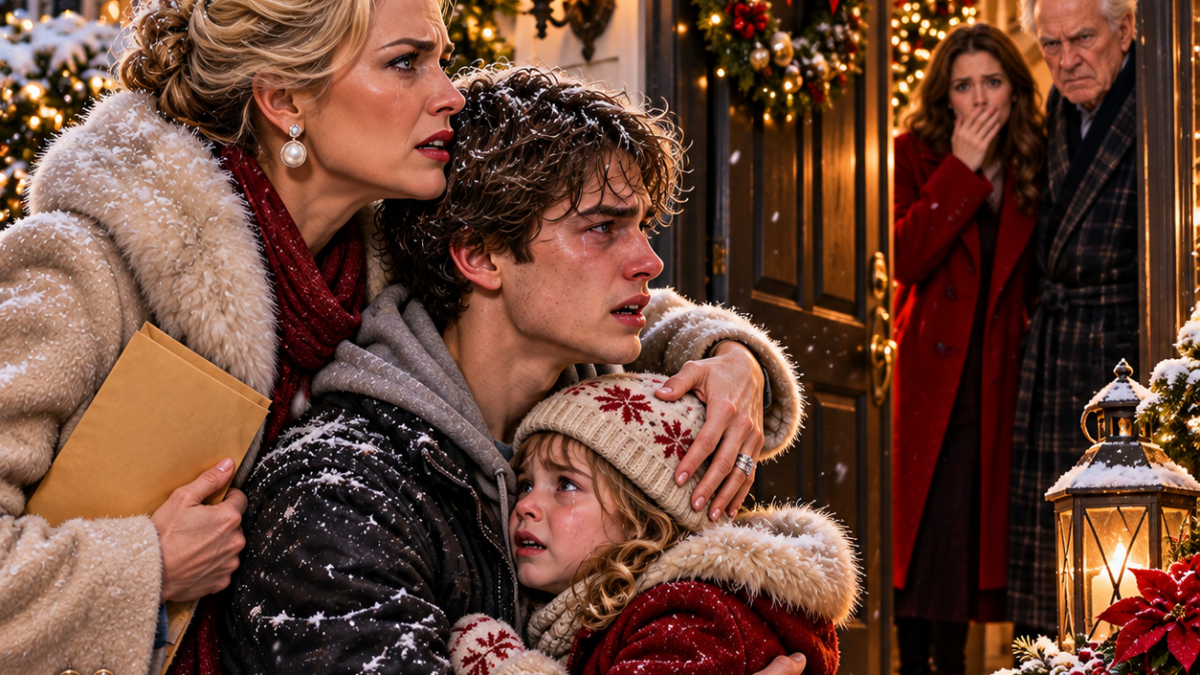
Leo continued.
“He said I shouldn’t ruin Christmas for everybody.”
There are moments when anger arrives hot.
Mine did not.
Mine froze.
“Listen carefully.”
“Okay.”
“Go around the left side of the porch.”
“There’s a cedar hedge near the stone wall.”
“Get behind it so the wind hits you less.”
“Keep moving your fingers.”
“Stamp your feet.”
“I’m coming.”
“Mom—”
“I’m coming.”
I hung up.
My foreman, Mike Alvarez, had climbed down the access ladder.
“What happened?”
“My son.”
He looked at my face and stopped asking.
“I’ve got the generator.”
“I know.”
I threw him the wrench.
Then I ran.
I did not wash my hands.
I did not change.
I did not care that my overalls were streaked with grease and copper dust.
I got into my old Ford F-250 and drove toward Caldwell Estate.
The Caldwells had spent years laughing at that truck.
Arthur called it “the mobile tetanus clinic.”
That night it became the only vehicle in my life that mattered.
Because my son was waiting for it.
PART2
The drive normally took a little over an hour.
That night, every mile felt like an accusation.
I called Leo every seven or eight minutes through the truck’s hands-free system.
“Still moving?”
“Yes.”
“Hands?”
“They hurt.”
“That’s better than numb.”
“Mom?”
“Yes?”
“Are you mad?”
“At you?”
“Yeah.”
“No.”
“I told Grandpa to shut up.”
“We’ll discuss your choice of wording later.”
A tiny laugh came through the phone.
Good.
Keep him talking.
“Mom?”
“Yes?”
“Dad said you’d make everything worse.”
That sentence hurt more than Arthur’s insult ever could.
“What do you think?”
“I don’t know.”
His voice broke.
“I just want to go home.”
“You’re going home.”
“Promise?”
“Yes.”
That promise required no lawyer.
No board vote.
No deed.
Just me.
I reached the Caldwell property shortly after ten.
The estate occupied seventeen acres outside Cincinnati.
Stone gates.
Heated driveway.
Columns.
Architectural lighting.
A mansion designed by people who believed wealth should be visible from space.
Snow covered the lawns.
Cars filled the circular drive.
Bentleys.
Mercedes.
Two Range Rovers.
One Aston Martin Arthur leased while lecturing employees about cost control.
The house glowed gold through huge bay windows.
Christmas tree in the main salon.
People inside.
Laughing.
I saw them.
Forty, maybe fifty guests.
Then my headlights found Leo.
He was crouched beside the front balustrade.
Backpack still on.
Knees against his chest.
I stopped so hard the truck slid several feet.
I jumped out.
“Leo!”
He stood.
Tried to walk.
His legs nearly folded.
I reached him.
His lips had gone pale.
His face was wet.
Tears or melting snow.
I did not know.
“Mom.”
“I’ve got you.”
I pulled off my canvas work coat and wrapped it around him.
His fingers were stiff.
Cold.
But responsive.
“Truck.”
I helped him down the steps.
“Heat all the way up.”
I gave him my keys.
He looked toward the house.
“Don’t go in.”
“I have to.”
“Mom.”
His voice carried real fear now.
“Dad’s mad.”
That sentence broke the final thread.
My son was worried that I might anger his father after his father had left him outside in dangerous cold.
I crouched.
“Leo.”
He looked at me.
“Your father’s anger is not your job.”
He blinked.
“Neither is Grandpa’s.”
“Okay?”
A tiny nod.
“Truck.”
“What are you going to do?”
“End something that should have ended a long time ago.”
He went.
I watched until the cab door closed.
Then I turned toward the house.
The front doors were locked.
I rang the bell.
Once.
Twice.
Through the glass, I saw a house employee look toward me.
Then toward someone else.
No door.
I knocked.
Hard.
Nothing.
Then Arthur appeared at the far end of the foyer.
He saw me.
Smiled.
Actually smiled.
And turned away.
That was when I stopped asking permission to enter.
One hard kick near the already-old latch.
The mahogany door burst inward with a deafening crack.
The brass hardware tore loose.
Conversation died.
Music stopped.
Every head turned.
I stepped across the threshold.
Grease on my clothes.
Snow melting from my boots.
Hair half escaped from its tie.
Exactly the woman they had always been embarrassed to have in their photographs.
Arthur Caldwell stood beside the Christmas tree holding bourbon.
His face turned purple.
“What the hell do you think you’re doing?”
“Getting my son.”
“He needs discipline.”
“He needed a parent.”
Julian stood near the fireplace.
Cream cashmere sweater.
Perfect hair.
Drink in his hand.
Warm.
He looked irritated.
Not frightened.
Not ashamed.
I think that hurt more than anything.
“Mara.”
He sighed.
“Can you not do this here?”
I stared.
“Do what?”
“Make a scene.”
I laughed once.
“You left our son outside in six-degree weather.”
“He was on the porch.”
“Outside.”
“He was being disrespectful.”
Arthur stepped closer.
“He called me a liar in my own home.”
“You called his mother garbage in front of him.”
Arthur scoffed.
“I called you a mechanic.”
“You called me a bottom-feeder laborer.”
“Same family of words.”
A few guests looked down.
Arthur raised his voice.
“This is a private family matter.”
“No.”
I looked at Julian.
“This became my matter when our child called me because his father would not open the door.”
Julian put his glass down.
“Leo was outside for twenty minutes.”
“Twenty minutes.”
“You hear yourself?”
“He had a coat.”
“Arthur grabbed him by that coat and put him out.”
Julian’s jaw tightened.
“He shoved past Dad.”
Leo had not said that.
Interesting.
“So you saw it?”
Julian hesitated.
That hesitation answered.
“You watched.”
“Mara—”
“You watched your father put our child outside.”
“He needed to apologize.”
“And until then?”
Julian said nothing.
“Until then what?”
I asked.
“He freezes?”
Someone gasped quietly.
Celeste Caldwell appeared.
My mother-in-law.
Pearls.
Red silk dress.
The expression of a woman inconvenienced by catastrophe.
“Don’t be vulgar, Mara.”
I turned.
“My son cannot feel his fingers.”
“He was being dramatic.”
“Come outside with me.”
Her face changed.
“What?”
“Take off that silk dress.”
“Put on one coat.”
“Sit on your front steps for twenty minutes.”
“Then tell me dramatic.”
Celeste’s mouth opened.
Nothing.
Arthur pointed toward the broken door.
“Get out of my house.”
That was when I remembered the envelope.
I had grabbed it from my truck’s locked console before walking up.
Not because I knew exactly what I would do.
Because for three months my attorney had told me never to go anywhere near a major Caldwell dispute without copies of our controlling documents.
I reached into my work bag.
Removed a thick envelope stamped in red.
Walked past Arthur.
Past Julian.
Past the staring guests.
And placed it on the banquet table.
Arthur laughed.
“What is that?”
“You should recognize it.”
He did not.
That told me how carefully he read anything that did not contain his own name in large letters.
Julian did.
His face changed.
“Mara.”
I looked at him.
“Don’t.”
Arthur picked up the first page.
Then another.
His eyes narrowed.
“What is Bennett Meridian Holdings?”
I almost smiled.
“My company.”
“No.”
“Yes.”
He looked at Julian.
Julian looked away.
That was the second betrayal of the night.
Not because Julian knew everything.
But because he knew enough.
Seven years earlier, Caldwell Development Group had nearly collapsed.
Arthur called it a “temporary liquidity event.”
Banks called it insolvency.
Three unfinished properties.
A construction lawsuit.
Two defaulting commercial loans.
And one very proud family desperate to keep its name off the bankruptcy pages.
At the time, my company was much smaller.
But profitable.
I had built it from my father’s diesel garage into a regional industrial-service business.
Fleet contracts.
Emergency power systems.
Commercial HVAC.
Heavy equipment.
Then infrastructure maintenance.
Dirty work.
Profitable work.
The kind of work Arthur mocked at dinner while depending on companies like mine to keep his properties functioning.
Julian came to me privately.
He said:
“If Caldwell goes down, Dad loses everything.”
I asked:
“What does that have to do with us?”
He said:
“They’re my family.”
So I helped.
Not with a check.
With a restructuring.
My attorneys created Bennett Meridian Holdings.
It acquired the distressed debt.
Converted part of that debt into equity.
Provided new working capital.
In exchange, I received sixty-eight percent voting control of Caldwell Development Group.
Arthur retained the chairman title for public appearances.
Julian became chief operating officer.
Celeste remained on the charitable foundation payroll.
Julian’s brother Grant ran acquisitions.
His sister Blair headed communications.
Three cousins held vice president titles that mostly seemed to involve lunch.
The family acted as though I had simply “introduced investors.”
Arthur never asked why the investors seemed extraordinarily patient.
Julian knew.
He had asked me to keep my control quiet because Arthur “couldn’t handle it.”
I agreed.
That was my mistake.
The estate itself was another matter.
Caldwell House had been collateral on one of Arthur’s loans.
When the bank prepared to foreclose, Bennett Meridian purchased the note.
Later, during the restructuring, the property deed transferred to our real-estate subsidiary under an occupancy agreement granting Arthur and Celeste residence while Arthur remained chairman and complied with the restructuring terms.
He had signed it.
His lawyer had reviewed it.
Arthur simply believed nothing could truly belong to someone like me if he still behaved as though it belonged to him.
I tapped the deed.
“This house is owned by Bennett Meridian Property LLC.”
Arthur stared.
“You are lying.”
“No.”
He looked at Julian.
“Tell her.”
Julian’s face had gone gray.
“Dad…”
Arthur slowly turned.
“You knew?”
Julian swallowed.
“Mara controls the holding company.”
Silence.
It was one of the most satisfying silences I have ever heard.
Grant Caldwell emerged from the crowd.
“What exactly does ‘controls’ mean?”
I looked at him.
“It means the grease monkey owns sixty-eight percent of the voting shares paying your salary.”
His face changed.
Blair whispered:
“That’s impossible.”
I nodded toward Julian.
“Ask him.”
Everyone looked at my husband.
He said nothing.
Celeste sat down.
Arthur threw the paperwork onto the table.
“This arrangement was temporary.”
“No.”
“It was a rescue.”
“Yes.”
“You were supposed to protect this family.”
I stared at him.
“I tried.”
“For seven years.”
“I protected your company.”
“Your property.”
“Your reputation.”
“I even protected you from knowing how dependent you were on a woman you considered beneath you.”
Arthur stepped closer.
“You cannot walk in here because a teenager threw a tantrum and seize a family business.”
“No.”
I agreed.
“That would be improper.”
A few people blinked.
Then I removed another packet.
“Fortunately, your employment review has nothing to do with Leo.”
Grant’s face drained.
That packet contained three months of findings from an independent audit.
I had commissioned it because our profit margins were deteriorating despite healthy revenue.
The results were ugly.
Arthur had charged personal travel to the company.
Grant had steered contracts toward two friends without required competitive review.
Blair’s department employed four people whose duties nobody could explain.
Celeste’s foundation office had billed company staff for private event planning.
Julian had repeatedly approved exceptions.
Not criminal fraud in some grand cinematic sense.
Something more ordinary.
Entitlement.
Thousands here.
Twenty thousand there.
Company cars.
Family trips.
Consulting retainers.
Nobody thought the rules applied because the company had always had their name.
My board had scheduled a January meeting.
My attorneys had already recommended restructuring management.
Christmas Eve did not create the evidence.
It simply removed my willingness to delay.
Arthur said:
“You wouldn’t dare.”
I looked at him.
“Arthur Caldwell, your employment as chairman of Caldwell Development Group is terminated for cause, effective immediately, subject to the formal board documentation already authorized under the control provisions.”
His mouth opened.
I turned.
“Grant, you are terminated.”
“What?”
“Blair.”
Her champagne glass shook.
“You’re terminated.”
Celeste stood.
“You cannot fire me from my own foundation.”
“The company funds your position.”
“My board controls that funding.”
“You’re terminated from company employment.”
Then Julian.
He stared at me.
“Mara.”
That one hurt.
For a second, I saw the man I married.
The man who once changed diapers at three in the morning.
Who slept in a hospital chair when I had pneumonia.
Who used to bring dinner to my garage because I forgot to eat.
That man had existed.
Maybe still did somewhere.
But tonight another man had sat beside a fire while our son froze outside because confronting Arthur would have been socially uncomfortable.
I looked him in the eye.
“Julian Caldwell.”
His face tightened.
“Do not do this.”
“Your position as chief operating officer is terminated.”
“Mara.”
“You’re fired.”
The room went dead.
Arthur erupted.
“You vindictive little—”
I cut him off.
“No.”
“I did not fire you because you insulted me.”
“I fired you because the audit shows you violated the policies of a company I legally control.”
“I did not fire Grant because he laughed when you called me trash.”
“I fired him because he ignored procurement rules and repeatedly awarded contracts without disclosure.”
“I did not fire Blair because she sat silent while Leo was outside.”
“I fired her because her department cannot account for hundreds of thousands in discretionary spending.”
Then I looked at Julian.
“And I am not firing my husband because he failed me.”
His eyes met mine.
“I am firing my COO because he signed approvals he had no authority to sign.”
Then softer:
“What happens to my husband will be handled separately.”
Julian looked like I had slapped him.
Good.
Arthur pointed toward the foyer.
“Leave.”
I smiled faintly.
“Gladly.”
Then I looked around.
“And because there seems to be confusion—none of the guests have to leave.”
“This is still Christmas Eve.”
“The catering is paid through midnight.”
“The house staff will be paid double for tonight.”
“But Arthur?”
I looked at him.
“Tomorrow morning, my property attorney will contact you regarding the occupancy agreement.”
He stared.
“You can’t throw us out.”
“Tonight?”
“No.”
“I am not you.”
That line traveled through the room like electricity.
I turned toward the broken door.
Then stopped.
“One more thing.”
Julian looked at me.
“If Leo is not exactly where I left him when I reach that truck, this becomes a very different conversation.”
He did not move.
Nobody did.
I walked out.
My boots left black grease marks across the white marble.
For once, I did not apologize.
Leo was in the truck.
Heat blasting.
My coat around him.
He looked terrified when I opened the door.
“Mom?”
“I’m here.”
“Did you fight?”
“Some.”
“Is Dad coming?”
The question hurt.
“No.”
Leo looked toward the house.
Then down.
“Okay.”
Not relief.
Not disappointment.
Both.
“We’re going to the hospital.”
“I’m fine.”
I almost laughed.
“Absolutely not.”
“I can feel my fingers.”
“Great.”
“A doctor will celebrate with us.”
I drove.
Halfway there, Leo asked:
“Are Grandpa and Dad mad?”
“Yes.”
“Because of me?”
There it was again.
Children always look for themselves in the wreckage adults create.
“No.”
“Leo, look at me.”
He did.
“You defended me.”
“You used language I would prefer you not use with your grandfather.”
“But nothing you said made an adult put you outside.”
“That was Arthur’s decision.”
“Your father choosing not to bring you back in was your father’s decision.”
“Whatever happens next is because of adult decisions.”
“Not yours.”
He stared.
“Did you really fire Dad?”
“Yes.”
His eyes widened.
“From work.”
“Yes.”
“Are you firing him from being my dad?”
That question almost forced me off the road.
“No.”
I answered carefully.
“I can end a marriage.”
“I can end employment.”
“I cannot erase your father.”
“He is your dad.”
“What happens between you and him will depend on how he behaves from here.”
Leo looked out the window.
“He picked Grandpa.”
“I know.”
That was all I could say.
At the emergency department, Leo was diagnosed with mild cold exposure.
No frostbite.
No lasting injury.
Warm fluids.
Observation.
His hands hurt as circulation returned.
I sat beside him.
At 12:07 a.m., Christmas officially arrived.
Leo looked at the digital clock.
“Merry Christmas.”
I almost cried.
“Merry Christmas, kiddo.”
Our tree was at home.
Presents unopened.
Turkey in refrigerator.
My husband somewhere else.
I had grease beneath my fingernails.
Leo wore hospital socks.
Worst Christmas.
Best Christmas.
Because my son was warm.
At 12:32, Julian arrived.
Leo saw him through the glass.
His entire body changed.
Shoulders tense.
Eyes down.
I noticed.
Julian entered carrying no coat.
He looked wrecked.
“Mara.”
I stood.
“Not here.”
“I need to see him.”
“You can ask him.”
His face tightened.
“I am his father.”
“Yes.”
“Which is why you should understand that he gets to decide whether he wants you beside his hospital bed tonight.”
Julian looked at Leo.
“Buddy?”
Leo did not look up.
Julian moved closer.
“I’m sorry.”
Silence.
“I should have brought you inside.”
Leo whispered:
“Why didn’t you?”
Julian froze.
I stepped back.
This answer belonged to him.
He sat slowly.
“I thought Grandpa would calm down.”
“That’s not what I asked.”
Julian’s face broke a little.
Leo looked at him.
“Why didn’t you open the door?”
Julian tried:
“I didn’t want things to get worse.”
Leo said:
“For who?”
My fourteen-year-old son asked the question every adult in that family had avoided.
Julian had no answer.
Leo’s eyes filled.
“You were warm.”
Julian looked down.
“You were right there.”
“I know.”
“And you told me to apologize.”
“I know.”
“Grandpa called Mom garbage.”
“I know.”
“So why was I the one outside?”
Julian began crying.
I had almost never seen him cry.
Leo did not comfort him.
Good.
Julian said:
“I was afraid of my father.”
That surprised both of us.
Leo stared.
Julian continued.
“I have spent my whole life trying not to make him angry.”
“That isn’t an excuse.”
Leo answered.
“No.”
Julian nodded.
“It isn’t.”
My son turned his face toward the wall.
“I don’t want you here.”
Julian closed his eyes.
Then stood.
For once, he did not argue.
“Okay.”
At the door he looked at me.
“We need to talk.”
“Tomorrow.”
“Mara, the company—”
I laughed.
He stopped.
“Our son is in a hospital bed and you almost said ‘the company.’”
He looked ashamed.
“Tomorrow.”
I repeated.
He left.
Leo whispered:
“Is Dad bad?”
There are questions parents should not answer for children if truth is more complicated.
“No.”
I said.
“Your dad made a bad choice.”
“A very serious one.”
“Adults can love you and still fail you.”
“What matters now is whether they take responsibility and change.”
Leo nodded.
“Grandpa won’t.”
Probably not.
I did not say it.
Christmas morning, Natalie arrived with coffee and Leo’s presents.
My sister looked at my clothes.
“You smell like hydraulic fluid.”
“Apparently that’s my brand.”
Leo laughed.
Good.
Natalie had already heard most of the story.
News travels quickly in wealthy families with group chats.
She leaned toward me.
“You kicked the door?”
“Technically.”
“You’re replacing it.”
“Yes.”
“Good.”
She smiled.
“Still worth it.”
We went home at noon.
Our house looked ordinary.
That was comforting.
Leo went upstairs.
I stood in the kitchen.
Julian’s coffee mug beside the sink.
His coat hanging near the garage.
Shoes.
A life.
Marriage does not stop occupying space simply because trust disappears.
My phone contained eighty-three notifications.
Arthur.
Celeste.
Grant.
Blair.
Board members.
Lawyers.
Employees.
Journalists somehow.
I turned it off.
Christmas Day belonged to Leo.
We reheated food.
Opened presents.
Watched a terrible action movie.
At one point Leo said:
“This Christmas sucks.”
“Yes.”
Then:
“Except you fired everybody.”
I tried not to laugh.
Failed.
“You are not allowed to enjoy people losing jobs.”
“I can enjoy Grandpa losing his.”
“Privately.”
“Deal.”
Two days later, the real work began.
Movies end after the dramatic speech.
Life begins there.
My board convened.
The audit findings were reviewed.
Every termination was confirmed through proper process.
Arthur called it a coup.
It was not.
A coup seizes power you do not legally possess.
I already possessed it.
I had simply spent years pretending otherwise to protect Julian’s pride.
That ended.
Grant threatened litigation.
His attorney quietly advised him not to.
Blair negotiated severance in exchange for waiving claims and returning company devices.
Celeste resigned from three ceremonial boards before anyone could remove her.
Arthur refused to accept anything.
For forty-eight hours he continued calling himself chairman in emails.
Our IT department disabled his account.
That was the first consequence he seemed to understand.
The estate was more complicated.
I did not evict Arthur and Celeste on December 26.
Despite what everyone expected.
I gave them ninety days under the occupancy agreement.
Why?
Because power is not proven by cruelty.
Arthur had put my child outside.
I was not going to become him.
He called the ninety days humiliation.
I called them generous.
The property later became part of a corporate retreat and training center.
The main dining room where Arthur had called me a grease monkey became a classroom for our apprenticeship program.
I did enjoy that.
A lot.
Arthur moved into a luxury condominium.
Celeste moved with him.
Apparently twelve thousand square feet had been essential to their dignity until they had to pay for it themselves.
Grant found a job at a development firm in another state.
Lower title.
Actual accountability.
Blair started her own communications consultancy.
To her credit, she eventually built something respectable.
I can acknowledge that.
Not everyone needs permanent punishment.
Julian was different.
He came home three days after Christmas.
Not to move back in.
To pack.
I had already spoken to a family-law attorney.
Leo was at Natalie’s house.
Julian stood in our bedroom surrounded by suitcases.
“You’re really divorcing me.”
“Yes.”
“Because of one night.”
“No.”
He looked up.
“Then what?”
“Because one night showed me what years had become.”
He stared.
I continued.
“You let your father insult me.”
“I ignored it because I thought defending myself would make me insecure.”
“You stopped bringing me to company dinners because you said my work clothes embarrassed him.”
“You asked me not to talk about where I started when investors were around.”
“You let your mother call me ‘rough around the edges’ in front of Leo.”
“I told myself none of it mattered because we loved each other at home.”
Julian sat on the bed.
“We did.”
“Yes.”
“That’s what makes this hurt.”
He covered his face.
“I never stopped loving you.”
“I believe you.”
He looked up.
“Then why?”
“Because love without loyalty eventually becomes a private hobby.”
He flinched.
“I was loyal.”
“To me?”
“Yes.”
“Christmas Eve.”
His face collapsed.
One example.
Enough.
“I froze.”
He whispered.
“No.”
I shook my head.
“Leo froze.”
“You stayed warm.”
Julian cried.
I did too.
That was the hardest part.
He was not a cartoon villain.
He was weak.
Sometimes weakness does as much damage as malice.
He said:
“I thought if Leo apologized, Dad would let him back in.”
“You accepted the premise.”
“What?”
“That Arthur had the right to put him out until he submitted.”
Julian looked down.
“I’ve lived like that my whole life.”
“I know.”
“That doesn’t mean Leo has to.”
Silence.
Then Julian said something I respected.
“You’re right.”
No but.
No explanation.
Just right.
He moved into an apartment.
We established temporary parenting arrangements through counsel.
Leo did not want overnight visits initially.
Julian accepted supervised daytime contact.
Not because a court forced it at first.
Because for once he listened.
He entered therapy.
So did Leo.
So did I.
Family damage does not disappear because one woman delivers a satisfying speech at Christmas dinner.
Healing is repetitive.
Unimpressive.
Appointments.
Apologies.
Boundaries.
Showing up.
Six weeks after Christmas, Julian came to one of Leo’s therapy sessions.
The counselor asked Leo what he needed his father to understand.
Leo looked at the floor.
Then said:
“I need you to pick me when Grandpa is mad.”
Julian began crying.
“I will.”
Leo looked up.
“You said that before.”
That sentence devastated him.
Good.
Promises should hurt when you have broken them.
Julian answered differently.
“You’re right.”
“I have to show you.”
That was better.
Over the next year, he did.
Not perfectly.
Arthur called.
Julian stopped answering when Arthur insulted me or Leo.
Arthur threatened to cut him out of the family trust.
Julian said:
“Do what you need to do.”
Arthur did.
Julian lost millions on paper.
For the first time in his life, he paid his own rent from money he earned.
Not family money.
Not Caldwell money.
His own.
He took a job outside Bennett Meridian.
Lower salary.
No executive title.
Operations manager for a regional manufacturer.
He hated it at first.
Then, unexpectedly, he became good at it.
I watched from a distance.
We never reconciled as husband and wife.
That matters.
Change does not entitle someone to get back what they broke.
But he became a better father.
That mattered more.
A year after Christmas, Leo agreed to spend Christmas Eve with Julian for dinner.
At Julian’s apartment.
No Arthur.
No Celeste.
Just pizza.
I drove Leo over.
Julian opened the door.
He looked at me.
“Merry Christmas.”
“Merry Christmas.”
Leo turned.
“Mom?”
“Yeah?”
“If Dad puts me outside, can I call you?”
Julian closed his eyes.
I stared at Leo.
Then saw the smirk.
Teenage humor.
Julian said:
“I deserved that.”
Leo laughed.
So did I.
That was progress.
Arthur never apologized properly.
Not once.
He sent a letter through his attorney claiming he regretted “the misunderstanding.”
I returned it.
No reply.
Later, he called Leo directly.
I only learned because Leo told me.
“What did he say?”
“He said families should forgive.”
“What did you say?”
Leo shrugged.
“I said forgiveness doesn’t mean I have to eat Christmas dinner with you.”
I almost applauded.
“Then?”
“He got mad.”
“Of course.”
“I hung up.”
Good boy.
Arthur and Leo remained distant.
That was Arthur’s consequence.
Not losing the mansion.
Not losing the title.
Losing access to a grandson who had once adored him.
People underestimate relational consequences because they do not come with legal paperwork.
They are often the heaviest.
Celeste eventually asked to meet me.
Almost two years later.
A café.
She looked smaller outside the estate.
Less like a dynasty.
More like an aging woman.
“I owe you an apology.”
I waited.
“For what?”
She seemed surprised.
“Christmas.”
“Which part?”
Her face tightened.
I was not going to help.
“For allowing Arthur to put Leo outside.”
“You did more than allow it.”
She looked down.
“I said he needed to learn respect.”
“Yes.”
“I was wrong.”
“Yes.”
“I also treated you badly for years.”
“Yes.”
She almost smiled.
“You’re going to make me say everything.”
“Yes.”
So she did.
Mechanic jokes.
Class comments.
Insults about my father.
Comments about my clothes.
The assumption that my money somehow counted less because I earned it with work they considered dirty.
Finally:
“I was ashamed that my son married someone we considered socially beneath us.”
I nodded.
“And then?”
“And then your company saved ours.”
“And you still considered me beneath you.”
She closed her eyes.
“Yes.”
“Why?”
Her answer was almost interesting.
“Because admitting what you were would have required admitting what we were.”
That was the first honest Caldwell sentence I had heard in years.
“What were you?”
“Dependent.”
There it was.
I accepted her apology.
Not friendship.
Not renewed family closeness.
Just the apology.
She saw Leo occasionally later.
On his terms.
Arthur never got that far.
My company changed too.
I removed the Caldwell name from the development division after a shareholder vote.
Not from spite.
The brand had become associated internally with entitlement and poor controls.
We folded it into Bennett Meridian Development.
Arthur called it erasing his legacy.
I called it rebranding.
Then we did something I had wanted for years.
We created a paid apprenticeship program for young mechanics, electricians, welders, HVAC technicians, and industrial-maintenance workers.
No tuition.
Paid training.
Tools supplied.
Mentors.
Career tracks.
Arthur once told a banquet table:
“People who turn wrenches are people who weren’t clever enough to own the building.”
That sentence became unofficial motivation.
Our first graduating apprenticeship class had forty-two people.
I stood on a small stage wearing clean work boots.
Leo sat in the front row.
Seventeen by then.
Tall.
Nearly six feet.
When I finished speaking, he yelled:
“GREASE MONKEY!”
The room froze.
Then I started laughing.
Everyone else did too.
I pointed at him.
“You’re grounded.”
He grinned.
Afterward, one apprentice asked:
“Is that really what your in-laws called you?”
“Among other things.”
She smiled.
“Pretty expensive mistake.”
Yes.
It had cost them control of a company.
But the truth was more complicated.
The Caldwells did not lose because they insulted a mechanic.
They lost because they had built an entire worldview around believing certain people did not matter.
Workers.
Staff.
Contractors.
Me.
Eventually Leo.
Entitlement is rarely selective.
Once you believe dignity belongs only to your class, you begin rationing it everywhere.
That is what destroyed them.
Not me.
By the time Leo graduated high school, he knew exactly what he wanted.
Mechanical engineering.
I laughed.
“You know there are easier ways to rebel against your father.”
He said:
“I’m rebelling against Grandpa.”
“Fair.”
He spent summers in our shops.
Not because I forced him.
He wanted to learn.
His first month, nobody called him the owner’s son.
At my request.
He swept floors.
Sorted parts.
Learned safety.
Ruined two shirts.
Burned a glove.
Came home smelling like diesel.
One evening Julian picked him up.
I happened to be outside.
Leo climbed into his car in greasy coveralls.
Julian looked at him.
Then at me.
For half a second, old Julian appeared.
The one ashamed of dirt.
Then he smiled.
“Good day?”
Leo said:
“Rebuilt a fuel pump.”
Julian nodded.
“Cool.”
Small moment.
Huge.
After they left, I stood alone in the parking lot.
My father had taught me how to rebuild a diesel injector when I was twelve.
Arthur once called him “a man with grease where ambition should be.”
My father died before Bennett Industrial became large.
He never saw the headquarters.
The acquisitions.
The boardroom.
But I think he would have liked Leo in those coveralls.
Not because dirty work is morally superior.
Because knowing how things work teaches humility.
Machines do not care about surnames.
Neither do frozen pipes.
Power systems.
Engines.
Buildings.
Eventually, neither does life.
At twenty, Leo asked me something unexpected.
“Do you regret kicking the door?”
I smiled.
“Financially?”
“It cost fourteen thousand dollars to replace.”
He stared.
“Fourteen thousand?”
“Custom mahogany.”
“Mom.”
“I paid.”
“Still.”
I laughed.
“Do I regret it?”
I thought.
“Yes.”
That surprised him.
“Really?”
“I regret that I reached a point where kicking the door felt like the only way to make anyone look outside.”
He nodded slowly.
“Would you do it again?”
“For you?”
“Yes.”
“Probably.”
He grinned.
“Good.”
Then he said:
“I remember you walking in.”
“You weren’t inside.”
“I saw through the window from the truck.”
I had never known.
“What did you think?”
Leo was quiet.
Then:
“That nobody was going to make me go back out.”
That sentence erased fourteen thousand dollars instantly.
“Good.”
He looked at me.
“I knew you were mad.”
“I was.”
“But not at me.”
“No.”
“That was the important part.”
Parents rarely know what children preserve.
Not the deed.
Not the firing.
Not the dramatic entrance.
He remembered the direction of my anger.
Away from him.
Toward the adults who had failed him.
That mattered more than everything else.
Years later, when Leo got married, Julian sat two rows behind me.
We had become cordial.
Not friends.
Not enemies.
Co-parents who had survived ourselves.
Arthur was not invited.
Celeste was.
She cried during ceremony.
I did too.
Julian leaned forward afterward.
“Remember that Christmas?”
I looked at him.
“How could I forget?”
He smiled sadly.
“I’m sorry.”
He had apologized a hundred times by then.
This one felt different.
“Thank you.”
He looked toward Leo.
“You saved him from us.”
I shook my head.
“No.”
“Leo saved himself enough to call.”
“I just answered.”
That is something I believe now.
Children sometimes send signals adults do not want to receive because receiving them demands conflict.
Leo called.
I answered.
That night changed everything because I refused to ask him to endure more for the convenience of adults.
After the wedding, Leo found me outside.
“Mom.”
“What?”
He handed me a small box.
Inside was a brass door hinge.
Old.
Scratched.
“What is this?”
He smiled.
“One of the hinges from Caldwell House.”
I stared.
“Where did you get that?”
“When the training center renovation happened, I asked the contractor to save one.”
“You have kept a door hinge for six years?”
“Yep.”
“Why?”
He turned it over.
Someone had engraved words on the back.
SOMETIMES YOU HAVE TO OPEN THE DOOR YOURSELF.
I laughed until I cried.
“You are so dramatic.”
“Genetic.”
“Not from me.”
“Sure.”
I kept the hinge.
It sits in my office today.
Not because I think kicking doors is a life philosophy.
Please don’t.
It is there because of what the door represented.
For years, I had stood outside the Caldwell family emotionally.
Allowed in when useful.
Mocked when inconvenient.
Expected to fund without leading.
Work without status.
Smile at insults.
Keep peace.
Julian had spent his life trapped inside that house in another way.
Leo was the first person young enough to say:
This is wrong.
That night, Arthur physically put him outside.
And Julian—still emotionally inside the Caldwell hierarchy—asked his own son to apologize for the privilege of being let back in.
I could not let that become Leo’s inheritance.
So I broke something.
Not just the latch.
The pattern.
Arthur died years later.
Leo chose not to attend the funeral.
That was his decision.
Celeste attended, obviously.
Julian did.
I did not.
I sent flowers.
No message beyond my name.
I did not hate Arthur by then.
Hate requires maintenance.
I had more useful things to maintain.
Businesses.
Friendships.
A relationship with my son.
My own peace.
Arthur’s death did not erase what he had done.
It also did not require me to spend another ounce of life punishing him.
That was freedom.
Caldwell Estate became one of our most successful training centers.
The ballroom where they had once hosted executives became a simulation lab for building systems.
The library became classrooms.
Guest suites became temporary housing for apprentices coming from rural counties.
And the front foyer?
We repaired the door.
Of course.
But I kept one design choice.
Beside the entrance, a bronze plaque reads:
BENNETT MERIDIAN SKILLED TRADES ACADEMY
Below it:
DIGNITY DOES NOT DEPEND ON THE WORK YOU DO.
IT DEPENDS ON HOW YOU TREAT THE PEOPLE DOING IT.
I never put Arthur’s name anywhere.
That bothered some people.
Not me.
On the fifth anniversary of that Christmas, Leo and I stood in the foyer watching a new group of apprentices arrive.
Work boots.
Tool bags.
Nervous faces.
One young man tracked slush onto the floor.
A facilities supervisor rushed for a mop.
I looked down.
Same kind of stone floor.
Same entrance.
Years earlier, I had crossed it dripping snow and grease while fifty rich people stared at me like dirt had become human.
Now workers walked through the front door because the building existed for them.
Leo noticed me staring.
“You okay?”
“Yes.”
He smiled.
“Real answer.”
Apparently everyone in my family had learned that annoying habit.
I laughed.
“I was remembering.”
“That night?”
“Yes.”
“Good memory?”
“No.”
Then I looked around.
“Good result.”
Leo nodded.
Outside, snow was beginning to fall.
He shoved his hands into his coat.
For one second, I saw fourteen-year-old Leo behind the cedar hedge.
Shaking.
Calling me.
I reached out automatically.
Touched his shoulder.
He looked confused.
“What?”
“Nothing.”
He was warm.
That was enough.
People have asked me over the years whether saying “every single one of you is fired” felt as good as it sounds.
Yes.
For approximately thirty seconds.
Maybe forty-five.
Then I had to take my son to the hospital.
Meet lawyers.
Untangle a company.
End a marriage.
Help a child understand his father’s cowardice was not his fault.
Build new boundaries.
Repair trust.
Grow up in several ways I should have learned earlier.
Revenge is a moment.
Consequences are a process.
The satisfying part was never Arthur’s face when he learned I controlled the company.
It was not Celeste discovering the estate was not hers.
It was not Grant losing his title.
Not Blair losing the company credit card.
Not Julian packing a suitcase.
The satisfying part came years later.
Leo walking into my workshop without embarrassment.
Julian learning to tell his father no even when it cost him money.
Celeste saying the word “wrong” without adding “but.”
A mansion built for status becoming a school for people the Caldwells once mocked.
My son growing into a man who knew that respect did not mean submission.
Those were the victories.
And me?
I stopped apologizing for the grease.
I still own the company.
I still sometimes crawl beneath equipment.
My executives complain.
They say the CEO should not be under a compressor with a wrench.
I tell them:
“Then fix it before I get there.”
At sixty, my knees object more than they once did.
But occasionally I still come home with black beneath my fingernails.
I like it.
It reminds me where I came from.
My father’s garage.
Cold mornings.
Diesel engines.
Work that solved real problems.
Nothing Arthur ever said could make that history cheap.
Only I could have done that by becoming ashamed of it.
I almost did.
Because Julian was ashamed.
Because wealthy people laughed.
Because I wanted peace.
That is another lesson I carry.
Never shrink a part of yourself your child may one day need permission to be proud of.
Leo once told me:
“When Grandpa called you a grease monkey, I got mad because I knew how hard you worked.”
He did not see humiliation.
He saw competence.
Children watch what we are ashamed of.
They learn from that too.
So I stopped.
The last Christmas before Leo moved across the country for work, he came home on December 24.
Just the two of us at first.
Julian came later for dessert.
Yes.
We reached that place.
Not friendship between us exactly.
Peace.
Leo arrived wearing a brand-new jacket.
He handed me an envelope.
Inside was a photograph.
Fourteen-year-old Leo beside my old Ford.
Taken the year after Caldwell Christmas.
Grease on his nose.
Me beside him.
Under the photograph he had written:
TO THE SMELLY GREASE MONKEY WHO ALWAYS CAME WHEN I CALLED.
I laughed.
Then cried.
He hugged me.
“You know that’s going on my office wall.”
“I assumed.”
Julian arrived twenty minutes later carrying pie.
He saw the photograph.
Read it.
His expression changed.
“I deserved that too.”
Leo looked at him.
“Different card.”
Julian smiled.
We ate dinner.
No Arthur.
No crystal banquet table.
No hierarchy.
Just people.
At one point Julian raised his glass.
“To Mara.”
I narrowed my eyes.
“For what?”
He looked at Leo.
Then me.
“For opening the door.”
Leo almost choked laughing.
“Dad.”
“What?”
“That’s terrible.”
“I thought it was poetic.”
“It’s awful.”
I laughed harder than either of them.
And that is the version of Christmas I choose to remember now.
Not the snow.
Not Arthur.
Not the broken mahogany.
Not the fifty guests.
Warm kitchen.
My son safe.
My ex-husband finally humble enough to laugh at himself.
A cheap pie.
Grease still occasionally under my nails.
And nobody in the room believing that love required anyone to stand outside and beg to be let back in.
Because that was the lesson I wanted Leo to keep.
Not that his mother owned the house.
Not that his mother controlled the company.
Not that money can defeat cruelty.
Money helped me exercise legal power that night.
But money was not why I went through that door.
I would have gone through it if I owned nothing.
I would have gone through it if Arthur owned every building in Ohio.
I would have gone through it wearing exactly what I was wearing—grease, sludge, steel-toe boots and all.
Because my son called.
He said:
“Mom, please come get me.”
And I did.
Everything after that—
the deed,
the company,
the firings,
the divorce,
the estate,
the academy—
was consequence.
The only decision that mattered happened before I ever reached the Caldwell driveway.
My child was cold.
My child was frightened.
My child believed the adults inside had chosen a Christmas party over him.
And I needed him to learn one thing before that belief hardened into something he carried for the rest of his life:
Someone would choose him.
Every time.
No apology required.
No family name required.
No money required.
No perfect manners required.
No begging at the door.
So yes.
I kicked it open.
And if you ask Leo what he remembers most about that night, he will not tell you about his grandfather losing the company.
He will not tell you about the deed.
He will not tell you about the guests.
He will tell you about an old Ford pulling into the driveway.
About headlights crossing the snow.
About a woman in filthy overalls jumping out before the engine had completely stopped.
About my coat going around his shoulders.
About the keys landing in his palm.
And about five words I said before I turned toward the house:
“You are coming home with me.”
That was the real victory.
Everything else was just paperwork.








