PART 2:“LET HER D!E—WE’RE IN MAUI!” My Husband Ignored 30 Calls While His Mother Lay Dying in Hospice, and His Mistress Mocked Me for Begging Him to Come Back—But Before Nora Took Her Last Breath, She Pressed a Silver Key Into My Hand and Whispered: “DON’T LET HIM TAKE WHAT I LEFT YOU…”
PART 2 and FULL ENDING  Thank you

Nothing.
Julian had told me he was in Dallas finalizing a major commercial agreement for Bennett Transportation Group, the company his father had founded and Nora still partly owned.
I called his assistant.
Voicemail.
His hotel.
No reservation under his name.
Something cold began spreading through me.
At call number thirty, Nora opened her eyes.
“You still trying?”
Her voice was weak.
“Yes.”
She almost smiled.
“Stubborn.”
“Takes one to know one.”
Then I pressed call number thirty-one.
Someone answered.
Not Julian.
A woman.
Young voice.
Annoyed.
Ocean noise behind her.
“Julian is in the shower.”
I froze.
“Who is this?”
A pause.
Then a soft laugh.
Not nervous.
Possessive.
“We’re in Maui.”
The room disappeared around me.
“What?”
“I said Maui.”
Then, with open irritation:
“Stop harassing us.”
She hung up.
I stared at the phone.
Nora stared at me.
She had heard everything.
Every word.
There was no way to protect her from it.
“I’m sorry.”
My voice broke.
“He isn’t coming.”
Nora did not cry.
That was somehow worse.
Her face changed only slightly.
As if a final question had just been answered.
Then she slowly reached beneath her pillow.
Her hand shook.
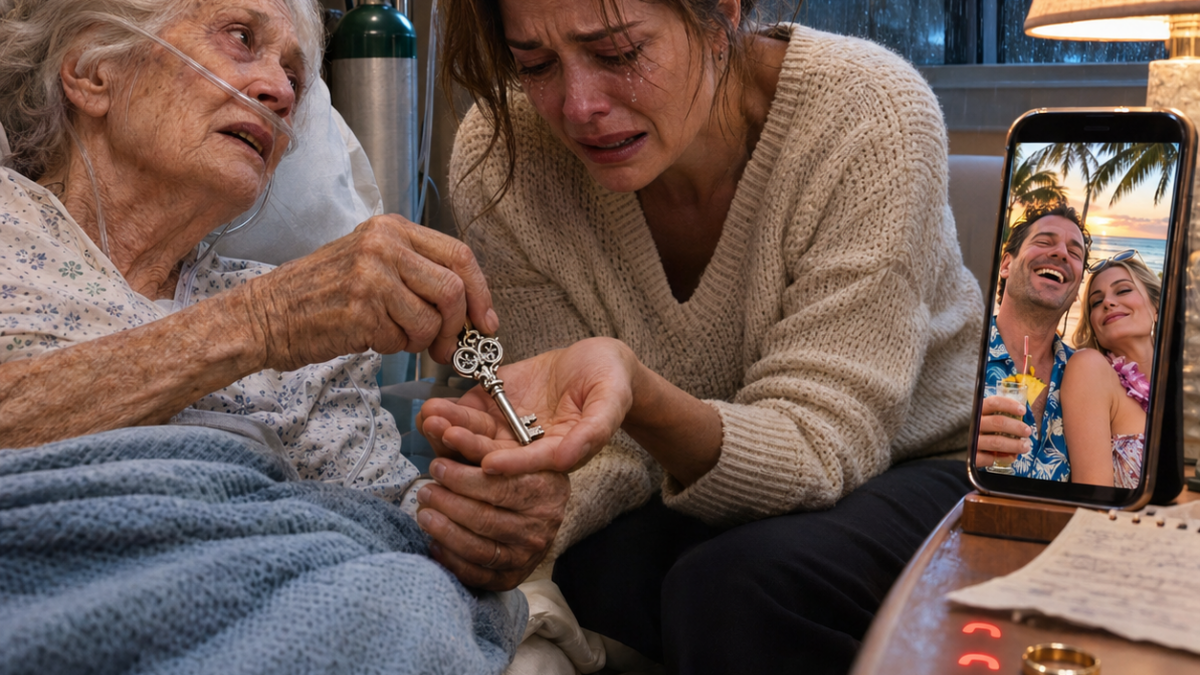
When it emerged, an old silver key rested between her fingers.
Small.
Heavy.
Worn smooth along one edge.
She pushed it toward me.
I bent closer.
“Take it.”
“Nora—”
“Take it.”
I closed my palm around the key.
Her fingers wrapped around mine with shocking strength.
“Arthur.”
I knew the name.
Arthur Vance.
Her estate attorney.
“What about Arthur?”
“Tomorrow.”
She struggled for air.
Then whispered:
“Don’t give it to Julian.”
PART2
I leaned closer.
“Nora, what does it open?”
Her eyes found mine.
“Truth.”
One word.
Then, after a long breath:
“He thinks…”
She stopped.
I waited.
“He thinks I don’t know.”
“Know what?”
Her grip tightened.
“Everything.”
Twenty minutes later, Nora Bennett died holding my wrist.
No son beside her.
No Julian.
No final goodbye.
Only me.
A nurse silenced the monitor.
Dr. Patel came in.
Someone removed the oxygen cannula.
Someone asked whether there was family to notify.
I looked at my phone.
Thirty-one outgoing calls.
Zero answered by my husband.
I whispered:
“He knows where we are.”
I stayed until nearly dawn.
Then I went home long enough to shower, change clothes, and put the silver key into the inside pocket of my coat.
At 8:47 the next morning, I walked into Vance, Holloway & Pierce.
Arthur Vance was seventy-three.
Thin.
Immaculate.
Silver glasses.
The kind of attorney who looked as though he ironed newspapers before reading them.
His receptionist called him.
He appeared within seconds.
“Evelyn.”
His expression changed immediately.
“Nora?”
I nodded.
Arthur closed his eyes.
“When?”
“Last night.”
“I’m sorry.”
Then I opened my hand.
The silver key rested on my palm.
Arthur stared at it.
Every trace of grief disappeared beneath professional focus.
“Where did you get that?”
“She gave it to me before she died.”
His eyes lifted.
“Did Julian see it?”
“No.”
Arthur crossed the lobby.
Closed his office door.
Locked it.
Then pulled the blinds.
My heartbeat changed.
“Arthur.”
He looked at me.
“Sit down.”
“What is going on?”
Instead of answering, he went to a floor safe concealed behind a cabinet.
Entered a code.
Removed a dark mahogany box.
About the size of a legal file case.
He placed it on the desk.
The lock on the front was small.
Silver.
My key fit perfectly.
Arthur did not turn it.
He pushed the box toward me.
“She wanted you to open it.”
My fingers felt numb.
I inserted the key.
Turned.
Click.
Inside were folders.
Bank statements.
Property deeds.
Corporate records.
Insurance policies.
Copies of tax filings.
Loan documents.
A thick manila folder with my name written in Nora’s unmistakable block handwriting.
EVELYN
On top lay a letter.
Arthur nodded.
“Read that first.”
I unfolded it.
Evelyn,
If you are reading this, I am gone, and either Julian finally became the man I feared he had become, or I ran out of time before I could stop him myself.
My hands started shaking.
I continued.
You have spent twenty years taking care of me while my son found reasons not to. I accepted your loyalty for too long without telling you what I knew. For that, I am sorry.
Then:
Do not allow Julian to turn your loyalty into a weapon against you.
My throat tightened.
Beneath the letter were documents.
Arthur began lifting them out.
Commercial loan guarantees.
Corporate lines of credit.
Refinance agreements.
Indemnity bonds.
Three separate financial institutions.
Several corporate entities I recognized only vaguely.
And on each document—
my name.
My signature.
Or something that looked almost exactly like it.
I stared.
“What is this?”
Arthur said nothing.
I picked up the first guarantee.
Evelyn Bennett, Personal Guarantor.
Amount:
$850,000.
Second.
$1.2 million.
Third.
$640,000.
Additional obligations.
Equipment financing.
Default exposure.
Legal fees.
By the time Arthur finished arranging the papers, the total possible liability exceeded three million dollars.
I looked at him.
My hands were shaking so violently that one page slipped to the floor.
“I never signed these.”
“I know.”
“What?”
“I said I know.”
I stood.
“Then why is my name on them?”
Arthur’s face became hard.
“Because Nora believed Julian had been manufacturing an exit strategy.”
The room seemed to tilt.
“What does that mean?”
Arthur leaned both palms against the desk.
“It means she believed your husband had been moving corporate risk into entities designed to fail and attaching your name to enough of the debt that, if your marriage ended badly, creditors would come after you.”
I stopped breathing.
“No.”
“She began noticing irregularities eighteen months ago.”
“Why didn’t she tell me?”
“She wanted proof.”
I laughed once.
It sounded ugly.
“She was dying.”
“She was also Nora.”
Fair.
Arthur continued.
“She hired a forensic accounting firm.”
He lifted another folder.
“Quietly.”
Inside were reports.
Timelines.
Email extracts obtained through corporate discovery and internal records Nora had lawful access to as an owner and director emerita.
Payment flows.
Entity structures.
Loan dates.
Then a chart.
My name appeared again and again.
Arthur said:
“Nora suspected your signatures were not genuine.”
“They aren’t.”
“We have preliminary handwriting analysis supporting that.”
My knees weakened.
I sat.
“Who signed them?”
“We don’t know yet.”
“Julian?”
“We have suspicions.”
“That is not evidence.”
Arthur looked at me with something like approval.
“No.”
“It isn’t.”
Even while my life collapsed, part of me still knew better than to turn suspicion into fact.
Then Arthur opened another envelope.
“However, we do have evidence he knew the guarantees existed.”
Emails.
Julian to the company’s CFO.
Julian to outside lenders.
Julian to a finance consultant.
One line burned itself into me.
Evelyn has agreed to backstop the exposure. She wants no operational role, so keep communication through me.
I read it again.
And again.
My stomach turned.
“Backstop?”
Arthur’s jaw tightened.
“I’m sorry.”
My phone began vibrating.
Julian.
I stared.
He had called four times since dawn.
Then six.
Then twelve.
Now the counter read thirty-seven missed calls.
Suddenly he could use a telephone.
Arthur looked at the screen.
“Do not answer until you have counsel.”
“You’re counsel.”
“I am Nora’s estate attorney.”
He paused.
“I will assist in preserving evidence and estate matters.”
“But you need independent representation for the marriage and personal exposure.”
I looked at my husband’s name flashing again.
“What does he know?”
Arthur’s mouth tightened.
“He knows his mother died.”
“How?”
“The hospital finally reached his office.”
“Then why is he calling me?”
Arthur looked at the box.
“Perhaps he knows she had the key.”
That chilled me.
My phone rang again.
This time, I answered.
Arthur’s eyebrows rose.
I put it on speaker.
“Evelyn?”
Julian sounded breathless.
Not grieving.
Panicked.
“Where are you?”
Good morning to you too.
“Your mother died.”
Silence.
Then:
“I know.”
“You know.”
“Yes.”
His voice lowered.
“I’m sorry.”
I waited.
Nothing else.
No:
Was she afraid?
Did she suffer?
Did she say my name?
Instead:
“Where are you?”
I looked at Arthur.
“Why?”
“I need to see you.”
“Are you still in Maui?”
Long silence.
“Who told you?”
The stupidity of that question nearly made me laugh.
“A woman answered your phone.”
Silence.
Then:
“It’s not what you think.”
Arthur looked down.
Even the seventy-three-year-old estate attorney had apparently heard that sentence too many times.
“What do I think, Julian?”
“That I’m having an affair.”
“Are you?”
Silence.
“Julian?”
“Yes.”
There.
Twenty-two years reduced to one syllable.
I closed my eyes.
“How long?”
“Evelyn, not over the phone.”
“How long?”
“About a year.”
Something inside me broke quietly.
Not explosively.
More like a wire snapping.
“Who is she?”
“Camille.”
Of course she had a name.
Camille Harper.
I recognized it.
Vice president of marketing.
Bennett Transportation Group.
Thirty-seven.
Divorced.
Always immaculate.
Always laughing too loudly at Julian’s jokes during company events.
I had invited her to Christmas dinner once because she told me she was spending the holiday alone.
I almost laughed.
“Your mother was dying.”
“I didn’t know how bad it was.”
“I called thirty-one times.”
“I had my phone off.”
“Camille answered it.”
Silence.
Then:
“I made a mistake.”
“No.”
My voice became calm.
“You made a reservation.”
Arthur looked at me.
Julian inhaled.
“We can deal with us later.”
Of course.
“What do you want now?”
Another pause.
“Did Mom give you anything?”
Arthur’s face hardened.
There it was.
Not grief.
The key.
“What would she give me?”
“Evelyn.”
“You tell me.”
“She had things.”
“What things?”
“Documents.”
“What documents?”
His voice sharpened.
“Stop doing this.”
Arthur gestured toward the phone.
Keep him talking.
So I did.
“Doing what?”
“Acting like you don’t know.”
“I genuinely don’t know what you mean.”
His breathing changed.
“My mother was paranoid.”
“About what?”
“Company finances.”
“What about them?”
“She thought people were stealing.”
“Were they?”
“No.”
“Then why are you nervous?”
“I’m not nervous.”
He sounded terrified.
Then he said:
“Did she give you a silver key?”
Arthur and I stared at each other.
There it was.
Confirmation.
Not of the fraud.
Of the box.
“How do you know about the key?”
Julian went silent.
I repeated:
“How do you know?”
“Evelyn, listen to me.”
“No.”
“You need to bring whatever Mom gave you to me.”
“No.”
“It belongs to the family.”
“I am family.”
“You know what I mean.”
Yes.
I did.
The Bennett family.
The blood family.
Twenty-two years and I could still be removed from the word whenever convenient.
Julian continued.
“Some of those documents are confidential corporate property.”
Arthur silently shook his head.
I said:
“Then your attorneys can identify anything that legally belongs to the company.”
“Where are you?”
“No.”
“Evelyn.”
“No.”
His voice dropped.
“Do not make this harder than it needs to be.”
Something in the tone made me cold.
Not a threat exactly.
The promise of pressure.
I looked at Arthur.
Then said:
“Your mother died while you were on vacation with your mistress.”
Silence.
“She spent her last twenty minutes knowing her son chose Maui.”
“Stop.”
“She still protected you for years.”
“Evelyn.”
“And your first real question to me after she died was whether she gave me a key.”
“STOP.”
The shout blasted through the speaker.
Arthur did not move.
Neither did I.
Then Julian spoke more quietly.
“I’m coming home.”
“Good.”
“We’ll talk tonight.”
“No.”
His breathing stopped.
“No?”
“You are not coming to our house.”
“That is my house.”
“Our house.”
“You cannot lock me out.”
“I didn’t say I would.”
“Then I’ll see you there.”
“No.”
“Where are you going?”
“To get a lawyer.”
I hung up.
My hands started shaking only afterward.
Arthur recommended a family-law attorney named Rachel Donovan.
She met me that afternoon.
Fifty.
Sharp blue eyes.
Former commercial litigator.
A woman who seemed personally offended by vague language.
She listened to the affair.
The forged guarantees.
The key.
The box.
Julian’s call.
Then said:
“We’re going to separate three things.”
I nodded.
“Your marriage.”
“Your potential personal liability.”
“Nora’s estate and corporate holdings.”
She pointed toward me.
“Do not mix them emotionally, even though Julian already has.”
I liked her immediately.
She asked whether I had signed any loan guarantees knowingly.
“No.”
“Anything similar?”
“One equipment lease years ago for the company.”
“Do you have a copy?”
“Yes.”
“Good.”
“Do you normally sign documents electronically?”
“Sometimes.”
“Does Julian have access to your personal email?”
My stomach tightened.
“He knew my password years ago.”
“Change it.”
“I already did.”
“Excellent.”
Then:
“Do not accuse him publicly of forgery yet.”
“I understand.”
“We preserve evidence.”
“We obtain originals.”
“We seek forensic examination.”
“We notify lenders appropriately through counsel.”
“Everything documented.”
I nodded.
This was not going to become a revenge fantasy.
It was going to become paperwork.
For the first time in my life, paperwork sounded beautiful.
Then Rachel asked:
“Do you want a divorce?”
I stared at the conference table.
Twenty-two years.
Christmas mornings.
Vacations.
Inside jokes.
A thousand ordinary Tuesdays.
Julian crying when my father died.
Me holding him when his business almost failed in 2009.
Our fertility treatments.
The baby we lost at fourteen weeks.
The years after when we stopped trying but never stopped being sad.
Nora.
The family.
All of it.
Then Maui.
Thirty-one calls.
Three million dollars.
“I don’t know.”
Rachel nodded.
“Then don’t decide today.”
That surprised me.
“I thought divorce lawyers were supposed to—”
“Divorce lawyers are supposed to represent clients.”
She leaned back.
“You need information before decisions.”
Choice.
That word would become important.
I did not return home that night.
I stayed at Nora’s townhouse.
Arthur arranged access because the property was held in her trust and she had specifically authorized me to remain there after her death.
The house smelled like Nora.
Lavender soap.
Coffee.
Her ridiculous cedar chest.
A half-finished crossword on the kitchen table.
I sat in her chair.
Then cried harder than I had at the hospital.
Not for Julian.
For her.
She had heard Camille laugh.
She had heard her son exposed.
And still her last act had been protecting me.
That thought devastated me.
On the counter was Nora’s pill organizer.
Monday.
Tuesday.
Wednesday.
Still filled.
The world does not remove objects when people die.
It leaves them exactly where they were.
That is one of grief’s cruelest details.
At two in the morning, I found another note.
Not hidden.
Taped inside the cabinet where Nora kept tea.
My name.
Evelyn—if Arthur opened the box, read the red folder before you decide anything about the company. Do not let anger make you careless.
Even dead, Nora was giving orders.
I laughed through tears.
The red folder was in the mahogany box.
I had not opened it.
The next morning, Arthur brought it.
Inside was Nora’s trust.
Share certificates.
Voting agreements.
A memorandum written six months earlier.
Bennett Transportation Group was not Julian’s company.
Not legally.
Not entirely.
Julian was CEO.
Public face.
Operational leader.
But Nora still controlled 58 percent of the voting shares through the Bennett Family Trust.
Julian owned 22 percent.
The remaining shares belonged to trusts established for family and senior management.
I stared.
“Julian always told people Dad left the company to him.”
Arthur gave me a dry look.
“Julian tells people many things.”
“What happens to Nora’s shares?”
Arthur opened the trust amendment.
My name appeared.
I stopped breathing.
“No.”
Arthur continued.
Nora had not left me all 58 percent personally.
That would have been absurd.
Instead, she had restructured voting control.
Twenty percent of the trust’s shares would pass outright to me.
Twenty percent would move into a protective family foundation Nora had created.
The remaining eighteen percent would be divided among long-term executives and an employee ownership trust.
But for a transitional period, I would serve as co-trustee with Arthur over the foundation’s voting block.
Combined with my personal shares and Arthur’s fiduciary vote, I could influence control of more than forty percent.
Enough to matter.
Enough to stop Julian from acting unilaterally.
My hands shook.
“I don’t know how to run a transportation company.”
Arthur almost smiled.
“Nora knew.”
“Then why?”
“Because you know how to ask questions.”
That sounded like her.
Then he gave me another letter.
I am not giving you the company. I am giving the company enough protection that Julian cannot treat it as his personal wallet.
I kept reading.
If he is innocent of what I suspect, good governance will not hurt him.
Then:
If he is guilty, he should not be protected by his mother’s silence.
That was Nora.
No theatrics.
No revenge.
Structure.
Julian arrived in Chicago that afternoon.
He came directly to Nora’s townhouse.
I saw him through the camera.
Dark coat.
No tie.
Exhausted.
He rang.
Again.
Then knocked.
“Evelyn.”
I did not answer.
“I know you’re in there.”
Still nothing.
Then:
“I loved her too.”
That made me open the door.
Not fully.
Chain attached.
Julian looked older than he had three days earlier.
His eyes were red.
Whether from grief or panic, I could not tell.
“I want to see her things.”
“This isn’t the time.”
“She was my mother.”
“Yes.”
His jaw tightened.
“You don’t get to keep me out.”
“I’m not.”
I looked at him.
“Arthur is arranging estate access.”
“I don’t need Arthur’s permission.”
“You do now.”
That landed.
His face changed.
“What did she do?”
I said nothing.
“Evelyn.”
“What did she leave you?”
There it was again.
Not What did she say?
“What did she leave you?”
I almost shut the door.
Then asked:
“Why didn’t you come?”
His expression cracked.
“I didn’t know she was dying.”
“Thirty-one calls.”
“I thought you were angry.”
“Why would I call thirty-one times because I was angry?”
He looked away.
“Camille and I…”
He stopped.
“What?”
“Had been fighting.”
I stared.
“You were in Hawaii cheating on me and you were having relationship problems?”
His face reddened.
“It’s complicated.”
“No.”
I almost laughed.
“It’s actually one of the least complicated parts.”
He covered his eyes.
“I’m sorry.”
“Are you?”
“Yes.”
“For which part?”
He looked at me.
I waited.
The silence answered.
He had too many choices.
Then I asked:
“Did you forge my signatures?”
His face changed so completely that I knew the question mattered.
But reaction was not proof.
He recovered quickly.
“What?”
“More than three million dollars in guarantees.”
“Evelyn—”
“Did you?”
“No.”
Fast.
Too fast.
“You knew about them.”
“I knew the company had guarantees.”
“In my name.”
Silence.
“You told lenders I agreed.”
“I was told you signed them.”
“By whom?”
“The finance team.”
“Who?”
He looked toward the street.
“Julian.”
“I don’t remember.”
I felt something inside me settle.
That answer ended more than if he had confessed.
The CEO of a family company did not remember who told him his wife personally guaranteed millions.
“No.”
I whispered.
“You remember.”
He stepped closer.
“Let me come inside.”
“No.”
“We can work this out.”
“Through lawyers.”
“Evelyn, please.”
I began closing the door.
Then he said:
“Camille is pregnant.”
My hand stopped.
Everything went silent.
“What?”
His face crumpled.
“She’s pregnant.”
“How far?”
“Four months.”
I stared.
Our last failed fertility treatment had been eight years earlier.
Julian had held me in a clinic parking lot while I cried.
For years afterward, he told me he did not care whether we had children.
You’re enough.
Now his mistress was pregnant.
I thought it would destroy me.
Instead, something inside me went quiet.
“How long have you known?”
“Six weeks.”
“Did Nora know?”
His eyes moved away.
Of course.
Everything.
She had said she knew everything.
“Get off the porch.”
“Evelyn—”
“Get off the porch.”
He stepped back.
I shut the door.
Locked it.
Then I walked to Nora’s kitchen sink and vomited.
For three days, I barely slept.
Grief has layers.
Nora.
My marriage.
The fraud.
The company.
The child Julian would have with someone else.
I could not process one before another arrived.
Rachel told me to stop trying.
“You don’t have to metabolize twenty-two years by Friday.”
I laughed despite myself.
Arthur focused on the estate.
The corporate board called an emergency meeting.
Julian tried to postpone it until after Nora’s funeral.
Arthur refused.
Not because grief did not matter.
Because lenders were already asking questions.
Nora’s forensic accountants had quietly flagged irregularities.
Her death removed the person who had been controlling certain disclosures.
The company could not wait.
I attended as beneficiary and incoming trustee representative.
Not as CEO.
Not pretending competence I did not have.
The boardroom where I had once brought Christmas cookies now felt like enemy territory.
Julian sat at the head.
Camille was not present.
Good.
Arthur sat beside me.
Outside counsel.
The CFO, Martin Dale.
Three independent directors.
Nora’s longtime operations chief, Sandra Walsh.
Julian opened:
“We are dealing with an emotional family dispute that should not interfere with operations.”
Sandra looked at him.
“Three million dollars in disputed personal guarantees is not an emotional family dispute.”
I almost smiled.
Julian’s jaw tightened.
Outside counsel laid out the issue.
Several loan documents included my purported signature.
I denied signing them.
Preliminary forensic review raised authenticity concerns.
The board would authorize an independent investigation.
Julian objected.
“It’s unnecessary.”
One director asked:
“Why?”
“Because these loans were approved years ago.”
“That isn’t an answer.”
Julian looked toward me.
“This is Evelyn retaliating because of my personal life.”
My blood went cold.
Before I could speak, Arthur did.
“No.”
His voice was quiet.
“Nora initiated the review eighteen months before Evelyn knew about your affair.”
Silence.
Julian went pale.
That was the first time I saw him understand that his mother had been investigating him.
Not me.
Nora.
Martin, the CFO, shifted uncomfortably.
I noticed.
So did Sandra.
Outside counsel asked him about the guarantees.
Martin said the finance package had come through Julian’s office.
Julian interrupted.
“That is not accurate.”
Martin stared at him.
“It is.”
The room changed.
Julian leaned forward.
“Be careful.”
Sandra said:
“No.”
Everyone looked at her.
“We are done with people being told to be careful.”
I felt Nora in that sentence.
The board voted.
Independent investigation.
Temporary restriction on certain new financing.
Julian remained CEO for the moment but lost unilateral authority over new debt and related-party transactions.
He looked at me afterward.
“This is what you wanted.”
“No.”
I put my folder away.
“I wanted your mother alive.”
Then I walked out.
Nora’s funeral happened two days later.
The church overflowed.
Employees.
Drivers.
Old friends.
Neighbors.
People Julian had not seen in years.
I sat front row.
Julian sat three seats away.
Camille did not attend.
I was grateful.
During the eulogy, Sandra told a story about Nora in 1989 walking onto a loading dock at two in the morning because management claimed a group of drivers were “refusing to cooperate.”
Nora discovered the heating system in their break room had failed during a Chicago winter.
She had it repaired before sunrise.
Then fired the manager who had called legitimate complaints “disloyalty.”
Everyone laughed.
I cried.
That was Nora.
She did not confuse inconvenience with insubordination.
I wished Julian had inherited that part of her.
After the service, he approached me.
“Can we talk?”
“No.”
“It’s about Mom.”
I stopped.
“What?”
“She left me a letter.”
Good.
“I don’t know if I can read it.”
That caught me.
For the first time since Maui, he looked like Nora’s son instead of my husband.
“Then don’t read it today.”
His eyes filled.
“You hate me.”
“I don’t know what I feel.”
“Evelyn.”
“Julian.”
I looked at him.
“Your mother died hearing your mistress answer your phone.”
His face broke.
“You are allowed to grieve.”
I continued.
“But I am not the person who can comfort you through the consequences of what you did.”
He nodded.
Slowly.
That was the first time he seemed to understand a boundary.
I filed for divorce the following week.
There was no dramatic moment.
No ring thrown.
I sat across from Rachel.
Signed papers.
Then cried in the elevator.
Twenty-two years deserves tears even when leaving is right.
Julian did not contest the marriage being over.
He contested everything else.
Property.
Stock.
Company roles.
Debt.
He argued I knew more about corporate finances than I claimed.
His attorneys suggested some signatures might be authorized reproductions.
Forensic experts disagreed.
Several original documents showed mechanical or traced characteristics inconsistent with my genuine signature.
Electronic metadata around other files pointed to internal preparation after my supposed execution dates.
Again, none of that automatically proved Julian personally forged anything.
But it proved the documents could not simply be treated as legitimate.
The lenders withdrew collection claims against me while investigations continued.
Then one lender produced an email chain.
Julian.
Martin.
A former finance manager named Derek Cho.
One line:
Use Evelyn’s guarantee package from the Ridgeway file. She doesn’t need to see every renewal.
I read it twice.
My attorney did not celebrate.
Neither did I.
Rachel said:
“That is significant.”
I whispered:
“He knew.”
“Yes.”
Not necessarily that every signature was forged.
But he knew I had not personally reviewed each renewal.
And he told them to use my prior guarantee materials.
The wall closed in.
Derek Cho had left the company nine months earlier.
The independent investigators interviewed him.
His testimony changed the case.
He said Julian repeatedly pressured finance personnel to “keep continuity” on guarantee packages when refinancing obligations.
Derek claimed he objected.
Julian said Evelyn had authorized the practice.
Derek asked for written confirmation.
None came.
Later, guarantee documents appeared anyway.
Derek refused to certify some of them.
He was moved out of treasury work.
Then left.
Why had he never told me?
He had considered it.
Then convinced himself it was an internal legal issue.
People always think there will be a better moment to tell the truth.
Sometimes the better moment arrives after enormous damage.
Martin eventually admitted he had known some approvals were irregular.
He denied creating signatures.
The investigation identified a former outside documentation contractor who had assembled several packages using signature pages recycled from earlier documents without proper authorization.
Some signatures were copied.
Others likely imitated.
The matter moved beyond family law into civil and regulatory review.
I did not control that process.
I stopped trying.
My job was to tell the truth when asked.
Preserve records.
Protect myself.
Not become a prosecutor.
Julian was placed on administrative leave by the board.
The vote was not unanimous.
His father’s old friends resisted.
Sandra did not.
Arthur did not.
Two independent directors did not.
My temporary voting rights through Nora’s trust mattered.
I voted for leave.
My hand shook when I did it.
Julian looked at me.
“You’re taking my company.”
I almost believed him for half a second.
Then remembered Nora’s letter.
“No.”
I said.
“I’m voting to let the company investigate its CEO.”
“You’re my wife.”
“Not for long.”
The motion passed.
Julian walked out.
For the first time since I had known him, the company continued operating without him.
That may have frightened him more than losing me.
Camille called me two weeks later.
I almost did not answer.
Then curiosity won.
“Evelyn?”
“Yes.”
“It’s Camille.”
“I know.”
Silence.
Then:
“I’m sorry.”
I laughed softly.
“I doubt that.”
“I am.”
“For the affair?”
“Yes.”
“For answering his phone while his mother died?”
She started crying.
That sound did nothing for me.
Not yet.
“I didn’t know she was dying.”
“I said it in the voicemail.”
“Julian told me you were exaggerating to ruin the trip.”
I closed my eyes.
Of course.
“He said Nora had episodes all the time.”
“She did.”
“But not like that.”
“I know now.”
I waited.
Then Camille said:
“He lied to me too.”
Predictable.
“What about?”
“He said you had been separated emotionally for years.”
“We weren’t.”
“He said divorce papers were already being prepared.”
“They weren’t.”
“He said Nora knew about us.”
I almost laughed.
“She did eventually.”
Camille cried harder.
Then:
“He wants me to sign a prenuptial agreement.”
That surprised me.
“You’re marrying him?”
“I don’t know.”
“Then why call me?”
She hesitated.
“Because some of the financial disclosure doesn’t make sense.”
My blood ran cold.
“Get a lawyer.”
“I have one.”
“Good.”
“There are companies I didn’t know existed.”
“That does not surprise me.”
Then:
“Did Julian ever put debt in your name?”
I did not answer.
She understood.
“Oh God.”
“Camille.”
“Yes?”
“You are pregnant.”
Her breathing shook.
“Do not sign anything because a man tells you love makes legal advice insulting.”
Silence.
Then she whispered:
“Did he do that to you?”
“Yes.”
Not with a prenup.
With guarantees.
Shared passwords.
Trust.
Years of saying:
Just sign here.
It’s routine.
I’ll handle it.
Camille said:
“I’m sorry.”
This time I believed she meant at least part of it.
I still did not forgive her.
That came later.
The reading of Nora’s trust became another battle.
Julian was furious that I received twenty percent of the voting shares.
“She wasn’t in her right mind.”
Arthur stared at him.
“You signed a board resolution six months ago stating your mother was fully competent.”
Julian went silent.
“She was manipulated.”
“By whom?”
He looked at me.
I almost laughed.
Arthur did not.
“Nora drafted the restructuring with me.”
He said.
“Evelyn was not present.”
“Evelyn did not know.”
“Two physicians later confirmed capacity.”
Julian’s attorney quietly touched his arm.
Stop.
Julian ignored him.
“She hated me.”
Arthur’s expression softened.
“No.”
That stopped him.
“She loved you so much she spent eighteen months trying to give you opportunities to correct things before she exposed anything.”
Julian’s face crumpled.
Arthur slid an envelope across the table.
“Your letter.”
Julian stared at it.
Then whispered:
“What does it say?”
“That is between you and your mother.”
He took it.
Left.
Later, years later, Julian told me what Nora had written.
Not all of it.
One line.
I taught you that the company was yours to protect, and somehow you learned that meant it was yours to use.
He said he read that sentence every day for almost a year.
I believe him.
The independent investigation lasted five months.
Bennett Transportation Group survived.
That mattered.
Seven hundred employees did not deserve to lose jobs because of one family.
The board appointed Sandra interim CEO.
She immediately stabilized lender relationships.
Opened books.
Cut several questionable affiliate agreements.
Closed two shell entities that served no legitimate operational purpose.
Renegotiated debt.
The company did not collapse.
It became less glamorous.
More transparent.
I liked it better.
Julian resigned before the investigation concluded.
He retained his legitimate twenty-two-percent ownership subject to various restrictions and pending claims.
He was not stripped of everything.
I did not want that.
Truth did not need theatrical poverty.
But he lost operating control.
The board title.
CEO office.
Private jet privileges.
Authority.
Those had been central to his identity.
Now he had to discover whether Julian Bennett existed without them.
The divorce became uglier before it became quiet.
Julian accused me of coordinating with Nora to take the company.
False.
He claimed my caregiving had been a strategy to influence her estate.
Ridiculous.
Then his own attorney received twenty years of calendars, emails, medical logs, photographs, and witnesses showing I had cared for Nora long before her trust amendment.
The accusation died.
One deposition hurt more than anything.
Julian was asked how often he had attended Nora’s cardiology appointments in the last five years.
He could name two.
I had attended thirty-seven.
He was asked what medications she took.
He knew one.
I knew eight.
He was asked what hospital she preferred.
He guessed wrong.
His attorney asked for a break.
I sat outside afterward shaking.
Not because I won.
Because a marriage can survive enormous blindness when one person keeps compensating for the other.
I had spent years making Julian look like a better son.
Nora knew.
So did I.
We both protected him.
That had not helped him.
Rachel asked whether I wanted spousal support.
I said no immediately.
Then she said:
“Stop answering based on pride.”
I stared.
“You spent twenty-two years in a marriage.”
“You contributed to the family company indirectly.”
“You provided substantial unpaid elder care.”
“You supported Julian’s career.”
“Legal entitlement and emotional desire are separate questions.”
I hated that she was right.
We reviewed everything.
Assets.
Retirement.
Marital property.
Stock valuation.
Tax implications.
I did not demand punishment.
I did demand accuracy.
That distinction became the core of the divorce.
My share of marital property was substantial.
I did not need Nora’s inheritance to survive.
That mattered emotionally.
For the first time, I saw clearly that Julian had spent years behaving as if Bennett wealth belonged exclusively to him.
It did not.
Some belonged to Nora.
Some belonged to employees.
Some belonged to shareholders.
Some marital assets belonged to both of us.
Money was not proof of authority.
It was simply an asset governed by documents.
Once I learned that, Julian’s power shrank.
The forged guarantees were ultimately removed from my personal liability after lenders accepted evidence that I had not authorized them.
Several related civil claims were settled.
The company absorbed some legitimate obligations.
Insurers covered parts.
Other debts attached to the correct entities.
The individuals responsible for document irregularities faced their own professional and legal consequences.
I will not pretend every question received a cinematic answer.
Real financial investigations are messy.
Responsibility divides.
People lie.
Then partially confess.
One person’s negligence combines with another’s pressure and a third person’s shortcut.
But one fact became clear.
I was not personally responsible for three million dollars merely because someone had successfully made paper look like I was.
That knowledge felt like oxygen.
Camille left Julian before giving birth.
Not because of me.
Because she saw enough.
She moved to California near her sister.
Their daughter, Sophie, was born healthy.
Julian became a father at forty-eight.
The irony was almost unbearable.
I thought I would hate the child.
Then hated myself for even thinking it.
Sophie had done nothing.
Neither had the baby I lost years earlier.
Children do not carry adult guilt.
Camille sent me a photograph once.
I did not ask for it.
Tiny baby.
Dark hair.
Julian’s nose.
I cried for an hour.
Not jealousy exactly.
Grief.
For the version of me who once imagined Julian holding our child.
For Nora never meeting her granddaughter.
For every path life does not take.
I did not respond to Camille that day.
A week later I wrote:
She’s beautiful. I hope she grows up surrounded by truth.
Camille replied:
Me too.
That was enough.
Julian asked to meet me six months after the divorce became final.
Not during litigation.
After.
Public restaurant.
I almost refused.
Then agreed.
He looked different.
No custom suit.
No driver.
Gray at the temples.
He had rented an apartment in Lincoln Park.
The old mansion was sold during the divorce because neither of us wanted it.
He sat across from me.
For a while, neither spoke.
Then:
“I read Mom’s letter.”
“I assumed.”
“She knew about Camille.”
“Yes.”
“For months.”
“Yes.”
“She knew about the guarantees.”
“Some of them.”
He looked down.
“I didn’t sign your name.”
I watched him.
“I know the investigation did not establish that you personally wrote the signatures.”
Relief flickered.
Then I continued.
“But you knew my authorization was being reused without asking me.”
His face changed.
“Yes.”
There.
A confession not to forgery.
To something still terrible.
“Why?”
Julian rubbed his hands.
“Because lenders wanted guarantees.”
“So you asked finance to treat old ones as continuing.”
“Yes.”
“Without telling me.”
“Yes.”
“Why?”
He looked at me.
“Because I knew you’d say no.”
That sentence ended whatever part of me still wanted an excuse.
I nodded.
“Thank you.”
He looked confused.
“For what?”
“For saying it clearly.”
Tears filled his eyes.
“I told myself we were married.”
“That my risk was your risk.”
“That everything was shared.”
“But you never shared the decision.”
He lowered his head.
“No.”
Then I asked the question I had been carrying since Maui.
“Why Camille?”
He laughed sadly.
“Because she didn’t know me.”
I frowned.
“You knew me.”
His eyes filled.
“You knew what I had become.”
“Camille still thought I was impressive.”
That answer hurt and healed simultaneously.
“So you wanted admiration.”
“Yes.”
“Not love?”
“I thought they were the same.”
I leaned back.
That sounded like Julian.
He had grown up as Nora’s only son.
Heir apparent.
Everyone expected him to become his father.
CEO.
Provider.
Leader.
He learned early that admiration felt like oxygen.
I had stopped admiring him blindly.
Nora too.
Camille arrived before she saw the cracks.
He breathed.
That did not excuse him.
It explained the shape of the failure.
“Did you love me?”
I asked.
He started crying.
“Yes.”
I believed him.
That was the painful part.
People want betrayal to prove love was fake.
Sometimes it doesn’t.
Sometimes people love you and still choose cowardice.
Still lie.
Still exploit trust.
Love does not neutralize character.
I whispered:
“I loved you too.”
His face broke.
“I know.”
“Then why couldn’t that be enough?”
He shook his head.
“I don’t know.”
Finally, an honest answer.
Julian became a father.
Slowly.
Not perfectly.
Camille and he never married.
But he moved closer to Sophie.
Established a formal custody arrangement.
Attended parenting classes after Camille insisted.
At first I heard about these things through Arthur because Bennett corporate matters still connected us.
Eventually through Julian himself.
He once told me:
“Mom would’ve loved her.”
“Yes.”
“She’d hate me for taking so long to learn diapers.”
“Also yes.”
He laughed.
We had reached the stage where Nora could belong to both of us again without becoming a weapon.
That took years.
I remained involved with Bennett Transportation Group longer than I expected.
At first, only as trustee.
Then Sandra asked me to join the board permanently.
I refused.
“I’m not a transportation executive.”
She said:
“Half the board isn’t either.”
“Not persuasive.”
She laughed.
Then:
“You understand governance.”
“I understand being lied to.”
“More useful than you think.”
Eventually, I accepted one term.
I learned.
Asked questions.
Read reports.
Never pretended expertise I did not possess.
The company stabilized.
Employee ownership expanded.
Executive compensation changed.
Major financing required stronger independent review.
No single family member could approve personal guarantees involving related parties.
Nora would have approved.
Probably while criticizing our meeting snacks.
The twenty percent Nora left me became valuable.
Very valuable.
I considered selling.
Arthur asked why.
“I don’t know if I want my life tied to Julian’s family forever.”
Arthur adjusted his glasses.
“Is it still only Julian’s family?”
That stopped me.
Nora had made me family long before Julian stopped acting like a husband.
Sandra.
The drivers.
Employees I had known for decades.
Maybe inheritance does not always mean possession.
Sometimes it means stewardship.
I kept most of the shares.
Later moved a portion into the employee trust.
Not as grand philanthropy.
Because Nora believed people who built the company should own more of it.
I wanted that too.
Three years after Nora died, Arthur asked me to come to his office.
Same room.
Same blinds.
Same safe.
The mahogany box sat on the desk.
My chest tightened.
“What now?”
He smiled.
“Nothing terrible.”
“Your definition of terrible has history.”
Fair.
He opened the box.
Empty now except for one envelope.
My name.
Nora’s handwriting.
“I found this in a sealed secondary file.”
“Why now?”
“Instructions.”
Of course.
I opened it.
Evelyn,
If Arthur is giving you this years after I am gone, then you survived the mess my son made. I knew you would.
I laughed through tears.
I have one final request.
I braced.
Stop taking care of everyone.
I stared.
Arthur smiled.
I continued.
You have spent your whole adult life proving your worth by being useful. First to Julian. Then to me. Then to the company. Enough.
I covered my mouth.
Go somewhere because you want to go. Buy something stupid. Sleep late. Learn to disappoint people.
That was so Nora I could hear her voice.
Then:
And if Julian ever says you abandoned him, remind him I died with you holding my hand.
I had to stop reading.
Arthur looked away.
Giving me privacy.
The final line:
You were the daughter I did not have the sense to ask life for. Thank you for choosing me anyway.
I cried until I could not breathe.
So I did what Nora ordered.
One last time.
I went to Italy alone.
Three weeks.
No company calls after the first four days.
I ate badly named tourist pasta.
Bought a ridiculous red coat in Florence.
Spent too much on a pair of handmade shoes.
Slept until nine.
No pill organizer.
No Julian schedule.
No board packet.
No one needed me.
At first, I hated it.
By week two, I understood why.
I had built my identity around usefulness.
If nobody needed me, who was I?
That was the real question beneath twenty-two years of marriage.
Nora had seen it.
Again.
Everything.
I started painting.
Badly.
There is no inspiring story in which hidden talent emerged.
I was terrible.
My trees looked like green explosions.
My buildings leaned.
I loved it.
For the first time in decades, I did something that benefited nobody.
No return.
No efficiency.
No caregiving purpose.
No financial value.
Just color.
Nora would have called it pointless.
Then secretly framed one.
I know she would have.
Five years after the divorce, Camille contacted me again.
Sophie was starting kindergarten.
She wanted Sophie to know about Nora.
Would I meet them?
I said no at first.
Then thought about Nora.
Said yes.
We met at a park.
Sophie had Julian’s eyes.
That hurt.
Then she smiled.
Nora’s smile.
That hurt differently.
Camille looked older.
Less polished.
More real.
“I’m sorry.”
I sighed.
“We’ve done this.”
“No.”
She looked at me.
“I’m sorry I laughed.”
The phone call.
Maui.
I had never forgotten the laugh.
Camille’s eyes filled.
“I thought you were a bitter wife trying to ruin our trip.”
“That’s what he told you?”
“Yes.”
“I should have known better.”
“Yes.”
She accepted it.
No excuse.
“I was cruel.”
“Yes.”
“I’m sorry.”
I looked toward Sophie on the swings.
Then back.
“I forgive you.”
The words surprised me.
Camille cried.
I did not.
Not because I was stronger.
Because the wound had stopped bleeding years earlier.
Forgiveness did not mean friendship.
It meant I no longer needed her punishment.
Sophie eventually learned I had been married to her father.
Children ask direct questions.
At nine, she asked:
“Were you my dad’s first wife?”
“Yes.”
“Did you hate him?”
“Sometimes.”
Her eyes widened.
“Do you hate him now?”
“No.”
“Why?”
I thought.
“Because hate is heavy.”
She considered this.
Then asked:
“Did Grandma Nora like you?”
I smiled.
“Very much.”
“More than Dad?”
That made me laugh.
“Ask your father.”
She did.
Julian called me afterward.
“You’re evil.”
“What happened?”
“She asked whether Mom loved you more than me.”
“What did you say?”
“The truth.”
I waited.
“She probably did at the end.”
His voice contained sadness.
Not bitterness.
Progress.
Julian never returned as CEO.
That chapter closed.
He consulted privately.
Invested.
Taught one course on family-business governance at Northwestern years later.
When Arthur told me, I laughed for five straight minutes.
Then Julian sent me the syllabus.
The first week’s topic:
Separating Ownership, Authority, and Entitlement.
I stared.
Then replied:
Nora would haunt you for this.
He wrote back:
I’m counting on it.
That was the closest we came to friendship.
Maybe friendship is too strong.
Peaceful history.
That was enough.
Bennett Transportation eventually stopped being Bennett Transportation.
After a merger, it became NorthLine Transit & Logistics.
At the final board meeting before the name change, Sandra brought out the old brass plaque from Nora’s first office.
BENNETT FREIGHT — 1978
Everyone signed the back.
I wrote:
For Nora—who knew a company survives only when truth outranks family.
Sandra read it.
Nodded.
“Sounds like her.”
It did.
Arthur retired at eighty-one.
His farewell dinner was small.
He gave me the silver key.
The original.
I stared.
“I thought this belonged to the estate.”
“It belongs to you.”
“What am I supposed to do with it?”
He smiled.
“Hopefully nothing.”
I laughed.
Then put it on a chain.
Not around my neck.
Too dramatic.
Inside my desk.
Sometimes I take it out.
Heavy.
Cold.
Ordinary.
A tiny piece of metal that once opened a box capable of changing my entire life.
But the key itself did not save me.
Evidence did not save me.
Arthur did not save me.
Rachel did not.
Nora tried, but even she could not.
They gave me information.
Support.
Time.
Choice.
I still had to use them.
For years, I believed the worst moment of that night was Camille answering Julian’s phone.
It wasn’t.
The worst part was watching Nora’s face afterward.
She had spent her life defending her son.
Making excuses.
Calling him busy.
Saying his father put too much pressure on him.
Saying leadership was lonely.
She knew his flaws.
But some part of her still hoped that when death became real, Julian would come.
He didn’t.
That broke something in her.
The silver key was not revenge.
It was acceptance.
She finally accepted that protecting Julian from consequences had helped turn him into someone who believed other people existed to absorb his mistakes.
So she stopped.
At the end.
Painfully late.
But she stopped.
I made the same mistake with him.
For years.
Covered missed birthdays.
Managed his mother.
Explained canceled dinners.
Told myself his work mattered.
Handled emotional labor because he handled the company.
Then discovered he had quietly been treating my trust as an asset too.
Old signatures.
Old permissions.
My reputation.
My credit.
My loyalty.
Available.
Reusable.
Renewable.
That was the real forgery.
Not only the name on paper.
The assumption that because I had said yes once, my yes belonged to him forever.
It didn’t.
No does not become betrayal merely because someone built plans around your silence.
That lesson cost me a marriage.
It was still worth learning.
People love the silver-key part when I tell this story.
They lean forward.
Secret box.
Hidden evidence.
Millions in forged debt.
Mother-in-law’s final revenge.
It sounds cinematic.
But Nora’s real gift was not the box.
The box contained danger.
Work.
Lawyers.
Grief.
Her gift was the sentence in her letter.
Do not allow him to use your loyalty as a weapon against you ever again.
I had spent decades believing loyalty meant staying.
Sometimes it does.
Sometimes loyalty to yourself means leaving.
The morning after Nora died, I walked into Arthur Vance’s office thinking I had lost my mother-in-law.
By sunset, I knew I had also lost my marriage, my trust in Julian, and the financial reality I thought I understood.
I believed that silver key had opened the door to disaster.
Years later, I see it differently.
The disaster was already there.
The key opened the door to seeing it.
That is not the same thing.
Truth does not create the fire.
It turns on the light so you can see what is burning.
On the tenth anniversary of Nora’s death, I went to her grave.
Alone.
I brought no flowers.
She hated cut flowers.
Called them “dead plants standing in water.”
Instead, I brought coffee.
Her favorite.
Black.
I sat on the grass.
Told her everything.
Arthur retired.
Sandra moved to Florida.
NorthLine was doing well.
Sophie loved horses.
Julian had finally learned to cook something besides eggs.
I had been dating a widowed architect named Daniel for eight months.
Very slowly.
Separate houses.
Separate finances.
My own attorney had reviewed our cohabitation agreement before he moved a toothbrush into my bathroom.
Nora would have approved.
Probably laughed.
Then I took the silver key from my pocket.
Held it.
“Still bossy.”
Wind moved through the trees.
I smiled.
“I did what you said.”
I had stopped taking care of everybody.
Not completely.
Habits die hard.
But enough.
Then I whispered:
“I miss you.”
And for once, missing someone did not require doing anything.
No medication.
No appointment.
No call.
No rescue.
Just grief.
That felt like another kind of freedom.
Daniel eventually became my second husband.
At fifty-two.
I made him wait.
He joked that Rachel Donovan had conducted a more thorough background check than any government agency.
Not quite.
But close.
Before we married, he said:
“I don’t want your company shares.”
“Good.”
“I don’t want your money.”
“Even better.”
“I want you.”
I looked at him.
“That line has history.”
He immediately said:
“Then forget I said it.”
I laughed.
That was one reason I married him.
He did not need the perfect sentence.
He needed enough humility to hear when a sentence hurt.
We had a prenup.
Separate lawyers.
Full disclosure.
Clear language.
I read every page.
So did he.
Then we went for tacos.
Nora would have found the whole thing deeply unromantic.
I found it incredibly peaceful.
Julian attended our wedding.
Yes.
People find that strange.
He came with Sophie.
Not Camille.
She had remarried.
Julian sat near the back.
At the reception, he approached Daniel.
I braced.
Instead, Julian shook his hand.
“Take care of her.”
Daniel looked at him.
Then smiled.
“I think she does that herself.”
I almost laughed.
Julian did.
Then looked at me.
“That’s probably better.”
“Yes.”
We both knew.
Years later, when Sophie got married, Julian asked me to attend.
Not because I was her mother.
Because Nora was gone and I carried part of Sophie’s family history.
At the reception, Sophie wore Nora’s pearl earrings.
I cried.
Julian stood beside me.
“She’d have complained about the flowers.”
“She would.”
“And the music.”
“Too loud.”
“The cake.”
“Too sweet.”
We laughed.
Then Julian said:
“I wish I answered the phone.”
The sentence landed softly.
He was sixty-four.
Nora had been gone sixteen years.
Some regrets never become smaller.
You just become strong enough to carry them.
“I know.”
He looked at me.
“Thirty-one calls.”
“Yes.”
“I used to tell myself the phone was off.”
“It was.”
“But I chose to turn it off.”
I said nothing.
That distinction was his.
He continued.
“I thought I had more time with her.”
“We always do.”
Tears filled his eyes.
“I’m sorry you had to be the one there.”
I looked toward Sophie dancing.
“No.”
Then smiled sadly.
“I’m glad I was.”
Both could be true.
When I finally retired from board work, the company presented me with a plaque.
I hated plaques.
Nora did too.
Sandra had once said corporate plaques were “gravestones for people still breathing.”
So I thanked everyone.
Then gave it to the office receptionist.
She looked horrified.
I laughed.
“Keep the box.”
That reminded me.
Boxes.
Keys.
Documents.
The objects people use to represent security.
But security is not a box.
It is understanding what is inside before somebody uses it against you.
If I could return to the hospice room, I would do only one thing differently.
I would stop calling after the tenth time.
Not because Julian did not deserve the chance to say goodbye.
Because Nora deserved my full attention.
I spent part of her final hours staring at a phone, begging someone absent to become the son we wanted him to be.
Nora already knew.
She had accepted something I had not.
People show you what they choose.
Believe the choice.
That is not cynicism.
It is respect for reality.
I still remember the sound of Camille’s voice.
Ocean behind her.
Annoyed.
“We’re in Maui. Stop harassing us.”
For years, that sentence made my stomach twist.
Now it sounds almost absurd.
A woman laughing beside the Pacific while an old woman died thousands of miles away.
None of us understood how expensive that call would become.
Not financially.
Emotionally.
That call stripped away the last excuse Nora had made for Julian.
Then she gave me the key.
Julian thought the danger was that I might find the corporate documents.
He was wrong.
The dangerous thing was that I finally stopped protecting him.
Once I stopped translating his absence into busyness—
his secrecy into stress—
his financial control into responsibility—
his infidelity into a midlife crisis—
everything became visible.
He lost his wife.
His CEO role.
His mother’s unquestioned faith.
But he did not lose his life.
That mattered.
Eventually, he became a better father than he had been a husband.
A more honest man than he had been a CEO.
Not perfect.
Better.
Justice does not always require destruction.
Sometimes accountability creates the first opportunity for change.
Whether someone uses it is their choice.
Nora understood that too late with Julian.
Not too late with me.
Her trust did not hand me an empire.
It handed me enough authority to prevent one man from treating an empire like a private account.
Her box did not prove every crime.
It preserved enough evidence for professionals to find the truth.
Her key did not promise revenge.
It unlocked information.
That distinction is why I can remember her gift without feeling poisoned by it.
The last page in Nora’s red folder contained one handwritten sentence.
I did not notice it until years later because it was written on the inside back cover.
Her handwriting.
Small.
Firm.
Evelyn, if you ever have to choose between keeping this family together and keeping yourself whole, choose yourself. A family worth keeping will survive the boundary.
I framed that sentence.
Not the stock certificate.
Not the silver key.
That.
It hangs in my office now.
Daniel once asked why.
I told him:
“Because I spent twenty-two years believing the opposite.”
And that is the real ending.
Not Julian losing the company.
He didn’t lose all of it.
Not Camille leaving.
Not the three-million-dollar guarantees being removed from my name.
Not Nora’s trust.
Not the inheritance.
The ending is that I stopped confusing endurance with devotion.
I stopped believing love required me to absorb every consequence so other people could remain comfortable.
I learned that loyalty without boundaries becomes permission.
And I learned the hardest lesson of all:
Sometimes the person who loves you enough to save you is the person willing to hand you the truth even when the truth destroys the life you thought you had.
Nora did that.
With one silver key.
On the night she died, Nora had almost no strength left.
She could barely speak.
But she pressed that key into my palm hard enough to hurt.
For years, I thought I understood why.
She was afraid Julian would take the box.
Later, I realized something deeper.
She wanted me to feel the weight.
Metal.
Cold.
Real.
Something undeniable in a room full of lies.
Julian was in Maui.
Camille was laughing.
Three million dollars of false debt waited in a safe.
My marriage was already ending without my knowledge.
And Nora could no longer explain everything.
So she gave me the one thing that would force me to open the box myself.
Choice.
That was her final gift.
My husband ignored my first thirty calls while his mother was dying.
On call thirty-one, his mistress told me to stop harassing them.
Nora heard every word.
Twenty minutes later, she died holding my wrist.
The next morning, a lawyer locked his office door and opened a box that exposed forged guarantees, hidden liabilities, corporate manipulation, and the financial trap waiting for me.
For months, I thought the most important discovery was that Julian had betrayed me.
It wasn’t.
The most important discovery was that I could learn the truth and still remain standing.
Not unchanged.
Not unhurt.
Standing.
And that is what I would tell any woman who finds herself holding her own version of a silver key.
Open the box.
Read the documents.
Ask questions.
Get your own lawyer.
Do not let somebody else’s confidence substitute for your understanding.
Do not confuse secrecy with protection.
Do not confuse dependence with love.
And if the truth reveals that the life you were trying desperately to preserve was built around your silence—
you are allowed to stop preserving it.
I did.
I lost a husband.
I lost the future I thought I had.
I lost the illusion that loyalty alone could turn a selfish person into a trustworthy one.
But I kept my name.
My credit.
My share of the life I had built.
My dignity.
Nora’s trust.
And eventually, something I had not realized I had been missing for years.
Myself.
The silver key still sits in the top drawer of my desk.
No box left to open.
No secret debt.
No hidden document.
Just a key.
Sometimes I pick it up.
Remember Nora’s hand.
Her voice.
Don’t give it to Julian.
Then the sentence she wrote years before she died:
Choose yourself.
So I did.
And once I did, I never again handed anyone the key to my life simply because they promised to love me.








