PART 2:“HE COULD HAVE SAVED HIMSELF… BUT HE WOULDN’T LET ME D!E.” My Pit Bull Swam 200 Yards Through Freezing Water, Dragging Me to Shore With Two Broken Ribs—Then Collapsed Only After He Saw Me Breathe
PART 2 and FULL ENDING  Thank you

I wish I could say he trusted me.
He didn’t.
Trust came later.
That afternoon, all he did was decide I might be slightly less dangerous than the highway.
It took thirty-two minutes to get him into my truck.
I know because I checked the dashboard clock after he finally climbed onto the passenger floorboard and curled into the smallest shape a sixty-pound dog could make.
I drove him to Lakeview Veterinary Clinic.
That was where I first met Dr. Elise Chambers.
She was forty-eight then.
Small woman.
Dark hair.
Calm hands.
The kind of veterinarian who spoke to animals before speaking to owners.
She scanned him.
No microchip.
Checked teeth.
Paws.
Eyes.
Old scars.
Nothing catastrophic.
Mostly neglect.
Hunger.
Fear.
She asked whether I wanted animal control to take him.
I looked through the examination-room door.
The dog was lying against the wall.
Watching me.
“What happens then?”
“Shelter intake.”
“Evaluation.”
“Possibly foster placement.”
“Possibly?”
Elise looked at me.
“You know what you’re asking.”
Pit bull mix.
Adult.
No history.
Fearful.
Shelters try.
But trying does not always create miracles.
I looked back at him.
“I’ll take him home tonight.”
Elise smiled faintly.
“Just tonight?”
“That’s what I said.”
“Sure.”
I took him home.
He never left.
I named him Briggs after an old Briggs & Stratton engine my father had kept running for twenty years with mismatched parts, wire, stubbornness, and language that should not be repeated in polite company.
The name fit.
Briggs was not easy.
For the first week, he slept beside the back door.
Not near me.
Near escape.
He ate too fast.
Flinched when cabinet doors slammed.
Would not enter the bathroom.
Would not cross the laundry room if there was water on the floor.
If rain collected in a puddle across the sidewalk, he walked around it.
If I turned on the garden hose, he disappeared.
The first time I tried to bathe him, he panicked so violently that I stopped before a single drop touched his coat.
After that, I cleaned him with damp towels.
Slowly.
One paw at a time.
I never forced water again.
Some fears do not need to be conquered to be respected.
I learned that from him before I knew I was learning anything at all.
What Briggs did not know was that I had fears too.
Mine simply did not look like water.
PART2
My wife, Margaret, had died seven years before I found Briggs.
Breast cancer.
Thirty-two years married.
People like to say things such as, “At least you had thirty-two years.”
They mean well.
They are also wrong.
Thirty-two years does not make losing someone easier.
It gives grief more rooms to live in.
Margaret existed everywhere.
In the coffee mug with the chipped rim.
The dent in the passenger seat where she always rested her purse.
The rosebush she insisted belonged beside the garage even though I told her it would never get enough sun.
The blue sweater still hanging behind the bedroom door because for six months I could not make myself move it.
We never had children.
Not because we chose not to.
Because sometimes wanting something does not make the body cooperate.
We tried.
Then stopped.
Then told ourselves we liked the freedom.
Maybe we did.
Maybe we were protecting each other from saying how much it hurt.
When Margaret got sick, I became useful.
Appointments.
Medication.
Food.
Blankets.
Questions for doctors.
Transportation.
I could do useful.
Useful gave grief a schedule.
Then she died.
And suddenly nobody needed anything.
That was worse than I expected.
The first year after Margaret, I worked.
A lot.
I had owned a small marine-repair shop before selling it, and afterward I did contract work whenever somebody called.
Engines were easy.
Machines tell you when something is wrong.
A sound.
A vibration.
Oil where oil should not be.
Heat where heat should not be.
People are harder.
Grief can look like functioning.
I paid bills.
Showered.
Answered phones.
Mowed the yard.
People told me I was “doing well.”
What they meant was I was not making them uncomfortable.
At night, I sat in the kitchen with the television on in the other room so the house would contain a human voice.
I slept on one side of the bed.
Could not cross the middle.
Could not cook Margaret’s chicken soup because the smell made me feel like I had been hit.
Eventually, friends stopped checking as often.
That is not cruelty.
People return to their lives.
The grieving person remains behind with the thing that did not return.
Then Briggs came.
At first, I believed he needed me more than I needed him.
Food.
Warmth.
Vet appointments.
Trust.
Routine.
It was satisfying.
I told myself I was giving him a home.
Then little things changed.
I started getting up at six because Briggs needed to go outside.
I started walking because he needed exercise.
Neighbors spoke to me because they wanted to pet him.
I went to the feed store.
The park.
The vet.
My world expanded by the radius of his leash.
One night, about three months after he came home, I woke at 2:17 a.m. from a dream about Margaret.
In the dream, she was standing in our kitchen.
Back turned.
Making coffee.
I knew she was dead.
Dreams are cruel like that.
You can know something and still beg it to stop being true.
I called her name.
She did not turn around.
Then I woke.
Dark bedroom.
Empty side of the bed.
I started crying.
Not quietly.
Not the dignified tears people imagine older men have.
I folded forward and cried until my ribs hurt.
Briggs had been sleeping on a blanket near the bedroom door.
He stood.
Walked toward me.
Paused.
He was still afraid of sudden movement then.
I did not call him.
He came anyway.
Put his front paws on the mattress.
Then climbed up.
First time.
He moved cautiously across the bed and pressed his head against my chest.
Right over my heart.
He stayed there until morning.
That became his place.
Whenever I was sick.
Sad.
Quiet too long.
Briggs found my heartbeat.
Years before the lake, he already knew where to listen.
Water remained different.
No amount of love changed that.
I took him to the lake once during our first summer.
Margaret and I used to walk there.
I thought Briggs might like the open space.
The trail wound through tall grass, cottonwoods, and low rocky shoreline.
He was happy until he saw the water.
Then he stopped.
Twenty yards away.
Leash tight.
Body low.
“No?”
He backed up.
“All right.”
We turned around.
That was it.
No therapy.
No dragging him closer.
No throwing treats near the edge.
If Briggs wanted distance from water, I could give him distance.
We found other trails.
For six years, the lake existed in our lives only as something we walked around.
Until November 3.
I woke that morning before six.
Temperature just above freezing.
Frost silvering the grass.
The sky was clear enough that the stars still showed when I made coffee.
Briggs stood at the back door.
Tail moving.
He was nine by then.
Gray beginning around his muzzle.
Still strong.
Still capable of becoming irrational about squirrels.
I had a doctor’s appointment later that morning and almost skipped the walk.
That detail haunted me for years.
If I had stayed home—
if I had slept another half hour—
if I had chosen the wooded trail—
if Briggs had taken longer to finish breakfast—
all the useless questions grief and trauma ask when they want to pretend the past was negotiable.
But that morning, I put on my coat.
Briggs followed.
We drove to the north trail.
The lake was quiet.
Almost metallic beneath the pale sky.
Mist hovered just above the surface.
There were no fishermen yet.
No families.
No boats.
Only the sound of our feet.
Briggs wandered a few yards ahead.
I remember him stopping to smell a fallen branch.
I remember saying:
“Leave the rabbit alone.”
There was probably no rabbit.
Then I remember the ground moving.
Not a dramatic landslide.
A crumble beneath my right boot.
My balance disappeared.
I reached for a branch.
Missed.
The shoreline dropped sharply in that section.
I went backward.
Struck something hard with the back of my head.
Then cold.
The kind of cold that is not temperature so much as violence.
And after that—
nothing.
Dennis Kellerman saw the middle.
Not the beginning.
Dennis was forty-five.
Construction foreman.
Married to a nurse named Julie.
Two daughters, fourteen and eleven.
He ran the lake trail three mornings a week because his doctor told him his blood pressure was “not a personality trait.”
Dennis loved telling that joke.
That morning, he was about a quarter mile away when he noticed something offshore.
He thought it was debris.
Dark shape.
Then movement.
Something brown.
Something white.
A dog.
Swimming.
Dennis stopped.
Briggs was far enough out that at first Dennis could not understand what he was seeing.
Then he saw my coat.
A body.
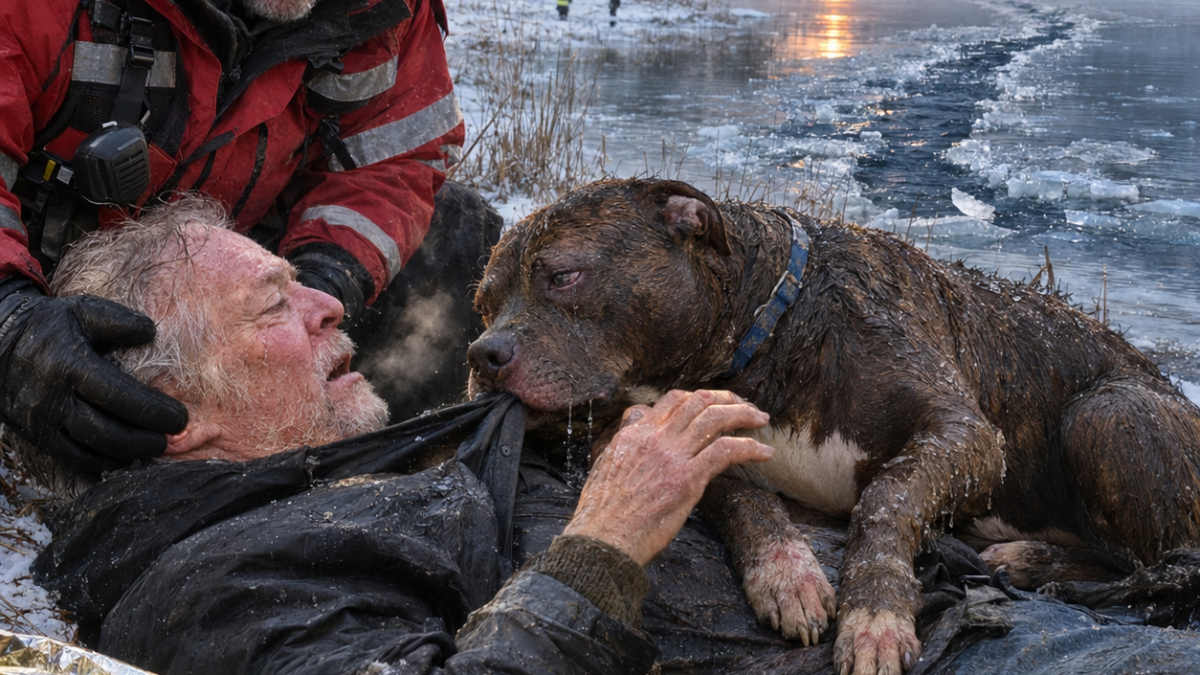
And the dog’s jaws gripping fabric.
Dennis started running.
He called emergency services as he moved.
What happened before that is reconstruction.
Briggs must have watched me fall.
Must have reached the edge.
Must have seen me drifting.
Maybe he barked.
Maybe paced.
Maybe ran along the bank looking for another way.
No one knows.
I have imagined it ten thousand times.
I wish I could ask him.
What I do know is that at some point, the dog who had spent six years refusing puddles made a decision.
He jumped.
The water was around forty degrees.
Cold enough to steal strength quickly.
Briggs hated water.
He did not know how far I would drift.
He did not know how deep it was.
He did not know whether I was alive.
He went anyway.
He reached me.
Found my jacket.
Bit down.
Then turned toward shore.
I weighed one hundred eighty-seven pounds.
My winter coat was soaked.
Boots heavy.
Briggs weighed about seventy.
Two hundred yards is a long swim for any dog in cold water.
Dragging a man made it something else.
Later, Dr. Chambers would estimate that at some point either during the jump, the struggle to gain leverage, or the first part of the pull, Briggs fractured two ribs.
He kept swimming.
Every stroke would have hurt.
Every breath would have moved broken bone against injured muscle.
He kept swimming.
That is the part I cannot think about too long.
Because Briggs did not understand heroism.
He understood one thing.
Walter was in the water.
Dennis ran along the bank shouting.
“Come on!”
“Come on, boy!”
“Bring him in!”
Whether Briggs understood the words does not matter.
He understood direction.
Shore.
When his front paws finally hit bottom, he could have stopped.
He did not.
He dragged backward.
Rear legs slipping.
Jaw locked into my jacket.
Dennis waded in until freezing water reached his thighs.
Grabbed me beneath the arms.
“Got him!”
Dennis later told me he said it to Briggs.
Not emergency dispatch.
Not himself.
The dog.
“Got him, boy!”
Briggs still would not release.
Dennis pulled me onto the grass.
Only when my chest cleared the water did Briggs open his mouth.
He staggered forward.
One step.
Two.
Pressed his nose against my face.
Then his legs folded.
He collapsed beside me.
Dennis knelt between us.
He searched my neck for a pulse.
Found one.
Weak.
My breathing was shallow.
He rolled me into position and followed dispatch instructions.
“Stay with me, old man.”
He kept saying.
“Stay with me.”
Then he looked at Briggs.
The dog was lying on his side.
Shivering.
Eyes open.
Watching me.
Dennis said:
“Your dog never looked away.”
That sentence destroyed me later.
The ambulance arrived in eight minutes.
Fire rescue.
Paramedics.
Chaos.
I was stabilized.
Warm blankets.
Oxygen.
IV.
Transport.
One paramedic asked what to do with the dog.
Briggs tried to stand when they lifted me.
Could not.
Hannah Cole was driving the second response unit.
She later told me she looked at Briggs and said:
“We’re not leaving him.”
Regulations meant he could not ride in my ambulance.
So she called Elise Chambers.
Lakeview.
Emergency admission.
Dennis volunteered to drive behind them because nobody knew who belonged to the dog.
Briggs was loaded onto a blanket in the back of Hannah’s vehicle.
As the ambulance carrying me pulled away, Briggs raised his head.
He tried to stand again.
Hannah held him gently.
“He’s going to the hospital.”
She told him.
“You did it.”
Briggs had no reason to understand.
His person had disappeared.
Again.
I reached St. Mary’s with hypothermia and a head injury.
There was bruising at the back of my skull.
Concussion.
No major intracranial bleeding.
Doctors told me later that cold water had slowed some processes enough to help, but the same cold could easily have killed me.
Another few minutes.
Another hundred yards.
No Dennis.
No Briggs.
The sentences always ended there.
No Walter.
At Lakeview, Elise Chambers did not know any of this yet.
She saw only a dog in bad condition.
Cold.
Exhausted.
Paws damaged.
Several nails cracked.
Breathing too shallow.
She started fluids.
Warmth.
Pain control.
Then Briggs whimpered when she examined his chest.
X-ray.
Two fractured ribs.
Fresh.
Not displaced enough to require surgery.
But painful.
Very painful.
Elise looked through the glass where Briggs lay.
Dennis arrived thirty minutes later.
Wet running clothes replaced by borrowed scrubs from the clinic because his own legs had gone numb.
He explained.
Dog.
Lake.
Man.
Two hundred yards.
Jacket.
Dragging.
Elise looked back at the X-rays.
“With these?”
Dennis nodded.
She touched the image.
“Every stroke.”
“What?”
“Every time his chest expanded.”
She stopped.
Closed her eyes.
“He would have felt it every time.”
Dennis looked toward Briggs.
“Then why didn’t he stop?”
Elise answered softly.
“He probably didn’t know stopping was an option.”
The first twenty-four hours were uncertain for me.
Briggs too.
I woke late the following afternoon.
Fluorescent ceiling.
Beeping.
Dry mouth.
A nurse adjusting something beside me.
“Mr. Graves?”
I tried to focus.
“Where…”
“You’re at St. Mary’s.”
My head felt full of broken glass.
“What happened?”
“You fell into the lake.”
Lake.
The word moved slowly through me.
Then something else arrived.
Briggs.
I tried to sit.
Pain exploded.
“Dog.”
The nurse put a hand on my shoulder.
“Please lie back.”
“My dog.”
“Briggs?”
“Yes.”
She had learned his name.
That gave me hope.
“Where is he?”
“I’m going to find out.”
“Is he alive?”
“I don’t know yet.”
I grabbed her wrist.
Not hard.
Desperate.
“Please.”
“I will.”
She did.
Twenty minutes later, she returned.
“He’s alive.”
I cried immediately.
“He’s at Lakeview Veterinary Clinic.”
“Is he okay?”
“I only know he’s being treated.”
I closed my eyes.
Alive.
For that moment, alive was enough.
Dennis came that evening.
I had never seen him before.
Tall.
Broad shoulders.
Construction hands.
He stood awkwardly near the door.
“Walter?”
“Yeah.”
“I’m Dennis.”
I stared.
He smiled slightly.
“I found you.”
I started crying before he finished.
He came closer.
“Briggs?”
Dennis pulled out his phone.
Showed me a photograph.
Briggs under a gray blanket.
Four bandaged paws.
Eyes open.
I touched the screen.
“He hates water.”
Dennis frowned.
“What?”
“He’s terrified of water.”
“You’re kidding.”
“No.”
“His whole life?”
“As long as I’ve had him.”
Dennis sat beside the bed.
For a while, neither of us spoke.
Then he looked at the photo.
“Well.”
“What?”
“He must love you more than he hates water.”
That sentence followed me for the rest of my life.
On day two, Elise called.
“Walter?”
“Yes.”
“I’m Dr. Chambers.”
“I know you.”
That confused her.
“You treated Briggs when I found him.”
A pause.
“Oh my God.”
“You’re highway Briggs.”
I almost laughed.
“Apparently.”
She remembered.
Of course she did.
“I need to tell you about his injuries.”
I gripped the phone.
She explained.
Paws.
Exhaustion.
Cold exposure.
Ribs.
“Broken?”
“Two.”
I shut my eyes.
“From what?”
“We can’t know exactly.”
“But likely during the rescue.”
My chest tightened.
“He swam with broken ribs.”
“Yes.”
“How?”
Silence.
Then Elise said:
“I don’t know.”
A veterinarian.
Fifteen years experience.
“I genuinely don’t know.”
That honesty made me cry.
Briggs did not eat.
First day.
Second.
Third.
Small amounts of water.
Fluids.
Pain management.
But no real interest in food.
Elise tried chicken.
Beef.
Wet food.
Hand feeding.
Nothing.
Briggs stayed in the back of the recovery kennel.
Head down.
Facing away from the door.
Physically improving.
Emotionally disappearing.
On the third afternoon, Elise told Dennis:
“He thinks Walter is gone.”
Dennis asked:
“Dogs understand death?”
Elise shook her head.
“Not like we do.”
“But they understand absence.”
That was enough.
I left the hospital on day four.
The doctor wanted another night.
I refused.
Not dramatically.
I just said:
“My dog hasn’t eaten because he thinks I’m dead.”
The doctor stared.
Dennis, standing beside me, nodded as though this were a standard medical reason.
“Fine.”
The doctor sighed.
“Straight home after.”
I lied.
“Yes.”
Dennis drove me to Lakeview.
Every bump hurt my head.
I had a bandage near the back of my skull.
Bruising.
Weakness.
I did not care.
Elise met us.
“You look terrible.”
“Thank you.”
“Sit if you get dizzy.”
“Where is he?”
Her face softened.
“This way.”
Briggs lay with his back to the door.
Exactly as Dennis described.
He looked older.
Smaller.
Broken.
I stopped breathing.
There is a particular pain in seeing an animal injured because of you.
Rationally, I knew I had not chosen to fall.
Emotion does not care about rationality.
I looked at his bandaged paws.
The ribs beneath his coat.
This dog had been safe on shore.
Then I fell.
And he broke himself getting me back.
I knelt.
Pain shot through my hip.
Elise reached for me.
“I’m okay.”
Then:
“Briggs.”
His ear moved.
That tiny movement nearly destroyed me.
“My boy.”
The ear moved again.
“I’m here.”
Slowly, Briggs lifted his head.
Turned.
His eyes found mine.
I will never forget his face.
Confusion first.
Then recognition.
His tail moved.
Once.
Weak.
Then again.
Faster.
His whole body tried to rise before it was ready.
Elise stepped forward.
“Briggs, no.”
He ignored her.
Front legs beneath him.
Shaking.
Back legs next.
He stood.
Almost fell.
Recovered.
Then took one step.
Another.
Toward me.
I opened the kennel.
Briggs came through the door.
He did not jump.
Could not.
He leaned.
All seventy pounds.
His body against my knees.
I put both arms around him carefully.
He pushed his head against my chest.
Right over my heart.
Same place he had chosen years earlier when Margaret was dead and I had forgotten how to survive another night.
I sobbed.
“You found it.”
Briggs stayed there.
“You found my heart again.”
Dennis turned away.
Elise covered her mouth.
I kissed Briggs’s head.
“You brought me back.”
His tail moved.
“You brought me back, boy.”
Then Elise brought food.
Briggs ate from my hand.
One bite.
Two.
Three.
By the fifth, everyone in the room was crying.
Even Dennis.
Especially Dennis.
Briggs came home two days later.
The instructions were absurdly detailed.
No stairs.
No jumping.
No running.
Short controlled bathroom breaks.
Medication.
Paw checks.
Rib healing.
I had almost identical restrictions.
No driving initially.
No ladders.
No sudden position changes.
Rest.
Hydration.
Follow-up.
Dennis looked at both sets of instructions.
“You two are a nursing home.”
I told him to leave.
He brought groceries instead.
Recovery was not beautiful.
That matters.
People like rescue stories to end at shore.
They do not.
The body remembers.
For weeks, I woke thinking I was underwater.
I would sit upright gasping.
Sometimes Briggs woke at the same time.
He would stand beside the bed, unable to jump because of his ribs.
I moved downstairs permanently for a while.
One night, I woke screaming.
Briggs was already there.
He pressed his head against my chest.
I held him.
“You too?”
His body trembled.
We sat on the floor until morning.
Two creatures who had survived the same lake but remembered different parts.
Briggs hated rain more after the accident.
If water hit the windows hard, he paced.
I hated silence.
If the house became too quiet, I heard water.
So I kept the radio on.
Old country.
Margaret hated country music.
I imagined her complaining.
That helped.
A local newspaper ran the story.
Dennis had told someone at work.
Someone contacted rescue personnel.
Then Lakeview.
Suddenly photographers wanted Briggs.
I refused.
Then Elise said:
“People are asking whether he needs help with medical costs.”
“I can pay.”
“That’s not the point.”
“What is?”
“They care.”
That made me uncomfortable.
Margaret used to say I was allergic to being cared for.
She was right.
Eventually, I agreed to one photograph.
Briggs and me on the porch.
Both looking tired.
His paws bandaged.
My head bandaged.
The headline called him THE DOG WHO SWAM THROUGH FEAR.
I hated it.
Not because it was wrong.
Because it made Briggs sound like fear disappeared.
It hadn’t.
Children sent letters.
One said:
DEAR BRIGGS, YOU ARE THE BRAVEST DOG IN AMERICA.
Another:
I AM SCARED OF SWIMMING TOO.
Another had a drawing of Briggs wearing a red cape.
He tried to eat that one.
I kept the damaged corner.
One letter came from a nine-year-old girl named Mia.
She wrote:
I HAVE CANCER AND I AM SCARED A LOT. MY MOM SAYS BRAVE MEANS NOT BEING SCARED BUT I THINK BRIGGS WAS SCARED SO MAYBE MY MOM IS WRONG.
I read it three times.
Then cried.
I wrote back.
Dear Mia,
Briggs was absolutely scared. He was probably more scared than anyone knows. Brave did not mean his fear disappeared. It meant he loved something enough to move while fear came with him.
You are allowed to be scared.
Love, Walter and Briggs
A month later, Mia’s mother sent a photograph.
Mia holding our letter during treatment.
I framed it.
Briggs never knew.
Maybe that is better.
Dogs do good without needing to understand reach.
By late November, Briggs’s paws were healing.
His ribs slowly too.
My headaches remained.
Some mornings, I could not remember why I entered a room.
Other days, light hurt.
The doctor said concussion recovery could be uneven.
I hated uneven.
I liked mechanical problems.
Cause.
Effect.
Repair.
The brain was not interested in my preferences.
Briggs understood.
He slept through my bad afternoons.
I slept through his.
Dennis became part of our life without anyone deciding it.
Sunday coffee.
Then Thursday check-ins.
His daughters visiting Briggs.
His wife Julie bringing soup.
At Christmas, they invited me to dinner.
I almost said no.
First Christmas away from my own house since Margaret died.
Then Dennis said:
“You can come sit in the corner and be miserable. We have a chair.”
I went.
Briggs wore a green bandanna.
Dennis’s younger daughter put reindeer antlers on him.
He looked betrayed.
I laughed harder than I had in years.
Then immediately felt guilty.
Grief has stupid rules.
It tells you laughing betrays the dead.
I heard Margaret’s voice in my head.
Oh, please, Walter.
She would have hated that guilt.
So I laughed again.
Early December, I returned to the lake.
I did not tell anyone except Dennis.
Briggs rode with us.
When I parked, my hands shook.
The lake looked harmless.
That made me angry.
Places do not carry guilt.
The water had no idea what happened.
We walked the trail.
Briggs slowed as soon as he smelled it.
Twenty yards from shore, he stopped.
Same distance as six years earlier.
His tail lowered.
I looked at him.
“You don’t have to.”
I walked forward alone.
Ten yards.
Five.
My heart hammered.
The closer I got, the more my body remembered.
Cold.
Dark.
Nothing.
I stopped.
Could not reach the edge.
My knees weakened.
I sat on a bench.
Dennis stayed farther back.
He knew not to rescue me from a feeling.
For several minutes, I stared at the water.
Then something touched my boot.
Briggs.
He had crossed the distance.
Not to the lake.
To me.
He sat beside my leg.
Still afraid.
So was I.
I put my hand on his head.
“We’re not going in.”
His tail moved once.
We sat together.
Then turned around.
That was enough.
Winter passed.
Spring arrived.
Briggs’s bandages came off.
One nail grew crooked.
I called it his medal.
His ribs healed.
My headaches slowly became less frequent.
We extended walks.
Half mile.
Mile.
Two.
Always away from water first.
Then eventually near it.
One afternoon in April, Dennis and I sat on the porch.
Briggs lay between us.
He had become obsessed with sunlight.
Old dogs understand luxury.
Dennis asked:
“Why did you keep him?”
I knew he meant six years earlier.
“Because he needed somewhere.”
“That’s the official answer.”
I looked at him.
He waited.
I sighed.
“Because Margaret died.”
Dennis nodded slowly.
“I was lonely.”
No shame now.
“At first Briggs slept by the door.”
“I remember.”
“Every day I thought he might run.”
I rubbed Briggs’s shoulder.
“Then one day I realized I was the one waiting for him to leave.”
Dennis looked at me.
“Why?”
“Everybody leaves eventually.”
That was grief talking.
Still.
Dennis did not argue.
“Then?”
“One night he climbed into bed.”
I looked down.
“Put his head here.”
I touched my chest.
“That was it.”
“What?”
“I stopped waiting for him to leave.”
Dennis stared toward the yard.
Then said:
“Maybe that’s why he came after you.”
“What?”
“You stopped leaving him.”
I swallowed.
“Maybe he decided to return the favor.”
Summer came.
Then autumn.
One year since the lake.
Dennis wanted to mark the date.
I hated the idea.
Anniversaries felt like grief demanding appointments.
But we went.
Elise came.
Hannah Cole.
Dennis’s family.
No speeches.
Coffee.
Donuts.
Briggs walked toward the water.
Everyone went quiet.
He stopped.
Then stepped forward.
Closer than before.
Water touched his front toes.
He froze.
I did not move.
No encouragement.
No command.
No crowd cheering.
One second.
Two.
Briggs stepped back.
Turned.
Walked directly toward the donut box.
Dennis laughed.
“Hero.”
I smiled.
“Yes.”
Perfect.
Courage did not require performance.
Life became ordinary again.
That was the miracle.
Not rescue.
Ordinary.
Breakfast.
Walks.
Vet appointments.
Dennis complaining about work.
Julie bringing too much food.
Briggs sleeping through television.
I returned to small repair jobs.
Not full-time.
Enough.
I started volunteering one afternoon a week at the county animal shelter.
That surprised everyone.
Especially me.
I worked with fearful dogs.
Not because I was an expert.
Because I understood waiting.
Sit.
Do not stare.
Offer food.
Let them choose distance.
Some dogs came close.
Some did not.
I stopped measuring success by closeness.
Safety is a gift even when trust takes longer than you hope.
Briggs had taught me that too.
Years passed.
Briggs turned ten.
Then eleven.
His muzzle whitened.
People at the lake recognized him.
“Is that the dog?”
Sometimes.
I hated when they asked like he was an attraction.
Then I remembered they meant admiration.
I learned to answer gently.
“Yes.”
Briggs never cared.
He cared about squirrels.
At eleven, arthritis appeared.
Elise pressed his hips.
He looked offended.
“Normal aging.”
She told me.
“Nothing about him is normal.”
“Fair.”
Medication helped.
Rugs went down over hardwood.
I built a ramp into the truck.
The first time Briggs used it, he looked at me as though I had insulted his masculinity.
Then used it every day after.
Dennis’s daughters grew up.
College.
Boyfriends.
One married.
Briggs attended the backyard wedding.
He wore a blue bow tie.
Slept through most of the ceremony.
When the bride walked down the aisle, she stopped and kissed his head.
Photographer captured it.
That photograph stayed on Dennis’s wall.
Briggs.
Old.
Eyes closed.
A young woman in white touching his gray muzzle.
Time passing in one frame.
At twelve, Briggs began sleeping more.
At night, sometimes I put my hand near his chest just to feel it rise.
I hated myself for that.
Then remembered how often he checked me after the lake.
Fair.
Margaret’s birthday remained hard.
Every year.
One evening, Briggs and I sat beside her grave.
I had brought nothing.
Just him.
I said:
“You would have loved this idiot.”
Briggs sniffed the grass.
“She would have pretended not to.”
He sat beside me.
I imagined Margaret.
Her hands.
Laugh.
The way she would have called Briggs “your dog” for six months before buying him a Christmas stocking.
I cried.
Briggs leaned against me.
That old habit.
Heart.
Always heart.
When Briggs was thirteen, Elise found the mass.
Routine exam.
Her face changed before she spoke.
I knew.
“No.”
“Walter.”
“No.”
“We need tests.”
“No.”
As if refusing language could refuse reality.
Biopsy.
Cancer.
Treatable, maybe.
But Briggs was old.
Options.
Surgery.
Medication.
Monitoring.
Quality of life.
I hated every word.
I wanted Elise to say:
We cut it out.
He lives forever.
Instead she said:
“We can likely give him meaningful time.”
Meaningful time.
That is the phrase doctors use when forever is unavailable.
I had heard it with Margaret.
I almost walked out.
Elise touched my arm.
“I know.”
“No, you don’t.”
Then I regretted it instantly.
She had treated Briggs for thirteen years.
Of course she knew something.
“I’m sorry.”
She shook her head.
“You don’t have to apologize.”
We chose treatment.
Not the most aggressive.
The kind designed to protect good days.
I had learned something from Margaret.
Life length matters.
So does life texture.
Briggs deserved both considered.
Treatment worked for a while.
A good while.
Months became a year.
Briggs turned fourteen.
Dennis brought steak.
Elise said one small piece.
Dennis gave him half.
I said nothing.
Some laws should be broken.
Briggs ate.
Then slept with his head on my foot.
We returned to the lake often during that final year.
Never swimming.
Not once.
People expect some grand moment where Briggs conquers water.
No.
He did not need that.
Sometimes he stood ankle-deep at the edge.
Sometimes twenty feet back.
Sometimes refused the trail entirely.
All acceptable.
The lake had already received more bravery from him than it deserved.
One late September afternoon, we sat at the end of the dock.
Briggs’s head on my knee.
Sunlight silver across the water.
Dennis had gone home.
Only us.
I looked down.
“You know I never thanked you properly.”
Briggs slept.
“I gave you food.”
Nothing.
“A house.”
One ear moved.
“Terrible baths.”
No response.
“You gave me my whole damn life back.”
His eyes opened.
I smiled.
“Yeah.”
Then something occurred to me.
I had spent years calling the lake rescue the day Briggs saved me.
Wrong.
He had saved me before.
The lake was only the day everyone else saw it.
I leaned down.
“Thank you for the years before too.”
Briggs closed his eyes.
That was enough.
Winter came hard.
Briggs declined.
Kidney numbers worsened.
Cancer progressed.
Arthritis.
His body became a collection of small failures.
His spirit stayed Briggs.
Still wanted toast.
Still disliked the mailman.
Still checked where I was.
Then one morning he could not stand.
I found him awake on his blanket.
He tried.
Front legs.
Back.
Nothing.
He looked at me.
That look.
I knew.
“No.”
I whispered.
Not again.
Not another creature I loved asking me to survive after them.
I sat beside him.
Briggs put his head on my lap.
I called Elise.
My voice failed halfway through his name.
She understood.
“I’m coming.”
Dennis came too.
Julie.
No crowd.
Just family.
We placed Briggs’s blanket beside the porch doors.
Sunlight reached the floor.
He had always loved that patch.
Elise examined him.
Then looked at me.
“Walter.”
I shook my head.
She waited.
I knew what she was asking without asking.
“Can he get better?”
Her eyes filled.
“No.”
“Can he be comfortable?”
“For a little.”
“How little?”
“I don’t know.”
I stared at Briggs.
His breathing shallow.
Eyes on me.
“He’s tired.”
Elise whispered.
I started crying.
“He pulled me two hundred yards.”
“I know.”
“He didn’t quit.”
“I know.”
“How do I quit for him?”
“You’re not.”
That made me look up.
Elise knelt beside me.
“You are not quitting.”
“What am I doing?”
“Listening.”
I looked at Briggs.
My boy.
Roadside dog.
Lake hero.
Bed thief.
Chicken thief.
Heart listener.
I put my hand against his chest.
“Hey.”
His tail moved.
Tiny.
“You don’t have to pull me anymore.”
My voice broke.
“I’m okay.”
Lie.
But a loving one.
“I’m on shore.”
Dennis covered his face.
Julie cried silently.
I bent down.
“You got me home.”
Briggs looked at me.
“You can rest now.”
His eyes softened.
I kissed his forehead.
Elise gave the medication.
Slowly.
Gently.
No fear.
No cold.
No water.
His head stayed on my lap.
My hand stayed over his heart.
One breath.
Then another.
Then no more.
I waited.
As though he might decide differently.
As though Briggs had ever respected limits.
Nothing.
I bent over him.
And for the first time in fourteen years, I could not feel him breathing.
I made a sound I did not know a person could make.
Dennis dropped beside me.
Put one arm around my shoulders.
I held Briggs.
Elise waited.
Nobody rushed.
Nobody said:
He had a good life.
Not yet.
Those words are true and useless in the first ten minutes.
I pressed my forehead against his.
“You were supposed to stay.”
There it was.
The oldest grief.
Stay.
Margaret.
Briggs.
Everyone.
Stay.
But love never promises that.
Only presence while time allows it.
After they took Briggs, I walked through the house.
His bowl.
Leash.
Blanket indentation.
Ramp by the truck.
One half-chewed toy under the table.
I sat on the kitchen floor.
Same floor where I had cried over Margaret years before.
No dog came this time.
That was the cruelest part.
I did not sleep that night.
At 5:17 a.m., I heard what sounded like nails in the hallway.
I sat up.
“Briggs?”
Silence.
Memory.
The brain hates vacancy.
It fills it.
For weeks, I kept looking down before stepping out of bed.
Kept expecting him beside the door.
Kept opening the back door at six.
Once I poured food into his bowl before remembering.
I sat beside it and cried until Dennis found me.
He had come with coffee.
He saw the bowl.
Said nothing.
Sat on the floor.
That was friendship.
The first Sunday after Briggs died, Dennis asked:
“Lake?”
“No.”
Second Sunday.
“Lake?”
“No.”
Third Sunday, he did not ask.
Three months later, I called him.
“Lake.”
Twenty minutes later, he was at my door.
We sat on the dock.
Winter again.
I held Briggs’s collar.
Leather worn.
Tag scratched.
The water looked almost exactly as it had that morning.
Dennis stared.
After a long time, he said:
“I keep seeing him.”
“In the water?”
“Yeah.”
I turned the collar in my hands.
“You once told me what he did was love.”
“I remember.”
“I think you were wrong.”
Dennis looked at me.
I continued.
“Love isn’t ignoring pain.”
He waited.
“It’s knowing the pain is there and deciding somebody matters enough to carry it.”
Dennis nodded slowly.
“That’s better.”
We sat until dark.
Briggs’s ashes went beneath the oak tree beside my porch.
Not the lake.
People expected the lake.
No.
The lake was where he fought.
Home was where he lived.
I wanted him home.
I buried his collar tag there too.
Kept the collar.
A year later, Lakeview started the Briggs Emergency Fund.
Elise’s idea.
I resisted.
Lost.
The fund helped emergency veterinary patients when families needed time or financial assistance.
No giant memorial.
Just a line:
THE BRIGGS FUND — BECAUSE SOMETIMES THE ONE WHO SAVES YOU HAS FOUR PAWS.
The first year, it helped twelve animals.
Second year, twenty-one.
One was a brown-and-white pit bull found beside a road.
I stood outside the exam room when he arrived.
Thin.
Terrified.
Water dripping from his coat.
For one irrational second, I thought:
Briggs.
Then immediately hated myself.
No.
Not Briggs.
Never.
The dog looked at me.
Then looked away.
A young woman named Kayla had found him.
She could not afford the emergency exam.
The fund covered it.
Later, she adopted him.
Named him Tucker.
People asked if I considered taking him.
No.
Love is not a vacancy another animal fills.
But I bought Tucker his first leash.
That was enough.
Elise retired.
Dennis became a grandfather.
Julie’s hair went silver.
I turned seventy.
Life kept doing the offensive thing it always does.
Continuing.
Every November 3, Dennis and I met at the lake.
Coffee.
No ceremony.
Sometimes his grandchildren came.
One year, his granddaughter Emma asked:
“Was Briggs really afraid?”
“Yes.”
“Like really afraid?”
“Really.”
“Then why’d he jump?”
I looked at the water.
How do you explain it simply enough for a child?
“Because I was in there.”
Emma frowned.
Then nodded.
As though that was enough.
Maybe it was.
When I was seventy-two, I finally told Dennis something I had never said aloud.
“I wanted to die after Margaret.”
He went still.
“Not actively.”
I looked toward the lake.
“I wasn’t planning anything.”
“But I didn’t care much whether I woke up.”
Dennis said nothing.
“Then Briggs came.”
My throat tightened.
“He needed breakfast.”
“Walks.”
“Vet appointments.”
“So?”
“So I kept waking up.”
I smiled sadly.
“By the time I realized I wanted to live again, he’d already done the work.”
Dennis wiped his face.
“You always say he saved you in the lake.”
“I know.”
“That wasn’t the first time.”
“No.”
It wasn’t.
That became the truth I eventually told at animal-rescue events.
Briggs did not save me once.
He saved me slowly.
Before the lake.
After Margaret.
Through mornings.
Walks.
Ridiculous routines.
Then dramatically when everyone was watching.
And finally after his own death, because loving him had taught me how to remain in a world that keeps taking things away.
I visited Mia once.
The little girl who had written about being scared during cancer treatment.
She was nineteen by then.
In remission for years.
Her mother contacted me through Lakeview.
Mia wanted to meet.
We sat at a café.
She brought the old letter.
Our reply.
Folded.
Soft from handling.
“You wrote this.”
“Yes.”
“Briggs was scared.”
“Yes.”
“You said I could be scared.”
“Yes.”
She cried.
“So many adults kept telling me not to be.”
I understood.
Adults hate children’s fear because they cannot fix it.
So they try to rename it courage.
Mia looked at me.
“I kept this during every treatment.”
I started crying.
She smiled.
“Briggs helped me too.”
There it was.
A dog who never met her.
Love moving farther than the body.
I have Briggs’s photograph on my desk.
Not lake Briggs.
Not bandages.
Normal Briggs.
Asleep on the porch.
Tongue slightly out.
That is who I want remembered.
Heroism is one moment.
A life is thousands.
He stole sandwiches.
Snored.
Hated baths.
Once barked at a plastic snowman for forty straight minutes.
He was afraid of thunder.
Loved toast.
Ignored every expensive dog bed I bought and preferred Margaret’s old rug.
That dog saved my life.
Not a symbol.
Not a legend.
A dog.
That makes it more beautiful.
I still go to the lake.
Not often.
Enough.
I never swim.
No dramatic return to water.
No victory lap.
I respect fear now.
Briggs taught me that too.
Bravery does not require unnecessary suffering.
Sometimes sitting near the thing that once nearly killed you is enough.
Sometimes turning around is wise.
Sometimes jumping is necessary.
The difference is love, purpose, and choice.
A few years ago, a fisherman recognized me.
“Walter?”
“Yes.”
“You’re the guy with that pit bull.”
“Was.”
He winced.
“Sorry.”
“It’s okay.”
“My daughter did a school project on Briggs.”
I laughed.
“Poor teacher.”
The man smiled.
“She said he was fearless.”
I looked at the water.
“No.”
He seemed confused.
“He wasn’t?”
“Terrified.”
“Then…”
I smiled.
“That’s what made him brave.”
The fisherman nodded slowly.
We left it there.
The last thing Dennis ever said about Briggs that mattered happened on the fifteenth anniversary of the rescue.
We were both old.
Dennis had a cane.
I had a better one and made sure he knew it.
We sat on the dock.
He said:
“You know what I remember?”
“What?”
“Briggs’s face when you reached shore.”
I looked at him.
“He looked at you.”
Dennis’s voice shook.
“Then he collapsed.”
“I know.”
“It was like he had been saving the last piece of himself until he knew somebody else had you.”
My eyes filled.
Dennis continued.
“That’s the part that gets me.”
“Not the swim.”
“Not the ribs.”
“That.”
He looked at me.
“He didn’t stop because the pain ended.”
“He stopped because his job was done.”
I stared at the water.
Then whispered:
“Yeah.”
Briggs always needed a job.
Years earlier, when I found him on the highway, I believed his job was learning to trust me.
Then I thought his job was companionship.
Then keeping me alive.
Wrong.
Briggs’s job was never assigned.
Love is not employment.
He simply belonged to me.
And I to him.
Everything else came from that.
If I could change one thing, I would not change the lake.
That surprises me.
For years, I would have.
Erase the fall.
The injuries.
The fear.
But then I would also erase the knowledge.
Not the public story.
The private one.
The way Briggs looked at me in the clinic after believing I was gone.
The way his tail moved.
The way he put his head over my heart.
The way we sat beside the lake later, both afraid, neither alone.
I would never choose his pain.
But I cannot separate life cleanly into the suffering I would delete and the love that grew around it.
Humans want editing rights we do not get.
So I take the whole story.
The road.
Margaret.
Briggs.
The lake.
The ribs.
Recovery.
Old age.
Goodbye.
All of it.
Because all of it was ours.
Sometimes I dream about Briggs.
Not the lake.
Never.
In the dream, I am driving the old truck.
Rain.
County Road 18.
I see him beside the ditch.
But this time, I do not stop.
I keep driving.
That dream terrifies me more than drowning.
I wake sweating.
Then remind myself.
I did stop.
I did.
Whatever else I failed in life, I stopped the truck.
And because I did, six years later a frightened dog jumped into freezing water for me.
That is too large a consequence for one brake pedal.
Life works like that sometimes.
Tiny decisions.
Unimaginable futures.
Margaret used to say:
“Be careful what you call ordinary.”
I thought she meant gratitude.
Maybe she did.
I understand differently now.
Ordinary is where devotion is built.
Morning walks.
Food bowls.
Hands on fur.
Sleeping beside each other.
Coming home.
The two-hundred-yard swim began years before the lake.
It began every time I returned.
Every meal.
Every safe night.
Every moment Briggs learned:
This man is mine.
Trust is repetition.
The lake simply revealed the structure.
People have asked whether Briggs knew he was saving me.
I have no idea.
Maybe he only knew I was moving away.
Maybe instinct.
Maybe panic.
Maybe attachment.
I do not need it to be mystical.
The truth is powerful enough.
A dog afraid of water entered water because his bonded human was there.
He endured pain.
Cold.
Exhaustion.
He brought me close enough for Dennis to finish.
That is extraordinary without magic.
I am an old man now.
Old enough to understand that the body gives no guarantees.
My friends are fewer.
Margaret gone.
Briggs gone.
Elise retired far away.
Dennis still here, stubbornly.
Some mornings, getting out of bed takes longer.
I keep Briggs’s collar in the top drawer beside Margaret’s wedding ring.
Not because grief should be stored.
Because sometimes the hand needs proof.
Things existed.
They were real.
Love leaves objects behind.
Last winter, I went to the lake alone.
Snow at the edges.
Water dark.
I sat on the dock.
My knees complained.
I put one hand beside me on the wooden plank.
The space where Briggs used to sit.
For a long time, nothing happened.
No revelation.
No sign.
Just cold.
Then a dog barked somewhere behind me.
I turned too quickly.
Brown shape on the trail.
For half a second—
Briggs.
Of course not.
Different dog.
Young.
Running beside a woman.
I smiled.
The dog stopped.
Looked at me.
Then continued.
I laughed softly.
“Go on.”
He did.
That was enough.
If Briggs taught me anything, it is that love does not always arrive in the form you expect.
I expected Margaret to be my great lifetime love.
She was.
Then she died.
I assumed the rest of my story would be smaller.
Then a frightened pit bull appeared beside a highway.
Different love.
Not lesser.
Not replacement.
A new language.
Margaret gave me thirty-two years.
Briggs gave me fourteen.
Both changed the shape of my life.
Neither stayed long enough.
Nobody does.
That is what makes staying while we can matter.
On the morning Briggs saved me, I was unconscious.
That fact used to bother me.
I did not see his courage.
Could not encourage him.
Could not thank him.
He did the hardest thing of his life while I was unable to witness it.
Then I understood.
Real love often works like that.
Margaret stayed awake beside me during my pneumonia once.
I slept through most of it.
My mother worked nights when I was a child.
I slept.
People sacrifice while the loved person is unaware.
Awareness is not required for love to be real.
Briggs did not need me watching.
He needed me alive.
I spent years trying to repay him.
Better food.
Medical care.
Walks.
Comfort.
Staying beside him at the end.
But love is not a debt ledger.
I cannot balance two hundred yards against fourteen years.
That misses the point.
He saved me because he loved me.
I cared for him because I loved him.
No one owed anyone.
That may be the purest thing we had.
If you ask Dennis today what happened, he still says the same thing.
“I saw a dog dragging a man.”
Then he pauses.
“And I saw the dog stop only after the man was safe.”
He refuses embellishment.
I like that.
The facts are enough.
I used to call Briggs my guardian angel.
Then stopped.
Angels are supposed to be fearless.
Briggs was better.
He was afraid.
Very afraid.
And he went anyway.
That is something humans can understand.
The final time I spoke publicly about him, I stood at Lakeview’s fundraiser.
Elise had returned for the event.
Older.
Still sharp.
The Briggs Fund had helped more than three hundred animals by then.
People expected a speech.
I hate speeches.
I looked at the crowd.
Then said:
“Briggs did not teach me that love makes fear disappear.”
Silence.
“He taught me fear and love can exist in the same body.”
I looked toward Elise.
She was already crying.
“And sometimes love gets one more vote.”
That was all.
I stepped away.
Best speech I ever gave.
People clapped.
I wished Briggs were there to ignore them.
When I return to the memory now, I no longer see the lake first.
I see the road.
Rain.
A thin dog beside a ditch.
I see myself opening the truck door.
Thirty-two minutes of waiting.
No heroism.
No headlines.
Just patience.
Then I see the clinic.
Briggs turning his head after four days.
Tail.
One thump.
Two.
Then his body against me.
Head over my heart.
Then the porch.
Gray muzzle.
Sunlight.
Then his final morning.
My hand over his heart.
Bookends.
He spent his life listening to mine.
At the end, I listened to his until it stopped.
There is terrible symmetry in that.
Also peace.
I once asked Elise whether animals know when they are dying.
She said:
“I don’t know.”
Good answer.
Then:
“But they know who is with them.”
That was enough.
Briggs knew.
I was there.
Just as he had been there for me.
The lake almost took my life.
Briggs brought it back.
Time eventually took his.
I could not stop it.
That is the part of love no heroism fixes.
You can pull someone from water.
Treat broken ribs.
Bandage paws.
Fight cancer.
Build ramps.
Give medication.
Hold them.
Eventually love reaches a place where saving changes meaning.
At the beginning, saving meant keeping Briggs alive.
At the end, saving meant not asking him to suffer because I could not bear goodbye.
That was the hardest rescue I ever performed.
I let him go.
I wish people talked more about that.
There is bravery in staying.
There is also bravery in release.
Briggs taught me both.
Today, if fishermen gather near the lake early enough, they may see an old man sitting at the end of the dock.
No dog beside him.
Just coffee.
One hand resting on the wood.
Sometimes they know the story.
Sometimes not.
The water does not care.
It moves.
Sunlight.
Wind.
Birds.
Everything continues.
I used to resent that.
Now I find comfort in it.
Briggs’s body is gone.
The lake remains.
The trail remains.
Dennis remains.
I remain.
For now.
And I know something I did not know before that November morning.
When the world suddenly gives way beneath your feet—
when cold closes around you—
when consciousness disappears—
when you cannot save yourself—
sometimes survival comes because somewhere, somehow, somebody who loves you refuses to accept your disappearance.
For me, that somebody had four paws.
A torn ear.
A white patch on his chest.
A crooked nail.
Two broken ribs.
And a lifelong terror of water.
His name was Briggs.
He did not stop being afraid when I fell.
He did not become some mythical creature.
He was the same dog who backed away from puddles.
The same dog who panicked at bathwater.
The same dog who once hid behind a couch because I turned on a hose.
That is why the story matters to me.
Fear did not disqualify him from courage.
Pain did not stop love from giving him direction.
And when his body finally touched shore, he had one last task.
Hold on.
Just a little longer.
Until somebody else had me.
Then he let go.
I think about that when grief feels heavy.
Briggs held on until someone else could take over.
Maybe that is what we all do.
Margaret held me for thirty-two years.
Then Briggs.
Dennis.
Elise.
Friends.
We carry each other in shifts.
No one does the whole distance alone.
That may be the real reason I survived.
Not because one dog performed one impossible rescue.
Because love kept changing hands.
When Briggs died, I thought the chain had ended.
It hadn’t.
The Briggs Fund.
Mia.
Tucker.
Dennis’s grandchildren.
Every person who heard the story and looked differently at a frightened dog.
Every owner who received help at Lakeview.
Love moved.
That was Briggs’s final trick.
He kept going after stopping.
If I get one more chance after this life—
and I do not claim to know how any of that works—
I have a request.
Nothing grand.
I do not need heaven gates.
Music.
Light.
I would like a wet October road.
An old truck.
A dog beside a ditch.
And before I even open the door, I want him to recognize me.
No fear.
No waiting thirty-two minutes.
Just Briggs.
Running.
And me saying the thing I did not know I was saying the first time.
“Come on, boy.”
“Let’s go home.”
Until then, I keep going.
Because he did.
Because Margaret did.
Because Dennis once pulled me the final few feet while a dog with broken ribs refused to release my coat.
Because an animal who feared water taught an old man that bravery is not the absence of terror.
Because I learned love is not always gentle.
Sometimes love hurts with every breath and keeps swimming.
Sometimes love tears its paws open reaching shore.
Sometimes love lies down only after making sure you are safe.
And sometimes, many years later, love looks like an old man sitting beside an empty place on a dock, smiling through tears because once—just once in a lifetime—he was loved by a creature who decided that leaving him behind was impossible.
Briggs had been afraid of water his entire life.
That fear stayed with him.
So did his courage.
So did his love.
And on the coldest morning of mine, when I had no strength, no consciousness, and no way to choose life for myself, my dog chose it for me.
Stroke by painful stroke.
Two hundred yards.
Toward shore.
Toward Dennis.
Toward another morning.
Toward fourteen years of memories I would never have had without him.
He brought me home.
And when his own final day came, I held him against my chest and listened until his heart became still.
I could not carry him back from that shore.
No one can.
So I did the only thing left that love could do.
I stayed.
I whispered his name.
I told him he had done enough.
And I did not let him leave this world alone.
That was the promise between us in the end.
He would not abandon me in the water.
And I would not abandon him when the time came to rest.
We both kept it.
That is why, whenever someone calls Briggs a hero, I smile.
They are not wrong.
They just do not know the whole story.
The heroic part was not only the freezing lake.
It was every ordinary day before it.
Every ordinary day after it.
The trust.
The waiting.
The staying.
The choosing.
Again and again.
Until there were no days left.
And if that is not love, I do not know what is.








