PART 2:“DON’T EMBARRASS ME IN FRONT OF MY MILITARY FRIENDS!” He Sent Me Into the Kitchen, Called My Life a Failure, and Invented a Glorious Army Career—But He Went Pale When One of the Soldiers Recognized the Woman He Had Just Insulted.
PART 2 and FULL ENDING  Thank you

One hung beside the back door like a medal.
Wendell loved that hat.
More than the hat, he loved what it made other people assume.
Authority.
Sacrifice.
Experience.
Leadership.
When Wendell spoke, he expected everyone around him to begin from the position that he had already earned the right to be correct.
For a while, I found it obnoxious but harmless.
Then Mom began changing.
Phone calls got shorter.
She stopped talking about Patricia, her closest friend of twenty-three years.
When I asked why, Mom said:
“Wendell thinks Patricia is a bad influence.”
My mother was sixty.
Patricia’s most dangerous habit was ordering dessert before dinner.
Then Mom quit pottery.
“Wendell says I’m wasting money.”
The woman owned her house outright and had her own retirement income.
Then she canceled a trip with her church group.
“Wendell doesn’t like me being gone overnight.”
That was when irritation became concern.
My Georgia assignment gave me an excuse to stay with her for several days.
Officially, I was nearby because of work.
Unofficially, I wanted to see her face.
I saw what I needed before breakfast on the second morning.
I came downstairs at eight.
Saturday.
Wendell stood in the kitchen holding a coffee cup in one hand with the other planted on his hip.
“It’s eight o’clock.”
I opened the cabinet where Mom had kept the mugs since I was twelve.
“It is.”
“In this house, everybody is up before seven.”
I almost laughed.
My parents had bought that house twenty-six years earlier.
Wendell had lived there eleven months.
“I didn’t realize we had Saturday formation.”
He did not smile.
“I’m serious.”
I poured coffee.
“In this house, I expect discipline.”
Then Mom walked in.
“Good morning, honey.”
She kissed my cheek.
Then looked at Wendell.
Only for a second.
But I saw it.
Caution.
She checked his face before deciding what expression to wear.
That frightened me more than anything he said.
Wendell pointed his mug at me.
“Your mother tells me you’re between jobs.”
Mom frowned immediately.
“I never said—”
“Somebody has to tell her the truth, Ruth.”
He looked at me.
“At thirty-one, you ought to know what you’re doing with your life.”
I could have ended the conversation immediately.
My military ID was upstairs.
My uniform hung in a garment bag.
I could have told him my rank.
My years of service.
My education.
My assignments.
I could have watched his arrogance evaporate before breakfast.
Instead, I added cream to my coffee.
“What would you recommend?”
His shoulders relaxed.
He thought I was genuinely asking.
“Discipline.”
I nodded.
“Responsibility.”
“Okay.”
“A serious career.”
“Interesting.”
“When I was in the Army, nobody wasted years trying to figure out who they were.”
There it was.
His favorite subject.
Himself in uniform.
Wendell could turn almost anything into a lecture about military life.
Traffic.
Dishwashers.
Neighbors.
Young people.
My mother’s gardening schedule.
If someone parked badly:
“In my unit, that kind of carelessness got corrected immediately.”
If Mom forgot milk:
“Logistics failures have consequences.”
If someone disagreed with him:
“People today have no respect for chain of command.”
The irony was almost impressive.
That afternoon, he announced four “real soldiers” were coming for dinner.
“Maybe they can teach you something.”
Then he smiled.
“And stay in the kitchen until I call you.”
I stared at him.
“Excuse me?”
“I don’t want you wandering in saying something ignorant and embarrassing me.”
Mom froze.
“Wendell.”
“What?”
“That’s rude.”
He laughed.
“I’m teasing.”
He was not.
He looked at me again.
“These men have careers. Structure. Responsibility.”
He paused.
“Maybe listen more than you talk.”
I looked at my mother.
Her eyes dropped.
And something inside me became completely still.
Because by then I already suspected Wendell Pruitt had built his whole authority on one enormous lie.
He had never been a command sergeant major.
And the soldiers he had invited to impress?
At least one of them already knew exactly who I was.
PART2
I had suspected Wendell’s military stories long before that Saturday.
Not because veterans all tell stories the same way.
They don’t.
The Army is enormous.
A mechanic remembers different things than an infantryman.
An intelligence officer remembers different things than a medic.
People mix dates.
Units reorganize.
Names change.
Memories blur.
A veteran saying something odd does not automatically make him a liar.
But Wendell’s career became more impressive every time he described it.
At Christmas, he was a senior NCO who “worked around generals.”
By Easter, he had “advised brigade commanders.”
By summer, he had supposedly been responsible for thousands of soldiers and major logistics operations overseas.
The places changed too.
One story put him in Kuwait.
Another in Iraq.
Another hinted at Afghanistan without saying it directly.
He once told Mom he had “commanded a platoon as a CSM.”
That made my professional instincts twitch.
Not because senior NCOs don’t lead.
They do.
Some of the best leaders I ever knew were senior enlisted.
But the way Wendell described units, rank, duties, and command sounded less like lived experience than a man assembling a biography from words he knew impressed civilians.
I still said nothing.
His fantasy was not automatically my problem.
My mother becoming smaller was.
Friday night, before the dinner, I found Mom setting the table.
She placed the water glasses exactly where she always had.
Wendell entered.
Looked.
Tapped one.
“These go farther right.”
Mom glanced down.
“They’re fine.”
“Ruth.”
One word.
Her shoulders changed.
She moved the glass.
Then the next.
Then every glass at the table.
I watched.
Wendell walked away.
“It was already correct,” I said.
Mom did not look at me.
“It doesn’t matter.”
There are sentences people use when they have been compromising themselves for too long.
It doesn’t matter.
The glass doesn’t matter.
The music doesn’t matter.
The friend doesn’t matter.
The trip doesn’t matter.
The receipt doesn’t matter.
Eventually, everything that makes you recognizable becomes too small to defend.
“Mom, can you help me upstairs?”
Wendell answered from the doorway.
“She’s busy.”
I looked at him.
“I asked Mom.”
His jaw tightened.
Mom said quickly:
“I can go.”
Upstairs, I closed my bedroom door.
She folded her arms.
“What?”
“Are you happy?”
Her face changed.
“Josephine.”
“Are you?”
“Of course.”
I waited.
Mom hated silence.
Eventually, she filled it.
“Wendell is particular.”
“You’re afraid to upset him.”
“I’m not afraid.”
“You looked at his face before saying good morning.”
“That’s ridiculous.”
“You changed a correctly set table because he said one word.”
“It was a glass.”
“That isn’t my point.”
Her eyes shifted toward the door.
“He gets embarrassed when people correct him.”
“Mom.”
“It isn’t worth fighting over everything.”
“No.”
I softened.
“But when did you stop fighting over anything?”
That landed.
Her mouth opened.
Closed.
I sat beside her.
“Has he ever hit you?”
Her eyes widened.
“No.”
I believed her.
“Threatened to?”
“No.”
“Stopped you leaving?”
“No.”
“Controlled your money?”
“No.”
Too fast.
I noticed.
So did she.
“Mom.”
“I said no.”
I could have pushed.
I didn’t.
I had spent years learning that people reveal less, not more, when they feel trapped.
So I changed direction.
“For the record, your glasses were fine.”
Mom stared at me.
Then a tiny smile appeared.
“I know.”
There she was.
Still there.
Saturday afternoon, Wendell turned the house into his personal command post.
He moved furniture.
Checked the bourbon.
Polished the glass over the shadow box mounted above the fireplace.
That shadow box had bothered me since Christmas.
Inside were medals, badges, ribbons, and insignia arranged to suggest decades of military service.
Some combinations were strange.
Not impossible.
Strange.
Dates implied by certain items did not align neatly with the career Wendell described.
The arrangement looked decorative rather than lived-in.
I never touched it.
I never used restricted systems to search him.
My position did not entitle me to turn government resources into tools for family suspicion.
Instead, I did what any private citizen could do.
I listened.
Asked questions.
Looked at public information.
Spoke to one retired man who had known Wendell decades earlier.
Found an old local newspaper reference from a period Wendell claimed he had been overseas.
It showed him working a civilian job.
The truth was much smaller than the story.
Wendell had enlisted in the Army Reserve at nineteen.
He served roughly sixteen months.
He separated as a private first class after attendance and disciplinary problems.
No combat deployment.
No twenty-seven-year career.
No senior enlisted academy.
No command sergeant major.
He had military service.
That part was true.
Almost everything he had built on top of it was not.
By the time Wendell put on his black embroidered cap before dinner, I knew enough.
He inspected himself in the hall mirror.
“You planning to wear that indoors all evening?”
He looked offended.
“It’s part of who I am.”
The answer made me unexpectedly sad.
Maybe it was.
The lie had been repeated so long that removing it might feel like removing skin.
Then he looked at me.
“Remember what I said.”
“I remember.”
“Kitchen until I call you.”
Mom appeared behind him.
“She can sit with us.”
“No.”
“Wendell.”
“This is good for her.”
I nodded.
“You may be right.”
He smiled.
He thought he had won.
Staff Sergeant Daniel Ruiz arrived first.
Active-duty logistics.
Polite.
The second guest was Sergeant First Class Marcus Hale.
The second I heard Marcus’s voice through the kitchen doorway, I nearly laughed.
Marcus and I had worked together during a multinational exercise two years earlier.
More importantly, he had sat through a briefing I gave three days earlier during my current assignment.
He knew exactly who I was.
Whether he knew this was my mother’s home was another question.
Captain Elena Brooks arrived third.
Sergeant First Class Tony Whitaker fourth.
All were active-duty.
All had apparently met Wendell through local events or acquaintances.
From the kitchen, I heard Wendell greet them like returning comrades.
“Come on in, soldier.”
“Once Army, always Army.”
“You know how it is.”
Marcus answered:
“Roger that.”
His voice was neutral.
Careful.
The tone of a man already noticing something.
Mom came into the kitchen.
Her face was pink.
“I’m sorry.”
“For what?”
“This.”
I gestured toward the roast.
“Dinner smells good.”
“Josephine.”
“He shouldn’t have told you to stay in here.”
“No.”
“He wants everything perfect.”
I looked toward the living room.
“He claims he spent twenty-seven years around soldiers.”
Mom’s eyes met mine.
I let that sit.
Then I took her hand.
“Whatever happens tonight, don’t defend me.”
“What does that mean?”
“I don’t need defending.”
“What are you planning?”
“Truth.”
Fear crossed her face.
Not fear of me.
Fear of what truth might cost her.
“Mom.”
Her fingers were cold.
“You don’t have to decide anything tonight.”
That mattered.
“I’m not here to replace Wendell’s control with mine.”
Her eyes filled.
“Then what are you here to do?”
“Make sure you have enough truth to choose for yourself.”
She stared.
Then nodded.
From the living room, Wendell began another story.
“Back when I was running logistics for the brigade in Baghdad…”
Marcus asked:
“What brigade, Sergeant Major?”
Wendell answered too quickly.
“Third.”
Captain Brooks said:
“Third Brigade?”
“Right.”
“Which division?”
A pause.
“You know how things were over there. Units moved constantly.”
Marcus replied:
“Sure.”
The skepticism was audible.
Wendell kept going.
“We had people attached from everywhere. Half the time I was working three levels above my actual position.”
Whitaker asked:
“What years were you in Baghdad?”
Another pause.
“Different rotations.”
“What years?”
Wendell laughed.
“After long enough they all run together.”
No.
Not like that.
Then he changed subjects.
To me.
Of course.
“My girlfriend’s daughter is staying here.”
Mom corrected softly:
“My daughter.”
“I know what I mean, Ruth.”
He continued.
“Thirty-one years old and still hasn’t figured out a proper career.”
Captain Brooks asked:
“What does she do?”
“Little art things.”
I almost dropped the knife.
I had taken one ceramics course when I was twenty.
Apparently I now ran an imaginary craft business.
“She says she’s figuring herself out.”
I had said no such thing.
Marcus was silent.
Then:
“What’s her name?”
“Josephine.”
Silence.
Half a second.
Enough.
Marcus asked:
“Josephine what?”
“Calloway.”
Another pause.
Captain Brooks said:
“Major Calloway?”
Wendell laughed.
“No. God, no.”
Nobody else laughed.
“She doesn’t have that kind of discipline.”
Mom closed her eyes.
I put down the knife.
Enough.
I went upstairs.
My service uniform was in a garment bag because I needed it later that week.
Everything was pressed.
I dressed carefully.
Not for revenge.
That mattered to me.
I did not borrow authority.
I did not exaggerate.
I did not construct a costume.
I put on what I had earned.
Twelve years of service.
Graduate education.
Assignments.
Deployments and overseas work.
Responsibilities that had taught me humility far more often than they had taught me pride.
I pinned my hair.
Straightened my jacket.
Looked at the rank on my shoulders.
Major.
I thought of the command sergeants major I had actually known.
Men and women who could silence a room by asking one quiet question.
Leaders who protected soldiers from stupid decisions.
Who corrected officers without humiliation.
Who accepted responsibility when something went wrong even if they had not personally caused it.
None of them needed to wear their title at the breakfast table.
I took one breath.
Then went downstairs.
Wendell was in the middle of another story.
“…and the colonel tells me, ‘Pruitt, I need you to straighten this whole battalion out.’ I told him—”
I walked into the living room.
Marcus saw me first.
His eyes widened.
Then reflex took over.
He shot to his feet.
“ATTENTION!”
Ruiz stood.
Whitaker stood.
Captain Brooks rose.
Mom gasped.
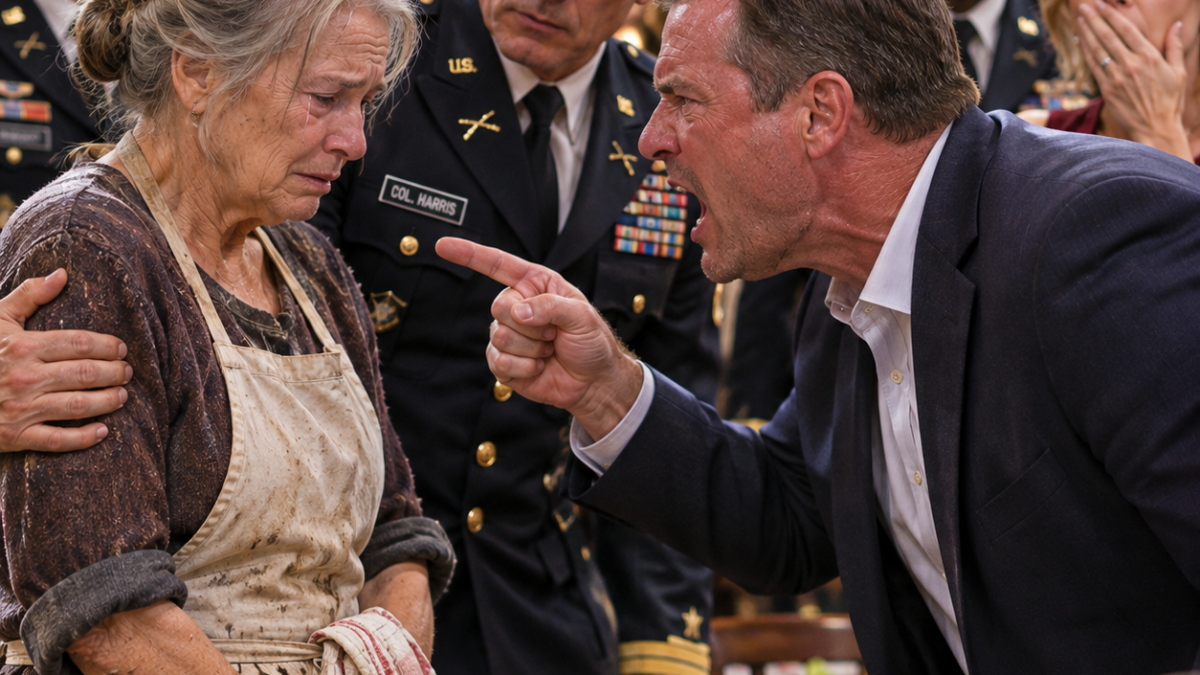
Wendell turned.
His eyes went first to my face.
Then the uniform.
Then the rank.
Then the ribbons.
The color left him so quickly I watched it happen.
Marcus recovered first.
“Ma’am.”
I nodded.
“At ease.”
The soldiers relaxed.
Wendell did not.
His mouth opened.
Closed.
“You…”
I smiled.
“Hi, Wendell.”
Mom’s hand covered her mouth.
Captain Brooks looked at me.
Then Wendell.
Then me again.
Marcus was fighting a smile.
Wendell finally managed:
“You’re…”
“A major.”
Nothing.
I helped.
“United States Army.”
Marcus, apparently unable to resist, added:
“Military intelligence.”
Wendell turned toward him.
Marcus arranged his expression into professional innocence.
“Sir.”
I almost laughed.
Mom sat hard on the sofa.
“Josephine.”
I turned.
Her expression hurt.
Not because of Wendell.
Because of me.
“You never told me.”
My stomach dropped.
“I tried.”
“You’re a major?”
“Yes.”
“When?”
“Nine months ago.”
Her eyes filled.
“Nine?”
I remembered.
I had called after the ceremony.
Mom answered.
Wendell had friends over.
She was distracted.
Said she would call back.
She never did.
I had been hurt.
Then stubborn.
Then busy.
Mom stood.
Walked toward me.
Touched the rank insignia like she needed proof.
“My baby.”
“Mom.”
She laughed through tears.
Then hugged me.
Over her shoulder, I watched Wendell.
If he had simply misunderstood me, embarrassment would have made sense.
Instead, I saw anger.
He felt robbed.
Not of truth.
Of dominance.
“Well.”
He forced a laugh.
“You certainly know how to make an entrance.”
I looked toward the kitchen.
“I tried staying where you told me.”
Ruiz stared into his drink to hide his face.
Wendell flushed.
“That was a joke.”
Mom turned.
“No.”
He looked at her.
“What?”
“You told her twice.”
“Ruth.”
“You said you didn’t want her embarrassing you.”
“I was teasing.”
“You weren’t.”
The room went quiet.
My mother had contradicted him publicly.
He noticed.
So did I.
Wendell glanced toward the soldiers.
“We don’t need to create drama in front of guests.”
Mom’s lips parted.
For a moment, I saw the reflex.
Apologize.
Back down.
Then she said:
“Why not?”
Marcus looked toward the floor.
Maybe giving her privacy.
Maybe hiding satisfaction.
Wendell shifted targets.
“Well, apparently Josephine has been keeping some things from us.”
My lie now.
Interesting.
“I never told you I was unemployed.”
“You let me believe it.”
“Yes.”
“Why?”
“Because I wanted to see how you treated somebody you thought had no status.”
His face hardened.
“That’s manipulative.”
“Maybe.”
I nodded.
“It was also informative.”
He looked at Mom.
“You see what she’s doing? She comes into this house—”
“My house.”
Mom said it quietly.
Wendell stopped.
She looked surprised by her own words.
Then repeated them.
“My house.”
He laughed.
“Our house.”
“No.”
My mother shook her head.
“You live here.”
He stared.
“You didn’t buy it.”
That was boundary number two.
Small sentences.
Large consequences.
Marcus cleared his throat.
“Mr. Pruitt.”
Wendell turned.
Marcus’s expression had become neutral.
“If you don’t mind me asking, where did you complete the Sergeants Major Course?”
“You may mind your own business.”
Marcus nodded.
“Understood.”
Captain Brooks asked:
“What unit did you retire from?”
“I’m not being interrogated.”
“No one said you were.”
“I served.”
Mom looked at him.
That sentence was smaller.
Not twenty-seven years.
Not command sergeant major.
Just I served.
I saw retreat.
So did everyone else.
I asked:
“What year did you retire?”
“Two thousand nine.”
“From active duty?”
“Yes.”
“Where?”
“Fort Benning.”
Marcus asked:
“What organization?”
Wendell snapped:
“What is this?”
Marcus remained calm.
“You invited us as fellow soldiers, Mr. Pruitt. Army gets small when people start talking careers.”
“I don’t owe you my résumé.”
“No.”
I said.
“You don’t.”
I looked at his cap.
“But when you use that résumé to demand respect, questions become predictable.”
His eyes narrowed.
“I know exactly what you’re doing.”
“So do I.”
Mom looked from Wendell to me.
Then the shadow box.
“Josephine.”
“Yes?”
“You know something.”
I hated what came next.
But she had asked.
“Yes.”
Wendell stepped toward me.
“What did you do?”
“Nothing improper.”
“You accessed my service record?”
“No.”
My answer came instantly.
“I did not and would not misuse restricted systems for family issues.”
His accusation lost momentum.
“I listened to your stories.”
I continued.
“I checked publicly available information.”
“I spoke to someone who knew you when you were younger.”
Mom whispered:
“Tell me.”
Wendell turned.
“Ruth, don’t.”
She stared.
“Don’t what?”
“Listen to this garbage.”
“You have spent two years telling me to listen to you.”
He went silent.
“I want to hear her.”
My mother looked at me.
So I told her.
“Wendell did serve.”
Relief flickered across her face.
Then I continued.
“He enlisted in the Army Reserve when he was nineteen.”
Wendell’s jaw tightened.
“He served roughly sixteen months.”
Mom stared.
“No.”
“He separated as a private first class.”
Her eyes moved toward him.
“No combat deployment.”
Silence.
“No twenty-seven-year career.”
I looked at the hat.
“No command sergeant major.”
Mom’s face emptied.
“Is that true?”
“Ruth—”
“Is that true?”
“I served.”
“That isn’t what I asked.”
“I wore the uniform.”
“For sixteen months?”
He said nothing.
“You told me twenty-seven years.”
“I was young.”
“What does that mean?”
“I made mistakes.”
“You told me you were in Iraq.”
“I supported—”
“Were you in Iraq?”
Silence.
Mom’s voice cracked.
“Were you ever deployed?”
Wendell looked down.
“No.”
Mom closed her eyes.
One syllable.
A two-year identity collapsed.
I expected screaming.
My mother sat down.
Slowly.
Then looked at Wendell’s cap.
“Take it off.”
He stared.
“What?”
“The hat.”
“Ruth.”
“Take it off.”
“This is childish.”
Mom pointed.
“Take that hat off in my house.”
Wendell removed it.
Slowly.
He placed it on the coffee table.
Gold embroidery faced us.
COMMAND SERGEANT MAJOR.
Mom stared at it.
Then him.
“You made me believe you understood leadership.”
“I do.”
“No.”
Her voice trembled.
“You understand being obeyed.”
Wendell opened his mouth.
She kept going.
“You corrected everything.”
“Ruth—”
“The table.”
“Your clothes.”
“My friends.”
“Patricia never respected—”
“Patricia disagreed with you.”
Mom’s voice rose.
“You told me I embarrassed you when I laughed too loudly.”
“You were drinking.”
“One glass of wine.”
“You told me women married to senior military men understood presentation.”
Wendell froze.
That was new to me.
“You told me I didn’t understand discipline.”
Her eyes filled.
“You told me to stop singing because it was childish.”
My chest tightened.
The missing music.
There it was.
“You said grown women don’t make noise for attention.”
Wendell rubbed his face.
“I said things badly.”
Mom laughed once.
“No.”
“You said them clearly.”
Captain Brooks spoke gently.
“Ms. Calloway, I’m sorry.”
Wendell snapped:
“Elena, stay out of this.”
Captain Brooks’s face changed instantly.
Cold.
“Mr. Pruitt.”
Marcus stood.
Ruiz straightened.
Whitaker’s jaw tightened.
Nobody threatened.
Nobody needed to.
For the first time, Wendell was surrounded by the very institution he had used as a costume, and the people inside that institution were not impressed.
He looked at me.
“You happy?”
“No.”
That confused him.
“You wanted to humiliate me.”
“No.”
“You walked in wearing that uniform.”
“Because you told Mom I would embarrass you in front of ‘real military men.’”
His face reddened.
“You could have corrected me privately.”
“Yes.”
“Then why didn’t you?”
“Because privately, you had already convinced my mother that disagreeing with you meant disrespecting military experience.”
He glanced at her.
“You invited witnesses because you thought they would make you stronger.”
I took a breath.
“You built the stage.”
His mouth tightened.
“I walked into the room.”
He stepped closer.
“Be very careful.”
Captain Brooks stood fully.
Marcus too.
I stayed still.
Mom saw everything.
“Don’t threaten my daughter.”
“I am not threatening her!”
“You just told her to be careful.”
“I meant what she says.”
“No.”
Mom rose.
“You mean she should stop because you’re losing control of the room.”
Wendell stared.
That sentence did not come from a major.
It came from Ruth.
And he knew the difference.
His face shifted.
For the first time that night, he looked scared.
“This is ridiculous.”
He laughed.
“You’re all turning a relationship disagreement into something sinister.”
Mom stared.
“I never hit you.”
He continued.
“Never threatened you.”
“No.”
“Never locked you in.”
“No.”
“So now I’m some kind of monster because I have opinions?”
Mom’s face went very still.
Then she asked:
“Why did I stop seeing Patricia?”
Wendell’s confidence faded.
“I didn’t make you.”
“You said she was trying to ruin our relationship.”
“She hated me.”
“She didn’t trust you.”
“Same thing.”
“No.”
Mom shook her head.
“Why did I quit pottery?”
“You complained it cost too much.”
“I complained one glazing fee went up.”
“Same thing.”
“Why did I stop traveling?”
“You told me you hated hotel beds.”
Mom’s eyes filled.
“No.”
She looked at him.
“You told me women in committed relationships didn’t disappear overnight with girlfriends.”
“That’s not what I—”
“It is.”
Her voice shook.
“Why did I start showing you receipts?”
Silence.
My body went cold.
Wendell looked toward me.
Then away.
“You were spending too much.”
“It’s my money.”
“We share expenses.”
“The house is paid off.”
“I contribute.”
“You pay half the groceries and electric bill.”
Mom stared at him.
“I started asking if I could buy shoes.”
“I never told you to ask.”
“No.”
Tears rolled down her face.
“You just made me regret it every time I didn’t.”
No one spoke.
Mom wiped her cheek.
Then whispered:
“I don’t know when I became afraid of disappointing you.”
That sentence did what my rank could not.
It destroyed the last defense.
Wendell looked at me.
“This is your fault.”
Mom stepped between us.
“No.”
He stared.
“This is yours.”
“You’re upset.”
“Yes.”
“We’ll talk tomorrow.”
“No.”
“Ruth.”
“I want you out.”
Everything stopped.
Wendell blinked.
“What?”
“Pack a bag.”
He laughed in disbelief.
“You cannot be serious.”
“I am.”
“Where exactly am I supposed to go?”
Mom’s mouth trembled.
Then something fierce came back.
“The Army taught you self-reliance, didn’t it?”
Marcus made a sound suspiciously like a cough.
I looked away before I smiled.
Wendell did not.
“I live here.”
“For eleven months.”
“Our relationship—”
“May or may not survive tonight.”
Mom said it carefully.
“I’m not deciding the rest of my life this angry.”
That impressed me.
“But you are leaving my house tonight.”
Wendell looked at me.
“She told you to say that.”
Mom’s face hardened.
“No.”
He stopped.
“I said it.”
Then pointed toward the stairs.
“Pack.”
He stood there ten seconds.
Then turned.
Walked upstairs.
The bedroom door slammed.
Mom flinched.
I moved toward her.
She lifted one hand.
“Not yet.”
So I stopped.
Captain Brooks stepped closer.
“Would you like us to leave?”
Mom looked at the untouched dinner.
The four soldiers.
Me.
Then laughed weakly.
“I have enough roast for an infantry company.”
Marcus smiled.
“That sounds like a lawful order.”
Mom wiped her tears.
“No more orders tonight.”
Then took a breath.
“But you’re welcome to stay.”
Ruiz nodded.
“We’d be honored.”
Wendell came downstairs twenty minutes later carrying two duffel bags.
The cap was gone.
So was the polo with an Army emblem.
He wore a plain shirt.
Without the costume, he looked smaller.
Human.
He stopped near the front door.
Mom walked toward him.
I stayed back.
This was hers.
He spoke quietly.
I could not hear the first sentence.
Mom shook her head.
He said something else.
“No.”
He reached toward her arm.
She stepped back.
“Don’t.”
His hand dropped.
Then he looked past her.
At me.
At the soldiers.
Humiliation flashed across his face.
Still humiliation.
Not grief.
Not yet.
He opened the door.
Then turned.
“You’re making a terrible mistake.”
Mom looked at him.
“Maybe.”
My chest tightened.
Then she said:
“But it will be my mistake.”
He stared.
No answer.
He left.
Mom closed the door.
Turned the deadbolt.
Kept her hand on it.
Then whispered:
“I need a locksmith.”
“Yes.”
Her shoulders collapsed.
I caught her before she hit the wall.
Patricia arrived twenty-two minutes later.
Mom called her.
I heard only:
“Pat?”
Then silence.
Then:
“I’m sorry.”
Patricia’s silver Honda came into the driveway like a rescue vehicle.
She entered wearing orthopedic sandals and purple glasses.
Took in four soldiers.
My uniform.
Mom crying.
The fake shadow box.
Then said:
“Well.”
She put down her purse.
“I apparently missed a parade.”
Mom laughed through tears.
Then Patricia hugged her.
No lecture.
No I told you so.
Just:
“I’m here.”
That was friendship.
Dinner happened.
Not Wendell’s dinner.
A better one.
Marcus told Mom about his daughters.
Ruiz carried plates.
Whitaker washed dishes.
Captain Brooks asked Mom for the roast recipe.
Wendell had invited them as proof of his importance.
Instead, they became ordinary people at my mother’s table.
At one point Whitaker said:
“I knew something was wrong five minutes in.”
Mom looked curious.
“What?”
“He told Marcus that command sergeants major report directly to the Secretary of the Army.”
Mom stared.
“They don’t?”
Marcus covered his face.
“No, ma’am.”
Then Captain Brooks said:
“He also told me officers salute command sergeants major indoors.”
Mom started laughing.
Really laughing.
She put down her fork.
“Oh my God.”
Every ridiculous detail loosened shame.
That was important.
For two years, Wendell had treated his military vocabulary like holy text.
Now Mom realized some of what had intimidated her was nonsense.
Not all of his control came from the military lie.
But the lie had given every opinion extra weight.
He had not just told her where to place glasses.
He had done it as a man who had supposedly led thousands.
He had not just called her loud.
He had told her a disciplined woman would know better.
The fraud had become scaffolding around ordinary control.
Now the scaffolding was collapsing.
After everyone left, Mom sat at the kitchen table.
I changed out of uniform.
My jacket hung over a chair.
For a while, neither of us spoke.
Then she said:
“Please don’t tell me you’re proud of me.”
That surprised me.
“Okay.”
“I feel stupid.”
“You aren’t.”
“I believed him.”
“You trusted him.”
“I let him make me smaller.”
My throat tightened.
“Mom.”
“I stopped singing.”
“I know.”
“I stopped seeing Patricia.”
“I know.”
“I quit pottery.”
“I know.”
She looked at her hands.
“I started asking permission to spend my own money.”
There it was.
The financial part.
Not theft.
Not yet.
But control.
“I don’t understand how I became that woman.”
I took her hand.
“You didn’t become her all at once.”
Mom cried.
“No.”
“You gave up one argument because you were tired.”
“One trip.”
“One friend.”
“One song.”
“One receipt.”
“You thought peace was cheaper.”
Her shoulders shook.
“I should’ve known.”
“Known what?”
“That something was wrong.”
“So should I.”
She shook her head.
“You were working.”
“I was gone.”
“Josephine—”
“No.”
I looked at her.
“I called every week and congratulated myself for it.”
Her eyes filled.
“I should have come home sooner.”
Mom squeezed my hand.
“I helped hide it.”
“Why?”
“I didn’t want you worrying.”
There it was.
Two women protecting each other into silence.
I almost laughed at the absurdity.
Instead I hugged her.
Mom slept in my room that night.
Not because she feared Wendell physically.
She could not sleep in the bedroom they had shared.
We sat against the headboard drinking tea until almost three.
Her eyes kept moving to my uniform.
“Major.”
“You keep saying that.”
“I missed your promotion.”
“You missed one ceremony.”
“I missed nine months.”
“I should have told you again.”
She looked at me.
“I should have called back.”
Both were true.
Then, around two, she asked the hardest question.
“Do you think he loved me?”
I took a long time.
“Yes.”
She looked surprised.
“I think he probably did.”
“How can somebody love you and treat you that way?”
“Love doesn’t automatically make somebody healthy.”
Mom looked down.
“I still love him.”
“I know.”
“A little.”
“I know.”
“Does that make me pathetic?”
“No.”
“Would you let me take him back?”
I smiled sadly.
“No.”
She almost laughed.
“At least you’re honest.”
“I’d argue with you.”
“Good.”
“But I would not lock you in your house until you agreed.”
She leaned against me.
“That’s reassuring.”
At 7:12 the next morning, Mom called a locksmith.
Before coffee.
Then the bank.
Then her attorney.
Then the alarm company.
New locks.
New garage code.
New alarm password.
New online banking password.
Wendell was an authorized user on one credit card.
Removed.
He had view access to one household account because he said it helped with budgeting.
Removed.
The house remained solely in Mom’s name.
No deed transfer.
I saw relief move through her body.
Then she whispered:
“I signed some papers.”
My stomach dropped.
“What papers?”
“I don’t know.”
“Mom.”
“Insurance.”
“Medical.”
“One was something about estate planning.”
I felt cold.
“Where are they?”
“The office.”
We spent three hours searching.
Insurance documents.
Utilities.
A medical authorization.
Tax papers.
No signed deed.
Then I found a folder labeled PLANNING.
Inside were photocopies of Mom’s property-tax records.
A valuation of the house.
Retirement account summaries.
Life insurance information.
And an estate-planning questionnaire.
Not signed.
But filled out in Wendell’s handwriting.
Under Primary Beneficiary, he had written his own name.
Under Residence, he wrote:
Possible life estate for surviving partner.
Mom stared.
“What does that mean?”
I knew generally.
I deliberately did not turn my general knowledge into a legal answer.
“We’re asking Evelyn.”
Mom looked at me.
“You know.”
“I know enough to know an attorney should explain the exact effect.”
Her eyes filled.
“You’re doing that on purpose.”
“What?”
“Not taking over.”
“Yes.”
She reached across the desk.
“Thank you.”
That was when I understood how careful love had to be.
After watching someone control my mother, it would have been easy to become controlling in the opposite direction.
Take the papers.
Call everyone.
Make decisions.
Tell myself it was protection.
That would still leave Mom without choice.
Freedom cannot mean exchanging one commander for another.
Her attorney, Evelyn Shaw, saw us Monday.
She reviewed everything.
No completed deed transfer.
No valid change she could identify that moved ownership of the house.
No updated beneficiary designation to Wendell on the major accounts we brought.
The medical authorization was limited and revocable.
The worksheet itself transferred nothing.
Mom started crying.
“Am I okay?”
Evelyn looked at her.
“You’re still the owner of your property.”
Mom exhaled.
“Your decisions remain yours.”
More tears.
Then Evelyn asked:
“What do you want?”
Mom blinked.
“What?”
“Not Josephine.”
I appreciated that immediately.
“Not Wendell.”
She leaned forward.
“What does Ruth want?”
Mom thought.
“I want everything to remain mine unless I choose otherwise.”
“Good.”
“I want Josephine as emergency medical contact.”
I nodded.
“Patricia second.”
“Fine.”
“I want no one making financial decisions alone for me while I’m capable of making them.”
“Excellent.”
“And if I change my estate plan…”
She swallowed.
“I want you to explain every page when I’m rested.”
Evelyn smiled.
“That’s exactly how we’ll do it.”
Mom looked taller when we left.
Wendell called seventeen times that week.
Mom ignored him.
His messages evolved.
We need to talk.
Then:
I’m sorry you were embarrassed.
Not sorry he lied.
Sorry she felt embarrassed.
Then:
Josephine manipulated you.
Then:
You know me better than they do.
Then:
After everything I did for you, this is how you repay me?
Mom played that one twice.
Then looked at me.
“Same speech.”
“What?”
“He always becomes the person who sacrificed most.”
She deleted it.
A small act.
A huge one.
Two days later, a handwritten letter arrived.
Mom wanted me to read it first.
I refused.
“Why?”
“It’s yours.”
“What if it upsets me?”
“It probably will.”
“That’s helpful.”
“You can stop whenever you want.”
She opened it.
Read silently.
Her face moved through anger, sadness, disbelief.
At the end, she folded it.
“What does he say?”
“That he lied because people treated him differently when they thought he’d had a long military career.”
That sounded honest.
“He says he left the Reserve ashamed.”
I nodded.
“He says he told one woman he had stayed longer than he actually did because she seemed impressed.”
Mom looked at me.
“Then he kept doing it.”
“A lie that worked.”
“Yes.”
She stared at the page.
“He says he never expected it to become his whole identity.”
I thought about the hats.
The shadow box.
Every lecture.
“What about how he treated you?”
Mom’s mouth tightened.
“He says he was trying to give me structure.”
There it was.
Still.
An explanation that turned control into assistance.
Mom folded the paper.
Put it in a drawer.
“What are you going to do?”
“Nothing.”
“No reply?”
She shook her head.
“For two years, I answered every accusation.”
Her voice steadied.
“I’m tired of defending myself.”
That sounded like the beginning of something.
A week later, Marcus called.
“Thought you should know something.”
“What?”
“Pruitt’s been speaking at veterans events.”
I sat straighter.
“As what?”
“Retired CSM.”
“Where?”
“Community breakfasts.”
“School events.”
“Couple fundraisers.”
“Any money?”
“Small honorariums at least once.”
That mattered.
I stayed careful.
“Document what you personally know.”
“Already done.”
“Don’t turn this into social-media entertainment.”
“I wasn’t planning to.”
“Good.”
I wanted facts handled by people who actually had reason and authority to handle them.
I wanted no online mob.
No vigilante crusade.
Truth was strong enough.
The local veterans organization reviewed Wendell’s role.
He was legitimately a veteran.
That complicated the story.
He had served.
Briefly.
But he had repeatedly represented himself to the organization and public audiences as a retired command sergeant major.
They removed him from ceremonial leadership duties.
Canceled two scheduled speaking engagements.
He repaid a few small honorariums after questions were raised.
There was no dramatic arrest.
No judge banging a gavel.
No federal agents marching him away.
Real consequences are often administrative.
Embarrassing.
Quiet.
But for Wendell, they struck the exact place he had built his identity.
People stopped calling him Sergeant Major.
The title disappeared from event flyers.
The speeches stopped.
He had to become Wendell Pruitt again.
Just Wendell.
That may have been harder than any punishment I could have imagined.
Mom did not become instantly happy.
That frustrated her.
“He lied.”
“Yes.”
“He controlled everything.”
“Yes.”
“I know ending it was right.”
“Yes.”
“Then why do I miss him?”
We sat on the porch.
I took a breath.
“Because your feelings didn’t receive a legal briefing.”
She gave me a look.
“I’m serious.”
“So am I.”
I took her hand.
“You loved parts of him.”
“Maybe all of him.”
“At one point.”
She nodded.
“He made me feel safe after George.”
That hurt to hear.
Not because Dad was replaceable.
Because Mom had spent years alone.
“Wendell checked doors.”
“Fixed things.”
“Drove on trips.”
“Made breakfast.”
She wiped her face.
“Those things were real too.”
“Yes.”
“I feel like saying that means I’m excusing everything else.”
“No.”
I looked at her.
“You don’t have to rewrite every good memory to justify leaving.”
Her mouth trembled.
“Good things happened.”
“Yes.”
“And bad things happened.”
“Yes.”
“Both?”
“Both.”
She cried.
“That’s inconvenient.”
“Human beings usually are.”
She laughed.
Later that afternoon she wrote on a yellow sticky note:
Missing him does not mean I need him back.
She put it beside the kitchen phone.
It stayed there for almost a year.
Patricia came back completely.
Thursday lunches.
Book club.
Pottery.
The first day Mom returned to the pottery studio, she called me from the parking lot.
“I made a bowl.”
“Congratulations.”
“It’s terrible.”
“That sounds correct.”
“I forgot everything.”
“You’ll relearn.”
Long pause.
Then:
“I felt like myself.”
I closed my eyes.
That was the victory.
Not the bowl.
Mom also began spending money badly on purpose.
Not recklessly.
Symbolically.
One afternoon she bought a bright red coat.
Called me from the store.
“It’s ridiculous.”
“How much?”
“Too much.”
“Can you afford it?”
“Yes.”
“Do you like it?”
“Yes.”
“Then why are you calling me?”
She went quiet.
Habit.
She had become accustomed to presenting a defense before spending.
I said:
“Buy the coat or don’t buy the coat.”
“Helpful.”
“But don’t ask me for permission.”
She laughed.
Then bought it.
When she wore it to lunch with Patricia, she sent me a photograph.
No explanation.
Just Mom smiling in red.
I saved it.
Three months after he left, Wendell came to the house.
Mom told me afterward.
That mattered.
“He came by.”
My body tightened.
“Did you let him inside?”
“No.”
“Did you feel safe?”
“Yes.”
“What did he want?”
“To apologize.”
I waited.
“He said he was ashamed of leaving the service early.”
That made sense.
Not excuse.
Sense.
“He said the first time he lied about being career Army, someone looked at him differently.”
Mom stared toward the garden.
“Like he mattered.”
I understood.
“Then he did it again.”
“And again.”
“Until he had twenty-seven years.”
“Yes.”
“What did you say?”
Mom looked at me.
“I told him I was sorry he had been ashamed.”
That surprised me.
Then she continued.
“And I told him his shame did not give him permission to make me ashamed of myself.”
My throat tightened.
“What happened?”
“He cried.”
“And you?”
“I cried.”
“Then?”
“I said goodbye.”
No dramatic confrontation.
No revenge.
No slap.
A boundary.
Sometimes endings that look small are the ones that hold.
Wendell wrote me a letter six months later.
I almost threw it away.
Then read it.
The first half was defensive.
He said seeing me in uniform had humiliated him.
Said I had deliberately trapped him.
I nearly stopped.
Then the tone changed.
I respected you after I saw your uniform.
I read that line twice.
I should have respected you before.
That was honest.
Then:
I liked the way people listened when they thought I had been important.
More honest.
Eventually I could not tell whether I wanted respect or obedience.
That mattered.
Near the end:
Your mother deserved neither my lies nor my corrections.
I folded the letter.
Did not respond.
A real apology does not create an obligation to reopen access.
Sometimes its purpose is simply to stop denying what happened.
My relationship with Mom changed.
Not because she became more dependent.
The opposite.
She became wonderfully difficult.
I suggested a new alarm system.
“No.”
A different doctor.
“I already have a doctor.”
A trip itinerary.
“Stop managing me.”
I smiled.
“Good.”
“What?”
“Nothing.”
“Don’t use your intelligence-officer tone on me.”
“Yes, ma’am.”
“Don’t ‘ma’am’ me.”
Every disagreement made me strangely happy.
During Wendell’s time, disagreement had become dangerous in her mind.
Now she used it casually again.
That was health.
She started asking about my career.
Not classified work.
The life.
What a major actually did.
Promotion.
Leadership.
How the Army functioned.
One afternoon she asked:
“Do people stand every time you enter a room?”
I laughed.
“No.”
“Marcus did.”
“Marcus panicked.”
“He shouted.”
“He enjoys drama.”
“I like Marcus.”
“I know.”
She smiled.
“Wendell would hate that I find Marcus more impressive.”
“Mom.”
“What?”
“You’re becoming petty.”
“I’m healing.”
Apparently those were adjacent processes.
A year after the original dinner, Mom hosted another one.
Same house.
Same dining table.
Different atmosphere.
Patricia came.
Marcus and his wife.
Captain Brooks.
Ruiz.
A few neighbors.
Mom cooked too much food.
Nobody was ordered to stay in the kitchen.
Nobody corrected the water glasses.
Marcus eventually said:
“Remember the last military dinner?”
Mom pointed a serving spoon.
“We do not discuss historical trauma before dessert.”
Marcus straightened theatrically.
“Yes, ma’am.”
Mom grinned.
“See? Military discipline.”
Everyone laughed.
Later, I found her staring at the blank wall above the fireplace.
Wendell’s fake shadow box had been removed.
“What are you putting there?”
“I don’t know.”
Months later she decided.
An old photograph.
Mom and Dad in their thirties.
Dad covered in paint.
Mom laughing.
Their kitchen under renovation behind them.
No medals.
No title.
No caption.
Just two people who had actually built something.
I understood.
She reclaimed the wall from performance.
My own reaction to the dinner bothered me later.
I had enjoyed the moment Marcus shouted.
Of course I had.
After being mocked for two days, watching Wendell’s face collapse felt satisfying.
For several seconds, I enjoyed holding the kind of authority he worshipped.
That made me uncomfortable.
Because rank is power too.
Legitimate power can still intoxicate.
I never wanted to become somebody who thought status made me more deserving of dignity.
Marcus and I discussed it months later.
“I enjoyed shouting attention,” he admitted.
“I know.”
“Possibly too much.”
“Absolutely.”
He grinned.
Then became serious.
“The point wasn’t really that you outranked him.”
“I know.”
“It was that he thought rank determined who deserved respect.”
I looked at him.
Marcus continued.
“Then the highest-ranking person in the room turned out to be the woman he told to stay in the kitchen.”
I laughed.
“That is still petty.”
“A little.”
He shrugged.
“But memorable.”
He was right.
Mom eventually told me when she first realized she was changing around Wendell.
Months before the dinner.
She had been washing dishes.
Singing Motown.
Wendell walked in.
Asked her to stop.
She laughed.
Thought he was joking.
He said:
“You’re sixty years old, Ruth. Act like it.”
Mom stopped singing.
Not because he ordered her.
Because he embarrassed her.
The next day, she did not sing.
Or the day after.
“I remember thinking the house sounded more respectable.”
Her eyes filled.
“Then eventually I realized it just sounded quiet.”
That sentence hurt more than the fake military rank.
Control is often visible through disappearance.
Friends.
Music.
Color.
Trips.
Opinions.
Laughter.
Volume.
The natural shape of a person.
Two years later, I came home on a Saturday.
At 7:40 a.m., Aretha Franklin shook the downstairs windows.
Mom stood barefoot in the kitchen.
Flamingo pajama pants.
Hair wild.
Pancake batter on one cheek.
I leaned against the doorway.
“What happened to discipline?”
She turned.
Raised the spatula.
“In this house, everyone sleeps as late as they damn well want on Saturday.”
I laughed.
“But breakfast ends at nine.”
“Yes, ma’am.”
“Better.”
There she was.
Not exactly the woman she had been before Wendell.
People do not return to an untouched version of themselves.
She was somebody new.
A woman who knew how quietly she could disappear and therefore guarded her voice more carefully.
The Wendell story gradually stopped being the center of her life.
That mattered.
At first, every change referenced him.
New locks because of Wendell.
Pottery because Wendell stopped her.
Patricia because Wendell isolated her.
The red coat because Wendell criticized spending.
Then eventually locks became locks.
Pottery became pottery.
Patricia became Patricia.
Music became music.
The day I knew Wendell was truly losing his power was when Patricia mentioned him over lunch and Mom had to pause before remembering the context.
He was no longer the measuring stick.
That was freedom.
Years later, I heard Wendell had joined an accountability group through his church.
According to Marcus, he had begun speaking more honestly about the military lies.
I hope he did.
Genuinely.
Not because I wanted him back in our lives.
Because being trapped inside a false identity must be a miserable way to age.
But his healing was not Mom’s responsibility.
That distinction mattered.
Forgiveness does not require supervision.
Compassion does not require access.
Mom never had another serious relationship.
Not because Wendell ruined romance.
She simply liked her life.
Patricia.
Travel.
Pottery.
Book club.
Garden.
Music.
One afternoon she told me:
“I spent two years wondering whether a man approved of me.”
Then she looked across her backyard.
“I had forgotten how pleasant it is not to be evaluated.”
That sentence followed me into leadership.
Everywhere.
When I walked into a room, did people become smaller?
Did they watch my face before speaking?
Did disagreement disappear?
If so, I had a problem.
Rank can produce silence quickly.
That does not mean it produced respect.
Wendell understood silence.
He called it discipline.
I learned never to make that mistake.
The best command sergeant major I later worked with was Denise Walker.
Thirty years in uniform.
Brilliant.
Tough.
Could dismantle foolishness with a raised eyebrow.
One evening, after a long exercise, I told her a cleaned-up version of Wendell’s story.
She listened.
Then said:
“You know what fake leaders love?”
“What?”
“Ceremony.”
I smiled.
“Why?”
“Because ceremony makes hierarchy visible.”
She leaned back.
“Real leadership gets tested when nobody is standing at attention.”
That sentence stayed with me.
Mom met Denise once.
Loved her.
Not because of her rank.
Because Denise asked Mom about pottery and then listened to the entire answer.
Later, Mom whispered:
“She’s terrifying.”
“Why?”
“She listens too carefully.”
“That’s why she’s good.”
Mom nodded.
“Wendell never listened unless he was waiting for his turn to correct somebody.”
Exactly.
At sixty-seven, Mom entered one of her pottery pieces in a local show.
A blue bowl with an uneven rim.
She received honorable mention.
She called me as though she had been appointed to the Supreme Court.
“I won.”
“Honorable mention is technically—”
“I won.”
“Yes, Mom.”
I sent flowers.
The card read:
For a woman with no discipline.
She called immediately.
“You think you’re funny.”
“Occasionally.”
“I’m keeping the card forever.”
She did.
At seventy, Mom wanted the kitchen repainted.
“What color?”
“Yellow.”
“Not orange?”
“Your father is dead. He cannot stop me.”
“That is dark.”
“It is marriage.”
Patricia and I helped.
Marcus came by one afternoon and somehow got paint on the ceiling.
Mom told him the Army had clearly failed.
He gave her a terrible salute with the roller.
Music played.
Loud.
At one point, I stood in the doorway.
Yellow paint.
Patricia dancing.
Marcus ruining the ceiling.
Mom laughing.
And I remembered that first morning.
Wendell announcing wake-up times.
Mom checking his face.
The missing music.
This was the ending I wanted.
Not Wendell suffering.
Mom occupying her own life again.
Years passed.
My career continued.
Assignments.
Promotions.
Moves.
Leadership jobs.
The strange thing about military careers is that one day you realize the people you once thought impossibly senior are now asking for your judgment.
I carried Mom’s kitchen with me into every position.
The glass being moved.
The quick glance at Wendell.
The silent calculation.
Was I creating that in other people?
Did subordinates tell me what they thought or what they believed I wanted?
Did they bring bad news early?
Could they correct me?
Could they say no?
That became my private definition of command climate.
Not whether rooms were quiet.
Whether truth could survive inside them.
When I was promoted again, Mom attended.
This time she knew months in advance.
She sat beside Patricia.
Marcus came too.
After the ceremony, Mom touched my insignia.
“I know this one.”
“You studied?”
“Marcus taught me.”
“Traitor.”
Mom smiled.
Then said:
“But you’re taking the trash out when we get home.”
Certain chains of command are permanent.
“Yes, Mom.”
“Good.”
That night, while cleaning the garage, we found one of Wendell’s old black caps.
The fake CSM patch was still stitched across the front.
Mom stared.
“Oh.”
“What do you want to do with it?”
She thought.
Then found a seam ripper.
Started removing the patch.
“What are you doing?”
“Fixing it.”
“No fire?”
“Too dramatic.”
“No ceremonial destruction?”
“I’m seventy-two, Josephine. I have laundry.”
The patch came loose.
Underneath was a plain black cap.
Mom looked at it.
“Better.”
Then tossed it into a donation box.
That image stayed with me.
Sometimes people do not need to destroy the object.
They need to remove the false title.
Then you see what was underneath.
Just a man.
Just a hat.
No borrowed rank.
Mom had minor surgery a few years later.
Nothing serious.
But paperwork made her anxious because of the forms Wendell once pushed toward her.
She called me.
“I know I’m being ridiculous.”
“You’re not.”
“I hate signing things now.”
“Then don’t sign until you understand.”
“That sounds obvious.”
“The useful things usually do afterward.”
At the hospital, a staff member started explaining a document quickly.
Mom raised her hand.
“Slow down.”
The woman stopped.
Mom asked questions.
Read every page.
Signed when she understood.
I sat beside her.
Silent.
That made me prouder than the night she threw Wendell out.
Because freedom often looks boring.
Paperwork.
Passwords.
Questions.
Time.
Choice.
The dinner story eventually became funny enough to tell.
Not all of it.
The harmless parts.
Marcus shouting.
Wendell’s face.
The fake hat.
Every year, Mom exaggerated how loudly Marcus had yelled.
By year five, according to her, the windows shook.
Marcus denied this.
Patricia said:
“Did Wendell really turn white?”
Mom answered:
“Copy paper.”
We laughed.
The laughter did not mean the harm disappeared.
It meant the memory no longer controlled the room.
That was different.
The last time Mom saw Wendell was in a grocery store.
She called afterward.
“You’ll never guess who I saw.”
“Who?”
“Wendell.”
I sat down.
“You okay?”
“Yes.”
“What happened?”
“He looked old.”
That surprised me.
He was only slightly older than she was.
“He said hello.”
“And?”
“I said hello.”
“Then?”
“He asked how I was doing.”
“What did you say?”
Mom laughed.
“I said, ‘Very loud.’”
I nearly choked.
“Mom.”
“What?”
“That is cruel.”
“No.”
She sounded delighted.
“That is closure.”
According to her, Wendell smiled.
Then said:
“I’m glad.”
Nothing else.
Maybe that was enough.
Two people who no longer owed each other access.
My Army retirement came years later.
Mom sat in the front row.
Older.
Smaller.
Still impossible.
During the ceremony, someone spoke about leadership, service, assignments, responsibility.
Mom cried through almost all of it.
Afterward, she hugged me.
Then whispered:
“Want to know what I’m proudest of?”
I expected something about service.
“What?”
“You never became Wendell.”
I stared.
She smiled.
“You could have.”
That was one of the deepest compliments she ever gave me.
Not because I believed I was immune from arrogance.
Because I understood what she meant.
Power always offers the same temptation.
People obey.
You begin believing obedience is evidence that you are right.
It isn’t.
Mom developed cancer years later.
Seventy-eight.
Aggressive.
Fast.
She approached it differently than she would have before Wendell.
Questions.
Second opinions.
Documents read carefully.
Choices explained.
She eventually chose hospice herself.
No one decided for her.
Not me.
Not a doctor.
Not fear.
Her.
Patricia came almost every day.
I took leave.
Marcus visited once.
Mom was weak by then.
He stood in the doorway.
She looked at him.
“Still standing at attention?”
He laughed through tears.
“Yes, ma’am.”
“No.”
She patted the chair.
“Sit down.”
He did.
On one of her final good afternoons, I sat beside the bed.
Aretha Franklin played softly.
Mom looked toward the photograph of her and Dad on the wall.
The photograph that had replaced Wendell’s shadow box.
“Jo.”
“Yes?”
“Remember the dinner?”
I smiled.
“Which dinner?”
She rolled her eyes weakly.
“You know.”
“Marcus was very dramatic.”
“He was.”
“Wendell looked terrible.”
“He did.”
Mom closed her eyes.
“I used to think that was the night you saved me.”
My throat tightened.
“You saved yourself.”
“I know.”
She opened her eyes.
“It took me years to understand that.”
I took her hand.
“You know what helped most?”
“What?”
“You did not tell me what to do next.”
I swallowed.
“You could have.”
“You had proof.”
“Rank.”
“Confidence.”
She smiled faintly.
“All the things I thought I needed somebody else to have.”
Her fingers squeezed mine.
“But you made me choose.”
Tears filled my eyes.
“I was terrified you’d take him back.”
“I know.”
“I would’ve hated it.”
“I know.”
“I still would’ve tried not to order you.”
Mom laughed weakly.
“That was respect.”
I lowered my head and cried against her hand.
Because that was what the whole story had always been about.
Not uniform.
Not rank.
Not Wendell.
Respect.
Mom died two weeks later.
Patricia on one side.
Me on the other.
Music playing.
No one telling her to lower it.
When we cleaned the house, I found three things in a kitchen drawer.
Her yellow sticky note.
Missing him does not mean I need him back.
The card from her pottery honorable mention.
And the note I had sent with flowers.
For a woman with no discipline.
She had kept all three.
I laughed and cried at the same time.
Then Patricia handed me a box.
Inside was the plain black baseball cap.
No fake patch.
“Why did she keep this?”
Patricia shrugged.
“She told me it reminded her that titles come off.”
That sounded like Mom.
I kept it.
Not as a memory of Wendell.
As a reminder.
Under the title is a person.
Judge the person.
People still ask about that dinner occasionally.
Usually veterans who heard some version through Marcus.
“Did somebody really shout attention?”
“Yes.”
“Did Wendell really turn white?”
“Yes.”
“Did you plan the whole thing?”
No.
I planned to stop lying by omission.
Marcus provided the theater.
And yes, for one moment, it felt incredible.
But that is not the sound I remember most clearly.
I remember Mom singing afterward.
Standing at the kitchen sink.
Off-key.
Loud.
Free.
Wendell believed military discipline meant entering a room and making everybody adjust to you.
He was wrong.
Some of the strongest leaders I ever knew entered rooms and made everybody else more capable.
He believed rank meant respect traveled downward.
Wrong again.
Respect either moves in every direction or it is merely obedience.
He believed people without status deserved less patience.
That was the ugliest lesson he taught me.
Because Wendell treated me badly only when he believed I was nobody important.
The uniform did not change my value.
It changed his perception.
And that told me exactly who he was.
If I could return to the Saturday afternoon when Wendell told me:
“Stay in the kitchen. I don’t want you embarrassing me in front of real military men.”
I would not warn myself.
I would not say:
Tell him now.
Show the ID.
Win the argument.
I would say:
Let him talk.
Let him invite witnesses.
Let him describe imaginary deployments.
Let him lecture about discipline.
Let him tell everyone you have no career.
Let him build the whole room around a lie.
Then walk upstairs.
Put on what you actually earned.
Walk back down.
And do not gloat.
You will not need to.
Truth has presence of its own.
But I would tell myself something more important.
The uniform will not save Mom.
The soldiers will not save Mom.
Exposing Wendell will not save Mom.
That comes later.
Through a locksmith.
A lawyer.
A bank.
Patricia.
Pottery.
A red coat.
Pancakes.
Loud music.
Lonely nights.
Missed feelings.
Hard questions.
A woman learning again that saying no does not require permission.
That is the real story.
Wendell Pruitt invited four soldiers into my mother’s house because he wanted witnesses to his authority.
He ordered me into the kitchen because he believed I had none.
Then I entered wearing a uniform I had actually earned.
Marcus stood.
The others followed.
Wendell turned white.
For a few seconds, the hierarchy he worshipped reversed itself.
But my rank did not defeat Wendell.
Truth did.
And truth did something more valuable than humiliating a liar.
It gave my mother one clean moment in which she could see that the man constantly telling her to become smaller had never actually been standing above her.
He had simply convinced her to keep looking down.
The moment she lifted her head, his power began disappearing.
Years later, when I think of Ruth Calloway, I do not see the woman crying beside the front door after Wendell left.
I see a yellow kitchen.
Flamingo pajama pants.
Aretha Franklin shaking the windows.
Pancake batter on her cheek.
My mother pointing a spatula at me and declaring:
“In this house, everybody sleeps as late as they damn well want on Saturday.”
That is the ending I keep.
Not the fake command sergeant major.
Not his humiliation.
Not the veterans organization.
Not even Marcus shouting.
My mother.
Loud again.
Because there is a difference between making somebody lose power and helping somebody reclaim their own.
I helped expose the first.
Mom rebuilt the second.
And on that very first night, after the soldiers had gone, after Wendell’s bags disappeared from the hallway, after Mom locked the front door and cried until she had no tears left, I heard something from the kitchen.
Singing.
Quiet at first.
Then louder.
I stood in the hallway.
Mom was washing dishes.
Some old Motown song.
Completely off-key.
She caught me watching.
“What are you smiling at?”
I shook my head.
“Nothing.”
She lifted a wooden spoon.
“Then stop staring and dry those plates.”
I walked into the kitchen.
“Yes, ma’am.”
She narrowed her eyes.
“Don’t ‘ma’am’ me.”
I laughed.
She laughed too.
And for the first time since I had come home, the house sounded like ours again.








