“PAINT IT CREAM DREAM OR I’LL TAKE YOUR LAND!” HOA Karen Fined Me $500 for a Fence on My Own Property—Then I Bought the 50 Acres Beneath Her Favorite Shortcut
“PAINT IT CREAM DREAM OR I’LL TAKE YOUR LAND!” HOA Karen Fined Me $500 for a Fence on My Own Property—Then I Bought the 50 Acres Beneath Her Favorite Shortcut
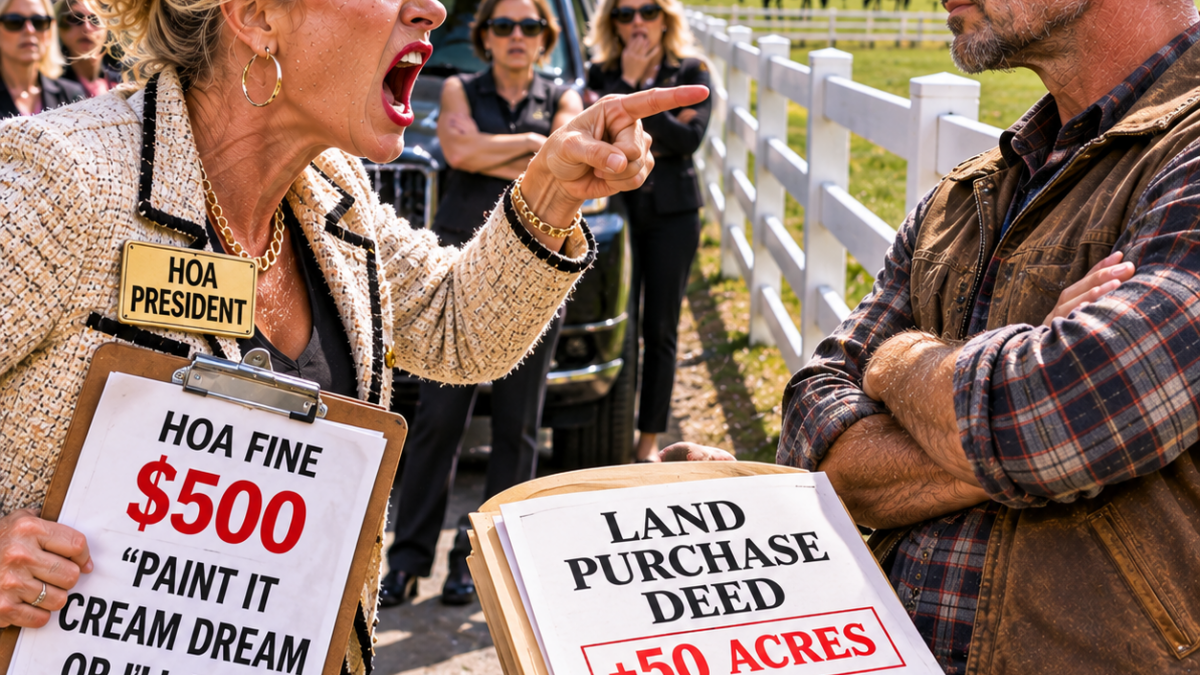
“TEAR DOWN THAT UGLY FENCE, MARCUS—ANTIQUE IVORY IS NOT AN APPROVED COLOR, AND I WILL FINE YOU UNTIL YOU LEARN WHO RUNS THIS NEIGHBORHOOD!” HOA president Dileia Kramer screamed across my vegetable garden, threatening to put a lien on a home that had never belonged to her association, while the silver BMW she drove every morning sat on the private shortcut she had been using without my permission for eight years.
What she didn’t know was that I had spent forty years designing municipal infrastructure, that the county’s original 1987 property records proved my fifteen acres were never part of Willowbrook Estates, and that a temporary construction-access agreement from 2003—the very document her HOA claimed gave it permanent control—had expired long before she began using my land as her personal road to the country club.
And when I spent $200,000 buying the fifty undeveloped acres beside my property, then installed a steel security gate across the old shortcut, Dileia arrived with lawyers, bolt cutters, and a truck full of men to teach me a lesson—only to discover that the real trap wasn’t the gate at all, but the financial records, fabricated boundary claims, and years of secret HOA deals her own residents were finally preparing to expose.
The first thing Dileia Kramer ever said to me was that my vegetables were lowering her property values.
Not my house.
Not an abandoned vehicle.
Not a collapsing barn.
My vegetables.
Specifically, the four-foot galvanized chain-link fence surrounding my tomato plants.
I was standing on my back porch that morning with a cup of coffee in my hand, watching three deer graze beside the creek, when a silver BMW rolled across the gravel entrance to my property.
The car stopped beside my truck.
A woman stepped out.
Blonde hair arranged in a style that looked expensive to maintain.
Designer sunglasses.
White sneakers so clean I doubted they’d ever touched actual dirt.
She surveyed my land with the expression of somebody inspecting a hotel room that hadn’t been prepared to her standards.
Then she marched toward me.
“Are you Marcus Thompson?”
“Yes, ma’am.”
“Dileia Kramer. President of Willowbrook Estates Homeowners Association.”
She extended her hand as though I’d been waiting all morning for the privilege.
I shook it.
“Nice to meet you.”
She didn’t waste time pretending to return the sentiment.
“We need to discuss your fence.”
I looked toward the garden.
“What about it?”
“It’s unacceptable.”
I waited.
She waited too.
Apparently, she expected the word itself to make me apologize.
Finally, I asked, “Unacceptable to whom?”
“To the association.”
I looked across the eastern property line.
Willowbrook Estates began beyond a stand of mature oaks.
Neat houses.
Curving roads.
A clubhouse.
Landscaped entrances.
My property was fifteen acres of rolling Tennessee hills that had existed long before the development.
I was not a Willowbrook homeowner.
I was their neighbor.
“Mrs. Kramer,” I said, “my land isn’t part of your HOA.”
Her smile sharpened.
“That’s a common misunderstanding among newer residents.”
“I have the deed.”
“And I have the covenants.”
“Good.”
I took another sip of coffee.
“Then one of us is going to have a very educational afternoon.”
She didn’t appreciate that.
Dileia opened a leather folder and produced a printed sheet containing the association’s fence standards.
Approved materials.
Approved heights.
Approved post caps.
Approved colors.
She pointed to the color section.
“Cream Dream.”
I blinked.
“Excuse me?”
“Cream Dream is the only approved white shade for perimeter fencing.”
I looked at my galvanized fence.
“Mine isn’t white.”
“Exactly.”
She tapped the page.
“Even antique ivory would be unacceptable.”
I thought she was joking.
She wasn’t.
I tried one more time.
“Mrs. Kramer, this is a vegetable-garden fence on land outside your association.”
“Your personal interpretation of the boundary doesn’t exempt you from community standards.”
“It’s not an interpretation.”
“It’s a survey.”
She snapped the folder closed.
“We’ll see about that.”
Then she turned and walked back toward the BMW.
Before leaving, she stopped beside my driveway.
One perfectly manicured finger pointed toward the old gravel track crossing the rear of my property.
“And another thing.”
“What?”
“You need to keep that road clear.”
I frowned.
“Which road?”
“Our community access route.”
I looked behind her.
The track ran past my creek, through a corner of the original fifteen acres, and continued into an old construction road near Willowbrook.
It wasn’t a county highway.
Wasn’t a public street.
Wasn’t even maintained well enough to deserve the word road.
“That’s private property,” I said.
Dileia laughed.
“Mr. Thompson, we’ve used that route for years.”
“Then you’ve had years to enjoy somebody else’s generosity.”
Her expression hardened.
“It’s established access.”
“For whom?”
“For the neighborhood.”
“And by whose permission?”
She stared at me.
Then said the sentence that changed the entire course of my retirement.
“We don’t need your permission anymore.”
She climbed into her BMW.
Started the engine.
And drove down the very track we’d just discussed.
Across my land.
Without asking.
I stood there watching the dust rise.
My coffee had gone cold.
And for the first time since moving to Tennessee, I felt the old engineer in me wake up.
The part of me that had spent forty years asking one simple question whenever somebody insisted something was legal, safe, necessary, or impossible.
Show me the drawing.
I’d bought this land because I wanted quiet.
My wife, Ellen, had died three years earlier after thirty-four years of marriage.
For nearly a year after the funeral, I couldn’t bring myself to move her gardening gloves from the kitchen counter.
I kept turning toward her side of the bed.
Kept buying groceries for two.
Kept hearing her voice every time I saw something ridiculous.
When I finally sold our old home, I didn’t want another subdivision.
I wanted space.
Trees.
A creek.
Tomatoes.
A place where I could grow old without having somebody knock on my door to discuss whether the shade of my fence met community expectations.
Apparently, fifteen acres wasn’t enough distance from Dileia Kramer.
But I would soon find out that another fifty acres might be.
And that the real secret of Willowbrook Estates wasn’t a paint color at all.
It was buried in a set of documents filed in 2003.
PART2
The certified letter arrived exactly fourteen days after Dileia’s visit.
I was repairing a loose board on the back porch when the mail carrier came up the driveway.
“Mr. Thompson?”
“That’s me.”
“Signature required.”
I signed.
Opened the envelope.
And stared.
WILLOWBROOK ESTATES HOA
NOTICE OF VIOLATION
UNAUTHORIZED FENCING INSTALLATION
INITIAL FINE: $500
CONTINUING NONCOMPLIANCE: $50 PER DAY AFTER THIRTY DAYS
I read the notice twice.
Then examined the photograph attached to it.
My garden fence.
My tomatoes.
My land.
Below the photograph was a sentence stating that all properties within the Willowbrook community influence area were subject to aesthetic review.
Community influence area.
I’d worked on municipal water infrastructure for four decades.
I’d seen creative engineering language.
Creative procurement language.
Creative attempts to explain why a project was suddenly two million dollars over budget.
But community influence area was a new one.
I called the HOA office.
A woman answered.
“Willowbrook Estates.”
“Marcus Thompson.”
A pause.
Then:
“Oh, Mr. Thompson.”
I could hear the change in her voice.
“Is Mrs. Kramer available?”
“One moment.”
Dileia answered almost immediately.
“Marcus.”
She said my name as though we were old friends.
“I assume you received the notice.”
“I did.”
“Excellent.”
“There’s a problem.”
“Yes?”
“My property isn’t covered by your covenants.”
She sighed.
“Marcus, we’ve already discussed this.”
“We discussed your opinion.”
“Now I’m asking for documentation.”
“You received the relevant standard.”
“I received a fence-color sheet.”
“I’m asking for the recorded instrument making my property subject to Willowbrook’s restrictions.”
Silence.
Then:
“Our surveyor has confirmed the fence encroaches into association jurisdiction.”
I looked out at the garden.
“Your surveyor has never been on my property.”
“We have aerial mapping.”
“That’s not the same thing.”
“Mr. Thompson, are you refusing to comply?”
“I’m disputing your authority.”
Her voice changed.
“Then perhaps you’d prefer formal enforcement.”
I smiled.
“I’d prefer the deed.”
She hung up.
I stared at the phone.
Then called my attorney.
Sarah Kai had handled the purchase of my property.
Forty-two.
Sharp.
Meticulous.
The kind of lawyer who made opposing counsel nervous simply by asking for the original document rather than accepting a summary.
She answered on the third ring.
“Marcus.”
“Good morning.”
“Why do I feel like I’m about to hear something expensive?”
“Have you ever heard of a community influence area?”
Silence.
Then:
“Oh, dear.”
I told her everything.
The fence.
The fine.
The supposed HOA jurisdiction.
The shortcut.
The claim that my land didn’t require my permission anymore.
Sarah listened without interrupting.
Then asked:
“Do you still have your title documents?”
“Yes.”
“Survey?”
“Yes.”
“Recorded declaration?”
“For my property, none showing HOA restrictions.”
“Good.”
She paused.
“And Marcus?”
“Yes?”
“Don’t ignore the notice.”
“I wasn’t planning to.”
“Don’t pay it either, at least not before we’ve examined the claim.”
“Glad we’re in agreement.”
“Send it over.”
I scanned everything.
Sarah called back an hour later.
“Your deed doesn’t place the parcel inside Willowbrook.”
“Exactly.”
“That doesn’t end every possible question about the old road.”
“I know.”
“But it raises a rather significant problem for Mrs. Kramer.”
“Which is?”
“She appears to be asserting authority she hasn’t demonstrated.”
I looked toward the garden.
“Then let’s ask her to demonstrate it.”
Dileia’s surveyor arrived the following morning.
His name was Michael Benton.
He looked about thirty-five.
Professional equipment.
Clean boots.
A quiet manner that suggested he’d learned the value of letting clients do most of the talking.
Dileia accompanied him.
Of course.
She marched toward my porch.
“Good morning, Marcus.”
“Mrs. Kramer.”
“Michael is here to clarify our mutual boundary problem.”
I looked at Michael.
“Licensed surveyor?”
He nodded.
“Yes, sir.”
“Good.”
I held out my hand.
“Marcus Thompson.”
He shook it.
Dileia interrupted.
“Now, Michael, show him where the fence crosses.”
Michael glanced at his field notes.
“Before I can establish that, I need to verify the record boundaries.”
Dileia frowned.
“You already reviewed the aerial map.”
“Aerial imagery isn’t a boundary survey.”
I liked him immediately.
He spent nearly two hours working.
Located corners.
Checked monuments.
Compared plats.
Took measurements.
I offered coffee.
He accepted.
Dileia declined.
She spent most of the morning pacing beside her BMW, speaking into her phone and watching Michael as though she expected him to discover the boundary through obedience.
Finally, Michael walked toward us.
“I’ve completed the initial field comparison.”
Dileia smiled.
“Wonderful.”
He looked uncomfortable.
“The garden fence is within Mr. Thompson’s recorded parcel.”
I kept my face still.
Dileia didn’t.
“What?”
“The fence is on his land.”
“That’s impossible.”
Michael looked down at his measurements.
“The county plat and the monuments agree.”
She crossed her arms.
“What about the community influence boundary?”
Michael blinked.
“The what?”
I almost laughed.
Dileia stared.
“Don’t pretend you don’t know what I’m talking about.”
He looked at me.
Then back at her.
“Ma’am, an HOA’s architectural review authority depends on its governing instruments and the land subject to them.”
“I’ve been asked to measure a property boundary.”
“That’s what I’ve measured.”
Dileia’s expression turned cold.
“Perhaps you should review the development documents.”
“I have some of them.”
“Then you know the community controls the entrance area.”
He paused.
“The old access route crosses Mr. Thompson’s parcel, but that’s a separate easement question.”
Dileia seized on the word.
“Exactly.”
I looked at her.
“An easement for travel isn’t ownership of the whole property.”
She ignored me.
Michael continued.
“And I haven’t been retained to give a legal opinion on access rights.”
Dileia looked ready to explode.
Then she did something very strange.
She thanked him.
Too politely.
Too quickly.
And announced that the HOA would conduct further review.
Michael packed his equipment.
When Dileia walked toward her car, he leaned closer to me.
“Mr. Thompson.”
“Yes?”
“You should have your own surveyor verify the full boundary before building anything permanent.”
I nodded.
“I intend to.”
He hesitated.
“And get a title attorney to look at the old road.”
I looked toward the track.
“Why?”
“Because your neighbor seems extremely confident about a right I haven’t seen documented.”
That was all he said.
But it stayed with me.
The next morning I drove to the county records office.
Old building.
Brick.
Fluorescent lights.
A clerk who had probably answered more property questions than most lawyers in the state.
Her name was Martha Whitcomb.
She wore reading glasses on a chain and treated every recorded document like it deserved more respect than the people misquoting it.
“Morning,” I said.
“Morning.”
“I need to trace an easement.”
She looked up.
“Of course you do.”
I laughed.
“Bad day?”
“Everybody wants to own a road.”
I smiled.
“That’s exactly my problem.”
She pointed me toward the relevant records.
I began with my deed.
The fifteen acres had been owned by Harold Westbrook beginning in 1987.
My purchase transferred the same recorded parcel boundaries, subject to any valid encumbrances.
No Willowbrook covenants appeared in the recorded chain affecting my property.
Then I pulled the subdivision documents.
Willowbrook Estates was developed beginning around 2002.
The subdivision lay east of my land.
Its recorded boundaries ended where my parcel began.
That confirmed what I already knew.
But the old road was another matter.
Construction plans.
Temporary access agreements.
Environmental review.
Phase-two development records.
Then I found it.
TEMPORARY CONSTRUCTION ACCESS EASEMENT
WESTBROOK PROPERTY
MARCH 2003
I leaned closer.
The instrument permitted construction vehicles to cross a defined portion of the Westbrook property during phase-two development.
The language limited its duration.
It required restoration after construction.
It identified a maximum term of eighteen months, subject to the agreement’s specific conditions.
I checked the later records.
Phase two had been completed in December 2004.
I searched for a renewal.
A permanent easement.
A recorded amendment.
A separate right-of-way grant.
Nothing obvious appeared.
That did not automatically settle every legal issue.
Twenty years of continued use could raise factual questions about claimed prescriptive rights, permission, notice, and the nature of the use.
Sarah would later remind me of that several times.
But one fact was clear.
The recorded construction agreement was not the permanent, unlimited HOA ownership right Dileia claimed.
I sat back.
Then read the restoration requirements.
The developer was supposed to remove temporary improvements and restore portions of the affected land after construction.
That hadn’t happened.
The gravel road remained.
Twenty years later, Dileia used it to reach her country club faster.
And she’d just sent me a five-hundred-dollar fine for a vegetable fence.
I looked around the records room.
Martha was sorting documents.
A printer hummed.
Somebody coughed.
I laughed.
Couldn’t help it.
Martha looked up.
“Find something?”
“Yes.”
“Good something?”
“I think so.”
She smiled.
“Then make copies.”
I did.
Twenty-one pages.
Certified copies where available.
The original temporary-access document.
The development plat.
The environmental conditions.
The completion records.
Relevant property descriptions.
I placed them carefully in a folder.
Not because they were a magical weapon.
Because they were the first things in this dispute that had existed before Dileia started talking.
Driving home, I took the longer county road around Willowbrook.
A sign stood beside the entrance.
WILLOWBROOK ESTATES
A COMMUNITY OF DISTINCTION
I couldn’t help smiling.
Then I noticed something.
Beyond the development was a large tract of undeveloped land.
Rolling hills.
Trees.
An old hunting trail.
A weathered sign beside County Road 847.
50 ACRES FOR SALE
I slowed.
The parcel bordered my eastern boundary and wrapped around part of Willowbrook’s rear perimeter.
I’d seen the sign before.
Never considered buying it.
I already owned fifteen acres.
That was plenty for one retired man with two bad knees and a vegetable garden.
But now I looked at the map differently.
The shortcut Dileia used passed through my original land and continued along the edge of the undeveloped tract.
The fifty acres controlled the area through which she routinely tried to bypass the county road.
I drove home.
Opened the county parcel viewer.
Checked the ownership.
Hartwell family trust.
Fifty acres.
Asking price:
$200,000.
I stared.
A lot of money.
Even for somebody who had saved carefully.
My retirement accounts were supposed to fund a quiet life.
Not a land war.
Ellen would have laughed herself sick if she knew I was considering buying fifty acres just to stop a woman from driving to a country club.
I could hear her voice.
“Marcus, you already have enough dirt.”
She would have been right.
But something else was occurring to me.
The land wasn’t merely leverage.
It was undeveloped habitat adjoining my creek.
And it had the potential to create a clean, controlled separation between my property and the subdivision.
If I could purchase it without endangering my retirement security, I could protect the land and eliminate the temptation to use the old construction route indefinitely.
I called Sarah Kai.
“Sarah.”
“Marcus.”
“I’ve found something.”
“Please tell me it’s another deed and not a bulldozer.”
“Fifty acres.”
Silence.
Then:
“Oh, no.”
I laughed.
“It’s for sale.”
“Of course it is.”
“Right beside mine.”
“How much?”
“Two hundred thousand.”
Another silence.
“Marcus.”
“Yes?”
“Do not buy a quarter-million-dollar problem because you’re angry at a five-hundred-dollar fine.”
I sat down.
“Fair.”
She continued.
“If you genuinely want the property, investigate it as a real investment.”
“Survey.”
“Title.”
“Access.”
“Taxes.”
“Environmental restrictions.”
“Existing easements.”
“Utilities.”
“And speak to a financial adviser about what you’re doing to your retirement.”
I sighed.
“You take all the fun out of revenge.”
“That’s why my invoices are worth paying.”
I looked at the map.
She was right.
I didn’t want to become the kind of man who ruined his own life trying to punish somebody else.
So I agreed to do the due diligence.
Then I called the listing agent.
Jennifer Patterson met me at the Hartwell property two days later.
She drove an aging Subaru and wore boots that had actually seen mud.
Already a refreshing change.
We walked the property.
The creek bent along the western edge.
Deer tracks cut through the hills.
A stand of mature hardwood trees bordered a clearing.
Farther east, the old construction track disappeared into vegetation.
Jennifer described the hunting history.
The parcel’s recorded road access.
The lack of residential development.
The tax classification.
I asked questions.
Many questions.
Drainage.
Soil.
Structures.
Buried utilities.
Wetlands.
Rights of way.
Neighboring land uses.
Jennifer finally laughed.
“Are you an engineer?”
“Retired.”
“That explains it.”
We reached a hill overlooking Willowbrook.
From there, I could see how the subdivision sat against the landscape.
The original county road curved around the southern entrance.
The temporary construction route crossed between my fifteen acres and the Hartwell tract.
Dileia had probably saved several minutes each day by using it.
Maybe twelve on a bad traffic day.
Eight years of convenience.
And she had begun treating those minutes as property she owned.
Jennifer looked toward the track.
“Some people still drive that.”
“I noticed.”
“The seller doesn’t use it.”
“Is it a public road?”
“Not according to the information I have.”
“Any recorded easements?”
“Title review would need to confirm.”
“Good answer.”
She smiled.
“I’m not getting sued for telling a retired engineer something I can’t prove.”
I laughed.
Smart woman.
I made an offer contingent on proper due diligence.
The negotiations took longer than the dramatic version of the story people later told.
No three-hour closing.
No instant transfer of two hundred thousand dollars.
No magic acquisition overnight.
Surveys were reviewed.
Title examined.
Potential access claims identified.
My financial adviser made me explain why I wanted the parcel.
Twice.
The second time, he asked:
“Is this a long-term land purchase or an argument with a neighbor?”
I stared.
“Both.”
He sighed.
“Then only proceed if the land makes sense without the argument.”
That sentence bothered me.
Because it was good advice.
I thought about Ellen.
The creek.
The wildlife.
What the land could become.
Then said:
“It does.”
We structured the purchase so I wasn’t emptying everything I needed for retirement.
I signed.
The Hartwell trust accepted.
Closing was scheduled.
And for the first time, I began to feel something other than anger.
Possibility.
Dileia had no idea.
She continued sending notices.
The original five-hundred-dollar fine.
Then threats of daily penalties.
A demand that I replace the garden fence with six-foot white vinyl.
Approved color:
Cream Dream.
I framed that page in my office.
Not because I thought it was funny anymore.
Because it reminded me exactly how absurd the fight had become.
At a certain point, intimidation loses its power when you can see the machinery underneath it.
Dileia wasn’t enforcing a real architectural restriction on my land.
She was trying to make me behave as though her authority extended wherever she pointed.
And that behavior had consequences far beyond one fence.
I started speaking to Willowbrook residents.
Not secretly.
Not conducting an operation.
Just asking questions when people approached me.
A man named Harold Miller told me Dileia had fined him for painting his mailbox the wrong color.
A woman named Denise Carter said she’d been cited for replacing a broken porch railing without first requesting permission, though other board members had done similar work.
An elderly widower named Walter Bennett told me he had paid hundreds of dollars in fines he didn’t understand because the association threatened collections.
I listened.
Took notes when they agreed.
And noticed a pattern.
People who questioned Dileia tended to receive more attention.
People who supported her appeared to receive more flexibility.
That wasn’t proof of every rumor.
But it was worth examining.
Sarah agreed.
“Selective enforcement is a real governance problem,” she told me.
“Even if the association has lawful authority over those homes.”
I looked at the pile of notices.
“And over my property?”
She smiled.
“Still waiting for them to demonstrate that.”
The closing took place on a Friday morning.
The office smelled of coffee and fresh paper.
Jennifer was there.
The closing attorney reviewed documents.
I signed more pages than I cared to count.
Then the deed transferred.
Fifty acres.
Purchased for $200,000, before other transaction and improvement costs.
I owned sixty-five acres altogether.
The original fifteen.
The adjoining fifty.
A creek.
A hill.
An old construction track.
And a considerably larger tax bill.
Ellen would have been horrified.
Then she would have walked the land with me and started planning where to put the garden.
I thought of her as I left.
Not of Dileia.
For one peaceful moment, I imagined what the property might become.
Then my phone vibrated.
A text.
Unknown number.
Mr. Thompson, this is Dileia Kramer. Your continued refusal to comply with Willowbrook fence standards is unacceptable. Meet me at the property line tomorrow at 8:00 a.m. We are ending this nonsense.
I looked at the screen.
Then at the deed folder.
I laughed once.
Not triumphantly.
In disbelief.
Some people have extraordinary timing.
I replied:
I’ll be there. You’re welcome to bring the documents supporting your claims.
She answered immediately.
I WILL BRING MORE THAN DOCUMENTS.
I forwarded the message to Sarah.
She called within minutes.
“Marcus.”
“Yes?”
“Please tell me you aren’t going to announce the land purchase by getting into a shouting match.”
I sighed.
“Wasn’t planning to.”
“Good.”
“Though I have to admit the timing is beautiful.”
She laughed.
“Legally beautiful is better than emotionally satisfying.”
“Can we have both?”
“Occasionally.”
The next morning, I stood near the property line with a thermos of coffee.
Eight o’clock.
Cold Tennessee air.
Sunlight filtering through the oaks.
A little mist above the creek.
The silver BMW arrived at 7:58.
Dileia stepped out wearing a navy blazer, dark trousers, and heels completely inappropriate for uneven ground.
Michael Benton, the surveyor, followed in a separate truck.
He looked uncomfortable.
I couldn’t blame him.
“Mr. Thompson.”
“Michael.”
“Morning.”
Dileia marched toward us.
“Marcus, this ends today.”
I looked at her.
“That’s what your message said.”
She opened a folder.
“Our attorneys have prepared a legal analysis confirming the association’s access rights.”
“Good.”
She seemed surprised.
“Good?”
“Yes.”
“I’ve been asking for supporting documents.”
She thrust the folder toward me.
Fifteen pages.
Letterhead from a real law firm.
Legal terminology.
Prescriptive easement.
Adverse use.
Community access.
Public nuisance.
Longstanding travel patterns.
I began reading.
Some arguments were recognizable legal theories.
Others were stretched far beyond what the underlying facts seemed to support.
The existence of a legal memorandum didn’t transform assertions into a court judgment.
I looked up.
“Have your attorneys reviewed the 2003 construction-access instrument?”
Dileia blinked.
“What instrument?”
I opened my folder.
Removed the certified copy.
“Temporary construction access.”
“Westbrook property.”
“Phase two.”
“March 2003.”
Michael stepped closer.
He read.
Then frowned.
Dileia crossed her arms.
“That agreement proves our historic access.”
“It proves temporary construction access was granted under specific terms.”
“Which became permanent through use.”
“That’s a legal claim you can ask a court to examine.”
I kept my voice even.
“But it doesn’t automatically make the road HOA property.”
She glared.
“I’ve driven that road for eight years.”
“I know.”
“Hundreds of residents use it.”
“That may be relevant to a claimed access right.”
I pointed to the document.
“But this written agreement had limits.”
Michael looked at the plat.
Then at my survey.
“The recorded route doesn’t appear to be a public dedication.”
Dileia snapped:
“Michael, stop helping him.”
He stiffened.
“I’m reading the documents.”
“I hired you.”
“I know.”
“Then do your job.”
He folded his arms.
“My job isn’t to tell you the answer you want.”
Silence.
I almost smiled.
Dileia turned toward me.
“Even if the road crosses your land, longstanding use gives the association rights.”
“Then we should have those rights determined properly.”
She narrowed her eyes.
“You intend to fight this?”
“I intend to protect my property.”
She laughed.
“With what money?”
That was the first time she openly treated my retirement as a weakness.
I stared.
Then decided it was time.
“Mrs. Kramer.”
“What?”
“You should know something.”
She tilted her head.
“I purchased the Hartwell property yesterday.”
Silence.
Then:
“What?”
“The fifty acres next door.”
She stared.
“The Hartwell tract?”
“Yes.”
“That’s impossible.”
“No.”
She looked toward the hill.
Then back at me.
Her face changed.
“You can’t do that.”
I almost laughed.
“I just did.”
“That land controls the shortcut.”
“I know.”
She stared.
“And you intend to close it?”
“After the appropriate legal reviews and any necessary arrangements, I intend to control unauthorized access.”
Her face turned crimson.
“You bought fifty acres to spite me?”
I considered.
Then answered truthfully.
“You were part of the reason I looked at it.”
She smiled bitterly.
“That’s the most pathetic thing I’ve ever heard.”
I nodded.
“Maybe.”
Then looked toward the creek.
“But the land will still be beautiful after this argument is over.”
She had no answer.
For once.
Construction began after the survey, permitting, and access reviews were sufficiently resolved for the portions being secured.
I didn’t build a dangerous trap.
Didn’t string invisible wire.
Didn’t install hidden devices designed to injure drivers.
Didn’t block an established emergency route without arrangements.
We marked boundaries.
Posted visible signs.
Installed controlled gates and perimeter fencing in authorized areas.
The steel security gate on the old shortcut became the centerpiece.
Heavy.
Tall.
Professionally constructed.
Reflective markings.
Clearly visible before a driver reached it.
A separate lawful route remained available for the public and residents.
The disputed private shortcut was being addressed through counsel rather than simply declared nonexistent because I had a deed.
That distinction annoyed Dileia.
She wanted to frame me as the man who trapped a subdivision.
I wasn’t going to give her that opportunity.
The fence contractor was Bobby Ellis.
Sixty.
Broad shoulders.
A laugh that sounded like an engine struggling to start.
He had spent thirty years installing agricultural and commercial fencing.
He looked at my plans.
Then at me.
“What’s the goal?”
“Keep unauthorized vehicles off the land.”
“Good.”
“Without making it dangerous.”
“Better.”
He nodded toward the old trail.
“People use that?”
“More than they should.”
“Then we make the entrance obvious.”
We did.
The signs read:
PRIVATE PROPERTY
NO UNAUTHORIZED VEHICLE ACCESS
GATE AHEAD
USE COUNTY ROAD 847
Nothing threatening.
Nothing theatrical.
Just a boundary.
The total cost of the land and improvements became substantial.
Much more than the original five-hundred-dollar fine.
I understood the absurdity.
But by then, I wasn’t buying a fence to win an argument over paint.
I was establishing how my own land would be used.
And Dileia was about to discover that the landscape no longer followed her morning routine.
The first morning the gate stood closed, I woke at 7:30.
Made coffee.
Went outside.
Sat beneath a pecan tree with a clear view of the old shortcut.
At 7:43, the BMW arrived.
Like clockwork.
Silver.
Spotless.
Dileia’s favorite sunglasses visible through the windshield.
She slowed.
Stopped.
Stared.
Then pulled forward until the front bumper was a safe distance from the closed gate.
A second passed.
Then another.
She pressed the horn.
Once.
Twice.
Then held it.
The sound rolled over the hills.
I took a sip of coffee.
Dileia climbed out.
Marched toward the gate.
Read the sign.
Then screamed:
“MARCUS!”
I stood.
“Morning.”
“OPEN THIS!”
“No.”
Her face reddened.
“You’ve blocked my road!”
“It’s a private access route.”
“You have no right!”
I looked toward the county road.
“Your normal legal route is open.”
“That adds twelve minutes!”
I nodded.
“Then I’d leave twelve minutes earlier.”
Her mouth opened.
Closed.
Then she pointed at the gate.
“DO YOU KNOW WHO I AM?”
I looked at her.
“Yes.”
“That makes this conversation especially confusing.”
She screamed something about lawyers.
Then returned to her BMW.
Held the horn again.
Three minutes.
Maybe more.
I checked my watch.
Then called Sarah Kai.
She answered.
“Marcus.”
“Good morning.”
“Why do I hear a car horn?”
I looked at Dileia.
“Somebody’s having trouble adjusting to new infrastructure.”
Sarah sighed.
“Tell me the gate is properly posted.”
“Yes.”
“And the access arrangements reviewed?”
“Yes.”
“And nobody is trapped?”
“No.”
“Good.”
Then:
“Don’t provoke her.”
I watched the BMW reverse.
Slowly.
Angrily.
Dileia backed down the track, turned around, and drove away.
I smiled.
“I didn’t say a word she didn’t ask for.”
Sarah groaned.
“That’s what worries me.”
The next week brought complaints.
Naturally.
Dileia called the county building office.
Then planning.
Then the sheriff.
Then the fence contractor.
Then an environmental reviewer.
Some complaints raised legitimate questions.
We answered them.
Others were unsupported.
The relevant inspectors reviewed the installations and approvals.
Where a detail needed adjustment, we corrected it.
I wasn’t interested in being the man who insisted every piece of my work was perfect simply because I disliked the person complaining.
Forty years in engineering had taught me that nobody’s drawings were above review.
Not even mine.
Especially mine.
Bobby appreciated that.
One afternoon, he looked at a drainage detail beside the gate.
“Marcus, we need another relief point.”
I examined it.
He was right.
“Do it.”
Dileia, watching from the road, shouted:
“SEE? YOUR FENCE IS ILLEGAL!”
I looked over.
“It’s called improving the drainage.”
She sneered.
“Excuses.”
Bobby leaned toward me.
“Does she ever get tired?”
“No.”
He shook his head.
“Impressive stamina.”
We went back to work.
Then fresh tire tracks appeared across my original fifteen acres.
The gate had stopped Dileia from using the old route.
Apparently, she decided the solution was to drive around it.
The marks cut through a grassy section near my creek.
Across land that had never been a roadway.
I followed them.
Stopped at a churned patch of soil.
A small sapling had been broken.
Two fence stakes knocked aside.
My stomach tightened.
Not because the damage was enormous.
Because someone had just decided a visible gate was an obstacle to evade.
I checked the cameras.
Silver BMW.
Dileia.
She approached the closed gate.
Stopped.
Looked around.
Then reversed and took a rough path through the grass.
The rear wheel spun near the creek bank.
She accelerated.
Crossed the property.
Rejoined the track beyond the gate.
I watched the footage twice.
Then called Sarah.
“She’s driving around the gate.”
Silence.
Then:
“Preserve the original recording.”
“I have.”
“Don’t chase her.”
“Wasn’t planning to.”
“And we should give formal written notice that no permission is granted for off-route crossing.”
“Agreed.”
We did.
Certified delivery.
Property maps.
Photographs.
A clear demand to stop.
Dileia responded through counsel.
She claimed the route was part of a broader historic access corridor.
We disputed that.
The attorneys exchanged documents.
For a while, it looked like the matter might finally go to court for a definitive ruling.
That would have been normal.
Expensive.
Slow.
But normal.
Then Dileia came with bolt cutters.
I was outside with Bobby when her BMW stopped beside the fence.
She emerged carrying a tool bag.
Bobby stared.
“Is that what I think it is?”
“Yes.”
Dileia marched toward the gate.
“THIS FENCE IS AN ILLEGAL OBSTRUCTION!”
Bobby stepped forward.
“Ma’am, the work site is closed.”
She ignored him.
Pulled out bolt cutters.
I felt my stomach tighten.
“Dileia.”
She looked at me.
“What?”
“Put those down.”
“No.”
She positioned the cutter jaws around a section of chain-link near the gate.
Bobby raised his hands.
“Ma’am, we’re not touching you.”
“But you’re damaging equipment.”
She squeezed.
Metal snapped.
Bobby swore.
I pulled out my phone.
Started recording.
Dileia grinned.
“Document all you want.”
“This is community property.”
“No,” I said.
“It’s the property in dispute, and you don’t get to decide the outcome with bolt cutters.”
She cut another section.
Bobby called the sheriff’s department.
Within minutes, Deputy Rodriguez arrived.
He approached slowly.
“Ma’am.”
Dileia turned.
“Finally!”
“You need to remove this man’s illegal fence.”
The deputy looked at the damaged section.
Then at the tool in her hand.
“Did you cut that?”
Dileia lifted her chin.
“Yes.”
“Why?”
“Because it’s blocking an established community access route.”
The deputy looked at me.
I provided the recordings.
Survey.
Property documents.
The attorneys’ correspondence.
Rodriguez listened.
Then told Dileia to stop damaging the fence and move away from the work area while the parties pursued their claims through lawful channels.
She argued.
Loudly.
Threatened complaints.
Demanded his supervisor.
He remained calm.
The incident was documented.
The damaged fence was photographed.
Dileia eventually left.
But before getting into her BMW, she pointed at me.
“This isn’t over.”
I looked at the broken chain link.
“No.”
I said.
“Apparently it isn’t.”
Two mornings later, a moving truck arrived.
Not a full-sized commercial moving van.
A rented box truck.
Behind it came Dileia’s BMW.
Two men climbed from the truck.
Both looked confused.
They unloaded pry bars and shovels.
Dileia stood with a folder, pointing toward the fence.
Bobby spotted them first.
“Marcus.”
I looked up.
“Oh, you’ve got to be kidding me.”
He shook his head.
“Nope.”
The workers approached the fence.
One began examining how the posts were anchored.
I walked toward them.
“Gentlemen.”
They turned.
“Who hired you?”
The taller man pointed toward Dileia.
“She did.”
“What were you told to do?”
“Move some fence panels.”
I looked at him.
“This is private property.”
He hesitated.
“Lady said it belongs to the HOA.”
I pointed toward the posted signs.
“Did she show you a court order?”
“No.”
“Recorded right authorizing removal?”
He looked at his partner.
“No.”
“Then please stop.”
Dileia stormed toward us.
“DON’T LISTEN TO HIM!”
She pointed at me.
“He’s trying to steal community access!”
I remained calm.
“Sarah Kai is on her way.”
Her expression changed.
“Who?”
“My attorney.”
Dileia laughed.
“Bring her.”
I did.
Sarah arrived thirty minutes later.
She stepped out of her Honda.
Looked at the fence.
The tools.
The truck.
Dileia.
Then me.
“Marcus.”
“Yes?”
“Please tell me this is a misunderstanding.”
I looked toward the two workers.
“I’m trying.”
Sarah walked over.
Introduced herself.
Asked the men what they’d been told.
They explained.
She showed them the relevant property records and correspondence.
Then said:
“There’s an unresolved legal dispute about claimed access rights.”
“That is not permission for a private party to dismantle a fence.”
“If you continue, you may become involved in a property-damage claim.”
The taller worker looked at Dileia.
“She said she had authorization.”
Sarah remained calm.
“Then ask to see it.”
He did.
Dileia opened her folder.
Produced the same legal memorandum.
The worker glanced at it.
Then said:
“Ma’am, this isn’t a work order from a court.”
Dileia screamed:
“YOU’RE NOT A LAWYER!”
He nodded.
“Exactly.”
Then put down the pry bar.
His partner followed.
They loaded the tools.
Climbed into the truck.
And drove away.
Dileia stood beside the fence.
Alone.
For the first time, she looked less like an HOA president and more like a person whose plan had failed in front of everyone.
Sarah turned toward her.
“Mrs. Kramer.”
Dileia glared.
“WHAT?”
“This dispute should be resolved through documents, negotiation, or a court.”
“Not tools.”
Dileia pointed at me.
“He bought fifty acres just to hurt me!”
Sarah looked toward the trees.
Then back.
“He bought land.”
“You still need a legal basis to use it.”
Dileia’s face twisted.
“This is harassment!”
Sarah nodded slightly.
“Then give your attorney the evidence and let the process work.”
That made Dileia even angrier.
Because Sarah wasn’t giving her anything to fight.
No insults.
No threats.
No theatrical declarations.
Just the law.
Dileia drove away.
And something changed in me.
For months, I’d been thinking about how to defeat her.
Watching that scene, I realized we were approaching something more important.
We were proving she couldn’t force her preferred result simply by escalating.
Not with notices.
Not with fake authority.
Not with bolt cutters.
Not with hired men.
The boundary would be determined by evidence.
And for the first time, she was running out of ways to avoid that.
The story reached Channel 7.
Not because Sarah called a television crew to stage an arrest.
Because a local reporter, Rita Walsh, had been examining HOA complaints in the county and heard about the fence dispute.
She contacted Sarah.
Asked for documents.
Then called me.
“Mr. Thompson?”
“Yes.”
“I’m Rita Walsh with Channel 7.”
“I’ve heard you bought fifty acres during a dispute with an HOA.”
“That’s true.”
“Why?”
I considered.
“Because the parcel made sense as an adjoining land purchase, and I wanted to control unauthorized access.”
She laughed softly.
“That’s the lawyer-approved version?”
“It’s the accurate version.”
“Were you also angry?”
“Absolutely.”
She laughed again.
“Can we talk?”
I agreed.
But I had conditions.
No filming inside my home.
No identifying uninvolved residents as villains.
No suggestions that an expired construction agreement automatically answered every possible easement claim.
No claims of criminal wrongdoing without verified evidence.
Rita accepted.
To her credit, she actually investigated.
Pulled the county records.
Reviewed the surveys.
Interviewed land-use attorneys.
Spoke with Willowbrook residents.
Examined the HOA fine sent to property outside its recorded boundaries.
Then requested comment from Dileia.
Dileia responded with a written statement accusing me of harassment and attempting to interfere with community access.
Rita included it.
Fairly.
When the story aired, the headline read:
HOA PRESIDENT ACCUSED OF OVERSTEPPING BOUNDARIES IN TENNESSEE LAND DISPUTE
The report showed my garden fence.
The original fine.
The recorded parcel boundaries.
The temporary construction agreement.
The new steel gate.
The damaged chain-link section.
And Dileia’s public position.
No circus.
No claim that I had single-handedly ended an HOA.
Just a documented dispute with questions worth answering.
That was enough.
The phones started ringing the next morning.
The first call came from a Willowbrook resident named Carol Hastings.
She had lived there twelve years.
“Mr. Thompson?”
“Yes?”
“I saw the news.”
“Okay.”
“I think you should know what happened to my mother.”
I sat down.
“What happened?”
Carol explained that her mother, now deceased, had been repeatedly fined over minor property issues after questioning HOA spending.
The notices escalated.
Late fees.
Threats of collections.
Eventually, Carol paid several thousand dollars because she didn’t want her elderly mother frightened.
“Do you have the records?”
“Yes.”
“Have you spoken to an attorney?”
“Not yet.”
I gave her Sarah’s office number.
Then another resident called.
And another.
Some stories were minor.
Real disputes about landscaping.
Parking.
Noise.
Things an HOA might legitimately regulate.
Others involved selective enforcement.
Questionable fines.
Contracts.
Meetings where proxy votes were counted but homeowners couldn’t verify who had authorized them.
Then a former HOA board member called.
His name was Edwin Price.
He sounded nervous.
“I saw your interview.”
“Yes.”
“I used to be treasurer.”
I sat straighter.
“Before Dileia?”
“During her first term.”
“What happened?”
Long silence.
Then:
“I resigned.”
“Why?”
“Because I couldn’t reconcile the accounts.”
My stomach tightened.
“What accounts?”
“Community improvement money.”
“Maintenance contracts.”
“Consulting payments.”
He paused.
“She told me not to worry about it.”
I looked at the stack of documents beside my desk.
“Do you have evidence?”
“Some.”
“Originals?”
“Copies I retained through board business.”
I asked him not to send anything he wasn’t authorized to share publicly or with counsel.
Instead, I connected him with Sarah.
She arranged a proper review.
And that was when the fence dispute turned into something much larger.
Edwin’s documents raised questions about several contracts.
Landscaping.
Waste management.
Security monitoring.
Clubhouse maintenance.
Some were ordinary.
Others contained unusual arrangements.
The association had paid premium prices to businesses with personal connections to Dileia.
A landscaping contractor allegedly maintained her private property at no charge while billing the HOA for neighborhood work.
A security vendor had billed for monitoring equipment residents couldn’t identify.
A waste-management contract included fees that seemed inconsistent with the services provided.
None of that automatically established criminal theft.
But it justified scrutiny.
Then came the proxy ballots.
Several HOA elections had been decided by narrow margins.
Edwin had questioned why votes attributed to residents who had moved away still appeared in the records.
Dileia dismissed his concerns.
When he insisted on verification, she accused him of undermining the board.
He resigned.
I listened to his account.
Then asked:
“Why didn’t you go to the homeowners?”
He looked ashamed.
“I thought they’d believe her.”
I looked at the fence outside.
I’d wondered the same thing when Dileia first started mailing notices.
Would anybody believe a retired engineer over the woman who had spent years calling herself the voice of the neighborhood?
Edwin continued.
“She’s very good at making reasonable questions sound like personal attacks.”
That was Dileia’s real talent.
Every request for proof became harassment.
Every challenge to her interpretation became hostility.
Every refusal to obey became evidence that somebody hated the community.
I knew the pattern.
Now the residents were beginning to see it too.
Rita aired a follow-up.
This time, the report focused on HOA governance.
Residents described financial concerns.
Edwin explained why he resigned.
A qualified accountant reviewed selected figures without pretending the incomplete records proved a precise criminal loss.
Dileia declined an on-camera interview.
Her lawyer sent a statement.
The HOA was cooperating with a review.
All contracts had been approved.
The claims were politically motivated.
The usual language.
Then homeowners demanded a special meeting.
Under their governing documents, a sufficient number of residents signed the petition.
The board couldn’t simply ignore it.
Dileia tried postponing.
Residents challenged the delay.
Eventually, the meeting was scheduled.
Saturday afternoon.
Community center.
The same building where Dileia had spent years issuing orders.
This time, she wouldn’t be the only person with documents.
The special meeting was packed.
More than a hundred residents.
Some angry.
Some frightened.
Some loyal to Dileia.
Some simply curious why a dispute over a vegetable fence had turned into questions about community money.
I attended with Sarah.
Rita sat near the back, subject to the meeting’s recording rules.
Dileia stood at the podium.
Her face was composed.
Her hands weren’t.
“Ladies and gentlemen,” she began, “we are here because certain outside interests have attempted to interfere with Willowbrook’s legitimate operations.”
I almost smiled.
Outside interests.
Me.
The man who owned land next door.
She continued.
“Our community has served residents faithfully for decades.”
“Recent attacks have unfairly questioned our leadership.”
A man shouted:
“THEN SHOW THE ACCOUNTS!”
Dileia banged the gavel.
“Order!”
Edwin stood.
“Dileia, where are the complete vendor invoices?”
She glared.
“They are being reviewed.”
“By whom?”
“Our legal and management teams.”
A woman stood.
“Your management team?”
Another voice:
“What about the security-monitoring charges?”
Then:
“Why is your landscaper working on your house?”
Dileia looked around.
Her smile disappeared.
Sarah rose beside me.
The chair recognized her during public comment.
“My name is Sarah Kai.”
“I’m counsel for Mr. Thompson.”
“I want to separate two issues.”
The room quieted.
“First, Mr. Thompson’s property dispute concerns land boundaries and claimed access rights.”
“That matter is being handled through the appropriate legal process.”
“Second, the HOA’s financial decisions are matters its homeowners are entitled to examine under applicable law and governing documents.”
She paused.
“One issue does not prove the other.”
“But neither excuses the association from producing records it is required to maintain.”
Dileia stared.
Sarah continued.
“A board’s authority comes from law and its governing instruments.”
“Not from personal confidence.”
A few residents applauded.
Dileia slammed the gavel.
“This is a hostile takeover!”
An elderly woman stood.
“Dileia, we’re asking about our money.”
The room went silent.
The woman was Helen Brooks.
Eighty-one.
Widow.
Had lived in Willowbrook since the development opened.
She carried an envelope.
“My husband and I paid every assessment.”
“Every increase.”
“Every emergency charge.”
“Because we trusted the board.”
Her voice shook.
“Last year, I skipped getting my hearing aids replaced because of the special assessment.”
Dileia opened her mouth.
Helen continued.
“Now I want to know where that money went.”
No one spoke.
Then Helen said:
“That’s not a takeover.”
“That’s a question.”
I looked at Dileia.
Her face had gone pale.
Because for the first time, she couldn’t frame the issue as one stubborn outsider trying to embarrass her.
Her own homeowners were asking.
And they weren’t leaving.
The members voted to commission an independent forensic audit.
They also voted to review board election procedures and examine the disputed contracts.
The vote was not unanimous.
Dileia still had supporters.
Some feared legal expense.
Others believed she was being unfairly targeted.
But enough residents wanted the truth.
The motion carried.
Dileia slammed her folder shut.
Then walked out.
Not formally removed that day.
Not arrested.
Not magically stripped of power by a state commission.
Real HOA governance has rules.
Removal procedures.
Notice requirements.
Voting thresholds.
Court oversight when necessary.
The members began following them.
And that was more dangerous to Dileia than any shouting match.
Because procedure was the one thing she had spent years pretending belonged exclusively to her.
Two weeks later, Sarah received the first independent audit findings.
Preliminary.
Incomplete.
But troubling.
Certain landscaping invoices did not match documented work.
Security charges lacked supporting installation records.
Consulting fees appeared disproportionate to the stated services.
Some payments went to vendors with undisclosed personal relationships to board officers.
Proxy-vote documentation required further review.
Sarah called.
“Marcus.”
“Yeah?”
“We have a real financial-governance problem.”
I sat down.
“How bad?”
“Too early to state a final loss.”
“What do the preliminary findings show?”
“Enough for the homeowners to pursue further recovery and refer potential misconduct to the appropriate authorities.”
I looked at the framed fence-color notice.
“Cream Dream.”
“What?”
“This whole thing started with Cream Dream.”
Sarah laughed once.
Then became serious.
“Don’t lose perspective.”
“I won’t.”
“The HOA has legitimate functions.”
“Residents need maintenance.”
“Common areas.”
“Insurance.”
“Financial controls.”
“The goal isn’t to destroy their association because one president misused authority.”
I nodded.
“The goal is to protect the homeowners.”
“Yes.”
“And make sure Dileia can’t keep using their money and votes as personal property.”
Sarah paused.
“Now you’re thinking like an engineer again.”
I smiled.
“Dangerous habit.”
The property-access dispute also moved forward.
The title review established that the original temporary construction agreement had expired according to its terms.
That supported our position.
But opposing counsel continued asserting possible prescriptive rights arising from long-standing use.
We didn’t pretend that theory was impossible merely because the original agreement had ended.
Courts examine the character of use, notice, permission, continuity, and other elements under applicable law.
So we prepared.
Historical photographs.
Recorded instruments.
Statements from prior owners.
Development correspondence.
Environmental restoration requirements.
Evidence about the route’s actual use.
Then a document surfaced from the Hartwell trust.
A letter written years earlier by Harold Westbrook.
The original owner of my fifteen acres.
He had objected to residents using the temporary construction route after development ended.
He described the continued passage as tolerated neighborly convenience pending a permanent road solution.
He expressly reserved his property rights.
Sarah read it.
Then smiled.
“That’s helpful.”
“Very helpful?”
“Yes.”
“Enough to win?”
She held up one hand.
“Marcus.”
I sighed.
“I know.”
“Evidence.”
“Not magic.”
She nodded.
“Exactly.”
The letter strengthened our position that continued use had not necessarily been adverse in the way Dileia claimed.
The parties still had to resolve the legal questions.
But the idea that Willowbrook simply owned the shortcut was becoming harder to maintain.
Dileia, meanwhile, continued telling residents she had permanent authority over it.
Even after her own lawyers had begun discussing negotiated access alternatives.
That contradiction would cost her credibility.
Her final public meltdown occurred at the steel gate.
It was a Tuesday morning.
Clear sky.
Cold wind.
I was walking the boundary with Bobby, reviewing a small damaged section of fencing that needed repair after the earlier incidents.
Dileia’s BMW appeared.
Behind it came a local television vehicle.
She had called reporters.
Again.
The BMW stopped before the gate.
She climbed out.
Marched toward us.
“THIS IS YOUR LAST CHANCE!”
Bobby looked at me.
“Morning entertainment?”
I didn’t smile.
Dileia held up a stack of papers.
“I’m filing to have the entire fence declared a public nuisance.”
Sarah, who had arrived a few minutes earlier, stood beside me.
“Mrs. Kramer,” she said calmly, “your counsel has ours.”
Dileia ignored her.
“This man bought fifty acres for the sole purpose of punishing a community.”
I looked toward the hills.
“Those fifty acres are still there, regardless of what happens to the road.”
She pointed at me.
“You’re stealing access!”
Sarah answered.
“Access rights are being addressed through documented legal procedures.”
Dileia screamed:
“THAT DOESN’T CHANGE THE FACT THAT PEOPLE HAVE DRIVEN HERE FOR TWENTY YEARS!”
I nodded.
“Then let’s establish what rights that history creates.”
She stared.
“No.”
“You don’t get to tell us to negotiate!”
I looked at her.
“That’s literally what your attorneys have been doing.”
The reporter turned toward Dileia.
“Mrs. Kramer, is the HOA negotiating an access agreement?”
Dileia froze.
Then:
“We are reviewing options.”
“Does the HOA own the route?”
She looked toward the gate.
Then back.
“We have historic rights.”
The reporter asked:
“Do you have a recorded permanent easement?”
Dileia opened her mouth.
No answer came.
Sarah stood quietly.
Bobby leaned against his truck.
I watched Dileia struggle.
For months, she’d controlled conversations by making the other person defensive.
Now she was being asked to explain the claim she’d repeated most often.
And she couldn’t.
Finally, she shouted:
“THIS MAN IS A THREAT TO OUR COMMUNITY!”
The reporter glanced at me.
I shrugged.
“I’m a retired civil engineer with tomatoes.”
Bobby burst out laughing.
Dileia looked like she might throw the papers.
Then the reporter asked the question that truly finished her.
“Mrs. Kramer, can you explain why HOA funds were used to pursue claims against land outside the association while its financial records are under independent audit?”
Her face changed.
No longer angry.
Afraid.
She pointed at the camera.
“TURN THAT OFF.”
The reporter remained still.
“Mrs. Kramer—”
“I SAID TURN IT OFF!”
She turned toward me.
“YOU DID THIS!”
I shook my head.
“No.”
“You sent the fines.”
“You claimed authority over my property.”
“You chose to cut my fence.”
“You refused to answer your residents’ financial questions.”
I paused.
“I bought land.”
“Everything else was your decision.”
She stared at me.
Then got into her BMW.
Slammed the door.
Reversed.
And drove away.
The reporter lowered his microphone.
Bobby looked at me.
“Well.”
I exhaled.
“Yeah.”
Sarah smiled faintly.
“That’s probably the last useful thing we get out of a roadside argument.”
She was right.
The rest would happen on paper.
Where it belonged.
The independent audit eventually identified a substantial body of unsupported and improperly documented expenditures.
Over several years, the questionable transactions and potential losses approached hundreds of thousands of dollars.
Not every amount initially flagged was proven stolen.
Some vendors had performed legitimate work.
Some invoices reflected real expenses.
Others did not.
The audit distinguished those categories.
Investigators examined possible fraud, misappropriation, and falsified election-related records.
Homeowners pursued civil remedies.
Law enforcement reviewed evidence where criminal conduct was alleged.
Certain vendors cooperated.
Others challenged the findings.
Dileia’s personal relationships and benefits became central questions.
The free landscaping.
The preferential waste services.
The security charges.
The consulting fees.
And the funds used to finance legal disputes that appeared to provide little legitimate benefit to the association.
The evidence accumulated.
Slowly.
Document by document.
Payment by payment.
Exactly the kind of work I’d spent my career respecting.
No dramatic secret button.
No instant state takeover.
Just people finally examining what had been hidden beneath years of confident speeches.
The homeowners followed their governing documents and removed Dileia from leadership after the required process.
A new board was elected.
Independent financial controls were established.
Contracts were reviewed.
Disputed fines were examined.
Some were withdrawn.
Others were reconsidered.
Affected residents pursued refunds or other remedies where justified.
The association did not disappear overnight.
It still existed.
Still needed to insure and maintain common property.
Still needed functioning governance.
But the new board stopped pretending that questioning a president was an act of betrayal.
Helen Brooks attended the first meeting under the new leadership.
She sat in the front row.
The treasurer presented the budget.
Line by line.
Vendor by vendor.
Questions were invited.
When Helen asked about landscaping costs, the new treasurer showed her the contracts.
Not a summary.
The actual relevant documents.
Helen nodded.
“Thank you.”
The treasurer smiled.
“Of course.”
That small exchange meant more to me than watching Dileia’s BMW trapped at the gate.
Because it showed the neighborhood had learned something.
Authority wasn’t a performance.
It was a responsibility.
The civil dispute over access was resolved through a negotiated agreement.
The new board acknowledged that the HOA did not own my sixty-five acres or possess general authority to regulate my garden fence.
The old construction instrument remained part of the historical record, not an unlimited modern license to use whatever route residents preferred.
The parties established practical access arrangements consistent with the final legal review.
The existing public route remained available.
Emergency access needs were addressed.
My private land was protected.
Unauthorized personal shortcut use stopped.
The agreement included responsibilities for maintenance, signage, and future disputes.
No one needed to pretend the HOA had been right all along.
No one needed to trap residents behind a wall.
That was a better outcome than the one I’d imagined during my angriest nights.
And it gave the new board room to fix the real transportation problem.
Not by threatening landowners.
By working with them.
Dileia’s criminal proceedings moved separately.
Investigators determined which transactions and acts supported charges.
The evidence was tested through the courts.
Some allegations were narrowed.
Others substantiated.
In the end, she faced meaningful criminal and civil consequences for the financial misconduct established by the investigation and the separate property-damage incidents.
Her attorneys represented her.
She had the right to contest evidence and negotiate lawful resolutions.
The outcome included restitution obligations and other penalties determined by the court.
I attended one proceeding.
Not to watch her suffer.
Because the case had begun with my property and involved neighbors who had trusted her.
Dileia sat beside her attorney.
No pearl necklace.
No clipboard.
No gavel.
Just a woman facing the consequences of decisions she’d spent years insisting nobody could question.
She looked at me once.
I didn’t smile.
Didn’t wave.
Didn’t feel the need to say anything.
Because for the first time, my silence wasn’t surrender.
It was peace.
Six months after the HOA changed leadership, its new president called me.
His name was James Holloway.
Retired school principal.
Soft-spoken.
The sort of man who listened long enough that people occasionally mistook him for indecisive.
He wasn’t.
“Mr. Thompson?”
“Marcus.”
“James Holloway.”
“Morning.”
“We’d like to discuss the county road improvements.”
I looked toward the gate.
“I’m listening.”
He explained that the county was evaluating safety improvements near Willowbrook’s main entrance.
Better turning lanes.
Signage.
Traffic management.
Potential signal improvements, subject to engineering and approval.
The development’s dependence on the shortcut had always been partly about convenience.
The main road could be improved.
Professionally.
Legally.
Without pretending somebody else’s land belonged to the HOA.
I found myself smiling.
“James.”
“Yes?”
“Do you have preliminary engineering drawings?”
He laughed.
“I was told you’d ask that.”
“Smart people told you.”
“Would you take a look?”
I considered.
Then:
“As a neighbor, sure.”
“Not as the engineer of record.”
“Of course.”
We met the following week.
The drawings weren’t perfect.
I made suggestions.
Drainage.
Turning movements.
Sight distance.
The county engineer considered them.
Some were useful.
Others didn’t fit the project constraints.
That was fine.
A technical discussion.
No screaming.
No property threats.
Just people trying to solve a transportation problem.
I went home that afternoon feeling something I hadn’t expected to feel about Willowbrook Estates.
Respect.
Then James asked about leasing a small portion of the Hartwell property for a properly documented emergency-access connection.
Not a permanent free-for-all.
Not the old country-club shortcut.
A limited access arrangement for specific circumstances, with insurance, maintenance responsibilities, and appropriate approvals.
I listened.
Reviewed the proposal with Sarah.
Considered the land impacts.
Then agreed to discuss terms.
The proposal included fair compensation.
I looked at the figure.
Then thought about Helen Brooks.
Her hearing aids.
The homeowners who had paid fines they didn’t understand.
The children growing up in the subdivision.
And the fact that I had enough money to live comfortably if I remained careful.
I told James:
“I’d like to structure part of the compensation to support a local scholarship fund.”
He stared.
“What?”
“Engineering.”
“Law.”
“Maybe land surveying.”
He laughed.
“That’s a remarkably specific list.”
“Somebody has to teach the next generation how to read a deed.”
James smiled.
“I’d support that.”
We worked through the details with counsel.
Not a promise of unlimited full scholarships funded by imaginary money.
A modest, real program.
Defined contributions.
Transparent governance.
Awards based on available funding.
Students from the area could apply.
The first recipients were Maria Gonzalez, who wanted to study civil engineering, and James Patterson, who planned to pursue legal studies.
I met them at a small ceremony.
Maria asked:
“Are you the man who bought fifty acres because of a fence?”
I sighed.
“Apparently.”
She grinned.
“My dad loved that story.”
I looked at her.
“Make sure you learn the boring parts.”
“What boring parts?”
“Surveys.”
“Title.”
“Drainage.”
“Contracts.”
“Those are the parts that saved everybody trouble.”
She nodded.
Then smiled.
“That’s why I want to be an engineer.”
I almost cried.
Didn’t.
But almost.
The land itself changed.
Not all at once.
And not because I suddenly became a billionaire philanthropist with unlimited resources.
I worked with local conservation groups and the county to explore appropriate uses.
A section along the creek was protected for wildlife habitat.
Another area was made available under controlled arrangements for community gardening.
A limited trail plan was reviewed for erosion, safety, maintenance, and access.
Some ideas were too expensive.
Others conflicted with the land.
We discarded them.
That was engineering too.
Not every beautiful drawing deserves to become a built project.
Eventually, a modest nature-education program began.
School groups visited under supervision.
Children learned about creek ecology.
Wildlife corridors.
Native plants.
Water quality.
And why heavy vehicles shouldn’t be driven casually across fragile ground.
I particularly enjoyed that last lesson.
One little boy raised his hand.
“Mr. Thompson?”
“Yes?”
“Why did you put up the big gate?”
I looked toward the old shortcut.
“Because people were using private land without a clear agreement.”
He thought.
“Why didn’t they ask?”
I smiled sadly.
“That’s a very good question.”
He looked at the gate.
“Did they finally ask?”
“Yes.”
“Then why is the gate still there?”
“Because asking doesn’t mean every answer has to be yes.”
The boy nodded.
Satisfied.
I wished adults learned that easily.
A year after the dispute ended, I sat on my back porch watching deer beside the creek.
The garden had grown.
Tomatoes.
Peppers.
Beans.
Ellen would have loved it.
The land beyond the garden was quiet.
No BMW engine.
No cloud of gravel dust.
No horn lasting three minutes.
The steel gate stood closed.
But it no longer felt like a weapon.
It was simply part of the landscape.
A boundary.
Bobby came by that afternoon.
We walked along the fence.
Checked a repair.
Talked about the weather.
He looked toward the hill.
“Worth two hundred grand?”
I considered.
“Depends what you’re measuring.”
He laughed.
“Still an engineer.”
“Unfortunately.”
He pointed toward the creek.
“It’s beautiful land.”
“Yes.”
“And the HOA finally stopped bothering you.”
“Yes.”
He smiled.
“Then I’d say you did all right.”
I looked at the garden.
I didn’t tell him what I was thinking.
That Ellen would have been more interested in what the land had become than in the woman who had tried to control it.
She would have asked whether the tomatoes were getting enough sun.
Whether the children liked the nature trails.
Whether the wildlife corridor protected the creek.
Whether the scholarship money would actually reach students who needed it.
She wouldn’t have cared how angry Dileia looked when the gate first closed.
That was probably why I had loved her.
One morning, James Holloway invited me to the Willowbrook annual meeting.
I hesitated.
“I’m not a member.”
“I know.”
“Then why?”
“We’re recognizing the conservation partnership.”
I sighed.
“James.”
“It’s a five-minute acknowledgment.”
“Five minutes?”
“Probably seven.”
I laughed.
“Honesty. I respect it.”
I attended.
The community center was nearly full.
The new board presented audited financial statements.
Maintenance plans.
Vendor disclosures.
Budget questions.
Members debated landscaping.
Pool hours.
Common-area repairs.
The meeting was gloriously boring.
Then James introduced me.
“Marcus Thompson.”
I stood reluctantly.
Some residents applauded.
Others simply nodded.
Both were fine.
James spoke about the documented access agreement and the education partnership.
No heroic exaggeration.
No story about how I had single-handedly destroyed the HOA.
When he finished, he handed me a small plaque.
IN RECOGNITION OF COOPERATION AND COMMUNITY STEWARDSHIP
I stared.
Then laughed.
“You people really did buy a plaque.”
James smiled.
“Approved in the budget.”
I looked at the residents.
“Was it competitively bid?”
The room erupted in laughter.
Even Helen Brooks laughed.
I held the plaque.
Then said:
“Thank you.”
“And if I can give one piece of advice…”
The room quieted.
“Read the documents.”
A few people chuckled.
I continued.
“Your board is allowed to make decisions.”
“It’s also accountable for those decisions.”
“You have rights as homeowners.”
“And responsibilities.”
“Your neighbors have rights too.”
“Even the ones who don’t belong to the association.”
I paused.
“Especially those.”
James smiled.
Then I added:
“And please, for the love of all things holy, stop sending me paint-color charts.”
The room laughed again.
I sat.
For the first time, I felt welcome in the very community whose former president had spent months threatening me.
Not because I’d joined.
Because we had learned how to be neighbors.
The legal dispute became a local story that occasionally resurfaced online.
People loved the dramatic parts.
The five-hundred-dollar fine.
The color called Cream Dream.
The silver BMW.
The $200,000 land purchase.
The steel gate.
The bolt cutters.
The hired workers who abandoned the dismantling job.
The financial investigation.
I understood.
Those were easy moments to picture.
But strangers often got the law wrong.
They said an expired temporary easement always makes every later use criminal trespass.
Not necessarily.
They said using a road for twenty years can never create rights.
Not necessarily.
They said any HOA fine issued by a corrupt president is automatically void.
Not necessarily.
They said one bad board means the entire association instantly dissolves.
Not how that usually works.
Real property rights are more complicated.
Recorded instruments matter.
So does the nature of use.
So does notice.
Permission.
Local law.
Court findings.
The structure of the association.
Its governing documents.
I started correcting people when they asked.
Not because it was satisfying.
Because I had spent forty years watching bad assumptions turn into expensive infrastructure failures.
The fence dispute was no different.
Dileia’s biggest problem wasn’t simply that she lacked a document she wanted.
It was that she treated her own confidence as a substitute for proof.
I refused to do the same.
Even when the facts seemed favorable.
That was the lesson.
One autumn afternoon, Rita Walsh returned to interview me.
The nature-education program had been operating for several months.
Children were planting native flowers near the creek.
The scholarship recipients had started their studies.
Willowbrook’s new board had published another transparent financial report.
Rita stood beside the gate.
“Marcus.”
“Rita.”
“Do you regret buying the fifty acres?”
I looked around.
Deer moving near the trees.
Students carrying shovels.
A volunteer explaining water quality.
The old shortcut no longer used as a private road.
“No.”
She smiled.
“Even after the expense?”
“Yes.”
“Even knowing you could’ve fought the access issue without buying it?”
I nodded.
“That’s fair.”
“Then why no regrets?”
“Because the land became something useful.”
She tilted her head.
“Did you know that would happen?”
“No.”
I laughed softly.
“I bought it partly because I was angry.”
She smiled.
“That’s quite an admission.”
“I’m old enough to tell the truth.”
I looked toward the hill.
“Then I decided anger wasn’t a good long-term land-management plan.”
Rita laughed.
“That’s a very engineer answer.”
“It’s the only kind I have.”
She lowered her microphone.
Then asked:
“What was the best moment?”
I thought of Dileia honking.
The gate.
The legal notices withdrawn.
The audit.
The new board.
Helen getting answers.
The children planting flowers.
Maria beginning engineering school.
Finally:
“The first morning nobody drove across the creek.”
Rita looked surprised.
“That’s it?”
“Yes.”
“No dramatic confrontation?”
“No.”
I smiled.
“Just quiet.”
She nodded.
“I think I understand.”
Maybe she did.
The last time I saw Dileia Kramer in person, it wasn’t at the gate.
It was outside a courthouse after one of the remaining civil proceedings.
She looked older.
Tired.
Her hair was shorter.
No expensive sunglasses.
No entourage.
She stood beside her attorney.
Saw me.
Stopped.
For a moment, neither of us spoke.
Then she said:
“You ruined everything.”
I looked at her.
“No.”
Her face tightened.
“You bought land just to destroy my life.”
“I bought land.”
“You challenged my HOA.”
“You sent me a fine for a fence outside your jurisdiction.”
Her eyes flashed.
“You could have just cooperated.”
I considered that.
Then asked:
“With what?”
She blinked.
“The fence?”
“The shortcut?”
“The financial questions?”
“Which part did cooperation require me not to ask about?”
She looked away.
I continued.
“You had opportunities to stop.”
“When the survey contradicted you.”
“When the documents didn’t establish what you claimed.”
“When your attorney offered negotiation.”
“When residents asked for the accounts.”
“When the first contractor refused to remove the fence.”
“You kept choosing escalation.”
Dileia stared.
Then said something I hadn’t expected.
“I didn’t think you’d have the money.”
I stopped.
“What?”
“To fight.”
She looked ashamed for the first time.
“I thought you’d pay the fine.”
I felt a strange sadness.
Not for myself.
For everyone who had paid because they lacked the time, money, or confidence to object.
Helen.
Carol’s mother.
Walter Bennett.
All those residents who didn’t know whether an HOA notice was valid and couldn’t afford to find out.
I looked at Dileia.
“That was the problem.”
She said nothing.
“You weren’t enforcing a rule you believed applied equally.”
“You were counting on people being too frightened or too tired to question you.”
She looked away.
I could have insulted her.
Could have asked whether she liked prison food.
Could have told her the gate was worth every penny simply because she’d hated it.
Instead, I said:
“Goodbye, Dileia.”
Then walked away.
I didn’t need her to agree.
The records already spoke.
That winter, I found an old photograph of Ellen.
We were standing in front of the first house we’d bought.
Young.
Sunburned.
She held a flowerpot.
I held a set of keys.
Both smiling like we had no idea what a mortgage would do to our lives.
I carried the photograph to the porch.
Set it beside my coffee.
The sun rose slowly over the creek.
For a while, I talked to her.
I told her about Maria and the scholarship.
The children who visited the nature program.
Helen getting answers about HOA spending.
James Holloway’s surprisingly functional board meetings.
The tomatoes.
The deer.
Then I laughed.
“And I bought another fifty acres.”
I could almost hear her.
“Marcus Thompson, have you lost your mind?”
“Possibly.”
“Two hundred thousand dollars?”
“Yes.”
“For land?”
“Yes.”
“Because a woman complained about your fence?”
“Partly.”
I smiled.
“You’d have hated that part.”
Then looked toward the creek.
“But I think you’d like what we did with it.”
The wind moved through the trees.
No answer.
Of course.
Still, sitting there, I felt closer to her than I had in months.
Because she’d loved land.
Not ownership as power.
Land as something you cared for.
Something you improved.
Something you left better than you found.
I finally understood that.
Maybe I had needed an absurd dispute to remember it.
By the second spring, the scholarship fund supported additional students as contributions accumulated.
Not unlimited tuition.
Not impossible promises.
Real money.
Real awards.
Students applied.
Independent reviewers assessed applications.
The program’s records were published.
That last part mattered to me.
I refused to create another small institution that depended on one person’s word.
Transparency was built in from the beginning.
Maria Gonzalez sent me a photograph from her first civil-engineering laboratory.
She stood beside a scale bridge model.
Smiling.
Below it she wrote:
Mr. Thompson, I learned that one missing support can bring down the whole structure. You were right about reading the drawings.
I laughed.
Then wrote back:
Good. Now learn to read the specifications too. That’s where the really expensive mistakes hide.
She replied with a laughing emoji.
I didn’t know what half those symbols meant.
But I was learning.
The community gardens produced their first meaningful harvest.
Tomatoes.
Peppers.
Squash.
Beans.
Some went home with families.
Some to the local food bank.
Children argued about who grew the biggest pumpkin.
A retired teacher volunteered to help label plants.
A former Willowbrook resident taught composting.
One afternoon, Helen Brooks arrived with a small folding chair.
She sat beside the garden.
Watched the children.
Then called me over.
“Marcus.”
“Yes, ma’am?”
“Do you remember when Dileia used to fine us for growing vegetables where she could see them?”
I smiled.
“Unfortunately.”
Helen looked across the beds.
“Look at all these vegetables.”
I laughed.
“Aesthetic catastrophe.”
She grinned.
“Absolutely terrible for property values.”
We sat in the sun.
For a while, we watched children carry watering cans between rows.
Then Helen said:
“I wish my husband could see this.”
I looked at her.
“Me too.”
She touched my hand.
“And your wife.”
My throat tightened.
“Yes.”
“Especially her.”
Helen nodded.
We didn’t say anything else.
Sometimes the best conversations end before the people in them run out of feeling.
The big steel gate remained.
People asked why.
If the HOA was reformed, why keep the barrier?
Because property boundaries don’t exist only when you’re angry.
Because access arrangements should remain clear after personalities change.
Because the old route had harmed the land.
Because maintenance and emergency planning worked better when everyone knew what was permitted.
And because a visible, lawful gate was simpler than another decade of assumptions.
The gate wasn’t punishment anymore.
It was infrastructure.
I had spent forty years designing systems to function when the original designers were gone.
A good system shouldn’t require its creator to stand beside it every morning shouting instructions.
It should be understandable.
Documented.
Maintainable.
Safe.
The same was true of the boundary.
The same was true of Willowbrook’s new governance.
The same was true of the scholarship fund.
A good design survived the personalities who began it.
That was what I wanted to leave behind.
People sometimes ask whether I’d spend $200,000 again.
The answer depends on what they mean.
Would I spend that amount solely to humiliate one woman?
No.
Would I advise another retiree to empty a retirement account to win a fence argument?
Absolutely not.
Would I buy valuable adjoining land after proper due diligence, if it fit my finances and long-term plans?
Yes.
I did.
Would I still insist that an HOA prove its authority before demanding money from a nonmember landowner?
Without hesitation.
Would I use lawyers, surveys, records, inspections, and patient documentation instead of threats?
Every time.
The most satisfying part of the story isn’t that I could afford to fight Dileia.
It’s that the documents were there.
Before me.
Before her.
Before the subdivision.
Before anybody knew how valuable that little gravel road would become.
The truth didn’t change when the BMW arrived.
It didn’t change when she opened a folder.
It didn’t change when she held bolt cutters.
It didn’t change when she called reporters.
It didn’t change when residents demanded an audit.
People finally started looking at it.
That’s all.
The truth had been sitting in the county records for years.
Waiting.
One morning, James Holloway stopped by with a Christmas card from the Willowbrook board.
I looked at the envelope.
Then at him.
“A card?”
He smiled.
“Yes.”
“From the HOA?”
“Yes.”
“Should I call Sarah before opening it?”
He laughed.
“Probably not.”
Inside was a photograph of the community gardens.
Children smiling.
A small caption thanked local partners for supporting the program.
No fines.
No demands.
No color charts.
I stared.
Then said:
“James.”
“Yes?”
“I think this is the first HOA envelope I’ve received that doesn’t make my blood pressure rise.”
He laughed.
“We’re aiming for consistency.”
“Good.”
Then he glanced toward the garden fence.
“By the way…”
I narrowed my eyes.
“What?”
“That fence.”
I stared.
He smiled.
“Still galvanized?”
“Yes.”
“Not Cream Dream?”
“Absolutely not.”
He laughed so hard he bent forward.
Then said:
“Good.”
And drove home.
I keep Dileia’s original fine in my office.
Five hundred dollars.
Antique ivory versus Cream Dream.
The thing that began everything.
Next to it hangs a copy of the temporary construction agreement from 2003.
And beside that, a photograph from the first nature-program opening.
Children standing near the creek.
A teacher pointing toward a deer trail.
My gate visible in the background.
Three images.
A demand.
A document.
A different outcome.
Sometimes visitors ask why I display them.
I tell them:
“Because bad decisions get expensive when nobody asks what the paperwork actually says.”
Then I add:
“And because being right about a boundary isn’t enough if you spend the rest of your life standing beside it hating people.”
That second sentence took me longer to learn.
Dileia taught me the first.
The land taught me the second.
Ellen probably knew both.
One year after the story first went viral, Rita returned for a final interview.
She stood on the hill overlooking the fifty acres.
The old access track had been restored where appropriate.
The creek banks were recovering.
Wildlife moved through the trees.
Families tended community garden plots under agreed rules.
The fenced security area remained intact.
A controlled emergency-access arrangement had been documented.
The main county route had received improvements through ordinary planning and funding processes.
Rita looked around.
“This is not what I expected when I first covered the fence dispute.”
I smiled.
“Me neither.”
She turned.
“Do you think Dileia understood what she’d started?”
I thought.
“No.”
“Why not?”
“Because she thought it was about whether I’d obey her.”
I looked toward the original fifteen acres.
“She never understood I was asking a different question.”
“What question?”
“Who actually had the right to decide?”
Rita nodded.
Then:
“And what was the answer?”
I smiled.
“The documents.”
“The law.”
“The homeowners.”
“The landowner.”
“Different questions had different answers.”
She laughed.
“That’s an annoyingly complicated ending.”
“I’m an engineer.”
“Complication is a professional courtesy.”
Rita smiled.
Then asked her final question.
“Was it worth it?”
I looked toward the creek.
The children.
The gardens.
The old gate.
Then imagined the silver BMW.
The horn.
The shouting.
The five-hundred-dollar fine.
The surveyor looking uncomfortable.
The bolt cutters.
The residents who had finally stood up.
And Ellen, standing beside me with a flowerpot, asking whether I had lost my mind.
“Yes,” I said.
“Not for the reason I expected.”
That evening, I sat on the back porch.
Coffee in hand.
The sky turned orange beyond the hills.
Deer moved near the creek.
A breeze carried the smell of fresh soil from the garden.
No engines.
No horns.
No angry HOA president marching toward me with a folder.
Just land.
Quiet.
And the life I had come to Tennessee hoping to find.
I thought about Dileia’s first words.
Your fence is unacceptable.
Then her second claim.
We don’t need your permission anymore.
She had been wrong about both.
The fence didn’t belong to her association.
And her years of convenient travel did not automatically give her ownership of somebody else’s land.
But the real mistake wasn’t one misunderstanding of an easement.
It was believing that authority meant never having to answer questions.
Believing residents were there to obey.
Believing fines could replace evidence.
Believing contracts could remain hidden because nobody wanted the trouble of examining them.
Believing she could shout loud enough to make recorded boundaries move.
She couldn’t.
And when the people around her finally stopped confusing confidence with truth, her power collapsed.
Not because I had a steel gate.
Because the gate forced a question she’d spent years avoiding.
What gives you the right?
That question opened the records.
The records led to the audit.
The audit led to accountability.
And accountability gave the neighborhood a chance to become something better.
I looked toward the garden fence.
Still four feet high.
Still galvanized.
Still keeping deer away from my tomatoes.
I hadn’t painted it.
Not antique ivory.
Not Cream Dream.
Not even a shade with a less ridiculous name.
It remained exactly what it had been the morning Dileia first arrived.
A simple fence on my own land.
Nothing more.
Nothing less.
I smiled.
Then raised my coffee mug toward the creek.
“To you, Ellen.”
The wind moved through the oaks.
And somewhere beyond the trees, children laughed near the garden.
I closed my eyes.
For the first time since buying the property, I wasn’t thinking about the next legal argument.
I wasn’t planning another move.
Wasn’t checking a camera.
Wasn’t wondering when Dileia would arrive.
I was simply sitting on my porch.
Retired.
Home.
At peace.
And I finally understood the most important thing my expensive little land war had taught me.
The best revenge wasn’t trapping Dileia Kramer’s BMW behind a steel gate—it was building a future on the land she tried to control, while making sure nobody in that neighborhood ever again had to be afraid of asking its president to prove what she claimed to own.








