On His Final Police Shift, He Found a Dog Chained to an Abandoned Train Station for Two Years—What Three Strays Had Been Doing Every Night Broke Him
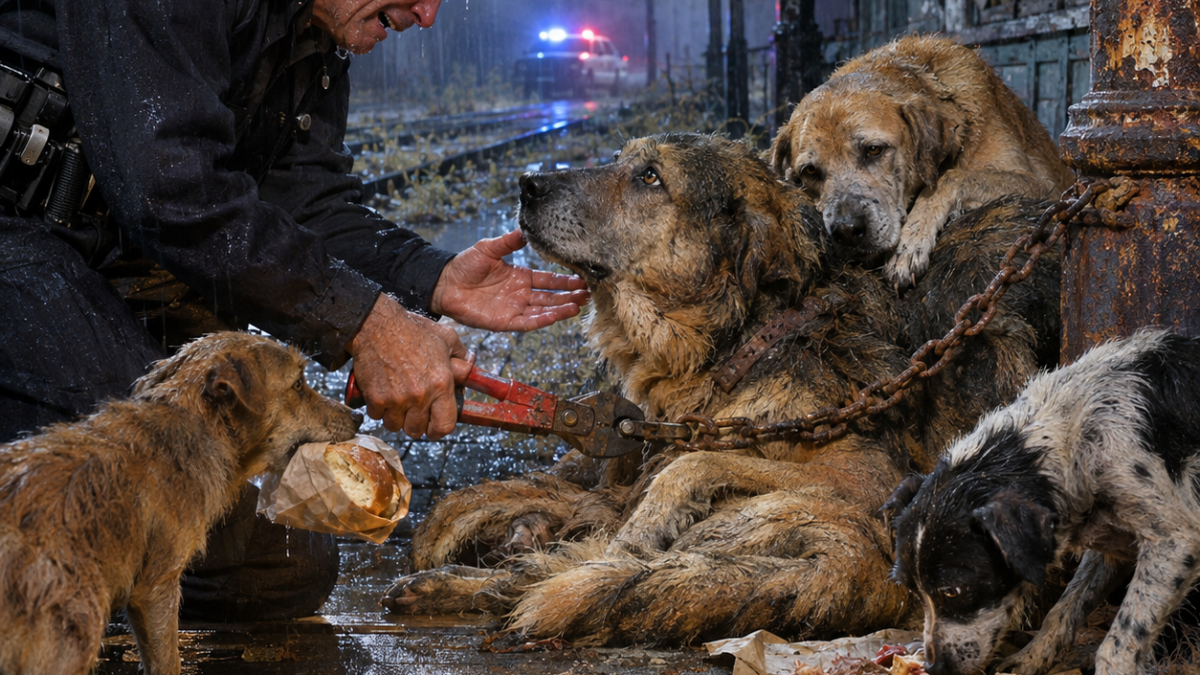
On His Final Police Shift, He Found a Dog Chained to an Abandoned Train Station for Two Years—What Three Strays Had Been Doing Every Night Broke Him
On November 12, during the final hours of his twenty-nine-year police career, Officer Philip Morrison found an emaciated dog chained to a rusted post inside an abandoned railway station, with two deep circles carved into the concrete from years of walking the same few feet over and over again.
Then Philip noticed three stray dogs watching silently from the ruins and discovered something no human being had bothered to do for two years—the black dog, the brown mutt, and the little white female had been carrying scraps of their own food to the chained dog and leaving them just inside the reach of his chain.
When rescuers finally cut the last rusted link and Philip learned the dog might never walk normally again, the officer who had planned to hand in his badge at exactly six o’clock made a decision that changed both of their lives: “He’s coming home with me.”
My name is Philip Morrison.
For twenty-nine years, people had called me Officer Morrison.
Sergeant Morrison for a while.
Then just Phil, once I had enough gray hair that younger officers stopped trying to impress me.
But on November 12, I had exactly one shift remaining before none of those titles mattered anymore.
At six o’clock that evening, I was supposed to surrender my badge.
My service weapon would be processed.
My locker emptied.
There would probably be a cake in the break room.
Someone would make a speech I didn’t want.
Then I would drive home to a house that had become unbearably quiet over the previous two years.
I had imagined retirement for decades.
Fishing.
Sleeping past five.
Repairing the back porch.
Maybe traveling.
Funny how plans made while your life feels full sound completely different after half the people inside those plans disappear.
My wife Ellen had left two years earlier.
Not for another man.
Sometimes I wished she had.
Anger would have been simpler.
Instead, one rainy Thursday evening she sat across from me at our kitchen table and said:
“I can’t do this anymore, Philip.”
“Do what?”
“Wait.”
I stared at her.
“For what?”
“For you to come home.”
I wanted to argue.
I had come home every night eventually.
She shook her head before I could speak.
“You’ve spent twenty-nine years belonging to everyone who calls 911.”
Her voice was tired.
“I don’t know if there’s enough of you left that belongs here.”
The sentence hurt because some part of me recognized it.
We had no children.
Her parents had died.
Mine too.
For years, work had become the thing around which everything else bent.
Ellen bent longest.
Then she stopped.
She packed two suitcases.
Kissed my cheek.
And moved to Oregon to live near her sister.
No screaming.
No slammed doors.
No affair.
Just an absence that grew permanent.
I understood why she left.
That was the worst part.
Understanding doesn’t make loneliness smaller.
After Ellen left, I moved through the house in circles.
Bedroom.
Kitchen.
Coffee.
Window.
Work.
Home.
Television I didn’t watch.
Chair.
Bed.
Again.
Sometimes I would catch myself standing in the kitchen holding two mugs.
Habit.
I’d put one back.
My partner Dennis died of a heart attack the following spring.
Fifty-six years old.
One moment he was complaining about the vending-machine coffee.
The next morning his wife called me.
I didn’t cry at the funeral.
I didn’t cry when Ellen mailed divorce papers.
I didn’t cry the day I signed my retirement documents.
Some men mistake the inability to cry for strength.
I did.
Then came that abandoned railway station.
The call came at 2:57 p.m.
Three hours and three minutes before retirement.
Dispatch said:
“Possible neglected animal at the old Mercer freight station. Caller reports dog tethered on property.”
I almost smiled.
My final police call.
A dog.
After twenty-nine years of domestic violence calls, fatal crashes, burglaries, overdoses, missing children, armed men, frightened families and more paperwork than should legally exist, I was going to finish my career checking on somebody’s dog.
“442 responding.”
The old station sat beyond the industrial district.
Passenger service had stopped decades earlier.
Freight operations lasted a little longer.
Now the tracks were brown with rust.
Windows broken.
Platform cracked.
Weeds grew through everything.
The sky hung low and gray.
November rain threatening but not falling.
I parked beside a bent chain-link gate.
At first, I saw nothing.
Then movement near the far end of the platform.
A dog.
He was tied to a steel support post beneath the broken awning.
And even from fifty yards away, I could tell something was terribly wrong.
PART2
FULL STORY CONTINUATION
I walked slowly.
Not because I was afraid of the dog.
Because experience teaches you that frightened animals deserve distance before they deserve good intentions.
“Hey, buddy.”
His head lifted.
Barely.
German Shepherd mix, I thought.
Maybe some hound.
Hard to tell through the condition of his coat.
He should have weighed close to forty pounds.
Maybe more.
He looked like half that.
His ribs stood out beneath skin.
Large patches of fur were missing from his back.
The exposed skin was thickened, gray-brown, cracked in places like leather left too long in the sun.
Around his neck:
A chain.
Not clipped to a proper collar.
The chain itself had been looped through an old collar so degraded that rust and leather appeared almost fused together.
I crouched outside his reach.
His eyes followed me.
No barking.
No growling.
That bothered me.
Healthy frightened dogs usually communicate.
Back away.
Warn.
Pull.
Bark.
This dog looked at me as if he had learned long ago that what humans did had very little to do with what he wanted.
“Hey.”
I swallowed.
“I’m Philip.”
Ridiculous.
I had introduced myself to suspects who didn’t care.
Now I was introducing myself to a dog.
“You don’t know me.”
He blinked.
“That’s all right.”
I looked at the ground.
That was when I saw the grooves.
Two deep circular tracks had been worn into the concrete around the post.
Not scratched.
Worn.
His paws had walked the same radius so many times that the surface itself had changed.
Round.
Round.
Round.
I touched the groove.
Cold concrete.
“How long have you been here?”
Of course he did not answer.
But silence had become unbearable.
I stood and walked toward the old ticket building.
No one.
I checked the surrounding property.
Abandoned bedding.
Trash.
A plastic bucket containing rainwater.
No food.
Then I noticed movement beyond the tracks.
Three dogs.
Strays.
A large black male.
A thin brown mixed-breed.
And a small white female.
They stood perhaps seventy feet away.
Watching.
Not threatening.
Not approaching.
The white dog held something in her mouth.
At first I thought it was trash.
Then she walked closer.
Ten feet.
Twenty.
Stopped at the edge of what seemed to be an invisible boundary.
Dropped it.
A piece of bread.
The chained dog lifted his head.
I stared.
The white dog backed away.
The black dog moved forward next.
Something dark in his mouth.
Maybe a scrap of meat.
He placed it near the end of the chain’s reach.
Then retreated.
I stopped breathing.
“No.”
I looked between them.
“You’ve been feeding him?”
The brown dog stood farther back.
Thin enough that he needed every calorie he found.
Yet somehow these animals had been sharing.
I looked down at the chained dog.
Then at the rust.
Then the grooves.
And suddenly I understood something I didn’t want to understand.
Those stray dogs knew exactly how far his chain reached.
They had done this before.
Probably many times.
Maybe hundreds.
They had learned where to place food so he could reach it.
No person had arranged this.
No caretaker.
No volunteer.
Three homeless dogs had been keeping another dog alive.
I turned away because my vision blurred.
“Jesus.”
My radio crackled.
Dispatch requesting status.
I picked it up.
“442.”
“Go ahead.”
“I need animal rescue and veterinary assistance at Mercer station.”
Pause.
“Copy. Condition?”
I looked at him.
“Severe neglect.”
My voice broke slightly.
“And get medical transport if animal rescue wants it.”
Another pause.
I could almost hear the dispatcher wondering whether retirement had affected my judgment.
“442, you’re requesting an ambulance?”
“For the dog.”
Silence.
Then professionally:
“Received, 442. We’ll contact appropriate services.”
I lowered the radio.
The dog watched me.
I sat on the edge of the platform.
Not too close.
For some reason, I said:
“You think you’re the only one who’s been stuck?”
His ear moved.
I laughed softly.
“Yeah.”
I looked down at my uniform.
“Twenty-nine years.”
Nothing.
“My wife got tired of waiting for me.”
The dog blinked.
“Can’t blame her.”
The words surprised me.
I had never said that aloud.
“She said I belonged to the job.”
I stared at the grooves.
“Maybe she was right.”
The dog shifted.
Chain scraped concrete.
That sound went straight through me.
Metal dragging over stone.
One circle.
Another.
I imagined him doing that in July heat.
January cold.
Rain.
Snow.
Night after night.
I thought about myself walking from bedroom to kitchen.
Kitchen to chair.
Chair to window.
Different cage.
Same circles.
Then I looked at three dogs who had nothing themselves and had still found something to give.
That was when I cried.
No warning.
One tear.
Then another.
I covered my face.
“Hell.”
Twenty-nine years of police work.
Dennis dead.
Marriage gone.
No tears.
But three stray dogs feeding a chained animal?
That broke whatever had been holding.
The black dog watched.
The white one sat.
The chained dog rested his chin on his paws.
I cried in front of all four.
None of them judged me.
Good audience.
At 3:42 p.m., an animal rescue vehicle rolled through the gate.
A young woman stepped out wearing a blue field uniform.
Dark hair tied back.
Large black equipment bag.
“Officer Morrison?”
“Yes.”
“Rachel Kim. County animal rescue.”
Twenty-eight, maybe.
She walked toward the platform.
Then stopped when she saw the chained dog.
Her face changed.
Experienced enough not to gasp.
Still human enough to feel it.
She crouched several feet away.
Then looked past him.
At the three strays.
“They’ve been feeding him.”
Not a question.
I stared.
“How do you know?”
She pointed toward the food scraps.
“Placement.”
“What?”
“They leave it inside the tether radius.”
She looked at the dogs.
“I’ve seen bonded strays do this.”
I swallowed.
“For two years?”
“How do you know two?”
“I don’t.”
She examined the chain without touching him.
Then the concrete.
“The rust layers.”
She pointed.
“See where newer corrosion built over older?”
I nodded.
“Those grooves took time.”
She looked at his teeth from a safe angle.
“Maybe five years old.”
Then quietly:
“He could have been here close to two.”
I looked toward the ruins.
The black dog had moved closer by one step.
Rachel noticed.
“Dogs don’t abandon social partners easily.”
Then added, almost to herself:
“People are better at that.”
I didn’t respond.
Maybe because of Ellen.
Maybe because I had spent an afternoon looking at something I could no longer categorize neatly.
Rachel opened her bag.
Water.
Soft food.
Gloves.
Slip lead.
Bolt cutters.
She first placed water within reach.
The dog sniffed.
Did not drink.
Food.
Nothing.
She spoke softly.
“Easy.”
His eyes moved toward her.
“My name is Rachel.”
She glanced at me.
“You talk to them?”
“All the time.”
“Good.”
She moved slowly.
Eventually, she positioned the lead.
He trembled.
Not aggressive.
Fear.
The bolt cutters closed around the first link.
Snap.
The dog flinched violently.
Rachel stopped.
“It’s okay.”
Waited.
Another link.
Snap.
He trembled.
She paused again.
No rushing.
“No one’s hurting you.”
Third.
Fourth.
Rust fell.
When the final section dropped, the chain hit the platform with a metallic clatter.
The dog stared down.
He didn’t move.
I expected him to stand.
Run.
Anything.
Nothing.
Rachel loosened the remaining material around his neck enough to avoid pressure.
“We’ll remove the collar medically.”
I asked:
“Why isn’t he moving?”
She touched one hind leg gently.
Then another.
“Muscle wasting.”
She looked at the grooves.
“If he has spent two years taking only a few steps at a time, the muscles shortened.”
“Can he walk?”
“Eventually?”
She hesitated.
“Maybe.”
My chest tightened.
“Maybe?”
“We won’t know until imaging.”
I looked toward the three strays.
The black dog stepped forward.
Stopped.
The white female wagged her tail once.
The chained dog—no longer chained—lifted his head.
For several seconds, the four simply looked at one another.
Then the white dog turned.
Brown one followed.
The black dog remained longest.
One step backward.
Then another.
Finally turned and disappeared through the weeds.
I whispered:
“They came to say goodbye.”
Rachel looked toward where they’d vanished.
“Maybe.”
Then softly:
“Or maybe they finally know somebody else is taking the shift.”
That sentence destroyed me all over again.
Rachel tried to lift the dog.
He weighed far too little.
Maybe twenty pounds.
He should have been nearly forty.
His body went limp in her arms.
Not resistance.
Surrender.
His head rested against her shoulder.
I looked at my cruiser.
Then heard myself say:
“I’ll take him.”
Rachel turned.
“To the veterinary hospital?”
“No.”
“What?”
“I’ll take him.”
She stared.
“You mean foster?”
“I mean home.”
“Officer Morrison.”
“Philip.”
She blinked.
“My shift ends in two hours.”
“That isn’t what I meant.”
“I know.”
“You haven’t even met this dog properly.”
“I’ve met enough.”
She looked at me for several seconds.
“You know rehabilitation could be months.”
“Yes.”
“Possible chronic medical conditions.”
“Yes.”
“He may have behavioral trauma.”
“Yes.”
“Possible mobility issues.”
“I heard you.”
“Do you own dogs?”
“No.”
“Ever?”
“As a kid.”
“That does not count.”
“Fair.”
Rachel looked at the dog.
Then me.
“You have no idea what you’re doing.”
“No.”
That was the first honest answer I had given about my future in years.
“But I’ll learn.”
We did not take him directly home.
Of course not.
Twenty-nine years of policing should have taught me at least that much.
The veterinary hospital was open twenty-four hours.
Rachel rode separately.
I sat in the back of my cruiser with the dog because he became distressed when I tried putting him alone behind the partition.
Against regulations?
Probably.
My final shift.
Sue me.
I removed my uniform jacket.
Wrapped him in it.
He didn’t struggle.
His body felt frighteningly light.
I touched the top of his head.
“You need a name.”
His eyes opened.
“Can’t keep calling you dog.”
I thought of dozens.
None fit.
Then:
“Buddy.”
Simple.
Maybe stupid.
But when I said it:
“Buddy?”
His ear moved.
That was enough.
“Okay.”
I smiled.
“Buddy.”
Dr. Miriam Ellis examined him.
Sixty-three.
Thirty years practicing veterinary medicine.
She had the calm tone of someone who had delivered puppies at three in the morning and told families goodbye at four.
After the exam, she removed her glasses.
“Severe malnutrition.”
I nodded.
“Dermatitis.”
“Parasites.”
“Joint contractures.”
“Pressure wounds.”
“The neck will need careful treatment.”
“Any fractures?”
“Old injuries.”
“New?”
“Nothing obvious yet.”
“Can he walk?”
She looked at me.
“Not normally today.”
“Eventually?”
“Possibly.”
I hated that word already.
“Possibly.”
She continued:
“We need controlled nutrition.”
“What does that mean?”
“You cannot just put down a huge bowl of food.”
“Why?”
“Refeeding complications.”
That scared me.
“You feed a starving dog too much, too fast, and you can make things worse.”
I listened like a rookie at academy orientation.
Small meals.
Hydration.
Labs.
Parasite treatment.
Skin care.
Physical rehabilitation later.
Dr. Ellis looked through the window at Buddy.
“I have never personally treated a dog tethered this long.”
“How did he survive?”
She studied him.
“Will.”
Then:
“And apparently those strays.”
I looked down.
“Me too.”
“What?”
I hadn’t meant to say it aloud.
“Nothing.”
Dr. Ellis watched me.
She understood.
Did not comment.
That kindness mattered.
At 5:51 p.m., my captain called.
“Phil.”
“Yeah?”
“You coming back?”
I looked at Buddy sleeping in a hospital kennel.
“Eventually.”
“You have nine minutes.”
“To what?”
“Retirement.”
I had forgotten.
At six exactly, I walked into the station.
No speech.
No ceremony large enough to survive my mood.
Dennis’s old photograph still hung near the roll-call room.
Someone had placed a cake beside my locker.
HAPPY RETIREMENT, PHIL.
I removed my badge.
Set it in the captain’s hand.
He looked at my jacket.
“You missing something?”
“Dog’s wearing it.”
He stared.
“Of course.”
I signed the paperwork.
Six o’clock.
Twenty-nine years ended.
Everyone clapped.
I wanted to leave.
The captain hugged me.
I normally hated that.
I let him.
Then I drove back to the clinic.
For the first time since I was twenty-two, there was no next shift.
Only Buddy.
He came home two days later.
Technically under foster-to-adopt pending case disposition.
Rachel helped with paperwork.
Then filled the back of my SUV with supplies.
“Bed.”
“Yes.”
“Crate.”
“Yes.”
“Medication.”
“Yes.”
“Feeding chart.”
“Yes.”
“Physical therapy instructions.”
“Yes.”
“Emergency number.”
“Yes.”
She stared.
“What?”
“You look terrified.”
“I carried a gun for twenty-nine years.”
“Dogs are scarier?”
“This one is depending on me.”
She smiled slightly.
“That’s usually scarier.”
Buddy refused the dog bed.
I placed it in the living room.
He lay beside it.
Hardwood floor.
I moved him gently onto it.
He crawled off.
So I stopped.
That first night, I spread blankets across the floor.
Buddy chose one near the wall.
Head on paws.
Eyes open.
Watching.
I sat in my chair.
Television off.
“Okay.”
He blinked.
“We don’t know what we’re doing.”
Nothing.
“That makes two of us.”
I made coffee.
Then remembered it was nine at night.
Retirement was already destroying my schedule.
I sat again.
Buddy stared at the wall.
I talked.
About nothing.
The weather.
Dennis.
Ellen.
Police work.
My terrible cooking.
Maybe because the house had been silent too long.
Maybe because a dog who had spent two years alone deserved sound that didn’t threaten him.
First morning:
Buddy did not eat.
Second:
Still nothing.
He drank some water.
Barely.
Dr. Ellis said not to panic yet.
Third day:
He lifted his head when I entered the room.
That felt enormous.
“Morning.”
His eyes followed me.
I sat on the floor.
“Coffee for me.”
I held up his measured food.
“Disgusting veterinary mush for you.”
Nothing.
“I’m told it’s expensive.”
He blinked.
“Still nothing?”
I placed a tiny amount on my fingers.
He smelled it.
Turned away.
“Okay.”
No force.
Dr. Ellis had been clear.
Offer.
Monitor.
Call if worsening.
I went to the kitchen.
When I returned, Buddy’s head had moved.
Small change.
But toward me.
Fourth day.
I sat beside him.
Hand resting on the floor.
Not touching.
Eventually his nose moved.
Sniffed my fingers.
Then one small lick.
I froze.
“Hey.”
Another lick.
I smiled.
“That’s something.”
His head lowered again.
I sat there for twenty minutes.
My back hurt.
Worth it.
The seventh day, I cooked plain chicken under veterinary guidance.
Tiny pieces.
I held one between two fingers.
Buddy smelled it.
Opened his mouth.
Took it.
Chewed.
Swallowed.
I nearly shouted.
Instead:
“Good.”
Another piece.
He ate.
Then another.
When the little portion was gone, he looked at me.
Not through me.
At me.
There was something different in his face.
Expectation.
I had seen that look thousands of times from people waiting for an officer to do something.
Help.
Decide.
Stay.
Trust always frightened me more than anger.
Anger expects nothing.
Trust creates responsibility.
I whispered:
“I’m not going anywhere.”
Buddy rested his head against my leg.
Physical therapy began after his weight stabilized enough.
Rachel came twice the first week.
We supported his body with a sling.
Three steps.
Rest.
Four.
Rest.
His legs trembled violently.
The first time he collapsed, I panicked.
Rachel did not.
“Normal.”
“He fell.”
“Yes.”
“That’s normal?”
“For him.”
I hated it.
Buddy looked at me.
I crouched.
“You want to stop?”
Rachel said:
“He’ll tell us.”
“How?”
“He already is.”
Buddy tried to stand.
Again.
Rachel smiled.
“There.”
We helped him.
Five steps.
He shook.
But stayed upright.
Progress was painfully small.
Week two:
Walk from living room to kitchen with support.
Week three:
Stand long enough to drink.
Week four:
Six unsupported steps.
He fell.
Got up.
Week five:
Across the living room.
I cried.
Quietly.
Buddy did not care.
He wanted chicken.
Fair.
The three strays stayed in my mind.
I drove back to the abandoned station.
More than once.
Food.
Water.
I left them carefully in safe places.
Did not try to trap them myself.
Rachel’s rescue group began monitoring.
The black dog appeared first.
Wouldn’t approach.
White female came closer.
Brown dog remained wary.
Rachel said:
“We can work on them.”
I looked at the black dog.
“Think they miss Buddy?”
“Maybe.”
“You always say maybe.”
“Because animals don’t write statements, Philip.”
“Useful.”
She smiled.
Then:
“But they knew he was gone.”
The feeding scraps stopped appearing beside the post.
Of course.
I stood over the concrete grooves.
The empty chain had been removed as evidence.
The circles remained.
I put my boot inside one.
Round.
Round.
Round.
Two years condensed into a mark in stone.
I thought of my house.
My own circles.
Coffee.
Window.
Chair.
Work.
Now the pattern had changed.
Wake.
Buddy.
Medication.
Food.
Exercise.
Vet.
Walk.
Talking.
My days suddenly had shape.
Responsibility.
Purpose.
I wondered if rescuing him was only another way to avoid myself.
Maybe.
At first.
Then Buddy looked at me one morning and wagged his tail.
First time.
Once.
Tiny.
And I realized it didn’t matter why the beginning happened.
What mattered was what I did with it.
Ellen called after hearing from an old friend that I had retired.
“Congratulations.”
“Thanks.”
“How does it feel?”
I looked across the room.
Buddy asleep.
“Strange.”
“You okay?”
I almost said yes.
Old habit.
Then:
“Getting there.”
She became quiet.
“That’s new.”
“What?”
“You admitting you’re not okay.”
I smiled.
“Retirement growth.”
She laughed.
Then:
“I heard you adopted a dog.”
“Foster.”
“Of course.”
“What?”
“You always need somebody to save.”
The words hit hard.
I went defensive immediately.
“That’s not fair.”
“No.”
She softened.
“It wasn’t meant cruelly.”
“Sounded like it.”
“I know.”
Then:
“Maybe let him save something too.”
I looked at Buddy.
Didn’t answer.
After the call, I sat beside him.
“You hear that?”
His eyes opened.
“My ex-wife thinks you’re doing therapeutic labor.”
Tail tap.
“Don’t encourage her.”
By month two, Buddy walked around the house without support.
Slow.
Awkward.
His rear legs still stiff.
But walking.
His coat began returning.
Not evenly.
Soft dark patches appeared where the skin had healed.
He gained weight.
Twenty-five pounds.
Then thirty.
He discovered the kitchen.
Bad development.
He also discovered that refrigerators contain miracles.
The first time I opened it, he appeared behind me so silently I nearly stepped on him.
“Where did you come from?”
He stared at chicken.
“No.”
Stare.
“You have food.”
Chicken.
“Absolutely not.”
I gave him chicken.
Training failure.
He did not understand toys.
I rolled a tennis ball.
It passed him.
He watched.
I tried again.
Nothing.
Third time, he sniffed it.
Progress.
A week later, he picked it up.
Held it.
Then dropped.
I clapped like an idiot.
Buddy startled.
“Sorry.”
Tail moved.
Eventually he learned to chase.
Fetch never interested him.
Why retrieve something a human had intentionally thrown away?
Reasonable.
The first time Buddy walked outside on grass, he froze.
I had a harness on him.
No neck pressure.
Rachel beside us.
He stepped from concrete onto lawn.
Stopped.
Moved one paw.
Then another.
Sniffed.
His entire expression changed.
Maybe because grass felt different.
Maybe because the world smelled overwhelming.
He lowered his nose and inhaled for almost a minute.
Then took five steps.
Ten.
Stopped near a tree.
I held my breath.
Trees had been prisons.
Buddy sniffed the trunk.
Then urinated on it.
Rachel laughed so hard she bent over.
I stared.
“Well.”
She wiped her eyes.
“That’s one way to reclaim the symbolism.”
Buddy walked on.
Good.
Let trees become trees again.
Two months after rescue, he ran for the first time.
Calling it running may be generous.
I unclipped his long training line inside a fenced rehabilitation yard.
Buddy walked.
Then trotted.
His hind legs moved awkwardly.
Then something changed.
A little burst.
Four seconds maybe.
He ran.
Stopped.
Looked back.
I shouted:
“Buddy!”
His tail rose.
He ran again.
Longer.
Not graceful.
Beautiful anyway.
I laughed.
Actually laughed.
Loud enough that Rachel looked at me.
“What?”
“Nothing.”
“You laugh?”
“Occasionally.”
“First documented occurrence.”
Buddy reached me.
I knelt.
He leaned into my chest.
I held him.
For the first time since retirement, I didn’t miss the uniform.
Rachel eventually trapped the small white stray humanely.
No chip.
Female.
Around four.
Healthy considering.
Then the brown one.
The black dog took another month.
I visited during their evaluations.
The white female recognized me.
Maybe.
Maybe I wanted her to.
Rachel warned:
“Don’t romanticize.”
“I know.”
“Seriously.”
“I know.”
“These dogs survived independently.”
“I know.”
“They don’t necessarily want houses.”
“I know.”
“Do you?”
“What?”
“Want all three?”
“No.”
Pause.
“Maybe.”
Rachel laughed.
“No.”
She was right.
The white dog went to an experienced adopter with acreage.
The brown dog entered a foster home with another calm dog.
The black dog surprised everyone.
He bonded with a retired mechanic named Walter.
Walter called him Coal.
At adoption, I stood beside Rachel.
Coal looked at me once.
Then followed Walter.
No dramatic farewell.
Perfect.
They had kept Buddy alive.
Now someone else would care for them.
Shift changed.
That phrase stayed with me.
Buddy reached forty-two pounds.
Then forty-four.
His ideal.
Coat almost completely restored.
The old skin damage left scars beneath it.
His neck healed.
He walked.
Then ran.
Not marathon distances.
Enough.
Dr. Ellis looked genuinely amazed.
“He exceeded my expectations.”
I said:
“He’s stubborn.”
“That’s often useful.”
Buddy sat beside me.
Head against my knee.
Dr. Ellis smiled.
“He’s attached.”
“To food.”
“Sure.”
The adoption became permanent.
Paperwork arrived in month three.
I stared at the signature line.
Rachel sat opposite me.
“You know you can still say no.”
I looked at her.
Buddy slept under my chair.
“No.”
“No, you don’t want him?”
“No, I can’t say no.”
She smiled.
I signed.
Philip Morrison – adopter.
That line felt more consequential than retirement documents.
Buddy was legally mine.
Then immediately:
No.
That language bothered me.
He lived with me.
I was responsible for him.
Enough.
At six months, my life looked nothing like November 12.
I woke at six because Buddy needed breakfast.
Not because dispatch might call.
Coffee.
Two mugs had finally become one without hurting.
Then dog bowl.
Walk.
Sometimes Rachel met us.
Sometimes Mrs. Garcia from next door.
She was seventy-four and had observed my entire transformation from behind lace curtains.
One morning:
“Officer Morrison!”
I turned.
“Not officer anymore.”
She smiled.
“Habit.”
Buddy went straight to her.
She carried treats.
Traitor.
“I heard you retired.”
“Six months ago.”
“And this is the famous dog.”
Buddy sat.
Mrs. Garcia scratched his head.
“What did you name him?”
“Buddy.”
She laughed.
“Very creative.”
“I had a stressful day.”
She looked at his coat.
His body.
Then me.
“You saved him.”
I looked down.
Buddy leaned against my leg.
“Maybe.”
“What?”
“I’m not sure who did what.”
Mrs. Garcia smiled.
“That happens.”
She had been widowed twelve years.
She understood more than she said.
That afternoon, I sat on my porch.
Buddy at my feet.
Sunlight.
No radio.
No duty belt.
No obligation beyond dinner.
I thought about November.
The grooves.
The dogs.
Ellen.
Dennis.
The badge.
Then I said:
“You know what family is?”
Buddy opened one eye.
“No?”
Fair.
“Sometimes family is whoever feeds you when nobody’s watching.”
His tail moved.
I smiled.
“Those dogs knew that.”
Then:
“Maybe Ellen did too.”
The thought hurt.
Because maybe love was not only staying.
Sometimes leaving was how someone stopped disappearing inside someone else’s life.
I did not need Ellen to be wrong for me to grieve her.
That was new too.
Buddy developed a ritual.
Every evening around nine, I sat in the old recliner.
He would approach.
Sit.
Look at me.
At first, I patted the floor.
He ignored me.
Then one night he tried climbing into my lap.
Forty-four pounds.
“No.”
He put front paws on my knees.
“Absolutely not.”
He climbed.
I groaned.
“This is physically unreasonable.”
He turned twice.
Settled across me.
Head against my chest.
I could barely breathe.
“Buddy.”
Tail.
“This cannot become a habit.”
It became a habit.
Every night.
Officer retires.
Dog crushes lungs.
Beautiful.
People began saying I looked better.
I hated that.
Better than what?
Lonely?
Retired?
Half-dead?
Maybe they were right.
I cooked again.
Not well.
Walked more.
Met former coworkers for breakfast.
Returned calls.
Dennis’s widow, Marsha, visited.
Buddy adored her.
She cried when he put his head in her lap.
“Dennis would’ve loved him.”
I smiled.
“He’d pretend not to.”
“Exactly.”
We laughed.
First time we spoke about Dennis without the conversation becoming a memorial.
That mattered.
Ellen visited the following spring.
Not because we reconciled.
We didn’t.
Her sister had surgery in Cleveland.
She called.
“Can I stop by?”
I almost said no.
Then:
“Sure.”
When she arrived, Buddy met her at the door.
Sniffed.
Sat.
Head against her leg.
Ellen immediately cried.
“Seriously?”
I laughed.
“He does that.”
She knelt.
“Hi.”
Buddy leaned harder.
She looked around the house.
Dog bed.
Toys.
Leash.
A framed photograph of Buddy running.
“You changed.”
“Maybe.”
She smiled sadly.
“I wish…”
She stopped.
“What?”
“Nothing.”
“No.”
Old Philip would have let her retreat.
New Philip waited.
“I wish you had learned how to come home before I left.”
That hurt.
I nodded.
“So do I.”
No defense.
No explanation.
She cried.
I cried.
Buddy sat between us.
No reconciliation.
But closure became less like a door slamming and more like a room we could finally leave without anger.
When Ellen departed, she hugged me.
Then Buddy.
“Take care of him.”
I said:
“He takes care of me.”
She smiled.
“I figured.”
On the first anniversary of November 12, I returned to Mercer station with Buddy.
Rachel came too.
The city had fenced the most dangerous parts.
Still abandoned.
We walked toward the platform.
Buddy slowed.
My chest tightened.
Does he remember?
No way to know.
Scent?
Place?
Body memory?
I refused to invent certainty.
He reached the concrete.
Sniffed the grooves.
The tracks his own paws had carved.
Then looked at me.
I held my breath.
Buddy stepped out of the circle.
Toward the open platform.
Then another step.
Then another.
He walked straight to the weeds.
Lifted his leg.
Rachel burst out laughing.
I did too.
Again.
Trees.
Concrete.
Past.
Buddy had no interest in symbolism.
Good.
Then a bark sounded in the distance.
Buddy froze.
A large black dog stood near the old freight building.
Coal?
Impossible to know at first.
Then Walter emerged behind him.
“Phil!”
I stared.
Walter waved.
Coal ran toward us.
Stopped several feet from Buddy.
The two dogs stared.
Buddy’s tail moved.
Coal approached.
Sniffed.
Buddy sniffed back.
No dramatic recognition scene.
No music.
Just dogs.
Then they walked together for several minutes.
I stood beside Walter.
“Didn’t know you came here.”
“Coal likes the area.”
“Maybe he remembers.”
“Maybe.”
Good answer.
Rachel had infected everyone.
When Walter left, Coal looked back once.
Then followed.
I whispered:
“He knows you’re okay.”
Rachel heard.
She didn’t correct me.
Buddy became locally known after an animal-rescue newsletter told his story.
I hated the attention.
Buddy loved people.
Bad combination.
Children wanted to meet him.
He was gentle.
Especially with quiet kids.
One boy from a foster program sat beside him without speaking.
Buddy placed his head in the boy’s lap.
The child whispered:
“He likes me.”
I had to look away.
Because I understood exactly how much that sentence could mean to somebody who wasn’t sure anyone did.
After that, Buddy and I joined occasional supervised humane-education visits.
Not therapy-dog certification at first.
Later, after proper training and assessment, yes.
Buddy had spent two years chained to a post.
Now he visited libraries.
Senior centers.
A veterans’ support group.
People touched him.
He stayed.
He had become something I never expected.
Not a symbol of suffering.
A source of calm.
At the veterans’ center, one man named Carl rarely spoke.
Vietnam.
PTSD.
He watched Buddy for three visits.
Fourth time, he held out his hand.
Buddy walked over.
Head on knee.
Carl cried.
First words he said to me:
“Dogs don’t ask.”
“No.”
“They just sit.”
“Yeah.”
He nodded.
Buddy remained.
Sometimes healing really is that unsophisticated.
Sit.
Stay.
Don’t leave.
I started volunteering with Rachel’s organization.
Not full time.
I had retired for a reason.
But enough.
Transport.
Home checks.
Older adopters who appreciated someone their own age.
I was sixty-one then.
Rachel called me:
“Officer Grandpa.”
I threatened to resign.
“You’re unpaid.”
“Then I resign twice.”
She laughed.
Buddy rode with me.
No cage.
Harnessed safely in the back.
Every time we passed a railway crossing, I glanced at him.
He looked out the window.
Maybe nothing.
Good.
The second year after rescue, I began helping the city identify long-term tethering cases.
My police background helped.
Evidence.
Documentation.
Warrants when necessary through current officers.
Rachel handled animal welfare.
I was careful not to become a vigilante retiree with bolt cutters.
Every rescue must be lawful.
Every case documented.
Buddy’s story taught me that emotion starts action.
Process makes it stick.
Without legal evidence, someone could have demanded him back.
I never forgot that.
One winter, Buddy became afraid when a chain scraped across pavement outside a hardware store.
He froze.
Body low.
Eyes wide.
I immediately moved him away.
No forcing.
At home, I called Rachel.
“Thought he was over it.”
She said:
“Over what?”
“Chains.”
“Phil.”
“What?”
“Trauma isn’t a staircase.”
I hated therapy language.
She continued:
“He can have a bad day.”
“So?”
“So give him a bad day.”
I sat beside Buddy.
He looked tired.
“Fine.”
I touched his side.
“You get a bad day.”
He leaned against me.
Maybe that was something I needed permission for too.
Retirement changed after Buddy.
At first, I thought retirement meant absence.
No radio.
No badge.
No partner.
No reason to leave the house.
Then I realized a job ending does not erase usefulness.
It only removes the old structure.
You have to build another.
Mine included:
Buddy.
Volunteer work.
Neighbors.
Former officers.
Breakfast with Marsha.
Occasional phone calls with Ellen.
A vegetable garden Buddy destroyed twice.
Not glamorous.
Enough.
Buddy reached seven years old.
Approximate.
Then eight.
We celebrated November 12 as his “free day.”
Rachel refused to call it a birthday.
No one knew when he was born.
Mrs. Garcia baked dog biscuits.
Buddy ate too many.
Again.
There were photographs.
One shows me sitting on the porch.
Buddy beside me.
Gray beginning around his muzzle.
I look older too.
But happy.
I rarely used that word about myself before.
Happy.
It felt dangerous.
Too temporary.
Buddy taught me that temporary does not mean unreal.
Everything is temporary.
Still worth loving.
The black dog Coal died before Buddy.
Cancer.
Walter called.
“I thought you should know.”
I drove over.
Coal had already been cremated.
Walter sat in his garage.
Empty dog bed.
“I keep thinking about that station.”
“So do I.”
“He fed Buddy.”
“Yeah.”
“He didn’t owe him anything.”
“No.”
Walter wiped his eyes.
“I don’t know why that gets me.”
I did.
Because kindness means something different when the giver has almost nothing.
Coal had been hungry too.
Still shared.
That is hard to forget.
We sat without talking.
Former cop.
Retired mechanic.
Two old men grieving a stray dog.
Life takes strange turns.
The little white female lived with her adopter for nine years.
Her name became Pearl.
The brown dog became Hank.
Rachel kept me updated.
All three survived long enough to know homes.
That mattered almost as much as Buddy.
Sometimes I imagined the four of them meeting again.
Dogs probably don’t think in sentimental reunions.
Humans do.
We need them.
Buddy’s mobility stayed surprisingly good.
Not perfect.
Arthritis arrived early.
Expected.
Supplements.
Medication.
Shorter walks.
Ramps.
No stairs when avoidable.
At ten, he could still trot across the yard.
No more full circles.
Funny.
The circles had changed meaning.
At the station, he walked circles because the chain defined the limit.
At home, he occasionally ran one because he could choose.
Same shape.
Completely different life.
Choice changes everything.
Mrs. Garcia once watched him loop around the garden.
“Look at him.”
I smiled.
“He used to walk circles because he couldn’t go anywhere else.”
“And now?”
“Now he does it because he’s happy.”
She looked at me.
“You too.”
“What?”
“You used to walk around that house because nobody was there.”
I stared.
“Now you’re always walking because that dog needs something.”
I laughed.
“Profound.”
“I’m old.”
“So am I.”
“Older.”
“Go home, Maria.”
She laughed all the way across the yard.
Buddy turned eleven-ish.
His face gray.
Eyes slightly cloudy.
Still head in my lap every night.
He could no longer climb onto the recliner without help.
I bought a larger chair.
Not kidding.
Salesman asked:
“Looking for lumbar support?”
I said:
“Dog support.”
He thought I was joking.
Buddy approved.
Every night, I helped him up.
Forty-five pounds.
My back complained.
Worth it.
The end came slowly.
Not a sudden tragedy.
I am grateful for that.
Rex—Dennis’s old dog? No. Different story. Grief makes memory strange.
Buddy simply aged.
Kidney values changed.
Arthritis worsened.
Appetite varied.
Dr. Ellis had retired, but her successor was kind.
We monitored quality of life.
Good days.
Bad.
Interest in food.
Mobility.
Comfort.
Tail.
The last metric mattered most to me.
Buddy’s tail.
When I came home:
Still moved.
When Rachel visited:
Moved harder.
When chicken appeared:
Miraculous recovery.
Good.
One evening, he couldn’t climb into my lap.
He tried.
Front paws on my knees.
Hind legs failed.
I immediately got onto the floor.
“Fine.”
I sat.
He lowered himself beside me.
Head in my lap.
Same position as the station, though I had not been the one holding him then.
Rachel had.
But later, countless times, he had chosen me.
I stroked his gray head.
“You did good.”
Tail tap.
“You know that?”
Another tap.
I cried.
Buddy stayed.
Always.
He died at home on a Sunday morning.
Almost twelve years after rescue.
That would make him around seventeen.
Possible.
Maybe our age estimate was wrong.
Maybe he was younger.
Doesn’t matter.
Rachel came.
Older now.
Gray at her temples.
Mrs. Garcia had passed two years earlier.
Walter too.
Time kept collecting people.
Buddy lay on his favorite blanket near the porch doors.
The veterinarian administered medication.
No fear.
I held his head.
He looked at me.
Not the resignation I had seen at Mercer station.
Peace.
I whispered:
“You’re not alone.”
My voice broke.
“You never have to be alone again.”
His breathing slowed.
Then stopped.
I stayed on the floor for an hour.
Rachel beside me.
No speeches.
Eventually she said:
“He had a hell of a retirement.”
I laughed through tears.
“He did.”
Then:
“So did you.”
I looked at her.
She was right.
The house became quiet.
Not like after Ellen.
Not exactly.
I had learned how to live inside silence without becoming trapped by it.
The first night, I still sat in the recliner.
No forty-five-pound dog climbing onto me.
My lap felt wrong.
I placed one hand there.
Remembered.
Chain.
Grooves.
Three strays.
Rachel.
Uniform jacket.
Chicken.
First steps.
First run.
Mrs. Garcia.
Coal.
Everything.
I cried.
Then went to bed.
Morning came.
I got up.
That was the difference.
Several months later, Rachel asked me to visit the rescue.
“No.”
“You don’t know why.”
“Yes, I do.”
“Phil.”
“No dog.”
“Who said dog?”
“You.”
“I didn’t.”
“You’re predictable.”
She laughed.
“Fine. There’s a dog.”
“No.”
“Old beagle.”
“No.”
“Eleven.”
“No.”
“Owner died.”
I stared at her.
“You’re manipulative.”
“Learned from the best.”
“I was a police officer.”
“Exactly.”
I went.
Of course.
The beagle’s name was Sam.
I did not adopt him that day.
Or the next.
Two weeks later.
Some lessons need repeating.
Sam never put his head in my lap.
He preferred occupying the entire sofa and snoring like a chainsaw.
Good.
Buddy’s gesture remained Buddy’s.
Different dog.
Different life.
Enough room.
Years later, a young officer asked me why I stayed involved in rescue.
We were standing near the renovated Mercer station.
Yes.
Renovated.
The city eventually transformed part of it into a community trail stop.
The concrete platform remained.
The grooves had faded.
Not disappeared.
He asked:
“Was it because of the dog?”
“Yes.”
“Buddy?”
“Yes.”
“He saved you?”
I thought.
People love that phrase.
Rescue dog saves rescuer.
Beautiful.
Too simple.
“No.”
The officer looked confused.
“He didn’t save me.”
“Then what?”
“He gave me something to get up for.”
Pause.
“I did the rest.”
I looked at the old platform.
“And he did his part.”
That felt truer.
Healing should not become another burden we place on animals.
Buddy did not owe me salvation because I took him home.
He existed.
Needed care.
Trusted me.
Loved me in whatever way dogs love.
That was enough.
What I rebuilt from that was mine to do.
I still think about the three strays most.
Why?
Because they had nothing.
No home.
No guaranteed food.
No veterinarian.
No one protecting them.
Yet somehow Buddy remained part of their world.
They could leave.
He couldn’t.
So they returned.
Food.
Company.
Presence.
No one gave them medals.
No article.
No ceremony.
For two years, in an abandoned station nobody cared about, three dogs kept another animal alive.
When humans finally arrived, they left.
Shift over.
That image never stopped humbling me.
One of the last conversations I had with Mrs. Garcia was about them.
She asked:
“You believe they knew what they were doing?”
“I don’t know.”
“You were a cop for twenty-nine years and still answer everything ‘I don’t know.’”
“That’s why I survived twenty-nine years.”
She smiled.
Then:
“I think they knew.”
“Why?”
“Because love isn’t always complicated.”
I laughed.
“You’ve been watching too much television.”
She shrugged.
“Maybe.”
Then looked at Buddy.
“But they fed him.”
Hard to argue.
The old station received a plaque after renovation.
Not because I asked.
Actually, I objected.
Rachel won.
It reads:
IN HONOR OF BUDDY AND THE THREE STRAY DOGS WHO KEPT RETURNING WHEN NO ONE ELSE DID.
No photograph.
No details of suffering.
Just that.
Kept returning.
I can live with it.
Sometimes families visit the trail.
Children ask about Buddy.
Parents tell them:
“He was chained here.”
I hate when they stop there.
So if I happen to be present, I add:
“Then he lived a long time afterward.”
That matters.
Rescue stories should not freeze animals in the worst scene.
Buddy was not only the dog tied to the post.
He became:
The dog who stole chicken.
The dog who hated baths.
The dog who sat with veterans.
The dog who destroyed tomatoes in my garden.
The dog who crushed me in a recliner nightly.
The dog who lived long enough to become gray and bossy.
That was his life.
The chain was only two years of it.
Terrible years.
Not the ending.
I once returned to the station alone on November 12.
Cold.
Cloudy.
Almost exactly like that first day.
I stood where Buddy had been tied.
The post was gone.
I put my boot into the remaining faint groove.
Then looked toward the ruins where the strays had stood.
For a moment, I could almost see them.
Black.
Brown.
White.
Watching.
I whispered:
“He made it.”
No answer.
Wind.
Traffic far away.
“That dog had a good life.”
My eyes filled.
Then:
“So did I.”
That was the part I had never expected.
Retirement frightened me because I thought the useful part of my life was over.
Buddy taught me usefulness changes.
Work ends.
Badges get surrendered.
Marriages change.
Friends die.
Bodies age.
But care still has somewhere to go if you let it.
At six o’clock every November 12, I place my old badge on the kitchen table.
I kept the retirement shadow box.
Badge.
Nameplate.
Photograph.
Twenty-nine years.
Then beside it I place Buddy’s collar.
Two lives.
One ended at six p.m.
Another began before I reached the station.
Police officer.
Dog guardian.
Volunteer.
Friend.
None erased the others.
People ask whether I regret retiring that day.
No.
I would have retired anyway.
But finding Buddy made retirement feel less like walking off a cliff.
I had somewhere to go.
Someone waiting.
Funny.
For two years, Buddy had been the one waiting for someone.
Then, once he came home, I discovered I had been waiting too.
For what?
I don’t know.
A reason.
A second beginning.
Permission to be more than the job.
Maybe all of it.
The most painful part of Ellen leaving was believing I had discovered her absence too late.
Buddy forced me into presence.
Dogs do not care what you intended yesterday.
They need food now.
Medicine now.
Walk now.
Comfort now.
You cannot love a dog entirely in retrospect.
That helped.
Eventually, I applied the same lesson to people.
I called old friends.
Visited Marsha.
Apologized to Ellen for things I had defended for years.
Not to win her back.
She had another life.
To acknowledge.
Presence while there is still time.
Buddy never knew he taught me that.
Good teachers often don’t.
If you want the dramatic ending, here it is:
On November 12, a police officer found a dog chained for two years.
Three strays had kept him alive.
The chain was cut.
The officer adopted him.
The dog recovered.
The lonely man recovered too.
Beautiful.
But the real ending took years.
Medication.
Physical therapy.
Tiny meals.
Failed walks.
First tail wag.
A fence.
A recliner.
Old age.
Goodbyes.
Then another morning afterward.
That is what life looks like when rescue becomes real.
Not one moment.
A thousand ordinary ones.
I have one photograph from that first afternoon.
Rachel took it without telling me.
I’m in uniform.
Kneeling beside Buddy.
He is wrapped in my jacket.
Head against my chest.
I look exhausted.
Older than sixty-one.
Behind us, far out of focus, the black dog is visible near the tracks.
I keep that photograph in a drawer.
Not framed.
Too private.
When I look at it now, I notice something I missed for years.
My badge is visible.
Buddy’s chain is not.
Maybe that’s why I like it.
One symbol of the life I was ending.
The other already gone.
Rachel once asked:
“If you could tell yourself one thing before answering that call, what would it be?”
I thought for a long time.
Not:
You’re going to save a dog.
Not:
Your life will change.
Not:
Bring chicken.
I said:
“Don’t rush to six o’clock.”
She looked confused.
“My whole last shift, I was counting down.”
Five hours.
Four.
Three.
I wanted the job finished.
Then at 2:57, life gave me something I hadn’t scheduled.
I almost treated it like one last task.
Instead, it became the doorway into everything afterward.
We spend so much time waiting for one chapter to end that sometimes we fail to notice the next one arriving early.
Buddy arrived three hours and three minutes before retirement.
Perfect timing.
I no longer have the badge on my belt.
No radio.
No patrol car.
People in town still occasionally call me Officer Morrison.
I correct them less now.
Names become histories.
Philip is enough.
But if someone points toward the station and says:
“That’s where you found Buddy?”
I always correct that too.
“That’s where we found each other.”
Cheesy.
True.
The first time I saw him, Buddy was lying inside a circle carved into concrete by his own footsteps.
I thought the cruelty was the chain.
Years later, I realized the worst part was repetition.
Every day convincing a living creature that nothing would change.
Same distance.
Same post.
Same hunger.
Same silence.
Hope dies through repetition too.
That is why small changes mattered so much afterward.
One meal.
One lick.
One step.
One tail wag.
One run.
Each event told his body:
Today is not yesterday.
Healing is repetition in the other direction.
Again and again until safety becomes the familiar thing.
Buddy taught me that.
So did retirement.
I had my own invisible circle.
Uniform.
Shift.
Home.
Coffee.
Silence.
Repeat.
I thought removing the badge would automatically free me.
It didn’t.
Freedom needs somewhere to go.
Buddy gave mine direction.
Morning walks.
Vet appointments.
Neighbors.
Volunteering.
Relationships.
I stepped outside my circle because someone else needed me to walk beside him.
Then eventually I kept walking because I wanted to.
That is why I never liked people saying:
“You rescued Buddy.”
Yes.
Legally and physically, I removed him from danger.
But rescue became mutual only because neither of us stayed where we started.
He learned to walk farther than the chain had allowed.
I learned to live farther than the badge had allowed.
Different chains.
Different wounds.
Same movement.
Outward.
When I think of Buddy now, I don’t see the rust.
I see him running badly across my backyard.
His rear legs still slightly uneven.
Tail high.
Making little loops through the grass.
Not because something forced him into a circle.
Because he could choose one.
I laughed every time.
Maybe because I recognized myself.
I had spent years walking circles too.
Then somehow we ended up running them together.
And I still wonder about those three strays.
Coal.
Hank.
Pearl, as they were eventually named.
Did they understand Buddy was safe?
I cannot know.
Did they come to say goodbye?
Maybe.
What I know is simpler.
When Buddy had no one else, they came.
When food was scarce, they shared.
When humans arrived, they watched.
When the chain fell, they left.
That is enough truth without turning it into magic.
There is one sentence I said to Buddy every night during his first week:
“I won’t leave you.”
At first, I said it because I thought he needed reassurance.
Eventually I realized I needed to hear it too.
After Ellen.
After Dennis.
After retirement.
People leave.
Sometimes by choice.
Sometimes because bodies fail.
Sometimes because life changes.
Promises like “never leave” are impossible in the literal sense.
So years later, I changed the words.
“I’m here.”
That was enough.
Not forever.
Now.
Buddy understood now.
Dogs are wiser that way.
On his final morning, the last thing I said was:
“I’m here.”
Same promise.
Completed.
He died knowing no chain held him.
No station surrounded him.
No hunger.
No cold concrete.
Only home.
My hand.
A life that had become his.
That is all I ever wanted for him after November 12.
And maybe all I wanted for myself too.
Twenty-nine years in law enforcement taught me procedures.
Evidence.
Threat assessment.
How to enter rooms.
How to leave them.
Buddy taught me something the academy never could.
Sometimes the most important thing you do for someone is not arrest the person who hurt them.
Not solve the entire past.
Not say the perfect words.
Sometimes it is simply becoming the person who keeps returning.
Morning.
Evening.
Tomorrow.
Again.
Until they believe they are no longer alone.
Three stray dogs knew that before I did.
At the renovated station, the plaque ends with one line Rachel insisted on adding.
I objected because it sounded sentimental.
She ignored me.
It says:
SOMETIMES FAMILY IS WHOEVER BRINGS YOU SOMETHING WHEN THEY HAVE ALMOST NOTHING THEMSELVES.
Years earlier, I had said something similar to Mrs. Garcia on my porch.
Apparently Rachel remembered.
I accused her of stealing my line.
She said:
“You were retired. Intellectual property expired.”
Terrible woman.
Still my friend.
Every November 12, I visit once.
Not because Buddy needs it.
He doesn’t.
I do.
I stand by the faded grooves.
Then I leave.
I never stay long.
The station was where Buddy waited.
Home was where he lived.
That difference matters.
The final time I took him there, before he became too old for car trips, Buddy stood near the platform.
I watched him.
He sniffed.
Walked.
Looked at me.
Then headed back toward the car.
No hesitation.
No looking behind.
I laughed.
“All right.”
Opened the door.
He climbed in slowly.
Home.
That may have been the most beautiful thing he ever did.
He chose to leave.
On November 12, at 2:57 in the afternoon, I thought I had three hours left in the only life I understood.
At 3:42, Rachel arrived with bolt cutters.
Before four, a rusted chain lay on the concrete.
At six, I surrendered my badge.
And that night, instead of sitting alone beside my kitchen window wondering what retirement was supposed to mean, I sat beside a battered dog in a veterinary hospital and promised him I would come back in the morning.
I did.
Again.
Again.
Again.
Until coming back became our life.
Buddy had survived because three stray dogs refused to let one of their own disappear.
I survived retirement because Buddy refused to remain only something I rescued.
He needed me.
Then trusted me.
Then annoyed me.
Then made me laugh.
Then became home.
That is how it happened.
Not one miracle.
A relationship.
If you had told me that morning that my final police call would become the most important call of my life, I would have laughed.
Twenty-nine years.
Thousands of calls.
Surely something bigger mattered more.
But importance isn’t always measured by danger.
Sometimes it is measured by what remains afterward.
The badge is in a box.
Most reports have been archived.
Cases closed.
Names blurred by time.
But I can still feel Buddy’s head in my lap.
Still see the white stray placing bread inside the chain’s reach.
Still hear Rachel’s bolt cutters breaking the final link.
Still remember the first piece of chicken Buddy took from my hand.
Those stayed.
And when people ask what I learned from my last shift, I tell them the truth.
Not that dogs are better than people.
People saved Buddy too.
Not that every lonely person should adopt a rescue animal.
Animals are not medicine.
Not that suffering happens for a reason.
It doesn’t.
Some suffering is simply wrong.
What I learned was smaller.
Better.
Do not assume that because someone has survived alone, they no longer need anyone to come.
Buddy survived two years.
The strays kept him alive.
That did not mean he should have stayed chained.
I survived Ellen leaving.
Dennis dying.
Retirement approaching.
That did not mean I was fine alone either.
Sometimes survival only means the story has not ended yet.
Buddy’s story did not end at the station.
Mine did not end with my badge.
The black dog did not remain a stray.
Neither did Pearl or Hank.
Ellen built another life.
I built mine.
Rachel became family.
Mrs. Garcia became memory.
Time moved.
It always does.
That is the mercy.
And the cruelty.
I keep Buddy’s collar beside my retirement badge now.
The collar is soft leather.
Not the rusted thing from the station.
A blue one I bought after his neck healed.
His name engraved.
BUDDY MORRISON.
I laughed when the clerk printed that.
“A dog with my last name?”
Then I kept it.
Family, after all.
Sometimes, late at night, I imagine that old platform before I arrived.
Buddy lying there.
Rain.
Cold.
Then footsteps.
Pearl.
Bread.
Coal.
Scrap.
Hank.
Whatever they found.
Three animals with no guarantee of tomorrow giving part of today away.
Then leaving.
Returning later.
Again.
Again.
Again.
That is the image I want to carry.
Not neglect.
Loyalty.
Not what was withheld.
What was given.
Because Buddy’s life was never only a story about what one human failed to do.
It was also a story about what three abandoned dogs chose to do anyway.
And eventually what Rachel did.
What Dr. Ellis did.
What Walter did.
What Mrs. Garcia did.
What I did.
Enough people kept showing up that the cruelty stopped being the final chapter.
That is how a life gets reclaimed.
Not by erasing the worst years.
By adding enough good ones afterward.
On my last police shift, I thought retirement meant I was finally done being responsible for anyone.
Then I found Buddy.
Turns out I had misunderstood what I was tired of.
I wasn’t tired of caring.
I was tired of carrying everything behind a badge.
Caring by choice felt different.
Buddy taught me that too.
If I could return to November 12 and speak to the man stepping out of that patrol car, I would not tell him:
This dog will save you.
Too dramatic.
Too much responsibility for the dog.
I would say:
“Go slowly.”
“Notice the three strays.”
“Call Rachel.”
“Keep your jacket.”
“You’re going to need a bigger recliner.”
And most importantly:
“When six o’clock comes, hand over the badge.”
“Your life is not ending.”
“Something is waiting just beyond the circle you have been walking.”
Buddy had grooves in concrete to prove how small his world had become.
I had no visible marks.
But I had circles too.
We both eventually stepped out.
His first steps were trembling.
So were mine.
That is why, even now, when I see an old photograph of him running through my yard, I don’t see a rescued dog.
I see movement.
Choice.
Life after confinement.
And I remember that on one gray November afternoon, an old cop preparing to surrender his badge and a neglected dog who had forgotten what freedom felt like met in a place abandoned by almost everyone.
Three stray dogs had kept Buddy alive until I arrived.
Then Buddy gave me a reason to discover that retirement was not the same thing as being finished.
At 3:42 p.m., Rachel cut the last rusted link from Buddy’s chain. At 6:00 p.m., I surrendered the badge that had defined me for twenty-nine years. I spent a long time believing I was the one who walked away free that day—but the truth is, we both did.
And if there is anything I still believe after all these years, it is this:
Sometimes the ones who have almost nothing are the ones who teach us what loyalty really costs, and sometimes the creature you think you are rescuing is simply standing beside you when you finally find the courage to step outside your own circle.








