“OH, GOD, EMILY, HE’S BREATHING! THERE’S A DOG IN HERE, AND I DON’T THINK HE’S SEEN THE SUN IN YEARS!” Michael shouted as I pulled the last rusted chain from the doors of an abandoned barn and a terrible smell rose from the darkness, revealing a skeletal dog lying on bare wooden boards with his golden-brown eyes fixed on the first light entering his prison —But What He Did When Sunlight Finally Touched His Face Broke My Heart
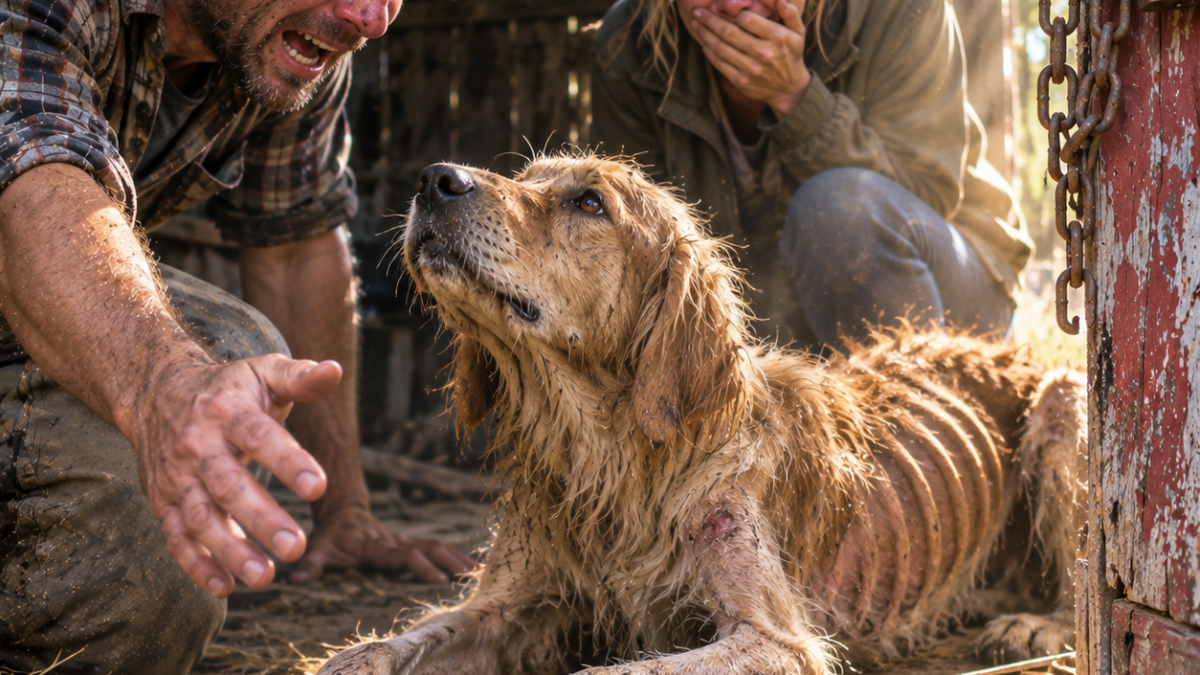
“OH, GOD, EMILY, HE’S BREATHING! THERE’S A DOG IN HERE, AND I DON’T THINK HE’S SEEN THE SUN IN YEARS!” Michael shouted as I pulled the last rusted chain from the doors of an abandoned barn and a terrible smell rose from the darkness, revealing a skeletal dog lying on bare wooden boards with his golden-brown eyes fixed on the first light entering his prison. For two long years, that animal had survived behind locked doors, with barely enough food to keep him alive and no soft grass beneath his paws, no sunlight warming his fur, and no gentle human hand to remind him that he mattered. But when I stepped aside and gave him a clear path to freedom, he did something so heartbreaking that my knees nearly gave way—and I realized the hardest part of saving him wouldn’t be opening the barn door, but teaching him that nobody would ever shut him inside again.
The chain fell from my hands with a metallic crash.
For a moment, nobody moved.
I stood in front of the abandoned barn, staring into the darkness.
The heavy wooden doors had been secured with an old chain that was so badly corroded it left reddish flakes across my palms.
Michael stood a few feet behind me.
He was the man who’d heard the strange sound coming from inside the building and refused to walk away.
Now his face was pale.
“Emily?”
I raised one hand.
“Just a second.”
The smell was the first thing that hit me.
Old wood.
Dust.
Stale water.
The heavy, sour odor of a place that had been closed for far too long.
Then I heard something.
A faint movement.
Not barking.
Not growling.
The soft scrape of something shifting against wooden floorboards.
I carefully opened the door wider.
Sunlight spilled across the floor in a long golden rectangle.
And at the far end of that narrow beam, something moved.
A dog.
My breath caught.
He was lying against the floor, his legs folded beneath a body so thin that his ribs showed beneath his filthy, matted fur.
He was large-framed, perhaps a shepherd mix, with a broad chest and paws that suggested he’d once been a powerful animal.
But now he looked terribly diminished.
His head rested against the boards.
His coat was dull.
And his eyes, an unusual light brown that almost seemed golden, stared toward the opening.
I knelt just inside the doorway.
“Hey, sweetheart.”
His ear moved.
I swallowed.
“Can you hear me?”
He raised his head.
Slowly.
Painfully.
And then he turned his face toward the sunlight.
What happened next nearly brought me to my knees.
He closed his eyes.
Not in fear.
Not as though he were trying to hide.
He simply lifted his muzzle toward the warmth and held still.
As if the first sunlight touching his face was something too extraordinary to understand.
Michael made a broken sound behind me.
“Oh, God.”
I couldn’t speak.
I’d been involved in animal rescue for years.
I’d seen dogs abandoned on roadsides, puppies left in cardboard boxes, and animals whose bodies carried the evidence of prolonged neglect.
But I had never witnessed anything quite like this.
A dog sitting in darkness, almost motionless, his face tilted toward a beam of sunlight as though he’d been waiting his entire life for someone to open a door.
I moved carefully to the side.
There was a clear path to the outside.
But he didn’t stand.
He kept his face lifted toward the light.
“Come on, sweetheart,” I whispered.
“It’s okay.”
His eyes opened slightly.
He looked at me.
Then toward Michael.
Then at the grass beyond the door.
I could almost see him trying to make sense of the world.
I wanted to reach out.
To gather him into my arms.
To carry him into the sunshine and promise he’d never spend another minute in that terrible place.
But something in his expression made me stop.
He wasn’t struggling to escape.
He was trying to understand whether escape was even possible.
I sat back on my heels.
“I’m not going to rush you.”
Michael stepped closer.
“Is he afraid?”
I looked at the dog.
“I don’t know.”
I swallowed.
“But imagine if the only world you’d known for two years was this room.”
Michael stared into the barn.
His eyes filled.
I continued softly.
“And then one morning, a door opened.”
The dog moved one front paw.
Then stopped.
I held my breath.
He placed that paw closer to the light.
Then the other.
Slowly, he pushed himself upright.
His legs trembled.
I didn’t move.
He looked toward the doorway.
The grass.
The sky.
The sunlight.
Then he took one unsteady step.
Another.
And finally crossed the threshold.
The first patch of grass touched his paws.
He froze.
Looked down.
Then lifted his head toward me.
And I began to cry.
Because for the first time in two years, this dog was standing outside.
Not in a cage.
Not behind a locked door.
Not surrounded by darkness.
Outside.
Under the open sky.
And he seemed to have forgotten what freedom felt like.
PART2
I could hear the grass moving beneath his paws.
That was what broke me.
Not the rusted chain.
Not the smell inside the barn.
Not even the sight of his ribs pressing against his skin.
It was that small sound.
The soft whisper of blades of grass bending beneath feet that had spent so long on bare wooden boards.
The dog looked down again.
He lifted one paw.
Set it carefully on the ground.
Then lifted the other.
I watched his face.
He seemed fascinated.
Not frightened exactly.
Just uncertain.
As though the earth itself had become unfamiliar.
Michael crouched behind me.
“He doesn’t know what to do.”
I swallowed.
“Give him a minute.”
The dog looked at us.
Then out toward the field.
A breeze moved through the long grass.
The sunlight touched his shoulders.
He blinked.
His golden-brown eyes narrowed against the brightness.
I wondered how much of the world he could see after spending so long in darkness.
I wondered whether light hurt.
Whether the wind frightened him.
Whether the sound of birds was familiar or terrifying.
So many questions.
And no way to ask them.
He took another step.
Then another.
Four.
Five.
Six.
Each one seemed a little more certain than the last.
I stayed low.
My hands were open.
I didn’t call him loudly.
Didn’t clap.
Didn’t try to make the moment bigger than he could handle.
“That’s it,” I whispered.
“Take your time.”
He approached.
His eyes moved between my face and my hands.
Then he stopped directly in front of me.
For a moment, neither of us moved.
I could feel his breath.
Warm.
Unsteady.
I extended one hand slowly, giving him the chance to retreat.
He lowered his muzzle.
Sniffed my fingers.
Then did something I will remember for the rest of my life.
He placed his entire head in my palm.
Not just a quick touch.
Not a nervous sniff.
He lowered the weight of his head into my hand and stood there.
As if he were tired of holding himself together.
As if he’d been waiting for someone to arrive long enough that he no longer had the strength to pretend he didn’t need them.
My vision blurred.
“Oh, sweetheart.”
I moved my other hand gently beneath his jaw.
He didn’t pull away.
His eyes remained fixed on mine.
I could feel his breathing.
And I began crying so hard I could barely see him.
Michael turned away.
I heard him whisper, “I don’t understand.”
I looked up.
His face was wet.
“How can anybody do this to a dog?”
I shook my head.
I didn’t have an answer.
I didn’t know who had shut the barn.
Didn’t know whether the person responsible had intended to return.
Didn’t know how the dog had survived so long.
And I wasn’t going to invent explanations simply because the truth was too painful to face.
All I knew was that someone had left an animal in a place where he had barely enough to survive.
And somehow, after all that time, he could still place his head in a stranger’s hand.
I called my supervisor.
Harold answered almost immediately.
“Emily?”
I tried to speak.
My throat tightened.
“Harold, I need help.”
His voice changed.
“What’s happened?”
“We found a dog.”
A pause.
“Where?”
“Inside an abandoned barn.”
I glanced toward the dark doorway.
“The building was chained shut.”
Harold was quiet.
I continued.
“He’s alive, but he’s badly underweight. His coat is matted. He’s weak, and I don’t know how long he’s been kept here.”
“How long do you suspect?”
I swallowed.
“The information we have suggests he may have been confined for about two years. Possibly longer.”
Harold exhaled.
“Two years?”
I looked toward the dog.
He was standing beside me, his head still resting against my hand.
“That’s what we’re trying to establish.”
Harold didn’t waste time.
“Is he responsive?”
“Yes.”
“Can he stand?”
“He can, but he’s weak.”
“Any obvious severe injury?”
“Nothing obvious beyond his condition, but he needs a full examination.”
Harold paused.
Then said, “I’m coming. I’ll bring Megan.”
I closed my eyes.
“Thank you.”
“Stay with him. Keep him calm. We’ll coordinate the transport.”
I nodded, though he couldn’t see me.
“And Harold?”
“Yes?”
“Bring blankets.”
There was a pause.
Then his voice softened.
“How many?”
I looked toward the barn.
The hard floor.
The dust.
The old boards he’d been lying on.
“As many as you can.”
Harold was quiet.
Then he said, “I’ve got you, Emily.”
The line ended.
I lowered my phone.
And looked at the dog.
He was watching me.
“Help’s coming,” I whispered.
His ear moved.
“And we’re going to find you somewhere soft to sleep.”
Michael sat on the grass beside us.
He didn’t ask to touch the dog immediately.
He simply lowered himself a few feet away and looked toward the barn.
For a long time, neither of us spoke.
The morning was beautiful.
That was the cruelest part.
The sun had risen above the nearby trees.
Birds were calling.
A breeze moved across the field.
The world was full of ordinary life.
And inside that barn, a dog had spent an unimaginable stretch of time cut off from almost all of it.
Michael rubbed his hands together.
“I heard something when I passed.”
I looked toward him.
“From inside?”
He nodded.
“A scratching sound.”
He glanced at the building.
“At first, I thought it was a raccoon.”
I listened.
“Then I heard something heavier move.”
His eyes filled.
“I almost kept going.”
I looked at him.
He swallowed.
“I told myself the building was abandoned. That it was probably nothing.”
He looked toward the dog.
“But I couldn’t stop thinking about that sound.”
I nodded.
“So you called.”
“Yes.”
Michael’s voice broke.
“I didn’t think…”
He stopped.
I waited.
“I didn’t think I’d find something alive in there.”
The dog turned toward the sound of his voice.
Michael noticed.
His expression softened.
“Hey, buddy.”
The dog watched him.
Michael held still.
“I’m sorry.”
I looked at him.
He swallowed.
“I’m sorry nobody came sooner.”
I felt tears gathering again.
But this time, I managed to speak.
“You came today.”
He lowered his eyes.
“Was it enough?”
I looked toward the dog.
He was standing on the grass.
Weak.
Thin.
Confused.
But alive.
“Today,” I whispered, “it was everything.”
While we waited for Harold, I examined what I could without overwhelming the dog.
He was male.
Middle-aged, perhaps five or six years old, though prolonged neglect made it difficult to judge his age precisely.
His body was large-framed.
The chest broad.
The paws powerful.
His coat was so dirty and tangled that it was difficult to distinguish the original colors beneath the dust.
I suspected he was a mixed breed, perhaps with some shepherd ancestry.
But I couldn’t say for certain.
His ribs were visible.
His hips stood out beneath his skin.
His muscles had clearly wasted away.
And around his neck, beneath the matted fur, I found old scars.
They looked like marks left by a collar that had once rubbed or pressed too tightly.
The skin had healed.
The history behind the scars was something we could only investigate, not assume.
I studied his face.
His eyes were remarkable.
Light brown.
Almost golden.
Even in the shade, they seemed to hold the warmth of sunlight.
He looked around constantly.
At the grass.
At the trees.
At Michael.
At me.
He followed the movement of shadows across the ground.
And every time the wind stirred the leaves, his ears lifted.
I had seen frightened dogs become overwhelmed by unfamiliar sounds.
But this was different.
He seemed fascinated.
As though he were trying to absorb everything at once.
I leaned closer.
“There’s a whole world out here, sweetheart.”
He turned toward my voice.
I smiled through tears.
“And you’ve missed so much of it.”
Michael looked toward the barn.
“Do you think somebody fed him?”
I followed his gaze.
A cracked bowl sat near one wall.
There was an old rusted bucket in the corner.
The floor around them was stained.
“Yes,” I said quietly. “It looks like he had some access to food and water at different times.”
Michael frowned.
“But not enough.”
I looked at the dog’s body.
“Clearly not enough for proper care.”
He lowered his head.
“So somebody kept him alive.”
I swallowed.
“That appears possible.”
Michael stared into the darkness.
“But they didn’t let him live.”
The words stayed with me.
Because that was exactly what the barn felt like.
A place where the basic requirements for continued existence might have been provided occasionally.
But comfort?
Freedom?
Exercise?
Companionship?
Daylight?
Nothing around us suggested he’d received those things.
I didn’t know the complete story.
But the physical evidence was heartbreaking.
A cracked food bowl.
A rusted water bucket.
A hard wooden floor.
And a dog whose first response to sunlight had been to close his eyes and stand perfectly still.
I rested a hand against his neck.
He leaned into it.
And I began wondering whether he even remembered what it felt like to have someone choose to stay beside him.
Help arrived about an hour later.
I heard the vehicle before I saw it.
Gravel shifted beneath the tires, and Michael turned toward the narrow road leading to the barn.
Harold stepped out first.
He was a tall man in his early sixties, with broad shoulders, silver hair, and hands that always seemed enormous until you watched him use them to comfort a frightened animal.
He’d spent thirty years in rescue work.
Thirty years of difficult calls.
Abandoned animals.
Severe neglect.
Emergencies that came too late.
And sometimes, against all expectations, a life pulled back from the edge.
I’d seen him remain calm in situations that left the rest of us shaking.
But when he saw the dog standing beside me, his expression changed.
He stopped walking.
For several seconds, he didn’t speak.
Then he whispered, “Dear God.”
Megan climbed out behind him.
She was our veterinarian, practical and composed, the kind of person who could walk into a chaotic emergency and make everyone around her feel that there was still something useful to do.
She carried her medical bag toward us.
But when she saw the dog’s condition, her pace slowed.
Her eyes moved over his ribs.
The sunken flanks.
The matted coat.
The old scars around his neck.
Then she looked toward the barn.
“How long?”
I swallowed.
“Possibly two years.”
Megan turned toward me.
“Inside that building?”
I nodded.
“We’re still confirming the history.”
She looked through the open doors.
The cracked bowl.
The rusted bucket.
The floorboards.
Then she looked back at the dog.
For the first time since I’d known her, I saw her struggle to find words.
“Two years,” she repeated.
Her voice was barely audible.
The dog lifted his head when she approached.
Megan immediately slowed.
“Hey, sweetheart.”
She crouched a few feet away.
“I’m Megan.”
He watched her.
His ears were slightly back, but he didn’t retreat.
She waited.
Didn’t reach for his face.
Didn’t try to move him.
Simply held out her hand and gave him room to decide whether he wanted to investigate.
I looked toward Harold.
His eyes were wet.
He was staring at the open barn door.
Then he looked at me.
“You got the chain off?”
I nodded.
“Yes.”
He glanced at Michael.
“And you found him?”
Michael swallowed.
“I heard him moving.”
Harold looked back toward the dog.
“Well, I’m glad you listened.”
Michael lowered his eyes.
“Me too.”
Megan continued working slowly.
She spoke in a quiet voice while assessing his breathing, his general responsiveness, and the condition of his coat and skin.
He watched her every movement.
At one point, she paused and allowed him to approach her hand.
He took a step.
Sniffed her fingers.
Then lowered his head into her palm.
Exactly as he’d done with me.
Megan froze.
For a moment, nobody spoke.
The dog’s eyes remained open.
His body was tired.
But he stood quietly with his head resting against her hand.
Megan’s face crumpled.
“Oh, sweetheart.”
She stroked his jaw gently.
“After everything, you’re still willing to try.”
I looked away.
My eyes were burning.
Harold cleared his throat.
“We should get him transported.”
Megan nodded.
“Yes.”
She looked toward the dog again.
“Carefully. He’s weak, and we need to assess his medical condition fully.”
We prepared soft bedding in the rescue vehicle.
The dog watched us.
He wasn’t frightened of the blankets.
He seemed curious.
He sniffed one.
Then pressed his muzzle against it.
For several seconds, he simply stood there with his nose buried in the fabric.
I felt my throat tighten.
It was such an ordinary blanket.
Something we used every day.
Washed.
Folded.
Stored.
Replaced when it wore out.
Yet I couldn’t stop wondering when this dog had last rested on anything soft.
Megan noticed my expression.
“Emily.”
I looked at her.
She nodded toward the bedding.
“He can have as many blankets as he needs.”
I laughed weakly.
Then began crying again.
Moving him into the vehicle took patience.
He was weak enough that we didn’t want him struggling unnecessarily.
We supported him gently and made sure he was comfortable.
Michael stood nearby.
He looked as though he wanted to help but was afraid of doing something wrong.
I turned toward him.
“You’ve already done something important.”
He shook his head.
“I just made a phone call.”
I looked directly at him.
“You heard something inside a locked building, and you didn’t ignore it.”
He swallowed.
I continued.
“You stayed. You helped. And you gave him the chance to be found.”
His eyes filled.
“That doesn’t feel like enough.”
I looked toward the dog settling onto the blankets.
“It’s more than he had yesterday.”
Michael turned away.
He wiped his face with the back of his hand.
Then nodded.
“Can I visit him?”
I smiled gently.
“We’ll have to see how he’s doing medically, but I’d like that.”
He glanced toward the vehicle.
“Really?”
“Yes.”
His expression softened.
“Thank you.”
I opened the passenger-side door, then looked back.
“Michael?”
He turned.
“Yeah?”
“Thank you for stopping.”
He stood very still.
Then nodded.
I climbed into the vehicle.
And we began the drive toward the clinic.
I sat in the back beside the dog.
He lay on the blankets, but he didn’t sleep.
His eyes remained wide open.
He watched the world through the window with such intensity that I began noticing things I’d taken for granted my entire life.
Trees passing beside the road.
Sunlight flashing between branches.
Shadows moving across the vehicle’s interior.
A bird landing briefly on a roadside fence.
He seemed fascinated by everything.
When the vehicle passed beneath a cluster of large trees, the light dimmed.
His ears moved backward.
He blinked quickly.
Then sunlight returned, spreading across his shoulder.
His body relaxed.
I watched him.
It was impossible to know exactly what he remembered from before the barn.
Maybe he’d once lived in a yard.
Maybe he’d known open fields.
Maybe he’d spent his early years beside someone who loved him.
But after prolonged confinement, even ordinary changes in light seemed overwhelming.
I leaned closer.
“That’s a tree, sweetheart.”
His ears moved.
I smiled.
“Lots of those out here.”
We passed a field.
“That’s grass.”
Then a row of houses.
“And those are homes.”
His eyes followed the passing shapes.
I felt something tighten in my chest.
“Someday, you’re going to have one of those.”
He blinked.
I looked at his thin body.
“I don’t know where yet.”
His tail remained still.
“But we’re going to try.”
We were halfway to the clinic when I began thinking about his name.
He had no identification we could rely on.
No collar with a tag.
No record immediately available to tell us what someone had once called him.
I didn’t want to keep referring to him as the barn dog.
That phrase described what had happened to him.
It didn’t describe who he was.
I looked toward the window.
Sunlight was streaming across the seat.
The dog’s head was lifted.
His golden-brown eyes followed the light as it moved over the blankets.
And suddenly, I knew.
“Ray.”
His ear moved.
I smiled.
“That’s what I’m going to call you.”
He looked toward me.
“Ray.”
I repeated it softly.
“Like a ray of sunshine.”
His eyes remained fixed on mine.
I felt tears gathering.
“Because that’s what you’ve been missing.”
I stroked his shoulder gently.
“And now it’s yours.”
He lowered his head onto the blanket.
A moment later, one small movement passed through his tail.
I don’t know whether it had anything to do with the name.
Probably not.
He was exhausted.
Confused.
Overwhelmed.
But I chose to take it as a hopeful sign.
“Okay, Ray,” I whispered.
“Let’s get you well.”
At the clinic, Megan began a full examination.
The findings were sobering.
Ray was undernourished.
His muscle condition was poor.
His coat needed extensive care.
There were signs of prolonged confinement and inadequate living conditions.
But he wasn’t at the point of complete starvation.
Some food and water had apparently reached him over time.
Enough to keep him alive.
Not enough to support good health.
And certainly not enough to compensate for the lack of ordinary exercise, veterinary care, or stimulation.
Megan examined the old scars around his neck.
She checked his eyes.
His ears.
His joints.
The condition of his teeth.
She assessed his weight and body condition and began planning how to restore his health gradually.
I watched from nearby.
Ray remained unusually quiet.
He allowed much of the examination.
But whenever something startled him, his body tightened.
He was particularly sensitive to sudden changes in light and to the sound of doors.
When a door closed in the hallway, he lifted his head sharply.
His ears flattened.
And he looked toward the exit with an expression that made my stomach twist.
Megan noticed.
“Did you see that?”
I nodded.
“He heard the door.”
She looked toward Ray.
“That sound may have become associated with confinement.”
I swallowed.
“Because someone closed the barn doors?”
“Possibly.”
She paused.
“We can’t know exactly how he interprets it, but we’ll need to help him feel secure.”
I looked toward the recovery room.
A door.
Such an ordinary thing.
Something most of us open and close without thinking.
For Ray, it seemed to carry the possibility of losing the whole world again.
Megan examined his vision carefully.
He was unusually sensitive to bright light.
He blinked frequently when the room’s lighting changed, and his responses suggested he wasn’t seeing distant objects as clearly as she wanted.
She explained that long-term confinement and other factors could contribute to visual or behavioral difficulties, and that his eyes needed follow-up evaluation.
I listened closely.
“Will he be able to see normally?”
Megan studied him.
“His vision may improve as he adjusts, but I don’t want to promise a particular outcome until we’ve monitored him.”
I nodded.
“And the light sensitivity?”
“We’ll manage his environment gently. He shouldn’t be overwhelmed by bright light all at once.”
I looked toward Ray.
He was resting on the examination table.
His golden-brown eyes followed my movements.
“Does it hurt him?”
“He appears uncomfortable with sudden brightness. We’ll make sure he has a comfortable place to recover.”
I swallowed.
“Okay.”
Megan finished her assessment.
Then looked at me.
“He has a real chance at a good life, Emily.”
My eyes filled.
“Really?”
“Yes.”
She glanced toward the paperwork.
“He needs proper nutrition, rest, monitoring, and time to rebuild strength.”
I nodded.
“And emotionally?”
She looked at Ray.
“That’s going to take patience.”
I thought about the barn door.
The way he’d frozen at the sound of it closing.
Megan continued.
“He may need a long period of gentle, predictable experiences before he feels fully secure.”
I swallowed.
“Do you think he can trust people?”
She smiled faintly.
“He already approached three of us willingly today.”
I looked toward Ray.
His eyes were half closed.
Megan’s voice softened.
“Whatever happened to him, he hasn’t lost the ability to connect.”
I felt tears run down my face.
Because after seeing him alone in that barn, I had been afraid that something inside him might have shut down forever.
But here he was.
Still watching.
Still responding.
Still willing to rest his head in an offered hand.
That evening, I stayed at the clinic.
Harold told me I didn’t have to.
Megan assured me Ray would be monitored.
But I couldn’t bring myself to leave.
The recovery room had been prepared with a large, soft bed and several clean blankets.
The lighting was gentle.
Fresh water was available.
And Ray had enough space to rest without feeling crowded.
I sat beside him.
For the first time since we’d found him, he was lying on something comfortable.
He shifted his body carefully.
Turned once.
Then lowered himself onto the bedding.
His head rested against the soft fabric.
I watched him.
He remained awake.
His eyes moved toward the ceiling light.
Then toward the doorway.
Then back at me.
I smiled.
“Pretty different, huh?”
His ears moved.
“No hard boards tonight.”
He blinked.
“No rusted bucket.”
I swallowed.
“No locked barn.”
Ray looked toward the door.
I felt my throat tighten.
I moved my chair slightly closer.
“That’s an ordinary clinic door,” I whispered.
“It doesn’t mean you’re going back.”
He watched me.
“You’re safe here.”
For a moment, he remained still.
Then he lowered his head.
I leaned back in the chair.
“I’m going to stay for a while.”
His breathing slowed.
I smiled.
“Just in case you need someone.”
A little later, the hallway became quiet.
Staff members finished their evening tasks.
Lights dimmed in the adjoining rooms.
And I found myself sitting alone beside Ray, listening to the soft sounds of the clinic.
He was staring at a light fixture above him.
Not anxiously.
Almost curiously.
Every time the light reflected against the ceiling, his eyes followed it.
I wondered what it meant to spend so long without seeing ordinary patterns of light.
A shadow on a wall.
Sunshine through a window.
A lamp switching on at dusk.
Such simple things.
I leaned toward him.
“There’s a whole sky out there, Ray.”
His ear moved.
“Did you know that?”
He looked toward me.
I smiled faintly.
“Blue in the daytime.”
His eyes remained fixed on mine.
“Sometimes gray.”
I laughed softly.
“And sometimes there are clouds that look like giant pieces of cotton.”
He blinked.
I continued.
“At night, there are stars.”
My voice grew quieter.
“More than you could ever count.”
Ray rested his head against the bedding.
I stroked the edge of his blanket.
“And tomorrow morning, the sun’s going to come up again.”
He sighed.
I swallowed.
“Then the next morning.”
His eyes began to close.
“And the morning after that.”
I looked toward the window.
“You don’t have to wait two years to see it anymore.”
Then something happened.
Ray lifted his head.
He looked toward me.
His ears moved.
And he barked.
Once.
A short, rough sound.
Not loud.
Not threatening.
Almost surprised.
As if he had suddenly remembered how to make it.
I sat straighter.
“Ray?”
He blinked.
I smiled.
“Was that you?”
His tail moved slightly.
I laughed.
“Oh, sweetheart.”
My eyes filled.
“There’s your voice.”
He lowered his head.
Then looked toward the ceiling again.
I sat back, unable to stop smiling.
It was one little bark.
A sound dogs make every day.
People complain about it.
They tell their pets to be quiet.
They close windows to block the noise.
But after seeing Ray’s silent world inside that barn, hearing his voice felt like a gift.
I whispered, “You can make as much noise as you need to, buddy.”
He closed his eyes.
And for the first time that day, he seemed ready to sleep.
I must have drifted off in the chair.
When I opened my eyes the next morning, sunlight was coming through the window.
For a moment, I couldn’t remember where I was.
Then I felt something warm against my hand.
I looked down.
Ray was standing beside me.
His muzzle pressed gently into my palm.
I blinked.
“Hey.”
His ears lifted.
“Good morning.”
His tail moved.
Once.
Then again.
I sat completely still.
“Ray?”
He looked at me.
And his tail began wagging.
Not much.
Not with the wild excitement of a healthy young dog.
But steadily.
Gently.
As though he was pleased to discover I was still there.
I felt tears gathering.
“Oh, sweetheart.”
I stroked his cheek.
“You’re happy to see me?”
His tail kept moving.
I laughed.
Then cried.
Because the day before, I’d found a dog who seemed unable to understand that the door could remain open.
Now, after one night in a warm room, he was standing beside me and greeting the morning.
I looked toward the sunlight.
Then back at him.
“You slept through the night.”
His ears moved.
“And when you woke up, you weren’t alone.”
I leaned forward and rested my forehead gently against his.
“That’s how it’s going to be from now on.”
Ray’s recovery didn’t happen all at once.
I wish it had.
I wish I could tell you that after one night in a warm bed, he woke up healthy, confident, and ready to run across a field.
But two years of confinement leave marks that one sunrise cannot erase.
Some of those marks were visible.
His thin body.
His matted fur.
His weak muscles.
The scars around his neck.
Others were harder to see.
The way his eyes widened when a door closed.
The way he sometimes paused in the middle of a room, uncertain whether he was allowed to move farther.
The way he stared at open windows as though the world beyond them might disappear at any moment.
On his second full day at the clinic, Ray approached a doorway leading into the hallway.
I was standing nearby.
He walked toward it carefully.
Stopped.
Sniffed the threshold.
Then placed one paw across it.
I smiled.
“That’s it.”
He looked at me.
“You can go through.”
He took another step.
For a moment, everything seemed fine.
Then a door farther down the hallway closed.
The sound echoed through the building.
Ray froze.
His ears flattened.
His whole body tightened.
Then he turned sharply and retreated to his bedding.
I felt my heart sink.
“Ray.”
He curled into himself.
I crouched a few feet away.
“Hey, sweetheart.”
He watched me.
I didn’t force him back toward the doorway.
Didn’t tell him he had nothing to be afraid of.
Because to him, that sound clearly meant something frightening.
I sat on the floor.
“It’s okay.”
His eyes moved toward the door.
I took a breath.
“You’re not going back.”
He remained tense.
I stayed where I was.
Eventually, his breathing slowed.
His ears lifted slightly.
And he lowered his head.
I looked toward the hallway.
One ordinary door closing.
That was all it took to bring him back to the fear he’d known inside the barn.
I realized then that rescuing Ray would require more than taking him out of the building.
We had to help him learn that the world could remain open.
We changed how we managed his environment.
Where it was safe and practical, doors were left open while he was adjusting.
We avoided unnecessary sudden noises.
We gave him clear, predictable routes between his resting area and the spaces where he could begin exploring.
When a door needed to close for safety, we helped him experience that gradually rather than allowing it to become another frightening surprise.
Megan guided us through the process.
“Don’t overwhelm him,” she reminded me.
I nodded.
“Let him investigate.”
“Okay.”
“And give him a choice whenever you can.”
That last instruction stayed with me.
For so long, Ray apparently hadn’t been given choices.
Where to sleep.
When to go outside.
Whether he could move beyond the barn.
Whether he could lie in sunlight.
Now he needed the opportunity to decide small things for himself.
Would he approach the doorway?
Would he investigate the new blanket?
Would he walk toward the window?
Would he come closer to my hand?
Would he prefer to rest?
I began paying attention to those decisions.
And the more choices we gave him, the more curious he became.
By the third day, Ray had discovered the clinic’s sunny patch of floor.
Every morning, sunlight came through the window and settled in a warm rectangle near the wall.
The first time he noticed it, he approached cautiously.
He lowered his head.
Sniffed the floor.
Then stepped into the light.
I watched from my chair.
He stood there.
Motionless.
The sun touched his shoulders.
His eyes narrowed.
Then he slowly lowered himself to the floor.
Right in the middle of the golden patch.
I pressed a hand over my mouth.
Because it was such a simple thing.
A dog lying in the sun.
Nothing more ordinary.
Nothing more beautiful.
Ray stretched his front paws carefully.
Rested his chin against them.
And closed his eyes.
I sat quietly.
The sunlight moved across his back.
For a moment, his face looked almost peaceful.
I wondered whether he’d done this before.
Long before the barn.
Maybe in a backyard.
Maybe on a porch.
Maybe beside a family that had once cared for him.
I didn’t know.
But whatever memories he carried, his body seemed to recognize the comfort of warmth.
I whispered, “You found the best spot.”
His ear moved.
I smiled.
“Smart boy.”
He sighed.
Then settled deeper into the light.
Michael came to visit that afternoon.
He arrived with his hands shoved into his jacket pockets, looking nervous.
I met him at the clinic entrance.
“Hey.”
He smiled slightly.
“Hi.”
I noticed he kept glancing toward the hallway.
“Everything okay?”
He nodded.
“Yeah.”
Then he swallowed.
“How is he?”
I smiled.
“Better.”
His face changed.
“Really?”
“He’s eating consistently under Megan’s plan, resting, and getting curious about his surroundings.”
Michael exhaled.
“Thank God.”
I led him toward Ray’s room.
Before we entered, I explained the importance of letting Ray approach on his own.
Michael listened carefully.
“I won’t touch him unless he’s comfortable.”
“Good.”
I opened the door.
Ray was lying in the sunlight.
His eyes opened when he heard us.
Michael stopped.
For several seconds, he just stared.
Then his face crumpled.
“Oh, look at you.”
Ray raised his head.
Michael swallowed.
“You’re not on that floor anymore.”
I felt my eyes burn.
He slowly sat in a chair near the wall.
Didn’t approach.
Didn’t call Ray repeatedly.
He simply took a small book from his pocket and began reading quietly.
I smiled.
“You brought a book?”
He looked embarrassed.
“I didn’t know what else to do.”
I shook my head.
“It’s perfect.”
He looked toward Ray.
“I figured maybe he just needed somebody around.”
My throat tightened.
“That may be exactly what he needs.”
Michael stayed for almost an hour.
Ray watched him from the sunlight.
At first, he seemed uncertain.
Then the rhythm of Michael’s voice began blending into the room.
Pages turning.
Quiet breathing.
The occasional sound of someone shifting in a chair.
Nothing threatening.
Nothing demanded.
At one point, Ray stood.
He looked toward Michael.
Took two steps.
Stopped.
Michael kept reading.
Ray approached another few feet.
His nose moved.
He sniffed the air.
Then he returned to his sunny patch and lay down again.
Michael looked toward me.
“Was that okay?”
I smiled.
“More than okay.”
He stared at Ray.
“He came closer.”
I nodded.
“He did.”
Michael looked down at his book.
Then smiled.
It was the first real smile I’d seen on his face since the morning at the barn.
And suddenly, I began to understand why this dog had affected him so deeply.
He wasn’t simply worried about an animal he’d found.
He was beginning to care about Ray as an individual.
A quiet, cautious dog who liked sunlight.
Who was learning to walk through doorways.
Who didn’t need someone to entertain him.
Just someone willing to sit nearby.
The next afternoon, Michael returned with an old portable radio.
He held it up when I opened the door.
“I hope this isn’t stupid.”
I looked at it.
“What is it?”
“A radio.”
I smiled.
“I can see that.”
He laughed nervously.
“I thought maybe some soft music would make the room feel less empty.”
I considered it.
We checked with Megan and kept the volume low enough not to overwhelm Ray.
Michael placed the radio beside his chair.
A quiet instrumental melody filled the room.
Ray lifted his head.
His ears turned toward the sound.
He watched the radio.
Then looked at Michael.
Michael smiled.
“It’s okay, buddy.”
Ray blinked.
The music continued softly.
A few minutes later, he lowered his head.
I looked toward Michael.
His expression was gentle.
He was watching Ray as though the simple fact that the dog could rest while hearing music meant something extraordinary.
I whispered, “He seems comfortable.”
Michael nodded.
“Good.”
Then he added quietly, “I thought he might like having a little noise that wasn’t frightening.”
I felt tears gathering.
Because Michael had been thinking about the silence inside the barn.
The absence of ordinary life.
The way the place had swallowed every sound.
And now he was trying to introduce something gentle.
A human voice.
A page turning.
Soft music.
Small reminders that the world could be full of sounds that didn’t mean danger.
On the third visit, Michael began talking.
Not reading.
Not playing music.
Just talking to Ray.
I was sitting near the doorway when he leaned forward.
“Hey, buddy.”
Ray looked toward him.
Michael smiled.
“Want to hear something?”
His ears moved.
“I moved here not long ago.”
I glanced at Michael.
He’d never told me much about himself.
He continued.
“New town. New job. New everything.”
Ray watched him.
Michael rubbed his hands together.
“I’m thirty-five.”
He smiled sadly.
“Which is old enough to know that starting over isn’t nearly as exciting as people make it sound.”
I listened.
“I don’t know many people here.”
He looked down.
“Some days, I go to work, come home, eat dinner, and sit around wondering whether moving was the right decision.”
Ray stood.
Michael noticed but didn’t move.
He continued quietly.
“I guess I know a little about feeling lost.”
I watched the dog approach.
One step.
Then another.
Michael’s eyes widened.
Ray stopped near his chair.
Sniffed the leg.
Then looked up.
Michael swallowed.
“Hey.”
The dog lowered his head slightly.
Michael waited.
Then Ray rested his muzzle briefly against Michael’s knee.
I pressed a hand over my mouth.
Michael didn’t move.
For several seconds, he simply stared down at the dog.
Then he whispered, “You’re a good boy.”
Ray stepped back.
Returned to his bed.
And lay down.
Michael looked toward me.
His eyes were filled with tears.
“He touched me.”
I nodded.
“He did.”
Michael swallowed.
“I don’t know why that means so much.”
I smiled through my own tears.
“I think you do.”
Over the following days, Ray’s body began changing.
Not dramatically.
But enough that those of us who saw him every day could notice.
He was gaining strength.
His coat was cleaner.
The mats had been addressed carefully.
His appetite was improving.
He could walk around the room without becoming exhausted after only a few steps.
And his eyes seemed increasingly interested in the world.
We continued monitoring his health and the problems associated with his long confinement.
Megan was pleased with his progress.
But she reminded us that physical recovery was only one part of the process.
“His muscles can improve with proper care,” she explained.
I nodded.
“His nutrition can be managed. His coat can recover.”
She looked toward Ray.
“But emotional security is built through repeated experiences.”
Michael stood beside me.
He listened carefully.
Megan continued.
“He needs predictable care, gentle handling, and time.”
Michael nodded.
“Okay.”
“And whoever eventually adopts him will need to understand that his fear of doors and enclosed spaces may not disappear immediately.”
I looked at Ray.
He was lying on his bed, watching sunlight move across the floor.
Megan smiled faintly.
“He’s making progress, though.”
I swallowed.
“Yes.”
“Very good progress.”
For a moment, I remembered the barn.
The hard floor.
The rusted bucket.
The chain.
Then I looked at Ray.
Warm.
Resting.
Safe.
I felt tears slip down my cheeks.
One afternoon, Harold came to check on him.
He stood in the doorway for a moment, watching Ray investigate a soft toy Megan had approved.
The dog sniffed it.
Nudged it with his nose.
Then looked at us as though he couldn’t understand why we were all smiling.
Harold laughed quietly.
“Look at that.”
I turned.
“Pretty different from the barn.”
He nodded.
“Very.”
Ray picked up the toy briefly.
Then dropped it.
Harold’s expression softened.
“He’s learning to be a dog.”
I looked at him.
“He was always a dog.”
“I know.”
Harold stepped closer.
“But now he gets to do the things he was denied.”
I looked toward Ray.
The toy.
The soft bed.
The sunlight.
The freedom to walk across the room.
I swallowed.
“Sometimes I think about how much time he lost.”
Harold nodded.
“So do I.”
I stared at the floor.
“Two years.”
He was quiet.
“Hundreds of mornings.”
My voice broke.
“Hundreds of nights.”
Harold rested a hand on my shoulder.
“Emily.”
I looked up.
“We can’t give him those days back.”
I swallowed.
“I know.”
“But we can give him the days ahead.”
I looked toward Ray.
He had settled beside the window, toy near his paws.
Harold continued.
“And those days matter.”
I nodded.
I knew he was right.
But there was still a part of me that wanted to reach back into the past, open the barn doors two years earlier, and carry Ray into the sunlight before his body and spirit had endured so much.
I couldn’t.
All I could do was make sure the rest of his life was different.
A week after the rescue, Megan told us Ray was medically ready to leave the clinic under an appropriate care plan.
I stared at her.
“Already?”
She smiled.
“He doesn’t need to remain hospitalized simply because his emotional recovery will take longer.”
I looked toward Ray.
He was resting comfortably.
His coat had begun looking healthier.
His weight was improving.
And his response to familiar people had changed remarkably.
But I still worried.
“What about the doors?”
“We’ll need to continue helping him adjust.”
“And his eyes?”
“He’ll need follow-up monitoring and a comfortable environment, especially while his sensitivity improves.”
I nodded.
“And what about the fear?”
Megan’s expression softened.
“That may take the longest.”
I looked toward the dog.
He was watching Michael, who had come for his usual visit.
Michael was sitting beside the bed with his old book.
Ray had moved closer to him.
His head rested against Michael’s shoe.
I smiled faintly.
“He’s gotten attached.”
Megan followed my gaze.
“Yes.”
For a moment, we watched them.
Then Michael looked up.
He seemed nervous.
“Can I ask something?”
I turned.
“Of course.”
He placed the book beside his chair.
Then looked toward Ray.
“Could he come home with me?”
The room went quiet.
I stared at him.
Harold, who’d just entered, stopped near the doorway.
Megan looked toward Michael.
He swallowed.
“I know it’s a lot.”
I didn’t speak.
He continued.
“I know he needs special care.”
His voice trembled.
“And I know he’s afraid of doors.”
He glanced toward Ray.
“But I’ve been here every day.”
I nodded.
“I’ve watched what helps him.”
He looked toward Megan.
“I can follow the medical instructions. I can bring him back for appointments.”
Then he looked toward me.
“And I don’t want him to go somewhere unfamiliar if he doesn’t have to.”
My throat tightened.
Michael took a breath.
“I think he knows me now.”
Ray lifted his head at the sound of his voice.
Michael looked down.
His expression softened.
“Hey, buddy.”
The dog’s tail moved.
Michael looked back toward us.
“I’d like to give him a home.”
Harold stepped closer.
“Michael, do you understand what you’re offering?”
Michael nodded.
“I think so.”
Harold’s expression remained serious.
“Ray has spent an extraordinary amount of time in confinement.”
“I know.”
“He may be frightened by things most dogs barely notice.”
“I know.”
“He may need gradual adjustment, ongoing veterinary care, and a lot of patience.”
Michael swallowed.
“I understand.”
Harold folded his arms.
“This isn’t a decision to make because you feel sorry for him today.”
Michael looked toward Ray.
For a moment, he didn’t speak.
Then he said, “That’s not why I’m asking.”
Harold waited.
Michael took a breath.
“I moved here recently.”
He glanced toward me.
“I’m thirty-five. I started over in a place where I barely know anyone.”
His voice grew quieter.
“I thought moving would make me feel like my life had finally begun.”
He laughed sadly.
“But mostly I just felt alone.”
I listened.
“Then one morning, I heard something inside a barn.”
His eyes filled.
“I almost walked away.”
He looked down at Ray.
“But I didn’t.”
The dog was watching him.
Michael continued.
“And ever since that morning, I haven’t been able to stop thinking about him.”
I swallowed.
“It’s not just that I want to help him.”
He paused.
“I want him in my life.”
His voice broke.
“I want to be there when he wakes up. I want to take him outside. I want him to know that if a door closes, it doesn’t mean he’s being abandoned.”
I looked away.
Tears were gathering.
Michael continued.
“I know he’s afraid.”
He swallowed.
“I’m afraid too.”
Harold’s expression softened.
Michael looked directly at us.
“Maybe we can learn how to start over together.”
Nobody spoke for several seconds.
Then Ray stood.
I watched him carefully.
He walked toward Michael.
Slowly.
Without hesitation.
He stopped in front of the chair.
Looked up.
Then lowered his head into Michael’s lap.
Michael froze.
His hands hovered for a moment.
Then he gently stroked Ray’s neck.
The dog sighed.
His eyes closed.
And his tail began moving.
Megan turned away.
I saw her wipe her eyes.
Harold cleared his throat and looked out the window.
I stood completely still.
Because there was something astonishing about that moment.
A man who’d found a dog in darkness was offering to become his family.
And the dog, who had once seemed uncertain whether he was allowed to walk through an open door, was now standing beside him willingly.
Michael looked up at me.
Tears were running down his face.
“Emily?”
I swallowed.
“Yes?”
“Do you think he wants to come with me?”
I looked at Ray.
His head rested in Michael’s lap.
His eyes were closed.
And his tail was moving gently against the floor.
I smiled through tears.
“I think he’s telling us he feels safe with you.”
Michael began crying harder.
He bent his head toward Ray.
“Then I’m going to do my best, buddy.”
He stroked the dog’s neck.
“I promise.”
The adoption process and care arrangements were completed with the same seriousness we’d given Ray’s medical treatment.
Megan reviewed his feeding plan.
His follow-up appointments.
His vision monitoring.
His need for gradual exposure to unfamiliar environments.
And the importance of keeping his daily routine predictable.
Michael took notes.
He asked questions.
Then asked more.
What should he do if Ray became frightened by a door?
How should he introduce him to visitors?
What signs of stress should he watch for?
How much exercise was appropriate while he rebuilt strength?
Where should his bed be placed?
What if he refused to enter a room?
Megan answered patiently.
I listened.
And every time Michael asked another question, I felt more certain that he’d thought carefully about the responsibility he was taking on.
He wasn’t looking for a dramatic rescue story.
He wasn’t imagining that Ray would become a perfectly adjusted dog the moment he reached a house.
He understood there would be difficult days.
Moments of fear.
Uncertainty.
A long process of learning what made Ray comfortable.
And he was willing to do that work.
At the end of the conversation, he looked toward me.
“Anything else?”
I thought for a moment.
Then nodded.
“One thing.”
He leaned forward.
“Tell me.”
I looked toward Ray.
“Don’t make every day a lesson.”
Michael frowned slightly.
“What do you mean?”
“Sometimes he just needs to be a dog.”
I smiled.
“Let him lie in the grass. Let him sniff a tree. Let him sleep in a sunny room.”
Michael listened.
“You don’t have to turn every moment into proof that he’s recovering.”
His expression softened.
I continued.
“Some of the best things you can give him are ordinary days.”
Michael looked toward Ray.
Then nodded.
“I can do that.”
The morning Ray left the clinic, Michael arrived early.
He’d barely slept.
I could tell from the way he kept checking the supplies in his car, opening and closing bags, and reading the veterinary instructions again even though he’d already gone through them with Megan.
He’d bought everything Ray might need.
Soft blankets.
A comfortable bed.
Food selected for his ongoing care.
A few simple toys.
The prescribed medication.
A secure way to travel.
And a thick, padded mat for the back of his car.
When I stepped outside, he was adjusting the mat for what must have been the third time.
“Michael?”
He looked up.
“Hey.”
I smiled.
“You okay?”
He laughed nervously.
“I think so.”
I looked into the car.
“Looks pretty comfortable.”
He checked the blanket.
“Do you think it’s soft enough?”
I stared at him.
Then smiled.
“Michael, it’s softer than my own bed.”
He laughed.
“Good.”
But a moment later, his expression changed.
“What if he doesn’t like my house?”
I leaned against the car.
“Then you’ll help him get comfortable.”
He nodded.
“What if the front door scares him?”
“Then you’ll give him time.”
He swallowed.
“What if he thinks I’m going to lock him inside?”
I looked toward the clinic.
“Then you’ll show him, day after day, that your home is different from that barn.”
Michael stared at the ground.
“I just want him to be happy.”
I rested a hand on his shoulder.
“I know.”
He looked at me.
“And I want to get it right.”
I smiled gently.
“You won’t do everything perfectly.”
His face tightened.
I continued.
“Neither will I. Neither will anyone.”
He lowered his eyes.
“But you can listen to him. Pay attention. Be patient. Ask for help when you need it.”
I paused.
“And keep showing up.”
Michael looked toward Ray’s supplies.
Then nodded.
“Okay.”
Ray was waiting in his room.
He stood when I entered.
His ears lifted.
His tail moved.
And he walked toward me with the same gentle curiosity he’d begun showing over the previous week.
I crouched.
“Hey, handsome.”
He pressed his muzzle into my hand.
I smiled.
“Big day today.”
His ears moved.
I stroked his cheek.
“Do you remember Michael?”
The dog looked toward the doorway.
Michael appeared.
“Hey, buddy.”
Ray’s tail began wagging faster.
I laughed.
“Well, I guess that’s your answer.”
Michael crouched.
Ray approached him immediately.
Sniffed his hand.
Then rested his head against his knee.
Michael closed his eyes.
I could see his throat working.
“Hi, Ray.”
His voice broke.
“Ready to go home?”
Ray’s tail moved.
Megan entered with the final paperwork.
She reviewed the instructions one last time.
Michael listened carefully.
Harold stood nearby, arms folded, wearing the expression he always wore when he was trying not to get emotional.
Once everything was ready, we walked toward the clinic entrance.
Ray moved carefully.
He stopped briefly at the doorway.
I felt my stomach tighten.
For a moment, his ears moved backward.
Michael noticed.
He stopped too.
Didn’t pull the leash.
Didn’t urge Ray forward.
Simply waited beside him.
“Take your time, buddy.”
Ray looked toward the open door.
Sunlight spread across the pavement outside.
A breeze carried the smell of grass.
He sniffed the air.
Then stepped forward.
One paw.
Then another.
And walked out.
I stood behind him, smiling through tears.
A week earlier, he’d been standing before another open door.
The door of a barn.
A place where he’d spent an unimaginable stretch of time in darkness.
Now he was crossing another threshold.
But this time, the person waiting outside wasn’t a stranger rushing him toward an uncertain future.
It was the man who wanted to take him home.
We reached the car.
Michael opened the door and gave Ray time to inspect the space prepared for him.
Ray sniffed the blanket.
Looked inside.
Then turned toward Michael.
His tail moved.
With calm assistance and encouragement, he settled into his travel area.
I made sure he was comfortable.
Then leaned closer.
“Look at you.”
His golden-brown eyes met mine.
I swallowed.
“You’ve got your own bed.”
His ears moved.
“Your own toys.”
I smiled.
“And somebody who can’t stop worrying about whether your blankets are soft enough.”
Michael laughed through tears.
“That’s true.”
I looked back at Ray.
I wanted to tell him everything.
That he would wake up in a home.
That the grass outside belonged to a yard he could explore.
That he wouldn’t have to wonder when the next meal would arrive.
That a man would be waiting to take him outside every morning.
That the barn was behind him forever.
But dogs don’t need speeches the way people do.
They need consistency.
Safety.
Care.
And time.
So I kept my goodbye simple.
“Be happy, Ray.”
He leaned forward.
His tongue touched my fingers.
Once.
Warmly.
Then he settled back onto the blanket.
I felt my throat tighten.
“I’ll miss you.”
His tail moved.
And I began crying.
Michael climbed into the driver’s seat.
He looked toward me.
“Emily?”
I wiped my face.
“Yes?”
“I don’t know how to thank you.”
I shook my head.
“You already did.”
He frowned.
“What?”
I looked toward Ray.
“You stopped when you heard him.”
Michael’s eyes filled.
“You didn’t walk away.”
I swallowed.
“And now you’re giving him a home.”
He looked down.
For a moment, he couldn’t speak.
Then he whispered, “He saved something in me too, you know.”
I looked at him.
Michael glanced toward the back seat.
“I thought moving here meant starting over alone.”
He smiled through tears.
“Turns out I was wrong.”
I felt my chest tighten.
He started the engine.
Ray raised his head when the vehicle moved.
I stepped back.
Michael waved.
I waved in return.
And the car slowly pulled away.
I stood in the clinic parking lot long after it disappeared from sight.
The morning sunlight warmed my face.
A breeze stirred the leaves.
Somewhere nearby, a bird began singing.
And I realized I was listening to the same ordinary sounds Ray had discovered when we opened the barn.
Only now, I was hearing them differently.
Harold came outside.
He stood beside me.
Neither of us spoke for a while.
Then he said, “Good work, Walker.”
I looked at him.
“Thanks.”
He glanced toward the road.
“You’re going to miss him.”
I laughed weakly.
“Terribly.”
Harold nodded.
Then I said something that had been on my mind since the rescue.
“I didn’t really do that much.”
He turned toward me.
“What?”
I wiped my eyes.
“I opened the barn.”
Harold looked at me for a long moment.
Then he smiled faintly.
“You did more than that.”
I shook my head.
“Michael found him. Megan treated him. You brought the team. And Michael’s the one taking him home.”
Harold nodded.
“All true.”
I looked toward the road.
“I just opened the door.”
Harold was quiet.
Then he said, “Emily, do you know what you did after you opened it?”
I looked at him.
“What?”
“You waited.”
I frowned slightly.
He continued.
“You didn’t drag that dog into the sunlight because you were desperate to rescue him.”
I remembered the barn.
The trembling legs.
The first patch of grass.
Harold continued.
“You saw how uncertain he was, and you gave him room to decide whether to come out.”
I swallowed.
“You let him take the first step.”
My eyes filled again.
Harold rested a hand on my shoulder.
“That’s harder than people realize.”
I looked down.
“We want to fix everything immediately. We want to make the suffering stop.”
He paused.
“But sometimes helping means making the world safe enough for someone to move forward at their own pace.”
I thought about Michael waiting beside the car door.
About Ray hesitating at the clinic entrance.
About all those quiet afternoons when he’d explored a room because nobody forced him to.
I smiled through tears.
Harold nodded.
“That’s what you gave him.”
The weeks after Ray’s adoption felt strange.
I returned to my usual work.
There were new rescue calls.
Other animals needing veterinary care.
Reports to complete.
People to speak with.
Ordinary responsibilities.
But every time I passed the room where Ray had recovered, I looked inside.
The bed was gone.
The blankets had been washed.
Another animal would eventually need that space.
Still, for a moment, I always expected to see him standing in the patch of sunlight near the wall.
His golden eyes watching me.
His tail moving slowly.
I missed the sound of his paws on the floor.
Missed the way he rested his head in my hand.
Missed the quiet companionship of sitting beside him while he learned that nothing bad was going to happen simply because a door closed somewhere in the building.
But I didn’t regret letting him go.
That was the purpose of rescue work.
Not to make animals need us forever.
To help them reach a point where they could live safely beyond us.
I reminded myself of that every time the room felt empty.
Ray hadn’t been taken away from me.
He’d gone home.
And that was exactly where he belonged.
Michael kept us updated.
At first, the messages were frequent.
A photograph of Ray lying on his new bed.
A note saying he’d eaten his dinner.
Another explaining that he’d investigated the living room and discovered a sunny corner near the window.
One evening, Michael called because Ray had refused to approach the front door after hearing it close.
I talked him through the familiar principles we’d discussed.
Give him space.
Keep things predictable.
Don’t force contact.
Use gentle encouragement and allow him to regain confidence.
Michael listened.
Then said, “I think I was more upset than he was.”
I smiled.
“That’s possible.”
He sighed.
“I just hate seeing him frightened.”
“I know.”
There was a pause.
Then I said, “Remember, recovery doesn’t mean he’ll never feel fear again.”
Michael was quiet.
“It means he has a safe place to experience it and people who will help him through it.”
He exhaled.
“Okay.”
“How’s he doing now?”
I could hear a little laugh.
“He’s lying on the rug.”
I smiled.
“Sounds pretty good.”
Michael paused.
“Emily?”
“Yes?”
“Thank you.”
“For what?”
“For helping me understand that I don’t have to fix every moment immediately.”
I looked toward my window.
“Sometimes being there is enough.”
He was quiet.
Then he said, “I’m learning.”
I smiled.
“So is Ray.”
Over time, Michael’s updates changed.
There were fewer anxious questions.
More stories.
Ray had discovered that the kitchen was an excellent place to wait when meals were being prepared.
He’d learned which room received the warmest morning sunlight.
He liked a particular soft blanket and would sometimes move it around before settling down.
He was becoming more comfortable walking through doorways.
And he’d developed the habit of checking on Michael whenever he moved from one room to another.
That last detail made me smile.
For two years, Ray had apparently lived in a world that rarely changed.
Now he lived with a person whose movements interested him.
If Michael went to the kitchen, Ray wanted to know why.
If he sat down to read, Ray settled nearby.
If he opened the front door, Ray looked toward the outside world with growing confidence.
The two of them were building ordinary routines.
And those routines were doing something extraordinary.
They were helping Ray understand that life didn’t have to be frightening all the time.
Three months after the rescue, a letter arrived.
Not an email.
Not a text message.
A real handwritten letter.
Michael had addressed it to me at the rescue office.
I recognized his name on the envelope and smiled before opening it.
Harold was standing near the desk.
“What’s that?”
“Michael.”
His expression softened.
“Ray?”
I nodded.
I carefully opened the envelope.
Inside was a letter and a photograph.
I unfolded the letter first.
Michael wrote that Ray was doing wonderfully.
His coat had grown healthier.
His body had filled out.
He was stronger.
More confident.
And increasingly comfortable with the rhythms of his new home.
He still had follow-up care, but he was enjoying life.
Then I reached the part that made my eyes fill.
Ray was no longer showing the same fear whenever doors closed.
He had learned that a door could close and open again.
That someone stepping into another room didn’t mean abandonment.
That a house wasn’t the same as a prison.
Michael wrote that Ray slept on his own soft bed beside the bedroom.
Every morning, they went outside together.
And every morning, Ray did the same thing.
He stopped.
Lifted his face toward the rising sun.
And closed his eyes.
I pressed a hand against my mouth.
The letter blurred.
I remembered the barn.
The door opening.
The golden rectangle of sunlight spreading across the boards.
The weak dog raising his head toward warmth he’d been denied for so long.
And now, three months later, he was still greeting the sunrise.
Not because he had to wait for someone to unlock a door.
But because he was free to step outside whenever Michael took him.
Michael’s next words broke me.
He wrote that he had begun joining Ray in that daily ritual.
At first, he’d simply waited while the dog stood in the sunlight.
Then one morning, he’d stopped beside him.
Looked up at the sky.
And realized how long it had been since he’d allowed himself to appreciate an ordinary sunrise.
He’d moved to a new town feeling isolated.
Uncertain.
Afraid that starting over at thirty-five meant admitting he’d somehow failed at life.
Then he’d found a dog in a barn.
A dog who’d spent two years without the freedom to walk beneath the open sky.
Now they stood together each morning.
One man.
One dog.
Two lives that had begun again.
Near the bottom of the page, Michael had written:
Ray still raises his face toward the sun every morning, as though he can’t quite believe the light has returned. I stand beside him now, because he taught me that sunlight, freedom, and another day together are things we should never take for granted.
I couldn’t see the rest of the page.
Tears were falling onto my hands.
I sat down.
Harold pulled up a chair beside me.
“Good news?”
I nodded.
Then handed him the letter.
He read it quietly.
When he finished, he took off his glasses and rubbed his eyes.
For a moment, neither of us spoke.
Then I remembered the photograph.
I carefully pulled it from the envelope.
And there he was.
Ray.
Sitting on a green hillside.
His coat was no longer dull and dusty.
It had become a rich, healthy brown.
His body looked stronger.
His ears were relaxed.
And his face was lifted toward the sun.
His eyes were closed.
Beside him sat Michael.
One hand resting gently against Ray’s back.
Both of them looking peaceful.
I stared at the photograph.
Then began crying again.
Harold looked over my shoulder.
His voice was quiet.
“That’s our boy.”
I nodded.
“Yes.”
He smiled.
“Look at him.”
I touched the edge of the photograph.
“I can’t believe it.”
Harold looked toward me.
“What?”
I swallowed.
“Three months ago, he was lying on a wooden floor behind a chained door.”
My voice broke.
“And now look at him.”
Harold nodded.
“I see.”
For a long moment, I couldn’t speak.
Then I whispered, “Was it worth it?”
Harold looked at me.
“All of it.”
I glanced toward the letter.
“The difficult calls. The animals we can’t always save. The long nights. The things we see that never leave us.”
My eyes filled.
“Was it worth it?”
Harold didn’t answer immediately.
He simply looked at the photograph.
Then he smiled gently.
“Emily, you know the answer.”
I looked down at Ray.
His face lifted toward the sunlight.
Michael beside him.
And I did.
That evening, I took the photograph home.
I placed it on my table.
Then went outside and sat in the garden.
The sun was beginning to set.
The sky had turned orange and pink above the trees.
I watched the light change.
For years, sunsets had been ordinary to me.
Beautiful sometimes.
But ordinary.
Something I’d notice while driving home from work.
Something that happened whether I was paying attention or not.
Now I found myself staring.
Thinking about Ray.
About the way he’d closed his eyes when sunlight first touched his face.
About how carefully he’d placed one paw onto the grass.
About how he’d rested his head in my palm.
I thought about the first time he’d barked.
The first morning his tail had wagged.
The first time he walked through a doorway without freezing.
And the day he placed his head in Michael’s lap while a grown man cried because he couldn’t believe a frightened dog might trust him.
All those small moments had led to a photograph.
A green hillside.
A healthy dog.
A man with his hand against warm fur.
Two lives beneath an open sky.
I still think about that abandoned barn.
Sometimes when I pass an old building with boarded windows, my mind returns to the smell of dust and damp wood.
The dark floor.
The rusted chain.
The cracked bowl.
The water bucket.
And the dog who stood in a beam of sunlight, unable to understand what had happened.
I wonder how many animals are still waiting.
Behind doors.
Beyond fences.
Inside buildings that nobody thinks to check.
Not all of them will have a Michael passing at exactly the right moment.
Not all of them will receive the medical help they need in time.
That is one of the hardest truths of rescue work.
We cannot save every animal.
And the stories that don’t end well stay with us too.
But Ray taught me something that helps me keep going.
A rescue doesn’t always begin with someone powerful doing something extraordinary.
Sometimes it begins with a person hearing a noise and deciding to investigate.
With a phone call.
With a rusted chain being removed.
With an open door.
And with the patience to let a frightened animal take one uncertain step toward the light.
People sometimes ask me what I remember most about Ray.
They expect me to talk about his condition.
How thin he was.
How filthy his fur had become.
How many years he’d spent in darkness.
Or how difficult it was to open the barn.
But those aren’t the memories that rise first.
I remember his eyes.
Golden-brown.
Wide.
Curious.
I remember the way he looked down at the grass as though it were something he’d never encountered.
I remember his head resting in my hand.
And I remember the way he closed his eyes when the sun touched his face.
That moment told me something I hadn’t fully understood before.
Survival and living are not the same thing.
Ray had survived inside that barn.
He’d breathed.
Eaten enough to remain alive.
Endured days and nights passing in a place where almost nothing changed.
But the morning the doors opened, he began discovering life again.
Grass.
Wind.
Trees.
Warmth.
A soft bed.
A gentle voice.
A familiar hand.
The comfort of sleeping without fear.
And finally, a home.
Michael still sends updates.
Not every day.
Not even every week.
But often enough that I know Ray is doing well.
Sometimes there’s a photograph of him sleeping beside the window.
Sometimes he’s standing in the yard with his ears raised.
Sometimes Michael writes about a funny habit Ray has developed.
And occasionally, he sends another sunrise photograph.
Ray sitting quietly.
His eyes closed.
His face lifted toward the light.
Every time, I smile.
Because those photographs remind me that the most important part of his story didn’t happen inside the barn.
It happened afterward.
When the rescue vehicle drove away.
When the clinic lights dimmed.
When someone offered him a soft blanket.
When a man sat reading beside him without asking for anything.
When a door closed and later opened again.
When he discovered he could be frightened and still be safe.
When he learned that another person might remain.
When he found a home where the morning sun was part of an ordinary daily routine.
That was the life we’d wanted for him.
Not a dramatic moment.
A thousand peaceful ones.
I looked toward the sunset in my garden that evening and thought about something Harold had told me.
Sometimes helping means opening a door and waiting.
I’d spent years believing rescue required action.
And often, it does.
There are moments when every second matters.
When an injured animal needs immediate medical care.
When a dangerous situation requires urgent intervention.
But there are other moments when the most important thing is patience.
When a frightened creature has finally been given a safe way forward.
And all we have to do is resist the urge to rush.
To allow curiosity.
To allow trust.
To allow the first step to belong to the one who’s taking it.
Ray taught me that.
He taught Michael something too.
That starting over isn’t always a failure.
That being alone today doesn’t mean you have to remain alone forever.
And that sometimes the greatest changes in a person’s life begin when they choose to stop and help someone else.
When I close my eyes, I can still see the barn doors opening.
The dust floating in the beam of sunlight.
Michael standing behind me.
My hands covered in rust.
And Ray lying on the floor, too weak and uncertain to understand that the world had finally come back to him.
I remember the moment he lifted his face.
The sunlight touched his fur.
He closed his eyes.
And for a few seconds, the world seemed perfectly still.
Two years of darkness.
Then warmth.
Two years behind a locked door.
Then an open field.
Two years on hard wooden boards.
Then grass beneath his paws.
And after everything he’d endured, he still found the courage to approach a stranger and rest his head in her hand.
I will never forget that.
Ray spent two years surviving in darkness, but his life truly began again when someone opened the door, stepped aside, and gave him the freedom to decide that the world was safe enough to enter.
Three months later, he was sitting on a hillside beside the man who had heard him inside the barn.
His coat was healthy.
His body was stronger.
His eyes were closed.
And sunlight warmed his face.
No chain.
No locked door.
No darkness waiting to swallow him again.
Just Ray.
Michael.
And another beautiful morning.
I couldn’t return the two years Ray had lost. None of us could. But we could make certain that the years ahead were filled with everything he’d been denied—sunlight, grass, companionship, freedom, and the quiet certainty that he was finally home.
And somewhere, at this very moment, another frightened animal may be waiting behind another door.
I hope someone hears.
I hope someone stops.
And I hope that when the door finally opens, there will be a patient hand waiting on the other side.
Because sometimes the greatest miracle isn’t what happens when we rescue a life.
It’s what happens when that life discovers it is finally safe enough to begin again.








