“NOBODY LEAVES UNTIL WE SEARCH THIS HOUSE!” HOA Karen Sent Six Armed-Looking Guards to Raid My Christmas Dinner—Then I Opened My FBI Credentials and Exposed Her $186,400 Secret
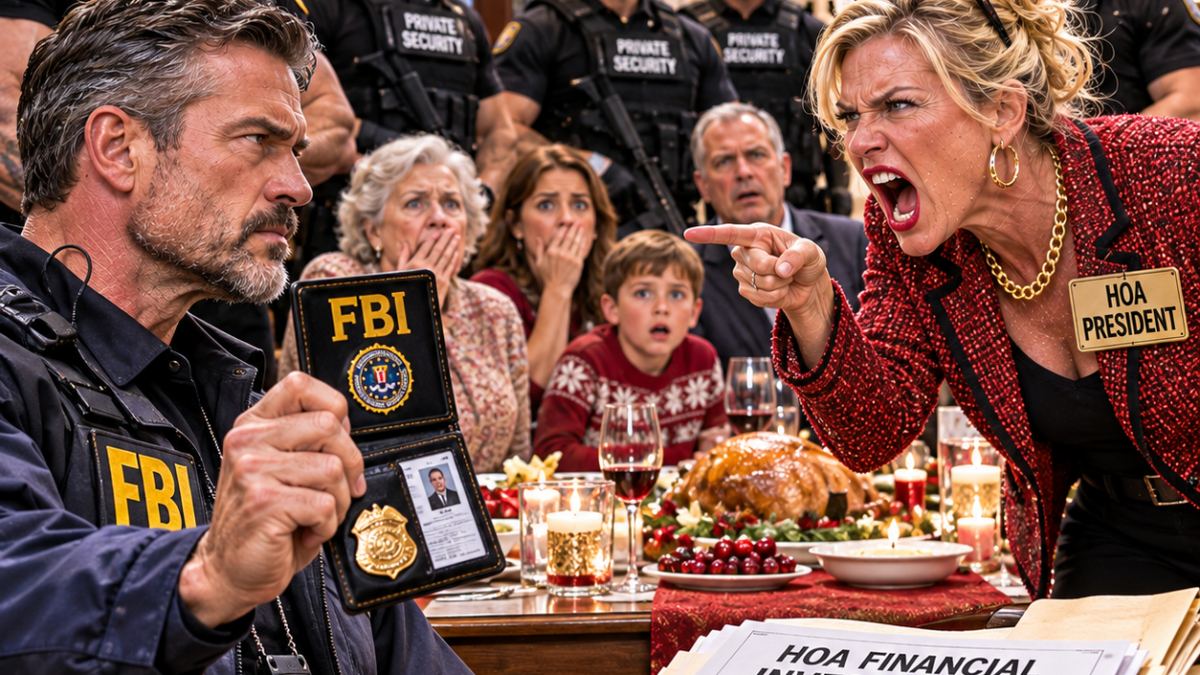
“NOBODY LEAVES UNTIL WE SEARCH THIS HOUSE!” HOA Karen Sent Six Armed-Looking Guards to Raid My Christmas Dinner—Then I Opened My FBI Credentials and Exposed Her $186,400 Secret
“SHUT OFF THAT CHRISTMAS MUSIC AND SHOW ME EVERYONE’S ID—NOBODY LEAVES THIS HOUSE UNTIL MY SECURITY TEAM FINISHES SEARCHING IT!” HOA president Candace Chatham screamed as six uniformed guards pushed into my living room, one seized my friend by the wrist, another blocked a terrified guest from leaving, and the woman who had spent eighteen months terrorizing our neighborhood waved a document bearing what looked like an official FBI seal directly in my face.
She had no idea that I was Special Agent Winston Abernathy, that the federal authorization she was brandishing was counterfeit, or that my Christmas guests included people who understood exactly what an actual federal warrant looked like—but when her lead guard saw my real credentials, his expression changed so violently that even Candace stopped shouting.
And when the guards’ body cameras, a frightened HOA treasurer, and a hidden folder labeled FEDERAL TEMPLATES eventually revealed that Candace had collected $186,400 from residents through fabricated security programs, her plan to humiliate one quiet homeowner before Christmas became the beginning of an investigation that would destroy the authority she had spent years building.
The first thing I remember about that night isn’t the shouting.
It isn’t the six men in black uniforms.
It isn’t Candace Chatham standing in my doorway with a smile that made my skin crawl.
It’s the sound of a fork hitting a dinner plate.
A small sound.
Barely noticeable under ordinary circumstances.
But when the music stopped, when the conversations died, when one of the guards announced that nobody could leave my house, I heard a silver fork fall from Ellen Prior’s hand and strike the edge of her porcelain plate.
Three little metallic clicks.
That was the moment I knew my Christmas dinner had become something my friends would remember for reasons none of us wanted.
My name is Winston Abernathy.
I was forty-two years old that December, and I had lived in Briar Glen Estates for just over three years.
I owned a two-story brick house at the end of Holloway Lane.
Nothing extravagant.
Four bedrooms.
A finished basement.
A garage that was perpetually too cluttered.
A kitchen with a window overlooking a small backyard where deer occasionally wandered close enough to eat the flowers I’d spent ridiculous amounts of money planting.
I had never married.
Never had children.
My parents lived three states away, and my younger sister had a family of her own.
I was the sort of man people described as polite, reliable, and a little difficult to know.
That description suited me.
I had spent most of my adult life working for the Federal Bureau of Investigation.
Not the cinematic version.
I didn’t spend every day chasing fugitives through warehouses or shouting into radios while helicopters circled overhead.
Most federal investigations require patience.
Documents.
Interviews.
Financial records.
Corroboration.
More documents.
Waiting for information.
Checking whether somebody’s account of events matches what can actually be established.
A successful investigation is often the result of hundreds of ordinary steps performed carefully enough that the eventual conclusion can withstand scrutiny.
I liked that work.
I was good at it.
And because of what I did professionally, I kept my personal life deliberately separate.
No FBI memorabilia hanging on my walls.
No badge displayed beside the television.
No government stickers on my vehicle.
No conversations at neighborhood gatherings that began with, “Well, in my line of work…”
To most of my neighbors, I was Winston.
The quiet man who kept his lawn trimmed, brought his trash cans in promptly, and occasionally helped older homeowners carry heavy things.
That was all they needed to know.
When I bought the house, Briar Glen looked peaceful.
White fences.
Old trees.
Sidewalks with carefully maintained flowerbeds.
Children riding bicycles through quiet cul-de-sacs.
During December, nearly every house displayed Christmas lights.
Mine were crooked.
They had always been crooked.
My friend Grant Whitfield claimed I could investigate complex criminal conduct but couldn’t run an extension cord in a straight line.
He wasn’t wrong.
The Christmas dinner had been my idea.
Twelve guests.
All adults.
Old friends.
A few former colleagues.
Two neighbors.
People I trusted.
For years, I’d worked through holidays.
Christmas Eve in hotel rooms.
Thanksgiving dinners eaten from plastic containers.
New Year’s celebrations spent reviewing case files.
This year, I wanted something ordinary.
A good meal.
Too much dessert.
Friends arguing about football.
Somebody laughing loudly enough to make the dog next door bark.
I had planned everything down to the minute.
The roast would come out at seven.
Marcus Dillard would carve because he considered himself the only person alive capable of properly handling a kitchen knife.
Ellen would bring her famous pecan bars.
Grant would complain about the wine and drink it anyway.
And if everything went according to plan, the worst argument of the evening would concern whether my Christmas tree leaned slightly to the left.
But three weeks before dinner, Candace Chatham mailed a letter to every household in Briar Glen.
Across the top, in bold letters, were five words:
HOLIDAY GUEST SECURITY PROGRAM — MANDATORY COMPLIANCE.
I opened it at the kitchen counter.
Read the first paragraph.
Then stopped.
Any homeowner expecting more than eight guests was required to submit the full legal names of every visitor.
Seventy-five dollars per guest.
Identification verification.
Mandatory security inspection.
Parking restrictions at the HOA’s discretion.
Refusal could result in escalating fines, suspension of community privileges, and further enforcement action.
At first, I assumed it was an absurd proposal somebody had forgotten to run past a lawyer.
Then I noticed the final paragraph.
It referenced federal residential holiday security coordination.
And beside Candace Chatham’s signature was an emblem designed to resemble a federal seal.
I stared at it.
Then I read the letter again.
Slowly.
Because something about that little emblem bothered me more than the seventy-five-dollar fee.
It wasn’t merely that Candace had invented a holiday rule.
She appeared to be borrowing authority that did not belong to her.
And in my experience, when someone starts dressing a personal demand in the appearance of government power, there is usually a reason.
PART2
I pulled Briar Glen’s governing documents from the filing cabinet beside my desk.
Declaration.
Bylaws.
Architectural guidelines.
Enforcement procedures.
Assessment provisions.
I had obtained copies when I bought the house and occasionally reviewed them when questions came up.
The HOA had legitimate authority over certain community matters.
Landscaping.
Common property.
Parking restrictions established under its governing documents.
Appropriate assessments.
Ordinary neighborhood administration.
It did not have a provision authorizing seventy-five-dollar fees for every Christmas dinner guest.
It did not give a private security company permission to enter occupied houses without consent.
It did not authorize the collection of driver’s licenses from visitors.
And it certainly did not permit Candace to claim that the FBI had approved a neighborhood Christmas-party inspection program.
I wrote her an email.
Short.
Polite.
Specific.
Mrs. Chatham,
I received the Holiday Guest Security Program notice. Please identify the governing provision authorizing the guest-registration requirements, per-person fee, and entry inspections. I will comply with valid association rules, but I do not consent to the collection of my guests’ personal information or any inspection of my residence based solely on the notice provided.
Respectfully, Winston Abernathy.
Her reply arrived forty-seven minutes later.
One sentence.
Then don’t be surprised when security arrives.
I read it twice.
Then printed it.
Placed it in a folder.
And went back to preparing my Christmas grocery list.
That’s one thing people tend to misunderstand about confronting someone like Candace.
They imagine you need to shout louder.
Make an enormous public scene.
Threaten a lawsuit before the other person finishes talking.
Sometimes the best response is much simpler.
Ask for the rule.
Keep the answer.
Do not give them a reaction they can later rewrite.
I didn’t know then how valuable that habit would become.
I’d been having problems with Candace almost from the moment I moved in.
She was forty-nine.
Always impeccably dressed.
Always carrying either a leather portfolio or an expensive handbag.
The kind of person who entered a room already certain everyone should be looking at her.
Her husband, Paul, worked in commercial insurance and traveled frequently.
Their only child was in college.
Candace had time.
Money.
And, apparently, an almost unlimited appetite for controlling people.
I first met her when she knocked on my door about a garden hose.
I was watering the flowerbeds.
The hose crossed a small section of my own walkway.
She looked down.
Then at me.
“Mr. Abernathy, we prefer homeowners to store hoses immediately after use.”
I stared.
“I’m using it.”
She smiled.
“Yes, but visible equipment can create an impression of disorder.”
I looked at the water running onto my hydrangeas.
“Would you prefer I carry it inside between watering each flower?”
She didn’t laugh.
Instead, she produced a clipboard.
That clipboard became familiar.
After that came a notice about my garage door staying open too long.
Then one about a wreath.
Then a warning over a delivery van that had stopped outside my house for fourteen minutes.
Another complaint concerned Christmas lights.
Mine were supposedly too warm in color.
Candace preferred cool white.
I told her my lights were already purchased.
She informed me that property-value preservation required consistency.
I asked for the relevant rule.
She stopped answering.
At least about that.
Instead, she found something else.
Every interaction followed the same pattern.
A demand.
A vague claim of authority.
My request for documentation.
Her refusal.
Then a new complaint.
For a long time, it was merely annoying.
I didn’t consider her dangerous.
Not until the security letters.
Two days after Candace replied to my email, a large new sign appeared near Briar Glen’s main entrance.
I saw it on my way to work.
FEDERAL HOLIDAY SECURITY COMPLIANCE IN EFFECT
Beneath it was an altered emblem.
Gold.
Blue.
Circular border.
An eagle-like figure that appeared designed to make passing motorists think of federal authority.
I pulled into a legal parking space near the clubhouse.
Got out.
Photographed it.
Then looked at the smaller print.
SUPPORTED BY FEDERAL COMMUNITY COMPLIANCE COORDINATION.
No agency name that made sense.
No actual legal citation.
No identifiable federal program.
Just impressive words arranged to create an impression.
I took several photographs.
Then drove away.
At work, I briefly informed my supervisor that a private neighborhood organization appeared to be using federal branding in questionable materials.
I didn’t ask the bureau to intervene in an HOA dispute.
I didn’t request that anyone investigate Candace because she annoyed me.
I simply raised a concern about apparent misuse of federal identification.
My supervisor told me to preserve what I’d received and keep my personal role separate if any legitimate federal investigation developed.
That was reasonable.
I went home.
Prepared my guest list.
And decided I wasn’t going to let one HOA president cancel Christmas.
On December twenty-third, Briar Glen looked beautiful.
A light frost covered the lawns.
White lights traced rooflines.
Red bows hung from mailboxes.
Children had built little snowmen from the thin patches of snow left in shaded yards.
The neighborhood smelled faintly of pine and wood smoke.
At five-thirty, I was in the kitchen seasoning the roast when Grant arrived carrying two bottles of wine.
He stepped inside.
Surveyed the decorations.
Then looked at the Christmas tree.
“Winston.”
“What?”
“Your tree is leaning.”
“It isn’t.”
Grant tilted his head.
“It’s practically filing for disability.”
I laughed.
“Come in or go home.”
He grinned.
Grant had known me for nearly twenty years.
We met during training early in our careers.
He had since moved into private consulting.
He was one of the few people outside my family who could tell when I was troubled before I spoke.
He set the wine down.
Then asked:
“How’s the HOA queen?”
I sighed.
“Still ruling her imaginary empire.”
“You pay the guest tax?”
“No.”
“Then I assume we’re all going to prison.”
“Only if you insult my tree again.”
He laughed.
A few minutes later, Marcus Dillard arrived.
Retired fire captain.
Broad shoulders.
Gray beard.
He carried enough food for thirty people and announced that my kitchen knives were unacceptable.
Ellen Prior came with pecan bars.
Dana Royce arrived carrying a gift bag.
Other friends followed.
By seven, the dining room was full of warm voices.
Someone turned on Christmas music.
Marcus began carving.
Ellen complained that nobody had left enough room for dessert.
Grant filled glasses.
I stood beside the table watching them.
For a moment, I felt something I hadn’t allowed myself to feel in years.
Contentment.
Not excitement.
Not triumph.
Just gratitude that everyone had chosen to spend the evening in my home.
At seven-forty, I saw Candace’s car pass outside.
It slowed.
Then continued.
At eight-oh-two, it passed again.
This time it stopped near the curb.
I watched through the window.
Three minutes.
Engine running.
Then it drove away.
Marcus joined me.
“Problem?”
I shook my head.
“Probably not.”
He looked toward the empty street.
“Your face says otherwise.”
“Just Candace.”
“The HOA woman?”
“Yes.”
Marcus grinned.
“Want me to go explain fire-code basics to her?”
“Please don’t.”
He laughed.
Then returned to the roast.
I let myself believe she had finally decided to leave us alone.
Fifteen minutes later, everything changed.
At 8:17, Marcus looked through the front window.
His expression shifted.
“Winston.”
I turned.
“What?”
He lowered his voice.
“Why are six guys in black uniforms walking up your driveway?”
The Christmas music continued.
People were laughing near the table.
I crossed the living room.
Looked outside.
Six men.
Black uniforms.
Metal badges.
Utility belts.
One wore a body camera.
Another carried a tablet.
Behind them came Candace Chatham.
No coat despite the cold.
Chin raised.
A smile on her face.
Marcus stood beside me.
“Are those police?”
“No.”
“You sure?”
“Yes.”
“Private security?”
“Looks like it.”
He stared.
“Six of them?”
I nodded.
Then reached toward the music controls and lowered the volume slightly.
Not off.
Not yet.
A hard knock sounded.
Three times.
I opened the door but remained standing in the frame.
The man at the front was broad-shouldered, mid-forties, with closely cropped hair and a name tag that read:
HOLUM — TEAM LEAD.
He corrected me when I read it.
“Holkum. Keith Holkum. Crestpoint Protective Services.”
I nodded.
“Winston Abernathy.”
He held out a packet.
“We’re here to conduct a holiday compliance inspection pursuant to the neighborhood security program.”
I didn’t take it immediately.
“Under which provision of the HOA’s governing documents?”
Keith blinked.
“The program has federal coordination authorization.”
I looked at the packet.
Across the top:
FEDERAL RESIDENTIAL HOLIDAY SECURITY COORDINATION NOTICE
There it was again.
The altered seal.
The counterfeit appearance of authority.
The words that were meant to stop ordinary people from asking questions.
I took the papers.
Read the first page.
Then looked back at him.
“Who supplied this?”
Keith glanced over his shoulder.
Candace stepped forward.
“I did.”
She smiled.
“Winston, I warned you.”
I looked at her.
“You did.”
“You refused to register your gathering.”
“Yes.”
“You refused the required guest fees.”
“Because you haven’t established that they’re authorized.”
She laughed.
“Still hiding behind technicalities.”
I held up the packet.
“Who issued this document?”
“Federal coordination.”
“Which agency?”
Candace’s smile broadened.
“People above your pay grade.”
Behind me, Grant had approached the hallway.
He heard that sentence.
I knew because he made a sound that was almost a laugh.
Candace pointed inside.
“Your party is now under community enforcement review.”
“We need the guest list.”
“Driver’s licenses.”
“Access to the garage and basement.”
“Verification of occupancy.”
“Inspection of alcoholic beverages.”
I stared.
Then asked:
“Do you have a warrant?”
Candace actually rolled her eyes.
“Don’t be ridiculous.”
“Then you don’t have my consent to enter.”
Keith shifted.
“Sir, we’re just here to perform an inspection.”
“No.”
I handed the packet back.
“This is my home.”
“You are not permitted inside.”
Candace stepped closer.
“Keith, proceed.”
I looked directly at the guard.
“I am telling you not to enter.”
For one second, he hesitated.
Then Candace said:
“If he refuses, document him as obstructing federal compliance.”
And Keith made the worst decision of his night.
He moved forward.
People later asked whether I was afraid.
The answer is complicated.
I wasn’t frightened of Candace herself.
I knew she was bluffing about her authority.
I knew I could call local law enforcement.
I knew how to document the incident.
But there were twelve guests inside my home.
Six uniformed men on the porch.
And an angry woman who had convinced herself she could control the situation through sheer insistence.
That combination is dangerous.
Not because anyone necessarily intends physical harm.
Because misunderstandings can escalate faster than people expect.
A frightened person reaches for a phone.
A guard mistakes the movement.
Someone blocks a doorway.
Someone pushes.
Someone falls.
I had spent enough time around confrontations to understand how quickly a stupid decision can become a serious one.
So I kept my voice steady.
I told Keith again:
“You do not have permission to enter.”
He stopped.
Then Ellen opened the side kitchen door to see what was happening.
One guard moved toward her.
She stepped aside in surprise.
He entered.
Two others followed.
I turned.
“Stop.”
Candace pushed past the front threshold.
“Finally.”
She looked around my living room.
Then smiled at the guests.
“Good evening, everyone.”
Nobody answered.
She lifted her folder.
“I’m Candace Chatham, HOA president.”
“We’re conducting a mandatory holiday security inspection.”
Grant looked at me.
Then at her.
“On what authority?”
Candace didn’t answer.
Instead, she told the guards:
“Document everyone.”
A young guard began writing names.
Another positioned himself by the front door.
Keith remained near the entry.
I walked into the living room.
“Everyone, stay calm.”
Then I looked at the guards.
“You’ve been told you do not have consent to enter.”
“Please leave.”
Candace laughed.
“This is HOA jurisdiction.”
I stared at her.
“No.”
“This is my living room.”
Her smile vanished.
Then Dana Royce picked up her purse.
“I’d like to go.”
The guard beside the door moved into her path.
“Nobody leaves until identities are verified.”
Dana froze.
“What?”
The guard held up one hand.
“Ma’am, we need to see your ID.”
She looked at me.
“Winston?”
I felt the atmosphere change.
Everything had been ridiculous until then.
Annoying.
Intrusive.
Aggressive.
But now one of my guests was being prevented from leaving my home.
That was no longer an argument about seventy-five-dollar fees.
It was a coercive situation involving private individuals who had no demonstrated authority to detain anyone.
I took one slow breath.
“Step away from the door.”
The guard looked toward Candace.
She nodded.
“Not until compliance.”
I looked at Keith.
“Your employee is preventing a guest from leaving.”
Keith glanced toward the door.
Then back at me.
“We just need a few minutes.”
“No.”
I kept my voice low.
“You need to stop.”
The Christmas music was still playing softly.
A cheerful song.
Completely wrong for what was happening.
Ellen reached over and switched it off.
That was when her fork fell.
Three metallic clicks.
And the entire room went silent.
Grant took out his phone.
He began recording.
A younger guard named Brody Lund spotted him.
“Sir, stop filming.”
Grant didn’t move.
“I’m inside my friend’s house.”
“Recording interferes with the inspection.”
“What inspection?”
Brody stepped closer.
“Put the phone away.”
I turned.
“Grant is allowed to document what’s happening in this home.”
Candace snapped:
“Confiscate devices if necessary.”
Keith looked at her.
“Candace, that’s not what our contract authorizes.”
It was the first time I heard a guard challenge her.
She turned sharply.
“I am paying you to enforce the program.”
Keith’s jaw tightened.
“Not to seize phones.”
Brody reached for Grant’s device anyway.
Grant pulled back.
Brody grabbed his wrist.
Grant cried out.
“Hey!”
I moved between them.
Not shoving.
Not striking.
Just putting myself where I could intervene verbally.
“Let go of him.”
Brody looked at me.
“Sir, step back.”
“Release his wrist.”
For a second, I thought he might refuse.
Then Keith said sharply:
“Brody.”
The young guard let go.
Grant stepped backward.
His face had gone pale.
I looked at his wrist.
A red mark was forming.
“Are you okay?”
Grant nodded.
But he wasn’t.
He was angry.
Shaken.
And looking at me in a way I’d never seen before.
Not expecting a joke.
Expecting me to make the danger stop.
Candace pointed at a laptop bag beside the sofa.
“Check that.”
I turned.
“What?”
“Unauthorized recording equipment.”
I almost laughed in disbelief.
“You’re standing inside my house trying to seize my guests’ devices, and now you want to search their belongings?”
She lifted her chin.
“Federal-backed inspection.”
I looked at Keith.
“Do you genuinely believe you have the legal authority to search this home?”
He gestured uncertainly toward the packet.
“We were told—”
“By whom?”
He looked at Candace.
She interrupted.
“Stop entertaining his questions.”
Then she pointed at me.
“From this moment forward, Winston Abernathy is obstructing a federal inspection.”
I stared at her.
And something became perfectly clear.
She wasn’t going to stop until somebody removed the illusion supporting her authority.
So I made a decision.
I reached slowly toward the inside of my jacket.
Keith stiffened.
His hand moved slightly toward his belt.
I stopped.
“Relax.”
I kept my other hand visible.
“I’m retrieving identification.”
Then I opened a black leather credential case.
Gold badge.
Federal identification.
My photograph.
My name.
Keith leaned forward.
Read the card.
His face changed.
Not gradually.
Immediately.
He looked from the credentials to my face.
Then back.
“Sir…”
I closed the case.
“My name is Winston Abernathy.”
“I am a special agent with the Federal Bureau of Investigation.”
No one spoke.
Not Grant.
Not Ellen.
Not Marcus.
Not Dana.
Not the guards.
Candace blinked.
Once.
Twice.
Then laughed.
A short, disbelieving sound.
“That’s ridiculous.”
I looked at her.
“It’s true.”
She pointed at me.
“You’ve been pretending to be an ordinary homeowner?”
“I am an ordinary homeowner.”
Keith turned toward her.
“Candace.”
His voice had changed.
“Where did you get the federal authorization notice?”
She opened her mouth.
Closed it.
Then said:
“Our attorneys prepared it.”
“Which attorneys?”
She stared.
I watched the room carefully.
The guard at the door stepped aside.
Dana moved away from him.
Brody lowered his hands.
Another guard stopped writing names.
Keith looked at the packet again as though it had suddenly become radioactive.
I spoke quietly.
“I’m here as the owner of this home.”
“I am not placing anyone under arrest.”
“I am not using my position to resolve an HOA dispute.”
“But you have been told repeatedly to leave.”
“And Mrs. Chatham has claimed that the FBI authorized this inspection.”
I looked at Candace.
“That’s a claim that needs to be examined by people other than me.”
Her face flushed.
“You’re abusing your badge!”
“No.”
I said.
“I’m asking you to explain yours.”
She stared.
Then shouted:
“KEITH, TURN OFF THE CAMERAS!”
He didn’t move.
I looked at him.
“Preserve the footage.”
“Do not delete recordings.”
“Do not alter the documents.”
Keith glanced at the camera on his chest.
Then back at Candace.
Something in his expression shifted.
He was beginning to understand that the woman who had hired him was now the person most desperate to erase the record.
And that was the moment her authority over the security team began to collapse.
I called county dispatch.
Not my federal office to demand immediate arrests.
Not a tactical unit.
Not anybody who would turn this into a performance.
County dispatch.
I reported an unauthorized entry into my home and concerns involving guests being prevented from leaving.
I gave the address.
Described the number of people.
Confirmed there were no immediate reports of weapons being drawn or serious injuries.
Then I called my supervisor.
Explained the apparent federal impersonation.
Told him I was personally involved.
He instructed me not to take an investigative role if the matter came under federal review.
That was exactly what I expected.
I was a witness.
A potential victim.
Not the case agent.
Meanwhile, Candace paced near my Christmas tree.
She had stopped pretending to be charming.
“This is outrageous.”
She looked at the guards.
“You work for me.”
Keith shook his head.
“We work under a contract.”
“Then enforce it!”
“Not by detaining people or searching a private residence without legal authority.”
Her face twisted.
“You were briefed.”
“By you.”
She stared.
Keith continued.
“You told us federal approval had already been obtained.”
“It was.”
“Then who approved it?”
Candace looked toward me.
I said nothing.
Then she pulled out her phone.
Started typing rapidly.
Keith stood close enough to glimpse the screen.
His expression changed.
“Candace.”
She ignored him.
He leaned forward.
“What are you doing?”
“Board business.”
He looked at me.
Then toward the approaching lights outside.
A sheriff’s cruiser had stopped near the curb.
Keith spoke quietly.
“She’s telling somebody to delete files.”
I looked at him.
“Tell the deputies exactly what you saw.”
He nodded.
Then instructed his team to stop interacting with the guests and wait outside.
Brody hesitated.
Keith repeated the order.
They complied.
Candace stared.
“YOU DON’T HAVE THE AUTHORITY TO OVERRIDE ME!”
Keith looked at her.
“I have the responsibility to stop my employees from making this worse.”
That was the first responsible sentence I’d heard from anyone in uniform that night.
Deputy Ray Callister arrived with another county deputy.
Callister was a compact man with gray hair at his temples and the calm demeanor of someone who had encountered too many ridiculous disputes to be impressed by shouting.
He entered after I invited him.
Looked around.
Christmas tree.
Dinner table.
Unfinished roast.
Twelve shaken adults.
Then Candace.
Then the security team outside.
He sighed.
“Can somebody tell me what happened?”
I let Keith speak first.
He explained the contract.
The inspection.
The document.
The claimed federal coordination.
The entry into the house.
I supplied the relevant sequence from my perspective.
Grant showed his recording.
Dana described being blocked from leaving.
Ellen explained how three guards entered through the side door.
Marcus described the demands.
Nobody needed to exaggerate.
What happened was bad enough.
Callister examined the packet.
Then looked at Candace.
“Ma’am, where did this come from?”
She folded her arms.
“Our legal department.”
“What legal department?”
“Association counsel.”
“Name?”
She hesitated.
Then gave the name of a law firm.
Callister wrote it down.
“Did they prepare this exact document?”
“I assume so.”
He looked at her.
“You assume?”
She snapped:
“I’m not a lawyer.”
That was an interesting defense for a woman who had spent the last hour telling everyone what the law required.
Callister looked at me.
“Mr. Abernathy, why do you believe this is not genuine federal correspondence?”
I kept my answer narrow.
The emblem was altered.
The agency references were inconsistent.
The field-office designation didn’t match legitimate correspondence.
The listed official didn’t hold the position stated.
And nothing about the FBI’s authority involved administering Christmas-party guest fees for a neighborhood association.
Callister listened.
Then looked toward Candace.
“Were you telling residents this program had federal authorization?”
She lifted her chin.
“It was federally aligned.”
He paused.
“What does that mean?”
“Security best practices.”
“Does it mean a federal agency authorized these guards to enter homes?”
She stared.
Keith answered quietly.
“That’s what we were told.”
Silence.
Then Brody spoke.
The young guard looked frightened.
“This isn’t the first house.”
Every face turned.
Callister asked:
“What do you mean?”
Brody swallowed.
“We’ve done other compliance visits.”
“How many?”
“Eight, I think.”
“Did you enter homes?”
“Some.”
“Collect fees?”
“Yes.”
Candace snapped:
“BRODY!”
He flinched.
Callister looked at her.
“Ma’am, let him finish.”
Brody continued.
“People paid through a QR code.”
“Some paid cash.”
“We were told the fees were mandatory.”
I looked at Candace.
She was staring at the carpet.
The room had changed again.
This wasn’t one ill-advised attempt to intimidate a homeowner.
It appeared to be a repeated program.
A system.
And somebody had been collecting money through it.
At 9:46, Candace left my property.
Not because I physically threw her out.
Not because I announced an arrest.
The deputies directed the parties to separate while they documented the reported conduct and considered the appropriate next steps.
The Crestpoint guards departed after providing relevant information and contact details.
Candace stood at the foot of my driveway for a moment.
Turned toward me.
Then shouted:
“This is not over, Winston!”
I looked at her.
“No.”
I answered quietly.
“I don’t think it is.”
She got into her car.
Drove away.
And the street fell silent.
Behind me, the house smelled of roast beef and extinguished candles.
My guests were still inside.
Some standing.
Some sitting.
Most looking stunned.
I closed the front door.
Turned the lock.
Then leaned against it.
For several seconds, I couldn’t move.
Not because I’d been frightened of Candace.
Because I finally understood how close that absurd little inspection had come to becoming something much worse.
A frightened guest could have pushed past a guard.
A guard could have mistaken a movement.
Someone could have fallen.
Someone could have been hurt.
All over a fake Christmas security fee.
I looked toward the dining room.
Grant sat holding his wrist.
Ellen was crying quietly.
Dana stood near the window.
Marcus had stopped making jokes.
My friend looked twenty years older.
“Winston,” he said.
I looked up.
“You okay?”
I almost answered automatically.
Of course.
Fine.
No problem.
Then stopped.
Because the truth was:
“No.”
Marcus nodded.
“Yeah.”
“Me neither.”
We stood there for a moment.
Then I said:
“I’m sorry.”
Grant looked up.
“For what?”
“For inviting you into this.”
Ellen shook her head.
“Winston.”
She crossed the room.
Took my hand.
“You didn’t invite those people.”
I looked away.
She squeezed harder.
“You invited us.”
“We came because we love you.”
“And that woman decided to ruin it.”
Grant nodded.
“She’s the one who should apologize.”
I swallowed.
He tried to smile.
“Preferably after someone explains what the Constitution is.”
Nobody laughed much.
Not yet.
The evening was too raw.
The deputies needed written statements.
So we turned my dining table into a temporary place for everyone to document what they’d seen.
The roast went cold.
The candles burned down.
The Christmas tree blinked cheerfully in the corner, almost offensively unaware that the holiday mood had been torn apart.
Dana wrote slowly.
Her hands shook.
At one point, she stopped.
“Winston.”
“Yes?”
“He really wouldn’t let me leave.”
I nodded.
“I saw.”
She stared at the paper.
“I’ve never had someone tell me I couldn’t leave a friend’s house.”
Her voice broke.
I sat beside her.
“I’m sorry.”
She looked at me.
“What if you hadn’t been here?”
I didn’t answer immediately.
Because I knew the question meant more than the words.
What if it had been an elderly homeowner?
Someone living alone?
A frightened widow?
A young family?
What if nobody had known the document was fake?
What if the guards had been more aggressive?
What if Candace had chosen someone who couldn’t afford counsel or didn’t know how to challenge a claim of authority?
I looked toward the packet on the side table.
The counterfeit seal glowed beneath the lamp.
Then I said:
“That’s why the evidence matters.”
Dana wiped her face.
I wished the answer were more comforting.
But it was true.
Just before the security team left, Keith came back to the porch.
I opened the door.
He stood alone.
No swagger.
No clipped commands.
Just a man who looked embarrassed and deeply worried.
“Mr. Abernathy.”
“Yes?”
“Can I speak to you?”
I stepped outside.
The air was cold.
He looked toward the street.
Then said:
“There’s something else.”
I waited.
“The contract contained an addendum.”
“What kind?”
“Candace asked us to describe ourselves as the Federal Community Compliance Support Team.”
I stared.
“Did your company verify that designation?”
He looked ashamed.
“No.”
“Why not?”
“We were told the HOA’s attorneys had approved the program.”
I nodded.
He continued.
“I should’ve questioned it.”
“Yes.”
He looked down.
“I know.”
I didn’t offer immediate forgiveness.
He had supervised guards entering my home without permission.
Had allowed the situation to continue after objections.
Had failed to stop a guest from being blocked at the door until the confrontation escalated.
That mattered.
But so did the fact that he was now cooperating.
“Preserve the contract.”
He nodded.
“And the addendum.”
“Yes.”
“Body camera footage.”
“Already secured.”
“Communications.”
“Yes.”
I looked at him.
“Tell investigators what happened.”
He swallowed.
“I will.”
Then he said:
“I’ve worked private security for nineteen years.”
“I’ve never seen anything like tonight.”
I looked at him.
“Neither have my guests.”
He nodded slowly.
Then walked away.
I slept less than two hours.
At six in the morning, I was sitting in my kitchen with a cup of coffee.
The house looked wrong.
The dining table hadn’t been fully cleared.
A pecan bar sat untouched on a plate.
One chair was crooked.
Grant had left his scarf over the back of the sofa.
I picked it up.
Held it.
Then stared at the living room.
Candace had wanted to embarrass me.
That much seemed clear.
She’d chosen the most public moment available.
Twelve guests.
Christmas dinner.
Uniformed guards.
A fake document.
She wanted everybody in Briar Glen to learn that refusing her rules brought consequences.
But why go that far?
I’d questioned the fee.
Refused to submit a guest list.
Asked for legal authority.
That shouldn’t have justified an operation involving six guards.
Unless the fee was part of something bigger.
Unless Candace wasn’t merely trying to win an argument.
Unless she was afraid that if one homeowner refused, others would begin asking the same questions.
I looked at the printed email in my folder.
Then don’t be surprised when security arrives.
Suddenly, it read less like anger.
More like a plan.
At nine, my supervisor called.
“Winston.”
“Yes, sir.”
“We’re assigning other agents to review the federal-impersonation concerns.”
“Understood.”
“You are not to participate in the investigation.”
“I know.”
“I mean it.”
“I understand.”
“You can provide witness statements and lawfully held materials through the normal process.”
“Of course.”
He paused.
“How are you?”
I looked at the dining table.
“Not great.”
“Take some time.”
“I’ll be fine.”
“That wasn’t what I said.”
I smiled faintly.
“No, sir.”
Then he added:
“Don’t confuse knowing how investigations work with being unaffected when something happens in your own home.”
I looked toward the Christmas tree.
“Understood.”
When the call ended, I sat quietly.
That was harder than I expected.
My professional instinct was to investigate.
Build timelines.
Compare statements.
Follow the money.
But this wasn’t my case.
I was involved.
I had to let other people do their jobs.
That restraint felt almost physically uncomfortable.
Then my phone rang again.
Unknown number.
I answered.
“Winston Abernathy.”
A woman’s voice trembled.
“Mr. Abernathy?”
“Yes.”
“My name is Lorna Teague.”
She paused.
“I’m the treasurer of Briar Glen Estates.”
I sat straighter.
“Good morning, Mrs. Teague.”
“Please.”
“Lorna.”
She took a shaky breath.
“I need to tell somebody what Candace has been doing.”
Lorna was fifty-six.
Quiet.
Careful.
A woman who had spent six years on the HOA board and rarely spoke at public meetings.
I’d seen her before.
Usually sitting beside the association president with financial reports stacked neatly in front of her.
She requested a meeting at a small coffee shop open on Christmas Eve.
I suggested she speak directly with investigators or independent counsel.
She said she would.
But first, she needed to explain why.
When I arrived, she sat alone at a corner table.
Hands wrapped around a cup she hadn’t touched.
A thick folder lay beside her.
I sat opposite.
“Lorna.”
She looked up.
Her eyes were red.
“I almost didn’t come.”
I waited.
She continued.
“Candace told me nobody would believe me.”
I didn’t interrupt.
“She said if I questioned the program publicly, she’d remove me from the board.”
“Then sue me.”
“For leaking confidential financial records.”
I looked at the folder.
“What records?”
She opened it.
Bank statements.
HOA reports.
Vendor invoices.
Payment summaries.
A printed spreadsheet.
My stomach tightened.
She pointed at several line items.
HOLIDAY SECURITY FEE.
FEDERAL COMPLIANCE PROCESSING.
GUEST VERIFICATION CHARGE.
EMERGENCY ACCESS ASSESSMENT.
The entries stretched back eighteen months.
Not merely December.
Not merely Christmas.
I looked at her.
“How long has this been happening?”
She swallowed.
“A year and a half.”
I sat still.
“How much has been collected?”
Her eyes filled.
“One hundred eighty-six thousand four hundred dollars.”
I looked down.
$186,400.
From residents of Briar Glen.
Some through special assessments.
Some through fees.
Some through the supposed security program.
I looked up.
“Where did the money go?”
Lorna opened another page.
“That’s the problem.”
She pointed at a vendor name.
CHATHAM COMMUNITY RISK CONSULTING.
The company had received a substantial portion of the funds.
Its business address was a mailbox location in a strip mall two towns away.
The listed business contacts led back toward Candace’s personal connections.
I stared.
“Was the relationship disclosed to the board?”
Lorna shook her head.
“Not properly.”
“Did the company provide services?”
“Some invoices say consulting.”
“Others say compliance administration.”
“But I couldn’t find work reports matching the amounts.”
I looked at her.
She continued.
“Crestpoint got paid something.”
“Not nearly as much as we collected.”
“Where did the rest go?”
She started crying.
“I don’t know all of it.”
I handed her a napkin.
She wiped her face.
Then whispered:
“I signed some of the transfers.”
That was the sentence she’d been afraid to say.
I looked at her.
“Lorna.”
She lifted her eyes.
“I didn’t understand at first.”
“I thought the board had approved a security program.”
“Candace presented everything as urgent.”
“Legal requirements.”
“Federal coordination.”
“She kept saying we couldn’t delay.”
I waited.
“When I started questioning the invoices, she threatened me.”
“Then I kept signing.”
Lorna covered her mouth.
“I knew I should stop.”
I didn’t tell her it wasn’t her fault.
Because she had responsibilities.
She knew that.
It was why she was sitting there shaking.
Instead, I said:
“You need independent legal advice.”
She nodded.
“And you need to give the material to investigators through an appropriate process.”
“I know.”
I looked at the folder.
“I shouldn’t take custody of these records myself.”
She frowned.
“Why?”
“Because I’m a witness in the incident involving Candace.”
“And because I want the evidence preserved through proper channels.”
Lorna stared.
Then nodded.
“Okay.”
I contacted the assigned investigative team.
An agent came to meet her.
Lorna provided the records directly.
Not to me.
To the people authorized to examine them.
As the agent prepared to leave, Lorna spoke again.
“One more thing.”
He turned.
She swallowed.
“There’s a folder on the clubhouse computer.”
“What folder?”
Her voice dropped.
“Federal Templates.”
I felt the hairs rise on the back of my neck.
Lorna continued.
“Logos.”
“Letterhead.”
“Warning notices.”
“Different versions.”
“She used to joke about it.”
The agent asked:
“What did she say?”
Lorna stared at her hands.
Then whispered:
“People obey seals, not bylaws.”
I looked out the coffee-shop window.
The street was full of shoppers carrying wrapped gifts.
Families preparing for Christmas.
People going about ordinary lives.
And I realized that inside our quiet little subdivision, a woman had apparently turned the appearance of federal authority into a revenue stream.
All because she believed nobody would examine the seal too closely.
By Christmas Eve afternoon, Briar Glen was unraveling.
Candace sent a neighborhood-wide email accusing me of intimidating community security personnel by abusing my FBI credentials.
She claimed the Christmas inspection had been legally authorized.
She said residents should remain calm while the board addressed a hostile homeowner’s interference with public safety.
I didn’t respond publicly.
Saved the email.
Forwarded it through appropriate channels.
Then my phone began filling with messages from neighbors.
A retired engineer had paid $450 after receiving a warning that his background could be reviewed by federal authorities.
A widow on Larkspur Court had been told her grandchildren couldn’t visit until she submitted a compliance form.
Another resident had paid a guest-verification charge after two uniformed guards appeared at his front door.
An older couple admitted they’d copied their driver’s licenses for HOA security because they believed refusing would create problems with the government.
That last message made me sit down.
Personal identification.
Collected by private contractors.
Stored somewhere.
Potentially accessible to people who had no legitimate reason to possess it.
The problem wasn’t simply money.
It was privacy.
Trust.
The ability of an organization to frighten people into surrendering information they otherwise would have protected.
I looked at the Christmas lights outside.
For the first time, they didn’t make the street feel safe.
They made it feel fragile.
Christmas morning arrived cold and bright.
I woke at seven.
Made coffee.
Pulled on a sweater.
Then heard vehicles outside.
Not sirens.
Engines.
Doors.
Voices.
I looked through the window.
Several official vehicles were parked near the clubhouse.
Investigators were entering under lawful authority.
Boxes.
Equipment.
Evidence containers.
The investigation had moved forward.
I did not walk over.
Didn’t ask to help.
Didn’t flash my credentials.
I stood at the end of my driveway beside an older neighbor named Walter.
He held a ceramic mug in both hands.
We watched quietly.
Walter looked at me.
“Winston.”
“Yes?”
“Is this about the Christmas security fees?”
I nodded.
“Partly, from what has been reported.”
He swallowed.
“I paid four hundred dollars.”
I looked at him.
“I’m sorry.”
He stared toward the clubhouse.
“She told me if I refused, somebody from Washington might review my background.”
My stomach tightened.
“Did you receive a notice?”
He nodded.
“Still have it.”
“Preserve it.”
“I already gave a copy to the authorities.”
“Good.”
Walter looked down.
Then said:
“I feel stupid.”
I turned.
“Why?”
He laughed bitterly.
“Because I believed her.”
I thought about Candace’s altered seal.
Her uniformed guards.
Her confident voice.
The way she used federal terminology.
“You were presented with something intended to look official.”
Walter shook his head.
“Still.”
I looked at him.
“The important thing is what happens now.”
He nodded.
Then whispered:
“My wife told me not to pay.”
I almost smiled.
“Sounds like she was paying attention.”
He laughed once.
Then stared at the clubhouse again.
“I wish I’d listened.”
So did I.
Because every time a resident paid out of fear, Candace learned that fear worked.
Every time someone submitted personal information, she learned the seal was effective.
Every time a board member remained silent, she learned the program could continue.
It had taken eighteen months to build the system.
And one Christmas dinner to expose it.
Investigators recovered records documenting how the program operated.
The full findings emerged gradually through lawful proceedings and later public filings.
Not in one dramatic press conference.
Not through somebody instantly reading everything from a computer screen.
Document by document.
Payment by payment.
The clubhouse computer contained a folder labeled:
FEDERAL TEMPLATES
Inside were altered emblems.
Warning notices.
Letters designed to resemble official correspondence.
Versions of fee demands.
Editable forms.
Some templates referenced federal agencies directly.
Others used deliberately vague phrases like federally aligned or national security compliance.
A spreadsheet tracked more than sixty households.
Residents had been assigned categories.
Low resistance.
Moderate resistance.
High resistance.
Preferred pressure method.
Payments received.
Response time.
I later learned that several households were identified as particularly vulnerable to threats involving legal trouble.
Elderly residents.
People with government jobs.
Immigrant families worried about official documentation.
Widows living alone.
That detail haunted me.
Candace hadn’t simply sent everyone the same letter and hoped for the best.
She appeared to have adjusted the pressure according to what she thought would frighten each household most.
Walter’s background warning.
A widow’s grandchildren.
Guest registrations.
A fabricated federal review.
Different fears.
Same purpose.
Obedience.
And money.
Keith Holkum became an important cooperating witness.
His body camera had recorded the Christmas visit.
So had other members of the team.
The company supplied relevant contracts and communications.
One email from Candace instructed:
Use the federal wording. Residents stop arguing when they think Washington is involved.
Another explained that if homeowners asked whether the FBI had approved the program, guards should say it was federally aligned and avoid detailed explanations.
Keith had believed he was managing a routine neighborhood security contract.
That belief didn’t excuse what happened in my home.
But his later cooperation helped investigators distinguish what the company had been told from what Candace had actually authorized.
Crestpoint terminated its contract with Briar Glen.
The company reviewed its practices for verifying claimed government authority.
Some employees faced internal consequences.
Others were retrained.
Brody, the young guard who had grabbed Grant’s wrist, provided his own statement and accepted responsibility for his actions.
None of that erased the fear my guests had experienced.
But at least the company stopped pretending the problem was a misunderstanding about Christmas-party etiquette.
Candace tried to maintain control.
Of course she did.
Even while investigators were reviewing her conduct, she called an emergency video meeting of the HOA board.
Her agenda had three items.
Remove Lorna Teague as treasurer.
Declare Winston Abernathy a hostile resident.
Approve association funds for Candace’s personal legal defense.
I learned about the meeting afterward from residents who attended.
At first, Candace spoke with her usual confidence.
She claimed Lorna had compromised privileged records.
She accused me of abusing federal authority.
She insisted the board needed to stand together.
Then Lorna spoke.
Quietly.
Calmly.
She referred to the association’s financial rules restricting the use of community funds for certain personal legal matters.
Candace interrupted.
Lorna continued.
A longtime board member named Howard Prescott then asked:
“Who owns Chatham Community Risk Consulting?”
Silence.
Candace stared at her screen.
Howard repeated:
“Who owns it?”
She said:
“That information is irrelevant.”
He shook his head.
“It’s receiving HOA money.”
“It’s relevant.”
Candace began shouting.
Threatening lawsuits.
Calling Lorna a traitor.
Accusing Howard of conspiring with me.
But the question remained.
Who controlled the company receiving the fees?
Why hadn’t the relationship been clearly disclosed?
And who authorized the transfers?
The board finally stopped treating those questions as disloyalty.
Under its governing procedures, it acted to suspend Candace’s authority pending further review.
Not by pretending an HOA president could be erased through one angry video call.
By using its own rules.
The same rules Candace had spent years waving at other people.
Her name disappeared from the next official neighborhood notice.
For the first time in eighteen months, it wasn’t printed beneath every warning.
The next community notice was different.
No counterfeit federal seal.
No threats.
No invented security classifications.
It said the holiday guest-security program was suspended.
Residents were instructed not to submit additional payments or personal documents through the program.
The board had retained independent counsel and auditors.
Past payments would be reviewed.
Homeowners who had received questionable notices were encouraged to preserve them.
Anyone whose identification had been collected could seek guidance about protecting personal information.
The notice didn’t declare all money instantly recovered.
It didn’t promise refunds before the accounts had been reconciled.
It acknowledged that the HOA had serious work to do.
I respected that.
A community organization can survive an abusive leader if the people responsible for repairing it stop pretending everything is fine.
But Candace wasn’t finished.
She called Keith.
Asked him to provide a written statement claiming I had aggressively brandished my federal credentials and threatened the security team.
He refused.
She insisted he owed her loyalty because she’d hired Crestpoint.
He reportedly answered:
“Not loyalty to something that didn’t happen.”
Then she contacted Lorna.
Left a voicemail.
In it, she offered not to pursue legal action against Lorna if the treasurer would tell investigators that the full board had approved the program.
Lorna saved the message.
Provided it through counsel.
Candace’s attempts to protect herself were becoming more damaging than the original financial discrepancies.
Then, on December twenty-sixth, she went to the clubhouse.
The building was under controlled access following investigative activity.
Exterior cameras recorded her approaching a side entrance.
She tried a key.
An authorized deputy stopped her.
Candace claimed she needed personal belongings.
When asked to identify them, she gave inconsistent answers.
Investigators addressed the situation under the applicable legal process.
Additional relevant records were later recovered and examined.
Among them were original invoices and a customized stamp associated with the counterfeit-looking notices.
The evidence connected the paper templates, the financial activity, and the people directing the program.
Candace had spent eighteen months relying on documents to intimidate residents.
Now those same documents were being used to understand what she’d done.
A few days after Christmas, Special Agent Theresa Vaughn called me.
She was leading the federal portion of the inquiry.
Methodical.
Professional.
Not interested in dramatic speeches.
She needed me to supplement my witness statement.
I went to the field office.
Sat in an interview room I’d visited many times in other capacities.
It felt strange sitting on the opposite side of the table.
Theresa opened her notebook.
“Winston.”
“Theresa.”
“I need to ask about the moment you showed your credentials.”
I nodded.
“Go ahead.”
“Why didn’t you identify yourself immediately when the guards arrived?”
I thought about the question.
Then answered:
“Because my profession wasn’t relevant to whether they had a right to enter my home.”
She waited.
I continued.
“I didn’t want the HOA to comply because I happened to work for the FBI.”
“I wanted them to comply because I was a homeowner who had refused consent.”
Theresa nodded.
“Then why show the credentials at all?”
“Because Candace repeatedly claimed federal authorization.”
“Her guards were entering the house.”
“A guest had been blocked from leaving.”
“Another had been grabbed.”
“I thought showing them that someone present knew the claimed authority was false might stop further escalation.”
She studied me.
“Did you tell anyone they were under arrest?”
“No.”
“Threaten an investigation?”
“No.”
“Order them to remain on the property?”
“No.”
“Did you personally begin searching for financial records afterward?”
“No.”
She nodded again.
Then:
“Good.”
I smiled faintly.
“That’s a lot of questions for somebody you know.”
“That’s why I ask them.”
I respected that.
Theresa closed her notebook.
Then said:
“One thing I want you to understand.”
I looked up.
“Your Christmas dinner wasn’t the beginning of this.”
“I know.”
“It was simply the incident that generated a complete, well-documented record of how the enforcement program operated.”
I thought of Grant’s phone.
Keith’s camera.
The packet.
The blocked doorway.
Candace shouting about federal authority.
She was right.
The Christmas party had become the point at which a hidden system was captured from start to finish.
And that record gave investigators a way to compare the claims made to other households.
The next development wasn’t a raid.
It was a quiet afternoon.
I was standing on a ladder replacing a burned-out bulb in the Christmas lights above my porch.
The tree was still up.
I hadn’t had the heart to take it down.
Three dark sedans stopped outside Candace’s house four doors away.
Agents walked toward the entrance.
Knocked.
Waited.
Candace opened the door.
I couldn’t hear the conversation.
Didn’t try.
I simply watched.
A few minutes later, she accompanied them to a vehicle in connection with the charges being pursued.
No sirens.
No shouting.
No crowd cheering.
The process was calm.
Professional.
Nothing like the operation she had staged at my dinner.
Candace had arrived at my home expecting six guards to frighten twelve ordinary guests into obedience.
Now people with actual legal authority were acting under real process.
No borrowed seal.
No invented holiday inspection.
No HOA clipboard.
No shouting about jurisdiction.
I climbed down the ladder.
Went inside.
Made coffee.
And stared at the Christmas tree.
I’d expected to feel triumphant.
I didn’t.
Mostly, I felt tired.
The legal case continued beyond that day.
Charges were allegations until resolved through the courts.
The evidence had to be examined.
The financial flows traced.
The documents authenticated.
The witnesses questioned.
The defense had the right to challenge the government’s case.
And the homeowners needed an independent audit to establish what money could be recovered.
The $186,400 represented fees collected through the questioned programs.
It did not automatically equal the exact amount stolen.
Some money had been paid to Crestpoint.
Some used for association activities.
Other transfers raised serious questions about private benefit and misrepresentation.
The audit separated those amounts.
The criminal case examined the fraudulent representations and associated financial conduct.
Local authorities addressed the events inside my home.
The matters overlapped but weren’t identical.
That distinction mattered to me.
I wanted the story to end with something stronger than outrage.
I wanted an accurate record.
Christmas had passed, but I couldn’t stop thinking about my guests.
Ellen told me she had jumped whenever a car stopped near her house.
Grant admitted he’d watched his recording repeatedly.
Dana said she hated being near the front door of someone else’s home now.
Marcus tried to joke about it.
Then admitted the incident bothered him more than he wanted to acknowledge.
He’d spent years as a fire captain.
Responded to deadly accidents.
Pulled people from burning buildings.
Yet he hadn’t expected to feel helpless at a friend’s Christmas dinner.
So I invited everyone back.
One week later.
Same house.
Same table.
Same Christmas tree.
No official inspection.
No paperwork required.
No guest fees.
Just dinner.
I asked before sending the invitations.
Not everybody was ready.
That mattered.
One friend declined.
Said she needed more time.
I understood.
The others came.
Grant arrived first.
Carrying wine.
He looked at the tree.
Then grinned.
“Still leaning.”
I laughed.
“You’re banned.”
He held up a finger.
“Under which bylaw?”
I laughed harder.
Marcus arrived carrying a roast.
Ellen brought pecan bars.
Dana came with flowers.
Nobody mentioned Candace for the first hour.
We ate.
Talked.
Laughed.
The room slowly returned to itself.
Then, after dessert, Marcus raised his glass.
“Winston.”
I looked up.
“Yes?”
“Just checking.”
He smiled.
“No security inspection tonight?”
I looked at the door.
Then at my friends.
“Not unless somebody arrives with genuine legal authority.”
The room burst into laughter.
Real laughter this time.
Not nervous.
Not strained.
The kind that makes your stomach hurt.
For a moment, I felt the evening Candace had stolen begin to return.
Later, Dana asked me something.
“Winston.”
“Yes?”
“Did she lose the moment you opened your badge?”
The table quieted.
Grant looked at me.
Ellen waited.
Marcus lowered his glass.
I thought about it.
Then shook my head.
“No.”
Dana frowned.
“Really?”
“Really.”
I looked toward the tree.
“Candace started losing long before that.”
“How?”
“The first time she told someone a fake federal notice was genuine.”
“The first time she collected a fee without a valid basis.”
“The first time she treated a seal as more important than the law behind it.”
I paused.
“My credentials didn’t make her actions wrong.”
“They were wrong already.”
Grant nodded slowly.
I continued.
“The badge just made the contradiction impossible to ignore in that room.”
Dana looked down.
Then said:
“So if you hadn’t been FBI…”
I finished:
“She still shouldn’t have been allowed to enter.”
Dana nodded.
That was the part I wanted everyone to remember.
Not that Candace had picked the wrong homeowner.
That no homeowner should have needed my profession to make the boundary matter.
The HOA’s financial recovery took months.
Lorna helped reconstruct the records.
Not alone.
Independent auditors and counsel handled the formal work.
She provided context.
Explained prior decisions.
Identified missing documents.
And accepted scrutiny of her own conduct.
She was not automatically cleared of responsibility merely because she eventually came forward.
But her cooperation mattered.
So did the truth.
The association began issuing refunds where the audit and legal process supported them.
Some households received money back quickly.
Others waited while disputed transactions were resolved.
The board reviewed contracts and financial controls.
Created clearer requirements for vendor selection.
Implemented conflict-of-interest disclosures.
Strengthened rules governing the collection and storage of residents’ personal information.
A new security policy stated plainly that private guards could not enter homes without valid consent or actual legal authority.
No more vague federal coordination programs.
No more unauthorized identity collection.
No more claims that holiday parties required government review.
The neighborhood began to feel like a neighborhood again.
Not a place under permanent inspection.
Lorna turned down the presidency.
Several residents wanted her to lead.
They trusted her more than most members of the old board.
She thanked them.
Then said something that became famous around Briar Glen.
“We don’t need another powerful president.”
“We need bylaws people actually read.”
The next community newsletter printed her words at the top.
I clipped the page.
Put it beside Candace’s original security notice.
One represented government-looking words used to frighten people.
The other represented ordinary people deciding to understand the rules that governed their shared property.
I liked the contrast.
The criminal proceedings eventually produced consequences for Candace and the fraudulent conduct established by the evidence.
Restitution was pursued.
Affected residents had opportunities to provide statements.
The association recovered what it could through the available legal and financial processes.
Some losses were painful.
Money returned late is still money someone had to do without.
Walter told me he’d skipped a medical appointment after paying one of the fake fees.
A widow said she’d borrowed from her daughter to avoid a threatened background review.
A young couple admitted they’d delayed buying a crib after receiving an emergency compliance assessment.
Those were the real costs.
Not just the total on the spreadsheet.
Not just $186,400.
Every number represented somebody making a choice under pressure.
Someone trusting a document that looked official.
Someone worried about being investigated.
Someone trying to protect a family.
That was what Candace had exploited.
And that was what I hoped the neighborhood would remember when the case finally became old news.
Spring arrived.
The frost melted.
Flowers opened.
Children returned to riding bicycles on the sidewalks.
The clubhouse reopened under the new board.
A neighborhood picnic was scheduled.
I almost didn’t go.
Then Ellen knocked on my door carrying a plate.
“Winston.”
“Yes?”
“You’re coming.”
“Am I?”
“Yes.”
“Do I get a vote?”
“No.”
I laughed.
She smiled.
“You’ve spent enough time alone thinking about all this.”
I looked at her.
She wasn’t wrong.
So I went.
There were hamburgers.
Potato salad.
Children running across the lawn.
Neighbors who had once avoided me now stopped to talk.
Some apologized.
Others asked questions.
A few admitted they’d believed Candace because she’d always sounded so certain.
Walter approached with his wife.
He shook my hand.
“I wanted to thank you.”
I shook my head.
“Walter, I didn’t conduct the investigation.”
“I know.”
“Lorna brought the records.”
“Keith provided footage.”
“Other residents came forward.”
“The investigators did their work.”
Walter smiled.
“Then thank you for asking the first question.”
I stared.
“What question?”
He laughed softly.
“Under which provision of the bylaws?”
I smiled.
That had been my first response to Candace’s security demand.
Not a threat.
Not a badge.
Just a question.
Walter continued.
“Sometimes that’s all somebody needs to hear before they realize they’re allowed to ask too.”
I looked around.
At the families.
The children.
The clubhouse.
The people who had spent eighteen months being told to obey.
Then nodded.
“Maybe.”
That summer, the HOA held its annual meeting.
I attended.
Not because I expected another confrontation.
Because it was my association too.
The new president, Howard Prescott, opened with a financial report.
Actual numbers.
Actual invoices.
Clear explanations.
Residents could ask questions.
He answered them.
Some people disagreed about landscaping costs.
Others complained about the pool schedule.
A heated discussion developed over whether the neighborhood should replace an aging playground structure.
For twenty minutes, people debated rubber surfacing and insurance deductibles.
I sat in the back smiling.
This was what an HOA meeting should sound like.
Boring.
Occasionally irritating.
But grounded in real issues.
At the end, Howard opened the floor for general comments.
Lorna stood.
“Mr. President.”
“Yes?”
“Will all members continue to have access to the relevant financial reports under the new process?”
Howard nodded.
“Yes.”
“And conflict disclosures?”
“Required.”
“And private security contracts?”
“Subject to independent verification and board approval.”
Lorna smiled.
“Good.”
Then sat.
Nobody accused her of disloyalty.
Nobody threatened to sue her.
Nobody reached for a fake federal seal.
And the entire meeting continued.
Ordinarily.
I loved it.
People still occasionally recognized me from the local news coverage.
The headlines had been irresistible.
HOA KAREN TRIES TO RAID FBI AGENT’S CHRISTMAS PARTY.
FAKE FEDERAL INSPECTION EXPOSES NEIGHBORHOOD FEE SCHEME.
SIX GUARDS, ONE BADGE, AND A CHRISTMAS DINNER GONE WRONG.
Some stories exaggerated what happened.
Claimed I arrested Candace in my living room.
I didn’t.
Claimed I ordered federal agents to raid the clubhouse that same night.
I didn’t.
Claimed the entire HOA was dissolved.
It wasn’t.
Claimed all $186,400 was instantly returned.
Not true.
But the real facts were dramatic enough without embellishment.
A woman invented a program.
Used federal-looking documents.
Collected money.
Hired guards.
Entered a private home without consent.
Allowed guests to be detained or physically pressured.
Then discovered that the homeowner understood exactly how false her paperwork was.
That was enough.
One afternoon, Keith Holkum wrote to me.
A short letter.
Not a lawyer’s statement.
Not a press release.
His own words.
He acknowledged he should have stopped the inspection at the front door when I refused entry.
He wrote that the incident had forced him to examine how his company verified client authority.
He said he had spent months replaying the moment Dana tried to leave.
Then the moment Brody grabbed Grant.
He ended with:
I kept waiting for someone else to tell me to stop. I was the supervisor. I should have been that person.
I read it twice.
Then wrote back.
Mr. Holkum,
Your acknowledgment matters. I hope you carry it into every future decision about protecting the people you serve. The authority to provide security is not the authority to disregard someone’s rights.
Winston Abernathy
I mailed it.
No dramatic reconciliation.
No new friendship.
Just accountability acknowledged.
Sometimes that is enough.
Grant’s wrist healed.
Dana eventually stopped feeling anxious whenever somebody stood near a doorway.
Ellen said she could finally look at Christmas decorations without remembering Candace screaming.
Marcus returned to making terrible firehouse jokes.
But none of us pretended the party had been harmless simply because it ended without serious physical injury.
There had been fear.
Humiliation.
Threats.
Coercion.
An invasion of privacy.
Those things leave marks that don’t appear in photographs.
We talked about them.
When somebody needed to.
And we made new memories.
More dinners.
Summer cookouts.
Birthday celebrations.
Ordinary evenings where the most serious problem was whether Grant had overcooked the steaks.
One day, Marcus said:
“You know, Winston, I’ve decided your house is cursed.”
I laughed.
“Why?”
“Every time I visit, somebody argues with me.”
“That is because you argue with everyone.”
“Not true.”
“Marcus.”
He grinned.
“Fine.”
Then looked toward the front door.
“Still glad Candace isn’t coming back.”
I nodded.
“So am I.”
The following Christmas, I hosted another dinner.
Same date.
December twenty-third.
Twelve guests again.
I debated whether to do it.
Part of me wanted to avoid the anniversary.
Maybe celebrate somewhere else.
At a restaurant.
At Marcus’s house.
Anywhere that didn’t carry the memory of six guards pushing through my doorway.
Then I realized something.
If I changed every part of my life that Candace had touched, I’d be giving her far more power than she ever deserved.
So I kept the date.
Decorated the house.
Bought another crooked tree.
Hung the same lights.
Cooked the same roast.
Invited the same friends.
Dana arrived carrying pecan bars.
Ellen complained that Dana had stolen her assignment.
Grant brought wine.
Marcus brought a carving knife he insisted was superior to mine.
I looked around the room.
Warm lights.
Laughter.
People I loved.
Then I stepped outside for a moment.
The air was cold.
The street quiet.
No security vehicles.
No HOA patrol.
No clipboard.
Just Christmas lights shining along Holloway Lane.
For the first time in a year, I could look at my front door without remembering how the guards had pushed past it.
Instead, I saw the people who had come through it willingly.
That was the difference.
Consent.
Trust.
Belonging.
Everything Candace had tried to turn into an obligation.
Inside, Marcus raised his glass.
“Before we eat, I’d like to make a toast.”
Grant groaned.
“Please don’t.”
Marcus ignored him.
“To Winston.”
I smiled.
“Oh, no.”
“To the only man I know who can turn a Christmas party into an investigation without burning the roast.”
Everyone laughed.
I shook my head.
Marcus continued.
“And to the rest of us.”
He looked around the table.
“For coming back.”
The laughter faded.
Not sadly.
Quietly.
Because we all knew what he meant.
Coming back to the house.
Back to the dinner.
Back to the room where someone had tried to make us feel powerless.
Dana lifted her glass.
“To coming back.”
Ellen followed.
Grant.
The others.
I looked at them.
Then raised mine.
“To all of you.”
We drank.
The roast was excellent.
Marcus took credit.
Grant complained about the tree.
Ellen declared dessert perfect.
And the music stayed on all night.
I’ve thought a lot about Candace Chatham since then.
Not because I miss the conflict.
I don’t.
And not because I feel compelled to celebrate her downfall.
I don’t.
What interests me is how a person convinces herself that authority exists simply because she keeps asserting it.
Candace was elected to help manage a neighborhood association.
That was her job.
Over time, she began acting as though the neighborhood belonged to her.
A rule became whatever she said it was.
A fee became mandatory because she put it on letterhead.
A security inspection became federal because she borrowed a seal.
A private home became HOA jurisdiction because she stepped across the threshold and declared it so.
But words didn’t create those powers.
Neither did a blazer.
Neither did a clipboard.
Neither did six guards.
And certainly not a counterfeit government emblem.
The problem wasn’t that she picked a fight with an FBI agent.
The problem was that she believed she could frighten any homeowner into surrendering basic rights by impersonating authority.
My job happened to make the lie obvious to everyone in the room.
But she had been wrong long before I opened my credentials.
That was the lesson I wanted people to take from the story.
Not:
Don’t mess with an FBI agent.
Instead:
Don’t mistake somebody’s confidence for proof they have legal authority.
And don’t let the appearance of an official document replace the need to verify it.
The most important person in the entire case wasn’t me.
It was Lorna.
A quiet treasurer who spent months afraid.
A woman who had made mistakes.
Who knew she had waited too long.
Who understood that continuing to remain silent would make her complicit in allowing the program to continue.
She finally came forward.
Not because she knew the outcome.
Not because she was guaranteed immunity from criticism.
Because she’d heard what happened at my Christmas dinner and realized the next house could be anybody’s.
That took courage.
So did Keith preserving the body-camera footage.
So did Walter admitting he’d paid out of fear.
So did the neighbors who brought forward their notices.
So did the people who testified.
So did the new board members who volunteered to sort through months of financial records instead of pretending the problem had ended with Candace’s removal.
Justice didn’t arrive in one dramatic moment.
It came through dozens of people deciding they would no longer let the same lie continue.
I understood that better than anyone.
Because I had spent my career watching investigations built from small, difficult acts of honesty.
I still keep the original Holiday Guest Security Program notice in my desk.
Beside it is Candace’s email.
Then don’t be surprised when security arrives.
And beside that is a photograph taken at the second Christmas dinner.
All twelve of us.
Smiling.
The tree leaning unmistakably to the left.
Marcus holding a carving knife.
Grant making a ridiculous face.
Ellen laughing.
Dana standing near the doorway without fear.
Sometimes I take out the photograph and look at it.
Not the notice.
Not the fake seal.
The photograph.
Because that is what I nearly forgot during the investigation.
Candace wanted the entire neighborhood to remember her authority.
I wanted my home to remember laughter.
She wanted people to fear opening their doors.
I wanted my friends to feel welcome walking through mine.
She wanted a list of names.
I wanted people I loved sitting around a table.
She wanted money.
Control.
Obedience.
And I wanted one ordinary Christmas dinner.
It should never have been complicated.
But sometimes the most important boundaries are the ones people insist you don’t have a right to draw.
One evening, Walter stopped by with a small package.
“Winston.”
“Evening.”
He handed it to me.
Inside was a wooden ornament.
Hand-carved.
Small house.
Christmas lights.
A tiny front door.
I looked at him.
“Walter.”
He smiled.
“My wife made it.”
“It’s beautiful.”
He nodded toward the door.
“Turn it over.”
I did.
On the back, in careful lettering, were six words:
A HOME IS NOT THEIR OFFICE.
I laughed.
Then felt my eyes sting.
Walter looked embarrassed.
“She said you might think it’s silly.”
I shook my head.
“No.”
“Not silly.”
He smiled.
“She wanted you to know we’re grateful.”
I looked at the ornament.
Then at him.
“Tell her thank you.”
“I will.”
He turned to leave.
Then stopped.
“Winston?”
“Yes?”
“Last Christmas, I was afraid to answer my own door.”
I went still.
He continued.
“This year, I put lights around it.”
I smiled.
“Good.”
He nodded.
“Good night.”
When he left, I stood in the doorway holding the ornament.
The street was quiet.
Christmas lights blinked along the houses.
And I realized that one of the worst things Candace had done was make ordinary people fear the spaces where they were supposed to feel safest.
A front door.
A dining room.
A holiday table.
An envelope in the mail.
An official-looking document.
It wasn’t only about money.
It was about turning community life into a series of threats.
The fact that Walter had decorated his doorway again meant something.
It meant the neighborhood was reclaiming its own normal life.
Years from now, I suspect people will still tell the story differently.
They’ll say six guards stormed an FBI agent’s Christmas dinner.
They’ll describe Candace’s face when I showed my badge.
They’ll laugh about the fake federal seal.
They’ll talk about the $186,400.
They’ll probably exaggerate the arrest.
Add dramatic dialogue.
Invent details about secret agents waiting outside.
That’s what happens when a story becomes entertainment.
But I was there.
I remember the quiet parts.
Ellen’s fork hitting the plate.
Dana staring at the guard who wouldn’t let her leave.
Grant holding his wrist.
Marcus watching the doorway instead of making jokes.
Keith reading my credentials and realizing his company had been sent into somebody’s home under false pretenses.
Lorna trembling over a folder of bank records.
Walter standing beside me on Christmas morning, ashamed that he’d believed a forged notice.
Those moments matter more than the headline.
Because they show what intimidation costs even when nobody ends up seriously injured.
Fear changes how people live.
And recovering from it takes more than one arrest.
It takes the return of trust.
The last Christmas before I turned fifty, I stood in my kitchen listening to my friends argue about whether the roast was overcooked.
It wasn’t.
Marcus insisted it needed another ten minutes.
Grant said Marcus had lost his sense of taste when he retired from the fire department.
Ellen threatened to ban both of them from the kitchen.
Dana was laughing so hard she had to sit down.
I looked around.
No guards.
No false paperwork.
No Candace.
No one demanding identification.
A knock sounded at the front door.
Every head turned.
For one fraction of a second, the room went silent.
The memory was still there.
Then I smiled.
“I’ve got it.”
I crossed the hallway.
Opened the door.
A neighbor stood outside holding a plate of cookies.
No uniform.
No clipboard.
No official seal.
Just a woman from down the street who wanted to wish us Merry Christmas.
“Sorry to interrupt,” she said.
I looked at the cookies.
Then toward my friends.
“Would you like to come in?”
She smiled.
“Just for a minute.”
I stepped aside.
“Of course.”
She entered.
Willingly.
Welcome.
And that ordinary little moment felt more important than any dramatic reveal that had happened in the same doorway.
Because a home is supposed to be a place where people enter by invitation.
Not intimidation.
Where the person living inside has a voice.
Where a document doesn’t become law simply because an angry HOA president printed it on expensive paper.
And where Christmas can be Christmas without somebody trying to charge seventy-five dollars for the privilege of having friends.
Later that night, when the last guest had gone home, I switched off the kitchen lights.
The tree glowed softly in the corner.
Walter’s wooden ornament hung near the top.
I stood beneath it and read the words again.
A HOME IS NOT THEIR OFFICE.
Then I looked toward the front door.
The same door Candace Chatham had crossed without permission.
The same doorway where six guards had stood.
The same place where I opened my FBI credentials and watched a carefully constructed lie begin to fall apart.
For a long time, that doorway had reminded me of anger.
Now it reminded me of something else.
The people who came back.
The neighbors who told the truth.
The community that decided it would no longer mistake fear for leadership.
I smiled.
Turned off the final lamp.
And went upstairs.
Because Candace had spent eighteen months teaching Briar Glen to obey a counterfeit seal.
But the thing she could never counterfeit was the one thing the neighborhood eventually found again.
Trust.
And when people finally understood that the law belonged to everyone—not just the person shouting loudest, holding the biggest clipboard, or wearing the most convincing badge—Candace’s false authority had nowhere left to stand.








