“NINE YEARS OF TWO COFFEES… AND ONE EMPTY CHAIR!” The Old Marine Never Told Me Why He Came—Until His Grandson Handed Me a Letter That Made My Hands Shake
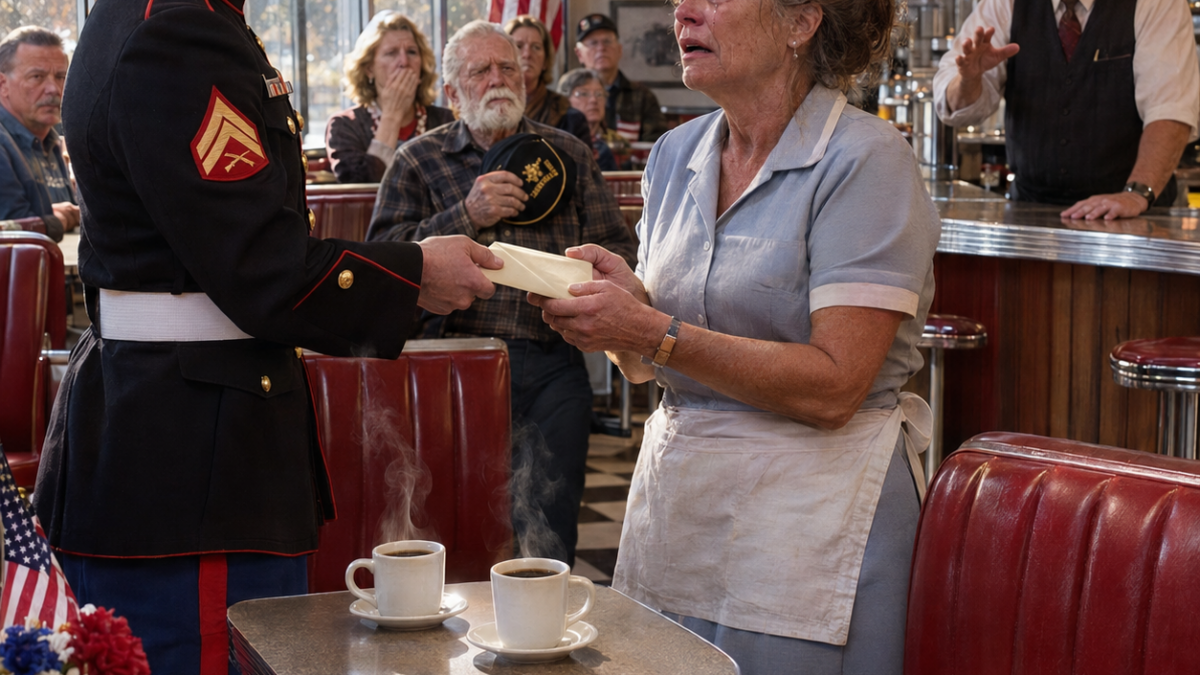
“NINE YEARS OF TWO COFFEES… AND ONE EMPTY CHAIR!” The Old Marine Never Told Me Why He Came—Until His Grandson Handed Me a Letter That Made My Hands Shake
“GET THOSE COFFEES OFF MY TABLE, JOSIE—THAT OLD MARINE ISN’T WORTH THREE HOURS OF LOST BUSINESS!” my boss shouted across the diner, loud enough for every customer to hear. For nine Veterans Days, I had quietly paid for two black coffees while an elderly Marine sat across from an empty chair, never realizing that the untouched cup held a secret connected to the father I had lost in Vietnam before I was old enough to remember his voice. But when a young corporal walked through our doors wearing dress blues and handed me an envelope bearing my name, the first thing he said made my heart stop: “Ma’am, my grandfather died in September, and he made me promise you would finally know the truth.”
My name is Josephine Hale, although nobody has called me Josephine regularly in more than twenty years.
I’m fifty-eight years old, and I’ve spent twenty-two of those years working at the Harbor Diner in Oceanside, California.
I’ve carried thousands of plates, poured more cups of coffee than I could possibly count, and learned that people reveal an awful lot about themselves when they think the woman refilling their mug isn’t listening.
I’ve watched young Marines kiss their wives goodbye before deployment. I’ve seen mothers stare through the windows while their sons boarded buses. I’ve watched men come home to embraces so fierce you could almost hear the years of fear breaking apart.
And I’ve watched people sit alone.
Sometimes those are the ones who stay with you.
Nine years ago, on Veterans Day, a gray-haired gentleman walked into our diner at exactly seven in the morning.
He wore a faded Marine Corps baseball cap, a brown jacket, and a small Vietnam service ribbon pinned above his heart.
He looked around before choosing Booth 4, the one beside the front window.
When I approached, he sat up a little straighter.
“Two coffees, please, ma’am. Black.”
I brought two steaming mugs.
He thanked me, placed one directly across from himself, and adjusted it until the handle pointed toward the empty seat.
Then he simply sat there.
For three hours.
He drank his coffee slowly, occasionally looking out toward the street, but he never touched the second mug.
When he finally stood, his hands trembled as he reached for his wallet.
“Don’t worry about it,” I told him. “Coffee’s on me.”
He looked surprised.
“Are you sure?”
“Absolutely. Thank you for your service, sir.”
His gaze dropped to my name tag.
For several seconds, he stared at it as though he’d forgotten how to speak.
“Josephine,” he said quietly.
I nodded.
Something changed in his face.
Not recognition exactly.
More like pain.
“Thank you, Josephine.”
Then he walked away.
The following Veterans Day, he returned.
Same time.
Same booth.
Same order.
Two black coffees.
One untouched.
By the third year, I’d learned his name was Walter Briggs.
He never spoke much about Vietnam, and I never pushed.
We talked about the weather, the diner, and how Oceanside had changed. Sometimes he asked whether I had children. Sometimes he wanted to know how long I’d worked there.
Once, he asked about my father.
I told him Dad had served in Vietnam and died when I was only three months old.
Walter’s fingers tightened around his cup.
“I’m sorry,” he whispered.
“Thank you. I never got to know him.”
He looked toward the empty chair.
For a moment, I thought he might cry.
Instead, he said, “Some men never really come home, Josephine.”
I didn’t understand what he meant.
Not then.
Every November 11 after that, I prepared his table before sunrise.
Every year, I paid his bill.
It wasn’t charity.
My father had been a Marine, too. The only photograph I owned showed him holding me as a newborn, still wearing his uniform. I kept it on my bedroom dresser.
Sometimes I wondered what kind of coffee he liked.
Sometimes I wondered whether he would have called me Josie.
And sometimes, when Walter sat quietly across from that untouched mug, I imagined that somewhere another daughter was remembering a father she couldn’t bring home.
Last spring, our longtime diner owner retired.
His son, Brent, took over.
Brent was thirty-one, ambitious, and obsessed with how quickly customers could be moved through the restaurant.
On Veterans Day, he found me setting two mugs on Booth 4.
“Who’s coming?”
“Mr. Briggs.”
“The guy who sits for three hours buying nothing but coffee?”
“Yes.”
Brent laughed.
“Then he can find somewhere else to sit. We’re running a business, Josie. Not a retirement home for lonely old soldiers.”
My face burned.
“I cover his bill.”
“Not anymore. If he comes in, he orders a meal or he leaves.”
I said nothing.
Seven o’clock arrived.
Walter didn’t.
Neither did he arrive at seven-thirty.
By eight, a cold feeling had settled in my stomach.
At 8:15, the bell above the entrance rang.
A young Marine in immaculate dress blues stepped inside.
He scanned the room, found my name tag, and walked directly toward me.
“Ma’am, are you Josephine Hale?”
“Yes.”
“I’m Corporal Ryan Briggs. Walter Briggs was my grandfather.”
The word was seemed to hang between us.
“He passed away in September,” the young man continued. “He asked me to give you something.”
He placed a thick, worn envelope in my hands.
Before I could open it, Brent approached.
“Sir, just so you’re aware, we have a fifteen-minute booth limit during the holiday rush.”
Ryan didn’t turn around.
He looked straight at me.
“My grandfather said you’d want to know who the second coffee was for.”
Then he glanced at the untouched cup waiting across Booth 4.
“Ma’am,” he whispered, “I think you should sit down before you read that letter.”
FULL STORY CONTINUATION
I looked at the envelope.
My name was written across the front in uneven blue ink.
Not Josie.
Not Mrs. Hale.
Josephine Hale.
There was something about seeing my full name in that shaky handwriting that made me feel suddenly, inexplicably young.
Like I was a little girl standing beside my mother, waiting for someone to explain why the man in the photograph wasn’t coming home.
“Sit down, ma’am,” Ryan said again.
I barely heard him.
Behind me, Brent cleared his throat.
“Look, I understand this is emotional, but we’re expecting a rush. Could you handle the personal stuff on your break?”
Ryan turned.
He didn’t raise his voice.
He didn’t need to.
“Sir, my grandfather served two tours in Vietnam. He was wounded twice. He spent the last nine Veterans Days sitting in this diner because there was something he couldn’t bring himself to say.”
Brent opened his mouth.
Ryan continued.
“He died asking me to come here. I intend to honor that request.”
For once, Brent had nothing ready to say.
I slid into Booth 4.
Ryan sat opposite me, carefully moving Walter’s untouched coffee a few inches to the side.
That small movement nearly broke me.
For nine years, nobody had sat in that chair.
Nobody.
Now Walter was gone, and his grandson was sitting exactly where the second coffee had always waited.
I ran my thumb across the envelope.
“Did he suffer?” I asked.
Ryan’s expression softened.
“No, ma’am. Not at the end.”
I nodded, though I wasn’t sure I believed I had the strength to hear anything else.
“Was he alone?”
“No. My mother was there. So was I.”
“Good.”
That was all I could manage.
I had known Walter for only a few hours each year, but I’d somehow imagined he would always be there.
Some people become fixtures in your life without ever becoming part of your daily routine.
The crossing guard who waves at you every morning.
The elderly woman who buys the same flowers every Friday.
The veteran who orders two coffees and sits across from an empty chair.
You don’t realize how much space they’ve occupied until they disappear.
Ryan rested his hands on the table.
“Grandpa talked about you a lot.”
I looked up.
“Me?”
“Yes, ma’am.”
“But we barely knew each other.”
Ryan gave me a sad smile.
“He knew more about you than you think.”
Something tightened in my chest.
“What does that mean?”
He glanced at the envelope.
“It’s better if you read it.”
I carefully opened the flap.
Inside was a folded letter, a small photograph, and an old piece of paper yellowed at the edges.
The photograph slipped out first.
I caught it before it reached the floor.
Two young Marines stood in front of a military vehicle somewhere in Vietnam.
One was Walter.
Much younger, of course.
His hair was dark. His shoulders were broad. His smile was almost reckless.
Beside him stood another young man.
Tall.
Dark-haired.
With a slightly crooked smile.
I knew that smile.
I’d been looking at it every morning of my adult life.
My hands started shaking so badly I nearly dropped the photograph.
“No,” I whispered.
Ryan leaned forward.
I brought the picture closer to my face.
The young Marine standing beside Walter was my father.
Daniel Hale.
My father.
For fifty-eight years, I had owned one photograph of him.
One.
A young man holding a newborn baby in a hospital blanket.
And now I was looking at a second photograph.
In this one, he was laughing.
Actually laughing.
His eyes were squeezed almost shut, his head tilted slightly toward Walter, and one hand rested on his friend’s shoulder.
There was dirt on his uniform.
His sleeves were rolled up.
He looked so alive that it hurt.
“Oh, my God.”
My voice came out in a sound I barely recognized.
“That’s my daddy.”
Ryan’s eyes filled.
“Yes, ma’am.”
I looked at him.
“How?”
He nodded toward the letter.
“Grandpa wanted to explain.”
I unfolded the paper.
The handwriting was shaky, but the first sentence was perfectly clear.
Dear Josephine,
If you’re reading this, then I have finally run out of chances to tell you something I should have told you many years ago.
I stopped.
My throat closed.
Ryan quietly pushed a napkin toward me.
I didn’t even remember picking it up.
I started reading again.
Before anything else, I want you to know that your father was my best friend.
His name was Daniel Hale. He was twenty-four years old when we served together in Vietnam, and he was the finest man I have ever known.
He was also the reason I came home.
I pressed the paper against the table.
Outside, a delivery truck rolled past.
Somebody laughed near the counter.
The coffee machine hissed.
The world kept moving as though nothing extraordinary had happened.
But everything inside me had stopped.
For the first time in fifty-eight years, I was holding words written by a man who had known my father.
Not from an official military record.
Not from a faded newspaper clipping.
Not from one of the carefully worded letters my mother had kept in a dresser drawer.
From a man who had eaten beside him.
Walked beside him.
Laughed beside him.
And watched him die.
I looked at Ryan.
“Your grandfather knew my father?”
He nodded.
“They served in the same unit.”
“Did he know who I was when he came into the diner?”
Ryan hesitated.
“Yes.”
The answer hit harder than I expected.
“All nine years?”
“Yes, ma’am.”
My eyes moved toward the empty coffee cup.
All nine years.
Walter had known.
He had sat across from me, asked about my life, listened while I talked about losing my father, and never once told me the truth.
A strange, painful mixture of gratitude and anger rose in my chest.
“Why?”
Ryan lowered his eyes.
“That’s what he spent the rest of his life trying to answer.”
I looked back at the letter.
Your father and I met during our first weeks overseas. I was a loudmouth from Missouri who thought knowing how to shoot a rifle made me a grown man. Your father was from California, quiet until he knew somebody, and stubborn enough to argue with a brick wall.
We didn’t like each other much at first.
Then he caught me trying to fix a radio I’d already made worse and spent half the night helping me put it back together.
After that, we were brothers.
Despite everything, I smiled through my tears.
My mother used to tell me Dad could repair anything with a screwdriver, electrical tape, and pure stubbornness.
I’d always thought she was exaggerating.
Apparently not.
Your father talked about your mother constantly. Her name came up every day, whether we wanted to hear it or not.
He carried her photograph in his pocket and checked it so often the corners wore away.
When he learned you had been born, he acted as if he were the first man in human history to become a father.
I laughed.
It came out broken and wet.
He showed everybody your photograph. Cooks. Mechanics. Corpsmen. Men who had already seen it six times.
He told us your name was Josephine.
Then he’d say, “But I’m calling her Josie.”
I covered my mouth.
The diner blurred.
For years, I’d wondered whether my father would have called me Josie.
I’d never asked my mother because she cried whenever she talked about him, and eventually I learned to protect her by keeping certain questions to myself.
Now here was his answer.
From a man who had stood beside him half a world away.
“He called me Josie,” I whispered.
Ryan nodded.
“Grandpa remembered that.”
I pressed my palm against my chest.
For a moment, I couldn’t breathe.
Then I continued.
Daniel had one particular way of drinking coffee. Black, too hot, and usually while complaining about how terrible it tasted.
He said the Marine Corps could ruin just about anything, but the coffee was a special accomplishment.
I used to tell him he should stop drinking it.
He’d say, “Not a chance. When I get home, I’m taking my little girl to a diner, and we’re going to have breakfast together. I’ll have coffee, and she’ll have whatever babies drink.”
I told him babies didn’t belong in diners.
He said, “Then I’ll wait until she’s old enough.”
I stared at the page.
My father had imagined taking me to breakfast.
Such a small thing.
Not a graduation.
Not a wedding.
Not some great milestone.
Breakfast.
A father and his daughter sitting across from one another in a diner.
And he had never lived long enough to do it.
I squeezed my eyes shut.
The pain came so suddenly that I bent forward over the table.
Ryan waited.
He didn’t try to comfort me with promises or explanations.
He simply sat there.
Exactly as Walter had done.
When I could finally see the page again, I kept reading.
I need to tell you what happened to him.
I’ve carried it for more than fifty years.
Some details have faded, and I don’t want to pretend I remember every minute perfectly. But there are things a man never forgets.
Your father’s last day is one of them.
I looked up.
Ryan was watching me carefully.
“Are you sure?” he asked.
I nodded.
“I’ve spent my whole life wanting to know.”
He said nothing.
I returned to the letter.
We were on patrol when we came under fire.
Everything happened fast. There was shouting, smoke, and the kind of confusion that makes it difficult to tell where anybody is.
I was hit while we were trying to get out.
I went down.
Daniel was already moving toward cover.
He could have kept going.
Instead, he turned around.
My fingers tightened around the paper.
He came back for me.
I stopped reading.
I knew what came next.
Some part of me had always known, because stories like this don’t have a hundred possible endings.
But knowing it and seeing it written by the man who survived were two different things.
He pulled me behind a low wall and tried to stop the bleeding.
I remember telling him to go.
I remember him saying, “Shut up, Briggs.”
He stayed until help reached us.
During those moments, he was wounded.
We lost him before we could get him to proper medical care.
I bent my head.
There it was.
The moment my father had disappeared from the world.
Reduced for decades to words in an official letter.
Now given shape by a friend who had been there.
A friend whose life had continued because my father’s hadn’t.
I stared at the last line.
For the rest of my life, I have lived with the knowledge that Daniel Hale came back for me.
I couldn’t read any further.
Not yet.
I laid the letter down.
Ryan sat quietly while I tried to steady my breathing.
Then I asked the question that had been waiting beneath everything else.
“Did your grandfather blame himself?”
Ryan looked at the photograph.
“Every day, I think.”
I nodded slowly.
“I wish he hadn’t.”
“So did we.”
I picked up the photograph again.
My father stood beside Walter, grinning beneath a tropical sun.
Two young men who had no way of knowing that one would become a grandfather and the other would remain twenty-four forever.
“Did Walter have a good life?” I asked.
Ryan’s face softened.
“Yes, ma’am. He married my grandmother. They had three children. Eight grandchildren.”
He swallowed.
“Six great-grandchildren.”
I smiled faintly.
“That’s wonderful.”
“He worked as an electrician. Coached Little League. Took us fishing. He was stubborn and grumpy, and he made the worst jokes you ever heard.”
I laughed through my tears.
Ryan laughed too.
“He never forgot your father, though.”
“I can see that.”
“He had the photograph on his dresser. Right beside Grandma’s.”
I looked down again.
The photograph was worn at the edges.
Walter had kept it for more than half a century.
And for nine years, he’d brought his grief into my diner without telling me why.
I thought about every five-minute conversation we’d shared.
Every time he’d asked whether I was doing all right.
Every time he’d looked at my name tag.
And suddenly those conversations felt different.
He had not been making small talk.
He had been trying to find a way to tell me he had known the man I’d spent my life missing.
“Why didn’t he say something?” I asked.
Ryan folded his hands.
“Grandpa tried.”
I looked up.
“What?”
“Every year. That’s what he told me.”
I frowned.
“He never said anything.”
“I know.”
Ryan took a breath.
“He said the first time he walked in, he wasn’t even sure you worked there anymore.”
I stared at him.
“Anymore?”
“Grandpa had been looking for you.”
My stomach tightened.
Ryan nodded toward the letter.
“He explains that part too.”
I lifted the paper again.
Josephine, when I came back from Vietnam, I wrote to your mother.
I wanted her to know that Daniel hadn’t died alone.
I wanted her to know he had talked about her and about you, right up until the end.
But I was twenty-three, badly wounded, and afraid that everything I said would only make her pain worse.
I wrote several letters.
I mailed one.
I never knew whether she received it.
My mother had died six years earlier.
For a moment, I wished desperately that she were sitting beside me.
She had spent so much of her life holding herself together.
I remembered her at the kitchen sink late at night, staring out the window.
I remembered the little wooden box under her bed.
The letters.
The photograph.
The folded American flag.
I remembered being twelve and asking why she had never remarried.
She’d smiled sadly.
“Some people get one great love, Josie. I had mine.”
I had accepted that answer because I didn’t know what else to do.
Now I wondered whether Walter’s letter had been among the things she kept.
Years passed. I raised my family. I worked. I tried to live a decent life.
But every Veterans Day, I remembered Daniel.
For a long time, I drank two coffees at home.
One for me.
One for him.
I suppose that sounds foolish.
It didn’t.
Not even a little.
Then, nine years ago, I was visiting Oceanside and stopped at a veterans’ memorial.
I saw your father’s name.
I stood there longer than I intended.
Later, I asked an old acquaintance whether anyone knew what had become of Daniel’s family.
He told me your mother had passed away recently and that you worked at the Harbor Diner.
My chest tightened.
Mom had died shortly before Walter’s first visit.
I drove past the diner three times before I went inside.
I had no idea what I would say.
I ordered two coffees because I was frightened.
Then you came to the table, and I saw your name tag.
Josephine Hale.
You had your mother’s eyes.
I covered my mouth again.
When you told me my coffee was free, I nearly told you everything.
But then you thanked me for my service.
And I looked at you, all grown up, smiling at a stranger, and I suddenly felt ashamed.
Your father never got to see you grow up.
I did.
I got to go home. I got to hold my children. I got birthdays and Christmas mornings and school plays and grandchildren.
And there you stood, paying for my coffee.
A tear landed on the paper.
I quickly wiped it away.
I didn’t know how to tell you that the man you were thanking was alive because the father you never knew had died helping him.
I stopped.
That was the first moment I understood Walter’s silence.
It hadn’t been indifference.
It hadn’t been secrecy for its own sake.
It had been shame.
The particular kind of shame that can follow a man home from war and sit beside him for decades, even when everyone around him insists he has nothing to be ashamed of.
I imagined Walter driving to the diner that first morning.
Stopping outside.
Looking through the windows.
Seeing me carry coffee to customers.
Trying to find enough courage to walk through the door.
And then losing it the moment I spoke kindly to him.
I closed my eyes.
“Oh, Walter.”
Ryan wiped his cheek with the back of his hand.
“He was afraid you’d hate him.”
I looked at him sharply.
“Hate him?”
Ryan nodded.
“He thought you might.”
“Why would I hate him?”
“Because he came home.”
I sat back.
The answer was so simple.
So terrible.
And so completely wrong.
My father had died helping his friend survive.
If I hated Walter for surviving, what would that say about the sacrifice my father had made?
I looked toward the untouched cup.
“Your grandfather didn’t take anything from me,” I whispered.
Ryan’s eyes filled again.
“I wish he could hear you say that.”
I leaned forward.
“He honored my father.”
Ryan nodded.
“For years.”
“No,” I said. “For his entire life.”
We sat quietly.
The breakfast rush had begun to build around us, but I barely noticed.
Then Brent appeared again.
“Josie.”
I looked up.
He stood beside the booth with a tight smile.
“I really need you back on the floor.”
I stared at him.
“Not right now.”
He blinked.
“Excuse me?”
“I’m reading a letter.”
“You’re working.”
Something in his tone made the back of my neck grow hot.
For twenty-two years, I had come to that diner through storms, illnesses, family emergencies, and holidays when the rest of the world was at home.
I’d worked double shifts when coworkers called out.
I’d stayed late to clean.
I’d covered tables that weren’t mine.
I’d spent Thanksgiving afternoons serving strangers while my own dinner cooled at home.
And now, for the first time I could remember, I wanted ten minutes that belonged entirely to me.
Brent looked impatient.
“Josie, I understand your friend died. That’s unfortunate. But I have a business to run.”
Ryan straightened.
I placed my hand on the table.
“Brent, please leave us alone.”
His smile disappeared.
“Don’t take that tone with me.”
I looked at him.
“I’m fifty-eight years old. I’ve worked here since you were nine. I am asking you to give me a few minutes to read a letter from a man who knew my father.”
Brent glanced at the photograph.
His expression barely changed.
“That’s personal business. Handle it on your own time.”
Ryan started to speak.
I gently touched his wrist.
“No,” I said.
He looked at me.
“I’ve got this.”
Then I turned back to Brent.
“If you need to take the cost of two coffees out of my pay, go ahead and put it in writing. But I’m not leaving this table until I’m finished.”
He stared at me.
For a moment, I thought he might actually fire me.
Then he said, “We’ll discuss your attitude later.”
“Fine.”
He walked away.
My hands were shaking again, but this time it wasn’t grief.
It was anger.
Not the kind that makes you want to shout.
The colder kind.
The kind that arrives when you realize someone has mistaken your patience for permission to treat you badly.
Ryan watched Brent disappear into the kitchen.
“I’m sorry,” he said.
I shook my head.
“Don’t apologize for him.”
Then I took another breath and returned to Walter’s letter.
I came back the next Veterans Day because I thought I might be brave enough.
I wasn’t.
You asked how I was doing. I said I was fine.
You asked about my family. I told you about my grandchildren.
I wanted to tell you your father once made me laugh so hard I nearly choked on a mouthful of coffee.
Instead, I talked about the weather.
A painful smile spread across my face.
That sounded exactly like Walter.
Every year, I promised myself I would tell you.
Every year, I failed.
At first, I thought I was protecting you from a painful memory.
Eventually, I understood the truth.
I was protecting myself from a difficult conversation.
I nodded slowly.
There was something about that admission that made me love him more.
He wasn’t trying to make himself into a hero.
He wasn’t asking me to excuse him.
He was simply telling the truth.
The older I got, the harder it became.
How does a man tell someone that he has been keeping an important truth from her for nine years?
How does he explain that he stood in front of her every November and watched her kindness without having the courage to return it with honesty?
I don’t have a good answer.
I only have this letter.
I paused.
I remembered one Veterans Day when Walter had seemed especially distracted.
He’d sat staring at his coffee while I wiped down the neighboring table.
I asked whether he was feeling all right.
He said, “Josie, do you believe people can carry something too long?”
I thought he meant physical pain.
“Sure,” I told him. “My back’s been carrying this place for twenty years.”
He had laughed.
Then he’d looked down.
“Yes,” he said. “I suppose it has.”
I’d never given the conversation another thought.
Now I wondered whether that had been one of his attempts.
One of the moments when the truth had almost escaped.
There is something else you should know about your father.
I leaned closer.
Daniel was afraid.
I stared at the words.
I don’t mean he was a coward. He wasn’t.
I mean he was human.
He was afraid of dying. Afraid of never seeing your mother again. Afraid of being nothing more than a photograph to you.
I swallowed.
He talked to me about it one night.
He said, “Briggs, what if she doesn’t remember me?”
I told him babies aren’t supposed to remember everything.
He said, “I know. But I want her to know I loved her.”
My vision blurred.
I asked him what he wanted me to tell you if anything happened.
He made me promise three things.
I gripped the letter.
First, he wanted you to know that he was proud to be your father.
Second, he wanted you to know that he loved your mother.
Third, he wanted you to grow up believing you could become anything you wanted.
I read those lines twice.
Then a third time.
My father had been afraid I would never know him.
And he had been right.
I hadn’t known his voice.
I hadn’t known the way he laughed.
I hadn’t known whether he liked music or dancing or whether he would have been the kind of father who embarrassed me in front of my friends.
But he had thought about me.
Not vaguely.
Not just as a baby waiting at home.
He had thought about the person I might become.
I should have told you those things long ago.
I’m sorry I didn’t.
But I hope knowing them now brings you some peace.
I pressed the letter to my chest.
For fifty-eight years, my father’s death had been the central fact of his existence in my life.
He was the man who died.
The man whose photograph stood on the dresser.
The man whose name was engraved on stone.
The man whose absence shaped my childhood.
But Walter’s words were giving me something I’d never really possessed.
A father who had been alive before he died.
A man who complained about coffee.
A man who fixed broken radios.
A man who made jokes.
A man who worried about his daughter.
I lowered the letter.
Ryan was watching me with tears in his eyes.
“Grandpa said you deserved to know him as a person,” he whispered.
I nodded.
“He was right.”
Ryan smiled sadly.
“He also said you were the kindest woman he’d ever met.”
I laughed.
“Oh, sweetheart. He hardly knew me.”
“He knew enough.”
I shook my head.
“He came here once a year.”
Ryan leaned forward.
“Can I tell you something?”
“Of course.”
“Grandpa didn’t always have an easy time with Veterans Day.”
I listened.
“When I was little, he’d get quiet every November. He’d stop sleeping well. Sometimes he’d go outside and sit alone for hours.”
“Did he talk about Vietnam?”
“Not much.”
Ryan looked at the photograph in my hand.
“But after he started coming here, something changed.”
“Changed how?”
“He still got sad. But he’d tell us he had somewhere important to go. He’d put on his old cap, polish his shoes, and drive to Oceanside.”
I smiled faintly.
“He always looked so neat.”
“Grandma said he spent more time getting ready for those breakfasts than he did for their anniversary dinners.”
I laughed again.
This time, the sound didn’t hurt quite as much.
“That sounds like something a wife would remember.”
Ryan nodded.
“She used to tease him about his mystery breakfast.”
“Did she know?”
“Eventually.”
I looked up.
Ryan hesitated.
“Grandpa told her about your father years before he told us.”
“Did she encourage him to talk to me?”
“Every year.”
I closed my eyes.
“Oh, Walter.”
“She said he was the bravest man she knew in some ways and the most stubborn coward in others.”
I burst out laughing.
Ryan joined me.
The laughter surprised both of us.
There we were, sitting in a diner on Veterans Day, crying over a dead Marine and laughing about the woman who had loved him.
It felt strange.
But it also felt right.
Grief isn’t always solemn.
Sometimes it arrives with a ridiculous memory that catches you off guard.
Sometimes you laugh so hard you cry.
Sometimes you do both and can’t tell where one ends.
Ryan took a breath.
“Grandma died three years ago.”
My smile faded.
“I’m sorry.”
“Thank you.”
He looked toward Walter’s cup.
“Grandpa kept coming.”
“Yes.”
“Even after she was gone.”
I nodded.
“He seemed lonelier after that.”
“He was.”
A silence settled between us.
Then Ryan spoke again.
“Last year, when Grandpa came home from the diner, he told me he’d finally decided what he was going to do.”
“What?”
“He was going to tell you everything this Veterans Day.”
I looked at him.
“This year?”
Ryan nodded.
“He said he was tired of being afraid.”
My eyes moved toward the untouched coffee.
But Walter hadn’t made it.
September had come first.
The ordinary cruelty of time.
A man can spend years preparing to say something important, believing there will always be another morning.
Until there isn’t.
I looked down at the letter.
There were only a few paragraphs left.
Josephine, I don’t know what you will think of me after reading this.
Maybe you’ll be angry that I waited.
You have every right.
Maybe you’ll wish I had stayed away.
I would understand that too.
But there is one thing I hope you never question.
Your father loved you.
He loved you before he ever held you.
He loved you while he carried your photograph through the rain and mud.
And he loved you on the last day of his life.
I covered my face.
For a long moment, I couldn’t move.
Then I read the final paragraph.
Every Veterans Day, I ordered two coffees.
One was mine.
The other was for Daniel.
I wanted him to have a place at the table.
And every year, when you paid the bill, I thought about what he would have said if he knew his little girl had grown into a woman who showed kindness to an old Marine without knowing anything about him.
He would have been proud of you, Josie.
I was proud of you too.
Thank you for letting me sit with my friend.
Semper Fidelis,
Walter Briggs
I stared at his signature.
The letters trailed downward, growing smaller toward the end.
I ran my finger just beneath his name.
Then I folded the letter carefully and placed it beside the photograph.
I wasn’t sure how much time had passed.
It could have been ten minutes.
It could have been an hour.
All I knew was that the untouched coffee across from me no longer looked like an empty ritual.
It looked like something I could finally understand.
I touched the handle.
Then I pulled the cup slightly closer to the photograph.
Ryan watched without speaking.
“Your grandfather,” I whispered, “spent nine years having coffee with my dad.”
Ryan nodded.
“Yes, ma’am.”
I stared at the dark surface of the coffee.
“And I was here the whole time.”
My voice broke.
“I was right here.”
Ryan reached across the table and took my hand.
“Grandpa wanted you to know that.”
I looked at him.
“Did he ever tell you what my father was like?”
Ryan smiled.
“He did.”
I drew in a shaky breath.
“Tell me.”
He looked down at the old photograph.
“Grandpa said your dad was always the first one to volunteer for the miserable jobs nobody wanted.”
I laughed through my tears.
“That sounds like my mother.”
“He said your dad was terrible at cards.”
“Really?”
“Apparently he couldn’t bluff to save his life.”
I smiled.
Ryan continued.
“He said your father could fall asleep anywhere. In a truck. Sitting against a tree. Once, Grandpa said, he fell asleep halfway through an argument.”
I laughed so hard I had to wipe my eyes.
“He sounds wonderful.”
Ryan’s smile trembled.
“Grandpa thought so.”
“What else?”
Ryan thought for a moment.
“He said your dad had this habit of making little things out of scrap wood.”
My heart skipped.
“Wood?”
“Yes.”
I sat very still.
On the dresser in my bedroom stood a small wooden bird.
A crude little thing, barely six inches long.
Its wings were uneven, and the paint had faded.
My mother told me Dad had made it before he left for Vietnam.
I had carried it through every move of my life.
Through marriage.
Through divorce.
Through raising my daughter.
Through the years after Mom died.
I’d always thought it was just something Dad had made around the house.
But Walter had remembered him carving things from scraps.
For some reason, that small confirmation felt enormous.
“My father made me a wooden bird,” I said.
Ryan leaned forward.
“Really?”
I nodded.
“I still have it.”
His eyes filled.
“Grandpa would’ve loved that.”
I smiled.
“I think he would’ve.”
Then I remembered the third item in the envelope.
The yellowed paper.
I carefully unfolded it.
It was a photocopy of an old handwritten note.
The ink was faded, and some words were difficult to read.
Across the top was a date from the year my father died.
Beneath it, in unfamiliar handwriting, were a few lines.
Briggs—
If you get home before I do, make sure you tell Josie her old man was thinking about her.
And buy her breakfast someday.
Daniel
I stared.
My hands went numb.
Ryan watched me.
“Grandpa kept that in his wallet for years.”
I couldn’t speak.
“He said your father wrote it after they were talking about home one night. It was supposed to be a joke between them.”
I looked up.
“A joke?”
Ryan nodded.
“Grandpa said they were arguing about who was going home first. Your dad told him that whichever one got back first had to buy breakfast for the other’s family.”
I covered my mouth.
The note shook in my hands.
For fifty-eight years, I’d had one photograph.
Now I had a second photograph.
A letter from my father’s closest friend.
And words my father had actually written.
Not an official notification.
Not a military citation.
His words.
Make sure you tell Josie her old man was thinking about her.
I brought the page to my chest.
“Oh, Daddy.”
The sound escaped before I could stop it.
Not Dad.
Not Father.
Daddy.
A word I hadn’t used aloud in decades.
I bowed my head and cried.
I cried for the little girl who had waited for a father she couldn’t remember.
I cried for my mother, who had spent so many evenings pretending she was stronger than she felt.
I cried for Walter, who had carried a promise longer than he should have had to.
And I cried for the young Marine in that photograph, smiling at his friend with no idea how short his life would be.
Ryan waited.
Then he reached into his uniform pocket and took out a small folded handkerchief.
“Grandpa always carried one,” he said.
I smiled through tears.
“So did my mother.”
He offered it to me.
I took it.
It was clean, neatly pressed, and probably the kind of thing he had never expected to need on a visit to a diner.
“Thank you.”
He nodded.
The room around us had grown quieter.
Not completely silent.
The diner was still open.
Coffee still brewed.
Plates still clattered.
But I began to notice that people nearby had stopped talking quite so loudly.
At the counter, an older gentleman wearing a Navy veteran’s cap sat with both hands around his mug.
A woman near the window was dabbing her eyes.
My coworker Maria stood beside the service station, holding a stack of plates she appeared to have forgotten to deliver.
I wondered how much they had heard.
Then Brent’s voice cut through the room.
“Josie. Kitchen. Now.”
I closed my eyes.
Not because I was frightened.
Because I was tired.
So deeply tired.
Tired of men like Brent believing that everything meaningful could be reduced to dollars per table.
Tired of hearing him call elderly customers problems.
Tired of being told that kindness was bad for business.
And especially tired of being treated as though twenty-two years of loyalty had purchased me no right to dignity.
I looked at Ryan.
“Excuse me a moment.”
He rose automatically when I stood.
I touched his arm.
“Stay right here, sweetheart.”
Then I walked toward the kitchen.
Brent stood by the swinging doors with his arms crossed.
“What is going on with you today?”
I stared at him.
“What do you mean?”
“You’ve been sitting at that booth forever. We’re short-handed, and Maria is covering your tables.”
“Maria offered.”
“That’s not the point.”
“Then what is the point?”
He seemed surprised I had asked.
“The point is that you’re an employee, Josie. You don’t get to decide when you’re working.”
I looked at him.
“I understand that.”
“Do you?”
“Yes.”
He leaned closer.
“Because I’m starting to think you’ve forgotten who signs your paycheck.”
Something inside me went very still.
I’d heard those words before.
From bad managers.
From impatient customers.
From people who thought a waitress’s smile meant she had no pride left to protect.
But this time, the words landed differently.
Perhaps because my father’s handwriting was still in my pocket.
Perhaps because Walter Briggs had spent nine years demonstrating that a person could carry deep suffering without becoming cruel.
Perhaps because I was fifty-eight years old, and suddenly the idea of wasting another day being afraid of Brent seemed ridiculous.
I met his eyes.
“Your father built this diner on the understanding that people mattered.”
Brent rolled his eyes.
“My father nearly ran this place into the ground giving things away.”
“Your father fed hungry families when they couldn’t pay.”
“Exactly.”
“He served coffee to veterans who didn’t have anyone to sit with.”
“That’s why we have to change things.”
I shook my head.
“No. That’s why people kept coming back.”
Brent looked toward the dining room.
“We don’t have time for this.”
“Then stop wasting it.”
His head snapped toward me.
“Excuse me?”
“You’ve interrupted me three times while I was reading a letter about my father, who was killed in Vietnam.”
Brent’s expression tightened.
“I already told you—”
“And you’ve insulted a dead Marine, his grandson, and every veteran who’s ever needed a quiet place to sit.”
“Don’t exaggerate.”
“I’m not.”
He stared at me.
I continued.
“Mr. Briggs came here once a year. Once. He ordered two cups of coffee. I paid for them. I cleaned the table afterward. Whatever money you think that cost this business, you can write it down.”
“That’s not how—”
“But don’t you dare call that man a cheapskate again.”
Brent’s face flushed.
“You need to watch your mouth.”
I nodded.
“You’re right. I do.”
He looked briefly satisfied.
Then I continued.
“Because I have spent too many years using it to apologize for things that never needed an apology.”
For a moment, neither of us spoke.
Then Brent said, “I can send you home.”
I looked at him.
“You can.”
“And I can replace you.”
That hurt.
Not because I believed I was irreplaceable.
Nobody is.
It hurt because twenty-two years of work had suddenly become a bargaining chip in a conversation about two cups of coffee.
I thought of Walter.
His trembling hands.
His quiet thank-you.
The way he always folded his napkin before leaving.
Then I said, “If you need to make that decision, make it. But I’m finishing this morning with Corporal Briggs.”
Brent stared at me.
“You walk away from your shift, and don’t expect me to hold your job.”
I felt fear move through me.
Real fear.
I wasn’t wealthy.
I had bills.
Rent.
A car that made a worrying noise every time I turned left.
A daughter with two children of her own who sometimes still needed help.
Losing my job at fifty-eight wasn’t something I could shrug off.
But I also knew that some choices stayed with you long after the practical consequences were settled.
I could spend the rest of my life wondering whether I’d done the right thing.
Or I could do it.
“I understand,” I said.
Then I took off my apron.
I folded it carefully and placed it on the counter beside him.
“I’m taking the rest of the morning.”
And I walked back into the diner.
My legs shook the entire way.
Ryan stood when he saw me.
“Is everything okay?”
I looked at Booth 4.
At the two coffees.
At my father’s photograph.
At Walter’s letter.
And for the first time that morning, I felt certain about something.
“It is now.”
I sat down.
Maria approached a few moments later.
She looked at my empty waist.
“Josie?”
I gave her a small smile.
“I might be looking for a new job.”
Her mouth fell open.
“What?”
“Brent and I had a disagreement.”
Her eyes moved toward the kitchen.
Then back to me.
“You’ve got to be kidding.”
I shrugged.
“Apparently I’m bad for business.”
Maria looked furious.
She had worked beside me for eleven years.
We’d survived broken refrigerators, flooded bathrooms, summer tourist crowds, and more than one customer who believed snapping his fingers was an acceptable way to summon another human being.
She knew exactly how much I gave that place.
“Stay here,” she said.
“Maria—”
“No. You stay right here.”
She turned and marched toward the kitchen.
I watched her disappear through the swinging doors.
Ryan looked uncomfortable.
“Ma’am, I didn’t mean to cause trouble.”
I took his hand.
“Sweetheart, you didn’t cause anything.”
“But your job—”
“Your grandfather taught me something today.”
Ryan waited.
“He taught me that some things deserve our time, whether anyone considers them profitable or not.”
I smiled.
“And I needed the reminder.”
He looked down.
Then he reached into the envelope.
“There’s something else.”
I blinked.
“What?”
He withdrew a smaller folded sheet of paper.
“Grandpa wanted me to tell you this, too.”
I almost laughed.
“How many secrets did that man have?”
Ryan smiled.
“More than you know.”
For a moment, the old fear returned.
After everything I’d heard, I wasn’t sure my heart could take another revelation.
But Ryan simply unfolded the paper.
It was a note written in Walter’s handwriting.
Ryan,
When you give Josephine the letter, please sit with her awhile.
Don’t rush her.
Don’t try to make her feel better.
Just listen.
She spent nine years giving an old man five minutes of kindness.
You can give her however long she needs.
I pressed my lips together.
Ryan folded the note again.
“He was very specific about that part.”
I smiled.
“He always was a gentleman.”
“Mostly.”
I raised an eyebrow.
Ryan laughed.
“Grandma would’ve had some stories.”
“I’m sure she would.”
We fell quiet again.
Then I asked a question I hadn’t realized was important until that moment.
“Did Walter ever tell you why he ordered two coffees instead of just keeping a photograph on the table?”
Ryan nodded.
“Yes.”
I looked at him.
“He said your dad never liked being fussed over.”
I smiled.
“He sounds like my mother again.”
“Grandpa said if he set out flowers or lit a candle, Daniel would’ve made some smart remark.”
I laughed.
“So coffee was better?”
“Grandpa said two Marines sitting down for coffee was something your dad would have understood.”
I nodded slowly.
That made sense.
Not everything important needs a ceremony.
Sometimes remembrance is ordinary.
A cup.
A chair.
A few quiet hours.
A place saved for somebody who isn’t coming.
Ryan glanced toward the coffee.
“Grandpa said he never drank the second one because it wasn’t his.”
Something about that simple statement made my eyes fill again.
For nine years, I’d watched the coffee grow cold.
I’d wondered whether it represented a wife, a brother, a friend.
I’d wondered whether Walter was lonely.
Now I knew.
He hadn’t been trying to fill the empty chair.
He’d been refusing to pretend it didn’t matter.
I took a long breath.
“May I ask you something personal?”
Ryan nodded.
“Anything.”
“Did your grandfather ever forgive himself?”
He was quiet for a moment.
Then he said, “I don’t think he ever completely did.”
I lowered my eyes.
“But he got closer.”
I looked up.
Ryan continued.
“A few weeks before he passed, we were sitting on the back porch. He was having a rough day, and I asked him what he thought your father would say if he could see him now.”
“What did he say?”
Ryan’s voice softened.
“He said Daniel would probably tell him to stop feeling sorry for himself and go mow the lawn.”
I laughed.
It was the sort of laughter that surprised me by how much it hurt.
“That sounds right.”
“Then Grandpa said something else.”
I waited.
“He said, ‘I think he would’ve liked the way I lived.'”
My throat tightened.
Ryan nodded toward the photograph.
“He never stopped missing your dad. But I think, near the end, he finally understood that living wasn’t a betrayal.”
I squeezed his hand.
“Good.”
It came out as a whisper.
“Good.”
Because that was what I wanted more than anything.
Not for Walter to have forgotten.
Not for him to have stopped loving his friend.
But for him to have been allowed to enjoy the life my father had helped him keep.
I thought about his children.
His grandchildren.
The six great-grandchildren.
The baseball games.
The fishing trips.
The Christmas mornings.
The bad jokes.
The woman who’d loved him.
I thought about how many ordinary moments had unfolded because Walter came home.
And I knew something with absolute certainty.
My father would never have wanted those moments poisoned by guilt.
He had wanted his friend to live.
That was the whole point.
A chair scraped behind us.
I turned.
The older gentleman from the counter had approached our booth.
He wore a navy-blue windbreaker and a cap identifying him as a Navy veteran.
He looked to be in his seventies.
“Ma’am,” he said, “I hope you don’t mind me interrupting.”
I quickly wiped my cheeks.
“Of course not.”
He looked at Ryan’s uniform.
Then at the photograph.
“I couldn’t help hearing some of your conversation.”
I nodded.
He held out his hand.
“Harold Jensen. Retired Navy.”
Ryan stood and shook it.
“Corporal Ryan Briggs, sir.”
Harold shook my hand too.
“Mrs. Hale, I’ve eaten breakfast here for the last seven years.”
I smiled faintly.
“I know. Scrambled eggs, sourdough toast, coffee with cream.”
He laughed.
“That’s me.”
Then his expression grew serious.
“I remember that old Marine.”
My heart squeezed.
“You do?”
“Every year. Same booth. Same two coffees.”
I nodded.
Harold looked toward the untouched cup.
“I always wondered.”
I glanced at the photograph.
“Now we know.”
He was quiet for a moment.
Then he reached into his pocket and took out his wallet.
I immediately shook my head.
“No, please.”
He raised one hand.
“I’m not offering you charity.”
“Then what?”
He placed a five-dollar bill on the table beside the coffee.
“For the second cup.”
I stared at it.
He smiled gently.
“Seems to me that Marine’s friend deserves to have his coffee paid for.”
My eyes filled.
“Oh, sir.”
Harold squeezed my shoulder.
“Thank you for looking after the old gentleman.”
Then he walked back to his seat.
I stared at the bill.
It was just five dollars.
Nothing extraordinary.
And yet I knew I would remember that moment for the rest of my life.
Maria returned from the kitchen a few seconds later.
Her expression was hard.
“Brent’s being an idiot.”
I almost smiled.
“That’s not news.”
She pulled a chair toward the booth.
“Mind if I sit?”
“Please.”
She sat down and looked at Ryan.
“I’m Maria.”
“Ryan Briggs, ma’am.”
She nodded toward the photograph.
“Josie’s dad?”
I nodded.
Maria pressed her fingers to her lips.
“Oh, honey.”
She leaned across the table and hugged me.
It wasn’t a careful hug.
It was the kind of hug you give someone when you don’t know what to say and don’t intend to try.
I let her hold me.
Then she pulled back.
“Listen to me.”
I sniffed.
“What?”
“Whatever Brent says, you don’t make any decisions today.”
I looked at her.
“Maria—”
“No. You’ve worked here twenty-two years. One bad morning doesn’t erase that.”
I looked toward the kitchen.
“I don’t know what he’ll do.”
“He doesn’t know either.”
That made me laugh.
Maria smiled.
“He’s thirty-one. He thinks spreadsheets make him clever.”
Ryan coughed into his hand.
I suspected he was hiding a laugh.
Maria turned serious again.
“His father should hear about this.”
I shook my head.
“Mr. Mercer is retired.”
“He’s not dead.”
I looked at her.
She folded her arms.
“And he didn’t spend thirty years building this place so his son could throw away the people who made it worth visiting.”
I knew she was right.
But I was exhausted.
“Not today,” I whispered.
Maria studied me.
Then she nodded.
“Okay. Not today.”
She stood.
“Are you hungry?”
I shook my head.
“Not really.”
“Too bad.”
She disappeared.
Five minutes later, she returned with a plate of buttered toast.
“Eat something.”
I smiled.
“You sound like my mother.”
“Somebody has to.”
I picked up a piece.
The toast tasted like nothing.
But I ate it anyway.
Because sometimes grief requires the same basic care as illness.
Food.
Water.
A chair.
Someone nearby who doesn’t expect you to perform gratitude for being looked after.
Ryan sipped his coffee.
I watched him.
The way he held the mug reminded me of Walter.
Not exactly.
But enough.
“Do you drink your coffee black?” I asked.
He smiled.
“Grandpa taught me.”
“Of course he did.”
Ryan looked across the booth.
“He used to say coffee was supposed to taste like coffee, not dessert.”
I laughed.
“Walter said that to me once.”
“He said it to everybody.”
I looked at the photograph.
“My father complained that it tasted terrible, apparently.”
Ryan grinned.
“Grandpa said Daniel complained about everything except your mother and you.”
I smiled.
“That’s a relief.”
Then I asked, “How old were you when you joined the Marines?”
“Nineteen.”
“And Walter approved?”
Ryan considered that.
“He was proud. Worried, too.”
“I can imagine.”
“He told me to understand why I was doing it. Not just to wear the uniform.”
I nodded.
“He sounds like a good grandfather.”
“He was.”
Ryan swallowed.
“Sometimes I wish I’d asked him more questions.”
I looked at him.
“That’s something you never stop wishing.”
He lowered his eyes.
I continued.
“I wish I’d asked my mother more. I wish I’d written things down. I wish I’d recorded her telling stories about Dad.”
Ryan nodded.
“But she was here for so long that I assumed I’d have another chance.”
I looked at the photograph.
“That’s what we do with people we love. We assume they’ll always be available for one more conversation.”
He was quiet.
Then I added, “You came here today. You kept your promise. That’s something.”
Ryan looked up.
“He was very clear about the uniform.”
I smiled.
“I noticed.”
“He said I had to come in dress blues.”
“Did he explain why?”
Ryan nodded.
“He said your father never got to see you grow up, but he wanted you to see another generation of Marines standing in front of you.”
My eyes filled again.
“That stubborn old man.”
Ryan laughed softly.
“Yes, ma’am.”
He touched his collar.
“I had these pressed twice.”
I smiled.
“Well, you look very handsome.”
“Thank you.”
“Your grandfather would’ve been proud.”
Ryan’s eyes reddened.
“I hope so.”
I looked directly at him.
“He was.”
The words came easily.
Maybe because I’d spent nine years learning how Walter looked when he was proud of somebody.
He would straighten his shoulders.
His eyes would soften.
And he’d try not to smile too much.
I could picture him looking at Ryan in that uniform.
I could almost hear him grumble about a crooked collar before pulling his grandson into a hug.
“Trust me,” I whispered. “He was.”
Ryan looked away for a moment.
Then he nodded.
“Thank you.”
Outside, the morning sun had finally broken through the coastal haze.
The light fell across Booth 4, touching the edge of the photograph.
For a second, the two young Marines seemed almost alive.
Walter grinning at something just beyond the frame.
Daniel looking toward him.
I wondered who had taken the picture.
Whether they’d been laughing at a joke.
Whether they were hot or exhausted.
Whether my father had just talked about me.
I wished the photograph could speak.
But it didn’t have to.
Walter had already done that.
I gently smoothed its edges.
Then I looked at Ryan.
“Would you mind if I made a copy?”
He smiled.
“Grandpa wanted you to keep the original.”
I stared at him.
“What?”
“The photograph. It’s yours.”
I looked down.
“But this was his.”
“He said it should be with Daniel’s daughter.”
I swallowed hard.
“Are you sure?”
Ryan nodded.
“He made me promise.”
I brought the photograph closer.
For decades, my father’s face had existed in one frozen moment.
A young man holding a baby.
Now I had a moment that belonged entirely to him.
A smile from before the loss.
A glimpse of his friendship.
Proof that he’d been happy, even in a terrible place.
“I don’t know how to thank you.”
Ryan shook his head.
“You don’t have to.”
“I do.”
He smiled.
“Grandpa said you’d probably say that.”
I laughed.
“He knew me better than I thought.”
“He did.”
I looked around the diner.
Customers had begun filling the tables.
Someone near the window raised a hand to get Maria’s attention.
A child dropped a spoon.
The kitchen bell rang.
Life was returning to its usual noise.
And suddenly I wanted something.
Something I hadn’t wanted when the morning began.
I wanted to tell someone about my father.
Not just that he had died.
Not just that he’d been a Marine.
I wanted to tell them he had been funny.
That he had loved terrible coffee.
That he had fixed radios and carved little birds.
That he had wanted to take his daughter to breakfast.
For the first time, I had stories.
Real stories.
I looked at Ryan.
“Would you mind if I called my daughter?”
He smiled.
“Of course not.”
I took out my phone.
My daughter, Emily, lived in Carlsbad with her husband and their two children.
She worked as a nurse, and I knew she might be busy.
But I called anyway.
She answered on the third ring.
“Hey, Mom. Everything okay?”
I tried to speak.
Nothing came out.
“Mom?”
I closed my eyes.
“Em, I found something.”
Her voice changed immediately.
“What happened?”
“I found your grandfather.”
There was a pause.
“Grandpa Daniel?”
I nodded, forgetting she couldn’t see me.
“Not exactly. I found someone who knew him.”
Another pause.
Then, gently, “Mom, are you crying?”
“Yes.”
“Are you okay?”
I looked at the photograph.
“I’m better than okay, sweetheart. I’m just…”
My voice broke.
“I have another picture of him.”
Silence.
Then Emily whispered, “What?”
“And I know what he was like.”
I began crying again.
“Oh, Emily. He used to talk about us.”
“Mom…”
“He knew I existed. He talked about me all the time.”
I heard my daughter draw in a breath.
“Where are you?”
“At the diner.”
“Stay there. I’m coming.”
“Sweetheart, you’re working.”
“I can arrange coverage.”
“Emily—”
“Mom, you’ve spent your whole life wondering about Grandpa Daniel. I’m not missing this.”
I closed my eyes.
“Okay.”
“I love you.”
“I love you too.”
When I put the phone down, Ryan was smiling.
“Your daughter?”
I nodded.
“She’s coming.”
He looked relieved.
“Good.”
Then he glanced toward the empty chair beside us.
“Grandpa would’ve liked that.”
I smiled.
“Yes. I think he would.”
We sat together while I waited.
Ryan told me about Walter’s fishing trips.
About the old truck he’d refused to sell.
About the garden he planted every spring despite complaining that nothing ever grew properly.
About the way he carried peppermints in his pockets and pretended not to notice when the grandchildren stole them.
I told Ryan about growing up with my mother.
About the small apartment where we lived.
About the photograph of Dad on the dresser.
About the times I used to stand in front of it, wondering whether I looked like him.
Ryan studied my face.
“You do.”
I smiled faintly.
“Really?”
He nodded.
“Your eyes are different, but your smile…”
He pointed toward the photograph.
“That’s definitely his.”
I looked down.
For the first time in my life, I saw it.
The slight tilt at one corner of the mouth.
The way the cheeks lifted.
The shape of the chin.
I had always seen my mother’s face in the mirror.
Now I saw something else.
A piece of a man who had been gone since I was a baby.
And for a moment, it felt as though he’d come a little closer.
The diner door opened again.
Emily hurried inside, still wearing her hospital scrubs beneath a cardigan.
She spotted me immediately.
“Mom.”
I stood.
She crossed the room and wrapped her arms around me.
I held on.
Hard.
For years, I’d been the one comforting her.
After childhood disappointments.
After her first heartbreak.
After the birth of her children.
After Mom died.
Now my daughter held me like I was a little girl who’d been waiting a long time to be found.
“Show me,” she whispered.
I pulled back.
“Come sit down.”
Ryan stood.
I introduced them.
“Emily, this is Corporal Ryan Briggs. His grandfather was a friend of your grandpa Daniel.”
Emily shook his hand.
“Thank you for coming.”
Ryan nodded.
“It was an honor.”
I handed her the photograph.
She stared at it.
Then she looked at me.
“Mom.”
I nodded.
“That’s him.”
She brought it closer.
“He looks like you.”
I laughed through my tears.
“That’s what Ryan just said.”
Emily’s eyes filled.
“He’s smiling.”
“Yes.”
She looked at the picture again.
“I’ve never seen him smile like that.”
“Neither have I.”
She touched the edge carefully.
“He looks happy.”
I nodded.
“He does.”
Then I handed her the letter.
She read it slowly.
I watched her face change as the story unfolded.
Surprise.
Grief.
Disbelief.
Tenderness.
When she reached the part about my father’s promise, she covered her mouth.
“Mom, he wanted to take you to breakfast.”
I nodded.
“Yes.”
She looked around the diner.
Then back at me.
“Here you are.”
The words made me cry all over again.
Because she was right.
I had spent twenty-two years serving breakfast to strangers.
My father had dreamed of taking me to a diner.
And for nine years, without knowing it, I’d been sitting with his closest friend at a table reserved for him.
It felt impossible.
Not supernatural.
Not like fate reaching down from somewhere mysterious.
Just the strange, heartbreaking way ordinary choices can overlap across decades.
Walter could have chosen another diner.
I could have worked somewhere else.
I could have refused his free coffee.
He could have stopped coming after the first year.
Instead, he kept returning.
And I kept saving his table.
Emily finished the letter.
She pressed it against her chest.
“Mom, this is incredible.”
I nodded.
“I know.”
She turned to Ryan.
“Did your grandfather talk about my grandfather often?”
Ryan smiled.
“More as he got older.”
Emily leaned forward.
“Would you tell us about him?”
“Everything I know.”
And he did.
For another hour, the three of us sat in Booth 4.
We talked about Walter and Daniel.
About family.
About service.
About the strange weight of promises.
At one point, Emily took out her phone and showed Ryan a photograph of my grandson, who was twelve and obsessed with airplanes.
Ryan laughed.
“Grandpa would’ve talked his ear off.”
“About airplanes?”
“About everything.”
Emily smiled.
“He would have loved him.”
Ryan nodded.
“He probably would.”
I thought about Walter’s great-grandchildren.
About my grandchildren.
Two families growing across decades, connected by an old sacrifice neither had fully understood.
A waiter brought more coffee.
It wasn’t Maria.
It was Brent.
He stood beside the booth, holding the pot awkwardly.
“Refills?”
I looked at him.
For a moment, neither of us spoke.
Then I nodded.
“Please.”
He filled my mug.
Then Ryan’s.
He looked at Emily.
“Coffee?”
She shook her head.
“Water, please.”
“Sure.”
He started to move away, then stopped.
“Josie?”
I looked up.
“Yes?”
He shifted uncomfortably.
“Can I talk to you when you have a minute?”
I held his gaze.
“Later.”
He nodded.
“Okay.”
Then he left.
Emily watched him go.
“That your new boss?”
I sighed.
“Unfortunately.”
She looked at me.
“Did something happen?”
I hesitated.
Maria appeared behind us.
“Something happened.”
I closed my eyes.
“Oh, Lord.”
Maria pulled out a chair.
“She can tell you herself.”
Emily looked alarmed.
“Mom?”
I took a breath.
Then I told her.
Not dramatically.
Not angrily.
Just the facts.
Brent’s remarks about Walter.
His demand that the elderly Marine either order food or leave.
His fifteen-minute limit.
His threat to send me home.
His warning that I could be replaced.
Emily’s expression grew harder with every sentence.
When I finished, she sat back.
“Mom, that’s unacceptable.”
I nodded.
“I know.”
“Did he fire you?”
“Not exactly.”
“What does that mean?”
“It means he threatened to.”
Emily looked toward the kitchen.
“I want to talk to him.”
I shook my head.
“No.”
“Mom—”
“No, sweetheart.”
She stopped.
I reached for her hand.
“I’m not a little girl anymore. I can handle Brent.”
Emily’s face softened.
“I know you can.”
“Then let me.”
She nodded reluctantly.
“Okay.”
Maria looked at Ryan.
“Your grandfather was a good man.”
He smiled.
“Thank you.”
“I served him every now and then when Josie was busy. He always thanked me like I’d done something extraordinary.”
I nodded.
“That was Walter.”
Maria smiled.
“He never complained. Even when the coffee got cold.”
I looked at the untouched cup.
“It wasn’t supposed to be hot forever.”
Maria followed my gaze.
Then she looked at me.
“Josie, there’s something you should know.”
“What?”
She hesitated.
“Mr. Mercer called.”
I frowned.
“The old owner?”
She nodded.
“Yes.”
“Why?”
“Harold called him.”
I looked toward the counter.
The retired sailor lifted his mug slightly.
I stared at Maria.
“He did what?”
“Apparently Harold knows him from the veterans’ association.”
I glanced at Ryan.
He looked just as surprised as I was.
Maria continued.
“Mr. Mercer is on his way.”
I sighed.
“Maria, I don’t want this to become a big thing.”
She looked at me.
“Honey, it already is a big thing.”
I shook my head.
“It’s two coffees.”
Maria pointed toward the photograph.
“No. It isn’t.”
And she was right.
Of course she was right.
But I was still uncomfortable.
I had never liked attention.
The Harbor Diner was full of people who did extraordinary things and never announced them.
Veterans.
Nurses.
Teachers.
Parents working two jobs.
People who had buried someone they loved and still gotten out of bed the next morning.
I wasn’t special because I bought Walter coffee.
I was just a waitress who had seen an old man sitting alone.
And somehow, through that small act, I’d received something I had wanted my entire life.
I didn’t want the kindness to become an argument about me.
I wanted it to remain what it had been.
A table.
Two coffees.
A quiet promise.
But some things grow beyond the people who started them.
Around eleven o’clock, Daniel Mercer walked into the diner.
He was sixty-eight, broad-shouldered, with thinning white hair and the same tired smile he’d worn through decades of running the place.
He’d owned the Harbor Diner since before I started working there.
For twenty-two years, he’d called me “the backbone of breakfast.”
He spotted me immediately.
“Josie.”
I stood.
“Mr. Mercer.”
He waved one hand.
“How many times have I told you to call me Dan?”
I smiled.
“About twenty-two years’ worth.”
He hugged me.
Then he stepped back.
“Harold told me what happened.”
I sighed.
“I’m sorry you had to come down here.”
He looked offended.
“Don’t apologize for that.”
He turned toward Ryan.
“You must be Corporal Briggs.”
Ryan stood.
“Yes, sir.”
They shook hands.
“Your grandfather was Walter?”
“Yes, sir.”
Dan nodded slowly.
“I remember him.”
I looked surprised.
“You do?”
Dan gave me a sad smile.
“Josie, I owned this diner for thirty years. You think I didn’t notice the old Marine who came every Veterans Day?”
I stared at him.
“Then why didn’t you ever say anything?”
“Because you seemed to have it handled.”
He looked toward the two cups.
“And because sometimes people need a place where nobody asks them to explain themselves.”
I felt my eyes fill.
Dan continued.
“I used to watch you sit with him. Five minutes, maybe ten. You never rushed him.”
I shook my head.
“He was never any trouble.”
“I know.”
Dan looked toward the kitchen.
Then back at me.
“Neither are you.”
For some reason, those four words hurt almost as much as Walter’s letter.
Because I’d spent the whole morning being treated like a problem.
And here was the man who’d hired me at thirty-six, reminding me that he had never seen me that way.
He looked at my missing apron.
“Did Brent fire you?”
I took a breath.
“He threatened to.”
Dan’s mouth tightened.
“He did.”
“Yes.”
Dan nodded once.
“All right.”
I touched his arm.
“Please don’t fight with your son because of me.”
He looked at me.
“Josie, whatever conversation I have with my son is between him and me.”
I hesitated.
He continued.
“But I will say this.”
His voice softened.
“Your father would have been proud of you today.”
I felt tears rise again.
“Dan…”
He nodded toward the photograph.
“That’s what this is about, isn’t it?”
I looked at my father’s young face.
Then at Walter’s name on the letter.
“Yes.”
Dan smiled sadly.
“Then let’s not make it about anything smaller.”
He left us and walked toward the kitchen.
I watched him go.
Emily squeezed my hand.
“You okay?”
I looked at her.
“I don’t know.”
She smiled gently.
“That’s allowed.”
For the next several minutes, I heard nothing from the kitchen.
The diner continued operating.
Maria carried plates.
Customers ate.
The sun climbed higher.
Then Dan returned with Brent.
My stomach tightened.
Brent looked uncomfortable.
Not furious anymore.
Just young.
For the first time since he’d taken over the diner, I noticed how young he really was.
Thirty-one.
So eager to prove himself capable of running a business that he’d begun treating kindness like a weakness.
Dan stood beside him.
“Brent has something he’d like to say.”
I looked at Brent.
He swallowed.
“Josie, I owe you an apology.”
I said nothing.
He glanced toward Ryan.
“And you, Corporal.”
Ryan nodded.
Brent continued.
“I handled this morning badly. I shouldn’t have made those comments about your grandfather.”
Ryan met his eyes.
“No, sir. You shouldn’t have.”
Brent’s face reddened slightly.
He looked back at me.
“I didn’t understand what the second coffee meant.”
I took a slow breath.
“Neither did I.”
The answer surprised him.
I gestured toward Walter’s letter.
“I didn’t know until today.”
Brent looked at the photograph.
Then at the coffee.
His expression changed.
“His friend?”
I nodded.
“My father.”
He swallowed.
For the first time, I saw something resembling genuine embarrassment.
“I’m sorry.”
I believed he meant it.
At least in that moment.
But I also knew an apology wasn’t the same as change.
I folded my hands.
“Brent, I appreciate you saying that.”
He nodded.
“But the problem wasn’t that you didn’t know who the coffee was for.”
He looked at me.
“The problem was that you thought a lonely old veteran needed to explain himself before you would treat him with respect.”
He lowered his eyes.
I continued.
“You don’t need to know someone’s whole story to be decent to them.”
Dan stood quietly.
Brent nodded.
“You’re right.”
I watched him.
“I hope you remember that.”
He swallowed again.
“I will.”
Then he added, “And your job is safe. I never should’ve threatened you.”
I nodded.
“Thank you.”
Dan looked at me.
“You can take the rest of the day, paid.”
I opened my mouth.
He raised a hand.
“That isn’t a negotiation.”
I almost smiled.
“You’re still bossy.”
“Retirement hasn’t cured it.”
For the first time all morning, the tension loosened.
Dan smiled at Ryan.
“And if your family ever comes back to Oceanside, there’s always a table for you here.”
Ryan looked at him.
“Thank you, sir.”
Dan glanced toward Booth 4.
“Actually, I’ve been thinking.”
I raised an eyebrow.
“That’s dangerous.”
He laughed.
“True.”
Then he looked at Brent.
“How about we keep one small tradition?”
Brent nodded.
“What kind?”
Dan gestured toward the table.
“Every Veterans Day, Booth 4 gets two coffees.”
My throat tightened.
Brent looked at me.
“On the house.”
I stared at him.
He continued.
“And no booth limit.”
Ryan lowered his head.
I pressed a hand against my mouth.
Dan smiled.
“Seems like a tradition worth keeping.”
I couldn’t speak.
I simply nodded.
Once.
Twice.
Then I whispered, “Thank you.”
But there was something else I needed to say.
I looked at Brent.
“Don’t do it because you feel guilty.”
He frowned slightly.
I continued.
“Do it because you understand why it matters.”
He thought for a moment.
Then nodded.
“Okay.”
I believed he was beginning to understand.
Not completely.
Maybe understanding would take time.
But sometimes that’s how change starts.
Not with one dramatic speech.
With being forced to look at something you’d dismissed and realizing it mattered more than you thought.
Dan put a hand on my shoulder.
“Go home when you’re ready, Josie.”
I nodded.
“Thank you.”
He squeezed my shoulder.
“Your dad sounds like he was quite a man.”
I looked at the photograph.
“He was.”
And for the first time in fifty-eight years, I said those words knowing something about the man beyond the fact that he’d died.
The afternoon passed gently.
Emily stayed.
Ryan stayed.
Maria brought us sandwiches and insisted nobody was paying for them.
Harold stopped by one more time before leaving.
A few customers offered quiet condolences.
Nobody made speeches.
Nobody turned it into a ceremony.
And I was grateful.
Because the most important thing happening that day wasn’t visible to anyone else.
It was happening inside me.
The little girl who had never known her father was finally beginning to meet him.
Through stories.
Through photographs.
Through the man he had saved.
As the afternoon light moved across Booth 4, I realized there was another question I needed to ask.
I turned toward Ryan.
“Where is Walter buried?”
He looked at me.
“In Missouri. Near Grandma.”
I nodded.
“Is it a long way from where you live?”
“About forty minutes.”
I considered that.
“Would it be all right if I visited someday?”
Ryan’s eyes filled.
“Ma’am, we’d love that.”
I smiled.
“I’d like to thank him properly.”
Ryan shook his head.
“He’d tell you there was no need.”
I laughed softly.
“I know.”
Then I added, “I’d go anyway.”
Ryan grinned.
“That’s exactly what Grandpa would’ve expected.”
I looked at his uniform.
“You know, he once told me something strange.”
“What?”
“He said some men never really come home.”
Ryan’s expression changed.
I continued.
“I didn’t understand then.”
He nodded slowly.
“I think I do now.”
I glanced at the empty cup.
“Some people come home physically. But part of them stays with the people they lost.”
Ryan looked down.
“Yeah.”
I took his hand.
“Your grandfather spent a long time carrying my father with him.”
Ryan nodded.
“And he let me share a little of that burden without telling me what it was.”
I smiled sadly.
“I wish I’d known sooner.”
“So did he.”
“But I’m grateful I know now.”
Ryan squeezed my hand.
“Me too.”
At four o’clock, the diner had finally grown quiet.
The lunch rush was over.
Maria had finished wiping down the tables.
The kitchen staff were preparing for dinner.
Ryan glanced at his watch.
“I should probably get going.”
My heart sank unexpectedly.
I had only met him that morning.
But through him, I had been given a piece of the family history I’d spent my whole life missing.
I wasn’t ready to let him walk away.
Then I realized I didn’t have to.
“Ryan,” I said.
He looked at me.
“Would you and your family come over for dinner sometime?”
He smiled.
“I’d like that.”
“I make a pretty good pot roast.”
“Grandpa loved pot roast.”
I laughed.
“Then we’ll have plenty to talk about.”
Emily leaned forward.
“And we’ll bring the kids.”
Ryan nodded.
“I’d love to meet them.”
I took out my phone and we exchanged numbers.
He promised to send me copies of other photographs his family might have.
I promised to send him a picture of my father’s wooden bird.
Nothing grand.
Nothing dramatic.
Just two families agreeing not to remain strangers.
Then Ryan stood.
I rose with him.
He looked at me for a long moment.
“Grandpa would’ve been happy today.”
My eyes filled.
“I hope so.”
Ryan shook his head.
“I’m sure.”
I opened my arms.
He hugged me.
For a moment, I held that young Marine as though some part of Walter were standing there with us.
And maybe, in the ordinary human way that love survives through memory, some part of him was.
“Thank you for keeping your promise,” I whispered.
Ryan’s voice broke.
“Thank you for taking care of Grandpa.”
I pulled back.
“He took care of me too.”
Ryan smiled through tears.
Then he stepped away.
But before leaving, he looked toward Booth 4.
The two cups still sat there.
My coffee had been refilled several times.
Walter’s cup remained untouched.
Ryan walked back to the table.
He looked at me.
“Would you mind?”
I shook my head.
“Go ahead.”
He lifted the untouched mug.
For one heartbeat, I thought he might drink from it.
Instead, he held it for a moment, looking at the photograph beside the saucer.
Then he set it down carefully.
“Semper Fi, Grandpa,” he whispered.
He straightened.
Nodded once.
And walked out of the diner.
I watched him disappear through the glass doors.
The bell rang softly behind him.
And I understood, with a pain that was also strangely peaceful, that this was the first Veterans Day in nine years when Walter Briggs had not come to Booth 4.
But it was also the first year I truly knew why he had come.
That evening, I drove home with the photograph and letter lying safely on the passenger seat.
I drove slowly.
Not because the roads were bad.
Not because I was tired.
But because I couldn’t stop looking at the envelope whenever I stopped at a light.
I kept thinking about all the things that could have gone differently.
Walter might never have found me.
He might have driven away that first morning.
I might have been off work.
I might have been impatient.
I might have brought the coffee and never sat down.
He might have stopped coming.
Ryan might not have kept his promise.
A hundred ordinary decisions could have prevented that day.
But somehow, through nine years of two coffees, we’d arrived at the truth.
When I reached home, I carried the envelope into my bedroom.
My father’s original photograph stood on the dresser.
The young Marine holding a newborn baby.
The picture had been there for so long that I could have drawn it from memory.
I placed Walter’s photograph beside it.
Now there were two.
In the first, Dad looked down at me.
In the second, he looked toward his friend.
For years, I’d imagined my father as a kind of distant hero.
A figure in uniform.
A name on a memorial.
Someone brave and lost.
Now I saw an ordinary young man.
A father.
A friend.
A person who liked to laugh.
Someone who was afraid of dying.
Someone who loved his wife and worried about his baby daughter.
I reached for the little wooden bird.
Its paint was chipped.
One wing sat slightly higher than the other.
I turned it over in my hands.
“Hello, Daddy,” I whispered.
The words felt strange.
And wonderful.
I sat on the edge of the bed.
Then I did something I hadn’t done since I was a teenager.
I talked to him.
Out loud.
I told him about my life.
About my mother.
About the years I’d spent working at the diner.
About my daughter.
About my grandchildren.
I told him that I’d been married once, that it hadn’t worked out, and that I’d made mistakes I wished I could undo.
I told him about Emily becoming a nurse.
About how proud I was of her.
About the first time I held my grandson and suddenly understood why my mother had cried whenever she saw me with a baby.
I told him I still wasn’t very good at saving money.
That I loved old country songs.
That I hated driving on the freeway after dark.
That I sometimes got lonely.
Then I told him about Walter.
I told him about the two coffees.
About the five-minute conversations.
About the old Marine’s trembling hands.
About the letter.
And finally, I said the thing I’d wanted to say since reading it.
“Daddy, he had a good life.”
My voice broke.
“He had children. Grandchildren. Great-grandchildren. He was loved.”
I looked at the photograph of the two young Marines.
“And he never forgot you.”
I sat there for a long time.
Then I placed the wooden bird between the photographs.
For the first time, the little display on my dresser didn’t feel like a memorial to absence.
It felt like a collection of memories.
Small.
Incomplete.
But real.
Later that night, Emily called.
“How are you doing, Mom?”
I smiled.
“Better.”
“Really?”
“Really.”
She was quiet for a moment.
Then she said, “I’ve been thinking about Grandpa Daniel all day.”
“So have I.”
“I wish we could’ve known him.”
I looked at the photographs.
“Me too.”
Emily hesitated.
“But we know more now.”
I smiled through tears.
“Yes.”
“That matters.”
“It does.”
She took a breath.
“Mom, can I tell you something?”
“Of course.”
“I’ve always worried you were sadder about Grandpa than you let on.”
I sat quietly.
She continued.
“When I was little, I’d see you looking at his photograph. Sometimes you’d smile, but sometimes you looked…”
She paused.
“Lost.”
I closed my eyes.
“I suppose I was.”
“I never knew what to say.”
“Sweetheart, you didn’t need to say anything.”
“I know.”
I heard her breathe.
“But today, when you showed me that second photograph, you looked different.”
“Different how?”
“Like you finally had something to hold on to.”
I looked at my father’s smile.
“I think I do.”
We talked for another half hour.
Then Emily said goodnight.
I turned off the bedroom light.
But before getting into bed, I left the small lamp on beside the photographs.
I wanted to see them when I woke up.
That night, I dreamed about the diner.
Not about war.
Not about gunfire.
Not about death.
I dreamed about Booth 4.
There were two coffees on the table.
One for Walter.
One for Daniel.
And in my dream, I wasn’t serving them.
I was sitting beside my father.
I couldn’t see his face clearly.
Dreams rarely give us exactly what we want.
But I remember feeling safe.
I remember hearing laughter.
And I remember waking with tears on my pillow.
Not because the dream had been sad.
Because, for a few moments, I had felt like someone’s little girl.
The next morning, I returned to the Harbor Diner.
I wasn’t sure what to expect.
Part of me feared Brent would have changed his mind overnight.
Part of me wondered whether returning would feel strange after everything that had happened.
But when I opened the door, the first person I saw was Maria.
She smiled.
“Morning, troublemaker.”
I laughed.
“Morning.”
She handed me an apron.
“Your kingdom awaits.”
I took it.
Then I looked toward Booth 4.
Something had changed.
There was a small framed photograph on the windowsill.
Walter and my father.
The copy Ryan had sent to Dan before leaving town.
Beside it stood a simple card.
Not flashy.
Not dramatic.
Just a few words.
In memory of Daniel Hale and Walter Briggs.
Two Marines. One friendship. Always remembered.
I stared.
Maria came to stand beside me.
“Dan thought it would be nice.”
My eyes filled.
“It is.”
She smiled.
“Brent helped put it up.”
I looked toward the kitchen.
He stood near the coffee station, pretending not to watch.
For a moment, our eyes met.
He nodded.
I nodded back.
It wasn’t forgiveness for everything.
It wasn’t proof he’d become a different person overnight.
But it was a beginning.
And sometimes a beginning is enough.
I walked to Booth 4.
The morning light fell across the table.
The chairs were neatly tucked in.
The photograph rested on the windowsill.
I set down my order pad.
Then I touched the frame.
“Morning, gentlemen,” I whispered.
It made me smile.
I worked my shift.
I served eggs and pancakes.
I refilled coffee.
I listened to customers complain about parking and traffic and the price of bacon.
The ordinary world continued.
But every time I passed Booth 4, I felt something warm and steady inside me.
Not happiness exactly.
Not sadness.
Something in between.
The knowledge that a question I’d carried my whole life had finally been answered.
A week later, Ryan sent me a package.
Inside were copies of three more photographs.
In one, my father stood beside a military truck.
In another, he sat with several Marines beneath a makeshift shelter.
In the third, he was holding a small piece of wood, grinning at Walter.
On the back, in Walter’s handwriting, were the words:
Daniel working on another one of his little projects.
I laughed when I saw it.
Then I cried.
Then I laughed again.
I called Ryan immediately.
“Where did you find these?”
“Grandpa kept them in a box with his service papers.”
I held the photograph closer.
“My father is carving something.”
Ryan laughed.
“Looks like it.”
“I told you about the wooden bird.”
“I remember.”
I looked at the little bird on my dresser.
For the first time, I wondered whether he’d made other little objects that had been lost along the way.
Not hidden treasures.
Not secrets.
Just ordinary pieces of a life that had ended too soon.
I thanked Ryan.
He said he was glad the pictures had reached me.
Then he told me his family wanted to invite Emily and me to Missouri.
I smiled.
“To meet everybody?”
“Yes, ma’am.”
“That’s a lot of people.”
He laughed.
“It is.”
I looked at Walter’s photograph.
“Well, I suppose your grandfather did have a big family.”
Ryan’s voice softened.
“He did.”
Then he added, “And I think he’d be happy to know it’s a little bigger now.”
I closed my eyes.
That one sentence stayed with me.
A little bigger now.
Because Walter and my father had started with a friendship.
And somehow, more than half a century later, that friendship had reached their children and grandchildren.
It wasn’t a replacement for anything we’d lost.
Nothing could give me my father back.
Nothing could give Ryan his grandfather back.
But it was something we could carry forward.
And that mattered.
The following spring, Emily and I traveled to Missouri.
It was my first trip there.
Ryan met us at the airport, dressed in jeans and a plain blue shirt.
He looked so different without his uniform that I almost didn’t recognize him.
He laughed when I told him.
“Grandpa used to say dress blues made everybody look taller.”
I smiled.
“He would’ve liked seeing you in them.”
Ryan nodded.
“I know.”
We spent the weekend with his family.
His mother embraced me the moment I walked through the door.
His aunts brought food.
His cousins told stories.
Children ran through the house carrying toys and asking questions.
There were photographs everywhere.
Walter as a young father.
Walter at Christmas.
Walter fishing with his grandchildren.
Walter laughing beside his wife.
Walter holding babies.
Walter wearing his faded Marine Corps cap.
Every photograph showed a different part of the life he’d lived.
A life my father had helped make possible.
Nobody said that out loud every five minutes.
They didn’t need to.
We simply sat together.
Ate.
Laughed.
Remembered.
Ryan’s mother showed me the old box where Walter had kept his military photographs.
She told me he used to open it late at night.
Sometimes he’d sit with the pictures for hours.
Sometimes he’d put them away almost immediately.
“He was a complicated man,” she said.
I nodded.
“I think most people are.”
She smiled sadly.
“He loved us.”
“I know.”
“But there was always this part of him we couldn’t quite reach.”
I touched the photograph of the two young Marines.
“I think I understand.”
She looked at me.
Then her eyes filled.
“Thank you for giving him those breakfasts.”
I shook my head.
“I didn’t know what I was giving him.”
She took my hand.
“That doesn’t make it less important.”
I looked down.
And for once, I let myself accept the gratitude without trying to explain it away.
On Sunday morning, Ryan drove us to the cemetery.
The sky was pale blue.
A light breeze moved through the trees.
Walter and his wife were buried beside one another beneath a simple headstone.
There were flowers near the base.
I stood in front of it for a long time.
I had imagined this moment repeatedly since Veterans Day.
I’d planned what I would say.
I’d practiced it during the flight.
But standing there, looking at his name carved into stone, all my prepared words disappeared.
Ryan waited a few steps behind me.
Emily stood beside him.
I crouched slowly.
My knees complained.
Walter would probably have laughed at that.
I placed a small paper cup of black coffee beside the headstone.
Then I looked at his name.
“Hello, Walter.”
My voice shook.
“I finally made it.”
The wind moved softly through the grass.
I smiled through tears.
“I brought your coffee.”
I took a breath.
“I wish you’d told me sooner.”
That was the truth.
I wasn’t going to pretend otherwise.
“I wish we’d had more time to talk about my daddy.”
My eyes filled.
“I wish you could’ve told me all those stories yourself.”
I looked at the photograph I’d brought.
“But I understand why it was hard.”
I paused.
“And I want you to know something.”
My voice broke.
“I never blamed you for coming home.”
I pressed my lips together.
“Not once.”
A tear fell onto the grass.
“My father saved you because he wanted you to live.”
I looked at the name on the stone.
“And you did.”
I smiled.
“You had a beautiful family, Walter. You made people laugh. You loved your wife. You raised children and grandchildren.”
My throat tightened.
“And you remembered him.”
I reached out and touched the headstone.
“Thank you for remembering my daddy when I couldn’t.”
Behind me, Emily began to cry.
I closed my eyes.
“Thank you for giving me his stories.”
Then I added the words I’d wanted to say since the moment Ryan handed me the envelope.
“Thank you for being his friend.”
I remained there for another minute.
Then I stood.
Ryan approached.
His eyes were wet.
“You okay?”
I nodded.
“Yes.”
He looked at the coffee.
“Grandpa would’ve liked that.”
I smiled.
“I hope so.”
Ryan touched my shoulder.
“He would’ve complained that it was getting cold.”
I laughed through tears.
“Well, his friend apparently didn’t think the coffee was very good anyway.”
Ryan laughed too.
And standing there in that cemetery, surrounded by people who had loved Walter, I felt something inside me settle.
Not disappear.
Grief doesn’t work that way.
But settle.
For years, my father’s death had seemed like a door that could never be opened.
I had stood outside it, imagining the life on the other side.
Now, because of Walter, there was a small window.
I could see enough to know that my father had been real.
That he had lived.
That he had laughed.
That he had loved me.
And that, even after his death, his friendship had continued shaping lives.
We drove away from the cemetery in silence.
But it wasn’t an uncomfortable silence.
Sometimes there are no words left because the important things have finally been said.
When I returned to California, I put the new photographs on my bedroom dresser.
There were too many to fit beside the original frame, so I bought a small album.
I arranged them carefully.
Daniel holding me.
Daniel beside Walter.
Daniel standing near the truck.
Daniel working on his little wooden project.
And Walter with his family.
Two lives.
One ending much too soon.
The other lasting long enough to carry the first man’s memory into another generation.
I placed the wooden bird beside the album.
Then I went back to work.
The Harbor Diner hadn’t changed dramatically.
The coffee machine still leaked.
The kitchen door still squeaked.
Brent still talked too much about expenses.
But he listened a little more than he used to.
And the following Veterans Day, when I arrived before sunrise, Booth 4 was already prepared.
Two clean mugs sat across from each other.
A small photograph stood on the windowsill.
Beside the coffee pot was a handwritten note from Brent.
Josie, this one’s on us.
I stood there holding the note for a long time.
Then I smiled.
At seven o’clock, I poured the coffee.
Two cups.
Black.
I placed one in front of Walter’s usual seat.
The other across the table.
Then I sat down for five minutes.
Not three hours.
Not long enough to interrupt the morning shift.
Just five minutes.
The same five minutes I’d given Walter every year.
I looked at the photograph.
Two young Marines grinning at the camera.
“Morning, gentlemen,” I whispered.
The sunlight came through the window.
The coffee steamed.
Outside, Oceanside was waking up.
Cars rolled past.
A few Marines walked down the sidewalk.
Somewhere nearby, a door opened and somebody laughed.
I thought about my father.
About the breakfast he’d once wanted to share with me.
About Walter keeping that promise in the only way he knew how.
And I smiled.
Because I’d finally learned something I’d needed to know for fifty-eight years.
My father hadn’t simply disappeared from the world.
He had left pieces of himself behind.
In my mother’s memories.
In a wooden bird.
In a photograph.
In Walter Briggs.
In the children and grandchildren of a man who had survived.
And now, at last, in me.
I reached across the table and gently touched the handle of the second cup.
“Daddy,” I whispered, “I finally know why you never made it home.”
My eyes filled.
“But I know something else now.”
I looked toward the photograph.
“You were loved.”
The diner bell rang.
I glanced toward the entrance.
A family had walked in.
A little boy in a red jacket held his father’s hand.
They were laughing about something.
The father lifted the boy onto a stool.
The child immediately began asking for pancakes.
I watched them for a moment.
Then I stood, wiped my cheeks, and picked up my order pad.
Because life was still happening.
Breakfast still needed serving.
People still needed kindness.
And there were still stories sitting quietly across tables, waiting for someone to care enough to listen.
Before I walked away, I looked back at Booth 4.
The two coffees remained where I’d placed them.
One for Walter.
One for Daniel.
And for the first time, the empty chair didn’t feel quite so empty.
I understood that the coffee had never been about pretending someone was still alive.
It was about refusing to let love disappear simply because a life had ended.
Walter had spent nine years honoring my father.
I would spend the years I had left remembering them both.
And every Veterans Day, as long as I could walk through the Harbor Diner’s doors, there would be two black coffees waiting in Booth 4.
Not because anyone was coming to claim the second cup.
But because two Marines had once made a promise about coming home.
One had kept his friend alive.
The other had kept his friend’s memory alive.
And together, across more than half a century, they had finally brought a little girl the one thing she’d been waiting for all her life.
The knowledge that her father had loved her.
I never got to have breakfast with my daddy.
But because of Walter Briggs, I finally got to know the man who would have sat across from me.
And that was a gift no amount of time could ever take away.








