My Father Banned Me From the Engagement Weekend at the Hotel I Helped Pay For—At Midnight, His Entire Family Lost Every VIP Privilege
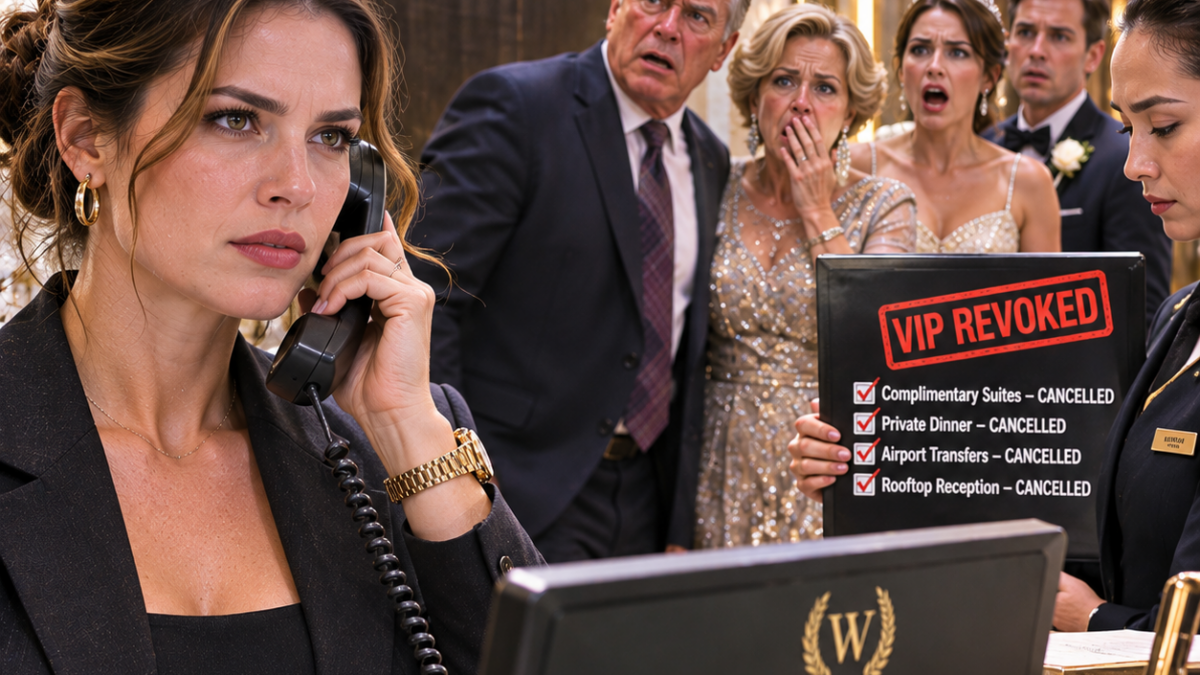
My Father Banned Me From the Engagement Weekend at the Hotel I Helped Pay For—At Midnight, His Entire Family Lost Every VIP Privilege
My father texted, “You’re not welcome in our five-star hotel,” while my younger sister checked into the presidential suite for an engagement weekend I had personally approved, arranged, and quietly agreed to finance.
I didn’t argue, remind him that he no longer owned a single share, or tell Madison that the complimentary suites, private dinners, airport transfers, champagne, and rooftop reception had been authorized by the very sister she was telling guests was “just a midlevel employee.”
I simply picked up the private security phone in my office and said, “At midnight, revoke every Wellington family VIP credential, remove all complimentary billing, and convert every room to the public rate.”
My name is Claire Wellington.
I was thirty-eight years old when my family finally discovered who owned the Wellington Grand.
The hotel rises above the waterfront in Charleston, South Carolina.
Twelve stories of pale limestone, polished brass, dark walnut, and windows facing the harbor.
Two hundred and fourteen rooms.
Thirty-one suites.
A rooftop lounge.
Private dining rooms.
A spa.
A ballroom where my father had celebrated his fiftieth birthday, my sister had hosted her college graduation dinner, and dozens of corporate clients had heard him introduce himself as:
“The man behind the Wellington Grand.”
Nobody corrected him.
Especially not me.
For years, I let people believe the hotel belonged to my father.
The truth was more complicated.
Dad had been one of the original investors.
Not the founder.
Not the sole owner.
One investor.
The property had opened badly.
Construction overruns.
Debt.
Weak management.
Occupancy below projections.
Within four years, several investors wanted out.
Dad’s consulting company was struggling at the same time.
He sold his interest.
Every share.
Every voting right.
Everything.
The family story, however, never changed.
Dad continued holding dinners there.
Continued telling friends:
“Our hotel.”
Continued walking through the lobby as though the marble had been installed from his personal bank account.
Then my grandmother stepped in.
She had money Dad knew very little about.
Old investments.
Commercial property.
A private trust built quietly over decades.
She bought the failing hotel through that trust.
Twelve years before Madison’s engagement weekend.
At the time, I was twenty-six and working in hospitality finance.
Grandmother asked me to help.
I thought she meant review the books.
Instead, she handed me a mess.
Debt.
Poor vendor contracts.
Overstaffed departments in some places and dangerously understaffed ones in others.
A restaurant losing money every month.
Deferred maintenance.
Reputation problems.
And a hotel whose greatest asset was its location.
I spent six years rebuilding it.
Renegotiating debt.
Replacing management.
Renovating rooms floor by floor instead of closing the property.
Restoring the ballroom.
Changing the restaurant concept.
Building corporate partnerships.
Developing destination-wedding packages.
Convincing travel publications to look at us again.
There was no cinematic moment where everything suddenly worked.
The hotel simply stopped bleeding.
Then became stable.
Then profitable.
Then excellent.
By the time I was thirty-four, Grandmother transferred controlling ownership of the trust’s hotel interest to me.
She asked for one thing.
“Don’t tell your father yet.”
I laughed.
“Why?”
“Because Richard confuses association with ownership.”
That was my father.
Richard Wellington.
Grandmother understood her son.
I should have listened more carefully.
“Let him believe what he wants for now,” she told me. “But don’t ever let his pride cost you what you built.”
I promised.
Then she died eighteen months later.
And for a while, keeping the secret felt like keeping something between us.
I approved Dad’s dinners.
His preferred suite.
His golf clients.
His holiday reservations.
Madison’s spa weekends.
Family brunches.
I never charged them full price.
Sometimes nothing at all.
I told myself generosity was easier than confrontation.
Then my father began mistaking generosity for entitlement.
And my silence for proof that he was right.
PART2
FULL STORY CONTINUATION
My younger sister, Madison, was thirty-one.
Beautiful.
Social.
Effortlessly charming.
Where I spent my twenties analyzing hotel debt, Madison spent hers moving between marketing jobs, charity committees, and social events where she seemed to know everybody before entering the room.
We were never enemies growing up.
That came later.
When we were little, she followed me everywhere.
If I painted my nails, Madison wanted the same color.
If I read on the porch, she dragged out a blanket and sat beside me.
When our parents argued, she climbed into my bed.
I had been her safe person once.
Then somewhere in adulthood, Dad began comparing us.
Not openly at first.
Claire is dependable.
Madison is fun.
Claire understands money.
Madison understands people.
Claire can fix anything.
Madison makes everything beautiful.
They sounded like compliments.
They became cages.
Whenever Dad needed help, he called me.
Whenever the family wanted celebration, attention, photographs, or social warmth, they called Madison.
I became useful.
She became adored.
The arrangement worked for everyone except us.
Madison started treating my competence like criticism.
If I offered advice, I was controlling.
If I said no, I was jealous.
If I paid for something quietly, nobody noticed.
If I asked to be included, suddenly I was making things about myself.
That was the pattern by the time she became engaged to Oliver Grant.
Oliver came from a respectable Charleston family.
His parents were kind.
His mother, Anne, volunteered with historic preservation organizations.
His father, Stephen, ran a regional shipping business.
I liked them immediately.
Madison and Oliver had been together almost three years.
When he proposed, she called me before posting anything online.
For one hopeful second, she sounded like my little sister again.
“Claire!”
I heard laughter.
Music.
Then:
“He asked!”
I smiled so hard my face hurt.
“Are you happy?”
“Yes!”
“That’s the only question that matters.”
She cried.
I cried.
Then she asked:
“Could we do the engagement weekend at the Grand?”
I did not hesitate.
“Of course.”
“Dad says he can arrange it.”
That should have warned me.
Instead, I said:
“I’ll take care of it.”
“What?”
“I said I’ll make sure everything is perfect.”
She paused.
“Oh.”
Not thank you.
Just:
“Oh.”
Then she continued talking.
Thirty guests.
Two nights.
Presidential suite for Madison and Oliver.
Harbor suites for both sets of parents.
Premium rooms for the wedding party.
Friday welcome cocktails.
Saturday private breakfast.
Spa appointments.
Yacht excursion.
Private engagement dinner.
Rooftop champagne afterward.
Airport pickups for six guests.
I approved all of it.
The standard value was significant.
But I didn’t care.
She was my sister.
I wanted to give her something beautiful.
My executive assistant, Laura, asked:
“Personal complimentary account?”
“Yes.”
“All rooms?”
“Yes.”
“Food?”
“Except premium liquor beyond package.”
“Transportation?”
“Yes.”
She looked at me.
“That’s a generous weekend.”
I smiled.
“She’s my little sister.”
Laura knew enough not to comment.
The first problem arrived Thursday.
Madison called.
“Dad says security needs the final guest list.”
“They already have it.”
“Oh.”
“He doesn’t handle hotel security.”
“I know, Claire.”
Her tone said she did not know.
I let it go.
Friday morning, I checked arrival schedules.
Everything perfect.
At 11:18, Dad texted.
You are not welcome at Madison’s engagement weekend.
I stared.
Then another message.
She doesn’t need your jealousy ruining this. Stay away from our hotel.
Our hotel.
I read it twice.
At first I thought Madison did not know.
So I called.
Voicemail.
Then a message appeared.
Please just respect Dad’s wishes this weekend. I want everything peaceful.
There it was.
I typed:
Did I do something?
Three dots.
Stopped.
Started again.
Then:
You always make things weird when attention is on me. Please don’t turn this into another Claire situation.
Another Claire situation.
I sat back in my chair.
My office looked over the harbor from the eleventh floor.
Ships moving slowly in the distance.
Tourists along the waterfront.
Below me, bell staff were preparing for the engagement-party arrivals.
A weekend I had approved.
A weekend my team had organized.
A weekend my family believed Dad had provided.
I should have been furious immediately.
Instead, I felt embarrassed.
That is what family exclusion does sometimes.
Even when you know you’re being mistreated, some younger part of you asks:
What did I do wrong?
I searched my memory.
Last Christmas?
No argument.
Madison’s birthday?
I sent flowers and jewelry.
Dad’s retirement dinner?
I paid the private dining bill.
Mom’s charity luncheon?
I arranged the ballroom at cost.
I had not fought with anyone.
I simply wanted to attend my sister’s engagement celebration.
Apparently that was too much.
Then Laura knocked.
“First Wellington arrivals are downstairs.”
I closed the text thread.
“Everything ready?”
“Yes.”
She paused.
“You okay?”
“Fine.”
She didn’t believe me.
Neither did I.
My parents arrived at 1:20.
Dad walked through the revolving doors like returning royalty.
Mom beside him.
My mother, Vivian Wellington, had mastered the art of looking gracious while allowing my father to make every difficult decision.
She rarely initiated cruelty.
She simply stood close enough to benefit from it.
The lobby camera showed Dad greeting the general manager, Michael Reyes.
He clapped Michael on the shoulder.
“Take care of us.”
Michael smiled professionally.
“Yes, Mr. Wellington.”
Dad gestured toward the luggage.
“Presidential party.”
“The presidential suite is prepared for Miss Wellington and Mr. Grant.”
Dad frowned.
“And my suite?”
“Harbor Royal Suite.”
“Not the Commodore?”
Michael checked the reservation tablet.
“The Commodore Suite is occupied.”
Dad looked annoyed.
I had approved one of our best suites for him.
Retail rate that weekend:
$2,400 per night.
Complimentary.
Still not enough.
“Who authorized this arrangement?”
Michael knew.
He also knew not to expose ownership casually.
“The executive office.”
Dad smiled.
“Good.”
As if that meant him.
Mom accepted champagne.
Madison arrived forty minutes later.
White dress.
Oliver holding her hand.
Guests clapping.
A photographer.
Flowers everywhere.
She looked happy.
That hurt more than I expected.
Not because she was happy without me.
Because I had helped create the happiness and apparently did not qualify to witness it.
At 3:12, Madison posted a lobby photo.
Caption:
Engagement weekend begins at Dad’s beautiful hotel. ❤️
I stared at it.
Then locked my phone.
At 4:00, Dad called the banquet office requesting an upgraded champagne brand.
At 4:15, he demanded a second car.
At 4:40, he changed Saturday dinner seating.
At 5:10, he ordered a seafood tower for his suite.
Each request was added to the master account I had approved.
At 5:30, Michael came into my office.
“You want me to stop this?”
“No.”
He looked surprised.
“Claire.”
“What?”
“This is your family.”
“I’m aware.”
“They think the weekend is complimentary under his authority.”
“I’m aware.”
“Do you want me to correct that?”
I looked through the glass toward the harbor.
“No.”
“Why?”
“Not yet.”
Michael sat.
He had been with me through six years of rebuilding.
He knew exactly what Dad owned.
Nothing.
“Claire, there’s generosity.”
“I know.”
“And there’s letting someone use your generosity to humiliate you.”
That landed.
I looked at him.
He said:
“If a corporate client banned you from an event you personally approved and then tried to bill your own hotel for eighty thousand dollars, what would you do?”
“That’s different.”
“No.”
He stood.
“It only feels different because he’s your father.”
Then he left.
I sat alone for twenty minutes.
At 5:57, a security report appeared in my inbox.
Dad had instructed front-desk staff:
Claire Wellington is not to be admitted to engagement events without my authorization.
I read the line.
Once.
Twice.
He had told employees in my hotel to keep me out.
That was the point where hurt became clarity.
I picked up the private security phone.
“James?”
“Yes, Ms. Wellington.”
James Holloway had directed hotel security for nine years.
“Update the Wellington family profile.”
Pause.
“Go ahead.”
“At midnight, revoke every Wellington family VIP credential other than mine.”
“Understood.”
“Remove all complimentary charges associated with Madison’s engagement weekend.”
Longer pause.
“Effective midnight?”
“Yes.”
“Convert rooms to public rate?”
“Yes.”
“Transportation?”
“Public rate.”
“Spa?”
“Public rate.”
“Food and beverage?”
“Public rate.”
James exhaled quietly.
“Should security remove anyone?”
“No.”
That mattered.
I was not throwing my sister into the street.
“They remain registered guests. No confrontation unless they violate normal policy.”
“Yes, ma’am.”
“Send the balance to the primary reservation contact.”
“Richard Wellington?”
“Yes.”
Another pause.
“Anything else?”
“Yes.”
“Revoke the gold VIP cards.”
Those cards were not room keys.
They were privilege credentials.
Private elevator access.
Executive lounge.
Priority dining.
Complimentary transfers.
Spa priority.
Late checkout.
Dad had carried one for years.
So had Mom.
Madison.
Family generosity disguised as status.
“Midnight exactly,” I said.
James replied:
“Yes, Ms. Wellington.”
I hung up.
Then I cried.
Quietly.
Not because I regretted it.
Because boundaries often hurt most the first time you enforce them.
At 6:30, Madison’s welcome party began.
I stayed in my office.
At 7:15, I received photographs from the event team.
Madison laughing beside Oliver.
Dad making a toast.
Mom holding champagne.
The ballroom glowing.
Beautiful.
I closed the file.
At 8:04, Dad texted:
See? Everything is perfect when people put Madison first for once.
I stared at that sentence for a long time.
For once.
I had paid the mortgage on his house for eighteen months when his consulting business failed.
Nobody knew except Grandmother.
I had arranged Mom’s surgery accommodations.
Fixed Madison’s student-loan refinancing.
Paid for Dad’s retirement dinner.
Covered hotel stays.
Introduced clients.
Found Madison her first serious marketing role.
For once.
Dependable daughters have a strange problem.
When you rescue everyone quietly, the rescue becomes invisible.
Eventually people remember only the rare moment you refuse.
At 8:11, I typed:
Enjoy the evening.
Dad replied with a thumbs-up.
The accounting system updated throughout dinner.
Presidential suite.
Harbor suites.
Premium rooms.
Food.
Champagne.
Spa.
Yacht.
Cars.
Private dining.
Service staff.
Taxes.
At 11:43, the estimated unpaid balance reached $84,600.
That was after removing several costs I still chose to absorb because vendors had already been contracted.
Michael came back.
“Last chance.”
“To do what?”
“Leave the comp status.”
“No.”
“You sure?”
“No.”
He smiled slightly.
“Good answer.”
I looked at the clock.
11:58.
“Do it anyway.”
Midnight.
Nothing dramatic happened immediately.
The hotel did not go dark.
Nobody’s luggage vanished.
Nobody was thrown outside.
At exactly 12:00, the family’s gold privilege credentials became inactive.
At 12:01, complimentary billing status disappeared.
At 12:02, the presidential suite reservation remained active—but the folio changed to payment required.
At 12:03, Madison tried to use the private elevator.
Red light.
Then again.
Red.
At 12:04, Dad tried his gold card.
Denied.
At 12:05, my phone rang.
Madison.
I watched it ring.
Answered.
“Claire.”
“Our cards don’t work.”
“I’m aware.”
“What did you do?”
“Converted the weekend to a standard paid reservation.”
Silence.
“What?”
“You’re still guests.”
“Dad says security has locked us out.”
“Your room keys still work.”
“They don’t.”
I checked the system.
“The room keys require payment authorization now. There’s no valid card securing the current balance.”
“What balance?”
I almost laughed.
“You don’t know?”
“Claire.”
“Eighty-four thousand six hundred dollars as of the last posted charges.”
She stopped breathing.
Then:
“No.”
“Yes.”
“Dad said everything was covered.”
“It was.”
“What does that mean?”
“By me.”
Silence.
Then Dad’s voice in the background.
“Give me the phone.”
Madison protested.
He took it anyway.
“Claire.”
“Dad.”
“Fix this immediately.”
“No.”
“We have guests standing in the hallway.”
“The front desk can take payment and reactivate access.”
“Payment?”
“Yes.”
“This weekend is complimentary.”
“It was.”
“What game are you playing?”
“No game.”
His voice rose.
“You cannot humiliate this family inside my hotel.”
I looked at the security feed.
Dad stood outside the presidential suite in a monogrammed hotel robe.
Bare feet.
Madison beside him.
Oliver talking quietly with the night manager.
Several guests watching.
“Your hotel?” I asked.
“Yes.”
“Interesting.”
“Do not start.”
“No, Dad.”
My voice stayed calm.
“You started this when you ordered security to keep me away from a party I financed.”
“You are jealous of your sister.”
“I approved the presidential suite.”
Silence.
“I approved every complimentary room.”
Nothing.
“I approved the airport transfers.”
He recovered.
“You work here. Of course you processed the arrangements.”
That sentence almost impressed me.
Even now, he could not imagine a reality where I outranked him.
“You’re right,” I said. “I processed them.”
“Good. Then process them back.”
“No.”
“Claire—”
“The night manager will explain payment options.”
I hung up.
At 12:17, my attorney arrived.
Not because I had summoned him after the call.
He had already been coming.
When I decided at six o’clock to revoke family privileges, I contacted Nathan Bell, the attorney overseeing the trust.
I asked one question.
“If Dad creates a scene and claims ownership, what do we need?”
Nathan replied:
“Original ownership certification and current trust authority.”
“Bring them.”
“Tonight?”
“Yes.”
He had laughed.
Then realized I wasn’t joking.
At 12:20, the private elevator opened.
Nathan stepped into the corridor.
Black folder.
Dark suit.
Hotel security beside him.
I walked out behind them.
Dad saw me first.
His face transformed.
“Claire.”
Madison turned.
Her eyes were red.
“Why are you doing this?”
I stopped several feet away.
“Because Dad told this hotel I wasn’t allowed at your engagement weekend.”
“That doesn’t mean—”
“He told me you didn’t want me here.”
She looked at him.
Dad said:
“This isn’t the time.”
“No.”
I looked at Madison.
“It is exactly the time.”
Dad stepped toward me.
“Restore the cards.”
Nathan moved slightly between us.
Dad recognized him.
“What is he doing here?”
Nathan opened the folder.
“Mr. Wellington.”
“Nathan.”
Dad’s anger changed.
Nathan had handled Grandmother’s estate.
That mattered.
“What is this?”
Nathan removed a certified trust document.
Current corporate ownership certification.
My controlling interest.
I placed the ownership certificate against the locked presidential-suite door.
“My grandmother left control of the Wellington Grand to me.”
Dad stared.
I continued.
“You sold your shares years before she bought the property.”
His mouth opened.
Nothing came out.
“I rebuilt the hotel.”
Madison looked between us.
“No.”
“Yes.”
“Dad owns this place.”
“No.”
Dad snapped:
“Claire, enough.”
Nathan said quietly:
“Mr. Wellington, Claire has controlling ownership through the trust structure. You have no present equity interest in the hotel.”
The corridor went silent.
Even the guests stopped pretending not to listen.
Dad looked at Nathan.
Then me.
“That isn’t what Mother intended.”
Nathan’s voice stayed neutral.
“It is precisely what she documented.”
Dad’s face reddened.
“You kept this from me.”
“Yes.”
“How dare you?”
That almost made me laugh.
“How dare I own something you sold?”
Mom finally spoke.
“Claire, people are watching.”
I turned toward her.
“People were watching when Dad banned me too.”
Her eyes dropped.
Madison whispered:
“You paid for all this?”
“Yes.”
“The rooms?”
“Yes.”
“Dinner?”
“Yes.”
“Everything?”
“Almost everything.”
Her face crumpled.
“Why didn’t you tell me?”
I looked at her.
“Because I wanted it to be a gift.”
She started crying.
Dad interrupted.
“This is emotional blackmail.”
Oliver turned toward him.
“With respect, sir, I don’t think she is the one doing that.”
First time he spoke.
Dad stared.
Oliver continued:
“You told us this was your hotel.”
“It is a family property.”
Nathan corrected him.
“No.”
Dad looked ready to explode.
I held up one hand.
“Here are your options.”
Everyone listened.
“You may remain as paying guests.”
Dad laughed bitterly.
“Absolutely not.”
“You may provide valid payment for the current balance and continue the weekend.”
“No.”
“Or you may check out.”
Madison looked at me.
“Tonight?”
“No.”
I softened.
“Nobody is throwing you outside.”
Her face changed.
“Front desk can hold rooms until ten tomorrow morning while payment arrangements are made.”
Dad said:
“You are enjoying this.”
“No.”
That was the truth.
I felt sick.
“But I’m done paying people to exclude me.”
Oliver’s father, Stephen, stepped forward.
“How much of the balance is associated with our guests?”
I looked at Michael.
He had joined us quietly.
“We can separate the Grant-family folios.”
Stephen nodded.
“Do that.”
Anne looked at me.
“Claire, we were told Richard was hosting.”
“I know.”
“We had no idea.”
“I know.”
Dad snapped:
“You do not need to pay her anything.”
Stephen turned.
“Richard, it’s her hotel.”
Dad’s face tightened.
Stephen continued.
“And apparently her money.”
That ended that part.
The Grant family provided payment for their rooms and several guests.
I offered to absorb Friday’s contracted dinner because I did not want Oliver’s family punished for my father’s behavior.
Stephen refused.
“You have already done enough.”
That kindness nearly made me cry.
Madison stood against the wall.
Mascara beginning to run.
I moved closer.
She whispered:
“Did you really want to come?”
The question hurt.
“Yes.”
“Dad said you were upset because Oliver chose me.”
I stared.
“What?”
“He said you’d been acting strange about the engagement.”
“Madison, I helped you select the rooftop floral package.”
Her face fell.
“You what?”
“The white roses.”
She blinked.
“I told Dad I loved those.”
“I know.”
“He said he suggested them.”
Of course.
“What else did he say?”
She looked toward him.
Dad said:
“This is ridiculous.”
Madison ignored him.
“He said you only got me rooms because you were an employee trying to impress management.”
I laughed once.
Not because it was funny.
Because the lie was so unnecessarily small.
I owned the hotel.
And Dad still needed Madison to believe my generosity belonged to him.
I said:
“Ask Laura tomorrow who approved the weekend.”
Madison covered her mouth.
Dad turned on me.
“You think owning paper makes you the Wellington family?”
There it was.
The real wound.
Not the money.
Not the keycards.
Control.
“You’ve been using this family’s name to build your career.”
I stared.
“My name?”
“Yes.”
“Dad, you sold your ownership before I took over.”
“Because I had a business crisis.”
“And Grandmother bought the hotel later.”
“With Wellington money.”
“With her money.”
“She was my mother.”
“That doesn’t make her assets yours.”
He stepped closer.
“You would have nothing without this family.”
I looked around.
At the corridor.
The hotel.
The staff.
My sister.
Then back at him.
“I spent twenty-six years being useful enough that you called when you needed something.”
My voice shook now.
“I paid your mortgage for eighteen months.”
Mom looked up.
Madison stared.
Dad froze.
“You told everyone you saved the house.”
I continued.
“I paid it.”
Madison whispered:
“What?”
Dad said:
“That was a private arrangement.”
“You mean the arrangement where I paid and you took credit?”
“Claire.”
“I paid forty-three thousand dollars during your business collapse.”
Mom’s face went pale.
“You never told me.”
I looked at her.
“He asked me not to.”
Dad snapped:
“Because I intended to repay her.”
“You repaid eleven thousand.”
Silence.
Nathan looked at the floor.
He already knew.
Madison stared at Dad.
“You told us Grandmother helped.”
Dad said nothing.
I felt something inside me finally stop trying to protect him.
The night ended quietly after that.
Not happily.
The Grants paid their portion.
Several friends paid their own rooms.
Some guests left the next morning.
Madison and Oliver remained.
I did not cancel the engagement dinner.
That surprised everyone.
Including Madison.
At breakfast, she texted:
Why are you still letting us have it?
I replied:
Because your engagement is not the thing I am angry about.
She called.
I did not answer immediately.
Then I did.
“Claire.”
“Yeah?”
“I don’t know what to say.”
“Then don’t say anything yet.”
“Are you coming tonight?”
I closed my eyes.
“Do you want me there?”
Long silence.
“Yes.”
“Not because of the hotel.”
“No.”
“Not because you feel guilty.”
Another pause.
“I want my sister there.”
I believed she meant it.
I also knew one emotional night did not repair years.
“I’ll come for dinner.”
She started crying.
“Okay.”
Dad did not attend.
Mom did.
He checked out that morning.
Paid nothing personally.
Mom quietly covered their room using her card.
Before leaving, Dad told Michael:
“This place would collapse without the Wellington reputation.”
Michael smiled.
“Mr. Wellington, our average annual occupancy is eighty-seven percent.”
Dad stared.
Michael added:
“Have a safe trip.”
I gave him a raise six months later.
Not for that line.
Mostly.
The Saturday dinner was beautiful.
Madison wore dark green.
Oliver gave a short toast.
His father spoke.
Mom cried.
Then Madison stood.
I tensed.
She looked at me.
“In all the planning for this weekend, I thanked a lot of people who didn’t actually make it happen.”
The room became quiet.
Dad’s empty chair sat near Mom.
Madison continued.
“My sister Claire did.”
She looked around.
“She approved this weekend.”
My chest tightened.
“She paid for far more of it than I understood.”
She swallowed.
“And I treated her like she was trying to ruin it.”
I wanted to disappear.
Public apologies can feel almost as uncomfortable as public humiliation.
“Madison…”
She shook her head.
“Let me finish.”
Then she said:
“Claire, I’m sorry.”
No excuses.
No Dad made me.
No misunderstanding.
Just:
“I’m sorry.”
I nodded.
“Thank you.”
Then she looked at everyone.
“And apparently she owns the hotel.”
Laughter.
Even me.
Tension broke.
Oliver added:
“Something I wish someone had put in the itinerary.”
More laughter.
It wasn’t full repair.
It was a beginning.
After dinner, Madison found me on the rooftop terrace.
Charleston lights below.
Harbor dark beyond them.
She stood beside me.
“Did Grandma really give it to you?”
“Yes.”
“Why?”
“Because I rebuilt it.”
She looked through the glass doors toward the lounge.
“I thought Dad did.”
“I know.”
“How long?”
“Twelve years since she bought it. Four since control transferred to me.”
Madison looked sick.
“I’ve been telling people you worked here.”
“I do work here.”
“You know what I mean.”
“Yes.”
“I told Oliver you were senior finance management.”
“I heard.”
She winced.
“Dad said you hated telling people you were an employee because you thought ownership sounded more glamorous.”
That one was almost impressive.
“Madison.”
“I know.”
She covered her face.
“How did I believe all of this?”
“Because Dad said it confidently.”
“That isn’t an excuse.”
“No.”
I appreciated that.
She looked at me.
“Were you jealous of me?”
“Sometimes.”
She seemed surprised.
I smiled sadly.
“You’re my little sister. Of course I was jealous sometimes.”
“Of what?”
“How easily Dad loved you when you weren’t useful.”
Her eyes filled.
That sentence came from somewhere I had never allowed myself to look.
I continued.
“He called me dependable when he needed me.”
I looked toward the harbor.
“He called me difficult when I wanted anything back.”
Madison began crying.
“I thought you looked down on me.”
“I thought you were ashamed of me.”
We stood there.
Two sisters.
Both convinced the other one had received the better version of our father.
Maybe neither of us had.
Dad’s response came Monday.
Attorney letter.
Of course.
He alleged Grandmother had lacked capacity when transferring ownership.
Nathan laughed when he read it.
Not because incapacity claims are funny.
Because Grandmother had anticipated him.
Medical assessments.
Independent counsel.
Video-recorded trust meetings.
Multiple witnesses.
Years of consistent planning.
Dad’s attorney withdrew the threat after reviewing the documents.
Then Dad switched strategies.
Family pressure.
Cousins called.
An aunt sent:
No hotel is worth destroying your relationship with your father.
I replied:
I did not ban myself from my sister’s engagement.
She never answered.
Another relative said:
“Your father is humiliated.”
I said:
“So was I.”
Silence.
People often tolerate cruelty until the person receiving it creates consequences.
Then suddenly they become passionate about peace.
Dad also demanded the return of his gold VIP card.
Nathan sent a formal response.
No.
He demanded lifetime complimentary rooms because he was a former investor.
No contractual right existed.
No.
He asked the board.
No.
For the first time in years, my father could enter the Wellington Grand like every other person.
Reservation.
Payment.
Normal keycard.
He hated it.
I did not ban him.
That distinction mattered.
The hotel was open to him.
He simply no longer received privileges he had treated as ownership.
Mom came to my office three weeks later.
No appointment.
Security called.
“Your mother is downstairs.”
I almost said no.
Then:
“Send her up.”
She entered carrying two coffees.
Old habit.
One cream.
No sugar.
She remembered.
We sat.
For a while, neither spoke.
Then Mom said:
“I knew your father no longer owned shares.”
I stared.
“What?”
“I knew.”
That hurt worse than expected.
“How much did you know?”
“That your grandmother owned it.”
“And that she transferred control?”
“Not the details.”
“But you knew Dad wasn’t the owner.”
“Yes.”
“Then why did you let him tell Madison?”
She looked down.
“Because correcting Richard in public becomes…”
She stopped.
“What?”
“Exhausting.”
I laughed bitterly.
“So you let me carry the correction alone.”
“I’m sorry.”
“Did you know he banned me?”
“Yes.”
My throat tightened.
“And you still checked in.”
She closed her eyes.
“Yes.”
“Why?”
“Because Madison was happy.”
“So was I supposed to disappear to protect that?”
“No.”
“But you allowed it.”
“Yes.”
At least she did not lie.
That was the beginning of a different relationship between us.
Not a good one yet.
A more honest one.
Mom told me something else.
Dad had started believing his own story.
For years, staff treated him well because I told them to.
Complimentary suites.
Preferred tables.
Cars.
Private elevators.
He stopped seeing them as gifts from me.
He saw them as evidence that everyone knew he was the real owner.
“That’s ridiculous.”
“I know.”
“Did he ever ask who paid?”
“No.”
Of course not.
People rarely investigate privileges.
The following month, our finance department completed a historical review of all family complimentary usage.
I requested it for governance reasons.
Not revenge.
Grandmother had authorized reasonable family hospitality while she controlled the trust.
I had continued it.
But the numbers shocked even me.
Over seven years:
Rooms.
Meals.
Spa.
Transport.
Event space.
Discounts.
Complimentary upgrades.
More than $312,000 in retail value.
Not cash out of my pocket dollar-for-dollar.
Hotels have margins.
Unused inventory.
But still.
Three hundred twelve thousand dollars in privilege.
Dad had taken almost all of it as his right.
I ended unrestricted family status permanently.
From then on:
Any personal complimentary stay required my written approval or standard executive policy.
No hereditary VIP cards.
No automatic family billing.
Clear.
Boring.
Healthy.
Madison called after hearing.
“Does that include me?”
“Yes.”
“Fair.”
I expected anger.
Instead:
“I probably should pay for hotels like a grown woman.”
I laughed.
“Radical.”
Then she said:
“Claire?”
“Yes?”
“I found something.”
My stomach tightened.
Dad had been using the Wellington Grand in pitch decks for his consulting work.
Photographs.
Logo.
Language implying a continuing ownership relationship.
Not technically saying:
I own it.
More subtle.
Our flagship hospitality property.
Our Charleston operations.
The Wellington family’s luxury portfolio.
I stared at the documents.
“Where did you get these?”
“He sent one to Oliver’s father.”
That was a problem.
Not because Dad had equity.
Because he was using my asset to support business credibility.
Nathan sent a cease-and-desist.
No dramatic lawsuit.
Just:
Stop representing any ownership interest.
Stop using the brand without authorization.
Dad complied.
Quietly.
His imaginary empire got smaller every week.
Madison’s engagement survived the weekend.
So did her relationship with Oliver.
I was happy about that.
Not every family crisis needs to destroy the unrelated relationship beside it.
Oliver had handled the hotel confrontation better than most men would.
He never blamed Madison publicly.
Never insulted Dad.
Never treated me like a walking credit card.
Several months later, Madison asked me to be maid of honor.
I stared at her.
“What?”
“I know.”
“You have six friends who would commit a felony for that position.”
“I want my sister.”
I laughed.
Then cried.
Then said yes.
But with one condition.
“No wedding at the Wellington Grand.”
Her eyes widened.
“Seriously?”
“Yes.”
“Why?”
“Because I want to be your sister that day.”
Not owner.
Not fixer.
Not financier.
Not invisible staff.
Her sister.
Madison nodded.
“Okay.”
They married at a historic property outside Savannah.
I paid for my own dress.
Nothing else.
It was wonderful.
Dad did not speak to me for six months.
Then one afternoon, he arrived at the hotel alone.
No attorney.
No family.
No warning.
Michael called.
“Your father is in the lobby.”
“What does he want?”
“He said ten minutes.”
I looked at the schedule.
“Send him up.”
Dad entered my office.
He looked different.
Not physically much.
Something in his posture.
No performance.
He sat.
For several seconds, he looked out the window.
Then:
“I didn’t know the hotel was struggling that badly.”
“When?”
“When Mother bought it.”
“You had already sold.”
“I know.”
“You told people you saved it.”
“I know.”
That surprised me.
“I told the story enough that…”
He stopped.
“That what?”
“I started believing I had.”
I sat back.
There it was.
Not a legal defense.
Not even a good excuse.
But truth.
He continued.
“When people treated me like the owner, I assumed Mother had preserved something for me.”
“Did you ever ask?”
“No.”
“Why?”
He almost smiled.
“I didn’t want an answer I wouldn’t like.”
That sounded like my father.
Then:
“I was angry at you.”
“For owning it?”
“For being the person Mother trusted with it.”
That surprised me more.
“Why?”
“Because I was her son.”
“And?”
“She trusted you more.”
He looked embarrassed saying it.
Grandmother and Dad had always had a difficult relationship.
He loved her.
Resented her.
Wanted her approval.
Rejected her advice.
Then chased her approval again.
Human.
Messy.
“I spent my whole life trying to prove I was successful.”
He looked around my office.
“And you actually made something successful.”
I said nothing.
“I hated how that made me feel.”
That was the first apology.
Not the word.
The truth underneath.
Then he said:
“I shouldn’t have banned you.”
My eyes filled.
“No.”
“I told Madison you were jealous because I knew she’d believe me.”
That hurt.
“I know.”
“I did it because…”
He stopped.
“Because if you came, people might ask why employees listened to you instead of me.”
There it was.
He had excluded me to protect the illusion.
Not Madison.
Not peace.
His status.
I nodded slowly.
“Thank you for telling me.”
“I’m sorry.”
I believed he meant it.
Not enough to restore everything immediately.
But enough to stop the argument inside my head.
He had known what he was doing.
And finally admitted why.
Dad asked:
“Can I have the VIP card back?”
I stared.
Then he laughed.
First time I had heard him laugh at himself in years.
“No?”
“No.”
“Worth asking.”
“Absolutely not.”
He nodded.
“Fair.”
Progress comes in strange shapes.
Our relationship became smaller.
That was healthier.
Dinner occasionally.
No business entanglements.
No hotel privileges beyond what I freely chose.
No emergency loans.
When Dad had a financial problem, I did not automatically solve it.
The first time he asked for help after the hotel confrontation, I said:
“I can recommend an advisor.”
He waited.
Probably expecting more.
I offered nothing else.
He said:
“Okay.”
No guilt.
No attack.
He figured it out.
Boundaries teach people what access lectures rarely do.
Mom and I rebuilt more slowly.
She apologized to Madison too.
For allowing Dad to define both of us.
I learned Mom had spent most of her marriage smoothing his moods.
That explained her.
It did not excuse every choice.
We could hold both truths.
She had been trapped in patterns.
She had also benefited from them.
Healing became possible only when she stopped asking me to pretend the second part wasn’t true.
Madison and I changed most.
For the first time, we talked without Dad’s translation between us.
She told me:
“Dad always said you thought I was stupid.”
I stared.
“He told me you thought I was shallow.”
“I never said that.”
“I know now.”
“What did he tell you about me?”
“That you thought I got everything because I was pretty.”
I laughed.
“I did think you got away with more.”
“That part is true.”
We both laughed.
Then I said:
“I also thought he loved you more.”
Madison’s expression changed.
“He didn’t.”
“No?”
“He liked me more when I was easy.”
That was not the same thing.
I understood immediately.
“He relied on you.”
She looked at me.
“And used you.”
We sat quietly.
Our father had not created all the distance between us.
We had contributed too.
Jealousy.
Assumptions.
Years of not asking each other directly.
But he had benefited from keeping us in separate roles.
Madison the adored one.
Claire the dependable one.
If we compared notes, the system stopped working.
Eventually, we did.
The hotel continued growing.
We opened a second property in Savannah.
Then a smaller luxury inn in Asheville.
I did not call the company Wellington Hospitality.
That surprised everyone.
I named it Harbor & Pine.
Grandmother would have liked that.
The original Wellington Grand kept its name.
History mattered.
But the company did not need my family name to justify itself.
That felt freeing.
When we opened Savannah, Dad asked whether he could attend.
Not as host.
Not as owner.
As my father.
I said yes.
At the reception, someone approached him.
“Mr. Wellington, you must be proud of what you’ve built.”
Dad glanced at me across the room.
Then answered:
“My daughter built it.”
Four words.
Nobody else would know how much they cost him.
I did.
I smiled.
He smiled back.
That moment meant more than getting the gold card back ever could have.
Grandmother’s trust documents stayed private except where corporate disclosure required them.
I kept one personal letter from her in my desk.
She wrote it before transferring control.
Claire,
Buildings do not know who receives credit for saving them.
Numbers do not care who tells the best story.
People do.
Be careful of people who need credit more than they need truth.
Then:
Your father is not a bad man.
But pride has made him careless with other people’s dignity.
Do not let loving him teach you to participate.
I read that letter often after the engagement weekend.
Grandmother had not told me to punish him.
She had told me not to participate.
There is a difference.
At midnight that Friday, I believed I was finally punishing my family.
Maybe a small part of me was.
I’m honest enough to admit it.
Watching Dad’s gold card stop working gave me satisfaction.
But what happened afterward taught me something more useful.
The real power was not deactivating a keycard.
It was ending an arrangement where I kept buying my place in my own family.
Paying for dinners.
Fixing mortgages.
Comping suites.
Solving crises.
Then quietly accepting exclusion because demanding respect might look selfish.
I had confused generosity with love.
They had confused generosity with obligation.
Both were mistakes.
The $84,600 became family legend.
Not because Dad paid it.
He did not.
The final balance was divided.
The Grants covered their guests and some event expenses.
Madison and Oliver paid a portion.
Mom covered her and Dad’s suite.
I absorbed several contracted costs I had intentionally approved as my gift to Madison.
The point was never collecting every dollar.
The point was ending the fiction that Dad could order luxury and send the invisible bill to me.
After that weekend, nobody in my family booked anything under the words:
“Dad said it’s covered.”
Ever again.
A miracle.
Madison still teases me.
Whenever we stay somewhere together, she hands me her credit card dramatically.
“Public rate, please.”
I reply:
“Declined.”
She gasps.
We laugh.
The first time we joked about it, I knew we were going to be okay.
Not back to childhood.
Something more adult.
Less innocent.
More honest.
Dad never regained a gold VIP card.
He has a standard loyalty account now.
Silver level.
He complains.
I tell him:
“Stay more often.”
He says:
“Pay retail?”
“Yes.”
“Cruel.”
“Character building.”
He laughs.
Sometimes boundaries become jokes after people finally accept them.
That is one of the nicest stages of repair.
The Wellington Grand still stands above the Charleston waterfront.
Every morning when I arrive, I walk through the lobby.
Not a private entrance.
The lobby.
Guests.
Bell staff.
Flowers.
Sunlight across marble.
I stop sometimes near the spot where Dad used to stand telling clients:
“Our hotel.”
I no longer feel angry.
He was trying to belong to a success he had once let go.
That was sad.
It just wasn’t my responsibility to maintain the illusion.
One of our newer managers once asked:
“Is Richard Wellington related to you?”
“Yes.”
“He told me you own the hotel.”
I smiled.
“Good.”
“He seemed proud.”
That stopped me.
“Did he?”
“Yes.”
“He said you saved it.”
I looked toward the front doors.
For years, Dad could not say that sentence.
Now he was saying it when I wasn’t even around.
That mattered.
Real change is often what someone says when the person they hurt cannot hear.
I visited Grandmother’s grave that afternoon.
Not because I am particularly sentimental about cemeteries.
I usually think the people we love are carried better in habits than stone.
But I went.
Sat beside the marker.
Told her about Savannah.
Dad.
Madison’s wedding.
The gold cards.
I laughed saying that part.
“You were right.”
Wind moved through the oak trees.
No answer.
Of course.
Then:
“I should have told him sooner.”
Maybe.
Maybe not.
Secrets create their own problems.
Even protective ones.
Grandmother had asked me to wait.
I had continued waiting after she died because avoiding conflict felt easier.
Dad’s arrogance grew partly because nobody corrected him.
That was not my fault.
But I learned something from it.
Truth delayed for peace does not always create peace.
Sometimes it creates a larger correction later.
At midnight.
In hotel robes.
If I could redo anything, I would not announce ownership at Madison’s engagement dinner.
I didn’t.
I’m glad.
Her celebration deserved to survive Dad’s behavior.
But I would have told my family the truth years earlier.
Not for credit.
For boundaries.
This is mine.
That is yours.
This is a gift.
This is not an entitlement.
Those sentences prevent resentment from becoming architecture.
Years later, Madison had a daughter.
Her name is Eleanor.
Middle name Claire.
When Madison told me, I cried.
“You didn’t have to do that.”
“I know.”
“Why?”
“Because I want her to know she has two strong women before me.”
I did not correct her.
Grandmother would have demanded first position anyway.
Little Eleanor loves the hotel.
Not because she understands ownership.
She likes elevators.
Room-service pancakes.
The revolving door.
At five, she asked:
“Aunt Claire, do you live here?”
“No.”
“Then why does everybody know you?”
Madison laughed.
I said:
“I work here.”
She nodded.
Good enough.
Children do not need ownership structures.
They need pancakes.
One Christmas, Dad brought Eleanor into the lobby.
She ran toward me.
“Aunt Claire!”
Dad followed.
He stopped beside the tree.
Then said:
“Show her your hotel.”
I looked at him.
He shrugged.
“Trying to learn.”
I smiled.
Then took Eleanor’s hand.
We went to see the gingerbread display.
No speech.
No dramatic reconciliation.
Just a man finally using the right possessive pronoun.
Sometimes that’s enough.
I never forgot the text.
You are not welcome in our five-star hotel.
I still have the screenshot.
Not framed.
Not printed.
Buried in an old message archive.
I don’t look at it often.
Why keep it?
Because it marked a boundary.
Before that text, I thought the problem was that my family did not appreciate me enough.
Afterward, I understood the bigger problem.
I had been financing a role in which appreciation was optional.
That arrangement ended at midnight.
The keycards were only the visible part.
People who hear the story usually love the same detail.
Every VIP card stopped working.
They imagine Dad furious in his robe.
Madison panicking.
Security collecting gold cards.
My attorney arriving.
The ownership certificate.
It is satisfying.
I understand.
But the real turning point happened earlier.
In my office.
Cold coffee.
Dinner menus.
Phone beside the keyboard.
I stopped typing an explanation.
That was the moment.
For most of my life, Dad only needed to hurt me and wait.
I would explain.
Defend.
Prove.
Help.
Pay.
Fix.
That Friday I did something different.
I let consequences speak first.
It turns out people learn faster from a locked VIP elevator than from twenty years of quiet resentment.
I don’t recommend this method for every family.
But it was effective.
My father had once carried me through floodwater when I was nine.
I never forgot that either.
He held me against his chest while brown water reached his waist.
I remember being terrified.
He said:
“I’ve got you.”
That man was real.
So was the man who excluded me from my sister’s engagement to protect his pride.
Humans rarely become one clean thing.
That complicates anger.
It also complicates forgiveness.
I did forgive Dad eventually.
Not by pretending he hadn’t used me.
By refusing to keep the old arrangement alive.
Forgiveness without boundaries would have been permission.
I had already given enough of that.
Mom once asked whether I regretted embarrassing him.
I said:
“Yes.”
She looked surprised.
“Then why did you do it?”
“Because avoiding his embarrassment required accepting mine.”
She became quiet.
That was the whole problem.
For years, our family had protected Dad’s dignity like a public monument.
Everyone else’s could be spent.
That changed.
Not perfectly.
But enough.
Madison once apologized for calling me jealous.
I told her:
“I was jealous.”
She looked horrified.
“Claire.”
“Not of Oliver.”
“Then what?”
“You could disappoint Dad and still expect him to call you sweetheart.”
She stared.
“That isn’t true.”
“It felt true.”
She thought.
Then:
“I was jealous of you too.”
“Why?”
“He trusted you.”
I laughed.
“He used me.”
“I didn’t know the difference.”
Neither did I.
That was our childhood in one sentence.
She thought responsibility was trust.
I thought affection was love.
Dad had given each of us enough of one thing to make us envy the other.
Once we understood that, sisterhood became easier.
At the hotel, I eventually instituted a rule banning informal family privileges.
Not because of my family specifically.
Because governance matters.
Complimentary stays are recorded.
Executive benefits reviewed.
Related-party transactions documented.
No owner’s relative can simply walk in and order services under a family name.
If I disappeared tomorrow, the hotel would not need to know which uncle believes he owns the rooftop.
Systems should survive personalities.
Grandmother taught me that with the trust.
Dad taught me by abusing the absence of rules.
Both lessons mattered.
Nathan retired from legal practice.
At his farewell dinner, he gave me the black folder.
The one he carried into the corridor that night.
Empty now.
“Souvenir.”
I laughed.
“I don’t want this.”
“You should.”
“Why?”
“So you remember the most expensive keycard problem in Charleston.”
I kept it.
Inside I placed a copy of Grandmother’s letter.
Nothing else.
Michael became chief operating officer of Harbor & Pine.
He still reminds me about the night he asked if I wanted to stop Dad’s spending.
“You said no.”
“I was emotionally processing.”
“You were avoiding.”
“Same thing.”
“No.”
He knows me too well.
Laura became general manager in Savannah.
At her promotion dinner, she said:
“The first thing Claire taught me was never to confuse a complimentary room with free.”
Everyone laughed.
Then she added:
“Somebody is always choosing to absorb the cost.”
That line stayed with me.
It applied beyond hotels.
Every family has complimentary rooms.
Invisible labor.
Emotional smoothing.
Money.
Time.
Forgiveness.
Someone absorbs the cost.
Problems begin when the recipient forgets someone is paying.
For years, I paid.
Not only money.
Silence.
I paid with silence.
That was the most expensive currency.
I let Dad own the story because correcting him felt petty.
I let Madison believe I was less important because demanding recognition felt needy.
I let Mom remain neutral because confronting her passivity felt cruel.
I protected everyone from discomfort.
Then wondered why nobody protected me from humiliation.
You teach people how expensive disrespect is by eventually refusing to subsidize it.
The night the cards stopped working, my father called it humiliation.
For him, it was.
For me, it was accounting.
Not financial accounting.
Relational accounting.
What had I given?
What had they assumed?
What had never been reciprocated?
What was I still willing to give freely?
What did I need to stop giving automatically?
Every healthy relationship needs that audit eventually.
Hopefully yours happens over coffee.
Mine required a presidential suite.
Dad attended Madison’s first anniversary dinner at the Wellington Grand.
His reservation was under his own name.
Paid.
Standard rate.
At check-in, the young front-desk agent said:
“Mr. Wellington, thank you for being a Silver member.”
Dad looked toward me across the lobby.
I smiled.
He smiled back.
No complaint.
Then he handed over his credit card.
Growth.
Madison later became a legitimate marketing consultant for the Savannah property.
Legitimate being the important word.
Contract.
Scope.
Rate.
Deliverables.
No sister privilege.
She was excellent.
I told her.
She said:
“Don’t sound so shocked.”
“I am not.”
“You are.”
Maybe a little.
Working together carefully helped repair something too.
For the first time, I saw what Dad had always seen.
Madison really did understand people.
She could walk into a room and feel what a brand needed emotionally.
I understood numbers.
Operations.
Structure.
We were different.
Neither smaller.
That realization came embarrassingly late.
One campaign she created increased destination-wedding inquiries by thirty percent.
She brought the report into my office.
Dropped it on my desk.
“Who’s the dependable daughter now?”
I laughed.
“Still me.”
She threw a pen at me.
Sisters.
Finally.
Dad never worked for the hotel.
I offered once.
Advisory role.
Very limited.
He declined.
Smart.
“I’d start ordering people around.”
“Yes.”
“I know myself.”
More growth.
My mother became surprisingly close to our spa director.
She pays full price.
Mostly.
I occasionally send her a gift certificate.
The difference is that now she knows it is a gift.
She thanks me.
Small words.
Big change.
The Wellington name remained on the building.
People sometimes ask why I didn’t rename it.
Because Dad did not own the name.
Neither did his pride.
Grandmother was a Wellington.
So am I.
So is Madison.
Names do not belong exclusively to the loudest person carrying them.
I decided not to surrender mine.
At forty-five, I stood on the rooftop during the hotel’s anniversary celebration.
Lights along the harbor.
Music inside.
Madison beside me.
Dad and Mom downstairs.
Oliver talking with guests.
Little Eleanor asleep in a chair somewhere while refusing to admit she was tired.
Madison raised her glass.
“To your hotel.”
I looked at her.
“To Grandmother’s hotel.”
She smiled.
“To both.”
That felt right.
Ownership is legal.
Legacy is wider.
The hotel nearly failed.
Grandmother rescued it financially.
I rebuilt it operationally.
Hundreds of employees made it excellent.
Guests made it successful.
No single person gets to claim an institution alone.
That was another thing Dad had misunderstood.
Ownership did not mean every polished floor reflected my greatness.
It meant responsibility.
Payroll.
Insurance.
Debt.
Roof replacement.
Staff safety.
Guest complaints.
Hundreds of people relying on decisions I made.
The gold keycard was the least meaningful part.
That is why I never gave myself one.
James once asked:
“Would you like an owner credential?”
“No.”
“You use your employee badge.”
“Yes.”
“You know you own the company.”
“I’m aware.”
He laughed.
Maybe Grandmother would too.
I spent years hiding ownership.
Then discovered I preferred being known for the work anyway.
The difference was that now hiding it was my choice.
Not something required to protect someone else’s ego.
If you ask Madison what happened that weekend, she tells the funny version.
Dad in a monogrammed robe.
Cards failing.
Oliver asking whether we were being arrested.
Nathan arriving with the black folder.
My ownership certificate against the suite door.
I tell a different version.
My father texted:
You are not welcome.
And for once, I believed him.
Not literally.
Legally, he had no authority to ban me.
But emotionally?
He was telling me exactly where I stood inside the family system he controlled.
Useful when needed.
Invisible when inconvenient.
That part I finally accepted.
Then changed.
The family did not fall apart because I revoked access.
The family changed because access had been masking the problem.
Dad apologized.
Mom admitted what she enabled.
Madison and I compared stories.
I stopped paying to keep everything smooth.
That created conflict first.
Then honesty.
Peace came later.
Real peace usually does.
I sometimes wonder what Grandmother would say about midnight.
Probably:
“Dramatic.”
Then:
“Effective.”
She had a wicked sense of humor.
She also would have reminded me not to enjoy Dad’s humiliation too much.
I didn’t.
Not for long.
Because once the adrenaline disappeared, he was still my father.
And I was still hurt.
Consequences do not erase grief.
They just stop grief from becoming permission.
That distinction changed my life.
I can love you and say no.
I can forgive you and remove your access.
I can pay for dinner and still expect a thank-you.
I can own a hotel and refuse to let ownership become my identity.
I can be the dependable daughter without becoming the family emergency fund.
I can be generous without being invisible.
Those lessons were more valuable than the hotel itself.
Dad once said:
“You would have nothing without this family.”
He was wrong.
But he was not completely wrong.
Grandmother gave me opportunity.
The Wellington name opened doors.
Family shaped me.
Even the bad parts.
But receiving something from family does not mean family owns everything you build afterward.
Gratitude is not lifelong surrender.
I wish I had learned that at twenty-six.
I learned it at thirty-eight.
Still counts.
The Wellington Grand remains profitable.
The presidential suite still has the same double doors.
Same harbor view.
New carpet.
Different art.
Whenever I walk past, I occasionally remember Dad outside in the robe.
Then I laugh.
Not cruelly.
Mostly.
The gold VIP cards are gone entirely now.
Digital guest profiles replaced them.
James complained.
“No souvenirs for dramatic family disputes.”
“Tragic.”
Security still has a private line to my office.
I rarely use it.
The last time was to help locate a lost six-year-old who had wandered from a wedding reception.
Much better reason.
One afternoon Eleanor asked me:
“Mom says Grandpa used to think this was his hotel.”
Madison nearly choked.
I looked at Dad.
He was sitting across the brunch table.
He sighed.
“Your mother talks too much.”
Eleanor looked confused.
“Was it?”
Dad pointed at me.
“No.”
Then:
“It was hers.”
I corrected him.
“Is.”
Dad nodded.
“See? Still difficult.”
Everyone laughed.
Including me.
There was a time that word would have hurt.
Difficult.
Now I heard affection.
Context changes everything.
I do not think every excluded daughter needs to shut off hotel keycards.
Most people do not own hotels.
Probably healthier.
But the principle travels.
When somebody treats your generosity like an entitlement, you do not need a dramatic revenge plan.
You need clarity.
What am I choosing to give?
What am I being pressured to give?
What happens if I stop?
Who respects me when the benefit disappears?
Those questions reveal a lot.
When I stopped providing invisible privilege, my father was furious.
Madison was confused.
Mom was embarrassed.
Then something unexpected happened.
They learned to interact with me without the benefits.
Dad and I had dinners where no bill needed fixing.
Madison called without needing reservations.
Mom visited my home.
Normal home.
Not hotel.
Relationship without transaction.
That was the family I had wanted all along.
We had to lose the free suites to find it.
The last time Dad stayed at the Wellington Grand, he paid full rate because we were nearly sold out.
At checkout, he called me.
“Highway robbery.”
“Market pricing.”
“I know the owner.”
“So do I.”
Pause.
“Breakfast was excellent.”
“Thank you.”
“Staff is good.”
“They are.”
Then:
“You did good, Claire.”
Four words.
Simple.
Late.
Still welcome.
I stood in my office looking over the harbor after the call ended.
And cried.
Not because I still needed his approval.
Because a part of me had wanted it once.
That younger Claire deserved to hear it.
Even late.
I kept the screenshot of his old text.
And one newer one.
Years later, before the opening of Savannah:
Proud of you. Let me know where to stand and I promise not to tell anyone I own it.
I laughed for a full minute.
Then replied:
Progress.
He sent:
Silver-member progress.
Maybe families do heal.
Not by pretending the worst night never happened.
By becoming people who can joke only after taking responsibility seriously.
At midnight on Madison’s engagement weekend, every VIP card stopped working.
My father believed I had stripped him of something that belonged to him.
What I actually removed was access I had been giving voluntarily for years.
That difference became the lesson.
The suite was never his.
The elevator was never his.
The lounge was never his.
The hotel was never his.
My money was not his.
My work was not his.
And my dignity was never supposed to be the price of keeping the Wellington family comfortable.
He told me I wasn’t welcome in “our” hotel.
So I finally stopped arguing about who was welcome.
I checked the ownership documents instead.
And when the truth arrived in that corridor after midnight, it did not scream.
It did not need to.
The trust certificate said what my father had spent years avoiding:
He once invested in the Wellington Grand.
My grandmother saved it.
I rebuilt it.
And he did not own a single share.
But ownership was never the best ending.
The best ending came years later when my father stood in a ballroom full of guests, pointed toward me, and said without hesitation:
“My daughter built this.”
No one forced him.
No attorney stood beside him.
No keycard had stopped working.
He simply told the truth.
And this time, I didn’t have to make anyone pay before I was allowed to hear it.
The night I revoked their VIP access, I thought I was finally taking something away from my family.
I was wrong.
I was giving something back.
The hotel to its actual rules.
My sister’s engagement to my sister instead of my father’s ego.
My generosity to choice instead of obligation.
And my own place in the family to something other than usefulness.
That was worth far more than $84,600.
Far more than a presidential suite.
Far more than a gold card.
Because the most valuable thing I reclaimed that weekend wasn’t the Wellington Grand.
It was the right to stop paying for the privilege of being disrespected by people who already knew exactly how much I had given them.








