“KNOW YOUR PLACE, YOU WORTHLESS OLD SOLDIER!” HOA President Punched a 72-Year-Old Veteran in a Packed Diner, Leaving Him Bleeding as Everyone Looked Away — He Had No Idea the Man He Just Humiliated Was the Father of a Powerful Homeland Security Official, or That His HOA Empire Was Already Under Threat
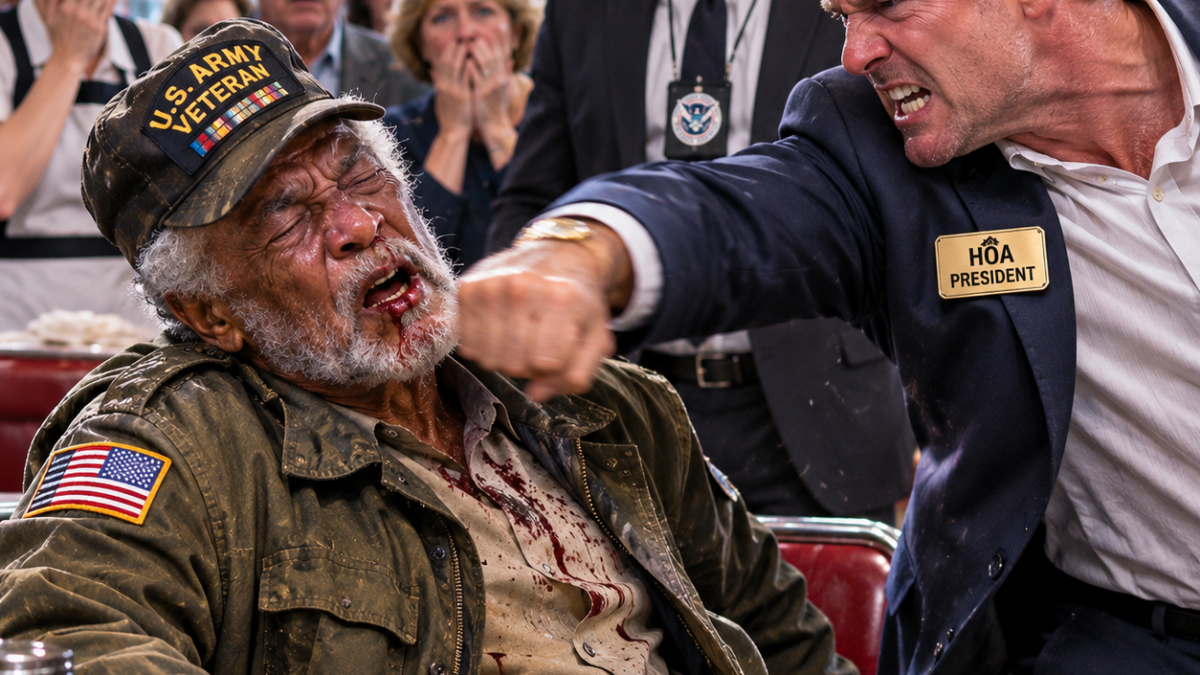
“GET OUT OF HERE, YOU WORTHLESS OLD SOLDIER! NOBODY WANTS PEOPLE LIKE YOU IN MY NEIGHBORHOOD!” Brad Morrison screamed before driving his fist into seventy-two-year-old Sam Washington’s face, sending the veteran staggering backward as his coffee spilled across the diner floor. Sam had survived war, buried friends, and spent decades teaching his son that a man’s dignity was worth more than any title, but now he stood bleeding in front of neighbors too frightened of their HOA president to intervene—and the deepest wound wasn’t the punch, but the realization that the community he’d called home for forty years had learned to look away. What Brad didn’t know was that Sam’s son, David Washington, held one of the most powerful positions in Homeland Security, and the evidence already gathering against Brad’s carefully protected HOA empire was about to turn one elderly man’s humiliation into a reckoning nobody in that diner would ever forget.
The sound of my coffee cup hitting the floor was louder than I expected.
It was one of those cheap paper cups with a flimsy plastic lid.
I’d bought it for two dollars and fifty cents, the way I did almost every morning.
When Brad Morrison’s fist struck my left cheek, the cup flew from my hand.
Coffee splashed across the white-and-gray linoleum.
The lid bounced beneath a booth.
A handful of quarters I’d been holding for the tip jar scattered across the floor.
Then everything went silent.
Not completely silent.
I could still hear the refrigerator humming behind the counter.
The ceiling fan above the register.
My own breathing.
But every human voice had stopped.
The conversations.
The laughter.
The silverware touching plates.
All of it disappeared.
I staggered backward and caught the edge of a booth before my legs gave out.
Pain exploded beneath my left eye.
My mouth filled with the metallic taste of blood.
I reached for my cane.
It wasn’t there.
I’d leaned it against the booth before ordering coffee, and now it lay on the floor, just beyond my reach.
Brad stood over me.
His face was red.
His fists were clenched.
He wore a charcoal-gray suit and an expensive wristwatch that caught the morning light.
“That’s what happens when you forget who’s in charge,” he spat.
I pressed one hand against my cheek.
Blood touched my fingertips.
I stared at him.
“Brad.”
He stepped closer.
“WHAT?”
“I’m seventy-two years old.”
He laughed.
“Then maybe it’s time somebody taught you some manners before you get any older.”
I heard a woman gasp behind the counter.
A young man near the back stood halfway from his seat.
Then he stopped.
Everyone knew Brad Morrison.
President of the Ridgewood Estates Homeowners Association.
A man who treated neighborhood meetings like courtroom trials and every homeowner who questioned him like a criminal.
He’d threatened people with fines.
Harassed families over parking.
Pressured residents who couldn’t afford legal representation.
And convinced enough influential neighbors that his bullying was simply strong leadership.
Now he’d struck me in a crowded diner.
And nobody seemed certain whether they were allowed to intervene.
Brad leaned closer.
“This isn’t your neighborhood anymore, Sam.”
His voice dropped.
“It’s mine.”
I felt something inside me go cold.
I’d owned my home long before Brad became HOA president.
Long before he moved into Ridgewood Estates.
Long before he began carrying himself like an elected king.
My wife and I had raised our son there.
I’d returned to that house after military deployments.
Buried my wife while living beneath its roof.
Watched our little boy become a man.
And now this stranger was telling me I didn’t belong.
I slowly straightened.
My cheek throbbed.
My knees trembled.
But I looked directly into his eyes.
“You don’t own this town, Brad.”
His mouth twisted.
He raised his voice.
“I OWN ENOUGH OF IT TO MAKE YOUR LIFE MISERABLE!”
Behind him, a waitress named Linda moved around the counter.
“Mr. Washington?”
I glanced toward her.
Her eyes were wet.
“Please sit down. You’re hurt.”
Brad scoffed.
“Oh, please. He’s fine.”
Linda looked at the blood on my lip.
Then at Brad.
“Sir, you need to leave.”
He turned sharply.
“Don’t tell me what to do in a place my association helps support.”
“This is a private business,” she answered, her voice shaking. “And you just hit one of our customers.”
Brad stared at her.
For a moment, I thought he might turn his anger on her.
I shifted forward instinctively.
“Leave her alone.”
Brad looked back at me.
Then smiled.
“Still playing the hero, old man?”
He glanced toward the faded veteran’s cap resting beside my breakfast plate.
“Think those medals make everybody afraid of you?”
I swallowed the blood in my mouth.
“No.”
He sneered.
“Good. Because they don’t mean a damn thing to me.”
The words hurt in a place his fist hadn’t reached.
I thought about the men whose names I’d spoken at funerals.
The families I’d visited.
The friends who never had the chance to grow old.
I wasn’t wearing my veteran’s cap because I wanted strangers to admire me.
I wore it because sometimes, when I touched its worn brim, I felt a little closer to the years that had shaped my life.
Brad picked up the cap.
For one terrible second, I thought he might throw it.
“Put that down,” I said.
My voice was quiet.
He laughed.
Then dropped it onto the counter.
“Know your place, Sam.”
He adjusted his suit jacket.
Tossed a few bills near the register.
And walked toward the door as though nothing serious had happened.
The bell rang above his head.
Then he was gone.
I stood beside the booth, one hand pressed against my bleeding cheek, while thirty people stared at me.
Some looked angry.
Some looked ashamed.
Others looked away.
And for the first time in years, I felt an unbearable loneliness.
Then Linda knelt to retrieve my cane.
A young busboy named Ethan began gathering the scattered quarters.
Someone called for medical assistance.
And from the back of the diner, I heard a familiar voice.
“Dad?”
I turned.
Standing just inside the side entrance, still wearing the dark suit he’d worn to an early morning meeting, was my son.
David Washington.
He had been expected to meet me for breakfast.
But the sight of blood on my face stopped him in his tracks.
His expression changed.
“Dad, what happened?”
I tried to smile.
“David.”
He crossed the room.
Then saw the swelling beneath my eye.
His voice became frighteningly quiet.
“Who did this to you?”
I looked toward the door Brad had just walked through.
Then back at the little boy I’d once taught to stand tall when the world treated him unfairly.
“Son,” I whispered, “I think it’s time you learned what’s been happening in this neighborhood.”
FULL STORY CONTINUATION
David didn’t immediately answer.
He was looking at my face.
At the blood on my lip.
At the red mark spreading across my left cheek.
Then his gaze dropped toward the cane Linda was holding.
He knew what it meant when I didn’t have that cane beneath my hand.
My left knee had never fully recovered from an injury I’d suffered during my military service.
Most mornings I managed well enough.
But a sudden impact could throw me off balance, and I was old enough to understand that falling onto a hard floor could injure me far more seriously than I wanted to admit.
David reached for my arm.
“Dad, sit down.”
I started to protest.
“I’m all right.”
“Please.”
Something in his voice stopped me.
It wasn’t the commanding tone he used in professional meetings.
It was the frightened voice of a son looking at his injured father.
I lowered myself into the nearest booth.
David sat beside me.
Linda brought a clean cloth and a small towel-wrapped cold pack.
“Mr. Washington, we’ve called for help.”
I nodded.
“Thank you, sweetheart.”
Her eyes filled.
“I should’ve stepped in sooner.”
I looked at her.
“No.”
She swallowed.
“I saw him getting angry.”
I gently touched her hand.
“Linda, he made the decision to hit me. Not you.”
Her face crumpled.
For a moment, she looked as though she might cry.
Then she nodded and returned to the counter.
David watched her go.
After a while, he turned toward me.
“Who was that man?”
I took a breath.
“Brad Morrison.”
David’s brow tightened.
“The HOA president?”
I nodded.
He stared.
“Dad, you’ve mentioned him before.”
“I know.”
“You said he was difficult.”
I looked down at my hands.
“That’s what I called it.”
David was quiet.
Then he asked something that made me ashamed of how much I’d been hiding.
“How long has he been treating you like this?”
I looked toward the window.
Cars moved through the morning traffic.
People walked past carrying coffee cups.
Life continued outside as though my world hadn’t just been turned upside down.
“Longer than I should’ve allowed.”
David took a slow breath.
“Dad.”
I looked back at him.
His eyes were wet.
“Why didn’t you tell me?”
I tried to answer.
But suddenly I was seventy-two years old, sitting in a diner with blood on my face, and I couldn’t find a way to explain why I had been so determined not to burden my own son.
The ambulance arrived a few minutes later.
A police officer came shortly afterward to take the initial report.
David stayed beside me while the medical responders examined my injuries.
I was embarrassed.
I hated being the center of attention.
Hated watching strangers glance at my swollen cheek.
Hated that the diner where I’d eaten breakfast for years had become the scene of something ugly.
But I was also shaken.
And as the adrenaline began wearing off, my face hurt worse.
The responders recommended further medical assessment.
I agreed.
David offered to accompany me.
I started to tell him he had work.
Then stopped.
He’d already taken my hand.
“I’m coming with you.”
It wasn’t a request.
I looked toward him.
For a moment, I saw the small boy who used to wait by the living-room window whenever I came home from a deployment.
Then I nodded.
“All right, son.”
My name is Samuel Washington.
Most people call me Sam.
I’m seventy-two years old, a military veteran, a widower, and the father of one son.
David.
If you ask me what I’ve accomplished in my life, people who know my service record might expect me to talk about medals.
Or promotions.
Or places I’ve been.
They might expect stories about military operations or difficult assignments.
But if you ask me what I’m proudest of, my answer has always been the same.
My family.
My late wife, Evelyn.
And the boy we raised together.
I served my country for many years.
I was proud to do it.
But I also know what that service cost the people who loved me.
I missed birthdays.
School events.
Quiet evenings.
More family dinners than I care to count.
I spent long periods away from home, sometimes in dangerous places, while Evelyn managed everything I couldn’t.
She handled the bills.
Repaired what needed repairing.
Comforted David when he was sick.
Helped him with schoolwork.
Attended parent-teacher meetings.
And somehow found time to write me letters that made even the hardest days feel bearable.
She never complained as much as she had a right to.
That was Evelyn.
Strong.
Gentle.
Stubborn when it mattered.
She believed that loving someone didn’t mean agreeing with every choice they made.
And she was never afraid to tell me when she thought I was wrong.
I miss that more than I can explain.
We bought our home in Ridgewood Estates when David was six.
It wasn’t fancy.
A two-story brick house with a narrow front porch, a small backyard, and a maple tree near the driveway.
The kitchen needed updating.
The basement smelled damp after heavy rain.
One bedroom window refused to close properly.
But Evelyn loved it.
The first time we walked through the front door, she stood in the empty living room and smiled.
“Sam.”
I looked toward her.
“What?”
She turned slowly, studying the windows.
The fireplace.
The small staircase.
Then she whispered, “This is the one.”
I laughed.
“Sweetheart, we haven’t even looked upstairs.”
She smiled.
“I know.”
Then she looked toward David, who was racing from room to room pretending he was exploring a castle.
“Listen to him.”
I did.
His footsteps echoed through the empty house.
His laughter rose from the hallway.
Evelyn took my hand.
“He’s happy here.”
I looked around.
Then smiled.
“All right.”
We bought the house.
And for the next several decades, it became the place where almost every important memory of my family was made.
David learned to ride his bicycle on the sidewalk.
Broke his wrist falling from the maple tree.
Brought home his first report card with straight A’s.
Cried after losing his first baseball game.
Celebrated his high school graduation in the backyard.
And stood on the front steps wearing his college jacket while Evelyn took so many photographs that he finally begged her to stop.
I remember every one of those moments.
Especially the ordinary ones.
The evenings we ate dinner together.
The mornings Evelyn made pancakes.
The sound of David laughing upstairs.
The smell of coffee drifting through the kitchen.
Those memories lived in the house long after the people inside it changed.
David grew into a serious young man.
He was intelligent.
Disciplined.
Determined to make a difference.
As a child, he hated seeing anyone bullied.
I remember an afternoon when he came home from school looking furious.
He was eleven.
His backpack hung from one shoulder.
His face was red.
Evelyn was preparing dinner.
I was at the kitchen table reading the newspaper.
David walked in and announced:
“Dad, I got in trouble.”
I lowered the paper.
“For what?”
He stared at the floor.
“I pushed a boy.”
Evelyn turned.
“David.”
He swallowed.
“He was picking on Michael.”
Michael was a smaller boy in his class.
Quiet.
Shy.
Often the target of cruel jokes.
I looked at David.
“Tell me what happened.”
He explained.
The boy had been shoving Michael near the lockers.
Other children were laughing.
David told him to stop.
The boy refused.
Then David pushed him away.
A teacher intervened.
Both boys were sent to the principal.
I listened.
Then asked:
“Did Michael need help?”
David nodded immediately.
“Yes.”
“Did you tell an adult?”
He hesitated.
“No.”
“Did you try to stop it without pushing?”
He looked down.
“I told him to stop.”
I nodded slowly.
“Good.”
Then I leaned forward.
“But listen carefully, son.”
He raised his eyes.
“Standing up for somebody doesn’t mean you can do whatever you want because you’re angry.”
He swallowed.
I continued.
“Sometimes you need to step between people.”
A pause.
“Sometimes you need help from somebody with authority.”
Another pause.
“And sometimes you need to make sure the truth gets heard.”
David stared at me.
I put down the newspaper.
“Being strong isn’t about frightening people.”
I looked directly into his eyes.
“It’s about making sure people who are weaker than you don’t have to be afraid.”
He nodded.
That was the lesson I wanted him to remember.
Not that our family was powerful.
Not that our name mattered.
That dignity mattered.
And that courage without self-control could become another kind of cruelty.
Years later, David entered public service.
He studied hard.
Worked long hours.
Held demanding positions.
And eventually rose to a senior leadership role in Homeland Security.
I was proud of him.
Of course I was.
But it wasn’t his title that made me proudest.
It was the way he treated people.
A receptionist.
A janitor.
A young employee.
A frightened person asking for help.
David spoke to them with the same courtesy he showed senior officials.
At least, that was what I saw.
I knew he wasn’t perfect.
Nobody is.
But I liked to think Evelyn and I had given him something more important than ambition.
A sense of responsibility.
Sometimes, when he visited, he’d sit beside me on the porch and complain that I never let him pay for dinner.
I’d laugh.
“I’m still your father.”
He’d shake his head.
“Dad, I have a job.”
“So do I.”
He’d raise an eyebrow.
“You’re retired.”
I’d smile.
“Exactly. My job is to enjoy making you argue about the dinner bill.”
He’d laugh.
Then we’d sit together, talking about ordinary things until the sun went down.
Those visits became especially important after Evelyn died.
My wife had been gone for six years when Brad Morrison punched me.
Six years.
People sometimes talk about grief as though it moves neatly through stages.
As though you wake one morning and realize you’ve reached the end of it.
That wasn’t my experience.
Grief changed.
It became quieter.
Less overwhelming on most days.
But it never disappeared.
There were mornings when I still reached toward Evelyn’s side of the bed.
Evenings when I turned to tell her something funny.
Moments when a particular song, smell, or photograph made the years fall away so suddenly that I felt as though I’d lost her all over again.
After she died, I considered selling the house.
It was too large for one person.
The stairs hurt my knee.
The yard required more work than it used to.
But every room reminded me of her.
Her favorite chair remained beside the living-room window.
The kitchen cupboards still held the dishes she’d chosen.
The maple tree in the backyard had grown tall enough to shade the porch.
And near the fireplace was the photograph David took on our thirty-fifth wedding anniversary.
Evelyn was laughing.
I had my arm around her waist.
Her hair was silver.
Her eyes bright.
She looked happy.
I couldn’t imagine leaving all of that behind.
So I stayed.
And for several years, Ridgewood Estates remained the neighborhood we’d loved.
Until Brad Morrison became HOA president.
Brad moved into Ridgewood Estates with an expensive car, a perfectly manicured lawn, and an opinion about everything.
At first, he seemed charming.
He introduced himself to neighbors.
Attended community meetings.
Complimented people’s homes.
Spoke enthusiastically about improving the neighborhood.
He was younger than most of the longtime homeowners and liked to describe himself as a businessman who knew how successful communities operated.
Some people admired that.
They thought his confidence meant competence.
When the previous HOA president announced she was retiring from the position, Brad ran to replace her.
He promised better maintenance.
Greater financial discipline.
Strong enforcement of neighborhood standards.
And higher property values.
Those were reasonable goals on their face.
A community association needs people willing to manage its responsibilities.
But after Brad won the election, I noticed a change.
He stopped treating residents like neighbors.
He began treating them like subordinates.
The first notices seemed small.
Trash cans left near the curb.
Fences that needed painting.
Vehicles parked where they shouldn’t be.
Ordinary things associations sometimes have legitimate reasons to address.
Then the letters became more aggressive.
The language changed.
Homeowners were no longer being asked to correct problems.
They were being ordered to comply.
Brad began issuing threats during meetings.
He interrupted people who questioned him.
Dismissed older residents as out of touch.
And referred to homeowners who appealed fines as troublemakers.
I didn’t like it.
But for a while, I kept my distance.
I told myself I had earned the right to enjoy retirement.
I’d spent enough of my life dealing with difficult personalities.
I didn’t want to spend my remaining years arguing about neighborhood politics.
That was my first mistake.
The trouble began for me over a flag.
It was the American flag Evelyn and I had displayed beside our porch for years.
The fabric had faded slightly.
But I maintained it respectfully and replaced it whenever necessary.
One afternoon, Brad appeared at my front door holding a violation notice.
“Sam.”
I looked up from the chair where I’d been reading.
“Morning, Brad.”
He held out the paper.
“You need to remove that flag.”
I frowned.
“Why?”
“It’s not consistent with the approved exterior appearance.”
I looked toward the flag.
It was mounted in the same place it had occupied for decades.
“Brad, it’s been there since before you moved in.”
He smirked.
“That doesn’t make it compliant.”
I took the paper.
Read it.
Then looked at him.
“Which provision?”
His expression tightened.
“Don’t start.”
I stared.
“Start what?”
“Arguing.”
I took a breath.
“I’m asking which rule applies.”
He stepped closer.
“Sam, the problem with people your age is that you think the neighborhood should stay frozen in the past.”
I felt my jaw tighten.
He gestured toward the street.
“Things change.”
I looked at him.
“Some things do.”
He smiled.
“Then you’ll understand why I expect compliance.”
He turned and walked away before I could respond.
I stood on the porch staring after him.
Then looked down at the notice.
It wasn’t the first time I’d disagreed with an HOA representative.
But it was the first time someone had spoken to me as though age itself made my opinion irrelevant.
I considered calling David.
Then decided against it.
A minor neighborhood dispute wasn’t something I needed to bring to my son’s attention.
I would handle it myself.
Over the following months, the disputes became more frequent.
Brad complained about the appearance of my mailbox.
The length of my driveway edging.
A garden bench Evelyn had bought years earlier.
He said the bench was outdated.
I told him I liked it.
He said personal attachment didn’t excuse violations.
I requested the relevant provision.
He became angry.
Then came a warning about my front porch light.
Another about the small flower bed near the steps.
And eventually, a notice concerning my veteran’s cap.
That one left me speechless.
I’d been sitting outside when Brad walked past.
He stopped.
Looked at the cap.
Then shook his head.
“Sam, you really ought to stop wearing that thing around the neighborhood.”
I stared.
“What thing?”
He pointed.
“That hat.”
I touched the brim.
“Why?”
“It makes the community look like a veterans’ hall.”
For a moment, I couldn’t believe what I’d heard.
I slowly lowered my hand.
“Brad, it’s a cap.”
He rolled his eyes.
“Everything’s a personal statement with you.”
I looked toward him.
“I didn’t ask anyone to make a statement about it.”
He smiled coldly.
“Then stop making everyone else look at it.”
I remember sitting on the porch after he left.
The cap in my hands.
Looking at the small embroidered emblem.
Thinking about the men I’d known.
The friends whose names had become part of memorial ceremonies instead of future plans.
I wondered how someone could look at an old man’s hat and feel so threatened by it.
Then I placed the cap back on my head.
And went inside.
I wasn’t the only homeowner Brad targeted.
There was a young couple on the next street who had rented out their property while dealing with financial difficulties.
Brad repeatedly challenged their arrangements and threatened escalating penalties.
The pressure eventually contributed to their decision to leave the neighborhood.
A woman received a series of notices about her mailbox.
One claimed it leaned.
Another said the paint was improper.
A third objected to the decorative flowers she’d planted beside it.
A father told me his tenant had moved out after months of disputes involving parking and property inspections.
There were rumors about questionable financial decisions within the HOA.
Payments that hadn’t been clearly explained.
Unusually expensive service arrangements.
Fundraising accounts Brad controlled closely.
I didn’t know which stories were true.
And I wasn’t going to accuse someone of financial wrongdoing based solely on gossip.
But I noticed something troubling.
Residents were becoming afraid to ask questions.
At meetings, people spoke quietly.
They looked toward Brad before disagreeing.
Some apologized before asking for routine financial information.
And when he raised his voice, the room usually went silent.
That silence bothered me.
Because I’d seen how power grows when people are taught that questioning it is dangerous.
One afternoon, I met a neighbor named Mrs. Parker near the mailboxes.
She was carrying a stack of notices.
Her eyes were red.
“Sam?”
I stopped.
“You all right?”
She tried to smile.
“Fine.”
I looked at the papers.
She noticed.
Then sighed.
“Brad says my fence needs replacing.”
I glanced toward her property.
The fence was old.
But I couldn’t see anything obviously dangerous from where we stood.
“Did he explain why?”
She shook her head.
“He says it’s unattractive.”
I nodded slowly.
She swallowed.
“I’ve gotten three letters.”
I looked at her.
“Have you asked for a hearing?”
Her expression changed immediately.
“Oh, no.”
“Why not?”
She lowered her voice.
“Sam, you don’t want Brad angry with you.”
For a moment, I stared at her.
Then she glanced around as though someone might be listening.
“He knows people.”
I frowned.
“What people?”
She shook her head.
“Important people.”
I took a breath.
“Mrs. Parker, knowing people doesn’t make somebody’s decisions automatically correct.”
She smiled sadly.
“I know.”
But her eyes told me she didn’t believe she could safely challenge him.
That conversation stayed with me.
Because I recognized the fear.
Not the fear of a dangerous battlefield.
A quieter fear.
The fear of being singled out.
The fear that your next complaint would bring another penalty.
The fear that a person with influence could make your life so unpleasant that surrender seemed easier than resistance.
I began attending HOA meetings more regularly.
I asked for records.
Requested clarification on certain enforcement policies.
Suggested that homeowners receive clearer explanations of their appeal rights.
Brad hated it.
The first time I questioned him publicly, he leaned toward the microphone.
“Sam, you’ve made your point.”
I looked toward him.
“I don’t believe you’ve answered the question.”
His face reddened.
“This isn’t a military briefing.”
I kept my voice calm.
“I know.”
He smirked.
“Then stop acting like you’re commanding troops.”
A few residents looked uncomfortable.
I took a breath.
“I’m asking about the assessment process.”
Brad slammed his palm against the table.
“YOU DON’T RUN THIS HOA!”
The room went silent.
I stared at him.
Then nodded.
“I didn’t say I did.”
He pointed toward the door.
“If you don’t like the way things are handled, perhaps you should find somewhere else to live.”
I looked at the other board members.
None spoke.
Then I turned toward Brad.
“I’ve lived here longer than you have.”
His mouth tightened.
I continued.
“My wife and I raised our son here.”
He rolled his eyes.
“Here we go.”
I felt my chest tighten.
He continued.
“Another speech about the good old days.”
I took a slow breath.
Then sat down.
Not because he had convinced me.
Because I could see that the meeting wasn’t going to produce a meaningful answer.
But that night, as I walked home, I began wondering how much longer I could ignore what was happening.
A few weeks later, I received a letter threatening additional enforcement over my porch.
It complained about the wooden bench.
The flag.
And a small decorative plaque Evelyn had hung beside the front door.
The plaque read:
Home Is Where Love Lives.
She bought it during a family vacation.
It had hung there for years.
When Brad called it an unapproved exterior ornament, something inside me finally broke.
I sat at the kitchen table holding the letter.
The house was quiet.
Evelyn’s photograph stood beside the lamp.
I looked at it.
Then at the notice.
For a long time, I couldn’t move.
I thought about the day she hung the plaque.
She’d stood on the porch holding a little hammer.
I’d offered to help.
She laughed.
“Sam, I can hang a plaque.”
I smiled.
“I know.”
She stepped back afterward.
Studied it.
Then nodded with satisfaction.
“There.”
I looked at the words.
Then at her.
“Looks good, sweetheart.”
She smiled.
“It’ll remind us what matters.”
Now, six years after her death, Brad Morrison wanted me to remove it because he didn’t approve of its appearance.
I pressed the letter against the table.
And whispered:
“Evelyn, I don’t know what to do with these people anymore.”
For a moment, the silence felt unbearable.
Then my phone rang.
David.
I looked at his name.
And almost told him everything.
But when I answered, he sounded exhausted from work.
“Hey, Dad.”
I smiled weakly.
“Hey, son.”
“How’re you doing?”
I stared at the notice.
Then answered:
“Fine.”
The word came too easily.
David paused.
“You sure?”
I closed my eyes.
“Just tired.”
He told me about his week.
Asked whether I needed anything.
Promised to visit soon.
I listened.
Laughed when he made a joke.
And never mentioned Brad.
After we hung up, I sat alone for another hour.
Looking at my wife’s plaque.
And wondering why I was more comfortable hiding my humiliation than admitting I needed help.
The morning of the diner assault began like any other Thursday.
I woke just after six.
My knee ached.
The weather was damp, and cold mornings often made the old injury worse.
I made coffee.
Took my medication as prescribed.
Read a few pages of the newspaper.
Then put on my veteran’s cap.
David had called the previous evening.
He was passing through town for an early meeting and wanted to meet me for breakfast afterward.
I was excited.
I didn’t see him often enough.
His work demanded long hours.
He traveled frequently.
And although I was proud of what he’d achieved, I sometimes missed the boy who used to come downstairs in the morning and ask whether we had any pancakes left.
I’d reserved my usual booth at the diner.
Not officially.
The staff simply knew where I liked to sit.
It was near the window.
Second booth from the entrance.
Good view of the street.
Close enough to the counter that I could talk to Linda without raising my voice.
I left home carrying my cane and a few coins for the tip jar.
I expected an ordinary breakfast with my son.
I had no idea Brad Morrison would be there.
The diner had been part of my life almost as long as Ridgewood Estates.
Evelyn and I used to visit on Sunday mornings.
She ordered scrambled eggs.
Toast.
And coffee with enough cream to make it nearly white.
I preferred black coffee and whatever breakfast special the kitchen was serving.
After David was born, we’d bring him along.
When he was small, he’d sit between us and order pancakes.
He always wanted extra syrup.
Evelyn would pretend to protest.
Then give him a little more.
I can still picture her laughing while he tried to cut pancakes that were almost as big as his plate.
Years later, when David was home from college, we continued meeting there.
Sometimes he’d arrive with stories about classes.
Sometimes he’d ask me questions about military service.
Other times we’d sit quietly, enjoying the fact that we were together.
After Evelyn died, the diner became one of the few places where I could remember her without feeling completely overwhelmed.
Linda had worked there for years.
She knew my usual order.
Always asked how I was feeling.
And never made me feel foolish when I occasionally looked toward the empty side of the booth.
That morning, she smiled when I entered.
“Morning, Mr. Washington.”
I raised my hand.
“Morning, sweetheart.”
“Your usual?”
I nodded.
“And my son’s coming.”
Her face brightened.
“David?”
“That’s the one.”
She smiled.
“Then I’ll make sure we save him some pancakes.”
I laughed.
“He’s a little old for that.”
She shook her head.
“Not in this diner.”
I smiled.
Then took my seat.
For a few peaceful minutes, I felt genuinely happy.
Brad entered shortly afterward.
I heard his voice before I saw him.
He was speaking loudly to someone near the entrance.
Complaining about a contractor.
Threatening to replace a service provider.
Talking about people who didn’t understand standards.
I kept my eyes on the newspaper.
I had no interest in starting an argument.
But Brad noticed me.
He stopped beside my booth.
“Sam.”
I looked up.
“Brad.”
His eyes moved toward my cap.
Then toward the cane leaning against the seat.
A cold smile appeared.
“Still wearing that thing?”
I folded the newspaper.
“It’s a free country.”
His expression hardened.
“That’s a convenient answer for someone who refuses to follow rules.”
I took a breath.
“Brad, I’m having breakfast.”
He leaned closer.
“And I’m tired of you questioning every decision I make.”
I glanced around the diner.
Several people were watching.
I kept my voice low.
“This isn’t the place.”
He laughed.
“You don’t get to decide that.”
I looked at him.
“Then what do you want?”
He placed one hand on the table.
“I want you to stop undermining the HOA.”
I stared.
“By asking questions?”
“By encouraging people to challenge legitimate authority.”
I shook my head.
“Brad, homeowners have a right to understand association decisions.”
He leaned closer.
“Not when people like you use those questions to create trouble.”
I felt my jaw tighten.
“People like me?”
His eyes narrowed.
“Old men who think past military service gives them a lifetime pass to ignore everyone else.”
For a moment, I couldn’t speak.
Then I slowly stood.
Not aggressively.
I simply didn’t want to remain seated while he leaned over me.
“Brad, go eat your breakfast.”
He laughed.
“Don’t tell me what to do.”
I reached for my cane.
And that’s when he stepped into my space.
“YOU DON’T BELONG HERE!”
The words exploded from his mouth.
Several people turned.
I held up one hand.
“Brad, back away.”
He sneered.
“MAKE ME.”
I kept my voice calm.
“I’m not fighting you.”
His face twisted.
“Of course you’re not.”
He leaned closer.
“YOU’RE A PATHETIC OLD MAN WHO THINKS A VETERAN’S HAT MAKES HIM IMPORTANT!”
I felt my chest tighten.
Then he shoved the edge of my shoulder.
I stumbled slightly.
My cane shifted against the booth.
I looked directly at him.
“Don’t touch me again.”
His eyes widened.
For a moment, he seemed genuinely offended that I’d set a boundary.
Then he raised his fist.
The blow came so quickly I didn’t have time to protect my face.
Pain.
A sharp flash.
Coffee flying.
Coins scattering.
My hand catching the booth.
Then the silence.
The terrible, humiliating silence.
I remember thinking:
Evelyn, please don’t let me fall.
Not because I believed she could somehow catch me.
Because in moments of fear, the mind reaches instinctively toward the people who once made us feel safe.
I managed to remain standing.
But my face was bleeding.
And Brad was smiling.
That smile hurt worse than the punch.
Because it told me he’d wanted to humiliate me.
He’d wanted the room to see an old man made helpless.
And he believed he had succeeded.
What Brad didn’t understand was that humiliation can produce two very different kinds of silence.
One is surrender.
The other is the quiet that comes when people finally recognize something they can no longer excuse.
I’d seen Linda’s expression.
The anger in Ethan’s face.
The customers looking toward one another.
The young man who’d half-risen from his booth.
Brad thought their silence meant support.
But I saw shame.
And when David entered moments later, that shame began turning into something else.
People started speaking.
Linda gave the responding officer a clear account of what she’d witnessed.
Ethan described the blow.
A customer near the back offered to preserve a video recorded on his phone.
The diner owner agreed to retain the security footage.
And my son sat beside me, looking at my bruised face, trying to understand how I’d spent months hiding what Brad Morrison had done to our neighborhood.
At the medical clinic, David remained quiet while I was examined.
The doctor assessed my facial injury and made sure there were no more serious complications.
I was fortunate.
The blow had caused bruising, swelling, and a cut near my lip.
But the initial evaluation didn’t reveal the kind of severe injury we’d feared.
I was given instructions for recovery and what symptoms would require urgent attention.
David listened carefully.
Asked questions.
Then helped me gather my belongings.
When we returned to his car, he opened the passenger door.
I stared.
“Son, I can get in.”
“I know.”
He waited.
I lowered myself into the seat.
My knee ached.
My cheek throbbed.
And for the first time all day, the room wasn’t full of strangers watching me.
It was just my son and me.
David got behind the wheel.
Closed the door.
Then remained still.
For a long moment, he stared through the windshield.
Finally, he whispered:
“Dad, I’m sorry.”
I turned toward him.
“What?”
His eyes were wet.
“I should’ve known.”
I felt something break inside me.
“David.”
He shook his head.
“I should’ve realized something was wrong.”
I reached toward his arm.
“Son, you asked me.”
He looked at me.
“More than once.”
My voice trembled.
“And I told you I was fine.”
For a moment, neither of us spoke.
Then I whispered:
“I didn’t want you worrying about me.”
David closed his eyes.
His hands tightened around the steering wheel.
When he spoke again, his voice sounded much younger than it had in the diner.
“Dad, you’re my father.”
I swallowed.
“I know.”
“You spent my whole childhood taking care of me.”
His voice broke.
“Let me be there when you need somebody.”
I looked away.
Because suddenly I was remembering the little boy who used to run to the front door whenever I returned home.
And I realized that I’d spent years teaching him to stand up for other people, then denied him the chance to stand beside me.
I nodded slowly.
“All right.”
David reached over.
Took my hand.
And held it for a moment.
Then he whispered:
“Tell me everything.”
I began with the flag.
David listened without interrupting.
Then I told him about the notices.
The mailbox.
The garden bench.
Evelyn’s plaque.
The arguments at association meetings.
The families who had become afraid to speak.
The young couple who’d left after repeated disputes.
The rumors about questionable financial arrangements.
And the elderly neighbors who had learned to lower their voices whenever Brad’s name came up.
We sat in the parked car for nearly an hour.
Sometimes David asked a question.
Other times he simply listened.
When I described the notice about Evelyn’s plaque, his expression changed.
“He wanted you to take down Mom’s sign?”
I nodded.
David looked toward the steering wheel.
For a moment, he didn’t speak.
Then he whispered:
“She loved that thing.”
I felt my eyes fill.
“I know.”
He shook his head.
“I remember helping her pick it out.”
I looked at him.
He smiled sadly.
“We were on vacation.”
My throat tightened.
“She made us stop at that little shop.”
David nodded.
“And you complained that we already had too many decorations.”
I laughed softly.
“I probably did.”
He looked toward me.
Then his expression crumpled.
“Dad, you should’ve told me.”
I nodded.
“I know.”
For several seconds, we sat quietly.
Then David took a deep breath.
“All right.”
His voice became steadier.
“First, we’re going to make sure you’re safe.”
I looked toward him.
“Second, we’re going to preserve the evidence of what happened today.”
He continued.
“And third, we’re going to figure out what Brad has been doing through the HOA.”
I felt my stomach tighten.
“David, I don’t want you abusing your position over this.”
He turned immediately.
“Neither do I.”
I studied his face.
He continued.
“My job doesn’t give me the right to order someone arrested because he hurt my father.”
I nodded.
“Good.”
“But it also doesn’t mean I have to pretend a crime didn’t happen.”
For a moment, neither of us spoke.
Then David added:
“And if the allegations about the HOA involve financial misconduct, the people with proper jurisdiction can decide what warrants investigation.”
I felt an unexpected wave of relief.
Not because he’d promised Brad’s destruction.
Because he’d remembered the lesson I’d taught him when he was eleven.
Strength without restraint can become another kind of bullying.
And my son understood that.
We returned to my house in the afternoon.
David carried my small bag while I walked carefully up the porch steps.
He stopped beside the wooden bench.
Looked at it.
Then touched the faded armrest.
“Mom used to sit here.”
I nodded.
“Every evening.”
He looked toward the plaque near the front door.
Then toward the flag.
For a moment, his eyes filled.
“Dad, this place still looks like her.”
My throat tightened.
“That’s why I stayed.”
David nodded.
We went inside.
The house was quiet.
Sunlight fell across the living-room rug.
Evelyn’s photograph stood beside the fireplace.
David stopped in front of it.
For several seconds, he simply looked.
Then whispered:
“Hey, Mom.”
I looked away.
Because those two words nearly brought me to my knees.
After David helped me settle, I showed him the folder I’d kept in my desk.
It contained Brad’s notices.
Copies of my responses.
Meeting agendas.
Emails.
Letters threatening further fines.
And notes I’d written after conversations with other residents.
I’d kept the records partly because I was accustomed to documenting important matters.
But also because something inside me had always suspected that Brad’s behavior would eventually become impossible to ignore.
David opened the folder.
Read the first notice.
Then another.
And another.
His expression grew more serious.
He didn’t speak for a long time.
Finally, he looked up.
“Dad, this is a lot.”
I nodded.
“I know.”
“How many of these were actually approved by the board?”
I shook my head.
“That’s part of the problem.”
He turned another page.
I continued.
“Brad often presents his own decisions as though the entire board has already agreed.”
David stared at the paper.
Then asked:
“Has anyone reviewed the financial records?”
“Some people have tried.”
“And?”
I looked toward the window.
“They haven’t received clear answers.”
David leaned back.
For a moment, I saw his professional instincts taking over.
Then he stopped himself.
Closed the folder.
And looked at me.
“Dad, I want to be careful about something.”
I nodded.
He continued.
“The assault is a matter for local law enforcement and prosecutors.”
I waited.
“The HOA records are a separate issue.”
I nodded again.
“If there’s evidence of fraud, theft, or other misconduct, it needs to go through the appropriate authorities.”
He paused.
“But we need facts, not rumors.”
I looked at my son.
Then smiled faintly.
“That’s exactly what your mother would say.”
David laughed softly.
“Probably.”
Then his expression became serious again.
“And it’s what you taught me.”
The video appeared online before dinner.
A diner customer had recorded part of the confrontation.
The clip showed Brad standing over me.
He was shouting.
I was holding my cane.
Then the blow.
My body staggering backward.
The coffee cup flying.
The terrible silence afterward.
Someone posted it with a short description identifying Brad as the Ridgewood Estates HOA president.
Within hours, people began sharing it.
I didn’t want to watch.
David found out about the video when his phone started ringing.
He was sitting across from me at the kitchen table.
I saw his expression change.
“What is it?”
He hesitated.
Then turned the screen toward me.
There I was.
An old man.
Standing beside a diner booth.
Being struck in the face while people watched.
I felt sick.
I looked away.
“Turn it off.”
David immediately lowered the phone.
“Dad?”
I covered my eyes.
For a moment, I couldn’t speak.
Then I whispered:
“I don’t want people seeing me like that.”
My voice broke.
“Helpless.”
David was silent.
I continued.
“I’ve spent my whole life trying to carry myself with dignity.”
A tear slipped down my cheek.
“And now people are going to watch that man knock me around like I’m nothing.”
David moved closer.
He knelt beside my chair.
“Dad, look at me.”
I shook my head.
“Please.”
I lowered my hand.
His eyes were wet.
“You weren’t helpless because somebody assaulted you.”
I swallowed.
He continued.
“You didn’t deserve that.”
My lips trembled.
“And the shame belongs to the man who hit you.”
I stared at him.
For a moment, I saw Evelyn in his face.
The same steady eyes.
The same refusal to let someone he loved mistake cruelty for a personal failure.
David gently took my hand.
“People are going to see what he did.”
He paused.
“They’re also going to see that you didn’t turn into him.”
I began crying.
My son held my hand.
And for the first time since the diner, I allowed myself to believe that being assaulted hadn’t taken away my dignity.
The next morning, the phone began ringing before eight.
Neighbors.
Old friends.
People from the diner.
A former colleague I hadn’t spoken with in years.
Some had seen the video.
Others had heard from friends.
Most wanted to know whether I was all right.
I answered as many calls as I could.
But the attention was overwhelming.
One neighbor apologized for not intervening.
Another said he’d been afraid Brad might retaliate against his family.
A woman told me she’d watched the video three times because she couldn’t believe a man who represented the HOA had behaved that way.
I thanked them.
Then asked everyone not to harass Brad or his family.
Whatever happened next needed to happen through evidence and lawful processes.
I didn’t want threats.
Didn’t want anyone vandalizing his property.
Didn’t want strangers taking their anger out on people who hadn’t committed the assault.
But I did want the truth examined.
And for the first time, the neighborhood seemed willing to look at more than the punch itself.
Linda called that afternoon.
Her voice was shaky.
“Mr. Washington?”
I smiled faintly.
“Linda.”
“How are you feeling?”
“Like somebody punched an old man in the face.”
She gave a startled laugh.
Then immediately sounded apologetic.
“I’m sorry.”
I smiled.
“Sweetheart, you’re allowed to laugh.”
Her voice softened.
“I wanted you to know we gave the police the video and our statements.”
I nodded.
“Thank you.”
She hesitated.
Then said:
“Mr. Washington, I’m ashamed.”
My chest tightened.
“Why?”
“Because I was afraid of him.”
I closed my eyes.
She continued.
“Not just that morning.”
A pause.
“For months.”
I listened.
“He’s threatened to complain about the diner. Said he’d make sure residents stopped coming here if we didn’t support his association events.”
I felt anger rise.
Linda swallowed.
“I’ve heard the way he talks to older people.”
Her voice cracked.
“I’ve watched him embarrass folks over nothing.”
A long silence.
Then she whispered:
“And when he hit you, I froze.”
I took a slow breath.
“Linda, you spoke up.”
“Afterward.”
“You helped me.”
Her voice trembled.
“I should’ve done more.”
I looked toward Evelyn’s photograph.
Then said gently:
“Sometimes courage arrives a moment later than we wish.”
Linda was quiet.
I continued.
“What matters is what we do next.”
For a moment, neither of us spoke.
Then she whispered:
“I’m going to tell the truth.”
My throat tightened.
“Thank you, sweetheart.”
The police investigation into the assault proceeded separately from the growing controversy surrounding the HOA.
I gave my statement.
The diner provided footage.
Witnesses gave accounts.
Medical records documented the injury.
The prosecutor’s office reviewed the available evidence through its ordinary process.
David didn’t order anyone to arrest Brad.
He didn’t call in Homeland Security agents to punish a personal enemy.
He remained my son while the proper authorities handled the case.
That didn’t make him less formidable.
In some ways, it made him more so.
He understood the consequences of abusing public authority.
And he refused to create another injustice in the name of correcting the first.
But he did encourage me to document what I’d experienced.
To speak with an attorney about the HOA disputes.
And to ensure that the residents who came forward with concerns knew how to preserve records and contact the appropriate offices.
Then the stories began arriving.
Mrs. Parker came to my house carrying a folder.
She stood on the porch looking nervous.
“Sam?”
I opened the door.
“Come in.”
She glanced toward David, who was sitting at the kitchen table.
For a moment, she hesitated.
Then she said:
“I saw the video.”
I nodded.
Her eyes filled.
“I couldn’t sleep afterward.”
I invited her to sit.
She placed the folder on the table.
“These are the notices Brad sent me.”
I opened it.
There were dozens.
Some involved her fence.
Others her mailbox.
A few concerned landscaping.
Several included threats of additional penalties.
She looked down.
“I paid some of them.”
Her voice broke.
“I was afraid not to.”
I studied the documents.
Then looked toward her.
“Did you appeal?”
She shook her head.
“Brad told me I’d regret making things difficult.”
David remained quiet.
Mrs. Parker looked toward him.
Then whispered:
“Mr. Washington, I know you’re important.”
David leaned forward.
“Please call me David.”
She swallowed.
“I don’t want trouble.”
His expression softened.
“Neither do we.”
For a moment, she looked confused.
Then he continued.
“But people should be able to ask whether an assessment is valid.”
Mrs. Parker nodded.
Tears filled her eyes.
“I kept thinking maybe I was the problem.”
I reached toward her hand.
“You weren’t the only one being treated this way.”
She looked at me.
Then whispered:
“That’s what I’m beginning to understand.”
Over the following days, more residents shared their records.
A couple who had moved away described repeated pressure over their rental property.
They provided copies of letters and bank statements showing the financial strain they’d endured.
A father explained how Brad’s enforcement threats had contributed to losing a tenant.
Another homeowner brought receipts for fines she believed had been imposed inconsistently.
Some accounts were incomplete.
Others involved legitimate disagreements over property standards.
Not every complaint proved wrongdoing.
And I didn’t want people assuming that a cruel HOA president was automatically guilty of every rumor circulating through town.
But as the documents accumulated, several recurring concerns emerged.
Penalties that seemed arbitrary.
Appeals discouraged or handled inconsistently.
Financial decisions that hadn’t been adequately explained to homeowners.
And a board culture in which Brad’s personal approval seemed more important than documented procedures.
I began organizing the information.
Dates.
Names.
Copies of letters.
Payment records.
Witnesses.
I didn’t enjoy it.
The work reminded me too much of difficult administrative disputes I’d hoped retirement would free me from.
But every time I became tired, I remembered Mrs. Parker standing in my kitchen.
Her hands shaking.
Apologizing for asking questions.
And I kept going.
A local reporter began examining the story.
Her name was Rachel Collins.
She was younger than I expected, with short brown hair and a direct, careful manner.
She called first.
Then arranged to meet me.
I was nervous.
I’d never wanted public attention.
Especially not for something as humiliating as the diner assault.
But Rachel explained that she wanted to examine the broader HOA situation.
Not merely replay the video.
She asked whether residents had been given clear opportunities to challenge fines.
Whether financial records were available.
Whether Brad’s conduct at meetings reflected a pattern.
And whether any complaints had been independently reviewed.
I appreciated the questions.
She wasn’t asking me to describe Brad as a monster.
She was asking for documents.
I gave her copies of my own correspondence and explained which concerns came from other residents whose permission she would need to obtain directly.
Then she asked:
“Mr. Washington, why do you think he singled you out?”
I considered the question.
“I can’t know everything he was thinking.”
She nodded.
I continued.
“But he repeatedly mocked my age and military service.”
Rachel looked down at her notes.
“And you believe those insults were part of his attempts to intimidate you?”
I nodded.
“Yes.”
She paused.
Then asked:
“How did that make you feel?”
I looked toward the window.
For a moment, I thought about giving her a polished answer.
Something about resilience.
Duty.
Dignity.
But then I remembered the diner floor.
The scattered quarters.
My cane lying beyond my reach.
The strangers watching.
And I answered honestly.
“Small.”
Rachel raised her eyes.
I swallowed.
“He made me feel small.”
For a moment, neither of us spoke.
Then I continued.
“I’ve been through difficult things in my life.”
My voice trembled.
“But being seventy-two years old and realizing a man can humiliate you in public because he believes nobody will challenge him…”
I stopped.
My throat tightened.
Then whispered:
“That was harder than I expected.”
Rachel lowered her pen.
For a moment, she simply looked at me.
Then said gently:
“Thank you for telling me.”
The first article focused on the diner assault and the questions surrounding Brad’s HOA leadership.
The video had already circulated widely.
But Rachel’s reporting added something important.
Context.
The notices.
The residents who had paid questionable fines.
The association’s response to complaints.
And the fact that some people had been afraid to speak publicly.
The article didn’t claim Brad had committed crimes that hadn’t been established.
It documented the allegations and the available evidence.
Brad responded angrily.
He called the reporting unfair.
Said he was being targeted by disgruntled residents.
Insisted that strict enforcement was necessary to protect Ridgewood Estates.
Then he accused me of exploiting my military service and my son’s position to undermine the association.
I read his statement at my kitchen table.
David was sitting across from me.
He noticed my expression.
“What?”
I handed him the article.
He read it.
Then sighed.
“Dad.”
I looked up.
“He’s trying to make me sound like the aggressor.”
David nodded.
“I see that.”
I felt my jaw tighten.
“He hit me.”
My voice broke.
“There’s video.”
David reached toward my hand.
“I know.”
I stared at the table.
Then whispered:
“Why does he keep acting like I’m the one who did something wrong?”
David was quiet for a moment.
Then he answered:
“Because acknowledging the truth would mean accepting responsibility.”
I looked toward him.
He continued.
“Some people will fight that for a very long time.”
Brad called me three days later.
I was sitting on the porch.
The afternoon sun was warm.
My cheek still ached, but the swelling had begun to improve.
When the phone rang, I didn’t recognize the number immediately.
I answered.
“Sam Washington.”
A familiar voice responded.
“Sam.”
My stomach tightened.
“Brad.”
For a moment, neither of us spoke.
Then he said:
“I think we need to talk.”
I stared toward the maple tree.
“About what?”
He sighed.
“This whole situation has gotten out of hand.”
I closed my eyes.
He continued.
“People are saying terrible things.”
I waited.
“And I think you and I should clear the air.”
I took a breath.
“Are you calling to apologize for hitting me?”
A long silence.
Then he laughed awkwardly.
“Sam, let’s not get dramatic.”
I felt something cold settle inside my chest.
He continued.
“Things got heated.”
I looked toward the street.
“You punched me.”
His voice tightened.
“You were provoking me.”
For a moment, I couldn’t believe it.
Then I answered quietly:
“Brad, I was trying to eat breakfast with my son.”
He sighed.
“Look, I’m willing to put this behind us.”
I took another breath.
“You can discuss the criminal case through your attorney.”
His tone changed.
“Don’t make this harder than it needs to be.”
I stared at the flag beside my porch.
For a moment, I remembered the punch.
The humiliation.
The people who’d spent years fearing him.
Then I said:
“You made this difficult when you decided you could hurt people without consequences.”
Brad’s voice sharpened.
“YOU DON’T KNOW WHO YOU’RE DEALING WITH.”
I closed my eyes.
I’d heard the threat so many times it no longer surprised me.
Then I answered:
“I know exactly who hit me.”
And ended the call.
The pressure didn’t disappear.
There were more articles.
More complaints.
More residents willing to challenge Brad.
But there were also people who defended him.
A local council member spoke about the importance of HOA leadership and warned against making judgments before investigations concluded.
Some longtime supporters insisted Brad had kept the neighborhood looking attractive.
Others said people were exaggerating minor disagreements.
An opinion column suggested the controversy reflected growing disrespect for community standards.
I understood that people could disagree about association rules.
But watching them minimize an assault caught on video left me shaken.
Then came the anonymous notes.
The first appeared on my porch one morning.
No envelope.
No signature.
Just a printed message suggesting I should stop causing trouble.
I stared at it.
For a moment, I felt the same fear I’d experienced in the diner.
Not because the words were especially sophisticated.
Because someone had approached my home to leave them.
The place Evelyn and I had chosen for safety.
The place where we’d raised our child.
I documented the note and reported it.
Then I installed additional lighting and took reasonable precautions.
I didn’t know who’d left it.
I wasn’t going to accuse Brad without evidence.
But the message frightened me.
And I hated admitting that.
One evening, an old neighbor stopped me near the mailboxes.
His name was Charles.
We’d known each other for years.
Worked together on the neighborhood watch.
Shared meals.
Helped one another after storms.
He looked uncomfortable.
“Sam.”
I smiled faintly.
“Charles.”
He glanced toward my cheek.
Then quickly looked away.
For a moment, neither of us spoke.
Finally, he sighed.
“This whole thing is getting messy.”
I stared.
“Messy?”
He nodded.
“People are taking sides.”
I felt my throat tighten.
“Charles, he punched me.”
He looked down.
“I know.”
I waited.
Then he whispered:
“Couldn’t you just let the courts handle that and stop stirring everybody up about the HOA?”
For a moment, I felt as though I’d been struck again.
Not physically.
Something deeper.
Charles had been my friend.
He’d eaten dinner at my table.
He’d hugged Evelyn after her diagnosis.
He’d attended her funeral.
And now he was asking me to stop questioning a pattern of intimidation because the resulting conflict made him uncomfortable.
I took a breath.
“Charles, I am letting the proper process handle the assault.”
He nodded.
“Then why all the other complaints?”
I looked at him.
“Because people have been afraid to ask questions for years.”
He sighed.
“Brad has friends.”
I felt a familiar ache.
“So do I.”
Charles looked away.
For a long moment, neither of us spoke.
Then he whispered:
“I just don’t want trouble.”
I nodded slowly.
“I understand.”
But as he walked away, I felt an old grief return.
The grief of discovering that someone you trusted may not stand beside you when it becomes inconvenient.
That night, I sat alone in the living room.
David had returned to work.
He called regularly.
But I didn’t want to make every conversation about Brad.
I wanted my son’s life to remain his own.
So I sat with Evelyn’s photograph beside me.
My cheek aching.
The anonymous note resting in an evidence folder.
And Charles’s words echoing in my head.
This whole thing is getting messy.
I looked toward the photograph.
Evelyn was smiling.
Her hand rested against my shoulder.
I remembered the way she used to challenge me when I became stubborn.
“Sam, don’t confuse being quiet with being peaceful.”
She’d said that once during an argument about a difficult neighbor.
At the time, I’d laughed.
Now I understood.
I’d spent months keeping quiet because I wanted peace.
But the silence hadn’t protected it.
It had allowed Brad to become more aggressive.
And when he finally struck me, the entire diner had gone quiet because people had been taught to fear him.
I looked at Evelyn’s photograph.
Then whispered:
“I wish you were here.”
My voice broke.
“I don’t know how much longer I can do this.”
The house remained silent.
And for a while, I cried.
The next morning, Linda called again.
She told me the diner staff had discussed what happened.
Several customers had offered statements.
The owner had preserved the security footage.
And one elderly man who’d witnessed the punch wanted to speak with me.
His name was Harold.
He’d been sitting three booths away.
I knew him by sight but not particularly well.
He was quiet.
Usually ordered oatmeal.
Often read the newspaper while he ate.
We arranged to meet at the diner a few days later.
I was nervous about returning.
The last time I’d walked through that door, I’d left with a swollen face and blood on my shirt.
But when I arrived, Linda came out from behind the counter.
She looked at me.
Then opened her arms.
I smiled weakly.
“Now, sweetheart—”
She hugged me gently.
And I stopped pretending I didn’t need it.
For a moment, I held on to her.
Then she stepped back.
Her eyes were wet.
“Your table’s ready.”
I looked toward the second booth by the window.
My usual seat.
A fresh cup of coffee waited there.
Beside it sat a small plate of pancakes.
I laughed softly.
“Linda, you know I didn’t order these.”
She smiled.
“They’re from the kitchen.”
I shook my head.
“I’m too old for all that sugar.”
Her eyes filled.
“Then eat half.”
I laughed.
And for the first time since the assault, the diner began feeling like a place where I belonged again.
Harold arrived shortly afterward.
He sat across from me.
For a moment, he stared at his hands.
Then whispered:
“Sam, I owe you an apology.”
I took a breath.
“Harold—”
He shook his head.
“Please.”
I waited.
He looked toward the floor.
“I saw Brad getting angry.”
His voice trembled.
“I knew something was wrong.”
I nodded.
“But when he hit you, I froze.”
His eyes filled.
“I was scared.”
For a moment, neither of us spoke.
Then Harold said something I hadn’t expected.
“My father used to hit my mother.”
I felt my chest tighten.
He stared toward the window.
“When I was a boy, I’d hear him shouting and I’d go very still.”
His voice broke.
“I thought I’d grown out of that.”
I looked at him.
Harold wiped his eyes.
“But when Brad raised his fist, I was ten years old again.”
I didn’t know what to say.
He continued.
“I hate that I didn’t help you.”
I reached across the table.
“Harold.”
He looked up.
“You didn’t make Brad hit me.”
He swallowed.
I continued.
“And you came here today.”
His lips trembled.
“You’re willing to tell the truth about what you saw.”
He nodded.
“That matters.”
Harold covered his face.
For a while, he cried quietly.
And I sat with him.
Because I finally understood something that had escaped me in the first terrible hours after the assault.
The silence in the diner hadn’t been one single emotion.
Some people were shocked.
Some frightened.
Some uncertain.
Some had been conditioned by years of Brad’s intimidation.
And others carried wounds I knew nothing about.
The responsibility for the punch belonged to Brad.
But the responsibility for what happened next belonged to all of us.
The HOA board called a special meeting as complaints continued accumulating.
By then, residents were asking for financial records and explanations of enforcement practices.
Some board members had begun distancing themselves from Brad.
Others remained loyal.
The association’s attorney advised the board to preserve documents and follow its governing procedures.
Independent review of certain financial and administrative records was discussed.
Homeowners wanted to know whether dues had been used appropriately.
Whether contracts had been approved properly.
Whether disputed penalties had been handled consistently.
And whether people who appealed fines had faced retaliation.
Brad called the scrutiny a conspiracy.
He told anyone who would listen that I was trying to destroy the association.
I wasn’t.
I wanted it to function fairly.
There is a difference between an HOA and a person who abuses an HOA position.
A community may need rules.
Shared maintenance.
Budgets.
Administrative decisions.
But none of those responsibilities require a president to humiliate older residents, discourage questions, or punch a homeowner in a diner.
The more people examined Brad’s conduct, the more difficult it became for his supporters to defend everything he’d done.
At one meeting, a motion to formally reprimand Brad nearly passed.
It failed after a contentious discussion.
For a moment, I felt defeated.
I’d attended with Mrs. Parker and several other residents.
We listened while some board members insisted the association needed stability.
Others argued that its reputation was already being damaged by Brad’s behavior.
The discussion ended without a decisive correction.
Afterward, Mrs. Parker approached me.
Her eyes were wet.
“Sam, does this mean nothing’s going to change?”
I looked toward the meeting room.
For a moment, I wanted to say no.
Wanted to tell her that all the effort had been wasted.
But then I remembered something I’d learned during military service.
Complex problems rarely disappear after one difficult conversation.
Sometimes progress is measured in smaller changes.
The questions people are now willing to ask.
The evidence they are willing to preserve.
The neighbors who no longer believe they’re alone.
I looked at Mrs. Parker.
“Not necessarily.”
Her expression softened.
I continued.
“The board didn’t act tonight.”
I paused.
“But they heard what people said.”
She nodded.
“And the records aren’t going away.”
For a moment, she remained quiet.
Then she asked:
“What do we do?”
I took a breath.
“We keep using the proper process.”
She looked toward the building.
Then back at me.
And nodded.
The turning point came when additional residents provided documents relating to disputed HOA transactions and payments.
A former homeowner produced correspondence about a property arrangement that had troubled him for years.
Another resident brought statements showing payments she couldn’t reconcile with the explanations she’d received.
A woman found old violation notices with signatures she believed didn’t match the people identified.
The materials didn’t establish every accusation on their own.
But they raised questions serious enough to warrant professional review.
The board began cooperating with outside accountants and counsel.
Some records were referred to the appropriate authorities for assessment.
Where allegations suggested possible criminal or regulatory violations, the officials with jurisdiction decided what investigative steps were justified.
David’s professional position was not a shortcut around those requirements.
He didn’t personally control the outcome.
And I never asked him to.
But I knew he was proud that residents were finally insisting on a documented review instead of accepting rumors or intimidation.
One evening, he called while I was sorting correspondence.
“How’s the cheek?”
I smiled.
“Better.”
“And the knee?”
“Still attached.”
He laughed.
“Dad.”
I grinned.
“I’m fine.”
Then his voice softened.
“Really?”
I looked toward Evelyn’s photograph.
For a moment, I considered saying the easy thing.
Then I answered honestly.
“Some days.”
David was quiet.
I continued.
“Some days I feel strong.”
A pause.
“Other days I feel old.”
His voice softened.
“You’re allowed.”
I smiled sadly.
“Your mother would’ve said the same thing.”
David laughed quietly.
“Yeah.”
Then he added:
“Dad, I’m proud of you.”
I swallowed.
“For what?”
“For telling the truth even when it hurts.”
My eyes filled.
I looked toward the folders on the table.
Then whispered:
“I’m trying.”
Brad hired an attorney and a public-relations adviser.
His statements became more carefully worded.
He stopped threatening residents openly during some meetings, though people continued reporting aggressive messages and attempts to pressure critics.
He insisted the assault was a misunderstanding.
Called the broader HOA allegations exaggerated.
And accused opponents of trying to destroy his reputation.
Some residents continued supporting him.
That was their choice.
But increasingly, they had to confront evidence rather than rely solely on his claims of strong leadership.
Then the legal case concerning the diner assault advanced.
Witness accounts were reviewed.
The footage was part of the evidence.
My medical records documented my injury.
Brad had legal representation and the opportunity to defend himself.
The proceedings took time.
Longer than many neighbors expected.
But I didn’t want a rushed conclusion.
I wanted a fair one.
Because if I’d spent months arguing that Brad abused authority, I couldn’t abandon respect for due process simply because I was the person he’d hurt.
One afternoon, I received a call from Rachel Collins.
She had been investigating the HOA’s administrative practices.
“Mr. Washington?”
“Rachel.”
“Do you have a minute?”
“Of course.”
She explained that her reporting had uncovered additional questions about certain service arrangements and how decisions were recorded.
She was careful to distinguish documented facts from unresolved allegations.
I appreciated that.
Then she asked:
“How are you handling all of this?”
I looked toward the living room.
“Some days better than others.”
She was quiet.
I continued.
“People have been very kind.”
A pause.
“But it’s strange having strangers know the worst morning of your life.”
Rachel sighed softly.
“I can imagine.”
I looked at my cane.
Then said something that surprised even me.
“Sometimes I wish nobody had recorded it.”
She didn’t answer immediately.
I continued.
“I know the video helped.”
My throat tightened.
“But every time I see a picture from that morning, I remember how helpless I felt.”
Rachel’s voice softened.
“Have you been able to talk about that with anyone?”
I looked toward Evelyn’s photograph.
Then answered:
“My son.”
She paused.
“I’m glad.”
For a moment, neither of us spoke.
Then I added:
“I’m grateful the truth came out.”
I swallowed.
“I just wish it hadn’t required so much pain.”
The evening official vehicles arrived in Ridgewood Estates, I was sitting on my porch.
The sun had gone down.
A cool breeze moved through the maple tree.
I’d made tea.
My knee was aching, so I’d elevated my leg on a small footstool.
For once, I wasn’t reading a violation notice.
I was trying to enjoy the quiet.
Then I saw headlights near the community entrance.
Several vehicles moved slowly through the street.
Some carried official markings.
A few people stepped outside.
Curtains shifted.
Neighbors began gathering at a distance.
I remained seated.
I didn’t know the details of the officials’ visit.
I had heard that records were being reviewed and that certain administrative matters had been referred for further examination.
But I had no authority over the process and no reason to insert myself into it.
Across the street, Brad came onto his porch.
His phone was pressed against his ear.
Even from a distance, I could see that he was angry.
He paced.
Stopped.
Looked toward the arriving vehicles.
Then began speaking rapidly.
For a moment, I remembered his face in the diner.
The confidence.
The contempt.
The way he looked down at me after the punch.
Now he looked unsettled.
Not because I’d raised a fist in return.
Not because David had threatened him.
Because people were finally examining records and conduct that Brad had spent years presenting as beyond question.
A neighbor approached my porch.
“Sam.”
I looked up.
He glanced toward the vehicles.
“Looks like they’re here about the investigation.”
I nodded.
“Seems so.”
He studied me.
“Aren’t you going to go see?”
I looked toward the street.
Then back at him.
“No.”
He seemed surprised.
I continued.
“If they need me, they’ll contact me.”
For a moment, he stared.
Then nodded.
I took another sip of tea.
And watched the night settle around us.
The reviews continued.
Some allegations led to further examination.
Others remained disputed or couldn’t be substantiated from the available records.
I learned not to treat every rumor as fact.
But the process exposed enough administrative problems that the board faced increasing pressure to act.
Several disputed enforcement decisions were reconsidered.
Residents demanded clearer financial oversight.
Some payments and service arrangements received closer scrutiny.
And the association began acknowledging that too much responsibility had been concentrated in Brad’s hands without sufficient transparency.
I was relieved.
Not because I wanted chaos.
But because responsible governance requires more than one person’s confidence.
The board had spent years allowing Brad to dominate meetings.
Now its members had to decide whether they intended to govern independently or remain an extension of his personal authority.
At last, a vote was scheduled.
The question was whether Brad should remain HOA president.
The meeting room was packed.
I arrived with David.
He wasn’t wearing anything that identified his professional position.
He had come as my son.
Nothing more.
He helped me find a seat.
Then sat beside me.
Several neighbors greeted us.
Mrs. Parker squeezed my hand.
Linda had come after her shift at the diner.
Harold sat near the back.
Charles was there, too.
When our eyes met, he looked away.
For a moment, I felt the old hurt.
Then I reminded myself that I couldn’t control whether everyone chose to stand beside me.
I could only decide how I intended to conduct myself.
Brad sat at the front.
His suit was perfectly pressed.
His expression hard.
He looked toward the crowd as though it had betrayed him merely by gathering.
The meeting began.
There were procedural statements.
Questions about records.
References to the governing documents.
Then the motion concerning Brad’s leadership was introduced.
Brad immediately objected.
He claimed the process was unfair.
Argued that residents had turned against him because of sensational media coverage.
Insisted the association would fall apart without his leadership.
I watched him.
For a moment, he looked exactly like the man who’d stood in the diner.
Confident that if he spoke loudly enough, everyone else would become quiet.
But this time, the room didn’t surrender to his voice.
Board members asked questions.
Residents were heard according to the meeting procedure.
Records were reviewed.
And Brad was required to respond without simply shouting people into silence.
When the vote came, I held my breath.
David rested one hand near mine.
I didn’t look at him.
My eyes were on the board.
The motion passed unanimously.
Brad Morrison was removed from his position as HOA president.
For a moment, I couldn’t move.
There was no explosion of cheering.
No dramatic confrontation.
A few people exhaled.
Someone began crying quietly.
Others looked at one another as though they weren’t sure whether the result was real.
Brad sat rigidly.
His face was red.
His hands were clenched.
Then he gathered his papers.
Stood.
And walked toward the door.
He didn’t look at me.
I watched him pass.
For months, he’d told homeowners that without his leadership, the neighborhood would lose its standards.
Now the board had removed him, and the building remained standing.
The lights stayed on.
The people were still there.
And the association still had rules it could administer through a more accountable process.
His title had never been the source of the community’s strength.
The people were.
Mrs. Parker began crying.
I turned toward her.
She was holding a tissue against her mouth.
“Sam.”
I leaned closer.
“You all right?”
She nodded.
Then shook her head.
Then laughed through tears.
“I don’t know.”
I smiled.
She looked toward the empty chair at the front.
“Is it really over?”
I considered the question.
“Some things are.”
Her eyes filled.
I continued.
“The association still has work to do.”
She nodded.
“But tonight, the board made a decision.”
For a moment, she looked down.
Then whispered:
“I thought he’d be in charge forever.”
I reached toward her hand.
She squeezed mine.
And I understood that, for many residents, the vote represented something much larger than removing one man.
It was proof that an elected position wasn’t permanent ownership.
That authority could be questioned.
That people who’d been afraid to speak could be heard.
And that the community belonged to all its residents.
After the meeting, David helped me walk outside.
The air was cool.
The parking lot was nearly empty.
I stopped beside his car.
For a moment, I stared toward the building.
He waited.
Finally, he asked:
“Dad?”
I looked up.
“Yeah?”
“How do you feel?”
I took a breath.
Then another.
For months, I’d imagined this moment.
Brad losing his authority.
The board recognizing the concerns.
Residents no longer trembling when his name was mentioned.
I’d expected to feel triumphant.
Instead, I felt exhausted.
And strangely sad.
I looked toward David.
“I wish your mother had been here.”
His expression softened.
He nodded.
“Me too.”
For a moment, we stood quietly.
Then I added:
“She would’ve been furious with him.”
David laughed softly.
“Oh, absolutely.”
I smiled.
“But she would’ve been proud of everybody who spoke.”
He nodded.
Then looked toward the meeting room.
“She would’ve told us to make sure the next board did better.”
I laughed.
“That sounds like your mother.”
David smiled.
Then gently opened the car door.
“Come on, Dad.”
I lowered myself into the seat.
And for the first time since the diner, I felt as though I could imagine a future in Ridgewood Estates that didn’t revolve around Brad Morrison.
The assault case eventually reached its own resolution.
Brad faced legal consequences through the ordinary criminal process, and the records of the attack remained separate from the HOA’s administrative findings.
Other financial and enforcement matters continued to be reviewed as appropriate.
Some residents received corrections to disputed assessments.
The association introduced clearer procedures for complaints and appeals.
Financial records became easier for homeowners to review.
Board decisions were documented more carefully.
And no single officer was allowed to treat personal preferences as unquestionable neighborhood law.
I wasn’t involved in every decision.
I didn’t want to be.
At seventy-two, I had no desire to become the permanent watchdog of Ridgewood Estates.
I’d spent enough of my life accepting responsibility for difficult problems.
I wanted the association to function without requiring an elderly veteran to challenge it every week.
So I attended meetings occasionally.
Asked questions when necessary.
And returned home afterward.
To my porch.
My coffee.
My books.
And Evelyn’s memories.
The diner changed, too.
At first, returning there was difficult.
Sometimes I’d hear the bell above the door and flinch before I could stop myself.
Sometimes I’d look toward the place where the coffee cup had fallen.
I knew the floor had been cleaned.
The quarters picked up.
The blood wiped away.
But memory doesn’t always respond to what the eyes can see.
For a while, I avoided sitting in my usual booth.
Linda never pushed.
She simply greeted me.
Brought my coffee.
And allowed me to sit wherever I felt comfortable.
One morning, I arrived and found a small card waiting on the counter.
It was from Ethan, the busboy who had gathered the scattered coins after the assault.
He’d written:
Mr. Washington, I wish I had been brave enough to help you sooner. Thank you for showing us that standing up for yourself doesn’t have to mean hurting somebody else.
I read it twice.
Then looked toward Ethan.
He was standing near the kitchen doorway.
His face reddened.
I smiled.
“Come here, son.”
He approached nervously.
I held out my hand.
He shook it.
Then I pulled him into a gentle embrace.
“You helped me.”
His eyes filled.
“I didn’t do much.”
I looked toward him.
“You stayed.”
For a moment, he couldn’t speak.
Then he nodded.
And I realized that the same kindness I’d needed from others had become something I could offer in return.
The owner of the diner later told me my meals would be covered whenever I visited.
I protested.
Of course I did.
“Now, I can pay for my own breakfast.”
He smiled.
“I know.”
I shook my head.
“Then why are you doing this?”
His expression softened.
“Because this place should’ve been safe for you.”
For a moment, I couldn’t speak.
He continued.
“And because you’ve been part of this diner for years.”
I looked toward the familiar booths.
The counter.
The old coffee machine.
The window where Evelyn used to sit.
My throat tightened.
Then I whispered:
“Thank you.”
I didn’t take advantage of his generosity.
Most mornings, I still left money for the staff.
But the gesture meant more than free coffee ever could.
The diner had been the place where Brad humiliated me.
Now the people who worked there were making sure I knew I still belonged.
Neighbors began treating one another differently.
Not perfectly.
Ridgewood Estates didn’t suddenly become a place without disagreements.
People still argued about parking.
Landscaping.
Noise.
Association budgets.
There were still difficult personalities.
There always would be.
But something important had changed.
Residents were less afraid to ask for explanations.
They attended meetings.
Reviewed documents.
And spoke to one another instead of assuming every neighbor who disagreed was an enemy.
Mrs. Parker became involved in a committee reviewing enforcement procedures.
The young couple who’d moved away received information about the review of their previous disputes.
Several longtime residents began helping older neighbors understand notices rather than leaving them to face the process alone.
I watched those changes with quiet satisfaction.
They were ordinary.
Administrative.
Not particularly dramatic.
But I knew how much they mattered.
Because I’d seen what happened when people believed their only choices were obedience or punishment.
Now they were beginning to understand that participation was another option.
Charles came to my house one afternoon.
I hadn’t spoken with him much since our conversation near the mailboxes.
When I saw him standing on the porch, I felt my chest tighten.
For a moment, I considered pretending I wasn’t home.
Then I opened the door.
“Charles.”
He looked uncomfortable.
“Sam.”
I waited.
He glanced toward the wooden bench.
Then down at his shoes.
“Can we talk?”
I considered the question.
Then stepped aside.
“Come in.”
We sat in the living room.
Evelyn’s photograph stood beside the fireplace.
Charles looked toward it.
His face changed.
For a moment, neither of us spoke.
Then he whispered:
“I owe you an apology.”
I looked at him.
He swallowed.
“I should’ve stood beside you.”
My throat tightened.
He continued.
“When I told you the situation was messy…”
His voice broke.
“I was trying to make my own discomfort more important than what happened to you.”
I looked down.
Charles wiped his face.
“I saw the video.”
He swallowed.
“I knew Brad hit you.”
His eyes filled.
“And I still asked you to stop making trouble.”
For a moment, neither of us spoke.
Then he looked toward Evelyn’s photograph.
“She would’ve been ashamed of me.”
My chest tightened.
“Charles.”
He shook his head.
“She trusted me.”
I took a slow breath.
“She cared about you.”
He nodded.
Tears rolled down his face.
“I know.”
I looked toward the photograph.
Then back at my old friend.
I couldn’t pretend his words hadn’t hurt.
They had.
Deeply.
But I also knew what it meant to make a mistake and wish you could take it back.
After a while, I said:
“Charles, I was hurt when you asked me to stay quiet.”
He lowered his head.
“I know.”
I continued.
“I needed my friends.”
His voice broke.
“I’m sorry.”
I nodded slowly.
For a moment, I considered saying everything was fine.
But I didn’t want to lie.
So I answered:
“Thank you for saying it.”
Charles looked up.
I continued.
“We’ll have to rebuild some trust.”
He nodded immediately.
“I understand.”
Then I added:
“But you can stay for coffee.”
His face crumpled.
He nodded.
And for the first time in months, we sat together without pretending the hard things hadn’t happened.
The last time I saw Brad Morrison, I was walking near the community entrance with David.
My son had come to visit for the weekend.
We’d spent the morning looking through old family photographs.
He’d found one of Evelyn standing beside the maple tree on the day we bought the house.
Her hair was dark.
She was smiling.
David was only six.
He stood beside her holding a toy truck.
We’d both laughed at how serious he looked.
Then David suggested a short walk.
I agreed.
The weather was beautiful.
Warm sunlight.
A gentle breeze.
The kind of afternoon Evelyn would’ve loved.
We were approaching the community gates when Brad appeared on the sidewalk.
He looked older.
His suit was wrinkled.
His face drawn.
The confident stride I’d once associated with him was gone.
For a moment, our eyes met.
I stopped.
David remained beside me.
Brad’s expression tightened.
He looked toward my son.
Then back at me.
For one brief instant, I saw the familiar anger.
The old resentment.
The impulse to say something cruel.
His mouth opened.
Then closed.
He looked down.
And walked away.
No insult.
No threat.
No announcement about who owned the neighborhood.
Just silence.
I watched him go.
For a moment, I felt something unexpected.
Not joy.
Not disappointment.
A kind of finality.
The man who had once struck me in front of strangers no longer had authority over my home.
And I no longer needed anything from him to know that I belonged.
David looked toward me.
“You okay?”
I nodded.
“Yeah.”
He studied my face.
For a moment, he seemed uncertain.
Then asked:
“Do you want to keep walking?”
I smiled.
“Of course.”
We continued down the sidewalk.
The maple trees were beginning to turn.
Children rode bicycles near the park.
A couple walked their dog.
Someone called hello from a driveway.
I raised my hand.
And we kept going.
After a while, David looked toward me.
“Dad?”
“Yeah?”
“Have you thought about moving?”
I stopped.
The question surprised me.
For months, I had considered it.
Especially after the assault.
The idea of selling the house had seemed tempting.
Leaving the neighborhood.
Starting somewhere new.
A place where nobody knew Brad Morrison or had seen the video.
But then I thought about Evelyn.
The maple tree.
The porch.
The little plaque beside the door.
The diner.
Linda.
Ethan.
Mrs. Parker.
Harold.
Charles.
All the people who had become part of my life, in good ways and difficult ones.
I looked toward David.
“No.”
He raised his eyebrows.
“Really?”
I nodded.
“This is my home.”
His expression softened.
I continued.
“Your mother and I built a life here.”
My voice trembled.
“And I don’t intend to let one cruel man decide where I spend the years I have left.”
David smiled.
Then nodded.
“All right, Dad.”
We continued walking.
And for the first time in a long while, Ridgewood Estates felt like a neighborhood instead of a place I had to defend.
Sometimes I still touch the faint mark on my cheek.
The visible injury healed, leaving only a subtle reminder of that morning.
But the memory remains.
The fist.
The coffee.
The scattered quarters.
The cane on the floor.
The terrible silence.
There are moments when I remember the humiliation so vividly that I feel my chest tighten.
And there are other moments when I think about everything that followed.
Linda stepping forward.
Ethan gathering my cane.
Harold finding the courage to explain his silence.
Mrs. Parker bringing her records to my kitchen.
Residents attending meetings.
My son sitting beside me while I cried.
The board finally holding Brad accountable.
And the community beginning to govern itself with greater fairness.
Those memories don’t erase the assault.
But they prevent it from becoming the only thing I remember.
I never wanted David to use his position as a weapon.
When Brad hit me, I was angry enough to understand the temptation.
There was a part of me that wanted somebody powerful to walk into the diner and make him feel as small as he’d made me feel.
But I remembered the lesson I’d taught my son when he was eleven.
Strength isn’t about making people afraid.
It’s about protecting those who need help.
David honored that lesson.
He supported me.
Helped me get medical attention.
Encouraged lawful reporting.
Stayed beside me through difficult conversations.
And never treated his professional title as permission to bypass the rules.
The accountability Brad faced came from witnesses, evidence, legal processes, and the choices of homeowners who were finally willing to act.
That’s the kind of justice Evelyn would have respected.
Not a powerful man destroying a weaker man simply because he could.
A community refusing to accept intimidation as leadership.
This morning, I woke just after six.
The house was quiet.
Sunlight filtered through the living-room curtains.
I made coffee.
Then stood beside Evelyn’s photograph.
Her smile looked exactly as I remembered.
I touched the frame.
“Morning, sweetheart.”
For a moment, I remained still.
Then I smiled.
“You would’ve liked seeing David stand up for me.”
My throat tightened.
“But you’d have liked seeing him do it the right way even more.”
I could almost hear her answer.
Of course, Sam.
I laughed softly.
Then picked up my cane and walked onto the porch.
The flag moved gently in the breeze.
The wooden bench stood beside the front door.
And Evelyn’s plaque remained exactly where she’d hung it.
Home Is Where Love Lives.
I looked at those words.
For the first time in months, they didn’t remind me of a violation notice.
They reminded me of her.
And that was how it should have been all along.
Later, I walked to the diner.
The bell rang when I opened the door.
Linda looked up.
“Morning, Mr. Washington!”
I smiled.
“Morning, sweetheart.”
“Your usual?”
I nodded.
“Please.”
She laughed.
“And I’m making you eat something besides coffee.”
I shook my head.
“Bossy woman.”
She grinned.
“Somebody has to look after you.”
I laughed.
Then walked toward the second booth by the window.
My usual seat.
The place where I’d been struck.
For a moment, I stopped.
The memory came back.
Brad standing over me.
The smell of spilled coffee.
The sound of coins striking the floor.
I took a slow breath.
Then sat down.
Not because I’d forgotten.
Because I wanted that booth to belong to my ordinary mornings again.
Linda brought coffee.
Then a plate of pancakes.
I looked at her.
“Now, I didn’t order these.”
She smiled.
“David called.”
I stared.
“What?”
She laughed.
“He said you ought to eat a proper breakfast.”
I shook my head.
“That boy.”
Linda smiled.
Then stepped away.
I looked toward the pancakes.
For a moment, I remembered David as a little boy sitting between Evelyn and me.
His face sticky with syrup.
His laugh filling the booth.
I felt tears gathering.
Then I smiled.
“Your mother would’ve loved this, son.”
I took a bite.
And watched the town wake beyond the window.
I used to believe dignity was something you maintained by never letting another person see you weak.
I’d spent much of my life standing tall.
Holding back tears.
Trying to be the person everyone else could depend on.
But at seventy-two, I learned something I wish I’d understood sooner.
Dignity doesn’t disappear when you’re frightened.
It doesn’t disappear when you’re injured.
It doesn’t disappear when you need help getting into a car or when your son has to hold your hand while you cry.
And it doesn’t disappear because a bully manages to humiliate you in front of strangers.
The shame belongs to the person who chooses cruelty.
Not the person who suffers it.
That took me time to understand.
Longer than I want to admit.
But I understand it now.
Brad Morrison believed a title made him powerful.
He believed money, influence, and fear entitled him to decide who belonged in Ridgewood Estates.
He thought the older homeowners would remain quiet.
That people with limited resources would pay whatever fines he imposed.
That neighbors who needed his approval would never challenge him.
And that a seventy-two-year-old veteran with a cane would be too frightened to do anything after being punched in public.
He was wrong.
Not because my son held an important government position.
Not because I had medals.
Not because I could threaten someone more effectively than Brad could.
He was wrong because he forgot something fundamental.
A neighborhood isn’t owned by the loudest man in the room.
It belongs to the families who live there.
The people who work.
Raise children.
Care for aging parents.
Bury loved ones.
Pay their dues.
Maintain their homes.
And deserve to be treated with dignity.
When those people finally stopped accepting intimidation as normal, Brad’s authority collapsed.
I finish my coffee.
Set the cup down.
Then reach toward the small bowl of coins beside the register.
Linda notices.
“Mr. Washington, you don’t have to leave a tip.”
I smile.
“I know.”
She shakes her head.
“Stubborn man.”
I laugh.
“Always have been.”
I place a few quarters into the jar.
The familiar metallic sound makes me pause.
For one brief moment, I remember the quarters scattering across the floor after Brad hit me.
Then I look at Linda.
At Ethan carrying plates toward a booth.
At Harold reading the newspaper near the window.
At the customers talking and laughing.
The sounds of an ordinary diner.
A place filled with people who once went silent in fear.
Now filled with people who know they can speak.
I smile.
Pick up my cane.
And walk toward the door.
As I reach it, Ethan calls:
“Have a good day, Mr. Washington!”
I turn.
“You too, son.”
Then I step into the sunlight.
Outside, the air is cool.
The street is busy.
Cars move through the intersection.
A woman walks a small dog along the sidewalk.
Two children laugh near the bus stop.
I stand for a moment, looking toward the road that leads home.
Then my phone rings.
David.
I answer.
“Morning, son.”
“Hey, Dad. How was breakfast?”
I smile.
“Good.”
He laughs.
“Did you eat the pancakes?”
I shake my head.
“David Washington, I am seventy-two years old. I don’t need you ordering my breakfast.”
He laughs harder.
“That’s not an answer.”
I grin.
“Yes, I ate them.”
“Good.”
For a moment, we’re quiet.
Then David’s voice softens.
“How are you doing, Dad?”
I look toward the sky.
The sunlight.
The familiar diner behind me.
Then I answer honestly.
“Better.”
He doesn’t speak immediately.
I continue.
“Some days still hurt.”
His voice is gentle.
“I know.”
I smile.
“But today is a good day.”
A pause.
Then David whispers:
“I’m glad.”
I look toward the neighborhood where I raised him.
And feel something warm settle in my chest.
“Your mother would be proud of you.”
The line goes quiet.
Then my son’s voice breaks.
“I miss her.”
I close my eyes.
“Me too.”
For a while, neither of us speaks.
Then I smile through tears.
“Come visit soon.”
He answers immediately.
“I will, Dad.”
“I’ll make coffee.”
David laughs.
“I’ll bring breakfast.”
I shake my head.
“Always trying to take over.”
He chuckles.
“Learned from the best.”
I laugh.
Then we say goodbye.
I begin walking home.
Slowly.
Carefully.
My cane taps against the sidewalk.
Each step is familiar.
The old injury still aches.
My body isn’t as strong as it once was.
There are things I can no longer do.
Places I can’t go.
Memories that still hurt.
But I’m here.
I’m alive.
My son is well.
The house Evelyn loved is still mine.
And the neighborhood that once seemed determined to push me aside has begun remembering how to care for its people.
I reach the community entrance.
Pause.
Then look toward the quiet streets beyond.
For a moment, I think about Brad Morrison.
The man who punched me.
Mocked my service.
Threatened my home.
And believed he could make an old veteran disappear through fear.
I don’t wish him more suffering.
I don’t need him to beg for forgiveness.
I don’t need to watch him humiliated.
The proper processes have taken their course, and the association has removed him from the position he abused.
That is enough.
I want to spend the years I have left living.
Not waiting for another battle.
Not measuring my happiness against another man’s downfall.
Living.
When I reach my house, I stop at the front gate.
The maple tree moves gently in the breeze.
My flag hangs beside the porch.
Evelyn’s plaque catches the morning sunlight.
And the wooden bench is exactly where it belongs.
I smile.
Then walk up the path.
For a moment, I rest my hand against the porch railing.
I remember the day Evelyn first stood here.
Young.
Smiling.
Holding our little boy’s hand.
I remember her saying:
This is the one.
I look toward the house.
Then whisper:
“You were right, sweetheart.”
My throat tightens.
“This was always home.”
I sit on the porch.
Take off my veteran’s cap.
And rest it on my knee.
The embroidered emblem is faded from years of wear.
I run one finger along its edge.
Then think about the friends who never came home.
The ones who didn’t get to grow old.
The ones whose families still remember them in photographs.
I think about the life I’ve been allowed to have.
The years with Evelyn.
The son we raised.
The people who stood beside me when I needed them.
And the neighbors who finally found the courage to speak.
For a long time, I sit quietly.
Then I place the cap back on my head.
And smile.
Brad Morrison believed that punching a seventy-two-year-old veteran in front of a crowded diner would finally teach him who controlled Ridgewood Estates. Instead, the blow exposed the fear he’d built his authority upon, brought years of complaints into the open, and ended with the community voting him out of the position he’d used to intimidate the very people he was supposed to represent.
But the greatest victory wasn’t watching Brad lose his title. It was the moment my son held my trembling hand and reminded me that being hurt hadn’t made me weak—and the day I returned to the same diner, sat in the same booth, and realized that no bully had the power to take away the dignity, love, and home I’d spent a lifetime building.
The sunlight settles across Evelyn’s flowers.
A bird calls from the maple tree.
And somewhere down the street, a child laughs.
I lean back in my chair.
Close my eyes.
And allow myself to enjoy the quiet.
Not because I’ve forgotten what happened.
But because I’ve finally stopped letting it decide what the rest of my life will be.
For the first time in months, there is no violation notice waiting on the porch.
No threat.
No shouting.
No reason to be afraid.
Only a house full of memories.
A son who loves me.
And another ordinary morning I’m grateful to have lived long enough to see.








