I Smashed a Truck Window in 114°F Arizona Heat and Pulled Out an Unconscious Golden Retriever—Then the Owner Ran Across the Parking Lot Screaming
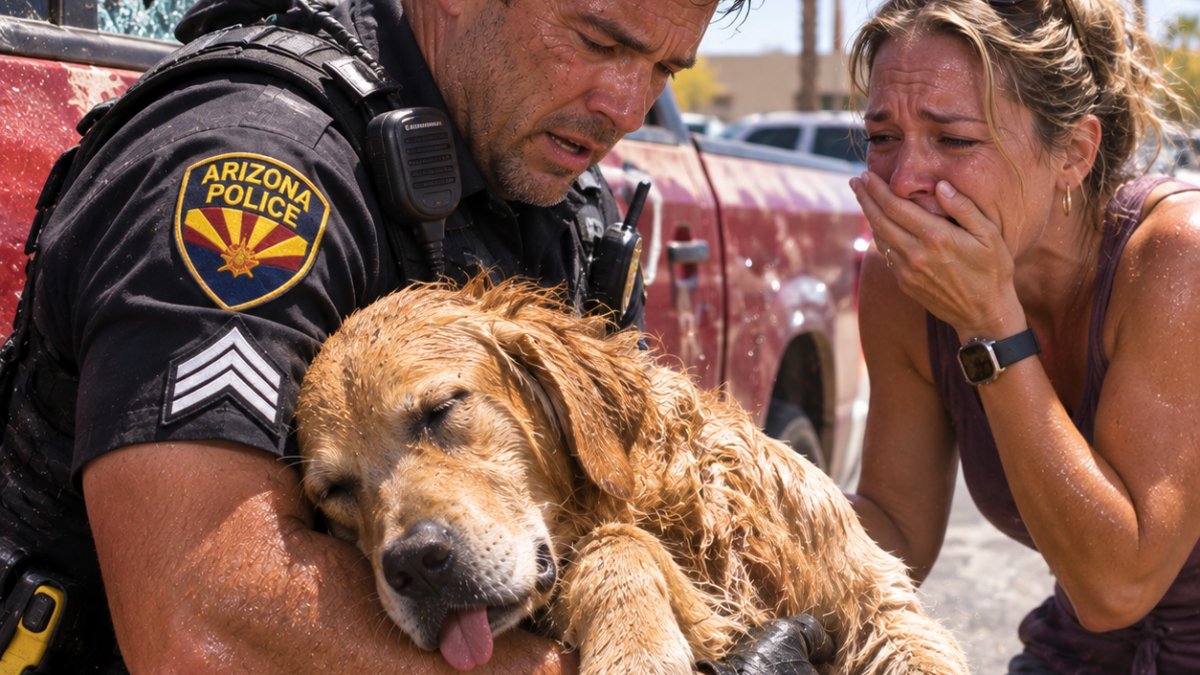
I Smashed a Truck Window in 114°F Arizona Heat and Pulled Out an Unconscious Golden Retriever—Then the Owner Ran Across the Parking Lot Screaming
On July 12, under brutal Phoenix heat, I stood beside a locked red Ford F-150 and watched a three-year-old golden retriever take slower and slower breaths in the back seat while the glass burned my fingertips and no owner could be found.
I had spent eighteen years wearing an Arizona police sergeant’s uniform, but nothing in the academy prepared me for the moment I raised my window punch and realized that if I hesitated because I was worried about damaging somebody’s truck, a young dog might die inches from my face.
Ten seconds after the glass shattered, I had the unconscious dog in my arms—and then a woman came running across the parking lot shouting, “THAT’S MY TRUCK!” before looking at the dog and whispering the six words that changed the entire scene: “Oh God… I forgot he was there.”
My name is Daniel.
I was forty years old that summer.
For eighteen years, I had worn a police uniform in Arizona.
In that time, I had learned to make decisions while people screamed at me.
I had walked into homes where arguments had turned violent.
I had stood on highways beside wrecked cars while traffic screamed past inches away.
I had searched buildings.
Chased suspects.
Talked frightened teenagers into putting weapons down.
Knocked on doors at two in the morning with news no parent should ever hear.
You learn to control your breathing.
You learn to separate urgency from panic.
You learn that hesitation can be dangerous, but acting without thinking can be worse.
And after enough years, you start believing very little can surprise you.
Phoenix in July can correct that kind of arrogance quickly.
The dispatch call sounded ordinary.
A woman had called 911 from the parking lot of a supermarket near 15th Avenue and Camelback Road.
She said a red Ford F-150 had been sitting in the same spot for what she believed was several hours.
Engine off.
Windows closed.
No driver.
There was a dog inside.
“He’s not moving much,” she told dispatch.
That changed the priority.
I was seven minutes away.
When I arrived, the heat hit me the instant I stepped from the cruiser.
The official air temperature was around one hundred fourteen degrees Fahrenheit.
The asphalt was far hotter.
Heat shimmered above the parking spaces.
Shopping carts were too hot to comfortably grab with bare hands.
People moved quickly between the store and their vehicles because simply standing still felt punishing.
The truck was parked at the far edge of the lot.
No tree.
No shade structure.
Nothing between it and the Arizona sun.
Red Ford F-150.
Engine silent.
I walked toward it.
A woman who had made the call stood several yards away.
“That one!”
I nodded.
“How long?”
“I noticed it when I came in earlier.”
“How much earlier?”
She hesitated.
“Maybe four hours?”
My stomach tightened.
“You’re sure?”
“No. I mean, I can’t swear nobody moved it. But it was here before.”
I reached the passenger side.
Looked through the glass.
And saw him.
Golden retriever.
Young.
Later I would learn he was three.
At that moment, all I saw was a golden body lying across the back seat.
His eyes were closed.
His tongue hung from his mouth.
Not panting normally.
His ribs moved.
Slowly.
Too slowly.
I knocked hard.
“Hey!”
Nothing.
Again.
“Buddy!”
I didn’t know his name yet.
The dog barely moved.
I tried the doors.
Locked.
Walked around the truck.
Every door.
Locked.
No owner.
No note.
No remote start.
No engine.
I touched the side window.
Pulled my fingers away almost immediately.
Hot.
I looked back inside.
The dog’s chest rose.
Fell.
Then another breath came mostly from his throat.
A weak, strained sound.
That was when the entire question changed.
It was no longer:
Do I have enough information?
It became:
How many seconds am I willing to spend thinking while this animal is failing in front of me?
PART2
FULL STORY CONTINUATION
I knew the authority I had.
I knew department policy.
I knew that when an animal’s life was in immediate danger, preserving life mattered more than preserving a vehicle window.
Still, law written on paper feels different from standing in a supermarket parking lot about to smash somebody’s property.
I remember one stupid thought clearly:
The owner is going to appear the second I break this glass.
Maybe human brains reach for ordinary problems when the real problem is too frightening.
Complaint.
Paperwork.
Supervisor.
Insurance.
Angry owner.
Then the dog took another breath.
Not with his full chest.
Only a shallow pull through his throat.
Everything else disappeared.
I reached for the window punch on my belt.
A small tool.
Nothing dramatic.
I chose a lower corner away from the dog’s body.
“Back up,” I told the woman who had called.
She stepped away.
I struck.
The glass did not explode into giant movie shards.
It fractured instantly into thousands of tiny pieces.
A web of glittering safety glass collapsed inward.
And the heat that came out of that truck hit my face like opening an oven.
That is not an exaggeration.
It shocked me.
The outside air was already brutal.
Inside the truck felt worse.
Stagnant.
Suffocating.
Hot enough that instinct made me pull my head away for half a second.
Then I reached through the broken opening, unlocked the rear door from inside, and pulled it open.
“Hey, buddy.”
No response.
I leaned in.
The dog’s coat felt hot.
Not warm from sunlight.
Hot enough that it frightened me through my hands.
I slid one arm beneath his chest.
Another beneath his body.
He was limp.
“Come on.”
I lifted.
For an instant his head rolled toward my shoulder.
No resistance.
No strength.
That scared me more than if he had fought.
Dogs fight when they have energy.
This one had almost none left.
I carried him toward my patrol vehicle.
Air-conditioning was already running.
I opened the rear door and placed him where the cooler air could reach him.
I radioed dispatch.
“Need animal emergency assistance and nearest veterinary contact.”
Then I grabbed water.
I had dealt with heat emergencies before and had read guidance after a previous animal call, enough to know not to shock an overheated dog with ice water.
So I began helping cool him carefully while we waited for transport instructions.
His paws.
Ears.
Lower body.
Slow.
Controlled.
Not dumping a cooler over him.
Not forcing water into his mouth while he was barely conscious.
“Stay with me.”
His eyelids moved.
I leaned closer.
“Come on.”
One eye opened.
Only slightly.
Then the other.
Brown eyes.
Unfocused.
But open.
“That’s it.”
His breathing remained fast and weak.
“Easy.”
For reasons I cannot explain, I kept talking.
Maybe because police officers are trained to keep conscious people engaged.
Maybe because silence made the situation too frightening.
“You’re safe.”
His eyes moved toward me.
“I know.”
I had no idea what I was claiming to know.
“Just stay with me.”
Then his tail moved.
Once.
Barely.
The smallest movement imaginable.
But it moved.
I laughed.
Not because anything was funny.
Relief leaks out of the body in strange ways.
“There you are.”
The tail stopped.
But that one movement felt like a promise he was still fighting.
Then somebody screamed across the parking lot.
“HEY!”
I stood.
A woman was running toward us.
Mid-forties.
Short hair.
Sunglasses.
Shopping bag in one hand.
She looked first at the truck.
Then the shattered window.
“What are you doing?”
I stepped toward her.
“Ma’am, stop there.”
“That’s my truck!”
“I’m Sergeant Daniel—”
“What happened to my window?”
Then she saw the dog.
Everything changed.
Her face emptied.
The shopping bag slipped from her fingers.
She looked at the back seat of my cruiser.
The golden retriever was lying near the air vent.
Trying weakly to raise his head.
The woman stopped moving.
“Oh my God.”
I had seen anger collapse before.
Usually when somebody realizes an officer is not the biggest problem in the scene.
This was different.
The realization seemed to travel physically through her body.
Her shoulders dropped.
Her mouth opened.
No sound.
I asked:
“Is this your dog?”
She looked at me.
Then said something strange.
“No.”
I frowned.
“What?”
She shook her head rapidly.
“No, I mean—yes.”
Her hands rose to her face.
“My dog. He’s my dog.”
I waited.
She stared at the truck.
Then at him.
“I went into the pharmacy.”
“How long ago?”
Her face changed again.
“I don’t know.”
“You need to think.”
“Five minutes.”
I said nothing.
She looked at the broken window.
Then the sun.
Then back at me.
“No.”
Her voice became smaller.
“It wasn’t five minutes.”
“How long?”
“I met somebody.”
She covered her mouth.
“An old friend.”
I felt anger rise.
Had to control it.
“How long?”
“I don’t know.”
“Ma’am.”
“Hours.”
The word almost disappeared.
She looked toward the dog again.
“Oh God.”
Then:
“I forgot.”
Her knees buckled.
She crouched beside my cruiser.
“I forgot he was back there.”
There are mistakes people make deliberately.
There are crimes committed through indifference.
There are also human failures so terrible that the person responsible understands what they have done before anyone can punish them.
I watched that realization happen.
The woman began crying.
Hard.
Not defensive.
Not arguing.
Not telling me:
I cracked the windows.
I was only gone a minute.
He had water.
None of that.
She simply stared at the dog.
“I forgot him.”
The words kept coming.
“I forgot him.”
Again.
“Buddy.”
That was the first time I heard his name.
She moved closer.
“Buddy.”
His eyes opened.
She reached toward him.
I stopped her for a moment.
“Slow.”
She nodded.
“Can I touch him?”
“Yes.”
Buddy’s nose moved.
The woman knelt.
Her fingers touched his paw.
“I’m sorry.”
Buddy looked at her.
Then, with almost no energy, licked one of her fingers.
She broke completely.
I had to look away.
People later asked why I didn’t scream at her.
What would that have accomplished?
The dog needed medical care.
The woman already understood the seriousness.
There would be reports.
Documentation.
Supervisory review.
Any legal or administrative decisions could be handled appropriately.
But in that parking lot, my priorities were simpler.
Keep Buddy alive.
Get him to veterinary care.
Make sure the owner understood that nothing about this was harmless.
I crouched beside her.
“Listen to me.”
She looked up.
“Your dog is alive.”
She nodded.
“But he is in serious condition.”
Another nod.
“You’re going to follow us to the emergency veterinary clinic.”
“Yes.”
“You are going to tell the veterinarian exactly how long you think he was in that vehicle.”
“Yes.”
“No minimizing.”
“I won’t.”
“And you’re going to listen to them.”
Her voice broke.
“Yes.”
I stood.
She stayed beside Buddy while I contacted my supervisor.
I explained.
Broken window.
Dog removed.
Severe heat exposure.
Owner located.
Transporting to emergency veterinary care.
My commander said:
“You did what you needed to do.”
Simple.
No drama.
Then:
“Take care of the dog.”
Buddy became more alert during the drive.
Not healthy.
Not remotely.
But alert.
The woman sat close to him.
Her hand stayed against his shoulder.
I could see them in the rearview mirror.
Every few seconds she whispered:
“I’m sorry.”
Buddy did not understand the concept of apology.
Probably.
But he knew her voice.
At one point he lifted his head and licked her chin.
That nearly undid me.
Dogs do not organize morality the way humans do.
They do not hold court.
Buddy did not know negligence law.
He knew:
My person is crying.
My person is here.
So he responded.
That was almost harder to watch.
“What’s his name?”
I already knew, but I wanted her talking.
“Buddy.”
“How old?”
“Three.”
Three.
I looked into the mirror.
Three years.
That was nothing.
A whole life still ahead.
“He’s healthy normally?”
“Yes.”
“Medical issues?”
“No.”
“Any medications?”
“No.”
“Good.”
She stroked his ear.
“I take him everywhere.”
The statement seemed to hurt her as soon as she said it.
“Usually.”
Then:
“I love him.”
I believed her.
That may be uncomfortable for people who want stories divided cleanly into good and bad.
People who love animals can make catastrophic mistakes.
Love does not replace responsibility.
But failure does not necessarily mean absence of love.
Both can exist.
That was what made the scene so painful.
The veterinary clinic was ready when we arrived.
Buddy was taken immediately.
Temperature.
IV access.
Bloodwork.
Cooling.
Monitoring.
The owner tried following into the treatment area.
A technician gently stopped her.
“We need space.”
She remained in the waiting room.
I stayed because I needed documentation and because, if I am being truthful, I wanted to know whether Buddy lived.
Police officers become skilled at leaving scenes.
You have to.
One call ends.
Another begins.
But I could not leave yet.
I stood near the door.
My hand stung.
I looked down.
Tiny cuts from safety glass.
Nothing serious.
A few bright red lines.
I washed them in the bathroom.
When I returned, Buddy’s owner was sitting with both hands over her face.
I sat several seats away.
For a while, neither of us spoke.
Then she said:
“I don’t deserve him.”
I looked at her.
“That isn’t the decision to make tonight.”
She cried.
“I could have killed him.”
“Yes.”
No comfort.
Truth first.
She looked shocked by the bluntness.
I continued.
“But he’s alive.”
She nodded.
“Right now, you help him recover.”
“What if he doesn’t?”
I did not answer.
I didn’t know.
The veterinarian came out after what felt like an hour.
Maybe it actually was close to that.
Older man.
Calm.
Tired eyes.
The kind of veterinarian who had probably delivered thousands of pieces of good and bad news.
“Buddy’s responding.”
The woman stood immediately.
“Is he going to live?”
“I believe so.”
She covered her mouth.
The veterinarian raised one hand.
“But.”
Every hopeful sentence in medicine seems to contain a but.
“He was dangerously overheated.”
She nodded.
“We’re monitoring kidney function and other organ systems.”
“How bad?”
“Bad enough that another stretch of time in that vehicle could have produced a very different outcome.”
“How much time?”
“I can’t give you a precise clock.”
He looked toward me.
“But he was in serious danger.”
She started crying again.
The veterinarian did not soften it.
Good.
“He was lucky.”
She looked at me.
“No.”
Then back at him.
“We were lucky the sergeant came.”
I hated being pulled into the center.
“This isn’t about me.”
The veterinarian said:
“He got the dog out.”
I replied:
“Because somebody called.”
That mattered.
The woman in the parking lot who noticed the truck.
Dispatch.
Everyone was part of the chain.
No single heroic moment.
Just somebody paying attention soon enough.
Buddy remained at the clinic for observation.
IV fluids.
Blood tests.
Cooling.
Rest.
Eventually he drank small amounts.
Later ate a little.
His owner sat close whenever the staff allowed.
I finished paperwork at the clinic.
There are few things less dramatic than writing an incident report after everybody calls you a hero.
Times.
Location.
Vehicle description.
Observations.
Actions taken.
Statements.
Medical disposition.
That is the actual work.
Documentation.
I wrote that the dog’s breathing was severely compromised.
That the vehicle was locked.
That no owner was present when I arrived.
That I used emergency entry to access the rear door.
That Buddy was immediately moved into a cooler environment.
Facts.
No adjectives like horrifying.
No:
I thought he was dying.
Reports are not memoirs.
But I was thinking it.
Before I left, I sat beside the owner.
“I want you to do something.”
She looked nervous.
“What?”
“Tell people what happened.”
Her face tightened.
“You mean report it?”
“No.”
I pointed at her phone.
“Tell them yourself.”
She stared.
“Online?”
“Yes.”
“Why?”
“Because people convince themselves they know how long five minutes is.”
She looked toward Buddy’s treatment room.
I continued.
“They think they’ll just run inside.”
“One item.”
“One prescription.”
“One conversation.”
“They believe the car isn’t that hot.”
“They think cracking a window fixes it.”
She looked down.
“I don’t want everyone to know what I did.”
“I know.”
“People are going to hate me.”
“Some probably will.”
Her eyes filled.
“Then why?”
“Because maybe somebody remembers your story before they make the same mistake.”
Long silence.
Then she unlocked her phone.
“What should I write?”
“Exactly what happened.”
“No excuses.”
She nodded.
Then started typing.
I left the clinic near sunset.
The heat had dropped.
Which in Phoenix in July does not mean cool.
It only means less brutal.
I sat in my cruiser.
Closed the door.
Turned on the air.
Then I put both hands on the steering wheel.
And stayed still.
That was when the adrenaline left.
My hands began shaking.
Not badly.
Enough.
I could still feel Buddy’s coat under my palms.
Too hot.
His limp head against my arm.
That throat-breath.
The tiny tail movement.
I leaned forward.
Forehead against the steering wheel.
And cried.
Not long.
Maybe thirty seconds.
Maybe two minutes.
I do not know.
Then my radio sounded.
Another call.
Life does not pause because you had a meaningful afternoon.
I wiped my face.
Answered.
“Go ahead.”
And went back to work.
The next morning my commander asked me into his office.
He had a computer screen turned toward the wall.
That is never comforting.
“You break any other windows overnight?”
“No.”
“Disappointing.”
I sat.
He turned the monitor.
Local news.
There I was.
Kneeling beside Buddy.
Water bottle in hand.
Patrol car behind me.
Someone had taken a photograph from a distance.
I had never seen the camera.
The headline described an officer rescuing a dog from a dangerously hot truck.
“Oh, great.”
My commander laughed.
“You’re famous.”
“No.”
“Buddy is.”
“Better.”
Then video played.
Buddy’s owner had spoken to a reporter.
Face visible.
Her choice.
No anonymity.
She said:
“I made a terrible mistake.”
I leaned closer.
She continued:
“I thought I was going inside for a few minutes.”
“I got distracted.”
“I forgot my dog was in the truck.”
Her voice broke.
“Sergeant Daniel broke my window and saved Buddy’s life.”
Then:
“I want people to be angry at me if that makes them remember never to do what I did.”
I sat back.
My commander became quiet.
“That took guts.”
“Yes.”
He pointed at the screen.
“You did well yesterday.”
“I broke glass.”
“You made a decision.”
“That’s the job.”
“Exactly.”
Then he smiled.
“Still did well.”
Police supervisors are irritating when they are correct.
The story spread faster than I expected.
Local stations.
Neighborhood pages.
Animal-welfare groups.
Comments.
Thousands.
Some compassionate.
Many furious at Buddy’s owner.
A few insisted she should never be allowed near an animal again.
Some wanted criminal charges regardless of context.
I did not participate.
My role was over.
I had documented what happened.
Appropriate authorities would handle whatever review was necessary.
Online outrage is not due process.
Still, I understood the anger.
I had felt it too.
But I had also watched the woman kneel beside Buddy and realize she almost caused the death of an animal she loved.
The internet had not seen that moment fully.
Maybe no camera could.
What interested me more were the messages from people saying:
“I always thought a few minutes was okay.”
“I won’t anymore.”
“I showed this to my teenagers.”
“I keep water in my car but never realized how fast heat builds.”
“I walked through a parking lot today and checked every car.”
That made the unwanted attention easier.
The point of a story should be what somebody does differently afterward.
Otherwise it is just noise.
That evening, I went home.
My wife Amy was waiting in the kitchen.
She had already seen everything.
Of course.
I stepped inside.
She looked at me.
I looked at her.
Then she asked:
“Did you cry?”
“No.”
She narrowed her eyes.
“I have been married to you for twelve years.”
“Congratulations.”
“Daniel.”
“No.”
She continued staring.
I lasted about three seconds.
“A little.”
“I knew it.”
“You sound happy.”
“I’m not happy.”
“Yes, you are.”
“Maybe slightly.”
Then she hugged me.
I held her longer than usual.
Our dog Molly came running.
Small golden mix.
Shelter dog.
Three years old.
Same age as Buddy.
That hit me.
She circled our legs.
Jumped.
Tail everywhere.
I crouched.
Picked her up even though she was too large to be comfortably picked up.
“Hey.”
She licked my nose.
I laughed.
“You know what I did today?”
Amy said:
“She doesn’t.”
“I saved somebody who looks a little like you.”
Molly licked me again.
“Exactly your age.”
That sentence caught in my throat.
Three years.
Buddy could have lost the next ten.
Twelve.
Maybe more.
Because of one afternoon.
I buried my face in Molly’s fur.
Amy touched my shoulder.
This time she did not tease me about crying.
That night I couldn’t sleep.
Arizona heat emergencies were not new.
Neither were neglected animals.
But Buddy stayed in my head.
I kept seeing the truck.
What if the caller had assumed someone else would handle it?
What if dispatch had categorized it lower priority?
What if I had arrived fifteen minutes later?
What if I had spent five extra minutes searching the store for the owner before breaking the window?
Police work contains endless alternate timelines.
If you allow yourself to live inside them, they will destroy you.
So we learn to focus on what happened.
Call came.
I responded.
Dog was alive.
Window broke.
Dog came out.
Veterinary treatment started.
Good.
Still, sleep took a long time.
The following week, I stopped at the same supermarket while on patrol.
Different call nearby.
I walked past the parking space.
Nothing there.
Of course.
Just asphalt.
Sun.
A shopping cart.
I stood for a second.
Then noticed myself looking into nearby vehicles.
Not suspiciously.
Checking.
No dogs.
No children.
Good.
I moved on.
That became a habit.
Not obsessive.
Just awareness.
Parking lots looked different afterward.
Amy noticed changes too.
One Saturday she said:
“You’re staring into cars.”
“No.”
“You absolutely are.”
“Occupational awareness.”
“You checked six vehicles outside Target.”
“There could have been—”
“Daniel.”
“Fine.”
She smiled.
“Buddy got to you.”
I did not deny it.
About ten days after the rescue, Buddy’s owner called the station asking whether she could leave me a message.
The desk transferred her.
“Sergeant?”
“Yes.”
“It’s Buddy’s owner.”
I recognized her voice immediately.
“How is he?”
“Good.”
My whole body relaxed.
“Really?”
“He had another blood test.”
“Kidneys?”
“Normal.”
“That’s good.”
“He’s eating.”
“Good.”
“He follows me everywhere.”
She laughed.
Then cried in the same breath.
“I don’t think he trusts me to leave the room.”
I didn’t know what to say.
She continued.
“I deserve that.”
“Don’t make it about what you deserve.”
Silence.
“Make it about what he needs.”
She breathed.
“What does he need?”
“Consistency.”
I was not a dog behaviorist.
But that answer felt safe.
“Be where you say you’re going to be.”
“Don’t put him in a vehicle unattended.”
“Follow your vet’s advice.”
“And forgive yourself enough that your guilt doesn’t become another burden he has to live around.”
That last sentence surprised both of us.
She became quiet.
“Thank you.”
“Take care of Buddy.”
“I will.”
I believed her.
Three weeks after July 12, an envelope arrived at the station.
Actual paper mail.
My name handwritten.
No return address I recognized.
Inside:
A photograph.
Buddy.
Golden coat.
Healthy.
Standing in a backyard.
Green grass.
Blue sky.
Mouth open in that retriever smile people anthropomorphize because we cannot help ourselves.
He looked enormous compared with the limp body I had carried.
Alive.
Completely, casually alive.
Behind the photo was a note.
Sergeant Daniel,
Buddy is doing well. His bloodwork is normal, his appetite is back, and he wakes beside me every morning. He follows me from room to room now. I don’t blame him. I am learning that love means being worthy of the trust you are given, not simply saying you love someone.
I stopped reading.
The next line blurred.
I waited.
Continued.
Thank you for breaking the window. Thank you for not caring whether I would be angry. Thank you for making the decision I should have prevented you from ever needing to make.
Buddy got a second chance. I did too.
At the bottom:
P.S. He still hates getting in the truck. We are working on that slowly, and he is never left there alone.
I laughed.
Then sat down.
My partner from the next desk looked over.
“You crying?”
“No.”
“Sure.”
Police stations are hostile environments for emotional privacy.
I put Buddy’s photograph beside family pictures on my desk.
Amy.
Molly.
A picture from our wedding.
Then Buddy.
One officer said:
“You know that’s not your dog.”
“I am aware.”
“Looks like your dog.”
“Molly has less dignity.”
Fair.
Buddy stayed there.
Months.
Then years.
The incident changed department conversations too.
Not in some enormous official way.
We already had policies.
Already trained for emergency entry.
But stories make policies memorable.
A younger officer once asked:
“How did you know it was time to break the glass?”
I answered:
“When waiting became more dangerous than acting.”
He nodded.
I added:
“Don’t copy the sentence into a report.”
He laughed.
But I meant the principle.
Police work is often deciding at what point uncertainty no longer justifies delay.
You need law.
Policy.
Training.
Observation.
Then judgment.
No academy can pre-decide every parking lot for you.
I also became more careful about how I spoke about animal calls.
When I was younger, I probably categorized some as minor.
Dog loose.
Animal welfare check.
Pet locked in vehicle.
Compared with weapons calls and domestic violence, they can feel less urgent.
But urgency belongs to the vulnerable being inside the event.
Buddy did not care that other calls were more dramatic.
For him, that truck was the whole emergency.
That mattered.
A year later, I got another hot-car call.
Different parking lot.
Different dog.
This time, the owner was found within minutes and the dog was still alert.
No broken window.
Good.
The owner looked annoyed.
“I was only inside a couple minutes.”
I asked:
“Do you know about Buddy?”
Her expression changed.
“The golden retriever?”
“Yes.”
“I saw that.”
She immediately opened the car.
Sometimes stories do work that authority alone cannot.
Buddy’s owner continued sending occasional updates.
Not constantly.
A holiday card.
A birthday photo.
Buddy at four.
Then five.
Swimming in a kiddie pool.
Wearing a ridiculous hat.
One year:
Buddy next to a new rescue puppy.
The note said:
He is teaching her bad habits.
I laughed.
The dog who once lay unconscious in a truck had become somebody’s annoying older brother.
Perfect.
The second anniversary of the incident, I received a message:
Two years today. I still think about the sound of that window breaking. At first it felt like the worst sound in my life. Now I think it was the sound that gave me more years with him.
I reread that sentence several times.
Glass breaking.
We usually associate it with violence.
Burglary.
Crash.
Damage.
That day, broken glass meant access.
Air.
Life.
Context changes sound.
Amy and I eventually met Buddy properly.
Not as patient.
Not as victim.
His owner invited us to a small animal-safety fundraiser.
I hesitated.
It felt awkward.
Amy said:
“We’re going.”
Of course.
Buddy was six by then.
Still golden.
Still energetic.
When we arrived, I wondered whether he would recognize me.
Probably not.
Maybe scent memory.
Maybe not.
He approached.
Sniffed my pants.
Then my hands.
Tail wagging.
I crouched.
“Hey, buddy.”
His owner watched.
“He likes you.”
“He likes everybody.”
“Not everybody.”
Buddy pushed his head beneath my hand.
I scratched behind his ear.
For one second, I remembered the hot fur.
The limp body.
Then Buddy sneezed into my face.
Memory ruined.
I laughed.
Good.
I preferred him ordinary.
Molly came too.
She and Buddy met carefully.
Sniff.
Tail.
Play bow.
Then chaos.
Two golden dogs running through a fenced yard.
Amy took video.
Buddy’s owner stood beside me.
She watched him.
“You ever think about that day?”
“Yes.”
“Me too.”
She looked at me.
“Every day.”
I said:
“You don’t have to punish yourself every day.”
She nodded.
“I know.”
“Do you?”
“I’m learning.”
Then Buddy ran past us with Molly chasing.
The woman smiled.
“This helps.”
Of course.
Present tense heals differently from guilt.
She had become involved with local animal-safety education.
Not as a public penance forever.
As something useful.
She spoke honestly.
No excuses.
“I forgot my dog in a vehicle.”
People always became uncomfortable at that sentence.
Good.
Then she explained distraction.
Routine interruption.
Conversation.
False confidence in short errands.
She encouraged people to build habits that prevent forgetfulness.
Leave necessary items with the pet’s leash?
Use reminders?
Avoid taking the dog if errands require leaving them unattended.
Have a second person check.
Practical safeguards.
Her mistake became prevention work.
That did not erase it.
It gave it direction.
I respected her for that.
There are different forms of accountability.
Some are legal.
Some social.
Some private.
The hardest may be allowing your worst mistake to become something other people can learn from without spending the rest of your life demanding everyone reassure you that you’re a good person.
She never asked me to absolve her.
She did the work.
Buddy seemed happy.
That was enough.
Years passed.
My career moved.
New officers.
New calls.
More gray in my hair.
Buddy’s photograph stayed on my desk.
People who did not know the story sometimes asked:
“Your dog?”
I said:
“Kind of.”
Then told them.
One rookie listened and said:
“So you didn’t ticket her?”
I looked at him.
“That is what you took from the story?”
He flushed.
“No, I just—”
“Every enforcement decision has facts.”
I tapped the photograph.
“Your job isn’t to satisfy internet comments.”
“It’s to act lawfully, document honestly, protect life, and make the decision the actual circumstances support.”
He nodded.
“Got it.”
“Good.”
Then:
“And don’t leave a dog in a Phoenix parking lot.”
He laughed.
Lesson complete.
At home, Molly aged too.
Watching her gray made Buddy’s story hit differently.
Three years old had seemed so young.
Because it was.
Molly reached ten.
Then eleven.
One afternoon I found her sleeping in sunlight.
I sat beside her.
Thought:
Buddy almost never got this.
All these ordinary years.
Naps.
Walks.
Treats.
Vet visits.
Annoying habits.
Aging.
Gray hair.
Being old is a privilege animals do not receive if one bad afternoon ends everything.
I scratched Molly’s ear.
She opened one eye.
“Getting old.”
She went back to sleep.
Good.
Buddy’s owner sent a photograph when he turned ten.
White around the muzzle.
Still smiling.
The message:
Remember when the vet said another fifteen minutes could have changed everything? Today he stole a sandwich off my counter at ten years old. I have never been happier to lose lunch.
I showed Amy.
She cried.
Then accused me of crying.
Marriage remained hostile to privacy.
When Buddy was eleven, his owner called.
My number had changed twice.
She somehow kept it.
“Daniel?”
“Yes.”
“This is—”
“I know.”
Pause.
“How is he?”
Silence.
I sat down.
That told me.
“Buddy?”
“He’s sick.”
My chest tightened.
“What kind?”
“Cancer.”
I closed my eyes.
“I’m sorry.”
“He’s comfortable.”
“Good.”
“We’re not there yet.”
I understood what she meant.
Not goodbye today.
But visible on the road ahead.
She said:
“I wanted you to know.”
“Thank you.”
Then:
“You gave me eight extra years.”
“No.”
“Yes.”
“He did the living.”
“And you opened the door.”
That stopped me.
Broken window.
Open door.
Life.
I did not argue.
Buddy lived another nine months.
His owner sent one final photograph.
He was lying beneath a tree.
White face.
Golden body thinner.
Eyes still bright.
Caption:
Still bossing everyone around.
Good.
The final call came on a quiet Sunday.
Amy and I were having coffee.
Phone rang.
I answered.
Buddy’s owner.
She cried before speaking.
“He’s gone.”
Amy saw my face and put down her cup.
I closed my eyes.
“When?”
“This morning.”
“At home?”
“Yes.”
“Good.”
“He was on his bed.”
Her voice shook.
“I was holding him.”
“That’s good.”
“I kept thinking about that day.”
I knew.
“I told him…”
She stopped.
“What?”
“I told him the officer was right.”
I smiled through tears.
“About what?”
“That he was safe.”
My throat closed.
Years earlier, I had said those words to a barely conscious dog because police officers say things when we want someone to keep fighting.
You’re safe now.
At the time, it was only temporarily true.
Cool cruiser.
Veterinary care.
Then his owner spent eight years making it permanent enough.
That mattered more than the parking lot.
After we hung up, Amy walked around the table.
Hugged me.
I cried openly.
No denial.
Molly was gone by then too.
Age.
Time.
The house held those absences differently.
I thought about Buddy at three.
Buddy at ten.
Buddy at eleven beneath a tree.
Eight years that almost disappeared.
Not because I was a hero.
Because somebody noticed him.
Called.
Dispatch sent me.
I acted.
Veterinary staff treated him.
His owner changed.
Buddy lived.
Rescue is usually a chain.
No single link gets to claim the whole thing.
Several weeks later, a package arrived.
Inside was Buddy’s red collar.
I stared.
A note:
I hope this isn’t strange. I kept his tags, but I wanted you to have the collar he wore for most of the years after that day. You were the first person who touched him when his life was hanging by a thread. I thought maybe you should have something from the life he got afterward.
I sat at my desk holding the collar.
No idea what to do with it.
Eventually I placed it beside the original photograph.
Not as a trophy.
Never.
A reminder.
Years of police work leave objects.
Challenge coins.
Badges.
Certificates.
Commendations.
Photos.
I value some.
But that collar means something different.
It reminds me that the most important decisions rarely feel heroic while you make them.
They feel uncertain.
Messy.
Immediate.
You worry about being wrong.
Then a weaker voice inside the moment asks:
What happens if I do nothing?
That question often clarifies things.
I still drive past that supermarket sometimes.
Phoenix changed.
Businesses changed.
Parking lot repainted.
The exact space hard to identify now.
Good.
Places should not have to remain memorials to their worst afternoon.
But when summer comes and the temperature climbs above one hundred ten, I look.
I always look.
Inside parked vehicles.
Quickly.
Not paranoia.
Memory.
Most are empty.
Good.
Every empty hot car feels like good news.
People still occasionally recognize me from the old news clip.
Less now.
One man once said:
“You’re that cop who broke the window for the dog.”
I smiled.
“Long time ago.”
“Hero.”
I shook my head.
“No.”
He started arguing.
I stopped him.
“Someone else called 911.”
He paused.
“Okay.”
“The vet saved his organs.”
“Okay.”
“His owner gave him years of care afterward.”
“Okay.”
“Buddy survived.”
The man smiled.
“So everybody’s the hero?”
“No.”
I laughed.
“Maybe nobody needs the title.”
He thought.
“Fair.”
I have become increasingly suspicious of the word hero.
It can make ordinary responsibility sound rare.
Breaking the glass was not some superhuman act.
It was a trained officer using lawful authority because a life was visibly in danger.
The person who called did something equally important.
She noticed.
That deserves emphasis.
How many emergencies become tragedies because everybody assumes someone else will notice?
Attention is one of the cheapest forms of public safety.
Look.
Listen.
Call.
Buddy also taught me something about mistakes.
The internet wanted his owner to be one thing forever.
Monster.
Negligent woman.
Bad dog owner.
Maybe some people will disagree with me.
Fine.
What she did was dangerous.
That fact never changed.
But neither did this:
She spent the next eight years behaving differently.
She educated people.
Changed routines.
Cared for Buddy.
Stayed beside him when he got old.
Held him when he died.
If accountability cannot include change, then what are we asking people to do with remorse?
Punishment has purposes.
So does rehabilitation.
So does learning.
Life is complicated enough to hold all three.
Buddy did not spend eight years thinking about July 12.
Humans do that.
Dogs have a better relationship with time.
He recovered.
Then ate.
Played.
Slept.
Aged.
Stole sandwiches.
Met another rescue dog.
Sat in the yard.
Followed his owner.
That was his victory.
He became ordinary again.
I prefer that to calling him a survivor forever.
Survival is important.
But nobody should have to wear their worst day as their permanent identity.
Not people.
Not animals.
Buddy deserved to become the dog who annoyed his owner at breakfast.
The dog who shed everywhere.
The dog who needed arthritis medicine.
The dog who became gray.
Those are luxuries.
Ordinary years.
When I look at his first photograph now, I no longer focus on myself kneeling beside him.
I look at his eyes.
Barely open.
Then I look at the later photograph.
Backyard.
Healthy.
Bright.
Years between them.
That is the story.
Not the broken glass.
The years.
Amy once asked:
“If you could redo it, would you change anything?”
“Break the window faster.”
She smiled.
“That’s it?”
“Maybe wear gloves.”
Tiny glass cuts hurt.
She laughed.
Then became serious.
“You ever think what would have happened if you hadn’t?”
“No.”
A lie.
Of course I had.
But eventually I stopped.
Alternate tragedy does not deserve more space than the life Buddy actually lived.
He survived.
That is the timeline I choose.
The incident also changed how I trained younger officers.
Not just animal calls.
Decision-making.
I would tell them:
“You will rarely have perfect information.”
“You still need enough information.”
“Know your legal authority.”
“Know policy.”
“Observe.”
“Think.”
“Then if delay becomes the greater danger, act.”
One officer asked:
“How do you know?”
“You won’t always.”
That answer frustrated him.
Good.
Real judgment should feel heavy.
If every difficult decision feels obvious, you are probably not thinking hard enough.
I told them the Buddy story.
Not because dogs make training memorable.
Though they do.
Because Buddy’s breathing forced a decision.
There was no supervisor standing beside me.
No committee.
Just heat.
Glass.
A failing animal.
Responsibility had arrived.
That is policing more often than people realize.
Small moments with no audience until afterward.
The photograph remained on my desk until retirement.
Yes.
Eventually I retired.
The station gave me a shadow box.
Badge.
Nameplate.
Years of service.
Photos.
Amy helped me pack my desk.
She picked up Buddy’s collar.
“This coming home?”
“Yes.”
“Photo?”
“Yes.”
“Everything?”
“No.”
Then I looked around.
Maybe most things could stay.
Buddy came home.
Of course.
At my retirement gathering, my old commander mentioned the rescue.
I groaned.
He ignored me.
“There are calls officers remember because they’re dangerous.”
He said.
“And calls they remember because they remind us what authority is for.”
Then he pointed toward me.
“Daniel once damaged a perfectly good Ford.”
Everyone laughed.
I shouted:
“Window.”
“Very expensive window.”
More laughter.
Then he became serious.
“And because he was willing to be wrong about a piece of property, a dog got eight more years.”
I looked down.
That phrasing stayed with me.
Property versus life.
Once reduced that way, the choice seemed simple.
In the moment, it had still required action.
After retirement, Amy and I adopted another dog.
Of course.
A senior golden mix.
She was eight.
Her name was Daisy.
People asked:
“Why an older dog?”
I said:
“Less chewing.”
Lie.
Daisy destroyed one shoe in the first week.
But senior dogs had become important to me.
Maybe Buddy.
Maybe Molly.
Maybe age had changed me.
When you are young, you think value comes from how much future remains.
Then you get older.
You realize today is not less valuable because there may be fewer tomorrows.
Applies to dogs.
Applies to us.
Daisy slept under my desk.
Sometimes I looked from her to Buddy’s photo.
Different dog.
No comparison.
Good.
Every animal deserves to be themselves.
I began volunteering occasionally with public animal-safety programs.
Not as “hero cop.”
I refused that introduction whenever possible.
Just Daniel.
Retired sergeant.
Dog owner.
A guy who once broke a window.
I talked about observation.
Heat.
Responsibility.
Emergency services.
And something people overlook:
Human memory is fallible.
Buddy’s owner did not wake up planning to hurt him.
That is precisely why prevention cannot depend only on thinking:
I would never forget.
People forget children.
Phones.
Groceries.
Appointments.
Pets.
We build systems because intention is not perfect.
Avoid situations where a pet must remain unattended in dangerous heat.
Use reminders.
Change habits.
Reduce reliance on memory.
That lesson is less emotionally satisfying than calling someone evil.
More useful.
Sometimes somebody in the audience would confess:
“I did something similar once.”
Not always with heat.
Forgot a dog outside.
Left a gate open.
Medication missed.
Then they waited for judgment.
I would say:
“What changed afterward?”
That is the question.
If nothing changes, remorse is only emotion.
If behavior changes, remorse becomes information.
Buddy’s owner changed.
I respected that.
One summer, a teenager approached me after a talk.
“My dad says dogs are fine in cars if the window is cracked.”
I sighed.
“Your dad and I need coffee.”
The teenager laughed.
Then took a pamphlet.
Maybe showed him.
Maybe not.
You plant what you can.
The most important part of Buddy’s story became less dramatic every year.
At first:
Officer smashes window.
Dog rescued.
Owner returns.
Veterinary emergency.
News.
Later:
Buddy turns eight.
Buddy turns ten.
Buddy gets old.
Buddy dies at home.
That is how it should be.
A rescue is successful when the emergency becomes smaller than the life that follows.
Buddy’s emergency lasted one afternoon.
His life after lasted eight years.
Good ratio.
I sometimes think about his first weak tail wag.
One movement.
Barely.
At the time it felt enormous.
Because it meant he was still inside that overheated body.
Still responding.
Still there.
Years later, his owner told me that near the end of his life, Buddy’s tail barely moved when she entered the room.
Old age.
Cancer.
Weakness.
But it moved.
Same dog.
Beginning and ending marked by one small wag.
That makes me emotional if I let myself think too long.
So I usually don’t.
Amy says I became softer after Buddy.
I disagree.
She has evidence.
I refuse to review it.
Maybe policing teaches you to compartmentalize because you need to keep functioning.
Animals have a way of ignoring compartments.
They do not care about rank.
Badge.
Professional distance.
Buddy was dying.
I was there.
That simple reality bypassed everything else.
Maybe softness is not the opposite of strength.
Maybe it is what strength is for.
The strongest thing I did that day was not swinging the window punch.
Tools make glass easy to break.
The harder part was committing to the decision.
Then staying calm enough to help afterward.
Force is sometimes necessary.
But force is not inherently strength.
Control is.
Purpose is.
Knowing what you are protecting is.
I carried Buddy because he could not carry himself.
That is probably the simplest version of the story.
No metaphor needed.
A living creature was helpless.
Someone had to act.
I happened to be there.
And yet, years later, that afternoon still changed me.
Not because cameras came.
Not because my commander praised me.
Not because a photo sat on my desk.
Because every time I looked at Buddy healthy in that backyard, I remembered how close an entire life came to being measured in minutes.
We waste time imagining we have endless ordinary days.
Buddy nearly lost all of his.
Then got thousands more.
Morning after morning.
That is what a second chance actually means.
Not one dramatic rescue.
The boring days afterward.
Buddy woke beside his owner.
Ate breakfast.
Went outside.
Came in.
Slept.
Repeated.
Nothing newsworthy.
Everything worth saving.
If someone asked me today what I remember most vividly, they might expect the glass breaking.
No.
The heat.
When the window opened.
That wave of trapped air.
I will never forget it.
Because standing outside, I already knew the day was dangerously hot.
Then I felt what Buddy had been breathing.
And suddenly every abstract warning about hot vehicles became physical.
No slogan could equal that second.
It made me angry.
Scared.
Certain.
The second thing I remember:
His coat in my arms.
Too hot.
The third:
One tiny tail wag.
The fourth:
His owner saying:
“I forgot.”
Not as an excuse.
As horror.
The fifth:
Buddy licking her hand.
The sixth:
The photo three weeks later.
Healthy.
Those six moments contain almost everything.
I do not tell people to carry a window punch and start breaking strangers’ cars.
Emergency scenes require judgment, law, and safe procedures.
Call emergency services.
Get help.
Do not turn concern into another danger.
My story is not permission for chaos.
It is a reminder not to ignore visible distress because intervening feels inconvenient.
There is a difference.
The caller did the right thing first.
She saw.
She called.
I arrived.
That order matters.
Sometimes courage is dialing three numbers and refusing to walk away until someone comes.
We should celebrate that too.
I eventually met her again.
The woman who called 911.
She recognized me at a community event.
“Sergeant Daniel?”
“Retired now.”
“I’m the person who called about Buddy.”
I stared.
Then smiled.
“I’ve wanted to thank you.”
She looked surprised.
“Me?”
“Yes.”
“I didn’t do anything.”
“You called.”
“That’s nothing.”
“No.”
I shook my head.
“That’s the entire reason I arrived.”
She became emotional.
People underestimate their link in a chain because someone else’s action looks more dramatic.
Without her:
No broken glass.
No clinic.
Maybe no Buddy.
I wanted her to know.
She asked:
“Did he make it?”
“Yes.”
I told her.
Eight more years.
She covered her mouth.
“Oh.”
Then cried.
Good.
Join the club.
That encounter completed something for me.
Buddy’s story belonged to more people than the news clip showed.
Caller.
Dispatch.
Me.
Veterinary team.
Owner.
Buddy.
Every link mattered.
Rescue is often collaborative even when photographs capture one person.
When I retired, I visited the parking lot one last time in uniform.
Not ceremonially.
I had another call nearby.
I parked.
Looked toward the far corner.
Summer.
Hot.
No red Ford.
No Buddy.
Just vehicles.
I smiled.
Then drove away.
Goodbye didn’t need more.
At home, Buddy’s photo now sits beside Molly’s.
Two dogs.
Both gone.
Daisy sometimes bumps the table with her tail.
Life continues disrespectfully.
I like that.
Grief should not turn a home into a museum.
Dogs certainly wouldn’t approve.
Too many objects to knock over.
Sometimes I receive messages from people who heard the story years later.
One said:
“I remembered Buddy when I saw a dog in a parking lot and called for help.”
Another:
“I never leave mine in the car anymore.”
Those messages mean more than praise.
Behavior.
Again.
That is the measure.
Buddy’s owner wrote me one final letter after he died.
Short.
I keep it behind the photograph.
It says:
Daniel,
For eight years after that July afternoon, I woke up every morning knowing Buddy was alive because a stranger chose his life over my window.
I used to think the broken glass was evidence of my worst failure. Eventually I understood it was also the beginning of my responsibility to do better.
Buddy forgave the world faster than I forgave myself. Maybe that was one more thing he taught me.
Thank you for giving me enough time to learn it.
I do not know whether “giving time” is accurate.
I opened a door.
Veterinarians did medicine.
Buddy did the hard biological work of surviving.
But I understand what she meant.
Time.
That is what everyone wanted that afternoon.
Buddy needed more.
His owner needed a chance to correct what almost became irreversible.
I needed enough seconds to make the right choice.
We got them.
Not everyone does.
That truth keeps the story from becoming sentimental nonsense.
Luck was part of it.
Timing.
A caller.
Seven-minute response.
Buddy still breathing.
We were lucky.
Responsibility and luck often meet in emergencies.
Use the luck well.
If I could speak to the version of myself standing beside that truck before breaking the glass, I would say:
Stop worrying about the complaint.
Look at the dog.
You already know.
Act.
Then I would tell him something else.
That golden retriever will live long enough to become gray.
Long enough to steal sandwiches.
Long enough to help another rescue dog learn a home.
Long enough for his owner to turn shame into education.
Long enough that one afternoon of heat will become only a small part of his life.
That is what I would want to know most.
Because on July 12, I thought I was saving a three-year-old dog from the next fifteen minutes.
I did not understand I was helping protect thousands of ordinary moments that had not happened yet.
Eight birthdays.
Winter mornings.
Backyard naps.
Vet appointments.
Family photographs.
Stolen food.
Gray fur.
Old age.
A final morning at home.
All of it was hidden behind that hot piece of glass.
That is what was actually at stake.
A future.
And that is why, decades into a career full of much louder emergencies, I still remember Buddy.
Not because he was the most dangerous call.
Not because I received an award.
I didn’t need one.
Not because local television used the word hero.
I still reject it.
I remember because that afternoon reduced the purpose of the badge to something very simple.
There was a vulnerable life trapped behind a barrier.
I had the authority and the ability to reach it.
So I did.
Buddy did not care about my rank.
He did not know the law.
He did not understand the broken window.
He simply opened his eyes in cold air, looked at the stranger beside him, and moved his tail once.
Sometimes one small movement is enough to tell you the decision was right.
Years later, when I learned Buddy had died peacefully at home, I did not think first about loss.
I thought:
He got old.
That sentence made me smile.
A dog who nearly died at three got to become old.
Gray.
Slow.
Loved.
Annoying.
Tired.
That is a beautiful ending.
Maybe the best.
So no, the moment I remember most is not the sound of the window breaking.
It is Buddy’s tail.
One weak movement against the seat.
The first sign that after all that heat, something inside him was still saying:
I’m here.
And everything we did after that was simply our answer:
So are we.
I once told Buddy, while his eyes were barely open:
“You’re safe now.”
At the time, I could only guarantee the next few minutes.
Cool air.
A veterinary clinic.
Someone paying attention.
But his owner spent the next eight years turning those three words into a life.
And that is the part of the story I carry with me.
Not a smashed window.
Not a mistake.
Not a headline.
A three-year-old golden retriever who almost lost every tomorrow he had—
and then got enough tomorrows to grow old.
That was worth one window.
It would have been worth a thousand.








