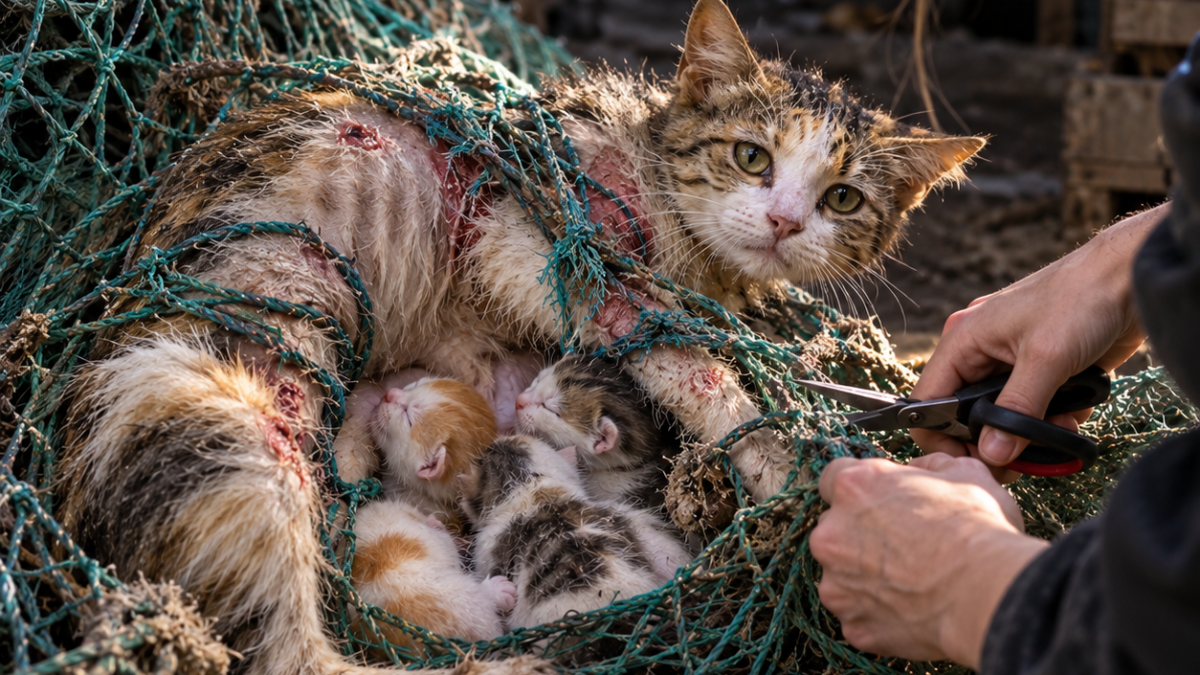
Heartbreaking:The Starving Mother Cat Was Found Tangled in a Fishing Net, Her Body Barely Able to Move — But When Rescuers Saw Her Newborn Kittens, They Realised She Had Been Hiding a Heartbreaking Secret.
FULL STORY CONTINUATION
“Don’t pull it,” I said quietly.
The other rescuer beside me stopped moving.
I pointed toward the strand of netting extending from the mother’s body toward the kitten.
“If we pull from the wrong side, it could tighten.”
We needed to separate the tangled cords without making the situation worse.
The mother cat’s eyes followed us.
She didn’t understand our words.
She couldn’t know why strangers had entered the warehouse or why we were reaching toward the very thing that had caused her so much pain.
All she knew was that we were close to her babies.
And for a mother who had survived alone in that dark building, that was reason enough to be afraid.
I kept my voice low.
“Easy, mama. We’re not taking them away.”
She lowered her head toward the smallest kitten.
Its tiny mouth moved against her belly, searching for milk.
The mother shifted to make room.
The rope pressed against her injured skin.
She flinched.
Then she stayed still so the kitten could feed.
That was the moment I had to look away.
Not because the injury was the worst thing I had ever seen.
Because she had reacted to her own pain for only an instant before returning her attention to her baby.
I didn’t know how long she had been trapped.
I didn’t know how much food she had managed to find before the net restricted her movements.
But I could see that the kittens had been cared for.
Their fur was clean.
Their bodies were warm against hers.
They looked nourished in a way their mother did not.
I had to remind myself not to invent a perfect explanation for everything I was seeing.
Only a veterinary examination could tell us how severely malnourished she was or how much injury the cords had caused.
Still, the visible evidence told a painful story.
This mother had been living under extreme strain.
And her babies had remained her priority.
I moved my hand closer to the first cord, carefully supporting the net so it wouldn’t pull against her skin.
She stiffened.
“It’s okay,” I whispered.
She didn’t believe me immediately.
I couldn’t blame her.
Trust is difficult when you’ve spent your life surviving without anyone to protect you.
But we had no intention of rushing.
We worked carefully around the tangled strands, keeping tension away from the kitten.
Each loose section revealed another knot.
Each knot seemed to lead into another twist.
The fishing net had become part of the space in which she was trying to raise her young.
And every moment she remained tangled in it was another moment of danger.
I examined one of the frayed strands.
It looked as though it had been chewed repeatedly.
I imagined her bending her head toward the rope and biting again and again, trying to loosen it with the only tool she possessed.
I imagined the exhaustion.
The hunger.
The need to return to her kittens even if she couldn’t escape.
But those were images in my mind, not memories I had witnessed.
The truth was that I could never know every moment she had endured.
What I knew was that she had not abandoned her babies.
They were still there.
Protected beneath her thin body.
Waiting for milk.
Waiting for warmth.
Waiting for a mother who had already given them so much.
And she was still trying.
The netting was difficult to remove because the mother and kitten couldn’t be treated as separate problems.
A movement that relieved one section could tighten another.
We had to keep the kitten supported while working on the cords around its mother.
The warehouse was quiet except for the small sounds of our movements and the occasional soft cry from one of the babies.
Each time a kitten stirred, the mother became more alert.
She watched us closely.
Her ears shifted toward every sound.
She was frightened, but she remained beside her litter.
At one point, I gently moved a loose section of net away from her leg.
She tried to adjust her position.
The rope caught.
She stopped.
I could see how little freedom she had.
Something as simple as turning toward a crying kitten had become difficult.
I thought about how many times she must have attempted that movement.
How many times a baby might have cried from the other side of her body.
How many times she had tried to reposition herself and felt the cord pull against her skin.
A mother cat relies on movement.
She needs to reach her kittens.
She needs to groom them.
She needs to shift her body so they can nurse.
She needs to leave when food or water is necessary.
For this mother, those ordinary instincts had become dangerous tasks.
I looked at her thin shoulders and the sharp outline of her frame.
It was impossible not to wonder what she had sacrificed.
Her kittens, meanwhile, were nestled together with full little bellies.
They didn’t understand the net.
They didn’t understand the hunger.
They knew the warmth of their mother and the familiar comfort of nursing.
Their tiny world had remained remarkably protected.
That contrast made the scene almost impossible to bear.
The mother had been suffering in ways the babies couldn’t comprehend.
And somehow, she had kept caring for them.
As we continued working, I noticed another chewed section near her body.
The fibers had been worn and separated.
Some strands were thin enough to suggest repeated effort.
I gently touched the damaged rope.
“You’ve been fighting this thing, haven’t you?”
She looked toward me.
Her eyes were tired.
I knew I was speaking to her as though she could answer, but I couldn’t stop myself.
“You’ve been trying so hard.”
I wished I could tell her that the struggle was nearly over.
But I didn’t want to frighten her by moving too quickly.
So I kept working.
One strand at a time.
One knot at a time.
There was something terrible about the simplicity of the trap.
The fishing net had probably been discarded as useless.
To whoever left it behind, it may have been nothing more than unwanted material.
But once it became tangled around a small animal, it had the power to cause extraordinary suffering.
The cords didn’t loosen when she struggled.
They could tighten.
They didn’t care that she was nursing newborn kittens.
They didn’t care that she needed to find food.
They didn’t care that she had no way to free herself by hand.
A piece of discarded equipment had become a threat to an entire family.
And the mother had been left to fight it with her teeth.
I thought about those chewed fibers again.
Each damaged strand seemed to represent an effort we had not witnessed.
Perhaps some of those efforts had loosened the pressure.
Perhaps others had failed.
Perhaps she had been forced to stop because the kittens needed feeding.
We would never know.
But I could see that the net had not simply fallen around her and remained untouched.
She had struggled against it.
Her exhausted body showed how costly that struggle had become.
When the final dangerous strands were loosened, we were able to move the mother and kittens more safely.
She remained tense.
I kept my hands gentle.
“You’re coming with us, mama.”
One of the babies made a faint sound.
She immediately turned toward it.
I guided the kitten closer so she could see and smell it.
Her nose touched its tiny body.
Then she began licking its head.
I felt my throat tighten.
Even after everything, she was still checking on them.
I had expected exhaustion to make her less responsive.
Instead, the moment one of her kittens stirred, her attention returned to it.
We prepared a safe carrier with soft bedding.
The mother hesitated when we began moving the kittens.
That reaction was understandable.
From her perspective, strangers were handling the only creatures she had been fighting to protect.
We kept the family together.
As the kittens settled near her, she moved toward them and arranged herself around their small bodies.
The old warehouse was still dark.
The fishing equipment still lay scattered across the floor.
The air still smelled of damp concrete and dust.
But the family was no longer trapped inside the net.
I looked down at the discarded cords.
For the mother, they had become a source of pain and restriction.
For the kittens, they had nearly turned their first days of life into a deadly trap.
I carefully gathered the loose material so it would not remain there to endanger another animal.
Then I returned my attention to the carrier.
The mother was crouched around her babies.
She didn’t seem relaxed yet.
Her body remained guarded.
Her eyes followed our movements.
But she was no longer struggling against the rope.
I crouched beside her.
“You don’t have to fight that anymore.”
She blinked.
I knew she couldn’t understand my words.
But I hoped she could begin to understand what was happening.
The pressure around her body had been relieved.
Her kittens were beside her.
And for the first time since we found her, there was nothing tying her movements to a dangerous knot.
The journey away from the warehouse felt strangely quiet.
I kept thinking about how little the mother had.
She was thin.
She was exhausted.
She had painful areas where the net had pressed against her body.
And yet her kittens appeared so well cared for.
There was something deeply moving about the physical evidence of her priorities.
The babies had been groomed.
Their bellies were rounded.
They had continued nursing.
While the mother had been struggling to survive, she had still been providing them with the things their tiny bodies needed.
I watched her through the carrier.
Every time one of the kittens shifted, she adjusted herself.
She seemed unable to stop monitoring them.
I wondered how long it would take before she could rest without worrying about every movement.
How long before she would learn that food and water could come to her.
That she would not have to risk tightening a cord to reach her babies.
That the next person approaching her would not necessarily bring danger.
I couldn’t know.
Animals do not recover emotionally on a schedule.
Some relax quickly when their surroundings become safe.
Others need time.
The mother had endured enough that we owed her patience.
And as I watched her settle around the kittens, I realized that this was what mattered most.
Not whether she immediately trusted us.
Not whether she seemed grateful.
Not whether the rescue looked dramatic from the outside.
What mattered was that she and her babies were no longer trapped.
They had a chance.
Once the family was somewhere safer, the mother’s needs became impossible to ignore.
For so long, she had seemed to place her kittens ahead of everything else.
Now she needed care, too.
Her thin body required nourishment.
Her injuries needed attention.
She needed a clean, quiet place to recover without the constant threat of entanglement.
We made sure she had access to appropriate food and fresh water and that her condition could be assessed.
I watched her with the kittens and felt an ache that went beyond sadness.
She had been providing milk while her own body was struggling.
A nursing mother uses enormous energy to feed her young.
Without enough food, that demand can become dangerous.
The kittens’ round bellies didn’t mean the situation had been safe.
They were a heartbreaking reminder of the difference between their condition and hers.
I thought about how often we admire animals for enduring suffering without asking why they were forced to endure it.
I didn’t want to romanticize her starvation.
There was nothing beautiful about a mother going hungry in a dark warehouse.
There was nothing noble about rope cutting into her skin.
There was nothing that should be celebrated about an animal having to chew through discarded fishing gear to protect her newborn kitten.
The beauty was in her care for her babies.
The tragedy was that she had been left to provide it under such terrible circumstances.
She deserved more than admiration.
She deserved relief.
She deserved food.
She deserved treatment for her injuries.
And she deserved a safe place to raise her kittens.
For the first time, I began looking at the kittens without feeling only fear.
They were tiny.
Their eyes and movements belonged to that fragile stage of life when almost everything depends on their mother.
They needed warmth.
They needed milk.
They needed protection.
And despite the terrible conditions in the warehouse, they had remained surprisingly clean and well nourished.
I watched one of them press its face into the mother’s fur.
Another wriggled closer.
The mother lowered her head and began grooming the little bodies.
I couldn’t stop thinking about the contrast.
Her ribs were visible.
Her babies’ bellies were full.
Her fur showed the effects of hardship.
Their coats had been carefully cleaned.
Her movements had been restricted by the net.
Their world had been made as comfortable as she could manage.
There was no speech that could explain that kind of devotion.
No declaration.
No dramatic promise.
Just the repeated acts of a mother caring for creatures who depended entirely on her.
She had kept them close.
She had continued feeding them.
She had tried to free herself and the kitten from the rope.
And she had remained beside them even as her own body weakened.
I wondered whether she realized the danger had changed.
There was no net pulling against her now.
No discarded fishing line tying her body to her baby.
No need to chew another strand just to make a small adjustment.
She could turn toward her kittens without the same restriction.
She could reposition herself more comfortably.
And someone else could finally make sure she received the nourishment she needed.
I sat beside the family for a while.
The mother looked at me occasionally.
I didn’t reach toward her every time.
Sometimes, the kindest thing I could offer was simply space.
She had spent so long being forced into one difficult position after another.
Now she deserved the freedom to decide when she wanted contact.
I kept remembering the frayed fishing net.
Those damaged strands would probably stay in my mind longer than almost anything else about the rescue.
Because they showed effort.
Quiet, desperate effort.
The mother couldn’t grasp the knot between her fingers.
She couldn’t lift the rope away from her kitten.
She couldn’t ask someone to cut it.
She had only her teeth.
And she had used them.
I imagined the small, repetitive motion of biting and pulling.
The frustration of fibers that wouldn’t separate.
The instinctive fear when a struggling kitten moved against the cord.
The exhaustion of trying again while hungry.
I knew these images were only my interpretation of what she might have experienced.
But the chewed net was real.
The wounds were real.
Her thin body was real.
And the kittens lying clean and well fed against her were real.
That was more than enough to understand the seriousness of what she had faced.
I remembered the moment in the warehouse when one kitten began nursing while the net pressed against its mother’s skin.
She had flinched.
Then stayed still.
That image broke my heart.
It showed how closely her own discomfort had become tied to the needs of her babies.
But now things were changing.
She no longer had to remain caught in the discarded rope.
She no longer had to face every ordinary movement as another risk.
And although her recovery would require time and care, the immediate trap had been removed.
I looked at the mother resting near her litter.
“You’re safe now,” I whispered.
I hoped that, with time, the words would become something she could feel.
The most painful part of rescuing a mother animal is sometimes realizing how long she has been responsible for everyone except herself.
She wakes because a baby needs feeding.
She moves because a kitten has wandered too far.
She grooms because the little bodies need cleaning.
She remains alert because danger might be nearby.
And when food is scarce, she may continue nursing while her own condition deteriorates.
For this mother, those responsibilities had unfolded inside a dark warehouse while she was physically trapped.
She had not simply been caring for newborns.
She had been caring for newborns while her own body was injured and weakened.
The burden was enormous.
I wanted her to experience something different.
Not the absence of her kittens.
She clearly wanted to remain close to them.
But the absence of constant danger.
I wanted her to eat without needing to fight a knot afterward.
To rest without a cord pulling against her skin.
To turn toward a crying baby without flinching.
To feel her kittens nursing while her own body was receiving the support it needed.
Those were ordinary things.
They should never have been extraordinary.
But after seeing her in that warehouse, I knew how much they mattered.
As I watched the family together, I realized the most important change was not something dramatic.
The mother was still thin.
Her injuries would not disappear immediately.
The kittens were still newborns.
They would continue needing careful attention.
But the net was gone.
That single change affected almost everything.
She could move without dragging the dangerous tangle.
She could stay close to her kittens without the same threat of the cord tightening around them.
She could receive food and water more safely.
Her injuries could be addressed.
And the babies could remain with the mother who had worked so hard to keep them alive.
I watched her lower her head toward one of them.
She gave the little kitten several careful licks.
Then she settled herself more comfortably around the litter.
The movement was simple.
It probably meant nothing remarkable to anyone who had never seen her trapped.
But I remembered how restricted she had been.
I remembered how every shift in the warehouse had pulled against the rope.
And seeing her move without that net made my eyes fill with tears.
Sometimes, freedom begins with something as small as being able to turn your body without pain.
I have thought about this rescue many times.
The warehouse.
The discarded net.
The mother cat’s frightened eyes.
The tiny kittens nestled against her.
The thinness of her body compared with their rounded bellies.
And the chewed fibers that suggested how desperately she had tried to free herself.
But when I remember her now, I try not to picture her only as a starving animal trapped in a terrible situation.
I remember her as a mother.
A mother who had continued grooming her kittens when she was exhausted.
A mother who had continued nursing them while her own body became thin.
A mother who had tried to loosen the cords with her teeth when she had no other way to untie them.
A mother who, when strangers finally arrived, still kept her body between them and her babies.
She had no idea who we were.
She couldn’t know what we intended.
All she could do was respond to the danger she understood.
And that danger was anything that might separate her from her kittens.
We had to earn the opportunity to help her.
Not through promises.
Through patience.
Through careful movements.
Through keeping her babies close.
Through removing the net without making their situation worse.
And through giving her the chance to recover.
The image I will carry with me is not the discarded fishing net lying on the warehouse floor.
It is the moment after the family was freed.
The mother was curled protectively around her kittens.
They were pressed against her belly, small and warm.
Her body was still painfully thin.
The marks left by the cords had not vanished.
She was not suddenly healthy simply because the trap had been removed.
But when one of her babies stirred, she turned toward it without the same rope pulling her back.
She lowered her head.
Gently cleaned its tiny face.
Then settled beside the others.
For the first time since we found her, I could watch that simple act without seeing the net tighten.
The kittens were safe beside their mother.
And their mother finally had someone looking after her.
I thought of the first moments in the warehouse, when I had seen those plump little bellies and her hollow frame.
At the time, the contrast had devastated me.
Now it reminded me why she needed to be rescued just as urgently as her babies.
She had protected them through conditions no mother should have had to endure.
But she shouldn’t have to keep sacrificing her own health just to give them a chance.
Her babies needed her alive.
They needed her nourished.
They needed her comfortable enough to care for them without being injured by every movement.
And she deserved those things for her own sake, too.
I looked at the tiny family one last time.
The mother rested her head near her kittens.
The babies remained tucked against her.
And the discarded fishing net was no longer part of their lives.
I couldn’t erase what had happened in that dark warehouse.
I couldn’t give her back the food she had gone without or the days she had spent fighting the rope.
I couldn’t undo the pain of the cords cutting into her body.
But we had reached her while she and her babies were still alive.
We had freed them.
And now the mother who had spent so much strength keeping her little family alive could finally begin receiving the care she had needed all along.
She had no hands to untie the knots.
No words to call for help.
No way to explain how hungry or exhausted she had become.
But she had stayed with her kittens.
And when we found them, those tiny babies were clean, warm, and fed.
Their mother had given them everything she could.
Now, at last, it was her turn to be cared for.








