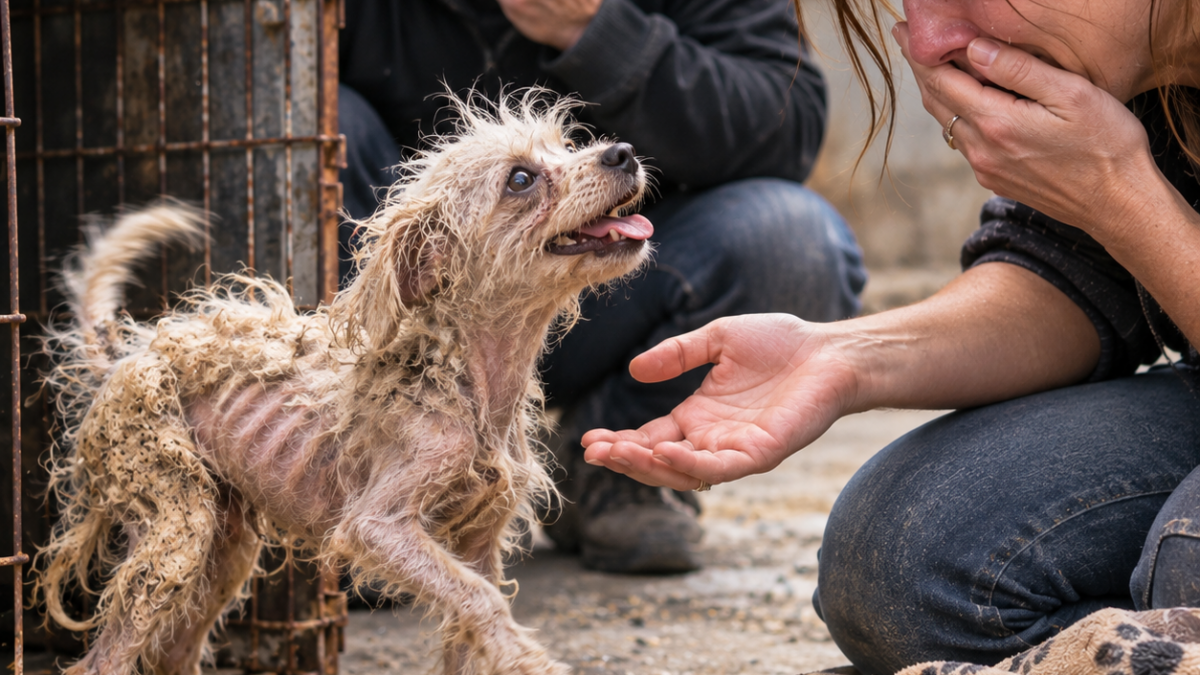
Heartbreaking:The Starving Little Dog Was So Weak Her Legs Could Barely Hold Her — Yet the Moment Her Cage Opened, She Tried to Play With Her Rescuers… What Had Happened to Her That Made Her Still So Desperate for Love?
FULL STORY CONTINUATION
Chelsea continued eating while I remained beside her.
Every now and then, I looked at her little face, hoping she might pause long enough to acknowledge the world around her.
But the bowl had her complete attention.
I didn’t blame her.
She had been deprived of something essential, and now food was finally available.
The sight was both comforting and heartbreaking.
Comforting because she was eating.
Heartbreaking because of what her urgency revealed.
I had seen hungry animals before.
Some were hesitant when food appeared.
Others were too weak to show much interest immediately.
Chelsea was different.
She had enough energy to approach us and try to play.
But the moment she realized there was food, everything else seemed to disappear.
I could see how much she needed it.
“Easy, little girl,” I murmured.
I knew that a severely undernourished animal needed careful veterinary guidance about feeding and recovery.
Giving her everything at once wasn’t the answer.
What she needed was consistent, appropriate nourishment, supervised according to her condition.
She would need medical care, not just one full bowl.
Still, I couldn’t stop thinking about the contrast.
A few minutes earlier, she’d been confined in a cramped cage.
Now she was outside it.
She had food.
People were watching over her.
And for the first time since we found her, there was a path toward something better.
I looked down at Chelsea.
“We’ve got a lot to do, sweetheart.”
She kept eating.
I smiled sadly.
“That’s okay. You focus on your breakfast.”
I wasn’t sure whether it was morning or afternoon that mattered to her.
All that mattered was that she was finally receiving care.
And I was determined that it wouldn’t stop there.
When I first began helping Chelsea, I thought the most difficult part would be getting her out of the environment where she’d been neglected.
I was wrong.
Removing an animal from a bad situation can happen in a single moment.
Recovery takes longer.
Sometimes much longer.
It isn’t enough to open a cage and declare that everything is fixed.
An animal who has gone without proper care may carry the effects in their body even after the danger has passed.
And there can be uncertainty about how they will adjust to safety, handling, routines, and new surroundings.
Chelsea needed careful attention.
Her thinness concerned me immediately.
So did the condition of her fur.
The mats were not ordinary tangles that could be brushed away in a few minutes.
They were dense, dirty, and uncomfortable-looking.
I could only imagine how difficult normal grooming must have become.
Her coat had been neglected long enough for the problem to grow serious.
I wanted to clean her immediately.
I wanted to remove every piece of dirt.
To make her comfortable.
To see the healthy little dog hidden beneath the tangled fur.
But I knew it had to be done carefully.
Matted coats can pull painfully against the skin, and trying to tear or brush through severe knots can cause unnecessary discomfort.
Chelsea had already endured enough.
I didn’t want the first people trying to help her to become another source of pain.
So the next important step was veterinary care.
I watched her move toward us again.
She still seemed interested in our attention.
“You’re going to meet someone who can help you feel better,” I told her.
She had no idea what was ahead.
Neither did I.
But at least she wouldn’t be going through it alone.
At the veterinary clinic, I tried to explain everything clearly.
How we’d found Chelsea.
The cramped cage.
The neglected coat.
The dirt.
Her thin body.
The way she’d eaten.
The way she’d tried to play despite her condition.
The veterinarian listened and began examining her.
I stayed nearby, watching Chelsea’s face.
She was so small that every unfamiliar movement seemed important to me.
I worried about whether she might suddenly become frightened.
Whether touching her tangled fur would hurt.
Whether she was more unwell than she appeared.
The veterinarian examined her carefully.
Chelsea needed treatment for health problems associated with the neglect she’d experienced.
She also needed her coat clipped.
I had expected that.
But hearing it confirmed still made me sad.
A dog’s coat should protect her body.
It should not become a heavy, tangled covering that requires medical attention to remove safely.
As the grooming and treatment began, I kept thinking about how little control Chelsea had had over any of this.
She couldn’t choose a clean place to sleep.
She couldn’t open the cage.
She couldn’t prepare food.
She couldn’t clip away the mats covering her body.
She depended entirely on the decisions of people around her.
And those decisions had left her in a terrible condition.
I watched the veterinary team work.
Every careful movement mattered.
Little by little, the dirty, tangled fur was removed.
The change was striking.
Chelsea looked smaller without it.
Even more fragile.
I had known she was thin.
But seeing her body more clearly made the reality of her condition harder to ignore.
I felt tears filling my eyes.
“Oh, Chelsea.”
She had been carrying more than the visible burden of dirt and matted fur.
She’d been living without the basic care that might have prevented her condition from becoming so serious.
I thought about the moment she’d stepped out of the cage.
How she’d approached us.
How she’d tried to jump and play.
There was something almost unbearable about remembering that cheerful little movement while seeing how much treatment she needed.
She hadn’t been well.
But she had still wanted to connect with us.
The veterinarian continued the examination and treatment.
I listened carefully to the guidance about her care.
I wanted to understand what she needed.
I wanted to make sure nothing important was overlooked.
But there was one question I couldn’t stop asking myself.
Where would she go when she was ready to leave?
At that point, I had no answer.
During the first days of Chelsea’s recovery, I visited regularly.
Every visit became something I looked forward to.
I would arrive thinking about the same things.
Was she eating?
Was she comfortable?
Was her body responding to treatment?
Was she becoming stronger?
I knew recovery wouldn’t happen overnight.
A dog doesn’t become healthy simply because someone gives her a bath and a meal.
Chelsea’s body needed time.
Her health problems required attention.
And even when she began feeling better, she would still need consistency.
But I wanted her to know that people would keep coming back.
I didn’t want her care to be a single act of compassion followed by another uncertain future.
The first time I visited after her initial treatment, I felt a strange nervousness.
What if she was frightened?
What if she had become withdrawn?
What if the friendly little dog I’d seen outside the cage had only been a momentary burst of energy?
Then I saw her.
Small.
Still recovering.
But unmistakably Chelsea.
“Hi, sweetheart.”
I approached gently.
She showed interest in the familiar attention.
I smiled.
“There you are.”
I didn’t know how much she recognized from one visit to another.
I wasn’t going to pretend I could read every thought behind her eyes.
But I could see her willingness to engage.
That was enough to make me happy.
I spent time with her.
I gave her affection appropriate to her condition.
I watched how she responded to being approached and cared for.
And I left hoping the next visit would bring another small sign of improvement.
One week.
That was how long the early period of treatment and regular visits lasted before the question of Chelsea’s future became impossible to ignore.
A week might not sound like much.
But when you’re watching a vulnerable animal recover, seven days can feel filled with important changes.
The first proper meals.
The veterinary examination.
The careful clipping of a severely matted coat.
The beginning of treatment.
Time spent resting.
And the small moments when a dog starts showing more of herself.
Chelsea began looking and feeling better.
Her body was still recovering.
She still needed care.
But the little dog who had been found neglected in that cage was beginning to move toward a different life.
I should have felt relieved.
And I did.
But as each day passed, another worry became heavier.
No home had been found.
Chelsea’s initial rescue had been arranged.
Her medical needs were being addressed.
But she still didn’t have someone committed to caring for her permanently.
I kept returning to that thought.
Where would she sleep?
Who would make sure she ate?
Who would notice if she became unwell again?
Who would be patient with her while she gained strength?
The idea of a shelter worried me.
Not because shelter workers don’t care.
Many work extremely hard to protect animals in difficult circumstances.
But Chelsea was tiny and vulnerable.
She had only recently begun receiving the care she needed.
I worried about how she would cope with another unfamiliar environment and an uncertain wait for adoption.
I pictured her in another enclosure.
Not the filthy cage we’d found her in.
But still a place without a home of her own.
And that image was hard to accept.
I wanted her recovery to lead somewhere.
Not simply from one temporary arrangement to the next.
I wanted Chelsea to experience the kind of ordinary life that healthy, loved dogs take for granted.
A comfortable place to sleep.
Meals arriving regularly.
Walks.
Affection.
Play.
A familiar person who would notice when something was wrong.
And someone who would still be there the following day.
But wanting something for an animal and being able to provide it are different things.
I had responsibilities.
A busy life.
Other animals to consider.
I couldn’t simply make a decision based on emotion without thinking about whether I could meet Chelsea’s long-term needs.
So I kept visiting.
And kept thinking.
By then, I had begun noticing something about myself.
I no longer thought of Chelsea merely as the dog we’d rescued from a cage.
I wondered about her throughout the day.
If I was busy, I would suddenly remember her little face.
If I saw another dog being walked, I’d think about Chelsea.
If I prepared food, I’d remember the way she’d lowered her head into that first bowl.
And sometimes, late at night, I’d find myself thinking about the moment she emerged from the cage and tried to jump.
I couldn’t get that movement out of my head.
It was such a small thing.
A little jump.
A playful approach.
An attempt to make friends.
But it had told me something important about the life Chelsea might have if she received the chance.
She wanted to participate.
She wanted attention.
She wanted to play.
Her body had been neglected, but her willingness to engage with people was still there.
And I wanted to protect that.
I didn’t want her remaining days to be defined by what had happened before the rescue.
I wanted her to have experiences that had nothing to do with neglect.
Ordinary experiences.
The kind a dog doesn’t need to understand or earn.
Just the simple pleasure of living somewhere safe.
I imagined her settling onto a comfortable bed.
I imagined taking her on walks when she was ready.
I imagined her meeting other dogs and learning how to share space with them.
I imagined her little body becoming stronger with proper nutrition and medical follow-up.
Then I imagined arriving home and seeing her waiting.
That was the thought that finally made me stop.
What if she came home with me?
I sat with it for a long time.
At first, I told myself it was only emotion.
I had become attached to a vulnerable animal I’d helped rescue.
Of course I wanted to keep her close.
That didn’t automatically mean adoption was the right decision.
But the more I considered her needs, the more I found myself returning to the same possibility.
I knew what caring for a dog required.
I knew it meant time.
Responsibility.
Expenses.
Veterinary appointments.
Patience.
And adjusting daily routines to accommodate another living being.
I didn’t pretend those things would be easy.
But I also knew Chelsea needed a home.
And I began realizing that the home I wanted for her might be one I could provide.
One day, I went to visit Chelsea and found myself watching her with a different feeling.
I had always hoped someone would adopt her.
Someone kind.
Someone prepared.
Someone willing to accept that she was still recovering.
But now, when I looked at her, I no longer pictured an unknown person taking her away.
I pictured her staying with me.
I thought about the other dogs in my life.
The routines already established.
The adjustments that would be necessary.
I wondered how Chelsea would fit in.
Would she be comfortable?
Would she adapt to sharing space?
Would her health continue improving?
I couldn’t know every answer in advance.
But adoption doesn’t require certainty about every future difficulty.
It requires a commitment to respond responsibly when difficulties arise.
I watched Chelsea move.
She had begun gaining some of the strength she’d lacked when we first found her.
She was still small.
Still needed attention.
But there was something hopeful in seeing her recover.
I crouched beside her.
“Hey, Chelsea.”
I smiled.
“How would you feel about coming home with me?”
Of course, she couldn’t answer.
But I found myself imagining that little playful jump again.
The one she’d made as soon as she was given the chance to leave the cage.
Maybe, I thought, that was the clearest answer I was ever going to receive.
She wanted a life.
And I could give her one.
I made the decision.
I would adopt Chelsea.
The moment I committed to bringing her home, the anxiety that had followed me through her recovery began to change.
I was still concerned about her health.
I still knew she needed ongoing care.
But the uncertainty about her future was gone.
There would be a home.
Not a temporary place.
Not another wait for someone to choose her.
A home.
Mine.
I felt emotional simply thinking about it.
Because Chelsea had never asked for anything complicated.
She hadn’t demanded special treatment.
She hadn’t needed expensive toys or a beautiful room.
She needed the basics.
Food.
Cleanliness.
Medical care.
Safety.
And the chance to behave like a dog instead of an animal trapped in neglect.
I could provide those things.
I wanted to provide them.
And I would keep providing them after the initial excitement of the rescue faded.
That last part mattered most.
Anyone can feel moved by a heartbreaking rescue story.
Anyone can look at a photograph of a neglected dog and wish things were different.
But making a home for a recovering animal means choosing to care for her during the ordinary days too.
The days when nothing dramatic happens.
When she simply needs breakfast.
When she needs to go outside.
When she needs rest.
When she needs another veterinary checkup.
When she needs patience.
When she has energy and wants to play.
And when she’s tired and wants to sleep.
I wasn’t adopting Chelsea because her story was sad.
I was adopting her because she was a living being who deserved a good future.
And I was ready to make room for her.
Bringing Chelsea home felt different from any of the visits we’d shared during her recovery.
Before, I would arrive, spend time with her, and eventually leave.
This time, I wasn’t going to leave her behind.
She was coming with me.
I tried not to overwhelm her.
Everything was going to be new.
The smells.
The rooms.
The sounds.
The daily routines.
The other dogs.
A home can seem wonderfully ordinary to the people who live in it.
But to a small dog experiencing unfamiliar surroundings, there may be a great deal to take in.
I wanted Chelsea to adjust at her own pace.
There was no reason to rush.
She had already endured enough changes.
She deserved time to become comfortable.
When we arrived, I let her begin exploring safely.
She was curious.
I watched her move through the new surroundings.
I thought about the first time I’d seen her inside that cramped cage.
The dirt.
The tangled fur.
The painfully thin body.
And now here she was.
In a home.
With room to move.
With someone paying attention to her.
It was such a simple difference.
But to me, it meant everything.
“Welcome home, Chelsea.”
I spoke softly.
There was no grand ceremony.
No crowd cheering.
Just a little dog entering a place where she would be cared for.
And I couldn’t imagine a more important moment.
The first days at home were about making Chelsea comfortable.
I paid attention to her appetite.
Her energy.
How she rested.
How she responded to the environment.
Her body was still recovering from neglect.
I didn’t expect her to become strong immediately.
Progress mattered more than speed.
She needed regular meals and appropriate follow-up care.
She needed opportunities to rest.
And she needed the freedom to explore and play without being pushed beyond her limits.
I watched her carefully.
Sometimes she seemed full of curiosity.
Other times she wanted nothing more than a comfortable place to lie down.
I loved those quiet moments.
They reminded me that safety isn’t always dramatic.
Sometimes it’s a dog being able to sleep without disturbance.
Sometimes it’s a bowl of food arriving without uncertainty.
Sometimes it’s waking up and discovering that the familiar person who cared for you yesterday is still there today.
I remembered how Chelsea had eaten when we first rescued her.
How she didn’t lift her head from the bowl.
Now mealtimes were becoming part of a dependable routine.
Food wasn’t a rare surprise.
It was something she could expect.
I couldn’t know exactly what Chelsea understood.
But I hoped consistency would help her feel more secure.
I hoped that, over time, the urgency surrounding food would no longer define her experience.
Because she deserved more than the relief of finally eating.
She deserved the comfort of knowing she would be fed again.
As Chelsea became more settled, the playful little personality I’d glimpsed outside the cage began having more opportunities to appear.
That made me especially happy.
I’d never forgotten her first attempt to play.
The moment she stepped out of confinement and moved toward the people around her.
The little jumps.
The curiosity.
The friendliness.
It had been such a striking contrast to her physical condition.
And now, instead of seeing that playful energy for a few moments during a rescue, I could watch it become part of her everyday life.
She had other dogs around her.
That meant she had opportunities for companionship as well as time with people.
I watched her adjust.
I wanted interactions to remain positive and comfortable for everyone.
Chelsea was still recovering.
There was no need to force anything.
But seeing her become part of a household made my heart feel lighter.
The little dog who once stood in a dirty cage now had an environment where she could move around and spend time with others.
She didn’t have to rely on a rare opportunity to play.
Play could be part of an ordinary day.
And that was exactly what I’d hoped for.
Some of my favorite moments with Chelsea were the ones that might seem unimportant to someone who hadn’t seen where she came from.
Watching her eat.
Watching her settle down to sleep.
Seeing her approach me for attention.
Noticing her growing comfort in the home.
None of those moments was extraordinary by itself.
Millions of dogs experience them every day.
That’s precisely why they mattered.
Chelsea should have been experiencing them all along.
She should never have reached the condition we found her in.
She should never have been left hungry and unwell inside a cramped, dirty cage.
She should have had proper grooming.
Care.
Medical attention.
A place where she could rest.
People who noticed when something was wrong.
And yet, when she finally received help, she didn’t spend every waking moment hiding from the world.
She reached toward it.
That was the part of Chelsea’s story I found most moving.
I didn’t want to romanticize what she’d endured.
Neglect isn’t something an animal should have to survive in order to be called resilient.
And her friendliness didn’t make the neglect any less serious.
But seeing her willingness to approach us reminded me how much could still be possible for her.
There was a life beyond that cage.
A life her physical condition had nearly hidden from us.
Now she was living it.
Sometimes I found myself looking at photographs or remembering the day Chelsea was rescued.
I would picture the dirty fur.
The cramped cage.
The way her body looked once the mats were clipped away.
Then I’d look at her now.
Resting comfortably.
Eating regular meals.
Moving through the home.
Spending time with the other dogs.
And I would feel overwhelmed by the contrast.
Not because Chelsea had become a different dog.
But because her circumstances had changed.
The curious, friendly little creature had been there all along.
She hadn’t needed to become lovable.
She already was.
She needed someone to recognize that she was suffering and respond.
Someone to arrange medical care.
Someone to give her time.
Someone to make sure her recovery led somewhere safe.
And eventually, someone to say, “You can stay.”
I was grateful I’d been able to become that person.
There were still practical responsibilities.
Chelsea’s improved condition didn’t erase the neglect she had experienced.
I remained attentive to her health.
I knew that maintaining her well-being required more than affection.
There would be food to provide.
Grooming to keep up with.
Walks.
Routine care.
Veterinary advice when needed.
And patience as she continued becoming stronger and more confident.
But those responsibilities didn’t feel like burdens imposed by her past.
They were simply part of caring for her.
I had chosen to bring Chelsea into my home.
And that choice meant accepting the everyday work that came with it.
I couldn’t guarantee that every day would be easy.
No pet owner can.
But I could guarantee that I would keep trying to meet her needs.
That she wouldn’t be abandoned simply because caring for her required effort.
That her health would matter.
That she would have a place to rest.
And that the little dog who wanted to play would have opportunities to do exactly that.
One evening, I watched Chelsea settle down after another ordinary day.
She had eaten.
Spent time moving around the home.
Received affection.
And now she was ready to sleep.
I looked at her for a long time.
It wasn’t an exciting moment.
There was no dramatic rescue unfolding.
No urgent veterinary appointment.
No frightened crowd gathered around a cage.
Just Chelsea.
Comfortable.
Safe.
Tired from the ordinary activities of being a dog.
I felt tears filling my eyes.
Because I remembered how uncertain her future had seemed during that first week.
I remembered visiting her and worrying about where she would go afterward.
I remembered thinking that such a small, vulnerable animal might struggle in a shelter environment while waiting for someone to adopt her.
And I remembered the moment I finally decided that I didn’t have to keep hoping an unknown person would take her home.
I could be that person.
I crouched beside her.
“Goodnight, sweetheart.”
She rested.
I smiled.
“You’re home.”
The most important change in Chelsea’s life wasn’t something I could measure with a single photograph.
Her coat looked better after proper care.
Her body began recovering.
Her living conditions were transformed.
Those changes were visible.
But what mattered to me was the pattern of her days.
A dependable routine.
Regular meals.
Comfortable sleep.
Safe walks.
Time with other dogs.
Human attention.
The opportunity to grow stronger without being neglected again.
Those things didn’t happen in one miraculous moment.
They happened because care continued.
One day after another.
And that was what made adoption so meaningful.
Rescuing Chelsea was the beginning of a promise.
Adopting her meant continuing to keep it.
I often think about the moment she first came out of the cage.
I can still picture it.
Her dirty fur hanging in clumps.
Her little legs supporting a body that needed nourishment.
The hesitation before she stepped forward.
Then the small jump.
The way she approached us, curious and friendly.
I didn’t know what to expect.
I certainly didn’t expect her to try to play.
But she did.
And in that moment, she showed us a part of herself that neglect had not managed to erase.
A little dog who wanted friendship.
Who wanted attention.
Who wanted to interact with the world.
I think about that moment whenever I see her enjoying her new life.
Because Chelsea didn’t need an extraordinary future.
She needed an ordinary one.
The kind where breakfast is expected.
Where a bed is comfortable.
Where walks are part of the day.
Where there are other dogs to spend time with.
Where a person is willing to care for her when she’s healthy and when she needs help.
That was the future I wanted to give her.
And it was the future she finally had.
When people hear about rescued animals, they often focus on the worst moment.
The cage.
The hunger.
The dirt.
The illness.
Those things are important.
We shouldn’t look away from them.
They help us understand why intervention was necessary.
But I don’t want the worst moment of Chelsea’s life to become the only thing people remember about her.
I want them to remember what she did when the cage opened.
How she tried to make friends.
How she showed interest in play even though she was physically unwell.
How she ate once food was placed in front of her.
How she received veterinary treatment and began recovering.
How she spent a week receiving care while her rescuer worried about what would happen next.
And how, finally, someone made a decision that changed the rest of her life.
Not a temporary rescue.
Not simply a promise to visit.
A permanent home.
I want people to remember Chelsea as a dog who deserved kindness long before someone found her.
A dog whose needs were finally taken seriously.
And a dog who was given the chance to enjoy the ordinary things she’d been missing.
There is one part of Chelsea’s story that still makes me emotional.
It’s not the moment the cage opened.
It’s not the sight of the food bowl.
It’s not even the first time I saw her looking more comfortable after treatment.
It’s the realization that she had been ready to give affection before she knew whether anyone would give it back.
She approached us.
She tried to play.
She reached toward people despite everything her condition suggested she’d been through.
I don’t know why she remained so friendly.
I don’t know what experiences shaped her behavior before we found her.
And I don’t believe I need to invent a history for her to make her rescue meaningful.
What happened was already enough.
Chelsea was neglected.
She was hungry.
She was unwell.
She needed medical care.
People stepped in to help.
She began recovering.
And when she still had nowhere to go, I adopted her.
That is a complete story.
Not because it has an enormous twist.
But because its ending answers the most important question raised at the beginning.
What would happen to the little dog inside that cage?
She would be cared for.
She would have a home.
And she would finally have the chance to live like a dog who was loved.
Today, Chelsea’s life is very different from the one we found her living.
She has proper meals.
She has a comfortable place to sleep.
She has walks.
She has other dogs around her.
She has someone attentive to her care and recovery.
Most importantly, she doesn’t have to face an uncertain future after every period of treatment.
She’s no longer waiting for someone to decide where she belongs.
That decision has been made.
She belongs here.
Sometimes I watch her resting and remember how tiny she looked when she first came out of the cage.
Other times, I see her playful energy and remember that little jump.
I smile.
Because now she can play without that moment being a brief interruption in an otherwise neglected life.
Now play is something she can return to.
Tomorrow.
And the day after.
Whenever she’s comfortable and ready.
I think about the person I was when I first found her.
I believed I was helping a dog escape a terrible situation.
I didn’t know I would become the person who brought her home.
I didn’t know how attached I would become during that week of visits.
And I didn’t know how much happiness there could be in watching a small animal experience something as ordinary as a peaceful night’s sleep.
But Chelsea taught me.
Not through some grand lesson she understood she was giving.
Simply by being herself.
By approaching us.
By eating when food was offered.
By responding to care.
By recovering.
By settling into the life she had been given.
The cage is no longer where Chelsea spends her days.
The dirty mats have been removed.
Her health needs are being addressed.
And the little dog who once had so little now has a person committed to meeting her needs.
I can’t change what happened before we found her.
I can’t give back the meals she missed or the comfort she went without.
I can’t erase every effect of neglect with one act of kindness.
But I can make sure her future isn’t a continuation of her past.
I can feed her.
Care for her.
Take her for walks.
Let her rest.
Give her affection.
And make room for her in my life.
I can be there on ordinary mornings when she wakes up.
I can be there when she wants to play.
And I can be there when she needs help.
That’s what Chelsea needed.
Not a perfect world.
Just a dependable home.
And someone who wouldn’t walk away when the first week of treatment was finished.
I look at her now and feel grateful that I made the decision to adopt her.
Because the little dog who came out of that cage trying to make friends finally has people and other dogs to share her days with.
She can eat without wondering when someone will provide another meal.
She can sleep comfortably.
She can explore.
And she can play.
The simplest things.
The things every dog should have.
I think about that first bowl of food sometimes.
How she lowered her head.
How she kept eating.
How everyone watching understood that her hunger was a serious sign of what she’d been denied.
And then I think about the meals that followed.
Not one bowl.
Not one day.
But a continuing routine of proper care.
That’s the difference a home makes.
A rescue can open a cage.
Medical treatment can begin repairing the damage of neglect.
But a committed caregiver can offer something equally important.
Continuity.
The assurance that care won’t simply stop when the most visible suffering is gone.
Chelsea needed that.
And she found it.
I still remember leaning toward her when she first stepped out.
“Hey, sweetheart.”
She approached.
Then tried to play.
I didn’t realize what that moment would become.
I didn’t know that one little jump would stay in my memory long after the cage was behind her.
But it did.
Because it was the first glimpse of the life she was waiting to have.
And now, when I see her comfortable in her new home, I understand exactly why that moment mattered so much.
Chelsea didn’t have to become a different dog to deserve love. She was already the same friendly little soul who tried to play the moment her cage opened. All she needed was someone willing to give her the food, care, safety, and permanent home she should have had from the beginning.








