Heartbreaking:The Starving Dog Hadn’t Eaten Properly in Days—But Every Scrap He Found Went to His Dying Friend, and What Rescuers Discovered Left Them in Tears
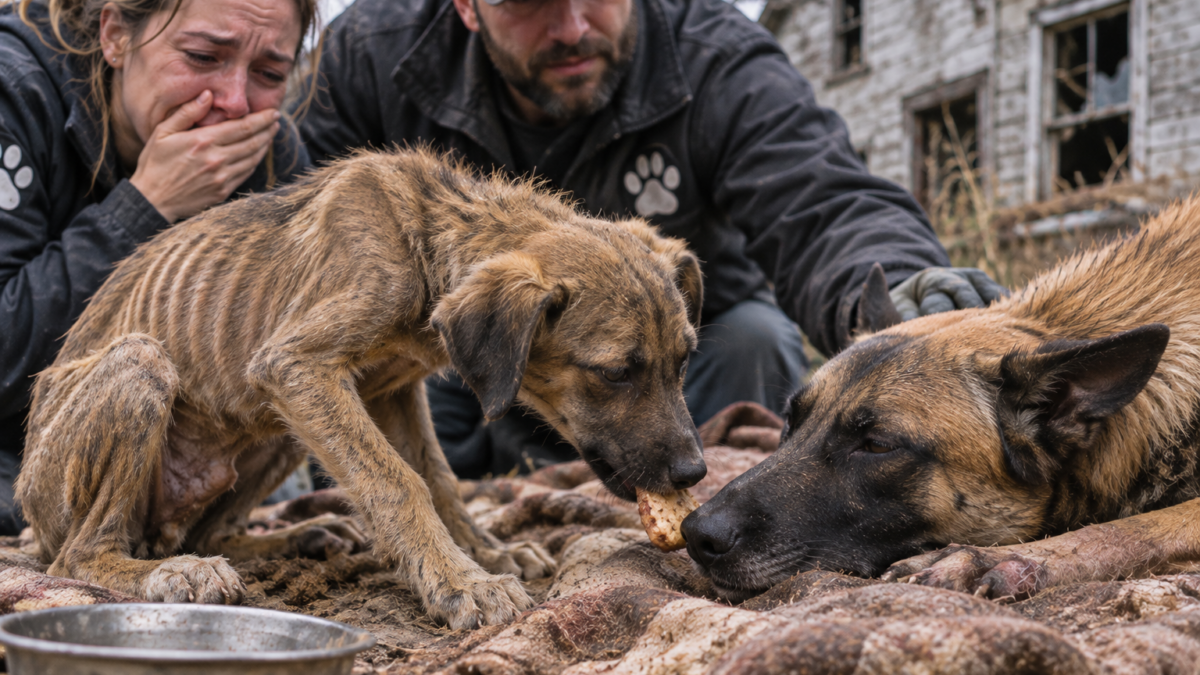
I stayed where I was.
About six feet separated me from the dogs.
It wasn’t a great distance, but at that moment, it felt like the most important six feet of my life.
The little dog watched me with an intensity I had rarely seen in an animal.
He looked young.
Perhaps two years old.
A mixed breed with a dark coat that had lost its shine.
His body was terribly underweight, and his movements were slow with fatigue.
Yet there was nothing uncertain about his determination to remain beside the Malinois.
He wasn’t lunging.
He wasn’t snapping.
He was simply refusing to move away.
I kept my hands open.
“That’s okay,” I whispered. “I’m staying right here.”
The dog blinked.
Behind him, the Malinois breathed shallowly.
I wanted to rush forward.
Every instinct told me to do something immediately.
But frightened animals can react unpredictably, especially when they’re exhausted and guarding a vulnerable companion.
I knew that forcing my way toward the larger dog could make the situation more dangerous for everyone.
So I waited.
Emily remained near the gate.
“The veterinary team is on the way,” she told me.
I nodded without looking away.
“How long?”
“They’re coming as quickly as they can.”
I swallowed.
“Good.”
She stepped closer to the fence.
“Do you think they’re abandoned?”
I looked around the property.
The barn doors were warped.
Weeds grew through cracks in the concrete.
The farmhouse windows were dark.
There were no fresh tire tracks in the yard, no visible signs of recent activity.
“I don’t know,” I said. “But they need help.”
Emily nodded.
She didn’t ask another question.
For a while, the only sounds were the wind moving through dry grass and the creaking of a loose piece of metal on the barn.
Then the smaller dog turned away from me.
He walked toward the Malinois and lowered his head.
Very gently, he licked the larger dog’s muzzle.
The Malinois’s eyes opened a little wider.
The smaller dog remained beside him.
I watched, barely breathing.
“He’s looking after him,” Emily whispered.
“Yes.”
I could hear the emotion in her voice.
“So thin, and he’s still looking after him.”
The little dog shifted closer to the Malinois’s body.
For a moment, he seemed to forget I was there.
His entire attention was directed toward the animal lying beside him.
That was when I first understood how strongly these two dogs depended on one another.
I had no way to know exactly what had happened before I found them.
I didn’t know how long they’d been at the farm.
I didn’t know whether they’d arrived together.
I didn’t know who had last fed them.
But I knew what I was seeing.
One dog was barely able to move.
The other was barely able to stand.
And the younger one was still watching over his companion.
I have always been a practical man.
That may sound strange coming from someone who ended up spending the night in a veterinary hospital waiting room because of two stray dogs.
But it’s true.
For most of my life, I believed that problems were things you solved by working through them.
You assessed the situation.
Figured out what was needed.
Did what you could.
Then moved on.
I had never considered myself especially sentimental.
I liked animals.
I respected people who rescued them.
But I wasn’t someone who expected a chance encounter on the road to change the shape of my days.
That morning, I had errands waiting at home.
Things to repair.
Bills to pay.
A refrigerator that needed groceries.
I had expected to spend the afternoon doing ordinary tasks.
Instead, I was sitting in the dirt outside a collapsing barn, trying to earn the trust of a dog who weighed far less than he should have.
I looked into his eyes.
“You’re a good boy.”
He watched me.
“I don’t know what you’ve been through.”
My voice grew quieter.
“But I’m going to try to help.”
I shifted slightly.
The dog tensed.
I stopped immediately.
“Okay. That’s enough.”
He relaxed a fraction.
I waited.
Then, very slowly, he moved closer to the Malinois and sat down.
His body remained between us.
But he was no longer standing.
It was a small change.
Yet I felt grateful for it.
He was exhausted.
At least, for a moment, he could rest.
Emily eventually moved closer and crouched beside the gate.
She kept a respectful distance.
“I’ve worked as a nurse,” she told me quietly.
I glanced toward her.
“Really?”
She nodded.
“I was coming home after a shift.”
“What made you stop?”
“I saw your car.”
She smiled faintly.
“I have a habit of checking when someone pulls over in a place like this.”
I looked back at the dogs.
“Good habit.”
She didn’t smile this time.
“I’m glad I stopped.”
We remained quiet for a while.
Then she asked, “What are you going to do with them?”
I looked at the little dog.
“First, get them to the hospital.”
“And afterward?”
I didn’t answer immediately.
The question seemed almost impossible.
I was still worried that the Malinois might not survive the next hour.
I couldn’t think about adoption, shelters, or anything beyond getting the dogs medical care.
“I haven’t thought that far,” I admitted.
Emily nodded.
“Fair enough.”
She looked toward the road.
“I just hope the veterinary team gets here soon.”
So did I.
Every time the Malinois’s breathing seemed to slow, my stomach tightened.
I wanted him to lift his head.
To move.
To show us that he had enough strength to keep fighting.
But he remained on his side.
The smaller dog watched him constantly.
And I found myself wondering whether he’d been doing that for days.
When the veterinary vehicle finally appeared, I almost cried with relief.
It came slowly down the dirt road and stopped beside Emily’s car.
Two members of the team stepped out carrying equipment.
They had transport crates, a soft stretcher, and the supplies needed to assess the dogs before moving them.
Emily hurried over.
I remained near the gate.
The smaller dog had already noticed the newcomers.
His ears rose.
His body stiffened.
When the veterinary team approached, he stood.
I could see how much effort it cost him.
One of the veterinary workers looked toward the Malinois.
“How long has he been like that?”
“I don’t know,” I answered.
“Has he tried standing?”
“Not since I found him.”
The worker’s expression became serious.
“We need to assess him.”
I nodded.
“But the other dog is guarding him.”
We discussed how to approach safely.
The smaller dog watched every movement.
Then a low sound came from his chest.
Not a loud bark.
Not a frantic snarl.
Just a warning.
He was telling us to be careful.
I crouched again.
“Hey, buddy.”
He looked toward me.
“It’s okay.”
His body remained tense.
“They’re here to help.”
I knew he couldn’t understand my explanation the way a person would.
But he had been listening to my voice for some time now.
I hoped the familiar tone might help him remain calm.
I moved carefully to the side.
He watched me.
Then he looked toward his companion.
One of the veterinary workers knelt at a safe distance.
The dog hesitated.
His paws shifted.
For a moment, I thought he might step forward again.
But instead, he moved slightly aside.
It was just enough.
The veterinary team approached the Malinois.
And I finally released a breath I hadn’t realized I was holding.
The larger dog was in terrible condition.
Up close, I could see the severity of his thinness.
His ribs were prominent.
His coat was dull and tangled.
His eyes looked tired.
When the veterinary worker checked him, he barely reacted.
I watched their hands move carefully.
They examined his breathing, assessed his condition, and prepared to transport him for urgent treatment.
One of them looked toward us.
“He’s severely weakened and dehydrated.”
Emily pressed a hand against her mouth.
“Is he going to survive?”
The worker hesitated.
“He needs immediate care. We’ll know more once we’ve examined him properly.”
It wasn’t the reassuring answer I wanted.
But it was honest.
I looked at the Malinois.
“Come on, big guy.”
His eyes moved faintly.
“Stay with us.”
The smaller dog stepped closer.
He lowered his head and touched the Malinois’s muzzle.
The veterinary team paused long enough to avoid startling him.
Then they prepared the stretcher.
When they began lifting the larger dog, the smaller one moved immediately.
He followed.
Every step.
Every movement.
His tired legs carried him alongside the stretcher as though being separated from his companion was unthinkable.
One of the workers looked at me.
“He’s attached to him.”
I nodded.
“Very.”
They carefully moved the Malinois toward the vehicle.
The smaller dog followed closely.
He didn’t try to run through the open gate.
Didn’t search for food.
Didn’t turn toward the road.
He watched the stretcher.
I felt my eyes fill.
We had finally opened the way out of that abandoned property.
And the little dog who’d been trapped there didn’t seem interested in freedom unless his companion came too.
During the drive to the veterinary hospital, I sat near the younger dog.
Emily followed in her car.
The veterinary team monitored the larger dog’s condition.
I kept looking toward him.
He lay quietly.
Too quietly.
The smaller dog settled near my feet.
He was trembling.
I placed a hand gently against his back.
His coat felt rough.
He was so thin that I could feel the shape of his body beneath my fingers.
“You’re exhausted, aren’t you?”
He lowered his head.
I stroked him carefully.
“You’re a good boy.”
He closed his eyes for a moment.
Then opened them again.
I looked toward the Malinois.
“I know. You’re worried about him.”
The little dog remained still.
I continued stroking his back.
“He’s getting help now.”
I don’t know whether my words comforted him.
Perhaps it was simply the quiet and the warmth of another living body nearby.
But his breathing gradually became steadier.
For the first time since I’d seen him behind the fence, he seemed to allow himself a little rest.
And I found that almost as heartbreaking as watching him protect his friend.
How exhausted had he been before we arrived?
How long had he been trying to remain alert?
How many nights had he spent beside the larger dog in the cold?
I couldn’t answer those questions.
But I hoped that from that day forward, he would no longer have to struggle alone.
The veterinary hospital was bright, warm, and busy.
When we arrived, the staff moved quickly.
The Malinois was taken inside for urgent assessment and treatment.
The smaller dog tried to follow.
He stopped when the larger dog disappeared through the doorway.
Then he looked toward me.
I crouched.
“Hey.”
He stood with his head lowered.
“They need to help him.”
He looked toward the door again.
“I know.”
For some reason, I felt the need to keep explaining.
As though the dog might understand that this separation was temporary.
That his companion hadn’t abandoned him.
That the people carrying him away were trying to save his life.
I rested my hand gently on his shoulder.
“You’re going to see him again.”
I meant it as a promise.
But even as I spoke, I felt afraid.
Because I didn’t know whether the Malinois would survive.
And I didn’t know what would happen to the smaller dog if he didn’t.
The veterinary team examined the younger dog too.
He was in better condition than his companion.
But only by comparison.
He was underweight.
Exhausted.
Clearly in need of proper nutrition, rest, and medical attention.
I listened carefully as the veterinarian discussed his condition.
Then I asked the question that had been haunting me.
“How do you think they survived out there?”
The veterinarian couldn’t know every detail.
But the behavior we’d witnessed suggested the younger dog had been staying close to the larger one and helping him as best he could.
I thought about the scraps of food.
The gentle nudges.
The way he positioned himself between strangers and the Malinois.
It was impossible to know exactly what the younger dog understood.
But his devotion was unmistakable.
I looked down at him.
He stood quietly beside me.
“What’s his name?” a staff member asked.
I hesitated.
I didn’t know either dog’s original name.
There were no tags.
No owner waiting at the desk.
No one who could tell us where they came from.
I looked at the smaller dog.
Then toward the room where the Malinois was receiving care.
“I think I’ll call him Bailey.”
The name felt right.
The staff member smiled.
“Bailey.”
I nodded.
“And the big one?”
I thought for a moment.
“Rex.”
I didn’t know why those names came to me.
Perhaps because giving them names made the situation feel more personal.
They were no longer simply two starving dogs behind a fence.
They were Bailey and Rex.
Two lives.
Two individuals.
Two animals whose future mattered.
I looked toward the treatment-room door.
“Come on, Rex,” I whispered.
“Don’t give up now.”
That night, I didn’t go home.
Emily stayed too.
We sat in the waiting room with paper cups of coffee.
The hospital was quieter after midnight.
The sounds of footsteps and distant equipment seemed louder in the silence.
I checked the clock repeatedly.
One hour passed.
Then another.
Every time someone entered the waiting room, my heart jumped.
I expected bad news.
I feared hearing that Rex’s body had simply been too weak.
Emily sat beside me.
“You should try to rest.”
I shook my head.
“I can’t.”
“Daniel, they’re doing everything they can.”
“I know.”
I stared at my coffee.
“I just keep seeing him lying there.”
Emily was quiet.
I continued.
“And Bailey standing in front of him.”
My voice broke.
“He was barely strong enough to stand himself.”
She reached for my hand.
“That little dog wasn’t going to leave him.”
I nodded.
“No.”
For a while, we sat without speaking.
Then Emily told me more about herself.
She worked in nursing.
She had spent years helping people through difficult moments.
She’d always wanted to do more for animals too, but work and ordinary responsibilities had often taken priority.
I told her about my life.
About the quiet routine I’d fallen into.
About how predictable my days had become.
I admitted that I’d begun feeling as though something important was missing.
I didn’t know what.
I simply knew that many evenings seemed too quiet.
Emily listened.
Then she looked toward the treatment rooms.
“Maybe today wasn’t just about finding them.”
I turned toward her.
“What do you mean?”
She smiled faintly.
“Maybe they found you too.”
I looked down.
At the time, I thought she was simply trying to comfort me.
I didn’t realize how true those words would become.
At five in the morning, the veterinarian entered the waiting room.
I stood so quickly that my knees ached.
“Rex?”
The veterinarian nodded.
“He’s stable.”
For a second, I couldn’t speak.
Emily covered her mouth.
“He’s alive?”
“Yes. He’s very weak, and the next few days will be important. But he’s responding to treatment.”
I closed my eyes.
Relief moved through me so intensely that I had to sit down.
“Thank God.”
The veterinarian explained that Rex still needed careful monitoring.
His recovery would take time.
There were no guarantees.
But the immediate situation had improved.
I looked toward the hallway.
“And Bailey?”
“He’ll need continued care too, but he’s doing better.”
I nodded.
Then I asked, “Can Bailey see him?”
The veterinarian considered it.
A supervised visit could be arranged when appropriate.
I nearly cried again.
Because I kept thinking about the little dog waiting for his companion.
He had stayed beside Rex when no one else was there.
He had watched strangers carry him away.
And now, at last, he might see that his friend was still alive.
When Bailey was brought into Rex’s room, I stood near the doorway.
Rex lay on a clean blanket.
His body looked so different from the way I’d found him in the dirt.
He was still terribly thin.
Still weak.
But he was warm.
Clean.
Receiving medical care.
His breathing was steadier.
Bailey stopped when he saw him.
For a moment, he didn’t move.
Then he approached slowly.
His head was lowered.
His steps were careful.
He reached Rex’s side.
And gently touched his muzzle.
I felt tears fill my eyes.
Rex didn’t lift his head.
But he was breathing.
Bailey settled beside him.
Close enough that their bodies nearly touched.
Then he rested his chin on his front paws.
And stayed there.
He didn’t try to leave the room.
Didn’t search for a toy.
Didn’t ask us for attention.
He simply remained beside Rex.
I watched them for a long time.
The room was quiet.
The veterinary equipment made soft sounds in the background.
Bailey’s eyes followed Rex.
Every time the larger dog moved slightly, Bailey seemed to notice.
I knelt nearby.
“He’s here, buddy.”
Bailey remained close.
“You did it.”
My voice broke.
“You kept him company until help came.”
I knew there was no way to prove everything Bailey had done before we found them.
But I had seen enough to understand how much he cared about being near Rex.
And I couldn’t stop thinking about the possibility that his persistence had helped keep the larger dog going.
I reached out and stroked Bailey’s back.
“Now it’s our turn.”
Recovery was slow.
Much slower than I wanted.
I had imagined that once Rex received food, water, warmth, and treatment, he’d begin looking better immediately.
But bodies don’t recover from severe deprivation overnight.
He needed time.
Medical monitoring.
Appropriate nutrition.
Rest.
And patience.
There were mornings when he looked more alert.
Then days when the progress seemed almost invisible.
I learned to stop expecting dramatic changes.
Instead, I began paying attention to small signs.
A steadier gaze.
A better response to familiar voices.
A little more energy.
A movement that would have been impossible the week before.
Each improvement felt important.
Bailey was recovering too.
He was still thin and tired, but his condition gradually improved.
He received proper meals and care.
His body began responding.
Yet the thing that struck me most was how much he continued to seek Rex.
Whenever he was allowed a supervised visit, he moved toward his companion.
He sat close.
Sometimes he gently licked Rex’s muzzle.
Other times he simply watched him.
And I began to understand that keeping them together whenever possible was part of respecting the bond we’d witnessed from the beginning.
Every morning, I drove to the hospital.
I became familiar with the reception staff.
The hallways.
The little waiting area.
The sounds of the building.
I would arrive and ask about Rex.
Then Bailey.
I learned to listen carefully when the veterinary team explained the day’s progress.
And I became increasingly invested in every small change.
Emily visited whenever she could.
Sometimes she came after work.
Sometimes on her days off.
She’d bring coffee and sit with me.
We talked about the dogs.
About life.
About the strange way two people who had never met before could become connected through a shared concern.
One afternoon, she watched Bailey settle near Rex and smiled.
“I think he’s finally starting to relax.”
I looked at the younger dog.
He was resting more comfortably.
His body no longer seemed quite as tense as it had behind the barn.
“I hope so.”
Emily nodded toward Rex.
“And he’s improving.”
I watched the Malinois’s chest rise and fall.
“Slowly.”
“Slowly is still progress.”
I smiled.
She was right.
There was one evening I still remember more clearly than almost anything else from those weeks.
I was sitting near Rex.
Bailey rested close by.
I had been talking quietly, mostly because I found it easier than sitting in silence.
I told Bailey what I planned to cook for dinner.
I talked about the weather.
I mentioned the garden at home.
Ordinary things.
Things that would have seemed ridiculous to discuss with a dog under different circumstances.
But the familiar sound of my own voice helped me feel less helpless.
Then Rex moved.
At first, I barely noticed.
His head shifted.
His ears responded slightly.
I kept speaking.
And suddenly, he lifted his head.
Not very high.
Not for very long.
But enough to look toward me.
I stopped.
“Rex?”
He looked at me.
His eyes seemed more focused than they had before.
I felt my heart pounding.
“Hey, big guy.”
He held my gaze.
I smiled through tears.
“There you are.”
Bailey looked toward him.
Then back at me.
For a moment, the three of us seemed suspended in that quiet hospital room.
It was such a small movement.
A dog lifting his head.
But I knew what it had taken for Rex to reach that point.
I remembered how he lay motionless beside the barn.
How faint his breathing had been.
How uncertain everything felt when the veterinary team carried him away.
Now he was looking at me.
Aware.
Present.
Still here.
I leaned forward.
“Keep fighting, buddy.”
My voice broke.
“We’re waiting for you.”
As the days became weeks, I began thinking about something I’d avoided from the start.
What would happen when Rex and Bailey were ready to leave the hospital?
At first, I assumed there would be an adoption process.
Perhaps a rescue organization would help find them homes.
Maybe someone with experience caring for recovering dogs would take them.
But every time I imagined that future, one question stopped me.
Would they be separated?
I couldn’t bear the thought.
I remembered the way Bailey had refused to leave Rex behind at the abandoned farm.
How he followed the stretcher.
How he tried to follow him into the treatment room.
How he settled beside him during every supervised visit.
I didn’t know the full history of their bond.
But the bond itself was obvious.
They had already endured enough uncertainty.
I didn’t want their recovery to end with another loss.
One afternoon, I sat beside Rex while Bailey rested nearby.
I looked at them both.
“You two have been through a lot.”
Bailey lifted his head.
I smiled.
“More than I probably understand.”
Rex remained quiet.
I looked toward the window.
Then I thought about my house.
The small fenced garden.
The rooms that had become too quiet.
The evenings when I returned home and turned on the television simply to have some sound around me.
I thought about what it would be like to open the door and see Bailey standing there.
To watch Rex walking slowly through the garden as he regained strength.
To prepare their food.
To take them outside.
To give them a place where they could rest without worrying about whether anyone would come back.
The thought arrived quietly.
Not as some sudden dramatic revelation.
More like an answer that had been waiting for me to notice it.
What if they came home with me?
I didn’t make the decision lightly.
Two dogs meant responsibility.
Rex would need continued care as he recovered.
Bailey would need proper nutrition, rest, and attention too.
They would need space.
Daily routines.
Veterinary follow-up.
Patience.
I couldn’t promise them a perfect life.
But I could offer a stable home.
I could provide meals.
A safe garden.
Comfortable places to sleep.
And, most importantly, the chance to remain together.
I spoke with the veterinary team.
We discussed their needs.
Their progress.
The practical requirements of bringing them home.
I listened.
Then I went home and sat in my living room.
I looked around.
The sofa.
The windows.
The empty floor.
The back door leading to the garden.
For years, I’d lived there alone.
I had become accustomed to the quiet.
But now, imagining those two dogs in the house made the silence feel unnecessary.
I stood and walked toward the garden.
The grass needed trimming.
The fence needed checking.
There was plenty of room for two dogs to rest in the shade.
I smiled.
Then I went back inside.
And made the decision.
I would adopt Rex and Bailey.
Both of them.
Together.
When I told Emily, she stared at me.
“You’re serious?”
I nodded.
“Very.”
Her face softened.
“Both?”
“Both.”
She smiled.
“I don’t think Bailey would agree to anything else.”
I laughed.
“Neither would I.”
Emily looked toward Rex.
He was recovering steadily.
He still moved slowly.
But he was stronger than when we’d found him.
Then she looked at Bailey.
The younger dog was resting nearby.
“You know,” she said quietly, “when I stopped that morning, I thought I was just helping someone on the side of the road.”
I nodded.
“Me too.”
She smiled.
“Funny how things turn out.”
I looked at the dogs.
“Yeah.”
My voice grew quiet.
“Funny.”
I began preparing the house.
I bought two dog beds.
Two food bowls.
Soft blankets.
Basic supplies.
I checked the fence.
Made sure the garden was safe.
Set up places where the dogs could rest comfortably.
I thought about their different needs.
Bailey was younger and more energetic, though he still had strength to regain.
Rex was recovering from a much more serious physical condition.
I wanted both dogs to have opportunities to move and explore without being pushed too quickly.
There was no reason to rush them.
They had already endured enough.
The important thing was consistency.
A dependable routine.
A familiar place.
And someone who would keep showing up.
The day I brought them home was sunny.
That small detail has stayed with me.
After the gray morning when I found them, the sunlight felt almost symbolic.
But I didn’t need to turn it into a miracle.
The weather was simply beautiful.
And the dogs were ready to begin their new lives.
Bailey was the first to step out when we arrived.
He stood for a moment, taking in the unfamiliar smells.
Then he began exploring.
Slowly at first.
His nose moved from one patch of ground to another.
He investigated the edge of the garden.
The grass.
The path near the house.
I watched him with a smile.
“Go ahead, buddy.”
He looked toward me.
“This is your place now.”
Rex emerged more cautiously.
His steps were slower.
His body was still rebuilding strength.
But he was walking.
That alone brought tears to my eyes.
I remembered the dog who couldn’t lift his head in the abandoned barn.
Now he was standing in my garden.
Taking careful steps.
Looking around.
Alive.
Bailey noticed him.
He stopped exploring.
Then moved toward Rex.
I laughed softly.
“Of course.”
They stood near each other.
Two dogs who had once been trapped behind a broken fence.
Now standing together in a safe garden.
I looked toward the house.
“Welcome home, boys.”
The first night, I slept on the sofa.
I had prepared beds for Rex and Bailey in the living room.
I wanted to stay close in case either needed help adjusting.
The house was quiet.
I could hear their breathing.
Occasionally, one shifted position.
I would open my eyes and check on them.
Then settle back.
For the first time in a long while, the quiet didn’t feel empty.
It felt peaceful.
When morning came, sunlight entered through the curtains.
I opened my eyes.
Bailey was lying beside the sofa.
Rex rested close to him.
Their bodies faced the same direction.
They were sleeping.
Together.
I remained still.
I didn’t want to disturb them.
The sight brought back the abandoned farm so vividly that my chest tightened.
There, Bailey had stood guard over Rex in the dirt.
Now they were resting on soft bedding in a warm home.
There, Rex had been too weak to rise.
Now he was recovering, with another day of care waiting for him.
There, the future had been uncertain.
Now they had a home.
I lay on the sofa and watched them breathe.
And I realized that this ordinary morning was one of the happiest moments I’d experienced in years.
The first weeks at home were full of adjustments.
Rex needed time.
His strength returned gradually.
Some days, he seemed eager to explore.
Other days, he tired quickly.
I followed the veterinary guidance and paid attention to his limits.
I wanted recovery to be steady.
Not rushed.
Bailey had his own needs.
He was still gaining weight and recovering from deprivation.
He needed proper food and rest.
But he also seemed increasingly interested in his surroundings.
The garden became a place of discovery.
The house became familiar.
And the daily routine began taking shape.
Morning meals.
Time outside.
Rest.
Gentle activity.
Evening care.
Nothing extraordinary.
Just the rhythm of being cared for.
I noticed how much I began looking forward to it.
Before the rescue, my days had sometimes seemed repetitive.
Now there was purpose in the simplest things.
Preparing their bowls.
Opening the back door.
Watching Bailey investigate the grass.
Seeing Rex grow stronger.
I had responsibilities again.
Living beings who depended on me.
And surprisingly, that responsibility made my life feel lighter.
As Rex recovered, his appearance changed.
His coat gradually improved.
His body filled out.
His movements became steadier.
The sharp outlines of his bones became less prominent as his health returned.
I watched him with quiet amazement.
The first time I saw him move confidently across the garden, I had to stop what I was doing.
He walked toward the grass.
Paused.
Looked around.
Then continued.
It wasn’t a dramatic event.
Most dog owners would barely notice.
But I remembered how close he’d seemed to death.
I remembered carrying that fear through the long night at the hospital.
And I felt tears fill my eyes.
“Look at you, Rex.”
He turned toward my voice.
I smiled.
“You’re doing it.”
Bailey moved nearby.
As usual, he seemed aware of where Rex was.
The younger dog had more energy now.
He could explore without the same exhaustion I’d seen when we found him.
But he still remained close to his companion.
Their bond hadn’t disappeared when the danger ended.
It had simply become part of a healthier life.
Sometimes I watched them running together in the garden.
Not for long at first.
Not beyond what Rex could comfortably manage.
But gradually, their movements became more confident.
Bailey would move ahead.
Then turn back.
Rex would follow at his own pace.
The sight always made me smile.
I thought about the days when Bailey had watched over a companion who couldn’t stand.
Now he had someone to move with.
Someone to share the garden with.
Someone who could respond to his invitation to play.
And Rex had the chance to be something other than a patient struggling to recover.
He could simply be a dog.
Exploring.
Resting.
Eating.
Spending time with his friend.
Those ordinary experiences became the reward for all the patience and care that had gone into their recovery.
Emily continued visiting.
Sometimes she came on Saturdays.
Sometimes after a shift.
Sometimes she brought a cake or something simple to share.
Other times, she came with nothing but a smile.
Bailey seemed especially comfortable around her.
He would approach.
Settle nearby.
Sometimes rest his head against her lap while she sat in the garden.
Emily always laughed.
“Well, hello to you too.”
I’d smile.
“He remembers you.”
I couldn’t know exactly how Bailey experienced those familiar visits.
But he certainly seemed comfortable with her presence.
And I was grateful she had remained part of our lives.
She had been there on the road.
At the hospital.
During the frightening first night.
Through the weeks of recovery.
She knew what the dogs had survived.
And she understood why the smallest signs of their happiness mattered so much.
Sometimes we’d sit outside while Rex and Bailey rested in the grass.
We’d talk quietly.
About work.
The weather.
The dogs.
The future.
And occasionally, we’d simply sit without talking.
The companionship felt easy.
Unexpected.
Real.
I began to understand that the rescue had changed more than the lives of two dogs.
It had brought people together too.
One evening, Emily and I were sitting in the garden as the sun went down.
Rex rested near my feet.
Bailey lay a little farther away in the grass.
The sky was orange and pink.
A soft breeze moved through the trees.
Emily looked toward the dogs.
“Do you ever think about what would have happened if you hadn’t stopped?”
I stared at Rex.
“All the time.”
She nodded.
“Me too.”
I thought about the road.
The dusty shoulder.
The old barn.
The movement I’d seen behind the fence.
What if I’d been looking in another direction?
What if I’d been in a hurry?
What if I’d told myself someone else would help?
I felt cold despite the warm evening.
Rex might not have survived.
Bailey might have continued trying to protect him until he was too weak to stand.
And no one might ever have known what happened behind that abandoned barn.
I looked at Emily.
“I’m glad I stopped.”
She smiled.
“I’m glad you did too.”
Then she reached down and stroked Bailey’s head.
He leaned closer.
I watched them.
And I realized how much my life had changed since that morning.
Before Rex and Bailey, I had been drifting through a routine.
I worked.
Came home.
Made dinner.
Watched television.
Went to bed.
There wasn’t anything especially wrong with my life.
But there were evenings when the silence felt heavy.
I didn’t always admit that.
It was easier to stay busy.
To tell myself I enjoyed being alone.
To avoid thinking about what might be missing.
Then two starving dogs appeared behind a broken fence.
And suddenly, my days had become full.
There were meals to prepare.
Veterinary appointments to remember.
A garden to maintain.
Walks to take.
Two animals whose well-being mattered to me.
And friends who came by because they cared about those animals too.
The change wasn’t dramatic in the way people sometimes imagine transformation.
I didn’t move to another country.
Didn’t win the lottery.
Didn’t abandon my entire life.
I simply opened my home to two dogs.
But that decision altered the feeling of every ordinary day.
I had companionship.
Purpose.
A reason to look forward to coming home.
And the quiet no longer felt like an absence.
It felt like rest.
I often think about Bailey’s first night in the hospital.
How he tried to follow Rex into the treatment area.
How he stopped when his companion disappeared.
How he looked at me.
I remember promising him he would see Rex again.
At the time, I was terrified I might be making a promise I couldn’t keep.
Now I watch them sleeping together.
Sometimes Bailey shifts closer to Rex.
Sometimes Rex rests his head near Bailey.
They don’t need to remain pressed together constantly.
They are safe enough to explore separately.
But they still choose to rest near each other often.
And every time I see it, I remember the barn.
The cold dirt.
The exhaustion.
The little dog who stood guard even though he could barely stand.
I remember wondering whether they would survive.
Now I wonder how I ever lived without them.
One afternoon, I found Bailey resting beneath a tree while Rex explored a nearby patch of grass.
I sat on the garden bench.
The dogs looked comfortable.
Healthy.
At ease.
I thought about how easily people can underestimate the importance of small acts.
Stopping a car.
Making a phone call.
Opening a gate.
Waiting patiently instead of forcing a frightened animal to move.
Driving to a hospital.
Staying through the night.
Returning the next morning.
And the morning after that.
Each act seemed small at the time.
But together, they changed two lives.
I looked at Bailey.
He lifted his head.
“Hey, buddy.”
His eyes met mine.
I smiled.
“You don’t have to worry so much anymore.”
He settled again.
I watched Rex walking nearby.
“And neither does he.”
It wasn’t entirely true.
Life still required care and attention.
Illness could happen.
Accidents could happen.
There would always be responsibilities.
But the immediate danger was over.
They had food.
Shelter.
Medical care.
And someone willing to keep providing those things.
That was enough to make me grateful.
There was one thing I wanted to be careful about whenever I told their story.
I didn’t want to make their suffering sound beautiful.
Starvation isn’t beautiful.
Abandonment isn’t beautiful.
Watching an animal grow so weak that it cannot stand is not inspiring in itself.
It is frightening.
It is painful.
And it should never happen.
What moved me was not the suffering.
It was what survived alongside it.
Bailey’s determination to remain near Rex.
Rex’s ability to keep going long enough to receive help.
The compassion of the people who stopped.
The patience of the veterinary team.
And the chance to turn a terrible beginning into a safer future.
I didn’t want people to admire Bailey’s loyalty so much that they forgot how desperately he needed help himself.
He was starving too.
He was exhausted too.
He deserved care just as much as Rex.
And the most important thing about his devotion wasn’t that he suffered for his friend.
It was that, once they were rescued, he no longer had to.
As the months passed, the dogs settled fully into our home.
Rex became stronger.
His coat grew healthier.
His movements became confident.
Bailey remained attentive and affectionate.
He still spent a great deal of time near Rex.
But he also explored, played, and enjoyed the daily routines of home.
They ate well.
They rested comfortably.
They spent time in the garden.
Sometimes I watched them from the kitchen window.
I’d see Bailey moving through the grass.
Rex following.
Then both settling somewhere in the shade.
And I would remember the same two dogs lying behind that broken fence.
The difference seemed almost impossible.
Yet it was real.
They were alive.
Recovering.
Together.
And home.
One evening, I opened the back door and called them inside.
“Come on, boys.”
Bailey looked up first.
Rex followed.
They walked toward the house.
Nothing unusual.
Just two dogs responding to their person.
But I stood in the doorway smiling.
Because I remembered the first time I’d approached them.
Bailey had stood between me and Rex.
Frightened.
Exhausted.
Protective.
Now he was walking toward me without hesitation.
And Rex was walking beside him.
I stepped aside.
They entered.
I closed the door.
The sound was soft.
Ordinary.
But to me, it meant something important.
They were inside.
Safe.
Where they belonged.
I’ve sometimes wondered what Bailey and Rex would say if they could tell me about the days before we found them.
Would they remember the hunger?
The cold?
The abandoned buildings?
Would they remember finding scraps of food?
Would Rex remember Bailey staying beside him?
Would Bailey remember the moment strangers appeared at the gate?
I don’t know.
Animals experience the world differently from us, and I don’t pretend to know every thought they carry.
But I know what I saw.
And I know what happened afterward.
Two severely neglected dogs were found on an abandoned property.
One was too weak to stand.
The other remained close and protective.
A stranger stopped.
Another stranger called for help.
Veterinary professionals arrived.
Both dogs received care.
The weaker one survived.
They recovered.
And eventually, they came home together.
That is enough.
I don’t need to invent a villain.
I don’t need to add some extraordinary secret.
I don’t need to turn their suffering into a spectacle.
The truth is already powerful.
Because there was a moment when their future was terribly uncertain.
And now there are mornings when I open the back door and watch them walk into the sunlight.
One Saturday, Emily arrived with a small homemade cake.
I was sitting in the garden.
Rex lay near my chair.
Bailey was resting beside the path.
Emily smiled when she saw us.
“Look at this family.”
I laughed.
“Not exactly what I expected.”
She sat beside me.
“Me neither.”
Bailey approached her.
She stroked his head.
He settled nearby.
For a while, we watched the dogs.
Then Emily asked, “Do you ever miss the way things were before?”
I thought carefully.
Before the rescue, my life had been quieter.
Simpler in some ways.
There were no veterinary appointments.
No dogs requiring daily care.
No bowls to clean.
No garden gate to check before bedtime.
But there was also no Bailey.
No Rex.
No Emily dropping by on Saturdays to talk and laugh.
No reason to smile at the sight of two dogs sleeping side by side.
I looked at her.
“No.”
She nodded slowly.
“Neither would I.”
I smiled.
And the conversation ended there.
We didn’t need to explain it.
Sometimes the most meaningful changes are the ones that become ordinary.
The first day Rex lifted his head at the hospital felt extraordinary.
The first time he walked confidently through my garden brought tears to my eyes.
The first night both dogs slept peacefully in my living room felt like a gift.
But now, those things are part of life.
Rex stands.
Walks.
Explores.
Rests.
Bailey plays.
Eats.
Sleeps.
Spends time near his companion.
And I watch them with the quiet happiness of someone who knows how different things might have been.
I don’t need every day to contain a dramatic milestone.
I don’t need to keep proving how far they’ve come.
I simply want them to enjoy the life they have.
Because that was what we were fighting for when we brought them out of the barn.
Not a dramatic rescue story.
A future.
A safe, ordinary future.
Last evening, I sat in the garden after dinner.
The sky was turning orange.
The air smelled faintly of grass and warm earth.
Crickets began singing beyond the fence.
Rex rested near my feet.
Bailey lay a short distance away.
I watched them breathe.
For a while, I thought about that morning on the country road.
I remembered how empty the landscape looked.
How the abandoned farmhouse seemed forgotten.
How I almost missed the movement behind the fence.
Then I remembered Bailey.
Standing there.
Thin.
Exhausted.
His little body trembling.
But refusing to move away from Rex.
I remembered the Malinois lying in the dirt, too weak to stand.
I remembered the fear that settled over me when I saw how faintly he was breathing.
Then Emily arrived.
The veterinary team came.
Rex was lifted onto the stretcher.
Bailey followed.
And something changed.
Not all at once.
Not easily.
But step by step.
The dogs were given a chance.
And people stayed long enough to help them use it.
I looked toward the house.
The back door stood open.
Their beds were inside.
Their bowls were clean.
Everything was ready for another ordinary morning.
I smiled.
Then I looked at Bailey.
“You know something, buddy?”
He lifted his head.
I laughed softly.
“I think you saved more than one life.”
He stared at me for a moment.
Then settled back into the grass.
I didn’t mean that Bailey had somehow performed a miracle.
I meant that witnessing his loyalty had changed me.
Watching him remain beside Rex had reminded me of something I hadn’t realized I’d forgotten.
The importance of staying.
Of noticing when someone needs help.
Of being present through difficulty.
Of continuing to care even after the most dramatic moment has passed.
I had spent years believing rescue was a single act.
You found someone in trouble.
You helped.
Then you returned to your life.
But Rex and Bailey taught me something different.
Rescue can begin with a decision.
It continues through patience.
Through responsibility.
Through ordinary days when no one is watching.
It means being there when recovery is slow.
When progress is uncertain.
When an animal needs another meal, another appointment, another quiet night of rest.
And sometimes, it means discovering that the life you thought you were returning to no longer feels complete without the ones you helped.
I leaned back in my chair.
Rex sighed in his sleep.
Bailey shifted a little closer to him.
I watched the space between them disappear.
And suddenly, I felt the same emotion I’d felt in the hospital room when Bailey first saw his companion alive.
Relief.
Gratitude.
A kind of peace I hadn’t known I needed.
I remembered the younger dog standing over the Malinois in that abandoned barn.
His body was weak.
His hunger was obvious.
Yet he continued trying to stay near his friend.
Now he didn’t have to guard Rex against strangers.
He didn’t have to search desperately for food.
He didn’t have to sleep on cold dirt beside a companion too weak to move.
He could simply rest.
And Rex could rest beside him.
I looked toward the stars beginning to appear.
For a moment, I thought about all the people who had helped.
Emily, stopping her car.
The veterinary team, working through the night.
The staff who cared for both dogs during their recovery.
Every small decision that brought them safely to this garden.
I was grateful for all of it.
Then Bailey lifted his head.
He looked toward Rex.
The larger dog moved slightly in his sleep.
Bailey watched for a second.
Then lowered his head again.
I smiled.
Some habits of devotion don’t disappear simply because danger has passed.
And perhaps they don’t need to.
Not when the one being watched over is safe.
Not when the watcher can finally sleep too.
I rose slowly.
“Come on, boys.”
Rex opened his eyes.
Bailey stood.
They followed me toward the house.
I stepped through the doorway and waited for them.
Bailey entered first.
Rex came beside him.
Then I closed the door behind us.
A simple sound.
A familiar routine.
Nothing remarkable to anyone who hadn’t seen where they came from.
But I stood there for a moment, looking at the two dogs settling into their home.
And I knew I would never forget the day I found them.
A gray morning.
A dusty road.
A broken fence.
Two starving dogs.
One too weak to stand.
The other too loyal to leave.
I had stopped because I thought they needed me.
And they did.
But in the months that followed, I discovered how much I had needed them too.
Bailey had spent his strength staying beside Rex when neither of them knew whether help would ever come. Now they have warm beds, full bowls, and a home where they can grow old together—and every time I see them sleeping side by side, I remember that sometimes the greatest act of love is simply refusing to leave someone behind.








