Heartbreaking:She Was Just Four Years Old, Yet Her Body Looked Like It Had Endured a Lifetime of Suffering — Hope Was Rescued From the Forest, but the Vet’s Discovery Made Us Fear Her Story Was Far Worse Than We Imagined.
FULL STORY CONTINUATION
The drive away from the forest was painfully quiet.
I kept looking toward the place where Hope was resting.
She didn’t bark.
She didn’t whine for attention.
She didn’t seem curious about where we were taking her.
She simply lay there, exhausted, her body trembling whenever something changed around her.
Every bump in the road made me glance toward her.
Every time she lifted her head, I watched to see whether she needed something.
The forestry worker had found her alive.
That was the first miracle of circumstance.
But she was in terrible condition.
And I couldn’t stop thinking about how easily she might have remained hidden.
Those bushes were thick.
The forest was large.
Her cries had been faint.
If the worker had been moving a little faster, or if the sound had been swallowed by the wind, he might have passed without noticing her.
I looked at her again.
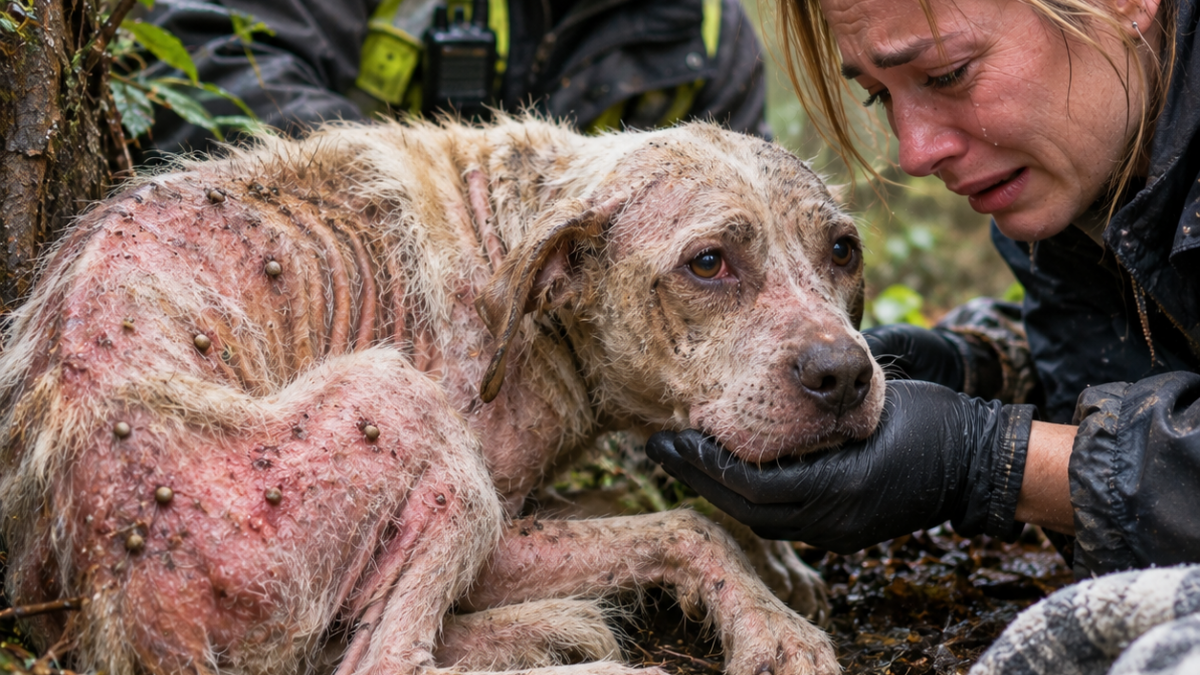
Most of her skin was exposed.
Her body carried ticks and patches of painful irritation.
Her nails had grown so long that they seemed likely to interfere with normal movement.
And beneath all of that were the troubling problems with her posture and legs.
She wasn’t merely exhausted from being abandoned.
Something seemed wrong with the way her body had developed.
I didn’t want to speculate before a veterinarian examined her.
But I was frightened.
Because neglect can leave damage that isn’t immediately visible.
A dog can be cleaned.
Ticks can be removed.
Skin can be treated.
But some injuries and deformities are far more difficult to repair.
I watched her breathe.
Then whispered, “Just get through today, sweetheart.”
She didn’t lift her head.
I wished she could understand that the car was taking her toward help.
Not away from it.
When we brought her into a safe indoor space, I expected her to relax.
At least a little.
The forest was behind her.
There was shelter.
There was water.
There were people trying to care for her.
But her trembling continued.
That was one of the first things that truly broke my heart.
She was no longer lying beneath wet branches, yet her body still behaved as though danger were everywhere.
We prepared a quiet, comfortable area where she could rest.
Then we gave her time.
I didn’t want to crowd her.
Everything about the situation was unfamiliar to her.
New smells.
New voices.
New surroundings.
New hands.
And for an animal who seemed overwhelmed by even gentle attention, too much affection could become another source of stress.
I sat nearby, keeping my movements slow.
“You’re inside now, baby.”
Her ears shifted toward my voice.
But her eyes stayed lowered.
I had seen frightened rescue dogs before.
Some reacted by barking.
Some tried to escape.
Some growled because fear made them defensive.
Hope did something quieter.
She withdrew.
She lowered her head, avoided direct eye contact, and made herself as small as possible.
I couldn’t know exactly what she had experienced before the forest.
But the way she responded to people suggested that closeness did not yet feel safe.
That thought stayed with me.
Because someone had once owned her.
Someone had been responsible for feeding her.
Keeping her clean.
Protecting her from parasites.
Providing appropriate space and veterinary care.
And somehow, by four years old, she had become a dog who shook when people tried to help.
When it was time to offer food, I realized how exhausted she truly was.
We placed a small portion within her reach.
She looked toward it.
Her nose moved.
For a moment, I felt hopeful.
She was interested.
She wanted to eat.
But when she tried to adjust herself, her body seemed too tired to cooperate.
She remained lying down.
Then slowly, carefully, she began eating.
I watched every movement.
Her head lowered toward the food.
She took a little.
Paused.
Then took more.
She didn’t leap up eagerly the way a healthy, hungry dog might.
She didn’t even rise into a comfortable standing position.
She ate while lying down because that was apparently all she could manage.
Something tightened inside my chest.
I thought about the ordinary things dogs do without effort.
Running toward a bowl.
Turning circles before dinner.
Standing with their tails moving as someone prepares food.
Hope couldn’t even eat that way.
She was so weak that getting through a meal required patience.
I sat beside her.
“That’s it, sweetheart.”
She took another small bite.
“You’re doing fine.”
She paused.
I wanted to tell her that there would be food again tomorrow.
That she didn’t need to worry about whether anyone would remember her.
That she didn’t have to finish everything immediately.
But I didn’t know what food had meant in her previous life.
I didn’t know whether she’d gone hungry.
I didn’t know whether she’d ever eaten comfortably.
I only knew the condition she was in now.
And watching her take those slow bites while lying down made me want to cry.
Not loudly.
Not dramatically.
Just the quiet kind of crying that comes when you witness suffering too intimate for words.
That night, I checked on her again and again.
Not because I expected her to become healthy before morning.
Because I couldn’t stop worrying.
Her skin was irritated.
Her body was weak.
Her posture was concerning.
She remained frightened, even when nobody was touching her.
The trembling was what troubled me most.
I looked at her resting in the quiet room and wondered whether she had ever known a place where she could truly relax.
A place without constant restriction.
Without fear.
Without pain.
A place where lying down meant rest instead of helplessness.
I couldn’t answer those questions.
And I didn’t want to pretend I knew what her past had been.
But I wanted her future to be different.
I wanted her to receive veterinary treatment.
Appropriate food.
A safe place to sleep.
A chance to move without being forced.
And people willing to give her time.
That last part mattered.
Hope didn’t seem ready for enthusiastic affection.
She wasn’t going to become confident simply because we called her beautiful.
She needed predictable, gentle care.
She needed to learn that being near people could lead to something good.
And perhaps most importantly, she needed her body to become comfortable enough that she could begin exploring the world.
I looked at her.
“Tomorrow we’re going to the doctor.”
Her eyes shifted slightly.
“Then we’ll figure out the next step.”
The following day, we took her to the veterinarian.
The journey felt frightening because I knew we were about to learn more about her condition.
I hoped the weakness came largely from exhaustion, skin disease, and parasites.
Those problems were serious, but treatment could help.
Yet I couldn’t forget the way she’d tried to stand.
The stiffness.
The unusual posture.
The difficulty placing her feet beneath herself.
I knew something more might be wrong.
At the clinic, Hope lowered her head almost immediately.
She seemed overwhelmed by the unfamiliar environment.
The sounds.
The smells.
The movement of people.
I stayed close enough to reassure her without crowding her.
“It’s okay, baby.”
She trembled.
I watched the veterinary team begin examining her.
They assessed her general condition and the visible skin problems.
They looked at the ticks.
Her overgrown nails.
The areas of irritation.
Then they examined the way she held her body.
Her spine.
Her pelvis.
Her legs.
As the examination continued, I noticed the veterinarian becoming increasingly thoughtful.
She wasn’t looking only at the skin anymore.
She was studying Hope’s structure.
The way her back curved.
The way her pelvis was positioned.
The way she attempted to support herself.
I felt my stomach tighten.
“Is something wrong with her bones?”
The veterinarian looked at me.
“We need to evaluate her musculoskeletal problems carefully.”
I watched Hope lower her head again.
She seemed to be trying to hide.
I wanted to reach out and hold her.
But I knew she was already frightened.
So I kept my voice gentle.
“You’re not alone, Hope.”
That was when the name felt right.
Hope.
Not because we knew she’d recover completely.
Not because we expected a miracle.
But because despite everything, she had survived long enough to be found.
And we were going to give her a chance.
The veterinary findings were worse than I had feared.
Hope had spinal abnormalities, including scoliosis, an abnormal curvature of the spine.
There was also a hernia.
And her pelvis was deformed.
I remember staring at the veterinarian, trying to arrange those words into something I could understand.
Spine.
Pelvis.
Deformed.
My mind kept returning to the same image.
Hope beneath the bushes, trying to stand and failing.
I’d thought I was watching an exhausted dog struggle against weakness.
Now I understood that her body had problems far beyond the skin disease and parasites we could see.
“Can those things heal?” I asked.
The veterinarian explained that some conditions could be managed, but structural changes to the bones might be permanent.
I felt something sink inside me.
Permanent.
The word seemed cruel when applied to a dog who was only four years old.
Four.
She should have been in the middle of her life.
Old enough to be confident.
Young enough to enjoy running, playing, and exploring.
Instead, she had a body whose shape had already been altered.
I looked down at her.
Hope was resting with her head lowered.
She didn’t understand the diagnosis.
She didn’t know what scoliosis meant.
She couldn’t know why we were so upset.
She only knew that strangers were handling her in an unfamiliar room and that her body wasn’t working comfortably.
I crouched beside her.
“Hey, baby.”
She kept her gaze down.
I swallowed.
“You’re only four.”
The veterinarian continued explaining what the findings suggested.
The abnormalities raised concern about how Hope had been kept during her earlier life.
Her body seemed consistent with prolonged confinement in inadequate space.
And because of her condition and history, there was a suspicion that she’d been used repeatedly for breeding.
I listened.
At first, the words didn’t fully register.
Then I looked at Hope again.
A breeding dog.
A cage.
Years of restricted movement.
The veterinarian wasn’t claiming to know exactly what had happened.
There were no records of Hope’s entire life.
No witness who could tell us every day she had spent with her former owner.
But the possibility was horrifying.
Could a dog have spent so much of her life in a cage that was too small for her body to move normally?
Could the lack of freedom have contributed to the changes we were seeing?
Had she given birth repeatedly while living in those conditions?
I felt tears gathering.
I thought of newborn puppies pressing against their mother’s belly.
Tiny creatures searching for milk.
A mother cleaning them.
Keeping them warm.
Then I thought about the possibility that those puppies had been taken away while Hope remained confined.
I couldn’t know whether that was precisely what happened.
But the suspected history made the damage to her body even more heartbreaking.
She might have spent years being valued for the puppies she could produce rather than for the living creature she was.
And when she was no longer wanted, someone had left her in the forest.
I looked at the veterinarian.
“Will she ever walk normally?”
There was no simple answer.
Her mobility would depend on several things.
Her existing structural problems.
Her physical strength.
The effects of treatment.
How she responded to care over time.
We couldn’t promise anything.
Not yet.
I looked at Hope.
Then whispered, “We’ll take whatever progress we can get.”
There are moments in animal rescue when you feel anger so intense that you have to remind yourself why you’re there.
I had one of those moments in the veterinary clinic.
Not because of the medical team.
They were working to help her.
Not because Hope was difficult.
She wasn’t.
She was frightened and exhausted.
I was angry because the damage to her body suggested she had been denied things so basic that most people barely think about them.
Room to move.
Appropriate care.
Protection from parasites.
Medical attention.
A safe place to rest.
I thought about the lives many dogs experience.
They wake up.
Stretch.
Walk around the house.
Follow their people into the kitchen.
Run toward the door when it’s time to go outside.
Choose where they want to lie down.
Turn around when something catches their attention.
Those little movements are part of ordinary life.
Now imagine living in a space that doesn’t allow them.
Day after day.
Month after month.
Perhaps year after year.
Imagine a body growing and changing while its freedom remains restricted.
Imagine being physically capable of wanting to move but never having enough room.
I couldn’t know every detail of Hope’s past.
But the possibility that she’d lived that way made my chest ache.
Then another thought arrived.
What if she’d never seen a field?
What if she’d never walked beside a person simply because they wanted her company?
What if every time someone approached, it was to take something from her rather than offer affection?
Again, those were questions.
Not facts we could prove.
But the fear in her body and the physical findings made them difficult to avoid.
I looked at her lowered head.
For the first time, I understood that our work wasn’t simply to make her stronger.
We needed to help her discover an entirely different relationship with the world.
One in which people didn’t only approach to handle her.
One in which she could rest without expecting danger.
One in which movement was possible and encouraged within her physical limits.
One in which she mattered even if she never produced another puppy, never ran, and never behaved like an affectionate pet.
She deserved a safe life regardless of how much she could recover.
The veterinary team began treatment to stabilize her condition.
She received fluids and care for the problems that had brought her in.
Her parasites and damaged skin needed attention.
Her overall weakness required monitoring.
Her spinal and pelvic abnormalities had to be considered in every decision about her movement and treatment.
I listened carefully to the instructions.
There would be medication.
Regular bathing as prescribed.
Patience.
Close observation.
And time.
I wanted someone to give me a date.
Two weeks.
A month.
A clear promise that Hope would stand comfortably and stop trembling.
But nobody could do that honestly.
Recovery wasn’t a schedule we could impose on her.
Some improvements might come quickly.
Others might take longer.
And some damage might remain permanent.
I looked at her lying quietly.
“That’s okay,” I whispered.
Not because permanent damage was okay.
It wasn’t.
But because I wanted her to have a life worth living even if she couldn’t become the dog she’d been meant to be before the suspected confinement.
If she could only walk slowly, we’d walk slowly.
If she needed help standing, we’d help her stand.
If she needed extra time to trust people, we’d give her that time.
If her skin required ongoing treatment, we’d provide it.
She didn’t have to become a perfect example of recovery to deserve care.
She was already worthy of it.
When I left the veterinary clinic, I carried the weight of her diagnosis with me.
For hours, I kept picturing Hope in the bushes.
The trembling.
The exposed red skin.
The ticks.
The nails.
The way she’d lowered her head as we approached.
Then I imagined her in a cage.
I tried not to linger too deeply on an unconfirmed past.
But I couldn’t ignore what the veterinarian had said.
Her body showed abnormalities that raised concern about prolonged confinement.
And she might have been used for breeding.
I thought about what people sometimes call a breeding animal.
A productive dog.
A valuable female.
A good mother.
Words that can sound ordinary until you look at a dog whose own health has been neglected.
A dog is not simply a means of producing puppies.
She has a body that needs movement.
A mind that responds to fear and safety.
A nervous system that experiences pain.
A need for rest, food, shelter, and care.
She can become frightened.
She can become overwhelmed.
She can suffer.
And Hope had suffered enough.
I thought about the possibility of puppies she’d nursed.
I imagined them growing stronger.
Opening their eyes.
Learning to walk.
Eventually leaving.
And Hope remaining behind.
Again, we couldn’t verify each part of that story.
But the thought was devastating.
Because if she’d been used for breeding, then people may have benefited from her ability to bring new lives into the world while failing to protect her own.
I looked down at my hands.
I wished I could undo it.
All the time she’d lost.
All the movement she’d been denied.
All the damage her body carried.
But I couldn’t.
We had to begin where she was.
And where she was, at that moment, was fragile.
The first days of treatment required careful attention.
Hope was still weak.
She wasn’t ready to move around freely.
Her body needed support.
Her skin needed treatment.
And her fear remained strong.
Sometimes, all I could do was sit nearby and let her rest.
That was difficult for me.
I wanted to make her feel better immediately.
I wanted to touch her head and watch her relax.
I wanted to see her tail move.
To hear a happy sound.
To know she understood that nobody intended to hurt her.
But healing frightened animals doesn’t work according to what makes people feel reassured.
Hope didn’t owe us a wagging tail.
She didn’t owe us gratitude.
She didn’t need to become affectionate on the first day simply because we had rescued her.
She needed space.
The freedom to observe us.
The chance to discover that familiar routines could be safe.
So we kept things gentle.
We approached slowly.
Spoke softly.
Allowed her to rest.
And made sure her treatment continued.
Sometimes she still trembled when someone entered.
Sometimes she lowered her head.
Sometimes her body seemed to anticipate discomfort even when we were only bringing food.
I reminded myself that every calm interaction mattered.
Not because one gentle moment would erase years of suffering.
But because repeated experiences might eventually teach her that her surroundings had changed.
One day, I watched Hope sleeping.
She lay in a comfortable, sheltered place.
Her body was still thin beneath the damaged coat.
Her skin was far from healed.
She hadn’t regained normal strength.
But she was no longer in the forest.
I sat nearby and studied her breathing.
It was such a simple thing.
A sleeping dog.
Yet I found myself grateful that she could rest somewhere protected.
In the woods, she had been surrounded by uncertainties.
Weather.
Wildlife.
Insects.
The inability to move easily.
No dependable food or water.
No one who knew where she was.
Now she was being cared for.
It didn’t mean everything was comfortable yet.
But it meant she wasn’t alone.
I wondered whether she could sense the difference.
Whether familiar voices might eventually become reassuring.
Whether the sound of someone approaching would stop making her shrink back.
Whether she would begin anticipating food instead of fearing hands.
I hoped so.
And for the first time, I allowed myself to imagine her future in small, manageable pieces.
Not running.
Not swimming.
Not standing beside the ocean.
Those possibilities seemed impossibly distant.
I imagined something simpler.
Hope lifting her head without fear.
Hope eating comfortably.
Hope standing for a moment.
Hope looking toward us when we called.
Hope deciding to approach a person because she wanted to.
Those would be victories.
And I was prepared to celebrate every one.
Three weeks passed.
Three weeks of treatment.
Observation.
Waiting.
Trying not to expect too much too soon.
Hope’s condition gradually stabilized enough for her to come home.
I remember how emotional that moment felt.
It wasn’t a dramatic transformation.
Her skin still needed care.
Her body still carried permanent structural changes.
She wasn’t suddenly a healthy dog who could run down a hallway.
But she had survived the first difficult stretch.
And she was ready for the next stage.
When we prepared to bring her home, I looked at her carefully.
Then something happened that made my eyes fill.
Hope stood.
She wasn’t moving with the effortless balance of a healthy young dog.
But she was on her feet.
Supporting herself.
The same dog who had barely been able to walk when the forestry worker found her.
The same dog who had eaten while lying down because she was too weak to rise comfortably.
Now she was standing.
For a moment, nobody around me spoke.
We simply watched.
I felt tears sliding down my face.
“Oh, Hope.”
She shifted slightly.
Her legs held.
I had to press my hand against my mouth.
Because I remembered those first hours so clearly.
The forest.
The trembling.
The failed attempt to stand.
The helplessness of watching her sink back down.
Now she was upright.
It wasn’t the end of her recovery.
It wasn’t proof that all the damage had healed.
But it was progress.
Real, visible progress.
And after what we’d seen, it meant everything.
I wanted to celebrate wildly.
To clap.
To shout.
To tell everyone that Hope had done something wonderful.
But I remembered how easily she became overwhelmed.
So I kept my voice quiet.
“Look at you, sweetheart.”
She stood for another moment.
Then settled.
I smiled through tears.
“That’s enough.”
Because she didn’t need to prove anything else that day.
She had stood.
Her body had supported her.
And the possibility of moving through the world had become a little more real.
I thought of the veterinarian’s findings.
The scoliosis.
The hernia.
The deformed pelvis.
Those conditions hadn’t disappeared.
They were still part of her body.
Some changes would remain.
But strength could improve even when structural abnormalities couldn’t be fully reversed.
Hope might learn to move more comfortably within the limits of her condition.
She might gain confidence.
She might discover what her legs could do.
We didn’t know how far she would progress.
But standing meant the future was no longer quite as uncertain as it had seemed.
I looked at her.
“You don’t know how proud we are of you.”
She didn’t react dramatically.
And that was all right.
She didn’t need to understand our pride.
She only needed to keep receiving the care that made more comfortable movement possible.
Coming home wasn’t the end of the work.
It was the beginning of a longer routine.
Hope needed daily medication.
Baths to support her skin treatment.
Patient handling.
Continued observation.
And a calm environment.
The first time I looked at all the care she needed, I felt overwhelmed.
Not because I regretted helping her.
Because I knew consistency would matter.
A missed treatment could affect her progress.
Too much activity could overwhelm or physically strain her.
Too much handling might frighten her.
Too little opportunity for safe movement might limit her confidence.
We needed balance.
And we needed to remember that Hope wasn’t just a medical condition.
She was a dog trying to learn how to live in a different environment.
Her skin needed attention.
But so did her emotional well-being.
Her mobility needed support.
But so did her curiosity.
She needed treatment.
But she also needed ordinary experiences that made life enjoyable.
I looked at her resting near us.
“One day at a time, baby.”
That became our approach.
One day.
Then another.
No demanding miracles.
No pretending that improvement had to happen quickly.
Just steady care.
Bath time was difficult at first.
Her skin was sensitive.
She was frightened by unfamiliar handling.
And the process could easily become overwhelming.
We followed the veterinary plan and kept everything as calm as possible.
I spoke to her gently throughout.
“You’re okay, Hope.”
She trembled.
“I know. It’s strange.”
I didn’t expect words to remove her fear.
But speaking softly helped me remain patient.
We handled her carefully.
Avoided unnecessary movement.
Gave her breaks when appropriate.
And focused on completing the care she needed without rushing.
Sometimes she lowered her head.
Sometimes she seemed to want to hide.
Those moments hurt to watch.
Because I knew our intentions were good.
We were trying to help her heal.
But she couldn’t understand that every unfamiliar sensation was part of treatment.
For a frightened dog, even gentle care can feel intimidating.
I wanted her to learn that discomfort and danger weren’t always the same thing.
That people could touch her carefully.
That a bath didn’t mean punishment.
That treatment could be followed by rest.
That nobody was angry with her for being afraid.
We didn’t demand that she become brave.
We simply continued showing her that she could be cared for safely.
The medication routine became part of our days.
So did checking her skin.
Looking for changes.
Watching how she moved.
Noticing when she seemed tired.
Giving her opportunities to rest.
There were days when progress felt obvious.
Other days, it was harder to recognize.
A small improvement in her coat.
A little less redness.
A movement that seemed easier.
A moment when she didn’t tremble quite as much.
Individually, those changes were easy to overlook.
But over time, they began adding up.
One evening, I looked at Hope and realized I could see the beginning of new fur growing where skin had once been almost completely bare.
I leaned closer.
Then smiled.
“Look at that.”
The hair was still short.
The coat was uneven.
Her skin hadn’t fully recovered.
But there was visible regrowth.
I felt a surge of happiness.
Not because her appearance mattered more than her comfort.
But because the change suggested her body was responding to care.
The red, exposed patches that had made me so worried were gradually improving.
And the dog who had looked painfully vulnerable in the forest was beginning to look more comfortable.
I remembered the first time I saw her.
Almost no fur.
Ticks.
Overgrown nails.
A body that trembled even when someone spoke softly.
Now, little by little, her appearance was changing.
I wondered what she felt.
Whether her skin was less irritated.
Whether resting had become more comfortable.
Whether the absence of parasites made daily life easier.
I couldn’t ask.
But I could observe.
And I could keep helping.
One of the hardest things about caring for Hope was resisting the urge to interpret every small movement as a miracle.
I wanted good news.
Of course I did.
Anyone who watched that dog struggle to eat would want the same.
But I also knew that progress wasn’t always straightforward.
Her spinal and pelvic abnormalities were still there.
Her body might have good days and difficult days.
She could become more mobile without becoming physically normal.
And she could grow more comfortable around people while still carrying fear.
I reminded myself of those limits frequently.
Not to diminish hope.
To protect it from becoming pressure.
Hope didn’t need a perfect recovery story.
She needed an honest one.
If she could stand, that was wonderful.
If she could take a few steps, we would celebrate.
If she had to rest, we would let her rest.
If she didn’t want to be touched, we would respect that.
If she approached us voluntarily, we would welcome her.
Her progress belonged to her.
Our job was to help make it possible.
Over time, I began noticing something even more meaningful than the changes to her skin.
Hope was becoming more comfortable around us.
It didn’t happen all at once.
There was no single day when she suddenly transformed from a frightened dog into an affectionate companion.
It was gradual.
At first, she would lower her head whenever we approached.
Then there were moments when she kept it raised a little longer.
She began paying attention to our movements without immediately shrinking away.
Sometimes she seemed curious about what we were doing.
Those small changes made me emotional because they suggested she was beginning to experience people differently.
I remembered the forest.
The way she hid beneath the branches.
The way she wouldn’t look toward us.
The way her whole body shook when we came close.
Now she was beginning to learn that our presence could be ordinary.
Someone might enter a room without hurting her.
A hand might bring food.
A familiar voice might mean it was time for care.
A person sitting nearby might simply be keeping her company.
There was no need to force affection.
Trust was developing through repetition.
And every time Hope seemed a little less frightened, I felt grateful.
Not because she owed us that trust.
Because life is easier for a dog who doesn’t feel compelled to fear every person nearby.
I remember sitting beside her one afternoon and noticing that she wasn’t trembling.
At first, I thought I must be mistaken.
I watched her carefully.
She was resting.
Her body seemed calmer.
She wasn’t shrinking away from the quiet activity around her.
I didn’t move closer.
I didn’t want to interrupt.
I simply sat there and let the moment happen.
After a while, I whispered, “There you are.”
Her eyes shifted toward me.
I smiled.
“That’s the girl I’ve been hoping to meet.”
Of course, the frightened dog from the forest was still Hope.
She hadn’t been a different animal.
Fear hadn’t made her less herself.
But as the fear slowly eased, we were beginning to see more of her personality.
More curiosity.
More interest.
More comfort.
I wondered whether this was what she’d always been like beneath the pain and exhaustion.
A dog who wanted to explore.
A dog who enjoyed being near familiar people.
A dog who might someday choose to run simply because the world around her was interesting.
I hoped so.
And for the first time, that possibility didn’t feel completely unrealistic.
Then came the day I saw something in her face that I had almost forgotten to look for.
Happiness.
It was not a sudden dramatic moment.
There was no grand performance.
No magical change that erased everything she’d endured.
Hope was simply spending time with people who cared for her.
And instead of looking overwhelmed, she seemed interested in what was happening.
Her body language was different.
She carried herself with more confidence.
Her attention moved toward the world instead of constantly withdrawing from it.
I looked at her and smiled.
“Are you having a good day, Hope?”
She looked toward the activity around her.
I watched her carefully.
There was something lighter about her.
Something that hadn’t been visible beneath those bushes.
And I realized how much we’d been waiting to see that change.
Not because happiness could be measured by a single expression.
But because the contrast with her first days was extraordinary.
In the beginning, she had been so frightened that approaching her required care.
She had eaten lying down.
She had lowered her head at the clinic.
She had trembled even after being brought into shelter.
Now she was beginning to engage with the world.
Her damaged skin was improving.
Her fur was growing back.
She could stand.
She was becoming more comfortable with familiar people.
And somewhere amid those changes, Hope had begun acting like a dog who expected good things might happen.
I felt tears gather.
“Look at you.”
She seemed interested in something beyond us.
I followed her gaze.
For the first time, I wasn’t looking at her only as a patient.
I was looking at her as a companion with a future.
Her mobility continued improving.
That was one of the most extraordinary parts of her recovery.
I still remembered how difficult standing had been at first.
The trembling legs.
The awkward posture.
The way her body seemed unable to support her comfortably.
Now she was moving with increasing confidence.
We remained mindful of her structural problems.
Her spine and pelvis hadn’t suddenly become normal.
But she was gaining strength and learning how to move within the body she had.
Every time she explored a little farther, I remembered the forestry worker’s words.
I don’t think she can walk.
I could still see him standing beside the bushes, looking worried.
I could still see Hope pressed against the ground, barely able to respond.
We had no idea then how much mobility she might regain.
And now she was beginning to show us.
One careful movement at a time.
I watched her take steps toward a familiar person.
Then toward something that caught her attention.
She wasn’t simply moving because we needed to examine or treat her.
She was moving because she wanted to go somewhere.
That difference was enormous.
A dog choosing a destination.
Something so ordinary.
Yet for Hope, it represented a freedom she’d almost lost.
I thought about how differently she’d entered our lives.
She had arrived as a rescue.
A problem needing urgent attention.
We were focused on skin treatment, parasites, nutrition, mobility, and veterinary findings.
There was so much to worry about that, at first, I barely imagined what life might look like beyond medical care.
But now her personality was becoming part of our days.
We began paying attention to what she liked.
What made her comfortable.
Which situations seemed overwhelming.
How much activity she enjoyed.
When she needed rest.
And when she seemed ready to explore.
I wanted to give her experiences that weren’t defined entirely by her injuries.
Because Hope’s life shouldn’t be reduced to the terrible things that had happened before we found her.
She was more than a neglected breeding dog, if that was indeed her history.
More than an abandoned animal.
More than a patient with scoliosis and a deformed pelvis.
She was a living creature with preferences, curiosity, and the capacity for enjoyment.
She deserved opportunities to discover those things.
And now that she was becoming stronger, we could begin offering them.
One day, as Hope moved around outside, I found myself thinking about the first time she’d been placed in a cage.
If the veterinarian’s suspicion was correct, confinement may have played a major role in her life.
I tried not to imagine precise events that we could never verify.
But I couldn’t stop thinking about the contrast between restriction and freedom.
In a cage, a dog has limited choices.
Where to stand.
Where to lie.
How far to walk.
Whether to approach something interesting.
Whether to move away from something frightening.
The size of the space determines so much.
Outdoors, the world is different.
A dog can notice a smell and move toward it.
Pause to listen.
Turn in another direction.
Follow someone she knows.
Explore a patch of ground.
Rest in a place she chooses.
Those freedoms might seem insignificant to people who experience them every day.
But for an animal whose body suggests prolonged confinement, they can be profound.
I watched Hope move through an open area.
She was still learning.
Still gaining confidence.
Still carrying permanent skeletal changes.
But she had choices.
She could go one way.
Then another.
She could follow a person.
Stop.
Turn back.
And I felt a quiet happiness that was difficult to explain.
She wasn’t being asked to produce anything.
She wasn’t being confined because someone wanted to use her.
She was simply allowed to be a dog.
The day Hope began running, I almost couldn’t believe what I was seeing.
Running.
It was a word I had barely dared to use during her first weeks.
Standing had seemed like a tremendous victory.
Walking comfortably had seemed uncertain.
And now her legs were carrying her forward with a speed and enthusiasm I had once feared she’d never experience.
I watched her move.
For a second, my mind refused to connect the dog in front of me with the one we’d lifted from the forest.
The same body.
The same spine with its abnormal curvature.
The same pelvis that had been found deformed.
The same dog who had trembled when people approached.
But now she was running.
I felt laughter rise in my chest.
Then tears.
“Oh, Hope!”
I didn’t chase after her.
I didn’t want to startle her or make her think something was wrong.
I simply watched.
Her legs moved beneath her.
Her body carried her toward something she wanted to explore.
And the sight was almost overwhelming.
I remembered her eating while lying down.
I remembered the way she’d lowered her head at the veterinary clinic.
I remembered being told some of her skeletal changes were permanent.
All of those things were still part of her story.
But so was this.
A dog who could run.
Not because all her problems had vanished.
But because treatment, strength, time, and patient care had helped her regain abilities we once feared might remain out of reach.
I pressed my hands against my face.
I couldn’t stop crying.
I wish I could show the version of myself who first saw Hope in the bushes what happened that day.
I wish I could return to the forest for one brief moment and tell that frightened rescuer something.
She’s going to stand.
She’s going to become more comfortable around people.
Her fur will begin growing back.
And one day, you’re going to watch her run.
I imagine how badly I would have wanted to believe it.
But I also know I would have been afraid to hope for too much.
Because when we first found her, the situation was uncertain.
The abnormalities in her bones were serious.
Her skin was badly damaged.
She was exhausted.
She was frightened.
We couldn’t know how her body would respond.
And I think that’s why watching her run affected me so deeply.
It wasn’t something we had been promised.
It was something she had reached through the care and time she’d been given.
I looked at her moving across the open ground.
Then I thought about the person who had abandoned her.
Whoever had left her in the forest had treated her as though her life no longer mattered.
Perhaps she was considered too damaged.
Too weak.
Too much work.
No longer useful.
We couldn’t know that person’s exact reasoning.
But the abandonment was real.
And now the animal who had been left behind was demonstrating that her life contained possibilities nobody had bothered to protect.
I didn’t feel satisfaction on behalf of the person who discarded her.
I felt sorrow that she’d nearly been denied the chance to experience this.
Hope began discovering new places.
And new friends.
That was another part of her story I loved.
In the forest, she had seemed unable to trust people.
Now, as she became more comfortable, she could spend time with those who wanted her close.
She still needed patience.
Her history hadn’t vanished.
But she was no longer defined only by fear.
I watched her become interested in the world around her.
Different places had different smells.
Different sounds.
Different things to explore.
She could walk toward what interested her.
Pause.
Look around.
Continue.
I thought about how much of a dog’s experience is shaped by scent and movement.
The world must have seemed enormous compared with whatever restricted environment she’d previously known.
I wondered what she noticed first.
The smell of grass.
The movement of air.
The sound of other animals.
The presence of familiar people.
There was no way to know precisely.
But I could see that exploring had become part of her life.
And that was enough to make me happy.
The first time I watched Hope approach a new place without immediately withdrawing, I felt the same quiet pride I’d felt when she stood.
Not because curiosity is remarkable in an ordinary dog.
Because it had been almost absent when we met her.
Under the bushes, she had seemed focused entirely on protecting herself.
She made herself small.
Avoided looking at us.
Shook when we moved.
There had been no sign that she wanted to explore beyond her hiding place.
Now she was choosing to investigate.
That choice mattered.
Fear can make the world feel narrow.
A frightened animal may remain close to whatever seems safest, even when curiosity might otherwise encourage exploration.
As Hope became more comfortable, her world appeared to expand.
She could notice something interesting without being overwhelmed.
She could move toward familiar people.
She could enjoy time outdoors.
I looked at her and thought about everything that had changed.
The forest was no longer the place where she had to hide.
The people around her were no longer unfamiliar figures whose approach made her tremble constantly.
Food was available.
Treatment was ongoing.
And there were opportunities to move freely.
It wasn’t a perfect life without limitations.
But it was a life with choices.
And that meant something.
I often thought about the puppies Hope may have had.
It was impossible not to.
The veterinarian suspected she had been used for breeding.
And if that was true, then her life might have been shaped by a repeated cycle of pregnancy, birth, nursing, and separation.
But we didn’t know the puppies.
We didn’t know where they had gone.
We didn’t know whether they had healthy lives.
We didn’t know how often Hope might have given birth.
I reminded myself not to invent details.
Yet the possibility still made me sad.
Because motherhood in animals can involve extraordinary physical demands.
Pregnancy changes the body.
Nursing requires energy.
Caring for newborns requires attention.
And a mother dog needs adequate space, nutrition, medical care, and rest.
Without those things, breeding can impose severe strain.
I looked at Hope’s altered body.
She had already endured enough without us needing to imagine every possible hardship.
The veterinary findings spoke for themselves.
And the suspicion of prolonged confinement made the entire picture more troubling.
I wanted her future to be free from that kind of exploitation.
No more being valued for what her body could produce.
No more being left behind when someone decided she was inconvenient.
No more having her needs treated as secondary.
She had given enough.
Now she deserved to receive care.
There were moments when I wanted to apologize to Hope on behalf of people.
I know that sounds strange.
I couldn’t have prevented her original suffering.
I didn’t know she existed until the forestry worker found her.
And I wasn’t responsible for what her former owner had done.
But when I looked at the damage to her body, I felt a kind of sorrow that went beyond the individual rescue.
We are responsible for the animals we choose to keep.
They depend on us in ways we sometimes forget.
A dog cannot arrange a veterinary appointment.
Cannot buy medication.
Cannot move herself into a larger enclosure.
Cannot decide to leave an abusive or neglectful owner.
Cannot explain to someone that her body hurts.
Cannot tell us that her skin is irritated or that her legs are struggling.
She communicates through behavior.
Movement.
Sounds.
Changes in appetite.
Posture.
And sometimes, by hiding.
Hope had been hiding when she was found.
I wondered how many people had seen her before and failed to recognize what she needed.
Perhaps nobody.
Perhaps many.
We couldn’t know.
But I knew that the person who had owned her had a responsibility to care for her.
And leaving a frightened, physically compromised dog in the forest was a terrible failure of that responsibility.
I looked at her resting after a period of activity.
“I’m sorry people let you down, baby.”
She was quiet.
Then I added, “But you’re not alone now.”
As her coat began returning, I was struck by how different she looked.
In the forest, most of her skin had been visible.
The red patches had made her appear painfully vulnerable.
The ticks had added another layer of distress.
Now the fur was coming back.
Gradually.
Unevenly.
But unmistakably.
I watched the changes over time.
Areas that had been bare began developing a coat again.
The severe redness improved with treatment.
Her skin looked less angry.
She began looking more comfortable.
And as her appearance changed, people could finally see something beyond the neglect.
A dog with a face capable of expression.
A dog who could enjoy being outside.
A dog who was becoming more confident.
Sometimes I found myself staring at her and smiling.
Not because she needed to look beautiful to deserve love.
She deserved care on the day we found her, when her fur was gone and her body was covered in ticks.
But I was grateful her skin was healing.
Grateful that treatment was helping.
Grateful that her body seemed to be recovering from some of the visible damage.
I wished the same could be said for every part of her skeleton.
It couldn’t.
But the improvement we could see mattered.
And it gave us reason to continue.
There was another change that meant even more to me.
Hope no longer seemed to expect every interaction to overwhelm her.
She still had moments of uncertainty.
But familiar people were becoming part of her comfort.
I thought about what that must have required.
Not just from us.
From her.
Every time she remained nearby instead of withdrawing, she was responding to an environment that had become more predictable.
Every time she allowed care with less fear, she was experiencing something different from the distress we’d witnessed at first.
Every time she approached someone voluntarily, she was making a choice.
I didn’t want to label every such moment as trust without considering her behavior carefully.
But the overall change was clear.
She was more comfortable.
She was less overwhelmed.
She was beginning to look happy.
And for a dog whose first response to help had been trembling and avoidance, that was extraordinary.
I began wondering whether we’d ever see her run toward someone simply because she was excited.
Then I reminded myself that she was already running.
Not necessarily in the precise way I’d once imagined.
But moving toward new places and experiences because she wanted to.
Perhaps happiness didn’t need to take any one form.
Perhaps it was enough that she could choose to move.
And that those movements no longer seemed defined by fear.
When Hope met new friends, I found myself watching with a mixture of happiness and caution.
She had endured enough that I wanted every experience to remain safe.
We paid attention to her comfort.
Allowed introductions and interactions to proceed at a pace she could handle.
And remembered that she still had physical limitations.
But there were beautiful moments.
Moments when she seemed interested in another dog.
Moments when she explored a place without the frightened posture we’d seen in the beginning.
Moments when she spent time outside with people who wanted her companionship.
I realized how different that was from what the veterinarian suspected about her past.
If Hope had spent years confined for breeding, then contact with other living creatures may often have been determined by someone else’s purposes.
Now she was being offered the chance to experience companionship differently.
To be around others without being treated as a means to an end.
To rest when she needed rest.
To move when she wanted to move.
To enjoy being near people.
I watched her and felt something warm settle in my chest.
We had not simply rescued a dog from a forest.
We were helping her experience parts of life she might have been denied.
And those experiences were becoming the heart of her recovery.
Sometimes, after Hope spent time running or exploring, I watched her resting and felt almost unable to believe the change.
I would remember her lying beside the food bowl.
Her head lowered.
Taking tiny bites because standing was too difficult.
Then I would look at her after a day outside.
The same dog.
Her structural abnormalities hadn’t disappeared.
But she had gained strength.
Confidence.
Comfort.
And opportunities to move.
The contrast was overwhelming.
I had once feared she might never stand properly.
Now she had experienced running.
I had once worried she might never feel safe around people.
Now she was spending time with people who loved having her nearby.
I had once looked at her exposed skin and wondered how long healing might take.
Now her fur was growing back.
None of those improvements erased the past.
But together, they changed the future.
I think that was what moved me most.
The past remained part of Hope’s body.
The scoliosis.
The pelvis.
The memories we couldn’t see.
But it no longer had to be the only thing defining her days.
There could be good days, too.
Days outdoors.
Days with friends.
Days of movement.
Days when she looked happy.
And the simple possibility of those days was worth everything we had done.
The day Hope saw the ocean, I understood something about her recovery that I hadn’t fully understood before.
For months, our attention had been focused on what was wrong with her.
Her skin.
Her spine.
Her pelvis.
Her weakness.
Her fear.
Every improvement had seemed important because it represented something she was recovering from.
But the ocean wasn’t about recovering something.
It was about discovering something new.
A place she could explore simply because she was alive and someone wanted to share the experience with her.
I remember watching her arrive near the water.
The shoreline stretched ahead.
The open sky seemed enormous.
Waves rolled toward the sand, broke into white foam, and slipped backward again.
There was movement everywhere.
The wind.
The water.
The shifting light.
And Hope stood looking toward it.
For a moment, I could barely breathe.
I thought about the forest.
The tangled bushes.
The damp ground.
The little space where she’d been trying to hide.
Then I looked at the ocean.
There were no branches closing around her.
No cage restricting the distance she could move.
No narrow space forcing her body into an unnatural position.
The shoreline opened in front of her.
She could look left.
Right.
Toward the water.
Toward the people beside her.
And there was room to move in every direction.
I felt my eyes fill.
Not because Hope necessarily understood the significance of the moment.
She couldn’t know that we were comparing the place where she’d nearly died with the open world in front of her now.
She didn’t know we were thinking about the veterinary diagnosis.
The suspected confinement.
The weeks of treatment.
The first moment she stood.
She was simply there.
A dog watching waves.
And somehow, that was the most beautiful thing I could imagine for her.
I wondered what the ocean sounded like to Hope.
Perhaps the waves were strange.
Perhaps the wind carried smells she’d never encountered.
Perhaps she was simply curious about the moving water.
I didn’t want to invent what she felt.
But I could see her standing there.
Aware.
Interested.
Present.
The frightened animal who once tried to disappear beneath a wall of bushes was now facing something unfamiliar without immediately hiding.
I remembered her first day at the veterinary clinic.
The way she’d lowered her head as though trying to make herself invisible.
The way her body trembled at the approach of people.
The way she seemed to expect danger everywhere.
Now she stood beside the ocean, looking outward.
It was such a quiet image.
A dog facing the waves.
Anyone else might have walked past without noticing.
But I couldn’t stop watching.
Because I knew what it had taken for her to reach that moment.
I knew about the skin treatments.
The medication.
The patient handling.
The time she spent regaining strength.
The uncertainty surrounding her mobility.
And the gradual change in her relationship with people.
I knew she had once been too exhausted to stand comfortably while eating.
And now there she was.
Standing on her own legs.
Watching the ocean.
I pressed my fingers against my mouth.
“Oh, Hope.”
I didn’t know what else to say.
The waves moved toward the shore.
Then away.
Again and again.
I watched the water and thought about how different it was from the life Hope may have known before.
A cage limits the world to what can be seen and reached from one place.
A forest can become a prison when an injured animal is too weak to leave its hiding spot.
But this shoreline represented something else.
Possibility.
Not limitless possibility.
Hope still had physical conditions that required care and consideration.
She wasn’t magically free of her spinal abnormalities.
Her pelvis remained changed.
Her health would continue to matter.
But she had the opportunity to experience the world beyond the places where she’d suffered.
She could spend time outdoors.
Meet friends.
Walk.
Run.
Explore.
Rest.
And be near people who wanted her there.
I imagined how different her life might have been if the forestry worker hadn’t heard her crying.
The thought made me shiver.
She had been so vulnerable.
Her cries so faint.
Her movements so limited.
Without help, she would have faced the forest alone.
But the worker had stopped.
He had pushed aside the branches.
He had looked closely enough to recognize that she needed rescue.
And because of that, Hope was here.
At the ocean.
I looked toward the horizon.
Then back at her.
One small act of attention had changed the direction of an entire life.
I think often about the person who abandoned Hope.
Not because I want to spend her story discussing someone who failed her.
But because the abandonment was the point at which every responsibility toward her had been rejected.
Someone had owned her.
Someone had known she existed.
Someone had been responsible for her welfare.
And then she’d been left in a place where she could barely walk.
I don’t know what that person was thinking.
I don’t know whether they recognized how serious her condition had become.
I don’t know whether they believed she would survive.
What I do know is that Hope was found in a forest, frightened and physically compromised, without the care she desperately needed.
That was enough to make the abandonment devastating.
And it made the kindness of the forestry worker even more meaningful.
He hadn’t been searching for a famous animal.
He hadn’t known there was a dramatic rescue story waiting behind the bushes.
He’d simply heard crying.
And instead of ignoring it, he’d stopped.
Sometimes compassion begins before we even know what we’re looking at.
A sound.
A movement.
Something that doesn’t seem right.
Then a decision.
To investigate.
To care.
To ask for help.
That decision gave Hope a chance.
And the people who cared for her afterward helped turn that chance into a life.
There are parts of Hope’s story that we will never know.
We don’t know every day she spent with her former owner.
We don’t know exactly when her body began developing the abnormalities the veterinarian found.
We don’t know whether she gave birth once or many times.
We don’t know where any puppies she may have had ended up.
We don’t know precisely what she experienced in the forest before the forestry worker found her.
And we don’t know everything she remembers.
That uncertainty used to trouble me.
I wanted answers.
I wanted to understand why such a young dog looked so damaged.
I wanted to know how someone could let her become covered in ticks, lose most of her fur, and struggle to walk.
I wanted to know why she seemed so frightened of people.
But the more time I spent with Hope, the more I realized that knowing every detail wasn’t necessary to care for her.
Her condition told us she needed help.
Her veterinary examinations told us she had structural problems.
Her behavior told us she was easily overwhelmed.
And her response to treatment showed us that she could improve.
Those were the things we could act on.
We couldn’t change the history.
But we could respond to the animal in front of us.
And over time, that became enough.
Not enough to erase the sadness.
Enough to keep moving forward.
I remember how frightened I was when we first learned about her spine.
The word scoliosis sounded so permanent.
So serious.
And it was serious.
The pelvic deformity frightened me, too.
I wondered what kind of life she would have.
Whether moving would remain difficult.
Whether she’d need help with ordinary tasks.
Whether her fear would prevent her from enjoying the companionship we wanted to offer.
I didn’t want to burden her with our expectations.
But it was impossible not to hope.
Then the weeks passed.
She began standing.
Her skin improved.
Her fur returned.
She became more comfortable around us.
She started looking happy.
And eventually, she ran.
That progression changed my understanding of recovery.
I had once imagined healing as a return to the way things were before an injury or illness.
But Hope showed me that recovery can mean something different.
Her bones weren’t suddenly restored to an ideal shape.
The past wasn’t erased.
Yet her strength improved.
Her comfort improved.
Her relationship with the world changed.
She could enjoy experiences that had once seemed impossible.
She wasn’t becoming a dog without a history.
She was becoming a dog with a future.
And that distinction mattered.
I watched her standing near the ocean for a long time.
Every now and then, the waves grew louder.
Foam moved across the sand.
The wind stirred.
Hope remained interested in the scene ahead.
I thought about how many dogs experience a beach visit as an ordinary pleasure.
Their people bring them.
They explore.
They sniff.
Some run toward the water.
Others remain cautiously near the shore.
Then they go home.
But for Hope, simply standing there carried an emotional weight that only the people who had seen her at her weakest could fully understand.
She had once been unable to eat except while lying down.
Now she could stand before an ocean.
She had once trembled when people approached.
Now she had people beside her who wanted her company.
She had once been abandoned in a forest.
Now she was being brought to places because someone wanted her to enjoy life.
I looked at her.
And realized that the most important change wasn’t the distance she could run.
It was the fact that she was no longer being treated as disposable.
She mattered.
Her comfort mattered.
Her fear mattered.
Her enjoyment mattered.
Her needs mattered.
Not because she could produce puppies.
Not because she was useful.
Not because her recovery made an inspiring story.
She mattered simply because she was alive.
Sometimes I wonder whether Hope’s former owner would recognize her now.
I picture the dog found beneath those bushes.
The red skin.
The missing fur.
The ticks.
The overgrown nails.
The lowered head.
The trembling.
Then I picture the dog who eventually ran.
Whose coat began to return.
Who became more comfortable with people.
Who stood watching the ocean.
The difference is extraordinary.
But I wouldn’t want anyone to look at her and believe the damage had vanished completely.
It hadn’t.
Her skeletal abnormalities remained part of her life.
And emotional recovery isn’t something we can declare finished simply because a dog looks happy.
She still needed thoughtful care.
Appropriate physical limits.
Patience with unfamiliar situations.
People who paid attention when something seemed uncomfortable.
Yet those needs didn’t make her life less valuable or less joyful.
Many animals live fulfilling lives while receiving ongoing treatment or managing permanent conditions.
Hope deserved the chance to do the same.
And watching her enjoy the world reminded me that a body doesn’t have to be perfect for a life to be meaningful.
One of my favorite memories of Hope isn’t a dramatic milestone.
It isn’t the first day she stood.
Or the first time she ran.
Or even the moment she saw the ocean.
It’s an ordinary moment when she seemed comfortable simply being near us.
No urgent treatment.
No frightened retreat.
No struggle to stand.
Just Hope, resting in the presence of people who cared for her.
I remember thinking that we had come a long way from the forest.
At first, I had wanted to hold her immediately.
To make her feel loved.
To erase the fear in her eyes with affection.
But she hadn’t been ready.
And the most important thing we could do was respect that.
We learned to approach gently.
To give her time.
To observe her behavior.
To allow her comfort to develop naturally.
Then, gradually, being near us became less frightening.
I realized that affection isn’t meaningful because it’s forced upon an animal.
It’s meaningful when the animal is comfortable enough to receive it—or choose it.
Hope’s growing comfort mattered because it belonged to her.
It wasn’t something we demanded.
It was something she gradually offered as the world around her became safer.
If I could return to the day the forestry worker called us, I would still be frightened.
I would still feel overwhelmed when I first saw her skin.
I would still worry about her ability to walk.
I would still cry at the veterinary findings.
Because none of those things were insignificant.
Her condition was serious.
She needed extensive care.
Her recovery was uncertain.
But I would also know something I didn’t know then.
A dog can have permanent physical damage and still experience happiness.
An animal can arrive terrified and gradually become comfortable with people.
A body that struggles to stand may become strong enough to move with confidence.
And a creature abandoned in a forest can eventually stand beside the ocean, watching waves roll toward the shore.
Those possibilities don’t excuse what happened.
They don’t make neglect less cruel.
They don’t turn suffering into something necessary or worthwhile.
Hope shouldn’t have had to endure any of it.
But once she had survived, she deserved every opportunity to experience something better.
And that’s what her rescuers tried to give her.
I think about the forestry worker often.
The moment he heard her crying.
The decision to stop.
The effort of pushing the branches aside.
The shock of finding a dog who could barely walk.
He didn’t know her name.
Didn’t know she was four years old.
Didn’t know about her spinal problems.
Didn’t know she’d become the dog we called Hope.
He only knew she needed help.
And he acted.
That matters.
Because so many rescue stories begin with someone noticing what others overlook.
A faint cry.
A frightened animal.
A movement beneath the bushes.
A dog who doesn’t belong in the place where she’s been found.
Then someone decides not to walk away.
That decision doesn’t guarantee a happy ending.
But it creates a possibility.
For Hope, it created the possibility of medical treatment.
Of recovering enough strength to stand.
Of having her skin heal.
Of learning to feel more comfortable around people.
Of running.
Of seeing the ocean.
I don’t know whether the worker imagined any of that when he made the call.
Probably not.
He may simply have hoped she would survive the day.
But because he stopped, Hope’s story didn’t end in the forest.
There is one image I will carry with me for the rest of my life.
Hope standing by the water.
Not crouched beneath branches.
Not lying beside a food bowl.
Not lowering her head in fear at the veterinary clinic.
Standing.
The shoreline stretched in front of her.
The waves moved endlessly toward the sand.
The sky opened above her.
And there was room in every direction.
I kept thinking about that contrast.
A dog who may have spent years in a cage too small for her body.
A dog who was left in the woods when she was no longer wanted.
A dog who arrived so frightened that she could barely look at the people trying to help.
Now she stood before something enormous.
Something she had never needed to earn.
The open world.
I watched her and felt tears running down my face.
I didn’t know whether she loved the ocean.
I didn’t know whether she understood how far she’d come.
But I knew she was there to experience it.
And I knew that was something nobody could have promised when we first found her.
Hope’s story didn’t end with a miraculous cure.
Her spine still had its abnormal curve.
Her pelvis remained deformed.
Her body carried evidence of what she’d endured.
And we couldn’t know exactly how much fear she might continue to carry.
But the dog who once struggled even to eat had learned to stand.
Then to move.
Then to run.
Her skin improved.
Her fur began returning.
Her trembling became less constant as she grew more comfortable with the people around her.
She discovered companionship.
Outdoor places.
New experiences.
And one day, she stood before the ocean.
I thought of the frightened creature beneath the bushes.
The forestry worker bending down to see her.
The rescuers approaching carefully.
The medical team examining her.
The weeks of treatment.
The first uncertain moment on her feet.
And the joy of seeing her run.
Every stage mattered.
Not because it made a perfect story.
Because it gave Hope more comfort, safety, and freedom.
In the beginning, the only thing we knew for certain was that she had been abandoned and desperately needed help.
We didn’t know whether she’d be able to stand.
We didn’t know how much her skin would recover.
We didn’t know whether she’d ever feel comfortable around people.
And we certainly didn’t know that she would one day run toward new places and stand watching waves.
We simply kept caring for her.
One treatment.
One meal.
One bath.
One gentle interaction.
One small improvement at a time.
And Hope did what she could with the strength she slowly regained.
I sometimes think about what the word hope really means.
It doesn’t mean pretending everything will be perfect.
It doesn’t mean promising that permanent injuries will disappear.
It doesn’t mean ignoring suffering or inventing a happy ending.
Sometimes, hope is much smaller.
It’s a forestry worker stopping when he hears a faint cry.
It’s a frightened dog being carried out of the bushes.
It’s a veterinarian searching for ways to help a weakened body.
It’s a rescuer sitting quietly beside an animal who isn’t ready to be touched.
It’s a meal eaten slowly while lying down.
It’s medication.
Clean bedding.
A gentle bath.
A moment of rest.
Then one day, it’s a trembling dog finding enough strength to stand.
Later, it’s fur returning to damaged skin.
A head held a little higher.
A frightened expression beginning to soften.
A dog exploring a new place.
And finally, legs that once struggled to support her carrying her forward in a run.
That is what Hope’s name came to mean to me.
Not certainty.
Possibility.
The belief that a life can contain something better than the suffering that came before it.
The forest where Hope was found will always be part of her story.
The bushes.
The faint cries.
The damaged skin.
The ticks.
The exhaustion.
The fear.
But it doesn’t have to be the only part we remember.
I want to remember the people who responded.
The veterinary care.
The patient weeks when every small improvement mattered.
The moment she stood.
The first signs of her coat returning.
The gradual change in her confidence.
The day she began running.
And the shoreline.
Especially the shoreline.
Because when I think of Hope now, I no longer see only the frightened dog trying to make herself invisible beneath the branches.
I see her standing near the waves.
Her body still imperfect.
Her past still unknown in many ways.
But her future no longer limited to what someone else had chosen for her.
I see a dog who had been given room to move.
A dog whose needs were finally being taken seriously.
A dog whose life was no longer measured by whether she was useful to another person.
And I feel grateful that someone heard her when she cried.
At four years old, Hope had already experienced more hardship than any dog should.
She had been abandoned.
Her body was damaged.
Her skin required extensive care.
And the fear in her behavior suggested that life had not been gentle with her.
But she was still alive.
That mattered.
She was alive when the forestry worker pushed the branches aside.
Alive when rescuers approached.
Alive when the veterinary team examined her.
Alive through the weeks of treatment.
And alive when she finally stood before the ocean.
I looked at her watching the waves and thought about how close she might have come to losing the chance to experience any of it.
Then I thought about all the simple things she could enjoy now.
Being outside.
Moving toward something interesting.
Spending time with familiar people.
Resting safely.
Exploring new places.
Running when her body allowed it.
Those experiences didn’t erase the damage.
But they gave her life something beyond damage.
Something worth protecting.
Something worth celebrating.
I watched the water move toward the shore.
Hope remained beside us.
And for a moment, I didn’t think about the person who had left her behind.
I didn’t think about the cage the veterinarian suspected.
Or the puppies she may have had.
Or the years we could never give back.
I thought about the dog in front of me.
The living, breathing animal who had survived.
Who had been cared for.
Who had gained strength.
Who had begun to trust.
Who had learned to run.
And who now had enough freedom to stand before a world that stretched far beyond the place where she’d once been abandoned.
I smiled through tears.
“Look at you, Hope.”
The waves continued moving.
The wind brushed across the shore.
And she stood watching.
Not hidden.
Not forgotten.
Not alone.
The dog who once had barely enough room to move was finally standing before an ocean, with a whole world open in front of her—and people beside her who wanted her to be part of it








