“HE ONLY WAGGED HIS TAIL ONCE… PLEASE DON’T LET THAT BE HIS LAST GOODBYE!” The Dying Dog Was Given Almost No Chance of Surviving the Night — Then He Wagged His Tail Once, and I Made a Promise That Would Break My Heart Weeks Later
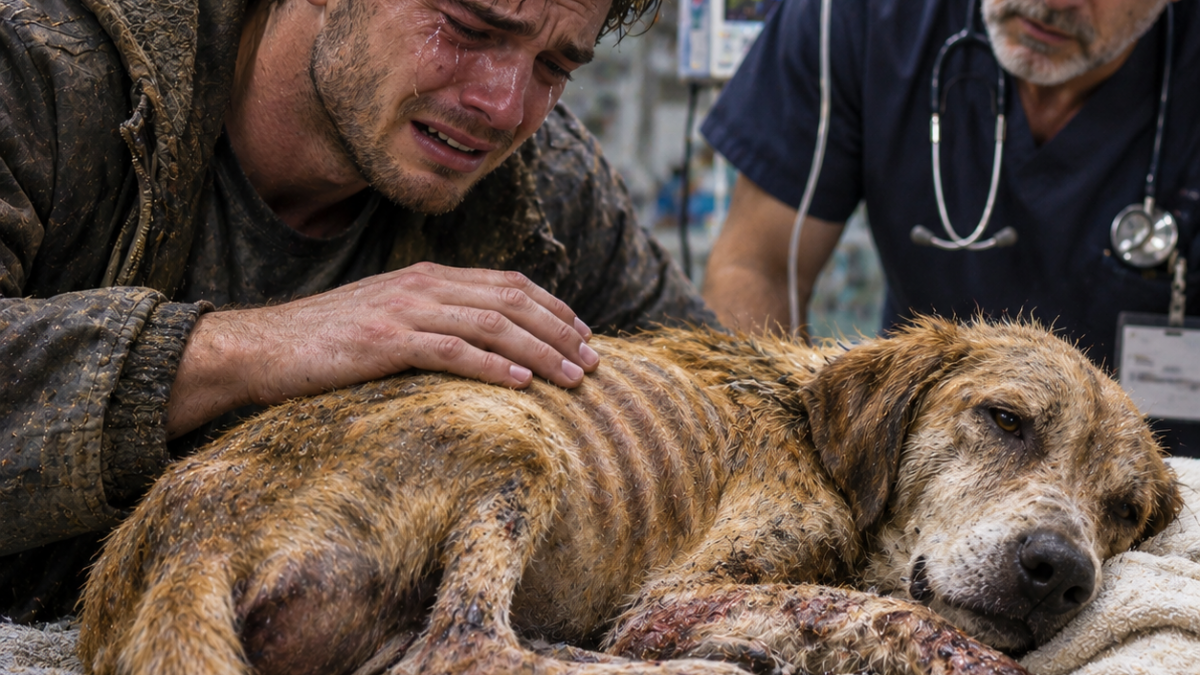
“HE’S TOO WEAK TO SURVIVE THE NIGHT!” I Found a Dying Dog Who Could Barely Lift His Head—But One Tiny Tail Wag Made Me Promise I Wouldn’t Leave Him
“PLEASE, DON’T GIVE UP ON HIM! HE JUST WAGGED HIS TAIL!” I cried as the veterinarian examined the starving dog I’d carried into the emergency clinic, his ribs protruding beneath his filthy coat, his breathing so shallow that I kept leaning closer to make sure he was still alive.
Dr. Elliott warned me that the dog was severely weakened and might not survive the night, but when I placed my trembling hand gently against his side, he somehow found the strength to move his tail just once—a tiny movement so heartbreaking that I sat on the clinic floor and begged him to hold on until morning.
I didn’t know that the dog I would name River would eventually learn to stand, walk, and run again, or that after weeks of fighting to keep him alive, the cruelest moment of my journey would come when I had to place his leash into another woman’s hands and walk away from the animal who had taught me what it meant to stay.
My name is Mason Wright. I’m twenty-eight years old, and I work in animal control.
People hear that job title and sometimes imagine I spend my days chasing loose dogs through neighborhoods or reminding people about leash laws.
Some days, that’s exactly what I do.
But there are other days.
Days when you open a gate and find an animal that hasn’t been fed properly in far too long.
Days when you enter an abandoned building and discover frightened eyes staring back at you from beneath broken furniture.
Days when you carry a living creature into a veterinary clinic without knowing whether you’ll ever see it stand again.
I’ve learned that suffering doesn’t always announce itself with barking or crying.
Sometimes it’s silent.
Sometimes it lies motionless in a place where nobody bothers to look.
And sometimes, the only thing separating an animal from being forgotten is one person deciding to stop.
I remember the night River came into my life with a clarity that still makes my chest tighten.
The darkness outside.
The cold air.
The weight of his body.
The way his head rested without strength.
And the terrible feeling that I was carrying someone who might be taking his final breaths.
We had found him in a condition that made even my experienced colleagues fall quiet.
He was painfully thin.
Weak beyond anything I wanted to imagine.
His fur was dirty, and his body showed signs of prolonged deprivation.
I couldn’t determine exactly how long he’d been suffering or what had happened before we reached him.
There was no reliable history.
No owner standing nearby to explain.
No familiar voice calling his name.
Just a dog who needed immediate care.
As we prepared to transport him, I crouched beside him.
“Hey, buddy.”
His eyes shifted toward me.
“Can you hear me?”
He didn’t lift his head.
I moved my hand slowly, allowing him to see it.
Then I rested it gently against his side.
I could feel the slight movement of his breathing.
For a moment, nothing happened.
Then his tail moved.
Just once.
Not a joyful wag.
Not the excited movement of a healthy dog greeting someone he knows.
A tiny, almost imperceptible motion.
But I saw it.
And I will never forget it.
I stared at him.
“Oh, buddy.”
My voice broke.
“You’re still trying.”
He remained motionless.
I kept my hand near him.
Then whispered, “Okay.”
I swallowed.
“I see you.”
That was the moment I stopped thinking about him as another animal needing transport.
He was a life.
A frightened, exhausted life that still responded to gentleness.
And I knew I wasn’t going to forget him when my shift ended.
At the clinic, Dr. Elliott and the veterinary team moved quickly.
They assessed his condition and began the appropriate emergency treatment.
I stood near the doorway, watching everything with my heart pounding.
I’d brought in critically ill animals before.
I knew that veterinary care was essential.
I knew how dangerous severe weakness and malnutrition could be.
But knowing those things didn’t make it easier to watch.
Eventually, Dr. Elliott approached me.
“Mason.”
I looked up.
“How is he?”
His expression was serious.
“He’s in critical condition.”
I swallowed.
“Can he recover?”
“We’re doing everything medically appropriate to stabilize him.”
I waited.
The doctor continued, “But his condition is severe. We need to get him through tonight.”
I looked toward the examination room.
The dog lay quietly beneath the clinic lights.
His body seemed impossibly fragile.
I thought about the little tail wag.
The tiny movement he’d managed when my hand touched him.
And I felt tears rising.
“Can I stay?”
Dr. Elliott studied me.
“You’re supposed to be off duty.”
“I know.”
“You look exhausted.”
“I know.”
He hesitated.
Then nodded.
“As long as you don’t interfere with his care.”
I swallowed.
“Thank you.”
I sat beside River that night.
At first, I didn’t have a name for him.
I simply called him buddy.
Good boy.
Sweetheart.
Little fighter.
I spoke softly while the veterinary team continued monitoring him.
I told him he wasn’t alone.
That he was inside.
That he was warm.
That there were people trying to help.
Sometimes his ears shifted.
Sometimes his eyes moved toward my voice.
Sometimes he lay so still that I became frightened all over again.
Hours passed.
I barely noticed.
At one point, I leaned closer and whispered, “I know you’re tired.”
My throat closed.
“But please stay.”
I looked at his thin body.
“Just until morning.”
Then I remembered something my grandfather used to tell me when I was growing up in the mountains of Virginia.
Slow water runs deep, Mason. Slow water smooths the stones.
Grandpa believed that patience could accomplish things force never would.
That strength wasn’t always loud.
That persistence mattered.
I looked toward the dog.
And thought of a river.
Something that keeps moving even when the way ahead is difficult.
“River,” I whispered.
His ear moved.
I smiled through tears.
“That’s your name.”
He didn’t lift his head.
But I stayed beside him.
“River.”
I gently stroked his side when it was appropriate.
“You’re not alone anymore.”
And sometime before dawn, as the first pale light appeared beyond the clinic windows, Dr. Elliott returned, checked his condition, and gave me the smallest piece of good news I’d heard all night.
“He’s made it through the first night.”
I covered my face.
For a moment, I couldn’t breathe.
Then the doctor placed a hand on my shoulder.
“Mason, listen carefully.”
I looked up.
“Surviving the night doesn’t mean he’s out of danger.”
I nodded.
“I know.”
“We still have a long way to go.”
I looked toward River.
His eyes were partly open.
Watching me.
And I whispered, “Then we’ll take the long way.”
I had no idea that the dog who couldn’t lift his head would one day run across a shelter yard with a tennis ball in his mouth—or that when he finally learned to trust me, I would have to decide whether loving him meant keeping him or finding the courage to let him go.
FULL STORY CONTINUATION
The first morning was not a celebration.
I wanted it to be.
I wanted to walk out of the clinic and call everyone I knew.
I wanted to tell Linda, my mentor, that the dog had survived.
I wanted to believe the worst was behind us.
But Dr. Elliott’s expression told me otherwise.
River had survived the first night.
That was all we knew.
His body had been pushed to a dangerous limit, and recovery would depend on how he responded to treatment over the following hours and days.
Dr. Elliott used the phrase cautious optimism.
I hated that phrase at first.
Optimism sounded like hope.
Cautious sounded like fear.
I wanted one without the other.
I wanted the doctor to tell me River would recover.
Instead, he explained that we’d need to monitor him carefully and respond to changes as they happened.
“Think in hours for now,” he said.
“Not weeks.”
I stared at him.
“Hours?”
He nodded.
“Every stable hour matters.”
I looked through the doorway.
River lay on his bedding.
The veterinary staff moved quietly around him.
His body was still weak.
His head still rested against the blanket.
I swallowed.
“Okay.”
Then I pulled my chair closer.
And began thinking in hours.
The first three days became a strange blur.
I stayed at the clinic as much as my work schedule and the staff’s rules allowed.
I slept in uncomfortable positions.
A chair.
A bench.
Once, on the floor with my jacket folded beneath my head.
I ate when someone reminded me.
Drank coffee I barely tasted.
Checked my phone without remembering why I’d picked it up.
And watched River breathe.
I had never paid so much attention to breathing before.
The way his ribs moved.
The quiet rhythm of his chest.
The pauses that frightened me even when they were normal.
Sometimes I leaned closer because I needed reassurance.
Sometimes I forced myself to sit back because the medical team was already monitoring him.
River didn’t need a frightened man hovering over him every second.
He needed calm.
Consistency.
Appropriate medical treatment.
And rest.
So I tried to become calmer.
It wasn’t easy.
On the second night, I sat beside him while rain tapped against the clinic windows.
The room smelled faintly of disinfectant and clean bedding.
A clock ticked on the wall.
River’s eyes were closed.
I rested my hands in my lap.
Then began talking.
“You know, I grew up in Virginia.”
His ear shifted slightly.
I smiled.
“Up in the mountains.”
I looked toward the window.
“My grandfather lived in a little house surrounded by trees.”
For a moment, I could picture it.
The narrow porch.
The gravel driveway.
The old rocking chair.
The sound of water moving through the creek behind his property.
Grandpa used to take me fishing.
We’d sit beside the water for hours.
Sometimes we’d catch something.
Usually we wouldn’t.
I remember complaining once that the fish weren’t interested.
Grandpa laughed.
“Maybe the fish aren’t the reason we’re here.”
I’d stared at him.
“Then why did we bring fishing rods?”
He chuckled.
“Because otherwise you wouldn’t sit still long enough to listen.”
I smiled at the memory.
Then looked toward River.
“Grandpa would’ve liked you.”
River remained still.
“He had a way with animals.”
My voice softened.
“He never rushed them.”
I paused.
“Guess I still have a few things to learn.”
River’s breathing remained steady.
I leaned back against the wall.
And continued telling stories.
There was one moment that second night when fear nearly overwhelmed me.
I stepped out to get water.
I’d been sitting beside River for hours, and Dr. Elliott had reminded me that I needed to take basic care of myself too.
So I walked into the hallway.
Filled a paper cup.
Drank.
Then stood beside the water dispenser, staring at the floor.
I was exhausted.
My entire body ached.
For a moment, I wondered whether I should go home.
Take a shower.
Sleep in my own bed.
Return in the morning.
River was receiving professional care.
He wasn’t depending on me to administer treatment.
There was nothing medically necessary about my remaining awake beside him.
I knew that.
But every time I imagined leaving, I saw his tiny tail wag.
The one movement he’d made when I touched him.
And I couldn’t make myself go.
I returned to the room.
Then stopped in the doorway.
River’s head was lifted.
Not high.
Not steadily.
But a little way above the bedding.
His eyes were fixed on the door.
I froze.
“River?”
His gaze moved toward me.
I stepped inside.
“Hey, buddy.”
His head trembled.
Then lowered again.
I crouched beside him.
“Did you hear me coming?”
I smiled through tears.
“Or were you looking for someone?”
He watched.
I reached toward him gently.
“I’m here.”
His eyes followed my hand.
I whispered, “I came back.”
And suddenly, the thought of leaving felt impossible.
By the fourth morning, River’s condition had remained stable enough for Dr. Elliott to speak a little more positively about his prospects.
He still emphasized the need for careful treatment.
There were no promises.
But River had begun showing small signs of responsiveness.
He seemed more aware of familiar voices.
His eyes followed movement.
His ears shifted when I spoke.
He was gradually taking in the world around him again.
Dr. Elliott watched me sitting near the kennel.
Then smiled faintly.
“He’s getting attached to you.”
I looked up.
“What?”
“He seems to respond when you’re here.”
I glanced toward River.
His eyes were on me.
I smiled.
“Maybe he likes my stories.”
Dr. Elliott chuckled.
“Maybe.”
Then his expression grew serious.
“Mason, I want you to think about something.”
My stomach tightened.
“What?”
“When he’s ready, he’s going to need a permanent home.”
I nodded.
“I know.”
“The rescue organization will need to make decisions about placement.”
I looked toward River.
His head rested against the bedding.
I swallowed.
Dr. Elliott continued.
“You may have to help him feel safe enough to leave here, then trust someone else to continue caring for him.”
I stared at the floor.
The idea made my chest ache.
I hadn’t even known River for a week.
Yet the thought of handing him over to a stranger already frightened me.
“I don’t want to think about that right now,” I admitted.
Dr. Elliott nodded.
“I understand.”
I looked up.
“He’s still so weak.”
“I know.”
“He can barely sit.”
The doctor smiled gently.
“Then let’s focus on helping him recover.”
I nodded.
That was something I could understand.
Something I could do.
I turned toward River.
“One day at a time, buddy.”
But I knew the doctor’s words would return.
Eventually, if River survived and recovered, someone would have to decide where he belonged.
And I was already afraid of the answer.
On the fifth day, something happened that changed the way I understood progress.
I was sitting on the floor beside River.
The clinic was quiet.
I’d brought my grandfather’s stories with me again.
River had become an unusually patient listener.
I told him about the summers I spent in Virginia.
How my grandfather woke before sunrise.
How he made coffee so strong it smelled as though it could strip paint.
How he insisted on taking the same walk every morning, even when the weather was miserable.
I smiled.
“He used to say, ‘Slow water runs deep, Mason.'”
River watched me.
“Never understood why he kept saying that.”
I looked toward him.
“Maybe I do now.”
Then River moved.
At first, I thought he was simply shifting to a more comfortable position.
His front paws slid forward.
His shoulders changed angle.
I stopped talking.
He pressed against the bedding.
Slowly, his chest rose.
I stared.
“River?”
He continued.
His body trembled with the effort.
His head lifted.
Then the front half of his body came up several inches.
He was trying to sit.
For one second, he held himself there.
Then two.
Then three.
I barely breathed.
“Good boy.”
My voice broke.
“That’s it.”
His legs trembled.
He looked toward me.
There was something different about the way he held himself.
Attention.
Effort.
A small willingness to try.
I smiled through tears.
“You’re doing it.”
Then his strength gave out.
He lowered himself back onto the bedding.
Exhausted.
I immediately checked that he was comfortable and alerted the veterinary team to what I’d seen.
But even after I knew he was resting safely, I couldn’t stop smiling.
He had tried.
For days, I’d watched him lie almost motionless.
Now he’d pushed himself upward.
Just a little.
Just for a few seconds.
But he’d done it.
I sat beside him.
“River.”
He opened his eyes.
I smiled.
“That was incredible.”
His ear shifted.
I laughed through tears.
“Grandpa would’ve loved that.”
I called Linda Pruitt that evening.
Linda had worked in animal control for twenty-two years.
She’d trained me.
Corrected me.
Encouraged me.
And occasionally told me things I didn’t want to hear.
She had a way of being kind without pretending everything was easy.
When she answered, I could hear traffic in the background.
“Mason?”
“Hey, Linda.”
“You sound exhausted.”
I laughed weakly.
“I am.”
“River?”
I smiled.
“You remember his name.”
“Of course I do.”
I leaned against the clinic hallway wall.
“He tried to sit today.”
There was a pause.
Then Linda said, “That’s encouraging.”
I nodded.
“I know.”
“How’s his medical condition?”
I explained what Dr. Elliott had said.
She listened.
Then asked whether I was taking care of myself.
I groaned.
“Everybody keeps asking me that.”
“Because you look like a man who thinks coffee counts as dinner.”
I laughed.
“Sometimes it does.”
“No, Mason.”
I smiled.
She continued gently.
“I’m glad he’s improving.”
I looked toward River’s room.
“Me too.”
Then Linda said something that stayed with me.
“Don’t make his recovery a race.”
I frowned.
“What do you mean?”
“He’s weak. He’s rebuilding. Every little improvement matters, but he doesn’t owe you a milestone every day.”
I was quiet.
She continued.
“Celebrate what he can do. Don’t punish yourself when he needs more time.”
I looked through the doorway.
River was resting.
I took a breath.
“Okay.”
Linda’s voice softened.
“And don’t forget that being there for him doesn’t mean you have to stop living.”
I smiled sadly.
“I’ll try.”
The following days became a series of small victories.
They arrived quietly.
Without warning.
Sometimes I almost missed them.
The first time River lifted his head when I entered.
The first time he stayed upright a little longer.
The first time he accepted food with more interest.
The first time he managed to stand briefly under appropriate supervision.
The first time he took two careful steps.
Each moment seemed impossible until it happened.
I learned not to compare him with healthy dogs.
A healthy dog might stand, walk across a room, and eat breakfast without anyone noticing.
For River, those things were enormous.
His body had been deprived of strength.
His muscles needed rebuilding.
His confidence needed time.
And every movement required effort.
I watched him work.
Not because he understood that people were waiting for an inspiring recovery.
But because, as his condition improved, he began responding to the opportunities around him.
He wanted to move.
To investigate.
To engage.
And I wanted to give him the safest possible chance.
The first time River ate from his own bowl without needing my hand nearby, I sat across from him and nearly cried.
The veterinarian had established an appropriate feeding plan for his condition.
We followed it carefully.
At first, River had been too weak or uncertain to approach food consistently.
Sometimes I remained nearby to encourage him.
Sometimes he needed additional support.
But that morning, I placed his meal where he could comfortably reach it.
Then sat back.
River looked toward the bowl.
Sniffed.
Then began eating.
I froze.
He continued.
Slowly.
Calmly.
Without repeatedly looking toward me for reassurance.
I smiled.
“Good boy.”
He kept eating.
I laughed softly.
“Look at you.”
For a moment, I felt like an absurdly proud parent watching a child do something ordinary for the first time.
Then I stopped laughing.
Because it really was that important.
River was becoming more independent.
He was beginning to participate in his own daily routine.
And the same dog who had barely managed a tail wag was now eating from his bowl.
I watched quietly until he finished the portion allowed by his care plan.
Then I sat on the floor beside him.
And whispered, “You’re coming back to us, buddy.”
The eighth day was unforgettable.
Dr. Elliott had reviewed River’s progress and approved a short, carefully supervised visit outside.
The weather was beautiful.
Sunlight filled the clinic courtyard.
The grass had been freshly cut.
A gentle breeze moved through the trees.
I stood near the back door while River prepared to step outside.
He hesitated at the threshold.
I watched him.
For so many days, he’d known only the clinic.
Clean bedding.
Medical equipment.
Quiet rooms.
The sounds of other animals.
Now the door stood open.
Beyond it was grass.
Air.
Sunlight.
Ordinary things he hadn’t experienced since his rescue.
I crouched beside him.
“Hey, buddy.”
He looked toward me.
“Want to see outside?”
His ears shifted.
I smiled.
“Come on.”
He stepped forward.
One paw.
Then another.
He stopped.
Lowered his head.
Sniffed the grass.
I felt my throat tighten.
The smell seemed to hold his attention.
He moved a little farther.
Then lifted his head.
His nose worked as he investigated the air.
For a moment, he stood quietly.
Just looking.
The sun warmed his coat.
The breeze moved around him.
I watched.
Then his tail began moving.
Slowly at first.
Left.
Right.
Left.
Right.
I stared.
And it kept moving.
Not one tiny wag.
Not the almost invisible motion I’d seen on the day of his rescue.
A real, continuing wag.
I pressed a hand over my mouth.
“Oh, River.”
Dr. Elliott stood nearby.
He watched the dog.
Then smiled.
“Looks like he’s enjoying being outside.”
I couldn’t speak.
My throat had closed.
River continued sniffing the grass.
His tail moved gently.
I began crying.
Because I remembered the first wag.
The one movement he’d managed when I touched his side.
And now, eight days later, his tail was moving freely in the sunshine.
I crouched.
“Good boy.”
My voice broke.
“You’re outside.”
River looked toward me.
Then took another careful step.
And I thought about my grandfather’s creek.
Slow water.
Always moving.
Even when the progress seemed impossible to see.
We stayed outside only as long as the medical team recommended.
River was still weak.
He tired easily.
His body needed rest.
But that short visit changed something in me.
Until then, I’d been focused almost entirely on survival.
Would he make it through the night?
Would he tolerate treatment?
Would his strength return?
Would he eat?
Would he stand?
Now, for the first time, I saw him enjoying something.
Not merely enduring care.
Not simply surviving.
Enjoying the world.
The smell of grass.
The warmth of sunlight.
The movement of air.
I looked at him as we returned inside.
And felt a quiet hope beginning to grow.
Maybe River wasn’t only fighting to stay alive.
Maybe he was beginning to discover what being alive could feel like.
His recovery continued.
Slowly.
Carefully.
The veterinary team monitored his progress.
As his strength improved, he began spending more time in appropriate activity.
There were still difficult days.
Sometimes he seemed tired.
Sometimes progress slowed.
Sometimes I worried that he wasn’t improving quickly enough.
On those days, I remembered Linda’s words.
Don’t make his recovery a race.
So I stopped counting how much stronger he should be.
And focused on what he could comfortably do.
Some days, that meant taking a few steps.
Other days, eating well.
Resting calmly.
Following my voice.
Or simply looking toward the door when I arrived.
I learned that not every victory announces itself.
Sometimes it appears as a dog sleeping peacefully because his body finally feels comfortable enough to rest.
When River was strong enough and had the appropriate clearance, I began bringing him to the shelter where I worked.
I wanted him to become familiar with a wider environment gradually.
The shelter had a secure yard.
Quiet areas.
People who understood how to work with recovering animals.
And opportunities for appropriate movement.
I introduced him carefully.
At first, he seemed uncertain.
The smells were different.
The sounds louder.
Other animals were nearby.
I stayed beside him.
“You’re okay.”
He looked toward me.
I smiled.
“Same guy. New place.”
His tail moved faintly.
I showed him my office.
The corner where I kept paperwork.
The chair I sat in when filling out reports.
The place where I ate lunch.
He sniffed.
Explored.
Then settled near me.
I laughed.
“Well, I guess that’s your spot now.”
He rested his head on his paws.
And watched while I worked.
River became my shadow.
If I stood, he lifted his head.
If I moved toward another room, he watched.
When it was appropriate for him to follow, he often did.
He wasn’t frantic.
He didn’t panic whenever I stepped away.
But he seemed comfortable being near me.
I grew used to hearing his paws behind me.
The quiet movement.
The occasional soft sound of his collar.
Sometimes I’d turn around and find him looking at me with those amber eyes.
I’d smile.
“What?”
His tail would move.
I’d laugh.
“Yes, I’m still here.”
That became our little conversation.
A question I imagined in his eyes.
And the same answer.
“I’m still here.”
At lunchtime, River often settled near my chair.
I’d eat a sandwich.
He’d watch.
I’d raise an eyebrow.
“Don’t even think about it.”
His tail moved.
I laughed.
“You’re not getting my lunch.”
He would lower his head.
Then look up again a moment later.
I shook my head.
“Very subtle.”
My coworkers began noticing.
One afternoon, my supervisor stood in the doorway.
“Is that the dog you brought in?”
I smiled.
“River.”
He looked down.
River lifted his head.
My supervisor nodded.
“He looks better.”
I felt warmth spread through my chest.
“He is.”
“He was in terrible condition.”
I nodded.
“I know.”
He watched River for a moment.
Then said, “Good work, Mason.”
I looked toward the dog.
“He’s done the hard part.”
My supervisor smiled.
“Maybe.”
Then he added, “But you stayed.”
I didn’t know what to say.
So I simply nodded.
By the end of the third week, River’s strength had improved dramatically.
He was still under veterinary guidance.
Still rebuilding muscle.
Still adjusting to the world.
But he had begun moving with a freedom I hadn’t dared imagine during those first nights.
Then came the tennis ball.
It was an ordinary afternoon.
We were in the secure yard behind the shelter.
The grass was dry.
The weather mild.
River stood nearby, looking around.
I had a tennis ball in my hand.
I didn’t expect much.
I simply wanted to see whether he showed interest.
I held it up.
“Hey, River.”
He looked toward me.
I smiled.
“What’s this?”
His ears lifted.
I gently tossed the ball across the grass.
It bounced.
Rolled.
Then stopped.
River watched it.
Then looked toward me.
I laughed.
“Yeah, I know.”
He looked back toward the ball.
For a moment, he stood still.
Then he moved.
At first, a few steps.
Then faster.
I stared.
“River?”
His pace increased.
And suddenly, he was running.
Really running.
Across the grass.
Toward the tennis ball.
His legs moved freely.
His tail lifted.
His ears shifted with the motion.
I froze.
My heart began pounding.
Three weeks earlier, he had barely been able to lift his head.
Now he was running.
He reached the ball.
Lowered his head.
Picked it up.
Then turned.
I couldn’t believe what I was seeing.
He came back toward me.
Not slowly.
Not reluctantly.
With the kind of eager movement I’d seen in healthy dogs countless times.
He stopped in front of me.
Lowered his head.
And dropped the ball at my feet.
Then looked up.
Waiting.
I crouched.
“River.”
My voice broke.
He wagged his tail.
I began laughing through tears.
“Good boy.”
He moved closer.
I placed my hands gently against his shoulders.
“Good, good boy.”
Then he leaned forward.
And licked my face.
Once.
A warm, sudden lick across my cheek.
I froze.
Then laughed harder.
“Oh, buddy.”
He wagged his tail.
I wrapped my arms around him gently, respecting his comfort.
And cried.
Because the dog who had used his last strength to wag his tail once was now standing in front of me with a tennis ball.
Asking me to play again.
I didn’t realize how hard I was crying until one of my coworkers approached.
“Mason?”
I looked up.
He stared at me.
“Are you okay?”
I laughed.
“Yeah.”
I wiped my face.
“He ran.”
My coworker looked toward River.
The dog stood beside the tennis ball.
Then wagged his tail.
My coworker smiled.
“I can see that.”
I shook my head.
“No.”
My voice broke.
“You don’t understand.”
I looked down at River.
“He couldn’t even lift his head.”
My coworker’s expression softened.
I continued.
“The first night, we didn’t know if he’d survive.”
I wiped my eyes.
“And now…”
I looked toward the ball.
River nudged it.
I began laughing again.
“Now he wants me to throw it.”
My coworker smiled.
“Then I guess you’d better throw it.”
I picked up the ball.
Looked toward River.
Then tossed it gently again.
He moved after it.
And for a moment, the world seemed almost unbearably beautiful.
That evening, I called Linda.
She answered on the second ring.
“Mason?”
“Linda.”
My voice was shaking.
She became serious.
“What happened?”
“River ran.”
Silence.
I smiled through tears.
“He really ran.”
Linda exhaled.
“Well, would you look at that.”
I laughed.
“He chased a tennis ball.”
She was quiet.
“Picked it up.”
My throat tightened.
“Brought it back.”
I wiped my face.
“And licked my cheek.”
Linda laughed softly.
“Oh, Mason.”
I leaned against my truck.
“He couldn’t stand three weeks ago.”
“I remember.”
“And now he’s running.”
She was quiet for a moment.
Then said, “I always told you the animals who come to us most broken can teach us things we never expected.”
I looked toward the shelter yard.
River was resting nearby.
“I know.”
Linda continued.
“You see it now?”
I swallowed.
“Yeah.”
Then my voice changed.
Because the happiness of the afternoon had brought another realization with it.
River was getting better.
Soon, he’d be ready for a permanent home.
And Dr. Elliott’s warning returned.
You may have to let him go.
I stared at the ground.
“Linda?”
“Yes?”
“How am I supposed to give him away?”
She didn’t answer immediately.
I swallowed.
“He follows me everywhere.”
“I know.”
“He trusts me.”
“I know.”
I looked toward River.
He lifted his head when he heard my voice.
My eyes filled.
“How do I hand him to someone else?”
Linda was quiet for a long moment.
Then she spoke gently.
“Mason, he didn’t choose you because he knew you were going to keep him forever.”
I closed my eyes.
“He trusted you enough to let you help.”
My throat tightened.
She continued.
“Your responsibility is to make sure he gets the life he deserves.”
I looked toward the shelter.
“And if that life isn’t with me?”
Linda paused.
“Then loving him may mean helping him find the right person.”
I began crying.
She let me.
Then whispered, “I know it’s hard.”
I pressed a hand over my face.
“It hurts.”
“I know.”
“He’s my boy.”
Linda’s voice softened.
“I believe you.”
Then she added, “But sometimes being someone’s safe place means helping them become safe somewhere else.”
I couldn’t answer.
Because I knew she was right.
And I hated how much it hurt.
I sat in my truck for nearly an hour after that call.
The shelter parking lot had grown quiet.
Most of the staff had gone home.
The sky was beginning to darken.
Inside, River was resting after his afternoon exercise.
He had food.
Water.
Clean bedding.
People who cared about him.
He was safe.
And I was sitting alone in my truck crying because safety wasn’t the same thing as belonging.
I wanted him to belong somewhere.
A real home.
A place where someone would open the door for him every morning.
Where he could have a familiar bed.
Where there would be toys on the floor and sunlight coming through a window.
Where he wouldn’t have to spend the rest of his life surrounded by the sounds of kennels and unfamiliar animals.
I wanted someone to love him.
But the selfish part of me wanted that someone to be me.
I stared through the windshield.
Then whispered, “What if nobody loves him the way I do?”
The question sounded reasonable for about three seconds.
Then I remembered all the animals I’d helped place over the years.
Dogs who’d been frightened.
Dogs who’d needed special care.
Dogs who had seemed attached to one staff member but gradually formed beautiful bonds with their adoptive families.
I’d seen it happen.
Again and again.
The right home could give an animal opportunities even the best shelter couldn’t provide.
I knew that.
But River wasn’t just another placement to me.
He was the dog whose breathing I’d counted through the night.
The dog who had lifted his head to look for me when I stepped out.
The dog who had taken his first careful steps toward my knees.
The dog who had just licked my cheek after chasing a tennis ball.
I rested my forehead against the steering wheel.
Then whispered, “I don’t know how to do this.”
Nobody answered.
And for once, I wished Linda could simply tell me what choice would hurt less.
The next morning, I returned to the shelter earlier than necessary.
River was awake.
He lifted his head when I entered.
His tail began wagging.
“Hey, buddy.”
I crouched.
He approached.
Pressed his head near my hand.
I smiled.
Then felt my throat tighten.
“You’re making this really difficult.”
He looked up.
I laughed weakly.
“You know that?”
His tail moved.
I sat on the floor beside him.
For several minutes, I simply stroked his fur.
I thought about bringing him to my apartment.
I had enough room for one dog, technically.
I could rearrange things.
Change my schedule.
Make it work.
Maybe.
But I also knew what my life looked like.
Long workdays.
Unexpected calls.
Nights when I had to respond to emergencies.
A schedule that changed depending on the needs of the shelter.
I wasn’t home as consistently as I wanted to be.
And River had already experienced enough instability.
He deserved more than a decision based on how badly I would miss him.
I wanted to be honest with myself.
Could I offer him the best permanent home?
Or was I afraid that someone else might?
Those were different questions.
And I knew I needed to answer the first one.
I spoke with my supervisor.
We discussed River’s progress and the next steps for adoption.
He was doing well.
His health had improved.
His strength had returned.
His confidence was growing.
The veterinary team would continue guiding any remaining care.
Soon, he could be considered ready for placement.
My supervisor asked whether I wanted to adopt him.
I hesitated.
For a moment, I almost said yes.
The word rose to my lips.
Then I imagined River alone in my apartment for long stretches while I was working.
I imagined arriving home exhausted after a difficult shift.
I imagined the uncertainty of emergency callouts.
None of those things automatically meant I couldn’t own a dog.
Plenty of people with demanding jobs care wonderfully for animals.
But I needed to consider whether River’s particular needs would be best served by my circumstances.
I looked down.
“I don’t know.”
My supervisor waited.
I continued.
“I love him.”
He nodded.
“I can see that.”
“But I want him to have more than whatever I can squeeze around my work.”
My voice broke.
He was quiet.
Then said, “We can look for a family.”
I nodded.
“Carefully.”
“Of course.”
I looked toward the kennel area.
“And I want to be involved.”
My supervisor smiled.
“I expected nothing less.”
The first family visited on a Saturday.
They were friendly.
Excited.
They had children who loved dogs.
On paper, there wasn’t anything immediately wrong with them.
But the visit moved too quickly.
The children approached enthusiastically, and River seemed overwhelmed.
He retreated toward me.
I asked everyone to slow down.
They tried.
But I could tell their expectations were different from what River needed.
They wanted a dog who would immediately run through the house, play with the children, and accept constant affection.
River might eventually enjoy some of those things.
But he still needed calm introductions and the ability to choose when to engage.
I explained that.
The parents nodded.
Then asked whether he would be ready for a busy family gathering the following weekend.
My heart sank.
I kept my response polite.
But after they left, I sat beside River.
He rested his head on my knee.
“Not the right one, buddy.”
His tail moved faintly.
I stroked him.
“We’ll keep looking.”
The second family had a beautiful house.
A large yard.
Plenty of money.
And a long history of owning dogs.
They seemed promising.
But when I explained River’s recovery and the importance of patience, they grew concerned.
They wanted to know whether he’d ever need additional veterinary care.
Whether his past condition might lead to future expenses.
Whether they could expect him to adapt quickly.
Those were fair questions.
Adopters should understand an animal’s needs.
But the way they reacted made me uncertain about whether they were prepared for anything less than an easy transition.
When I mentioned that River might have days when he needed extra reassurance, the man sighed.
“We’re really looking for something low-maintenance.”
I nodded.
“Then River may not be the best fit.”
They left disappointed.
I watched them go.
Then looked toward River.
He was sniffing the grass.
Completely unaware that I’d just rejected what someone else might have considered an excellent opportunity.
I smiled sadly.
“That’s okay.”
He turned toward me.
“There’s someone out there.”
I wanted to believe it.
The third family seemed kind.
They had owned dogs before.
They asked reasonable questions.
They listened to the veterinary history.
But they were about to move across the country and weren’t sure what their living situation would look like afterward.
I worried that River would face too many changes at once.
The family understood.
We agreed that it wasn’t the right time.
The fourth family lived in a busy household with frequent visitors.
The fifth was excited about River’s appearance but seemed less interested in his emotional needs.
The sixth wanted him primarily as an outdoor dog.
That wasn’t the future I wanted for an animal who had spent so much time learning to feel safe around people.
The seventh family was gentle and well intentioned, but their schedule and existing commitments made me uncertain about whether they could give River the consistency he needed.
Each meeting took something out of me.
Not because the people were bad.
Most weren’t.
They simply weren’t the right match.
I found myself becoming protective.
Perhaps too protective.
One evening, Linda called.
“How many families?”
“Seven.”
She whistled softly.
“Seven?”
I nodded.
“Yes.”
“And none worked?”
“No.”
She was quiet.
Then asked, “Are you sure you’re evaluating them fairly?”
I closed my eyes.
There it was.
The question I’d been avoiding.
I sat on my couch with the phone pressed to my ear.
“Linda, you didn’t meet them.”
“I know.”
I rubbed my forehead.
“Some were too rushed.”
“Okay.”
“Some didn’t understand his needs.”
“That matters.”
“One wanted him outside most of the time.”
“Not appropriate for the placement you’re seeking.”
I sighed.
“And the others…”
My voice trailed off.
Linda waited.
Finally, I whispered, “I don’t know.”
She spoke gently.
“Mason, you should absolutely protect River from an unsuitable placement.”
“I am.”
“But be careful not to make the standard impossible because you’re afraid to lose him.”
I stared at the wall.
For a moment, I felt angry.
I wanted to defend myself.
Tell her she didn’t understand.
Tell her how River followed me.
How he trusted my voice.
How he looked for me whenever I left the room.
But Linda did understand.
She’d spent twenty-two years doing this work.
She’d said goodbye to more animals than I could imagine.
And she’d taught me that rescuing an animal wasn’t the same as owning its future.
I swallowed.
“What if he misses me?”
“He might.”
My throat closed.
“What if he waits for me?”
“Then a patient adopter can help him settle.”
I looked down.
“What if he thinks I abandoned him?”
Linda was quiet for a moment.
Then said, “You can’t explain every change to a dog in words.”
I pressed my eyes closed.
“But you can choose a home where he’ll be safe, loved, and given time.”
I began crying.
She let the silence stretch.
Then whispered, “You don’t have to be the only person he trusts, Mason.”
That sentence hurt more than I expected.
Because somewhere deep inside, I’d begun finding comfort in being River’s person.
The one he looked for.
The one he followed.
The one he trusted.
I loved that bond.
But if loving River meant helping him trust someone else, I had to be willing to do that too.
The next morning, I sat beside River in the shelter yard.
He had his tennis ball.
I watched him nose it through the grass.
The sun was warm.
The fence cast long shadows across the ground.
I leaned against a tree.
“Can I tell you something?”
River looked toward me.
I smiled.
“You’re ruining my life.”
His tail moved.
I laughed.
“Not really.”
I reached out.
He approached and rested beside my knee.
I stroked his head.
“Actually, you’re making it better.”
I looked toward the sky.
“I used to think helping an animal meant bringing him somewhere safe.”
River shifted closer.
“But it turns out that’s just the beginning.”
My voice softened.
“Then you have to help him live.”
I looked down.
“And sometimes that means someone else gets to give him the life you wanted for him.”
River rested his head near my leg.
I swallowed.
“I don’t know who that person is yet.”
Then I smiled faintly.
“But I’m going to find them.”
Elizabeth arrived on a Tuesday afternoon.
I remember the weather.
It had rained earlier, and the parking lot still held small puddles.
The clouds were beginning to break apart.
Sunlight appeared between them.
I was finishing paperwork when the receptionist told me a woman had arrived to meet River.
I almost sighed.
Another meeting.
Another conversation.
Another attempt to determine whether someone could love a dog whose early recovery had become so entwined with my own life.
I stood.
Straightened my shirt.
And walked toward the lobby.
Elizabeth was thirty-four.
She was an elementary school teacher.
She wore a simple cardigan, comfortable shoes, and an expression that seemed both hopeful and uncertain.
She stood when I entered.
“Are you Mason?”
I nodded.
“Yes.”
“I’m Elizabeth.”
We shook hands.
Her grip was gentle.
She smiled nervously.
“Thank you for letting me meet him.”
I nodded.
“Of course.”
Then I noticed she wasn’t holding a leash.
No bag of expensive toys.
No elaborate list of demands.
Just a small notebook.
I smiled.
“Questions?”
She looked embarrassed.
“Quite a few.”
“Good.”
Her expression relaxed.
“I hope that’s okay.”
I nodded.
“It’s exactly what I want.”
We sat in a quiet room.
I explained River’s history.
Everything we knew.
And everything we didn’t.
I told her he had been found extremely weak and in need of emergency veterinary care.
That his early condition had been critical.
That he had required careful treatment and rehabilitation.
That his physical recovery had been encouraging.
And that his emotional adjustment still deserved patience.
Elizabeth listened without interrupting.
She didn’t make dramatic expressions.
Didn’t immediately announce that she could fix everything.
She took notes.
Then asked about his appetite.
His routine.
His favorite activities.
How he responded to unfamiliar people.
What frightened him.
What helped him relax.
I answered carefully.
She nodded.
Then asked, “Does he have a favorite place to sleep?”
I paused.
“Near people.”
She smiled faintly.
I continued.
“He likes being close enough to know someone’s there.”
She looked down at her notebook.
Then said, “I think I can understand that.”
Something in her voice made me pause.
I waited.
Eventually, she looked up.
“I lost my Labrador recently.”
My chest tightened.
“I’m sorry.”
She nodded.
“Thank you.”
She swallowed.
“He was fourteen.”
I sat quietly.
She continued.
“He’d been with me through everything.”
Her eyes filled.
“My first teaching job.”
She smiled sadly.
“My first house.”
Her voice broke.
“Some very hard years.”
I nodded.
She looked down.
“When he died, the house went quiet.”
I felt something shift inside me.
She continued.
“I kept reaching for his leash.”
A tear slipped down her cheek.
“I’d wake up and listen for his paws.”
She laughed weakly.
“Then remember.”
I swallowed.
“I know that feeling.”
She looked toward me.
I told her about my apartment.
How quiet it had been before River.
How much I’d grown used to his presence.
Elizabeth nodded.
Then said, “I’m not trying to replace my dog.”
I smiled.
“I wouldn’t expect you to.”
She wiped her eyes.
“I just…”
Her voice trembled.
“I think there’s room in my life to love another one.”
I looked at her.
Then toward the door.
For the first time during the adoption process, I felt something other than dread.
I felt possibility.
I asked Elizabeth why she wanted to meet River specifically.
She thought for a moment.
Then answered carefully.
“Because I read about his recovery.”
I nodded.
“And because I know what it means to need time.”
She smiled sadly.
“My last dog became very old.”
Her voice softened.
“He needed help with stairs.”
I listened.
“Some days he moved slowly.”
Her eyes filled.
“I learned to change my routine around what he needed.”
I nodded.
She continued.
“I don’t expect a dog to fit perfectly into my life without any adjustment.”
I looked toward her.
“I think loving one means making room for the life they actually have.”
I felt my throat tighten.
That was it.
The thing I’d been hoping to hear.
Not a promise that River would never be frightened.
Not an expectation that he’d immediately become a perfect companion.
Just an understanding that caring for an animal involves meeting its needs.
I smiled.
“Would you like to meet him?”
Elizabeth’s face softened.
“Very much.”
I brought River into the quiet meeting area.
He walked beside me.
His coat looked healthier now.
His body had regained condition.
His movements were more confident.
But I still watched him carefully.
Elizabeth was seated on the floor.
She hadn’t rushed toward him.
She hadn’t called loudly.
She simply waited.
River noticed her.
Stopped.
Looked at me.
Then back at Elizabeth.
I smiled.
“Hey, buddy.”
His ears shifted.
“There’s someone I’d like you to meet.”
Elizabeth remained still.
Her hands rested loosely in her lap.
“Hi, River.”
Her voice was gentle.
He watched her.
She didn’t reach out.
Didn’t demand attention.
She simply smiled.
“It’s nice to meet you.”
River looked toward me again.
I felt my heart pounding.
I wanted him to like her.
And I was afraid of what it would mean if he did.
He took a step.
Stopped.
Looked toward Elizabeth.
Then moved closer.
She remained quiet.
I barely breathed.
River approached.
Sniffed her hand.
She let him investigate.
Then he moved another step.
And sat directly in front of her.
My throat tightened.
Elizabeth looked toward me.
Her eyes were filling.
I nodded slightly.
River lowered his head.
And rested it on her lap.
I stopped breathing.
For one terrible, beautiful moment, my heart seemed to break and heal at the same time.
Elizabeth looked down at him.
A tear rolled down her cheek.
She didn’t immediately wrap her arms around him.
She simply rested her hand gently against his shoulder after checking that he was comfortable.
“Hello, sweetheart.”
Her voice trembled.
River remained there.
His head on her knees.
His body relaxed.
I stared.
I had seen him do that with me.
The first time he’d taken his unassisted steps.
The way he’d lowered his head onto my knees.
Now he was doing something similar with Elizabeth.
Not because I told him to.
Not because she coaxed him.
He had approached her.
Chosen to sit close.
And accepted her presence.
Elizabeth looked toward me.
Tears filled her eyes.
“He came to me.”
I nodded.
My voice wouldn’t work.
She looked back at River.
Then whispered, “I think he likes me.”
I laughed through tears.
“Yeah.”
I swallowed.
“I think he does.”
We remained there for a long time.
River rested beside Elizabeth.
Sometimes he lifted his head.
Looked toward me.
Then settled again.
Elizabeth spoke softly.
She told him about her house.
The fenced backyard.
The sunny window in the living room.
The quiet mornings before school.
The evenings when she read.
I listened.
Her words were simple.
Unrehearsed.
She didn’t promise to make him happy every second.
She simply described a life.
A place.
A routine.
And I could imagine River inside it.
Sleeping near the window.
Following her into the kitchen.
Waiting while she prepared breakfast.
Walking in the garden.
Chasing his tennis ball.
I felt tears gathering.
This was what I’d wanted for him.
Not a dramatic ending.
An ordinary life.
The kind he’d almost lost before it began.
After the meeting, Elizabeth and I talked privately.
I asked whether she’d want time to think.
She nodded.
“I want to make sure I’m ready.”
I smiled.
“That’s a good answer.”
She looked toward the room where River was resting.
“I think I am.”
Then she looked at me.
“But I don’t want to rush him.”
My heart softened.
I explained that we’d move through the adoption process carefully.
Review his needs.
Confirm the environment.
Make sure the placement was appropriate.
Elizabeth listened.
Then asked, “Can I visit again before taking him home?”
I smiled.
“Absolutely.”
She looked relieved.
“Good.”
Then she said something that nearly made me cry again.
“I don’t want him to feel like everyone is suddenly disappearing.”
I looked down.
I swallowed.
“Neither do I.”
Over the next several visits, Elizabeth returned.
She sat near River.
Walked with him when appropriate.
Learned his routine.
Brought calm, consistent attention.
Sometimes she simply spent time with him.
No agenda.
No expectation.
I watched carefully.
River became increasingly comfortable around her.
He approached more readily.
Wagged his tail.
Rested near her feet.
She learned to recognize when he wanted interaction and when he preferred space.
She asked questions.
Listened.
And treated his needs seriously.
I began feeling something unfamiliar.
Relief.
Not because letting him go was becoming easy.
It wasn’t.
But because I was beginning to trust that someone else could care for him well.
I watched Elizabeth speak softly to River.
And realized I no longer had to imagine a perfect stranger taking him away.
I knew the person.
I knew the home she wanted to give him.
And I could see the bond beginning to form.
One afternoon, Elizabeth sat beside me in the shelter yard.
River rested nearby with his tennis ball.
She watched him for a moment.
Then said, “Can I ask you something personal?”
I nodded.
“Sure.”
She hesitated.
“Are you going to be okay?”
I looked toward her.
“What do you mean?”
She smiled sadly.
“Letting him go.”
I stared at River.
My throat tightened.
“I don’t know.”
Elizabeth nodded.
“I understand.”
I rubbed my face.
“I’ve spent almost every day with him since he was brought in.”
She listened.
“I watched him struggle.”
My voice broke.
“I stayed when we didn’t know if he’d survive.”
Elizabeth’s eyes filled.
I continued.
“And somewhere along the way, he became…”
I stopped.
I couldn’t find the word.
Mine?
Family?
The creature I loved most?
None felt simple enough.
Elizabeth waited.
Finally, I whispered, “Important.”
She nodded.
“Of course he did.”
I looked toward her.
“I don’t want him to feel abandoned.”
Her expression softened.
“He won’t be alone.”
I swallowed.
She continued.
“I know I can’t explain everything to him.”
I nodded.
“But I can give him a calm home.”
Her voice was steady.
“A routine.”
I looked toward River.
“Time.”
Elizabeth nodded.
“And patience.”
For a moment, neither of us spoke.
Then she reached toward my hand.
Not touching.
Just offering the gesture.
“I’ll take good care of him, Mason.”
I closed my eyes.
And finally allowed myself to believe her.
The day the adoption was approved, I went home and cried.
Not at the shelter.
Not in front of Elizabeth.
At my apartment.
I sat on the couch and stared at the wall.
I should have been celebrating.
River had survived.
Recovered.
Learned to run.
Found a family.
A patient woman with a safe home and the experience to understand his needs.
Everything I’d wanted had happened.
So why did I feel as though someone had reached into my chest and taken something away?
I called Linda.
She answered.
“Mason?”
“It’s happening.”
Her voice softened.
“River?”
I nodded.
“Elizabeth.”
“Is she a good fit?”
I swallowed.
“Yes.”
“Does he seem comfortable with her?”
“Yes.”
“Have you completed the checks?”
“Yes.”
Linda was quiet.
Then said, “Sounds like you found his person.”
I began crying.
She let me.
After a while, I whispered, “I thought I’d be happy.”
“You are.”
I shook my head.
“It doesn’t feel like it.”
She spoke gently.
“You’re grieving the end of something important while celebrating the beginning of something better for him.”
I stared at the floor.
“That sounds awful.”
Linda laughed softly.
“Sometimes doing the right thing hurts.”
I covered my face.
She continued.
“But hurting doesn’t mean it’s wrong.”
I didn’t answer.
Because I knew she was right.
And I wished she weren’t.
The night before River left, I stayed late at the shelter.
The building had grown quiet.
Most of the staff had gone home.
Outside, the sky was dark.
I brought River to the quiet room where we’d spent so much time together.
He settled beside me.
His tennis ball lay near his paws.
I sat on the floor.
For a long time, I didn’t speak.
I simply watched him breathe.
The movement was calm now.
Steady.
Nothing like those frightening first hours at the clinic.
I remembered counting breaths.
Watching his chest.
Praying that the next movement would come.
Now he lay beside me, completely relaxed.
I stroked his head.
“Tomorrow’s a big day.”
His ears shifted.
I smiled sadly.
“You’re going home.”
He looked toward me.
I swallowed.
“Not this place.”
I looked around the room.
“Your real home.”
My voice broke.
“You’ve got a wonderful person waiting for you.”
River leaned closer.
I continued.
“Her name’s Elizabeth.”
His tail moved.
I laughed through tears.
“Yeah. You know her.”
I stroked his fur.
“She’s going to take care of you.”
I looked down.
“And you’re going to have a yard.”
My voice trembled.
“A soft bed.”
I smiled weakly.
“A sunny window.”
Then I stopped.
Because the tears were coming too quickly.
I pressed my face into my hands.
“God, I’m going to miss you.”
River moved closer.
His head rested against my knee.
I looked up.
Those amber eyes watched me.
The same eyes I’d seen during his first night.
Only now they were bright.
Alert.
Alive.
I smiled through tears.
“You know what?”
I rested a hand gently against his shoulder.
“I think you’re going to be okay.”
His tail moved.
I laughed shakily.
“Better than okay.”
Then I leaned forward and kissed the top of his head.
“You’re going to be loved.”
I didn’t want the final morning to arrive.
But it did.
Sunlight entered through the shelter windows.
Staff members moved through their routines.
Dogs barked.
Phones rang.
Someone laughed in the hallway.
To everyone else, it was an ordinary workday.
To me, it felt like the end of a chapter I wasn’t ready to close.
I prepared River’s belongings.
His medical records.
Feeding instructions.
Veterinary recommendations.
The information Elizabeth needed to continue his care.
And his tennis ball.
The same ball he’d chased on the day he first ran.
I held it for a moment.
Its green surface was worn.
There were marks from his teeth.
Nothing expensive.
Nothing remarkable.
But it had become precious to me.
I remembered tossing it across the shelter yard.
River looking from the ball to me.
Then running.
I smiled through tears.
“You’re taking this with you, buddy.”
I placed it in the bag.
Then checked everything again.
Not because I’d forgotten anything.
Because I wasn’t ready to stop preparing.
If I kept checking the paperwork, I didn’t have to think about goodbye.
Elizabeth arrived exactly when she’d promised.
She wore comfortable clothes and a gentle smile.
When she saw me, her expression softened.
“Good morning.”
I smiled.
“Morning.”
She glanced toward River.
He stood nearby.
His tail began wagging.
Elizabeth crouched.
“Hello, sweetheart.”
River approached.
He rested his head briefly against her hand.
I felt my throat tighten.
She looked up.
“He’s ready?”
I nodded.
“Everything’s prepared.”
We reviewed the paperwork.
The routine.
The recommendations.
The follow-up information.
Elizabeth listened.
Asked a few final questions.
Then thanked me.
I nodded.
“Of course.”
For a moment, neither of us moved.
Then she looked at River.
“Ready to go home?”
His tail moved.
I smiled through tears.
And realized that every minute of the past weeks had brought us toward this moment.
The moment someone could say those words to him.
Ready to go home?
I insisted on driving River to Elizabeth’s house myself.
Not because I doubted her.
Because I wanted to see the place where he would begin his new life.
I needed to know where his bed would be.
Where he’d eat.
Where he’d play.
And what would greet him when he walked through the door.
Elizabeth understood.
She didn’t tease me.
Didn’t tell me I was being overly attached.
She simply said, “I’d like that.”
So we arranged the drive.
River settled safely for the journey.
I drove carefully.
Elizabeth followed in her car.
The route took us through quiet streets toward the edge of town.
I kept glancing toward River.
He looked relaxed.
Curious.
Occasionally watching the world beyond the window.
I spoke softly.
“Almost there, buddy.”
His ears shifted.
I swallowed.
“Almost home.”
Elizabeth’s house was small.
Nothing extravagant.
A modest front porch.
A neatly maintained yard.
A fence enclosing the garden behind the house.
Sunlight fell across the windows.
There were flowers near the walkway.
The kind of place that looked comfortable rather than impressive.
I parked.
Stepped out.
And stood for a moment.
River looked toward me from the vehicle.
I opened the door carefully.
“Come on, buddy.”
He climbed out with assistance appropriate to his needs.
Then stood beside me.
His tail moved.
Elizabeth approached.
“Welcome.”
I looked toward the house.
And smiled.
“It’s beautiful.”
She laughed softly.
“Thank you.”
Then she opened the front door.
“Come see.”
The living room was warm.
There was a couch beside the wall.
Bookshelves.
A small table.
And near the window, a large soft dog bed.
Sunlight fell across it.
I stopped walking.
Elizabeth noticed.
“I thought he’d like this spot.”
My throat tightened.
I nodded.
“He will.”
A water bowl stood nearby.
There was a quiet place for meals.
The floors were suitable for River to move comfortably.
Everything had been prepared thoughtfully.
Not extravagantly.
Thoughtfully.
I looked toward the garden.
Through the glass, I could see the fenced yard.
A green lawn.
A tree.
And a tennis ball waiting near the grass.
I began smiling.
Elizabeth followed my gaze.
“I bought one.”
I laughed.
“He has his favorite too.”
She nodded.
“I figured two balls couldn’t hurt.”
I wiped my eyes.
Then looked toward River.
He was sniffing the living room.
Exploring.
Taking in the unfamiliar smells.
He approached the bed.
Sniffed it.
Then looked toward Elizabeth.
She sat nearby.
“That’s yours.”
He watched her.
She smiled.
“No rush.”
I swallowed.
Those two words meant everything.
No rush.
Exactly what River needed.
We spent time helping him settle.
He explored the room.
The doorway.
The garden.
He seemed interested in the new environment.
Elizabeth remained calm.
I stayed nearby.
We didn’t demand that he immediately understand the change.
We simply let him investigate.
Eventually, River returned to the living room.
He approached the soft bed.
Turned once.
Then lowered himself onto it.
I stared.
For a moment, the room seemed to disappear.
I remembered the first night at the clinic.
How weak he’d been.
How his head rested against the bedding.
How I’d whispered for him to stay alive.
Now he was lying on a bed in a home.
His new home.
Sunlight warmed his coat.
He looked comfortable.
Safe.
I felt tears gathering.
Elizabeth sat nearby.
She smiled.
“Well, that seems promising.”
I laughed weakly.
“Yeah.”
Then I looked toward River.
And whispered, “You made it.”
I knew it was time to leave.
I’d known it from the moment we arrived.
But my body refused to move.
I stood beside the doorway holding River’s leash.
The same leash I’d used on so many walks.
The one he’d learned to follow.
The one that had connected us as he regained strength.
I looked at Elizabeth.
She held out her hand gently.
I stared at the leash.
For a moment, I couldn’t release it.
It was ridiculous.
River wasn’t being taken somewhere unsafe.
He was receiving exactly what I wanted for him.
A stable home.
A patient person.
A quiet garden.
A place to rest.
But my fingers tightened around the leash anyway.
Elizabeth waited.
She didn’t rush.
Didn’t reach for it.
She simply stood there.
And allowed me the moment I needed.
I looked down at River.
He lifted his head.
His amber eyes met mine.
I crouched.
“Hey, buddy.”
His tail moved.
I smiled through tears.
“You did it.”
My voice broke.
“You made it all the way here.”
I stroked his head.
“From that first night.”
I swallowed.
“From the clinic.”
His eyes remained on mine.
“From learning to stand.”
I laughed shakily.
“From chasing your stupid tennis ball.”
His tail moved again.
I began crying.
“Oh, River.”
I leaned closer.
“You’re such a good boy.”
He shifted toward me.
Then gently licked my cheek.
Once.
Slowly.
I closed my eyes.
For a moment, I couldn’t breathe.
It was the same gesture he’d given me after running for the first time.
The same simple affection.
And it nearly broke my heart.
I rested my forehead briefly near his.
Then whispered, “Thank you.”
Not because I believed he understood every word.
But because I needed to say it.
“Thank you for staying.”
I stood.
My hands were trembling.
Elizabeth stepped closer.
I placed the leash into her hand.
For one moment, we both held it.
Then I let go.
Such a small movement.
Opening my fingers.
Releasing a leash.
Yet it felt as though I were giving away something enormous.
Elizabeth looked at me.
Her eyes were filled with tears.
“I’ll take good care of him.”
I nodded.
“I know.”
She swallowed.
“And you’re welcome to ask how he’s doing.”
I smiled weakly.
“Careful. I’ll ask every hour.”
She laughed.
“Then I’ll send pictures.”
I looked toward River.
He had settled near his bed again.
I swallowed.
“Thank you.”
Then I turned toward the door.
Because I knew that if I waited much longer, I might not have the strength to leave.
I walked outside.
The afternoon air felt warm.
Birds called from somewhere nearby.
A car passed along the street.
Everything looked normal.
I hated that.
I wanted the world to stop.
To recognize that something important had just happened.
That a dog who nearly died had found a home.
That a man who loved him had done the hardest thing he knew how to do.
But the world continued.
People drove.
Leaves moved in the breeze.
A neighbor watered flowers.
I reached my truck.
Opened the door.
Sat behind the wheel.
And didn’t move.
My hands rested on the steering wheel.
I stared through the windshield.
Then I began crying.
Not the quiet tears I’d managed inside.
The kind that make breathing difficult.
The kind that leave you bent forward, unable to pretend you’re fine.
I cried because River was safe.
I cried because he was gone.
I cried because I loved him.
And because doing the right thing had not made goodbye hurt any less.
I don’t know how long I sat there.
Several minutes.
Perhaps longer.
Eventually, I lifted my head.
Wiped my face.
Looked toward Elizabeth’s house.
The front door was closed.
River was inside.
Not alone.
Not frightened in a clinic.
Not lying motionless beneath medical equipment.
Inside a home.
With someone who had been waiting to love him.
I tried to smile.
My phone vibrated.
I looked down.
Elizabeth.
My heart jumped.
I opened the message.
There was a photograph.
River lay on his new bed near the window.
His head rested on his paws.
His eyes were half closed.
Sunlight warmed his coat.
He looked peaceful.
The message read:
He’s settling in beautifully. Thank you for trusting me with him.
I stared at the photograph.
Then began crying again.
But this time, something was different.
The pain remained.
The loss.
The empty space where River had been in my daily routine.
But beneath it was relief.
He was safe.
He wasn’t searching for me at the front door.
He wasn’t standing frightened in an unfamiliar yard.
He was resting.
In his bed.
In his home.
I pressed the phone against my chest.
Then whispered, “Good boy, River.”
I returned to the clinic before going home.
Dr. Elliott was finishing some paperwork.
He looked up when I entered.
“Mason.”
I nodded.
He studied my face.
“How did it go?”
I swallowed.
“He’s home.”
The doctor smiled.
“Good.”
I handed him the final placement information.
We reviewed what needed to be documented.
Then I showed him Elizabeth’s photograph.
He looked at it.
His expression softened.
“Well, look at that.”
I smiled through tears.
“Yeah.”
Dr. Elliott looked toward me.
“You did good work.”
I shook my head.
“I just stayed with him.”
The doctor was quiet.
Then said, “Sometimes that matters more than people realize.”
I looked toward the photograph.
He continued.
“The veterinary care stabilized him. His body recovered. But consistent, gentle handling helped him adjust.”
I nodded.
The doctor smiled.
“And then you found him the right home.”
My throat tightened.
“I almost couldn’t let him go.”
“I know.”
I looked up.
“Does that get easier?”
Dr. Elliott considered the question.
Then answered, “It becomes familiar.”
I waited.
“But it doesn’t always become easy.”
I smiled sadly.
He placed a hand on my shoulder.
“That’s not necessarily a bad thing.”
That evening, I returned to my apartment.
The silence greeted me as soon as I opened the door.
For a moment, I stood in the hallway.
Then I stepped inside.
Set down my keys.
And looked toward the place where River had sometimes rested during the parts of his recovery we’d shared outside the clinic.
The space was empty.
My throat tightened.
I moved toward the kitchen.
Made dinner.
Sat at the table.
And discovered that I wasn’t hungry.
I laughed bitterly.
“Great.”
I looked toward the empty room.
“Now I’m the one refusing meals.”
I could almost hear Linda telling me to stop being dramatic and eat something.
So I did.
Slowly.
Then I washed the dishes.
Sat on the couch.
And opened Elizabeth’s photograph again.
River sleeping in the sunshine.
I stared at it.
And felt something settle inside me.
He wasn’t gone in the way I’d feared losing him during those first nights.
He was alive.
Safe.
Loved.
His life was continuing.
I had helped him reach it.
And perhaps that was enough.
The following morning, I woke before my alarm.
For a moment, I reached toward my phone to check River’s condition.
Then remembered.
He wasn’t at the clinic.
He wasn’t waiting for me to arrive.
He was in Elizabeth’s house.
Probably sleeping.
Or waking.
Or investigating the kitchen.
I smiled.
Then felt tears gathering.
The habit of worrying about him hadn’t disappeared overnight.
But now I could imagine him doing ordinary things.
Eating breakfast.
Following Elizabeth through the house.
Looking out the window.
Resting in the sun.
And eventually, running across his new garden.
I got out of bed.
Made coffee.
Then went to work.
The shelter felt different without River.
I walked past the room where he’d spent so much time.
The bedding had been cleaned.
The kennel prepared for another animal.
The yard was quiet.
His tennis ball was gone.
I had placed it in the bag Elizabeth took home.
I stood beside the doorway.
For a moment, I imagined River looking up when I entered.
His ears shifting.
His tail moving.
Then I looked at the empty space.
And smiled sadly.
“Have a good life, buddy.”
I turned away.
Because there were other animals who needed care.
And River’s recovery had reminded me why that work mattered.
Elizabeth sent another photograph a few days later.
River was in the garden.
His tail lifted.
His coat shining in the sun.
A tennis ball lay near his paws.
The message read:
He loves the yard.
I laughed.
Of course he did.
I remembered the first time he’d stepped onto grass outside the clinic.
How cautiously he’d moved.
How he sniffed the air.
How his tail began wagging.
Now he had an entire fenced yard of his own.
I replied:
He earned every inch of it.
Then I looked at the picture again.
And smiled.
Over the following weeks, Elizabeth continued sending updates.
Nothing dramatic.
Just ordinary moments.
River eating well.
River sleeping near her chair.
River enjoying a walk.
River carrying his tennis ball around the garden.
Sometimes she asked questions.
I helped when I could and referred medical concerns to Dr. Elliott or the appropriate veterinarian.
I wanted the transition to succeed.
But I also began learning to step back.
River belonged in Elizabeth’s home now.
He needed the chance to form his own relationship with her.
He didn’t need me appearing every day because I couldn’t tolerate missing him.
So I let the updates be enough.
A picture.
A short message.
An occasional call.
And the knowledge that he was safe.
One afternoon, Linda asked how I was doing.
We were sitting outside the shelter during a break.
I looked toward the yard.
“Better.”
She smiled.
“River?”
“Great.”
I showed her the latest photo.
She studied it.
Then nodded.
“He looks happy.”
I smiled.
“Yeah.”
Linda looked toward me.
“And you?”
I hesitated.
Then answered, “I’m proud of him.”
She smiled.
“You should be.”
I looked down.
“And I miss him.”
“Of course.”
I took a breath.
“But I think I understand now.”
Linda waited.
I looked toward her.
“When I first met River, I wanted him to stay alive.”
I paused.
“Then I wanted him to stand.”
I smiled faintly.
“Then walk.”
Linda nodded.
“Then run.”
I looked toward the yard.
“And when he could do all those things, I realized there was one more thing he needed.”
Linda smiled softly.
“A home.”
I nodded.
“A home.”
She placed a hand on my shoulder.
“And you helped him find it.”
I swallowed.
“Yeah.”
Then I smiled.
“I did.”
Sometimes, when I drive through Elizabeth’s neighborhood for work, I pass her street.
I don’t always stop.
I don’t need to.
But occasionally, if I’m nearby and we have arranged a visit, I see River.
The first time I saw him in the garden after the adoption, I nearly cried.
He was running.
His tail high.
His body moving freely across the grass.
Elizabeth stood near the porch.
She tossed the tennis ball.
River chased it.
Then returned.
He dropped it near her feet.
She laughed.
The sound carried faintly through the afternoon air.
I stood outside the fence for a moment.
Watching.
Elizabeth noticed me.
She waved.
I waved back.
River looked toward me.
His ears lifted.
For a second, my heart stopped.
Then his tail began wagging.
He approached the fence.
I crouched.
“Hey, buddy.”
He looked through the gaps.
His tail moved.
I smiled through tears.
“Look at you.”
Elizabeth came closer.
“He’s been doing wonderfully.”
I nodded.
“I can see that.”
River pressed his nose near my hand.
I stroked him gently.
Then he turned toward Elizabeth.
She called his name.
He looked at her.
His tail wagged.
And he moved back toward her.
For a moment, I felt a sharp ache.
Then something warmer.
He knew me.
But he was comfortable returning to her.
He had a home.
A person.
A life that no longer depended on me being there.
I smiled.
“Good boy.”
Elizabeth looked toward me.
Her eyes softened.
“You okay?”
I nodded.
“Yeah.”
I wiped my face.
“I’m really okay.”
I remember the night I sat beside River at the clinic and begged him to stay.
He could barely move.
His breathing frightened me.
His body seemed too weak to survive.
I watched every hour pass.
Every small change.
Every breath.
I told him stories about my grandfather.
About the mountains.
About slow water moving through stone.
I didn’t know whether River understood my words.
But I hoped my voice made the room feel less frightening.
And when he lifted his head to look for me, I felt something begin to form between us.
A bond built from presence.
Consistency.
And time.
I didn’t know then that loving him would eventually mean giving him to someone else.
I thought saving him was the entire job.
It wasn’t.
Saving him was the beginning.
Helping him recover came next.
Helping him trust.
Helping him play.
Helping him feel comfortable enough to run.
And finally, finding someone who could give him an ordinary life.
A home where he was wanted.
Not because he’d survived something terrible.
But because he was River.
A dog with amber eyes.
A wagging tail.
A love of tennis balls.
And a gentle habit of resting his head on the knees of people he trusted.
There are things I will never know about River’s past.
I don’t know exactly how he came to be so weak.
I don’t know how long he’d been suffering.
I don’t know whether he once belonged to someone who loved him.
Or whether he’d spent much of his life without consistent care.
Those questions matter when investigating animal neglect, but I won’t pretend to know facts we never established.
What I do know is what happened after we found him.
He received emergency treatment.
He survived the first night.
He began responding to care.
He lifted his head.
Tried to sit.
Stood.
Walked.
Ate.
Stepped onto grass.
Wagged his tail.
Then ran.
And finally, he met Elizabeth.
A woman who knew how to love a dog without demanding that he become something he wasn’t.
She offered patience.
A quiet home.
A garden.
A bed in the sunshine.
And the chance to belong.
River approached her.
Rested his head on her knees.
And began a new life.
I still work in animal control.
The calls continue.
Some are routine.
Others are frightening.
There are animals who need medical care.
Animals who need temporary shelter.
Animals who need families.
And animals whose stories will not end as happily as River’s.
I know that.
I’ve always known it.
But now, whenever I face a difficult case, I remember his first tail wag.
One tiny movement.
Almost nothing.
A sign that he was still responsive when his body seemed to have very little strength left.
I remember how much that movement mattered to me.
And how little I knew about what would follow.
I didn’t know about the first steps.
The tennis ball.
The kiss on my cheek.
Or Elizabeth’s sunny living room.
I only knew that an animal was alive.
And that we needed to do what we could to help.
Sometimes I think about my grandfather’s words.
Slow water runs deep.
As a child, I thought he was simply talking about rivers.
The creek behind his house.
The current moving around stones.
The way water shaped the land over time.
Now I think he was teaching me something about patience.
Progress isn’t always dramatic.
Strength doesn’t always announce itself.
And sometimes the most important changes happen so slowly that we don’t recognize them until we look back.
River’s recovery was like that.
One stable hour.
One small movement.
One meal.
One step.
One moment of trust.
Then another.
And another.
Until the dog who once couldn’t lift his head was running across a garden toward a woman who loved him.
This morning, Elizabeth sent me another photograph.
River was asleep beside the window.
The tennis ball lay near his paws.
Sunlight warmed his coat.
He looked peaceful.
I placed the phone on my desk.
Then sat quietly for a moment.
I thought about how frightened I’d been when Dr. Elliott warned me that River might not survive.
How desperate I’d felt during the first night.
How proud I’d been when he tried to sit.
How I cried when he ran.
And how deeply it hurt to place his leash into Elizabeth’s hands.
Then I looked at the photograph again.
And understood that none of those moments had been wasted.
Every frightening hour.
Every hopeful morning.
Every difficult goodbye.
They had all led somewhere.
To this.
A dog sleeping safely in his home.
If River could understand everything I wanted to tell him, I’d keep it simple.
I’d tell him that I’m proud of him.
That the first night was frightening.
That there were moments when I wasn’t sure we’d see another morning together.
I’d tell him that every small movement mattered.
That I remember his first tail wag.
His first attempt to sit.
His first careful steps.
The way he rested his head on my knees.
And the first time he ran after a tennis ball.
I’d tell him that saying goodbye hurt.
More than I expected.
But I’d also tell him that I wouldn’t change the decision.
Because he deserves a life beyond the shelter.
A home.
A garden.
A person who waits for him.
And a future filled with ordinary, happy moments.
I’d tell him that I loved him enough to let him find those things.
Then I’d scratch behind his ears.
And say the words he heard from me so many times.
“Good boy, River.”
I don’t know when the next difficult call will come.
Maybe tonight.
Maybe tomorrow.
Maybe in the middle of an ordinary afternoon.
A frightened dog.
An abandoned animal.
A life that needs help.
I know I’ll be tired sometimes.
I know there will be moments when the work feels unbearable.
But I also know why I continue.
Because somewhere, there may be another dog like River.
One who has become so weak that even raising his head seems impossible.
One who has learned to expect nothing from people.
One who needs medical care.
Patience.
And someone willing to stay long enough to give him a chance.
I can’t promise that every animal will recover.
I can’t promise every story will end with a dog running through a garden.
But I can promise to take the need seriously.
To seek appropriate help.
To remain compassionate.
And to do what I can within the limits of what is possible.
River taught me that.
Not with words.
But with one tiny movement of his tail.
Last week, I visited Elizabeth.
We sat on her porch while River explored the garden.
The afternoon was warm.
Birds sang in the trees.
Elizabeth told me about her students.
How they’d asked about River.
How she’d shown them a photograph.
How one little boy wanted to know whether dogs could really recover after being so sick.
She told him that recovery depends on many things.
Medical care.
Time.
The animal’s condition.
And the support available.
Then she showed him a picture of River running.
I smiled.
“That must’ve made his day.”
Elizabeth laughed.
“It made mine.”
River approached with his tennis ball.
He stopped near us.
Dropped it.
Then looked up.
I laughed.
“Some things never change.”
Elizabeth picked up the ball.
“Ready, River?”
His tail wagged.
She tossed it gently across the yard.
He ran.
I watched.
And for a moment, the world became very quiet inside me.
Not because there was no sound.
There was laughter.
Birdsong.
The soft movement of grass.
River’s paws across the ground.
But because I no longer felt the fear I’d carried for so long.
I wasn’t counting breaths.
I wasn’t watching a clock.
I wasn’t waiting for a doctor’s warning.
I was watching a dog play.
A dog who had survived.
Recovered.
And found a home.
Before I left, River approached me one last time.
He stood beside my knees.
His tail moved.
I crouched.
“Hey, buddy.”
He lowered his head.
Rested it against me.
And I smiled.
For a moment, I remembered the first time he’d done that.
The living room of the clinic.
His trembling legs.
Those first difficult steps.
The enormous relief when he reached me.
Now he stood comfortably.
Strong enough to move away whenever he wanted.
Comfortable enough to approach someone he knew.
I stroked his head.
“Look how far you’ve come.”
He closed his eyes briefly.
Then lifted his head.
Elizabeth called from the porch.
“River!”
His ears moved.
He looked toward her.
Then back at me.
I smiled.
“Go on, buddy.”
His tail wagged.
“Go home.”
He turned.
And ran toward Elizabeth.
I watched him reach her.
Watched her bend to greet him.
Watched him settle beside the woman who had opened her home to him.
Then I turned toward my truck.
My eyes filled.
But I was smiling.
Because this time, the goodbye didn’t feel like losing him.
It felt like knowing exactly where he belonged.
My name is Mason Wright.
I’m twenty-eight years old.
And I work in animal control.
I once spent three nights beside a critically ill dog, begging him to survive until morning.
I watched him regain strength one small movement at a time.
I taught him that my voice would remain familiar.
That I would come back.
That gentle hands could be trusted.
Then I helped him learn to stand, walk, and play again.
And when the time came, I gave his leash to a woman who could offer him the life he deserved.
I thought the hardest part would be keeping him alive.
I was wrong.
The hardest part was understanding that my love for him didn’t have to end simply because my role in his life changed.
I didn’t stop loving River when I walked away from Elizabeth’s house.
I simply began loving him from a little farther away.
And every photograph she sends reminds me why that was worth doing.
The first night, River was so weak that he couldn’t lift his head, and the only response he could manage when I touched him was one tiny movement of his tail. Three weeks later, he ran across the grass with a tennis ball in his mouth, then came back and kissed my cheek as though the world had finally become a place worth exploring.
But the moment I understood what saving him truly meant came later, when I watched him run through Elizabeth’s garden toward the woman who had become his family. I had begged him to stay alive, and he did. Then I loved him enough to let him leave, because the purpose of saving River was never to make sure he belonged to me. It was to make sure that, for the rest of his life, he would never have to wonder whether he belonged anywhere at all.








