“HE HAS NOTHING LEFT TO GIVE!” My 14-Year-Old German Shepherd Was Spending His Final Night at the Vet—Until a Dying Little Puppy Began Crying Beside Him
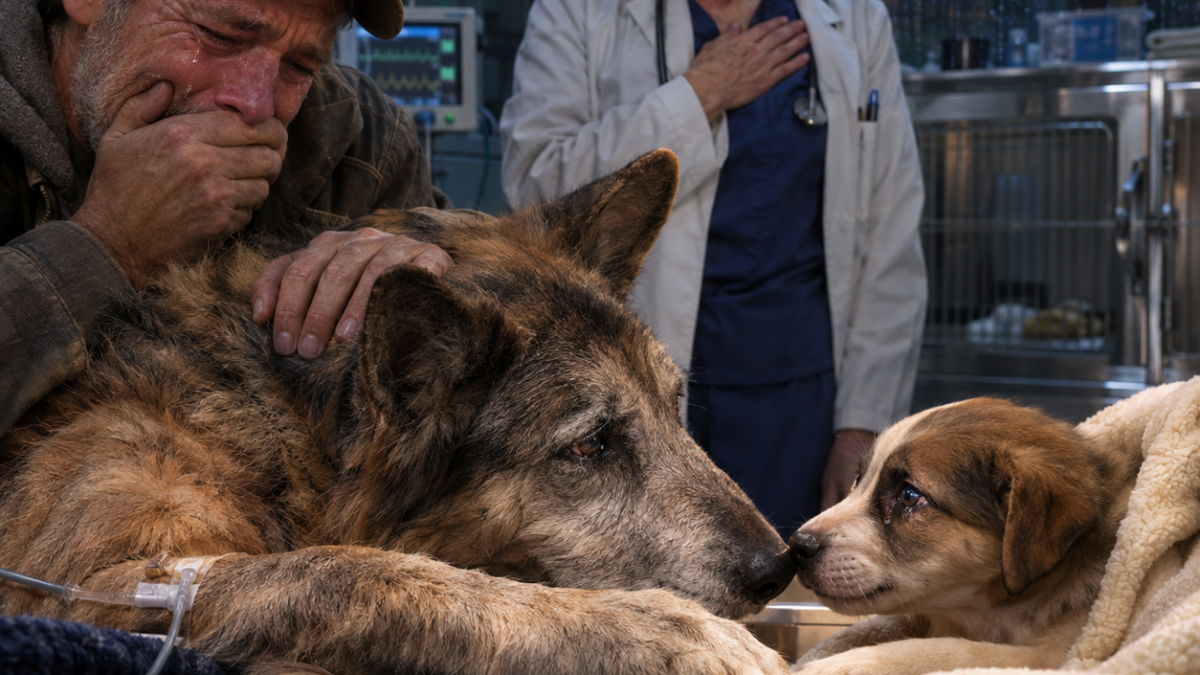
“HE HAS NOTHING LEFT TO GIVE!” My 14-Year-Old German Shepherd Was Spending His Final Night at the Vet—Until a Dying Little Puppy Began Crying Beside Him
“ROCKY IS SUFFERING, JACK, AND WE CAN’T ASK HIM TO KEEP FIGHTING FOREVER,” Dr. Parker told me as I knelt beside my fourteen-year-old German Shepherd, the dog who had once pulled me through the smoke of a collapsing Chicago building and had spent the last twelve years refusing to leave my side.
At three in the morning, while I waited for the nine o’clock appointment that would end his suffering, a tiny abandoned puppy began crying in the next kennel, and the old dog who hadn’t eaten in three days suddenly lifted his head, dragged himself toward the frightened little creature, and did something that made the veterinary nurse burst into tears.
I thought I was spending one final night saying goodbye to my best friend, but when Rocky placed his enormous head beside that trembling puppy and refused to move away, I realized he might still have one last reason to wake up—and what happened over the following nine days would change the way I understood love, loss, and the promises we make to those who cannot speak.
My name is Jack Sullivan.
I was sixty-one years old, a retired Chicago firefighter, and I had survived enough terrible nights to know that sometimes doing the right thing feels worse than doing anything at all.
But nothing in my thirty-two years with the fire department had prepared me for the night I carried Rocky into the veterinary clinic and told the receptionist that I didn’t think he could come home again.
He had always been a big dog.
A German Shepherd with a broad chest, powerful shoulders, and ears that stood so straight they made him look as though he were listening to conversations from three rooms away.
His muzzle had once been black.
Now it was almost entirely gray.
The thick fur around his neck had thinned, his hips had become painfully visible, and the legs that once carried him over fences and through deep snow trembled whenever he tried to stand.
Cancer had taken almost everything from him.
His strength.
His appetite.
His ability to chase a ball.
His habit of greeting me at the door with a toy in his mouth.
And, in the final weeks, even his interest in the world outside our living room window.
He had been my partner, my shadow, and the one constant presence through the most difficult years of my life.
I had carried him to the clinic that evening because I could no longer pretend another medication or another hopeful morning would bring back the dog he’d once been.
Dr. Parker examined him gently.
He listened to Rocky’s chest, reviewed his recent tests, and watched the way my old friend struggled to settle comfortably on the examination blanket.
Then he sat beside me.
“Jack,” he said, “we need to talk about his quality of life.”
I nodded.
I already knew.
We had talked about it before.
The cancer had advanced, affecting his breathing and mobility despite treatment intended to make him comfortable.
He was eating almost nothing.
He needed help standing.
Some nights, he couldn’t settle long enough to sleep.
The medications were no longer giving him the relief we’d hoped for.
Dr. Parker didn’t tell me that loving Rocky meant keeping him alive at any cost.
He told me the opposite.
Sometimes love meant recognizing that an animal had carried enough pain.
We discussed the compassionate option of euthanasia.
I asked questions.
Then asked the same questions again, hoping that different words might produce a different answer.
They didn’t.
Finally, we agreed that if Rocky’s condition remained as poor as it was that evening, we would help him pass peacefully at nine the following morning.
I asked whether I could stay with him overnight.
Dr. Parker looked at my face.
Then nodded.
“We’ll make arrangements.”
I thanked him.
It was a strange thing to thank someone for helping you prepare to lose your best friend.
But I meant it.
The staff moved us into a quiet treatment room with padded bedding.
A chair stood beside Rocky’s resting place.
There was a blanket on the floor, a water bowl nearby, and a small lamp illuminating the room without making it too bright.
I sat beside him.
He opened his tired brown eyes.
Looked at me.
Then closed them again.
I rested my hand against his neck.
“Hey, old buddy.”
His ear moved.
“It’s just you and me tonight.”
My voice broke.
I swallowed hard.
“Just like always.”
I wanted him to lift his head.
I wanted the familiar tail thump.
I wanted him to look at me with that old expression that always seemed to say, Well, Jack, what are we doing next?
But he barely moved.
And I knew that wanting something didn’t make it possible.
At 11:40 p.m., a veterinary nurse named Megan came into the room carrying fresh blankets.
She was thirty-two, kind, and had helped care for Rocky through several difficult months.
She knew how much he meant to me.
“Can I get you anything?” she asked.
I shook my head.
Then glanced toward the small room across the hall.
A faint sound had caught my attention.
A tiny whimper.
Megan followed my gaze.
“We had an emergency intake earlier,” she explained. “A very young puppy.”
“Is he all right?”
“He’s being monitored. He’s underweight and frightened, but the initial assessment is encouraging.”
I nodded.
The whimper came again.
So small it hardly sounded like a dog.
Megan looked toward Rocky.
“He’s resting?”
“Trying to.”
She gave me a sympathetic smile.
Then left us alone.
I leaned back in the chair.
Outside the clinic, Chicago was settling into another cold night.
Traffic hissed along the wet pavement.
An ambulance passed somewhere in the distance.
And beside me, the dog who had once faced smoke, flames, and falling debris without hesitation lay so weak that lifting his head seemed impossible.
I looked at the clock.
11:58.
Nine hours remained until the appointment.
I closed my eyes.
And began remembering the first day Rocky came into my life.
PART2
The shelter had called him Bear.
That was the name written on his paperwork when I first saw him, years earlier, sitting behind a wire gate with his oversized paws spread in front of him.
He was still young, awkward, and all ears.
His head looked too big for his body.
His tail swept across the concrete whenever somebody walked past.
I had no intention of adopting a dog that day.
I had gone to the shelter with my friend and fellow firefighter, Mike Brennan, because he wanted to meet a Labrador.
I was forty-nine.
Living alone.
Working too many shifts.
Sleeping badly.
And convinced that the last thing my life needed was an animal depending on me.
Mike found the Labrador he wanted to meet.
I wandered toward the larger kennels.
That’s where I saw Rocky.
He was sitting quietly while the dogs around him barked.
He watched me approach.
Then tilted his head.
I stopped.
He tilted it the other direction.
I laughed.
“Well, what are you looking at?”
His tail moved.
The shelter volunteer smiled.
“He likes you.”
I shook my head.
“He doesn’t know me.”
“Dogs don’t always need much time.”
I looked at Rocky again.
He stood, walked to the gate, and pressed his nose gently against the wire.
I crouched.
“Hey, Bear.”
His ears lifted.
I held out my hand.
He sniffed my fingers.
Then licked them.
Just once.
Mike appeared behind me.
“Oh, no.”
I glanced up.
“What?”
He laughed.
“Jack Sullivan is about to get himself a dog.”
I stood.
“Absolutely not.”
Ten minutes later, I was asking about the adoption paperwork.
An hour later, Rocky was sitting in the back seat of my truck.
Mike followed us to the parking lot.
He looked at the dog.
Then at me.
“What happened to absolutely not?”
I opened the truck door.
“Shut up, Mike.”
He laughed.
Rocky barked once.
As though agreeing with him.
That was how it began.
Not with some grand decision.
Not with a plan.
With a young German Shepherd who looked at me through a shelter gate and made a lonely man feel recognized.
I renamed him Rocky after bringing him home.
Not because he was tough.
Because the first night, he dragged one of my old work boots onto his blanket and refused to sleep without it.
He looked like a little fighter guarding his prize.
I sat on the floor.
“You know that boot costs money, right?”
He wagged his tail.
I reached for it.
He pulled it closer.
I laughed.
“Rocky it is.”
He slept beside my bed that night.
And almost every night after.
I hadn’t realized how quiet my house had become until Rocky filled it.
Before him, I’d come home from the fire station, dropped my keys into a bowl, microwaved dinner, and sat in front of the television until exhaustion finally caught up with me.
Some nights, sleep came easily.
Other nights, I heard things that weren’t there.
A radio calling for assistance.
A roof cracking.
A child crying somewhere behind smoke.
The fire department teaches you how to work through an emergency.
It doesn’t always teach you how to stop remembering one.
Rocky changed the rhythm of my days.
He needed walks.
Meals.
Training.
Attention.
He didn’t care whether I’d had a terrible shift.
He didn’t know the difference between a difficult rescue and an ordinary Tuesday.
He knew only that I was home.
And home meant the world had become interesting again.
He’d bring me his leash before I removed my jacket.
If I sat too long, he’d drop a ball at my feet.
If I ignored him, he’d place one enormous paw on my knee.
At first, I complained.
“You’re a demanding little guy.”
He’d wag his tail.
I couldn’t stay angry.
Eventually, I began bringing him to approved training events and spending my days off learning more about canine behavior and search work.
Rocky wasn’t an officially certified fire-department rescue dog.
He was my dog.
But he was intelligent, athletic, and astonishingly responsive to training.
He learned commands quickly.
He could follow scent trails.
He understood when to stay beside me and when to seek help.
Most importantly, he trusted me.
I trusted him too.
At the time, I didn’t understand how much that trust would matter.
The fire happened on a January night I still remember in fragments.
An old commercial building on Chicago’s South Side.
Temperatures below freezing.
Heavy smoke.
Flames moving through the upper floors.
The kind of call where everything happens quickly until suddenly one moment seems to last forever.
Our crew had been searching an adjacent storage area after reports that someone might still be inside.
Rocky was nearby with an approved volunteer search team assisting from a safer area.
I was moving toward a doorway when the ceiling began to fail.
I heard a cracking sound.
Someone shouted.
Then came the impact.
The world turned black.
For a moment, I couldn’t move.
Something heavy had struck my shoulder.
My helmet had shifted.
Smoke filled the space around me.
I remember trying to reach my radio.
Then coughing.
My chest hurt.
My left arm wouldn’t respond properly.
I thought about the people outside.
I thought about my crew.
Then I heard barking.
Not distant.
Close.
Rocky.
I couldn’t understand how he’d reached the area.
Later, people explained that he’d broken away when the search team moved toward the exit and followed the sound of the collapse.
What I remember is his nose against my face.
His barking.
The pressure of his teeth gripping the heavy fabric near my shoulder.
I tried to move.
He pulled.
I crawled.
He moved backward again, urging me toward the opening where the air was clearer.
At one point, I collapsed.
Rocky barked so loudly that rescuers outside located us.
When firefighters reached me, I was near the doorway.
Rocky stood over my legs.
Still barking.
Still refusing to leave.
People later said he saved my life.
I never argued.
I knew the truth was more complicated than a dog dragging a grown firefighter all the way out of a burning building.
My crew saved me.
My equipment protected me.
Training mattered.
And Rocky had done something extraordinary by reaching me, helping me move, and alerting the others.
But when I opened my eyes in the hospital two days later, the first thing I asked was:
“Where’s my dog?”
Mike Brennan laughed.
Then began crying.
“Jack, that damn dog almost gave us all heart attacks.”
I tried to sit up.
“Is he okay?”
“He’s fine.”
I closed my eyes.
Mike leaned closer.
“He wouldn’t let anybody move him away from the ambulance until they got you inside.”
I started crying.
Not because I was frightened anymore.
Because somewhere during that terrible night, Rocky had decided he wasn’t leaving without me.
The following months were difficult.
My shoulder required surgery.
I had broken ribs.
My lungs needed time to recover from smoke exposure.
I spent weeks frustrated by how little I could do.
Rocky remained beside me.
When I struggled to climb the stairs, he waited.
When I couldn’t throw his ball, he brought it anyway.
When I woke from nightmares, he climbed beside the bed and rested his head near my hand.
He didn’t ask me to explain what I’d seen.
Didn’t tell me to stop thinking about the fire.
Didn’t remind me that other firefighters had survived worse.
He simply stayed.
Some nights, I sat on the floor with my back against the sofa.
Rocky would settle beside me.
I’d rest one hand in his fur.
Then breathe until my heart stopped racing.
I began thinking of him as more than a pet.
Not a replacement for the people I loved.
Not a solution to every problem.
A steady presence.
A reminder that the world continued beyond the worst moments of my job.
When I finally returned to duty, Mike looked at Rocky sitting in the truck.
“You two gonna be okay?”
I nodded.
“Yeah.”
He smiled.
“Good.”
Then he leaned toward the dog.
“Keep an eye on him, buddy.”
Rocky wagged his tail.
For years afterward, Mike claimed Rocky understood the assignment.
I think he might have.
Now, twelve years after that winter, I sat beside him in a veterinary clinic watching his chest rise and fall.
The strong dog who had pulled at my jacket was gone.
In his place was an old animal who struggled to breathe comfortably.
I wanted to trade places with him.
I wanted to give him the strength he’d once given me.
But love doesn’t work that way.
You can’t simply take somebody else’s pain because carrying it would be easier than watching.
At midnight, Rocky shifted.
I leaned forward.
“Hey.”
His eyes opened slightly.
“You okay?”
A foolish question.
Of course he wasn’t okay.
But I’d been asking him that question for years.
After thunderstorms.
After long car rides.
After difficult veterinary appointments.
After he stumbled on the stairs.
And every time, he would look at me as though he understood I wasn’t really asking for information.
I was asking whether he was still with me.
That night, he gave me a small movement of his tail.
Barely enough to lift the fur from the blanket.
I swallowed hard.
“Good boy.”
Then I rested my forehead against his shoulder.
And waited.
At 1:40 a.m., Megan returned.
She checked Rocky’s comfort and reviewed his medications.
Then she offered me coffee.
I shook my head.
“Couldn’t swallow it.”
She nodded.
“Can I bring water?”
“Please.”
She returned with a paper cup.
I took it.
My hands were shaking.
Megan sat on a chair near the doorway.
For a few minutes, neither of us spoke.
Then she asked:
“How long have you had him?”
“Twelve years.”
She smiled.
“That’s a long friendship.”
I looked toward Rocky.
“Not long enough.”
Her expression softened.
“No,” she said quietly. “It never is.”
I swallowed.
Then asked:
“Do you think he knows?”
Megan looked at me.
“Knows what?”
“That tomorrow’s the end.”
She considered the question carefully.
“I don’t know what Rocky understands about tomorrow.”
I looked down.
“But I think he understands you’re here tonight.”
Tears filled my eyes.
She continued:
“And I know he’s being cared for.”
I nodded.
That was all she could honestly promise.
It was more than enough.
At 2:15, the puppy began crying again.
A tiny sound.
Weak.
Uncertain.
It came from the nearby recovery area.
Rocky’s ears moved.
I noticed immediately.
He hadn’t reacted to much all evening.
Not the distant telephone.
Not the carts rolling along the hallway.
Not Megan opening the door.
But he reacted to that sound.
I leaned toward him.
“Did you hear that, buddy?”
His ear moved again.
A few seconds later, the puppy whimpered.
Rocky’s eyes opened.
I stared.
He raised his head slightly.
Then lowered it, exhausted.
I rested my hand beside him.
“It’s okay.”
He closed his eyes.
I thought that was the end of it.
At 2:50, Megan passed the doorway carrying a small blanket.
I asked about the puppy.
She stopped.
“Still frightened.”
“What happened to him?”
“He was brought in after somebody found him abandoned near a roadside.”
My stomach tightened.
“How old?”
“Very young. He’s been examined, warmed, and stabilized, but he’s small and underweight.”
“Does he have a family?”
“Not that we know yet.”
I looked toward the hallway.
“Poor little guy.”
Megan nodded.
“He’s been crying whenever somebody leaves him alone.”
I thought about Rocky.
The dog who used to follow me from room to room.
I looked at his face.
Then asked:
“Could he hear him from here?”
Megan smiled sadly.
“I think he already has.”
She continued toward the recovery room.
A few minutes later, the puppy’s bedding was moved to a quiet supervised area near Rocky’s enclosure, where staff could keep an eye on both animals.
The little creature was small enough to fit inside my two hands.
His fur was dark brown with cream-colored patches near his chest.
His ears folded forward.
His paws looked absurdly tiny.
He was wrapped in a soft blanket.
I watched him.
He lifted his head.
Looked around.
Then let out another weak whimper.
Rocky opened his eyes.
And for the first time that night, I saw something in them that wasn’t simply exhaustion.
Interest.
At 3:07, the puppy began trembling.
I remember the exact minute because the clock above the door caught my eye while I was standing.
The little animal shifted beneath his blanket.
His legs moved weakly.
He looked toward the unfamiliar room.
Then cried again.
I stepped closer.
“Hey, little guy.”
He stared at me.
His eyes were dark.
Wide.
Frightened.
I didn’t try to pick him up.
Megan had already explained that the puppy needed careful handling and continued monitoring.
I simply crouched beside the enclosure.
“It’s okay.”
He whimpered.
I glanced toward Rocky.
My old dog was watching him.
Not sleeping.
Not staring blankly.
Watching.
I felt my throat tighten.
“Rocky?”
His ears lifted.
The puppy cried again.
Then Rocky did something I hadn’t seen him attempt for hours.
He moved his front paws.
Slowly.
Painfully.
He shifted his weight.
I stood immediately.
“Easy, old man.”
He kept moving.
His body trembled.
He was trying to drag himself toward the puppy.
My heart began pounding.
I didn’t want him hurting himself.
But he seemed determined.
I called for Megan.
She arrived quickly.
“What happened?”
“Rocky’s trying to move toward the puppy.”
She looked down.
Then toward the old Shepherd.
“Rocky, sweetheart.”
He continued shifting.
Megan checked his condition and helped arrange the bedding so he wouldn’t have to strain himself.
The puppy had already been assessed, and under her supervision the two animals were allowed gentle, brief contact in the shared quiet space.
Rocky leaned forward.
His nose reached the edge of the puppy’s blanket.
He sniffed once.
Then again.
The puppy stopped crying.
I froze.
Rocky shifted closer.
Megan supported his body carefully.
Then he lowered his enormous head beside the tiny puppy.
Not on top of him.
Beside him, close enough that the puppy could press into the warm fur along his neck.
The little creature moved.
Sniffed Rocky’s muzzle.
Then tucked himself against him.
His trembling gradually eased.
I stared.
The puppy’s eyes closed.
His breathing became slower.
Rocky remained awake.
Watching.
As though he had suddenly remembered something important.
Megan covered her mouth.
“Oh, Jack.”
I couldn’t answer.
Because the dog who had barely lifted his head for three days was lying beside a frightened puppy with an expression I hadn’t seen in months.
He looked interested in tomorrow.
I knelt beside him.
My hands shook.
“Rocky?”
His eyes moved toward me.
Then back to the puppy.
I began crying.
Not because I thought the cancer had disappeared.
Not because I believed a miracle had occurred.
Because for one moment, pain was not the only thing my old friend seemed to feel.
There was a tiny creature beside him who needed warmth.
And Rocky had decided to offer what little he still possessed.
I stayed kneeling beside them until the muscles in my legs began to ache.
I had spent three days watching Rocky turn away from food.
Three days offering water, encouragement, and gentle touches.
Three days listening to the veterinarian explain how far his disease had progressed.
Now the same dog was alert enough to notice a puppy crying several feet away.
It wasn’t a cure.
I knew that.
But after so many hours of watching him withdraw from the world, the change was almost unbearable.
Megan adjusted the blanket.
“Let’s keep them comfortable and watch how they respond.”
I nodded.
“Okay.”
Rocky shifted his head.
The puppy made a tiny sound.
Then burrowed closer.
I had to look away.
There was something almost impossibly gentle about the sight.
Rocky’s paws were enormous beside the puppy’s body.
His muzzle was almost as long as the little animal’s entire back.
One had lived fourteen years.
The other had barely begun.
One was approaching the end of a long life filled with familiar smells, places, and people.
The other had arrived frightened and alone, with no idea where he belonged.
And somehow, they had found each other in a veterinary clinic at three in the morning.
I sat back in my chair.
Megan dimmed the light.
“Try to rest, Jack.”
I shook my head.
“I don’t want to miss anything.”
She looked at Rocky.
Then at the puppy.
“Neither do I.”
At four thirty, the puppy woke.
He stretched one tiny paw.
Then another.
His nose moved against Rocky’s fur.
The old Shepherd lifted his head just enough to look down.
The puppy opened his mouth.
Let out a little squeak.
Rocky’s tail moved.
Barely.
One soft thump against the bedding.
I stared.
“Did you see that?”
Megan was checking equipment nearby.
She turned.
“What?”
“His tail.”
She looked toward Rocky.
The puppy moved again.
Rocky’s tail lifted.
Then settled.
Megan smiled.
“I see it.”
I laughed.
Not loudly.
Just a short, surprised sound.
For a moment, I felt like the man I’d been years earlier, sitting on my living-room floor while a young German Shepherd dragged my boot across the carpet.
I leaned closer.
“Hey, Rocky.”
His eyes moved toward me.
“Looks like you’ve got yourself a friend.”
He blinked.
The puppy stretched.
Then settled against him.
I wiped my face.
“Good choice, buddy.”
For the rest of the night, I watched them sleep.
Rocky never looked comfortable enough that I forgot his illness.
His breathing remained labored at times.
He needed help shifting positions.
Occasionally, he coughed, and the sound made my chest tighten.
Megan continued checking him.
Nothing about his medical condition had disappeared.
Yet every time the puppy moved, Rocky seemed to notice.
Every time the little creature cried, he lifted his head.
And every time he settled beside Rocky’s warm fur, he grew quiet again.
I couldn’t explain what they meant to each other.
I only knew I was witnessing a kind of companionship I hadn’t expected on the saddest night of my life.
At six fifteen, a pale strip of sunlight appeared along the bottom of the window.
The clinic began waking.
Footsteps moved through the hallway.
A telephone rang.
Someone rolled a cart past the doorway.
I looked toward the clock.
Three hours until nine.
Three hours until the appointment.
I felt a familiar panic rising.
For weeks, I’d been moving toward this decision.
Every appointment made it clearer.
Every difficult night made the conversation harder to avoid.
And now, when I had finally prepared myself to help Rocky die peacefully, he was lying beside a puppy as though he had discovered something worth protecting.
I wanted to turn back time.
I wanted one more week.
One more month.
One more ordinary morning when Rocky would meet me at the kitchen door.
But I was afraid of confusing my desire for more time with what was best for him.
I looked toward his face.
The gray muzzle.
The tired eyes.
The shoulders that had once been so strong.
Then I looked at the puppy.
Still sleeping.
Still pressed against Rocky’s neck.
I whispered:
“What am I supposed to do, buddy?”
Rocky opened one eye.
Looked at me.
Then lowered his head.
Of course he couldn’t answer.
And perhaps that was the hardest part of loving an animal.
You make promises on their behalf.
You interpret their needs.
You choose when to treat, when to rest, when to intervene, and sometimes when to say goodbye.
All while knowing they have trusted you with decisions they cannot explain in words.
I pressed my forehead against the edge of the chair.
Then whispered:
“Please help me know what’s right.”
At seven, Megan brought food.
She had been working through the night.
Her hair was tucked into a loose bun, and her eyes looked almost as tired as mine.
She placed a small portion of Rocky’s approved food near him.
I watched.
For three days, he’d turned away.
I expected the same.
Rocky lifted his head.
Looked at the bowl.
Then at the puppy, who had begun stirring beneath the blanket.
He sniffed.
Paused.
And took one small bite.
I froze.
Megan didn’t speak.
Rocky chewed slowly.
Then took another.
And another.
Only a few mouthfuls.
Not enough to change the course of his illness.
But enough to make Megan kneel beside the bedding and place one hand over her mouth.
“Jack.”
I was already crying.
“He’s eating.”
She nodded.
“He is.”
I laughed through tears.
The puppy lifted his head.
Looked toward Rocky’s bowl.
Then gave a little squeak.
Rocky paused.
Looked down at him.
Then finished another bite.
I shook my head.
“Of all the things.”
For weeks, I had coaxed him to eat.
Tried different approved foods.
Warmed meals.
Sat beside him.
Begged.
Now he was eating while a tiny puppy watched.
I couldn’t know whether the puppy caused it.
Maybe the supportive care was helping.
Maybe the night had been more comfortable.
Maybe the smell of food or the stimulation of company made a difference.
But the timing felt extraordinary.
Rocky took one final bite.
Then lowered his head beside the puppy again.
I reached toward him.
Rested my hand gently on his shoulder.
“Good boy.”
His tail moved.
And for the first time in weeks, I allowed myself to hope for something very small.
Not that he would live forever.
Not that the cancer would disappear.
That he might have another comfortable day.
Dr. Parker arrived shortly before nine.
He entered quietly.
Megan met him in the hallway.
I heard her speaking softly.
Then the veterinarian stepped inside.
He looked toward Rocky.
Then toward the puppy.
For a moment, he simply stood there.
“Well,” he said, “this is unexpected.”
I gave a shaky laugh.
“Tell me about it.”
He approached carefully.
Examined Rocky.
Listened to his breathing.
Checked his comfort and mobility.
Reviewed the overnight observations and medications.
Then sat beside me.
I watched his face.
Trying to read the answer before he spoke.
“Jack.”
I swallowed.
“Is it time?”
He was quiet for a moment.
Then said:
“Rocky’s cancer is still advanced. Nothing that happened overnight changes that.”
I nodded.
“I know.”
“We also need to be careful not to assume a few bites of food mean he’s no longer suffering.”
I looked toward Rocky.
The puppy was sleeping against his side.
“I know.”
Dr. Parker continued:
“But he’s more engaged this morning, and with the support we’ve been providing, he appears more comfortable than he was yesterday.”
My heart began pounding.
“What does that mean?”
“It means we can reassess the plan.”
I stared.
He looked directly at me.
“If we continue, it needs to be because Rocky can still experience acceptable comfort—not simply because we want more time.”
I swallowed.
“Yes.”
“We’ll need to monitor his breathing, pain, appetite, and ability to rest. If those decline again, we should be prepared to act.”
I nodded.
Then looked toward the puppy.
Rocky had lifted his head.
He was watching the little creature shift beneath the blanket.
I took a breath.
“Can we give him another day?”
Dr. Parker considered the question.
Then nodded.
“With close monitoring and a clear comfort plan, I believe that’s reasonable today.”
I closed my eyes.
The relief came so quickly it almost frightened me.
Then I heard myself whisper:
“Not today.”
Dr. Parker rested a hand briefly on my shoulder.
“Not today.”
I looked toward Rocky.
My voice broke.
“Not today, old buddy.”
The puppy moved.
Rocky’s tail gave a single, slow thump.
And I began crying harder than I had cried all night.
That afternoon, I learned more about the puppy.
He had been found near a county road, alone and frightened, and brought to the clinic for evaluation.
No one had yet identified an owner.
He was very young, but old enough to be eating puppy food with help and encouragement.
His temperature had stabilized.
He was still underweight.
Still tired.
And still learning whether the unfamiliar world around him could be trusted.
Megan told me that an animal-rescue organization was coordinating his next placement.
I listened.
Then looked toward Rocky.
The old Shepherd had settled beside the puppy again.
“What happens when he’s ready to leave?”
Megan smiled.
“He’ll need a suitable foster or adoptive home, following the rescue’s process.”
I looked at the little dog.
His nose was tucked into Rocky’s fur.
For a moment, something moved inside me.
Not an answer.
Not yet.
Just a possibility.
I had spent weeks planning for a house without Rocky.
I’d imagined the silence.
The empty dog bed.
The leash hanging beside the door.
The water bowl no one would use.
I didn’t know whether I could survive bringing another dog into that house so soon.
It felt almost disloyal to consider it.
Then Rocky lifted his head.
Looked at the puppy.
And gave his ear a slow, gentle lick.
I stared.
For years, I’d watched Rocky greet other dogs.
He had been friendly but selective.
He liked calm companions.
Disliked dogs that rushed into his face.
And never showed much interest in puppies once he became older.
Now he was using the little strength he had left to groom this tiny stranger.
I looked toward Megan.
“He’s acting like the puppy belongs to him.”
She smiled.
“He does seem very attentive.”
I swallowed.
Then whispered:
“I haven’t seen him care about anything like this in months.”
I went home that evening to shower and change.
Megan promised to call if Rocky’s condition changed.
I didn’t want to leave.
But I had been awake for more than thirty hours, and even stubborn firefighters eventually need clean clothes and food.
My house looked wrong when I opened the door.
Not because anything had moved.
Because Rocky wasn’t there.
For twelve years, I’d entered that house and heard his nails clicking across the floor.
Sometimes slowly.
Sometimes in a joyful scramble that made him slide around the corner.
Even during his illness, he usually lifted his head from his bed when I came home.
Now there was nothing.
I stood in the hallway.
My keys in one hand.
The door still open.
Then I said automatically:
“Hey, Rocky.”
Silence.
I closed my eyes.
The house felt enormous.
I walked into the living room.
His old bed stood beside the fireplace.
A faded tennis ball lay beneath the coffee table.
His leash hung on its hook.
The water bowl sat near the kitchen door.
I couldn’t bring myself to touch anything.
I went upstairs.
Showered.
Changed into clean clothes.
Then sat on the bed.
For a moment, I considered sleeping.
But every time I closed my eyes, I saw Rocky beside the puppy.
The enormous gray head.
The tiny dark paws.
The way the puppy had stopped trembling.
I stood again.
Went downstairs.
Found Rocky’s old photograph album.
And opened it on the kitchen table.
The first picture showed him as a young dog standing in the yard with one of my boots in his mouth.
I laughed.
Then cried.
The next showed him covered in snow.
Another captured him asleep beside the fireplace.
There was a photograph of him wearing a ridiculous birthday hat Mike had bought.
Rocky looked deeply offended.
Mike looked delighted.
I turned the page.
There was the photograph taken after the fire.
I was sitting outside the hospital in a wheelchair.
My shoulder was bandaged.
My face looked gray with exhaustion.
Rocky stood beside me, his head turned toward the camera.
He was young then.
Powerful.
Proud.
I rested my fingers on the photograph.
“You got me out, buddy.”
My voice shook.
“You didn’t give up.”
Then I looked toward the doorway.
I thought about the little puppy.
Frightened.
Alone.
Trying to understand where he belonged.
And Rocky reaching toward him despite his pain.
I closed the album.
For years, I had thought the greatest thing Rocky ever did was help save my life.
Now I wasn’t sure.
Perhaps the greatest thing was much smaller.
Perhaps it was choosing to comfort somebody else when he had almost nothing left to give.
When I returned to the clinic, Rocky was awake.
The puppy lay beside him.
Megan smiled.
“He’s been looking toward the door.”
I stared.
“You think he was waiting?”
She shrugged gently.
“I can’t know for sure.”
I smiled.
“Well, I was coming back either way.”
I crouched beside Rocky.
“Hey, buddy.”
His tail moved.
The puppy woke.
Lifted his head.
And stared at me.
I looked at him.
“Hey, little guy.”
He blinked.
Then gave a tiny yawn.
His tongue curled.
His ears folded forward.
I laughed.
It was the first time I’d laughed without crying in what felt like weeks.
Rocky turned his head toward the puppy.
Then back toward me.
I reached out.
Touched his shoulder.
“You made a friend, huh?”
He lowered his head.
The puppy climbed clumsily over a fold in the blanket.
Then tucked himself against Rocky again.
I sat in my chair.
For the first time, I didn’t feel I was waiting for the end of something.
I felt I was witnessing something I wanted to remember.
The second day brought a small discovery.
The puppy wasn’t frightened of Rocky.
He was frightened of almost everything else.
When a cart moved along the hallway, he startled.
When someone opened a cabinet, he froze.
When a new person entered, he pressed himself low against the bedding.
But beside Rocky, he relaxed.
He would lift his head.
Look toward the old dog’s face.
Then settle.
Megan arranged supervised, gentle interactions while continuing the puppy’s separate feeding and medical care.
Rocky couldn’t care for the puppy in any practical sense.
He couldn’t provide the nutrition a young dog needed.
Couldn’t keep him medically stable.
Couldn’t protect him from disease.
That was the clinic staff’s work.
But he could offer something the puppy seemed to find reassuring.
Warmth.
A familiar smell.
A calm presence.
And every time the two rested together, the little dog seemed less frightened.
I spent hours watching.
At one point, the puppy attempted to climb over Rocky’s front paw.
He failed.
Tumbled sideways.
Then stood up as though nothing had happened.
I laughed.
Rocky opened one eye.
The puppy tried again.
This time, he made it over the paw.
Then sat proudly on the other side.
I looked toward Megan.
“Did you see that?”
She smiled.
“I did.”
“He’s got some determination.”
“He certainly does.”
I looked down at him.
The little creature stared back.
Big brown eyes.
Tiny ears.
More courage than he seemed to know what to do with.
Something about him reminded me of Rocky when he was young.
Not his appearance.
His attitude.
A stubborn willingness to keep trying even when his body didn’t quite cooperate.
I smiled.
“Bailey.”
Megan looked up.
“What?”
“I think he looks like a Bailey.”
She considered it.
Then nodded.
“Bailey.”
I looked toward the puppy.
“Hey, Bailey.”
He tilted his head.
I laughed.
“There it is.”
Megan smiled.
“What?”
“That look.”
I glanced toward Rocky.
“He used to do the same thing.”
By the third day, Bailey had learned that the clinic was full of interesting people.
Megan brought his food.
Another technician checked his temperature.
Dr. Parker examined him.
And I appeared whenever I could.
Bailey recognized the sound of the food container.
He began wagging his tiny tail when Megan approached.
He could hold himself in a little seated position long enough to watch the world.
It wasn’t a trained command yet.
Just a puppy learning how his legs worked.
But I celebrated every attempt.
Rocky watched him.
Sometimes he raised his head.
Sometimes he gave a slow lick to Bailey’s ears.
Sometimes he simply closed his eyes while the puppy rested nearby.
On the third morning, Bailey began crying while Megan prepared his meal.
Rocky heard him.
He lifted his head.
Moved one front paw.
Then looked toward Megan.
I stared.
“He wants to get up.”
Dr. Parker was nearby.
He came over and assessed Rocky before allowing any assisted movement.
With support, Rocky managed to stand briefly.
His legs shook.
His breathing changed.
I could see the effort.
My heart tightened.
“Easy, buddy.”
He took one careful step.
Then another.
Not a heroic return to strength.
Not the dog he’d been before cancer.
Just an old animal making a difficult effort.
Bailey looked toward him.
His little tail moved.
Rocky lowered his head.
Sniffed the puppy.
Then allowed the staff to help him settle again.
I stood there with tears running down my face.
Dr. Parker watched quietly.
Then said:
“That’s enough for now.”
I nodded.
Rocky needed rest.
Bailey needed food.
And I needed to remember that a good moment did not erase the seriousness of his disease.
But I would carry that moment with me for the rest of my life.
That afternoon, Dr. Parker sat beside me.
He had just completed another assessment.
I could tell from his face that the news wasn’t going to be easy.
“Jack.”
I looked up.
“Tell me.”
He took a breath.
“Rocky’s cancer hasn’t improved.”
I nodded.
“I know.”
“His appetite remains limited. His breathing and strength still concern me.”
I looked down.
“He walked today.”
“Yes.”
“And that’s meaningful to you. I understand.”
My throat tightened.
Dr. Parker continued:
“But we need to keep looking at the whole picture.”
I nodded.
“Are we hurting him by waiting?”
The question came out before I could stop it.
Dr. Parker considered it carefully.
“Right now, we’re monitoring his comfort closely. He has periods when he’s settled and interested in his surroundings, but the disease is progressing, and that balance may change quickly.”
I looked toward Rocky.
Bailey was sleeping near his front paws.
“Does he have weeks?”
“Possibly a short time, but I can’t promise that. It may be less.”
I closed my eyes.
The room became quiet.
Then Dr. Parker said:
“Jack, I want you to know that choosing euthanasia when suffering can no longer be adequately relieved would still be an act of love.”
I began crying.
“I know.”
He waited.
I wiped my face.
“I just wanted him to have something good before the end.”
Dr. Parker looked toward the dogs.
“Then let’s keep making careful decisions about what gives him comfort.”
I nodded.
He continued:
“Bailey may be part of what makes Rocky’s remaining time meaningful. But we’ll keep reassessing, and we won’t let that become a reason to prolong distress.”
I looked at him.
“Promise you’ll tell me when it’s time.”
He nodded.
“I will.”
I reached for Rocky’s paw.
Then whispered:
“And I promise I’ll listen.”
That evening, Mike Brennan came to visit.
He’d retired from the fire department two years after I did.
His hair was white.
His knees were bad.
And he still walked into every room as though someone had just announced a drill.
He carried a paper bag.
I looked at it.
“What’s that?”
“Dinner.”
“I told you I wasn’t hungry.”
“Good. Then I won’t have to share.”
He pulled out two sandwiches.
A bottle of water.
And a small packet of cookies.
I smiled despite myself.
Mike looked toward Rocky.
Then stopped.
For a moment, all the humor left his face.
“Hey, big guy.”
Rocky lifted his head.
His tail moved.
Mike stared.
Then knelt beside him.
“Still causing trouble?”
I laughed softly.
“Always.”
Mike looked toward Bailey.
Then back at me.
“Who’s the little one?”
“Bailey.”
Mike smiled.
“Your dog?”
“Not officially.”
He raised an eyebrow.
I looked away.
Mike laughed.
“Oh, Jack.”
“What?”
“I’ve known you thirty years.”
“So?”
“You’ve already named him.”
I stared at Bailey.
The puppy was busy trying to chew the corner of his blanket.
“I didn’t say I was adopting him.”
Mike nodded solemnly.
“Of course not.”
I looked at him.
“Don’t start.”
He smiled.
Then turned toward Rocky.
“Your old man needs another dog, huh?”
Rocky blinked.
Mike sat back.
For a while, neither of us spoke.
Then he said:
“You remember that fire?”
I looked toward him.
“Every day.”
He nodded.
“I remember seeing Rocky near the doorway.”
My throat tightened.
Mike continued:
“He was barking like the whole world depended on us paying attention.”
I looked down.
“He got me moving.”
“He did.”
Mike swallowed.
“And he made sure we knew where you were.”
I wiped my eyes.
Mike stared at Rocky.
“You know, I spent years telling that story because I thought it showed how brave he was.”
I looked at him.
He continued:
“But looking at him now, I think it showed something else.”
“What?”
Mike smiled sadly.
“He never liked leaving anybody behind.”
I looked toward Bailey.
The tiny puppy had finally stopped chewing the blanket.
He was resting with his head against Rocky’s paw.
I couldn’t answer.
Mike didn’t try to make me.
We sat together.
A retired firefighter.
His oldest friend.
A dying German Shepherd.
And a puppy who had no idea how much he meant to us.
For once, there was nothing that needed fixing.
Only something worth remembering.
The fourth day was quieter.
Rocky ate a little breakfast.
Drank some water.
Accepted his medications.
Then slept for most of the morning.
Bailey spent part of the day receiving his own care, learning to eat regular puppy meals and growing stronger with every passing hour.
When the staff brought him into the quiet room for a supervised visit, he made a little sound the moment he saw Rocky.
Not quite a bark.
Not quite a whine.
Something between the two.
Rocky lifted his head.
His tail moved once.
Bailey approached.
Sniffed his muzzle.
Then curled beside him.
I watched.
For a long time, I tried to imagine what Rocky understood.
Did he recognize the puppy was young?
Did he know Bailey was frightened?
Was he simply comforted by another dog’s presence?
I couldn’t answer any of those questions.
But I knew what I saw.
Rocky seemed calmer when Bailey was nearby.
And Bailey settled more easily beside Rocky than he did anywhere else.
The comfort flowed in both directions.
That was what surprised me.
I’d always thought of Rocky as the strong one.
The protector.
The dog who watched over me when I slept badly.
The one who stood between me and anything he considered suspicious.
Now he could barely stand.
Yet he still had something to give.
And Bailey, who had arrived at the clinic with almost nothing, was giving something back.
Not medicine.
Not a cure.
Companionship.
A reason to lift his head.
A little warmth beside a tired body.
I began understanding that love doesn’t always require strength.
Sometimes it simply requires presence.
On the fifth day, Rocky went outside.
It took planning.
Dr. Parker examined him first and agreed that a very short, supported visit to the clinic’s quiet outdoor area was reasonable if Rocky appeared comfortable.
A technician helped him rise.
I stood beside him.
Bailey remained inside with Megan.
Rocky’s legs trembled.
He took one step.
Then another.
We moved slowly through the hallway.
Every movement seemed to require effort.
I could hear his breathing.
I watched for any sign he was uncomfortable.
When we reached the small courtyard, a breeze moved through the trees.
Rocky stopped.
Raised his head.
And sniffed the air.
For a moment, I saw the dog he’d once been.
Not because his body had recovered.
Because the expression was familiar.
He was curious.
Interested in the world beyond the clinic.
I knelt beside him.
“Smell that, buddy?”
A few leaves moved along the pavement.
Rocky watched them.
Then turned his head toward me.
I smiled through tears.
“Yeah. It’s still out here.”
The staff helped him settle comfortably on a padded mat for a few minutes.
I sat beside him.
The sun warmed my face.
A bird called from a nearby tree.
Rocky rested his head against my leg.
I looked down.
His eyes were half-closed.
His breathing remained slow but effortful.
I stroked the fur near his neck.
For twelve years, we’d walked together through every season.
Summer mornings.
Winter snow.
Autumn leaves.
Spring rain.
I’d complained when he wanted to go outside before sunrise.
I’d grumbled when he rolled in mud.
I’d laughed when he chased falling leaves like they were living things.
Now I would have given almost anything for one more ordinary walk.
I looked toward the courtyard gate.
Then whispered:
“You gave me so much, old man.”
Rocky shifted his head.
I continued:
“I don’t know how I’m supposed to give it all back.”
He rested his chin against my knee.
I closed my eyes.
Then realized something.
Maybe love was never meant to be repaid.
Maybe it was meant to be carried forward.
That evening, I spoke with the rescue coordinator about Bailey.
Her name was Sarah Collins.
She explained that the organization was continuing its intake procedures, monitoring his health, and arranging suitable placement.
The little dog had no identified family.
He was young, and he would need vaccinations, veterinary follow-up, appropriate nutrition, training, and a stable home.
I listened carefully.
Then asked:
“What if somebody wanted to adopt him?”
Sarah smiled.
“Then we’d discuss the process and whether the home was suitable.”
I looked toward Rocky.
He was sleeping.
Bailey lay on a separate blanket nearby, his tiny paws twitching.
I swallowed.
“What about somebody my age?”
Sarah laughed softly.
“Age by itself doesn’t tell me whether someone can provide a good home.”
I nodded.
“What if that person just lost a dog?”
Her expression changed.
She studied my face.
Then said:
“Jack, adopting another dog doesn’t replace the one you loved.”
I looked away.
She continued:
“But it can be important to think honestly about whether you’re ready for the responsibility.”
I nodded.
“I know.”
“Would you like an application?”
I looked toward Bailey.
He opened his eyes.
Yawned.
Then attempted to stand on the edge of his blanket.
His front paws slipped.
He recovered.
And tried again.
I smiled.
“Yes.”
Sarah nodded.
“I’ll bring one.”
For several minutes afterward, I sat quietly.
Then leaned toward Rocky.
“Hey, buddy.”
His ear moved.
“I might be getting myself into trouble.”
Bailey chose that moment to let out a tiny squeak.
I laughed.
Rocky’s tail moved once.
I looked down.
“Yeah. I think you already know.”
On the sixth day, I wrote Rocky a letter.
I don’t know why.
He couldn’t read it.
He couldn’t understand the sentences.
And there was nothing in the letter I hadn’t already told him a hundred times.
But I needed to put the words somewhere.
I sat at the small table in the clinic’s family room with a pen and three pages of paper.
At the top, I wrote:
Dear Rocky,
Then I stopped.
How do you thank a dog for twelve years?
How do you explain to an animal that his presence made some of the darkest years of your life survivable?
I stared at the blank page.
Finally, I began.
You came into my life when I thought I didn’t need anyone.
You stole my boot the first night and acted as though it belonged to you.
You made me get up when I wanted to stay in bed.
You made me laugh when I didn’t think anything was funny.
You helped save my life when the building collapsed.
But that’s not the only reason I owe you so much.
I paused.
Wiped my eyes.
Then continued.
After the fire, when I couldn’t sleep, you stayed beside me.
When I retired and didn’t know what to do with my days, you gave them a shape.
When I got older and the house became quiet, you made sure it never felt empty.
I looked through the glass toward the room where Rocky was resting.
Bailey was awake beside his blanket.
Megan was checking his food.
I returned to the letter.
I used to think being brave meant running toward danger.
You taught me that sometimes bravery means staying with somebody who is frightened.
And now, when you’re tired and sick, you’ve somehow found a way to teach me one more thing.
My hand shook.
I wrote:
There is always room for one more act of kindness, even when we have almost nothing left.
Then I stopped.
For a long time, I cried.
When I finally finished, I folded the letter.
Put it in my pocket.
And went back to Rocky.
He was awake.
I sat beside him.
“Hey, buddy.”
His eyes moved toward me.
“I wrote you something.”
His ear lifted.
I laughed softly.
“Don’t look so impressed. It’s not very good.”
Then I read it aloud.
Slowly.
Every word.
Rocky lay quietly while I spoke.
Bailey watched from his blanket.
When I finished, I rested my hand against Rocky’s shoulder.
“I love you, old man.”
His tail moved.
Just once.
But enough.
The seventh day was difficult.
Rocky coughed more often.
He seemed tired after even small movements.
His appetite decreased again.
I could see the worry in Megan’s face before she said anything.
Dr. Parker examined him.
Reviewed the comfort plan.
Adjusted what could safely be adjusted.
Then sat beside me.
“Jack.”
I looked up.
“I know.”
He was quiet.
I swallowed.
“Are we getting close?”
“Yes.”
The word hurt.
Even though I’d been expecting it for months.
Dr. Parker continued:
“We need to be ready to say goodbye if his breathing or comfort becomes difficult to maintain.”
I nodded.
My eyes filled.
“Is he suffering right now?”
“He’s resting at present, and the team is monitoring him closely. But his reserves are very limited.”
I looked toward Rocky.
He was sleeping.
Bailey lay on his own blanket beside the old dog’s front paws.
I pressed a hand against my mouth.
For a moment, I wanted to beg.
Another medication.
Another treatment.
Another test.
Anything that would make the next few days disappear into some distant future.
But I knew that wasn’t fair to Rocky.
I had promised to listen.
I took a breath.
“If he becomes uncomfortable and we can’t relieve it, we don’t wait.”
Dr. Parker nodded.
“That’s the right thing to keep in mind.”
I looked down.
Then whispered:
“I just wish the right thing didn’t hurt so much.”
He sat beside me.
For a long time, neither of us spoke.
Finally, he said:
“That’s because you love him.”
I closed my eyes.
“Yes.”
That night, Bailey pressed his head against Rocky’s paw.
Rocky had been coughing.
Each sound made me tense.
I wanted to help.
But there was only so much anyone could do.
Megan monitored him.
Dr. Parker remained available.
Rocky eventually settled into a more comfortable position.
Bailey moved toward him.
Sniffed his paw.
Then rested his tiny head against it.
Rocky opened his eyes.
Looked at the puppy.
And gave one slow lick to the top of his head.
I felt tears fill my eyes.
The puppy sighed.
Then fell asleep.
I leaned back in my chair.
For years, Rocky had comforted me without understanding every reason I was hurting.
Now Bailey seemed to be doing something similar for him.
Not because the little dog understood cancer.
Not because he knew death was coming.
Because he knew where he felt safe.
Beside Rocky.
I looked at the two of them.
Then whispered:
“Maybe that’s enough.”
On the eighth day, Rocky was very tired.
He slept almost the entire morning.
When he woke, he drank a little water.
Accepted gentle care.
Then rested again.
The veterinary team checked him frequently.
I barely left the room.
Mike came with breakfast.
I ate two bites.
He didn’t complain.
He simply sat beside me.
For a while, we watched Rocky sleep.
Then Mike asked:
“Have you decided about the puppy?”
I looked toward Bailey.
He was playing with the corner of a small blanket.
“I’m applying to adopt him.”
Mike smiled.
“Good.”
I looked down.
“Do you think it’s too soon?”
He considered the question.
Then shook his head.
“Too soon for what?”
“For another dog.”
Mike looked toward Rocky.
Then back at me.
“Jack, you’re not replacing him.”
“I know.”
“Do you?”
I swallowed.
“I think so.”
Mike leaned forward.
“You’ve been afraid of going home to an empty house.”
I nodded.
“And that puppy needs a home.”
I looked toward Bailey.
He stumbled over his own paws.
Then sat down, looking thoroughly offended by gravity.
Mike smiled.
“Seems to me those are two things worth thinking about.”
I laughed weakly.
Then looked toward Rocky.
“Do you think he’d mind?”
Mike was quiet.
Then said:
“I don’t know what Rocky thinks about adoption applications.”
I laughed through tears.
Mike continued:
“But I’ve watched him make room for that little dog every day.”
I looked down.
“Yeah.”
“Maybe you can too.”
That afternoon, Rocky lifted his head when Bailey began eating.
The puppy had grown stronger.
His little body no longer trembled constantly.
He approached his food with enthusiasm.
He had begun recognizing familiar voices.
And he seemed especially happy whenever he saw Rocky.
After Bailey finished eating, Megan brought him near the old Shepherd for a quiet visit.
Rocky watched.
Then lifted one front paw slightly.
Bailey approached.
Sniffed the paw.
And settled beside it.
I smiled.
“That’s your friend, buddy.”
Rocky blinked.
His tail moved.
A tiny motion.
Almost invisible.
But I saw it.
I always saw it.
Then Rocky lowered his head.
I looked toward Megan.
She smiled sadly.
“He seems peaceful right now.”
I nodded.
For months, I’d been thinking about what cancer had taken from Rocky.
His energy.
His appetite.
His strength.
His ability to run.
His interest in toys.
Now I found myself thinking about what remained.
The way he recognized my voice.
The way his eyes followed Bailey.
The quiet movement of his tail.
His willingness to rest beside someone who needed him.
Cancer had taken so much.
But it had not taken everything.
That evening, I asked Dr. Parker whether I could stay overnight again.
He nodded.
“We’ll arrange it.”
I thanked him.
Then went home briefly to shower and collect clean clothes.
Before leaving, I stood in the living room.
Rocky’s bed remained beside the fireplace.
His leash still hung near the door.
The tennis ball was still beneath the coffee table.
I looked around.
Then noticed something strange.
For the first time, I could imagine Bailey there.
Not instead of Rocky.
Beside the memories of him.
A little puppy on the rug.
Tiny paws crossing the kitchen floor.
Someone waiting for breakfast.
Someone needing a walk.
I closed my eyes.
The thought made me feel guilty.
Then I remembered the letter I’d written.
There is always room for one more act of kindness.
I looked toward Rocky’s bed.
Then whispered:
“I’m not forgetting you, buddy.”
The room remained silent.
I swallowed.
“I promise.”
I returned to the clinic before dark.
The ninth night began quietly.
Rocky rested for most of the evening.
His condition was fragile, and the staff remained attentive to his comfort.
Bailey had received his care and was sleeping nearby.
I sat in my chair.
The same chair I’d occupied on the night I believed Rocky would die at nine the next morning.
Nine days.
It seemed impossible.
Nine days ago, I’d been preparing to say goodbye.
Now I had nine days of memories I hadn’t expected to receive.
Rocky eating a few bites.
His tail moving.
A short visit to the courtyard.
The warmth of the sun.
The way he watched Bailey learn to stand.
The tiny puppy sleeping against his fur.
I looked toward him.
His breathing was quiet.
His eyes half-closed.
I leaned forward.
“Hey, old buddy.”
His ear moved.
“It’s been a pretty good week, huh?”
He didn’t lift his head.
I smiled through tears.
“Not bad for a couple of old guys.”
Bailey shifted in his blanket.
Rocky opened his eyes.
Looked toward him.
Then lowered his head again.
I watched them.
For a long time, I didn’t speak.
Then I took the folded letter from my pocket.
The paper was already soft from being handled.
I opened it.
Read the last paragraph again.
Then whispered:
“Thank you, Rocky.”
My throat tightened.
“Thank you for finding me.”
I looked down.
“And thank you for finding him.”
Around midnight, Megan checked on us.
Rocky was resting.
Bailey was asleep.
The clinic was quiet.
She brought me a fresh blanket.
I thanked her.
Then asked:
“Do you think he knows how much I love him?”
Megan looked toward Rocky.
For a moment, she seemed unable to speak.
Then she said:
“Jack, look at how he relaxes when you touch him.”
I looked down.
Rocky’s head rested near my hand.
She continued:
“Look at how he recognizes your voice.”
I swallowed.
“And how he’s trusted you to care for him through all of this.”
Tears filled my eyes.
Megan smiled sadly.
“I can’t tell you exactly what Rocky understands. But I think you’ve given him a life filled with reasons to feel safe.”
I nodded.
Then whispered:
“I hope so.”
She rested a hand on my shoulder.
“You’ve been here for him every step of the way.”
I looked at Rocky.
Then at Bailey.
“Not every step,” I said.
Megan frowned.
“What?”
I smiled through tears.
“He got this last part started without me.”
She looked toward the puppy.
Then laughed softly.
“Yes.”
After she left, I remained beside Rocky.
Listening.
Remembering.
Waiting.
At some point during the night, I fell asleep.
I hadn’t meant to.
I’d promised myself I’d stay awake.
But exhaustion finally overcame me.
I remember the last thing I saw.
Rocky lying on his side.
Bailey curled safely beside his shoulder.
The old Shepherd’s front paw resting near the puppy.
Not covering him.
Just close enough that the little dog could touch it.
Rocky’s eyes were closed.
His breathing sounded quiet.
I reached down.
Stroked his fur.
Then whispered:
“I’m right here, buddy.”
He didn’t move.
I rested my head against the chair.
And slept.
I woke just after dawn.
At first, I didn’t understand what had changed.
The room was quiet.
Too quiet.
Pale morning light filtered through the blinds.
A cart moved somewhere in the hallway.
I opened my eyes.
Megan was sitting on the floor near Rocky.
Her hands rested in her lap.
She was crying.
My heart stopped.
I stood so quickly the chair scraped across the floor.
“Megan?”
She looked up.
Her expression told me everything.
I shook my head.
“No.”
I moved toward Rocky.
His body lay peacefully on the bedding.
His eyes were closed.
One front paw rested beside Bailey.
The puppy was still asleep, tucked against the old dog’s fur.
I knelt.
Placed a hand against Rocky’s shoulder.
Waited.
No movement.
No breath.
Nothing.
I looked toward Megan.
She nodded through tears.
“Dr. Parker confirmed it a few minutes ago.”
I stared at Rocky.
Then whispered:
“Oh, buddy.”
My voice broke.
I leaned forward.
Rested my forehead against his head.
And cried.
Not the tears I’d shed during the previous nine days.
Not relief.
Not fear.
Grief.
The kind that seems to come from somewhere beneath words.
I had known this was coming.
I’d prepared.
I’d discussed it with the veterinarian.
I’d promised not to prolong his suffering.
Yet when the moment arrived, every part of me wanted one more breath.
One more look.
One more small movement of his tail.
I rested my hand on his gray muzzle.
“Rocky.”
Nothing.
“Come on, old man.”
The words escaped before I could stop them.
The same words I’d used when he was tired after a long walk.
The same words I’d said when he refused to leave a snowy field.
The same words I’d whispered when he was recovering from the fire.
“Come on, buddy.”
But there was nowhere left for him to go.
I closed my eyes.
Then whispered:
“Thank you.”
My voice cracked.
“Thank you for everything.”
Bailey stirred.
The little puppy lifted his head.
Looked toward me.
Then sniffed Rocky’s fur.
He shifted closer.
Placed his muzzle against the old Shepherd’s chest.
And settled again.
I began crying harder.
The puppy didn’t understand death as I did.
He knew warmth.
Scent.
Familiarity.
The place where he’d felt safe for nine days.
Now that place had changed.
I watched him.
Then looked toward Megan.
“What do we do?”
She wiped her cheeks.
“We’ll give you time.”
I nodded.
Dr. Parker came in a few minutes later.
He spoke gently about what had happened and the arrangements we could make for Rocky.
I listened.
Then asked whether Bailey could remain nearby for a little while, with staff supervising.
They agreed.
I wanted the puppy to have time to investigate the change in his own way.
Not because I knew what he would understand.
Because separating them abruptly felt wrong after everything they’d shared.
Bailey sniffed Rocky again.
Moved around his front paws.
Then sat beside me.
He looked toward the old dog.
Then toward my face.
I reached out slowly.
For the first time, Bailey climbed into my lap without hesitation.
He was so small.
So light.
He rested his head against my chest.
And I held him while I cried over Rocky.
Two creatures grieving in different ways.
One understanding too much.
The other perhaps understanding only that something familiar had gone quiet.
I stroked Bailey’s soft fur.
Then looked toward the dog who had saved my life.
“Don’t worry, old man,” I whispered.
“I’ve got him.”
Later that morning, Mike arrived.
I hadn’t called him yet.
Megan had asked whether there was someone who could sit with me, and after I agreed, she helped me contact him.
He walked into the room.
Saw Rocky.
And stopped.
For a long moment, he didn’t speak.
Then he removed his cap.
Held it against his chest.
And whispered:
“Hey, big guy.”
I began crying again.
Mike knelt beside Rocky.
Rested one hand gently against his shoulder.
Then closed his eyes.
For thirty years, I’d watched Mike walk toward terrible things without hesitation.
Burning buildings.
Car accidents.
Flooded basements.
Places where other people needed help.
Now he knelt beside an old dog with tears streaming down his face.
He whispered:
“You did good, buddy.”
I looked down.
Mike continued:
“You did real good.”
We stayed there together for a long time.
No speeches.
No attempts to make grief feel smaller.
Just two retired firefighters saying goodbye to the dog who had once helped bring one of them home.
I made arrangements for Rocky’s cremation.
I chose a simple wooden urn.
Nothing fancy.
A small brass plate engraved with his name.
And the years he’d been part of my life.
I also asked for a paw print.
The clinic staff helped arrange it.
When they brought it to me, I held it in both hands.
Rocky’s paw had always seemed enormous.
When he was young, it left muddy prints across my kitchen floor.
I’d complained about cleaning them.
Now I stared at the impression.
And wished I could find just one more muddy paw print near the door.
Grief is strange that way.
It makes you miss the things that once annoyed you.
The fur on your coat.
The water spilled beside the bowl.
The sound of nails clicking across the floor at five in the morning.
The dog who insisted on sitting in the one place you needed to walk.
I’d spent years telling Rocky to move out of my way.
Now I would have given anything to find him standing in the hallway again.
Bailey was ready for placement soon afterward.
The rescue organization reviewed my application.
We discussed my home.
My schedule.
My ability to care for a young puppy.
My plans for veterinary care and training.
The fact that I was recently grieving.
I answered honestly.
I didn’t pretend I had everything figured out.
I was sixty-one.
Retired.
Living alone.
My knees weren’t what they used to be.
And I had just lost the dog who’d been beside me for twelve years.
But I also had time.
A safe home.
Experience caring for dogs.
A veterinarian I trusted.
Friends willing to help.
And a willingness to learn what Bailey needed rather than expect him to become Rocky.
When the adoption was approved, I sat with the paperwork in front of me.
I looked toward Bailey.
He was playing with a soft toy.
His little paws slipped against the blanket.
He recovered.
Then pounced again.
I smiled.
“Hey, little guy.”
He looked up.
“Looks like you’re coming home with me.”
His tail moved.
I began crying.
Not because the moment was sad.
Because I finally understood what Rocky had given us.
Nine days.
That was all.
He hadn’t lived long enough to watch Bailey grow.
Hadn’t seen him learn to climb stairs.
Hadn’t watched him race through a yard or chase falling leaves.
But in those nine days, he’d offered a frightened puppy the chance to experience another dog as something safe.
And he’d given me a reason to imagine my life continuing after goodbye.
I leaned forward.
Picked Bailey up gently.
He settled against my chest.
I looked toward the empty place where Rocky had rested.
Then whispered:
“We’re going home.”
I drove carefully.
Bailey rode secured in a suitable travel carrier on the passenger side.
He made little sounds whenever the car stopped.
Then settled when I spoke.
I kept glancing toward him.
At one traffic light, he lifted his head and looked at me through the carrier opening.
I smiled.
“Hey, Bailey.”
His tail moved against the blanket.
I swallowed.
“You know, your old friend taught me a lot.”
He blinked.
I looked toward the road.
“He taught me how to be patient.”
I laughed weakly.
“Though apparently he didn’t teach you how to sit still.”
Bailey wriggled.
I smiled.
Then my voice broke.
“He taught me that being scared doesn’t mean you stop trying.”
I took a breath.
“And he taught me that sometimes the best thing you can do for somebody is stay beside them.”
The light changed.
I drove on.
Then whispered:
“I’m going to do my best for you, little guy.”
I glanced toward Bailey.
He was resting with his head on the blanket.
“I promise.”
The house was quiet when we arrived.
I opened the front door.
For one painful second, I expected Rocky to come toward me.
My heart reacted before my mind remembered.
Then I looked down at Bailey’s carrier.
I carried it into the living room.
Set it down.
Opened the door.
And let him decide when to come out.
Bailey sniffed the air.
Looked toward the fireplace.
Then stepped onto the floor.
His little paws made almost no sound.
I watched.
He explored the rug.
The corner of the coffee table.
The edge of the sofa.
Then he stopped beside Rocky’s old bed.
My chest tightened.
The bed was enormous compared with him.
Bailey sniffed it.
Walked around it.
Then climbed onto the edge.
He looked toward me.
I knelt.
“That’s where Rocky used to sleep.”
Bailey blinked.
Then curled into a little ball.
I stared.
His tiny body occupied barely one corner of the cushion.
For years, Rocky had filled the entire bed.
Now a little puppy rested in the same place.
And somehow, instead of making the loss greater, it made the room feel a little less empty.
I sat on the floor.
Bailey opened one eye.
Then closed it.
I whispered:
“Good night, buddy.”
For a second, I heard Rocky’s nails on the floor.
Then the house was quiet again.
I cried.
Bailey slept.
And the first night of our new life began.
The first weeks were difficult.
Bailey woke early.
Chewed things he shouldn’t.
Needed frequent trips outside.
Had accidents.
Discovered that table legs were fascinating.
And seemed determined to investigate every corner of the house.
I was exhausted.
Some mornings, I wondered whether I’d made a terrible mistake.
Then he’d come toward me.
His little tail moving.
His big brown eyes full of curiosity.
And I’d remember.
He wasn’t Rocky.
He wasn’t supposed to be.
He was Bailey.
A young dog with his own personality.
His own fears.
His own way of learning.
I began attending puppy training classes.
Worked with him gently.
Kept his veterinary appointments.
Made sure he had enough activity and rest.
Mike visited often.
Sometimes he helped with walks.
Sometimes he simply sat on the porch while Bailey explored the yard.
One afternoon, Bailey stole Mike’s glove.
I stared.
Mike looked down.
Then burst out laughing.
“Jack.”
I covered my mouth.
Bailey carried the glove proudly toward the living room.
Mike shook his head.
“Well, I’ll be.”
Tears filled my eyes.
Rocky had loved stealing gloves when he was young.
Bailey didn’t know that.
He couldn’t.
It was simply something a curious puppy might do.
But the sight of that tiny dog carrying an enormous glove across the floor made me laugh and cry at the same time.
Mike looked at me.
Then smiled sadly.
“Looks like you’ve got another troublemaker.”
I nodded.
“Yeah.”
Bailey dropped the glove.
Looked toward us.
Then wagged his tail.
I smiled.
“And I wouldn’t trade him.”
Bailey grew quickly.
His legs lengthened.
His ears became comically large.
His dark eyes remained just as expressive as they’d been at the clinic.
He developed a habit of tilting his head whenever I spoke.
Sometimes left.
Sometimes right.
Always as though he were considering whether my words deserved serious attention.
He loved the yard.
Loved the sound of the treat container.
Loved chasing soft toys.
And loved sleeping near the fireplace.
The first winter after Rocky died, I lit the fire on a bitterly cold evening.
Snow pressed against the windows.
Wind rattled the bare branches outside.
Bailey watched the flames from a comfortable distance.
Then walked toward the old rug.
Circled twice.
And lay down.
His head settled on his front paws.
I froze.
Rocky used to sleep exactly like that.
I stood beside the fireplace with tears running down my face.
Bailey looked up.
His tail moved.
I smiled.
“Hey, buddy.”
He blinked.
I sat beside him.
Rested one hand on his shoulder.
And whispered:
“You know, there used to be a pretty great dog who slept right there.”
Bailey leaned toward my hand.
I laughed through tears.
“He was stubborn.”
The puppy’s tail moved.
“Brave.”
I swallowed.
“And a much better listener than you.”
Bailey stood.
Picked up a toy.
Dropped it in my lap.
I laughed.
“Okay. Maybe not.”
We played for a while.
Then I settled into my chair.
Bailey returned to the rug.
And the house felt warm.
Not because Rocky had been replaced.
Because love had found another place to grow.
On the first anniversary of Rocky’s death, I visited the clinic.
I brought a photograph.
Rocky lying beside Bailey during those final nine days.
His gray muzzle resting near the puppy’s tiny body.
Both of them asleep.
Megan met me at the entrance.
She smiled.
Then her eyes filled when she saw the photograph.
“Oh, Jack.”
I handed it to her.
“Thought you might want this.”
She studied it.
Then whispered:
“I remember that night.”
I nodded.
“Me too.”
She looked toward Bailey, who was waiting calmly beside me on his leash.
“He’s gotten so big.”
I laughed.
“Too big.”
Bailey wagged his tail.
Megan knelt to greet him.
He sniffed her hand.
Then leaned forward for attention.
She began crying.
I looked away.
For a moment, I was back in that quiet room.
Three in the morning.
A puppy crying.
An old dog lifting his head.
The beginning of nine days I hadn’t expected.
Megan stood.
“Jack, I’ve thought about Rocky so many times.”
I nodded.
“So have I.”
She glanced at the photograph.
“People sometimes ask me whether working here gets easier when you lose an animal you’ve cared for.”
I looked at her.
“What do you tell them?”
She smiled sadly.
“That you learn how to support people through it.”
I waited.
“But you never stop feeling the loss.”
My throat tightened.
She continued:
“And sometimes, an animal leaves you with a memory that makes all those difficult days worth enduring.”
I looked down at Bailey.
He was watching us.
His tail moving slowly.
I smiled.
“Yeah.”
Then whispered:
“Sometimes.”
Before leaving, I asked whether Dr. Parker was available.
He came into the lobby a few minutes later.
He looked at Bailey.
Then at me.
“Jack.”
I smiled.
“Doctor.”
He crouched beside Bailey.
“Well, look at you.”
Bailey sniffed his hand.
Then wagged his tail.
Dr. Parker stood.
“He looks healthy.”
“Doing well.”
“Good.”
I hesitated.
Then asked something I’d been carrying for a year.
“Do you think I made the right decision giving Rocky those extra days?”
Dr. Parker studied my face.
He knew what I meant.
The original appointment.
The postponement.
The nine days.
The morning we found him gone.
He took a breath.
“Jack, we made those decisions based on Rocky’s condition at the time.”
I nodded.
“His comfort improved enough to justify continued supportive care, and we watched him closely.”
I swallowed.
He continued:
“When he declined, we were prepared to change the plan if necessary.”
I looked down.
“Do you think he suffered at the end?”
Dr. Parker’s expression softened.
“We can’t know everything an animal experiences. But his final observations didn’t suggest a prolonged crisis, and he was receiving attentive care.”
Tears filled my eyes.
He paused.
“Jack, I wouldn’t want you to conclude that another dog should always be kept alive longer because Rocky had those nine days.”
I nodded.
“I know.”
“Sometimes the kindest choice is to say goodbye sooner. Sometimes a reassessment shows that a short period of comfortable time remains.”
I looked at him.
He continued:
“Rocky’s situation was his own.”
I swallowed.
Then whispered:
“And Bailey?”
Dr. Parker smiled.
“Bailey was part of those days.”
I looked toward the young dog.
His ears stood high.
His eyes were bright.
His tail moved whenever someone spoke.
I smiled through tears.
“Yeah.”
I looked back at Dr. Parker.
“He really was.”
That evening, I took Bailey to the park.
The sun was setting.
Children played near the swings.
A man threw a ball for his Labrador.
A couple walked along the path holding hands.
Ordinary life.
The kind that continues even after we lose someone we love.
Bailey walked beside me.
He stopped occasionally to sniff the grass.
Then looked up, waiting for me to move again.
At one point, we passed a bench overlooking a pond.
I sat down.
Bailey settled near my feet.
I looked toward the water.
For a long time, I thought about Rocky.
Not only his final days.
The young dog stealing my boot.
The snowstorms.
The walks.
The fire.
The nights when I couldn’t sleep.
The way he’d learned the sound of my truck.
The way he greeted me as though coming home was the most wonderful thing a human being could do.
Then I looked at Bailey.
He had grown into a strong, healthy dog.
Not as large as Rocky.
Not as serious.
Far more interested in squirrels.
But there was something familiar in the way he rested beside me.
A quiet confidence.
The knowledge that he belonged somewhere.
I reached down.
Touched his shoulder.
He leaned into my hand.
I smiled.
“You know, Bailey, that old dog taught me something.”
His ears lifted.
I looked toward the pond.
“I used to think the hardest part of loving somebody was losing them.”
My voice shook.
“But maybe that’s not the whole story.”
Bailey rested his head against my knee.
I continued:
“Maybe the hardest part is finding the courage to keep loving after they’re gone.”
I swallowed.
“And maybe that’s the part Rocky wanted me to learn.”
The wind moved across the water.
Bailey closed his eyes.
I rested my hand in his fur.
And for the first time, the memory of Rocky’s last night didn’t feel only like a wound.
It felt like a gift.
A painful one.
One I would never have asked for.
But a gift all the same.
I still have Rocky’s letter.
It sits in a drawer beside his paw print.
The photograph from the clinic is framed above the fireplace.
In it, Rocky looks old.
Tired.
His gray muzzle rests beside a puppy so small he almost disappears into the blanket.
Most people who see the photograph ask whether the puppy survived.
I always smile.
Then point toward Bailey.
He’s usually sleeping on the rug.
Or standing beside the window.
Or carrying one of my gloves through the hallway.
People laugh.
Sometimes they ask why I kept that particular picture.
Why not a photograph of Rocky running?
Or playing?
Or standing proudly beside me after the fire?
I have those too.
But the picture above the fireplace tells me something the others don’t.
It reminds me that Rocky’s strength wasn’t only in his legs.
His courage wasn’t only in what he did during a terrible fire.
And his worth didn’t disappear when cancer took away his ability to run, eat normally, or stand without help.
Even when he was exhausted, he could still offer another creature comfort.
Even when he was dying, his presence could help someone else feel less alone.
And even when his time was almost gone, he could still change the direction of another life.
Bailey’s.
Mine.
Perhaps Megan’s too.
I don’t know whether Rocky understood what he was doing.
I don’t think he needed to.
Love doesn’t become less meaningful because we can’t explain every reason behind it.
One night, years later, I woke from a dream about the fire.
I was back in the building.
Smoke filled the hallway.
Something crashed above me.
I couldn’t move.
Then I heard barking.
Rocky’s bark.
Sharp.
Urgent.
Familiar.
I woke with my heart racing.
For a moment, I couldn’t remember where I was.
Then I felt movement near the foot of the bed.
Bailey.
He lifted his head.
Looked toward me.
Then stood.
Walked closer.
And rested his muzzle near my hand.
I stared at him.
The room was dark.
Rain tapped against the window.
My breathing was still too fast.
I reached down.
Touched his fur.
“Hey, buddy.”
He leaned into my hand.
I closed my eyes.
Then whispered:
“I’m okay.”
Bailey settled beside the bed.
I kept my hand resting on his shoulder until my heartbeat slowed.
For a long time, I lay awake.
Thinking.
I didn’t believe Rocky’s spirit had somehow entered Bailey’s body.
Bailey was his own dog.
His own personality.
His own future.
But he had begun his life beside Rocky.
He had learned, in those first nine days, that another dog could offer warmth and calm.
And now, years later, he was offering something similar to me.
That was enough.
Love doesn’t have to travel through something mysterious to survive.
Sometimes it survives because kindness teaches us what kindness feels like.
And then we pass it on.
Every year, on the anniversary of Rocky’s death, I make the same drive to the little park where we used to walk.
Bailey comes with me.
We follow the path beside the pond.
Stop near the bench.
Then sit.
Sometimes I bring Rocky’s old tennis ball in my pocket.
I don’t throw it.
The rubber is worn.
The felt almost gone.
It hasn’t bounced properly in years.
But I like holding it.
It reminds me of a younger dog who believed every ball was the greatest discovery in the world.
I look toward the water.
Then say quietly:
“Hey, Rocky.”
Bailey usually lifts his head.
I smile.
“Yeah, buddy. I’m talking about your old friend.”
Sometimes I tell him stories.
About the fire.
The stolen boots.
The birthday hat.
The way Rocky used to bark at the vacuum cleaner.
The night he refused to leave my side during a thunderstorm.
And always, eventually, I tell him about the clinic.
Three in the morning.
A little puppy crying.
An old dog lifting his head.
Nine days.
I don’t know whether Bailey understands a single word.
Probably not the way I do.
But he stays.
And when I finish, he usually presses his head against my knee.
Exactly where I need him.
I used to think that loving a dog meant preparing yourself for the day you would lose him.
I was wrong.
You can know the day will come.
You can tell yourself that fourteen years is a long life.
You can understand that cancer is cruel and medicine has limits.
You can make every compassionate decision available.
And when the end arrives, your heart can still break as though you had never considered the possibility.
But I learned something else from Rocky’s final days.
The ending of a life doesn’t erase the love inside it.
And the love doesn’t end merely because the animal who gave it can no longer stand beside you.
Rocky left behind a house full of memories.
A retired firefighter who was less afraid of being alone.
A young dog who had learned what safety felt like.
And nine days that I would not trade for anything.
Not because those days cured him.
They didn’t.
Not because they made the goodbye easy.
They didn’t.
But because they reminded me that his life was still his life, right up to the end.
He wasn’t only a patient.
Only a diagnosis.
Only a dog waiting to die.
He was Rocky.
The same loyal, stubborn, gentle Shepherd who stole my boot, helped me escape a fire, and spent twelve years making sure I never faced the darkest parts of life entirely alone.
And when a tiny frightened puppy needed someone, Rocky gave him the last thing he had to offer.
His company.
His warmth.
His heart.
These days, Bailey sleeps beside the fireplace.
When I come home, he greets me at the door.
When I feel sad, he brings me a toy.
When thunder rolls across Chicago, he moves closer.
And when I sit in my chair at night, he rests his head against my knee.
Sometimes I look at him and think about the morning I found Rocky gone.
The old Shepherd lying peacefully on his side.
His paw beside the puppy.
Megan crying.
The terrible silence.
Then I remember something else.
The night nine days earlier, when Rocky first lifted his head.
The moment Bailey stopped trembling.
The soft movement of that old tail.
And I realize that I had been so focused on saying goodbye that I almost missed the beginning happening right in front of me.
One life was ending.
Another was just beginning.
For nine brief days, they overlapped.
And something beautiful passed between them.
Not a cure.
Not a miracle that defeated death.
Something quieter.
A reason for a frightened puppy to feel safe.
A reason for an old dog to lift his head.
And a reason for a grieving man to open his heart again.
Sometimes, late at night, I sit beside Bailey and whisper:
“Your old friend saved me twice, you know.”
He tilts his head.
I smile.
“The first time, he helped get me out of a burning building.”
Bailey rests his head on my knee.
“And the second time…”
My voice breaks.
I look toward Rocky’s photograph above the fireplace.
Then back at the dog beside me.
“The second time, he made sure I wouldn’t be alone when he was gone.”
I run my fingers through Bailey’s fur.
He closes his eyes.
Lets out a long, contented sigh.
And I smile through my tears.
Because Rocky taught me that it’s never too late to give love, never too late to receive it, and never too late for a new beginning—even when you’re standing at the end of something you never wanted to lose.
I will miss that old German Shepherd for the rest of my life.
But when I look at Bailey, I don’t see a replacement.
I see the little life Rocky chose to comfort when he had almost nothing left to give.
And I know, with a certainty I cannot explain, that my best friend’s final gift wasn’t nine more days with me.
It was teaching me that the love he gave could keep going, long after his last breath.








