“HE DIDN’T RUN. HE DIDN’T BARK. HE JUST WALKED TOWARD THE SUN…” Max Had Survived 16 Days Locked Inside a Sealed Trailer With Almost No Food or Water—When We Finally Opened the Doors, His Skeletal Little Body Stepped Onto the Grass… Then Collapsed, as If He Had Been Waiting Until That Moment to Stop Fighting.
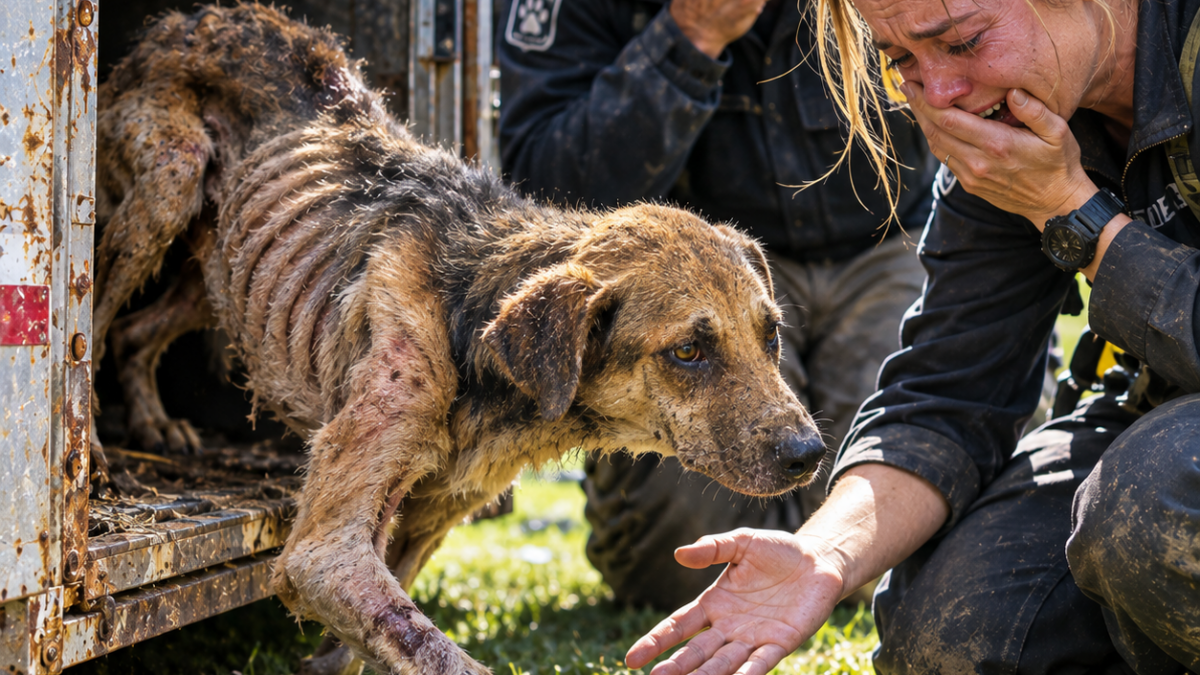
“HE DIDN’T RUN. HE DIDN’T BARK. HE JUST WALKED TOWARD THE SUN…” Max Had Survived 16 Days Locked Inside a Sealed Trailer With Almost No Food or Water—When We Finally Opened the Doors, His Skeletal Little Body Stepped Onto the Grass… Then Collapsed, as If He Had Been Waiting Until That Moment to Stop Fighting.
For sixteen days, Max survived inside a sealed metal trailer in the middle of summer with no food, almost no water, and nothing but wooden pallets to chew while the temperature inside swung from unbearable daytime heat to freezing darkness at night.
When Gareth and I finally opened the doors, we expected panic, barking, maybe an animal too frightened to let us near him—but instead a skeletal little dog stepped slowly toward the sunlight, walked onto the grass, and simply lay down as if he had been waiting all those days for permission to stop fighting.
The veterinarian later told me Max should not have survived at all, but what happened after I opened that trailer taught me something harder to explain: sometimes the life you think you are rescuing has already decided to rescue something in you.
My name is Jacob Miller.
I worked logistics at a rural equipment base where most days were so predictable that we measured time by deliveries.
Trucks came in.
Trailers went out.
Forklifts moved pallets.
Paperwork accumulated.
Nothing dramatic.
Nothing heroic.
Then, one August morning, Gareth asked me about a trailer that had been sitting in the wrong section of the yard.
“Was that supposed to be picked up?”
I looked toward the far row.
Old white freight trailer.
Rust along the lower frame.
One rear light missing.
“I thought it was empty.”
“So did I.”
“Who dropped it?”
He checked his tablet.
“July twenty-ninth.”
I looked at the date.
August fourteenth.
Sixteen days.
The trailer had arrived during a storm-heavy week when three shipments had been rerouted.
Someone apparently parked it in overflow storage instead of the inspection lane.
Nobody opened it.
Nobody had a reason to.
Until Gareth heard something.
“What did you hear?”
He frowned.
“I don’t know.”
“Rat?”
“Maybe.”
We walked closer.
The morning sun was already heating the metal.
I put one hand against the side.
Warm.
Not dangerous yet.
It would be by noon.
Gareth walked around the rear.
Then stopped.
“Jacob.”
I heard it.
Scratch.
Very faint.
Then silence.
We stared at each other.
I stepped closer.
“Hello?”
Nothing.
Gareth knocked once.
A sound came from inside.
Not barking.
Not even whining.
More like something dragging itself across the floor.
My stomach tightened.
“Get the bolt cutters.”
The trailer seal was old and corroded.
Gareth ran.
I stayed.
I pressed my ear near the door.
“Hey.”
For several seconds, there was nothing.
Then—
A tiny sound.
A dog.
Barely.
My heart started pounding.
Gareth returned.
We cut the seal.
The latch resisted.
Rust.
Heat.
I pulled harder.
The door finally released.
Sunlight sliced into the darkness.
The smell hit us first.
Hot metal.
Rotten wood.
Urine.
Dust.
Something sour and living.
I stepped back.
Inside, the trailer was almost completely dark.
Wooden pallets had been stacked along one side.
Several were splintered.
Chunks of wood covered the floor.
Then something moved in the far corner.
Gareth whispered:
“Oh my God.”
A small dog stood there.
Or tried to.
Brown coat.
Every rib visible.
Hips sharp beneath skin.
His legs shook so badly he looked like he was standing on unstable ground.
He stared at the open doors.
At the light.
At us.
I crouched.
“Hey, buddy.”
He didn’t bark.
Didn’t growl.
Didn’t run.
He simply looked at the sun.
Then he took one step.
Stopped.
Another.
His paws made almost no sound on the trailer floor.
When he reached the edge, he hesitated.
I thought he might be afraid of the drop.
Instead, he lifted his face toward the sunlight.
Closed his eyes.
For one second, he just stood there feeling warmth that was not trapped metal.
Then he stepped down.
Walked three feet into the grass.
Turned once.
And lay down.
No panic.
No attempt to escape.
No fight.
He placed his head on the ground and closed his eyes.
As if he had spent sixteen days believing that if he survived long enough, eventually the door would open.
Gareth stood beside me.
Neither of us spoke.
Finally, he whispered:
“I’m calling the vet.”
I sat in the grass several feet from the dog.
I didn’t touch him.
I didn’t want to wake him.
The sun warmed his thin body.
Wind moved through the grass.
For sixteen days, his entire world had been darkness, steel, hunger, and the taste of chewed wood.
Now he slept in the light.
And watching him, I realized something that made my throat ache.
He had not walked out like an animal escaping prison.
He had walked out like someone who had finally reached home.
FULL STORY CONTINUATION
Gareth called Dr. Claire Osborne.
She was the closest veterinarian who handled emergency cases in our part of the county.
Her clinic was twenty minutes away, but that morning she was already on the road visiting a farm.
When Gareth explained what we had found, she changed direction immediately.
“Don’t feed him,” she told us.
Gareth put her on speaker.
I frowned.
“He hasn’t eaten in sixteen days.”
“I understand.”
“Then why—”
“Because after prolonged starvation, giving too much food too quickly can cause serious complications.”
Her voice was firm.
“Small amounts of water only if he wants it. Keep him cool. Don’t force him to stand.”
I looked at Max.
We did not know his name then.
He was still asleep.
“Is he going to make it?”
A pause.
“I can answer that after I examine him.”
I hated that answer.
But it was honest.
We moved a canopy over the grass to shade him.
Not because the sunlight seemed to bother him.
Because his body was already dangerously depleted.
The summer heat would only add stress.
I put a shallow bowl of water several feet away.
He opened his eyes.
Saw it.
For a few seconds, he didn’t move.
Then slowly lifted his head.
He tried to stand.
His front legs shook.
He fell back down.
My instinct was to rush forward.
Dr. Osborne’s warning stopped me.
“Easy.”
He looked at me.
I slid the bowl closer instead.
He sniffed.
Lapped once.
Stopped.
Another lap.
Then a few more.
I wanted him to drink everything.
But he seemed to know his own limits.
After maybe ten seconds, he lowered his head again.
Gareth crouched beside me.
“How the hell did he survive?”
I looked toward the trailer.
The roof had a long crack near one corner.
Dark stains ran down the interior wall.
“Rain.”
“What?”
“We had two storms.”
Gareth followed my gaze.
Water must have leaked inside.
Not much.
Enough to collect in grooves on the floor or on pieces of plastic.
Enough for a desperate dog to lick.
Then there were the pallets.
Chewed corners everywhere.
Wood splinters.
Deep tooth marks.
He had gnawed them until some sections looked shredded.
Not food.
Nothing close.
But something to put in his mouth.
Something to create saliva.
Something to do while time passed in total darkness.
Gareth looked sick.
“Sixteen days.”
I nodded.
“How many nights?”
“Sixteen.”
“How hot does it get inside one of those?”
I didn’t answer.
We both knew.
A sealed metal trailer in August could become an oven.
At night, temperatures dropped sharply on that exposed yard.
Hot.
Cold.
Dark.
No one.
I looked back at the dog.
His chest rose.
Fell.
Still alive.
Dr. Osborne arrived forty minutes later.
She climbed out of her pickup carrying a medical bag.
The moment she saw him, she stopped.
“You said sixteen days?”
“Yes.”
“Confirmed?”
“The trailer arrived July twenty-ninth.”
“What date today?”
“August fourteenth.”
She looked at the dog again.
“Dear God.”
She approached slowly.
I expected him to tense.
He opened his eyes.
Watched her.
Nothing else.
Dr. Osborne knelt.
“Hi, sweetheart.”
She let him smell her hand.
Then began examining him.
Gums.
Eyes.
Heart.
Skin.
Ribs.
Abdomen.
Paws.
The more she checked, the tighter her expression became.
Finally:
“He’s severely dehydrated.”
Gareth nodded.
“Severe malnutrition.”
She ran her hand carefully along his shoulders.
“Significant muscle wasting.”
I stared.
“But?”
She looked up.
“What?”
“You sounded like there was a ‘but.’”
Dr. Osborne exhaled.
“But his heart is beating reasonably steadily for his condition.”
I almost laughed from relief.
“That good?”
“It’s better than the alternative.”
She continued.
“He’s responsive. His temperature is concerning but not catastrophic.”
Then she looked toward the wood fragments.
“You said he chewed those?”
“Yes.”
“All over the trailer.”
She picked up a piece.
Examined the tooth marks.
“The wood didn’t feed him.”
“I figured.”
“But chewing may have stimulated saliva and helped preserve some jaw function.”
She looked toward the roof.
“And water came through that crack?”
“We think so.”
“Recent storms?”
“Two.”
Dr. Osborne stared at Max for several seconds.
Then at me.
“Jacob, this dog should not be here.”
My stomach tightened.
“What do you mean?”
“Sixteen days without real food.”
She pointed toward the trailer.
“Minimal water.”
“Extreme heat.”
“Isolation.”
“Probably very little ventilation.”
Her voice softened.
“He shouldn’t have survived this.”
I looked at Max.
He had closed his eyes again.
“But he did.”
Dr. Osborne nodded.
“Yes.”
Then she whispered:
“He did.”
We needed to move him.
Dr. Osborne didn’t want him walking.
Gareth brought a flat transport board and blanket.
We placed the blanket beside Max.
I expected fear when we approached.
Instead, he lifted his head.
Looked at me.
Not Gareth.
Me.
I froze.
Dr. Osborne noticed.
“Go slowly.”
I knelt.
“Hey.”
His eyes stayed on mine.
“We’re moving you.”
I knew he could not understand.
Still, it felt wrong not to explain.
“Somewhere better.”
He sniffed my hand.
That was the first physical contact.
His nose was dry.
Warm.
Then, astonishingly, he placed his chin briefly against my palm.
Dr. Osborne looked at me.
“Okay.”
Her voice became even softer.
“He trusts you.”
I swallowed.
“How?”
“You opened the door.”
That sentence hit me harder than expected.
I had done almost nothing.
Pulled a latch.
Opened a door.
But to Max, maybe that was everything.
We transported him to Dr. Osborne’s clinic.
I followed in my truck.
Gareth came too.
Technically, both of us should have returned to work immediately.
Our supervisor told us to stay until intake was complete.
Maybe he saw our faces.
At the clinic, two technicians carried Max inside.
The doors closed.
And for the first time since opening the trailer, I could not see him.
I hated it.
That surprised me.
An hour earlier, I didn’t know the dog existed.
Now I stood in a veterinary waiting room staring at a closed door like something belonging to me was behind it.
Gareth bought coffee.
I didn’t drink mine.
Thirty minutes.
Forty-five.
Finally, Dr. Osborne came out.
“He’s stable.”
I exhaled so hard my chest hurt.
Gareth leaned back against the wall.
“What now?”
“Fluids.”
“Monitoring.”
“Very controlled nutrition.”
She looked at us.
“The next couple of days matter.”
I asked:
“Can he die?”
Dr. Osborne did not soften the answer.
“Yes.”
I looked down.
“But,” she continued, “he has survived the part I would have expected to kill him.”
I looked back up.
“So he has a chance.”
“A real one.”
We still didn’t have a name.
Animal control checked lost-dog reports.
Nothing matching.
No collar.
No microchip.
No recent owner report.
It was possible he had been placed inside the trailer intentionally.
Possible he had climbed in before it was transported and become trapped.
Nobody could prove either.
I wanted an explanation.
Someone to blame.
Dr. Osborne told me:
“Focus on the dog in front of you.”
I didn’t appreciate it then.
She was right.
For the first three days, Max mostly slept.
That became his temporary name because Gareth said we could not keep calling him “Trailer Dog.”
“Max?”
I looked at him.
“Why Max?”
“He survived the maximum amount of bad luck.”
“That’s terrible.”
“You have something better?”
I didn’t.
Max stayed.
Dr. Osborne wrote it on his chart.
His recovery was frighteningly quiet.
No dramatic turnaround.
No morning where he suddenly stood and became healthy.
Progress came in inches.
Day one:
More alert.
Day two:
Hydration improving.
Day three:
Lifted his head when someone entered.
Day four:
Tried to stand.
Failed.
I visited every evening.
At first I told myself it was because the accident happened on our property.
Responsibility.
Guilt.
Professional interest.
All lies.
I went because every time I walked away, I saw him lying in that trailer.
Darkness.
Sixteen days.
And every time I returned to the clinic, I needed to see that the door was still open.
On the fifth day, Max recognized my voice.
I entered the treatment room.
“Hey.”
His eyes opened.
His head lifted.
Then his tail moved.
Barely.
One weak motion against the blanket.
I stopped.
Dr. Osborne was checking another kennel.
She smiled.
“You saw it.”
“He wagged.”
“He did.”
“Does he do that for everyone?”
“No.”
I looked at her.
She continued:
“Mostly me when food appears.”
I laughed.
Then she added:
“And you.”
My throat tightened.
“Why?”
“Dogs remember people connected to major transitions.”
She closed the chart.
“You were there when darkness ended.”
I sat beside him.
Max lowered his head again.
My hand remained near him.
After a few minutes, his paw shifted until it touched my shoe.
Maybe accident.
I didn’t move it.
The clinic began learning his triggers.
Metal doors bothered him.
The sound of a heavy latch made him tremble.
Dark enclosed rooms terrified him.
The first time a technician moved him toward a kennel with a solid side wall, Max froze.
Would not enter.
They changed plans.
Open medical run.
More light.
Dr. Osborne explained:
“Trauma isn’t always loud.”
Max rarely barked.
Rarely growled.
His fear looked like stillness.
That was somehow worse.
He simply stopped.
Eyes distant.
Body rigid.
Waiting for something bad to happen.
I began sitting nearby when certain procedures happened.
Not touching him.
Just talking.
“It’s okay.”
Sometimes he looked toward me.
Sometimes not.
But he seemed calmer when I stayed.
At the end of the first week, Dr. Osborne explained what prolonged isolation could do.
“He wasn’t just hungry.”
She sat across from me in her office.
“The nervous system responds to prolonged stress.”
“Is he permanently damaged?”
“I wouldn’t use that language.”
I felt embarrassed.
She continued.
“He may have fears.”
“Behaviors.”
“He may always react to darkness or confinement.”
“But look at him.”
She nodded toward the treatment room.
“He’s remarkably calm.”
“Why?”
She smiled sadly.
“I wish I knew.”
Then:
“Some animals come out of trauma defensive.”
“Some shut down.”
“Some remain surprisingly open.”
She looked at me.
“Max walked into the sunlight and went to sleep.”
I nodded.
“That tells me something.”
“What?”
“He believed safety was possible.”
I thought about that all night.
Believed safety was possible.
How?
After sixteen days?
Maybe he had known people before.
Maybe someone had loved him.
Maybe those memories survived.
Or maybe dogs do not build the same stories humans do.
Maybe he did not sit in darkness thinking:
Nobody is coming.
Maybe he simply survived the next minute.
Then the next.
Then the next.
Rainwater.
Chew wood.
Sleep.
Wake.
Wait.
Door opens.
Light.
Walk.
Rest.
There was something almost sacred in that simplicity.
At the end of the second week, Dr. Osborne introduced solid food.
Small amount.
Soft.
Warm.
I happened to be there.
Probably not an accident.
She placed the bowl near Max.
He approached slowly.
Smelled it.
Then stopped.
He looked at me.
Directly.
I laughed nervously.
“What?”
Max looked at the food.
Then at me.
Dr. Osborne whispered:
“I think he’s asking.”
“Asking what?”
“Whether it’s safe.”
That broke something inside me.
Food.
A dog asking permission to eat.
I crouched.
“It’s yours.”
Max stared.
I nodded.
“Go ahead.”
He lowered his head.
Took one bite.
Stopped.
Looked at me.
“Yeah.”
Another.
Then another.
Soon he was eating steadily.
Not frantic.
Controlled.
When the bowl was empty, he licked the edge.
Then walked toward me.
I held out my hand.
Max licked it.
One slow swipe.
First affection.
I turned my face away.
Dr. Osborne pretended to study a chart.
Neither of us mentioned my eyes.
Gareth visited later that week.
Max liked him.
But differently.
Gareth sat beside me.
“You come every day?”
“Most.”
He smiled.
“You’re adopting him.”
“No.”
“You absolutely are.”
“I live alone.”
“Dogs tolerate that.”
“My hours.”
“Figure it out.”
“I’ve never owned a dog.”
Gareth looked at Max.
“Looks like one owns you.”
“Shut up.”
Max rested his head on my shoe.
Gareth laughed.
“Case closed.”
I resisted the idea.
Not because I didn’t want Max.
Because wanting and being responsible are different things.
My apartment was small.
Work unpredictable.
I had never planned around another living creature.
Adoption meant years.
Money.
Time.
Training.
Veterinary care.
Not a dramatic rescue ending.
A commitment.
I took that seriously.
Still, every night when I went home, the apartment felt different.
Too quiet.
I noticed how little of my life existed outside work.
Kitchen table.
Television.
A couch nobody else used.
No reason to hurry home.
No one waiting.
I had always called that independence.
After Max, it began feeling more like absence.
By week three, he could walk short distances.
The first trip outside the clinic was maybe twenty yards.
Dr. Osborne used a support sling.
I walked beside him.
The door opened.
Sunlight entered.
Max stopped.
Not fear.
Recognition.
His nose lifted.
He stepped outside.
Grass beneath his paws.
Warm air.
He walked five feet.
Then ten.
Found a square of sunlight.
Lowered himself into it.
Closed his eyes.
I stood beside him.
Sixteen days in total darkness.
I realized sunlight meant something different to him.
For me, ordinary.
For him, proof.
The world remained open.
He began seeking sunlight everywhere.
Clinic window.
Outdoor yard.
Hallway where afternoon light crossed the floor.
If there was a warm patch, Max found it.
He would lie down.
Close his eyes.
Sleep.
Dr. Osborne called it self-regulation.
I called it worship.
One evening, she sat beside me outside.
Max slept in sunlight.
“Jacob.”
I looked over.
“I’ve been practicing twenty-five years.”
“That’s depressing.”
She smiled.
“Thank you.”
Then became serious.
“I’ve seen dogs survive starvation.”
“Abuse.”
“Accidents.”
“Isolation.”
“But Max…”
She watched him.
“The physical survival is extraordinary.”
I nodded.
“What surprises me more is him.”
“What do you mean?”
“He still trusts.”
She looked at me.
“He still seeks people.”
“He relaxes when you enter.”
“He does not behave like the world taught him only cruelty.”
I looked at Max.
“Maybe he’s stupid.”
Dr. Osborne laughed.
“Or wiser than us.”
That evening, I went home and sat at my kitchen table.
No television.
No lights except above the stove.
I thought about sixteen days.
Then about my own life.
I was not traumatized.
Not abandoned.
Not suffering.
But somewhere over the years, I had stopped expecting much from life outside work.
Wake.
Job.
Food.
Sleep.
Again.
Nothing terrible.
Nothing full.
I had always told myself:
Later.
Maybe I’ll move.
Maybe date seriously.
Maybe get a dog.
Maybe travel.
Later.
Watching Max walk into sunlight made “later” feel embarrassing.
He had almost lost every future minute.
And here I was postponing mine because the timing wasn’t perfect.
The next morning, I went to the clinic.
Dr. Osborne saw my face.
She smiled before I spoke.
“I want to adopt him.”
She crossed her arms.
“I was wondering how long it would take.”
“You knew?”
“Everyone knew.”
“Gareth?”
“Especially Gareth.”
I sighed.
Dr. Osborne walked toward Max.
He lifted his head.
She scratched his ear.
“He’s already chosen.”
I looked at him.
“That’s a lot of pressure.”
Max’s tail moved.
The adoption could not happen immediately.
He needed more medical clearance.
There were formal checks.
Animal control had to complete the stray hold and confirm no owner claim.
Nobody did.
Part of me was relieved.
Part of me hurt for him.
No one searching.
Sixteen days missing.
Nobody called.
Nobody came.
I wanted to know where he belonged before.
Then I realized perhaps home was supposed to be forward.
Not backward.
I prepared the apartment.
Terribly.
Bought a bed too large for my living room.
Two bowls.
Four toys.
One looked like a duck.
Gareth said Max would destroy it in minutes.
He was right eventually.
I bought a leash.
Collar.
Blankets.
Baby gate.
Then stood in a pet store aisle wondering why there were forty kinds of dog shampoo.
A woman beside me asked:
“New puppy?”
“Adult rescue.”
She smiled.
“First dog?”
“Obvious?”
“Very.”
The day Max came home, Dr. Osborne gave me instructions thick enough to qualify as a textbook.
Food portions.
Follow-up bloodwork.
Exercise restrictions.
Weight monitoring.
Hydration.
Behavioral notes.
No forced confinement.
Be careful with dark spaces.
Give him choice.
“Call me if anything concerns you.”
“Everything concerns me.”
She smiled.
“Excellent. You’re ready.”
Max walked out of the clinic beside me.
Slow.
Stronger.
His coat already improving.
When we reached my truck, he hesitated at the open door.
Dark interior.
I saw his body stiffen.
I stopped.
Did not pull.
“Take your time.”
Max sniffed.
One paw.
Back.
I sat on the ground beside the truck.
People passed.
I felt ridiculous.
Didn’t care.
Five minutes.
Ten.
Finally Max approached.
He placed his front paws on the floorboard.
Looked at me.
“It stays open.”
I held the door.
“No closing until you’re ready.”
He climbed inside.
I sat beside him for another minute.
Then closed the door slowly.
Max tensed.
I opened it again.
Waited.
Second try.
Better.
By the third, he remained calm.
That twenty-minute lesson taught me more about trust than many people ever had.
At home, Max inspected everything.
Living room.
Kitchen.
Bathroom.
Bedroom.
He avoided the closet.
Fine.
He found the sunny window immediately.
Of course.
Lay down.
Looked at me.
I sat on the couch.
For twenty minutes, neither of us moved.
Then Max stood.
Walked over.
Sat at my feet.
And placed his head on my knees.
I froze.
Exactly the way he had rested in the grass outside the trailer.
But different.
Closer.
Personal.
His eyes closed.
I put one hand gently against his head.
“Home?”
His tail tapped once.
I swallowed.
“Yeah.”
My voice broke.
“Home.”
That first night was hard.
Max would not sleep in the new bed.
He lay near the front door.
Every small sound woke him.
At 2 a.m., he stood.
Checked the living room.
Kitchen.
Windows.
Then returned.
At four, again.
I slept badly too.
Around dawn, I woke to sunlight entering through the blinds.
Max had moved.
He lay directly inside the brightest patch.
Completely asleep.
For the first time, his body looked loose.
No tension.
I stayed in bed watching him.
No photograph.
No phone.
Some moments feel wrong to interrupt.
Recovery continued for months.
Weight slowly returned.
Muscle.
Energy.
His personality appeared.
That was the best part.
The dog who seemed almost ancient in the trailer turned out to be playful.
He liked tennis balls.
Hated vacuum cleaners.
Loved cheese.
Disliked closed bathroom doors.
Stole socks.
The first time he ran through my apartment carrying one, I laughed so hard I had to sit down.
He stopped.
Looked at me.
Then ran faster.
Not survivor.
Dog.
That distinction became important.
People wanted to talk about the trailer constantly.
The miracle dog.
Sixteen days.
No food.
Darkness.
Wood pallets.
Rainwater.
Everyone reduced him to his suffering because suffering made the story dramatic.
I started correcting them.
“His name is Max.”
Not Trailer Dog.
Not Miracle Dog.
Max.
He deserved a life larger than the worst two weeks of it.
He developed rituals.
Sun patches.
Every day.
Morning light by the living-room window.
Afternoon light near the patio.
If clouds covered the sun, he waited.
When light returned, he moved into it.
Sometimes he simply lay there awake.
Eyes half closed.
I wondered what warmth felt like after that trailer.
I stopped taking sunlight for granted too.
Rain affected him differently.
The first heavy storm after adoption, Max stood at the window.
Listened.
Rain hitting the roof.
His ears moved.
I expected panic.
Instead, he walked to the kitchen.
Looked at the ceiling.
Then at me.
I remembered the crack.
Rainwater.
The thing that had probably kept him alive.
Maybe rain was not only fear.
Maybe it was memory of survival.
He went back to his bed.
Slept.
I stood there with tears in my eyes because apparently I had become a person who cried when a dog ignored weather.
Darkness was harder.
Power outage one evening.
Apartment instantly black.
Max panicked.
No barking.
He froze.
Then began breathing rapidly.
I reached for my phone flashlight.
“Max.”
He backed toward the wall.
“It’s me.”
I turned on the light.
His eyes found mine.
I sat on the floor.
Did not approach.
“Door’s open.”
I opened the patio curtain.
Moonlight entered.
Max stared.
After several minutes, he walked toward me.
Sat.
Head against my shoulder.
We waited together until electricity returned.
After that, I bought emergency lights.
Not because Max needed coddling.
Because safety can be practical.
Dr. Osborne recommended a behavior specialist.
We went.
No shame.
The trainer taught me to offer choice.
Never trap him.
Practice doors.
Short enclosed spaces with exits visible.
Reward calm behavior.
Progress was slow.
One day, Max entered my bedroom closet voluntarily to retrieve a ball.
He backed out immediately.
I celebrated like he’d won a championship.
The trainer laughed.
“That’s huge for him.”
It was.
Small victories can look ridiculous to people who don’t know what came before.
The base investigated how Max ended up inside the trailer.
Paperwork.
Driver interviews.
Shipping records.
No clear answer.
The trailer had changed hands through a subcontractor.
It was possible Max entered before transport.
Possible someone put him there.
No proof.
For weeks, I obsessed.
I wanted justice.
Then one night, Max lay beside me chewing the duck toy.
Completely content.
I realized my anger was becoming more important to me than his present.
I stopped.
If evidence appeared, fine.
But I would not build his new life around a mystery we could not solve.
Gareth visited often.
Max adored him eventually.
Not like me.
Different.
Gareth always brought treats.
“Bribery.”
“Relationship building.”
“Bribery.”
Max followed him immediately.
“Traitor.”
Gareth smiled.
“See? Dog has judgment.”
Three months after adoption, Max reached a healthy weight.
Dr. Osborne showed me the chart.
“Look.”
The line moved upward steadily.
I felt absurdly proud.
“Muscle coming back too.”
She examined him.
“Gums good.”
“Coat good.”
“Heart good.”
Then she looked at me.
“You know he’s going to be okay.”
I knew.
But hearing it broke something.
“Really?”
“Yes.”
“Like normal?”
She smiled.
“He is normal.”
I looked toward Max.
He was sitting near the window waiting for sunlight.
I laughed.
“Okay.”
At home that evening, I opened the photograph Gareth had taken on the first day.
Max in the grass.
Skeletal.
Eyes closed.
Sunlight on him.
I had avoided looking at it.
Now I placed it beside a new photograph.
Max standing in my yard.
Healthy.
Coat shining.
Ball in his mouth.
Before.
After.
I stared.
Not to glorify suffering.
To remember transformation.
People say resilience means fighting.
Max taught me something different.
He did fight.
Obviously.
Sixteen days.
But survival inside that trailer was not dramatic action.
Mostly, it was endurance.
Wait.
Find moisture.
Chew.
Sleep.
Wake.
Wait again.
Resilience sometimes means doing almost nothing except refusing to die before the door opens.
That is not passive.
It is enormous.
I began thinking differently about people too.
Friends going through grief.
Coworkers exhausted.
People who looked like they were “doing nothing.”
Maybe surviving was the work.
Maybe sometimes walking into the light and lying down was enough.
Max changed the way I judged strength.
He also changed my apartment.
Hair.
Everywhere.
I bought a better vacuum.
He hated it.
Battle continued.
Shoes moved higher.
Garbage can gained a lid.
My couch became ours.
Then mostly his.
My calendar included walks.
Vet visits.
Training.
I had complained for years that life after work felt empty.
Now someone waited at the door.
It changed how quickly I left the office.
That mattered.
Before Max, I volunteered for late shifts constantly.
Why not?
Nobody waited.
After Max, I became better at saying:
“Someone else can cover.”
Not always.
Responsibilities remained.
But I learned that dedication did not require permanent absence from my own life.
Maybe Max saved me from becoming a man whose entire identity fit inside an employee badge.
I didn’t realize I needed that.
One night, I had a terrible day.
Equipment failure.
Argument with supervisor.
A mistake that cost money.
Nothing life-threatening.
Just one of those days when every small problem combines.
I came home angry.
Max approached with his ball.
“Not now.”
He stopped.
I immediately felt guilty.
He walked away.
Ten minutes later, I sat on the floor.
“Sorry.”
Max looked at me.
I held out my hand.
He came over.
Head on my knee.
No grudge.
No lecture.
I laughed weakly.
“You’re better at this than I am.”
His tail moved.
The first anniversary of the trailer came quietly.
August fourteenth.
I remembered before breakfast.
Max did not, obviously.
He ate.
Went outside.
Rolled in grass.
I took him to the base.
Not inside the trailer.
That trailer was gone.
Scrapped after inspection.
Good.
We stood near the area where it had been parked.
Nothing special.
Asphalt.
Weeds.
Max sniffed.
No reaction.
I was relieved.
I didn’t need cinematic recognition.
I wanted the past to matter less to him than to me.
We drove home.
He slept in sunlight.
Perfect anniversary.
Dr. Osborne called later.
“One year.”
“You remembered?”
“Hard not to.”
She asked how he was.
I described him.
“Sounds terrible.”
“Tragic.”
We laughed.
Then she said:
“I still tell veterinary students about him.”
“Why?”
“Because survival isn’t always predictable.”
She paused.
“And because he remained trusting.”
I looked at Max.
“Yeah.”
“That still amazes me.”
I sometimes wondered whether Max’s calmness came from trust or exhaustion.
Maybe on the first day he did not choose faith.
Maybe he simply had no strength to fear us.
That possibility bothered me.
Then I remembered later moments.
Food.
Truck.
Closet.
Darkness.
He repeatedly chose to approach after strength returned.
Trust became real over time even if it began as necessity.
Maybe human relationships work that way too.
What matters is what gets built afterward.
Max became popular in the neighborhood.
Kids asked to pet him.
He was gentle.
One boy asked why he had scars.
I answered simply.
“He had a hard time before he came here.”
“Did someone hurt him?”
“I don’t know.”
“Is he okay now?”
I looked down.
Max leaned into the boy’s hand.
“Yes.”
The child smiled.
“Good.”
Kids understand endings better than adults sometimes.
Max loved lying in grass.
Not just sunlight.
I thought about the first moment outside the trailer.
Grass must have felt impossible after metal.
He would roll onto his back.
Paws in the air.
Complete surrender.
I often stood there smiling.
The same dog who once slept because he could no longer fight now slept because he knew he didn’t need to.
There is a difference.
A local reporter eventually heard the story.
They wanted an interview.
I refused initially.
Then Dr. Osborne convinced me.
“People need to hear about abandoned animals.”
So we did it.
The reporter asked:
“How did Max survive sixteen days?”
I answered honestly.
“Luck.”
“Rainwater.”
“His own body.”
“Maybe timing.”
She wanted something inspirational.
I refused to make survival sound easy.
Then she asked:
“What did you think when he came out?”
I remembered.
“He walked into the sun.”
I paused.
“And went to sleep.”
The reporter waited.
“Why does that stand out?”
“Because he seemed like he’d been waiting for permission to rest.”
That line became the headline.
I hated it.
Then received dozens of messages from people saying it helped them.
Maybe stories stop belonging completely to us once shared.
One message came from a woman undergoing cancer treatment.
She wrote:
Some days I feel like all I do is wait. Max made me feel like waiting can still be brave.
I printed it.
Kept it.
Max chewed the corner months later.
Appropriate.
Another came from a man recovering from addiction.
I spent years thinking resilience meant constantly fighting. Sometimes it means staying alive long enough for the door to open.
That one changed me.
Max had become metaphor to people who never met him.
He was just sleeping in sunlight.
I was careful not to romanticize suffering.
I told anyone who asked:
Max should never have been trapped.
His survival did not make what happened acceptable.
Stories about resilience can become dangerous when they imply suffering is valuable.
It isn’t.
What matters is what someone does with life afterward.
Max’s best chapter was not the trailer.
It was everything after.
He learned to swim eventually.
That terrified me.
Not him.
We visited a lake with Gareth.
Max stepped into shallow water.
I hovered.
Gareth laughed.
“He’s a dog.”
“He’s my dog.”
“Exactly.”
Max splashed.
Then swam.
No fear.
I realized again that trauma is not always where we expect.
Darkness bothered him.
Water did not.
He came back dripping and shook all over Gareth.
Justice.
He learned the word “sun.”
Accidentally.
Every afternoon I would say:
“Go find your sun.”
He would move toward the window.
Eventually, if I said “sun,” he looked for the bright patch.
I found that unbearably beautiful.
A dog whose defining memory might have been darkness now had a word for light.
Years passed.
Max aged.
Not dramatically at first.
Gray around muzzle.
Longer naps.
Less interest in destroying toys.
Still sunlight.
Always.
I began worrying prematurely.
Dr. Osborne caught me once.
“He’s healthy.”
“I know.”
“Then stop mourning him while he’s alive.”
Harsh.
Correct.
I tried.
We took longer walks.
Sat outside.
I learned to be bored.
That may sound ridiculous.
Before Max, I needed activity.
Phone.
Work.
Noise.
With him, I could sit.
Sunset.
Dog breathing.
Nothing else.
He taught me stillness.
Maybe that was another rescue.
One winter evening, snow fell.
Max had never seen much snow with me.
He stepped outside.
Stopped.
Looked at the ground.
Then buried his nose in it.
Jumped backward.
I laughed.
He ran through the yard like a puppy.
Healthy dog.
Older now.
But joyful.
I filmed twenty seconds.
That became my favorite video.
Not dramatic.
No rescue.
Just Max discovering snow.
The trailer story always started with darkness.
His life with me filled with firsts afterward.
Snow.
Lake.
Beach.
Hotel.
Camping.
Road trip.
Ice cream—small amount, veterinary approval.
Every new experience felt like adding something to a life that once seemed almost over.
At the beach, Max spent an hour digging one hole.
No purpose.
Pure commitment.
I sat laughing.
A stranger asked:
“How old?”
“About eight, we think.”
“Had him long?”
I looked at Max.
“Not long enough.”
The answer slipped out.
The stranger smiled sadly.
“No time is.”
True.
Max never stopped checking open doors.
If a room door closed accidentally, he sometimes waited nearby.
Not panicked anymore.
Just aware.
I learned not to shut him inside spaces unnecessarily.
Respect is not about forcing someone to prove they are “over” something.
We can accommodate harmless needs.
Humans too.
One day, Gareth asked:
“Think he remembers the trailer?”
I looked at Max sleeping.
“Maybe.”
“Would you want him to forget?”
I thought.
“Yes.”
Then changed it.
“No.”
Gareth raised an eyebrow.
“I want it not to matter.”
That was more accurate.
Memory can remain without controlling the present.
Max seemed to achieve that better than many people I knew.
Dr. Osborne retired eventually.
Her clinic held a small celebration.
I brought Max.
She knelt painfully beside him.
“You.”
Max wagged.
“You made me famous.”
I laughed.
“She tells your story constantly.”
Dr. Osborne scratched his ears.
“Still sunny?”
“Every day.”
Her eyes filled.
“Good.”
Before we left, she hugged me.
Then whispered:
“You know he changed you.”
I smiled.
“I know.”
She was right.
Before Max, I thought meaning came from extraordinary events.
Promotion.
Achievement.
Something visible.
Max’s life became meaningful through ordinary repetition.
Morning walk.
Food bowl.
Sun patch.
Head on knee.
Someone waiting when I got home.
Maybe meaning is usually small enough to miss if you are looking for spectacle.
When Max became older, I moved to a house with a small yard.
Technically for me.
Actually for him.
He walked outside the first day.
Found sunlight.
Lay down.
I laughed.
“Of course.”
He looked at me like:
Why else did we move?
The house had large windows.
I chose them because of Max.
Never told the realtor.
She probably knew.
One spring afternoon, I found Max asleep beside the window.
Sunlight across his face.
His breathing slow.
For one terrible second, he looked exactly like the dog in the grass sixteen years—no, years earlier.
My heart jumped.
“Max?”
His eyes opened.
Tail thump.
I sat beside him.
“Don’t do that.”
He closed his eyes again.
Dogs do not respect human anxiety.
Age brought arthritis.
Medication helped.
Walks shortened.
Sun time increased.
That seemed fair.
He had earned retirement.
I occasionally returned to the base.
New employees heard the story.
Some didn’t believe.
“Sixteen days?”
“Yes.”
“No food?”
“None that we found.”
“Wood?”
“Chewed pallets.”
“Rainwater?”
“Probably.”
One young worker asked:
“Why didn’t anyone hear him?”
That question hurt.
Because the answer was simple.
Nobody went near the trailer.
The lesson became policy.
Every incoming trailer checked.
No exceptions.
Doors opened.
Visual inspection.
The base changed procedures because of Max.
No animal would survive—or die—unnoticed in a parked trailer there again if we could prevent it.
That mattered.
His suffering produced prevention, not because suffering was necessary, but because we learned.
A plaque appeared near the inspection area.
Not dramatic.
CHECK BEFORE YOU LOCK.
Below it, a small image of a dog paw.
Gareth did that.
He denied it.
I knew.
One day, a worker opened a trailer and found a stray cat inside before it was sealed.
They brought her to animal control.
Safe.
Gareth texted me.
Max policy worked.
I looked at Max sleeping.
“You saved somebody.”
He didn’t wake.
Heroes are exhausting.
Years after adoption, I finally learned to stop asking what life would have been without Max.
No point.
The door opened.
He walked out.
Our paths crossed.
That became life.
When people say:
“You saved him.”
I always answer:
“I opened a door.”
They think I’m being modest.
I’m not.
Max did the first sixteen days.
Dr. Osborne did medicine.
His body did recovery.
I provided home afterward.
Rescue is usually collective.
The person opening the door gets too much credit.
But privately, I know opening mattered.
Sometimes the smallest action becomes enormous because of timing.
A latch.
A phone call.
Looking twice.
Listening.
Max’s story made me pay more attention.
What sounds are we dismissing?
What doors remain closed because nobody thinks to open them?
Not metaphorically only.
Literally.
Check.
Listen.
Look.
One evening, years later, I sat beside Max in the yard.
Sunset.
Warm.
His head rested on my knee.
I remembered Dr. Osborne saying:
“He chose you.”
I had resisted.
Now I believed it.
Not in mystical terms.
He associated me with light.
Safety.
Food.
Home.
And over time, something more ordinary and more important.
Routine.
I told him:
“You know you ruined my life.”
Tail moved.
“I used to travel.”
Another tail thump.
“I could stay late at work.”
Nothing.
“I had clean furniture.”
Max opened one eye.
“Terrible animal.”
He closed it.
I smiled.
“Best thing that ever happened.”
His tail moved again.
As he aged, the sunlight ritual became slower.
He no longer rushed toward the window.
Walked.
Turned carefully.
Lowered himself.
I placed soft mats in every sunny spot.
My house began looking ridiculous.
Worth it.
One rainy week, sunlight barely appeared.
When it finally broke through, Max stood despite stiff joints.
Moved toward the window.
Lay down.
Face in warmth.
I sat beside him.
“Missed it?”
He sighed.
I thought about the trailer.
Sixteen days.
How precious light must have become.
Then I corrected myself.
Maybe I was projecting.
Maybe he simply liked warmth.
That was okay too.
Not every behavior needs symbolic interpretation.
Sometimes a dog likes sun.
Still beautiful.
On difficult days, I used Max’s story improperly at first.
I would tell myself:
He survived sixteen days. Stop complaining.
Eventually I realized that was unfair.
Pain is not competition.
Max did not survive so I could shame myself.
His lesson was not:
Others have it worse.
It was:
Darkness ends.
Sometimes slowly.
Sometimes because someone opens a door.
Sometimes because you keep walking.
That was kinder.
More useful.
I began volunteering with a rescue organization.
Not because Max demanded it.
Because once you see one abandoned animal recover, you notice others.
Weekend shifts.
Transport.
Home visits.
I wasn’t particularly gifted.
I showed up.
That counts.
One dog at the shelter refused to leave a dark corner.
Staff asked if I could sit nearby.
I did.
Two hours.
No contact.
At the end, the dog moved six inches closer.
I went home thinking about Max.
Patience had become part of my life.
Gareth joked:
“Look at you.”
“What?”
“Dog guy.”
“I have one dog.”
“You volunteer at a shelter.”
“Temporary error.”
“You own a shirt with paw prints.”
“That was a gift.”
“You wore it.”
I had no defense.
Max attended a rescue fundraiser once.
People recognized him.
A woman knelt.
“Is this the trailer dog?”
I said gently:
“This is Max.”
She corrected herself.
“Max.”
He wagged.
Good.
Names matter.
She asked:
“Can I touch him?”
I appreciated that.
“Yes, if he comes to you.”
She held out her hand.
Max approached.
She cried before touching him.
“I followed his story when my husband was sick.”
I didn’t know what to say.
She continued.
“He died.”
My chest tightened.
“I’m sorry.”
She stroked Max’s head.
“Your dog helped me.”
I looked at him.
“He’s good at that.”
She smiled through tears.
Max leaned against her.
For one minute, the dog who once needed the whole world to be gentle became gentle with someone else.
That felt like full circle without being forced.
Max’s old age became another kind of education.
You cannot rescue someone from time.
That is difficult for people who become accustomed to solving problems.
Medicine helps.
Comfort helps.
Love helps.
But aging remains.
I struggled.
Max did not.
He adjusted.
Walk slower.
Sleep more.
Enjoy food.
Sunlight.
Me.
He was better at aging than I was at watching it.
Dr. Osborne once told me before retirement:
“Don’t turn every change into tragedy.”
I remembered.
Gray hair wasn’t tragedy.
A shorter walk wasn’t tragedy.
A nap was not loss.
It was life changing shape.
One afternoon, Max no longer wanted the long trail we often walked.
He stopped halfway.
Looked back toward the house.
I understood.
We turned around.
No forcing.
No “come on, you can do it.”
Respect.
He had spent sixteen days being unable to choose where he went.
He would have choices now.
That became my rule.
Choice whenever possible.
Door open.
Path available.
Food offered.
Touch invited.
Love without trapping.
Maybe all relationships could use more of that.
Near the end of one summer, I found the old piece of chewed pallet Gareth had saved.
I had forgotten it.
Small splintered block in a storage box.
Tooth marks.
I held it.
My first instinct was to keep it.
Then I looked at Max.
He was asleep in sunlight.
I threw the wood away.
Why preserve evidence of suffering forever?
The photograph was enough.
Memory enough.
Max did not need a relic.
Neither did I.
I kept his collar from the first day home.
That felt different.
Beginning, not prison.
Years after opening the trailer, I sometimes dreamed about it.
In the dream, I arrive late.
Open door.
No movement.
I wake sweating.
Then hear Max breathing nearby.
Relief.
Even after happy endings, the mind sometimes rehearses the ending we escaped.
That is normal.
I learned to accept it.
Max helped because he existed.
Not as a therapist.
Not magical.
Just there.
Warm body.
Breathing.
Present.
Sometimes reality is the best answer to nightmare.
One night, lightning woke me.
Max was already old.
He lifted his head.
I put my hand on him.
He looked at me.
Then back to sleep.
Roles reversed.
Maybe I needed reassurance more now.
At the base, the trailer inspection policy became permanent.
New hires were told why.
Some rolled their eyes.
Then heard sixteen days.
Nobody rolled their eyes after.
A preventable tragedy had almost happened once.
“Almost” is where policy should change.
Not after death.
We were lucky enough to learn while Max lived.
Gareth retired before I did.
At his farewell, he raised a glass.
“To the dog who made Jacob finally leave work on time.”
Everyone laughed.
I pointed at him.
“Traitor.”
Gareth continued.
“And to checking trailers.”
The room became quieter.
Then everyone raised glasses.
That meant more.
Max couldn’t attend by then.
Too old.
I brought Gareth to the house later.
Max recognized him.
Tail moved.
Gareth sat on the floor despite bad knees.
“Hey, buddy.”
Max placed his head in Gareth’s lap.
Gareth’s eyes filled.
“Still remembers.”
“Of course.”
He looked at me.
“We almost missed him.”
I nodded.
That sentence never stopped hurting.
Almost.
But “almost” cuts both ways.
We almost missed him.
He almost didn’t survive.
The door almost stayed closed.
Instead, it opened.
Life often lives inside that small difference.
People want to know what Max ate.
“Wood?”
No.
He chewed it.
Maybe swallowed small bits.
But wood did not sustain him.
Rainwater likely mattered.
His body reserves mattered.
Luck.
The exact physiology is less romantic than the story.
That is fine.
Survival does not need mystery to be meaningful.
He was not supernaturally strong.
He was vulnerable.
Severely.
That is why survival mattered.
Courage and vulnerability can exist together.
Max never needed to “prove” anything after.
He didn’t owe inspiration.
He simply lived.
That was enough.
When I eventually began dating someone seriously, Max hated her for eleven minutes.
Then discovered she carried treats.
Betrayal.
She became part of our life.
The first time she saw Max sleeping in the sun, she whispered:
“So that’s the spot.”
I smiled.
“Always.”
She knew the story.
Never turned it into spectacle.
I loved her partly for that.
Our life expanded.
Not because Max fixed everything.
Because opening one door made me less afraid to open others.
That is as close as I come to saying he saved me.
Eventually, Max could no longer jump onto the couch.
I bought a ramp.
He ignored it.
I lifted him once.
He looked offended.
We compromised.
Floor bed near the couch.
He could still place his head on my knee.
Important.
On his slower days, sunlight mattered most.
I moved his bed according to the season.
Winter near the southern window.
Summer near the patio.
I became an expert in solar geometry for one elderly dog.
Ridiculous.
Worth it.
There are photographs of Max healthy enough that people who see them first don’t believe the trailer photo.
Same dog?
Yes.
That is the picture I prefer showing.
After.
Always show after.
People need to know survival can lead somewhere.
At rescue events, I started making a point of photographing recovered animals months later.
Not only intake.
Not only wounds.
Healing deserves documentation too.
Max taught me that.
One volunteer asked:
“Why are you taking a picture of him sleeping?”
“Because six months ago he couldn’t sleep around people.”
She looked again.
Understood.
Progress often photographs badly.
Take the picture anyway.
Max’s sunlight photographs became a collection.
Hundreds.
Same dog.
Different years.
Different windows.
Sometimes I thought I was repetitive.
Then realized maybe I was documenting proof.
The darkness did not win.
Again.
Again.
Again.
Every patch of sun.
When people called him a miracle, I stopped correcting them.
Maybe miracle was not about violating biology.
Maybe miracle could mean outcome plus timing plus gratitude.
We opened the door.
He survived.
We found each other.
Good enough.
The older Max got, the less I cared about what word people used.
I cared that he was comfortable.
One evening, long after the rescue, I sat on the porch.
Max beside me.
He was sleeping.
Sun setting.
I thought about the first sixteen days.
Then all the thousands after.
The scale changed.
Sixteen days once defined him.
Eventually, they became a tiny fraction of his life.
That was beautiful.
Pain can dominate memory while occupying less of a life than what follows.
If we are lucky.
Max was.
So was I.
I leaned down.
“Sixteen days.”
His ear moved.
“All that drama.”
Tail thump.
“You milked it.”
Another thump.
I smiled.
“Worth it.”
If I could speak to the dog inside that trailer before we opened it, what would I say?
Not:
Be strong.
He already was.
Not:
Don’t give up.
He hadn’t.
I would say:
Just a little longer.
The door is going to open.
Maybe humans need that sometimes too.
Not promises we cannot guarantee.
Just the possibility.
Doors open.
I think that is why the story resonates.
Everyone has known some version of darkness.
Not sixteen days in metal.
But isolation.
Waiting.
Uncertainty.
The feeling that nobody knows where you are emotionally.
Max did not teach me that rescue always comes.
Life is not that fair.
He taught me that while waiting, existence still has value.
And when light appears, you do not have to sprint.
You can walk three feet.
Lie down.
Rest.
That can be enough.
The first time Max lay in grass, I interpreted it as surrender.
Years later, I understood it as trust.
Surrender says:
I cannot continue.
Trust says:
I don’t have to continue alone.
Different.
At the clinic, he trusted Dr. Osborne.
At home, me.
Over time, the world.
Not completely.
Enough.
Healing is often “enough,” not perfect.
He still disliked closed metal doors.
Fine.
He loved life anyway.
That’s recovery.
Not erasing every reaction.
Living larger than them.
If I had forced him into trailers to “get over it,” maybe I would have damaged him.
Instead, we respected his boundary.
He never needed to enter one again.
Not every fear requires conquest.
Some simply deserve accommodation.
Another lesson.
When I became responsible for newer staff at the base, I told them Max’s story.
Not as inspiration.
As accountability.
A process failed.
A trailer went unchecked.
An animal nearly died.
Good outcomes do not erase mistakes.
We changed procedures.
That is what responsibility looks like.
Max could not tell us how he entered.
That gap remained.
I learned to live with unanswered questions.
Important skill.
Humans often hurt themselves trying to manufacture certainty.
Sometimes “we don’t know” is the most honest conclusion.
What I knew:
He survived.
He healed.
He trusted.
He had a home.
Those facts were enough.
Years later, a new worker recognized me.
“Are you Jacob? Max’s guy?”
I laughed.
“Apparently.”
“Is he still alive?”
At the time, yes.
I smiled.
“Very.”
The worker looked relieved.
As if Max belonged partly to everyone who knew the story.
Maybe stories create that.
Shared investment in a life.
I went home.
Max asleep.
I whispered:
“You’ve got fans.”
No response.
Celebrity had exhausted him.
The day I realized Max had fully changed my idea of home came after a work trip.
Three days away.
Someone trusted stayed with him.
When I returned, Max was waiting at the window.
I opened the door.
He walked toward me.
Older.
No jumping.
Tail moving.
Head against my leg.
My apartment—house by then—became home at that exact contact.
Not furniture.
Not address.
Being expected.
That was what Max gave me.
A place where arrival mattered.
Maybe that is the deepest way he saved me.
Before him, I could disappear into work for days and nobody’s world changed.
After him, someone noticed.
Being needed can become unhealthy if it is your only worth.
But being connected?
That is different.
Max connected me.
When he was younger, I saved him physically.
When he was older, he saved me from drifting through my own life unnoticed by myself.
Fair trade.
As his senior years continued, the vet changed.
Dr. Osborne retired.
New veterinarian knew the file.
“Famous Max.”
I groaned.
Max accepted admiration.
The new vet looked at old records.
“His recovery was remarkable.”
I nodded.
Then she examined him.
“He’s aging normally.”
That became the best sentence.
Normally.
After everything.
Normal aging.
A privilege.
I told Gareth.
“Vet says normal.”
He understood why that mattered.
“Good.”
Normal became precious.
Normal stiffness.
Normal gray hair.
Normal naps.
Normal appetite changes.
Normal.
The dog who once should not have lived long enough to age was aging.
That was victory.
One autumn day, Max lay outside while leaves moved around him.
He watched them.
I sat beside him.
He leaned against me.
Sunlight.
Always sunlight.
I realized I had spent years trying to imagine what those first rays meant to him.
Maybe I would never know.
Maybe I didn’t need to.
The light was here.
He was here.
That was enough.
If you ask me for the most important moment in Max’s story, most people expect:
When the doors opened.
I might choose something later.
The day he ate.
The day he trusted the truck.
The first night he slept deeply.
The first time he played.
The adoption.
The first storm without panic.
The first completely normal bloodwork.
The first gray hair.
Stories love rescue moments.
Lives are made from recovery moments.
The trailer door was only the beginning.
That changed how I understood rescue forever.
Opening a door is dramatic.
Staying afterward is love.
I opened the door.
Dr. Osborne stayed medically.
I stayed emotionally.
Max stayed alive.
All required.
When he placed his head on my knees the day he came home, I interpreted it as thanks.
Now I think maybe it was simpler.
Comfort.
Warmth.
Safety.
We humans love making ourselves important.
Dogs often need less explanation.
He felt good there.
So he stayed.
That is beautiful enough.
Years after, he still did it.
Every evening.
Head on knee.
Sometimes while I read.
Sometimes television.
Sometimes nothing.
That became our language.
No words.
Weight.
Presence.
On bad nights, I placed my hand on him.
On bad days, maybe he placed himself on me.
Mutual rescue often looks ordinary.
I eventually stopped telling people:
“I saved Max.”
Instead:
“We found him.”
Because that felt more accurate.
A whole group.
Gareth heard.
Dr. Osborne treated.
Max survived.
I adopted.
No single hero.
Better story.
Sixteen days in darkness became less important each year.
Not forgotten.
Outnumbered.
One year of light.
Three.
Five.
More.
That’s how healing won.
Not by deleting sixteen.
By adding thousands.
If Max could understand numbers, I would tell him.
“You beat it.”
Not the trailer.
Time.
More good days than bad.
More sunlight than darkness.
More full bowls than hunger.
More safe nights than isolation.
That is the victory I wanted for him.
And perhaps for all of us.
You cannot always change the days behind you.
You can try to accumulate enough different ones afterward that the old ones stop being the whole story.
Max did.
The final version of his story is not a starving dog chewing wood.
It is an older dog asleep beside a sunny window.
Full stomach.
Soft bed.
Home.
Someone nearby.
That is the image I choose.
But I never forget the first.
Because the first reminds me how narrow the distance can be between forgotten and found.
One unopened door.
One faint scratch.
One person stopping.
That is terrifying.
It is also empowering.
Pay attention.
Gareth heard something.
We could have dismissed it.
Rat.
Metal.
Wind.
We checked.
That decision mattered.
You don’t need to be heroic to change an outcome.
Sometimes curiosity is enough.
That became another policy in my life.
If something feels wrong, look.
Not paranoia.
Attention.
Max existed because someone noticed.
Years after the trailer, I stood with Gareth outside the base.
He said:
“You know what I still think about?”
“What?”
“How quiet he was.”
I knew.
“If he’d barked, someone would’ve found him earlier.”
“Maybe.”
Gareth looked toward the trailers.
“What if he had no voice left?”
I swallowed.
“That’s why we check now.”
He nodded.
No more needed.
The weakest voices need systems.
Not luck.
That may be the most practical lesson from Max.
Hope and resilience are beautiful.
Inspection procedures are better.
Both can coexist.
At home that evening, Max snored.
I smiled.
“Loud now, aren’t you?”
His ears moved.
Sixteen days nobody heard him.
Now he snored like machinery.
Good.
Be loud.
The older he became, the louder he snored.
I considered it compensation.
When I tell the story now, I still sometimes feel that first morning.
The latch.
The smell.
Darkness.
Movement.
Max stepping toward us.
But memory no longer stops there.
It keeps going.
Clinic.
Food.
Sun.
Home.
Grass.
Snow.
Beach.
Gray muzzle.
Head on knees.
That is how memory should work.
Continue past disaster.
Max taught me that second chances are not grand resets.
They are built through small repeated safety.
Bowl filled.
Door opens.
Person returns.
Light arrives.
Again.
Again.
Again.
Eventually the nervous system believes the new pattern.
Maybe the heart does too.
I didn’t become a different person overnight.
Neither did Max.
We changed through routine.
Probably the only durable way.
If someone asks what I learned from him, I give different answers depending on the day.
Patience.
Resilience.
Attention.
Commitment.
Sunlight.
But one answer keeps returning.
Open the door.
Literal.
Emotional.
Whatever door has stayed closed because you assume nothing is behind it.
Check.
Maybe someone is waiting.
The day Max came out, he did not leap.
Did not celebrate.
Did not know us.
He walked.
Three feet.
Grass.
Sun.
Sleep.
That was enough.
I want people to understand that.
Recovery does not need to look triumphant.
Sometimes the bravest thing a body can do after survival is rest.
Dr. Osborne once said he had entered “deep recovery.”
I think he spent the rest of his life teaching me what that meant.
Recovery is not going backward to who you were.
You become someone who has been through something and still discovers joy.
Max never became the dog from before the trailer.
I never knew that dog.
He became Max after.
That was the one I loved.
There is dignity in after.
My favorite photograph was eventually not the one in grass.
It was Max years later in the backyard.
Sleeping on his back.
Mouth slightly open.
One paw in the air.
Absolutely ridiculous.
Nobody looking at that photograph would know he survived anything.
Perfect.
That is what I wanted.
I framed it.
Not the rescue photo.
The ridiculous one.
When people asked why:
“Because that’s who he is.”
Not was.
Is.
One evening, someone visiting noticed both photographs in a drawer.
“Why don’t you display the famous one?”
I looked at Max.
“Because he doesn’t live there anymore.”
The person understood.
Neither did I.
If I had never opened the trailer, my life would have continued.
Work.
Apartment.
Meals.
Maybe eventually other changes.
I don’t pretend Max was the only possible path to meaning.
But he was the path that happened.
I am grateful.
That is the word I feel most.
Gratitude.
Not for his suffering.
Never.
For survival.
For timing.
For Dr. Osborne.
For Gareth hearing.
For rain through a crack.
For a heart that kept beating.
For trust after.
For every sunny day added.
Sometimes survival relies on strange things.
A storm that causes trouble elsewhere provides water through a roof crack.
A trailer parked in the wrong place gets noticed.
A worker hears a scratch.
Chance can be cruel.
Sometimes kind.
We live between both.
Max did not philosophize about any of this.
He ate dinner.
Better approach.
As he aged, I learned another lesson from him.
Take the good thing while it is here.
Sun patch appears?
Lie in it.
Food arrives?
Eat.
Person comes home?
Greet them.
Tired?
Sleep.
Humans complicate joy.
Dogs are efficient.
I tried to become slightly more doglike.
Within reason.
Gareth said I already smelled bad enough.
Friendship.
The sixteen-day anniversary eventually stopped hurting.
It became Max’s “found day.”
Not his birthday.
We didn’t know that.
Every August fourteenth, I gave him something special.
Long walk.
New toy.
Later, shorter walk.
More cheese.
No ceremony.
Just acknowledgment.
Door opened today.
Good day.
On one found day, I whispered:
“You’ve been out longer than you were in.”
Obviously true by then.
But saying it felt important.
Darkness no longer even statistically significant compared to light.
Max wagged.
He preferred cheese.
If trauma could be solved by arithmetic, life would be easier.
Still, numbers comforted me.
Sixteen bad days.
Thousands safe.
Keep adding.
I wish every rescue story could end that way.
They don’t.
That truth makes Max’s story more precious, not less.
We got lucky.
He got lucky.
That obligates gratitude.
Maybe action too.
We changed procedures.
Supported rescue.
Checked trailers.
The best use of a miracle is reducing the need for another.
I told that line at a safety meeting once.
Everyone stared.
Gareth whispered:
“Very inspirational.”
“Shut up.”
Max would not have cared.
He slept through most meetings.
Smart dog.
Years later, a new animal-control officer asked me to visit a dog recovering from prolonged confinement.
She thought my experience with Max might help.
I went.
Different dog.
Different story.
I sat quietly.
The dog did not approach.
That was fine.
Max had taught me not to demand identical endings.
Every animal heals differently.
I stayed thirty minutes.
Left.
Came back next week.
On the fourth visit, the dog sniffed my shoe.
Huge victory.
No headlines.
Perfect.
Helping Max had made me more patient with progress nobody applauds.
That carried into everything.
Work.
Relationships.
Myself.
Maybe healing one animal changes more than one life because people learn through caring.
At some point, I stopped knowing whether I adopted Max because he needed me or because I needed him.
Likely both.
Relationships do not require single-direction rescue.
He needed a home.
I needed something worth coming home to.
Fair exchange.
One evening, I sat beside him while he slept.
His breathing slow.
I thought about the old phrase:
Who rescued who?
Usually cheesy.
With Max, annoyingly accurate.
I still refuse to put it on a bumper sticker.
Standards.
If I could tell the version of myself sitting in the grass on August fourteenth what was coming, I would say:
That dog will live.
He will eat.
He will run.
He will steal your socks.
He will hate your vacuum.
He will sleep in sunlight for years.
He will become old enough to move slowly.
And one day you will be grateful for his gray hair because gray hair means time.
I wish I could give that man the relief.
He did not have it yet.
He just watched a skeletal dog breathe.
Sometimes hope is being forced to wait for evidence.
Max waited sixteen days.
I waited weeks for recovery.
Then years gave us the answer.
Yes.
Life continued.
The last thing I want people to remember is not how close he came to death.
Remember how thoroughly he lived afterward.
That is the part worth carrying.
The trailer was dark.
But Max was not a story about darkness.
He was a story about the door.
The moment it opened.
The decision to walk.
The ability to rest.
The willingness to trust again.
The thousands of mornings that followed.
He survived without food.
Drank rainwater.
Chewed pallets.
Those details shock people.
They should.
But the detail that still shocks me most is this:
After all of it, when the door opened, Max did not attack the world.
He walked toward it.
That is extraordinary.
Maybe he knew someone would come.
Probably not.
Maybe he simply responded to light.
Also beautiful.
I stopped needing to know.
Meaning doesn’t always depend on intention.
What matters is that he walked out.
And I happened to be there.
The day I adopted him, Dr. Osborne told me:
“He’s been yours since you opened that door.”
I disagreed then.
Years later, I understood.
Not ownership.
Connection.
The first safe transition tied us together.
Then every day afterward strengthened it.
At home, Max still occasionally placed his head on my knees exactly as he did the first day.
Whenever he did, I stopped what I was doing.
Phone down.
Laptop closed.
Hand on his head.
Some rituals deserve full attention.
Because one day, every ritual ends.
That knowledge should make us more present, not more afraid.
Another lesson from age.
So I stopped worrying about the future during those moments.
Just Max.
Warm head.
Breathing.
Sunlight nearby.
Home.
Maybe that’s what he felt when he left the trailer.
Not future.
Not survival story.
Just grass.
Warmth.
Rest.
Sometimes the present is enough.
I have spent years trying to turn Max’s story into lessons.
Maybe he would prefer I stopped.
He never needed a moral.
He needed water.
Food.
Light.
Safety.
Love.
We supplied them.
He lived.
End of story.
And yet humans learn through stories, so I keep telling it.
I tell it for the worker who might hear a faint sound and decide to check.
I tell it for the shelter volunteer who thinks a shut-down dog has no hope.
I tell it for the person in darkness who feels ashamed because all they can do is wait.
I tell it because Max existed.
Because forgotten lives deserve witnesses.
But I also tell the after.
Always the after.
Otherwise suffering becomes entertainment.
Max deserved better than that.
So here is the after.
Max ate.
Max healed.
Max walked.
Max played.
Max trusted.
Max slept.
Max loved sunlight.
Max found home.
Max grew old.
Max was loved.
And a man named Jacob learned to come home before dark because somebody was waiting near the window.
That is the complete rescue.
Not opening the trailer.
Building everything afterward.
On summer afternoons, Max would lie in the brightest patch on the living-room floor.
Sometimes I sat nearby.
He would open one eye.
See me.
Close it.
No fear.
That tiny motion meant more than any dramatic gesture.
He did not need to monitor me.
Didn’t need to stay awake.
Didn’t need to survive.
He could simply sleep.
Safety had become boring.
That was the goal.
The dog who spent sixteen days in darkness eventually became bored in sunlight.
Beautiful.
Years later, on one quiet afternoon, I sat beside him and remembered the trailer.
I said softly:
“Did you really think someone was coming?”
Max slept.
No answer.
Probably better.
I smiled.
“Doesn’t matter.”
I rested my hand on his shoulder.
“We came.”
His tail moved once against the floor.
Maybe dream.
Maybe me.
Again, no need to know.
There are some answers life gives through outcome instead of explanation.
Max lived.
That was the answer.
If you ask me what courage looks like now, I do not picture someone fighting.
I picture a small exhausted dog in total darkness.
Not knowing how long.
Finding rainwater.
Chewing wood.
Sleeping.
Waking.
Still breathing.
Then a door opening.
And somehow having enough left inside to stand.
One step.
Another.
Toward light.
He did not run.
He didn’t need to.
He had already done the hard part.
Three feet into the grass, he lay down.
At the time, I thought he had no strength left.
That was true.
But maybe he also knew something before I did.
The waiting was over.
Someone else could stay awake now.
Years later, whenever Max placed his head on my knees and fell asleep, I felt the same message.
You’re here.
I can rest.
That is trust.
Maybe that is love too.
The first day, I thought I was keeping watch over a dying dog.
Afterward, for years, he kept watch over parts of me I had neglected.
He gave me routine beyond work.
Connection.
Patience.
Responsibility.
A reason to notice sunlight.
I did not need saving from catastrophe.
Sometimes people need saving from emptiness.
Less dramatic.
Still real.
Max filled space.
Not noisily.
Simply by existing in it.
My house stopped being somewhere I slept.
It became where Max was.
Home.
That word changed.
One night, after a long day, I unlocked the front door.
Max was too old then to run.
He lifted his head from the sunny spot—though the sun was gone.
Tail moved.
I sat beside him.
“Long day.”
He leaned closer.
I smiled.
“Yours?”
He sighed.
Probably exhausting.
I thought about the trailer.
Sixteen days alone.
Then all these years.
No longer alone.
That was enough to make me cry occasionally.
Max never mocked me.
Good dog.
I know someday the story will outlive him.
Stories do that.
When it does, I hope people tell it accurately.
Not:
A miracle dog survived by eating wood.
He didn’t eat wood for nourishment.
Not:
He had no water.
He likely survived partly because rain leaked in.
Not:
He was fearless.
We don’t know.
Tell the truth.
He was trapped sixteen days.
Severely dehydrated.
Starving.
Alone.
He survived.
Then when we opened the door, he walked toward the sunlight and slept.
That truth is enough.
And tell the rest.
He recovered.
He found someone.
He became home.
Otherwise you miss the point.
The darkest chapter of a life can be true without being the title forever.
Max taught me that.
His title became something else.
Beloved dog.
Sun seeker.
Sock thief.
Gareth’s favorite “not my dog.”
Dr. Osborne’s miracle patient.
My family.
Much better titles.
On August fourteenth every year, I remember opening the doors.
Metal groan.
Sunlight entering.
Max in the corner.
Then I look at wherever he is now—couch, yard, window—and feel the same gratitude.
Not that darkness happened.
That it ended.
Important difference.
I do not thank suffering for teaching lessons.
I thank survival for leaving someone here to teach me.
Max didn’t need the trailer to become worthy.
He already was.
We simply finally saw him.
Another lesson worth remembering.
There are probably lives around us now waiting to be noticed.
Animals.
People.
Not all trapped literally.
You cannot rescue everyone.
But you can check the door in front of you.
That is manageable.
Gareth heard.
We checked.
Max lived.
A chain of small decisions.
That is often how outcomes change.
No cape.
No miracle worker.
Just attention.
If I ever become cynical about whether small choices matter, I think about that latch.
One piece of metal.
I pulled.
Door opened.
Light entered.
An entire future followed.
A home.
Years.
Love.
Policy changes.
Other animals checked.
People inspired.
All downstream from one door.
Small things are not always small.
Max taught me that too.
The veterinarian once said:
“He shouldn’t be here.”
Years later, I looked at him sleeping on my couch.
“Still here.”
His tail moved.
Defiance by existence.
Maybe that is the last lesson.
Sometimes surviving does not need to become achievement.
Being here is enough.
So when Max lies in the sun, I do not ask him to be inspirational.
I let him sleep.
He earned ordinary peace.
And when people ask me why I adopted him, I no longer explain.
I simply say:
“Because after sixteen days waiting for someone to open a door, he deserved to know that the next time he woke up, somebody would still be there.”
That is the truth.
I believed I opened that trailer and saved Max.
Maybe physically, in a small way.
But he opened something too.
A life I had kept postponed.
A home I had never built because I kept telling myself later.
A capacity for patience I did not know I had.
A reason to come back every evening.
The day I carried his adoption papers home, I thought I had given a dog a second chance.
Years later, I understood that second chances rarely belong to only one side.
Max got sunlight.
I got home.
And sometimes, late in the afternoon, he would lift his head from that warm patch by the window, look at me with the same calm eyes I first saw inside the trailer, then walk across the room and rest his head on my knees.
Every time, I remembered the door.
Every time, I put my hand on him.
Every time, I thought the same thing.
You waited long enough.
You never have to wait alone again.








