“GO AHEAD, CALL THE JUDGE—I’LL POUR THE CONCRETE BEFORE SHE GETS HERE!” HOA Karen Built an $11.4 Million Road on My Ranch—Then Federal Marshals Shut It Down
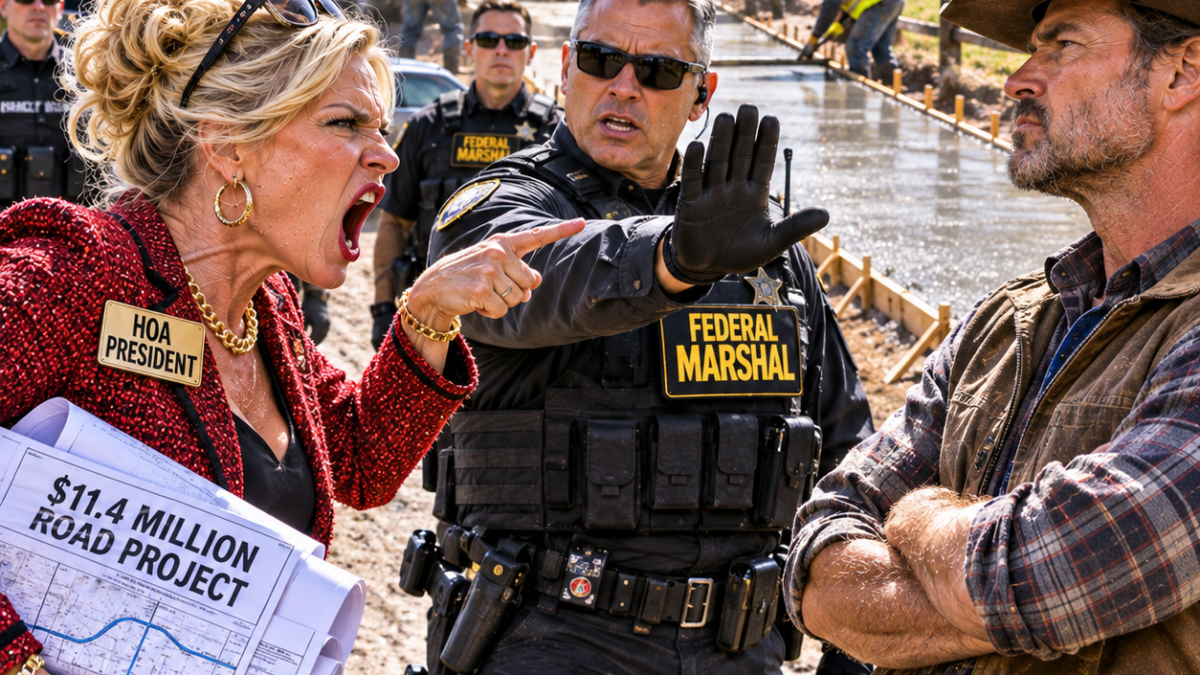
“GO AHEAD, CALL THE JUDGE—I’LL POUR THE CONCRETE BEFORE SHE GETS HERE!” HOA Karen Built an $11.4 Million Road on My Ranch—Then Federal Marshals Shut It Down
“TEAR THAT COURT NOTICE DOWN AND START POURING—THAT JUDGE DOESN’T OWN THIS LAND!” HOA president Veronica Ashford screamed at her construction supervisor at 6:12 Monday morning, standing beside a freshly broken federal court seal while three bulldozers and a line of concrete trucks prepared to bury part of my family’s 640-acre ranch beneath an $11.4 million private access road she had been expressly ordered not to build.
“BY THE TIME YOUR LAWYER GETS ANOTHER HEARING, THIS ROAD WILL BE PERMANENT!” she shouted at me less than an hour later, apparently unaware that my cameras had already recorded her reading the judge’s injunction, tearing down the posting herself, and ordering the machines forward while her own construction manager warned her—twice—that what she was doing could cost everyone on that site their careers.
But when United States Marshals arrived that morning, the bulldozers went silent, Veronica’s own attorney contradicted her in front of the officers, and a hidden $420,000 withdrawal from the HOA’s reserve account surfaced in court, the woman who had spent seven years treating other people’s property like an obstacle to her ambitions finally discovered that concrete does not become legal simply because it hardens before a judge can stop it.
My name is Grant Hollister.
The first time Veronica Ashford threatened me, she was standing nearly two hundred feet inside my property line.
I remember that detail because she kept insisting she wasn’t.
She stood on the edge of a freshly graded strip of earth, holding a rolled-up engineering plan, wearing cream-colored slacks and sunglasses that probably cost more than my work boots.
Behind her, a yellow excavator rested on a section of land where my grandfather had once grazed cattle.
A dozen bright orange stakes ran through the grass.
Beyond them, somebody had installed a sign large enough to be read from the county highway.
STONEBRIDGE CREST EAST ACCESS EXPANSION
PROJECT VALUE: $11,400,000
I stopped my truck.
Read the sign twice.
Then looked at the earthmoving equipment.
At the stakes.
At the temporary construction fence.
At the stretch of pasture I had maintained for almost twenty years.
And for several seconds, I couldn’t figure out what I was seeing.
Because none of that land belonged to Stonebridge Crest.
It belonged to me.
All 640 acres.
Pasture.
Timber.
A creek that ran muddy in spring and shallow in August.
Old oak trees.
A weathered barn.
And a half-mile stretch of fence my grandfather had repaired so many times that three generations of wire were twisted through the posts.
I was fifty-one years old.
I had spent most of my career managing infrastructure projects for a regional utility company.
I understood grading.
Road construction.
Permitting.
Drainage.
Survey stakes.
Easements.
And, most importantly, the difference between a contractor being allowed to build something and a contractor merely being paid to build it.
That distinction was about to become the most expensive lesson Stonebridge Crest had ever learned.
Veronica didn’t seem concerned when I approached.
In fact, she smiled like a woman greeting someone who had arrived late to a meeting she believed she already controlled.
“Mr. Hollister.”
“Morning.”
“We’ve been meaning to speak with you.”
I looked at the machinery.
“About what?”
“Our East Access project.”
“On my land?”
She gave a little laugh.
“I think there’s been some confusion about the boundary.”
I stared at her.
“Whose confusion?”
She unrolled her map across the hood of a black SUV.
Several colored lines covered the page.
Planned road.
Drainage.
Retaining wall.
Security checkpoint.
Connection to the highway.
A complete two-lane access system.
Right across my pasture.
Veronica pointed toward a line drawn farther west.
“This is your actual boundary.”
I leaned closer.
“According to whom?”
“Our engineering team.”
“Licensed survey?”
“Of course.”
“Can I see it?”
She tapped the map.
“It’s right here.”
“No.”
I looked at her.
“I mean the certified boundary survey.”
Her smile tightened.
“Grant, our engineers are professionals.”
“So am I.”
“This project has been through planning.”
“Then it should be easy to show me the document.”
She folded the map.
The conversation was already over in her mind.
“Construction is proceeding on schedule.”
I looked at the excavator.
Then the oak trees beyond it.
“Not until you prove you’re on your side.”
She smiled again.
Cold this time.
“I’m afraid that isn’t your decision.”
I remember the exact feeling that came over me.
Not anger.
Not yet.
Something quieter.
The unmistakable recognition that the person standing in front of me wasn’t confused.
She simply believed she could get away with it.
And that belief was about to cost Stonebridge Crest a fortune.
My grandfather, Thomas Hollister, bought the land when the county highway was still a narrow two-lane road with more cattle trailers than luxury SUVs.
He raised Herefords.
My father planted the pines along the eastern ridge.
And I spent most of my twenties trying to leave.
That is the truth.
When you’re young, six hundred and forty acres can feel less like freedom and more like a place you’re expected to spend your life maintaining.
I went to college.
Studied civil engineering.
Then moved into infrastructure management.
For years, I came back mostly on weekends.
Helped Dad repair fences.
Checked the creek crossing.
Argued with him about drainage systems he refused to replace because they had “worked fine for thirty years.”
He always said:
“You’ll appreciate this place when everything around you starts changing.”
I didn’t believe him.
Not until it did.
Stonebridge Crest arrived as a small gated development near the southeast boundary.
At first, I barely noticed.
Then came more houses.
Bigger ones.
A clubhouse.
A stone monument at the entrance.
Decorative iron fencing.
Golf carts.
A landscape company that apparently considered fallen leaves a personal insult.
The original development was lawful.
It stayed on its own land.
I didn’t care what the residents did behind their gates.
Some were good neighbors.
A retired schoolteacher occasionally walked the public road near my property.
An older couple brought me homemade cookies one Christmas after I helped pull their SUV out of a drainage ditch.
Most people were decent.
And the ones who weren’t were easy enough to avoid.
Then Veronica Ashford became HOA president.
People told me she was efficient.
Aggressive.
A woman who got things done.
She had spent years in luxury residential development before becoming the board’s president.
She ran community meetings like corporate briefings.
Issued violations for fences being two inches too tall.
Fined homeowners over paint colors.
Threatened liens for landscaping disputes.
She had a favorite phrase.
“Community interests come first.”
It sounded admirable.
Until you learned that Veronica always decided what the community’s interests were.
I didn’t pay much attention.
My ranch had never joined Stonebridge Crest.
Never signed its covenants.
Never agreed to its rules.
I was outside her jurisdiction in every ordinary sense.
At least I thought that would be enough.
Then the orange stakes appeared.
And Veronica decided my land was part of her future.
I drove straight from the construction site to the county office.
Russell Fenwick had worked as the county surveyor for decades.
Gray beard.
Thick glasses.
A man who treated old plats like family photographs.
He looked up when I entered.
“Grant.”
“Got a problem.”
“Water?”
“Land.”
He sighed.
“Worse.”
I showed him the photographs.
He studied the stakes.
The road alignment.
The construction sign.
Then opened the original recorded plat.
He checked it against the parcel records.
Pulled another map.
Then a third.
His expression changed.
“Who told them this was their land?”
“Veronica Ashford.”
Russell leaned back.
“Well.”
“What?”
“She needs a better survey.”
He enlarged the boundary.
Measured.
Compared.
Then turned the monitor toward me.
The road wasn’t brushing against my property line.
It crossed well inside it.
At one point, the proposed road and associated grading extended more than sixty-three feet beyond the actual boundary.
Some survey stakes had been placed almost two hundred feet inside my property, depending on which part of the wider construction corridor we measured.
I stared.
“That’s not a minor error.”
“No.”
“Could they honestly believe this is theirs?”
Russell took off his glasses.
“Maybe somebody made a mistake.”
He looked at the expansion plan.
“But if I were building an eleven-million-dollar road, I’d make very sure the property rights were correct before moving equipment.”
I looked at the red line running across my land.
“Why this route?”
Russell zoomed out.
I understood immediately.
Stonebridge Crest needed a second access road connecting its eastern expansion to the county highway.
The logical route over land they already controlled would require a much longer road.
Additional grading.
A new bridge.
More complicated drainage.
Nearly two extra miles.
Potentially more than eight million dollars in additional cost.
My land offered a shortcut.
A very expensive shortcut.
Unless somebody could convince themselves it belonged to the HOA.
I left with certified copies of the records and a promise from Russell to conduct a formal field verification.
I still thought the problem might be corrected with one letter.
That was before I learned how much Veronica had riding on the project.
And how little she cared about what happened to the man who owned the land beneath her bulldozers.
PART2
That afternoon, I sent Stonebridge Crest a written demand to stop all construction beyond my property boundary.
I included the recorded plat, county parcel references, photographs of the equipment, and Russell’s preliminary findings.
I asked for their certified survey.
I asked for any recorded easement they claimed.
And I requested a meeting with their engineer before any further work occurred.
I thought those were reasonable requests.
Veronica apparently considered them an insult.
Two days later, a letter arrived by certified mail.
The heading read:
NOTICE OF INTERFERENCE WITH COMMUNITY INFRASTRUCTURE
I actually laughed when I saw it.
It accused me of obstructing a lawful development.
Threatened legal action if I interfered with contractors.
Warned that my conduct could cause financial harm to Stonebridge Crest homeowners.
And demanded that I stop approaching the construction site.
My construction site.
On my land.
I read it twice.
Then called Veronica.
She answered on the fourth ring.
“Grant.”
“We need to discuss the survey.”
“Our engineers are satisfied.”
“I’d like to walk the boundary together.”
“That isn’t necessary.”
“With Russell Fenwick present.”
“Absolutely not.”
I sat at the kitchen table.
“Why?”
“Because delay costs the community money.”
“Veronica.”
“Yes?”
“You’re building on my property.”
She sighed.
Like I was a child who had been told the same thing too many times.
“Your interpretation of the property line is outdated.”
“Then show me the recorded instrument you’re relying on.”
“You’re becoming difficult.”
I looked at my grandfather’s photograph on the wall.
His hand rested on the shoulder of a young calf.
He looked about twenty-five.
“I’m trying to resolve this before someone gets hurt or spends money unnecessarily.”
“Grant.”
Her voice became colder.
“Stonebridge Crest doesn’t have time to indulge every neighboring landowner who dislikes progress.”
That was when I stopped treating the dispute as a misunderstanding.
I called Reed Vaughn.
Reed had been a property and land-use attorney for almost twenty years.
He spoke slowly.
Wrote everything down.
And had the kind of calm that made angry people feel either safer or more furious.
I liked him immediately.
His office sat above a hardware store downtown.
He invited me in.
I placed the documents on his desk.
He read.
Measured.
Compared.
Then looked at me.
“How much have they built?”
“Clearing and preliminary grading.”
“Any concrete?”
“Not yet.”
“Good.”
I frowned.
“Why good?”
“Because removing dirt is easier than removing a finished road.”
He looked through the photographs.
“How far inside?”
“Up to roughly two hundred feet for portions of the marked work area.”
“Main road alignment?”
“More than sixty-three feet in places.”
He nodded.
“Recorded easement?”
“None I’ve found.”
“Permission from you?”
“No.”
“Written demand to stop?”
“Yes.”
“Response?”
I handed him Veronica’s letter.
He read it.
Then, for the first time, he smiled.
Not happily.
Professionally.
“She put that in writing?”
“Yes.”
“Excellent.”
I stared.
“How is a threat excellent?”
“Because now we can show what they claimed after receiving notice.”
Reed opened a notebook.
“Grant, what do you want?”
“Every machine off my property.”
“Money?”
“I don’t want to sell.”
“I didn’t ask if you wanted to sell.”
He leaned forward.
“What remedy matters most?”
I answered immediately.
“My land back.”
“Exactly as it was.”
“No road.”
“No retaining wall.”
“No checkpoint.”
“No easement.”
“And a written order that prevents them from trying again.”
Reed nodded.
“Then we prepare for an injunction.”
“How long?”
“That depends on the court, the evidence, and the procedural basis.”
He looked at the photographs again.
“But we’re going to move quickly.”
I leaned back.
“I don’t enjoy lawsuits.”
“Good.”
“Why?”
“People who enjoy them usually don’t understand their cost.”
Then he added:
“Now stop calling Veronica yourself.”
“Why?”
“Because she’s already told you she won’t listen.”
“From this point forward, she talks to me.”
That turned out to be one of the smartest decisions I made.
For three days, Reed assembled the case.
The original deed.
Recorded plat.
Russell’s survey.
A complete chronology.
My emails.
Veronica’s letter.
Photographs.
Construction notices.
Permit documents.
A declaration explaining ownership, boundaries, and the ongoing work.
He also investigated the companies attached to the project.
The construction manager was Travis Bellamy.
Nearly thirty years of experience.
A practical man with a reputation for completing difficult jobs without cutting corners.
His firm had accepted a major contract from Stonebridge Crest.
The planned road, drainage system, retaining wall, and checkpoint represented an $11.4 million project.
That figure wasn’t a fantasy number Veronica shouted to intimidate me.
It appeared in the actual paperwork.
The project involved multiple contractors, suppliers, financing arrangements, and phases.
A costly operation.
On a piece of land nobody from the HOA had legally obtained.
Reed found something else.
An easement document the HOA had referenced in preliminary communications.
Dated 1989.
He requested a copy.
It looked impressive.
Official stamp.
Legal description.
Recorded number.
Everything.
Then Russell checked the parcel.
The document covered another property.
Nearly half a mile away.
Not mine.
Not even close.
I called Reed when he told me.
“They’re using someone else’s easement?”
“That’s what the document appears to be.”
“Could it be a mistake?”
“Maybe.”
“But they had plenty of opportunities to verify it.”
I looked out toward the eastern fence.
The excavator was still working.
“Then stop them.”
Reed answered:
“That’s what we’re asking the court to do.”
The case proceeded before Judge Lenore Whitcomb in federal court under the jurisdictional circumstances presented in the filings.
She had a reputation.
Strict.
Precise.
No patience for attorneys who substituted rhetoric for documents.
Reed warned me beforehand.
“Answer only what you’re asked.”
“Don’t argue with Veronica.”
“Don’t roll your eyes.”
I frowned.
“I don’t roll my eyes.”
Reed stared.
“Grant.”
“Fine.”
“Do not roll your eyes.”
The hearing room was smaller than I expected.
Wood paneling.
Flag.
Court seal.
An atmosphere that made everybody lower their voices automatically.
Veronica entered in a navy suit.
Perfect hair.
Pearl earrings.
Confident smile.
She looked like she was attending a ribbon-cutting ceremony.
Her attorney, Paige Wexler, carried two large binders.
Paige was experienced.
Careful.
Not the sort of lawyer who enjoyed theatrics.
That would matter later.
Judge Whitcomb entered.
Everyone stood.
Then the hearing began.
Veronica accused me of attempting to hold the community hostage.
“Mr. Hollister is exploiting a technical boundary disagreement to extract money from hundreds of families.”
I stared straight ahead.
Reed rose.
“Your Honor, my client has made no demand for payment.”
“He has requested that construction stop on land he owns.”
The judge looked at Veronica’s attorney.
“Produce the recorded basis for your claimed access.”
Paige presented the 1989 easement.
Russell took the stand.
He reviewed the document.
Then said:
“That is not Mr. Hollister’s parcel.”
The judge leaned forward.
“Explain.”
Russell identified the legal description.
The parcel references.
The location.
Then compared them to my deed.
“The easement benefits an unrelated tract nearly half a mile away.”
Paige checked her notes.
Veronica turned toward her.
Then toward Russell.
I watched the confidence leave her face for the first time.
Not completely.
Just enough.
Reed asked:
“Mr. Fenwick, where is the HOA’s road actually being constructed?”
Russell pointed to the certified survey.
“Inside Mr. Hollister’s recorded boundaries.”
“How far?”
He explained the work corridor and road encroachment.
Then:
“There is no recorded easement in the materials I reviewed granting Stonebridge Crest the right to construct this road on the Hollister parcel.”
The judge looked toward Paige.
“Do you have another instrument?”
Paige paused.
“No additional recorded easement at this time, Your Honor.”
Silence.
Veronica’s hands tightened.
Judge Whitcomb reviewed the photographs.
The stakes.
The excavators.
The written objections.
Then she issued a preliminary injunction.
Construction on the disputed part of my land was to stop immediately.
No excavation.
No grading.
No deliveries.
No concrete work.
No removal or alteration of boundary evidence.
No interference with the court’s posted notice.
She looked directly at Veronica.
“Mrs. Ashford.”
“Yes, Your Honor?”
“Do you understand this order?”
“Perfectly.”
“Then make sure your contractors do too.”
Veronica smiled thinly.
“Of course.”
The judge’s expression did not change.
“This is a court order.”
“Not a suggestion.”
“I understand.”
I believed her.
That was my mistake.
She understood perfectly.
She simply intended to violate it.
Outside the courtroom, Veronica leaned toward Travis Bellamy.
I was several steps away.
Close enough to hear.
She said:
“We only need forty-eight hours.”
Travis looked at her.
Didn’t answer.
Just lowered his eyes toward the folder in his hands.
I didn’t like that exchange.
On the drive home, I told Reed.
He didn’t dismiss it.
“Check your cameras.”
“I already do.”
“More often.”
“Why?”
“Because people who believe deadlines matter more than courts sometimes make dangerous decisions.”
I looked through the windshield.
The sky was clear.
The hills beyond town looked peaceful.
“You think she’ll ignore the order?”
“I think we should be prepared if she does.”
A Deputy United States Marshal accompanied the formal posting and enforcement arrangements at the site.
The disputed construction corridor was marked.
The official court notice went up at the entrance.
The machinery stopped.
For the first time in weeks, I heard birds where engines had been.
I drove to the fence.
Looked at the posted notice.
The court’s authority printed clearly.
Then at the silent machines.
I felt something close to relief.
I called my younger sister, Rachel.
She lived in Colorado.
We talked weekly.
Usually about family.
Rarely about legal problems.
“It’s stopped.”
She exhaled.
“Finally.”
“For now.”
“What does that mean?”
“Reed says to stay alert.”
Rachel was quiet.
Then:
“Grant, are you safe?”
I looked at the excavators.
“I’m fine.”
“That’s not what I asked.”
I sighed.
“Yes.”
She paused.
“Dad would be furious.”
I almost laughed.
“Dad would have parked his tractor across the road.”
“And gotten arrested.”
“Probably.”
Then Rachel said:
“You’re doing this right.”
I wanted to believe her.
The next two nights, I barely slept.
At 11:47 one evening, my camera captured a Stonebridge Crest SUV creeping past the posted injunction.
Slow.
Headlights sweeping the fence.
Then disappearing.
Forty minutes later, it returned.
Then again.
Three passes.
Same vehicle.
Same speed.
Like someone checking whether the camera was active.
Or whether anyone was watching.
I saved the video.
Sent it to Reed.
He answered:
Preserve original. Do not confront anyone.
I stared at the message.
Then went outside.
The night air smelled of wet earth.
I stood near the porch.
Listened.
No engines.
No voices.
Nothing.
But I knew the quiet wasn’t the same as peace.
It was waiting.
And somewhere inside Stonebridge Crest, Veronica Ashford was running out of time.
I didn’t know about the financing deadline yet.
That came later.
The project had a milestone tied to its construction loan.
A completion threshold.
If the eastern access road failed to reach a specified stage by the end of the week, favorable financing terms could be withdrawn or renegotiated.
The consequences were enormous.
Delays.
Penalties.
Additional interest.
Potential need for new funding.
The board had not been fully briefed on the severity of the condition.
Veronica had apparently assured people the work was proceeding smoothly.
She had built her reputation on finishing projects ahead of schedule.
And now her defining project was under a court injunction because she had tried to build it on land she didn’t own.
Instead of explaining the problem honestly, she decided the judge was the obstacle.
Not the nonexistent easement.
Not the wrong parcel.
Not the construction plans.
The judge.
That belief would destroy her.
Monday morning.
5:54.
My phone vibrated on the nightstand.
Motion alert.
I opened one eye.
Looked at the screen.
Then sat upright.
Headlights.
Concrete trucks.
An excavator.
Bulldozers.
Workers in reflective vests.
Equipment moving into position on my property.
My heart slammed against my ribs.
I opened the second camera.
Veronica stood at the construction entrance.
Cream jacket.
Dark pants.
Phone in one hand.
Travis Bellamy stood beside her.
He was pointing at the posted court notice.
I turned the audio up.
“Veronica.”
His voice was clear.
“We cannot touch that.”
She looked at him.
“Why?”
“Because it came from a federal judge.”
“It’s a piece of paper.”
“It’s a court order.”
“We’re already behind schedule.”
“That doesn’t change the order.”
Veronica stared at the notice.
Then at the machines.
“Is anyone here enforcing it?”
Travis said:
“That isn’t how this works.”
She smiled.
“Then we’re proceeding.”
I watched her step toward the posting.
Read it.
Actually read it.
Then reach up.
Grab the edge.
Pull.
The paper tore.
She pulled again.
The attached seal and posting were damaged as she tore the notice down.
The camera timestamp read:
6:12:18 A.M.
Veronica tossed the torn posting aside.
Turned toward the crews.
And shouted:
“START THE MACHINES.”
I sat frozen.
For several seconds, I couldn’t believe what I had just watched.
Then the bulldozers moved.
I was out of bed before the video finished.
I reached for my boots.
Pulled them on.
Then stopped.
My first instinct was to drive straight down there.
Stand in front of the machines.
Demand they stop.
I had spent months protecting the land.
Now I was watching someone deliberately destroy it in real time.
Anger burned through me.
My hands shook.
I picked up my phone.
Called Reed.
He answered immediately.
“Grant.”
“She’s doing it.”
“Who?”
“Veronica.”
“The road.”
“Machines are moving.”
“Concrete trucks.”
“She tore down the court notice.”
Silence.
Then Reed’s voice became very steady.
“Do not enter the site.”
“She has bulldozers on my land.”
“I understand.”
“Do not confront the crew.”
“She just—”
“Grant.”
His voice sharpened.
“Listen.”
I stopped.
“Save the footage.”
“Keep your camera recording.”
“Do not touch the equipment.”
“I am contacting the court.”
I stared at the screen.
Workers moving.
Dust rising.
Veronica pointing.
“What if they pour concrete before anyone gets here?”
Reed answered:
“Then they will have poured concrete in violation of an injunction.”
I was breathing hard.
“Grant.”
“Yes?”
“Do not give her the confrontation she wants.”
I closed my eyes.
Then:
“Okay.”
“I’m sending an investigator with aerial-camera equipment.”
“Document everything from a lawful position.”
“Stay clear of the work.”
I ended the call.
Then drove to the far edge of my property where I could see the construction corridor without entering the active work area.
The morning sky was gray.
A bulldozer was stripping soil.
Workers directed trucks.
An excavator swung its bucket over ground that had been pasture three months earlier.
I stood beside my truck.
Filmed.
Every minute.
Every machine.
Every load.
Every movement.
Then Veronica saw me.
She crossed toward the fence.
Smiling.
Of course she was smiling.
“Good morning, Grant.”
I kept the camera steady.
“Veronica.”
“You’re up early.”
“So are your bulldozers.”
She laughed.
“We have a schedule.”
“You have a court order.”
She glanced toward the torn posting lying near the temporary barrier.
Then back at me.
“Paperwork.”
I stared.
“What?”
“That’s all this is.”
“A temporary procedural obstacle.”
“A federal judge ordered you to stop.”
She waved one hand.
“Judges don’t build roads.”
“No.”
I looked at the concrete trucks.
“They order people not to build them on other people’s land.”
Her smile vanished.
“By tonight, this road will be permanent.”
“You seem very confident.”
“We’ve already invested too much to stop.”
I stared.
Then asked:
“Does your attorney know you’re doing this?”
“She knows what she needs to know.”
“Did she authorize it?”
Veronica stepped closer.
“Grant, you’re not going to intimidate me with legal terminology.”
I almost laughed.
“I’m asking whether your lawyer told you to ignore a judge.”
She pointed toward the machines.
“Look around.”
“Do you honestly think a court will order us to tear all this out after it’s finished?”
I looked at her.
“That seems like a dangerous bet.”
Her eyes narrowed.
“Then sue me again.”
I lowered my phone slightly.
“Veronica.”
“What?”
“I don’t think that’s how injunctions work.”
She laughed.
Then turned toward the crew.
“KEEP MOVING.”
And walked away.
I stood there watching her go.
My grandfather used to say the most dangerous people were not always the ones who didn’t know the rules.
Sometimes they knew perfectly well.
They simply believed rules were for everyone else.
Veronica had just given me a perfect demonstration.
At 6:48, Paige Wexler called Veronica.
I learned the details later.
Paige had received an emergency message from Reed.
Copies of the footage.
The damaged posting.
The machines operating.
She called immediately.
“Veronica.”
“What?”
“Stop construction.”
“We’re already moving.”
“Stop it now.”
“Paige, I don’t have time.”
“You’re violating an active federal injunction.”
“It’s only temporary.”
“That means it is currently binding.”
Veronica reportedly sighed.
“You’re overreacting.”
Paige asked:
“Did you personally remove the posted notice?”
“No.”
A lie.
Clear.
Direct.
And preserved by the same camera that showed Veronica doing exactly that.
Paige warned her again.
“Do not touch the court posting.”
“Do not pour concrete.”
“Stop the equipment.”
Veronica ended the call.
Then instructed Travis to continue.
At 7:03, the first concrete entered the forms.
Gray.
Wet.
Heavy.
Spreading across land that had never been sold to Stonebridge Crest.
I watched from the fence line.
Every instinct in my body screamed to intervene.
I didn’t.
I kept filming.
Because I knew something Veronica didn’t.
The injunction was still in force.
And every additional yard of concrete was another act she would have to explain.
By seven-thirty, Reed had assembled the emergency submission.
Camera footage.
Timestamped photographs.
Witness statements.
The posted order.
Evidence of continuing construction.
He contacted the court through proper emergency procedures.
The subject line on the submission was unmistakable.
VERIFIED VIOLATION OF ACTIVE INJUNCTION — CONSTRUCTION OCCURRING NOW
Judge Lenore Whitcomb reviewed the footage.
Then had her clerk attempt to contact the parties.
Paige answered.
Reed answered.
Veronica did not.
Three attempts.
Nothing.
The judge scheduled an emergency show-cause hearing.
She also initiated immediate enforcement through the United States Marshals Service under a signed order.
Veronica didn’t know any of that.
She was too busy trying to turn wet concrete into a legal defense.
At the construction site, Travis Bellamy was reaching his limit.
He had spent almost thirty years managing crews.
He understood scheduling pressure.
Change orders.
Cost overruns.
Contract penalties.
Owners who demanded impossible deadlines.
He had seen all of it.
But he had never agreed to violate a federal court injunction just because a client was afraid of losing financing.
He walked to Veronica.
“We need to stop.”
She didn’t look at him.
“Keep the trucks moving.”
“I’m not doing that.”
Now she turned.
“Excuse me?”
“My company is not continuing this work.”
“You signed a contract.”
“I signed a construction contract.”
“Not a promise to ignore a judge.”
Her face hardened.
“Do you know what this delay is costing us?”
“Yes.”
“Do you know what your company could lose?”
Travis stared.
“Do you know what my company could lose if we keep going?”
Veronica pointed toward the machines.
“You work for Stonebridge Crest.”
Travis replied:
“I don’t work for your personal decisions.”
For a moment, both stood still.
Then Veronica said:
“Get your people moving.”
“No.”
Her voice rose.
“I can terminate your contract.”
“Then do it.”
Silence.
Travis turned toward the crew.
“SHUT IT DOWN.”
One by one, machines slowed.
Operators looked toward him.
Engines dropped.
A concrete truck stopped.
Veronica looked furious.
“TRAVIS!”
He didn’t turn.
“Everybody off the equipment.”
I watched from the fence.
And for one brief moment, I thought reason had finally arrived.
Then Veronica pulled out her phone.
Called another subcontractor.
And ordered a replacement crew.
The woman had received a federal injunction.
A warning from her own lawyer.
A refusal from her construction manager.
And still believed the solution was to hire different people willing to move faster.
That was when I realized she was no longer thinking about winning a property dispute.
She was trying to outrun consequences.
At 8:14, Veronica received the emergency hearing notice.
The court wanted her there at 1:30 that afternoon.
The notice made clear that she would have to explain why she should not be held in contempt.
She read it.
Then folded it.
And told the replacement crew:
“We have until lunch.”
I watched a new truck pull up.
Different company logo.
Workers stepping out.
Some looked confused.
Some apparently hadn’t been told why the first contractor left.
One asked where the posted permit was.
Veronica pointed toward the job trailer.
“Everything is approved.”
I could hear enough through the camera system to understand.
Everything is approved.
Same old story.
Confidence first.
Paperwork later.
Except this time, the paperwork was a judge’s order prohibiting the work.
And Veronica was treating the clock like an enemy.
At 9:02, the second crew began preparing equipment.
Reed called me.
“Grant.”
“Yeah?”
“She’s still going.”
“I see it.”
“Do not interfere.”
“I know.”
“The judge knows.”
I looked toward the concrete.
“How long?”
“I can’t promise a minute.”
“Understood.”
Then Reed said:
“There’s something else.”
“What?”
“Stonebridge Crest’s attorney is on her way to the site.”
I almost laughed.
“Good.”
“Maybe Veronica will listen to her.”
Reed paused.
“I’m not optimistic.”
Neither was I.
Paige arrived shortly after nine.
Her black sedan stopped near the trailer.
She stepped out carrying a folder.
Walked directly to Veronica.
I couldn’t hear the first words.
Then Paige raised her voice.
“STOP THE MACHINES.”
Veronica stared.
“Paige, you’re making a spectacle.”
“I’m trying to keep you from making this worse.”
“We’re almost finished with the first section.”
“That is irrelevant.”
“You’re supposed to protect the association.”
“I am.”
“Then stop helping Hollister.”
Paige’s face changed.
“Veronica.”
She spoke slowly.
“I represent the association.”
“Not your decision to violate a court order.”
Veronica laughed.
“Then tell the judge I’ll explain later.”
Paige stared.
“That’s not how this works.”
“Everything can be explained.”
“Then you’re going to explain why you ignored my written instructions.”
I could see Veronica’s jaw tighten.
“Don’t threaten me.”
“I’m warning you.”
Paige looked toward the replacement crew.
“If you’re working on the disputed corridor, stop.”
Veronica stepped between her and the workers.
“You are not the project manager.”
“No.”
Paige replied.
“I’m the attorney telling you that your client is violating a federal injunction.”
The workers exchanged glances.
One operator shut his machine off.
Another stepped down.
The site was beginning to fracture.
Veronica could still have stopped.
She could have accepted the damage already done.
Appeared before the judge.
Explained.
Taken responsibility.
Instead, she ordered the remaining crew to continue.
That was the decision that made everything else unavoidable.
At 9:38, Stonebridge Crest treasurer Brooke Danner checked the reserve account.
Brooke was not a dramatic woman.
She had worked in accounting for nearly twenty-five years.
Served as HOA treasurer for six.
She liked reconciled statements.
Timely invoices.
Receipts.
She despised surprises.
When the banking portal showed a $420,000 withdrawal from the reserve account, she stared at the screen.
Then refreshed it.
Same number.
Four hundred twenty thousand dollars.
Transferred to the construction contractor under emergency infrastructure authority.
Brooke opened the supporting memo.
ACCELERATED COMPLETION PAYMENT — EAST ACCESS
Her stomach dropped.
The board had not approved that expenditure in the usual way.
Not as a separate accelerated payment.
Not with a complete explanation.
She called Veronica.
“Veronica.”
“Yes?”
“Why was four hundred twenty thousand dollars taken from reserves?”
“Construction.”
“I can see that.”
“Then why are you calling?”
“Because I don’t have a board authorization matching this transfer.”
“It’s emergency infrastructure protection.”
“What emergency?”
“Brooke, I do not have time for this.”
Brooke looked at the screen.
“This is nearly half a million dollars.”
“Do not ask questions you don’t understand.”
Then Veronica hung up.
Brooke sat still.
She had known Veronica for years.
Considered her difficult.
Controlling.
Sometimes rude.
But she had believed Veronica understood financial responsibility.
Now a huge payment had been made under vague emergency authority while the project was under a court injunction.
Brooke opened the original invoice.
The contractor had described the payment as an accelerated completion bonus.
Not emergency infrastructure protection.
Different purpose.
Different description.
Same money.
Brooke printed the records.
Then printed the emails.
Then saved copies outside the regular HOA office system through appropriate secure channels.
She wasn’t yet sure what had happened.
She only knew she did not want anyone altering the records before she understood it.
That decision would help expose the financing motive.
And it would finally break Veronica’s control of the board.
At 10:36, dark vehicles appeared on the access road.
No sirens.
No flashing emergency lights.
Just a line of government vehicles traveling steadily toward the site.
I saw them before Veronica did.
One.
Then another.
Then a third.
They stopped near the barrier.
Doors opened.
A man stepped out wearing a jacket marked:
UNITED STATES MARSHAL
Deputy U.S. Marshal Everett Sloan.
Eighteen years of enforcing federal court orders.
He didn’t look angry.
He looked prepared.
Several deputies moved with him.
Professional.
Quiet.
Precise.
Veronica spotted the jackets.
Her expression changed.
Then she straightened.
Smiled.
And walked toward them like she was about to explain a parking violation.
I watched from beyond the restricted area.
Everett met her near the temporary fence.
“Mrs. Ashford?”
“Yes.”
“Deputy United States Marshal Everett Sloan.”
He handed her a document.
“Federal court enforcement order.”
“All construction activity on this disputed property stops immediately.”
Veronica looked at the document.
Then at him.
“You don’t have authority over our private contractors.”
Everett pointed to the signature.
“The court does.”
She laughed nervously.
“I’m afraid you’ve been misinformed.”
“No, ma’am.”
“This project is privately financed.”
“Understood.”
“And we have permits.”
“That does not authorize violating the court’s injunction.”
Veronica stared.
“This is an HOA development.”
Everett nodded.
“That is not a defense.”
He turned toward the site supervisor.
“Power down the equipment.”
“Everybody step away safely.”
The engines began stopping.
One by one.
The sound was extraordinary.
For months, my eastern pasture had been filled with diesel engines.
Excavators.
Trucks.
Metal.
Grinding.
Hydraulic systems.
Now the machines fell silent.
And nobody shouted over them.
Not even Veronica.
At least not at first.
Then she stepped forward.
“YOU CANNOT SHUT DOWN AN ELEVEN-MILLION-DOLLAR PROJECT.”
Everett looked at her.
“Ma’am.”
His voice remained calm.
“We are enforcing a signed court order.”
“You should take your objections to the court.”
Veronica turned toward me.
I was still outside the perimeter.
“HOLLISTER!”
I didn’t move.
“YOU DID THIS!”
I looked at her.
“No.”
She froze.
I continued:
“The judge ordered you to stop.”
“You chose not to.”
Everett turned slightly.
“Mr. Hollister, please remain outside the secured area.”
I nodded.
“Of course.”
And stepped back.
That was the difference.
I didn’t need to argue.
I didn’t need to stand in front of a bulldozer.
I didn’t need to threaten anybody.
The court order existed.
The marshals were enforcing it.
And Veronica’s authority had just become irrelevant.
The marshals secured the site.
Equipment stopped.
Workers moved to designated safe areas.
Vehicle identifiers recorded.
Work areas photographed.
Existing records preserved.
The job trailer documented.
The broken court posting identified.
Cameras and electronic footage secured through proper legal procedures.
Nothing theatrical.
No shouting.
No handcuffs at that moment.
No dramatic chase.
Just official enforcement carried out methodically.
Which somehow made the scene more devastating for Veronica.
She had spent years intimidating people with gestures of authority.
Now actual authority stood in front of her.
Quiet.
Unimpressed.
Unwilling to negotiate reality.
Everett approached her again.
“Mrs. Ashford.”
She folded her arms.
“Yes?”
“Did you understand the injunction was active this morning?”
“My attorney said it was outdated.”
At that exact moment, Paige came walking toward them.
She heard.
Stopped.
Then said:
“No.”
Veronica turned.
Paige looked directly at Everett.
“I absolutely did not tell her that.”
Silence.
Veronica’s face changed.
Paige opened her folder.
“I sent written instructions to stop work.”
“Repeatedly.”
“I specifically told her not to interfere with the posted notice.”
Everett looked at Veronica.
She stared at Paige.
“How could you—”
Paige interrupted.
“Because it is true.”
That was the first time I’d ever seen Veronica Ashford look genuinely alone.
Not because nobody stood beside her.
The contractors were still there.
The HOA vehicles were still there.
Her attorney was still there.
But nobody was willing to turn her choices into their own lies.
Everett checked his watch.
“Mrs. Ashford.”
“Judge Whitcomb expects you at one-thirty.”
Veronica swallowed.
Then Everett said:
“Bring your phone.”
The color drained from her face.
I called Reed.
“It’s stopped.”
“I know.”
“You watching?”
“Receiving updates.”
I looked at the secured site.
The trucks.
The marshals.
The torn posting.
The wet concrete.
“Reed.”
“Yes?”
“Thank you.”
He paused.
“We’re not done.”
I exhaled.
“I know.”
“Court at one-thirty.”
“I’ll be there.”
Then he said:
“Grant.”
“Yeah?”
“Bring the original camera files.”
“Already on the drive.”
“Good.”
I hung up.
For the first time in three months, I walked back to my truck without looking over my shoulder at an excavator.
The site was silent.
And the silence belonged to the court.
The emergency hearing began at 1:30.
Judge Whitcomb entered.
Everyone stood.
Veronica sat beside Paige.
But the distance between them was visible.
Paige had moved her papers slightly away from Veronica.
Her expression was tight.
Professional.
Controlled.
Veronica looked exhausted.
Not from work.
From spending an entire morning discovering that the people she usually controlled had begun keeping records of her decisions.
The judge opened a folder.
Then looked over her glasses.
“Mrs. Ashford.”
“Yes, Your Honor.”
“Do you understand why you’re here?”
Veronica cleared her throat.
“To explain a construction misunderstanding.”
The judge did not blink.
“A misunderstanding.”
“Yes.”
Judge Whitcomb looked down.
“Let’s review the timeline.”
She read slowly.
“Six twelve a.m.”
“The court posting was removed and damaged.”
“Six eighteen.”
“Machinery began operating on the disputed parcel.”
“Six forty-eight.”
“Counsel instructed that all work stop.”
“Seven oh-three.”
“Concrete was poured.”
“Eight fourteen.”
“You received notice of this hearing.”
“Nine oh-two.”
“Additional contractors were brought in.”
“Ten thirty-six.”
“Federal marshals arrived and enforced the order.”
The courtroom was silent.
Judge Whitcomb looked up.
“Mrs. Ashford.”
“At which point did you believe the injunction permitted construction to continue?”
Veronica shifted.
“Your Honor, our contractor told us—”
The judge held up one hand.
“Which contractor?”
“Travis Bellamy.”
Paige looked down.
Reed stood.
“Your Honor, we have the contractor’s written warnings.”
The judge nodded.
“Proceed.”
The messages appeared.
Travis to Veronica:
The injunction remains active. We cannot continue work on disputed property.
Then:
I am directing my crew to stop. Continuing would expose the company to serious consequences.
Then Veronica’s response:
Proceed under my authority. I will handle the court.
The judge looked toward her.
“Did you write that?”
Veronica swallowed.
“Yes.”
“Then Mr. Bellamy did not tell you the injunction permitted the work.”
“No.”
The judge paused.
“Your attorney?”
Veronica glanced toward Paige.
“She didn’t make the risks clear.”
Paige’s face tightened.
Reed produced the email.
Sent before construction resumed.
Paige:
STOP ALL WORK IMMEDIATELY. DO NOT REMOVE OR ALTER THE COURT POSTING. THE INJUNCTION REMAINS ACTIVE.
The judge read it.
Then looked up.
“Is this your attorney’s instruction?”
Veronica’s voice fell.
“Yes.”
“Did you follow it?”
“No.”
A murmur moved through the courtroom.
Judge Whitcomb waited until it stopped.
Then:
“Why not?”
Veronica stared.
“Because…”
Her voice changed.
“We were facing severe financial consequences.”
Reed looked at me.
There it was.
The truth beginning to crack through.
Reed entered the financing agreement.
The milestone.
The deadline.
The potential restructuring.
The cost of delay.
The judge reviewed it.
Then looked at Veronica.
“Your decision to continue was tied to the project’s financing deadline.”
Veronica hesitated.
“Community safety was also—”
The judge interrupted.
“Answer the question.”
“Yes.”
“Were you aware of the injunction?”
“Yes.”
“Did you understand the court had ordered construction stopped?”
“Yes.”
“Did you choose to continue because you believed finishing the work would place the court in a difficult position?”
Veronica looked toward Paige.
Paige did not answer for her.
Finally:
“I believed stopping would cause catastrophic financial loss.”
Judge Whitcomb leaned back.
“That was not my question.”
Silence.
Then the judge said:
“You were not confused about whether construction was prohibited.”
“You decided your financial deadline was more important than this court’s order.”
Veronica stared at the table.
For the first time, she had no polished answer.
Then the camera footage played.
Not just the portion showing the posting being torn down.
The entire sequence.
Veronica approaching.
Reading.
Travis warning her.
Her dismissive response.
Her hand reaching up.
The tear.
The damaged seal.
Her order.
START THE MACHINES.
The courtroom watched.
Nobody moved.
Then the second camera angle.
Clear.
Unmistakable.
The judge asked:
“Mrs. Ashford, did you personally remove this posting?”
Veronica swallowed.
“Yes.”
“Did you tell your attorney otherwise?”
Her voice barely carried.
“Yes.”
“Why?”
Silence.
The judge waited.
Finally:
“I panicked.”
Reed looked down at his notes.
Paige closed her eyes.
Veronica continued:
“I believed once enough work was finished, the court would consider the economic consequences.”
Judge Whitcomb stared.
“So you deliberately attempted to create those consequences by violating the order.”
Veronica did not answer.
She didn’t need to.
Russell Fenwick testified briefly.
The boundary had not moved.
The recorded plat remained.
The construction continued on my land.
No valid easement had been produced.
The 1989 document still covered another parcel.
Nothing changed the basic facts.
Then I testified.
Reed asked:
“Mr. Hollister, what did you observe Monday morning?”
I described it.
No shouting.
No adjectives I couldn’t support.
Five fifty-four.
Camera alert.
Six twelve.
Posting removed.
Six eighteen.
Equipment operating.
Seven oh-three.
Concrete.
Veronica’s statements.
The marshal arrival.
I explained what I’d recorded.
What I personally witnessed.
What remained visible on my own land.
The judge asked:
“Did you interfere with the contractors?”
“No, Your Honor.”
“Touch any equipment?”
“No.”
“Enter the restricted work zone?”
“No.”
“Why not?”
I paused.
“Because counsel told me to let the court enforce its order.”
The judge nodded.
I looked at Veronica.
She stared straight ahead.
I had wanted to scream at her all morning.
Tell her she was destroying my family’s land.
Tell her how much her arrogance had already cost.
Tell her that my grandfather’s property line wasn’t a suggestion.
But sitting in that courtroom, I realized I didn’t need to.
The evidence was speaking more clearly than anger ever could.
Then Reed said:
“Your Honor, we have additional financial records relevant to why construction continued.”
Paige looked up.
Veronica’s head turned.
Reed called Brooke Danner.
Stonebridge Crest treasurer.
She walked to the witness chair carrying a folder.
Nervous.
But steady.
She explained the reserve account.
The withdrawal.
The internal description.
Then the contractor’s invoice.
Four hundred twenty thousand dollars.
Transferred as an accelerated completion payment.
Brooke looked at the judge.
“The board did not approve that expenditure through our normal process.”
Veronica leaned toward Paige.
Whispered something.
Paige shook her head.
Brooke continued.
“The internal memo described the transfer as emergency infrastructure protection.”
“But the contractor’s invoice described it as a completion acceleration bonus.”
Judge Whitcomb asked:
“Why does that distinction matter?”
Brooke answered:
“Because board members were told the payment was necessary for emergency work.”
“We were not told it was an incentive to accelerate construction after the court ordered it stopped.”
The judge made a note.
Then Reed produced an email.
From Veronica.
Before the injunction hearing.
Once the concrete is down, Hollister won’t be able to undo it.
I looked at Veronica.
Her expression emptied.
Reed displayed a second email.
Sent the night before the original hearing.
Veronica to Travis:
Courts move slowly. Concrete doesn’t.
Judge Whitcomb read it.
Once.
Then again.
She set the page down.
The silence stretched.
I could hear the ventilation system.
A chair creaking.
Someone shifting paper.
Finally, the judge looked directly at Veronica.
“Mrs. Ashford.”
Veronica’s lips parted.
No sound.
The judge continued:
“You anticipated the possibility of an injunction.”
“You planned to accelerate construction despite that risk.”
“You then received an injunction.”
“You acknowledged understanding it.”
“You tore down the posted notice.”
“You directed continued work.”
“You ignored your own attorney.”
“You sought replacement contractors after the first manager refused.”
“And you authorized or caused the transfer of funds intended to accelerate completion.”
Veronica looked as though she might faint.
Judge Whitcomb said:
“This was not an innocent misunderstanding.”
“It was deliberate defiance of a court order.”
Nobody in the courtroom moved.
The woman who had spent seven years making others afraid of her authority now sat before an authority she could not dismiss.
And her own words had brought her there.
Reed asked the court for relief.
Not revenge.
Not a speech about Veronica’s personality.
Relief.
Stop the work.
Preserve evidence.
Protect the parcel.
Require safe restoration.
Address the damage.
Impose appropriate contempt measures.
The HOA’s counsel argued that removing construction already placed could impose severe costs on residents.
That argument wasn’t completely imaginary.
Ordinary homeowners could suffer financially because of Veronica’s decisions.
I knew that.
Some were retirees.
Families.
People who didn’t attend board meetings and assumed their HOA wasn’t committing deliberate legal violations.
I didn’t want them hurt.
But I also refused to surrender my land because their president had spent community money illegally.
Reed said:
“Your Honor, the financial hardship Stonebridge Crest now invokes was created by construction undertaken after this court had specifically prohibited it.”
He paused.
“The association should not be permitted to transform the expense of its own violation into a reason my client must accept the violation’s permanent result.”
Judge Whitcomb nodded.
She looked at me.
“Mr. Hollister, what is your primary objective?”
I stood.
“My land back.”
She waited.
I continued:
“I don’t want the road.”
“I don’t want the checkpoint.”
“I don’t want a share of the development.”
“I want the property restored.”
“And I want them to stop coming onto it.”
The judge looked at the photographs.
Then at Veronica.
Then at the documents.
She issued enforcement and restoration directions.
Construction remained stopped.
The disputed site secured.
Evidence preserved.
An independent engineer appointed to determine the proper restoration plan.
Stonebridge Crest responsible under the court’s orders for the required remediation as the case proceeded toward final determination.
Veronica subject to contempt findings, conditions, and sanctions appropriate to her conduct.
Additional financial and governance issues preserved for separate review as required.
The court did not promise the process would be easy.
It ordered that the unlawful construction not simply remain because removing it was expensive.
That was enough.
For that afternoon.
Outside court, Veronica avoided reporters.
Her face had changed.
Not the hairstyle.
Not the expensive jacket.
The certainty.
For the first time, she moved like a person unsure whether everyone around her still believed she was powerful.
A reporter called:
“Mrs. Ashford, did you knowingly violate the judge’s order?”
She kept walking.
Another:
“Why did you transfer $420,000 from HOA reserves?”
No answer.
Another:
“Are you resigning?”
She reached her car.
Opened the door.
Then saw me standing beside Reed.
For a second, our eyes met.
Her expression hardened.
I thought she might say something.
Threaten me again.
Accuse me.
Blame me for the entire community’s problems.
Instead, she looked away.
Got into the car.
And drove off.
I stood still.
Reed said:
“You okay?”
“No.”
He nodded.
“Fair.”
I looked toward the courthouse.
“Does it get easier?”
“Eventually.”
“Good.”
Then he said:
“Grant.”
“Yes?”
“Remember this.”
“What?”
“You didn’t have to become like her to stop her.”
That stayed with me.
The HOA’s emergency board meeting was worse than the courtroom for Veronica.
In court, she had to answer a judge.
At home, she had to answer the people whose money she’d spent.
Brooke opened the meeting with the reserve records.
The $420,000 transfer.
The acceleration invoice.
The financing deadline.
The legal notices.
The court order.
The video.
Every fact Veronica had minimized or hidden.
Residents filled the room.
Some stood along the walls.
Some brought printed assessment statements.
Others brought questions.
A retired man stood.
“Did you know the road was on private land?”
Veronica answered:
“There was a boundary dispute.”
He replied:
“Did we have an easement?”
She hesitated.
“Counsel was reviewing—”
“Did we have one?”
Silence.
Another homeowner stood.
“Did you authorize construction after the judge stopped it?”
“Emergency infrastructure concerns—”
“YES OR NO?”
Veronica’s face reddened.
“Please maintain decorum.”
The man stared.
“Decorum?”
“You took hundreds of thousands of dollars from reserves and got federal marshals sent to our construction site.”
“Now you want decorum?”
The room erupted.
Brooke held up a hand.
“We’re going to answer questions.”
Veronica turned toward her.
“You are undermining the board.”
Brooke looked directly at her.
“No.”
“I’m doing the job I was elected to do.”
That landed hard.
Carol, a board member who had served alongside Veronica for nearly four years, stood next.
Soft-spoken.
Usually avoided arguments.
She looked hurt more than angry.
“Veronica.”
“What?”
“Did Paige tell you to stop?”
Veronica stared.
“Carol.”
“Did she?”
Silence.
Paige sat at the far end of the table.
Carol looked toward her.
“Paige?”
Paige answered:
“Repeatedly.”
One word.
That was all.
Carol lowered her eyes.
Then asked:
“Did the board authorize the acceleration payment?”
Brooke answered:
“No.”
Veronica interrupted:
“I had emergency spending authority.”
Brooke looked at her.
“Authority is not a personal checking account.”
The room went silent.
Then applause.
Not polite.
Angry.
Relieved.
The kind people give when someone finally says aloud what everybody has been thinking.
Veronica stood.
“This entire community benefited from my leadership.”
A woman near the back called:
“You benefited from nobody questioning you.”
Another voice:
“You brought marshals to our neighborhood.”
Another:
“You spent our reserves fighting to build on land you knew wasn’t ours.”
Veronica pointed toward the crowd.
“Without me, this development would be nowhere.”
Carol said quietly:
“Maybe.”
“Perhaps that’s why we let you go too far.”
The room fell silent.
Then the vote began.
Paper ballots.
Formal procedure.
No shouting.
No performance.
Board members wrote.
Folded.
Submitted.
Counted.
Veronica watched.
Her hands rested on the table.
Perfect manicure.
No movement.
The result removed her from the presidency.
Just like that.
Seven years of control.
Gone.
She did not scream.
Not immediately.
She stared at the result.
Then at Brooke.
“You’ve all made a terrible mistake.”
Brooke looked at her.
“No.”
“We’re trying to stop making the same one.”
Brooke became interim president.
Not because she wanted the job.
She didn’t.
She said so publicly.
She accepted because somebody needed to restore order to the finances and make sure the association complied with the court.
The board commissioned an independent audit.
All major payments Veronica had personally authorized.
Emergency expenses.
Construction contracts.
Reserve transfers.
Legal fees.
Development financing.
Not every expenditure turned out to be improper.
That mattered.
A serious audit is not a machine for proving every suspicion true.
It’s a process for identifying what actually happened.
But enough was wrong that the association faced painful consequences.
Financial restructuring.
Contract renegotiation.
Restoration expenses.
Legal fees.
Expert costs.
Contempt-related consequences.
And the collapse of the assumption that the East Access project could proceed through my land.
The project Veronica had hoped would define her legacy became the reason her own community forced her out.
Weeks later, restoration crews arrived.
The sight of construction vehicles near my ranch again made my stomach tighten.
But this time the purpose was different.
A court-approved restoration plan governed the work.
Independent engineering oversight.
Defined boundaries.
Documented procedures.
The crews weren’t building a road.
They were removing one.
I stood outside the work area with Reed.
Watched the first saw cut into the concrete.
A long mechanical whine.
Dust rising.
Then a slab lifted.
Steel and stone exposed beneath.
I thought about Veronica telling me:
By tonight, the road will be permanent.
Now the concrete was being cut into manageable sections.
Loaded.
Removed.
Piece by piece.
The base material followed.
Then the unauthorized drainage structures.
Grading.
Restoration of contours.
Surface stabilization.
The work took time.
Cost money.
Required careful engineering to avoid causing even more damage.
But it happened.
The thing Veronica had believed nobody could force her to undo was being undone in front of me.
No argument.
No shouting.
Just machines removing the evidence of her ambition.
Travis Bellamy’s company helped with portions of the restoration under the approved arrangements.
That surprised me.
I asked Reed:
“Same contractor?”
“Yes.”
“Why?”
“He refused to continue violating the injunction.”
“And he understands what was installed.”
I watched Travis speaking with the independent engineer.
He looked tired.
When he saw me, he approached.
“Grant.”
“Travis.”
He removed his hard hat.
“I owe you an apology.”
I frowned.
“For what?”
“We started work without verifying the land rights the way we should have.”
I stared.
He continued:
“We relied on the client and the documents provided.”
“That was a mistake.”
I nodded.
“Yes.”
He accepted it.
Didn’t argue.
Didn’t make excuses.
Then:
“I should’ve stopped earlier.”
I thought about his refusal that Monday morning.
“You stopped when it mattered.”
He shook his head.
“Later than I should’ve.”
Maybe.
But he had eventually said no.
And that mattered too.
I extended my hand.
He shook it.
Then went back to work.
I watched him go.
Not everybody involved in the project had acted with Veronica’s arrogance.
Some had been misled.
Some had been careless.
Some had been afraid of losing contracts.
Some had stood up when the line became unmistakable.
The difference mattered.
I didn’t want a story where everybody on the other side was evil.
I wanted an accurate one.
Because accuracy was what saved my land.
The restoration dragged on through the next several weeks.
Some sections were easier.
Others needed special drainage work to avoid erosion.
The old pasture had been compacted.
Topsoil disturbed.
Natural contours altered.
An independent engineer documented progress.
Russell checked the boundary.
Reed kept records.
I took photographs.
But I no longer woke every night expecting bulldozers.
That was a victory too.
A small one.
The kind nobody makes headlines about.
One morning I stood near the eastern fence.
Coffee in hand.
Watched the restoration crew working.
No panic.
No anger.
No need to call an attorney.
They were there under a lawful plan.
Doing what had been ordered.
I realized that for the first time in months, I could think about something other than Stonebridge Crest.
The north pasture needed attention.
The barn roof had a leak.
The creek crossing needed gravel.
Ordinary problems.
My own problems.
I was almost grateful for them.
Judge Whitcomb’s final contempt ruling came after the full record was considered.
Veronica faced personal sanctions and compliance conditions tied to her deliberate defiance.
The broader financial disputes proceeded through the appropriate processes.
The site remained subject to court oversight until the required restoration was completed and verified.
Eventually, the independent engineer certified the work.
Russell reset boundary markers.
The court accepted the final compliance record.
And the marshals’ enforcement role ended.
On the day of final handoff, Everett Sloan arrived with the written confirmation.
He handed it to me near the new fence.
I looked down.
Then back.
“That’s it?”
He smiled faintly.
“That’s usually how enforcement ends.”
I looked around.
No bulldozers.
No HOA gate.
No checkpoint.
No pavement.
Just restored land.
Grass beginning to return.
The creek running beyond the slope.
Everett followed my gaze.
“Looks different.”
“It looks like mine.”
He nodded.
“That’s the idea.”
We shook hands.
He left.
No dramatic farewell.
No speech.
Just a man carrying out a court’s order and then driving away when it was done.
I built a new fence entirely inside my boundary.
Not because the old line had moved.
It hadn’t.
Because construction had damaged sections and I wanted a clean barrier.
Russell checked the posts.
Every one.
I installed a modest gate.
Nothing elaborate.
Then a small sign.
PRIVATE PROPERTY — ACCESS BY WRITTEN PERMISSION ONLY.
No mention of Veronica.
No insult.
No giant threat.
Just a statement of fact.
The day I finished, I stood beside it for a long time.
I thought about Grandpa.
He would have liked the fence.
He would have complained about the price of the new posts.
He would have told me to make the gate stronger.
Then probably asked why I didn’t save the old wire.
I smiled.
Some people never really leave a place.
Their habits remain in the work you do.
That was one reason I had refused to sell.
Not because the land was perfect.
Not because it was worth some impossible fortune.
Because it was ours.
And no one else got to decide what that meant.
Veronica drove past one final time.
I was near the fence replacing a damaged staple.
Her black SUV appeared along the public road.
Slowed.
Stopped briefly.
She looked through the window.
At the restored land.
At the absence of her road.
At the place where her security checkpoint should have stood.
At the new fence.
Then at me.
I didn’t wave.
Didn’t smile.
Didn’t say anything.
Neither did she.
For several seconds, she looked like a woman searching for something that had disappeared.
Maybe authority.
Maybe status.
Maybe the road she believed would make her famous inside Stonebridge Crest.
Then she drove away.
I went back to the fence.
One more staple.
One more post.
There was still work to do.
The financial reckoning for Stonebridge Crest lasted longer.
The association had to address the consequences of Veronica’s spending decisions.
Financing.
Contractor expenses.
Restoration.
Legal costs.
Independent audits.
Resident questions.
Some homeowners were furious.
Others embarrassed.
A few blamed me.
That didn’t surprise me.
When an organization incurs a major loss, people sometimes find it easier to blame the person who refused to surrender his rights than the leader who violated them.
One homeowner wrote me a letter.
He said:
“If you had just worked with us, none of this would have happened.”
I read it.
Then handed it to Reed.
He asked whether I wanted to respond.
I thought about it.
Then said:
“No.”
Because I had worked with them.
I asked for surveys.
Requested meetings.
Offered to walk the boundary.
Sent formal notices.
Waited for documents.
Sought lawful relief.
Complied with the injunction.
Avoided confrontation.
Submitted evidence.
Testified.
There was nothing else I owed them.
The HOA had been offered multiple chances to stop.
Veronica declined every one.
The cost belonged to her decisions and the association’s response to them.
Not my refusal to donate a road.
Then a different letter arrived.
From a Stonebridge Crest resident named Eleanor Price.
Seventy-six.
Widowed.
She wrote in careful handwriting.
Mr. Hollister,
I have lived here for eleven years. I did not know the East Access road was being built on your land. We were told the project had been properly approved. I am embarrassed that our association treated you this way. I wanted you to know not all of us agreed with what happened.
I read it twice.
She continued.
My husband was a farmer before we retired. He would have understood why you refused to let someone take your property just because it was convenient.
I sat at the kitchen table.
Then wrote back.
I thanked her.
Told her I did not blame every Stonebridge Crest resident.
And that I hoped the community would rebuild trust with better leadership.
I mailed it.
That felt better than arguing with the angry letter writer.
Some people want a fight.
Others want the truth acknowledged.
I had enough energy left for the second group.
Brooke Danner eventually called.
Not as treasurer.
As interim president.
She asked whether we could meet at the fence.
I agreed.
She arrived in an ordinary sedan.
No entourage.
No construction manager.
No glossy maps.
She stood outside the gate.
“Grant.”
“Brooke.”
“I wanted to speak without attorneys for a minute.”
I looked at her.
“Okay.”
She took a breath.
“I’m sorry.”
I said nothing.
She continued.
“Not as a legal statement.”
“Not on behalf of every resident.”
“Personally.”
“I should have asked harder questions about the financing.”
“About the survey.”
“About why we were spending so much money to solve an access problem that apparently depended on somebody else’s land.”
I studied her.
“Did Veronica tell you we owned the corridor?”
“She said it was controlled through an old easement.”
“Did you see it?”
“No.”
She looked ashamed.
“I trusted the wrong person.”
I nodded.
“That’s expensive.”
“Yes.”
Then:
“We’re changing how the association handles major projects.”
“Independent verification of property rights.”
“Board approval for large expenditures.”
“Outside review of recorded easements.”
“Better reserve controls.”
I almost smiled.
“Sounds like work.”
“It is.”
“Good.”
She looked through the fence.
At the restored ground.
Then:
“You know, Veronica always talked about community benefit.”
I said:
“I remember.”
Brooke shook her head.
“I think she forgot that a community can’t benefit by taking from somebody who isn’t part of it.”
That was exactly right.
We shook hands.
She left.
I closed the gate.
And for the first time, I felt no anger when a Stonebridge Crest board member drove away.
People sometimes ask why I didn’t sell the easement.
That question usually comes from people who have never owned working land.
They hear:
Six hundred and forty acres.
Eleven-million-dollar project.
Eight-million-dollar reroute.
And assume the answer is a price.
Maybe a large price.
Maybe a huge one.
But land isn’t always interchangeable with money.
The proposed route cut through an area I had planned to preserve as open pasture and timber.
The road would change drainage.
Traffic.
Access control.
Noise.
Security.
The character of the property.
It would convert a private working landscape into infrastructure serving a development I did not own.
And once a permanent road existed, it would shape the property’s future long after I was gone.
I had no desire to manage an HOA shortcut through my ranch.
No desire to deal with emergency vehicles, construction trucks, resident traffic, checkpoint disputes, and shared maintenance obligations.
Not even for a large check.
Stonebridge Crest’s cost problem did not automatically create a duty for me to sell.
That was what Veronica never understood.
She believed the scale of the development made her interests more important than mine.
Hundreds of homeowners.
Millions of dollars.
Loans.
Deadlines.
A major road.
One rancher.
Surely the rancher should give way.
But ownership does not work by comparing how many people would find another person’s land convenient.
If that were the rule, anyone with enough money and enough neighbors could simply annex whatever stood in the way.
That is not property law.
That is intimidation disguised as arithmetic.
One winter afternoon, I found the original injunction in my office drawer.
I had kept a copy.
The paper was slightly worn now.
I unfolded it.
Read the order.
Then thought about the morning Veronica tore down the posting.
She looked at the judge’s signature.
Read the words.
And decided they mattered only if an officer was standing beside her.
For approximately four hours, she believed she was right.
No marshals at six-twelve.
No judge at six-twenty.
No police cruiser blocking the concrete trucks.
Just paper.
Cameras.
A landowner filming from his fence.
She mistook silence for permission.
Distance for weakness.
And delay for opportunity.
Then the marshals arrived.
The machines stopped.
The papers returned.
Except now the papers were being enforced by people she couldn’t bully.
That was the whole story in one image.
A woman who believed an $11.4 million road could outrun a court order.
Standing beside bulldozers that were suddenly very, very quiet.
I never learned exactly when Veronica first decided the land was worth stealing control of.
Maybe during a planning meeting.
Maybe after an engineer showed her the cost of the legal route.
Maybe when someone pointed out the two-mile detour and the extra bridge.
Maybe when financing became tied to a deadline she had already promised the board she could meet.
Perhaps it happened gradually.
First a misleading map.
Then survey stakes.
Then excavation.
Then a threat letter.
Then a false easement claim.
Then an injunction.
Then the decision to ignore it.
People like to imagine wrongdoing begins with a dramatic moment.
A villain deciding to become a villain.
Real life is usually more ordinary.
One dishonest shortcut.
Then another.
A promise made before the facts are checked.
A lie told to avoid embarrassment.
A deadline approaching.
A leader unwilling to admit a mistake.
And eventually, the only way to preserve the original story is to keep escalating until the cost becomes impossible to hide.
Veronica had multiple off-ramps.
She could have stopped when I first objected.
When Russell verified the boundary.
When Reed demanded proof.
When the 1989 easement failed in court.
When the injunction was signed.
When Travis warned her.
When Paige called.
When the court scheduled the contempt hearing.
Even after the first concrete was poured, she could have shut down.
Instead, she kept going.
That was why the final consequences were so severe.
Not because one person made one mistake.
Because she made the same choice again and again, after every opportunity to choose differently.
The ranch slowly recovered.
Grass returned.
The disturbed soil settled.
We reseeded portions of pasture.
Drainage held during spring runoff.
The old creek did what creeks always do.
Ignored human plans and continued finding its own route through the land.
I found myself watching the restored area more than I expected.
Sometimes I worried about erosion.
Sometimes I remembered where the concrete had been.
Sometimes I simply appreciated seeing a quiet slope instead of construction machinery.
One morning, deer crossed the recovered corridor.
Three of them.
A doe and two young ones.
They paused near the new fence.
Looked toward the house.
Then moved into the trees.
I stood on the porch with coffee.
Watched until they disappeared.
No cameras.
No lawyers.
No documents.
Just animals moving over ground that had finally been returned to its intended use.
That moment mattered more than the court transcript.
Not legally.
Personally.
It reminded me what I had been fighting for.
Not to defeat Veronica.
To stop having to think about her.
On the anniversary of the first survey stakes, Rachel came to visit.
She drove from Colorado.
Brought her husband.
Stayed a week.
We rode the ranch in the old truck.
Checked fencing.
Walked the eastern line.
She looked at the restored slope.
“So that’s where the road was?”
“Yes.”
She stared.
“They really built all that?”
“Part of it.”
“And you watched them tear it out?”
“Yes.”
She shook her head.
“Unbelievable.”
I smiled.
“That was my word too.”
She looked at the fence.
“Dad would’ve loved this.”
“The fence?”
“The fact you kept the land.”
I was quiet.
Then:
“He would’ve hated the legal bills.”
Rachel laughed.
“He would’ve complained for six months.”
“Only six?”
We stood looking at the trees.
Then she said:
“I’m glad you didn’t sell.”
I looked at her.
“You’d have been okay with it?”
She considered.
“If it were your choice, sure.”
Then:
“But not because some woman thought she could bully you into it.”
I smiled.
“That was never happening.”
She looked toward the highway.
“I can see that.”
A few months later, I drove past Stonebridge Crest.
Their original entrance still stood.
Stone monument.
Landscaping.
Private security gate.
The clubhouse visible beyond.
No East Access road.
No new entrance crossing my land.
A new sign near the development advertised revised plans.
The expansion continued under a different design.
Slower.
More expensive.
Legally.
That last part mattered.
The residents still had a community.
Homes.
Roads.
Views.
Life.
The world had not ended because they were required to respect a property boundary.
It had simply become more expensive to do something correctly than Veronica had promised it would be to do it unlawfully.
That wasn’t my responsibility.
It never had been.
One day, a young engineer from the utility company where I used to work called.
He had heard about the case.
Wanted advice.
Not legal advice.
Project management.
“How do you avoid something like this?”
I almost laughed.
“Something like what?”
“Spending millions before discovering you don’t have the land rights.”
I considered.
“Verify before you mobilize.”
He laughed.
“Seriously?”
“Seriously.”
“Don’t assume a line on a planning drawing equals an easement.”
“Don’t assume the client checked.”
“Don’t assume the person with the biggest title knows the boundary.”
“Don’t make deadlines more important than authority.”
“And when somebody shows you a court order, stop.”
He laughed again.
“That last one seems obvious.”
“Apparently not to everyone.”
Then I said:
“Also, listen to the person telling you there’s a problem.”
He paused.
“What do you mean?”
“I told them for months.”
“Surveys.”
“Letters.”
“Meetings.”
“They treated disagreement like disobedience.”
“That’s how projects go bad.”
“Someone in the room thinks questioning the plan is betrayal.”
He became quiet.
Then:
“Thanks, Grant.”
“No problem.”
After the call, I thought about Travis.
He had finally refused.
Paige had warned.
Brooke had saved the records.
Russell had checked the boundaries.
Reed had prepared the case.
Everett had enforced the order.
No one person fixed the problem.
A chain of people did their jobs when it mattered.
Veronica failed because she believed her job was to win regardless of truth.
Everyone else who ultimately helped stop her understood that their job had limits.
Limits are not weakness.
They are what keep authority from becoming abuse.
The judge’s final order remains in my filing cabinet.
Not on the wall.
Not framed.
I don’t need to look at it every day.
The land itself is enough.
But I keep it.
Because one day somebody else may try to treat a boundary like a suggestion.
Maybe a developer.
Maybe a neighbor.
Maybe another association.
Maybe someone who honestly doesn’t know.
If that happens, I want the records ready.
Deed.
Survey.
Plat.
Court order.
Everything.
My father taught me to maintain equipment.
My grandfather taught me to maintain fences.
Veronica taught me to maintain evidence.
Not the lesson I wanted.
Still useful.
There was one moment after everything ended that I think about more than the others.
Not the marshals arriving.
Not the hearing.
Not Veronica being removed.
It happened during restoration.
A worker was operating a small excavator near the old road alignment.
He saw me standing outside the work zone.
Stopped.
Climbed down.
Walked over.
“Mr. Hollister?”
“Yes?”
“We’re getting close to the original grade.”
I nodded.
“Good.”
He looked toward the fence.
“Before we finish this section, do you want to check where your old drainage line was?”
I stared.
Not because the question was complicated.
Because somebody finally asked.
For months, Stonebridge Crest had behaved as though my opinions were obstacles.
My ownership was inconvenient.
My objections were threats.
My desire to keep the land undisturbed was selfish.
Now a worker operating machinery on the same ground wanted to know what I needed.
I showed him the drainage line.
He listened.
Marked it.
Checked with the engineer.
Then adjusted the work accordingly.
Simple.
Professional.
Respectful.
That was all I had wanted from the beginning.
Permission.
Verification.
A conversation.
Before anyone started moving dirt.
The expensive part had never been asking.
The expensive part was deciding they didn’t need to.
Two years later, I saw Brooke at the county fair.
She was no longer interim president.
A permanent board had been elected.
The association had stabilized financially, though it was still working through consequences of the expansion dispute.
Brooke looked tired.
But relieved.
“Grant.”
“Brooke.”
She smiled.
“Still have the ranch?”
I laughed.
“Last time I checked.”
She shook my hand.
“I wanted to tell you something.”
“What?”
“We revised our major-project rules.”
“So I heard.”
“Recorded property rights now require independent verification before contracts are approved.”
“Good.”
“No major reserve transfer without documented board authorization except narrowly defined emergencies.”
“Even better.”
“Contractors have direct authority to stop work when legal restrictions are identified.”
I smiled.
“Travis would appreciate that.”
She nodded.
Then her expression grew serious.
“I wish we’d had those rules earlier.”
I looked at her.
“You can wish.”
“Doesn’t change what happened.”
“No.”
“But it might change what happens next.”
She smiled.
Then:
“I hope nobody ever has to sue us again over a road.”
“Me too.”
We parted.
No bitterness.
No grand reconciliation.
Just two people who had learned different things from the same expensive disaster.
As for Veronica, I heard occasional updates.
She contested some proceedings.
Faced financial consequences.
Lost her leadership role.
Became a name people mentioned when discussing HOA governance mistakes.
I didn’t track every detail.
I had no interest in making her life a hobby.
There are people who win a lawsuit and spend the next ten years following their opponent’s misfortunes like a television series.
I didn’t want that.
I wanted my ranch.
And when I got it back, I wanted to return to living.
It is possible to insist on accountability without dedicating your future to revenge.
I wish more people understood that.
Reed once asked if I wanted to file an additional complaint over something Veronica said to the press.
I thought about it.
Then shook my head.
“Does it affect the land?”
“No.”
“The order?”
“No.”
“Then let her talk.”
Reed smiled.
“Growth.”
I frowned.
“Don’t start.”
He laughed.
The new fence has weathered now.
The posts are no longer bright.
The gate squeaks slightly in winter.
I should oil the hinge.
I will.
Eventually.
The eastern pasture grows grass again.
The creek crossing has survived two major storms.
The old barn still needs a new roof.
The county highway carries more traffic than when Grandpa bought the place.
And Stonebridge Crest remains on the other side of the boundary.
Exactly where it belongs.
Some evenings, I drive to the gate before sunset.
Not because I expect trouble.
Because I like the view.
From that spot, the land slopes toward the timber.
The sky turns orange behind the hills.
You can hear wind moving through dry grass.
And if you’re lucky, you see deer before they see you.
One evening I found the old orange stake I had kept from the first construction survey.
The paint had faded.
The wood was cracked.
I had thrown it into the shed after the site was cleared.
I held it.
Thought about that first afternoon.
Veronica spreading the map across her SUV.
Telling me my boundary was wrong.
Telling me the HOA had already taken care of the survey.
Telling me construction would proceed.
The confidence.
The dismissal.
The assumption that I would fold because the project was bigger than me.
Then I looked toward the restored pasture.
No road.
No checkpoint.
No retaining wall.
No concrete.
Just land.
The boundary had never moved.
Not an inch.
The only thing that changed was how many people finally acknowledged it.
Some people hear the dollar amount and think that’s the story.
Eleven-point-four million dollars.
A huge project.
A major construction plan.
A financing deadline.
Four hundred twenty thousand dollars rushed out of HOA reserves.
Federal marshals.
Contempt.
Restoration.
All dramatic.
All true within the story of what happened.
But the largest number wasn’t the most important thing.
The most important thing was a question.
Who gave you permission?
I asked Veronica that before anything else.
Before Reed.
Before the injunction.
Before the bulldozers restarted.
Before the marshals arrived.
Who gave you permission?
She had no answer.
Not a real one.
Only maps.
Budgets.
Schedules.
Titles.
Community benefit.
Construction contracts.
Emergency authority.
And finally a belief that speed could create ownership.
She built every defense around everything except the one fact that mattered.
The land belonged to someone else.
That was true before the first stake.
Before the first excavator.
Before the $11.4 million contract.
Before the court order.
Before the concrete.
And after it was removed.
The property line did not care about Veronica’s deadline.
The deed did not care about her presidency.
The court order did not care about her confidence.
And the marshals did not care how expensive the bulldozers were.
That was the lesson she never learned in time.
On the third anniversary of the injunction, I opened my filing cabinet.
Found the original copy.
Read Judge Whitcomb’s signature one last time.
Then placed it beside the deed.
A document proving what my family owned.
And a document protecting it when someone tried to pretend we didn’t.
I closed the drawer.
Went outside.
The sky was clear.
A few cows stood near the fence.
The eastern pasture stretched toward the trees.
No Stonebridge Crest construction crews.
No orange stakes.
No court posting.
No broken seal.
Just the world continuing.
I walked to the new gate.
Closed it.
Slid the chain through.
Turned the lock.
The click was small.
Ordinary.
Almost disappointing after everything.
But that was the point.
The real victory wasn’t a woman being humiliated in court.
It wasn’t a board vote.
It wasn’t marshals arriving in dark vehicles.
It wasn’t millions of dollars of unauthorized construction being cut apart and hauled away.
Those were consequences.
The victory was that I could close my own gate again without asking anybody’s permission.
And nobody would dare tell me otherwise.
Veronica Ashford once believed power meant having enough money to build faster than anyone could stop her.
Then she believed power meant having an HOA board behind her.
Then she believed the court’s order mattered only if someone was standing there to enforce it.
She was right about one thing.
Nobody stopped her when she first reached up and ripped down the federal posting.
Nobody stopped her at 6:12.
Or 6:18.
Or when the first concrete began pouring.
For a few hours, the machines kept moving.
And Veronica smiled because she thought the silence meant she had won.
But she had confused the absence of immediate consequences with the absence of authority.
By 10:36 that morning, the marshals were at her construction site.
The engines were shutting down.
Her attorney was contradicting her.
And the evidence she had created was already waiting for her in Judge Whitcomb’s courtroom.
She had spent months trying to make something illegal permanent.
In the end, the court made her undo it.
I still remember the last thing she said to me at that fence.
“By tonight, this road will be permanent.”
I remember looking at the fresh concrete.
At the machines.
At her smile.
And thinking of my grandfather, who bought that land long before anybody dreamed of Stonebridge Crest.
He would have understood what she didn’t.
A boundary is not a challenge to be overcome by arrogance.
A court order is not an invitation to race the clock.
And concrete poured on stolen ground doesn’t become ownership when it dries.
Now, whenever I drive the eastern fence line, I see exactly what Veronica once promised could never happen.
The road is gone.
The land is mine.
The gate is locked.
And the only permanent thing she left behind is the record of how completely she was wrong.








