“GET YOUR SICK WIFE’S FLOWERS OFF MY ROAD!” HOA Karen Drove Her Lexus Through My Dying Wife’s Butterfly Garden—She Never Expected the Steel Barrier or the Documents Her Own Husband Brought Me
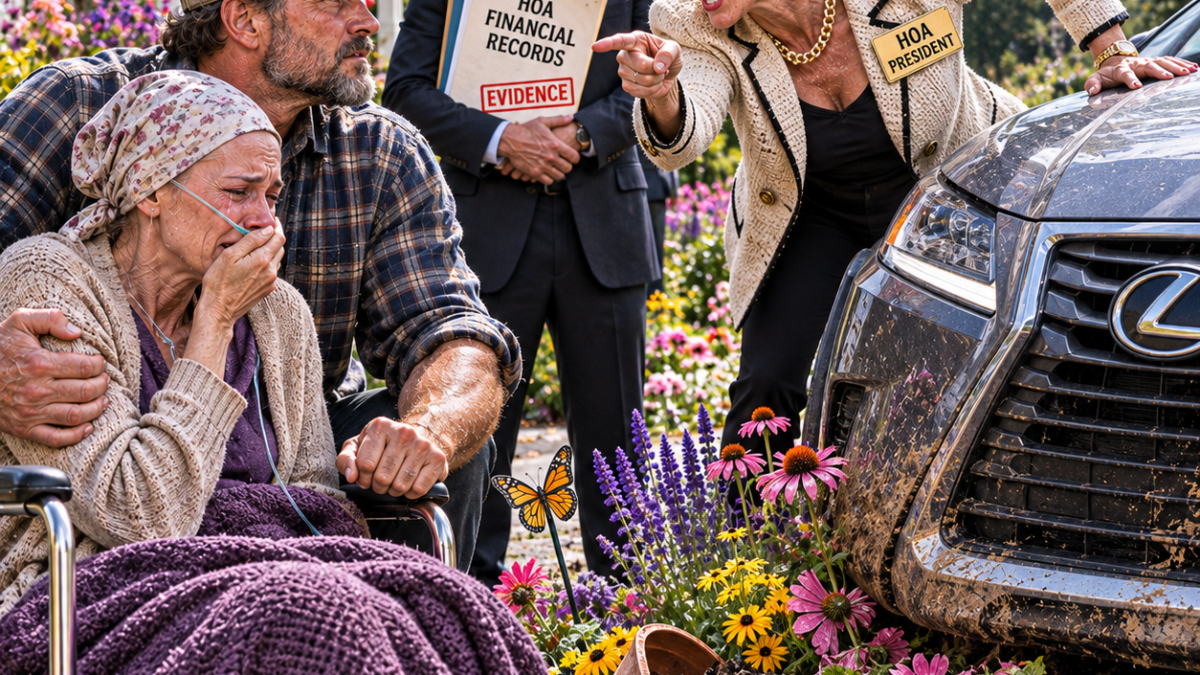
“GET YOUR SICK WIFE’S FLOWERS OFF MY ROAD!” HOA Karen Drove Her Lexus Through My Dying Wife’s Butterfly Garden—She Never Expected the Steel Barrier or the Documents Her Own Husband Brought Me
“MOVE YOUR DYING WIFE’S STUPID FLOWERS, CLAYTON—MY HOA HAS MORE RIGHTS THAN YOUR LITTLE CATTLE RANCH!” Brenda Winchester screamed through the open window of her white Lexus as she drove straight through the bluebonnets my wife had planted between chemotherapy treatments, scattering our cattle and leaving Sarah sobbing beside the crushed garden she had created to give herself one beautiful thing to look forward to.
What Brenda didn’t know was that I had spent twenty-eight years in the Marine Corps working with hydraulic systems, that six cameras had already recorded forty-seven incidents on our private property, and that the supposed historic water easement she kept waving in my face concealed a trail of forged signatures, expired agreements, and financial irregularities involving two hundred unsuspecting homeowners.
And when she finally led fifteen vehicles toward my gate, broadcasting her promised takeover live while my cancer-stricken wife watched from the porch, Brenda discovered that the steel security barriers were only the first thing standing in her way—because her own husband had already handed me the documents that could bring down everything she had built.
The first time my wife asked me whether she was going to die, we were sitting on our porch watching butterflies.
Not in a hospital.
Not in a doctor’s office.
Not in one of those quiet consultation rooms where people lower their voices before delivering news nobody wants to hear.
We were home.
Our home.
Two hundred acres of rolling pasture in East Texas, with a narrow creek, a weathered barn, a cattle operation that barely paid for itself some months, and the kind of silence you can only find when your nearest neighbor lives half a mile away.
Sarah had just finished her second round of chemotherapy.
She had lost most of her hair.
The skin around her eyes looked almost transparent.
Her hands shook when she lifted her coffee.
But she was smiling.
A monarch butterfly had landed on the honeysuckle climbing the porch railing.
She watched it for almost a minute before she spoke.
“Clayton?”
“Yeah, sweetheart?”
“Do you think I’m going to die here?”
I put down my mug.
“What kind of question is that?”
“A real one.”
I looked at her.
Twenty-eight years married.
A lifetime of knowing what each expression meant.
I knew better than to give her some cheerful lie about how everything would be fine.
Her stage-three breast cancer was serious.
Her treatment was difficult.
The doctors were hopeful, but hope was not a guarantee.
So I told her the truth.
“I don’t know.”
She nodded.
Then she asked, “If I do, will you keep the flowers?”
That nearly broke me.
Sarah had never been somebody who asked for much.
When we were young, she worked at an elementary school while I served in the Marines.
She learned to fix plumbing because I was deployed.
Learned to drive our truck with a slipping transmission because we couldn’t afford another.
Learned how to stretch fifty dollars into groceries for a week.
When I retired after twenty-eight years, I promised her something.
A place where she could finally stop waiting.
No more military moves.
No more boxes.
No more wondering which country I’d be in when the phone rang.
She chose the ranch.
The first thing she wanted was a butterfly garden.
Not a swimming pool.
Not a remodeled kitchen.
Not one of those expensive horse barns people build because they think ranch ownership requires one.
Flowers.
Native Texas wildflowers.
Bluebonnets.
Indian paintbrush.
Milkweed.
Zinnias.
Cosmos.
A winding gravel path and two wooden benches.
She wanted monarch butterflies to have somewhere safe during migration.
“Everybody deserves somewhere to rest,” she told me.
So I built the beds.
Hauled the soil.
Installed irrigation.
And watched my wife kneel in the dirt planting seeds like every one of them was a promise she intended to keep.
Five years later, with an oxygen concentrator sometimes humming beside her porch chair, she was still tending them whenever her strength allowed.
I took her hand.
“I’ll keep the flowers.”
“Even if they get out of control?”
“Especially then.”
She smiled.
“Good.”
Then she leaned against me.
“Because I want something beautiful to stay.”
Three weeks later, Brenda Winchester drove her white Lexus straight through them.
It was 6:30 in the morning.
I remember the time because I was standing in the kitchen waiting for the coffee to finish brewing.
At first I heard tires on gravel.
Fast.
Too fast.
Then an engine accelerated.
I looked through the window.
White Lexus GX.
Tinted windows.
Custom license plate.
BLESSED.
Brenda Winchester.
Fifty-two.
Pharmaceutical sales manager.
President of the Meadowbrook Heights Homeowners Association.
And the most aggressively entitled woman I had ever encountered outside a military command dispute.
Her subdivision sat along our eastern boundary.
Two hundred beige houses.
Red-tile roofs.
Perfect mailboxes.
A clubhouse.
A swimming pool.
And an HOA board that apparently believed owning a house in a planned community granted jurisdiction over the rest of East Texas.
Brenda had been cutting across our ranch for weeks.
She claimed an old roadway gave the HOA a right to reach its water pump station.
I told her to use the public access road.
She told me she had used this route for years.
I posted signs.
She laughed.
I installed a new gate.
She drove through whenever it was open for ranch work.
Now she was doing it again.
But this morning she didn’t stay on the gravel.
Her front tires turned sharply into Sarah’s butterfly garden.
Bluebonnets flattened beneath the wheels.
A wooden border snapped.
Freshly planted milkweed disappeared into the mud.
Her Lexus fishtailed slightly before climbing back onto the track.
I dropped my mug.
Coffee splashed across the kitchen floor.
Then I heard Sarah scream.
Not a long scream.
A sharp, terrified cry from the porch.
I ran.
Sarah was standing beside her chair, reaching for the railing.
Her portable oxygen tubing had caught beneath one of the porch rockers as she startled upright, pulling the connector loose.
The machine’s alarm was sounding.
I got to her.
Fixed the connection.
Helped her sit.
Checked that oxygen was flowing.
“Breathe, sweetheart.”
She gripped my wrist.
“Clayton.”
“I’ve got you.”
“The flowers.”
I looked across the driveway.
Brenda was disappearing toward the subdivision.
She never stopped.
Didn’t slow.
Didn’t check on Sarah.
Didn’t even look back.
My wife’s eyes filled.
“She knew.”
I swallowed.
“She knew I was sitting here.”
Sarah stared at the crushed bluebonnets.
“She looked right at me.”
That was the moment this stopped being a property dispute.
The garden wasn’t expensive.
Not by the standards of wealthy suburban homeowners.
Some seeds.
Soil.
Hours of work.
A few hundred dollars in plants.
But it was the one place my wife could sit after treatment without feeling like a patient.
And Brenda had turned it into a shortcut.
I looked toward the gate.
Then back at Sarah.
“No one drives through your flowers again.”
She squeezed my hand.
“Clayton, please don’t do anything you’ll regret.”
I kissed her forehead.
“I won’t.”
Then I added something I meant with every part of me.
“But this ends.”
PART2
What I didn’t tell Sarah that morning was how close I had come to losing my temper.
I stood beside the broken flower bed with my hands shaking.
Twenty-eight years in the Marines had taught me how to function under pressure, but retirement hadn’t made me immune to anger.
I knew what uncontrolled anger could cost.
Especially when a person knew exactly how to provoke it.
And Brenda Winchester was becoming an expert.
Our trouble had started three months earlier when I found her measuring my ranch gate with a tape measure.
She had arrived on an ATV.
Navy business suit.
High heels.
Sunglasses.
A clipboard resting across the handlebars like she was conducting a government inspection.
I was checking fence posts.
I heard the engine.
Followed the sound.
Found her standing on the inside of my property line.
“Ma’am,” I said, “can I help you?”
She didn’t look up.
“Sixteen feet.”
“What?”
“Your gate opening.”
She wrote it down.
“Sixteen feet isn’t sufficient for community infrastructure access.”
I stared at her.
“Community what?”
“Water infrastructure.”
She finally looked at me.
“And who are you?”
“Clayton Rivers.”
“This is my ranch.”
She smiled.
Not pleasantly.
“Oh.”
“So you’re the new owner.”
“Five years isn’t particularly new.”
She ignored that.
“I am Brenda Winchester.”
“President of Meadowbrook Heights.”
“Congratulations.”
Her smile narrowed.
“This road provides access to our neighborhood pump station.”
I looked toward the public road half a mile south.
“You have a dedicated access road.”
“That takes eleven extra minutes.”
“Then I suggest leaving eleven minutes earlier.”
Her face hardened.
“Mr. Rivers, we have historical access rights.”
“Show me the recorded easement.”
She blinked.
“The what?”
“Easement.”
“Deed reference.”
“Recorded instrument.”
“Anything showing your association has a legal right to cross my property.”
She laughed.
“I don’t carry property documents on an ATV.”
“Then don’t carry yourself onto my land.”
That was our first argument.
Brenda told me she’d been using the route since before we moved in.
I told her convenience wasn’t ownership.
She said a working ranch was an outdated use of valuable land.
I told her the cattle disagreed.
She left angry.
I thought that would be the end.
Instead, she came back the next morning.
And the next.
And the next.
At first it was the ATV.
Then her Lexus.
Sometimes alone.
Sometimes with a passenger.
Every time I approached, she repeated the same sentence.
“Historical right-of-way.”
No document.
No recorded reference.
Just those words.
She said them like an incantation.
Eventually she began bringing other HOA board members.
Five SUVs on one Tuesday morning.
Twelve people.
They parked near our barn.
Walked through a cattle pasture without asking.
Left a gate unlatched.
And stood inside Sarah’s butterfly garden discussing where they might build a “community viewing gazebo.”
I walked toward them with our ranch dog, Scout, beside me.
Brenda pointed at an open patch of land.
“We could put benches here.”
I stopped.
“Who could?”
She turned.
“Oh, Clayton.”
“We’re evaluating future neighborhood amenities.”
“On my ranch?”
“Adjacent community resources.”
I looked around.
The treasurer was holding a clipboard.
The HOA vice president was photographing our fence.
A man in a polo shirt had walked into a pasture occupied by an Angus bull weighing well over a thousand pounds.
“Everybody back to the vehicles,” I said.
Brenda crossed her arms.
“Don’t be dramatic.”
“That’s a working livestock pasture.”
“We’re simply touring.”
“You’re trespassing.”
One of the board members looked nervous.
“Brenda, maybe we should—”
She cut him off.
“Clayton, your attitude is exactly why rural property owners need oversight.”
I pointed toward the open gate.
“Leave.”
She smiled at her group.
“See?”
“This is what happens when one stubborn owner puts private feelings ahead of community access.”
That was the first time I understood she wasn’t merely cutting across our land.
She was testing authority.
Every time I objected, she framed my objection as proof I needed regulation.
Every boundary became a challenge.
Every refusal became a grievance.
And every grievance gave her another reason to return.
Then Thunder was injured.
Thunder was our prize Angus bull.
Massive.
Normally calm.
The kind of animal that could make a grown man feel tiny just by lowering his head.
During one of Brenda’s “inspection tours,” two vehicles drove too close to his pasture.
A visitor slammed a door.
Someone shouted.
Thunder bolted.
He crashed through a weakened corner section and caught his hind leg on barbed wire.
Forty-seven stitches.
Three weeks of antibiotics.
Hundreds of dollars in veterinary bills.
Dr. Martinez, our large-animal veterinarian, worked beside me while I held the bull steady.
When he finished, he removed his gloves.
“Clayton, somebody’s going to get seriously hurt if people keep treating this ranch like a public park.”
“I know.”
“Animals don’t understand a board tour.”
“I know.”
“Then stop the tours.”
I looked toward the house.
Sarah was standing behind the screen door, watching.
Her face looked exhausted.
“I intend to.”
But intention isn’t enforcement.
And Brenda was counting on that difference.
I installed six trail cameras.
Not fancy military equipment.
Ordinary outdoor cameras with motion activation, timestamps, and overlapping views of the gate, driveway, garden, barn approach, and livestock corridors.
I kept the footage backed up.
Dates.
Times.
License plates.
Vehicle movements.
People entering.
Gates left open.
Damage.
I also placed visible no-trespassing signs at the entrances.
I didn’t want ambiguity.
I wanted anyone approaching to know where private property began.
The first week of video made me angrier than the actual encounters.
Because I could watch what Brenda did when she thought I wasn’t there.
One Tuesday, she arrived with eight residents.
A woman handed her a fifty-dollar bill.
Brenda smiled.
“Thank you.”
Another paid.
Then another.
I paused the footage.
Zoomed.
Money.
Cash.
The next recording showed Brenda speaking beneath our pecan tree.
“Authentic Texas ranch experience.”
“Exclusive access.”
“Historic water route.”
I searched the Meadowbrook Heights community Facebook page.
Found the announcement.
MEADOWBROOK HEIGHTS HERITAGE RANCH TOUR
$50 PER PERSON
LIMITED SPACES
ALL PROCEEDS SUPPORT COMMUNITY IMPROVEMENT INITIATIVES
The photograph was of my land.
My cattle.
Our creek.
And Sarah’s butterfly garden.
Brenda had advertised my wife’s sanctuary as a paid tourist attraction.
Without permission.
I stared at the screen until Sarah walked into the kitchen.
“What is it?”
I turned the laptop.
She read.
Then read again.
“Fifty dollars?”
“Yes.”
“For our ranch?”
“Yes.”
She covered her mouth.
Then whispered:
“She charged people to walk through my flowers?”
I nodded.
Sarah sat.
The silence that followed frightened me more than shouting would have.
Eventually she said:
“Clayton, I don’t want to fight anymore.”
I turned toward her.
“What?”
“Every time I hear that engine, I feel sick.”
“I’m already sick.”
She looked down.
“I don’t have the strength to be angry every morning.”
I sat beside her.
“You shouldn’t have to.”
She started crying.
“I built that garden because I wanted to see something living when everything in my body felt like it was dying.”
I took her hand.
“And now every time I look at it, I wonder when she’s coming back.”
My throat closed.
I wanted to promise her Brenda would never return.
But promises made without a plan are just another way to disappoint someone.
So I said:
“I’m going to do this properly.”
“Evidence.”
“Lawyer.”
“Survey.”
“Whatever it takes.”
Sarah leaned against me.
“Please don’t let her turn you into somebody you don’t want to be.”
I kissed her hair.
“She won’t.”
That became my rule.
Brenda would not make me reckless.
She would not make me violent.
She would not turn my wife’s sanctuary into a place where someone could get killed over a driveway.
I would win with documentation.
Even if it took longer.
My lawyer was an old Marine buddy named Jake Mercer.
Jake had served with me for years before going to law school.
He was still built like a refrigerator and talked like every conversation came with an official objection.
I sent him the footage.
He called twenty minutes later.
“Clayton.”
“Yeah?”
“Please tell me she’s not the president of an HOA.”
“She is.”
He groaned.
“Of course she is.”
“What do you think?”
“I think you have a very strong basis to demand she stop entering your property.”
“And the tours?”
“Keep documenting them.”
“Advertisements.”
“Payment records.”
“Statements from people who paid.”
“Your footage.”
“Every bit helps.”
“What about her easement?”
“That’s the first question.”
“I’ve never seen one.”
“Then we search.”
He paused.
“And Clayton?”
“Yeah?”
“Don’t physically block emergency access to a functioning water facility until we know exactly what rights exist.”
“I know.”
“I’m serious.”
“So am I.”
“Good.”
Then he added:
“Your ranch may be private, but if that line serves two hundred families, we’re going to protect Sarah without putting innocent residents in the middle.”
I looked toward the porch.
Sarah sat beneath a blanket.
Watching butterflies land on the few flowers Brenda hadn’t crushed.
“That’s what I want.”
The surveyor arrived three days later.
Pete Lawson.
Seventy, if he was a day.
Gray beard.
Sunburned neck.
Survey truck older than some of my cattle.
He took one look at Brenda’s claimed roadway and shook his head.
“Everybody thinks a dirt road becomes public because somebody drove on it more than twice.”
I laughed.
“Can you prove where the boundary is?”
“That’s why you called me.”
He spent two days reviewing records and locating surveyed boundaries.
When he finished, he spread the map over my kitchen table.
Our ranch.
The subdivision.
Adjacent properties.
The pump station.
The water line.
And the roadway Brenda used.
Pete pointed.
“There’s your property line.”
I leaned closer.
“The road is entirely on my side.”
“Most of it.”
“What about the waterline?”
“That crosses several parcels.”
“Under recorded easements?”
Pete leaned back.
“That’s the interesting question.”
“What do you mean?”
“The survey shows physical infrastructure.”
“Not necessarily valid permission.”
I looked at him.
“So?”
“You need a title attorney to examine the recorded instruments.”
“Your lawyer should review the chain.”
I called Jake.
He told me to visit the county records office.
We searched.
Then searched again.
Old deeds.
Plat maps.
Utility filings.
Subdivision documents.
Water service agreements.
The paperwork was a mess.
Several old easement references appeared in association records.
Some related to parcels that had been divided later.
One instrument appeared to grant temporary access during construction decades earlier.
Another referenced an agreement whose term had ended.
There was no clearly recorded, current right for Brenda to operate her personal shortcut through my ranch.
That wasn’t the same as proving the water line had no lawful protection.
Jake made that distinction immediately.
“Water infrastructure can involve separate utility rights.”
“We have to verify those.”
“But the road she’s driving?”
“Her personal inspections?”
“Her paid tours?”
He paused.
“I haven’t seen a document authorizing those.”
That was enough to continue.
Brenda responded by filing an easement claim.
The county sent notice of a hearing.
MEADOWBROOK HEIGHTS HOA — ACCESS CLAIM
The letter arrived on a Thursday.
Sarah was having treatment.
I opened it alone.
Brenda claimed historic use.
Community necessity.
Infrastructure access.
Emergency operations.
She also requested consideration for an HOA security booth beside our gate.
I read that part three times.
A security booth.
On my property.
For an organization whose president had already turned my ranch into a paid tour destination.
I called Jake.
He listened.
Then laughed once.
“She’s ambitious.”
“Can she do this?”
“She can file a claim.”
“That doesn’t mean she’ll win.”
“What do we do?”
“Prepare.”
The financial consequences started before the hearing.
Our bank asked for updated title information because of the access dispute.
The equity line we’d planned to use as a reserve for Sarah’s medical expenses was temporarily held for review.
Not permanently canceled.
But suddenly unavailable when we needed certainty most.
Then the insurer requested information about commercial activity on the ranch.
Brenda had apparently told somebody we were operating public tours.
Sarah sat at the kitchen table as I explained.
Her face fell.
“She’s saying we’re running a business with visitors?”
“That’s what she claims.”
“But she’s the one charging people.”
“I know.”
Sarah stared at the bills spread beside her medication schedule.
Then whispered:
“How much more of this can we afford?”
I had no answer I liked.
That night, I lay awake listening to her oxygen concentrator.
Three in the morning.
Then four.
Finally she reached across the bed.
“Clayton.”
“Yeah?”
“You’re shaking.”
I looked at my hands.
She was right.
“I hate that she can do this.”
Sarah rolled toward me.
“She can make trouble.”
“She doesn’t get to decide what we become.”
I turned.
Her face was pale.
But her eyes were steady.
“We didn’t buy this land to spend the rest of my treatment fighting a woman in a Lexus.”
“I know.”
“Then don’t let the fight take everything beautiful out of it.”
I kissed her forehead.
“I won’t.”
I meant it.
Even then.
The county hearing was held in a fluorescent conference room that smelled like old carpet and weak coffee.
Brenda arrived wearing a navy suit and carrying a leather portfolio.
Four HOA board members followed.
One local reporter.
Two attorneys.
A water department representative.
I came with Jake and a box of documents.
Brenda smiled when she saw my jeans.
“Clayton.”
“Mrs. Winchester.”
“I see you brought your little lawyer.”
Jake smiled.
“Licensed in Texas.”
“Unlike little insults, that qualification is verifiable.”
Her face tightened.
The hearing officer asked Brenda to explain the claim.
She stood.
“Meadowbrook Heights has relied on this access route for decades.”
“Two hundred families depend on our water system.”
“Mr. Rivers is attempting to deny access because of a personal grudge.”
I sat still.
She continued.
“He has placed aggressive signage.”
“Installed surveillance equipment.”
“Threatened board members.”
“And interfered with our ability to perform safety inspections.”
Jake wrote something.
Then she said:
“This is not about one man’s flowers.”
My jaw tightened.
Sarah’s flowers.
Not mine.
The hearing officer looked toward us.
“Mr. Rivers?”
Jake stood.
“We dispute the HOA’s claimed right to use the ranch roadway for personal travel, recreational tours, or proposed structures.”
He laid out the survey.
Then the recorded documents we’d located.
Then Brenda’s paid-tour advertisement.
The hearing officer looked down.
“Fifty dollars per person?”
Brenda stiffened.
“Voluntary donations.”
“On private land?”
“Historical community route.”
“Do you have written permission from Mr. Rivers?”
“No.”
“But the association’s historic—”
The officer interrupted.
“I’m asking about permission for paid tours.”
Brenda looked toward her attorney.
He said nothing.
Then Jake placed still photographs on the table.
Twelve people in Sarah’s garden.
Vehicles beside cattle.
A gate left open.
Thunder injured.
Veterinary records.
The hearing officer studied them.
Brenda said:
“These are exaggerated claims.”
I stood.
“Then let’s watch the video.”
Her expression changed.
We played it.
The visitors.
The money.
The vehicles.
The damaged flower bed.
By the time it ended, the room was silent.
Then Jake raised the easement documents.
“Whatever utility rights may exist, the HOA has not established that its president can use this working ranch as a private shortcut or paid recreational attraction.”
The officer turned toward Brenda.
“Where is the recorded instrument you rely on?”
She opened her portfolio.
Removed a document.
Handed it forward.
I watched Jake read.
His face changed.
Not dramatically.
Just enough.
Then he leaned toward me.
“Clayton.”
“What?”
“Don’t say anything.”
The hearing was continued for additional records review.
No instant victory.
No ruling that settled every property right.
But Brenda did not get her security booth.
And the paperwork she submitted created an entirely new problem.
For her.
Jake called me that evening.
“Are you sitting?”
“Yes.”
“Look at the document Brenda filed.”
I opened the scan.
“Okay.”
“Date?”
“Nineteen eighty-five.”
“County seal?”
I looked closer.
Then froze.
I had seen that seal.
On recent county documents.
Jake continued.
“The version of the seal on this supposed 1985 instrument wasn’t adopted until years later.”
I stared.
“What?”
“And the notary information may not match.”
“We need certified records and proper examination.”
“Could it be a later copy?”
“Maybe.”
“That’s why we investigate.”
“But it is suspicious.”
I looked toward Sarah.
She was planting zinnia seeds in small pots on the porch.
Jake said:
“Don’t confront Brenda yet.”
“Why?”
“Because if this is forged, the document is more important than the argument.”
The next morning, I drove to the homes of three neighboring property owners.
Tom Henderson.
Maria Santos.
Bill Crawford.
Their land lay near the same water infrastructure.
Tom raised cattle.
Maria’s family had owned their parcel for generations.
Bill raised quarter horses and taught history before retiring.
I showed them the survey.
The old records.
Brenda’s access claim.
Tom swore.
Maria went quiet.
Bill asked:
“Why would the HOA file a document affecting all our land without notifying us?”
I shrugged.
“That’s what I want to know.”
Then the stories started.
Tom had received nuisance complaints about his cattle trailers.
Maria had been threatened with county complaints over fence repairs.
Bill found strangers measuring his pastures.
Each time, Brenda’s name appeared somewhere.
A letter.
A phone call.
An HOA committee.
She had framed neighboring ranches as threats to Meadowbrook Heights.
Tom looked at the survey again.
“She wants us gone.”
Maria shook her head.
“Maybe not gone.”
“Controlled.”
Bill said:
“She can’t control what she doesn’t own.”
I looked at them.
“Then we make her prove what she owns.”
Three days later, Brenda filed a formal nuisance complaint against the ranch.
Twelve pages.
Agricultural odors.
Livestock movement.
Drainage concerns.
Visual appearance.
Property-value impact.
She demanded modernization measures.
Threatened a supposed $500 daily HOA fine.
Jake called it an impressive collection of assertions unsupported by any authority over my land.
The county still had to investigate certain specific allegations.
Inspector Rodriguez arrived Tuesday.
Spent three hours reviewing legitimate agricultural compliance issues.
Feed storage.
Waste handling.
Drainage.
Fencing.
Livestock conditions.
Everything passed.
When he left, he shook my hand.
“Mr. Rivers, I can’t tell you the complaint was filed in bad faith.”
“I understand.”
“But I can document that the inspected conditions met the relevant requirements.”
“That’s all I need.”
He paused.
“Your wife okay?”
I looked toward the porch.
“She has better days.”
Rodriguez nodded.
“Tell her the garden looks good.”
Then drove away.
Two days later, Sarah collapsed during chemotherapy.
It wasn’t a dramatic fall.
No screaming.
She became faint, and the nurses caught her.
They admitted her overnight for evaluation.
The doctors discussed dehydration, treatment effects, low blood pressure, and complications they needed to monitor.
I refused to pretend Brenda caused Sarah’s illness.
Cancer was responsible for enough without handing that woman ownership over the disease.
But the constant fear and interrupted sleep had made treatment days harder.
Sarah admitted that.
She lay in the hospital bed with her eyes closed.
I sat beside her.
“Clayton.”
“Yeah?”
“I dreamed about the garden.”
I held her hand.
“What happened?”
“All the butterflies were gone.”
My chest tightened.
She opened her eyes.
“Promise me something.”
“Anything.”
“If I don’t get better…”
“Sarah.”
“Let me finish.”
I swallowed.
“If I don’t get better, don’t spend the rest of your life hating that woman.”
I stared.
“She’s hurting you.”
“Yes.”
“And you’re not going to let her keep doing it.”
“No.”
“But this ranch is supposed to be alive.”
“Not a monument to what she did.”
I leaned over.
Kissed her forehead.
“We’re going home.”
She smiled faintly.
“And planting more flowers.”
“Yes, ma’am.”
“Good.”
Then:
“Because I am not done growing things.”
I spent the next weekend at the courthouse with Jake.
We found the old utility documents.
Certified copies.
Renewal notices.
Recorded instruments.
The original agreement referred to limited infrastructure access under specific terms.
There were questions about expiration, continuation, and subsequent rights that required legal review.
But one thing became clear.
The paper Brenda submitted as a supposedly historic recorded easement did not match the authentic archive.
Different signatures.
Different seal.
Different formatting.
Some dates impossible.
Then something even stranger happened.
Brenda’s husband called me.
David Winchester.
He worked for the county water department.
Quiet man.
I’d seen him twice.
Never spoken more than a greeting.
He sounded exhausted.
“Mr. Rivers?”
“Yes.”
“It’s David Winchester.”
I sat straighter.
“What do you want?”
“To tell you something about the documents.”
I said nothing.
He continued.
“My wife isn’t showing you the originals.”
“Where are they?”
“I have copies.”
“Why call now?”
Long silence.
Then:
“Because I helped her find the first problem fifteen years ago.”
My stomach tightened.
“What problem?”
“The expired agreement.”
“And then?”
David breathed shakily.
“Then she decided she could fix it herself.”
We met at a diner twenty minutes outside town.
No cameras.
No dramatic entrance.
David sat in the back booth with a manila folder beside his coffee.
He looked like somebody who hadn’t slept.
I sat opposite him.
“Let’s hear it.”
He pushed the folder forward.
Inside:
Old easement records.
County correspondence.
HOA meeting notes.
And documents that appeared to have been recreated with false signatures and dates.
I stared.
“Who made these?”
David looked down.
“Brenda directed the process.”
“Did you help?”
He swallowed.
“Yes.”
That answer surprised me.
He could have lied.
Blamed her.
Pretended ignorance.
Instead:
“I helped her find old forms.”
“I knew some of the material was wrong.”
“Why?”
“Because she said two hundred homeowners could lose access if the agreements weren’t renewed.”
“Why not negotiate legal rights?”
“Cost.”
“Time.”
“People asking questions.”
He rubbed his face.
“She said nobody would notice if we documented what everybody had been doing for years.”
I stared at him.
“You understand that historic use and an actual recorded right aren’t interchangeable.”
“I do now.”
I looked through the paperwork.
A notary stamp on a supposedly older document.
A signature from someone who appeared to have died before the stated execution date.
A county seal that did not belong to the year shown.
“Why bring this to me?”
David stared at his coffee.
“Because she won’t stop.”
He swallowed.
“She turned the problem into a business.”
“What business?”
“Water management charges.”
“Consulting.”
“Community infrastructure assessments.”
“Some of the money went where it should have.”
“Some didn’t.”
“How much?”
“I don’t know the final figure.”
“Does the HOA treasurer know?”
“Not everything.”
“Why now?”
David looked toward the window.
“Last night she told me to find out how to disable your gate.”
I stopped breathing.
“She said if you wouldn’t cooperate, she would teach you what a public emergency looked like.”
I stared.
Then asked:
“Does she know you’re here?”
“No.”
“What happens when she finds out?”
David laughed bitterly.
“Probably the end of my marriage.”
I leaned forward.
“Mr. Winchester, I’m not promising you anything.”
“I wouldn’t ask.”
“If you participated in falsifying documents, an attorney and investigators need to know.”
“I know.”
“Are you willing to give a truthful statement?”
He nodded.
“Yes.”
“Even if it implicates you?”
He closed his eyes.
Then:
“Yes.”
That was the moment I realized Brenda had already lost something more important than an easement argument.
Her own husband no longer believed her story.
Jake reviewed the folder.
He did not celebrate.
He asked David to retain independent counsel and preserve originals.
We sent the relevant evidence to appropriate investigators.
There were questions about document falsification.
Possible misuse of HOA funds.
Potential financial fraud.
We did not presume every accusation was a federal crime simply because the paperwork looked terrible.
What mattered was preserving evidence and letting the people with authority investigate.
Meanwhile, Sarah came home from the hospital.
She was weak.
Needed help walking longer distances.
But she still insisted on seeing the garden.
I had replanted.
New border.
Fresh milkweed.
Zinnias.
Cosmos.
The crushed bluebonnets would have to return in season.
She stood beside me looking at the young plants.
“You did all this?”
“Yes.”
“When?”
“While you were resting.”
She smiled.
“You’re getting good.”
“Don’t tell anyone.”
“Why?”
“They’ll make me start a landscaping business.”
She laughed.
The sound made every hour worth it.
Then she noticed the folder on the porch table.
“What did Jake say?”
I told her.
The forged-looking records.
The water agreements.
David’s cooperation.
The investigation.
Sarah listened.
Then said:
“She didn’t only hurt us.”
“No.”
“Those homeowners probably don’t know what’s happening either.”
“No.”
She looked toward Meadowbrook Heights.
“Then don’t turn them into enemies.”
I nodded.
“You’re right.”
“I’m usually right.”
“That’s why I married you.”
“No.”
She smiled.
“You married me because I made better biscuits than your mother.”
I laughed.
She was right about that too.
Brenda learned that the county was reviewing her documents.
She reacted exactly as I expected.
Not with caution.
With a campaign.
First, a Facebook post.
RURAL LANDOWNER THREATENS COMMUNITY WATER SECURITY
Then an emergency HOA meeting.
Then printed notices on neighborhood doors.
According to the messages residents forwarded, Clayton Rivers was attempting to seize control of neighborhood infrastructure, impose outrageous access fees, and threaten families’ water service.
None of that was true.
We had not shut off a line.
Not touched a pump.
Not blocked authorized maintenance workers.
We had asked for lawful access arrangements and an end to unauthorized driving through our private ranch.
But Brenda knew fear worked.
Two hundred homes.
Children.
Elderly residents.
Families needing water.
She transformed a dispute over access and records into:
Clayton wants your faucets dry.
I received angry calls.
Some callers shouted.
Others cried.
An elderly widow named Mrs. Patterson asked:
“Mr. Rivers, are you really going to cut off our water?”
I closed my eyes.
“No, ma’am.”
“Brenda said—”
“I know what she said.”
“My husband has dialysis appointments.”
“You have my word I am not interfering with safe water service.”
She paused.
“Then why is she saying you are?”
“That’s what I wish she’d explain.”
The next day, I invited Mrs. Patterson and several other residents to meet with Jake.
Not on social media.
In person.
We showed them the public documents.
The survey.
The disputed easement.
The difference between continued utility service and Brenda’s personal right to drive through my wife’s garden.
Mrs. Patterson looked confused at first.
Then angry.
“So she can still reach the water station by another route?”
“Yes.”
“And you’ve never threatened to shut off our supply?”
“No.”
“Then why did she tell us you had?”
Jake said:
“That is a question for her.”
Mrs. Patterson stood.
“I intend to ask.”
That was the beginning of Brenda losing the neighborhood.
Not all at once.
Truth rarely moves as fast as fear.
But it moved.
The steel barrier came later.
I researched professionally installed vehicle-rated bollards because Brenda had ignored gates and signage, and our ranch entrance needed something stronger.
I was trained in hydraulic systems.
That didn’t mean I intended to turn my driveway into a weapon.
I told the contractor precisely what I wanted.
A barrier that would visibly protect the private entrance.
Clearly posted.
Installed with permits and professional review.
Safe access for authorized vehicles and emergency responders.
No surprise mechanism that could launch into a vehicle already crossing.
The contractor, an experienced security installer from Houston, recommended two retractable steel bollards used as a controlled gate system.
They would remain raised across the private shortcut when access wasn’t authorized.
Approaching vehicles would see reflective markings and warning signs from a safe distance.
I also installed a camera covering the approach.
The public road and properly authorized utility access remained available.
The cost was significant.
Twelve thousand dollars.
Sarah stared at the invoice.
“You spent twelve thousand dollars to keep a woman from driving through flowers?”
“No.”
I said.
“I spent twelve thousand dollars so your garden stops being a roadway.”
She studied me.
Then smiled.
“That’s the most expensive garden fence in Texas.”
“Don’t tell my accountant.”
She laughed.
Then she became serious.
“Promise you won’t make this dangerous.”
“I promise.”
That mattered.
The barrier was designed to stop unauthorized access.
Not to ambush anybody.
Brenda would get warnings.
Signs.
Certified notice.
And every chance to turn around.
What she did with those chances was her decision.
Brenda received the notice.
Signed for it.
Then called me.
I answered from the barn.
“CLAYTON RIVERS!”
“Morning, Brenda.”
“You have no legal right to barricade our access.”
“Your attorney has Jake’s number.”
“I am not paying lawyers to explain a road to a stubborn cowboy.”
“Then use the public road.”
“You will remove that barrier before Monday.”
“No.”
She inhaled sharply.
“What?”
“No.”
“Do you understand who you’re dealing with?”
I looked toward Thunder grazing.
“Yes.”
“A woman who has driven through my wife’s flowers forty-seven documented times.”
Brenda went silent.
Then:
“You’ve been spying on me.”
“On my property.”
“Recording my illegal tours.”
“They were community functions.”
“Charging fifty dollars a head.”
“You cannot prove—”
“I have the video.”
Silence.
I continued.
“Your attorney should also ask you about the easement records.”
Brenda’s breathing changed.
“What records?”
“The ones the county is reviewing.”
Her voice sharpened.
“You have no idea what you’re getting into.”
“Maybe.”
Then:
“But I know where my property line is.”
I hung up.
She called six more times.
I forwarded the voicemails to Jake.
Her husband warned us of another escalation.
Brenda was planning what she called a community water-rights convoy.
Fifteen vehicles.
HOA members.
Residents.
A hired security consultant.
Her intention, according to David, was to arrive during the annual infrastructure inspection, stage a public confrontation, and remove my private entrance barriers while livestreaming the event.
Jake immediately notified law enforcement about the threatened trespass and potential property damage.
The investigator handling the document allegations was also informed.
I did not arrange an arrest.
Did not plan one.
Did not ask anybody to watch while someone destroyed a car.
I wanted an incident avoided.
And if Brenda refused every warning, I wanted the evidence preserved.
Saturday evening, Sarah watched me check the camera recordings.
“You’re nervous.”
“Yes.”
“You don’t look nervous.”
“Twenty-eight years of practice.”
She placed her hand over mine.
“Clayton.”
I turned.
“You don’t have to prove you’re tougher than her.”
“I know.”
“Then promise me something.”
“What?”
“Tomorrow, if everything goes wrong, you come back to me.”
My chest tightened.
“I will.”
“I mean it.”
“Nothing out there is worth losing you.”
I looked into her eyes.
The woman who had survived deployments with me.
Reunions.
Money troubles.
Two moves across the country.
A cancer diagnosis that changed everything.
“I’m not going anywhere.”
She smiled sadly.
“Good.”
“Because I still need you to fix the garden bench.”
I laughed.
“Now?”
“Eventually.”
“Bossy woman.”
“Your favorite.”
Always.
Monday arrived bright and cold.
At 9:00, Brenda assembled her convoy in the Meadowbrook Heights clubhouse parking lot.
Fifteen vehicles.
Several SUVs.
Two pickups.
One expensive white Lexus leading.
Her social media livestream started before the engines.
Brenda stood in front of her vehicle wearing a red blazer.
She looked like a politician announcing a campaign.
“Today,” she said into her phone, “we are standing up for the rights of two hundred families.”
Behind her, residents held signs.
PROTECT OUR WATER
STOP RANCH EXTREMISM
One man held a cardboard sign reading:
NO ONE OWNS COMMUNITY RIGHTS
I almost laughed.
Of course individuals own property.
Communities have rights too.
The entire dispute was about identifying those rights honestly.
But slogans were easier than documents.
Brenda continued.
“One selfish rancher has decided his private preferences matter more than our children.”
I watched the livestream on my laptop.
Jake stood beside me.
A sheriff’s deputy waited near the public-road approach after being briefed about the planned protest.
Sarah sat on the porch.
Blanket.
Oxygen nearby.
A cup of tea.
She insisted.
“I want to watch the end of this.”
I looked at her.
“From the porch.”
“From the porch.”
“No standing near the gate.”
“Clayton.”
“What?”
“I’m not stupid.”
I smiled.
“I know.”
Then kissed her.
At 10:15, the convoy started moving.
Fifteen vehicles along a narrow country road.
Brenda in front.
The hired security consultant beside her.
Marcus Webb.
A broad man in tactical-looking clothing who liked calling himself an infrastructure enforcement specialist.
Jake had checked his credentials.
They did not support the authority he claimed.
Behind Brenda, several residents appeared nervous.
One woman was driving with two children in the back.
That made me angry.
Not at her.
At Brenda.
She had convinced ordinary families to bring their children to a dispute that already had lawyers and investigators involved.
She had made them believe this was the only way to keep their water.
The convoy approached my private gate.
The bollards were already raised.
Visible.
Reflective.
Signs posted.
PRIVATE PROPERTY
NO UNAUTHORIZED VEHICLE ACCESS
VEHICLE BARRIER AHEAD
USE PUBLIC ACCESS ROAD
Brenda slowed.
For one second, I thought she might stop.
She did.
Then Marcus got out.
Walked toward the barrier.
Studied it.
He pulled a tool from his bag.
The deputy approached.
“Sir, step away.”
Marcus turned.
“This is HOA infrastructure.”
The deputy looked at the private-property sign.
“Not according to the information provided to us.”
Brenda got out of her Lexus.
Her livestream remained active.
“What is this?”
The deputy spoke calmly.
“Ma’am, you cannot dismantle private security equipment.”
Brenda pointed at me across the gate.
“HE HAS BLOCKED OUR WATER ACCESS!”
I stepped forward but remained on my side.
“No, Brenda.”
“The approved public access road is open.”
“Maintenance access can be coordinated through the utility and counsel.”
“You are not authorized to drive through my ranch.”
She screamed:
“YOU DO NOT DECIDE!”
I looked at her.
“That’s exactly the question the court will decide.”
Her face turned crimson.
Then she looked toward the convoy.
“Everybody, stay right where you are.”
She climbed back into the Lexus.
Marcus hurried toward the passenger side.
The deputy shouted:
“Ma’am, do not drive into the barrier.”
Brenda rolled down her window.
“You think you can stop me with a couple of metal posts?”
I did not answer.
She looked straight toward Sarah on the porch.
Saw her.
Then smiled.
I knew that smile.
The same one from the morning she crushed the bluebonnets.
Brenda leaned out.
“GET YOUR SICK WIFE’S FLOWERS OFF MY ROAD!”
Sarah flinched.
Every muscle in my body went tight.
Then Brenda accelerated.
Not fast by highway standards.
Far too fast for a gated ranch entrance.
The Lexus lurched across gravel.
The tires spun.
The front end struck the stationary steel barrier with a horrible metallic crash.
Airbags deployed.
The engine stalled.
Steam rose from the damaged front.
For one awful moment, nobody moved.
My heart slammed.
I had wanted her stopped.
I had not wanted anyone injured.
I started toward the gate.
Jake grabbed my arm.
“Let the deputy handle it.”
Brenda’s horn began blaring.
Marcus shouted inside the vehicle.
The deputy ran toward them.
“Are you hurt?”
Brenda screamed:
“HE ATTACKED MY CAR!”
I stared.
The barrier had not moved.
It had been raised and visible long before she approached.
She had driven into it.
Her livestream was still running.
It had recorded everything.
The signs.
The warnings.
The deputy telling her to stop.
And Brenda choosing the accelerator.
Behind her, the convoy froze.
Nobody cheered.
Nobody knew what to do.
Then Sarah called from the porch.
“Clayton!”
I turned.
She was crying.
“Come back.”
I walked toward her immediately.
She took my hand.
“Don’t go over there.”
“I’m here.”
She looked at the damaged Lexus.
Then at the garden.
“Please tell me nobody’s hurt.”
“We don’t know yet.”
She squeezed my hand.
“Then that’s what matters first.”
Of course.
Even after everything.
My wife still cared whether Brenda was safe.
That was Sarah.
That was why I loved her.
Emergency responders checked Brenda and Marcus.
Both were conscious.
They were assessed for possible injuries and transported for medical evaluation as a precaution.
No one celebrated the crash.
A tow truck was arranged.
The road was cleared.
The convoy remained.
And the livestream kept recording until Brenda’s phone finally went dark.
The deputy asked witnesses to remain available.
Some residents looked embarrassed.
Others angry.
A woman approached the gate.
Mrs. Patterson.
The widow I had spoken to weeks earlier.
She stared at Sarah’s garden.
Then at me.
“I didn’t know.”
I nodded.
She continued.
“Brenda said you were going to shut off the water.”
“I know.”
“She didn’t tell us she had another road.”
“I know.”
Mrs. Patterson started crying.
“I brought my grandson today.”
My chest tightened.
“Is he okay?”
“Yes.”
She looked toward the crushed flower beds.
“Your wife made all this?”
“Yes.”
Mrs. Patterson lowered her head.
“I’m sorry.”
Then Maria Santos arrived.
Tom Henderson.
Bill Crawford.
The three neighboring property owners.
They stood beside me.
Not applauding.
Not shouting.
Just standing.
That mattered more.
The law enforcement response to the crash was separate from the document investigation.
Investigators preserved the available footage.
Statements were taken.
Whether Brenda had committed offenses would be determined through the proper process.
The crash itself did not prove every allegation about the HOA’s finances.
I understood that.
So did Jake.
The most important evidence wasn’t the wrecked Lexus.
It was already sitting in our folders.
The records.
The signatures.
The payments.
The testimony.
Brenda had spent months trying to create a spectacle.
The spectacle finally forced residents to look at the documents.
And once they looked, the questions didn’t stop.
Three days later, Meadowbrook Heights held another emergency meeting.
Brenda was absent.
Her attorney had advised her not to speak publicly while investigations continued.
The vice president chaired.
Residents filled the clubhouse.
Standing room only.
Mrs. Patterson spoke first.
“I want to know why we were told the neighborhood would lose water if Mr. Rivers refused access.”
The vice president looked at her paperwork.
“We were acting on information from the president.”
“Was it true?”
Silence.
Tom Henderson stood.
“Show the easement.”
Another resident shouted:
“Show the accounts.”
Maria Santos held up a copy of the disputed document.
“Why does a supposedly old agreement have a seal that didn’t exist at the time?”
The room erupted.
The treasurer, a nervous man named Howard, stood slowly.
“I’ve been asking for an independent audit for months.”
The vice president stared.
“You never told us.”
Howard laughed bitterly.
“I did.”
“Three times.”
“Brenda told me the files were with counsel.”
People began shouting.
Howard continued.
“Some payments went through categories I couldn’t reconcile.”
“Water management consulting.”
“Administrative review.”
“Special access coordination.”
He swallowed.
“I should have pushed harder.”
For the first time, someone on the board admitted what many residents had begun to suspect.
Brenda had not simply exaggerated her authority over ranch roads.
She may have used the appearance of authority to conceal financial decisions nobody else understood.
The residents voted for an independent forensic audit and to suspend Brenda’s authority pending legal review under the association’s governing procedures.
The investigation expanded.
The new board retained independent counsel.
And the water utility began working with the neighboring landowners to establish lawful, documented access arrangements without interrupting household service.
That was the victory Sarah wanted.
Not two hundred families punished.
Two hundred families told the truth.
The forensic review took months.
It identified improper documentation, unauthorized expenditures, and questionable transfers associated with infrastructure management.
Not every higher water bill was fraudulent.
Some reflected actual maintenance costs.
Some increases were justified.
Others lacked adequate supporting records.
The independent auditors separated those categories carefully.
Jake insisted we do the same.
“Clayton, we don’t need to exaggerate.”
“I know.”
“The facts are strong.”
“I know.”
“Then let them stand.”
David Winchester provided investigators with original documents, messages, and testimony.
He acknowledged his own involvement.
He did not receive automatic forgiveness because he eventually told the truth.
His attorney negotiated cooperation terms through the proper authorities.
Brenda’s attorneys argued that the association had long believed it possessed broad access rights.
That continued use had created legitimate legal expectations.
That document inconsistencies were administrative mistakes.
Some of those arguments required real examination.
But the altered signatures and false dating became difficult to explain.
Especially once investigators obtained communications discussing how to create substitute paperwork when the originals could not be located.
The paper trail led back to Brenda.
And the money trail raised more questions.
One afternoon, Jake came to the ranch.
Sarah sat at the kitchen table sorting seed packets.
I had coffee ready.
Jake looked serious.
“What’s wrong?”
“We’ve got enough confirmation to move forward on several civil claims.”
“Fraud?”
“Potentially.”
“Property damage?”
“Yes.”
“Unauthorized entry?”
“Documented.”
“What about all those homeowners?”
“Their new board is pursuing recovery for improper association expenditures.”
Sarah looked up.
“So they may get money back?”
“Some.”
“Maybe substantial sums, depending on the final findings.”
Sarah nodded.
“Good.”
Then asked:
“Can the water service remain stable?”
Jake smiled.
“Yes.”
She looked relieved.
That was the difference between Sarah and Brenda.
Brenda had turned water into a weapon.
Sarah wanted water to keep flowing.
The criminal process moved more slowly than the internet expected.
Brenda’s crash video had gone viral.
People called her the Lexus HOA Queen.
The BLESSED license plate became a running joke.
Some outlets exaggerated the impact.
Some claimed steel bollards had shot up from the ground and destroyed the SUV like a trap.
They hadn’t.
They had been visibly raised.
Some claimed federal agents arrested her while her airbags were still deploying.
Also false.
The actual investigation took evidence, warrants where warranted, financial review, witness interviews, and time.
I refused interviews that treated the crash like entertainment.
One reporter asked:
“Did it feel good watching her Lexus get destroyed?”
I looked at him.
“No.”
He blinked.
“Really?”
“It felt good that she finally stopped driving through my wife’s garden.”
“Those aren’t the same thing.”
He tried another question.
“Would you call it Texas justice?”
I shook my head.
“Justice isn’t a car crash.”
“Justice is getting the records corrected, protecting property, holding people accountable, and making sure families keep their water.”
That clip went viral too.
Not as much as the crash.
People prefer impact to paperwork.
But paperwork was what changed things.
The first ruling in our property case confirmed the HOA had not established the broad private-road access Brenda claimed.
Any legitimate utility easement questions required separate resolution based on actual recorded rights, title history, and applicable law.
The court did not simply declare that decades of infrastructure vanished.
Nor did it give Brenda permission to drive through Sarah’s flowers.
A practical arrangement followed.
The new HOA leadership and relevant utility representatives negotiated lawful access and compensation where appropriate.
Some infrastructure was serviced from the public approach.
Other access arrangements were documented and limited.
No paid ranch tours.
No speculative gazebo.
No HOA security booth beside my gate.
No president using a cattle ranch as a private driveway.
Our settlement included compensation for documented damage, legal costs as negotiated, and future access provisions.
The other property owners reached their own agreements.
Tom called me after signing.
“Clayton.”
“Yeah?”
“First time in fifteen years somebody asked permission before bringing equipment onto my pasture.”
I laughed.
“How’s that feel?”
“Suspicious.”
“Understandable.”
Brenda eventually faced criminal charges arising from the falsified records and financial conduct established by the investigation.
Her lawyers negotiated.
There were hearings.
Arguments.
Evidence.
Victim statements.
David testified.
So did residents.
The final resolution included a guilty plea to several offenses, restitution obligations, and a custodial sentence.
The exact scope of responsibility was determined in court rather than in a livestream comment section.
Brenda lost her HOA position.
Her professional reputation collapsed.
Her marriage ended.
And the residents whose trust she had used to maintain authority finally obtained a clearer accounting of what happened to their money.
I attended sentencing.
Sarah wanted to come.
I told her she didn’t need to.
She smiled.
“I know.”
Then:
“That’s why I want to.”
We sat in the back.
Brenda looked smaller without the Lexus.
No navy suit.
No portfolio.
No audience she could command.
When the victims were invited to speak, several residents described unexplained fees and fear of losing access to essential infrastructure.
Tom described property interference.
Maria described threatening letters.
Bill described strangers entering his horse pasture.
Then Sarah stood.
Slowly.
I helped her.
She faced the court.
Her voice was weak.
But clear.
“My name is Sarah Rivers.”
She paused.
“I have breast cancer.”
“Several years ago, my husband and I bought a ranch because I wanted somewhere peaceful to live during treatment.”
Brenda looked down.
Sarah continued.
“I planted a butterfly garden.”
“It wasn’t valuable to anybody else.”
“I understand that.”
“But it was valuable to me.”
The courtroom stayed silent.
“Mrs. Winchester knew I was ill.”
“She saw me on the porch.”
“She drove through the flowers anyway.”
Sarah took a breath.
“For months I stopped sitting outside because I was afraid of hearing her car.”
I felt tears behind my eyes.
“People talk about property damage like it’s only the cost of replacing a plant or fence.”
She looked toward the judge.
“But sometimes the damage is teaching a sick person that even her own home is not safe.”
Brenda began crying.
Sarah did not look satisfied.
She continued.
“I don’t want anyone hurt.”
“I don’t want the homeowners to lose their water.”
“I don’t need Mrs. Winchester humiliated.”
“I want her held responsible.”
Then:
“And I want the garden to be a garden again.”
She sat.
I held her hand.
That was the only speech I remembered afterward.
When we drove home, the monarchs had begun arriving.
Sarah watched from the passenger seat.
“You see them?”
“Yes.”
“More than last year?”
“Hard to tell.”
“Clayton.”
“What?”
“Just say yes.”
I laughed.
“Yes, sweetheart.”
She smiled.
We pulled into the ranch through the proper entrance.
The steel bollards stood beside the private shortcut.
Quiet.
Unremarkable now.
They had never needed to stop another vehicle.
That was fine.
Sarah looked toward the garden.
“Do you think she’ll write?”
“Brenda?”
“Yes.”
“Maybe.”
Sarah leaned back.
“I hope she gets help.”
I looked at her.
“After everything?”
“Yes.”
“You can want accountability and still hope somebody changes.”
I shook my head.
“You’re a better person than me.”
“No.”
She smiled.
“I’m just tired of carrying her around in my head.”
That might have been the smartest sentence of our entire marriage.
Eight months after the crash, Sarah’s oncology team told us her treatment was working better than expected.
The scans showed encouraging improvement.
There were still appointments.
Still medication.
Still fear.
We did not pretend flowers or lower stress cured cancer.
Her doctors treated her.
Sarah fought through side effects.
Some days remained terrible.
But that afternoon, after the appointment, she asked me to stop at the nursery.
“What for?”
“Milkweed.”
“You have milkweed.”
“Not that variety.”
“Sarah.”
“What?”
“We have three acres of flowers now.”
“Then we need something in the third acre.”
I laughed.
“Bossy.”
“Your favorite.”
Always.
She bought sixteen plants.
I carried them.
She supervised.
Naturally.
Meadowbrook Heights changed too.
Not overnight.
Some residents still resented the lawsuit.
Some blamed me for exposing a problem they would have preferred never to know existed.
Others apologized.
The new board adopted transparent financial reporting and independent review for major infrastructure expenditures.
A residents’ committee worked with neighboring ranchers on access and agricultural education.
Children visited during supervised, scheduled events.
With permission.
Not fifty-dollar secret tours.
Not cars through the garden.
Sarah agreed to one educational afternoon.
Twenty children.
Parents.
A local monarch researcher.
They learned about milkweed, migration, and why a working ranch was not a playground.
One little boy asked Sarah:
“Why are there so many flowers?”
She smiled.
“Because sometimes the world is hard, and you need somewhere soft to land.”
The boy considered.
Then:
“Like butterflies?”
“Yes.”
“Exactly like butterflies.”
I stood behind her trying not to cry.
A year after sentencing, Brenda wrote us.
Prison stationery.
Handwritten.
No lawyer language.
No threats.
She apologized for entering the property, frightening Sarah, and damaging the garden.
She admitted using the claimed water rights as an excuse to avoid admitting she was wrong.
Sarah read the letter.
Then handed it to me.
“What do you think?”
I stared.
“I think I don’t know whether I believe her.”
Sarah nodded.
“Fair.”
“Do you want to answer?”
“Yes.”
“What do you want to say?”
She took a sheet of paper.
Wrote slowly.
Then showed me.
Brenda,
I accept that you have apologized. I hope you use your time to understand what you did to the families who trusted you and the neighbors you treated as obstacles.
I forgive you for my own peace, but forgiveness does not erase restitution or responsibility.
My garden is growing again. I hope you grow into someone who would never drive through it.
Sarah Rivers
I read it twice.
Then kissed her.
“You really are better than me.”
She rolled her eyes.
“Clayton, would you please stop saying that and mail the letter?”
I mailed it.
Two years later, our ranch became part of a local conservation effort.
Not a public park.
Not an HOA amenity.
Private property with carefully planned habitat improvements.
A university researcher helped Sarah document monarch activity.
We installed more native plants.
Improved water access for wildlife.
Protected cattle from delicate habitat areas.
Balanced both.
The project attracted attention.
A regional environmental organization asked whether they could feature the sanctuary.
Sarah agreed.
On one condition.
“No photograph of me looking pathetic in a chair.”
The photographer laughed.
“Understood.”
She insisted on standing beside the milkweed.
Blue shirt.
Wide-brimmed hat.
One hand on her cane.
The other holding mine.
Behind us, orange butterflies rested on pink flowers.
That photograph is still on our mantel.
It matters more to me than any legal ruling.
Jake eventually helped establish a small legal assistance fund for veterans and rural landowners facing documented property-access disputes or coercive development tactics.
Nothing grand.
No fake nonprofit empire.
A modest program supported by donations and volunteer attorneys.
It helped people find surveys.
Read deeds.
Understand recorded easements.
Find qualified local counsel.
Preserve evidence.
And, perhaps most importantly, avoid dangerous confrontations.
I spoke at the first community meeting.
Somebody asked:
“What is the first thing you should do if someone claims an HOA right to your land?”
I said:
“Ask for the documents.”
“Second?”
“Hire a qualified surveyor or attorney.”
“Third?”
“Don’t let anger make your legal position worse.”
A man laughed.
“What about steel bollards?”
I shook my head.
“Professional barriers can protect property when installed lawfully and safely.”
“But a barrier isn’t a substitute for understanding who has legitimate access.”
“Don’t build traps.”
“Build a record.”
Jake smiled from the back.
I hated that he looked proud.
The most unexpected outcome was our relationship with Meadowbrook Heights.
For years, Brenda had convinced residents that ranchers and suburban families were natural enemies.
Different lifestyles.
Different priorities.
Different rights.
Once she was gone, something ordinary happened.
People talked.
Tom Henderson helped residents understand cattle fencing.
Maria Santos taught children about local land history.
Bill Crawford hosted a small horse-care demonstration.
HOA families volunteered to help maintain a shared public roadside pollinator strip, separate from private ranch land.
The new board arranged infrastructure inspections through proper channels.
Nobody needed to trespass.
Nobody needed to threaten.
Nobody needed to pretend a garden was a road.
One summer evening, Mrs. Patterson came to visit Sarah.
She brought lemon bars.
Sarah loved lemon bars.
They sat on the porch watching monarchs.
I overheard Mrs. Patterson say:
“I’m ashamed I believed her.”
Sarah replied:
“You believed the person you elected.”
“That’s not shameful.”
“Not questioning her sooner was our mistake.”
Mrs. Patterson nodded.
Then:
“You saved us a lot of trouble.”
Sarah smiled.
“No.”
“Clayton did the paperwork.”
“I just grew the flowers.”
I stood inside listening.
And thought:
You did more than that.
You reminded me what the paperwork was for.
Three years after that first terrible morning, Sarah and I sat on the same porch.
Same chairs.
New cushions.
Same creek.
Same cattle.
Thunder older and crankier.
Scout sleeping beneath the table.
The garden extended across three acres.
Milkweed.
Bluebonnets.
Indian paintbrush.
Zinnias.
Cosmos.
Honeysuckle.
More monarchs than we ever expected.
Sarah’s health had improved enough that some treatments had ended, although follow-up appointments remained part of our lives.
We had stopped measuring every day by fear.
Not because fear vanished.
Because life returned alongside it.
She rested her head against my shoulder.
“Clayton.”
“Yeah?”
“Do you remember what I asked you when we bought this place?”
“Lots of things.”
She laughed.
“About dying here.”
I looked at her.
“Yes.”
“You remember what you promised?”
“To keep the flowers.”
She nodded.
“Even if I wasn’t here.”
My throat tightened.
“Sarah.”
“I’m not going anywhere today.”
She smiled.
“I’m just asking if you remember.”
“Every word.”
She looked out across the pasture.
Then:
“I think I was asking the wrong question.”
“What should you have asked?”
She took my hand.
“Whether we’d really live here.”
I looked at the garden.
The porch.
The butterflies.
The woman beside me.
“We are.”
She smiled.
“Yes.”
“We are.”
Sometimes people still ask about Brenda’s Lexus.
They want to know exactly how badly it was damaged.
Whether the engine was destroyed.
Whether the bollards bent.
Whether I laughed.
The truth is less cinematic than people want.
The vehicle was badly damaged.
It was towed.
Insurance and liability questions were handled separately.
The barrier required inspection.
We repaired part of the entrance.
I was relieved nobody was seriously hurt.
That was all.
The wreck wasn’t my favorite part of the story.
Not even close.
My favorite part happened months later.
Sarah came outside one morning without asking me for help.
She carried a small tray.
Seedlings.
The air smelled of rain.
I watched from the porch as she knelt slowly beside a bare patch of soil.
She made a hole.
Placed a plant.
Covered the roots.
Then another.
And another.
I went to help.
She waved me away.
“I’ve got this one.”
So I stood.
Watched.
Waited.
The same woman who had cried when Brenda’s tires crushed her first bluebonnets was planting again.
Not because a judge told her she could.
Not because Brenda went to prison.
Not because the HOA finally accepted our property rights.
Because the garden was hers.
It always had been.
And once the road stopped being a threat, she could remember what she loved about it.
That was justice.
I don’t believe every HOA is evil.
I met two hundred homeowners who were frightened, misinformed, and sometimes angry because someone they trusted told them their water was in danger.
Most of them weren’t bad people.
They were families.
They wanted safe homes.
Affordable bills.
Reliable water.
The same ordinary things Sarah and I wanted.
What went wrong was allowing one president to confuse leadership with ownership.
Brenda treated the neighborhood’s dependence on infrastructure as permission to intimidate everyone around it.
She used technical documents few residents understood.
Financial records they never saw.
Legal-sounding words.
Fear.
And an expensive white Lexus to make herself look untouchable.
For a while, it worked.
Because I was busy caring for Sarah.
Tom was busy with cattle.
Maria was busy managing family land.
Bill was busy with horses.
Residents were busy raising children.
Nobody had time to spend every weekday searching decades of records.
That is how small abuses become large ones.
Not because nobody cares.
Because everyone is trying to live.
And because a person who is willing to spend all day abusing a process can exhaust people who have real lives.
That was Brenda’s advantage.
Until we stopped arguing and started documenting.
One evening, Jake asked me whether I felt the whole thing had been worth it.
We were standing near the barn.
Watching the last sunlight cross the pasture.
I thought about the money.
Lawyers.
Surveyors.
Cameras.
Security.
Property repairs.
Lost sleep.
Medical bills.
The days Sarah should have spent resting instead of worrying about tires in her garden.
I almost said no.
Then Sarah called from the porch.
“Clayton!”
“Yeah?”
“Come here.”
“What?”
“Just come!”
I walked over.
She pointed toward a cluster of milkweed.
A monarch butterfly had landed.
Then another.
And another.
Sarah smiled.
“They’re back.”
I stood beside her.
For a long moment, neither of us spoke.
Then I answered Jake.
“Yes.”
He looked at me.
“What?”
“You asked if it was worth it.”
I looked at Sarah.
“Yes.”
“Every bit.”
Because I hadn’t fought for a driveway.
Or a gate.
Or a line on a survey.
I’d fought for a woman who deserved to sit on her own porch without fear.
A woman who had survived enough already.
A woman who had planted flowers while receiving chemotherapy because she still believed beautiful things were worth planning for.
And I had promised her those flowers would stay.
There is a photograph hanging near our kitchen window.
It was taken the spring after the legal dispute finally ended.
Sarah in her garden.
Standing.
Smiling.
One monarch resting on the back of her hand.
She looks toward the camera as if she has something funny to say.
She usually did.
Behind her, the gravel driveway curves away from the garden.
The gate is closed.
The private shortcut is protected.
The cattle graze peacefully.
No white Lexus.
No HOA board.
No unauthorized tour.
Just home.
When visitors ask about the photograph, Sarah tells them the story differently from me.
I talk about the documents.
The survey.
The cameras.
The forged paperwork.
The investigation.
The neighbors who finally stood together.
She talks about the flowers.
She says:
“One woman tried to turn my garden into a road.”
“Clayton made sure she couldn’t.”
Then she smiles.
“And after that, I planted twice as many.”
That’s Sarah.
Always making something grow where somebody else tried to leave destruction.
I spent twenty-eight years in the Marines learning how to protect complicated machinery, follow procedures, repair failures, and keep important systems operating under pressure.
I thought that experience would make me good at defending our home.
It helped.
But Sarah taught me the most important part.
You don’t protect a home by making everyone afraid of what you’ll do.
You protect it by making the people inside feel safe enough to live.
Brenda Winchester spent years demanding respect because she had a title.
My wife earned respect by putting seeds into dirt while fighting cancer.
One woman’s power ended when the paperwork was examined.
The other woman’s work kept blooming long after the conflict ended.
And on the mornings when the monarchs return, I still sit beside Sarah with coffee, watching them land on the flowers she refused to surrender.
Sometimes she catches me looking at her.
“What?”
“Nothing.”
“Clayton.”
I smile.
“Just glad you’re here.”
She takes my hand.
“Me too.”
Then she points toward the garden.
“By the way, the zinnias need watering.”
I laugh.
“Yes, ma’am.”
Because Brenda may have spent fifteen years trying to tell this county who owned every road, every waterline, and every piece of land.
But she never understood the one thing my wife knew from the day we arrived.
You can crush a flower beneath a tire. You can tear up the soil. You can even frighten the person who planted it. But if you cannot take away their right to plant again, you haven’t won anything at all.








