“GET THE POLICE—THIS DANGEROUS SOLDIER IS TRYING TO KILL ME!” HOA Karen Called Three Cruisers on My Driveway—She Had No Idea I Commanded 12,000 Soldiers or What Her Secret Files Would Expose
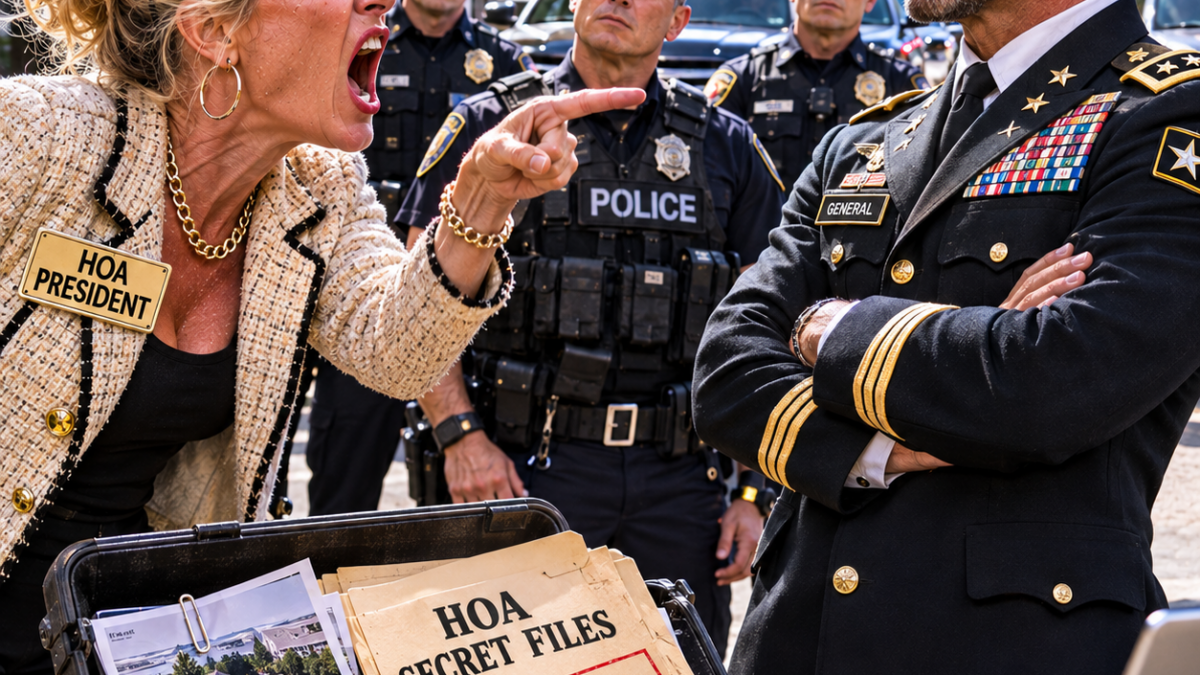
“GET THE POLICE—THIS DANGEROUS SOLDIER IS TRYING TO KILL ME!” HOA Karen Called Three Cruisers on My Driveway—She Had No Idea I Commanded 12,000 Soldiers or What Her Secret Files Would Expose
“GET HIM OUT OF THIS NEIGHBORHOOD—HE’S A DANGEROUS MILITARY MAN WHO THINKS HE’S ABOVE THE LAW!” HOA treasurer Linda Ashford screamed into her phone while standing deliberately behind my parked truck, and within minutes three police cruisers surrounded my driveway as my ten-year-old twins watched from the porch and my seventy-three-year-old father, a Vietnam veteran living with dementia, began crying because he thought soldiers had come to take me away.
Linda had spent three months filing complaints against my family, humiliating military children at school, and telling neighbors I was mentally unstable, but she had no idea that I was Colonel Marcus Hendricks, the garrison commander responsible for roughly 12,000 soldiers at Fort Carson, or that my home security cameras had recorded her whispering that destroying my career would be the first step toward forcing every military family out of Maplewood.
And when an independent investigation uncovered a coordinated network collecting the personal schedules, children’s information, financial vulnerabilities, and home-security details of twelve military families, Linda discovered that her plan to have me removed from command had opened the door to investigators who were far more interested in who was buying those files than in the truck I parked on my own driveway.
The first police cruiser arrived at 7:18 on a Friday morning.
I remember the exact time because my daughter Emma had been watching the kitchen clock, terrified that she would miss the school bus.
The second cruiser pulled in thirty seconds later.
The third blocked the street near our mailbox.
Red and blue lights washed across the front windows of our home.
I stood beside my Ford F-150 with one hand resting against the door.
Across the street, Linda Ashford held her phone against her chest.
She was smiling.
Not nervously.
Not with relief.
She had the tight, satisfied expression of someone watching a performance unfold exactly as rehearsed.
An officer stepped out of the first cruiser.
“Sir, keep your hands where I can see them.”
I lifted both hands.
“Of course.”
“Step away from the vehicle.”
I complied.
Behind me, our front door opened.
“Daddy?”
Emma.
My heart dropped.
“Go inside, sweetheart.”
She didn’t move.
Her twin brother Jake appeared beside her.
Both ten years old.
Both still wearing their backpacks.
Their mother had been deployed to Germany for four months, and I was already struggling to keep their mornings from becoming chaos.
Now they were watching police officers approach their father like he was a threat.
Then my own father stepped onto the porch.
Seventy-three.
Vietnam veteran.
Purple Heart.
A man who could once field-strip a rifle blindfolded and now sometimes forgot what room he was standing in.
He saw the patrol cars.
His face changed.
“Marcus?”
“Dad, go inside.”
He gripped the railing.
“What’s happening?”
“Nothing you need to worry about.”
He looked at the officers.
Then toward the street.
His breathing became shallow.
“Are they taking you?”
The question struck me harder than anything Linda had done.
“No, Dad.”
He took one step down.
“Marcus, I can’t lose another boy.”
My father had lost his younger brother in Vietnam.
Sometimes, during the worst episodes of confusion, he forgot that fifty years had passed.
He remembered the loss.
Not the calendar.
I watched him stare at the police cruisers, suddenly certain that his son was about to disappear.
And across the street, Linda was still smiling.
Officer Martinez approached.
He was young but experienced enough to keep his voice calm.
“Sir, we received a complaint alleging that you threatened a neighbor with your vehicle.”
I nodded toward the truck.
“It’s parked.”
“Were you operating it when the incident occurred?”
“I was preparing to back out.”
“Did anyone approach the vehicle?”
“Yes.”
“Who?”
I looked across the street.
“Mrs. Ashford.”
Linda stepped forward immediately.
“He tried to run me over!”
Emma gasped.
Jake shouted:
“THAT’S A LIE!”
I turned.
“Jake, inside.”
“But Dad—”
“Inside, son.”
My voice came out sharper than intended.
Jake flinched.
I hated that.
Then Emma started crying.
Dad looked from the children to me.
His hands began shaking.
And something inside my chest went painfully cold.
I had served three deployments in Afghanistan.
I had walked through places where every roadside object could be a threat.
I’d spent twenty-three years in military service learning how to make decisions under pressure.
But standing in my driveway while my children cried and my father slipped backward into a war he’d survived decades earlier, I felt something I hadn’t felt during combat.
Helplessness.
Not because I couldn’t defend myself.
Because I knew exactly how easily one reckless reaction could make the morning worse.
So I stayed still.
And spoke calmly.
“Officer, my home security cameras cover the driveway and the street-facing approach.”
“The footage should clarify what happened.”
Linda laughed.
“Of course he has cameras.”
“He’s a military intelligence officer.”
“He watches everybody.”
Martinez looked at her.
Then back at me.
“Sir, could you provide the recording?”
“Yes.”
I reached for my phone only after he agreed.
Opened the security application.
Selected the previous fifteen minutes.
And pressed play.
On the screen, my truck sat in the driveway.
I entered from the garage carrying the twins’ lunch bags.
Placed them inside.
Started the engine.
Checked the mirrors.
Then Linda emerged from across the street.
Phone already raised.
She walked behind the truck.
Stopped.
Spoke into her phone.
And positioned herself directly in the path I would have taken if I had reversed.
The audio captured her voice.
Not perfectly.
But clearly enough.
“This should be the final complaint we need. Once they remove him from command, we can get the rest of these military families out of the neighborhood.”
Martinez stopped the video.
Looked up.
Linda was no longer smiling.
And I knew that the morning was about to become something much bigger than a parking complaint.
Three months earlier, I hadn’t even known Linda’s name.
All I wanted was a quiet home for my family.
My wife Sarah was serving in Germany.
Our ten-year-old twins needed school, homework, meals, and somebody who remembered that Emma hated peanut butter while Jake refused to eat apples unless they were sliced.
My father needed predictable routines, medical appointments, and the patience of a household that understood his memory was slipping away.
And Fort Carson needed a commander.
Twelve thousand soldiers.
Training.
Logistics.
Readiness.
Families.
Personnel issues.
Budget meetings.
Inspections.
Problems that followed me home whether I invited them or not.
I had chosen Maplewood because it seemed peaceful.
Tree-lined streets.
A playground.
Wide sidewalks.
Houses built close enough that neighbors could help one another but far enough apart to leave a little privacy.
We had lived there eight years.
Eight.
Yet Linda Ashford, who had moved in only six months earlier, had decided my family was a temporary inconvenience.
She was HOA treasurer.
Not president.
But she behaved as if she’d personally purchased every lawn, driveway, mailbox, and resident in Maplewood.
Her husband, Charles Ashford, operated a facilities-management company that had recently lost a competitive bid for a major maintenance contract associated with Fort Carson.
The contract was worth approximately $2.3 million.
I knew about the procurement.
I had not personally selected the successful contractor.
The award process involved contracting officials, evaluations, legal requirements, and documented competition.
Charles’s firm had not won.
That should have been the end.
Instead, his wife apparently decided the families of soldiers living near the installation would pay for his disappointment.
I didn’t know that when she first appeared beside my driveway.
But I would learn.
And by the time the truth finally came out, Linda would have to explain not only why she had tried to get me arrested for parking at home, but why she’d maintained detailed files on children who had never done anything to her.
PART2
The first confrontation happened on a Tuesday morning in September.
I was adjusting the parking position of my F-150.
Nothing unusual.
Our twins had left their bicycles beside the garage, and I wanted enough room for them to walk past without scratching the truck.
I pulled slightly to the right.
Parked.
Turned off the engine.
Then heard:
“EXCUSE ME!”
I looked across the street.
Linda Ashford was coming toward me in a cream-colored sweater, dark sunglasses, and shoes that were spectacularly unsuited to walking across gravel.
She carried her phone upright.
Recording.
“Can I help you?”
She pointed at the truck.
“That vehicle is parked at an unacceptable angle.”
I looked at it.
Then back at her.
“It’s in my driveway.”
“It obstructs emergency sight lines.”
I glanced toward the street.
The truck was fully within the driveway.
No sidewalk obstruction.
No vehicle access blocked.
“What emergency sight line?”
She frowned.
“Don’t be difficult.”
“I’m asking.”
“This is a residential neighborhood, Colonel.”
I had never told her my rank.
But it wasn’t secret.
A few neighbors knew.
The installation directory and community events made my position discoverable.
At the time, I assumed someone had mentioned it.
“We’re aware this isn’t a military base,” I said.
Linda’s expression sharpened.
“Then stop behaving like a military commander in your own neighborhood.”
I stared.
“How am I doing that?”
“By taking up more space than necessary.”
I almost laughed.
“You’re welcome to bring any actual driveway restriction to the HOA board.”
“I’m the treasurer.”
“Then you know how to submit it.”
She stepped closer.
“Military families seem to believe normal community rules don’t apply to them.”
That sentence bothered me.
Not because it was insulting.
Because she’d moved from my truck to military families in general.
“Rules apply to everybody,” I answered.
“Good.”
She lifted her phone.
“Then you won’t mind if I document this.”
I shrugged.
“It’s a public-facing driveway.”
“Document away.”
She looked irritated that I hadn’t stopped her.
Then turned and marched home.
I thought it was finished.
Twenty minutes later, a patrol officer arrived.
Complaint:
Aggressive military neighbor threatening an HOA representative.
I provided the video.
Answered the questions.
The officer left without finding a basis for the alleged threat.
Linda stood in her front window watching.
That evening, I received an HOA violation notice.
IMPROPER VEHICLE POSITIONING.
The next morning:
EXCESSIVE EARLY-MORNING ENGINE NOISE.
Then:
UNAUTHORIZED FENCE ALTERATION.
I had replaced a loose board that was falling off.
Seven notices arrived within ten days.
Seven.
Each referenced a different bylaw subsection.
Each included a photograph.
Some were taken so close to our property that the photographer appeared to have stood on our lawn.
I spread them across my home-office desk.
Read every line.
Then checked the actual covenants.
Several notices misapplied the cited provisions.
Others relied on interpretations that were inconsistent with how similar properties had been treated.
At first, I tried handling each one quietly.
Written responses.
Photographs.
Copies of approvals.
Requests for clarification.
No threats.
No special privileges.
I didn’t want to be the commander who used his military title to win an argument about a fence.
Then my daughter came home crying.
And the dispute stopped being about property.
Emma was carrying a crumpled piece of paper when she walked through the door.
Her eyes were red.
Her backpack hung from one shoulder.
I was helping Dad sort his medications into the weekly organizer.
“Hey, sunshine.”
She didn’t answer.
“Emma?”
She walked straight toward me.
Then wrapped both arms around my waist.
“What happened?”
She started crying.
Jake followed.
His jaw was tight.
“Mrs. Ellie said Emma can’t be safety patrol captain anymore.”
I crouched.
“Why not?”
Emma wiped her face.
“Because we’re military.”
My stomach tightened.
“What?”
“She said some moms complained.”
“Complained about what?”
“That we might move.”
I stared.
“We’ve lived here eight years.”
Emma nodded.
“I told her.”
“Then what?”
“She said military kids should let permanent families have leadership jobs.”
Jake slammed his backpack onto the floor.
“Tommy Morrison said we’re not real neighbors.”
I looked at him.
“Who told him that?”
“His mom.”
Jake’s voice cracked.
“She said military dads just come and go.”
I wanted to stand.
Walk across the street.
Demand answers.
But my children were standing in front of me.
And they needed a father more than they needed an angry colonel.
So I sat on the floor.
Opened my arms.
Both came.
Emma buried her face against my shoulder.
Jake tried not to cry.
Then failed.
I held them.
“Listen to me.”
“Both of you.”
They looked up.
“You belong here.”
“This is your home.”
“Your mom belongs here.”
“Grandpa belongs here.”
“And no neighbor gets to decide you’re less important because one of your parents wears a uniform.”
Emma whispered:
“But they can take my school job.”
I swallowed.
“Then we find out why the school changed its decision.”
“Can you make them stop?”
That question hurt.
Because I had influence at a military installation.
Not unlimited authority over a school.
I could ask questions.
Request records.
Advocate.
But I couldn’t simply order civilians to treat my children fairly.
“I can help make sure your voices are heard.”
Emma looked disappointed.
I understood.
Children want their father to be able to fix everything.
Sometimes honesty feels smaller than reassurance.
Then Dad appeared in the doorway.
He had been listening.
For once, his eyes were clear.
“Marcus.”
“Yeah, Dad?”
He looked at the twins.
“Who told my grandchildren they don’t belong?”
I sighed.
“It’s a school problem.”
Dad shook his head.
“No.”
“It’s a character problem.”
Then he looked at Emma.
“Sweetheart, I fought in a war because people back home were supposed to have the freedom to live their lives.”
He paused.
“I didn’t come home so some woman could decide children don’t count.”
Emma ran to him.
He hugged her carefully.
Then looked at me.
“Son.”
“Yes?”
“Don’t let her teach them that being quiet means accepting mistreatment.”
I nodded.
I didn’t know how much longer Dad would be able to give advice like that.
Some days he forgot I was his son.
That night, he remembered exactly who he was.
And exactly what mattered.
After the children went to bed, I reviewed the HOA records available to homeowners.
I wasn’t trying to build a criminal case.
I wanted to understand whether other military families were experiencing selective enforcement.
I made a spreadsheet.
Violation dates.
Types.
Addresses.
Outcomes.
Appeals.
Some records were incomplete, so I noted those gaps rather than assuming facts.
But the pattern in the available material was striking.
Military-connected households represented about twenty-three percent of the properties I could identify.
Yet they accounted for approximately seventy-three percent of the formal violations in the sample I’d obtained.
That alone did not prove discrimination.
Different households can generate different complaints.
Evidence requires comparisons.
So I looked for similar conduct.
My repaired fence board.
Linda had repaired a nearly identical board on her own fence.
No citation.
My truck starting for duty at 6:30.
Charles Ashford’s diesel pickup started at roughly the same time.
No violation visible in the records.
Captain Williams had been cited for an allegedly intimidating flag display.
A civilian neighbor with a similar display received no formal notice.
Master Sergeant Rodriguez received repeated lawn-height violations.
Nearby nonmilitary homes with comparable grass conditions received reminders or nothing at all.
I organized photographs.
Dates.
Documents.
Then stopped.
Because I knew where this could go.
I could spend nights turning neighborhood disputes into an intelligence exercise.
Map every person.
Every complaint.
Every connection.
But I’d spent enough years in uniform understanding the difference between collecting relevant evidence and allowing suspicion to consume your life.
I closed the spreadsheet.
Looked at the photograph of Sarah and the twins above my desk.
Germany.
Four thousand miles away.
She didn’t know what our children had endured that afternoon.
I picked up my phone.
Then put it down.
I didn’t want to worry her.
That was my first mistake.
Not Linda’s first wrongdoing.
Mine.
I began carrying the entire problem alone.
The next day, the school called about Emma’s gifted program.
She had tested in the ninety-fifth percentile.
Qualified.
Excited.
For weeks, she’d talked about the advanced science projects.
Now the school said her placement was under review.
“Why?”
I asked.
The coordinator hesitated.
“Questions have been raised about continuity.”
“Continuity?”
“Whether the family expects to remain in the district.”
I stared.
“We own our house.”
“Yes.”
“I’ve been assigned to Fort Carson for years.”
“Yes.”
“Has my daughter failed any academic requirement?”
“No.”
“Then why is her placement suddenly uncertain?”
The woman grew quiet.
Finally:
“Certain parent committee members expressed concerns.”
I felt my jaw tighten.
“About my daughter?”
“About military mobility generally.”
There it was.
I kept my voice steady.
“Please provide the written placement criteria and the basis for reconsidering her selection.”
“We can arrange a meeting.”
“Good.”
“I’d appreciate that.”
I hung up.
Then sat at my desk.
Not moving.
Linda had moved from the HOA into the school.
She was no longer just harassing me.
She was trying to teach my children that their father’s service made them less deserving.
And I still hadn’t told Sarah.
The school board meeting took place on a Wednesday evening.
I arranged for Dad to stay with a trusted neighbor because the meeting would run late.
The twins came with me.
They asked.
I agreed.
Not because I wanted them exposed to an angry public debate.
Because the decisions concerned them, and I didn’t want them to feel their own future was something adults discussed behind closed doors.
Linda arrived with five women.
Matching folders.
Printed packets.
An organization they’d named the Concerned Mothers Coalition.
She stood at the podium in a navy blazer.
Perfect hair.
Prepared remarks.
“Military families contribute to our community,” she began, “and of course we respect their service.”
A phrase followed every few minutes.
Of course we respect their service.
Then came the actual message.
Military families were unstable.
Deployment stress affected children.
Rotations disrupted classrooms.
Leadership opportunities should prioritize long-term residents.
Special programs required continuity.
Her slides included statistics about military mobility.
Some were accurate in isolation.
But she was applying broad averages to individual children without evidence that those children were likely to move or unable to participate.
Then she named my family.
“Colonel Marcus Hendricks provides a perfect example.”
I felt Emma stiffen beside me.
Linda continued.
“His household has generated repeated neighborhood complaints.”
“His children are struggling to adapt to civilian expectations.”
“And yet he expects those children to receive leadership opportunities that more stable local families could fulfill.”
Jake whispered:
“Dad?”
I took his hand.
Linda looked toward us.
Then smiled.
“Military privilege should not replace fairness.”
Something inside me went very quiet.
When the public-comment period opened, I stood.
“Colonel Hendricks.”
I said.
“Parent of Jake and Emma Hendricks.”
“I’d like to correct several claims.”
The board chair nodded.
“Go ahead.”
“First, my children have attended this district for years.”
“Second, there has been no announced relocation.”
“Third, Emma qualified for the gifted program through the published testing criteria.”
“Fourth, I’m not requesting special treatment.”
“I’m asking that decisions about individual children be based on their actual qualifications.”
Linda folded her arms.
I continued.
“Military families do move.”
“Sometimes frequently.”
“Children may experience stress during deployments.”
“Those are real issues.”
“But none of that justifies excluding a specific child from a school opportunity because somebody assumes her family is temporary.”
A few parents nodded.
The chair asked for the relevant selection policy.
The district administrator looked through her papers.
Then admitted that residential stability was not part of the academic eligibility criteria for the program.
A murmur moved through the room.
Linda stood.
“Continuity matters!”
The chair looked at her.
“Mrs. Ashford, please wait your turn.”
Linda sat.
Angrily.
Then Emma tugged my sleeve.
“Daddy?”
“Yes?”
“Can I say something?”
I looked toward the chair.
Then at my daughter.
She was shaking.
I knelt.
“You don’t have to.”
“I know.”
“Are you sure?”
She nodded.
I asked the chair whether she could speak.
He agreed.
Emma approached the microphone.
Ten years old.
Small enough that a staff member lowered it for her.
She looked at the board.
Then at Linda.
“My name is Emma.”
Her voice trembled.
“I’ve lived here since I was two.”
“My mom is in Germany because she’s in the Army.”
“My dad takes us to school every day.”
“My grandpa lives with us.”
She swallowed.
“I don’t know if we’ll ever move.”
“Kids who aren’t military can move too.”
A few people smiled.
Emma continued.
“I worked really hard to get into the science program.”
“I didn’t ask somebody to let me in because my dad’s a colonel.”
“I did the test.”
Her eyes filled.
“And I don’t think it’s fair that people who don’t know me get to say I can’t do it because maybe someday we might move.”
Silence.
Then she whispered:
“I just want to go to school.”
My throat closed.
The chair thanked her.
A teacher in the front row began clapping.
Then another.
The room followed.
Linda remained seated.
Arms folded.
Face hard.
As Emma walked back, Jake stood and hugged her.
I sat beside them, unable to speak.
Because my daughter had just explained fairness more clearly than thirty adults with printed presentations.
The school reversed the questionable program decision after reviewing its criteria.
Emma’s placement was confirmed.
Jake’s student leadership opportunities were reviewed separately.
Other military-connected families requested explanations for similar decisions.
Some situations had legitimate administrative reasons.
Others exposed inconsistent procedures.
Parents began pushing for clearer selection criteria.
That should have been the end.
But Linda couldn’t tolerate public embarrassment.
She escalated.
More HOA violations.
More reports to police.
Anonymous concerns sent to my command.
Claims that I intimidated civilians.
Accusations that military training had made me unstable.
One report suggested I might be experiencing combat-related mental health problems.
That accusation angered me for two reasons.
First, it was unsupported.
Second, it treated mental health care as something shameful or inherently dangerous.
I had spent years encouraging soldiers to seek treatment when they needed it.
PTSD is not proof that someone is violent.
Seeking care is not evidence of misconduct.
Yet Linda was using those stereotypes as weapons.
When Lieutenant Colonel Sarah Webb from installation security called, her tone was careful.
“Marcus.”
“Sarah.”
“We’ve received allegations concerning your conduct in the community.”
“I expected that.”
She paused.
“You did?”
“Yes.”
“Then we need to talk.”
We met through proper channels.
I provided the relevant documents.
Not a speech.
Evidence.
The complaints.
The videos.
The school meeting record.
The pattern of timing.
Webb listened.
Then said:
“We’ll assess any allegations that actually concern command conduct.”
“Fair.”
“And Marcus?”
“Yes?”
“This is a conflict-sensitive situation.”
“I know.”
“You cannot turn military resources toward settling a neighborhood dispute.”
“I won’t.”
She nodded.
“Good.”
Then:
“But if someone is seeking restricted personnel information or threatening dependent security, that becomes a separate matter for the appropriate security and law-enforcement authorities.”
I leaned forward.
“What do you mean?”
“Have you seen anything suggesting that?”
I thought about the photographs.
The unusual detail in certain complaints.
The school information.
The references to deployment schedules.
Then said:
“Not enough to establish that.”
Webb nodded.
“Then document what you do have.”
That was how a legitimate investigation should begin.
Not by deciding a rude HOA treasurer was a foreign spy.
By identifying actual concerns and giving them to the people authorized to examine them.
I left the meeting uneasy.
Because until then, I had thought Linda wanted to hurt my reputation.
Now I wondered whether somebody had been collecting information they had no business holding.
The next discovery came from Captain Luis Rodriguez.
His wife worked in the school district’s administrative office.
She had noticed unusual requests for information about military-connected families.
Not just school committee membership.
Emergency contacts.
Children’s schedules.
Parent deployment availability.
Home addresses.
Certain medical accommodations.
The requests were being framed as community safety planning.
But the breadth concerned her.
Luis called me that evening.
“Marcus, I think you need to talk to Webb.”
“What happened?”
He explained.
I listened.
Then asked:
“Did your wife provide the information?”
“No.”
“She questioned the requests.”
“Good.”
“There’s more.”
He hesitated.
“Some of the women making requests are connected to Linda’s coalition.”
My stomach tightened.
“Do you have documents?”
“Only what my wife is authorized to preserve and report internally.”
“Then don’t send me private student records.”
Luis paused.
“Right.”
“Have her report the requests through school administration and appropriate privacy channels.”
“Understood.”
I hung up.
Then looked toward the twins’ bedrooms.
Their doors were open.
Emma was reading.
Jake was building something from plastic bricks.
Normal.
Children.
I imagined their school pickup times in a stranger’s spreadsheet.
Their medical contacts.
Their mother’s deployment.
Their grandfather’s health.
And for the first time, Linda frightened me.
Not because she was loud.
Because the things she seemed interested in had nothing to do with lawn height.
Over the following weeks, several families came forward.
Master Sergeant Rodriguez had received repeated selective violations.
Captain Williams had been pressured over his flag.
Lieutenant Bailey over his truck.
Others from nearby subdivisions described similar efforts to exclude military children from activities.
Captain Martinez said his children had been removed from a soccer roster after parent pressure about scheduling stability.
Major Thompson’s daughter faced questions about long-term commitment to her school organization.
Sergeant First Class Johnson’s son had been told military mobility might affect scholarship consideration.
The details varied.
Not every unfavorable decision was discriminatory.
Not every person involved knew Linda.
But enough similarities existed to warrant a closer review.
I created a civilian-side summary using information families voluntarily provided.
Dates.
Statements.
Documents.
Public meeting records.
I did not access classified personnel records.
Did not request service members’ private information.
Did not use intelligence systems to map civilian neighbors.
Instead, affected families worked with counsel and the appropriate school, housing, and military-support offices.
I sent my summary to Webb.
Then told Sarah.
Finally.
The call was difficult.
She appeared on my phone screen from Germany.
Hair pulled back.
Tired eyes.
The background of a temporary military office.
“Marcus.”
“Hey.”
She studied me.
“What happened?”
I almost smiled.
“How do you always know?”
“Twenty years of marriage.”
I told her.
The HOA complaints.
The school.
Emma.
Jake.
The information requests.
The police reports.
All of it.
By the end, Sarah was crying.
“You let me think everything was fine.”
I looked down.
“I didn’t want to worry you.”
Her expression changed.
“Marcus.”
“I know.”
“No.”
“Listen to me.”
I looked up.
“I’m their mother.”
“I don’t stop being their mother because I’m deployed.”
“I know.”
“And I’m your wife.”
“I know.”
“Then stop protecting me from our life.”
That hurt.
Because she was right.
I had been treating the home front like another operation I could manage alone.
But family isn’t a command.
Partnership isn’t compartmentalization.
I swallowed.
“I’m sorry.”
She wiped her face.
“How are the kids?”
“Scared.”
“Dad?”
“Some days better.”
She closed her eyes.
Then whispered:
“I wish I were home.”
I wanted to tell her to come back immediately.
I didn’t.
Her duties mattered.
The process for any compassionate adjustment belonged to her command.
Instead, I said:
“I wish you were too.”
She looked at me.
“Promise me something.”
“Anything.”
“When this gets worse…”
I nearly laughed.
“You think it’s going to get worse?”
“Yes.”
“Because people who do this don’t usually stop when you ask nicely.”
She leaned closer.
“Don’t turn this into a personal military operation.”
“I won’t.”
“Don’t make the kids feel like we’re at war with our neighbors.”
“I’ll try.”
“And don’t forget Dad.”
I looked toward the hallway.
“Never.”
She softened.
“Good.”
Then:
“Put Emma on.”
I called the children.
Emma ran.
Jake followed.
For the next twenty minutes, Sarah asked about school, homework, friends, and whether Jake had finally cleaned beneath his bed.
She didn’t mention Linda.
Not once.
She reminded them that life was bigger than one angry neighbor.
I listened from the kitchen.
And understood I should have called her much sooner.
Dad’s condition worsened that winter.
Not continuously.
Dementia rarely moves in a straight line.
Some mornings, he knew everything.
My rank.
The twins’ names.
The year.
What he’d eaten.
Other mornings, he looked at me and asked when his own father was coming home.
Sometimes he thought I was his brother.
Sometimes he called Jake by my childhood nickname.
The hardest days were when he knew something was wrong but couldn’t explain it.
One afternoon, Linda approached him near the mailbox.
I learned what happened from Dad’s account, a neighbor, and the door camera.
She asked whether I kept military weapons in the house.
Whether officers visited late at night.
Whether Dad felt safe living with a man who had spent years in combat.
Dad became confused.
He started talking about Vietnam.
Linda kept asking questions.
He grew distressed.
When I found him, he was sitting on the porch shaking.
“Dad?”
He looked at me.
“Are we going home?”
“We are home.”
“No.”
He looked toward the street.
“The woman said we’re being watched.”
My blood went cold.
“Who?”
He pointed at Linda’s house.
Then began crying.
“Marcus, I can’t remember where your mother is.”
My mother had died twelve years earlier.
I sat beside him.
Took his hand.
Told him gently.
He cried harder.
A neighbor named Mrs. Price brought us water.
She looked furious.
“Linda was questioning him.”
I nodded.
“I saw.”
“Marcus, she knew he gets confused.”
I looked across the street.
Linda’s curtains moved.
I wanted to walk over.
Shout.
Demand she leave him alone.
Instead, I took Dad inside.
Made tea.
Put on an old baseball game.
He slowly settled.
Later, when he was clear again, he said:
“You’re angry.”
“Yes.”
“Don’t let her make you stupid.”
I laughed despite myself.
He smiled.
“That’s what I used to tell you when you were little.”
“I remember.”
Then he took my hand.
“Marcus, I know I’m forgetting things.”
I went still.
He looked toward the twins’ photographs.
“Don’t let anybody use that to make you ashamed of me.”
My throat closed.
“Never, Dad.”
He nodded.
“Good.”
Then:
“And don’t let them make those kids ashamed of you.”
I held his hand.
I promised.
Both things.
Linda’s next police complaint alleged that I was conducting surveillance of her home.
She claimed my cameras, mounted on my property, were intended to intimidate her.
Another alleged threatening gestures.
Another accused me of harassment during ordinary neighborhood encounters.
The reviews did not substantiate those claims as presented.
But every complaint took time.
Every letter needed a response.
Every new allegation added stress to the household.
Then, one Friday morning, she made the mistake that changed everything.
My truck was parked in the driveway.
I was preparing to take the twins to school.
Linda stood across the street.
Phone raised.
Recording.
I gave her a polite nod.
Nothing more.
She moved behind my truck.
I saw her in the rear camera.
Stopped.
Stayed in park.
She began shouting into her phone.
“He’s trying to run me over!”
The words were absurd.
But absurdity can become dangerous when someone else is required to respond to it.
Three patrol cars arrived.
The children cried.
Dad thought I was being taken away.
And Officer Martinez watched the security recording.
The part where Linda walked behind the truck.
The part where she said:
“This should be the final complaint we need. Once they remove him from command, we can get the rest of these military families out of the neighborhood.”
Martinez replayed it.
Then asked:
“Mrs. Ashford, were you speaking to someone on the phone?”
Linda stared.
“I was calling for help.”
“Before the emergency call?”
She looked away.
“I don’t remember.”
I said nothing.
Martinez reviewed the situation.
The vehicle had remained stopped.
There was no visible attempt to strike her.
The complaint was documented for further assessment.
The officers didn’t simply declare crimes on the spot.
But the footage was preserved.
And Linda’s own words gave investigators a new reason to ask questions.
Not about my truck.
About her stated plan to remove military families from their homes.
When the patrol cars finally left, I walked toward the porch.
Emma ran into my arms.
Jake held on to my coat.
Dad stared.
“Are you staying?”
I crouched before him.
“Yes.”
“You’re not going?”
“No.”
He touched my shoulder.
Then whispered:
“Good.”
He looked relieved.
But he still didn’t understand what had happened.
I realized then that Linda’s accusations had entered the one place I had tried hardest to protect.
My father’s fragile sense of safety.
And no amount of paperwork could erase that morning from my children’s memories.
The recording was reported through proper channels.
Civilian law enforcement reviewed potential false-reporting and harassment concerns.
The HOA received complaints about selective enforcement.
School administrators examined whether private student information had been requested or disclosed improperly.
Base security separately assessed whether restricted or operationally sensitive information had been sought.
Those investigations had different purposes.
Different authority.
Different rules.
That mattered.
I wasn’t permitted to turn Fort Carson into my personal police department.
I couldn’t summon Linda to the garrison office and threaten her with military arrest because she had been rude to my family.
She was a civilian.
Her rights mattered.
Even when she behaved as though ours did not.
Instead, the appropriate authorities handled their own parts.
And because I was personally involved, I stepped away from decisions that could create conflicts.
It wasn’t glamorous.
But it was lawful.
That was the only justice I wanted.
A result that could survive scrutiny after the headlines faded.
The larger discovery began with a shared document.
Not something I stole from Linda’s computer.
Not a secret intelligence interception.
A file provided to investigators through an authorized witness who had participated in the Concerned Mothers Coalition and become disturbed by its activities.
Her name was Barbara Ellis.
She had initially joined because Linda claimed military families needed more support during deployments.
Barbara believed it was a community-service project.
At first, the spreadsheets contained ordinary information.
Volunteer availability.
School-event schedules.
Neighborhood contacts.
Then Linda added columns.
FAMILY STABILITY.
DEPLOYMENT RISK.
HOUSEHOLD VULNERABILITY.
EFFECTIVE COMPLAINT TYPE.
Barbara said she thought the document was inappropriate.
Linda told her it was strategic planning.
Then names appeared.
Military families.
Twelve at first.
Across multiple subdivisions.
Some entries listed children’s school schedules.
Others described spouses’ deployment status.
Home-security cameras.
Vehicles.
Medical issues.
Debt concerns.
Some information appeared to have come from public social media.
Other details raised serious questions about privacy and authorization.
Barbara confronted Linda.
According to her statement, Linda said:
“We need to know which pressure points make these families leave.”
Barbara quit the group.
Then preserved what she could lawfully provide and reported her concerns.
Investigators obtained the complete document through appropriate legal process.
The contents were worse than I expected.
Not because every item was classified.
Most wasn’t.
Because the document treated children and families as targets.
An eight-year-old’s allergy.
A soldier’s spouse working night shifts.
A father’s dementia.
A child’s fear when a parent deployed.
Information that should have prompted compassion had been organized into categories of leverage.
I was shown a limited, appropriately reviewed summary because my family was affected.
One entry listed:
HENDRICKS HOUSEHOLD — COMMAND PRESSURE, DEPENDENT SCHOOL ISSUES, ELDERLY FATHER, COMPLAINT ESCALATION HIGH PRIORITY.
I stared.
My father.
My children.
Our home.
Reduced to a row.
I had analyzed hostile networks during military service.
But this was different.
These weren’t combatants.
They were neighbors.
And the person entering the information had smiled at us during school pickup.
The family profiles created another concern.
Some data involved service schedules, installation activities, and security arrangements.
Not necessarily classified.
But potentially sensitive when aggregated.
Base security referred relevant material to appropriate federal investigators for assessment.
The FBI became involved after information suggested possible unauthorized acquisition and transfer of personal or security-sensitive data across jurisdictions.
I did not decide whether espionage occurred.
I did not get access to every finding.
There were legitimate limits.
But the investigation eventually identified outside intermediaries who had sought information about military households.
Some requests appeared linked to private commercial intelligence or data-brokering activity.
Others raised questions about foreign connections.
Investigators had to determine what was legal, what was unauthorized, and whether anyone intended to support hostile intelligence gathering.
The distinction mattered.
A neighbor collecting public photographs is not automatically a spy.
A civilian questioning military policy is not automatically committing a federal crime.
And being cruel to military families is not, by itself, proof of espionage.
But unauthorized access to protected records, fraud, threats, stalking, and certain transfers of sensitive information can create serious legal consequences.
The evidence—not my anger—had to determine the outcome.
Linda kept escalating anyway.
She held a press conference on the sidewalk across from my house.
Two local news vans.
A radio reporter.
Several parents.
Her supporters holding signs.
PROTECT CIVILIAN NEIGHBORHOODS.
STOP MILITARY INTIMIDATION.
I watched through the kitchen window.
Dad was asleep in his recliner.
The twins were at school.
Sarah was still in Germany.
Linda stood before the cameras.
Navy blazer.
Perfect hair.
A folder pressed against her chest.
“Today,” she announced, “we are exposing a dangerous pattern of military influence in residential communities.”
She pointed toward my house.
“Colonel Marcus Hendricks has used his status and authority to intimidate law-abiding civilians.”
I stared.
Not because the accusation was new.
Because she was now broadcasting it.
Then she continued.
“Military families bring unnecessary instability.”
“Combat-trained individuals should not be permitted to intimidate ordinary homeowners.”
“We need neighborhoods where civilian families can feel safe.”
A reporter asked:
“Are you proposing restrictions on military families purchasing homes?”
Linda smiled.
“Yes.”
The word hung in the cold air.
“We need military-free residential zones near sensitive community areas.”
I nearly dropped my coffee.
Not because the proposal had any obvious lawful basis.
Because she had finally said her goal aloud.
Not a fence.
Not a truck.
Not a safety patrol position.
Military families themselves.
She wanted them gone.
The reporter asked:
“Doesn’t that raise serious fairness and legal concerns?”
Linda crossed her arms.
“Communities have rights.”
Of course they did.
So did the people living inside them.
The clip aired that night.
Parents called the station.
Veterans commented.
Civil-rights groups expressed concern.
Local officials clarified that an HOA did not possess blanket authority to exclude households merely because a parent served in the military.
And investigators obtained the recording as evidence of Linda’s stated intentions.
But no amount of public embarrassment made her stop.
She had become so convinced she was right that every objection seemed to prove a conspiracy against her.
I recognized the danger.
When someone treats all disagreement as evidence of persecution, correcting them can become almost impossible.
At home, the twins watched part of the news before I could turn it off.
Emma’s face crumpled.
“She doesn’t want us here.”
I sat beside her.
“Linda doesn’t decide that.”
“Then why does she keep saying it?”
I didn’t have a simple answer.
Jake looked at me.
“Are we going to move?”
“No plans to.”
“But if you get in trouble?”
I swallowed.
“I haven’t done what she says.”
“What if people believe her?”
That was the real fear.
Not truth.
Belief.
Reputation can affect a family before facts catch up.
I pulled them close.
“We’ll keep telling the truth.”
Emma whispered:
“I’m tired of having to prove we belong.”
I closed my eyes.
She was ten years old.
Ten.
And already exhausted by a fight she hadn’t chosen.
I thought of Sarah in Germany.
Dad asleep in the other room.
The morning patrol cars arrived.
Then I said:
“You shouldn’t have to prove that.”
“I’m sorry adults made you feel otherwise.”
Jake leaned against me.
Emma did too.
We sat like that until the television went dark.
Sarah called that evening.
She had seen the news.
Her expression was controlled.
Too controlled.
“Marcus.”
“Hey.”
“Are the kids okay?”
“Trying.”
“Dad?”
“Sleeping.”
She looked away.
Then back.
“I’ve spoken with my chain of command.”
I sat straighter.
“About what?”
“Our family situation.”
My chest tightened.
“Sarah—”
“No.”
“You listened to me last time.”
“Now listen again.”
I waited.
“I’m requesting consideration for an adjustment to my assignment based on documented family circumstances.”
“Dad’s care needs.”
“The twins.”
“The ongoing harassment.”
I swallowed.
“You don’t have to leave your mission because of this.”
“I know.”
“Then—”
“Marcus.”
Her voice softened.
“I miss our children.”
I stared.
“I miss you.”
She looked down.
“I know you’re trying to hold everything together.”
“But you’re not supposed to do it alone.”
My throat closed.
“What if they say no?”
“Then we’ll make another plan.”
She smiled sadly.
“That’s what families do.”
Not commands.
Families.
I nodded.
And for the first time in weeks, I allowed myself to feel relieved.
Not because the problem was solved.
Because I wasn’t the only one carrying it.
The decisive evidence came from a financial trail unrelated to the HOA fines.
Investigators found payments to intermediary businesses associated with the acquisition and compilation of private household information.
Some appeared to be ordinary consulting charges.
Others lacked legitimate explanations.
The full inquiry involved multiple agencies and jurisdictions.
Linda’s personal conduct was only part of it.
Several people had provided information.
A few believed they were participating in neighborhood safety planning.
Others were accused of knowingly obtaining information without authorization.
The investigators separated those roles.
That mattered.
Because when a scandal grows, people want everyone connected to it punished equally.
Real accountability requires knowing who did what.
Linda had coordinated pressure campaigns.
Her own statements supported that.
She had solicited information.
The spreadsheet supported that.
She had repeatedly filed accusations against families she wanted removed.
Documents supported that.
But the exact nature of any outside intelligence activity required independent proof.
I refused to speculate publicly.
Even when reporters asked.
Especially then.
A federal agent named Patricia Morrison eventually met with me and counsel.
She spoke carefully.
“We have concerns about unauthorized data acquisition and transmission.”
I nodded.
“I understand.”
“Some of the household information is private.”
“Yes.”
“Some of the sources may have used improper access.”
“Yes.”
“Some recipients are still being identified.”
I looked at her.
“Are my children safe?”
She paused.
Then answered with the only truthful answer available.
“We have not identified an imminent physical threat to them from the information currently reviewed.”
I exhaled.
Not completely.
But enough.
She continued.
“We do recommend continued attention to privacy, school pickup authorization, and ordinary home-security precautions.”
I nodded.
“Will Linda be arrested?”
“Charging decisions depend on evidence and the appropriate prosecutors.”
“Understood.”
Then I asked:
“Can you tell me why she was doing this?”
Morrison looked at me.
“We’re examining motive.”
“Personal retaliation appears to be part of the evidence.”
“Other financial and outside relationships are under review.”
I sat quietly.
That was enough.
The investigation was real.
The threat had been taken seriously.
But nobody was going to hand me a Hollywood ending simply because I wanted one.
Linda made one final attempt to damage my command.
She sent a packet to multiple offices containing allegations about my mental health, ethics, and supposed abuse of military authority.
Some photographs were ordinary pictures of my truck.
Others showed me taking Dad to medical appointments.
One photograph captured Emma crying near the driveway after the police visit.
That one made me sick.
She had used my daughter’s distress as evidence against me.
The packet alleged that I was emotionally unstable and therefore unfit for command.
The installation reviewed relevant concerns through proper procedures.
I answered questions.
Provided evidence.
Cooperated.
The conclusions did not substantiate the accusations as presented.
Then Lieutenant Colonel Webb called me into her office.
She stood when I entered.
“Marcus.”
“Ma’am.”
“Sit.”
I sat.
She looked at the file.
Then at me.
“I want you to know something.”
I waited.
“This review did not establish misconduct warranting the action requested against your command.”
I closed my eyes briefly.
She continued.
“But I also want to make sure you’re taking care of yourself.”
I almost laughed.
“Everybody keeps asking that.”
“Maybe because you look exhausted.”
I stared at her.
She wasn’t wrong.
Webb leaned forward.
“You have two children.”
“A father who needs care.”
“A spouse overseas.”
“And a high-responsibility command.”
“You do not need to prove strength by refusing help.”
I looked down.
She continued.
“We’ll work through legitimate support options.”
“Care resources.”
“Scheduling where possible.”
“Family services.”
“Not because you’re weak.”
“Because you’re human.”
For a moment, I couldn’t speak.
Then:
“Thank you.”
Webb nodded.
“And Marcus?”
“Yes?”
“Don’t confuse surviving a crisis with recovering from it.”
That sentence stayed with me.
Long after the investigation ended.
The civil side of the dispute accelerated.
Affected families retained legal counsel.
Parents requested reviews of school decisions.
HOA homeowners demanded a special meeting.
Military family-support organizations helped connect people with resources.
The association’s violation patterns were examined for selective treatment.
And Linda’s public statements became part of the record of her intentions.
Some complaints were legitimate.
A few military-connected households had actually violated minor community rules.
That did not excuse selective enforcement.
Fairness didn’t mean soldiers never had to follow rules.
It meant applying the same rules honestly to everybody.
That principle helped keep the coalition together.
Because civilian neighbors who had initially feared I was demanding military privilege began to understand what we were asking.
Not exemption.
Equality.
A repaired fence board should be treated the same regardless of whether the homeowner is military.
A child’s school placement should follow the same criteria regardless of whether a parent deploys.
A parked truck should not become a threat merely because its owner has a rank.
That message resonated.
Even with people who had originally supported Linda.
Mrs. Ellie, the school volunteer who had removed Emma from safety patrol, called me one afternoon.
She sounded nervous.
“Colonel Hendricks?”
“Marcus is fine.”
“I owe your daughter an apology.”
I sat down.
“Go on.”
“I believed the parent committee.”
“What did they tell you?”
“That your family was moving soon.”
“That Emma had already been informed.”
I stared.
“Neither is true.”
“I know now.”
She started crying.
“I should have asked.”
I didn’t rush to comfort her.
Because she should have asked.
Then she said:
“I want to speak to Emma personally.”
I looked toward the living room.
Emma was doing homework.
“Only if she wants to.”
“Of course.”
When I asked, Emma thought for a long time.
Then nodded.
Mrs. Ellie came the next afternoon.
She knelt beside Emma.
“Sweetheart, I made a decision based on information I hadn’t verified.”
“I was wrong.”
Emma looked at her.
“Did you believe I didn’t belong?”
Mrs. Ellie’s eyes filled.
“I let other adults convince me something unfair was practical.”
“That wasn’t right.”
Emma nodded slowly.
Then:
“I wanted that job.”
“I know.”
“I worked really hard.”
“I know.”
Mrs. Ellie wiped her face.
“Would you like to return?”
Emma considered.
Then shook her head.
I was surprised.
“Emma?”
She looked at me.
“Dad, I don’t want it anymore.”
I waited.
“I want to do science.”
She turned back to Mrs. Ellie.
“But please don’t take it from another kid because their mom or dad might move.”
Mrs. Ellie started crying again.
“I won’t.”
That was Emma.
Not a child getting everything back exactly as it had been.
A child deciding which parts of the experience she wanted to carry forward.
I was proud of her.
And sad that she’d had to grow up in that particular way.
Dad had his own moment of unexpected clarity.
It happened during a community gathering organized by military families and civilian neighbors.
Nothing dramatic.
A Saturday picnic.
Children playing.
People bringing food.
A short discussion about better relationships between the installation and nearby neighborhoods.
Dad sat under a tree with a blanket across his knees.
Jake had brought him tomatoes from the garden.
I was speaking to a neighbor when Dad called:
“Marcus.”
I turned.
“Yeah?”
“Come here.”
I crouched beside him.
He pointed toward a group of children.
“Are those our people?”
I smiled.
“Some are military families.”
He nodded.
Then:
“Good.”
I waited.
He looked at me.
“Son, don’t let anybody teach those kids that a uniform makes them better than other people.”
I nodded.
“Never.”
He continued.
“And don’t let anybody teach them it makes them worse.”
My throat tightened.
That was the whole fight.
Right there.
Not about soldiers being above civilians.
Not about civilians being enemies.
Equal dignity.
A shared neighborhood.
Rules applied fairly.
I took his hand.
“You’re right, Dad.”
He looked toward the kids again.
Then smiled.
“Good.”
A few minutes later, he asked where my mother was.
I sat beside him.
Helped him through the confusion.
But I never forgot what he’d said.
The major legal developments arrived several weeks later.
Investigators had gathered enough evidence to pursue charges against Linda and certain collaborators concerning unauthorized information access, related fraud or misuse of records, and documented false-reporting conduct where supported by applicable law.
Other complaints remained civil or administrative matters.
No magical statute converted every HOA insult into a federal offense.
No garrison commander issued a civilian arrest order.
The legal process came through investigators, prosecutors, and courts.
That mattered.
I wanted my children to understand that the law wasn’t a weapon for the most powerful person in the room.
It was supposed to be a process.
Sometimes frustrating.
Sometimes slow.
But more important than my desire for a satisfying confrontation.
The arrest warrants were executed without my involvement.
Linda was taken into custody in connection with charges supported by the investigation.
Other individuals faced separate proceedings according to their conduct.
I learned about it through proper notification.
Not because I’d been invited to watch her humiliation.
That evening, a reporter called.
“Colonel, how do you feel about Linda Ashford’s arrest?”
I looked toward the backyard.
Dad was sitting with the twins beside his tomato plants.
I answered:
“I’m relieved the matter is being handled through lawful channels.”
“Do you see this as a victory?”
“I see it as accountability being tested.”
The reporter paused.
“Can you elaborate?”
“Yes.”
“An arrest isn’t a conviction.”
“The people accused have rights.”
“The families affected deserve truthful answers.”
“And our neighborhood needs to rebuild without turning this into another campaign of intimidation.”
The reporter seemed disappointed.
He wanted a line about military justice.
I gave him something else.
The truth.
The HOA called an emergency meeting.
This time, not to punish me.
To determine what its own board knew and how to prevent the same problems.
The clubhouse was packed.
Linda’s chair sat empty.
Mrs. Henderson attended.
So did Master Sergeant Rodriguez.
Captain Williams.
Lieutenant Bailey.
Families who had never spoken at a meeting before.
Civilian neighbors who had once supported Linda.
The acting chair opened.
“We need to address the association’s selective enforcement concerns and the governance failures that allowed them.”
Some residents demanded immediate removal of every board member.
Others wanted investigations first.
Lawyers advised following the bylaws.
Records were reviewed.
Votes scheduled.
Policies changed.
An independent committee was formed to examine complaint handling.
The association eventually replaced the leadership responsible for the discriminatory enforcement practices.
Military-connected residents joined committees.
Not as a separate ruling bloc.
As homeowners.
Like everyone else.
The first major change was simple.
Formal violations required consistent documentation and review before fines.
The second:
The HOA would not collect unnecessary information about children’s school or medical circumstances.
The third:
Board members had to disclose conflicts and recuse themselves where required.
The fourth:
No person could use their HOA position to claim authority over school eligibility, military assignments, or matters outside the association’s lawful scope.
Mrs. Henderson stood.
“I’d like to add something.”
The chair nodded.
She looked around.
“A neighborhood isn’t an army.”
A few people laughed.
She continued.
“And it isn’t a kingdom.”
The room quieted.
“It’s a place where people live.”
“Some serve in the military.”
“Some don’t.”
“Some move.”
“Some stay thirty years.”
“Everybody still has to be treated like a neighbor.”
Applause spread.
I sat in the back.
Emma beside me.
Jake on my other side.
For the first time in months, I didn’t feel like we were defending our place there.
We were simply there.
Homeowners.
Family.
Neighbors.
The criminal proceedings took longer than the arrest.
Evidence was challenged.
Records examined.
Some alleged foreign connections proved narrower than the initial suspicions.
Others involved actual unauthorized information transfers to outside intermediaries with international ties.
Investigators established who acquired what, which records were improperly accessed, what payments were made, and which defendants knowingly participated.
Linda’s personal motive was strongly supported by her own words.
The lost maintenance contract.
Her hostility toward military families.
The attempts to damage my command.
The pressure campaign involving children.
But motive alone did not prove every charged offense.
The prosecutors relied on the evidence they could establish.
Eventually, Linda entered a plea resolving substantial criminal allegations involving unlawful information practices and related conduct.
Other defendants reached their own outcomes.
Civil claims concerning selective HOA enforcement and documented harms proceeded separately.
A settlement established financial relief for affected households, with payments and other remedies tied to supported losses rather than imaginary fixed amounts assigned to every family.
Some school decisions were corrected.
Some families received reimbursements.
Others received policy changes and formal acknowledgments.
No court could give Emma back the first day she came home crying.
No check could erase Dad’s terror when he saw the police cruisers.
But the official record finally recognized that something wrong had happened.
That mattered.
The outside data network became part of a broader investigation.
Some information had been sought for commercial intelligence purposes.
Some records had been gathered or shared without proper authorization.
Other evidence suggested efforts to exploit military-family information for purposes that raised security concerns.
Authorities addressed what they could prove.
Certain individuals faced legal consequences.
Access pathways were closed.
Affected institutions tightened controls.
Schools reviewed privacy practices.
Military family-support offices expanded guidance about protecting personal schedules and information.
I never learned every detail.
Some findings remained restricted.
Some simply weren’t shared with victims.
And I learned to accept that.
Closure doesn’t always mean knowing the name of every person who touched a file.
Sometimes it means knowing the vulnerability was addressed.
Still, one fact never stopped troubling me.
Linda had thought my father’s dementia, my wife’s deployment, and my children’s school routines were useful weaknesses.
Whether she fully understood every outside connection didn’t change what she’d done in our neighborhood.
She had turned ordinary family struggles into opportunities for pressure.
That was the part I could never make small.
Sarah came home the following spring.
Not because I ordered it.
Not because base command was frightened by a headline.
Her reassignment or leave arrangements were reviewed through the appropriate military processes in light of her service obligations and documented family circumstances.
When the plans were confirmed, she called me.
“Marcus.”
“Yeah?”
“Don’t tell the kids.”
I stopped.
“What?”
“I want it to be a surprise.”
My heart started pounding.
“Sarah.”
She smiled.
“I’m coming home.”
I sat down.
For a long moment, I couldn’t speak.
Then:
“When?”
“Friday.”
I laughed.
Then cried.
She laughed too.
“Colonel Hendricks, are you crying?”
“Negative.”
“Your voice says otherwise.”
“Bad connection.”
“Sure.”
On Friday afternoon, I told the kids we were going to pick up a package.
They complained.
Of course.
Jake wanted to play outside.
Emma had science homework.
Dad sat in the passenger seat because I didn’t want to leave him alone.
We drove to the airport.
When Sarah came through the arrivals doors, Emma saw her first.
For one second, she froze.
Then screamed:
“MOM!”
Jake ran.
I barely had time to stop him before he reached her.
Sarah dropped her bag.
Knelt.
Opened her arms.
Both children crashed into her.
She cried.
They cried.
I cried.
Dad watched from his wheelchair.
Then his face changed.
“Sarah?”
She looked up.
He recognized her.
“Dad.”
She crossed toward him.
Hugged him.
He began crying.
“You came back.”
“Yes.”
He held her hand.
“Good.”
Then:
“We’ve had some trouble.”
Sarah smiled through tears.
“I heard.”
He nodded seriously.
“Marcus handled it.”
I looked away.
Because I hadn’t handled it alone.
Not really.
And I never wanted to pretend otherwise again.
Life didn’t magically become easy.
Sarah returned to a household that had developed habits without her.
I cooked breakfast badly.
The twins had learned to pack their own schoolbags.
Dad had appointments and routines she needed to understand.
We argued over small things.
Who moved the medication organizer?
Why was the garage door left open?
Why did Jake have three unfinished science projects?
Why did Emma think cereal counted as dinner?
Marriage after deployment takes readjustment.
It isn’t a movie scene that ends at the airport.
We worked through it.
Sometimes awkwardly.
Sometimes laughing.
Sometimes exhausted.
But together.
One night, after the kids went to bed, Sarah and I sat on the back deck.
Dad’s tomato plants stood in neat rows.
The neighborhood was quiet.
She leaned against me.
“Do you remember what you said before I left?”
“What?”
“That you’d keep everything under control.”
I sighed.
“Yes.”
She smiled.
“Terrible promise.”
“I’ve made better.”
She took my hand.
“Next time, just promise you’ll tell me when things are hard.”
I nodded.
“I can do that.”
“Good.”
Then she kissed me.
And for the first time in months, the deck felt like a place to rest rather than somewhere I went to think about enemies.
Dad’s dementia continued progressing.
Peace didn’t reverse it.
We didn’t pretend the end of harassment cured a neurological condition.
That would have been a comforting lie.
What changed was the support around him.
Sarah helped coordinate care.
The twins learned how to respond calmly when he became confused.
We involved medical professionals.
Neighbors offered help with his garden.
Some days were still hard.
Very hard.
One afternoon, he mistook me for his brother.
Another, he couldn’t remember what a tomato was called.
But he still knew how to hold one.
How to smell the leaves.
How to judge whether a plant needed water.
Jake sat beside him often.
Emma labeled the raised garden beds with large, clear signs.
TOMATOES.
BEANS.
HERBS.
The labels weren’t a cure.
They were a kindness.
Dad smiled when he saw them.
“Good idea.”
Emma hugged him.
“Thanks, Grandpa.”
He looked at her.
For a second, uncertain.
Then:
“Pretty girl.”
She smiled.
“I’m Emma.”
He nodded.
“Emma.”
And when he forgot again, she told him again.
Without anger.
That was bravery too.
Not dramatic.
Not viral.
Just love repeated as often as necessary.
The school district changed some practices after reviewing the complaints.
Selection criteria for student leadership and academic programs were published more clearly.
Complaints from parent organizations were documented and evaluated against actual policy.
Military status wasn’t treated as a reason, by itself, to deny a qualified child an opportunity.
Other children benefited too.
Families who moved for medical care.
Children whose parents changed jobs.
Students in foster placements.
Kids who had never lived in one place for more than a year.
Emma eventually joined an advanced science program.
She loved it.
Jake helped organize a student kindness initiative.
Not a grand national anti-bullying movement.
A local project.
Students wrote welcome notes for new classmates.
Created maps of the school.
Offered to sit with children who didn’t know anyone.
When I asked Jake why he’d joined, he shrugged.
“Because moving doesn’t make somebody weird.”
I smiled.
“You’re right.”
He looked at me.
“Dad?”
“Yeah?”
“Do you think Linda knows that now?”
I thought.
Then:
“I don’t know.”
He nodded.
“Okay.”
He wasn’t looking for punishment.
He was trying to understand whether people could change.
I hoped they could.
I couldn’t promise it.
A year after the investigation, Fort Carson and nearby community organizations created a military-family welcome initiative.
Practical.
Local.
Not a mythical nationwide program that solved every problem.
Orientation for new families.
Community contacts.
Information about school enrollment.
Resources for legitimate HOA disputes.
Privacy guidance.
Ways for civilian neighbors to ask questions without treating military service as either a privilege or a threat.
Sarah volunteered.
So did several spouses.
Mrs. Henderson agreed to speak at a community meeting.
Her opening line made the room laugh.
“I’m a civilian.”
“I’ve been a civilian my entire life.”
“I assure you, it’s not contagious.”
Then she became serious.
“Military families are families.”
“Not recruitment posters.”
“Not political arguments.”
“Not temporary inconveniences.”
“People.”
“They need good schools, safe streets, fair rules, and neighbors who mind their own business when appropriate.”
I liked that final part.
So did Sarah.
My military career continued.
The allegations hadn’t ended it.
But the experience changed how I thought about command.
I’d always understood that soldiers carried burdens outside their assigned duties.
Finances.
Marriage.
Health.
Children.
Caregiving.
Housing.
I knew that intellectually.
Then Linda weaponized all of those things against my family.
Suddenly, the spreadsheet categories I’d seen in the military-family support briefs became personal.
A soldier can be fully competent at work and terrified about what’s happening at home.
A spouse can be deployed thousands of miles away while a child is being excluded at school.
A senior officer can command thousands of people and still feel powerless when his father asks whether the police are taking him away.
I became more attentive to family-support pathways.
Not by promising to solve every civilian dispute through military power.
That would be wrong.
By making sure people knew where lawful help existed.
Housing counsel.
School liaisons.
Caregiver support.
Mental health resources.
Command communication.
And the simple permission to ask for help without feeling they had failed.
I started saying something in leadership meetings:
“Readiness doesn’t end at the installation gate.”
Then I clarified:
“That doesn’t mean our command authority extends into every neighborhood.”
“It means family stability matters, and we should connect people with the right support.”
That distinction became important to me.
Because Linda’s greatest error was believing power meant control over other people’s lives.
I had no intention of answering her mistake by making the same one in uniform.
One afternoon, I received a letter from Charles Ashford.
Linda’s husband.
I almost threw it away.
Then read it.
He wrote about the lost maintenance contract.
How disappointed he’d been.
How Linda had blamed the military community.
How he’d initially tolerated her bitterness because he shared some of the resentment.
Then he’d watched her become obsessed.
The HOA complaints.
The school campaign.
The attempts to discredit me.
He admitted he’d failed to intervene.
Not because he controlled Linda.
Because he had his own responsibility when he saw the harm.
He ended with:
I can’t undo what my wife did, Colonel. But I want you to know that losing a contract was not an excuse to make your children afraid in their own home. I should have said that when this began.
I sat with the letter for a long time.
Then showed Sarah.
She read it.
“What do you think?”
I looked out the window.
“I think he’s telling part of the truth.”
“Do you believe him?”
“Maybe.”
She nodded.
“Do you want to answer?”
I thought.
Then wrote:
Mr. Ashford,
Your letter is received. The harm to my family cannot be undone by an apology, but I appreciate your acknowledgment that the contract dispute did not justify what followed. I hope you use what happened to make different choices in the future.
Marcus Hendricks
Nothing more.
I mailed it.
Then put the issue away.
Some relationships don’t need to continue in order for an apology to matter.
Linda’s eventual sentence and the consequences for other defendants became public.
Reporters called.
Neighbors debated whether the penalties were enough.
Some wanted more.
Others thought she’d already lost too much.
I didn’t join those arguments.
The courts had dealt with the criminal conduct established in the proceedings.
The civil and administrative processes addressed other harms.
I cared about the result.
But I was tired of turning my life toward Linda.
Every hour spent imagining her punishment was an hour I wasn’t spending with the people she had tried to hurt.
One Sunday, I was helping Dad water tomatoes when Sarah came outside.
“You’ve been quiet.”
“Thinking.”
“About Linda?”
I sighed.
“Maybe.”
She sat beside me.
“Marcus.”
“Yeah?”
“She doesn’t get to live in this house forever just because she made us afraid for a while.”
I looked at her.
She smiled gently.
“Let her go.”
I nodded.
Not instantly.
Not completely.
But I began.
The twins turned twelve.
Then thirteen.
They grew tall.
Jake stopped wanting hugs in front of his friends.
Emma started borrowing Sarah’s jackets.
Dad became more dependent on us.
Sarah and I learned to plan around the good days.
The HOA leadership changed again through ordinary elections.
People argued about pool hours.
Lawn watering.
Snow removal.
Normal suburban problems.
Not every neighbor became our friend.
Some still thought military families received too much attention.
Others were uncomfortable discussing the scandal.
That was fine.
A healthy community doesn’t require everybody to agree.
It requires people to respect boundaries and handle disagreements without attacking families.
Our property remained our home.
The F-150 stayed in the driveway.
Sometimes angled slightly to make room for bicycles.
No patrol cars came because of it.
No neighbor filmed my children loading backpacks.
And slowly, the twins stopped looking across the street every time the engine started.
That was a kind of recovery no legal settlement could measure.
Dad had one more particularly clear afternoon.
It was early summer.
The tomatoes were ripening.
He sat on a bench beside the garden.
I brought him lemonade.
He looked at me.
“Marcus.”
“Yeah, Dad?”
“You remember when you got your first command?”
I stopped.
“Yes.”
“You called me.”
“I did.”
“You were scared.”
I laughed softly.
“Probably.”
He smiled.
“You said you didn’t know if you were ready.”
I stared.
That memory was real.
I had called him from a temporary apartment years earlier.
He’d told me every responsible commander questioned whether he was ready.
I hadn’t thought about that call in years.
Dad continued.
“I told you something.”
I swallowed.
“What?”
He looked toward the house.
“Command is not making everybody obey.”
I waited.
“It’s taking responsibility when things go wrong.”
My eyes filled.
“Yeah.”
He nodded.
“And you did that?”
I thought about Linda.
The children.
Sarah.
The investigations.
The mistakes I’d made.
How long I’d waited to tell my wife.
The times anger almost carried me away.
“I tried.”
Dad looked at me.
“Good.”
Then he smiled.
“That’s all any decent man can do.”
A few minutes later, he forgot what we’d been discussing.
But I remembered.
Every word.
When Dad died two years later, it was peaceful.
A long decline.
Medical care.
Family beside him.
Sarah holding his hand.
Emma reading an old photograph album aloud.
Jake sitting near the window.
I stood at the foot of the bed.
My father opened his eyes once.
Looked at me.
“Marcus.”
“I’m here, Dad.”
He nodded.
Then whispered:
“Take care of them.”
I leaned forward.
“I will.”
He died that evening.
At the funeral, people remembered his military service.
His Purple Heart.
His years as a father.
The tomatoes.
The jokes.
His kindness on the days when memory allowed him to show it clearly.
I spoke briefly.
Not about Linda.
Not about police cruisers.
About my father.
The man who taught me that rank never made someone more human than anybody else.
The man who warned me that anger could make a smart person foolish.
The man who loved his grandchildren even when he sometimes forgot their names.
Afterward, Emma stood beside me.
“Dad?”
“Yeah?”
“Grandpa knew we loved him, right?”
I pulled her close.
“Yes.”
“Even when he forgot?”
I looked at her.
“Especially then.”
She cried.
So did I.
And I understood something I had missed during those awful months.
Linda had tried to reduce my father’s dementia to a weakness.
But what I remembered most was not his confusion.
It was his love.
That was the part she never understood.
A family isn’t weak because somebody needs care.
It’s a family because people keep caring.
Years later, Emma graduated high school with honors.
Jake stood beside her in his own graduation gown.
The twins were taller than Sarah.
Almost as tall as me.
At the ceremony, a teacher described Emma as a student who understood fairness because she was willing to ask difficult questions.
I cried.
Of course.
Emma rolled her eyes when she saw me.
Afterward, she handed me a small envelope.
“Dad.”
“What’s this?”
“Open it.”
Inside was a photograph of Emma at ten years old standing before the school board microphone.
I stared.
She’d kept it.
On the back she had written:
I belonged here before they voted.
My throat closed.
I hugged her.
Then Jake handed me another photograph.
Him beside Grandpa in the tomato garden.
On the back:
Grandpa said we don’t have to be better than anybody. We just have to be good.
I cried harder.
Sarah laughed through tears.
“Marcus, you’re ruining your shirt.”
I looked at her.
“Your children did this.”
“Our children.”
“Fine.”
She kissed me.
Then the twins dragged us toward the car.
Dinner.
Photographs.
Graduation celebrations.
Life.
All of it happening in the very neighborhood Linda once declared unfit for military families.
A journalist eventually asked whether I would write a book about the HOA case.
I said no.
He was disappointed.
Then asked:
“Why not?”
“Because my children deserve a life that isn’t permanently organized around the worst neighbor we ever had.”
He nodded.
“But the story could help people.”
I considered.
Then agreed to talk about the lessons.
Not the fantasies.
The real ones.
Document what happened.
Preserve evidence lawfully.
Compare how rules are applied.
Challenge unfair decisions through the proper channels.
Protect children’s privacy.
Avoid turning a personal dispute into an abuse of official power.
Seek qualified legal help.
And don’t assume an ordinary neighbor has unlimited authority because she claims to speak for the HOA.
He asked:
“What’s the most important lesson?”
I thought about the morning three patrol cars boxed in my driveway.
Dad crying.
Emma trembling.
Jake shouting.
Linda smiling.
Then I answered:
“Don’t make children pay for adults’ resentments.”
That was it.
Everything else was procedure.
That was the wound.
I retired from active command years later.
Not because Linda had forced me out.
Not because the allegations succeeded.
Because twenty-three years had become more, and eventually it was time.
At my retirement ceremony, Sarah stood beside me.
Emma and Jake attended.
Both grown.
Dad’s photograph rested on a small remembrance table.
I looked at the soldiers.
Officers.
Civilian employees.
Military families.
People who had carried far heavier burdens than most of the audience would ever know.
When I spoke, I didn’t mention Linda by name.
I talked about trust.
I said:
“Command is not the privilege of being obeyed.”
“It’s the obligation to make decisions that affect people who are trusting you to act responsibly.”
I looked toward Sarah.
“Sometimes that means acknowledging you need help.”
Then toward the twins.
“Sometimes it means listening to somebody much younger than you.”
Then Dad’s photograph.
“And sometimes it means remembering the lessons people taught you long before you wore a uniform.”
I paused.
“Authority is temporary.”
“Character is what remains when the title is gone.”
That was what I wanted to leave them.
Not a story about getting even.
A standard.
After retirement, Sarah and I stayed in Maplewood.
People found that surprising.
“After everything that happened?”
Yes.
After everything.
The house was ours.
The trees were larger.
The garden had changed.
The twins had left for college.
Dad’s tomato beds still stood near the fence.
I planted them every spring.
Not as perfectly as he did.
He would have criticized my spacing.
I can hear him now.
“Marcus, tomatoes aren’t soldiers.”
“You don’t have to line them up like a parade.”
I smiled whenever I remembered.
We kept the F-150 for years.
Eventually replaced it.
No HOA protest.
No police complaint.
No one claiming the truck was a threat because of my military career.
One morning, Sarah stood beside me in the driveway.
She looked across the street.
Linda’s old house had new owners.
A young couple.
A little boy.
A dog that barked at delivery drivers.
They waved.
We waved back.
Nothing dramatic.
No conflict.
Sarah squeezed my hand.
“Remember when you thought this place wasn’t peaceful?”
I smiled.
“I had evidence.”
She laughed.
“Lots of it.”
Then:
“Are you glad we stayed?”
I looked at the neighborhood.
The sidewalks.
The trees.
The house where our children grew up.
The garden where Dad spent his last good summers.
“Yes.”
I said.
“I’m glad.”
She leaned against me.
“Good.”
Because that was our home.
Not Linda’s.
Not the HOA’s.
Ours.
People still sometimes tell the story as though Linda’s biggest mistake was discovering the man she had tried to intimidate commanded twelve thousand soldiers.
I understand why.
It’s a satisfying reveal.
The arrogant HOA treasurer thinks she’s confronting an ordinary father.
Then learns he’s a colonel.
A commander.
A man with a military career she cannot simply destroy by making a phone call.
But I’ve never liked that interpretation.
Because it suggests the problem was choosing the wrong target.
As if she would have been justified if I’d been a mechanic.
Or a school janitor.
Or a disabled veteran.
Or a single father with no connections.
Or an elderly man whose memory was failing.
No.
She was wrong before she knew my rank.
She was wrong when she photographed my truck.
Wrong when she used HOA fines selectively.
Wrong when she tried to exclude children from school opportunities.
Wrong when she frightened my father.
Wrong when she called police and made accusations unsupported by what had occurred.
Wrong when she treated military families as obstacles to remove rather than neighbors to know.
The rank made the story unusual.
The truth made the conduct unacceptable.
And the investigation didn’t succeed because I commanded soldiers.
It moved through independent authorities, witnesses, documents, lawful process, and people who refused to keep accepting intimidation.
That’s how it should work.
The law is not supposed to become more meaningful because the homeowner has an eagle on his uniform.
It should matter just as much when he doesn’t.
Sometimes I think about the final morning Linda stood behind my truck.
The three patrol cars.
The dispatcher.
Her smile.
The way Dad’s hands trembled.
The fear in Emma’s face.
Jake’s small fists clenched.
The officer saying:
“Sir, step away from the vehicle.”
And the recording that followed.
“Once they remove him from command, we can get the rest of these military families out of the neighborhood.”
That sentence was meant to be a plan.
A strategy.
The beginning of a campaign to make families leave.
But it became evidence.
Not because Linda was foolish enough to speak near a camera.
Because she believed the goal itself was acceptable.
She had convinced herself that military families were a problem.
Then anything she did to remove them became justified in her mind.
False complaints.
School pressure.
Neighborhood surveillance.
Collecting private information.
Threatening careers.
All of it could be repackaged as community safety if she repeated the words often enough.
That’s why the most dangerous part of Linda wasn’t the shouting.
It was the certainty.
The belief that she had the right to make other people’s lives smaller.
That was what finally destroyed her authority.
Not my rank.
Not my anger.
The moment enough people saw the difference between protecting a neighborhood and controlling who was allowed to belong in it.
One spring morning, long after I’d retired, I sat on the back deck with coffee.
The sun rose over Maplewood.
A lawnmower started somewhere down the block.
A dog barked.
Children laughed on their way to school.
Sarah came outside carrying another mug.
She handed it to me.
“Morning, Colonel.”
I smiled.
“Retired.”
“Still bossy.”
“Tragic.”
She sat beside me.
For a while, we watched the garden.
Dad’s tomatoes were starting to flower.
The house across the street had new curtains.
The old arguments existed only in files and memory.
Then Sarah asked:
“Do you ever think about moving?”
I looked at her.
“Why?”
“Just asking.”
I considered.
The house where our children had cried.
Where Dad had forgotten and remembered.
Where our marriage survived another deployment.
Where a woman had tried to make us feel unwelcome.
Where neighbors had eventually stood beside us.
Where the twins had graduated into lives of their own.
“No.”
Sarah smiled.
“Me neither.”
She rested her head against my shoulder.
Then, quietly:
“Marcus?”
“Yeah?”
“You kept your promise.”
I looked at her.
“Which one?”
“That we’d always have a home.”
My throat tightened.
I thought about Dad standing on the porch asking whether the officers were taking me away.
Emma whispering that she was tired of proving she belonged.
Jake asking whether we would have to move.
Sarah calling from Germany.
All those moments when I wasn’t certain how much more we could endure.
Then I looked at the garden.
The trees.
The familiar windows.
My wife beside me.
And I said:
“We did.”
Not I.
We.
Because I hadn’t saved our family alone.
Sarah helped.
The twins spoke.
Dad reminded me who I was.
Other families shared evidence.
Civilian neighbors stood up.
The authorities did their work.
And the community eventually chose something better than fear.
We had kept the house.
We had kept our dignity.
We had kept the right to belong.
Across the street, the new neighbor stepped outside.
He waved.
I raised my coffee mug.
He waved again.
Nothing else happened.
No phone call.
No cruiser.
No shouting.
No allegation.
Just two neighbors acknowledging each other on a quiet morning.
And after everything Linda Ashford tried to do, that ordinary moment felt like the finest victory of all.
Because no soldier should have to command twelve thousand people to prove his family belongs on one peaceful street—and no child should ever have to stand on her own porch wondering whether a neighbor has enough power to take her father, her home, or her future away.








