“GET THAT FILTHY OLD WOMAN OUT OF MY CHURCH!” My Daughter Humiliated Me in Front of My Grandson, But She Never Knew What My Dead Husband Had Left Behind.
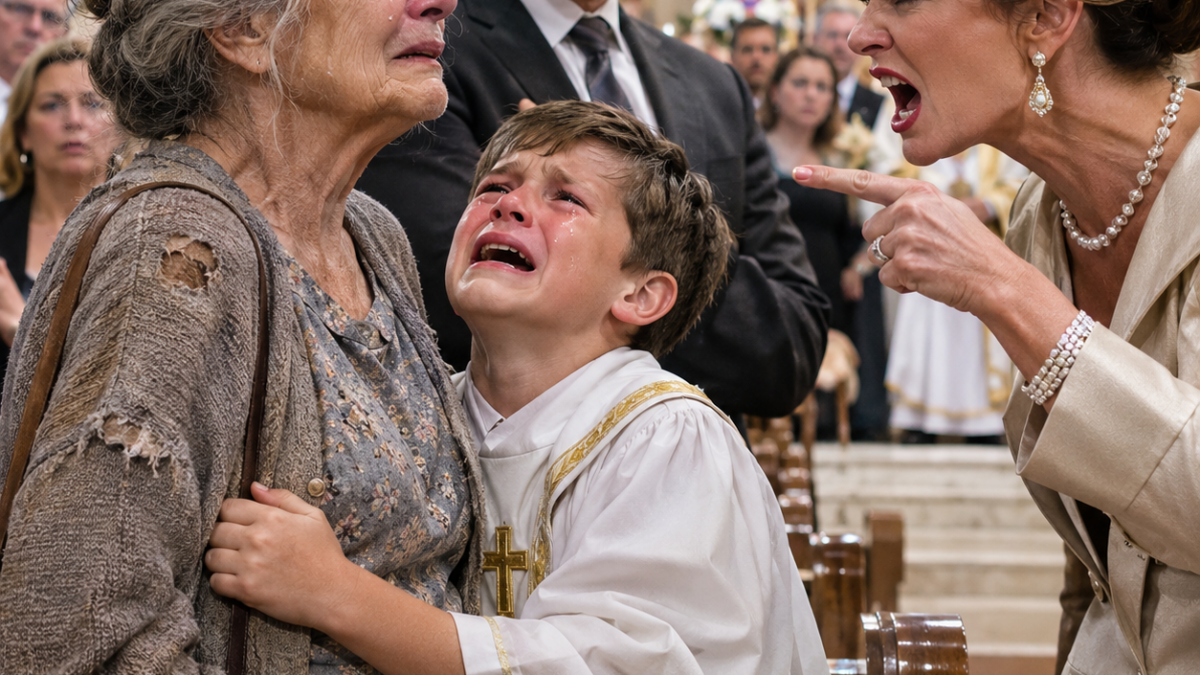
FULL STORY CONTINUATION
For a moment, I couldn’t move.
I stood in the middle of the church aisle with the shawl pressed against my chest, staring at the daughter whose first steps I had witnessed, whose fevers I had nursed, and whose tears I had wiped away throughout her childhood.
I searched her face for some sign that she regretted what she’d said.
There was none.
Jennifer was more concerned about the people watching than about the pain in my eyes.
“Please,” I whispered. “I only wanted to see him.”
She glanced around nervously.
“You’re making everything worse.”
Michael was crying.
“Mom, let Grandma stay!”
Jennifer pulled him closer.
“Stop acting like a baby.”
“I’m not!”
“Michael.”
“She didn’t do anything wrong!”
Those words almost brought me to my knees.
A nine-year-old boy could see the cruelty in that room more clearly than the adults surrounding him.
I looked toward the altar.
A priest stood near the sacristy entrance.
He had witnessed the confrontation, but he remained silent.
Other parents stared.
Some looked uncomfortable.
Others looked annoyed.
Nobody stepped forward.
I understood then that humiliation becomes even more painful when people who know something is wrong decide it is safer to look away.
I bent down as much as my aching knees allowed.
“Michael, sweetheart.”
He reached for me.
Jennifer tightened her grip.
“I love you,” I told him.
His face crumpled.
“I love you too, Grandma.”
“Be good today.”
“I want you here!”
My voice broke.
“I know.”
I wanted to tell him that I would always be there for him.
But Jennifer was already pulling him away.
He twisted around, reaching toward me.
“Grandma!”
I stepped backward.
Then another step.
I didn’t want him to remember his First Communion as a day when his grandmother and mother screamed at each other in church.
So I did the only thing I could think to do.
I turned and walked away.
Behind me, Michael kept calling my name.
Every cry felt like someone tearing another piece out of my chest.
I passed the elegantly dressed woman who had first demanded my removal.
She looked away.
I passed two men standing beside a pew.
One whispered something I couldn’t hear.
The other shook his head.
I kept walking.
When I reached the church doors, I paused.
I had traveled more than six hours for that moment.
Six hours on a bus, holding the little shawl I had knitted for my grandson.
Six hours imagining the look on his face when he saw me.
Six hours praying that Jennifer might welcome me, even if only for one day.
And now I was leaving before the ceremony had even begun.
I stepped outside.
The heavy doors closed behind me.
And the sound of Michael’s crying disappeared.
I stood on the cathedral steps, unable to breathe properly.
My knees trembled.
I wanted to sit down, but I was afraid that if I did, I wouldn’t be able to stand again.
So I began walking.
I didn’t know where I was going.
I only knew I couldn’t remain there.
The city moved around me as though nothing had happened.
Cars rolled past.
People laughed on sidewalks.
Someone shouted into a phone.
The world continued with complete indifference while mine seemed to be falling apart.
I held the shawl against my chest.
I had spent almost two weeks knitting it.
The stitches weren’t perfect.
My fingers had become stiff with age, and sometimes I had to stop because the pain in my joints became too much.
But every row had been made with Michael in mind.
I imagined him wrapping it around his shoulders on a cold evening.
I imagined telling him how his grandfather used to sit beside me while I knitted.
I imagined him smiling and saying, “Thank you, Grandma.”
Now I wondered whether Jennifer would even allow him to keep it.
Tears blurred my vision.
I stopped beside a storefront and wiped my face.
Then I heard footsteps behind me.
“Ma’am?”
I stiffened.
I was exhausted from strangers telling me where I didn’t belong.
“I don’t have any money,” I said without turning.
The footsteps stopped.
“I’m not asking for money.”
The voice was male.
Older.
Gentle.
“I saw what happened at the church.”
My stomach tightened.
I turned slowly.
An elderly gentleman stood a few feet away.
He wore a white shirt, dark trousers, and a straw hat. A wooden cane rested in his right hand.
He looked about my age.
His expression was kind but serious.
“I’m sorry to bother you,” he said. “My name is Ernest.”
I nodded cautiously.
“I’m Martha.”
“Martha,” he repeated. “I wanted to tell you that what happened back there was wrong.”
I looked away.
He continued.
“I watched that little boy run to you. I saw how he hugged you.”
My throat closed.
“He’s my grandson.”
“I know.”
“His name is Michael.”
Ernest nodded.
“He loves you very much.”
That was all it took.
I began crying.
I had managed to hold myself together while my daughter humiliated me.
I had managed to walk out of the church.
I had managed to get down the steps without collapsing.
But one stranger speaking kindly about my grandson broke whatever strength I had left.
“I’m sorry,” I whispered.
“Don’t apologize.”
I pressed my hand over my mouth.
“I just wanted to see him.”
“I believe you.”
“He was so happy.”
“I saw.”
“And then Jennifer pulled him away.”
Ernest waited quietly.
He didn’t tell me to calm down.
He didn’t say everything would be fine.
He didn’t pretend to understand a lifetime of family pain from a few minutes in a church.
He simply allowed me to cry.
After a while, he asked where I was going.
“The bus station.”
“Are you leaving today?”
“Yes.”
“How long did you travel?”
“More than six hours.”
He looked troubled.
“And you came only for the ceremony?”
I nodded.
He glanced at my shawl.
“Did you make that?”
“Yes.”
“For your grandson?”
I nodded again.
Ernest was silent for a moment.
Then he said, “Would you allow me to buy you a cup of coffee before you leave?”
I hesitated.
I had spent years learning that kindness sometimes came with conditions.
But there was something honest about the way he spoke.
He didn’t seem interested in pitying me.
He seemed interested in making sure I didn’t have to walk away from that day feeling completely alone.
“Just coffee,” I said.
He smiled.
“Just coffee.”
We walked slowly toward a small diner around the corner.
He adjusted his pace to match mine.
And for the first time that morning, I felt like a human being again.
The diner smelled of fresh coffee and cinnamon.
We sat beside a window overlooking the street.
Ernest ordered two coffees and a cinnamon roll.
I protested when he asked for the pastry.
“I’m not hungry.”
“You don’t have to eat it,” he said. “But after a six-hour trip, it might be nice to have something.”
I smiled faintly.
It was a small kindness.
But after the morning I’d endured, it felt enormous.
For a while, we drank our coffee in silence.
Then Ernest asked about my family.
I told him about Michael.
About Jennifer.
About Roger.
And eventually, about Matthew.
“My husband died seven years ago,” I said.
Ernest set down his cup.
“I’m sorry.”
“He was working when it happened.”
“What kind of work?”
“Construction. He did whatever needed doing. Concrete, framing, steel. He was never afraid of hard work.”
Ernest nodded.
“Sounds like a good man.”
“He was.”
I looked out the window.
“He wasn’t perfect. He could be stubborn, and he kept too much to himself. But he never made me feel ashamed of where we came from.”
Ernest asked his name.
“Matthew Baker.”
He became very still.
I noticed immediately.
“Are you all right?”
He stared at me.
“Matthew Baker?”
“Yes.”
“How old was he when he died?”
I answered.
Ernest’s fingers tightened around his cup.
“Did he ever talk about his childhood?”
The question surprised me.
“Not much.”
“His parents?”
“He said he didn’t really know them.”
Ernest swallowed.
“Did he ever mention an orphanage?”
I frowned.
“No.”
He looked away.
For several seconds, I thought he might be ill.
Then he leaned closer.
“Martha, forgive me for asking something very personal.”
“Go ahead.”
“Did Matthew have a scar on the left side of his neck?”
My heart stopped.
“Yes.”
Ernest closed his eyes.
I stared at him.
“How could you know that?”
He took a long breath.
“Because I knew a boy named Matthew Baker more than fifty years ago.”
I felt the coffee cup grow heavy in my hands.
Ernest continued.
“We lived in an orphanage in Queens. We were children. He was older than me.”
I could barely speak.
“And?”
“There was a fire.”
He looked down.
“The building burned. We were separated. I was told Matthew died.”
I stared at him.
Ernest’s voice trembled.
“I’ve spent most of my life believing my brother was dead.”
The word hung between us.
Brother.
I looked at the old man across the table.
At the shape of his face.
The eyes.
The line of his jaw.
And suddenly, I saw something familiar.
Something that reminded me painfully of Matthew.
“Are you saying…” I whispered.
Ernest nodded slowly.
“I think your husband may have been my brother.”
I pressed a hand against my chest.
It seemed impossible.
Matthew had been dead for seven years.
And now a stranger who had followed me out of a church was telling me that the man I loved might have had a brother he never spoke about.
I wanted proof.
I needed proof.
But beneath my disbelief, something else began to stir.
Hope.
Not the hope of bringing Matthew back.
Nothing could do that.
But the hope that perhaps his life had contained a history I might finally understand.
Ernest invited me to his home in Williamsburg, Brooklyn.
I almost refused.
The day had already brought too many shocks.
But he told me he had kept documents from his childhood.
Photographs.
Letters.
Records from the orphanage.
“If I’m wrong,” he said, “you’ll know soon enough.”
I looked at him.
“And if you’re right?”
His eyes filled.
“Then I finally found my brother.”
I thought about Matthew.
About the scar on his neck.
About the way he sometimes woke from nightmares but refused to explain them.
About how he avoided speaking of childhood.
And I agreed.
Ernest’s house was modest.
The paint had faded on the outside walls, but the rooms were clean and filled with the quiet warmth of a life lived carefully.
Photographs stood on tables.
A wooden clock ticked in the hallway.
A small statue of the Virgin Mary rested on a shelf.
I felt more comfortable there than I had in any of Roger’s expensive rooms.
Ernest brought a box from a cabinet.
It was wrapped in dark blue fabric.
He placed it carefully on the table.
“I haven’t opened this in years.”
His hands trembled slightly as he removed the lid.
Inside were yellowed documents, old envelopes, and photographs.
He took out a black-and-white picture.
Two little boys stood close together.
One had his arm wrapped around the other.
Both wore clothes that were too big for them.
The older boy had unruly hair and a crooked smile.
And on the left side of his neck was a thin scar.
I made a sound I didn’t recognize.
“Matthew.”
Ernest looked at me.
“You’re sure?”
I touched the photograph.
The boy was younger than I had ever known my husband.
But the smile was unmistakable.
The shape of his eyes.
The tilt of his head.
“My God,” I whispered. “It’s him.”
Ernest began crying quietly.
I looked up.
He pressed one hand over his face.
“For fifty years…”
He couldn’t finish.
I reached across the table and took his hand.
Neither of us needed to say anything.
For a long time, we sat looking at the photograph.
Then Ernest began telling me about the orphanage.
He described the narrow beds.
The cold mornings.
The older children who bullied the younger ones.
He told me how Matthew had protected him.
How they had shared food.
How they promised never to abandon each other.
Then he described the fire.
The smoke.
The screams.
The moment a volunteer carried Ernest out while Matthew remained somewhere inside.
“I kept calling his name,” Ernest whispered. “Nobody would let me go back.”
He had spent years believing that Matthew died in the flames.
Afterward, Ernest was placed with another family.
His surname changed.
His records became tangled with those of other children.
And the connection between the two brothers disappeared.
“But Matthew survived,” I said.
Ernest nodded.
“Somehow.”
I thought about the childhood my husband had never described.
The pain he’d carried in silence.
The way he sometimes stared into the distance as though listening for something nobody else could hear.
I wondered whether part of him had always been searching for the little brother he lost.
Ernest showed me a small notebook.
On one page, written in childish handwriting, were the words:
Matthew and Ernest. Brothers till the end.
I began sobbing.
I had spent years believing I knew the man I’d married.
But now I understood there were wounds he had carried long before we met.
Wounds he had never learned how to explain.
And somehow, fate had brought his brother to me on the morning my own daughter rejected me.
That evening, Ernest asked whether Matthew had left any personal papers.
I told him about the wooden box my husband kept in our bedroom.
It had contained documents, photographs, and little objects he refused to throw away.
After his death, Jennifer and Roger had taken it.
They told me they were organizing his estate.
I trusted them.
I was grieving.
I couldn’t think clearly.
They handled the paperwork.
Then, gradually, I lost access to much more than the box.
Roger began discussing the house.
He claimed there were debts.
He said certain documents needed signing.
Jennifer told me not to worry.
Eventually, I found myself living in a small rented place while the home Matthew and I had shared was treated as though it belonged to someone else.
At the time, I believed it was simply another cruel consequence of being widowed and poor.
Now Ernest looked deeply troubled.
“Did Matthew own any land?”
I frowned.
“He mentioned a property in Queens once.”
Ernest leaned forward.
“What property?”
“I never understood the details. He said it was something he wanted to leave for the family.”
“Do you have documents?”
“No.”
“Did Jennifer take them?”
“She took the box.”
Ernest became quiet.
Then he opened another compartment and showed me a copy of an old transaction involving property in Queens.
Matthew’s name appeared clearly.
I stared at it.
“What is this?”
Ernest hesitated.
“Something we need to investigate.”
My heart began pounding again.
I had come to New York to see my grandson.
Now I was sitting in a stranger’s home, discovering that my dead husband might have had a brother and that property he owned could have been hidden from me.
I felt overwhelmed.
“Ernest, I don’t want money.”
He looked at me.
“I know.”
“I don’t want a fight.”
“I know that too.”
“I only wanted Michael.”
His expression softened.
“And that’s exactly why we shouldn’t ignore this.”
I looked down.
He continued.
“Your husband may have left things for his family. If someone has concealed them, that’s not just about money. It’s about the truth.”
I thought about Jennifer’s face in the church.
The disgust in her eyes.
The way she’d pulled Michael away from me.
I wondered what Roger had told her about Matthew’s estate.
And what she had chosen to believe.
Ernest offered me a room for the night.
I accepted because my bus had already left and I was exhausted.
That night, I lay awake beneath unfamiliar blankets, staring at the ceiling.
I kept seeing Matthew as a little boy in the photograph.
I kept hearing Michael calling my name.
And I kept wondering whether the two things were connected in a way I didn’t yet understand.
The next morning, Ernest brought out more of his records.
We compared names, dates, and locations.
The evidence pointing toward his connection to Matthew became stronger.
But the property documents concerned him most.
He believed Matthew had purchased land in Long Island City.
And the copy he possessed suggested that the land remained connected to Matthew’s estate.
I remembered something else.
“My husband had a little statue of St. Jude.”
Ernest looked up.
“Where?”
“On a shelf in the hallway of our old house.”
“What about it?”
“He never let anyone move it.”
I swallowed.
“He used to touch it before leaving for work.”
Ernest studied me.
“Do you think he might have hidden something there?”
“I don’t know.”
“But it’s worth checking.”
I hesitated.
Going back to the house felt like walking into the place where my life had been taken apart.
Jennifer had made it clear that she didn’t want me there.
Roger had repeatedly treated me like a trespasser in my own history.
But I couldn’t ignore what was happening.
Matthew had left questions.
And for the first time, I had someone willing to help me find answers.
We went to the old house later that day.
I stood outside for several minutes.
The paint had faded.
The front steps were worn.
But it was still the place where Matthew and I had spent years building a life.
I remembered the children playing in the yard.
The smell of supper in the kitchen.
The evenings when Matthew sat at the table repairing tools.
I remembered being happy there.
Then I remembered being told to leave.
Ernest stood beside me.
“Are you ready?”
I nodded.
We approached the door.
It wasn’t fully closed.
I called out.
No one answered.
I pushed it gently.
The door opened.
Inside, the house smelled of dust and stale air.
Some furniture was covered.
The hallway looked unfamiliar despite the memories surrounding me.
Then I saw the shelf.
And the statue of St. Jude.
I moved toward it.
My hands were shaking.
“Matthew,” I whispered.
Ernest examined the shelf.
“There may be something behind it.”
He carefully looked along the back panel.
Then he found a narrow opening.
Inside was an envelope.
Folded.
Yellowed.
Hidden from view.
I took it with trembling fingers.
Matthew’s handwriting covered the front.
For Martha.
I pressed it against my chest.
For seven years, I had wanted one more conversation with my husband.
One more chance to ask him why he’d kept so much of his childhood hidden.
One more chance to hear him tell me everything would be all right.
Now I was holding words he’d left behind.
I opened the envelope.
The letter was short.
But it changed everything.
Matthew wrote that he had become suspicious of Roger.
He believed documents concerning the family property might be altered or concealed.
He warned me not to trust blindly.
And then I reached a sentence that made my hands shake.
If you ever need help, find Ernest. My brother.
I looked up.
Ernest was staring at me.
“He knew,” I whispered.
His eyes filled.
“He knew I was alive?”
I nodded.
I handed him the letter.
He read it slowly.
Then he sat down.
For fifty years, he had believed Matthew was dead.
And now he was learning that his brother had eventually discovered traces of him too.
But before we could say anything more, the front door slammed.
“What are you doing here?”
Jennifer stood in the doorway.
Her face was furious.
Then she saw the envelope in my hand.
And the anger in her expression became something else.
Fear.
“Mom, give me that.”
I held the letter against my chest.
“No.”
Jennifer stared at me.
“This is my house.”
I looked around.
“It was mine too.”
“That doesn’t give you permission to come in whenever you want.”
I felt the old instinct to apologize rise inside me.
Then I remembered Michael.
I remembered the church.
And I remembered all the times I’d remained silent because I was afraid of losing my daughter completely.
“Jennifer, your father left this letter for me.”
Her eyes flickered toward Ernest.
“Who’s he?”
“My husband’s brother.”
She laughed sharply.
“Dad didn’t have a brother.”
“Yes, he did.”
“Mom, please. Don’t start inventing things.”
Ernest stepped forward.
“My name is Ernest. Matthew and I were separated as children.”
Jennifer stared at him.
Then she looked at the letter again.
“What does it say?”
I studied her.
“Why are you afraid of it?”
“I’m not afraid.”
“Then why are you demanding it?”
She crossed her arms.
“Roger says you’ve been causing trouble.”
I felt something cold move through me.
“Roger?”
“He told me you were asking questions about the property.”
“Because your father owned it.”
Jennifer’s face tightened.
“That’s all been settled.”
“Has it?”
“Yes.”
“Then why won’t you show me the documents?”
She looked away.
For the first time, I wondered how much she knew.
Was she simply repeating Roger’s lies?
Or had she knowingly helped him hide what belonged to Matthew’s family?
I didn’t want to believe the second possibility.
But after what happened in the church, I could no longer pretend Jennifer was incapable of choosing cruelty.
“Mom, leave.”
I stood straighter.
“I will. But I’m keeping this letter.”
She stepped forward.
“You can’t just take things.”
I looked into her eyes.
“Jennifer, it has my name on it.”
She stopped.
Then her phone rang.
She answered immediately.
I couldn’t hear the other person clearly, but her expression changed as she listened.
“Yes,” she said.
A pause.
“No, they didn’t find anything important.”
I looked at Ernest.
He was watching her carefully.
Jennifer turned slightly away.
“I said I’ll handle it.”
She ended the call.
Then she looked at us with a face I hardly recognized.
“You have no idea what you’re getting involved in.”
I felt my heart pounding.
“Then tell me.”
She shook her head.
“You should have left the past alone.”
I looked at the letter in my hand.
“The past is the only reason any of us are here.”
Jennifer said nothing.
I walked past her.
Ernest followed.
Outside, I felt my knees weaken.
But I didn’t collapse.
Not this time.
Because the woman who had entered that house was not quite the same woman who’d been humiliated in the church.
I was beginning to understand that my silence had protected people who never intended to protect me.
And I was finished helping them hide the truth.
Over the next several days, Ernest and I began searching for the records Matthew had left behind.
One clue led us to an elderly priest who had known my husband.
Father Michael lived near a parish house and remembered Matthew as a quiet man who sometimes came to pray.
When we visited, he greeted us warmly.
“Martha Baker.”
I nodded.
“Father.”
“Your husband spoke very highly of you.”
Those words almost made me cry.
For years, I had heard people describe Matthew as stubborn, quiet, or difficult to understand.
Hearing someone speak of his love for me felt like receiving a message from another lifetime.
We explained what we’d discovered.
Father Michael listened.
Then he opened a cabinet and removed a sealed envelope.
“Matthew asked me to keep this.”
I stared at it.
My name was written across the front.
“Why didn’t you give it to me?”
“He gave instructions about when it should be opened. I understood he feared certain documents might disappear.”
I took the envelope.
Inside was another letter.
Matthew wrote about Roger’s growing influence over Jennifer.
He said he suspected forged paperwork.
He mentioned property in Queens and a lawyer named Robert Cisneros.
He urged me to find Ernest if I needed help.
I could barely read the final paragraph through my tears.
The most valuable thing I leave in this world is…
The sentence ended.
A page was missing.
Ernest examined the letter.
“Was there another sheet?”
Father Michael shook his head.
“Not when it was given to me.”
I stared at the torn ending.
Matthew had been trying to tell me something.
Something he believed mattered more than the house or the land.
And I couldn’t help wondering whether Roger already knew what it was.
Robert Cisneros’s office was above an old fabric store in downtown New York.
The building smelled of paper, furniture polish, and dust.
When we explained why we had come, the attorney studied us carefully.
“Matthew Baker?”
“Yes,” I said. “He was my husband.”
Recognition moved across his face.
“I remember Matthew.”
He invited us into his office.
“He was an unusually careful man when it came to property documents.”
I nodded.
“That sounds like him.”
Robert opened a filing cabinet.
“He came to me when he purchased a parcel of land in Long Island City.”
He placed a blue folder on the table.
Inside were signed documents, notary records, and copies of the original deed.
Matthew’s name appeared clearly.
I touched the paper.
For years, I had been told there was nothing left.
That the property had been transferred.
That everything had already been settled.
Now I was staring at documents suggesting otherwise.
“Was there ever a valid transfer to Roger?” I asked.
Robert’s expression darkened.
“Roger visited me about a year ago.”
I felt my stomach tighten.
“He brought a document he claimed proved ownership.”
“And?”
“I found serious irregularities. I refused to validate it.”
Ernest leaned forward.
“What kind of irregularities?”
“Signatures that didn’t match, questionable dates, and inconsistencies with the original records.”
I stared at the attorney.
“Are you saying Roger forged my husband’s signature?”
“I’m saying the documents need to be investigated. But there is substantial reason to question their authenticity.”
My hands trembled.
I thought about the day Matthew died.
The shock.
The funeral.
Jennifer taking his papers.
Roger promising to handle everything.
I had trusted them.
I had believed family meant protection.
Instead, I was beginning to understand how vulnerable grief had made me.
“Can we challenge the transfer?” I asked.
Robert nodded.
“Yes. And if the evidence supports forgery, there may also be criminal consequences.”
I looked down at the documents.
I didn’t feel excited about the possibility of reclaiming land.
I felt angry.
Because if Roger had stolen from Matthew’s estate, he hadn’t simply taken property.
He had taken security.
History.
The future Matthew hoped to leave behind.
And he had used my grief to do it.
Meanwhile, Michael was suffering in ways I didn’t yet understand.
Jennifer had torn up a drawing he’d made of me.
I didn’t learn about it until later.
He had drawn me sitting outside the church, wearing my shawl.
Underneath, he’d written:
I love you, Grandma.
He had hidden it in his schoolbag because he feared Roger would destroy it.
But Jennifer found it.
And when Michael defended me, she tore the paper in half.
When I eventually learned what had happened, I felt a pain unlike anything I could describe.
My grandson had watched the adults around him use shame as a weapon.
He had tried to protect someone he loved.
And his mother punished him for it.
Michael became quiet.
His teacher noticed.
He stopped participating in class.
He stopped talking about his drawings.
He withdrew into himself.
Then he became ill.
Jennifer called me late one afternoon.
For a moment, when I saw her number, I considered letting the phone ring.
Then I answered.
“Jennifer?”
Her voice was shaking.
“Mom.”
I sat down.
“What happened?”
“It’s Michael.”
My heart stopped.
“What’s wrong?”
“He’s in the hospital.”
I gripped the phone.
“What?”
“He has a high fever. He’s dehydrated. He hasn’t been eating properly.”
I was already reaching for my shawl.
“Which hospital?”
She gave me the address.
Then she whispered something that made my heart break.
“He keeps asking for you.”
I closed my eyes.
My sweet boy.
After everything Jennifer had done to keep us apart, Michael still wanted his grandmother.
“Can I see him?” I asked.
There was a long silence.
Then Jennifer said, “Please come.”
I reached the hospital with Ernest shortly before sunset.
The corridors smelled of disinfectant.
Nurses hurried past carrying charts.
I asked for Michael’s room.
When I stepped inside, I saw him lying in a hospital bed, his face flushed and his small body surrounded by blankets.
He looked much younger than nine.
My knees nearly gave way.
“Oh, sweetheart.”
I approached slowly.
His eyes opened.
For a moment, he stared at me as though he were dreaming.
Then his lips moved.
“Grandma?”
I took his hand.
“I’m here.”
His fingers closed around mine.
“Don’t go.”
I felt tears sliding down my face.
“I’m right here, Michael.”
He swallowed.
“I thought you were mad at me.”
I stared at him.
“Why would I be mad at you?”
“Because Mom made you leave.”
I bent toward him.
“Oh, my precious boy. None of that was your fault.”
He began crying.
I held his hand while he sobbed.
“I wanted you to stay.”
“I know.”
“I tried.”
“You did more than enough.”
He looked at me through tears.
“Do you still love me?”
I couldn’t speak for a moment.
Then I kissed his forehead.
“More than anything in this world.”
He closed his eyes.
And for the first time since I entered the room, his face relaxed.
Jennifer stood in the doorway.
She had watched everything.
I looked at her.
For a brief moment, I saw shame in her expression.
But she didn’t come inside.
She turned away.
I stayed with Michael.
I told him stories about the countryside.
About the vegetables Matthew used to grow.
About the way his grandfather came home with muddy boots and pretended he hadn’t noticed the dirt he tracked through the kitchen.
Michael smiled weakly.
“Grandpa sounds funny.”
“He was.”
“Did he love me?”
I stroked his hair.
“Very much.”
“Even when I was little?”
I smiled through tears.
“Especially then.”
Michael squeezed my hand.
“Tell me another story.”
So I did.
I stayed until he grew tired.
And when he fell asleep, his little hand remained wrapped around mine.
The next morning, Roger appeared.
I was returning from the restroom when I saw him standing beside Michael’s bed.
His arms were crossed.
His expression was cold.
“What are you doing here?” he demanded.
I stopped in the doorway.
“Visiting my grandson.”
“You’re not welcome.”
Michael shifted beneath the blankets.
I lowered my voice.
“Don’t start an argument in front of him.”
Roger stepped closer.
“I’m his father. I decide who sees him.”
I looked directly at him.
“Michael asked for me.”
“I don’t care.”
Something in me hardened.
“You should.”
His eyes narrowed.
“Don’t lecture me, Martha.”
I held my ground.
For years, I had avoided confrontation with Roger.
I had swallowed his insults because I feared losing access to Michael.
But standing beside my sick grandson, I understood that silence wasn’t protecting him.
It was teaching Roger that intimidation worked.
“I’m not leaving because you dislike me,” I said.
He laughed harshly.
“You have five minutes.”
A nurse appeared in the doorway.
Her name was Lisa.
She had a gentle face and a calm, professional manner.
“Is everything all right?”
Roger turned toward her.
“This woman isn’t supposed to be here.”
Lisa looked at me.
“Are you Michael’s grandmother?”
“Yes.”
She glanced toward the bed.
“The family needs to follow the hospital’s visitor procedures,” she said firmly. “And nobody is going to shout in a patient’s room.”
Roger’s expression darkened.
“I’m his father.”
“Then let’s discuss any concerns with the care team outside.”
He glared at her.
Then at me.
“This isn’t over.”
He left.
I sat beside Michael again.
My hands were shaking.
Lisa approached.
“Are you all right?”
I nodded.
“Thank you.”
She looked toward the hallway.
“You shouldn’t have to deal with that while worrying about your grandson.”
I stared at her.
For years, I had been treated as though the simple act of loving Michael was an offense.
Now a stranger had spoken to me with compassion.
It reminded me of Ernest outside the church.
And I began to understand something important.
Family isn’t always the people who stand beside you when everything is easy.
Sometimes it’s the people who refuse to look away when you’re being treated cruelly.
That night, Lisa contacted me with troubling information.
Roger was discussing transferring Michael to a private medical facility.
The proposed move raised concerns because the treating team had not agreed that a transfer was medically appropriate.
I was frightened.
It wasn’t simply that Roger wanted a different hospital.
It was that he seemed determined to keep Michael away from anyone who questioned his authority.
I contacted Jennifer.
“Do you know what Roger is planning?”
She sounded exhausted.
“He said Michael would receive better care.”
“Have you spoken with the doctors?”
A pause.
“No.”
“Then please do.”
She became defensive.
“Mom, Roger knows what he’s doing.”
I looked at Michael’s sleeping face.
“Jennifer, your son is sick. This is not about Roger’s pride.”
She didn’t answer.
I continued.
“Please don’t let him make another decision without listening to the people responsible for Michael’s care.”
Her voice broke.
“I don’t know what to do anymore.”
For the first time, I heard something beneath her anger.
Fear.
I knew that voice.
I’d heard it in myself years earlier, when I was afraid of confronting Roger because I might lose my daughter.
“Then start by telling the truth,” I said.
She began crying.
“I’ve made so many mistakes.”
I closed my eyes.
“Yes, you have.”
She sobbed harder.
“But Michael still needs you.”
There was a long silence.
Then she whispered, “I know.”
The hospital ultimately kept Michael under medical supervision until the care team considered him stable.
Roger’s attempted transfer did not proceed.
And the incident became another piece of the larger pattern of intimidation that was beginning to emerge.
Lisa agreed to tell investigators what she had witnessed.
I didn’t want to draw her into our family conflict.
But she insisted.
“Mrs. Baker,” she told me, “people like Roger depend on everyone being too frightened to speak.”
I looked at her.
“He’s made my daughter afraid of her own judgment.”
“Then perhaps it’s time someone reminded her she still has one.”
I thought about Jennifer.
The little girl who used to bring injured birds home in shoeboxes.
The teenager who cried when she thought she’d disappointed me.
The woman who had humiliated me in church.
I couldn’t understand how those versions of her fit together.
But I knew I wanted my daughter to find her way back to the person she used to be.
Not by pretending she’d done nothing wrong.
But by finally taking responsibility.
Ernest and I continued working with the attorneys.
The evidence against Roger became stronger.
Records showed two conflicting deeds involving Matthew’s Queens property.
One was tied to the original transaction.
The other appeared to transfer ownership after Matthew’s death, despite carrying a signature presented as his.
That alone raised serious questions.
The notary information didn’t match cleanly.
The dates were suspicious.
And the handwriting differed from verified examples of Matthew’s signature.
The attorneys arranged for specialists to examine the documents.
Jennifer’s role remained uncertain.
She admitted that Roger had handled the estate papers.
She acknowledged that she’d allowed him to keep documents away from me.
But she claimed she hadn’t known the full extent of the forgery.
I wanted to believe her.
I also knew belief wasn’t evidence.
One evening, Ernest spread the documents across his dining table.
He looked exhausted.
“This wasn’t a simple misunderstanding.”
I sat across from him.
“No.”
“Someone worked hard to make that transfer appear legitimate.”
I stared at Matthew’s name on the original deed.
“Roger always thought he was clever.”
Ernest nodded.
“But he underestimated your husband.”
I smiled sadly.
“Matthew trusted paper more than promises when it came to property.”
“That may be why he kept so many copies.”
I looked at the letters we’d found.
“Then why didn’t he tell me?”
Ernest leaned back.
“Perhaps he thought he could protect you by handling everything himself.”
I lowered my eyes.
“That was Matthew.”
He had always tried to carry difficult things alone.
Sometimes I loved him for it.
Sometimes it made me furious.
Now I wondered how different our lives might have been if he had trusted me with the truth before he died.
But there was no point blaming a dead man for not predicting every betrayal.
He had left warnings.
He had preserved documents.
And now those documents were helping us reclaim what had been hidden.
Roger’s behavior became increasingly erratic as the investigation progressed.
He stopped appearing at family gatherings.
He avoided calls.
Jennifer told me he had begun drinking heavily.
Then we learned he was staying in a rented room in Queens.
The man who had once spoken to me as though I were dirt beneath his shoes was now watching his carefully constructed reputation collapse.
I didn’t celebrate.
I was too concerned about Michael.
The legal dispute had already taken an emotional toll on him.
He had watched adults argue.
He had been pulled away from his grandmother.
He had seen his mother destroy something he’d made with love.
And he’d spent days in the hospital while his family fought over who was allowed to comfort him.
I wanted his childhood back.
I wanted him to worry about school, friends, and drawings.
Not forged deeds.
Not family secrets.
Not whether the people who loved him would be allowed in the same room.
When he was discharged, I helped care for him while Jennifer worked through the arrangements with the attorneys and social services.
Michael seemed happier when he could spend time with Ernest and me.
He loved Ernest’s stories.
He called him Uncle Ernest at first, then sometimes simply Ernest, depending on his mood.
He asked endless questions about Matthew.
“Was Grandpa brave?”
“Sometimes,” Ernest replied.
“Was he scared during the fire?”
Ernest was quiet.
“Very scared, I imagine.”
Michael frowned.
“Then how was he brave?”
Ernest smiled.
“Being brave doesn’t mean you aren’t scared. It means you try to do the right thing even when you are.”
Michael thought about that for a long time.
Then he said, “Grandma was brave at church.”
My eyes filled.
I looked away.
Ernest nodded.
“Yes, she was.”
Michael reached for my hand.
“I don’t want anyone to be mean to you again.”
I squeezed his fingers.
“Sweetheart, you don’t have to protect me from every unkind person.”
“But I want to.”
“I know.”
I kissed his forehead.
“Then grow up to be someone who treats people kindly. That’s the best way you can honor me.”
He nodded solemnly.
And I wondered how a nine-year-old child could sometimes understand dignity better than people who had spent their whole lives chasing status.
The legal proceedings took time.
There were interviews.
Document reviews.
Statements from people who had known Matthew.
The original attorney provided certified records.
Handwriting experts examined the questionable signatures.
Lisa gave information about Roger’s attempts to control Michael’s hospital care and the threats she said he’d made.
Eventually, investigators found evidence that Roger had used forged documents in connection with the property transfer.
The case became more serious.
He was no longer simply a rude son-in-law who disliked his mother-in-law.
He was a man accused of taking property that didn’t belong to him.
And the people he had intimidated were beginning to speak.
One afternoon, an attorney contacted Ernest.
“There may be a witness who knows how the documents were altered.”
My heart pounded.
“Who?”
“A man who worked around the relevant notary and registry paperwork.”
The witness admitted that Roger had sought assistance getting an irregular transfer accepted.
He described being frightened after Roger warned him not to discuss what happened.
I listened as the attorney explained what the witness had agreed to provide.
For years, I’d thought Roger was simply arrogant.
Now I understood how deliberately he’d worked to take control.
He had relied on my grief.
On Jennifer’s obedience.
On the assumption that a poor widow wouldn’t have the money or knowledge to challenge him.
And he’d almost succeeded.
I remembered the church.
The woman shouting that I looked like I belonged in a homeless shelter.
Jennifer telling me to leave.
Roger’s contempt.
They had all looked at my worn clothing and decided I had no power.
They never understood that my strength didn’t come from money.
It came from the life I’d survived.
From the work I’d done.
From the love I still carried.
And from my refusal to let the people I loved be erased.
One evening, Jennifer came to Ernest’s house.
I was sitting at the kitchen table when she knocked.
Ernest answered.
She stood outside wearing jeans and a plain sweater.
Without the expensive clothes and carefully arranged hair, she looked younger.
And more tired.
“Mom?”
I stood slowly.
“Jennifer.”
She looked down.
“Can we talk?”
I stepped aside.
She entered and sat at the table.
For several minutes, she said nothing.
Then she began crying.
“I’m sorry.”
I looked at her.
“For what?”
She wiped her face.
“For the church.”
My throat tightened.
She continued.
“For treating you like you were embarrassing. For letting Roger make every decision. For keeping Michael away.”
I sat across from her.
“Why did you do it?”
She stared at her hands.
“Because I wanted people to think we were successful.”
I closed my eyes.
“Jennifer.”
“I know.”
“Your father worked his whole life.”
She nodded.
“He came home tired. His clothes were dirty. Sometimes we had very little money.”
“I remember.”
“And you grew up ashamed of that?”
Her face crumpled.
“I didn’t want to be poor.”
I stared at her.
“Neither did I.”
She looked up.
“But I never believed being poor made us worth less.”
Jennifer cried harder.
“Roger made me feel like everything about my childhood was something I had to escape.”
I shook my head.
“Roger didn’t create that shame out of nothing, sweetheart. But he encouraged it.”
She nodded.
“I let him.”
I looked at her carefully.
“Did you know about the property?”
She hesitated.
“I knew Dad had papers.”
“And?”
“Roger told me they weren’t important.”
“Did you believe him?”
She looked away.
“I wanted to.”
I felt tears gathering.
“Jennifer, your father trusted you.”
She covered her face.
“I know.”
“He wanted you to have a good life.”
“I know.”
“And you helped a man erase him.”
She sobbed.
I wanted to hold her.
Part of me still saw the little girl who used to fall asleep with her head in my lap.
But another part remembered Michael crying in the church.
And the drawing she’d torn apart.
I needed her to understand that apologies didn’t undo the harm.
“Where are the papers?” I asked.
She reached into her bag.
Then she placed Matthew’s wooden box on the table.
My breath caught.
I touched the worn lid.
“His box.”
She nodded.
“I kept it.”
“Why?”
“Roger told me to.”
I opened it.
Inside were old photographs, a wristwatch, receipts, and letters.
I recognized Matthew’s handwriting immediately.
My fingers trembled.
For seven years, those things had been kept from me.
Seven years of memories locked away because Roger wanted control and Jennifer was afraid to challenge him.
I looked at my daughter.
“Thank you for bringing it.”
She began crying again.
“Can you forgive me?”
I stared at the box.
Then I looked at her.
“I don’t know yet.”
She nodded miserably.
“I understand.”
I took her hand.
“But telling the truth is a beginning.”
She squeezed my fingers.
And for the first time in years, she didn’t try to argue.
Michael’s recovery brought some joy back into our days.
He returned to school.
He began drawing again.
His teacher, Ms. Laura, told Jennifer that he seemed more engaged.
He wasn’t completely free of worry.
Sometimes he asked whether Roger would come back.
Sometimes he wanted to know why adults lied.
Sometimes he became quiet when someone raised their voice.
But he was beginning to feel safe.
I spent afternoons with him whenever arrangements allowed.
We baked bread.
We tended the small garden.
I taught him how to plant seeds in straight rows.
He preferred drawing to gardening.
He would sit beneath a tree with a notebook, sketching houses, people, and places from his imagination.
One afternoon, he showed me a drawing of a small home.
In the doorway stood a woman wearing a shawl.
Beside her was a boy holding her hand.
“Who’s that?” I asked, though I already knew.
He smiled.
“You and me.”
I felt my throat close.
“Why did you draw us there?”
“Because nobody can make us leave.”
I pulled him close.
I couldn’t speak.
Michael rested his head against my shoulder.
“Grandma?”
“Yes?”
“Do you think Grandpa would like it?”
I looked toward the sky.
“I think he’d love it.”
The first major court decision came after months of investigation.
I sat beside Ernest in the courtroom.
Roger was present with his attorney.
He looked thinner.
Less confident.
But when he glanced at me, I still saw the same resentment in his eyes.
The judge reviewed the property records, signatures, and evidence surrounding the disputed transfer.
Matthew’s original ownership had been established.
The alleged transfer to Roger did not withstand scrutiny.
The court ruled in favor of restoring the property rights that had been improperly taken from the estate and its rightful beneficiaries.
I sat motionless.
I had imagined feeling triumphant.
Instead, I thought about Matthew.
How carefully he must have saved.
How proud he would have been to know he’d secured something for his family.
How frightened he must have become when he suspected Roger intended to take it.
And how lonely he must have felt carrying those concerns without telling me everything.
Ernest reached for my hand.
“We did it,” he whispered.
I nodded.
Tears slid down my cheeks.
The decision didn’t restore the years I’d lost.
It didn’t erase Jennifer’s cruelty.
It didn’t undo Michael’s fear.
But it confirmed something important.
Roger had not been entitled to take Matthew’s property simply because he believed he could intimidate the people left behind.
The criminal allegations continued through the appropriate legal process.
Roger faced consequences for the document fraud.
And for the first time, he could no longer control the story simply by speaking the loudest.
Outside the courthouse, reporters waited.
Someone asked how I felt.
Another wanted to know whether I planned to celebrate.
I looked at the microphones.
Then I thought about the little shawl I’d carried into church.
The one Michael never received that morning.
I said quietly, “I didn’t come here for revenge. I came for the truth.”
Then I walked away.
That evening, Michael greeted us at home.
He ran toward me.
“Grandma! Did we win?”
I knelt and hugged him.
“Yes, sweetheart.”
He grinned.
“Does that mean Roger can’t take Grandpa’s land?”
“The court has recognized what belongs to the family.”
Michael looked thoughtful.
“Was Grandpa rich?”
I smiled sadly.
“Your grandfather was rich in some ways that don’t show up in a bank account.”
He frowned.
“What does that mean?”
I sat beside him.
“He worked hard. He loved his family. He tried to leave something behind for the people he cared about.”
Michael nodded.
“So the land was like a present?”
“In a way.”
He thought about that.
Then he said, “I think the best present Grandpa left was you.”
I began crying.
He looked alarmed.
“Grandma, did I say something bad?”
I shook my head.
“No, sweetheart.”
I pulled him close.
“You said something beautiful.”
The property case wasn’t the end of Matthew’s secrets.
There were more letters.
More documents.
More pieces of a past he’d spent most of his life hiding.
Some concerned his childhood.
Others concerned the property.
And one was addressed specifically to Michael.
A supplementary document was recovered from an old archive connected to Matthew’s estate.
It carried instructions that it be opened when Michael was ready to learn more about his family history.
We took it home.
I placed it beside Matthew’s watch and the photograph of the two brothers.
That evening, Michael sat at the table with Ernest and me.
“Is it from Grandpa?”
I nodded.
“Yes.”
“Can I read it?”
I looked at Ernest.
He smiled gently.
“Go ahead, Michael.”
The boy opened the envelope.
His fingers were careful.
He unfolded the paper.
Some of the words were difficult for him, so I helped him read.
Matthew wrote about family.
About the importance of honesty.
About how people should never be ashamed of their origins.
He spoke of the property he’d worked to acquire and his hope that it might help provide security for those he loved.
But the heart of his message was not about land.
It was about memory.
He wanted Michael to know where he came from.
He wanted him to understand that dignity couldn’t be purchased.
He wanted the family history preserved.
And he wanted the boy to know that no amount of money could replace the love of people who stood beside him during difficult times.
Michael read slowly.
When he finished, he looked at me.
“Grandpa sounds like you.”
I laughed through tears.
“We spent a long time together.”
He studied the page again.
“Do you think he knew what would happen?”
I looked at Matthew’s handwriting.
“He knew there were things he needed to protect.”
Michael nodded.
Then he folded the letter carefully.
“I’m going to keep it.”
I smiled.
“Good.”
“Not because it’s worth money.”
“I know.”
“Because it’s Grandpa.”
I pressed a hand against my chest.
That was the moment I understood that Matthew’s most important inheritance had already survived.
It lived in a nine-year-old boy who still knew how to love without being ashamed.
As the legal matters continued, Jennifer began working to repair what she’d damaged.
It wasn’t easy.
Michael didn’t immediately trust her.
Sometimes he pulled away when she tried to hug him.
Sometimes he asked why she’d torn his drawing.
Sometimes he refused to speak when Roger was mentioned.
Jennifer wanted quick forgiveness.
I recognized the impulse.
For years, I had wanted her to return to me without having to confront the reasons she’d left.
But healing didn’t happen that way.
One afternoon, Jennifer came to me carrying an envelope.
Inside were the two pieces of Michael’s torn drawing.
I stared at them.
The blue sky.
The crooked bench.
My gray shawl.
And the words:
I love you, Grandma.
Jennifer began crying.
“I kept it.”
I looked at her.
“Why?”
“Because after I tore it, I couldn’t stop thinking about his face.”
She wiped her eyes.
“I realized I’d done exactly what Roger always did. I punished someone for loving a person I was ashamed of.”
I didn’t answer.
She continued.
“I don’t know how to make it right.”
I touched the paper.
“Start by telling Michael the truth.”
She nodded.
That evening, she sat with him.
I stayed nearby but didn’t interfere.
Jennifer placed the drawing in front of him.
Michael stared at it.
“Why did you keep that?”
She swallowed.
“Because I was wrong.”
He didn’t move.
“I shouldn’t have torn it.”
His eyes filled.
“Then why did you?”
Jennifer began crying.
“Because I was angry and ashamed, and I let those feelings make me cruel.”
Michael looked at her.
“Grandma didn’t do anything.”
“I know.”
“She came because she loves me.”
“I know.”
“Then why did you make her leave?”
Jennifer couldn’t answer immediately.
Finally, she whispered, “Because I cared more about what people thought than about what was right.”
Michael looked down.
For a long time, neither spoke.
Then he said, “You hurt Grandma.”
Tears slid down Jennifer’s face.
“I did.”
“And you hurt me.”
She nodded.
“Yes.”
Michael reached for the torn pieces.
He fitted them together on the table.
The image was damaged.
But it was still recognizable.
After a while, he looked at his mother.
“Can you help me fix it?”
Jennifer covered her mouth.
Then she nodded.
“Of course.”
They taped the drawing together.
The line where it had been torn remained visible.
Neither pretended otherwise.
But Michael placed it inside his notebook.
And that small act became the beginning of something they could rebuild.
There were still questions about Matthew’s childhood.
Ernest and I spent hours reviewing old records.
We learned more about the fire that separated the brothers.
More about the confusion afterward.
More about how Matthew survived and was eventually taken to rural Pennsylvania.
The details were painful.
He had lost his family as a child.
He had grown up without understanding what happened to his brother.
And even when he became a husband and father, part of that childhood remained locked inside him.
I wished he’d told me.
I wished I could have held him while he spoke about the little boy he’d lost.
But I couldn’t change the past.
I could only honor it.
Ernest became an important part of our lives.
He wasn’t simply a stranger who had helped me after the church incident anymore.
He was family.
A brother-in-law I never knew I had.
A man who carried memories of Matthew that no one else could give me.
Sometimes we’d sit together after Michael went to bed.
Ernest would tell stories about the orphanage.
About Matthew sharing his food.
About the time he defended a younger child from bullies.
About their promise to stay together.
I would tell him stories about Matthew as a husband.
How he sang badly while fixing things around the house.
How he pretended not to like birthdays but always smiled when the children surprised him.
How he planted a tree that never seemed to grow properly but refused to cut it down.
We would laugh.
Then sometimes we’d cry.
Ernest had lost a brother.
I had lost a husband.
And together, we were finally giving Matthew the complete story he’d never been able to tell.
One afternoon, Michael disappeared for several hours.
It was one of the most frightening experiences of my life.
He left a note saying he wanted to find something his grandfather had hidden.
When I discovered it, I felt the world tilt.
“Ernest!”
He came running.
I showed him the note.
Michael had gone looking for a place connected to Matthew’s childhood.
We searched the locations mentioned in the old records.
Eventually, we found him near the remains of a place associated with the former shelter.
He was sitting on a stone with his backpack beside him.
I ran toward him.
“Michael!”
He stood.
“Grandma!”
I wrapped my arms around him.
For a moment, I couldn’t speak.
I was too relieved.
Then I held him at arm’s length.
“You must never disappear like that again.”
His eyes filled.
“I’m sorry.”
“You frightened me terribly.”
He nodded.
“I know.”
“What were you thinking?”
He looked down at his backpack.
“I wanted to find something from Grandpa.”
I closed my eyes.
“Sweetheart, your grandfather’s history matters. But your safety matters more.”
He nodded again.
Then he opened his bag.
Inside was a small wooden box he’d discovered in the old area.
It contained a watch, an old photograph, and a sealed letter associated with Matthew’s childhood.
The discovery raised more questions than it answered.
I couldn’t understand how the objects had remained there or exactly when Matthew had left them.
But I knew we needed to handle the documents carefully rather than make assumptions.
Ernest examined the photograph.
It showed the brothers as children.
His eyes filled.
Michael looked at him.
“Is that you?”
Ernest nodded.
“Yes.”
“And Grandpa?”
Ernest touched the photograph.
“Yes.”
Michael smiled.
“I found him.”
I hugged my grandson again.
“No, sweetheart. You found another piece of his story.”
Then I took his hand.
“And now we’re going home.”
Over time, the legal process reached its conclusion.
The disputed deed was invalidated.
The property rights connected to Matthew’s estate were recognized.
Roger’s forged documents and related misconduct were addressed through criminal proceedings.
Jennifer provided statements acknowledging what she had concealed and what she had allowed Roger to control.
Nothing about the outcome erased the damage done to our family.
But it gave us the chance to move forward without the same lies hanging over us.
I could finally think about Matthew’s property as something other than evidence in a fight.
It could become part of the family’s future.
It could help provide security.
It could be used for something good.
I didn’t yet know what.
But I knew I didn’t want it to become another symbol of greed.
Matthew had worked too hard for that.
One morning, a social worker named Brenda Roman contacted me.
She explained that an old family file had been located during a search connected to Matthew’s records.
There was something else.
Something I had never been told.
The records indicated that Matthew and I had had a son before Jennifer was born.
I felt the room spin.
“A son?”
Brenda spoke gently.
The child had been placed for adoption decades earlier.
The records suggested that documents had been signed under circumstances that required serious examination.
I had been hospitalized after a complicated childbirth.
I remembered illness.
Confusion.
Pain.
But I had never been told that the child had survived and been placed elsewhere.
For a long time, I couldn’t speak.
The discovery was almost impossible to comprehend.
I had spent decades believing that chapter of my life had ended differently.
Now someone was telling me that a son had lived.
Grown up.
And begun searching for his origins.
I sat in silence after the call.
Then I began crying.
Ernest found me at the kitchen table.
“Martha?”
I looked at him.
“I had a son.”
He sat beside me.
I handed him the documents.
He read them carefully.
Then he looked at me.
“Where is he?”
I could barely answer.
“He’s alive.”
Ernest took my hand.
“Then you have a chance to meet him.”
I shook my head.
“What if he hates me?”
“Why would he?”
“Because I wasn’t there.”
Ernest squeezed my fingers.
“You didn’t know.”
I began sobbing again.
For years, I had been grieving losses I understood.
My husband.
My relationship with Jennifer.
The home that had been taken from me.
Now I was grieving decades stolen from a relationship I hadn’t even known existed.
And somewhere, a grown man was waiting to meet the mother he’d spent his life searching for.
His name was Louis.
He was a little over forty years old.
The social worker arranged a private meeting in a quiet office.
I arrived with Ernest and Michael.
Michael waited outside while I went in.
Louis stood when I entered.
He had dark hair, a tired but gentle face, and eyes that made me think immediately of Matthew.
For several seconds, we simply stared at each other.
Then he said, “Martha?”
I nodded.
“Yes.”
His lips trembled.
“I’m Louis.”
I pressed a hand against my chest.
“Hello, Louis.”
He smiled nervously.
“I don’t really know what I’m supposed to say.”
“Neither do I.”
We both laughed through tears.
Then the silence returned.
I looked at him.
I wanted to touch his face.
To study every feature.
To discover whether there were traces of the baby I had never been allowed to know.
But he was a grown man.
A stranger.
And I didn’t want to overwhelm him.
“I’m sorry,” I whispered.
He shook his head.
“You don’t have to apologize.”
“I didn’t know.”
“I know.”
“They never told me.”
He nodded.
“I read the records.”
I began crying.
“I would have looked for you.”
His eyes filled.
“I believe you.”
For a long time, we talked.
Louis told me about growing up in different homes.
About never feeling entirely certain where he belonged.
About working hard and building a life while wondering who his parents were.
He said he had searched for years.
When he saw my name connected to the legal case involving Matthew’s estate, he realized it might be the family he’d been looking for.
“I didn’t come for money,” he said.
I looked at him.
“I know.”
“I just wanted to know whether you were real.”
My heart broke.
I reached across the table.
He took my hand.
And for the first time, I touched the son I had never known.
I couldn’t give him back his childhood.
I couldn’t repair every wound caused by the decisions made before he had a voice.
But I could tell him the truth.
I could listen.
I could learn who he’d become.
And I could make room for him in the family that was finally beginning to understand its own history.
When we left the meeting room, Michael looked up from his notebook.
Louis smiled.
“Are you Michael?”
The boy nodded.
“I’m your uncle Louis.”
Michael studied him.
Then he grinned.
“Can I draw you?”
Louis laughed.
“I’d like that.”
And just like that, a relationship that had been hidden for decades began with a child’s simple invitation.
I don’t pretend that everything became perfect afterward.
Jennifer and I still had difficult conversations.
Michael still carried memories of the church.
Louis and I had decades to learn about each other.
Ernest and I still grieved Matthew.
And the legal troubles surrounding Roger had left scars that couldn’t be erased with a court order.
But our family was changing.
We were no longer organizing our lives around keeping secrets.
We were learning to tell the truth.
Even when it hurt.
Especially when it hurt.
I began writing our family history.
Not a formal history filled with impressive dates and titles.
A simple record.
The stories Matthew told me.
The things Ernest remembered.
The documents we’d recovered.
The difficult truth about Louis.
And the lessons Michael needed to understand as he grew.
I wanted him to know that his grandfather had been more than a man who owned property.
He had been a child who survived a fire.
A brother who lost his family.
A worker who built a life with his hands.
A husband who loved deeply but kept too many secrets.
A father who tried, imperfectly, to protect what mattered.
And a grandfather who wanted the next generation to know its history.
I wanted Michael to understand that people aren’t defined by the price of their clothes or the size of their houses.
They are defined by what they choose when kindness is difficult.
By whether they protect the vulnerable.
By whether they tell the truth.
And by whether they can admit when they’ve done wrong.
Sometimes he sat beside me while I wrote.
“Grandma, are you putting the church in there?”
I paused.
“Yes.”
He looked worried.
“Even the bad part?”
I nodded.
“Yes, sweetheart.”
“Why?”
“Because pretending something didn’t happen doesn’t make it disappear.”
He thought about that.
Then he said, “Will you write that I hugged you?”
I smiled.
“That’s the most important part.”
He grinned.
“Good.”
Years passed.
Michael grew taller.
His drawings became more detailed.
He became interested in science and medicine.
At first, I thought it was simply a phase.
He would ask Lisa endless questions about hospitals.
He wanted to know why people got sick.
How doctors knew what was wrong.
Why some families couldn’t afford the care they needed.
I answered what I could.
Lisa answered the harder questions.
And slowly, Michael began imagining a future in which he could help people who had been ignored.
One afternoon, he told me he wanted to become a doctor.
I looked at him.
“Why?”
He shrugged.
“Because when I was sick, people helped me.”
I smiled.
“That’s a good reason.”
He continued.
“And because I remember how people treated you at church.”
My throat tightened.
“Michael—”
“They looked at your clothes and decided you didn’t belong.”
I nodded slowly.
He looked serious.
“I don’t want anyone to feel like that when they need help.”
I pulled him close.
“You have a good heart.”
He leaned against me.
“Grandpa would want that, right?”
I looked toward Matthew’s photograph on the shelf.
“Yes,” I whispered. “I believe he would.”
By the time Michael reached adulthood, our lives had changed in ways I could never have imagined on the morning of his First Communion.
Roger no longer controlled our family.
Jennifer had begun taking responsibility for the damage she’d caused.
She worked to repair her relationship with Michael.
I didn’t force him to forgive her quickly.
I didn’t demand that he forget.
But I encouraged honesty.
And over time, they found a way to speak to each other without fear.
Louis became part of our family life.
He visited when he could.
He shared stories about his work and the experiences he’d lived through.
Sometimes he and Michael sat together drawing or talking for hours.
Ernest grew older.
His hair became completely white.
He walked more slowly.
But his mind remained sharp, and he continued sharing memories of Matthew with anyone willing to listen.
As for me, I grew old.
My hands became more wrinkled.
My knees ached.
Some mornings, I needed extra time simply to get out of bed.
But I had something I hadn’t possessed for years.
Peace.
Not because every wrong had been undone.
Not because every question had been answered.
But because I was no longer living under the power of people who treated my dignity as something they could take away.
I had survived their cruelty.
And I had learned that the truth could outlast even the most carefully constructed lies.
When Michael was twenty-seven, he invited me to a special ceremony in rural Pennsylvania.
He wouldn’t tell me exactly what it was.
“Just wear something comfortable, Grandma.”
I laughed.
“At my age, everything I wear is comfortable.”
He smiled.
“Then bring your shawl.”
I looked at him.
“The old one?”
He nodded.
“The one from the church.”
My throat tightened.
I still had it.
After all those years, I had kept the shawl I’d made for his First Communion.
The fabric had faded.
Some stitches had loosened.
But I couldn’t bring myself to throw it away.
It reminded me of the day I nearly lost him.
And the moment he chose to run toward me.
So I folded it carefully and brought it.
When we arrived, I saw a small building with white walls and pale blue trim.
People were gathering outside.
There were flowers near the entrance.
A modest wooden sign stood beside the walkway.
I stared at it.
Then I read the words.
Martha’s Community Clinic.
My knees weakened.
“Michael?”
He took my hand.
“Come inside, Grandma.”
I looked at him.
“What is this?”
He smiled.
“Something I’ve wanted to do for a long time.”
Inside, the clinic was bright and welcoming.
There were comfortable chairs.
Clean examination rooms.
A reception area.
And staff members preparing to welcome patients.
I looked around in disbelief.
Michael had become a doctor.
And now he had helped establish a clinic for people who struggled to access care.
People from working families.
Older people.
People who had spent their lives giving everything to others and often received very little respect in return.
He had named it after me.
I began crying.
“Sweetheart, you didn’t have to do this.”
He smiled.
“I know.”
“Then why?”
He took both my hands.
“Because you taught me something when I was nine years old.”
I shook my head.
“Michael, I was humiliated that day.”
“I know.”
“I couldn’t even stay for your First Communion.”
He squeezed my fingers.
“But you came.”
I stared at him.
“You traveled all that way because you loved me.”
My lips trembled.
“And when people treated you like you didn’t belong, you didn’t stop loving me.”
He looked toward the clinic entrance.
“I wanted to build a place where nobody would ever be treated that way.”
I couldn’t speak.
Guests began entering.
Ernest sat in the front row, his white hair neatly combed.
Lisa stood nearby holding a bouquet of sunflowers.
Louis smiled at me from across the room.
Jennifer was present too, standing quietly among the guests.
I looked around at the people who had become part of our complicated, imperfect family.
And suddenly, the morning at St. Jude’s Cathedral seemed both terribly close and impossibly far away.
Michael stepped to the microphone.
The room became quiet.
He looked at me.
“Twenty years ago, my grandmother traveled more than six hours to see me receive my First Communion.”
I lowered my eyes.
“She wasn’t invited.”
The room remained silent.
“She wore a gray dress and old sandals. She carried a shawl she’d knitted herself.”
Tears began sliding down my face.
“Some people looked at her and saw someone who didn’t belong.”
Michael paused.
“I looked at her and saw the person who loved me.”
I covered my mouth.
He continued.
“That day, I watched adults humiliate my grandmother because she didn’t have money or expensive clothes.”
His voice trembled.
“I was only nine years old, but I knew they were wrong.”
He looked directly at me.
“Grandma, you taught me that dignity isn’t something wealthy people give to everyone else.”
I began sobbing.
“It’s something every person already has.”
He gestured around the clinic.
“That’s why we built this place.”
The guests listened quietly.
“Every person who comes through these doors deserves to be treated with respect. Whether they have money or not. Whether they’re wearing designer clothes or worn work boots. Whether they arrive with family or alone.”
His voice grew stronger.
“No one here is less important because their life has been difficult.”
Applause began.
But Michael wasn’t finished.
He reached for an envelope.
Inside was a framed drawing.
I recognized it immediately.
A woman in a shawl.
A church bench.
A little boy standing beside her.
And beneath the picture, the words:
I love you, Grandma.
My hands flew to my mouth.
“Michael…”
He smiled through tears.
“This was the drawing I made after the church.”
I looked toward Jennifer.
She was crying.
Michael continued.
“It was torn apart. But the pieces were saved.”
He held up the framed drawing.
“You can still see where it was repaired.”
The tear line remained.
The tape was visible.
The paper had yellowed.
But the picture was whole enough to understand.
Michael looked at me.
“Grandma, I kept it because it reminds me that being hurt doesn’t mean you lose your worth.”
I couldn’t stop crying.
“And because the love you gave me survived everything people tried to do to it.”
The room erupted in applause.
I stood slowly.
Michael stepped down from the podium and came toward me.
For one beautiful moment, I saw the nine-year-old boy in his white communion suit.
The child who had run across a church because he couldn’t bear to let his grandmother stand alone.
Then the vision faded.
Before me stood a grown man.
A doctor.
A person who had chosen to turn painful memories into compassion.
He opened his arms.
I embraced him.
And just as he had done twenty years earlier, Michael held me as though he didn’t care who was watching.
“Grandma,” he whispered.
I pressed my face against his shoulder.
“I’m so proud of you.”
He laughed softly.
“You’re the reason I did this.”
I shook my head.
“No, sweetheart. You made these choices yourself.”
He kissed my forehead.
“But you showed me what mattered.”
After the ceremony, Michael invited me into his office.
The room was small and practical.
A desk stood near the window.
Medical books lined the shelves.
On one wall hung a photograph of Matthew.
I stopped when I saw it.
My husband’s familiar face smiled back at me.
For a moment, I couldn’t breathe.
“Michael?”
He came beside me.
“I wanted Grandpa here too.”
I touched the frame.
“He would have loved this.”
Michael nodded.
“I hope so.”
Then he handed me a little wooden box.
“There’s something else.”
I opened it.
Inside were Matthew’s letters.
His old watch.
A photograph of the two brothers.
And a note written in Michael’s handwriting.
I unfolded it.
Everything I am began with the love you gave me.
I closed my eyes.
For so long, I had believed that the most important things Matthew left behind were the documents we’d recovered.
The land.
The house.
The legal proof that Roger had no right to take what belonged to the family.
But standing inside Michael’s clinic, I understood that the greatest inheritance was something no court could award.
It was the values that survived.
Matthew’s honesty.
Ernest’s loyalty.
Lisa’s courage.
Louis’s willingness to seek the truth.
And Michael’s determination to treat vulnerable people with respect.
Those things had become part of our family.
Not because they were written into a deed.
But because people had chosen to carry them forward.
Later that afternoon, the clinic welcomed its first patients.
I sat quietly near the hallway, watching.
A woman entered wearing worn clothing and shoes that had clearly seen better days.
Her face was weathered.
Her hands were rough.
She looked tired.
She reminded me so much of myself on the morning I entered St. Jude’s Cathedral that my throat tightened.
The woman hesitated near the reception desk.
“I don’t know if I can afford this,” she said.
Michael approached.
He smiled.
“Let’s talk about what you need.”
She looked embarrassed.
“My feet have been swelling, and I’ve been having trouble walking.”
He offered her a chair.
“Then let’s make sure you’re comfortable.”
She sat slowly.
I watched him kneel beside her, speaking gently as he began assessing her condition.
He didn’t look at her old shoes with disgust.
He didn’t make her feel foolish.
He didn’t speak to her as though she were beneath him.
He looked into her eyes.
And he treated her like a person who mattered.
I began crying again.
Because I recognized what I was seeing.
Twenty years earlier, a crowd had watched me being humiliated and done nothing.
Now my grandson was choosing to become the kind of man who would never let someone feel invisible simply because they were poor.
The woman wiped her eyes.
“Thank you, Doctor.”
Michael smiled.
“You’re welcome here.”
I pressed my shawl against my chest.
And in that moment, I knew Matthew’s legacy was finally safe.
Not because Roger had been defeated.
Not because we had recovered the property.
Not because our family had become wealthy or important.
But because the little boy who once shouted that he loved his grandmother had grown into a man who knew how to protect the dignity of strangers.
That evening, after most of the guests had gone home, I walked slowly through the clinic.
The rooms were quiet.
The lights glowed softly.
Outside, the Pennsylvania air had begun cooling.
I stopped beside the front window.
For a long time, I watched the last light settle over the street.
Then I looked down at my shawl.
The same knitted shawl I’d carried into church.
I remembered the elegant woman shouting that I didn’t belong.
I remembered Jennifer’s face.
Roger’s arrogance.
Michael crying as his mother pulled him away.
I remembered walking down the church steps, feeling as though the world had decided I was worthless.
And I remembered Ernest following me.
A stranger who offered a cup of coffee.
A stranger who turned out to be the brother my husband had lost.
One act of compassion had opened the door to a truth buried for more than fifty years.
And that truth had brought us here.
To a clinic named for an old grandmother who had once been treated as though she didn’t deserve a seat in church.
I smiled through tears.
“Matthew,” I whispered.
For a moment, I imagined him standing beside me.
His old work boots.
His rough hands.
His quiet smile.
I imagined telling him everything.
About Ernest.
About the letters.
About the land.
About Louis.
About Jennifer’s mistakes and her attempts to repair them.
About Michael.
Especially Michael.
The little boy who had become a doctor.
The child who had taken our family’s pain and turned it into something useful.
Something kind.
Something that would help people we would never even meet.
I looked toward the examination rooms.
“You would have been so proud of him,” I whispered.
Then I touched the old watch Matthew had left behind.
For years, I’d believed that losing him meant the best part of my life was over.
Then Jennifer rejected me.
Michael was taken from my arms.
Roger tried to erase my rights.
And I thought my remaining years would be spent quietly enduring whatever pain came next.
But life had surprised me.
It had brought Ernest back into our family.
It had uncovered Matthew’s truth.
It had given me a chance to meet Louis.
It had allowed Jennifer to face what she’d done.
And it had given Michael the freedom to grow into the man he wanted to become.
I couldn’t call all those years easy.
They had been painful.
Terrifying.
At times almost unbearable.
But they had also shown me something I would never forget.
A person’s dignity doesn’t disappear because someone else refuses to recognize it.
Love doesn’t become worthless because someone rejects it.
And the truth doesn’t stop existing simply because powerful people hide it.
I had entered that church wearing an old gray dress.
I had been told that I didn’t belong.
I had walked away carrying a shawl no one wanted.
But the boy I traveled to see had run toward me.
He had hugged me.
He had shouted that he loved me.
And twenty years later, he had built a place where people like me would never be made to feel ashamed of who they were.
I looked at the wooden sign outside.
Martha’s Community Clinic.
My name.
Not on a luxury hotel.
Not on a mansion.
Not on some grand monument built to impress strangers.
On a place where tired people could sit down and receive help.
A place where no one would be judged by their clothes.
A place where kindness mattered more than appearances.
And I knew that if I could live my whole life again, I wouldn’t trade that moment for all the gold Roger had ever dreamed of possessing.
Michael came into the hallway.
“Grandma?”
I turned.
He smiled.
“Are you ready to go home?”
I looked around the quiet clinic.
Then I looked at the man my grandson had become.
For a moment, I saw him at nine years old again.
Standing in that church.
Crying.
Reaching for me.
I smiled through tears.
“Yes, sweetheart.”
He offered me his arm.
I took it.
We walked slowly toward the door together.
And just before we stepped outside, I looked back once more.
“Matthew,” I whispered, “we did it.”
Not because we recovered the land.
Not because Roger lost his power.
Not because Jennifer finally understood her mistakes.
But because the love we had tried to give our family had survived.
It had passed through years of silence, cruelty, and betrayal.
It had endured grief, secrets, and separation.
And now it was living in the hands of a young doctor who would use it to care for people the rest of the world might overlook.
I had once stood in a church where people told me I didn’t belong.
Now I stood in a place built to make sure nobody else would ever hear those words.
And when Michael held the door open for me, I finally understood that the greatest inheritance Matthew and I could ever leave behind wasn’t land, money, or a family name—it was a grandson who had learned to look at every human being with dignity.








