“GET OUT OF MY HOUSE, YOU USELESS OLD WOMAN!” My Daughter-in-Law Screamed—She Never Expected the Document I Pulled From My Purse.
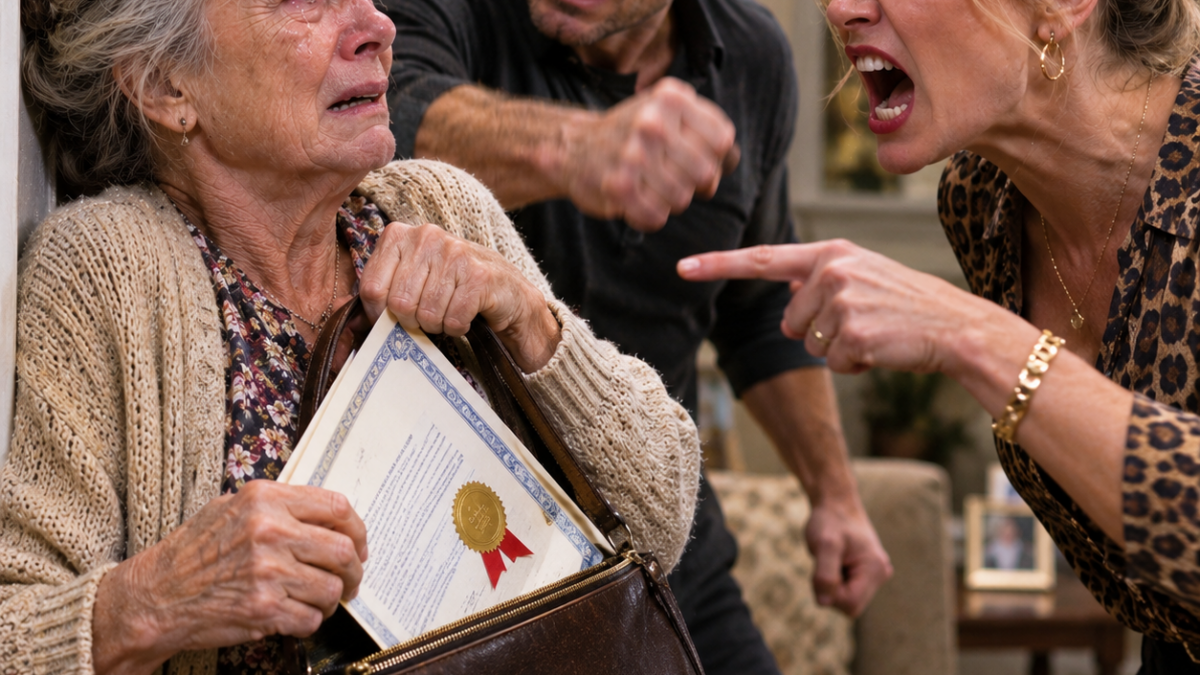
Sarah reached toward the envelope.
“What is that?”
I moved it out of her reach.
“A document you should have expected.”
Alex stared at me.
“Mom, what have you done?”
I almost laughed.
The question was so extraordinary that for a moment I couldn’t answer.
What have I done?
I had spent four years being ordered around inside my own apartment.
Four years paying bills while my son and daughter-in-law used every room as though I were an unwanted tenant.
Four years watching Michael’s possessions disappear.
Four years of humiliation.
And now, because I was holding a legal document, Alex wanted to know what I had done.
I looked at him.
“I finally asked someone to help me.”
Sarah’s face hardened.
“Who?”
“An attorney.”
The word changed the atmosphere instantly.
George—no, there was no George here, only my son Alex, the man I had raised—looked at his wife as if hoping she would know how to respond.
Sarah recovered first.
“An attorney?”
She laughed too loudly.
“With what money? You can’t even afford decent clothes.”
I felt the familiar sting.
For years, she’d mocked the dresses I made myself.
The old cardigans.
The shoes I repaired rather than replaced.
She believed that because I lived modestly, I had no power.
But she had mistaken frugality for helplessness.
“My attorney’s name is James,” I said.
Alex’s expression changed.
“Mom, why would you need a lawyer?”
I looked him directly in the eyes.
“Because every time I asked you to protect me, you chose not to.”
His mouth opened.
Nothing came out.
Sarah crossed her arms.
“Well, your little lawyer isn’t going to scare us. We have rights.”
“You have the right to receive lawful notice and respond through the proper process,” I said. “You do not have the right to threaten me or steal my home.”
Her eyes narrowed.
“Who told you that?”
“James.”
She laughed bitterly.
“Some stranger has been filling your head with nonsense.”
I shook my head.
“No, Sarah. A stranger finally listened to what my own son wouldn’t.”
For a few seconds, nobody moved.
Then Sarah stepped closer.
“You’re going to regret this.”
I looked at the woman who had made me frightened to enter my own kitchen.
The woman who’d turned my bedroom into hers.
Who’d thrown away my belongings.
Who’d told me she wished I would die.
And I answered quietly.
“I already regret something.”
She smirked.
“What?”
“That I allowed you to believe kindness meant I would never defend myself.”
I returned the envelope to my purse.
Then I walked toward the kitchen.
My knees were trembling.
My heart was racing.
But I kept walking.
Behind me, Sarah began shouting again.
This time, I didn’t turn around.
Because the document in my purse wasn’t merely a piece of paper.
It was the beginning of the end of four years of suffering.
Four years earlier, my life had looked completely different.
Michael had just died.
Even now, writing those words hurts.
We’d been married for forty-five years.
Forty-five years of ordinary days that only became extraordinary after I lost him.
He worked in construction.
His hands were rough from lifting materials, repairing buildings, and working through bitter winters.
I was a seamstress.
I spent decades altering dresses, repairing uniforms, shortening trousers, and making clothes for families who couldn’t afford expensive stores.
Neither of us became wealthy.
But we lived carefully.
We saved.
We paid our bills.
We took pride in having something that belonged to us.
Thirty years before he died, we bought our apartment.
It wasn’t luxurious.
The kitchen was small.
The bathroom needed updating.
The living-room window sometimes rattled during winter storms.
But it was ours.
Michael loved sitting beside that window after work.
He’d read the newspaper while I prepared dinner.
Sometimes he’d fall asleep in the old armchair with the paper still open across his chest.
I’d tease him.
“Michael, you’re missing all the important news.”
He’d open one eye.
“The important news is that I’m home.”
Then he’d smile.
I can still see that smile.
When Alex was little, Michael would lift him onto his shoulders and walk around the apartment pretending they were exploring some enormous castle.
“This is the royal kitchen,” he’d announce.
Alex would laugh.
“And that’s where the queen makes dinner!”
I’d pretend to be offended.
“Does the queen ever get a day off?”
Michael would kiss my cheek.
“Only if the king learns to cook.”
Those were happy years.
Not perfect years.
We argued.
We worried about money.
We had days when we were exhausted.
But we respected one another.
And when Michael became ill, we faced that together, too.
The last months were difficult.
I watched the strong man I’d loved become weaker.
I helped him dress.
Prepared his meals.
Sat beside him through sleepless nights.
Sometimes he apologized.
“Mary, I never wanted you to have to do all this.”
I’d take his hand.
“You’ve taken care of me for forty-five years.”
He’d smile sadly.
“Not enough.”
One evening, as the sun was setting, he looked around the bedroom.
“Promise me something.”
“Anything.”
“Don’t let anyone take this place away from you.”
I frowned.
“Michael—”
“Promise.”
I squeezed his hand.
“I promise.”
His eyes filled.
“You worked just as hard for this apartment as I did. It’s yours, Mary. Whatever happens.”
He died not long afterward.
And for months, I barely knew how to live without him.
Grief made the apartment feel enormous.
I would wake up and reach toward Michael’s side of the bed.
Empty.
I’d prepare coffee and instinctively take out two mugs.
Then remember.
Sometimes I heard a sound in the hallway and thought he was coming home.
For one wonderful fraction of a second, I forgot he was gone.
Then reality returned.
I cried in the kitchen.
In the bathroom.
Beside his armchair.
I cried while folding clothes he’d never wear again.
And I cried when I opened the drawer containing the letters he’d written during the years he worked construction jobs in other states.
Those letters were precious.
Some were thirty years old.
The paper had yellowed.
His handwriting slanted unevenly across the pages.
But every word brought back his voice.
He wrote about missing me.
About saving money.
About building a secure future.
About the little apartment he wanted us to own outright someday.
Sometimes he included silly jokes.
Sometimes he drew terrible pictures of himself wearing a hard hat.
I kept every letter.
They were pieces of him I could still hold.
After his death, Alex began visiting on Sundays.
I was grateful.
He was our only son.
I’d poured so much love into raising him that the idea of losing our closeness frightened me almost as much as the loneliness itself.
Sometimes he brought Sarah.
My daughter-in-law had always been distant.
Polite when other people were watching.
Cold when we were alone.
I tried not to take it personally.
Not every daughter-in-law becomes close to her husband’s mother.
I understood that.
I cooked her favorite meals.
Asked about her work.
Tried to make her feel welcome.
But there was always something in her expression that made me feel I was being evaluated.
As though every part of my home fell short of her expectations.
She disliked the furniture.
The curtains.
The kitchen appliances.
The old photographs on the walls.
She once looked around the living room and said, “Mary, this place could look so much better if you got rid of all this old junk.”
I smiled.
“Most of it has sentimental value.”
She rolled her eyes.
“That’s what people say when they don’t want to update anything.”
Alex laughed awkwardly.
I pretended the comment didn’t hurt.
I was lonely.
I didn’t want to create tension.
So I stayed quiet.
I didn’t understand then how expensive my silence would become.
One afternoon in March, Alex arrived looking worried.
He sat on the sofa.
“Mom, I need to talk to you.”
I set down my sewing.
“What’s wrong, sweetheart?”
He rubbed his hands together.
“Sarah’s pregnant.”
My heart leaped.
“A baby?”
He nodded.
I stood so quickly my knees protested.
“Oh, Alex!”
I hugged him.
“A grandchild!”
For the first time since Michael’s death, I felt uncomplicated joy.
I imagined holding a tiny baby.
Buying little dresses.
Sewing blankets.
Teaching a child the stories Michael had once told Alex.
But my son’s smile faded.
“There’s something else.”
I sat down.
“What?”
“We’re having money problems.”
My stomach tightened.
He explained that their rent had increased to nine hundred dollars a month.
With a baby coming, they couldn’t afford their current apartment.
They’d looked for cheaper places, but the options were unsuitable or in neighborhoods they didn’t feel safe moving to.
“I don’t know what to do, Mom.”
I looked at him.
He was a grown man.
But in that moment, I saw the frightened boy who used to come to me when something went wrong.
“How can I help?”
His shoulders relaxed slightly.
“Could we stay here?”
I hesitated.
He continued quickly.
“Just for a few months. Six months, maybe a year at the absolute most.”
I looked toward Michael’s armchair.
The apartment had been painfully quiet since he died.
Perhaps having family nearby would make it feel alive again.
“A year?”
“Probably less.”
“And Sarah agrees?”
“Yes.”
He leaned forward.
“Mom, I promise we’ll leave as soon as I get the raise I’ve been waiting for.”
I thought about the baby.
My grandchild.
How could I refuse?
I reached for his hand.
“Of course you can stay.”
Alex embraced me.
“Thank you, Mom.”
He sounded genuinely grateful.
“You don’t know what this means.”
I smiled through tears.
“Family helps family.”
I believed every word.
And that was the beginning.
Two weeks later, Alex and Sarah moved in.
They arrived with suitcases, boxes, baby supplies, and furniture.
I prepared Michael’s old office for them.
I’d cleaned it thoroughly.
Rearranged the furniture.
Put fresh sheets on the bed.
Placed flowers on the dresser.
When Sarah entered, she looked around without smiling.
“This is the room?”
I nodded.
“It’s the largest spare room.”
She glanced toward my bedroom.
“And that’s yours?”
“Yes.”
She said nothing.
But I noticed how long she stared at the door.
The first few days were quiet.
Sarah spent most of her time resting.
Alex worked late.
I tried to give them privacy.
I made meals and cleaned up afterward.
I told myself we were adjusting to a new routine.
Then the changes began.
One afternoon, I returned from buying groceries and found the living room completely rearranged.
My sofa had been moved.
Michael’s armchair was pushed into a corner.
The small table we’d bought on our twentieth anniversary had been placed against the wall.
Sarah stood in the middle of the room.
“Much better, don’t you think?”
I stared.
“You moved everything?”
She shrugged.
“The old arrangement made no sense.”
I looked at Michael’s chair.
“That was where my husband always sat.”
Sarah sighed.
“Mary, I know you’re sentimental, but this apartment can’t remain frozen in time.”
I wanted to tell her to put everything back.
Instead, I looked at her growing belly.
She was pregnant.
Perhaps she needed more room.
Perhaps I should be considerate.
So I nodded.
“If it makes things easier.”
She smiled.
“Exactly.”
It seemed such a small surrender.
But it taught her something.
She could change my home without asking.
And I would accept it.
Next came the kitchen.
I opened a cupboard one morning and found it empty.
My pots and pans were gone.
I searched the lower cabinets.
Nothing.
Sarah entered carrying a box.
“Looking for something?”
“My cookware.”
“Oh, I packed that away.”
I stared at her.
“Why?”
She gestured toward the new pans on the counter.
“I brought my own.”
“But mine were perfectly good.”
She laughed.
“Mary, some of those pots are older than Alex.”
“That doesn’t make them unusable.”
She opened a drawer.
“I don’t want to cook with rusty things.”
“They aren’t rusty.”
She looked annoyed.
“Can you please not make everything into an argument?”
I stopped speaking.
I was beginning to recognize the pattern.
Whenever I questioned a change, Sarah acted as though I was unreasonable.
If I defended something important to me, I was difficult.
If I wanted my belongings respected, I was controlling.
If I became upset, I was emotional.
So I swallowed my frustration.
Again.
Over the following weeks, the apartment changed piece by piece.
The curtains Michael and I had chosen disappeared.
Sarah replaced them with beige ones.
Our family photographs came down.
Modern prints appeared in their place.
My collection of porcelain figurines was packed into boxes.
She called them clutter.
My favorite lamp was moved to storage.
She said it didn’t match the new furniture.
Every room looked more like Sarah.
And less like me.
One evening, I stood in the hallway staring at the empty wall where Alex’s childhood photographs had once hung.
I had measured his life in those pictures.
First birthday.
First day of school.
Graduation.
Wedding.
Now the wall held a large abstract print.
I didn’t even know what it was supposed to represent.
I touched the place where Michael’s favorite photograph had hung.
And I wondered how a person could become a guest in her own home without ever agreeing to leave.
Four months after they moved in, I overheard a conversation.
It was late.
I was carrying folded towels toward the linen closet when I heard Sarah speaking from their bedroom.
The door was slightly open.
“Why do we have to keep pretending?”
I stopped.
Alex answered.
“What do you mean?”
“This apartment should belong to us.”
My heart began pounding.
“Sarah, it’s Mom’s.”
“For now.”
A pause.
“You’re her only son. Eventually, everything becomes yours anyway.”
Alex sighed.
“Don’t start.”
“Why not?”
Her voice sharpened.
“We’ve been here four months. She trusts you completely. You could ask her to transfer it.”
I pressed my back against the wall.
I couldn’t believe what I was hearing.
Alex lowered his voice.
“I don’t know if she’d agree.”
Sarah laughed.
“Of course she would. She’s lonely. She’s grieving. She’ll do practically anything to keep you close.”
My knees weakened.
I gripped the towels.
Sarah continued.
“Wait until she’s vulnerable enough. Then ask her to sign something. A transfer. A will. Whatever works.”
I waited for Alex to object.
To tell his wife that taking advantage of my grief was unthinkable.
To remind her that Michael and I had spent thirty years paying for that apartment.
Instead, he said quietly, “Maybe later.”
Maybe later.
Two words.
That was all.
And they changed something inside me.
I returned to my room, closed the door, and sat on the bed.
I wanted to believe I’d misunderstood.
Perhaps Sarah was simply talking about inheritance.
Perhaps Alex had been humoring her.
Perhaps they didn’t actually intend to pressure me.
I searched for explanations because the alternative was unbearable.
My son had heard his wife planning to exploit my grief.
And he hadn’t said no.
That night, I barely slept.
But the next morning, I acted normally.
I made breakfast.
Smiled.
Asked Sarah how she was feeling.
And pretended I hadn’t heard anything.
I didn’t realize that my silence had become permission for them to go further.
My granddaughter was born in August.
A beautiful little girl.
When Alex called from the hospital, I cried.
I thought about Michael.
How much he would have loved holding her.
I wished he could have seen the tiny fingers, the little face, the way Alex stared at his daughter as if he’d never witnessed anything so extraordinary.
For a few days, I allowed myself to hope things would improve.
A new baby might soften Sarah.
Perhaps motherhood would make her understand what I’d spent years giving Alex.
Perhaps our family would finally feel close.
Instead, everything became worse.
Two days after Sarah returned from the hospital, she appeared in my bedroom.
“Mary, we need to make some changes.”
I looked up from the blanket I was sewing for the baby.
“What changes?”
She glanced around.
“This room is farther from the living room. It’s quieter.”
I nodded.
“Yes.”
“We need it.”
I stared at her.
“What?”
“The baby cries at night. Alex and I need rest.”
“But you have the spare bedroom.”
“It’s too small.”
I placed the blanket on my lap.
“Sarah, this was Michael’s and my bedroom.”
She sighed.
“Mary, you’re one person. We’re three.”
My throat tightened.
“Where am I supposed to sleep?”
She gestured toward the living room.
“The sofa is comfortable.”
I stared at her.
“The sofa?”
“Temporarily.”
I had learned to fear that word.
Temporary.
The same word Alex used when asking to move in.
The same word Sarah used whenever she changed something in my apartment.
I looked toward my husband’s side of the bed.
I remembered him sleeping there.
The morning sunlight touching his face.
His voice asking whether I wanted coffee.
And I felt as though someone was asking me to give away another piece of him.
“Please,” I whispered. “Not this room.”
Sarah’s expression hardened.
“Are you seriously going to make a newborn baby suffer because you’re sentimental about a bedroom?”
I stared at her.
She continued.
“I thought you wanted to be a good grandmother.”
The accusation worked.
Of course it did.
I didn’t want to be selfish.
I didn’t want the baby uncomfortable.
I didn’t want Alex disappointed.
So I packed my clothes.
And at seventy years old, I began sleeping on the sofa in the apartment I owned.
The sofa was uncomfortable.
The cushions were worn.
My back hurt every morning.
Sometimes I woke with numbness in my legs.
But I didn’t complain.
I told myself Sarah had just given birth.
She needed rest.
The baby needed care.
Things would eventually settle.
They didn’t.
Alex’s promised raise never seemed to arrive.
Every time I asked whether they’d begun looking for another apartment, he had an excuse.
“Mom, rent is crazy right now.”
“The baby is too little to move.”
“We need a few more months.”
“I’m trying to save.”
I wanted to believe him.
Then Sarah started setting rules.
I couldn’t use the washing machine on weekends.
She needed it for the baby’s clothes.
I couldn’t cook certain foods because she disliked the smell.
I couldn’t invite friends over because the baby needed quiet.
I couldn’t watch television after eight.
I couldn’t rearrange anything without asking.
I couldn’t enter their bedroom.
Soon, I couldn’t enter the nursery without permission.
Alex installed locks on the doors.
I watched him kneel with a screwdriver in my own hallway.
“Son, do we really need locks?”
He didn’t look up.
“Sarah wants privacy.”
“I would never enter without knocking.”
“I know, Mom.”
“Then why?”
He sighed.
“Please don’t make this difficult.”
I stared at the back of his head.
Michael had taught that boy how to use tools.
They’d repaired furniture together.
Built shelves.
Fixed broken hinges.
And now Alex was using those skills to keep his mother out of rooms inside her own home.
The drill buzzed.
Metal scraped.
The lock clicked into place.
I felt something inside me shrink.
The bills remained mine.
Electricity.
Gas.
Water.
Maintenance fees.
Most of the groceries.
My pension was only about seven hundred dollars a month.
I had some savings, but they were limited.
Alex and Sarah contributed almost nothing.
Yet Sarah wore expensive clothes.
Bought new makeup.
Ordered shoes.
Went shopping with friends.
Sometimes she’d return carrying bags from stores I had never entered because their prices frightened me.
I would look at those bags and think about the money Alex claimed they didn’t have for rent.
But I said nothing.
Whenever I tried to discuss expenses, he looked ashamed and promised things would improve.
Whenever I asked Sarah, she became angry.
“Mary, we’re raising a child.”
“I understand.”
“Then stop counting every penny.”
I wanted to tell her those pennies had paid for the apartment she now controlled.
That Michael and I had counted every dollar for decades.
That financial responsibility wasn’t something shameful.
But I stayed quiet.
As the months passed, I began losing weight.
I wasn’t eating properly.
I was anxious.
Tired.
Frightened of doing anything that might upset Sarah.
I stopped calling friends.
Stopped going out.
Stopped sewing because she complained about the noise.
My apartment became smaller every day.
Not physically.
Emotionally.
The space I was allowed to occupy kept shrinking.
And the worst part was that I began believing I deserved it.
By the second year, Sarah had stopped pretending to respect me.
She invited friends over for parties.
They drank in my living room.
Played loud music.
Moved furniture.
Left dishes everywhere.
Sometimes I stayed in the hallway because I couldn’t bear being treated like an inconvenience in front of strangers.
One evening, a guest shouted from the sofa.
“Hey, can you bring me another beer?”
I turned.
He was looking at me.
I stared at him.
“Excuse me?”
He gestured toward the kitchen.
“Another beer.”
Something inside me tightened.
“I don’t work here.”
He laughed.
“Oh. Sorry.”
I swallowed.
“I own this apartment.”
He looked around.
Then laughed again.
“Really? Because Sarah seems to be running the place.”
The people nearby chuckled.
I stood frozen.
He wasn’t trying to be especially cruel.
He was simply describing what he saw.
Sarah controlled the living room.
The kitchen.
The bedrooms.
The visitors.
The rules.
And I had become an elderly woman moving quietly through the edges of my own home.
I walked toward the small utility closet and shut myself inside.
It was the only place Sarah hadn’t reorganized completely.
I sat on a stool among cleaning supplies and cried silently.
For the first time, I wondered whether I would spend the rest of my life that way.
Not homeless.
But without a home.
Eleanor came to visit one afternoon.
She had been my friend for years.
We used to meet for coffee.
Exchange sewing patterns.
Go shopping together.
After Michael died, she’d been one of the few people who consistently checked on me.
But I’d gradually stopped answering her invitations.
I was embarrassed.
I didn’t want anyone to know how Alex and Sarah treated me.
When I opened the door, Eleanor stared.
“Mary?”
I tried to smile.
“Hello, sweetheart.”
Her face changed.
“What happened to you?”
“Nothing.”
“You’re so thin.”
“I’m just tired.”
She looked past me.
The living room was almost unrecognizable.
The family photographs were gone.
Michael’s armchair had disappeared.
The curtains had changed.
She stepped inside.
“Where are your things?”
I looked away.
“Eleanor—”
“Mary.”
Her voice softened.
“Where do you sleep?”
I tried to answer.
Couldn’t.
She looked toward the sofa.
Then back at me.
“Oh, my God.”
That was when I began crying.
I told her everything.
The bedroom.
The locks.
The insults.
The unpaid bills.
The constant rules.
The fear.
The way Alex refused to defend me.
Eleanor held me while I shook.
When I finally stopped, she looked furious.
“Mary, this is abuse.”
I shook my head.
“They’re family.”
“That doesn’t make it less abusive.”
“Alex is my only son.”
Her expression softened.
“I know.”
“And the baby…”
My voice broke.
“If I make them leave, they might keep my granddaughter from me.”
Eleanor took both my hands.
“Mary, listen to me.”
I looked up.
“This apartment belongs to you.”
I nodded.
“You paid for it.”
“Yes.”
“Michael worked his entire life to help you keep it.”
Tears filled my eyes.
“And now you’re sleeping on a sofa while your son and his wife act as though you’re their servant.”
I looked down.
“You need help.”
I whispered, “I can’t do it.”
She shook her head.
“You don’t have to do it alone.”
Before I could answer, the front door opened.
Sarah walked in carrying expensive shopping bags.
She stopped when she saw Eleanor.
“What is she doing here?”
Eleanor stood.
“I’m visiting Mary.”
Sarah looked at me.
“Mary, I told you we don’t want visitors disturbing the baby.”
I tried to speak.
Eleanor answered.
“This is her home.”
Sarah gave a cold laugh.
“Her home?”
She set the bags down.
“We’ve lived here for more than a year.”
Eleanor stared at her.
“And?”
Sarah crossed her arms.
“She’s part of our family arrangement. You aren’t. So I suggest you leave.”
Eleanor didn’t move.
“I’ll leave when Mary asks me.”
Both women looked at me.
My throat closed.
Sarah’s stare was hard.
Threatening.
I knew what would happen after Eleanor left if I defended myself.
The shouting.
The punishment.
The accusations.
My fear was stronger than my courage.
“Eleanor,” I whispered, “perhaps you should go.”
I saw the hurt in her eyes.
She stood still for a moment.
Then nodded.
“All right.”
At the door, she turned.
“Mary, remember what I told you.”
I nodded.
But I couldn’t look at her.
After she left, Sarah moved directly toward me.
“If I see that woman here again, you’ll regret it.”
I stared at the floor.
“Do you understand?”
“Yes.”
“And there’s something else.”
My stomach tightened.
“We need the living room.”
I looked up.
“What?”
“Alex bought exercise equipment. We’re setting up a gym.”
I stared at the sofa.
“Where am I supposed to sleep?”
She smiled.
“The utility closet.”
For a moment, I thought she was joking.
Then I saw her expression.
She wasn’t.
The utility closet was approximately six feet by six feet.
No windows.
Poor ventilation.
A stained ceiling.
Shelves holding cleaning supplies.
There was barely enough room for a thin mattress on the floor.
I stood in the doorway and stared.
“Sarah, I can’t sleep here.”
She shrugged.
“You can.”
“My back is already hurting.”
She rolled her eyes.
“You’re always complaining about something.”
I looked toward Alex, who was standing in the hallway.
“Son?”
He avoided my eyes.
“Mom, it’s just until we figure something out.”
Temporary.
Again.
I looked at him.
“Please.”
He sighed.
“Don’t make this harder.”
I felt something inside me collapse.
Sarah crossed her arms.
“Or we can start looking for a retirement home.”
I stared at her.
She smiled.
“Of course, we’d need to sell the apartment to pay for it.”
My blood ran cold.
There it was.
The real threat.
Obey.
Or lose everything.
That evening, I carried my blanket into the closet.
I lay down on the thin mattress.
The floor was hard.
The air smelled of mildew and cleaning chemicals.
I could hear Sarah laughing in the living room.
The television blared.
Someone moved the exercise equipment.
And I stared at the ceiling, wondering how I had become a prisoner in the home Michael promised would always protect me.
I thought about calling Eleanor.
Then imagined Sarah discovering it.
I thought about confronting Alex.
Then remembered his silence.
I thought about leaving.
But where would I go?
How would I live?
What would happen to my granddaughter?
Those questions kept me trapped more effectively than any locked door.
The following months were terrible.
Sarah gave me chores.
Laundry.
Cleaning.
Cooking.
Childcare.
Whenever she wanted to go shopping or visit friends, I was expected to watch the baby.
I loved my granddaughter.
That love was real.
But Sarah used it against me.
“You’re the grandmother,” she’d say. “You should be grateful.”
I was grateful for the child.
I wasn’t grateful for being treated as unpaid labor.
Sometimes Sarah woke me in the middle of the night because she wanted water.
Or a snack.
Or help cleaning something.
If I hesitated, she accused me of being selfish.
If I said I was tired, she laughed.
“You’re retired, Mary. What do you have to be tired about?”
I stopped arguing.
My body hurt constantly.
I lost more weight.
My hands trembled.
I began feeling frightened whenever I heard her footsteps.
Alex saw everything.
Sometimes he looked guilty.
But he never intervened.
If I asked for help, he said Sarah was stressed.
If I told him she’d insulted me, he said she didn’t mean it.
If I cried, he told me not to upset his wife.
My son had chosen silence.
And his silence became another form of cruelty.
One afternoon, I overheard Sarah speaking on the phone.
She was in the kitchen.
I was in the hallway.
At first, I intended to walk past.
Then I heard my name.
“Mary’s getting weaker.”
I stopped.
Sarah laughed.
“Honestly, I think she’ll sign eventually.”
My heart began pounding.
There was a pause.
Then she continued.
“The apartment’s worth about three hundred thousand dollars. Alex is her only son. It should already be ours.”
I pressed my hand against the wall.
Sarah lowered her voice.
“If she gets sick, that might make things easier.”
I couldn’t breathe.
She laughed again.
“I’m not saying I’d do anything to her. I just mean old people fall. They have accidents. Things happen.”
My knees weakened.
“Besides,” she continued, “if I make her miserable enough, she’ll eventually agree to a nursing home. Then we can deal with the apartment.”
I stood frozen.
Three hundred thousand dollars.
That was how she saw me.
Not as a mother.
Not as a grandmother.
Not as a woman who’d spent decades working.
As an obstacle between her and an apartment.
I returned to the utility closet.
Sat on the mattress.
And stared at the floor.
For the first time, I was genuinely afraid of what might happen if I continued living there.
The next morning, Sarah opened the closet door at six.
“Get up.”
I blinked.
“What?”
“We have company coming tonight. Clean the apartment.”
I tried to sit up.
My back protested.
“Sarah, I didn’t sleep well.”
She stared.
“I don’t care.”
“I’m exhausted.”
She crouched in front of me.
Her perfume filled the tiny space.
“Listen carefully, Mary.”
I froze.
“I don’t care if you’re tired. I don’t care if you’re sick. I don’t care if you’re dying.”
My eyes filled.
“You’re going to do what I say.”
I whispered, “Please stop.”
Her expression hardened.
“And if you don’t, I’ll tell Alex you tried to hurt the baby.”
The world seemed to stop.
I stared at her.
“What?”
She smiled.
“You heard me.”
“But that’s a lie.”
“Of course it’s a lie.”
She leaned closer.
“But who do you think he’ll believe?”
I couldn’t speak.
“Me? Or the confused old woman who can’t even remember where she puts things?”
Tears slid down my cheeks.
She stood.
“Get up. We have a lot to do.”
Then she left.
I sat alone in that closet.
For several minutes, I couldn’t move.
The threat had gone beyond humiliation.
Sarah was willing to accuse me of harming my granddaughter.
The child I loved.
The child I’d cared for every day.
She was prepared to use that love to destroy me.
Something changed inside me.
It wasn’t courage yet.
It was survival.
I realized that if I continued obeying, I might lose everything.
My home.
My reputation.
My independence.
Perhaps even my safety.
I looked toward the closed door.
And for the first time in years, I thought:
No.
Not again.
Not anymore.
That afternoon, while Sarah slept and Alex was at work, I left the apartment.
I walked three blocks to Eleanor’s house.
Every step hurt.
My back ached.
My knees trembled.
I felt as though I were escaping from something rather than simply visiting a friend.
When Eleanor opened the door, she stared at me.
“Mary?”
I began crying immediately.
She pulled me inside.
Sat me on her sofa.
Brought tea.
Then waited.
“I need help,” I whispered.
Her eyes filled.
“Tell me.”
I told her everything I’d been too ashamed to say before.
The utility closet.
The threats.
The phone conversation about the apartment.
Sarah’s plan to make me miserable until I agreed to leave.
The threat to accuse me of hurting the baby.
By the time I finished, Eleanor’s expression was fierce.
“This ends.”
I looked at her.
“I don’t know how.”
“We’re going to find out.”
She sat beside me.
“First, you need to protect yourself.”
I nodded.
“Second, we need evidence.”
I looked confused.
“Evidence?”
“Record what happens, if it’s lawful to do so. Keep notes. Preserve messages. Document the threats. A lawyer can explain what can be used.”
I swallowed.
“Sarah checks my phone.”
Eleanor stood.
She returned carrying an old smartphone.
“Use this to keep records securely. Don’t let her take it.”
My hands trembled as I accepted it.
Then Eleanor said, “I know an attorney.”
I looked up.
“His name is James.”
I shook my head.
“I can’t afford one.”
She took my hands.
“I’ll help you with the initial costs.”
“Eleanor—”
“No.”
Her voice softened.
“You’ve spent your entire life helping other people. Let someone help you.”
I began crying again.
I hadn’t realized how badly I needed to hear those words.
James was in his fifties.
He had a calm voice and the serious expression of someone accustomed to difficult situations.
When Eleanor brought me to his office a week later, I could barely speak.
He offered water.
Waited patiently.
And listened.
I told him about Michael.
The apartment.
Alex and Sarah moving in.
The unpaid bills.
The bedroom.
The utility closet.
The threats.
The plans to pressure me into transferring ownership.
James asked questions.
Careful questions.
He wanted documents.
Proof of ownership.
Financial records.
Messages.
Dates.
Witnesses.
I brought everything I could.
He studied the deed.
Then looked at me.
“Mary, this apartment is legally yours.”
I nodded.
“I know.”
“Your son doesn’t become an owner simply because he lives here.”
Tears gathered.
“And his wife doesn’t gain the right to force you out because she’s been staying there.”
I pressed my hands together.
“But they’ve lived with me for years.”
“That means we need to follow the proper process for ending their occupancy. We can’t simply ignore whatever rights they may have under local housing law.”
I nodded.
“Can I make them leave?”
“There are legal steps we can take. And the allegations of intimidation and exploitation may support additional protective measures.”
I stared at him.
“Even though they’re family?”
He leaned forward.
“Being family doesn’t give someone permission to threaten you or take control of your property.”
I began crying.
James gave me time.
Then he said, “Mary, I want you to understand something.”
I looked up.
“You are not asking the court to give you something that belongs to your son.”
He pointed toward the deed.
“You’re asking the law to protect property you already own.”
The words stayed with me.
For years, Sarah had made me feel selfish for wanting my own bedroom.
My own kitchen.
My own home.
Now a stranger was telling me that wanting those things was not unreasonable.
They were mine.
Over the following days, I began documenting what happened.
I kept notes.
I saved messages.
I preserved recordings where permitted and discussed their use with James.
Sarah continued insulting me.
Alex continued avoiding responsibility.
And I continued gathering evidence.
One evening, I heard Sarah speaking on the phone again.
Her voice carried through the hallway.
“She still hasn’t signed anything.”
A pause.
Then she laughed.
“I’m thinking about finding someone who can help with the paperwork.”
My stomach tightened.
She continued.
“If we could get her signature on the transfer, she’d never be able to fight us.”
I felt cold.
She mentioned the possibility of forging documents and involving someone she believed could help authenticate them.
I carefully preserved what I heard and reported it to James.
When he reviewed the information, his expression became grave.
“Mary, this is serious.”
I swallowed.
“What does it mean?”
“It raises concerns about attempted fraud. We need to make sure the relevant authorities have the information and that your property records are protected.”
My hands began shaking.
“Could they actually take my apartment?”
“Not simply by saying it belongs to them. But attempted forgery or fraudulent filings are reasons to take precautions immediately.”
I looked down.
For years, I’d been waiting for Alex to defend me.
Now I understood that I needed to defend myself.
James began preparing the necessary filings and seeking appropriate legal protections.
Eleanor came to see me regularly.
She brought food.
Encouraged me to rest.
Reminded me that I wasn’t alone.
And slowly, I began recovering the strength Sarah had spent years trying to take away.
Sarah noticed the change.
One afternoon, she stood in front of me with her arms crossed.
“You’re acting strange.”
I looked up from the laundry.
“Am I?”
“Don’t play stupid.”
I remained silent.
She narrowed her eyes.
“What are you hiding?”
“Nothing.”
She leaned closer.
“Mary, if you’re planning something, you’re going to regret it.”
I looked at her.
For once, I didn’t immediately lower my eyes.
Her expression changed.
She wasn’t accustomed to that.
She continued.
“You have nobody. No money. No power.”
I thought of Eleanor.
James.
The deed.
The evidence.
The legal documents being prepared.
And I knew she was wrong.
But I didn’t argue.
I simply said, “I need to finish the laundry.”
She stared at me.
Then walked away.
My hands were trembling.
But I felt something extraordinary.
I had looked her in the eyes without apologizing.
It was a small victory.
Yet after four years, it felt enormous.
The next few days were difficult.
Sarah became more aggressive.
She threw away clothes I loved.
She damaged one of the remaining photographs of Michael.
She forbade me from using the kitchen after six in the evening.
She complained whenever Eleanor visited.
But I continued working with James.
At last, the court process reached the point where formal notice could be served.
James called.
“Mary, we have the necessary paperwork. There are specific deadlines and procedures, and we’ll make sure everything is handled lawfully.”
I sat on the mattress in the utility closet.
“Does that mean I can have my home back?”
“It means we’re taking the steps needed to enforce your ownership and protect you. We’ll explain the exact timeline and any orders when we meet.”
I closed my eyes.
For a moment, I couldn’t speak.
“Mary?”
“I’m here.”
“Are you all right?”
I began crying.
“Yes.”
It was the first time in years I could say the word and almost believe it.
The morning James arrived with officers present for safety, I woke before dawn.
I hadn’t slept much.
I lay staring at the utility closet ceiling, listening to the apartment.
The refrigerator humming.
A car passing outside.
Alex snoring faintly behind the locked bedroom door.
The building was quiet.
Ordinary.
And I knew that by the end of the legal process, my life might finally change.
I sat up slowly.
My back hurt.
I looked around the cramped space.
The cleaning supplies.
The stained walls.
The mattress.
For years, this had been the only area where Sarah allowed me to retreat without demanding something.
I touched the blanket.
Then whispered, “Never again.”
I stood.
Showered.
And put on a dark green dress Michael had given me years earlier.
It was one of the few pieces Sarah hadn’t thrown away.
I smoothed the fabric.
Looked in the mirror.
My face was thinner.
My hair almost completely gray.
There were lines around my eyes that hadn’t been there when Alex moved in.
But I stood straight.
I wanted Michael to recognize me.
Not because I needed to look young.
Because I wanted to look like the woman he’d loved.
The woman who’d spent decades working beside him.
The woman who’d promised to protect their home.
At the appointed time, the doorbell rang.
I opened it.
James stood outside with his briefcase.
Officers were with him.
He smiled gently.
“Good morning, Mary.”
I nodded.
“Good morning.”
“Are you ready?”
My hands trembled.
But I answered.
“Yes.”
Sarah appeared from the bedroom wearing a robe.
She stopped when she saw James and the officers.
“What is this?”
James introduced himself and explained that he represented me.
He presented the relevant court documents and notices.
Sarah’s expression changed.
First confusion.
Then disbelief.
Then anger.
“Mary!”
She turned toward me.
“What have you done?”
I looked at her.
“For the first time in four years, I’ve defended myself.”
She snatched the papers.
Read them.
Then looked toward Alex, who had appeared in the hallway.
“Alex! Your mother is trying to throw us out!”
My son stared at James.
Then at me.
“Mom?”
I looked at him.
He seemed genuinely shocked.
As if he’d never imagined I could act without his permission.
“What’s going on?”
I took a breath.
“I’m ending the arrangement that allowed you and Sarah to live here.”
He frowned.
“But we’re family.”
The words hurt.
Not because they were false.
Because he’d used them for years while ignoring what family should mean.
“Yes, Alex.”
I looked at him.
“You are my son.”
His face softened slightly.
Then I continued.
“And for four years, you watched your wife mistreat me without intervening.”
He looked away.
“You moved me out of my bedroom.”
Silence.
“You put locks on doors inside my apartment.”
He swallowed.
“You let Sarah make me sleep in a utility closet.”
“Mom, we were under pressure.”
I shook my head.
“Pressure doesn’t excuse cruelty.”
Sarah interrupted.
“This is ridiculous! We’ve lived here for years!”
James calmly explained the legal status of the proceedings and the requirements they would have to follow.
Sarah argued.
Threatened.
Insisted the apartment belonged to the family.
But the deed showed my name.
Only mine.
Michael had made sure of that.
And the legal process was no longer something Sarah could dismiss with an insult.
I watched her face change as she realized shouting would not erase the documents.
For the first time, she looked frightened.
Alex turned toward me.
“Mom, please.”
I looked at him.
He stepped closer.
“Think about the baby.”
My heart tightened.
My granddaughter.
The child I’d cared for.
The little girl whose arrival had been one of the few joys after Michael’s death.
I loved her.
But I also knew what Alex was doing.
He was using that love to make me retreat.
“Alex, I have thought about her.”
He looked hopeful.
“Then you can’t make us leave.”
I shook my head.
“Your daughter deserves parents who can provide a safe, stable home.”
His expression hardened.
“That’s what we’re trying to do.”
“By taking mine?”
He looked away.
I continued.
“I gave you a place to stay temporarily.”
“We needed help.”
“And I helped.”
My voice broke.
“I helped until I was sleeping on the floor.”
He stared at me.
“I helped while you and Sarah paid almost nothing.”
Silence.
“I helped while you let her insult me.”
His eyes filled.
I stepped closer.
“And when she threatened to accuse me of hurting my granddaughter, where were you?”
He looked stunned.
“What?”
Sarah’s face changed.
“Mary, don’t start.”
I turned toward her.
“You told me you’d accuse me of hurting the baby if I didn’t obey you.”
Alex looked at his wife.
“Sarah?”
She shrugged.
“I was angry.”
His expression shifted.
He looked back at me.
“Mom, did she really say that?”
I felt tears gathering.
“Yes.”
He stared at Sarah.
For once, she seemed uncertain.
Then she snapped.
“Oh, please. Your mother exaggerates everything.”
I reached into my purse.
And removed the envelope.
The same envelope I’d held when Alex had stepped toward me in anger.
Inside were copies of the relevant documents and evidence I’d preserved.
I looked at my son.
“Alex, you don’t have to believe only my word.”
Sarah’s face went pale.
I held the documents where he could see them.
“James has the evidence.”
My son stared.
He looked from me to Sarah.
Then back again.
And something in his face began to change.
Sarah’s anger erupted.
“You sneaky old woman!”
She stepped forward.
“You were recording us?”
James remained calm.
“Mrs. Hernandez has been documenting alleged threats and exploitation. Relevant material will be addressed through the appropriate legal process.”
Sarah pointed at me.
“I knew you were hiding something!”
I looked at her.
“Yes.”
Her eyes widened.
“I was hiding the fact that I had finally asked for help.”
She opened her mouth.
I continued.
“For years, you used my fear of losing my family to make me obey you.”
My voice shook.
“You told me I was useless. That I was a burden. That I should die so you could have this apartment.”
Sarah’s expression twisted.
“You’re making things sound worse than they were.”
I shook my head.
“No.”
I looked at the officers.
Then at Alex.
“She threatened to forge documents to take ownership.”
Alex’s face drained.
“Sarah?”
She turned on him.
“Don’t you dare look at me like that.”
He stared.
“Did you?”
She didn’t answer directly.
Instead, she began shouting about how much they deserved the apartment.
How they’d lived there for years.
How I was too old to need so much space.
How Alex was my only son and everything would eventually belong to him anyway.
I listened.
Then said quietly, “I’m not dead, Sarah.”
She stopped.
I looked directly at her.
“I am standing in front of you.”
My voice grew stronger.
“This is my home. My life. My property.”
I pointed toward the deed.
“And you do not get to inherit something from a woman who is still alive simply because you’ve decided she’s no longer useful.”
For a moment, the room was silent.
Then Sarah lunged toward me.
It happened so quickly that I barely moved.
One of the officers stepped between us.
Sarah stopped, still shouting.
The officer instructed her to step back and remain calm.
She obeyed reluctantly.
But the look she gave me was full of hatred.
I was shaking.
Yet I didn’t apologize.
I didn’t retreat.
And I didn’t ask James to withdraw anything.
The legal process continued until Alex and Sarah were required to leave.
They were given the applicable notice and deadlines, with the orders explained and enforced through the appropriate procedures.
For the first time in years, I knew that their permission was not required for me to exercise my rights.
Sarah spent the remaining days packing angrily.
Drawers slammed.
Boxes scraped across the floor.
She moved through the apartment like a storm.
Alex barely spoke.
Eleanor came to sit with me.
Sometimes we drank tea.
Sometimes she helped me organize documents.
Sometimes she simply remained nearby so I wouldn’t feel alone.
Sarah hated her presence.
But this time, I didn’t ask my friend to leave.
One afternoon, Sarah began disconnecting the living-room television.
I stood in the doorway.
“That belongs to me.”
She turned.
“Oh, now you have a voice?”
I swallowed.
“The television was here before you moved in.”
She laughed.
“Prove it.”
I took out my phone and called James.
He explained that the property inventory and ownership records would determine which belongings each person could lawfully remove.
I gave him the details.
Sarah became furious.
But she left the television in place.
It was another small moment.
Yet it meant something enormous.
For years, she’d treated my possessions as things she could take, move, or destroy whenever she pleased.
Now she had to consider that the law recognized my rights.
I wasn’t a helpless old woman merely because she said I was.
I was the owner.
The night before they left, I heard Alex and Sarah arguing.
Their voices carried through the apartment.
“This is your fault!” Sarah screamed.
Alex answered quietly.
“I didn’t know Mom would do this.”
Sarah laughed bitterly.
“Exactly! You said she was weak!”
I sat on the sofa, listening.
“She’s always been weak,” Sarah continued. “Always afraid of upsetting you.”
Alex said nothing.
“And now we have to find somewhere else to live!”
He sighed.
“We’ll manage.”
“With what money?”
“We’ll figure it out.”
Sarah shouted again.
“Your mother betrayed us!”
Then I heard Alex say something that made me stop breathing.
“No.”
A pause.
“We betrayed her first.”
Silence followed.
I sat motionless.
For four years, I’d begged my son to acknowledge what was happening.
I’d asked him to defend me.
To listen.
To understand.
And he’d ignored me.
Now, facing the loss of the apartment he’d taken for granted, he finally said the truth aloud.
We betrayed her first.
I pressed my hands together.
Part of me wanted to rush into the hallway.
To embrace him.
To thank him for finally seeing me.
But another part understood that one honest sentence could not erase four years of silence.
He had to live by that truth.
Not merely speak it when everything collapsed.
So I remained where I was.
And allowed the silence to settle.
On the morning of the departure deadline, I woke early.
I made coffee in my own kitchen.
No one shouted.
No one told me I was using the wrong pan.
No one accused me of taking up space.
I sat at the dining table.
The same table where Michael used to read his newspaper.
The morning sunlight touched the wood.
I ran my fingers along a small mark near the edge.
Alex had made it when he was little, dragging a toy car across the surface.
Michael had laughed when he discovered the scratch.
“Well, now it’s officially a family table.”
I smiled through tears.
That memory belonged to me.
Sarah could remove furniture.
Change curtains.
Take down photographs.
But she couldn’t erase every moment Michael and I had lived there.
At eight, Sarah emerged carrying suitcases.
Her face was swollen.
She looked as though she’d been crying.
When she saw me sitting at the table, her expression hardened.
“I hope you’re happy.”
I looked at her.
“I’m relieved.”
She laughed bitterly.
“You’ve thrown your own family out.”
I set down my cup.
“No.”
She stared.
“I ended an arrangement that had become abusive.”
Her face twisted.
“Call it whatever you want.”
She stepped closer.
“You know what I regret?”
I remained silent.
“Not being harder on you sooner.”
My stomach tightened.
She continued.
“I thought you were weak. Stupid. Easy to control.”
I looked at her.
“And for a long time, you were.”
Her words hurt.
But they no longer controlled me.
I took a breath.
“Sarah, the fact that I trusted you doesn’t mean I deserved what you did.”
She sneered.
“I should’ve gotten the apartment transferred years ago.”
I stared at her.
She leaned closer.
“And you would’ve signed if Alex had asked nicely enough.”
I thought about the conversation I’d overheard years earlier.
The plan to wait until I was lonely and vulnerable.
I looked directly at her.
“That’s why I needed legal protection.”
Her expression darkened.
Then, without warning, her hand moved.
The slap struck my cheek.
My head turned.
Pain exploded across my face.
For a second, I couldn’t see clearly.
I heard Alex enter the room.
He stopped.
“Sarah!”
She stood with her hand still raised.
I pressed my fingers against my burning cheek.
My son looked at me.
Then at his wife.
For a terrible moment, I wondered whether he’d finally defend me.
Instead, he said quietly, “Let’s go.”
I stared at him.
That was all.
Not Are you all right, Mom?
Not How dare you hit her?
Just Let’s go.
I felt something inside me go still.
There were no more explanations left.
Sarah grabbed her bags.
Then she paused near the door.
“Oh, one more thing.”
I looked up.
She smiled.
“Remember that photograph of Michael you kept beside your bed?”
My heart tightened.
“What about it?”
“I threw it away.”
I stared at her.
She continued.
“And those old letters.”
My breath caught.
“What letters?”
She laughed.
“The ones you kept in the drawer. All those pathetic love letters.”
I couldn’t move.
“Sarah.”
“I got rid of them.”
My voice came out as a whisper.
“No.”
She looked pleased.
“Yes.”
I stepped toward her.
“Those were Michael’s letters.”
“I know.”
Tears began streaming down my face.
“He wrote them to me.”
Sarah shrugged.
“They were old junk.”
I stared at her.
“You knew what they meant to me.”
Her smile widened.
“Exactly.”
For a moment, I couldn’t breathe.
The letters were irreplaceable.
Some had been written when Michael worked away from home.
Others were from the early years of our marriage.
They contained his jokes.
His hopes.
His promises.
His love.
They were pieces of a life that could never be recreated.
And Sarah had destroyed them simply because she knew it would hurt.
I looked toward Alex.
He stood beside the door.
His eyes were lowered.
I waited for him to say something.
Anything.
He didn’t.
Sarah opened the door.
“Enjoy your empty apartment, Mary.”
She laughed.
“Enjoy dying alone.”
Then she walked out.
Alex carried the remaining boxes after her.
He didn’t look back.
The door closed.
And silence filled my home.
For a long time, I sat at the table.
I couldn’t move.
The apartment was finally mine again.
The people who had humiliated me were gone.
I should have felt happy.
Instead, I felt empty.
The silence was enormous.
I could hear the clock ticking.
A car passing outside.
The refrigerator humming.
For four years, I’d dreamed of this moment.
No shouting.
No threats.
No demands.
No Sarah.
No Alex standing silently beside her.
Now it had arrived.
And I didn’t know how to feel.
I began crying.
Not because I wanted them back.
Because of everything I’d lost.
Four years of peace.
My bedroom.
My health.
My confidence.
My sense of safety.
The letters from Michael.
And the relationship I thought I had with my only son.
I looked toward the hallway.
The door to the bedroom stood open.
For years, Sarah had kept it locked.
Now I could enter.
I stood slowly.
Walked down the hall.
And stepped inside.
The room was almost empty.
The curtains were gone.
Most of the furniture had been removed.
The bed remained, but it wasn’t the one Michael and I had shared.
Sarah had thrown that away years earlier.
She’d said the mattress was old.
I remembered standing beside it while she ordered Alex to remove it.
I’d cried quietly.
But I’d allowed it.
Now I touched the unfamiliar mattress.
I thought of Michael.
The mornings we’d awakened together.
The evenings he’d held me.
The nights we’d whispered about our future.
All of it seemed impossibly far away.
I opened the nightstand drawer.
Empty.
The letters were gone.
I sat on the bed and covered my face.
For the first time since Michael died, I felt as though I had lost him all over again.
Then I remembered something.
A shoebox.
Years earlier, before Sarah moved in, I’d hidden a few old photographs and letters in the back of the bedroom closet.
I’d almost forgotten about them.
I stood.
Opened the closet.
Moved aside winter coats.
Reached behind several boxes.
And found it.
An old shoebox.
The cardboard was dusty.
The corners were worn.
I carried it carefully to the bed.
For several seconds, I stared at the lid.
Then I opened it.
Inside were photographs.
Our wedding.
Alex as a baby.
Michael standing outside our first apartment.
A lock of Alex’s hair from his first haircut.
And beneath them—
Letters.
Michael’s letters.
Not all of them.
But some.
The earliest ones.
Written before we married.
I lifted the first envelope.
My hands trembled.
I recognized his handwriting immediately.
My dearest Mary.
The words blurred.
I began crying.
But this time, the tears were different.
Sarah had tried to destroy every connection I had to my husband.
She’d thrown away photographs.
Letters.
Furniture.
Memories.
But she hadn’t succeeded.
There were still pieces of Michael here.
Pieces she hadn’t found.
I held the letters against my chest.
For the first time since her final cruelty, I felt relief.
She had taken much from me.
But not everything.
The doorbell rang.
I wiped my eyes.
Eleanor stood outside carrying a basket of food.
When she saw my face, her expression changed.
“Mary?”
I touched my cheek.
She stepped inside.
“What happened?”
“Sarah hit me before she left.”
Eleanor’s eyes widened.
“She did what?”
I nodded.
“She’s gone now.”
Eleanor set the basket down.
“Did Alex stop her?”
I looked away.
She understood.
“Oh, Mary.”
I began crying again.
She held me.
For several minutes, neither of us spoke.
Then she looked around the apartment.
“They took a lot.”
I nodded.
“Yes.”
She glanced toward the bedroom.
“Are you all right?”
I considered the question.
My cheek hurt.
My heart hurt.
My home looked unfamiliar.
My son had left without defending me.
And some of Michael’s most precious letters were gone forever.
But Sarah and Alex no longer controlled my life.
I looked at Eleanor.
“I think I will be.”
Her eyes filled.
She smiled gently.
“That’s a beginning.”
We spent the afternoon cooking.
Eleanor made chili.
I chopped vegetables.
For the first time in years, I cooked without listening for Sarah’s footsteps.
Without worrying that she’d criticize the smell.
Without asking permission to use my own kitchen.
We talked.
Laughed a little.
Cried.
And slowly, the apartment began feeling less like a place where I’d been trapped and more like somewhere I could recover.
James visited later with the necessary paperwork and follow-up information.
I reported the assault.
My cheek was still sore.
He advised me about documenting the injury and the available legal options.
I was exhausted.
I didn’t know whether I wanted another confrontation.
He listened.
Then said, “Mary, you can make an informed decision about how to proceed. But please don’t ignore threats to your safety.”
I nodded.
I knew he was right.
The legal protection around the apartment mattered.
So did my physical safety.
I didn’t want to spend the rest of my life frightened that Sarah might return.
The locks needed changing.
I arranged that immediately.
When the locksmith removed the locks Sarah had installed on the bedroom doors, I stood watching.
The old hardware fell into his hand.
One lock.
Then another.
The doors opened freely.
I felt something loosen inside me.
For years, those locks had represented humiliation.
My own son had installed them to keep me out.
Now they were gone.
And I could walk through every room without asking anyone’s permission.
The next morning, I carried the utility closet mattress outside.
It was thin.
Stained.
Uncomfortable.
It smelled faintly of mildew.
I looked at it lying near the trash.
For years, I’d slept on that mattress while my son and daughter-in-law occupied the best room in my home.
I remembered the aching mornings.
The sleepless nights.
The times Sarah woke me to fetch something.
The fear.
The humiliation.
I stood beside it.
Then whispered, “Never again.”
When the garbage truck eventually carried it away, I watched from the window.
I couldn’t stop smiling.
It was such a small thing.
A mattress disappearing into a truck.
But for me, it marked the end of a chapter I had once feared would never end.
I bought a new mattress for my bedroom.
Nothing expensive.
I didn’t have much money.
But I chose it.
I picked the firmness.
The size.
The bedding.
I bought soft cream-colored curtains and hung them myself.
Eleanor helped me repaint the living room pale yellow.
The color reminded me of sunlight.
Warm.
Gentle.
Hopeful.
We brought out the family photographs Sarah had hidden.
Michael’s smiling face returned to the walls.
Alex’s childhood pictures went back into frames.
I hesitated over those.
Part of me wanted to hide them forever.
I couldn’t look at the little boy without seeing the man who had failed to protect me.
But I also knew the childhood memories were real.
The love I’d given him had been real.
The happiness Michael and I had felt raising him had been real.
His adult choices didn’t erase every good moment from the past.
So I kept a few photographs.
Not as proof that everything was fine.
But as reminders that my life had contained love long before the betrayal.
A week after they left, Alex called.
I stared at his name on the screen.
My heart began pounding.
For a moment, I considered letting the call go unanswered.
Then I picked up.
“Hello?”
“Mom?”
His voice sounded tired.
“Alex.”
A silence followed.
Then he asked, “How are you?”
I looked around my living room.
The freshly painted walls.
The cream curtains.
Michael’s photographs.
The sunlight.
“Better than I’ve been in four years.”
He began crying.
I froze.
“Mom, I’m sorry.”
I closed my eyes.
“I should’ve stopped her.”
I said nothing.
“I should’ve defended you.”
My throat tightened.
He continued.
“I knew what was happening.”
A tear slid down my cheek.
“I saw how she treated you. I saw where you were sleeping.”
His voice broke.
“And I did nothing.”
I gripped the telephone.
“Why, Alex?”
He sobbed.
“I was afraid of losing Sarah.”
I stared toward the window.
“So you let me lose everything instead?”
He couldn’t answer.
I waited.
Finally, he whispered, “Yes.”
The honesty hurt.
But I appreciated that he didn’t invent an excuse.
He continued.
“Sarah left me.”
I closed my eyes.
“She’s staying with her mother. She took our daughter.”
My heart tightened.
“I’m sorry.”
He began crying harder.
“I lost everything, Mom.”
I thought about the utility closet.
The insults.
The hunger.
The loneliness.
The four years I’d spent feeling trapped.
I wanted to comfort him.
That maternal instinct was still there.
But I knew what would happen if I rushed to rescue him.
Once again, his pain would become more important than mine.
So I took a breath.
“Alex, I’m sorry you’re suffering.”
He sniffled.
“But I can’t fix this for you.”
“I know.”
“You made choices.”
“I know.”
“And those choices hurt me terribly.”
He cried quietly.
“I don’t expect you to forgive me.”
I looked at Michael’s photograph.
“I don’t know whether I can yet.”
He swallowed.
“I understand.”
When the call ended, I sat quietly.
Part of me wanted to call him back.
Tell him to come home.
Put my arms around him.
Make everything better.
But for the first time, I allowed myself to feel his pain without accepting responsibility for solving it.
That was new.
And difficult.
But necessary.
The weeks turned into months.
My apartment slowly became home again.
I began sleeping better.
Eating regularly.
Taking walks.
Meeting Eleanor for coffee.
I brought my old sewing machine out of storage.
It had been packed away for four years because Sarah said the sound irritated her.
I cleaned it.
Oiled the moving parts.
Replaced a worn piece.
Then plugged it in.
The familiar hum filled the room.
I smiled.
I hadn’t realized how much I’d missed that sound.
For decades, sewing had been more than work.
It was how I expressed myself.
How I made something useful and beautiful from ordinary fabric.
How I earned money with my hands.
How I helped support our family.
Sarah had made me feel ashamed of it.
Now I was proud again.
I began doing small alterations for neighbors.
Hemming trousers.
Repairing seams.
Adjusting dresses.
The money helped supplement my pension.
But the greater reward was feeling useful on my own terms.
People came to pick up their clothes and stayed for coffee.
We talked.
Laughed.
Shared stories.
Slowly, my world expanded beyond the apartment.
I wasn’t hiding anymore.
I was living.
One afternoon, a neighbor named Angela came to collect a dress I’d altered.
She was in her sixties.
Elegant.
Friendly.
Always beautifully dressed.
She tried on the dress and smiled.
“Mary, it’s perfect.”
I laughed.
“I’m glad.”
Then her expression became serious.
“Can I tell you something?”
“Of course.”
She sat down.
“I heard a little about what happened with your family.”
My stomach tightened.
I wasn’t sure how much I wanted people to know.
But she continued gently.
“I don’t mean to pry.”
I nodded.
“It’s all right.”
She took a breath.
“My sister has been living with me for three years.”
I looked at her.
“She doesn’t contribute financially. She expects me to cook and clean. She insults me when I ask for help.”
My heart tightened.
Angela’s eyes filled.
“I kept telling myself I couldn’t ask her to leave because she’s my sister.”
I reached for her hand.
She continued.
“But after hearing what you did, I spoke with a lawyer.”
I stared at her.
“Really?”
She nodded.
“I’m taking steps to end the arrangement properly.”
Tears slid down her cheeks.
“I’m frightened. But I know I can’t continue living this way.”
I squeezed her hand.
“Good for you.”
She smiled through tears.
“You’re the reason I finally believed I had the right.”
I shook my head.
“You already had the right, Angela.”
She nodded.
“I just needed someone to remind me.”
After she left, I sat beside my sewing machine for a long time.
For years, I’d felt ashamed of what happened.
Now I realized my experience might help someone else recognize mistreatment.
I hadn’t wanted to become an example of courage.
I’d simply become tired of suffering.
But perhaps those two things sometimes look the same from the outside.
Autumn arrived.
The trees outside turned gold.
The air became crisp.
I placed plants near the windows.
Bought new pillows.
Made curtains for the kitchen.
Small changes.
Nothing extravagant.
But each one reminded me that I was allowed to make decisions.
I was allowed to enjoy my home.
Allowed to have friends.
Allowed to sew.
Allowed to rest.
Allowed to say no.
Sometimes I woke expecting Sarah to shout.
The habit didn’t disappear immediately.
I would hear a noise and tense.
Then remember.
She was gone.
Alex was gone.
The apartment was quiet.
At first, that silence frightened me.
I had spent so long listening for danger that peace felt unfamiliar.
But gradually, I learned to enjoy it.
I would sit with coffee beside the window.
Read.
Watch people walking outside.
And think about Michael.
I hoped he would have been proud of me.
Not because I’d fought perfectly.
I hadn’t.
I’d endured far too much before asking for help.
But because I’d finally remembered his promise.
This home will always be yours.
And I’d defended it.
One afternoon in November, I saw Sarah standing across the street.
I froze.
Her hair was shorter.
She wore a coat I didn’t recognize.
But I knew her immediately.
She was looking toward my building.
My heart began pounding.
There were legal restrictions concerning contact and my safety.
I knew I should not approach her casually.
I contacted the appropriate authorities and James about her presence.
But the sight still shook me.
For months, I’d been learning to feel safe again.
Now the woman who had tormented me was standing within sight of my home.
Later, when the situation was addressed, Sarah communicated that she wanted to apologize.
She said things had become difficult since she left Alex.
She was living with her mother.
And, according to her, she was beginning to understand what it felt like to be controlled and humiliated.
I listened to the information through the appropriate channels.
Part of me felt compassion.
Another part remembered the slap.
The utility closet.
The threats.
The destruction of Michael’s letters.
I did not invite her back.
I did not agree to restart our relationship.
I made my position clear.
Her apology could be acknowledged without giving her access to my life.
I hoped she might genuinely change.
But that work belonged to her.
Not to me.
Later that evening, my phone rang.
Unknown number.
I hesitated.
Then answered.
“Hello?”
“Mom?”
Alex.
His voice was shaking.
I felt my stomach tighten.
“What’s wrong?”
“I’m at the hospital.”
I stood.
“What happened?”
“I had an accident.”
My heart began pounding.
“Are you hurt?”
“My leg. It’s broken. They say I need surgery.”
I gripped the telephone.
“Where are you?”
“St. Raphael’s.”
He paused.
“Mom, you don’t have to come.”
His voice broke.
“I just didn’t know who else to call.”
I closed my eyes.
For a moment, I was back in the years when Alex was little.
The time he fell off his bicycle.
The night he had a fever.
The afternoon he broke his wrist and cried because he was frightened.
I had always gone to him.
Always.
And now, after everything, he was still my son.
But I was no longer the woman who believed helping him required surrendering myself.
“I’ll come for a visit,” I said.
He began crying.
“Thank you.”
I looked toward Michael’s photograph.
Then picked up my coat.
Alex was lying in a hospital bed when I arrived.
His leg was bandaged.
An IV line ran toward his arm.
His face looked pale and exhausted.
When he saw me, tears filled his eyes.
“You came.”
I nodded.
“Yes.”
I sat beside the bed.
For a while, neither of us spoke.
Then I asked, “How are you feeling?”
He looked toward the ceiling.
“Terrible.”
I waited.
“Not just the leg.”
He swallowed.
“My whole life is a mess.”
I looked at him.
He continued.
“I lost my job.”
My chest tightened.
“Two weeks ago.”
He wiped his eyes.
“Sarah left. I barely see my daughter. I’m renting a room, and I don’t know how I’ll pay for it next month.”
I listened.
He looked toward me.
“And I know it’s my fault.”
I remained quiet.
He began crying again.
“I let Sarah treat you like garbage.”
My throat tightened.
“I watched you suffer.”
He looked down.
“I knew you were sleeping in that closet.”
Tears filled my eyes.
“And I did nothing.”
I looked toward the window.
It hurt to hear him say it.
But it also mattered.
For years, he’d refused to acknowledge the truth.
Now he was finally speaking it aloud.
“Why, Alex?”
He swallowed.
“I was afraid she’d leave me.”
I nodded slowly.
“And did keeping her happy make your life better?”
He began crying harder.
“No.”
I looked at him.
“Then learn from that.”
He nodded.
“You have a daughter now.”
His face crumpled.
“She needs a father who can stand up for what’s right.”
“I know.”
“Not a father who stays silent while someone else is hurt.”
He wiped his eyes.
“You’re right.”
I took a breath.
“Alex, I can’t save you from every consequence.”
“I know.”
“And I won’t give up my home or financial security to rescue you.”
He nodded quickly.
“I didn’t call for money.”
I studied him.
He looked sincere.
But I had learned not to confuse sincerity in one moment with lasting change.
“Then show me,” I said quietly.
He looked up.
“Show me through what you do next.”
A doctor came to discuss the treatment plan.
Alex needed surgery for a fracture in his leg.
The medical costs worried him.
He had no insurance.
When he heard the estimated expense, his face went pale.
I felt the old instinct rise immediately.
Pay it.
Fix it.
Protect him.
Make everything easier.
For years, that instinct had controlled me.
It had made me give up my bedroom.
My privacy.
My peace.
But I stopped.
I took a breath.
Then looked at my son.
“Ask to speak with the hospital’s financial assistance team.”
He nodded.
“There may be options for payment arrangements or help with the bill.”
He looked at me.
For one moment, I thought he’d ask whether I could pay.
Instead, he said, “Thank you.”
I nodded.
“I can sit with you tonight. But you’ll need to take responsibility for the arrangements.”
He looked down.
“I understand.”
And for the first time, I believed that perhaps he was beginning to understand something he should have learned years earlier.
Being loved didn’t mean never having to face difficulty.
Being helped didn’t mean someone else had to surrender everything.
We talked for a while.
Not about Sarah.
Not about the apartment.
About childhood.
His first bicycle.
The time Michael taught him to swim.
His graduation.
The old family vacations.
Some memories made us laugh.
Others made us quiet.
I looked at him and saw traces of the little boy I’d raised.
But I also remembered the adult who’d stood silent while his wife hit me.
Both were real.
I couldn’t pretend otherwise.
When I stood to leave, Alex reached for my hand.
“Mom?”
I looked at him.
“There’s something I need to tell you.”
I waited.
“Sarah threw away most of Dad’s letters.”
My throat tightened.
“I know.”
He swallowed.
“But I saved one.”
I froze.
“What?”
“One of his letters.”
My eyes filled.
“I found it before she could destroy it.”
He looked ashamed.
“I kept it safe.”
I stared at him.
“Where?”
“In a safe-deposit box.”
My hands began trembling.
“I meant to give it back.”
I couldn’t speak.
He continued.
“I know that doesn’t make up for anything.”
I shook my head.
“No.”
“But I want you to have it.”
Tears slid down my cheeks.
“Thank you.”
He nodded.
“I’ll arrange for you to receive it.”
I looked at him.
For a moment, I wanted to tell him that everything was forgiven.
That the past didn’t matter.
That one kind gesture had erased four years of betrayal.
But it hadn’t.
So I said the truth.
“Alex, I’m grateful you saved the letter.”
He nodded.
“And I hope this is the beginning of you becoming someone who protects what matters instead of standing by while it’s destroyed.”
His eyes filled.
“I want that, too.”
I leaned forward.
Kissed his forehead.
The way I had when he was a child.
Then I stepped back.
“Take care of yourself.”
He nodded.
“And take care of your daughter.”
His voice broke.
“I will.”
I left the hospital with tears in my eyes.
I didn’t know whether Alex would change.
I didn’t know whether our relationship could ever become healthy.
But I knew one thing.
I could love him without surrendering my life again.
The following months were peaceful.
My sewing work grew.
Neighbors recommended me.
I began working six days a week, not because I desperately needed the money, but because I enjoyed it.
I liked the sound of the machine.
The texture of fabric beneath my fingers.
The satisfaction of repairing something that seemed ruined.
Sometimes I thought sewing was the perfect symbol of what had happened to me.
A seam could tear.
A garment could be damaged.
But with patience, care, and the right tools, some things could be repaired.
Not everything.
Some fabric was too damaged.
Some pieces had to be replaced.
But the work taught me to look closely before deciding what could be saved.
My life was like that.
The years of suffering could not be erased.
The lost letters could not all be replaced.
The trust I’d once had in Alex would never return in exactly the same form.
But I could build something new.
I could mend what was possible.
And I could stop trying to repair things that required me to destroy myself.
Eleanor and I became inseparable.
We had lunch together.
Went shopping.
Watched movies.
Visited friends.
Sometimes she sat beside me while I sewed.
We talked about ordinary things.
Recipes.
Weather.
Neighborhood gossip.
Old memories.
Those conversations helped me more than I could explain.
For years, Sarah had made me believe I was annoying.
Unwanted.
A burden.
Now I had people who enjoyed my company.
Not because I paid their bills.
Not because I cooked for them.
Not because I provided free housing.
Simply because they liked me.
That was a revelation.
At seventy, I was learning that friendship could be mutual.
That affection didn’t have to be purchased through sacrifice.
That I didn’t need to apologize for occupying space.
In December, a package arrived.
The sender was Alex.
I carried it into the living room.
For a long moment, I stared at the wrapping.
Then I opened it.
Inside was a single letter, carefully protected.
Michael’s handwriting filled the yellowed page.
I recognized it immediately.
My hands began shaking.
I sat beside the window.
Then unfolded it.
He had written it thirty years earlier while working on a construction project in another state.
His words were simple.
He missed me.
The days felt gray without me.
He was working hard so we could have a secure future.
He wanted us to grow old together in a home that belonged to us.
He promised he’d love me for the rest of his life.
I pressed the paper against my chest.
For a moment, I could almost hear him.
His laugh.
His voice.
The way he used to say my name.
“Mary.”
I began crying.
But the tears were filled with gratitude.
The letter had survived.
One more piece of Michael.
One more reminder of a love that had been real.
I placed it in a frame beside our wedding photograph.
Then I stood back.
For years, Sarah had tried to make me feel that Michael’s belongings were worthless.
Old.
Outdated.
Embarrassing.
Now his words had a place of honor in my living room.
I touched the frame.
“We did it, Michael.”
My voice broke.
“We kept our home.”
Christmas arrived quietly.
I decorated a small tree.
Hung lights near the window.
Prepared a simple dinner.
Eleanor came.
A few neighbors joined us.
The apartment filled with laughter.
For the first time in years, I didn’t dread the holiday.
No one shouted.
No one demanded that I cook something different.
No one accused me of taking up space.
We ate.
Talked.
Exchanged small gifts.
And celebrated without fear.
Later that evening, Alex called.
“Merry Christmas, Mom.”
I looked toward the tree.
“Merry Christmas.”
He sounded calmer.
He told me he was working again.
Attending therapy.
Trying to rebuild his relationship with his daughter.
I listened.
I was glad he was taking steps.
But I didn’t rush to declare everything healed.
Trust would require time.
Consistency.
Honesty.
Actions.
He seemed to understand that.
Before ending the call, he said, “Mom, I know I don’t deserve another chance.”
I took a breath.
“Alex, you don’t need to spend the rest of your life proving you’re worthless.”
He became quiet.
“But you do need to become someone who behaves differently.”
He swallowed.
“I’m trying.”
“I hope you continue.”
When we hung up, I looked toward Michael’s photograph.
I didn’t know what the future held for Alex.
But for the first time, I could hope for his improvement without making myself responsible for achieving it.
Sarah never returned to my apartment.
I heard later that she’d moved to another state.
Her life hadn’t become easy.
But I didn’t celebrate her suffering.
I didn’t need her to be miserable in order to feel safe.
I needed distance.
Peace.
And the freedom to live without fear.
I had those things now.
The legal protections had helped.
The locks were changed.
My home was mine.
And the woman who’d spent years threatening me no longer controlled my days.
Sometimes I still remembered her voice.
You’re useless.
You’re a burden.
I wish you’d disappear.
Those words had carved deep wounds.
But they no longer defined me.
I was Mary.
Michael’s wife for forty-five years.
Alex’s mother.
A grandmother.
A seamstress.
A friend.
A woman who’d worked hard, loved deeply, and survived more than anyone should have to endure inside her own family.
And I was finally learning that none of those roles required me to accept cruelty.
One afternoon in January, I sat beside the window sewing a dress.
Winter sunlight filled the living room.
The pale yellow walls glowed warmly.
My plants stood near the glass.
Michael’s photograph smiled from the shelf.
His framed letter rested beside it.
I stopped sewing.
Looked around.
And felt something I hadn’t experienced in years.
Peace.
Not the kind that comes from pretending everything is perfect.
My life wasn’t perfect.
I still missed Michael.
I still grieved the relationship I’d once had with Alex.
I still felt pain when I remembered the utility closet.
The slap.
The threats.
The destruction of the letters.
But the apartment no longer frightened me.
I could walk through every room.
Open every door.
Use my kitchen.
Invite friends.
Sew.
Read.
Rest.
Live.
I thought about the woman I’d been four years earlier.
A grieving widow.
Lonely.
Desperate to keep her son close.
Willing to surrender anything if it meant she wouldn’t lose her family.
I wished I could speak to that woman.
Tell her that love didn’t require humiliation.
That generosity didn’t mean giving away control of her life.
That a son could be loved without being allowed to mistreat his mother.
That a granddaughter could be cherished without being used as a weapon.
And that the apartment Michael had worked so hard to secure was worth defending.
Then I thought about the woman I had become.
Older.
More cautious.
Still kind.
But no longer willing to confuse kindness with obedience.
I smiled.
There was a time when Sarah believed I was too frightened to ask anyone for help.
A time when Alex believed I would always choose his comfort over my own safety.
A time when both of them expected me to remain silent because I was old, widowed, and afraid of losing my family.
They were wrong.
I had found Eleanor.
I had found James.
I had found the documents proving my rights.
And, most importantly, I had found the courage to act.
The apartment had always belonged to me legally.
But after four years of surrendering one room after another, I had finally reclaimed it emotionally, too.
I switched off the sewing machine.
The room became quiet.
I walked toward Michael’s photograph and rested my hand against the frame.
“You were right,” I whispered.
“Home matters.”
Then I looked around the apartment.
Not because of its market value.
Not because of the furniture.
Not because it was worth three hundred thousand dollars.
Because it held the life Michael and I had built together.
The love.
The work.
The memories.
The promises.
And because, after everything, it was still a place where I could begin again.
I turned toward the bedroom.
My bedroom.
With my curtains.
My bed.
My belongings.
No locks keeping me out.
No one deciding whether I deserved to sleep there.
For four years, I’d lived as though I needed permission to exist.
Now I knew better.
I was seventy years old.
I had lost my husband.
Almost lost my home.
And nearly lost myself trying to hold on to a family that had forgotten how to treat me with love.
But I was still here.
Still capable.
Still worthy of respect.
Still able to choose what happened next.
And that night, when I lay down in my own bed and switched off the lamp, I thought about the moment Alex had stepped toward me with his fists clenched.
The fear.
The envelope.
The look on Sarah’s face when she realized I had sought legal help.
For years, she had believed my silence meant I was powerless.
She hadn’t understood that even a woman who has spent decades giving everything to others can eventually reach a point where she refuses to give away one more piece of herself.
I closed my eyes.
And for the first time in four years, I didn’t listen for Sarah’s footsteps.
I didn’t worry that someone would order me out of bed.
I didn’t wonder what humiliation tomorrow might bring.
I simply slept.
Safe.
Warm.
In the home Michael had promised would always be mine.
They had taken my bedroom, my peace, and four years of my life. But the one thing they couldn’t take forever was my right to stand up and say: Enough.








