“GET OFF MY PROPERTY, YOU BROKE OLD MAN!” HOA President Built a $180,000 Luxury Kitchen on My Land—Then the Judge Made Him Hand It Over
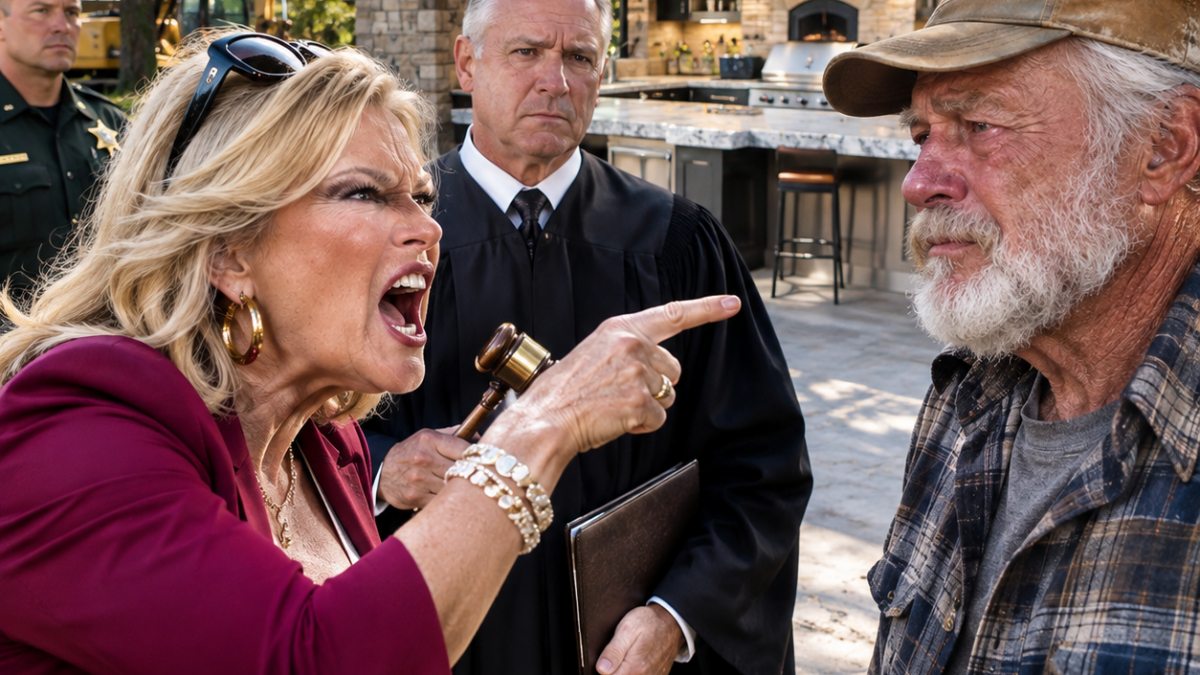
“GET OFF MY PROPERTY, YOU BROKE OLD MAN!” HOA President Built a $180,000 Luxury Kitchen on My Land—Then the Judge Made Him Hand It Over
“GET YOUR WORTHLESS SURVEY STAKES OFF MY PROPERTY, MARCUS—IF YOU CAN’T AFFORD TO LIVE IN WILLOW BROOK, I’LL MAKE SURE THE HOA FORECLOSES ON YOUR HOUSE!” Richard Pemberton shouted while his construction crew poured concrete twelve feet beyond our property line, and his wife Janet stood behind him smiling as though threatening a sixty-one-year-old widower with homelessness was just another neighborhood improvement project.
For eight months, Richard used his position as HOA president to invent daily fines, turn neighbors against me, threaten my retirement savings, and build a $180,000 luxury addition featuring an $18,000 Italian marble island and a built-in Miele espresso bar on land he knew belonged to me—but he had no idea that the quiet old man he called confused had spent thirty years surveying property boundaries for Metro County.
And when Judge Elena Martinez finally announced that the disputed structure would pass to me under the court-approved resolution, along with $47,000 in attorney fees and costs, Richard collapsed between the courtroom tables while Janet screamed that I had stolen their dream home—never imagining that I would eventually turn their expensive kitchen into the one thing they had spent years preventing Willow Brook Estates from becoming: a real community.
The first thing I unpacked in my new house was my wife’s coffee mug.
Not my clothes.
Not the television.
Not even the framed photograph of Linda that I’d carried in the passenger seat all the way from our old home.
Her mug.
White ceramic with a faded blue flower painted near the handle.
The handle had been repaired once.
The glaze was chipped.
It was worth approximately nothing.
I’d have traded my entire pension to hear her complain about me putting it in the wrong cupboard one more time.
Linda Holbrook died on November fourth.
Pancreatic cancer.
Fifty-eight years old.
Thirty-six years married.
When people talk about losing a spouse, they usually describe the funeral.
The empty bed.
The first Christmas.
The anniversary that arrives like an ambush.
Nobody mentions the strange, ridiculous details that can destroy you without warning.
Finding her shopping list in the glove compartment.
Realizing her contact information is still saved as Linda ❤️.
Walking past the grocery-store freezer and remembering she liked a certain brand of vanilla ice cream.
Or standing alone in a kitchen holding a mug that still seemed to belong to someone who would be coming home any minute.
By the time I moved into Willow Brook Estates, Linda had been gone eleven months.
I was sixty-one.
Retired.
Reasonably healthy.
Financially comfortable enough to live quietly if I didn’t do anything foolish.
And utterly unprepared to spend another twenty years in the house where she had died.
We’d raised our children there.
Celebrated birthdays.
Argued about bills.
Repainted the kitchen three times.
Planted a maple tree that had eventually grown tall enough to shade the upstairs bedroom.
Then the cancer came.
And slowly, every room became associated with medicine.
The bathroom where Linda lost her hair.
The bedroom where the hospital bed had stood.
The kitchen counter covered with prescriptions.
The living room where relatives had gathered to say goodbye while pretending they weren’t saying goodbye.
I stayed almost a year.
Then one afternoon I stood in the hallway and realized I hadn’t opened the curtains in seven weeks.
That was when I decided to sell.
Willow Brook looked perfect.
Forty-three homes.
Established trees.
Quiet streets.
An HOA brochure promising peaceful retirement living and carefully maintained community standards.
A two-car garage where I could store my surveying equipment.
A small backyard large enough for vegetables.
And, most importantly, no memories waiting in every doorway.
I bought the house.
Moved in on a Tuesday morning in March.
And made myself one promise.
No more property disputes.
That promise was especially important because I had spent thirty years working as a county surveyor.
Thirty years measuring boundaries.
Searching for monuments.
Interpreting plats.
Helping attorneys untangle easement disagreements.
Explaining to furious neighbors that a fence installed twenty years ago was not necessarily proof of where their property ended.
I’d seen lawsuits begin over two inches of pavement.
Divorces triggered by driveway disputes.
Brothers stop speaking over a shared fence.
A man once threatened to have me arrested because a survey showed his garage was six inches too close to his neighbor’s property.
I knew exactly how ugly land disputes could become.
Retirement was supposed to be my escape.
Plant tomatoes.
Read mysteries.
Take occasional consulting jobs when somebody truly needed me.
Spend quiet evenings drinking coffee on the patio.
Maybe, eventually, learn how to be alive without Linda.
Three days after I moved in, Janet Pemberton appeared at my driveway carrying a clipboard.
That should have been my first warning.
Janet was fifty-six.
Blonde highlights.
Designer sunglasses.
A matching exercise outfit that looked expensive enough to have its own insurance policy.
She walked toward my open garage and stared at the equipment shelves.
“Excuse me.”
I turned.
“Morning.”
She didn’t smile.
“I’m Janet Pemberton.”
“HOA secretary.”
“Welcome to Willow Brook.”
“Thank you.”
Her eyes moved toward my surveying equipment.
“Unfortunately, we already need to discuss a violation.”
I stared.
“A violation?”
“Yes.”
She clicked her pen.
“Section twelve-point-three.”
“Professional equipment visible from the street.”
“Seven days to remedy.”
“Fifty-dollar daily fine after that.”
I looked behind me.
Two tool cabinets.
A properly stored tripod.
Survey rods.
A GPS receiver in its case.
Everything inside my garage.
Nothing extending into the driveway.
I looked back at her.
“You’re fining me for equipment in my garage?”
“Visible equipment.”
“It’s stored on shelves.”
“Visible from the street while the door is open.”
I almost laughed.
Linda would have loved this.
She would’ve stood beside me with both hands on her hips and said:
“Marcus, you retired to escape boundary disputes and somehow found an HOA that wants to regulate what your garage looks like from the sidewalk.”
Instead, I stood there alone.
Holding a box of coffee mugs.
And trying not to smile.
“Thank you for the notice.”
I said.
Janet blinked.
She seemed disappointed that I wasn’t arguing.
“Will you comply?”
“I’ll review the rules.”
She handed me the paper.
“Good.”
“Because Willow Brook is a very special community.”
Then she turned and walked away.
I watched her go.
Looked down at the photocopied violation.
And whispered:
“Linda, this is going to be interesting.”
I didn’t know then how much I would come to regret those words.
I met Richard Pemberton that evening.
His house occupied the large corner lot behind mine.
Technically, our properties shared a rear boundary, but the homes faced different streets.
That arrangement gave Richard a broad side yard and a backyard much larger than most in Willow Brook.
His place looked like a luxury real-estate listing.
White columns.
Expensive landscaping.
Stone walkway.
Decorative lighting.
And the kind of enormous front door nobody actually needed.
Richard answered wearing golf clothes and a watch worth more than my first pickup.
He was sixty.
Tall.
Silver hair.
Teeth so perfect they looked like an advertisement.
He extended his hand.
“Marcus Holbrook.”
“Welcome to Willow Brook.”
I shook it.
“Thanks.”
“Richard Pemberton.”
“HOA president.”
“My wife tells me you’ve already met.”
I smiled.
“She introduced me to your garage standards.”
Richard laughed.
“Janet takes community appearance seriously.”
“So I gathered.”
He leaned against the doorway.
“Property values have risen eighteen percent over five years.”
“That’s impressive.”
“We work hard at it.”
Then he lowered his voice.
“Not everyone appreciates standards.”
I looked at him.
“Really?”
“Some people think buying a house means they can do absolutely anything.”
I nodded.
“That’s usually not how ownership works.”
His smile widened.
“Exactly.”
I didn’t correct him.
Not yet.
Then Richard gestured toward the rear of his house.
“I’m planning a major entertainment addition.”
“Covered patio.”
“Outdoor kitchen.”
“Built-in appliances.”
“About twelve hundred square feet of improved space when we’re finished.”
“Sounds nice.”
“City-approved.”
“HOA-approved.”
“Architectural committee approved.”
He emphasized every phrase.
Almost too much.
I had spent thirty years listening to people explain approvals.
The ones who repeated the word approved most often were sometimes the ones hoping nobody would inspect what had actually been approved.
But I was retired.
It wasn’t my project.
And the last thing I wanted was another boundary dispute.
So I smiled.
“Hope it turns out well.”
Richard slapped my shoulder.
“Knew you’d understand.”
Then he said:
“People who support progress do well here.”
I walked home wondering why that had sounded more like a warning than a compliment.
Two weeks later, I understood.
I had decided to grow tomatoes.
Six plants.
Maybe eight.
Nothing ambitious.
Linda had been the gardener in our marriage.
She could get flowers to grow in soil that looked like crushed concrete.
I once managed to kill mint.
Mint.
A plant that apparently spends most of its life trying to take over the entire planet.
Linda never let me forget it.
“Marcus,” she’d say, “if the houseplants ever declare war, I’m sending you in first.”
Now I wanted to build a small vegetable bed in her memory.
Nothing dramatic.
Just a little rectangle in the backyard.
A few tomato plants.
Something living.
Something that needed me to come outside.
Something that might make the house feel less like a waiting room.
Saturday, April fifteenth, was beautiful.
Blue sky.
Warm breeze.
The sound of birds in the trees.
I carried my measuring tape into the backyard.
Marked out a rectangle.
Twenty feet from the house.
Ten feet wide.
Perfect morning sunlight.
I was hammering the first garden stake into the ground when I heard an excavator reverse.
Beep.
Beep.
Beep.
I looked over my shoulder.
The noise came from Richard’s property.
I’d expected construction eventually.
He’d warned me.
What I hadn’t expected was the excavator sitting where the rear section of my lawn should have been.
I walked toward the fence.
Looked over.
Then stopped.
A crew was digging footings.
A concrete truck sat nearby.
Workers were preparing formwork for what appeared to be a substantial rear addition.
And the entire operation was much closer to my house than Richard’s plans should have allowed.
I studied the distances.
Old habits came back immediately.
The line of the original rear fence.
The relationship between the two houses.
The lot depth recorded on the subdivision plat.
The position of a utility pedestal.
I knew what I was seeing.
Or, at least, I was worried I did.
“Excuse me!”
The foreman looked up.
“Yeah?”
“Who’s supervising the boundary layout?”
He frowned.
“Pemberton job.”
“I know.”
“Who’s responsible for the site survey?”
He shrugged.
“Owner supplied the plans.”
“Could I see the site layout?”
He studied me.
“Why?”
“Because I believe you’re excavating across the property line.”
The foreman laughed.
“Buddy, we’ve got permits.”
“Permits don’t create ownership.”
He stared.
Then unrolled the site plan.
I leaned closer.
The addition extended twenty-four feet from Richard’s existing rear wall.
But based on the measurements I remembered from the recorded plat, his house sat only about twelve feet from our shared boundary.
My stomach tightened.
I pointed.
“What is this distance?”
The foreman looked.
“Twenty-four feet.”
“And where’s the rear property line shown?”
He tapped a line.
I stared.
It appeared to have been drawn twelve feet farther into my parcel than the original plat indicated.
I looked up.
“Stop work until the line is verified.”
He shook his head.
“No can do.”
“I’ve got a schedule.”
“You’re building on my land.”
“Then talk to the owner.”
I looked toward Richard’s mansion.
The excavator began moving again.
I walked around the block.
Rang his doorbell.
Janet answered.
She looked annoyed.
“Marcus.”
“Morning.”
“Richard available?”
“Why?”
“His construction appears to cross my property boundary.”
She stared.
Then laughed.
“Oh, Marcus.”
The tone alone made my jaw tighten.
Like I was an elderly patient confusing a television remote with a telephone.
Richard appeared behind her carrying a drink garnished with celery.
“Everything okay?”
I looked at him.
“No.”
“Your addition is crossing our shared boundary.”
His smile flickered.
One second.
Maybe less.
Then it returned.
“Marcus, the project is fully approved.”
“I know you keep saying that.”
“Because it’s true.”
“Approvals don’t change property lines.”
Janet stepped closer.
“Richard works with the city all the time.”
“He knows development standards.”
I nodded.
“Then he knows the difference between a permit and a deed.”
Richard’s expression cooled.
“Marcus, property lines can be complicated.”
“I agree.”
“Modern development uses sophisticated survey methods.”
I looked at him.
“I surveyed property for thirty years.”
He waved one hand.
“Different era.”
“Different technology.”
That almost made me smile.
I’d used everything from old transit equipment to modern GNSS systems.
He was explaining surveying to a professional surveyor.
Then Richard leaned closer.
“Trust the people who know what they’re doing.”
The words were polite.
The message wasn’t.
I looked toward the backyard.
The excavator was still digging.
“Richard, I’m asking you to pause the work until we verify the boundary.”
His smile vanished.
“No.”
One word.
Then:
“I won’t let a new resident interfere with a project that’s been approved by the city and my HOA.”
“Your HOA?”
“I am the president.”
“I noticed.”
He straightened.
“Then understand that this community doesn’t tolerate obstruction.”
I looked at him.
Then Janet.
Then the enormous house behind them.
I could feel an old professional instinct waking up.
The one I’d promised myself I wouldn’t need anymore.
I said:
“Fine.”
Richard smiled.
“Good.”
Then I added:
“I’ll verify it myself.”
His smile vanished again.
I didn’t sleep much that weekend.
Not because I was frightened of Richard.
Because I was angry at myself.
Thirty years surveying property.
Thirty years telling clients to confirm boundaries before construction.
And I’d moved into a house without personally checking every rear monument.
I had relied on the title work and survey information supplied during purchase.
Reasonable for most buyers.
Embarrassing for me.
Monday morning, I opened the garage.
Took out my old equipment.
Trimble receiver.
Survey rods.
Measuring tape.
Field book.
Metal detector.
Flagging.
Old subdivision plat.
Recorded legal description.
And copies of the survey materials associated with my property.
I felt something strange.
Comfort.
Like opening a toolbox after years away.
The equipment was familiar.
Predictable.
It didn’t flatter people.
Didn’t care how much their landscaping cost.
Didn’t change a boundary because somebody wore expensive golf clothes.
I began with the known control points and available boundary monuments.
One iron pin near the front corner.
Another along the side.
I checked recorded bearings and distances.
Compared them with the field conditions.
Then located evidence near the rear corners.
The discrepancy became clearer.
The original lot depth was approximately one hundred fifty feet.
The current construction layout appeared to use a boundary position twelve feet beyond the correct rear line.
I checked again.
Then again.
Repeated the observations.
Cross-referenced the original plat.
Measured the position of Richard’s existing house.
And marked my preliminary findings with temporary flagging on my own side.
I knew better than to declare a binding legal survey solely because I had worked as a surveyor for decades.
Professional practice required the proper documentation, standards, and independent verification where appropriate.
But the field evidence was striking.
Richard’s construction extended approximately twelve feet across our shared boundary for a substantial length.
About 288 square feet of my land was involved in the main encroachment.
Twelve feet.
Not an accidental fence post.
Not a few inches of grading.
A significant section of a luxury addition.
I stood beside the markers looking at the concrete.
Then heard a voice behind me.
“Marcus?”
Mike Rodriguez.
Detective.
Metro Police Department.
Lived across the street.
We’d become friendly during my first weeks in Willow Brook.
He was a good man.
Practical.
Married.
Two children.
A vegetable garden that made mine look like a child’s science experiment.
He walked toward me carrying a coffee mug.
“Working again?”
I smiled without humor.
“Apparently.”
“What’s going on?”
I pointed toward Richard’s foundation.
Mike looked.
Then at the stakes.
Then at me.
“No.”
“Yes.”
“How much?”
“Twelve feet across the line.”
He whistled.
“That’s not a mistake somebody overlooks while carrying groceries.”
“I know.”
“Did you tell Richard?”
“Yes.”
“What’d he say?”
“City approval.”
Mike stared.
Then laughed.
“That’s not how deeds work.”
“Exactly.”
He became serious.
“Document everything.”
“Already started.”
“And Marcus?”
“Yeah?”
“Don’t assume he’s too stupid to know.”
I looked toward Richard’s house.
“That thought has occurred to me.”
I spent the afternoon preparing a detailed report.
Photographs.
Measurements.
Boundary references.
Construction plans.
Locations of monuments.
Date-stamped observations.
A timeline showing when work began and when I notified Richard.
I also contacted an independent licensed surveyor to review and certify the disputed boundary.
Not because I doubted my work.
Because I wanted a second professional opinion that couldn’t be dismissed as the angry neighbor measuring his own lawn.
That evening, I sat at the kitchen table with Linda’s mug beside my laptop.
I looked at the photograph on the wall.
Linda on our twenty-fifth anniversary.
Laughing.
Holding a terrible homemade birthday cake I’d baked.
She’d told me it looked like a road construction accident.
I smiled.
Then looked back at the foundation photographs.
“Linda,” I whispered.
“I just wanted tomatoes.”
The house was silent.
A moment later, my phone rang.
Unknown number.
I answered.
“Marcus Holbrook?”
“Yes.”
“This is David Tatum.”
“Pemberton Development Group.”
I sat straighter.
“What can I do for you?”
“Mr. Pemberton asked me to discuss your concerns about his project.”
“Good.”
“He wants to maintain neighborhood harmony.”
“Then stop building on my land.”
A pause.
“Mr. Holbrook, I think we can reach a practical compromise.”
“I’m listening.”
“Richard may be willing to adjust the project by a few feet.”
I stared.
“How many?”
“Two or three.”
I almost laughed.
“The addition crosses my boundary by approximately twelve.”
“That’s your interpretation.”
“It’s a measurement.”
“Subject to verification.”
“Then let’s verify it.”
Silence.
David continued.
“In exchange for Richard’s flexibility, we’d expect you to withdraw complaints and cease interfering with approved construction.”
I looked at the folder.
“What’s your client’s position on the remainder of the encroachment?”
“Mr. Holbrook, not every issue needs to become a lawsuit.”
“I agree.”
“Sometimes the most practical course is cooperation.”
“Then cooperate by building on your client’s own property.”
His voice changed.
“Legal disputes are expensive.”
I said nothing.
“Especially for someone on a fixed retirement income.”
There it was.
Not a boundary argument.
A financial threat.
I leaned back.
“Mr. Tatum.”
“Yes?”
“Send anything further to me in writing.”
Then I hung up.
Twenty minutes later, Janet Pemberton knocked on my front door.
And the fines began.
Three notices.
All taped where anyone walking past could read them.
UNAUTHORIZED PROFESSIONAL EQUIPMENT — $50 PER DAY.
UNAPPROVED LANDSCAPING MODIFICATIONS — $75 PER DAY.
HARASSMENT OF APPROVED CONSTRUCTION CREWS — $100 PER DAY.
Two hundred twenty-five dollars a day.
For documenting a neighbor building on my land.
I read the notices.
Then looked at Janet.
She stood beside two women.
Susan Walsh.
Lisa Tatum.
Both members of HOA committees.
Susan was holding a phone at chest level.
Recording.
Janet smiled.
“Marcus, we’re here because your behavior has become disruptive.”
I glanced at Susan’s phone.
“Are you recording?”
She nodded.
“For association documentation.”
“Fine.”
I kept my voice calm.
Janet continued.
“Richard offered a reasonable compromise.”
“He offered to reduce a twelve-foot encroachment by two feet.”
“Alleged encroachment.”
Lisa corrected.
I looked at her.
“Are you related to David Tatum?”
She hesitated.
“My husband is an attorney.”
“Does he represent Richard?”
Her expression tightened.
“That’s not relevant.”
I smiled.
“Interesting.”
Janet stepped forward.
“Marcus, you’re making this unnecessarily confrontational.”
I stared.
Then said:
“Your husband is building a structure on land I own.”
“I’m asking him to stop pending verification.”
“Your association is fining me for documenting it.”
“Which part of that is my confrontation?”
Susan raised the phone a little higher.
Janet smiled.
“You’re refusing to comply with community standards.”
“Community standards don’t authorize trespass.”
She ignored that.
“Continued violations may lead to collection action.”
I nodded.
“Then send the notices through the proper process.”
Janet’s smile sharpened.
“Don’t underestimate HOA enforcement.”
“We can impose liens.”
“And in some circumstances, foreclosure.”
I felt my chest tighten.
Not because I believed her threat was automatically lawful.
Because I’d bought this house to escape the room where Linda died.
And now, barely a month after moving, somebody stood on my porch threatening to take the second home I’d forced myself to choose.
Janet leaned closer.
“You live alone, don’t you?”
I stared.
“What?”
“You don’t have family here.”
I felt something cold move through me.
She glanced toward the framed photograph visible behind me.
“Your wife passed away?”
I didn’t answer.
Janet tilted her head.
“How sad.”
Then:
“It must be difficult managing all this by yourself.”
I looked at her.
That was the moment I stopped thinking Janet was merely following her husband’s orders.
She knew exactly what she was doing.
Taking grief.
Turning it into weakness.
Trying to make me feel alone enough to surrender.
I opened the door wider.
“Ladies, this conversation is over.”
Janet’s face hardened.
“We’ll document your refusal.”
“Please do.”
I closed the door.
Then sat at the kitchen table.
My hands were shaking.
I looked at Linda’s mug.
And for the first time since moving, I wondered whether I’d made a terrible mistake.
That night, Mike Rodriguez came over.
He found me sitting on the back porch watching Richard’s framing crew work under temporary lights.
“Marcus.”
“Hey.”
“You okay?”
I laughed.
“That’s a complicated question.”
He sat.
We watched a worker carry lumber across the rear section of Richard’s lot.
Then Mike said:
“Richard has a reputation.”
I looked over.
“What kind?”
“Control.”
“Uses the HOA to pressure people.”
“Knows exactly how to make something sound official.”
I nodded.
“Any criminal cases?”
“Nothing I can discuss as a detective.”
“Fair.”
“But as your neighbor, I can tell you to be careful.”
I looked toward the addition.
“He seems very confident.”
“People often do when nobody challenges them.”
Mike paused.
“What’s his end game?”
“Finish the addition.”
“Maybe.”
He shook his head.
“Think bigger.”
“He owns a development company.”
“He sits on HOA boards.”
“He gets approvals.”
“He intimidates anyone who objects.”
I stared.
Mike continued.
“That can become a business model.”
I looked at the house.
The construction.
The fancy cars.
The aggressive legal letters.
Then said:
“I think I need a lawyer.”
Mike nodded.
“Good.”
I looked toward Linda’s photograph through the kitchen window.
Then added:
“And maybe I need to stop believing I’m going to get the retirement I planned.”
Mike was quiet.
Then:
“Marcus, you can still have a peaceful life.”
“Just don’t confuse peace with letting somebody steal from you.”
I looked at him.
That sounded like something Linda would have said.
I smiled.
“Fair.”
The next morning I called Sarah Tatum.
No relation to David or Lisa, despite the shared surname.
She was a property attorney I’d worked with for fifteen years.
Sharp.
Practical.
Unimpressed by bluster.
Her office occupied a converted Victorian house downtown.
I arrived carrying a banker’s box of documents.
She looked at it.
Then at me.
“Marcus.”
“Sarah.”
“You retired.”
“Apparently badly.”
She smiled.
“What’s in the box?”
“Retirement.”
She laughed.
Then opened it.
For an hour, she reviewed the plats, field notes, independent survey materials, photographs, construction plans, and HOA notices.
Her smile disappeared.
Then she removed her glasses.
“Twelve feet?”
“Yes.”
“Across a substantial section?”
“Yes.”
“And they continued after you notified them?”
“Yes.”
She looked at the construction photographs.
“Marcus, this is serious.”
“I know.”
“Have they stopped?”
“No.”
She leaned back.
“Then our immediate concern is preventing further harm while the boundary is resolved.”
I nodded.
“Injunction?”
“Potentially.”
“Notice.”
“Court relief.”
“Title and boundary claims.”
“Damages.”
“We need to examine the governing law and facts carefully.”
I looked at her.
“What about the structure?”
She tapped the photograph.
“That’s the difficult part.”
“Richard is building something attached to his house that extends onto your land.”
“Courts have several possible ways to resolve encroachments.”
“Removal.”
“Damages.”
“Conveyance.”
“Easements.”
“Equitable relief.”
“Sometimes a negotiated transfer of the affected improvements.”
I leaned forward.
“Could I end up owning the addition?”
Sarah looked at me.
“Not automatically just because he crossed the line.”
I nodded.
“But?”
“If he knowingly builds despite notice, that can substantially affect the available remedies and negotiations.”
She studied the documents.
“We need to establish the boundary, stop additional construction where appropriate, and make sure the court understands his conduct.”
I looked at the photographs.
The framing was already rising.
Sarah said:
“And Marcus?”
“Yes?”
“Don’t help him finish it.”
I stared.
“What?”
“Don’t delay action hoping the structure becomes more valuable.”
“That’s dangerous legally and financially.”
I nodded.
“Understood.”
“We’re not trying to trick somebody into building us a kitchen.”
“We’re trying to protect your land.”
I smiled faintly.
“Linda would’ve liked you.”
Sarah softened.
“I liked Linda.”
I swallowed.
“I know.”
Then she pushed a legal pad toward me.
“Now let’s get to work.”
Richard didn’t respond to our first formal demand with cooperation.
He responded with a cease-and-desist letter.
Claimed I was harassing contractors.
Interfering with lawful development.
Making defamatory statements.
Threatening economic loss.
Then his company lawyer demanded I stop speaking to neighbors about the construction.
Sarah read the letter.
Laughed once.
Then placed it in a folder.
“Good.”
I stared.
“Good?”
“More documentation.”
She looked up.
“They’re putting their position in writing.”
I sighed.
“Lawyers really are a strange species.”
“That’s why you hired me.”
She prepared the appropriate filings.
The independent surveyor completed the boundary work.
His conclusions supported the encroachment.
The evidence was no longer just mine.
We had a professional boundary report, recorded documents, and contemporaneous construction photographs.
The dispute moved into formal legal channels.
Richard continued acting like the project would proceed as planned.
But the legal risk was growing.
Then he made another mistake.
He posted a video of me measuring the property.
Edited.
Cut.
Rearranged.
In the footage, I looked frustrated.
I was pointing.
Talking to workers.
Walking near the fence.
The caption read:
DIFFICULT NEW NEIGHBOR HARASSES HOA-APPROVED CONSTRUCTION PROJECT.
Within hours, residents began commenting.
Some supported Richard.
Some questioned my behavior.
One wrote:
Old people with too much time are ruining this neighborhood.
Another:
HOA should fine him until he stops.
I stared at the comments.
Old.
Alone.
Retired.
A problem.
Not a person.
Not a man who’d just buried his wife.
Not someone who wanted to plant tomatoes.
Just the obstacle to somebody else’s entertainment area.
I closed the app.
Then saved the video.
The original footage from my own cameras showed the broader interactions.
What I’d said.
What the contractor said.
How far I stayed from the work.
What Richard had omitted.
That mattered.
But I also knew something painful.
By the time a correction appears, the lie has already made itself comfortable.
The next weekend, the Washingtons knocked.
George and Elaine.
Retired teachers.
They lived next door.
Sweet people.
The kind who brought homemade cookies when I first moved in.
Elaine looked embarrassed.
“Marcus.”
“Come in.”
George held a folder.
“We owe you an apology.”
I blinked.
“For what?”
“We watched Richard’s video.”
Elaine said.
“And we believed him.”
I stared.
She continued.
“Then Mike showed us your survey stakes.”
“And we looked at our own rear fence.”
George opened the folder.
Photographs.
Measurements.
Old records.
He pointed.
“Richard replaced a fence last year.”
“He told us it followed the existing line.”
“Now we’re worried it was moved.”
“How far?”
“Maybe four feet.”
I stared.
Another possible encroachment.
Another neighbor who trusted the HOA president because he seemed to know the rules.
George looked ashamed.
“I taught history for thirty-eight years.”
“I used to tell students to check original sources.”
“Then I let Richard tell me where my own land ended.”
I looked at him.
“Don’t blame yourself.”
He shook his head.
“I should’ve looked.”
I nodded.
“That’s fair.”
Then smiled.
“Well.”
“We can look now.”
Elaine started crying.
Not hard.
Just a few tears.
“Thank you.”
I didn’t know what to say.
So I brought out coffee.
Linda’s mug remained on the shelf.
I used another.
We sat at the table.
And for the first time in weeks, I didn’t feel like I was fighting the entire neighborhood.
The pattern widened.
I reviewed publicly available development records.
Richard’s company had been involved in numerous projects across communities where he held HOA positions or influenced architectural approvals.
Seventeen projects over several years.
Some perfectly legitimate, as far as the public record showed.
Others raising questions about conflicts of interest.
A contractor approving work for his own company through a board he helped control was not automatically proof of criminal fraud.
But it created obvious reasons for scrutiny.
I gathered dates.
Project descriptions.
Business registrations.
Approval records where public.
And the additional residents’ statements.
Then took everything to Sarah.
She reviewed it.
“Marcus.”
“Yes?”
“Do not label this fraud yet.”
“I know.”
“Some projects may be proper.”
“I know.”
“And some conflicts may be disclosed.”
“I know.”
She smiled.
“Good.”
Then she looked at the list again.
“But the pattern warrants investigation.”
I nodded.
“That’s what I thought.”
We referred the material to appropriate authorities without claiming to have proved criminal conduct ourselves.
I also contacted Amy Walsh.
Investigative reporter at the Metro Herald.
She’d covered property disputes before.
She had a reputation for checking records and asking questions people disliked.
We met at a coffee shop.
I brought the documents.
She read.
Then looked at me.
“Marcus.”
“Yes?”
“Do you understand how unusual this is?”
“Unfortunately.”
“An HOA president building on his neighbor’s land while fining that neighbor for documenting it?”
“Yes.”
She studied the photographs.
“Can you independently verify the boundary?”
I slid over the certified survey.
She nodded.
“That’s useful.”
“What about the other projects?”
“Under review.”
“Not all proved improper.”
She smiled.
“Good answer.”
I looked at her.
“Why?”
“Because people who are trying to sell me a story usually insist they know every motive and every crime.”
She tapped the documents.
“People with actual evidence know which parts they can’t prove yet.”
I nodded.
Then she asked:
“Why are you doing this?”
I looked down.
“Honestly?”
“Please.”
“I wanted to plant tomatoes.”
Amy stared.
Then laughed.
I didn’t.
She stopped.
“Oh.”
I looked toward the window.
“My wife died.”
“I retired.”
“I moved because I wanted quiet.”
“And now my neighbor is threatening my home because I won’t let him build through the property line.”
Amy’s face softened.
“I’m sorry.”
I nodded.
She said:
“Let me verify everything.”
“Then we’ll tell the story.”
The article appeared Sunday morning.
Headline:
HOA PRESIDENT’S LUXURY ADDITION CROSSES NEIGHBOR’S PROPERTY LINE, SURVEY SHOWS.
The piece included photographs.
The boundary survey.
Richard’s permit representations.
My HOA fines.
The threats of collection.
Statements from the Washingtons.
And questions about the relationship between Pemberton Development Group and HOA approvals.
Amy contacted Richard.
His attorney responded.
The article included their position.
I appreciated that.
Truth should survive the other side getting a chance to answer.
By noon, the story had traveled far beyond Metro County.
People shared it.
Argued about it.
Called Richard arrogant.
Called me stubborn.
Some called for criminal investigations.
Others warned that internet comments weren’t a substitute for court findings.
For once, I agreed with the cautious people.
The important thing was that neighbors began asking for documents.
Not taking Richard’s word.
Not mine.
The actual records.
That was when he began losing control.
The next morning, Richard appeared at my front door.
No golf shirt.
Business suit.
Red face.
Fury barely contained.
He didn’t wait for me to invite him in.
“YOU.”
I stared.
“Morning, Richard.”
“You ruined my reputation.”
I looked at him.
“Did I?”
“You went to the press!”
“Yes.”
“With private association business!”
“I provided records concerning my own property.”
He stepped closer.
“You think you’re clever because you used to measure dirt for the county?”
I felt my jaw tighten.
Thirty years of professional work reduced to measuring dirt.
Then he said:
“I’ll bury you in legal fees.”
I stared.
He continued.
“I have resources you can’t imagine.”
“Attorneys.”
“Connections.”
“Companies.”
“I’ll make you spend every dollar Linda left you before you get a single inch of satisfaction.”
My body went cold.
Linda.
He used her name.
I hadn’t told him much about her.
He’d done enough digging to know what might hurt.
For one second, I wanted to slam the door into his face.
Instead, I looked straight at him.
“Richard.”
“What?”
“Get off my porch.”
He blinked.
“You can’t order me—”
“Yes.”
“I can.”
“This is my property.”
He laughed.
“Until the HOA forecloses.”
I looked at the camera mounted beside my door.
Its small recording light was on.
Richard followed my gaze.
His face changed.
I said:
“Thank you for putting that on the record.”
Then closed the door.
I stood inside trembling.
Not with triumph.
With grief.
Because Linda’s name had become another weapon in the mouth of a man who barely knew me.
I sat at the kitchen table.
Held her mug.
And whispered:
“I’m sorry.”
I didn’t know why I said it.
Maybe because I’d promised her I’d retire peacefully.
Maybe because I was tired of fighting.
Maybe because I missed having someone tell me when to stop.
Then my phone rang.
Sarah Tatum.
I answered.
“Marcus.”
“Yes.”
“Are you okay?”
I started crying.
There was silence.
Then she said:
“Take your time.”
I did.
And when I could speak again, I told her what Richard had said.
She listened.
Then:
“Send me the footage.”
I almost smiled through tears.
“Of course that’s your answer.”
“First we preserve the evidence.”
Then her voice softened.
“After that, you go eat something.”
I laughed.
Linda would’ve liked her even more.
The construction continued for a short period amid the legal dispute, then stopped under the pressure of court proceedings and the growing uncertainty surrounding the project.
By then the addition was substantial.
Covered structure.
Framing.
Electrical work.
Plumbing.
Premium cabinets ordered.
A custom kitchen design.
Marble island.
Built-in grill.
Wine refrigerator.
Miele espresso station.
The total committed project cost was approaching $180,000.
Every new invoice made Richard more desperate.
Every new photograph made my attorney more determined to resolve the encroachment before the consequences became worse.
I didn’t celebrate the construction.
It sat beside my yard like an expensive insult.
I couldn’t plant tomatoes without staring at it.
Couldn’t enjoy coffee without hearing contractors.
Couldn’t walk out back without remembering Richard telling me my retirement savings would be destroyed.
Linda’s garden bed remained unplanted.
The empty patch of dirt felt like a symbol of everything I’d wanted and couldn’t have.
Then Richard’s wife came over.
Alone.
Janet.
No clipboard.
No phone.
No pearls.
She looked tired.
“Marcus.”
I stood in the doorway.
“What can I do for you?”
She swallowed.
“Can we talk?”
I hesitated.
Then stepped onto the porch.
Not inside.
She looked toward the addition.
Then back.
“Richard says you’re trying to steal our kitchen.”
I almost laughed.
“Janet, it’s being built partly on land I own.”
She looked down.
“I know what the surveys say.”
“Then you understand the problem.”
She nodded.
Tears filled her eyes.
“That kitchen was supposed to be our retirement dream.”
I stared.
She continued.
“I saved ideas for five years.”
“The marble.”
“The appliances.”
“The patio.”
“I wanted our children to come home at Christmas and have somewhere beautiful to gather.”
For a moment, I saw a real person beneath the cruelty.
A woman who wanted something lovely for her family.
I understood that desire.
Then I remembered her standing on my porch threatening foreclosure.
Using Linda’s death as a weakness.
Recording me.
Calling me uncooperative while her husband’s construction crew crossed my boundary.
I said:
“Janet, I didn’t choose this.”
She started crying harder.
“Please.”
“Maybe there’s a compromise.”
“We could give you an equivalent area from another part of the lot.”
I shook my head.
“Equivalent square footage isn’t necessarily equivalent location or value.”
She nodded.
“Then money.”
“We’ll pay.”
I looked toward the addition.
“That’s a legal discussion.”
“Sarah Tatum has my authority to negotiate.”
Janet stared.
“You won’t just say yes?”
“Not on my porch.”
She looked wounded.
Then angry.
“Richard said you were enjoying this.”
I felt something inside me go quiet.
“Janet.”
She looked up.
“I buried my wife less than a year ago.”
Her expression changed.
“I bought this house because I couldn’t stand living in the place where she died.”
“All I wanted was to grow a few tomatoes.”
I pointed toward the backyard.
“Your husband built through the line.”
“Then threatened to take my home when I objected.”
“And you helped him.”
Janet covered her mouth.
I continued.
“So no.”
“I’m not enjoying this.”
She looked away.
I said:
“Have your attorney call mine.”
Then went inside.
I didn’t slam the door.
Didn’t shout.
Didn’t make her feel small for crying.
But I also didn’t rescue her from consequences her family had helped create.
That was a boundary too.
The criminal investigation into Richard’s broader business practices continued independently of our civil property claim.
Several homeowners came forward.
Some alleged encroachments.
Others questioned HOA approvals.
Some projects had ordinary documentation errors.
Others raised more serious concerns about misrepresentations and undisclosed conflicts.
Investigators separated those cases.
Examined records.
Interviewed witnesses.
Reviewed financial transactions.
Nobody was entitled to a criminal conviction simply because the internet wanted one.
Meanwhile, Sarah pursued our civil remedies.
The boundary was established through professional evidence.
Richard’s permit submissions were reviewed.
His notice of the encroachment became critical.
We had repeatedly asked him to verify the boundary before continuing construction.
He refused.
Then threatened us.
Then continued.
Those facts affected negotiations and the legal positions available to the parties.
The proposed settlement structures grew more complex.
One option required removal of the encroaching section and restoration of my land.
Another involved a land purchase or exchange with compensation.
A third contemplated transferring the completed disputed improvements under a broader court-approved resolution.
Richard rejected the first proposal.
Then the second.
He insisted he’d done nothing wrong.
Even as his lawyers urged a practical resolution.
Eventually, his business faced broader legal and financial pressure.
And the option he once dismissed became the only arrangement the parties could complete.
A transfer of the disputed addition to me, documented through enforceable property instruments, together with a stipulated award of substantial legal costs.
Not an automatic prize because concrete crossed a line.
A negotiated legal consequence of construction, disputed ownership, documented conduct, and court-supervised resolution.
Sarah explained it carefully.
“Marcus.”
“Yes?”
“This isn’t a simple rule that says a landowner automatically gets every expensive building touching their property.”
“I understand.”
“We are resolving ownership of the affected improvement through properly drafted instruments and judicial approval.”
I nodded.
“And the amount?”
“The project is valued at approximately $180,000.”
“The parties have agreed to the relevant terms.”
“Your fee claim is separately addressed.”
I stared at the documents.
Richard Pemberton.
The man who told me I was too old to understand modern surveying.
The man who threatened to bury me in legal fees.
Had finally agreed to terms that could cost him the very luxury addition he’d insisted on finishing.
I didn’t smile.
Not yet.
Because the signatures still needed to be completed.
And the court still needed to act.
The hearing was scheduled for November seventh.
Judge Elena Martinez.
Metro County courthouse.
Nine in the morning.
The night before, I sat alone in the kitchen.
The banker’s box was beside the door.
Survey reports.
Photographs.
Recording transcripts.
Original plat.
Deed.
Correspondence.
Court papers.
Everything indexed.
Thirty years of county work had taught me that organization can matter more than outrage.
I looked at the old mug.
Then at Linda’s photograph.
“Tomorrow,” I whispered.
No answer.
I smiled sadly.
“You would’ve hated the paperwork.”
Silence.
“And loved being right.”
I looked toward the backyard.
The disputed addition stood beneath temporary work lights.
Expensive.
Incomplete.
A dream somebody tried to build by treating my property like an inconvenience.
Then I looked at the bare patch where I still hadn’t planted tomatoes.
I made myself another promise.
After this was over, I would grow something.
No matter what happened in court.
Because I hadn’t moved to Willow Brook to spend the rest of my life punishing Richard Pemberton.
I’d moved because I wanted to find out whether life could still hold something good after Linda.
I needed to remember that.
The courtroom was full when I arrived.
Richard brought three attorneys.
Expensive suits.
Leather briefcases.
Janet sat beside him.
Her face looked pale.
Mike Rodriguez was there.
The Washingtons.
Several other homeowners.
Amy Walsh from the Metro Herald.
Sarah Tatum stood beside me.
“You ready?”
I nodded.
“No.”
She smiled faintly.
“Good answer.”
The judge entered.
Everyone stood.
Case called.
Counsel appeared.
The court reviewed the stipulated factual record, the boundary findings, and the proposed resolution.
Sarah presented the original subdivision plat.
The independent survey.
The twelve-foot encroachment.
Approximately 288 square feet.
The chronology of notice.
The construction activity after warning.
The HOA fines.
The threats.
The failure to resolve the issue when I first raised it.
Richard’s attorneys preserved their objections and positions as part of the negotiated order.
The court examined the written agreement.
The transfer instruments.
The terms addressing the attached addition.
The obligations associated with separating its ownership and use from the remainder of Richard’s home.
And the stipulated fee award.
I listened.
Tried to remain calm.
This wasn’t a victory speech contest.
It was the moment the legal relationship would be made enforceable.
Judge Martinez looked over the papers.
Then toward Richard.
“Mr. Pemberton.”
He stood.
“Yes, Your Honor.”
“You understand the ownership consequences of the agreement presented to the court?”
He swallowed.
“Yes.”
“You have consulted counsel?”
“Yes.”
“And you understand the transfer and compliance obligations?”
Long pause.
“Yes.”
The judge looked toward me.
“Mr. Holbrook?”
I stood.
“Yes, Your Honor.”
“You also understand the terms, including the obligations and limitations associated with the transferred improvement?”
“Yes.”
She reviewed the order.
Then spoke.
“The court approves the agreement and enters the corresponding judgment.”
Silence.
Then she read the essential terms.
The boundary was recognized.
The disputed improvement would transfer to me through the required instruments and associated compliance arrangements.
Its documented project value was approximately $180,000.
Richard would satisfy the agreed $47,000 obligation toward attorney fees and court costs under the judgment.
The parties would complete the required transfer and practical separation work under the order’s deadlines.
No magic deed appearing from nowhere.
No claim that the court could instantly hand me every attached appliance without dealing with access, structural connections, or real property formalities.
The legal consequences were spelled out.
But the result was unmistakable.
Richard had spent months threatening to take my house.
Now he had agreed to lose his luxury addition.
Judge Martinez finished.
Then signed the order.
Richard sat motionless.
Janet covered her mouth.
For a moment, nobody moved.
Then Richard tried to stand.
His face had turned white.
He gripped the table.
His knees gave way.
He collapsed between the counsel tables.
People shouted.
A bailiff moved.
His lawyer knelt beside him.
Someone called for medical assistance.
Janet began crying.
“Richard!”
I stood instinctively.
Not celebrating.
Concerned.
Whatever he had done, I didn’t want him seriously injured.
Medical personnel checked him.
He remained conscious.
Breathing.
Shaken.
He was assisted and evaluated.
The hearing paused.
When order returned, Janet looked toward me.
Her face was wet.
“You’re taking everything we worked for.”
I stared.
I wanted to answer angrily.
Wanted to remind her of every threat.
Every fine.
Every night I lay awake afraid of losing the house I’d bought after Linda died.
Instead, I said:
“I asked you to stop before the foundation was finished.”
She looked away.
I added:
“You had months to fix this.”
Then I sat.
That was all.
The first thing I did after leaving the courthouse was not call a reporter.
I drove home.
Walked into the backyard.
Looked at the addition.
Then went inside.
Put my keys on the counter.
And made coffee in Linda’s mug.
I knew she would’ve complained.
“Marcus, that cup is chipped.”
I would’ve said:
“So am I.”
She would’ve laughed.
Then taken it from me and made another cup.
I sat at the kitchen table.
Tears came slowly.
Not because I’d won a structure.
Because the fear was ending.
The threat of foreclosure.
The daily fines.
The edited videos.
The court papers.
The arguments.
The humiliation.
The way Richard used Linda’s name as ammunition.
It had all taken something from me.
Time.
Peace.
Sleep.
The first months of retirement.
Months I would never get back.
But it hadn’t taken my home.
And the next morning, when I stepped outside, I looked at the corner of the yard where the tomato garden had been planned.
The ground was still empty.
I fetched a shovel.
Then stopped.
Because something about the addition no longer felt right.
I had supposedly won the ultimate suburban revenge.
A $180,000 luxury kitchen.
An Italian marble island.
An espresso machine Richard had boasted about.
A space designed to impress guests.
And I was a sixty-one-year-old widower who wanted tomatoes.
What on earth was I supposed to do with it?
Three weeks passed while contractors completed the work required by the judgment and transfer arrangements.
There were inspections.
Building modifications.
Utility separations and service agreements.
Access arrangements.
Insurance updates.
Recording of instruments.
Nothing as simple as a judge stamping a deed and somebody handing me keys to a fully independent luxury kitchen.
But eventually the disputed improvement became legally and practically mine.
I walked inside.
The marble island gleamed beneath recessed lighting.
Custom cabinets lined the walls.
The built-in espresso station looked like something from a hotel in Milan.
The wine refrigerator had a stainless-steel door.
The outdoor cooking area was enormous.
I stood in the middle of it.
Then laughed.
“Linda.”
My voice echoed.
“You would’ve hated this.”
She preferred kitchens where people could actually work.
Not rooms designed to impress guests.
She would’ve spent the first hour complaining about fingerprint marks on the stainless steel.
Then would’ve baked enough food to fill every counter.
I put one hand on the marble.
Cold.
Perfect.
Expensive.
And completely wrong for the life I’d imagined.
That night, Mike Rodriguez came over.
I gave him a tour.
He whistled.
“Marcus.”
“Yeah?”
“This is ridiculous.”
“I know.”
“There’s a coffee machine here that costs more than my car.”
“Probably.”
He opened the wine refrigerator.
Stared.
“Why do you need this?”
“I don’t.”
He looked at me.
Then smiled.
“I know that expression.”
“What expression?”
“You’ve got an idea.”
I stared around the room.
Then toward the backyard.
The empty tomato bed.
The fence.
The homes beyond.
The people who had watched this dispute unfold.
I turned back to Mike.
“Maybe the neighborhood needs this more than I do.”
I called a community gathering.
Not an HOA meeting.
Not a legal hearing.
Just neighbors.
Saturday afternoon.
Twenty-three families came.
The Washingtons.
Mike and his wife.
Janet Walsh from Oak Street.
A couple of younger families.
Several retirees.
People I’d never spoken to.
And Amy Walsh, who wanted to understand why I was inviting half the neighborhood into the addition Richard lost.
We stood in the outdoor kitchen.
People looked around.
Whispered.
Touched the marble.
Examined the appliances.
Then I spoke.
“I know everybody has heard more than enough about my boundary dispute.”
A few people laughed.
I continued.
“Richard and Janet built this because they wanted a private entertainment space.”
“And under the judgment, the affected addition has been transferred to me.”
“I could keep it.”
“Use it.”
“Sell whatever interests could be transferred lawfully.”
“Or let it sit empty.”
I paused.
“But I don’t need a luxury kitchen.”
Elaine Washington smiled.
“Speak for yourself.”
The room laughed.
I looked around.
“Willow Brook has forty-three families.”
“We don’t have much common gathering space.”
“Most meetings used to happen in Richard’s living room.”
“Which gave one man a lot of control over what the community heard.”
People nodded.
I continued.
“So here’s my proposal.”
“Subject to the necessary occupancy, insurance, safety, and access arrangements, I’d like to make this space available for community gatherings.”
“Potlucks.”
“Holiday dinners.”
“Neighborhood meetings.”
“Celebrations.”
“Maybe a place where somebody who’s recently lost a spouse doesn’t have to spend every evening eating alone.”
My voice cracked on that last sentence.
I hadn’t planned it.
The room went quiet.
Elaine reached for George’s hand.
I swallowed.
Then:
“Linda always said a beautiful room isn’t worth much if people are afraid to enter it.”
I looked toward the marble island.
“Let’s make this one useful.”
Nobody spoke for a moment.
Then Mrs. Washington stepped forward.
“Marcus.”
“Yes?”
“Are you sure?”
I nodded.
“Yes.”
She smiled.
“Then I’ll bring pies.”
Someone laughed.
Another neighbor volunteered to help with maintenance.
Mike offered to coordinate scheduling.
A young father suggested birthday parties.
A woman asked whether it could host graduation celebrations.
I smiled.
“That’s the idea.”
Then Amy Walsh asked:
“And the legal fee award?”
I looked toward her.
“Funny you should ask.”
The judgment included a $47,000 obligation toward attorney fees and costs.
Collection and payment would occur under the actual terms rather than because someone could instantly produce a check.
I had no intention of pretending that legal fees were free money.
We first accounted for the costs, obligations, and amounts properly available after settlement.
Then I discussed the remaining funds and future donations with Sarah Tatum.
The idea became an educational fund.
Small.
Local.
Focused.
Students entering surveying, engineering, law, land management, or related fields.
Young people who might someday prevent exactly the sort of boundary dispute that had consumed my retirement.
I wanted something useful to grow out of Richard’s expensive mistake.
Sarah helped with the legal structure.
The community formed an appropriate committee.
Donations followed.
The name was simple.
Willow Brook Educational Fund.
Our goal was to support students who understood that technical competence and integrity belonged together.
I didn’t want a scholarship for somebody who simply knew how to measure a straight line.
I wanted students who understood why the line mattered.
The first donations came from neighbors.
Then local businesses.
Amy’s follow-up reporting brought wider attention.
A surveying company offered support.
An engineering firm contributed.
A retired judge sent a check with a handwritten note:
Property rights are easiest to protect before somebody ignores them.
I framed that one.
Beside Linda’s photograph.
Richard resigned from the HOA leadership.
The board changed.
New elections were held.
Conflict-of-interest rules were strengthened.
Construction approvals involving board members required independent review and appropriate recusal.
The association adopted procedures encouraging boundary verification before significant construction near lot lines.
Not because one survey automatically prevents every dispute.
Because checking before digging costs less than fighting after concrete has hardened.
Mike became HOA president for a term.
He hated it.
I enjoyed that.
He complained constantly.
“Marcus, do you know how many people argue about fence colors?”
“Yes.”
“It’s insane.”
“Yes.”
“And somebody wants to ban bird feeders.”
I laughed.
“Welcome to community governance.”
He glared.
“You did this to me.”
“Technically, the homeowners voted.”
“You encouraged them.”
“Absolutely.”
He shook his head.
But under the new board, things improved.
Records were shared.
Meeting minutes published.
Conflicts disclosed.
Residents asked questions without being threatened.
No more daily fines invented on a clipboard because somebody disagreed with the president.
No more construction approvals treated as permission to ignore recorded boundaries.
The neighborhood became less impressive on paper.
And more livable in reality.
Richard’s development company faced its own consequences.
The broader investigation identified improper conduct in certain projects, but not every project became a criminal charge.
Some were resolved through civil claims.
Others required corrections.
Investigators looked at specific misrepresentations, approvals, and financial records.
Eventually Richard entered a plea agreement involving business-related offenses supported by the investigation.
The court imposed conditions, penalties, restitution obligations where applicable, and supervision.
His company lost much of its business.
His reputation collapsed.
But I never celebrated the idea of a man going to prison simply because the internet wanted punishment.
I wanted the people he’d harmed compensated.
I wanted the records corrected.
I wanted the behavior stopped.
That was enough.
Janet came by one afternoon.
Months after the ruling.
The Pemberton house had been listed for sale.
She stood on my porch without a clipboard.
No sunglasses.
No pearls.
She looked older.
Not physically destroyed.
Just tired.
“Marcus.”
“Janet.”
“May I say something?”
I hesitated.
Then nodded.
She looked toward the addition.
Through the gate, she could see children helping decorate for a neighborhood holiday gathering.
Her expression tightened.
“It’s beautiful.”
I looked back.
“People have been using it.”
She nodded.
Then:
“I owe you an apology.”
I said nothing.
Janet swallowed.
“I knew Richard was cutting corners.”
“I didn’t know how many.”
“But I knew enough to understand why you were asking questions.”
I stared.
She continued.
“And I helped him make you feel like the problem.”
“Yes.”
Her eyes filled.
“I threatened your house.”
“Yes.”
“I knew your wife had died.”
I looked away.
She started crying.
“I shouldn’t have used that.”
“No.”
She wiped her face.
“I don’t expect you to forgive me.”
I considered.
Then said:
“Janet, I didn’t want your kitchen.”
She nodded.
“I know.”
“I didn’t want your marriage to fail.”
She looked down.
“I know.”
“I wanted you to stop building on my property.”
Tears slipped down her cheeks.
“I wish we’d listened.”
I stared toward the garden.
Then:
“So do I.”
She looked at the addition again.
People were setting out chairs.
A young girl carried a tray of cupcakes.
Someone laughed.
Janet whispered:
“Linda would’ve liked what you’ve done.”
I turned sharply.
She flinched.
I took a breath.
“Please don’t tell me what my wife would’ve liked.”
Her eyes widened.
“I’m sorry.”
I nodded.
Then, after a moment:
“But I think she would have.”
Janet started crying again.
We stood quietly.
Then she said goodbye.
I watched her walk away.
No satisfaction.
No hatred.
Just the strange exhaustion of seeing a person finally acknowledge something they’d spent months denying.
The community’s first Thanksgiving potluck drew thirty-seven people.
I nearly canceled.
The idea of sitting in a room full of families while Linda’s chair remained empty felt unbearable.
Then Elaine Washington called.
“Marcus.”
“Yes?”
“I’m bringing three pies.”
“Good.”
“And if you don’t show up, I’m leaving them in your refrigerator.”
I laughed.
“You wouldn’t.”
“Try me.”
I went.
The marble island disappeared beneath casseroles.
Turkey.
Mashed potatoes.
Green beans.
Dinner rolls.
Pumpkin pie.
Children ran around outside.
People argued about football.
Someone spilled cranberry sauce.
Nobody screamed.
Nobody waved HOA violation notices.
For the first time, the addition felt like a place where ordinary people belonged.
I stood beside the espresso machine.
A ridiculous device with more settings than my old surveying equipment.
Mike approached.
“You ever figure that thing out?”
“No.”
“Thought you were good with complicated equipment.”
“Property coordinates are easier than Italian coffee.”
He laughed.
Then looked around.
“Linda would be proud.”
I glanced at him.
He hesitated.
“Sorry.”
I shook my head.
“No.”
“It’s okay.”
Because from Mike, the words weren’t an attempt to manipulate me.
They were kindness.
There was a difference.
I was beginning to learn how to recognize it again.
The first scholarship ceremony took place the following spring.
Three students.
Five thousand dollars each.
Maria Santos.
Future civil engineer.
Ashley Rodriguez.
Environmental science.
James Kim.
Interested in law and public policy, with plans to study property-related legal issues eventually.
They stood in the addition.
Families gathered.
Photographs.
Handshakes.
A few speeches.
Maria spoke first.
“My grandfather worked construction.”
“He always said mistakes in planning can become permanent problems.”
She smiled.
“I want to help people build things properly.”
I stared.
Something tightened in my chest.
Then Ashley spoke about sustainable neighborhoods.
How land development affects drainage.
Erosion.
Access.
Neighboring properties.
How responsible planning should include the people who already live there.
I thought about Richard.
His addition.
His arrogance.
His insistence that progress meant nobody could question him.
Then James spoke.
“I want to study how people resolve conflicts before they become lawsuits.”
The room laughed.
I did too.
Later, I sat beside Linda’s photograph on the shelf.
Held the scholarship program.
And whispered:
“Look at that.”
Not a mansion.
Not a marble island.
Three young people moving toward futures they might not otherwise have afforded.
The thought made me cry.
Then smile.
Then cry again.
Grief does that.
Even when something beautiful is happening.
A year after the court resolution, I finally planted tomatoes.
Not six.
Twelve.
Apparently retirement makes people ambitious in strange directions.
I dug the bed in the southeast corner.
Measured the spacing.
Checked sunlight.
Improved soil.
Installed supports.
I even bought a gardening book.
Linda would’ve found that hysterical.
The first tomatoes came in late June.
Small.
Red.
Uneven.
Some cracked.
Some were eaten by birds.
But enough survived.
I carried a bowl into the community kitchen.
Elaine saw them.
“Marcus!”
“What?”
“You grew these?”
“Apparently.”
She picked one up.
“Good heavens.”
“What?”
“They’re actually edible?”
I stared.
“Everybody’s a comedian.”
She laughed.
Then sliced them for sandwiches.
That afternoon, I ate a tomato sandwich beneath the patio roof Richard had built.
Not because I had won something expensive.
Because I’d grown something alive.
Something small.
Something Linda would’ve recognized.
That mattered more than the marble.
The addition became the heart of Willow Brook.
Holiday meals.
Community meetings.
Game nights.
Graduation parties.
A wedding anniversary.
Emergency-planning sessions.
A place where neighbors could sit down without entering the HOA president’s house and wondering whether disagreeing would bring a fine.
It required rules.
Scheduling.
Insurance.
Maintenance.
Utilities.
Cleaning.
No community space manages itself simply because everyone has good intentions.
We worked that out.
Residents volunteered.
A committee coordinated events.
The legal use arrangements remained documented.
I retained the ownership interest established under the settlement, while appropriate permissions governed community use.
That distinction mattered.
After all, the entire story had begun because somebody thought permission and ownership were interchangeable.
I wasn’t going to repeat the mistake.
One winter evening, the power went out.
Heavy storm.
Freezing rain.
Several homes lost heat.
The addition had backup arrangements suitable for temporary community use, and the neighborhood had a plan.
Families gathered safely.
Warm drinks.
Blankets.
Children playing games.
A retired nurse checking on elderly residents.
Mike coordinating information.
Nothing heroic.
Just people solving problems together.
I watched from beside the coffee counter.
Elaine approached.
“Marcus.”
“Yeah?”
“Remember when Richard told everybody your surveying equipment was ruining property values?”
I laughed.
“Yes.”
She looked around.
“Turns out your surveying equipment saved us a lot more than money.”
I stared.
Then smiled.
“Maybe.”
She nudged me.
“Don’t be modest.”
I looked toward the children.
One girl was helping an elderly man carry his cup.
A young father had brought extra blankets for a family he’d never met.
Two neighbors who used to argue about tree branches were sharing a table.
The room glowed warmly against the winter darkness.
“Linda would’ve liked this,” I whispered.
Elaine smiled.
“Yes.”
“She would’ve.”
The school fund grew.
Not explosively.
Not into a national charity.
Through consistent donations.
Small fundraisers.
Local businesses.
A portion of community-event proceeds when appropriate.
In its first year, it supported three students.
Later, additional awards followed.
Maria sent photographs from engineering classes.
Ashley shared a project on environmentally responsible subdivisions.
James wrote about interning in an office where property disputes were handled before they reached court.
I kept their letters.
Not because I wanted credit.
Because they reminded me that consequences didn’t have to stop at punishment.
Richard built an addition expecting to impress his guests.
Now it helped young people build careers.
He threatened to make me spend my retirement savings.
Now a portion of the financial recovery supported education.
He tried to isolate me.
Now neighbors gathered in the space.
It was almost too poetic.
Linda would’ve told me not to get sentimental.
Then cried anyway.
The Washingtons eventually had their boundary independently surveyed.
The fence Richard moved did cross into their lot.
Not quite by the exact amount they’d initially suspected.
But enough to matter.
Their dispute was resolved through documentation and negotiation.
The fence was corrected.
No dramatic courtroom collapse.
No million-dollar damages.
Just a properly established boundary and a repaired relationship with the new homeowners.
George called me after the work was done.
“Marcus.”
“Yeah?”
“Fence is back where it belongs.”
“Good.”
“Cost less than our attorney initially estimated.”
“Even better.”
He paused.
“I wish we’d checked years ago.”
I smiled.
“Most people don’t think about boundaries until something happens.”
“That’s what you always say.”
“Thirty years of practice.”
Then George said:
“Thanks for not making us feel stupid.”
I looked at him.
“Why would I?”
He laughed.
“Because we believed Richard.”
I thought about the early weeks.
The edited video.
The comments.
The way I felt everyone had already judged me.
Then said:
“You changed your mind when you saw the evidence.”
“That counts.”
George was quiet.
Then:
“Thanks.”
Sometimes I passed the old Pemberton house.
New owners eventually bought it.
A young couple with twins.
They waved.
Planted flowers.
Asked normal questions about fences.
One day, the husband came over.
“Mr. Holbrook?”
“Marcus.”
He smiled.
“We heard the story.”
I sighed.
“Of course.”
He glanced toward the community addition.
“Is it true the old owner built that on your land?”
“Yes.”
“And you ended up with it?”
“Through a court-approved resolution.”
He looked impressed.
“That’s wild.”
I smiled.
“That’s one word.”
Then he asked something I appreciated.
“Anything we should know about the boundary?”
I laughed.
“Absolutely.”
We reviewed the survey information.
He hired a qualified professional before planning a deck.
No threats.
No expensive fight.
Just two neighbors checking the documents.
I liked him immediately.
At sixty-three, I thought about Linda less painfully.
Not less often.
That’s different.
At first, every memory of her hurt.
Then some began arriving as smiles.
Her terrible singing.
Her crooked garden labels.
The way she always accused me of overmeasuring everything.
The time she insisted we didn’t need a level to hang a picture and then spent six months pretending the crooked frame was intentional.
I still missed her.
That never stopped.
But grief became something I carried rather than something that carried me.
I started inviting people over for coffee.
Went to neighborhood dinners.
Volunteered with the scholarship committee.
Even joined a book club.
Linda would’ve been stunned.
I was a terrible book-club member.
Always arguing about whether the fictional detectives properly handled evidence.
Elaine eventually told me:
“Marcus, this is a mystery novel, not a court transcript.”
I laughed.
“Details matter.”
“Go home.”
I did.
Smiling.
One evening, Sarah Tatum stopped by the community kitchen.
We had remained friends after the case.
She was still busy.
Still sharp.
Still capable of reducing an arrogant attorney to silence with one well-placed question.
We sat with coffee near the marble island.
She looked around.
“You know, Marcus, I didn’t expect this.”
“What?”
“This space.”
“Why?”
“Most clients who win something expensive want to enjoy it.”
I smiled.
“I enjoy it.”
“You barely use the appliances.”
“I use the coffee station.”
“You still don’t know all its settings.”
“Neither does anybody else.”
She laughed.
Then looked toward Linda’s photograph on the shelf.
“Do you think this is what she would’ve wanted?”
I considered.
“I don’t know.”
Sarah nodded.
“Fair.”
Then I said:
“But I know what kind of person she was.”
“She fed people.”
“She helped neighbors.”
“She hated bullies.”
“And she believed beautiful things should be used, not displayed.”
I looked around.
“So I think she’d approve.”
Sarah smiled.
“Then that’s enough.”
I nodded.
“Yes.”
“It is.”
The last time I saw Richard Pemberton was outside a courthouse office where paperwork from one of the remaining proceedings was being handled.
He looked older.
Thinner.
No expensive watch.
No entourage.
No practiced smile.
We stopped a few feet apart.
For a moment, I thought he’d walk away.
Instead, he said:
“Marcus.”
“Richard.”
He looked uncomfortable.
Then:
“I hear the addition is popular.”
I nodded.
“People use it.”
He stared at the ground.
“That kitchen was Janet’s dream.”
I felt the familiar anger rise.
Then subside.
“I know.”
He looked up.
“Do you?”
“Yes.”
“And I asked you to stop before you poured the foundation.”
Silence.
He swallowed.
“I thought you were bluffing.”
I stared.
He continued.
“I thought if I kept building, you’d have to sell me the land.”
There it was.
Not an innocent mistake.
Not confusion about a plat.
He’d calculated that a finished structure would force me to surrender.
I felt something cold in my chest.
Then asked:
“Why?”
Richard looked away.
“Because I usually got what I wanted.”
I nodded.
At least he was finally saying something true.
He continued.
“I didn’t think you’d have the money to fight.”
I stared.
“And the HOA fines?”
He looked ashamed.
“I wanted you to back down.”
“And the foreclosure threats?”
Silence.
I took a breath.
“Richard.”
He looked at me.
“You didn’t just try to take land.”
“You tried to make an old man afraid of losing the home he bought after burying his wife.”
His expression changed.
I continued.
“That’s what I’ll remember.”
He swallowed.
“I’m sorry.”
I looked at him.
I wasn’t sure whether he meant it.
Maybe he did.
Maybe losing had finally forced him to see what he’d done.
But I no longer needed to know.
I nodded once.
Then walked away.
No clever final insult.
No threat.
No need.
The addition was being used.
My property rights were documented.
The fines were gone.
And my tomatoes were growing.
That was enough.
One year after the addition first opened for community use, we held a neighborhood anniversary dinner.
Forty-three households invited.
Not everybody came.
Some people were traveling.
Some didn’t like crowds.
Some simply preferred their own homes.
That was fine.
Community doesn’t require compulsory friendship.
But the room filled.
Children.
Retirees.
Young couples.
People carrying casseroles.
Someone brought flowers.
Someone else made a huge cake shaped like a house.
It looked terrible.
I loved it.
Mike stood near the marble island holding a microphone.
That worried me.
“Marcus.”
I groaned.
“No.”
He smiled.
“Yes.”
“Put that down.”
“Too late.”
The room laughed.
Mike continued.
“A year ago, this space was the center of the ugliest property dispute Willow Brook had ever seen.”
I stared.
“Thank you for the reminder.”
More laughter.
He smiled.
“Today, it’s where we celebrate birthdays, raise scholarship money, hold meetings, and help each other during emergencies.”
He paused.
“Marcus didn’t have to share this.”
I looked down.
“But he did.”
The room applauded.
I hated applause.
Always had.
It made me want to disappear.
Then Mike looked straight at me.
“And I think the only thing he’d rather do right now is go home and water his tomatoes.”
Everybody laughed.
I smiled.
He wasn’t wrong.
Then he raised his glass.
“To Linda Holbrook.”
My breath caught.
I looked up.
Mike continued.
“Because we never got to meet her.”
“But from everything Marcus says, she would’ve known exactly what to do with a kitchen this beautiful.”
The room quieted.
I covered my mouth.
Then looked toward her photograph.
Mike raised his glass higher.
“To Linda.”
People repeated it.
“To Linda.”
I cried.
Of course.
But for the first time, I didn’t feel embarrassed.
After the dinner, I stayed behind cleaning.
The room was quiet again.
A few crumbs on the marble.
Coffee cups.
Stacked chairs.
The espresso machine humming.
I wiped the counter.
Then looked around.
What had been Richard’s monument to wealth had become a place filled with ordinary mess.
A child’s drawing taped near the entrance.
A bulletin board covered with neighborhood events.
Scholarship recipients’ photographs.
A calendar of community meetings.
A shelf of board games.
A basket of donated books.
The wine refrigerator contained sparkling cider and soda.
The expensive grill had cooked hamburgers for families who couldn’t have cared less what it cost.
I smiled.
Then whispered:
“Linda.”
The room was silent.
“I finally planted the tomatoes.”
I laughed softly.
“Only took me a year.”
Then I sat.
The marble island was cold beneath my hand.
I thought about what Richard had said when we first met.
Trust the professionals and let progress happen.
He’d meant himself.
His approvals.
His development company.
His authority.
His position as president.
But progress had happened.
Just not the kind he expected.
The neighborhood learned to question its leaders.
The land boundary was corrected.
The homeowners improved their rules.
The community gained a gathering place.
Students received help with education.
And a widower who had spent months staring at an empty kitchen table eventually found people willing to sit beside him.
That was progress.
Sometimes people ask whether the entire dispute was worth it.
I never know how to answer quickly.
Because the question assumes the result erases what happened before.
It doesn’t.
I lost sleep.
I spent months afraid.
I was threatened with foreclosure.
Humiliated online.
Forced into legal proceedings when I wanted peace.
And had Linda’s memory used against me by people who knew exactly how vulnerable grief could make a person.
The $180,000 addition didn’t repay those months.
The $47,000 award didn’t restore the evenings I spent staring at court documents instead of reading the mystery novels Linda had bought me.
But I also gained things I didn’t expect.
Friends.
Neighbors.
Purpose.
An educational fund.
A place to gather.
And proof that being alone didn’t mean I had to face everything alone.
I think about that when I water my tomatoes.
Because plants are remarkably indifferent to court orders.
They don’t care who used to own the property next door.
They don’t care what Richard said.
They need sunlight.
Water.
Soil.
Time.
And someone willing to keep showing up.
Linda would’ve said that’s how life works too.
She was usually right.
The final photograph I keep in my office isn’t from the courtroom.
It’s not Richard collapsing.
Not Janet crying.
Not Judge Martinez signing the order.
Not a picture of the luxury kitchen.
It’s a photograph from the first scholarship ceremony.
Three young people standing beside a table.
Smiling.
Families behind them.
The marble island visible in the background.
And me off to one side, looking terribly uncomfortable because somebody had insisted I be in the picture.
Linda would’ve laughed at that too.
I framed it beside her photograph.
Two lives.
The one we built together.
And the one I was learning to continue without her.
Not replacing.
Continuing.
That distinction matters.
One Saturday morning, I was working in the tomato bed when I heard a child’s voice.
“Mr. Holbrook!”
I looked up.
A little boy stood beside the fence.
One of the twins who had moved into Richard’s old house.
“Morning.”
He pointed toward the addition.
“Is that the famous kitchen?”
I smiled.
“Apparently.”
“Did you really win it in court?”
“Through a legal settlement and court order.”
He considered.
“Because the old man built it on your land?”
I laughed.
“Something like that.”
He looked toward the garden.
“Why didn’t he just build it on his own land?”
I stared.
Then laughed harder.
Because that was the question nobody had ever answered satisfactorily.
“Kid.”
I said.
“I have been asking that for years.”
He smiled.
Then pointed at the tomatoes.
“Are those yours?”
“Yes.”
“Can I have one?”
I looked toward the house.
His mother stood on the porch, watching.
I waved.
She waved back.
I picked a ripe tomato.
Walked to the fence.
Handed it over.
The boy stared.
“Do I owe you money?”
I shook my head.
“No.”
He smiled.
“Thanks.”
Then ran home.
I stood beside the fence watching him go.
And thought about how strange life was.
A man had spent $180,000 trying to build something beautiful by taking what belonged to someone else.
Now a child stood on the same boundary asking politely for a tomato.
I had given it to him.
Not because he had power.
Not because his family was wealthy.
Not because he could threaten me.
Because he asked.
And because I had enough.
That was the neighborhood I had wanted all along.
When Richard Pemberton first told me to trust the professionals, he thought I was an old man who no longer understood property law.
When Janet threatened foreclosure, she thought I was a lonely widower who would surrender before risking his retirement savings.
When the construction crew poured concrete twelve feet across the boundary, they assumed the city permit made every question disappear.
They all made the same mistake.
They confused confidence with correctness.
A title isn’t proof of integrity.
A permit isn’t a deed.
An HOA vote isn’t ownership.
And money doesn’t change where a property line belongs.
Those truths don’t become less important because someone wealthy finds them inconvenient.
In the end, Richard lost the addition because of the facts, his conduct, and a legally enforceable resolution he had spent months trying to avoid.
But the story didn’t end when Judge Martinez signed the order.
It ended much later.
In a kitchen full of neighbors.
At a table where students received scholarships.
At a Thanksgiving dinner where a widower laughed without feeling guilty.
And in a backyard where six tomato plants became twelve because somebody finally had enough peace to care for them.
I still miss Linda.
Every day.
Sometimes I hear her laugh when the wind moves through the garden.
Sometimes I reach for her mug before remembering she’s gone.
Sometimes I sit alone and wish she could have seen what happened here.
But I don’t believe she would’ve cared most about the expensive marble.
Or the legal fees.
Or the courtroom drama.
She would’ve cared that a room built out of arrogance became a place people were welcome.
That neighbors learned each other’s names.
That frightened homeowners found the courage to question someone who treated authority like ownership.
And that I finally stopped sitting in the dark waiting for my old life to return.
The next time somebody asks me what the best revenge against Richard Pemberton was, I don’t tell them about his collapse in court.
I tell them about the community kitchen.
The scholarship fund.
The Thanksgiving dinners.
The tomato garden.
Because Richard tried to take twelve feet of my land.
Then tried to take my peace.
The court helped me recover the first.
The neighbors helped me recover the second.
And the most expensive thing Richard ever built ended up teaching him a lesson that thirty years of property surveys had taught me long before I met him:
You can build with marble, steel, and money all you want—but if you build your success by stealing somebody else’s ground, don’t be surprised when the foundation of everything you value finally gives way.








