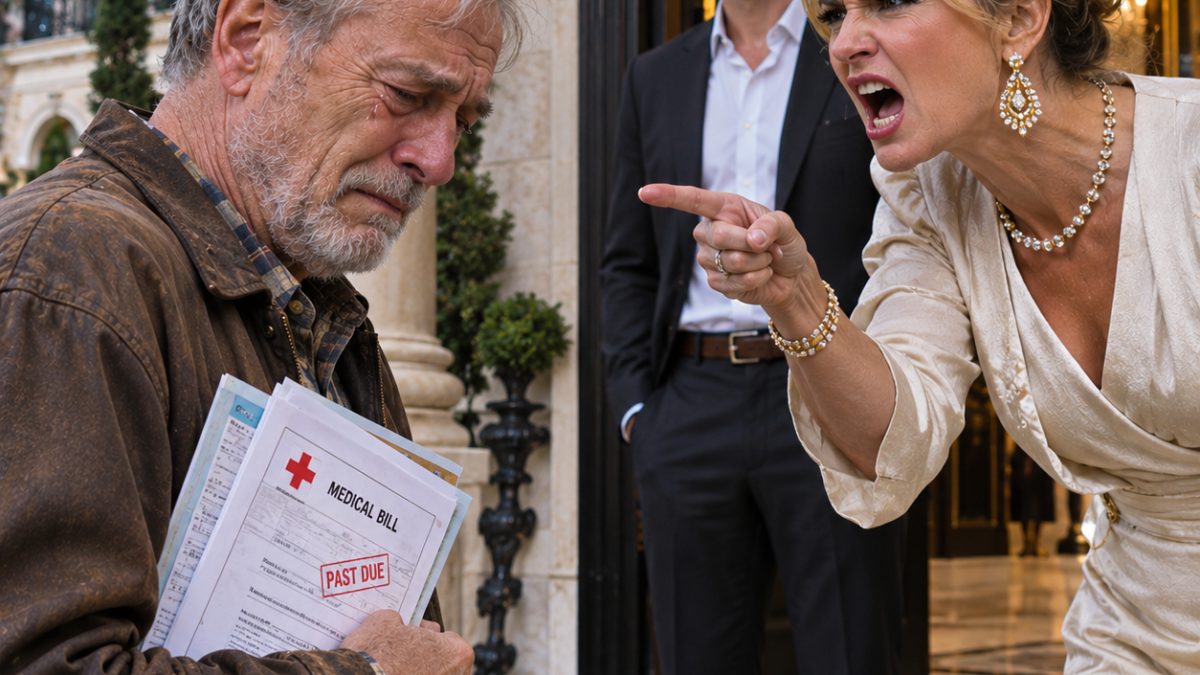
“GET OFF MY PROPERTY, ROBERT! MY HUSBAND INHERITED FIVE MILLION DOLLARS, AND WE ARE NOT SUPPORTING A BANKRUPT OLD MAN!” my daughter-in-law shouted from the front steps of the mansion my son now called home, loud enough for the neighbors to hear
FULL STORY CONTINUATION
I couldn’t answer immediately.
I had spent so many weeks being ignored, dismissed, and treated like a burden that hearing genuine happiness in another person’s voice almost undid me.
“David,” I finally whispered.
“Uncle Robert! My goodness. How are you?”
I stared at Helen’s photograph on the table.
How was I supposed to answer that?
How could I explain that the woman who had been beside me since I was eighteen was dead, that my only son had inherited everything we’d built, and that I was sitting alone in a rented apartment wondering whether I could afford groceries?
David heard my silence.
His voice changed.
“What’s wrong?”
I swallowed.
“It’s Helen.”
He went quiet.
“Is she sick?”
I closed my eyes.
“She’s gone, son.”
For several seconds, there was no sound.
Then he whispered, “Oh, Uncle Robert.”
The grief in his voice was real.
That was what broke me.
Not the lawyer telling me I had no inheritance.
Not Paula slamming the door.
Not even Andrew standing silently behind the glass.
It was hearing a young man who wasn’t my biological son grieve for Helen as though he’d lost part of his own family.
“I’m so sorry,” David said. “She was like a second mother to me.”
I pressed my hand over my mouth.
“I know.”
“Why didn’t anyone tell me?”
“I don’t know.”
He took a breath.
“Tell me what happened.”
So I did.
I told him about the cancer.
The medical bills.
The funeral.
The will.
The property transfers.
And finally, the afternoon I’d stood outside Andrew’s mansion while Paula told me I didn’t belong in their family anymore.
David listened without interrupting.
When I finished, I heard him exhale slowly.
“Uncle Robert, I need you to answer something.”
“All right.”
“Did you and Aunt Helen ever intend for everything to go to Andrew while you were still alive?”
“No.”
“Did she ever discuss leaving you responsible for all the debts?”
“Never.”
“Did you sign financial documents while she was in the hospital?”
I stared at the table.
“Yes.”
“What kind?”
“I thought they were authorizations. Paula said they were necessary for the company and Helen’s care.”
David was quiet.
Then he asked, “Did you read them?”
The shame hit me immediately.
“No.”
I heard him take a breath.
“All right.”
“I’m an old fool, David.”
“Don’t say that.”
“I signed things I didn’t understand.”
“You were trying to care for your dying wife.”
“I should have been more careful.”
“Maybe. But trusting your family isn’t permission for them to exploit you.”
I began crying.
David waited.
When I could speak again, he said, “I want to review the paperwork.”
I looked at the photograph beside me.
“David, I don’t have money for an attorney.”
“You paid for my education.”
“That was years ago.”
“I remember every dollar.”
“You don’t owe me anything.”
He answered immediately.
“Then let me do this because I love you.”
I couldn’t speak.
For months, I had been trying to persuade my son that I deserved basic kindness.
Now another man’s son was offering me help without asking what he would receive in return.
David continued.
“Don’t sign anything else. Don’t agree to new financial arrangements. Send me every document you have.”
“I don’t know how to scan them.”
“Do you have someone who can help?”
I thought of Mrs. Rose, the elderly widow who lived near my apartment.
“Yes.”
“Good. And Uncle Robert?”
“Yes?”
“Do you have enough money for rent and food?”
I stared at the empty coffee cup in front of me.
I wanted to lie.
Pride is a stubborn thing.
Especially when you’ve spent your whole life providing for other people.
But I was tired of pretending.
“No,” I whispered.
David was silent for a moment.
Then he said, “I’m going to help with that while we figure out what’s happened.”
“Son, I can’t—”
“You can.”
His voice softened.
“You once told me that when a man has the ability to help someone he loves, he should never make that person beg.”
I closed my eyes.
I remembered saying those words to him when he was seventeen.
I had almost forgotten.
David hadn’t.
To understand why that phone call meant so much, you need to understand the life Helen and I built.
We didn’t begin with five million dollars.
We began with almost nothing.
I met Helen at a neighborhood party when I was eighteen.
She had honey-colored eyes, thick dark hair, and a laugh that seemed to fill every corner of a room.
I was a construction worker’s son.
My father laid bricks.
My mother sold sandwiches to workers near our home.
I didn’t have an expensive car.
I didn’t own a suit.
The best thing I could offer Helen was a promise that I would work hard and never leave her facing life alone.
She accepted.
Two years later, we married at St. Michael’s Church.
The ceremony was small.
Friends contributed food.
Someone lent us a sound system.
Her parents let us hold the reception in their backyard.
There were folding chairs, paper decorations, and a cake made by her aunt.
I remember dancing with Helen under strings of inexpensive lights.
She leaned against me and whispered, “We’re going to have a good life.”
I laughed.
“We don’t even have enough money for a honeymoon.”
She smiled.
“I didn’t say we’d have an expensive life.”
That was Helen.
She understood the difference.
We rented a small apartment with two bedrooms and a kitchen barely large enough for us to stand in together.
I worked construction.
Helen worked as a secretary.
Our bills consumed almost everything we earned.
But we were happy.
Then Andrew was born.
I remember holding him for the first time.
He was wrapped in a blue blanket, his tiny face scrunched in an expression of outrage.
Helen laughed when she saw me crying.
“Robert, he’s going to think something’s wrong.”
I shook my head.
“Nothing’s wrong.”
I looked down at our son.
“Everything’s right.”
I promised that little boy he would have opportunities I hadn’t.
I promised him I would work harder than I’d ever worked before.
And I kept that promise.
At least, I believed I did.
When Andrew was five, my friend Louie and I started a construction company.
Louie had known me since we were young.
He was clever with numbers, good at finding opportunities, and the kind of man who could turn a conversation over coffee into a business deal.
I knew construction.
I knew how to build.
I knew how to tell whether a wall would stand or whether someone had tried to hide poor work beneath fresh paint.
We made a good team.
We pooled our savings.
Bought secondhand equipment.
And began taking small jobs.
Kitchen repairs.
Floor installation.
Painting.
Bathroom renovations.
At first, every contract felt like a miracle.
Helen handled the paperwork from our apartment.
She answered calls while Andrew played on the floor.
She kept records in an old notebook.
When we couldn’t afford an accountant, she learned what she needed.
When clients called after dinner, she answered.
When Louie and I came home exhausted, she had invoices organized and questions ready.
People later spoke about our company as though Louie and I had built it alone.
We never did.
Helen was there from the beginning.
Her work was simply less visible.
While we were pouring concrete and installing beams, she was making sure the bills got paid and the employees received their wages.
We worked seven days a week during those early years.
Sometimes I left before sunrise.
Sometimes I returned after Andrew was asleep.
There were nights when Helen waited at the table with cold dinner because she’d been too worried to eat until I came home.
I remember one evening when a major customer refused to pay us.
Louie and I were desperate.
We had workers waiting for wages.
Bills coming due.
And almost no money in the bank.
I sat in our kitchen with my head in my hands.
“I can’t do this anymore,” I told Helen.
She sat beside me.
“Yes, you can.”
“We might lose everything.”
She took my hand.
“Then we start over.”
I looked at her.
She smiled sadly.
“But we don’t quit because one dishonest man refuses to pay his bill.”
The next morning, I went back to work.
Eventually, we recovered the money.
The company survived.
And slowly, it grew.
We bought a truck.
Hired employees.
Started taking larger contracts.
By the time Andrew reached middle school, we had a small but respectable construction business.
I was proud.
Not because we were becoming wealthy.
Because we were providing jobs.
Paying taxes.
Building things that would last.
And giving our son the future we’d dreamed about.
Louie had a son named David.
David was different from Andrew.
I loved both boys, but they approached the world in different ways.
Andrew liked nice clothes.
He enjoyed business meetings and talking about money.
He wanted success without spending much time around the dust and noise of a construction site.
David wanted to understand everything.
He asked questions constantly.
Why did we use one material instead of another?
How did bidding work?
What made one contract profitable and another dangerous?
Why did some workers earn more?
How did taxes affect the company?
Sometimes I’d find him sitting beside Helen, watching her calculate payroll.
Other times he’d be following Louie through a job site with a notebook in his hand.
He was hardworking.
Curious.
And hungry to learn.
When David graduated from high school, he told us he wanted to become a lawyer.
Louie was proud.
But he was also worried.
College was expensive.
David hadn’t secured the financial assistance he’d hoped for.
One evening, Louie and I sat outside the office after closing a substantial contract.
He looked exhausted.
“Robert, I don’t know how we’re going to pay for his education.”
I studied my friend.
This was the man who had stood beside me through our worst years.
He had worked when there was almost no money.
He had helped me when Helen was sick during Andrew’s childhood.
He had never abandoned a job or an employee simply because things became difficult.
I said, “Then we’ll pay for it.”
Louie stared at me.
“What?”
“Helen and I. We’ll help David get through school.”
He shook his head.
“Robert, I can’t ask you to do that.”
“You didn’t.”
He began protesting.
I held up my hand.
“Louie, that boy has earned an opportunity.”
When I told Helen, she didn’t hesitate.
“Of course we’ll help.”
And we did.
We paid David’s tuition through his studies.
There were years when it was difficult.
There were company expenses.
Unexpected repairs.
Bills.
But we kept our promise.
When David graduated, Louie cried.
Helen cried.
I cried.
David hugged us all.
“One day I’m going to pay you back.”
I shook my head.
“You don’t owe us money.”
He looked at me.
“Then what do I owe you?”
I smiled.
“Become a good man. Help someone else when you can.”
He nodded.
“I will.”
After graduation, David received an opportunity with a prestigious law firm in New York.
He was worried about leaving.
He’d promised to work for our company.
Louie told him to go.
So did I.
“You don’t turn down a future because you feel guilty about the people who helped you reach it.”
David hugged us.
Then he left.
Years passed.
He became successful.
We exchanged occasional messages.
But our lives moved in different directions.
I never imagined that the boy whose tuition we’d paid would one day become the person standing between me and financial ruin.
Andrew joined the construction company after earning his business degree.
I hoped he would eventually take over.
He was smart.
He understood contracts.
He knew how to speak to clients.
He wore expensive suits and handled meetings in offices where I never felt entirely comfortable.
There were things he did well.
I don’t deny that.
He helped the business expand.
He negotiated deals.
He brought in clients.
But he also began treating the company as though it had appeared fully formed the day he arrived.
He rarely asked about the employees who had been with us from the beginning.
He didn’t seem interested in the sacrifices behind our early success.
And when I reminded him how much Helen and Louie had done, he smiled impatiently.
“Dad, business has changed.”
Maybe it had.
But honesty hadn’t.
Loyalty hadn’t.
The value of a promise hadn’t.
At least, I believed those things shouldn’t change.
Then Andrew met Paula.
She worked in public relations and moved comfortably among wealthy businesspeople.
She was beautiful.
Intelligent.
Well connected.
And determined to climb.
Andrew was fascinated.
He told us Paula understood the kind of life he wanted.
Helen was delighted.
I was more cautious.
Not because Paula came from money.
Not because she dressed beautifully.
But because of the way she looked at people.
She was warm toward anyone she believed could help her.
Cold toward anyone she considered unimportant.
The first time she came to our home, she looked around the living room and smiled.
“What a charming old house.”
Helen thanked her.
Paula continued.
“Of course, Andrew will need something more appropriate once he’s managing the company.”
I felt uncomfortable.
Andrew laughed.
“Paula likes nice things, Dad.”
I nodded.
“So do I.”
She smiled.
“Really?”
“Yes. Honest people. Good work. A home where everyone feels welcome.”
For a moment, her expression changed.
Then she laughed politely.
I should have understood the warning.
Instead, I told myself she was simply different from us.
Andrew loved her.
And I wanted him happy.
They married in an elaborate ceremony in Santa Barbara.
The flowers alone probably cost more than my first truck.
Helen cried with happiness.
I tried to focus on that.
But during the reception, I watched Paula’s wealthy relatives examining our family with expressions that made me feel like an unwanted contractor at a private club.
Andrew didn’t seem to notice.
Or perhaps he did.
And had already decided which side of the room he wanted to belong to.
After the wedding, everything began changing.
Andrew and Paula moved into a mansion in an affluent neighborhood.
The property had a pool, a large garden, and rooms they rarely used.
Paula spoke about their home as though it proved they were better than the people they’d left behind.
When Helen invited them to dinner, Paula often declined.
When she accepted, she commented on the furniture.
The neighborhood.
The carpets.
The food.
“Don’t you think it’s time to renovate?”
“Wouldn’t you be happier in a nicer area?”
“Andrew has important connections now. People notice these things.”
Helen tried to be gracious.
She wanted a good relationship with her daughter-in-law.
She wanted the family to remain close.
I watched her smiling through comments that clearly hurt.
Sometimes, after Andrew and Paula left, I’d find Helen standing at the sink with tears in her eyes.
“What’s wrong, sweetheart?”
She’d shake her head.
“Nothing.”
I knew it wasn’t nothing.
But I also knew how desperately she wanted to stay close to Andrew.
Then our grandsons were born.
Sam first.
Matthew a year later.
Helen adored them.
She knitted blankets.
Bought little clothes.
Saved photographs on her phone.
She spoke about them constantly.
But Paula controlled every visit.
The boys were busy.
They had appointments.
Activities.
Lessons.
Family commitments.
When Helen finally saw them, the visits were short and closely supervised.
My wife endured it because those children mattered more to her than her pride.
I tried to do the same.
But resentment grew inside me.
I had built a company so my son could have freedom.
Somehow, he’d used that freedom to become someone who was ashamed of the people who gave it to him.
When Louie died, I felt as though I’d lost a brother.
He suffered a heart attack.
It happened quickly.
One day, we were discussing a contract.
The next, I was standing beside his casket.
David flew home.
He hugged me so tightly I almost lost my balance.
“You were Dad’s best friend.”
I held him.
“He was mine too.”
The company eventually purchased Louie’s family’s ownership interest under an arrangement we believed was fair.
Andrew took on more responsibility.
I began thinking seriously about retirement.
Helen and I had spent decades working.
We wanted to travel.
Maybe visit places we’d seen only in magazines.
Maybe rent a little house by the ocean for a month.
Maybe spend ordinary mornings drinking coffee without worrying about employees, deliveries, or deadlines.
We had earned that.
Then Helen became ill.
And every plan changed.
Her cancer diagnosis was advanced.
The doctor explained treatment options carefully.
Helen listened.
I held her hand.
When he finished, she asked, “How much time?”
He hesitated.
I squeezed her fingers.
The answer wasn’t simple.
There was hope that treatment might help.
But the disease was serious.
We began chemotherapy.
Hospital visits.
Medication.
Testing.
More treatment.
Some days Helen seemed stronger.
She’d smile and tell me not to worry.
Other days, she couldn’t get out of bed.
I would sit beside her holding a glass of water, waiting for her to feel well enough to drink.
The company continued operating under Andrew.
I focused on Helen.
I trusted my son to handle the business.
I trusted Paula when she said she was organizing paperwork.
I trusted the attorney she brought to the hospital.
That trust became the instrument they used against me.
At first, Paula’s involvement seemed practical.
She wanted to organize accounts.
Review insurance.
Protect property from mounting medical costs.
She told us the family needed updated authorizations.
Then came powers of attorney.
Asset-management documents.
Company resolutions.
Pages of legal language I couldn’t understand.
I signed some.
Helen signed others.
I wish I could tell you I questioned everything.
I didn’t.
Sometimes Helen was barely conscious.
Sometimes she was heavily medicated.
Sometimes she confused the day or asked questions she’d already asked an hour earlier.
I was exhausted.
Terrified.
And desperate to believe the people around us were helping.
Paula would enter carrying a folder.
“Robert, we just need these signatures.”
I’d ask what the paperwork was.
“Routine financial protection.”
She sounded confident.
The lawyer nodded.
Andrew said very little.
So I signed.
Then I went back to Helen’s bedside.
I didn’t know that our signatures were being used to transfer assets out of our control.
I didn’t know that the home we’d supposedly sold to fund medical care had been transferred under suspicious terms.
I didn’t know that money was moving through company accounts in ways Helen and I had never authorized.
I only knew my wife was dying.
And I was trying to save her.
During Helen’s last week, I barely left the hospital.
She became too weak to speak for long.
Some mornings, she recognized me immediately.
Other times, she seemed disoriented.
I would lean close and tell her stories.
About the night we met.
Our first apartment.
Andrew’s birth.
The first company truck.
The time Louie accidentally painted a client’s garage door the wrong color.
Sometimes she smiled.
Sometimes she slept.
I held her hand regardless.
Andrew came shortly before the end.
He stood awkwardly beside the bed.
“Hi, Mom.”
Helen opened her eyes.
“Andrew.”
He leaned closer.
She touched his cheek.
“My boy.”
I looked away.
Whatever had changed between my son and me, Helen loved him.
I didn’t want the last hours of her life filled with arguments.
He stayed briefly.
Paula waited outside.
Later that night, Helen became quieter.
Her breathing changed.
I knew what it meant.
I bent close.
“I’m here, sweetheart.”
She looked at me.
Her voice was barely audible.
“I love you.”
I began crying.
“I love you too.”
“Take care of the boys.”
“I promise.”
Her fingers tightened around mine.
Then relaxed.
And Helen was gone.
I don’t remember much about the next hour.
I remember nurses.
A doctor.
Someone gently touching my shoulder.
I remember refusing to release her hand.
And finally, I remember standing beside the hospital bed, feeling as though every part of my life had suddenly lost its meaning.
The funeral was simple.
Helen would have wanted it that way.
Old friends came.
Employees.
Neighbors.
People who remembered the years when she answered company calls from our kitchen.
David wasn’t able to attend, and we hadn’t successfully reached him with the news.
Andrew stood beside Paula.
My grandsons wore little dark suits.
I wanted to embrace them, but Paula kept them close.
After the burial, I returned to the rented apartment we’d taken when our finances became strained during Helen’s illness.
Her coffee mug stood beside the sink.
Her magazines were stacked near the sofa.
Her perfume remained in the bathroom.
I sat in her favorite chair.
And I cried until I couldn’t cry anymore.
One week later, Paula’s attorney asked me to attend a meeting.
Andrew was there.
So was Paula.
The lawyer explained that Helen had executed updated estate documents.
He read the provisions.
The company.
The properties.
The accounts.
Everything was allocated in a way that gave Andrew control over almost all the substantial assets.
I listened in disbelief.
“What about me?”
The lawyer adjusted his glasses.
“Your wife made provisions consistent with her wishes.”
I stared at him.
“She wouldn’t have done this.”
He pointed toward the document.
“Her signature is here.”
I looked at Andrew.
“Son?”
He stared at the table.
“Andrew, look at me.”
He didn’t.
Paula touched his arm.
“Robert, please don’t make this difficult.”
I felt anger rising.
“Difficult?”
“Everyone is grieving.”
I looked at her.
“You’re telling me my wife left me with debts and no security after forty years of marriage.”
She sighed.
“Andrew has responsibilities. The company needs stability.”
I stared at my son.
“Is that what you believe?”
He finally looked up.
“Dad, the paperwork is legal.”
It was the first time he’d spoken.
And those words haunted me.
Not I’m sorry.
Not We’ll make sure you’re okay.
Not Let’s find out what Mom intended.
The paperwork is legal.
As though legality were the only thing that mattered.
As though my life with Helen could be reduced to a signature on a page.
The weeks afterward were humiliating.
Bills arrived constantly.
Hospitals.
Clinics.
Medication providers.
The funeral home.
I tried to organize them on the kitchen table, but each envelope seemed to contain another amount I couldn’t pay.
My Social Security income barely covered rent and basic expenses.
I called Andrew.
No answer.
I sent messages.
No response.
I went to the company office.
The receptionist didn’t recognize me.
“Do you have an appointment?”
I stared at her.
“I’m Robert Morales.”
She smiled politely.
“Yes, sir. Who are you here to see?”
“Andrew.”
“Mr. Morales is unavailable.”
I felt the blood rush to my face.
“I’m his father.”
Her expression changed.
Not to recognition.
To discomfort.
“I’m sorry, but you’ll need to schedule a meeting.”
I looked past her toward the offices.
I’d helped build that company from a small rented workspace.
I’d worked in winter rain to finish jobs on time.
I’d paid employees from my own savings when clients delayed payments.
And now I couldn’t walk through the reception area without permission from someone who’d never met me.
I turned and left.
Outside, I sat in my old car and stared at the company sign.
For the first time, I felt like a stranger in the life I’d created.
Mrs. Rose was the person who kept me from completely falling apart.
She was a widow who had known Helen and me for years.
She brought food.
Checked on me.
Sometimes sat quietly while I talked about my wife.
One afternoon, I finally told her what had happened with the inheritance.
She listened.
Then she set down her coffee cup.
“Robert, that doesn’t sound right.”
I laughed bitterly.
“Tell that to the lawyer.”
“I’m serious.”
“So am I.”
She looked at me.
“Did Helen ever tell you she wanted to leave everything to Andrew?”
“No.”
“Did she ever say you’d be responsible for the medical debt?”
“Never.”
Mrs. Rose leaned forward.
“Then you need someone independent to review those documents.”
I shook my head.
“I can’t afford another lawyer.”
She thought for a moment.
“What about David?”
I looked up.
“Louie’s son?”
“Yes.”
“He lives in New York.”
“Isn’t he a lawyer?”
I nodded.
“A very successful one, from what I hear.”
“Then call him.”
I looked away.
“I haven’t spoken to him properly in years.”
She shrugged.
“You helped raise that boy.”
“He doesn’t owe me anything.”
Mrs. Rose studied me.
“Perhaps not. But maybe he’d like the chance to help you.”
I didn’t answer.
That evening, after she left, I opened the old photograph boxes.
I found pictures of Helen and me when we were young.
Louie standing beside our first truck.
Andrew as a boy wearing an oversized hard hat.
Then David’s graduation.
I touched the photograph.
He looked so young.
So proud.
Helen stood beside him smiling as though he were her own son.
I remembered how grateful he’d been.
I remembered telling him never to feel obligated.
Then I found his business card.
I placed it on the table.
And stared at it for two days before finding the courage to call.
David didn’t simply offer sympathy.
He acted.
The next morning, he called again.
“Uncle Robert, I need the documents.”
Mrs. Rose helped me scan them.
We sent the will.
The powers of attorney.
The property papers.
The letters from creditors.
Everything we could find.
Then David asked how much money I needed to get through the next few months.
I protested.
He refused to let the subject drop.
The following day, money arrived in my account.
Enough to cover several months of rent and living expenses.
I sat staring at the bank balance.
Then I began crying.
For the first time since Helen died, I could breathe without immediately calculating how much money remained until the next bill.
I called David.
“Son, this is too much.”
He laughed gently.
“It’s not.”
“I don’t know how I’ll repay you.”
“Uncle Robert, you already did.”
I looked toward Helen’s photograph.
“She’d be proud of you.”
His voice changed.
“I hope so.”
For the next two weeks, David investigated.
He worked with lawyers who could examine the relevant property and estate records.
He reviewed the documents.
He compared signatures.
He traced transfers.
And then one evening, he called.
“Uncle Robert, I need you to come to New York.”
My heart began pounding.
“Why?”
“Because I found something.”
“Something bad?”
He paused.
“Something important.”
I gripped the phone.
“David.”
His voice hardened.
“I don’t believe Aunt Helen’s estate was handled honestly.”
I closed my eyes.
For weeks, I had been afraid of exactly those words.
But hearing them also brought a strange relief.
Perhaps I wasn’t losing my mind.
Perhaps Helen hadn’t betrayed our marriage.
Perhaps someone had betrayed both of us.
David arranged my flight.
I hadn’t traveled by plane in years.
I was nervous.
I felt old and out of place.
I wore my best jacket and carried a small suitcase.
When I arrived at JFK, I saw David waiting near the exit.
He was older than I remembered.
Tall.
Confident.
His dark suit fit perfectly.
But when he saw me, he smiled like the boy who used to run into our construction office after school.
“Uncle Robert!”
He crossed the terminal and embraced me.
I held him tightly.
For a moment, I couldn’t speak.
He stepped back.
“You’ve lost weight.”
I smiled weakly.
“It’s been a hard year.”
His expression softened.
“I know.”
Then he took my suitcase.
“Come on. Let’s get you somewhere comfortable.”
During the drive through New York, I stared at the enormous buildings.
David asked about my health.
My finances.
How I was coping without Helen.
I answered honestly.
I told him I felt old.
Defeated.
Ashamed.
He listened.
Then he said, “You spent your life building things, Uncle Robert. You know better than anyone that a damaged structure isn’t always beyond repair.”
I looked at him.
He smiled.
“We’re going to find out exactly what happened.”
That night, we ate dinner in his apartment.
He ordered Chinese food.
We sat at the table talking about Louie.
About Helen.
About the early company years.
David remembered details I’d forgotten.
How Helen kept candy in her desk for children who visited.
How Louie always claimed he could fix anything.
How I once spent an entire Sunday helping David build a wooden desk for his bedroom.
I laughed for the first time in months.
Then David grew serious.
“Uncle Robert, there’s something you should know.”
I set down my fork.
“What?”
“I didn’t become successful entirely on my own.”
I frowned.
“Of course you did.”
He shook his head.
“You and Aunt Helen gave me a chance.”
“That was a long time ago.”
He leaned forward.
“I have never forgotten it.”
My throat tightened.
He continued.
“When I was eighteen, I thought I might lose the future I’d worked toward because we couldn’t afford tuition.”
I remembered.
“Then you stepped in.”
I shrugged.
“You deserved an education.”
David looked at me.
“And now you deserve someone to stand beside you.”
I couldn’t answer.
Because for the first time since my wife’s death, someone was speaking to me as though my life still mattered.
The next morning, David took me to his office.
The firm occupied part of a skyscraper overlooking Manhattan.
There were glass walls.
Conference rooms.
Rows of computers.
People moving quickly with folders and phones.
I felt terribly out of place.
David noticed.
He placed a hand on my shoulder.
“Uncle Robert, you belong here.”
I laughed nervously.
“In a place like this?”
He smiled.
“Half the reason I have an office here is because of what you did for me.”
He guided me into a private conference room.
Several thick folders sat on the table.
I knew immediately that whatever he had found was serious.
He closed the door.
Then he sat across from me.
“Before I explain, I want you to understand that we’re still building the legal case. Some facts will need to be established through formal proceedings.”
I nodded.
“But we have enough to believe that Paula and the attorney she hired manipulated the estate documents.”
I felt cold.
David opened the first folder.
He showed me the original estate planning records.
Helen and I had made arrangements years earlier.
Those documents reflected what we’d always discussed.
The surviving spouse would be protected.
Andrew would inherit a substantial portion later.
The company would continue operating.
Our family’s work would benefit the next generation without leaving either parent destitute.
I touched Helen’s signature.
It was familiar.
Strong.
Confident.
I remembered the afternoon we’d signed those papers.
She’d joked that I should stop worrying because she intended to outlive me.
I began crying.
David gave me a moment.
Then he showed me the later document.
It had been prepared during Helen’s final illness.
The signature looked different.
Unsteady.
There were irregularities involving witnesses and the circumstances of execution.
David explained that the validity of the later instrument could be challenged.
I stared at it.
“She barely knew what day it was some mornings.”
He nodded.
“We’ve obtained medical information that raises serious concerns about her ability to understand and voluntarily approve major changes during that period.”
I looked away.
I remembered Paula entering the hospital room with folders.
The way she’d smiled.
The way she’d told us the paperwork was necessary.
Then David opened another folder.
“There’s more.”
He showed me property records.
The house we’d believed had been sold during Helen’s treatment had been transferred to Andrew under terms that deserved investigation.
Other parcels of land had moved as well.
Assets I barely remembered because Helen handled the financial details.
Then came the company accounts.
Payments.
Transfers.
Invoices.
David pointed toward several entries.
“These transactions appear suspicious. We believe some may have been used to divert money.”
My hands trembled.
“Andrew knew?”
David looked at me.
“We’re still trying to determine what he knew and when.”
I closed my eyes.
I wanted to believe my son had been deceived.
That Paula had manipulated everything without his knowledge.
But I remembered him standing behind the glass door.
Watching while his wife humiliated me.
He might not have understood every legal document.
But he understood cruelty.
And he’d allowed it.
David brought out one more item.
A recording.
He explained that it had been obtained by an investigator and would need to be examined for authenticity and legal admissibility.
Then he played it.
I heard Paula’s voice.
Cold.
Confident.
Talking about ensuring I received nothing.
Calling me a nuisance.
A reminder of Andrew’s poor background.
A man whose old clothes and working-class habits didn’t belong among the people she wanted to impress.
I felt as though I’d been punched.
Then she spoke about Helen.
About her illness.
About obtaining signatures.
The conversation continued.
I couldn’t listen anymore.
“Stop.”
David paused the recording.
I covered my face.
For a long time, I cried.
Not because Paula despised me.
I’d known that for years.
But because she had looked at my dying wife and seen an opportunity.
She had watched me trying to save Helen.
And used my desperation against me.
I remembered every signature.
Every document.
Every time she’d told me she was only helping.
Then I thought about Andrew.
My son.
The little boy I’d carried on my shoulders at construction sites.
The man who inherited everything.
And who couldn’t even open his front door when I came asking for help.
“Uncle Robert,” David said softly.
I looked up.
He leaned forward.
“We can fight this.”
I wiped my face.
“Will it ruin Andrew?”
David didn’t answer immediately.
“It may have serious consequences for his marriage, his finances, and possibly his legal position, depending on the evidence.”
I stared at the table.
“He’ll never forgive me.”
David spoke gently.
“That isn’t something you can control.”
I looked toward the window.
For years, I had taught Andrew that family came first.
Now I was being asked to decide whether protecting my son’s reputation mattered more than protecting the truth about his mother.
I thought of Helen.
Her tired face.
Her hand in mine.
Her final promise of love.
Then I looked at David.
“Do it.”
He nodded.
“You’re sure?”
I took a breath.
“I want the truth.”
My voice trembled.
“And I want back what Helen and I built.”
The following week was exhausting.
David introduced me to the legal team assisting with the case.
They explained the need to gather certified documents, financial records, medical testimony, and evidence about the property transfers.
They asked questions that forced me to revisit Helen’s final months.
When had Paula first brought documents?
Who was present?
Was Helen alert?
What did the lawyer tell us?
What did Andrew say?
Did I understand the powers of attorney?
Had anyone independently explained their consequences?
Some questions made me feel foolish.
Others made me angry.
But David kept reminding me to answer honestly.
“Don’t try to make yourself look better or worse. Just tell the truth.”
I did.
I admitted I hadn’t read the documents.
I admitted I’d trusted Paula.
I admitted I’d been too exhausted to ask the questions I should have asked.
And I admitted that even after the will was read, I’d wanted to believe my own son would eventually help me.
David listened without judgment.
Then he asked me to think about something.
“Uncle Robert, what do you want to happen if we win?”
I stared at him.
“I want to be able to live.”
He nodded.
“What else?”
I thought about Helen.
“I want her name cleared.”
He waited.
“I want people to know she didn’t choose to leave me with nothing.”
My voice broke.
“And I want Andrew to understand what he allowed.”
David nodded slowly.
“Then that’s what we keep in mind.”
I returned home while the case was prepared.
Mrs. Rose met me at the apartment.
She took one look at my face.
“You found something.”
I nodded.
She stepped aside.
“Coffee?”
I smiled.
“Please.”
We sat at the kitchen table.
I told her what David had discovered.
She listened.
Then she shook her head.
“That woman.”
I looked down.
“Paula?”
“Yes.”
I sighed.
“I never wanted a war with my son.”
Mrs. Rose reached across the table.
“Robert, you didn’t start this.”
I stared at her.
“You spent decades working for that company.”
I nodded.
“You spent years caring for your wife.”
Tears gathered in my eyes.
“And now people are trying to convince you that asking for what belongs to you makes you greedy.”
She squeezed my hand.
“Don’t believe them.”
I looked toward Helen’s photograph.
For the first time since the funeral, I felt something stronger than grief.
Determination.
The lawsuit was filed.
David returned with other attorneys and an investigator.
They reviewed the final documents with me.
The estate issues.
The disputed transfers.
The allegations concerning the company.
Everything.
Then David explained that we were going to confront Andrew and Paula.
I felt sick.
“At their house?”
“Yes.”
“Why?”
“Because they need to understand the seriousness of what we’re alleging. But we won’t threaten them or pretend a filed lawsuit is already a judgment.”
I nodded.
“We’ll let the documents speak.”
The next morning, vehicles arrived to take us.
They were black SUVs, carrying the legal team and their equipment.
I sat beside David.
My hands were sweating.
“Uncle Robert, are you okay?”
I shook my head.
“No.”
He smiled faintly.
“That’s understandable.”
I looked out the window.
“What if Andrew refuses to speak to me?”
David was quiet.
Then he said, “You’ve already survived him refusing to speak to you.”
I swallowed.
He was right.
The worst part wasn’t what might happen that morning.
The worst part had already happened.
My son had watched me beg for help.
And turned away.
When we reached the mansion, I stared at the gates.
I remembered standing outside them months earlier with unpaid bills in my hands.
I remembered Paula’s voice.
A bankrupt man doesn’t belong in a millionaire family.
The words returned so clearly that I felt my face burn.
David stepped out.
I followed.
The other lawyers gathered their folders.
We approached the front door.
David rang the bell.
After a moment, Paula appeared.
She wore expensive athletic clothes.
Her hair was perfectly styled.
Her expression changed when she saw me.
“Robert?”
Then she noticed David and the others.
“What is this?”
David stepped forward.
“Mrs. Morales, my name is David. I’m an attorney representing Robert Morales.”
He offered his card.
She stared at it.
Then at me.
“What kind of stunt are you pulling?”
David remained calm.
“We’ve filed legal proceedings concerning the estate documents and property transfers.”
Paula’s face tightened.
“That’s ridiculous.”
“We have evidence that raises substantial questions about the validity of several documents and transactions.”
She looked over her shoulder.
“Andrew!”
A moment later, my son appeared.
He was wearing sweatpants and a T-shirt.
When he saw me, his face changed.
“Dad?”
I stared at him.
For months, I’d wanted to hear him say that word.
Now it sounded almost unfamiliar.
David introduced himself again.
Andrew frowned.
“What’s this about?”
David handed him a folder.
“Your father’s legal claim concerns the estate administration, powers of attorney, and transfers involving your parents’ assets.”
Andrew stared at the documents.
Paula stepped forward.
“This is harassment.”
David shook his head.
“We’re not entering your property or demanding an immediate response. Your attorneys can address the filed claims through the proper process.”
She turned toward me.
“You couldn’t accept the will, could you?”
I looked at her.
“Helen wouldn’t have left me destitute.”
Paula laughed.
“People make choices, Robert.”
“Yes,” I said quietly. “They do.”
David opened another folder.
He explained what the records showed.
The earlier will.
The suspicious later documents.
The transfers.
The financial irregularities.
Andrew’s expression grew increasingly troubled.
Then David referred to the recording.
Paula went still.
“What recording?”
He explained that evidence had been gathered concerning conversations about the estate arrangements.
She tried to interrupt.
He remained composed.
When he played an excerpt, her voice emerged.
The old man can’t see a single dollar.
The words seemed to freeze the air.
Andrew looked at her.
“Paula?”
She said nothing.
The recording continued.
She spoke about my humble past.
About how my presence embarrassed her.
About how she wanted me removed from the family.
I stood motionless.
Hearing those words a second time hurt.
But this time I wasn’t alone.
David stood beside me.
And Andrew was finally hearing what his wife had said.
When the recording stopped, nobody spoke.
Then Paula exploded.
“This is illegal!”
David answered calmly that the recording’s legal status and admissibility would be addressed through the appropriate process.
“You had someone spying on me?”
He didn’t argue.
He simply referred her to the documents.
Paula turned toward me.
“You ungrateful old man!”
I flinched.
Then she stepped closer.
“After everything Andrew has done, you’re trying to destroy his life?”
I looked at my son.
“Andrew.”
He raised his eyes.
“Did you know?”
He swallowed.
“Know what?”
“That your mother was being made to sign documents while she could barely understand what was happening?”
He looked toward Paula.
She grabbed his arm.
“Don’t answer him.”
I stared at him.
“Did you know I would be left with the debts?”
He said nothing.
“Did you know I came here because I was afraid of losing my apartment?”
His face crumpled.
“Dad—”
“You watched through that window.”
I pointed toward the glass doors.
“You heard her tell me I didn’t belong in this family.”
His eyes filled.
“And you stayed inside.”
Tears slipped down my cheeks.
“Do you know what your mother would have said if she’d seen that?”
Andrew looked away.
I continued.
“She spent her final days worrying about you and the boys.”
My voice broke.
“And you couldn’t even come outside to ask whether I had enough food.”
Paula pulled at his arm.
“Andrew, we’re going inside.”
He didn’t move.
She stared at him.
“Andrew!”
He looked at her.
Then at the folder in his hands.
For the first time, he seemed to see the world around him without her explaining what he was supposed to think.
“Is this true?” he whispered.
Paula’s face hardened.
“Don’t be stupid.”
He stared at her.
“Did you say those things about Dad?”
She looked away.
“You’re missing the context.”
He closed his eyes.
And I knew something had changed.
Not enough to repair everything.
Not nearly enough.
But for the first time, my son was questioning the woman he’d allowed to control our family’s future.
David handed him the remaining documents.
“Have independent counsel review these.”
Andrew nodded slowly.
Paula began shouting again.
But I stopped listening.
I turned away.
And walked toward the vehicles.
I didn’t feel victorious.
I felt exhausted.
Yet with every step, something inside me grew steadier.
I had returned to the place where I’d been humiliated.
And this time, I hadn’t come begging.
I had come with evidence.
The case moved forward through the courts.
There were filings.
Hearings.
Depositions.
Financial reviews.
Medical testimony.
And months of uncertainty.
David’s team worked constantly.
They found additional suspicious company transactions.
Transfers involving assets that had once belonged to Helen and me.
Payments that required explanation.
The matter expanded beyond the will.
Investigators became interested in the financial movements.
Paula hired expensive lawyers.
They denied wrongdoing.
They portrayed me as an angry old man trying to seize assets from his successful son.
When I read their response, I felt sick.
I had spent decades building the company.
And now I was being accused of trying to steal from it.
David told me to remain calm.
“We have documents.”
I looked at him.
“They have expensive attorneys.”
“So do you.”
I almost laughed.
“Mine just happens to remember when I paid his tuition.”
David smiled.
“Exactly.”
Andrew eventually called.
I was sitting beside Helen’s photograph when the phone rang.
His name appeared on the screen.
For several seconds, I couldn’t answer.
Then I pressed the button.
“Hello?”
“Dad.”
His voice sounded different.
Tired.
Ashamed.
I closed my eyes.
“Andrew.”
He took a breath.
“I had a lawyer review the documents.”
I waited.
“He says there are serious problems.”
I looked toward the window.
“David told me.”
Andrew was silent.
Then he whispered, “I didn’t know everything Paula was doing.”
I felt anger rise.
“Did you know enough?”
He didn’t answer.
“Andrew, did you know your mother was sick?”
“Yes.”
“Did you know I was paying for her treatment?”
“Yes.”
“Did you know I had almost nothing left afterward?”
A long silence.
“Yes.”
I closed my eyes.
“Then don’t tell me you didn’t know.”
He began crying.
“Dad, I’m sorry.”
I looked at Helen’s photograph.
“Your mother needed you.”
His breathing became uneven.
“I know.”
“She waited for you.”
“I know.”
“And after she died, I needed you.”
His voice broke.
“I was a coward.”
I said nothing.
“I let Paula convince me that the company and the money mattered more than everything else.”
I swallowed.
“And when she humiliated you, I didn’t stop her.”
Tears rolled down my face.
“That’s what I can’t forget.”
He began sobbing.
For a moment, I heard the little boy I’d once held in my arms.
But I knew I couldn’t let that memory erase the man he’d become.
“Andrew, if you want to make something right, cooperate with the investigation.”
He was quiet.
“That may destroy my marriage.”
I closed my eyes.
“Then you need to decide what kind of marriage you want to protect.”
He didn’t answer.
“And what kind of father you want your boys to remember.”
I ended the call feeling empty.
But I also knew I’d finally told my son the truth.
The first major hearing was one of the hardest days of my life.
I wore my old dark suit.
The one I kept for funerals and weddings.
Mrs. Rose helped straighten my tie.
“You look handsome,” she said.
I smiled weakly.
“I look terrified.”
“That too.”
She hugged me.
Then David arrived.
We went to court together.
Paula sat across the room with her lawyers.
Andrew was beside her.
Neither looked comfortable.
David presented our case.
The original estate documents.
The later will.
The powers of attorney.
The property transfers.
The medical records.
He explained how the evidence supported our allegations that Helen’s illness and my grief had been exploited.
Paula’s attorney argued that everything had been legal.
He described her actions as estate planning.
He said Helen knew what she was signing.
Then I was called to testify.
I walked slowly to the witness stand.
My knees hurt.
My hands trembled.
But I told the truth.
I spoke about Helen.
Our marriage.
The company.
The cancer.
The nights I slept in a chair beside her hospital bed.
The documents Paula brought.
The things I signed without understanding.
And the day I discovered I’d been left with almost nothing.
When Paula’s attorney questioned me, he asked about my education.
“How far did you go in school, Mr. Morales?”
“Eighth grade.”
He nodded.
“So you don’t understand complicated financial documents?”
“Not without help.”
He smiled slightly.
“And yet you signed them?”
“Yes.”
“Without reading them?”
“I trusted my family.”
He paused.
Then he asked, “Isn’t it possible your wife simply decided her son was better equipped to handle the estate?”
I stared at him.
“Helen and I spent our lives building that business together.”
“That wasn’t my question.”
I took a breath.
“She wanted Andrew to have a future.”
The lawyer nodded.
“Exactly.”
I continued.
“But she never wanted that future built by leaving me homeless.”
The courtroom went quiet.
He shifted.
“Mr. Morales, how much money does a man your age really need?”
I felt anger rise.
For a moment, I wanted to shout.
Instead, I looked directly at him.
“This isn’t about how little an old man can survive on.”
He stared at me.
“It’s about whether someone can take what he spent his life earning simply because they think he’s too old to fight back.”
David objected when the questioning became argumentative.
The judge directed the attorney to move on.
I returned to my seat exhausted.
David squeezed my shoulder.
“You did well.”
I shook my head.
“I feel like I just buried Helen all over again.”
He looked at me sadly.
“I know.”
Medical testimony followed.
Doctors discussed Helen’s condition during the relevant period.
The medications.
The confusion.
The extent to which her ability to make informed decisions may have been impaired.
The court reviewed the circumstances surrounding the later documents.
Financial specialists examined the property transfers.
Investigators presented evidence about irregular company payments.
The recordings were contested.
Their authenticity and admissibility were examined.
But as the case progressed, more documents emerged.
And Paula’s explanations became increasingly difficult to reconcile with the evidence.
Then Andrew made his decision.
He contacted David through his own lawyer.
He agreed to cooperate.
He provided emails.
Text messages.
Company records.
Communications concerning the asset transfers.
I wasn’t sure whether to feel relieved or heartbroken.
His cooperation helped establish the truth.
But the fact that he possessed those records made me wonder how much he’d chosen not to see.
When he called me again, he told me he intended to divorce Paula.
I sat quietly.
“Why?”
He sounded exhausted.
“Because I can’t keep living with someone who did this to Mom.”
I looked down.
“And to me?”
He began crying.
“To you too, Dad.”
I closed my eyes.
He continued.
“I thought success meant getting away from where we came from.”
My throat tightened.
“Your mother and I worked so you could go farther than we did.”
“I know.”
“Not so you’d be ashamed of us.”
He sobbed.
“I’m sorry.”
I didn’t forgive him that day.
But I listened.
And for the first time in years, he wasn’t asking me to admire his money.
He was asking me to believe he might still become a decent man.
The criminal investigation eventually resulted in charges against Paula and the attorney who had assisted with the disputed transactions.
Paula was arrested.
The news spread through the business community.
Journalists began calling.
People who had once ignored me suddenly wanted interviews.
I didn’t enjoy it.
I didn’t want to become famous for being betrayed by my family.
I wanted my wife back.
I wanted the years before her illness.
I wanted to wake up in our old house and hear her making coffee.
No court could give me those things.
But it could determine what had happened to the estate.
And whether the documents used to take control of our assets were valid.
The final hearing arrived after months of legal work.
David sat beside me.
Mrs. Rose came too.
Andrew was present.
Paula appeared under escort.
She looked different without her expensive clothes and carefully maintained appearance.
But when she glanced toward me, I saw the same coldness.
I looked away.
I didn’t want to spend another moment measuring my worth against her opinion.
The judge reviewed the evidence.
The estate documents.
The testimony.
The financial transfers.
The conduct surrounding Helen’s illness.
Then he announced his ruling.
The later will could not stand.
The disputed powers of attorney and resulting transfers were invalidated to the extent established by the court.
Assets improperly transferred were ordered restored through the legal process.
Compensation was awarded for the harm caused.
The earlier estate arrangements were recognized as controlling.
I sat motionless.
For a moment, I couldn’t understand what I’d heard.
Then David touched my shoulder.
“Uncle Robert.”
I looked at him.
“We won.”
I began crying.
He stood and embraced me.
Mrs. Rose was crying too.
People around us were speaking.
Attorneys were shaking hands.
But all I could think about was Helen.
My wife.
The woman who kept our first company’s records in a notebook.
The woman who worked beside me through years of exhaustion.
The woman who believed we would grow old together.
Her intentions had finally been defended.
I closed my eyes.
And whispered, “Helen, we did it.”
The aftermath was complicated.
Restoring property and accounts required more paperwork.
There were additional legal proceedings.
Financial professionals helped me understand what I owned and what obligations remained.
David recommended a trustworthy accountant.
He warned me not to make sudden decisions.
I listened.
After everything I’d endured, I wasn’t interested in another complicated financial arrangement I didn’t understand.
I wanted security.
Peace.
And the ability to live without fearing the next envelope in the mail.
Eventually, my financial position stabilized.
I no longer had to choose between rent and food.
I no longer lay awake worrying that creditors would take the last things Helen and I owned.
But the money didn’t make me happy in the way I’d imagined.
It made me safe.
There was a difference.
I understood that better than ever.
Two weeks after the ruling, Andrew came to my apartment.
He carried carnations.
Helen’s favorite flowers.
When I opened the door, he stood there looking nervous.
“Dad.”
I stared at him.
“Andrew.”
“Can I come in?”
I hesitated.
Then stepped aside.
He entered slowly.
I noticed how carefully he looked around.
The small sofa.
The old table.
Helen’s photographs.
It was nothing like the mansion he’d lived in.
But it was mine.
And for the first time in months, he seemed to understand what that meant.
We sat.
He placed the flowers on the table.
“I brought these for Mom.”
I nodded.
“She loved carnations.”
His eyes filled.
“I know.”
For several minutes, neither of us spoke.
Then he told me he’d separated from Paula.
The divorce proceedings were underway.
He’d sold the mansion.
Moved with the boys to a smaller apartment.
He’d begun trying to rebuild his life.
I listened.
Then he asked about the possibility of bringing Sam and Matthew to visit.
My heart tightened.
I hadn’t seen my grandsons properly in so long.
I remembered Helen holding them.
How happy she was when they visited.
How deeply she’d wanted them to know us.
I looked at Andrew.
“They’re innocent.”
He nodded.
“I know.”
“I don’t want them carrying our mistakes.”
“Neither do I.”
I took a breath.
“They can come.”
His face changed.
“Really?”
“Yes.”
He began crying.
I raised my hand.
“But Andrew, this doesn’t mean everything is forgiven.”
He nodded quickly.
“I understand.”
“It doesn’t mean our relationship goes back to the way it was.”
“I know.”
“If we’re going to rebuild anything, it has to be honest.”
He looked at me.
“I want that.”
I studied his face.
For the first time, I saw something that resembled humility.
Not because he’d lost money.
But because he’d finally begun to recognize how much he’d destroyed.
I nodded.
“Then start there.”
The following week, Sam and Matthew came to visit.
Sam was eight.
Matthew was six.
They entered shyly.
I had bought snacks and a few toys.
Mrs. Rose helped me prepare.
When the boys arrived, I was more nervous than I’d been before my court testimony.
Sam looked around.
“Are you Grandpa Robert?”
I smiled.
“Yes.”
He studied me.
“Dad says you built houses.”
I laughed softly.
“A few.”
His eyes widened.
“Big ones?”
“Some big. Some small.”
Matthew stood behind his brother.
He looked uncertain.
Then he asked a question that nearly broke my heart.
“Are you good or bad?”
I knelt carefully so I could look him in the eyes.
“What makes you ask that, sweetheart?”
He looked toward Andrew.
“Mom did bad things. Dad says people can make mistakes.”
I felt tears gathering.
I wanted to give him a simple answer.
But I knew he’d already learned that adults could be complicated.
So I said, “I’m your grandfather. I love you, even though we haven’t spent much time together.”
He watched me.
“And I try to do what’s right.”
He thought about that.
Then he stepped closer.
“Okay.”
It was such a small word.
But it felt like a door opening.
We spent the afternoon looking at photographs.
I showed them pictures of Andrew as a boy.
The first truck.
Our early construction sites.
Helen making food for the workers.
Sam laughed at the photograph of his father wearing an oversized hard hat.
“Dad looks funny!”
Andrew smiled sadly.
“I thought I looked pretty cool.”
Matthew climbed onto the sofa beside me.
“Can you teach us to build something?”
I smiled.
“Of course.”
And for the first time since Helen died, I began imagining a future that contained more than grief.
Our visits became regular.
The boys grew comfortable.
They asked questions.
Told stories.
Argued over games.
Helped me with small projects.
Sam liked understanding how things worked.
Matthew loved using his hands.
I showed them how to measure wood.
How to plant vegetables.
How to fix simple household items.
Nothing dangerous.
Just the ordinary skills my father taught me.
One afternoon, Matthew was helping me tighten a loose handle on a cabinet.
He looked up.
“Grandpa?”
“Yes?”
“Did Dad really work with you when he was little?”
I smiled.
“Yes.”
“Was he good?”
I thought about Andrew as a boy.
His impatience.
His curiosity.
The way he wanted to finish quickly so he could play with friends.
“He tried.”
Matthew laughed.
“That sounds like Dad.”
I looked toward the kitchen, where Andrew was helping Sam prepare sandwiches.
For a moment, I saw three generations connected by ordinary work.
And I wished Helen could have been there.
She would have loved it.
I eventually decided to move.
The city held too many painful memories.
Every street reminded me of something.
The hospital.
The lawyer’s office.
Andrew’s mansion.
The company I’d lost and regained.
I wanted somewhere quiet.
David helped me explore options.
I found a small house near San Diego.
Two bedrooms.
A modest garden.
Good weather.
Friendly neighbors.
Nothing extravagant.
But when I stood in the backyard, I felt something I hadn’t felt in years.
Peace.
I purchased it.
I hired a professional administrator to oversee the company.
I wanted the employees protected.
Some had worked with us since the early days.
They had families.
Mortgages.
Children.
I wasn’t going to allow our family’s conflict to destroy their livelihoods.
Andrew no longer held his previous position at the company.
The business needed independent leadership.
And Andrew needed to build a future without simply returning to the authority he’d once taken for granted.
We both understood that.
At least, we were beginning to.
The new house changed me.
Every morning, I walked into the garden.
I planted tomatoes.
Peppers.
Herbs.
I watered them.
Pulled weeds.
Watched new leaves appear.
There was something comforting about work that didn’t involve contracts or lawyers.
Something simple.
Honest.
A seed needed soil, light, and attention.
It didn’t care about the size of my bank account.
It didn’t care whether I wore an expensive suit.
It didn’t care what Paula thought of me.
It simply grew when I cared for it.
I understood that.
I’d spent my whole life building things with my hands.
Now I was building a quieter life.
The boys visited regularly.
Sometimes they stayed the weekend.
They helped me in the garden.
Played with neighborhood children.
Asked about Helen.
I told them stories.
Not just about the company.
About their grandmother’s kindness.
Her stubbornness.
Her laughter.
The way she always saved the best piece of cake for someone else.
One afternoon, Sam asked, “Did Grandma Helen ever get mad?”
I laughed.
“Oh, yes.”
His eyes widened.
“At you?”
“Especially me.”
The boys laughed.
I told them about the time I tracked muddy footprints through her freshly cleaned kitchen.
Helen had handed me a mop and said, “Since you enjoy bringing the construction site home, perhaps you’d like to finish cleaning it.”
Matthew laughed so hard he nearly fell out of his chair.
I laughed too.
Then, suddenly, my throat tightened.
Because for a few beautiful seconds, remembering Helen had made me happy instead of only sad.
That was when I realized healing was finally beginning.
Paula’s criminal case eventually reached its conclusion.
She received a five-year prison sentence for fraud, along with financial penalties and restitution requirements.
The attorney who assisted with the fraudulent transactions was also sentenced and lost his ability to practice law.
The news appeared in newspapers.
Some reporters contacted me.
I declined most interviews.
I didn’t want to spend the rest of my life being known as the old man whose daughter-in-law stole his inheritance.
That was something that happened to me.
It wasn’t who I was.
Paula eventually wrote a letter asking for forgiveness.
She also wanted me to support an effort to reduce her sentence.
I read it once.
Then placed it in a drawer.
I didn’t respond.
Not because I wanted to spend my remaining years hating her.
But because I knew a letter didn’t entitle her to my help.
She had been given opportunities to act honestly.
She’d chosen otherwise.
The court had addressed her conduct.
And I was finished allowing her decisions to control my life.
David remained close.
He visited when his work allowed.
Sometimes we’d sit in the garden drinking coffee.
He’d tell me about cases he was handling.
I’d tell him about the tomatoes.
He would laugh.
“Uncle Robert, you used to manage construction projects worth millions. Now you’re excited about vegetables.”
I smiled.
“These tomatoes don’t call me in the middle of the night.”
He laughed.
Then he’d grow quiet.
Sometimes we talked about Louie.
About Helen.
About how much life had changed.
One evening, I looked at David and said, “I never imagined you’d become the person who saved me.”
He shook his head.
“You helped me become a lawyer.”
“That doesn’t mean you owed me all this.”
He smiled.
“I know.”
I studied him.
“Then why?”
He looked toward the garden.
“Because you treated my father like a brother.”
I felt my throat tighten.
“And you treated me like a son.”
He paused.
“When I was young, I learned that family wasn’t only about blood.”
I looked down.
He continued.
“It’s about who shows up.”
I felt tears gathering.
“Your father would be proud of you.”
David smiled sadly.
“I hope so.”
We sat quietly for a while.
Then he said, “Aunt Helen would be proud of you too.”
I closed my eyes.
For the first time, I believed it.
Andrew continued working to rebuild our relationship.
It wasn’t easy.
There were days when we talked comfortably.
Other days, I remembered him standing behind the glass doors while Paula humiliated me.
Sometimes the memory arrived unexpectedly.
He’d say something innocent.
Or I’d see him checking his phone during dinner.
And suddenly, I’d be back on that mansion’s front steps, holding unpaid bills.
The hurt would return.
Andrew noticed.
One afternoon, he asked, “Dad, are you ever going to trust me again?”
I looked at him.
“I don’t know.”
His face fell.
I continued.
“Trust isn’t something I can decide to give you simply because we both want it.”
He nodded.
“It takes time.”
“I know.”
“And it takes evidence.”
He looked up.
“What kind?”
I thought carefully.
“Honesty when the truth makes you uncomfortable.”
He listened.
“Respect when we disagree.”
He nodded.
“And knowing that if someone humiliates me again, you won’t stand silently behind a door.”
Tears filled his eyes.
“I won’t.”
I looked at him.
“I hope that’s true.”
Almost a year after the verdict, Andrew came to visit alone.
The boys were with friends.
We sat in the garden.
The afternoon sun was warm.
Andrew looked nervous.
“Dad, can we talk?”
I put down my gardening gloves.
“Of course.”
He took a long breath.
“I’ve been going to therapy.”
I nodded.
He’d mentioned it before.
“It’s helped me understand some things.”
I waited.
He looked toward the mountains.
“When I was young, I thought you expected me to become exactly like you.”
I frowned.
“Why?”
“Because you worked so hard. You built the company. Everybody respected you.”
I stared at him.
“And you didn’t want that?”
“I wanted to be successful. But I was afraid I wouldn’t measure up.”
I said nothing.
“When I met Paula, she made me feel like there was another way to prove myself.”
He swallowed.
“Money. Status. The right house. The right friends.”
I looked down.
“She convinced me that our old life was something to escape.”
My throat tightened.
He continued.
“And I let her.”
I stared at my son.
“I thought if I became wealthy enough, nobody would remember that I grew up around construction sites.”
I shook my head.
“Andrew, I was proud of those construction sites.”
“I know.”
“Your mother was too.”
His eyes filled.
“I know that now.”
He looked at me.
“I was ashamed of the wrong things.”
I said nothing.
He continued.
“When Mom got sick, Paula said it was time to secure our future. She told me you didn’t need much money because you were old and simple.”
I felt anger rising again.
Andrew saw it.
“I wanted to believe her.”
I stared at him.
“Why?”
“Because it was convenient.”
The answer hurt.
But it was honest.
He continued.
“I told myself I’d help you later.”
I looked away.
“Then later came.”
He began crying.
“And I didn’t.”
I took a breath.
“You stood behind that window.”
He nodded.
“I know.”
“You watched me beg for help.”
“I know.”
“And you did nothing.”
He covered his face.
“I’m sorry.”
For a long time, we sat in silence.
Then Andrew lowered his hands.
“I don’t expect you to forget.”
I looked at him.
“I don’t want you to.”
He nodded.
“I don’t.”
His voice broke.
“I want to become someone you can be proud of again.”
I stared at my son.
For years, I’d wanted him to understand the value of honest work.
Of loyalty.
Of family.
Now he was speaking without excuses.
Without blaming Paula for everything.
Without asking me to erase the past.
He was finally acknowledging his own choices.
I felt my chest tighten.
“Andrew.”
He looked up.
“I forgive you.”
He began crying immediately.
I lifted a hand.
“But listen to me.”
He nodded through tears.
“Forgiveness doesn’t mean nothing happened.”
“I know.”
“It doesn’t mean trust comes back overnight.”
“I understand.”
“And it doesn’t mean you can ever treat me that way again.”
He shook his head.
“I won’t.”
I looked at him.
“I believe you’re trying to change.”
He began sobbing.
Then I opened my arms.
He leaned toward me.
And for the first time in years, I held my son the way I’d held him when he was a little boy.
I cried too.
Not because everything was repaired.
It wasn’t.
But because we had finally begun speaking honestly.
And that gave us something we hadn’t had in a very long time.
A real beginning.
Today, I am sixty-six years old.
I live in a small house near San Diego.
I have a garden.
A comfortable chair.
Good neighbors.
And more peace than I ever found in the expensive places my son once believed defined success.
The company continues under professional management.
The workers who helped build it still have jobs.
David remains part of my life.
Mrs. Rose visits when she can.
Sam and Matthew come regularly.
They help me in the garden and ask endless questions.
Andrew and I have a relationship that remains imperfect.
But it’s honest.
We don’t pretend the past never happened.
We don’t erase Helen’s suffering.
We don’t forget the humiliation.
Instead, we try to live differently.
That’s all I can ask.
Sometimes, in the late afternoon, I sit outside and look toward the mountains.
The light turns golden.
The air becomes cooler.
The garden grows quiet.
And I think about Helen.
I remember her at eighteen.
Standing beneath those backyard lights on our wedding night.
Smiling at me.
Telling me we were going to have a good life.
I used to believe that meant building a successful company.
Buying a house.
Saving money.
Providing opportunities for our child.
And those things mattered.
They still do.
But after everything that happened, I understand that Helen knew something I was slow to learn.
A good life isn’t measured only by what you own.
It’s measured by what remains when the money disappears.
When the business struggles.
When illness comes.
When the people you trusted disappoint you.
When you stand outside a mansion with unpaid bills in your hands and discover that the person who should open the door is the person choosing to keep it closed.
That afternoon was one of the lowest moments of my life.
I remember Paula’s voice.
A bankrupt man doesn’t belong in a millionaire family.
I remember the way she looked at my worn jacket.
The contempt in her smile.
The sound of the door closing.
And Andrew standing behind the glass.
For weeks, I believed she’d been right about one thing.
That I no longer belonged anywhere.
I had lost Helen.
Lost the company.
Lost the house.
Lost my savings.
And nearly lost my son.
But Paula was wrong about what made a man valuable.
I wasn’t worthless because I had debts.
I wasn’t shameful because I worked with my hands.
And I wasn’t less deserving of love because I had grown old.
I had spent decades building something honest.
I had helped pay for a young man’s education because I believed he deserved a chance.
I had stayed beside my wife until her final breath.
And even after everything, I had found the strength to fight for the truth.
That was my worth.
Not the money I recovered.
Not the property deeds.
Not the court’s judgment.
Those things restored my security.
But my dignity had been mine all along.
David helped me remember that.
He was the son of the man I once called my brother.
A young man whose education Helen and I had helped pay for.
He became a successful lawyer.
And when I called him in desperation, he didn’t ask how much money I had left.
He didn’t question whether helping me would improve his reputation.
He simply remembered the family that had stood beside him when he needed a chance.
And he stood beside me.
I’ll never forget that.
Sometimes Sam asks me why I still keep the old photograph of David’s graduation beside the picture of Helen and me.
I tell him the truth.
“Because that picture reminds me of something important.”
He looks up.
“What?”
I smile.
“Never underestimate what one act of kindness can become.”
He thinks about that.
Then he asks whether David really became rich because Grandpa paid for his college.
I laugh.
“No, sweetheart. David became successful because he worked hard. We just helped open a door.”
Sam nods seriously.
Then I add, “And years later, when I needed help, he remembered.”
Matthew usually asks the simpler question.
“Did he save you, Grandpa?”
I think about the lawyer’s office.
The evidence.
The courtroom.
The day the judge recognized that Helen and I had been wronged.
Then I look at my grandsons.
“In a way,” I say.
“But he also reminded me that I could still stand up for myself.”
And I hope they remember that lesson long after I’m gone.
I hope they understand that wealth doesn’t make someone honorable.
That poverty doesn’t make someone inferior.
That family love should never depend on how much money a person can provide.
And that when someone vulnerable asks for help, the right response isn’t to calculate what helping them might cost.
It’s to ask what you can do.
There is one final memory I return to often.
It is from the morning after the court ruling.
I had barely slept.
The legal team had celebrated.
Mrs. Rose had cried.
David had embraced me.
Andrew had sat quietly in the courthouse, facing the damage done to our family.
And I had gone home with documents confirming that much of what Helen and I had built would be restored.
The next morning, I made coffee.
I took Helen’s old cup from the cabinet.
I hadn’t used it since she died.
For months, I couldn’t bear to touch it.
But that morning, I filled it.
Carried it to the table.
And sat beside her photograph.
I looked at her smiling face.
Then I whispered, “We got it back, sweetheart.”
I began crying.
But after a moment, I shook my head.
“No.”
I touched the frame.
“We got the truth back.”
Because that was what had mattered most.
Helen hadn’t abandoned me.
She hadn’t chosen to leave me without protection.
She hadn’t decided that our forty years together meant less than the fortune our son would inherit.
Her wishes had been distorted.
Her illness had been exploited.
And our trust had been betrayed.
But the truth survived.
It survived in the documents we’d signed when we were healthy.
In the records David uncovered.
In the testimony of people who knew Helen’s condition.
And in the determination of a man who remembered what we’d done for him when he was young.
I sat with that photograph for a long time.
Then I finished my coffee.
Opened the window.
And let the morning air into the apartment.
For the first time since Helen died, I could imagine living without being consumed by fear.
Today, the modest house near San Diego is my home.
The garden is mine.
The quiet mornings are mine.
The decisions about my life are mine.
And when my grandsons run through the backyard laughing, I can almost hear Helen laughing with them.
I lost the woman I loved.
I endured a betrayal I never expected from my own child.
I fought a legal battle when I was exhausted and grieving.
But I did not let the people who hurt me decide how the rest of my life would be lived.
I recovered my security.
I found a way to rebuild my relationship with Andrew without pretending he’d done nothing wrong.
And I gained the chance to be the grandfather Helen always hoped I would become.
Sometimes I still miss her so much that the grief takes my breath away.
But now, when I sit in the garden beneath the evening sky, I don’t think only about what was stolen.
I think about what survived.
Love.
Honesty.
The dignity of hard work.
The kindness we gave away without expecting repayment.
And the people who remembered us when we needed them most.
My daughter-in-law thought five million dollars made her family wealthy enough to throw me away. But the person who finally stood beside me was someone I’d helped when I had far less—and he proved that the most valuable thing Helen and I ever built was never the company, the houses, or the money. It was the good we left in other people’s lives.








