“GET OFF HOA PROPERTY OR I’LL HAVE YOU ARRESTED!” HOA Karen Tried to Steal My Family’s 200-Acre Texas Ranch—Then the 1952 Deed Exposed What Her Husband Had Built on My Land
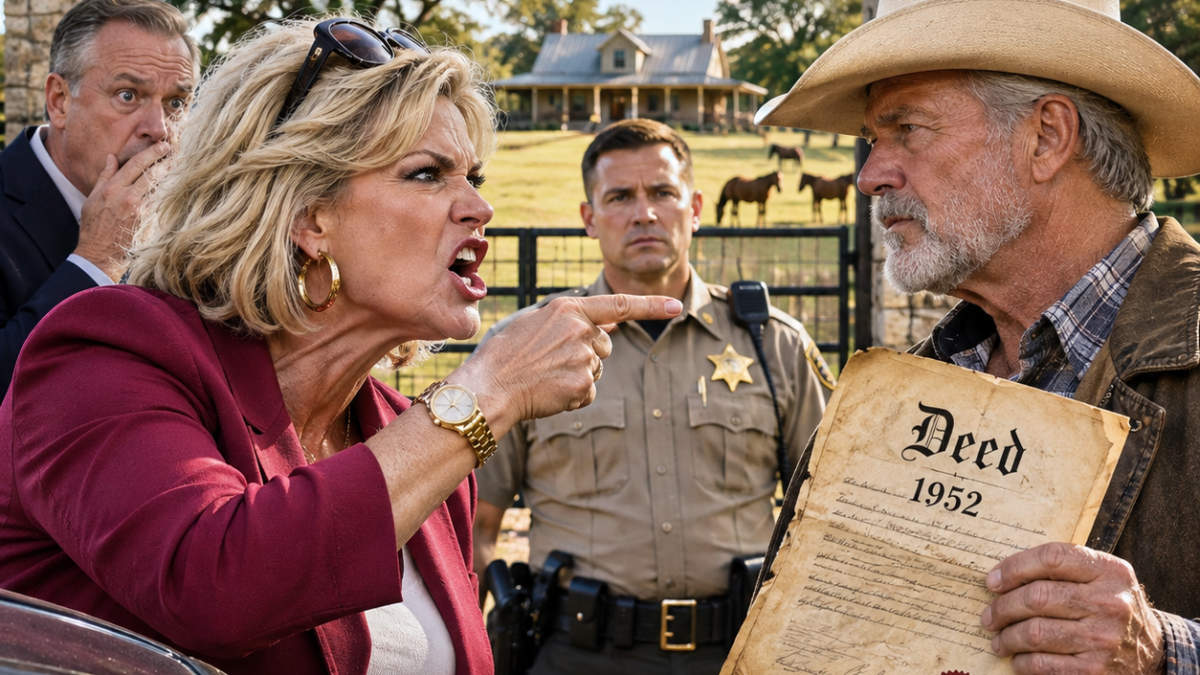
“GET OFF HOA PROPERTY OR I’LL HAVE YOU ARRESTED!” HOA Karen Tried to Steal My Family’s 200-Acre Texas Ranch—Then the 1952 Deed Exposed What Her Husband Had Built on My Land
“GET OFF OUR PROPERTY, YOU UNSTABLE MILITARY THUG—THE HOA OWNS THIS ROAD, AND I’VE ALREADY CALLED THE POLICE!” Karen Whitfield screamed as she blocked the entrance to my family’s 200-acre Texas ranch with her white Mercedes, while the original 1952 deed sat in my hand and the wooden gate behind her still carried the name my grandfather had carved seventy years earlier.
I had been home from an eighteen-month Army deployment for less than forty-eight hours when she threatened to have my cattle confiscated, handed me a stack of $500-a-day HOA fines, and announced that her developer husband would soon turn our pasture into the second phase of his luxury subdivision—never imagining that the man she was trying to intimidate had spent years studying engineering plans, land surveys, and infrastructure records for the United States Army Corps of Engineers.
And when the county records finally revealed that twenty-five acres beneath her subdivision’s stone entrance, community center, and main access road had never legally left the Stone family, Karen’s own husband would be forced to explain why he had spent millions improving land he might not own, while the neighbors she had frightened into supporting her discovered that the supposed “dangerous rancher” was the only person offering to keep their homes safe.
The first thing I noticed when I came home from Afghanistan was the silence.
Not the good kind.
Not the gentle silence of cattle grazing beneath live oaks or a creek flowing over limestone.
An unfamiliar silence.
No diesel tractor humming near the lower pasture.
No sound of my uncle’s old windmill.
No hammer tapping against a fence post.
And no grandfather waiting beside the ranch gate with a cup of coffee.
Grandpa Frank had died eight months into my deployment.
I knew before the funeral.
A phone call.
A chaplain’s office.
My father’s voice breaking through a bad connection.
But knowing somebody has died is different from returning home to the place where they should still be.
There should have been a pickup parked near the gate.
A gray hat hanging on the porch railing.
A voice shouting, “Garrett, close the damned gate before Roosevelt gets ideas!”
Instead, there was a white Mercedes blocking the entrance.
And a blonde woman in an expensive cream-colored pantsuit standing beside it, holding a phone.
She pointed at me as I climbed out of my truck.
“You!”
I stopped.
“Can I help you?”
“Absolutely not. You’re trespassing.”
I looked past her.
The wooden ranch gate stood fifteen feet away.
Hand-hewn cedar.
Steel hinges.
A carved plank across the top.
STONE CREEK RANCH — 1952.
My grandfather made that sign with his own hands.
I helped repaint it when I was twelve.
Now the lettering was faded.
The right post leaned slightly.
But it was still there.
I looked back at the woman.
“Ma’am, you’re blocking my driveway.”
She folded her arms.
“This entrance is under Meadowbrook Estates HOA jurisdiction.”
I stared.
“Meadowbrook what?”
“Estates.”
She enunciated each syllable as if speaking to somebody who had failed third grade.
“The luxury residential development adjacent to this property.”
I glanced toward the hillside.
When I left, the subdivision was still under construction.
Now rows of enormous houses sat along the ridge.
Matching roofs.
Decorative stone walls.
Ornamental streetlights.
A giant entrance monument with artificial waterfalls and bronze lettering.
Meadowbrook Estates.
I looked at it for a moment.
Then back at the woman.
“Congratulations.”
Her face tightened.
“Excuse me?”
“Looks expensive.”
She did not smile.
“Sir, you need to leave.”
I pointed toward the gate.
“My family owns the ranch.”
She laughed.
Actually laughed.
A sharp, delighted little sound.
“Oh, wonderful.”
“Another person claiming historic ownership.”
She lifted her phone.
“I’ve already contacted law enforcement.”
I stared at her.
“Why?”
“Because you are refusing to leave community property.”
I looked at the dirt beneath my boots.
Then at Grandpa’s gate.
Then at the pasture beyond.
Two hundred acres.
Three generations.
Seventy-plus years of work.
My father’s childhood.
My own.
Every fence.
Every oak.
Every summer drought.
Every winter storm.
And this stranger was standing on the entrance road telling me I was trespassing.
I felt something cold settle behind my ribs.
“What’s your name?”
“Karen Whitfield.”
“HOA president.”
“I’m Garrett Stone.”
The name meant nothing to her.
That was clear.
She looked at my dusty boots.
My faded Army T-shirt.
The deployment bag in my truck.
“Mr. Stone, whatever arrangement the previous owners had is no longer relevant.”
I looked at her.
“The previous owners?”
“Yes.”
“The people who operated that little cattle property.”
I felt my jaw tighten.
Little cattle property.
I thought about Grandpa Frank hauling water through the drought of 1956.
My father rebuilding fences after the floods in 1981.
The summer I broke my wrist trying to repair a windmill.
The time Grandpa stayed awake three straight nights helping a heifer through a difficult birth.
Little cattle property.
I said:
“Ma’am, you’ve made a mistake.”
Her smile sharpened.
“No.”
“I think you’re the one making a mistake.”
She lifted the phone again.
“Officer, yes. The individual is still here.”
Then she looked me straight in the eye.
“He’s being aggressive.”
I almost laughed.
I hadn’t moved toward her.
Hadn’t raised my voice.
Hadn’t touched her vehicle.
But suddenly I understood what kind of person stood in front of me.
She wasn’t reporting what happened.
She was building a version she expected other people to believe.
I stepped back toward my pickup.
Opened the passenger door.
And took out a leather folder.
Inside was a copy of the original family deed.
Recorded.
Dated 1952.
Franklin Stone.
Two hundred acres in the Texas Hill Country.
I held it up.
“Here.”
Karen waved dismissively.
“Old papers don’t override modern zoning.”
I looked at her.
“No.”
“But they often establish ownership.”
She rolled her eyes.
“Your attitude is exactly why our association needs stronger enforcement.”
Then she said something I would hear again months later in a courtroom.
“People like you need to understand that progress doesn’t ask permission from the past.”
I looked at Grandpa’s gate.
Then at the Mercedes.
Then at the development above us.
“Maybe.”
I said.
“But you’re going to need a better argument than that to take my ranch.”
Sirens sounded down the valley.
Karen smiled.
She believed she’d won.
She had no idea the real dispute hadn’t even started.
PART2
The deputy who arrived was named Tom Bradley.
No relation to Karen’s husband, Bradley Whitfield.
Tom and I had gone to high school together.
He was older than me by two years and had spent most of his adult life working for the county sheriff.
He climbed out of his patrol SUV and stopped.
“Garrett?”
I smiled.
“Hey, Tom.”
He looked from me to Karen.
Then back.
“Didn’t know you were home.”
“Got in yesterday.”
He stepped forward and shook my hand.
“I’m sorry about Frank.”
The words hit harder than I expected.
I swallowed.
“Thank you.”
Karen watched the handshake like it personally offended her.
“Officer!”
Tom turned.
“Ma’am?”
“Are you going to address the trespasser?”
Tom looked at me.
Then toward the gate.
Then back at her.
“Can you explain the complaint?”
Karen launched into a speech.
Community property.
Private entrance.
Potentially dangerous livestock.
Unknown men.
Security concerns.
Military-looking equipment.
Tom listened without interrupting.
Then asked:
“Where exactly is the alleged trespass?”
She pointed at my truck.
“There.”
Tom looked toward the ranch.
“That’s the Stone entrance.”
Karen stiffened.
“The HOA maintains the access corridor.”
“Maybe there are access arrangements.”
Tom said.
“But that doesn’t establish that Mr. Stone is trespassing simply by coming home.”
Her expression changed.
“He’s making threatening gestures.”
Tom looked at me.
“Garrett?”
I shook my head.
“No.”
“Did you threaten her?”
“No.”
“Anybody touch anybody?”
“No.”
“Any property damaged?”
“No.”
Tom turned toward Karen.
“Ma’am, this appears to be a property-access dispute.”
“We can document the complaint, but we’re not going to remove the owner of the adjoining ranch based solely on your interpretation of the boundary.”
Karen opened her mouth.
Closed it.
Then:
“You’re taking his side because you know him.”
Tom’s face remained calm.
“No.”
“I’m explaining the limit of what we can determine here.”
She pointed at my deed.
“He’s waving around seventy-year-old paperwork!”
Tom looked at it.
“Recorded property documents matter.”
Karen’s voice rose.
“So do HOA rules!”
“Yes, ma’am.”
“But those rules don’t automatically govern every neighboring parcel.”
For a moment, she seemed unable to speak.
Then she pulled a folded packet from her handbag.
“You want documentation?”
She thrust it toward me.
“Here.”
I opened it.
Violation notices.
One after another.
UNAUTHORIZED LIVESTOCK OPERATIONS — $500 PER DAY.
AGRICULTURAL ODOR NUISANCE.
EXCESSIVE FENCING.
UNAPPROVED COMMERCIAL VEHICLE STORAGE.
FAILURE TO COMPLY WITH COMMUNITY AESTHETICS.
I stared at the papers.
My cattle.
My fences.
My workshop.
All supposedly illegal under Meadowbrook HOA standards.
I looked up.
“You’re fining my ranch?”
Karen smiled.
“Daily until you comply.”
“Comply with what?”
“Community standards.”
I glanced at Tom.
He looked uncomfortable.
I turned back to Karen.
“Meadowbrook’s covenants don’t run with my land.”
“That’s what our attorney will determine.”
“No.”
I said.
“That’s what the recorded title documents will help determine.”
Her smile vanished.
“Enjoy your fines, Mr. Stone.”
She climbed into the Mercedes.
Started the engine.
Then rolled down the window.
“One more thing.”
I waited.
“Your livestock should be removed within forty-eight hours.”
I looked past her toward Roosevelt, our enormous Angus bull, grazing near the fence.
“Good luck explaining that to him.”
Tom coughed to hide a laugh.
Karen slammed the window shut.
She drove away so fast gravel sprayed across the road.
I watched her disappear.
Tom stood beside me.
“Welcome home.”
I looked at the papers.
“Yeah.”
“Some welcome.”
Grandpa’s house smelled the same.
Old pine.
Coffee.
Leather.
And the faint trace of his pipe tobacco that somehow remained even though he’d stopped smoking years earlier.
I walked through the front door and set my deployment bag beside the stairs.
My boots left dust on the floor.
For one awful moment, I expected Grandpa to shout from the kitchen.
“Boy, don’t drag half the desert into my house.”
Nobody did.
The quiet felt enormous.
I entered the kitchen.
His coffee mug sat on the shelf.
A pair of reading glasses beside the newspaper.
One work glove on the counter.
I stared at it.
Then sat down.
I had spent eighteen months preparing myself to come home.
I had imagined this moment hundreds of times.
The gate.
The pastures.
The creek.
The barn.
But not the empty chair.
Not the unfinished crossword puzzle.
Not the realization that I would never again hear Grandpa call me “boy” even though I was forty.
I leaned forward.
Covered my face.
And cried.
Not because of Karen.
Not because of the fines.
Because I had come home too late.
After a while, I heard tires outside.
Then footsteps.
A knock.
“Garrett?”
Mrs. Rodriguez.
I recognized her voice immediately.
I opened the door.
She stood holding a casserole dish.
Silver hair.
Bright eyes.
A floral apron.
At seventy-one, she was still somehow more energetic than most people half her age.
She stared at me.
Then threw her arms around my neck.
“Mi hijo.”
I hugged her.
She cried first.
Then I did.
“Your grandfather would’ve been so happy to see you.”
I swallowed.
“I know.”
She pulled back.
Looked at my face.
“Have you eaten?”
I laughed through tears.
“Not really.”
“Then sit down.”
She walked into the kitchen like she owned it.
Which, in a way, she always had.
Mrs. Rodriguez and Grandpa had been neighbors for forty years.
When her tractor broke, Grandpa helped fix it.
When our cattle needed watching, her husband Charlie came over.
When her family lost a barn during a storm, the Stones brought lumber.
It was that kind of relationship.
Not charity.
Not favors recorded for later repayment.
Just people looking after each other because nobody survived ranch country alone.
She placed a plate in front of me.
Then sat.
“I heard about the Mercedes woman.”
I groaned.
“Already?”
She shook her head.
“That woman doesn’t sneeze without making it everybody’s problem.”
I smiled.
“Who is she?”
“Karen Whitfield.”
“Her husband Bradley built those houses.”
I looked toward the ridge.
“Three years ago, there was nothing there.”
“Now there are two hundred families.”
“Some good.”
“Some foolish.”
“Mostly good.”
She sighed.
“Karen thinks the whole valley should look like a country club.”
“Cattle upset her.”
“Hay bothers her.”
“She doesn’t like tractors.”
“Imagine moving next to a ranch and discovering ranch things.”
I laughed.
Then her expression grew serious.
“Garrett.”
“What?”
“She came here while you were deployed.”
My smile disappeared.
“When?”
“Several times.”
“Why?”
“Measuring.”
“Taking pictures.”
“Asking about water rights.”
“She even wanted to know whether Frank had left the property to somebody who might sell.”
I felt cold.
“Did Grandpa speak to her?”
“Once.”
“What happened?”
Mrs. Rodriguez looked toward the window.
“He told her the ranch wasn’t for sale.”
I nodded.
“She didn’t like that.”
“Did she threaten him?”
Mrs. Rodriguez hesitated.
Then:
“She told him the land would be worth more to a developer than to a family living in the past.”
I stared at the table.
The wooden surface had scratches from decades of meals.
Grandpa’s hand had rested there thousands of times.
“Is that what she said?”
“Yes.”
“She laughed when he told her three generations of Stones would keep it.”
Something tightened in my chest.
Mrs. Rodriguez reached across the table.
“Don’t let that woman turn your homecoming into a war.”
I looked at the fines.
Then toward the ridge.
“I won’t start one.”
She sighed.
“That isn’t exactly what I said.”
Stone Creek Ranch had survived worse than a subdivision president.
Grandpa Frank bought the first acreage in 1952.
Not through some magical handshake that replaced recorded ownership.
The deed was properly recorded, but the financing, fencing, road access, and neighbor agreements were built through relationships that mattered almost as much as the paperwork.
He started with fifty cattle.
A borrowed tractor.
Two horses.
And a barn whose roof leaked badly enough that my father said you could tell how hard it was raining outside by how many buckets were needed inside.
By the time I was born, the ranch covered two hundred acres.
Rolling pasture.
Oak stands.
Limestone outcrops.
A year-round creek.
A workshop.
Two barns.
A small cattle operation that wasn’t huge but had always been honest.
My father died when I was twenty-seven.
A highway accident.
One wrong turn by a drunk driver.
No warning.
Grandpa took over more of the operation again.
I was already in the Army.
He told me not to come home permanently.
“Serve.”
He said.
“This place will be here.”
He meant it.
Even as his hands weakened.
Even when he began hiring younger men to handle the heaviest work.
Even when the doctor told him his heart was failing.
The ranch remained his promise to me.
Then he died while I was overseas.
And within weeks of my return, Karen Whitfield was attempting to put HOA fines on the same cattle operation he’d protected for decades.
That wasn’t simply insulting.
It felt like somebody was trying to erase a man who could no longer stand up for himself.
I couldn’t allow that.
But I also knew something Grandpa taught me.
He used to say:
“Garrett, the man who gets angriest first usually makes the other man’s case for him.”
So I didn’t threaten Karen.
Didn’t chase her car.
Didn’t rip up the notices and throw them into the wind.
I put them in a folder.
Started a log.
And called Nolan McCarthy.
Nolan had known my grandfather since before I was born.
Seventy-three.
Former prosecutor.
Now a property lawyer who liked difficult cases, good coffee, and telling younger attorneys exactly why their arguments were wrong.
When I entered his office, he stood.
“Garrett Stone.”
Then pulled me into a hug.
“Your grandfather was proud of you.”
I swallowed.
“Thank you.”
He sat.
I placed Karen’s notices on his desk.
He read.
Then removed his glasses.
“Five hundred dollars a day?”
“Yes.”
“For cattle?”
“Yes.”
“On Stone Creek Ranch?”
“Yes.”
Nolan leaned back.
Then laughed.
Not a little.
A full, deep laugh.
I stared.
“What’s funny?”
“Son, I spent thirty years waiting for someone stupid enough to try putting Meadowbrook’s rules on Frank Stone’s cattle.”
I almost smiled.
“Can she?”
“She can send a notice.”
“Whether it’s enforceable is another question.”
He turned to his computer.
“We start with the deed.”
“Then the covenants.”
“Then the county’s zoning and land-use records.”
I nodded.
“No assumptions.”
“Exactly.”
He looked at me.
“Your Army training taught you to verify infrastructure before you trust a map.”
“Yes.”
“Property law works the same way.”
He opened a drawer.
Pulled out an old photograph.
Grandpa Frank standing beside Nolan.
Both younger.
Both laughing.
The ranch gate behind them.
“I helped your grandfather with an easement dispute in 1994.”
I stared.
“You never told me.”
“You were busy trying to join the Army.”
Nolan smiled.
“Frank was stubborn.”
“I know.”
“Good man.”
He grew serious.
“Don’t lose this ranch because some woman knows how to write threatening letters.”
I looked at the photograph.
“I won’t.”
Our first discovery came from the county planning records.
When Bradley Whitfield sought approval for Meadowbrook Estates, the application included land-use studies, traffic plans, drainage reports, and zoning materials.
The county had allowed the development under an overlay arrangement that preserved existing lawful land uses on surrounding parcels, including the Stone family ranch.
Karen’s claim that everything near the subdivision had magically become residential was wrong.
Nolan highlighted the relevant provisions.
“Your existing agricultural use remains protected under the applicable approvals.”
I nodded.
“Good.”
“But don’t oversimplify it.”
“What?”
“An agricultural property can still be subject to environmental, building, and safety requirements.”
“Of course.”
“The important fact is that Meadowbrook’s residential covenants don’t automatically apply to your ranch.”
I smiled.
“That I like.”
Then Nolan found something else.
The planning meeting minutes from 2019.
Bradley Whitfield had appeared before the county planning commission.
He was quoted describing Stone Creek Ranch as a desirable neighboring feature.
The historic working ranch will provide an authentic Hill Country atmosphere that enhances the residential experience.
I read the sentence twice.
Then laughed.
“Authentic Hill Country atmosphere.”
Nolan nodded.
“Your cattle were a selling point.”
“Now his wife wants them gone.”
“Apparently.”
I kept reading.
Bradley had argued that preserving nearby agricultural land would improve the development’s character and help distinguish it from ordinary suburban projects.
In other words, he had used my family’s history to sell expensive homes.
Then, once the houses were sold, his wife began calling our ranch an eyesore.
I sat back.
There was something more deliberate here than ordinary neighbor irritation.
I could feel it.
But feeling wasn’t evidence.
So we kept digging.
The survey came next.
Nolan hired a licensed land surveyor named Chuck Morrison.
Chuck looked like he had spent his entire life outdoors.
Sun-browned face.
Gray beard.
A faded hat.
Very little patience for people who confused decorative stone pillars with legal boundary monuments.
He spent two days reviewing the old surveys and walking the land.
I went with him.
We found iron markers.
Some original.
Some replaced during later documented work.
We compared coordinates.
Field notes.
County control points.
Subdivision plat references.
When Chuck finished the preliminary survey, he called me to the entrance.
“Garrett.”
I walked over.
He pointed toward the enormous Meadowbrook entrance monument.
Two stone pillars.
Bronze lettering.
Decorative landscaping.
An expensive fountain system.
“See that?”
“Hard to miss.”
He showed me his map.
“Your deed boundary appears to run beyond the monument.”
I looked closer.
“How far?”
“About fifteen feet at this location.”
I stared.
The entrance pillars were on the wrong side.
The HOA’s fancy gateway had been built partially on land the Stone family had never knowingly transferred.
I looked at Chuck.
“You sure?”
“I’m sure enough to document the discrepancy and recommend a full title review.”
“What does that mean?”
“It means a survey tells us where the recorded boundary lies.”
“An attorney still needs to determine the legal effect of any easements, transfers, or later claims.”
I nodded.
Then stared at the bronze sign.
MEADOWBROOK ESTATES — PRIVATE COMMUNITY.
Karen had stood fifteen feet inside my family’s recorded boundary while calling me a trespasser.
The irony was almost painful.
But I wasn’t going to declare victory from a survey alone.
Nolan had warned me.
Title questions could become complicated.
Long use.
Recorded instruments.
Reliance.
Potential prescriptive claims.
Developer mistakes.
County actions.
Courts.
The survey was evidence.
Not a magic spell.
Still, it gave us a place to start.
And Karen Whitfield had no idea what we’d found.
Her next visit came on Thursday.
She arrived with a county inspector.
The inspector introduced himself.
I showed the necessary documents.
Land-use classification.
Agricultural operations.
Livestock records.
Relevant permits and inspections.
He spent an hour examining the claimed violations.
Barn.
Pasture.
Fencing.
Equipment.
Karen followed him everywhere.
Speaking constantly.
“This is a serious neighborhood hazard.”
“This fence is unsightly.”
“Those cattle produce odors.”
“The vehicles aren’t appropriate for a luxury development.”
The inspector finally stopped.
“Ma’am.”
She smiled.
“Yes?”
“I’ve completed my inspection.”
“And?”
“I haven’t identified the violations you’ve alleged under the applicable requirements.”
Karen stared.
“What?”
“The ranch’s established agricultural use is recognized.”
“The conditions I’ve inspected don’t support the enforcement action you’re requesting.”
Her face reddened.
“But your zoning maps—”
“The zoning maps don’t make the HOA’s rules applicable to this separate parcel.”
She turned toward me.
“You manipulated him.”
I said nothing.
The inspector looked uncomfortable.
“Mrs. Whitfield, please.”
Karen stepped forward.
“I don’t care what dusty old papers say.”
“This entire area is becoming residential.”
“And I’m not allowing a backwoods cattle operation to ruin my community.”
I looked at her.
Then at Roosevelt standing near the fence.
The bull was enormous.
Dark coat.
Heavy shoulders.
Perfectly calm.
He watched Karen’s Mercedes like he was considering whether it qualified as livestock.
The inspector closed his folder.
“Mrs. Whitfield, this property has an established history of agricultural use.”
Karen snapped:
“Then he can sell it and leave.”
Silence.
The inspector stared.
I felt my jaw tighten.
Karen continued.
“I’ll make his life miserable until he does.”
That time, she said the quiet part out loud.
In front of a county official.
I looked toward the inspector.
He wrote something down.
Karen noticed.
Her expression shifted.
Too late.
She had just created a record of what she’d been trying to hide.
Not safety.
Not zoning.
Removal.
She wanted me gone.
The bull became a neighborhood celebrity before I ever did.
Roosevelt had an unusual habit.
Whenever Karen drove past the ranch fence and honked, he’d stop grazing and stare at her car.
Not charge.
Not snort dramatically.
Just stare.
A thousand-plus pounds of silent judgment.
Mrs. Rodriguez loved it.
She started calling him “Judge Roosevelt.”
One Saturday morning, she arrived with coffee.
Sat outside the fence.
Watched Karen drive past.
The Mercedes horn sounded three times.
Roosevelt raised his head.
Turned.
And stared.
Mrs. Rodriguez laughed so hard she nearly spilled her cup.
“Garrett!”
“Yeah?”
“That bull has better manners than the HOA president.”
I laughed.
A little too hard.
Because for a moment, Grandpa was there in my memory.
Standing beside me.
Watching the cattle.
Saying:
“Roosevelt knows a fool when he sees one.”
I looked at the bull.
Then toward the white Mercedes disappearing down the road.
The valley still had some humor left in it.
I needed that.
Karen’s third attack was more dangerous.
She decided to change the creek.
Stone Creek wasn’t a large river.
It was a narrow, clear waterway running through limestone beds and shaded pasture.
Sometimes shallow.
Sometimes swollen after storms.
The cattle depended on it.
Wildlife depended on it.
And Grandpa had spent decades maintaining the banks so erosion wouldn’t eat away our lower pasture.
One morning, I heard heavy equipment across the boundary.
An excavator.
Then trucks.
I drove toward the eastern edge of the ranch.
Contractors were cutting a drainage channel near Meadowbrook’s common area.
At first, I assumed it was routine work.
Then I saw the direction.
The new cut would redirect stormwater toward the creek’s existing flow path.
The grading could affect how water entered our lower pasture.
I stopped.
Watched.
Then approached the site supervisor from the public-access side.
“Morning.”
He looked up.
“Can I help you?”
“I’m Garrett Stone.”
“Stone Creek Ranch.”
He nodded.
“Okay.”
“Who’s supervising the drainage design?”
“Meadowbrook’s engineer.”
“Can I see the permit information?”
He hesitated.
“Talk to the HOA.”
“I’m asking whether the work is authorized.”
He sighed.
“Mrs. Whitfield says the ranch is causing flooding.”
I stared.
“What?”
“Runoff.”
“Mosquitoes.”
“Water contamination.”
I looked at the excavation.
The subdivision sat above our ranch in parts.
Its paved streets and storm drains affected runoff.
Our creek had flowed through the valley long before the development existed.
But Karen had decided the ranch was the problem.
I took photographs.
Recorded locations.
Documented the equipment.
Then called Nolan.
His first response was simple.
“Don’t touch the excavation.”
“I wasn’t planning to.”
“Get a qualified engineer and the relevant regulator involved.”
“Already thinking that.”
He paused.
“Garrett, this isn’t just a property-line dispute anymore.”
“I know.”
“Water can hurt people.”
I looked toward the new houses downhill.
Three homes sat near the drainage area.
Families living inside.
Children.
Cars.
Pets.
People who probably had no idea what was being changed above them.
“Then we do this carefully.”
My Army Corps background was in infrastructure support.
Hydrology.
Field engineering.
Route planning.
Water-management systems.
Survey interpretation.
I had enough training to recognize potential drainage problems.
But I wasn’t going to claim that military experience automatically gave me authority over Texas water law.
So I hired qualified local engineers and contacted the relevant agencies.
We documented existing conditions.
The channel.
The grades.
Stormwater flow.
The creek’s banks.
Potential impacts.
Water-quality sampling followed under appropriate protocols.
The results raised concerns about subdivision runoff, including nutrients and other contaminants associated with developed surfaces.
Our ranch’s own operations were also evaluated.
Not simply declared perfect.
The engineers looked at fencing, cattle access, erosion controls, and existing conservation work.
Grandpa had installed protected crossings and vegetated buffers along the most vulnerable stretches.
Those measures helped.
They didn’t make the ranch magically pollution-free.
But the evidence did not support Karen’s sweeping claims that our cattle were destroying the watershed.
More importantly, the proposed channel raised serious questions about downstream flood risk.
At one engineering meeting, a consultant named Helen Brooks pointed at the revised drainage map.
“Who approved this?”
The contractor representative looked uncomfortable.
“The HOA.”
Helen stared.
“Who performed the hydrologic analysis?”
Silence.
She asked again.
“Who evaluated peak flows during a major storm?”
The representative shuffled papers.
Helen looked at me.
“Mr. Stone.”
“Yes?”
“If this channel performs the way these grades suggest, some of the flow could be redirected toward the residential lots.”
I leaned forward.
“Which ones?”
She pointed.
Three houses.
I stared.
Karen had justified the project by saying she was protecting children.
But an inadequately reviewed diversion could put three families at risk.
I felt my stomach turn.
Because I could already imagine what would happen if a spring storm arrived before anyone stopped the work.
The relevant water and environmental authorities reviewed the concerns.
They required additional information and issued instructions affecting the unauthorized or inadequately documented work.
The project was halted pending proper review and corrective action.
No dramatic government official appeared to announce ten-thousand-dollar fines every single day from thin air.
Real enforcement required actual authority, findings, and process.
But the result was immediate enough.
The excavator stopped.
The drainage channel was evaluated.
Corrective work was ordered where warranted.
And the engineering assessment made something clear.
Karen had tried to turn the creek into another weapon against the ranch.
Instead, she’d exposed weaknesses in Meadowbrook’s own stormwater planning.
The local newspaper ran a story.
HOA DRAINAGE WORK HALTED AS ENGINEERS REVIEW FLOOD RISKS NEAR HISTORIC RANCH.
The photograph showed Roosevelt drinking from the creek.
Mrs. Rodriguez bought three copies.
She arrived waving them.
“Mi hijo!”
I laughed.
“What?”
“Judge Roosevelt made the newspaper!”
I took one.
The bull stood in shallow water.
Sunlight on his dark coat.
Dragonflies above the creek.
He looked magnificent.
Grandpa would have been delighted.
I stared at the photograph.
Then smiled.
“Yeah.”
“He did.”
Karen reacted by filing more complaints.
Unsafe barn.
Improper storage.
Fence-height violations.
Unlicensed repair work.
She claimed I was operating an automotive business because I fixed neighbors’ tractors and trucks.
My workshop became the subject of repeated inspections.
The county officials reviewed the specific allegations under the applicable standards.
Some required documentation.
Others were plainly misapplied.
Agricultural structures and residential houses can be subject to different requirements, but that doesn’t mean a barn is exempt from every safety rule.
I knew that.
So did Nolan.
We didn’t tell inspectors they had no authority.
We showed the records.
Building history.
Structural information.
Equipment use.
Relevant permits.
And a qualified engineer’s assessment when requested.
The inspector assigned to several complaints was Dale Krueger.
Mid-forties.
Pressed khakis.
A clipboard he held like a shield.
He examined our barn.
Measured fencing.
Photographed the workshop.
Then stared at a welding rig.
“Commercial equipment?”
“Personal and ranch use.”
He wrote something.
“Your operation is unusually extensive.”
I looked around.
“It’s a cattle ranch.”
He didn’t smile.
Then:
“I’ll need an independent structural review of the barn.”
“On what basis?”
He showed me the stated concern.
I nodded.
“Fine.”
I hired a local professional engineer.
Marcus Skyler.
Former Army colleague.
Now working in civilian structural design.
He inspected the barn properly.
Reviewed the loads.
The existing framing.
Condition.
Foundations.
Relevant code and agricultural-use requirements.
When he finished, he shook his head.
“Garrett.”
“Yeah?”
“This building is stronger than I expected.”
I smiled.
“Grandpa built it.”
“Good man.”
“The roof needs maintenance in two areas, but the claim it’s structurally unsafe doesn’t match what I found.”
“Can you write that?”
“That’s what you hired me for.”
The independent report went to the proper office.
Several allegations were withdrawn or closed without enforcement.
But Dale’s involvement would become important later.
Not because every inspector who makes a questionable call is corrupt.
Because we found evidence suggesting he had relationships nobody had disclosed.
Karen’s attacks began targeting my Army service.
That was when the situation stopped feeling merely absurd.
Someone found a record referring to a disciplinary review during my deployment.
It involved my refusal to certify engineering data I believed was inaccurate.
The record showed I raised concerns about falsified field reports.
The matter was reviewed.
My decision was ultimately supported through the appropriate process.
But Karen took one phrase out of context.
REFUSED DIRECTIVE.
Then posted it online.
DANGEROUS VETERAN WITH HISTORY OF INSUBORDINATION THREATENS NEIGHBORHOOD SAFETY.
I stared at the screenshot.
My hands went cold.
Not because the post was clever.
Because it touched something I had spent years learning to live with.
The Army had been my life.
My grandfather’s pride.
My father’s dream.
I had watched good men die.
Watched people make difficult decisions.
Watched technical mistakes become human tragedies.
And now Karen Whitfield was turning a complicated service record into evidence that I was dangerous to children.
Mrs. Rodriguez called.
“Garrett.”
“Yes?”
“Don’t read the comments.”
Too late.
Some residents defended me.
Others questioned whether I should be allowed to keep livestock near families.
One wrote:
Combat veterans can be unpredictable.
I stared at that sentence.
Then closed the app.
For a long time, I sat in the workshop.
No radio.
No tools.
No engine noise.
Just the smell of leather and oil.
Grandpa had once told me:
“Never be ashamed of honest work.”
I wondered what he’d say about honest service.
Probably the same thing.
I opened my documentation folder.
Added the screenshots.
Then called Nolan.
Nolan listened.
Then said:
“She’s trying to make you angry enough to make a mistake.”
“I know.”
“She wants the police called.”
“I know.”
“She wants footage of you shouting.”
“I know.”
“Then don’t give it to her.”
I stared toward the ranch gate.
“She called me an unstable veteran.”
Nolan’s voice softened.
“I read it.”
“She said I was dangerous.”
“I read that too.”
I swallowed.
“Grandpa would’ve hated this.”
Nolan paused.
Then:
“Frank would’ve told you to finish your coffee and let the evidence do the talking.”
I laughed despite myself.
That sounded exactly right.
Mrs. Rodriguez organized a meeting in her kitchen.
Not a secret army.
Not spies.
Neighbors.
People concerned about what was happening in the valley.
Her husband Charlie.
Tom Henderson.
A feed-store owner.
Our veterinarian, Dr. Sarah Skyler.
Marcus Skyler’s younger sister.
A former county employee.
Several Meadowbrook homeowners who had become uncomfortable with Karen’s behavior.
They brought what they knew.
Letters.
Notices.
Photographs.
Meeting minutes.
One homeowner had received a warning for allowing her children to feed ducks near a drainage area.
Another had been told that supporting the ranch could harm neighborhood property values.
Tom said Karen had approached him about selling a corner of his pasture.
“When I refused, she started asking about nuisance complaints.”
Charlie frowned.
“She came to the feed store too.”
I looked up.
“What?”
“Asked whether we’d stop supplying you.”
I stared.
“Why?”
“Said your operation was under legal review.”
“And you?”
Charlie smiled.
“Told her the feed store had served the Stones for forty years.”
“What did she say?”
“She threatened to take her business elsewhere.”
Mrs. Rodriguez laughed.
“Charlie told her we don’t sell enough decorative mulch to be frightened.”
I smiled.
Then Dr. Sarah Skyler spoke.
“She called my clinic.”
My stomach tightened.
“What did she say?”
“That your cattle were neglected.”
“Asked us to stop providing veterinary services until the allegations were resolved.”
I stared.
Sarah continued.
“I told her we had personally treated your livestock and had no basis to terminate care.”
“Then she suggested I might lose clients if I kept helping you.”
I felt sick.
Not because Karen had found another way to inconvenience me.
Because she was willing to interfere with animal care to pressure a landowner.
Sarah looked at me.
“Garrett.”
“Yes?”
“Your cattle are healthy.”
“I know.”
“And I’m not abandoning them because a woman in a Mercedes dislikes their smell.”
The room laughed.
I did too.
Then Mrs. Rodriguez looked around.
“See?”
“We’re not letting her isolate him.”
For the first time since coming home, I felt less alone.
That mattered more than I’d expected.
The deeper property discovery began with an old notebook.
Grandpa’s.
Brown leather.
Faded pages.
Numbers written in pencil.
Pasture measurements.
Fence repairs.
Water lines.
Gravel deliveries.
Then a page labeled:
EAST SECTION — COUNTY TRANSFER PROBLEM.
I stared.
Below it were notes from 1987.
Names.
Parcel numbers.
A reference to a county quitclaim instrument.
And the words:
Never signed release of 25 acres.
My pulse quickened.
I read the note three times.
Grandpa had known something.
Not necessarily the full answer.
But enough to write it down.
I called Nolan.
He came the next morning.
We spread old maps across the kitchen table.
The development’s recorded plat.
The ranch deed.
Later tax parcel descriptions.
A county instrument from 1987.
Survey revisions.
Something didn’t align.
Nolan leaned closer.
“Garrett.”
“What?”
“Where did you find this?”
“Grandpa’s notebook.”
He pointed toward the parcel reference.
“This was conveyed by the county years before Meadowbrook was built.”
I frowned.
“Conveyed to whom?”
“A predecessor entity.”
“Then eventually through transactions leading to Whitfield Development.”
I stared.
“On what basis did the county own it?”
Nolan looked at me.
“That is the question.”
We went to the county records office.
Then the state archives.
Requested certified copies.
Deeds.
Conveyances.
Surveys.
Index records.
Tax information.
Planning documents.
After days of work, an increasingly serious discrepancy emerged.
A twenty-five-acre section shown as county-owned in one later transfer appeared never to have been properly conveyed out of the Stone family’s original holdings.
The records were not simple.
Parcel descriptions had changed.
Survey references differed.
A creek boundary complicated one historical map.
There were old public-use and access questions.
But the chain of title could not be reconciled by looking only at the development’s most recent deed.
Nolan sat beside me in the archive reading room.
He removed his glasses.
Then whispered:
“Garrett.”
I looked up.
“I think we’ve found the real problem.”
He placed two certified documents side by side.
One recorded ownership transfer the county had relied on.
One older Stone deed and attached legal description.
“The county may have conveyed an interest it did not actually hold.”
I stared.
“What does that mean?”
“It means Bradley Whitfield’s company may have received defective title to part of the land it developed.”
“How much?”
Nolan looked at the map.
“Potentially twenty-five acres.”
My throat tightened.
Twenty-five acres.
Not the entire subdivision.
Not all two hundred homes.
But the common areas.
The fancy entrance.
The community center.
And substantial portions of the main private road.
I looked at the map again.
“You’re telling me Karen’s community center may be on Stone land?”
“I’m telling you the title evidence raises that serious possibility.”
I stared at him.
Then laughed once.
Not happiness.
Disbelief.
For months Karen had tried to push us off the ranch.
Now the documents suggested part of the property under her own HOA facilities had never left my family.
Nolan raised one finger.
“Don’t celebrate yet.”
I stopped.
“Why?”
“Because title law is not a children’s puzzle.”
He pointed to the map.
“Adverse possession, limitations, recorded instruments, notice, public-use claims, tax treatment, and other equitable issues may matter.”
I nodded.
“Then what do we do?”
“We investigate.”
“Thoroughly.”
“And after that?”
“Quiet-title action if justified.”
I looked toward the old photograph of Grandpa in my folder.
The ranch gate.
His hands.
His smile.
The man who kept everything.
Even the notes nobody else understood.
“Okay.”
I said.
“Let’s do it properly.”
The tax records added another layer.
Stone family payments had continued under descriptions that included the disputed acreage, although assessments and parcel mapping had changed over time.
That was important evidence.
Not automatic proof of ownership.
Not a guarantee against every competing claim.
But another reason the chain needed judicial examination.
The county tax clerk, an older woman named Elaine Parker, reviewed the records.
Then sighed.
“This is the sort of thing people discover thirty years after everybody involved has retired.”
I looked at her.
“Can it be fixed?”
“Through the proper process.”
“Will the county help?”
“We can provide certified records and respond as required.”
I nodded.
Then she said:
“Your grandfather came in about this once.”
I froze.
“What?”
“Years ago.”
“He asked why a tax description had changed.”
I leaned forward.
“Do you remember what happened?”
“Not clearly.”
“Records are better than memory.”
She smiled sadly.
“Your grandfather said the same.”
My chest tightened.
He had seen the problem.
Tried to understand it.
Then perhaps ran out of time.
Or money.
Or energy.
Now I stood in the same building decades later.
Holding the same question.
Only the stakes had grown.
A twenty-five-acre title discrepancy was no longer pasture.
It was roads.
Stone pillars.
A clubhouse.
Utilities.
Homeowner investments.
And a developer who had sold the community as legally complete.
I understood immediately that the innocent residents could be hurt if we handled this recklessly.
I had no intention of using their homes as leverage to punish Karen.
That was the line I would not cross.
That evening, I drove to the creek.
Roosevelt stood near the lower pasture.
The sun was setting.
Limestone reflected pale gold.
The water moved slowly between stones.
I sat on a fallen log.
For the first time, I let myself imagine Grandpa there.
Not as a ghost.
As memory.
The old man who had told me how to repair a gate.
How to read weather.
How to listen when cattle went suddenly quiet.
How to tell whether a person wanted help or wanted control.
I looked toward the distant subdivision.
Lights came on along the ridge.
Hundreds of people living their lives.
Cooking dinner.
Helping children with homework.
Watching television.
Most had never met my grandfather.
Most didn’t know his name.
They didn’t know the ground beneath some of their common facilities was disputed.
They simply bought homes.
Paid mortgages.
Trusted title insurance.
Trusted the development process.
I realized something.
Karen wanted me to see those families as enemies.
If I did, I would become exactly what she described.
A bitter rancher threatening ordinary homeowners.
I wouldn’t give her that.
I would protect my land.
I would seek compensation and correction.
But I would not turn two hundred families into collateral damage.
Grandpa had always said:
“A man doesn’t own land so he can forget his neighbors.”
I stood.
Looked toward the ranch house.
Then whispered:
“I think I know what you’d do.”
Our lawyer prepared a quiet-title action.
But Nolan also began settlement discussions.
The potential resolution was straightforward in concept.
Clarify ownership.
Identify valid existing access and utility rights.
Negotiate appropriate conveyances, easements, or ground leases for the common infrastructure.
Compensate the proper owner.
Protect residents.
Resolve the legal defect without creating unnecessary chaos.
Karen would hate it.
Bradley might prefer it to litigation.
That difference became important.
Before we filed, Nolan contacted the developer’s counsel.
He received a cautious response.
Then silence.
Then a request for copies of the old records.
Nolan sent them through proper channels.
Three days later, Bradley Whitfield called.
Not Karen.
Bradley.
He wanted a meeting.
I agreed.
At Nolan’s office.
Lawyers present.
No private handshake arrangement.
No midnight threats.
Bradley arrived wearing an expensive gray suit.
Early fifties.
Tired eyes.
A man whose face looked like it had been designed by an advertising firm.
He sat.
Looked at the maps.
Then toward me.
“Mr. Stone.”
“Mr. Whitfield.”
He hesitated.
“I knew your grandfather.”
I went still.
“What?”
“Met him during the early planning process.”
I stared.
“Then you know he never wanted to sell.”
Bradley looked down.
“Yes.”
Something changed in the room.
Nolan leaned forward.
“Do you recognize the title discrepancy?”
Bradley’s attorney answered.
“We recognize that the documents require review.”
I looked directly at Bradley.
“Did you know?”
He didn’t answer immediately.
Then:
“I knew there were questions about the eastern parcel.”
My jaw tightened.
“What questions?”
“Old records.”
“County descriptions.”
“An access issue.”
I stared.
“And you built anyway?”
His attorney interrupted.
“Mr. Whitfield shouldn’t speculate about matters under review.”
I looked at Nolan.
He nodded slightly.
Keep calm.
I returned my gaze to Bradley.
“Your wife has been trying to force me to sell.”
Bradley’s expression changed.
“Karen has strong opinions.”
I laughed.
“She filed $500-a-day fines against my cattle.”
“She tried to have my ranch inspected repeatedly.”
“She publicly called me dangerous.”
“She’s been telling people my operation has to disappear.”
Bradley said nothing.
I leaned forward.
“You used my grandfather’s ranch to sell your homes.”
His eyes moved toward the table.
“I saw the planning minutes.”
I continued.
“You called Stone Creek authentic Hill Country charm.”
Then:
“Now your wife says it belongs in a museum.”
Bradley swallowed.
Nolan spoke calmly.
“We’re willing to discuss a legally supportable solution.”
“Clear title.”
“Access.”
“Compensation.”
“Protection for homeowners.”
“That’s our client’s position.”
Bradley’s attorney nodded.
“We’ll review.”
Then Bradley looked at me.
“What do you want?”
I considered.
Not the answer he’d expected.
“An honest record.”
He frowned.
“What?”
“An honest record of what was owned, what was transferred, what was built, and what rights exist.”
“After that, we can discuss terms.”
Bradley stared.
Then nodded.
“Fair.”
I left unsure whether he meant it.
But at least he had listened.
That was more than Karen had ever done.
Karen learned about the title claim before the lawsuit had even moved far.
Within a day, social media exploded.
DANGEROUS VETERAN THREATENS TO SHUT DOWN MEADOWBROOK.
RANCHER CLAIMS COMMUNITY CENTER BELONGS TO HIM.
FAMILIES COULD LOSE ACCESS TO THEIR HOMES.
Some posts included my photograph.
Others showed edited images of cattle beside the subdivision.
One used an old military photograph of me wearing body armor.
Caption:
IS THIS THE KIND OF PERSON YOU WANT CONTROLLING YOUR FAMILY’S ROAD?
I stared.
The comments were worse.
Some people believed it.
Others demanded evidence.
Several Meadowbrook residents contacted me directly.
One woman asked:
“Are you going to demolish the clubhouse?”
“No.”
“Are you going to close the road?”
“No.”
“Then what are you doing?”
“Seeking a lawful resolution of the title defect.”
She hesitated.
“What does that mean for us?”
“I can’t promise the outcome of a court case.”
“But I am proposing arrangements that protect existing access while ownership is resolved.”
There was silence.
Then:
“That’s not what Karen told us.”
“I know.”
A second resident called.
Then a third.
I answered each.
Not because I enjoyed explaining land law.
Because frightened people deserve information.
Even when their HOA president makes them difficult to talk to.
Karen attempted to turn the court process into another confrontation.
She filed allegations that I was stalking her.
Threatening the association.
Using military contacts to intimidate residents.
Her lawyer sought temporary restrictions during the dispute.
The court required evidence.
There were hearings.
My attorney responded.
We did not treat a restraining order as a joke.
If an order applied, we followed it.
We arranged livestock movement through lawful routes and professional contractors when necessary.
We documented boundaries.
Kept communications through counsel.
Avoided direct confrontation.
That mattered.
Because Karen desperately wanted a scene.
One video of me shouting.
One argument beside the gate.
One moment she could edit into proof.
I refused.
Instead, I stayed at the ranch.
Worked.
Maintained fences.
Checked cattle.
Read documents.
And tried to grieve the grandfather I hadn’t properly mourned yet.
The hardest day came when someone damaged our east fence.
Not a complete collapse.
Enough.
A vehicle used during nearby utility work struck a section.
Wire loosened.
Posts shifted.
One heifer slipped through.
We found her before she reached the road.
But the possibility terrified me.
A loose cow near a subdivision could cause a serious accident.
I checked the camera footage.
Then called the contractor.
Filed an incident report.
Arranged repair.
No yelling.
No accusations beyond what evidence supported.
Still, that night I sat at the kitchen table shaking.
Mrs. Rodriguez found me there.
She’d brought tamales.
She placed them down.
Then sat.
“Garrett.”
I looked up.
“What?”
“You look like Frank.”
I almost smiled.
“That’s not necessarily a compliment.”
She shook her head.
“No.”
“I mean when he was tired.”
I stared at the table.
She continued.
“He used to sit right there after your father died.”
My throat tightened.
“He did?”
“Yes.”
“He kept working.”
“Kept fixing fences.”
“Kept feeding cattle.”
“Kept saying he was fine.”
I looked away.
Mrs. Rodriguez reached across the table.
“He cried when nobody was looking.”
I covered my mouth.
She squeezed my hand.
“Mi hijo, don’t let these people take your grief and turn it into anger you never finish carrying.”
I started crying.
Quietly.
Then harder.
“I wasn’t here when he died.”
She nodded.
“I know.”
“He waited for me.”
“Maybe.”
“I should have come home.”
Mrs. Rodriguez’s eyes filled.
“He knew you were serving.”
I shook my head.
“I should have been here.”
She held my hand tighter.
“Frank knew you loved him.”
I stared.
She continued.
“Do you know what he said the week before he died?”
I couldn’t speak.
“He told Charlie, ‘Garrett will come home, and he’ll know what to do.’”
I broke.
She let me.
Didn’t tell me to be strong.
Didn’t say men shouldn’t cry.
Just sat with me.
And for the first time since returning, I let myself mourn instead of turning every difficult feeling into another legal document.
The lawsuit advanced.
Title reports.
Surveyors.
Depositions.
Recorded instruments.
Historic maps.
County responses.
Developer records.
The complexity made me impatient.
Karen used every delay as proof that I was losing.
I learned to stop reading her posts.
But I did read one message sent by a Meadowbrook homeowner named Jennifer Hayes.
She was on the HOA board.
Unlike Karen, she seemed genuinely concerned about the residents.
Jennifer wrote:
Mr. Stone, if the title issue is real, I want to understand it without threatening anyone. Can we meet with counsel present?
I called Nolan.
He said:
“Good.”
“Someone reasonable.”
We met at the county library.
Jennifer brought two other board members.
They studied the documents.
Asked questions.
Listened.
Then Jennifer said:
“I bought my house believing the development was properly titled.”
I nodded.
“Of course.”
“I’m paying a mortgage.”
“I understand.”
“I have children.”
“I know.”
She looked at me.
“Are you going to force us out?”
“No.”
Tears filled her eyes.
“Thank you.”
I leaned forward.
“Jennifer, I can’t personally guarantee every legal outcome.”
“But I’m not trying to take families’ houses.”
“I’m trying to correct a title problem and stop harassment.”
She nodded.
Then:
“Karen told us you wanted revenge.”
I stared.
“Against people I don’t know?”
Jennifer looked embarrassed.
“She said you hated the development.”
I thought about the houses above the pasture.
Then Grandpa’s voice.
A man doesn’t own land so he can forget his neighbors.
“I don’t hate the families.”
I said.
“I hate what your president is doing.”
Jennifer nodded.
“Then maybe we can fix it.”
That was the beginning of the end for Karen.
Not a dramatic arrest.
Not a giant metal gate slamming shut.
Three HOA board members sitting with a rancher and admitting that facts mattered more than pride.
Then we discovered the payment to Dale Krueger’s consulting company.
Five thousand dollars.
From an entity associated with Whitfield Development.
The timing overlapped the period when multiple code complaints had been filed against my ranch.
That didn’t automatically prove bribery.
There could be legitimate explanations.
But the relationship hadn’t been disclosed in the records we’d seen.
Nolan referred the information to appropriate oversight officials.
The review expanded.
Then two other property owners came forward.
Both had experienced similar complaints while declining purchase offers from interests linked to the development.
One owned a small orchard.
The other a pasture near the proposed second phase.
They described repeated inspection requests and pressure to sell.
Different facts.
Different properties.
But a pattern worth examining.
I sat at Nolan’s office reviewing their statements.
“Do you think Bradley planned this?”
I asked.
Nolan leaned back.
“I think there are enough connections to ask.”
“That’s not an answer.”
“It’s the only responsible one until the evidence is tested.”
I sighed.
He smiled.
“Law isn’t nearly as satisfying as a good revenge movie.”
“I’ve noticed.”
Then Karen announced a community safety rally.
Near our ranch entrance.
Cameras.
Signs.
Speeches.
A large crowd.
She had spent months calling me dangerous.
Now she wanted a public confrontation.
We notified the relevant authorities and coordinated to avoid disruption.
We didn’t install a surprise roadblock.
Didn’t trap homeowners.
Didn’t use the disputed title as permission to close an essential access route without lawful authorization.
Nolan was firm.
“Garrett, innocent families live there.”
“I know.”
“We preserve safe access during the litigation.”
“I know.”
“And no steel barriers designed to make Karen drive into something.”
I laughed.
“Wasn’t planning that.”
“Good.”
Instead, temporary survey markings and informational signs identified the disputed boundaries without obstructing lawful passage.
The rally proceeded.
Karen stood beside her white Mercedes.
Microphone.
Red blazer.
A crowd behind her.
“Today, we are defending Meadowbrook from intimidation.”
She pointed toward our cattle.
“This ranch threatens the future of our community.”
Several people cheered.
Others stood silent.
I watched from my side of the documented boundary.
Mrs. Rodriguez beside me.
Roosevelt grazed nearby.
Karen continued.
“The owner has used military training to create fear among families.”
Mrs. Rodriguez muttered:
“That woman could turn a picnic into a conspiracy.”
I almost laughed.
Karen pointed toward me.
“HE WANTS YOUR ROADS!”
I remained still.
“HE WANTS YOUR COMMUNITY CENTER!”
Still.
“HE WANTS TO HOLD YOUR HOMES HOSTAGE!”
Jennifer Hayes stepped forward from the crowd.
“Karen.”
She turned.
“What?”
“We’ve asked for a lawful title review.”
Karen glared.
“This isn’t the time.”
Jennifer remained calm.
“Then when is?”
The crowd quieted.
Karen stared.
Jennifer continued.
“Mr. Stone has proposed continued access and a negotiated solution.”
“Why are you telling everybody he wants to shut us down?”
Karen’s face changed.
“Because that’s what will happen!”
Jennifer held up the settlement outline.
“Then why does this document offer a road easement and potential ground lease?”
Murmurs.
Karen stared.
Then looked toward the camera.
It was the first time I saw her lose control of a crowd she’d personally assembled.
She shouted:
“That is propaganda!”
Jennifer shook her head.
“It’s from the attorneys.”
Silence.
The rally didn’t end with an arrest.
It ended with residents demanding copies of the documents.
For Karen, that was worse.
The county’s own records review became increasingly serious.
The twenty-five-acre discrepancy was no longer something a rancher and lawyer were complaining about.
The relevant governmental offices had to address whether the historic conveyances matched the interests actually held at the time.
The developer’s title insurer became involved.
So did counsel for the HOA and other affected entities.
The court scheduled proceedings.
Nolan prepared exhibits.
Original deed.
Certified transfer records.
Survey maps.
Tax history.
Planning minutes.
Correspondence.
Independent title analysis.
Expert testimony.
The goal wasn’t theatrical destruction.
It was a judicial determination of ownership and an enforceable resolution of the rights that had developed over decades.
But Karen kept treating the process as a personal competition.
That was her fatal weakness.
She could never admit the issue was bigger than her authority.
Bradley Whitfield’s financial condition deteriorated during the litigation.
News emerged of debt pressure and restructuring efforts.
Some entities connected to his development business sought insolvency protection.
That did not automatically prove fraud.
Developers go bankrupt for many reasons.
Interest rates.
Costs.
Market changes.
Litigation.
But the financial stress increased the urgency of reaching a settlement.
Karen responded by publicly accusing me of trying to bankrupt the community.
I watched her interview on local television.
She wore pearls.
As always.
The reporter asked:
“Mrs. Whitfield, the Stone family owned the ranch before Meadowbrook was developed. Why hasn’t the association pursued a negotiated access agreement?”
Karen smiled tightly.
“Because progress cannot be held hostage by nostalgia.”
The reporter continued.
“Are you disputing the title records?”
“We dispute the relevance of outdated documents.”
I stared.
Outdated documents.
A deed wasn’t outdated simply because somebody wished it were.
The reporter asked another question.
“Would you support a settlement that protects homeowners while compensating the rightful landowner?”
Karen’s smile vanished.
“We will not reward intimidation.”
Then she said the sentence that would be replayed for months.
“That ranch belongs in a museum.”
I turned off the television.
Grandpa’s photograph sat on the mantel.
I stared at it.
Then whispered:
“You would’ve liked that one.”
Because Grandpa hated museums.
He said they were full of things people were too frightened to use.
And Stone Creek Ranch was very much alive.
The hearing finally arrived.
The courtroom was full.
Not because the public could vote on ownership.
They couldn’t.
Because people finally understood the title issue affected their community.
The press attended.
Meadowbrook homeowners.
Neighboring ranchers.
County representatives.
Lawyers.
Surveyors.
And Karen Whitfield.
She entered like she was arriving for a real-estate awards ceremony.
Dark suit.
Pearls.
Perfect hair.
Bradley sat three rows behind her.
He did not look at her.
I noticed.
Nolan leaned toward me.
“Remember.”
“What?”
“No speeches unless you’re asked.”
I smiled.
“Disappointing.”
“Tragic.”
Then he grew serious.
“Garrett.”
“Yes?”
“Whatever happens, we protect the record.”
I nodded.
“Always.”
The judge called the matter.
Counsel identified the parties.
Evidence was presented through proper procedure.
No single county commissioner waved a gavel and magically dissolved an HOA.
The court examined the title dispute.
The land history.
The conveyances.
The claimed competing rights.
The question was not simply who had the oldest piece of paper.
It was which interests had legally passed, what later rights might exist, and what relief was available.
Nolan’s presentation began with Grandpa’s 1952 deed.
Then the subsequent chain.
Then the disputed county transfer.
Then the survey.
The legal descriptions appeared on large exhibits.
I watched Karen.
She looked bored at first.
Then irritated.
Then, as the documents built on one another, less certain.
The title expert explained the missing link.
The county instrument did not establish the ownership interest the developer had assumed.
The parties disputed the consequences.
The title insurer’s counsel asked technical questions.
The judge listened.
Notes were taken.
Then Nolan called Chuck Morrison.
He explained the boundary survey.
Original monuments.
Field measurements.
Recorded plat discrepancies.
The fifteen-foot intrusion near the entrance.
And the broader twenty-five-acre overlap.
Karen whispered angrily to her lawyer.
He held up one hand.
Quiet.
Then the developer records were discussed.
Bradley’s planning statements.
The subdivision’s sales materials.
The use of Stone Creek Ranch as a selling point.
The preliminary site plans.
The later construction.
I looked toward Bradley.
He sat very still.
Nolan asked a question about the developer’s knowledge of outstanding title concerns.
The answers were careful.
Not the dramatic confession I wanted.
But enough documentation had survived to show that some discrepancies were known or reasonably discoverable before construction was complete.
The court would decide what weight to give them.
That was what mattered.
Karen was not the only person called to testify.
But she was the loudest.
At one point, she insisted the association had acted only to protect homeowners from agricultural hazards.
Nolan asked whether she had personally authorized repeated HOA violation notices against land outside Meadowbrook’s recorded covenant boundaries.
Her attorney objected.
The judge ruled on the question.
The issue was narrowed.
Karen answered.
Then came correspondence.
Emails.
Letters.
Complaints.
One message included:
We need to make the ranch operation financially unbearable if we’re going to get the east phase moving.
The room went silent.
Karen stared at the screen.
Nolan asked:
“Mrs. Whitfield, do you recognize this communication?”
She hesitated.
“Yes.”
“Did you write it?”
Another pause.
“Yes.”
I felt my chest tighten.
The words were there.
Financially unbearable.
Not safety.
Not children.
Not environmental protection.
Pressure.
Nolan asked:
“Who was the intended recipient?”
Karen’s jaw tightened.
Her lawyer intervened as permitted.
Questions followed.
Some answered.
Some constrained.
But the communication existed.
I looked toward the back row.
Mrs. Rodriguez sat with Charlie.
She had one hand over her mouth.
Jennifer Hayes stared at Karen.
Bradley looked down.
For the first time, the courtroom understood something the ranch neighbors had suspected for months.
The campaign against Stone Creek wasn’t simply a disagreement about cattle odors.
It was tied to development ambitions.
Then Karen lost her temper.
Nolan had just introduced another planning document when she stood.
“This is ridiculous.”
Her lawyer touched her arm.
She pulled away.
“You people are treating a pile of old ranch paperwork like it’s more important than two hundred modern families!”
The judge looked up.
“Mrs. Whitfield, please sit.”
Karen continued.
“This community represents progress.”
“We’re not going to be controlled by some backward rancher!”
The room went silent.
I stared at her.
Backward rancher.
My grandfather’s land.
My father’s work.
My family history.
My service.
My life.
Reduced to that.
The judge spoke firmly.
“Mrs. Whitfield, your testimony is subject to the court’s procedures.”
“If you continue interrupting, there will be consequences.”
Her lawyer whispered urgently.
Karen sat.
But she was shaking.
And the cameras outside the courthouse would later make sure everyone heard what she’d said.
When I was called to testify, I walked to the witness stand.
Swore the oath.
Sat.
Nolan asked me about the ranch.
The family’s ownership history.
My grandfather.
The existing operations.
The records I’d found.
The violations.
The disputes.
I answered only what I knew.
Didn’t exaggerate.
Didn’t claim every inspector was corrupt.
Didn’t pretend my Army training made me a Texas property judge.
I described the evidence.
The notices.
The photographs.
The documented complaints.
The attempt to pressure the ranch toward sale.
Then Nolan asked:
“What do you want from this proceeding, Mr. Stone?”
I looked toward the judge.
“Clear title.”
“An accurate record.”
“Relief from unlawful interference.”
“And a settlement structure that protects innocent homeowners.”
He nodded.
“Do you intend to close the subdivision road?”
“No.”
“Do you intend to remove families from their homes?”
“No.”
“Do you intend to demolish the community center?”
“No.”
Karen shifted in her seat.
Nolan continued.
“Then why bring this claim?”
I took a breath.
“Because my grandfather spent his life maintaining this land.”
“Because my father worked here.”
“Because the ranch was here before the development.”
“And because nobody should be able to turn a clerical mistake into permission to harass the person whose property is affected.”
I paused.
Then:
“I don’t hate Meadowbrook.”
“I want Meadowbrook and Stone Creek to be neighbors.”
“Not enemies.”
The courtroom stayed quiet.
Nolan asked:
“What about the compensation?”
“If land has been used without a properly acquired interest, the parties need to resolve that fairly.”
“I’m willing to negotiate lawful access, easements, or other arrangements.”
“I’m not willing to surrender ownership simply because somebody built first and asked questions later.”
I looked toward Karen.
Then back at the judge.
“That’s all.”
It wasn’t a mic-drop speech.
It was the truth.
And the truth was enough.
The court didn’t deliver a final judgment in ten minutes.
That would have made a better short video.
It would’ve been dishonest.
There were additional briefs.
Legal questions.
Title-insurance issues.
Further review of competing claims.
Negotiations.
Some claims were resolved.
Others narrowed.
The judge’s preliminary findings and subsequent orders substantially supported the Stone family’s position concerning the disputed twenty-five-acre section, subject to the legal interests and negotiated protections that had to be addressed.
The threat to residents was real enough to require careful handling.
But not because I wanted to take their homes.
Because a development had been built around a title defect that should have been investigated before the first foundation was poured.
That was the real failure.
And the longer it stayed hidden, the more people depended on it.
The HOA’s new leadership understood that.
Karen did not.
Three days after the hearing, Jennifer Hayes called.
“Garrett.”
“Hey, Jennifer.”
“We need to talk.”
“About?”
“Karen.”
I waited.
She continued.
“The board has moved to remove her from leadership under our governing procedures.”
I sat.
“What?”
“She lied to residents.”
“Threatened litigation without proper board authority.”
“Misrepresented your settlement proposal.”
“And turned this dispute into a personal vendetta.”
I looked toward the pasture.
“Is the vote valid?”
“We’ve got independent counsel overseeing the process.”
“Good.”
Jennifer sighed.
“Most of us never wanted this.”
“I know.”
“We bought homes.”
“We wanted a peaceful neighborhood.”
I smiled sadly.
“Funny.”
“What?”
“That’s all my grandfather wanted too.”
She was quiet.
Then:
“Would you still consider the ground lease arrangement?”
“Yes.”
“Even after everything?”
I looked toward Grandpa’s house.
Then at the creek.
“Yes.”
“Because you’re not Karen.”
She started crying.
I pretended not to notice.
The settlement discussions took weeks.
Lawyers.
Surveyors.
Title experts.
Insurers.
The county.
The developer’s representatives.
HOA leadership.
Sometimes the negotiations felt endless.
But they were finally addressing the right questions.
Who held what interest?
What had been recorded?
What rights needed to be confirmed?
What compensation was appropriate?
How would safe road and utility access continue?
How could homeowners obtain marketable, insurable title?
How would the ranch remain operational without repeated interference?
There was no one-page miracle.
No single handshake fixing seventy years of records.
But there was a path.
The disputed common-area land was addressed through a negotiated structure involving recognized Stone interests, compensation, record corrections, and properly documented access and use arrangements.
Some parcels required conveyance.
Others required defined easements or lease terms.
The details mattered.
Nolan insisted on every description being checked.
“Garrett, the entire problem started because people relied on assumptions.”
“I know.”
“We’re not doing that again.”
“Agreed.”
The HOA obtained stable legal access to its infrastructure.
The ranch received agreed compensation.
Certain title defects were cured through recorded instruments and court-approved resolution.
Residents weren’t forced out.
The community center stayed.
The road stayed open.
And the HOA stopped pretending it owned every neighboring cow.
That, to me, was victory.
The legal and regulatory investigations into Bradley’s development activities continued separately.
The title discrepancy was not itself proof of criminal fraud.
Investigators had to determine what had been known, disclosed, and represented.
Some development records showed troubling omissions.
Others showed confusion and reliance on county instruments.
Bradley’s companies faced financial and legal consequences.
He ultimately resolved certain proceedings, including admissions concerning misleading real-estate representations, and was subject to penalties and oversight.
The county reviewed its historic title-verification practices.
Dale Krueger faced professional consequences after an independent review found undisclosed conflicts involving outside consulting work and the properties he had inspected.
Karen lost her HOA presidency.
Her marriage to Bradley ended.
She moved away from Meadowbrook.
I heard rumors about where she went.
Didn’t investigate.
Didn’t care.
Her leaving didn’t erase what happened.
But the daily harassment stopped.
That mattered more than revenge.
The first morning after the final access agreement was recorded, I woke before dawn.
Habit.
Old Army rhythm.
I made coffee.
Walked outside.
The ranch smelled of wet earth.
A light breeze moved through the oaks.
Roosevelt stood near the fence.
I leaned against the gate.
Looked toward Meadowbrook.
The entrance pillars were still there.
But now the underlying legal arrangements were documented.
No more ambiguous claims.
No more pretending that a decorative monument established ownership.
No more threats demanding my cattle leave.
I looked at Grandpa’s carved sign.
STONE CREEK RANCH — 1952.
Then I touched the wood.
The carving was rough.
Imperfect.
His hands had made it.
For the first time since coming home, the ranch didn’t feel like a place I was defending from ghosts.
It felt like home.
I took a sip of coffee.
Then heard an engine.
Mrs. Rodriguez’s truck.
She stopped beside me.
Window down.
“Mi hijo.”
“Morning.”
“Did you sleep?”
“Eight hours.”
She stared.
“Liar.”
“Six.”
“Better.”
She looked toward the entrance.
Then at the pasture.
“Frank would be proud.”
My throat tightened.
“You think?”
She smiled.
“I know.”
That was enough.
The next spring, Meadowbrook’s new board invited us to a community picnic.
I almost refused.
The memory of Karen shouting about dangerous ranchers still made me uneasy around the clubhouse.
Then Jennifer called.
“Garrett.”
“Yes?”
“We’ve got families asking whether their kids can see the cattle.”
I looked toward Roosevelt.
“That depends.”
“On what?”
“Whether the kids are better behaved than the HOA president.”
Jennifer burst out laughing.
We arranged a supervised visit.
Not a free-for-all petting zoo around breeding cattle.
Professional livestock-handling boundaries.
Safe distances.
Education.
People learned what ranching actually involved.
Why fences matter.
Why cattle need predictable handling.
Why a bull is not a giant dog.
How land stewardship works.
Why a working ranch smells like a working ranch.
One boy pointed toward Roosevelt.
“Can I pet him?”
“No.”
“Why?”
“Because he’s a bull.”
“He looks friendly.”
“He’s beautiful.”
“That’s different.”
The boy considered.
Then nodded.
“Okay.”
Mrs. Rodriguez laughed.
“Better livestock judgment than Karen.”
I smiled.
The children loved the ranch.
The parents asked questions.
And the community picnic became the beginning of something I never expected.
Cooperation.
That summer, we held the first Stone Creek harvest festival.
Not the massive county fair fantasy Karen had accused us of organizing without permission.
A properly planned community event.
Local vendors.
Music.
Food trucks.
Agricultural demonstrations.
A safe livestock viewing area.
Children learning about water conservation.
Mrs. Rodriguez ran the food table.
Charlie helped set up.
Jennifer coordinated residents.
Nolan came with his wife.
Even Chuck Morrison attended.
I saw him standing beside the ranch sign.
“What?”
I asked.
He smiled.
“Nothing.”
“Surveyor looking for errors?”
“Always.”
I laughed.
Then he said:
“Nice to see the land being used for something other than litigation.”
I looked around.
Families.
Music.
Hay.
Children laughing.
A barbecue pit.
The creek beyond the fence.
“Yeah.”
I said.
“Me too.”
Dr. Sarah Skyler became part of my life slowly.
Not dramatically.
No rescue romance.
She had been our veterinarian for years.
Known Grandpa.
Treated Roosevelt.
Helped during the harassment.
One afternoon, after checking a heifer, she stood beside me near the barn.
“Garrett.”
“Yeah?”
“You ever go into town for something besides court records and tractor parts?”
I stared.
“What?”
She smiled.
“Dinner.”
I looked at her.
Then laughed nervously.
“You asking me?”
“Yes.”
“Why?”
“Because you’re kind.”
I froze.
She continued.
“And because I think you deserve to enjoy your own life once in a while.”
I looked toward Grandpa’s house.
Then back.
“Okay.”
Sarah smiled.
“Okay?”
“Dinner.”
She nodded.
“Good.”
Then:
“Try not to bring a land survey.”
I laughed.
“No promises.”
We dated.
Slowly.
Carefully.
I told her about the deployment.
The grief.
My father.
Grandpa.
How much I feared losing the ranch because it felt like losing the last piece of my family.
She listened.
Then said something I didn’t expect.
“Garrett, the people you loved are not trapped inside your property lines.”
I stared.
She continued.
“You can protect the land without making your whole life a memorial.”
That took months to understand.
She was right.
The settlement compensation allowed us to make improvements we’d postponed for years.
Barn repairs.
Better livestock facilities.
Workshop upgrades.
Fencing.
A professional watershed management plan.
And conservation protections for the creek corridor where appropriate.
I did not become a millionaire overnight.
Land settlements involve costs.
Taxes.
Legal fees.
Engineering.
Maintenance.
But the ranch became more financially stable.
And I could invest in its future instead of paying lawyers to defend its past.
We also established a modest agricultural scholarship program using part of the recurring income from the agreed land arrangements.
Local students.
Agricultural engineering.
Environmental science.
Land management.
Rural trades.
The first year, two students received assistance.
Both wrote thank-you letters.
One said he wanted to return to Texas to help ranch families manage drought.
I read that letter to Mrs. Rodriguez.
She cried.
Then pretended a pepper had gotten into her eye.
I let her.
The county updated some of its record-review procedures after the title dispute.
Not because one rancher transformed all Texas land law.
Because the case exposed how older conveyance assumptions could become embedded in modern development approvals.
The lesson was practical.
Verify ownership.
Compare legal descriptions.
Check surveys.
Resolve discrepancies before construction.
Don’t assume a quitclaim deed grants more interest than the grantor possessed.
And don’t treat title insurance as a substitute for understanding the underlying record.
I helped teach a small workshop at the county extension office.
Forty-three people attended.
Ranchers.
Homeowners.
Young couples.
A few HOA board members.
I explained the basics I had learned the hard way.
Find the deed.
Check the recorded instruments.
Use a licensed surveyor.
Get local legal advice.
Understand that zoning, title, easements, and HOA covenants are different things.
And preserve evidence when someone tries to intimidate you.
One man raised his hand.
“What if the HOA president is crazy?”
The room laughed.
I smiled.
“Start with the documents.”
He laughed too.
Then I said:
“Seriously.”
“Don’t let somebody else’s anger determine your response.”
“That’s how you make mistakes.”
Nolan sat in the back.
He smiled.
Grandpa would’ve too.
One afternoon, years later, I found the original 1987 notebook again.
Grandpa’s handwriting.
Never signed release of 25 acres.
I sat at the kitchen table.
Turned the pages.
Then found a note I hadn’t noticed before.
Dated years later.
Need to straighten county map before Garrett comes home for good.
I stopped breathing.
Read it again.
Grandpa had been trying to fix the title problem.
Not simply for himself.
For me.
He knew I planned to retire eventually.
Return.
Run the ranch.
Build a life.
He was preparing the property for that future.
Then his health failed.
The work remained unfinished.
I pressed my hand over the page.
For a long time, I couldn’t speak.
Then Sarah came into the kitchen.
She stopped.
“Garrett?”
I looked up.
She saw my face.
“What’s wrong?”
I handed her the notebook.
She read.
Then sat beside me.
“He was doing it for you.”
I nodded.
Tears ran down my face.
“I thought I was protecting what he left.”
Sarah took my hand.
“You were.”
I shook my head.
“No.”
“He was still protecting me.”
She leaned against my shoulder.
We sat quietly.
No need to say anything else.
Roosevelt got older.
Still enormous.
Still opinionated.
Still convinced he owned every pasture he stood in.
He became a local celebrity after the newspaper photograph.
Visitors occasionally asked about him.
Some wanted selfies.
I allowed photographs from a safe viewing area.
Not close handling.
Not children climbing fences.
Roosevelt was a bull.
Not a mascot.
But I did make a small sign beside the public viewing area during festivals.
ROOSEVELT — HEAD OF NEIGHBORHOOD RELATIONS.
Mrs. Rodriguez laughed every time she saw it.
“Better president than Karen.”
“Better attendance too.”
We both laughed.
The HOA’s new president, Jennifer Hayes, became a good neighbor.
Not because she agreed with me about everything.
She didn’t.
We still argued about drainage maintenance.
Fence placement.
Traffic during community events.
Noise.
Normal things.
But she brought documents.
I brought documents.
We talked.
We disagreed.
Sometimes compromised.
That was how it was supposed to work.
One summer, a storm damaged a section of the common-area road.
Jennifer called.
“Garrett.”
“Yeah?”
“We have a problem.”
I stared at the phone.
“Please don’t tell me you’re about to fine my cattle.”
She laughed.
“No.”
“Road washout.”
“Need access for an engineering assessment.”
“Through the agreement area?”
“Yes.”
“Send the request.”
“Already did.”
I smiled.
“Look at you.”
“Using paperwork.”
She laughed.
“Your influence.”
The road was repaired.
Nobody screamed.
Nobody called 911.
Nobody claimed ownership of the entire valley.
I considered it a triumph.
Sarah and I got engaged on Christmas Eve.
No giant romantic surprise.
No helicopter.
No luxury resort.
We were standing on the porch after dinner.
Cold air.
Stars.
The creek audible in the distance.
I held a small ring box.
She looked at it.
Then at me.
“Garrett.”
I swallowed.
“Yeah?”
“Are you serious?”
“Terrifyingly.”
She laughed.
Then cried.
Then kissed me.
“Yes.”
I slipped the ring on her finger.
She held up her hand.
Looked at it.
Then said:
“You know Roosevelt is not walking me down the aisle.”
I stared.
“That was my entire plan.”
She laughed so hard she bent forward.
I wrapped my arms around her.
For a moment, I thought of Grandpa.
My father.
The years I’d spent away.
The day Karen blocked the gate.
The nights I believed I might lose everything.
Now I stood on the porch with someone who loved me, on land that still belonged to my family, listening to a creek that had flowed long before anyone thought of building Meadowbrook.
I felt something I hadn’t felt for years.
Peace.
Our wedding was small.
The next fall.
Under the oak trees near the ranch house.
Mrs. Rodriguez cried before the ceremony even started.
Nolan wore a suit that looked older than I was.
Jennifer and several Meadowbrook residents attended.
Tom Bradley came with his wife.
Chuck Morrison brought a gift certificate for a survey update.
I told him he was the least romantic man alive.
He laughed.
Sarah looked beautiful.
Simple dress.
Hair loose.
Boots beneath the hem.
When she reached me, she whispered:
“Did you bring a deed?”
I smiled.
“Only a marriage license.”
“Progress.”
We laughed.
Then made promises.
Not about never facing trouble.
We’d both lived enough to know that was foolish.
We promised to face it together.
That mattered more.
The ranch continued.
Cattle.
Hay.
Workshop repairs.
The creek.
Roosevelt.
The windmill.
The fence Grandpa built.
The Stone family name on the gate.
The Meadowbrook entrance remained nearby, but the relationship changed.
The association paid for its agreed use of land.
The relevant title and access arrangements were recorded.
Common areas remained available to residents.
Ranch operations continued.
And the idea of a second subdivision phase swallowing Stone Creek quietly disappeared.
Some people credited the lawsuit.
Others credited the settlement.
I credited everyone who refused to let intimidation replace evidence.
Mrs. Rodriguez.
Nolan.
Chuck.
Tom.
Charlie.
Sarah.
Jennifer.
Even the homeowners who initially believed Karen and then changed their minds.
It takes humility to admit you were misled.
I respected that.
One evening, Bradley Whitfield sent a letter.
Not through counsel.
Personal.
Brief.
He acknowledged the damage caused by the development’s mishandled title issues and the way the dispute had escalated.
He apologized for not confronting the problems earlier.
I read it.
Then put it beside Grandpa’s notebook.
Sarah asked:
“Are you going to answer?”
I thought.
“Maybe.”
“What would you say?”
I looked toward the window.
The subdivision lights glowed beyond the pasture.
“Get your records right before you build.”
She laughed softly.
“Perhaps something a little kinder.”
I smiled.
“I’m working on it.”
Eventually, I wrote:
I accept that you have acknowledged what happened. I hope the experience changes how you do business. The families who bought homes trusted you, just as my family trusted the public records. Neither deserved what followed.
I mailed it.
Not forgiveness exactly.
Not friendship.
Closure.
Enough.
People still ask what happened to Karen Whitfield.
I heard she left the county after the divorce.
Somebody claimed she worked in retail near San Antonio.
Another said she went back into sales.
I didn’t verify it.
Didn’t need to.
My life didn’t improve by monitoring her failure.
The important part was that she could no longer use the HOA presidency to threaten our ranch.
Her power ended when the residents stopped accepting her claims without evidence.
That was the real turning point.
Not when the title report found twenty-five acres.
Not when the county corrected its records.
Not when the settlement was signed.
Those were essential.
But the deeper change happened when neighbors realized they were allowed to ask:
Where is the document?
Who approved this?
Who benefits?
What rights actually exist?
Karen had ruled through certainty.
Even when she was wrong.
She said things confidently.
People believed her.
Then they began checking.
And once they checked, her certainty stopped mattering.
On the tenth anniversary of Grandpa’s death, we held a small gathering at the ranch.
No big festival.
Family.
Neighbors.
A few friends.
We placed his photograph on the porch table.
The one Nolan had shown me years earlier.
Grandpa beside the ranch gate.
Smiling.
His hat tilted.
His hand resting on the cedar post.
I stood before the group.
I hadn’t planned a speech.
Then Mrs. Rodriguez handed me a folded paper.
“What is this?”
She smiled.
“Something Frank wrote.”
I opened it.
A copy of an old note he’d given Charlie years earlier.
It said:
A ranch is not just ground. It is the place where people learn whether their word is worth anything. Keep the fences strong, but don’t let them make you forget the neighbors outside them.
My throat tightened.
Grandpa.
Still teaching.
Still correcting me.
Still refusing to let ownership turn into bitterness.
I read it aloud.
Then looked toward Meadowbrook.
Two hundred houses.
Families.
Children.
People whose lives intersected with ours because of a title problem none of us had chosen.
I folded the note.
Then said:
“Frank Stone knew this land longer than any of us.”
“He built it with work.”
“He protected it with patience.”
“And when the time came for me to defend it, I learned that he had left more than a deed.”
I looked at Mrs. Rodriguez.
“Friends.”
At Nolan.
“Good advice.”
At Sarah.
“A reason to keep living.”
My voice broke.
I swallowed.
Then:
“And a reminder that you can stand your ground without becoming the person who tried to push you off it.”
Nobody applauded immediately.
Thank God.
They just stood quietly.
Then Charlie raised his coffee cup.
“To Frank.”
Everybody repeated:
“To Frank.”
That was enough.
Later that night, after everyone left, I walked to the gate.
The moon lit the pasture.
Roosevelt stood beneath an oak.
The creek moved beyond him.
I touched the carved words.
STONE CREEK RANCH — 1952.
Then I thought about the first day home.
The white Mercedes.
Karen screaming.
Police sirens.
The deed in my hand.
Her certainty that I was about to be arrested.
She believed power came from a title.
HOA president.
Developer’s wife.
Community standards.
Property values.
She thought those words were stronger than a family history.
Stronger than a recorded deed.
Stronger than a working ranch.
She was wrong.
Not because old land automatically outranks new homes.
Not because ranchers are always right and suburban residents are always wrong.
Not because military service gives someone special ownership rights.
She was wrong because she tried to substitute intimidation for evidence.
Because she tried to make the people who came first disappear simply because their continued existence complicated somebody else’s plans.
And because she confused progress with removal.
Real progress would have been checking the records before building.
Recognizing the ranch’s lawful use.
Designing proper drainage.
Negotiating access.
Treating the landowner as a neighbor.
Protecting the families who bought homes.
That was possible all along.
It just wasn’t the version Karen wanted.
Sarah came down the driveway carrying two mugs.
“Garrett.”
I turned.
“Hey.”
She handed me coffee.
“Thought you’d be here.”
I smiled.
“Was it that obvious?”
She looked at Grandpa’s gate.
“Some things are.”
We stood together.
The air smelled of hay and creek water.
She leaned against me.
“Do you ever wish you hadn’t found those old records?”
I thought.
“No.”
“Even after everything?”
“Even then.”
“Why?”
I looked toward Meadowbrook.
Then back at the ranch.
“Because if we hadn’t, that mistake would still be waiting for somebody else.”
She nodded.
Then:
“And if Karen hadn’t made such a spectacle?”
I smiled.
“Maybe we’d have found it later.”
“Maybe not.”
She took a sip.
“Strange.”
“What?”
“She tried to take the ranch.”
“And ended up making it safer.”
I laughed softly.
“Yeah.”
“Pretty strange.”
We stood in silence.
Then Sarah said:
“Your grandfather would be proud.”
I looked at the sign.
The carved wood.
The years.
The man who’d kept every document because he believed someday somebody would need it.
“I hope so.”
Sarah squeezed my hand.
“He would.”
I believed her.
The next morning, a group of Meadowbrook children arrived for a scheduled ranch visit.
Jennifer brought them.
Parents followed.
There were permission forms.
A livestock-safety briefing.
Clear fencing.
No unexpected access.
I stood beside the pasture.
One little girl pointed toward Roosevelt.
“Is that the famous bull?”
I smiled.
“Depends.”
“Famous for what?”
“For making a very angry lady even angrier.”
The children laughed.
One boy looked toward the entrance.
“Is that your land?”
“Yes.”
“All of it?”
“Most of what you see here.”
He stared.
“How long have you had it?”
“My family bought it in 1952.”
His eyes widened.
“That’s forever.”
I laughed.
“Feels like it sometimes.”
Then the little girl asked something that stopped me.
“Are you going to keep it forever?”
I looked across the pasture.
The barn.
The creek.
The old house.
The development on the ridge.
Then I answered.
“I’m going to take care of it while I’m here.”
She frowned.
“Then what?”
“Then somebody else will.”
“Your kids?”
“Maybe.”
“Family?”
“Maybe.”
“People who love it?”
I looked at her.
Then smiled.
“Exactly.”
Because that was the part Grandpa had understood.
Ownership wasn’t a promise that land would never change.
It was a responsibility to be careful about how it changed.
To know what you held.
To respect other people’s rights.
And to leave a record clear enough that the next person wouldn’t have to fight the same battle again.
I still keep Karen’s first violation notice.
The one that demanded five hundred dollars a day because Roosevelt existed.
It sits in a folder beside the 1952 deed.
Sometimes I take both out when somebody asks about the story.
One page represents what a stranger thought she could demand.
The other represents what my family actually owned.
But the most important document is neither.
It’s Grandpa’s handwritten notebook.
Never signed release of 25 acres.
A few ordinary words.
Written by a man who was trying to protect the future.
That notebook changed everything.
Not because a single line automatically proved title.
Because it pointed us toward the records nobody had checked carefully enough.
And once the records were examined, the truth had somewhere to stand.
Karen Whitfield spent months telling me I didn’t belong on my own ranch.
She called the police.
Demanded fines.
Attacked my cattle operation.
Tried to rewrite the creek.
Challenged the barn.
Targeted my business relationships.
Questioned my military service.
And told a courtroom that seventy years of ranch history belonged in a museum.
But after the surveys, the hearings, the title review, and the settlement, the community entrance she had used as a symbol of her authority remained standing only under lawful arrangements that acknowledged the Stone family’s rights.
She had spent months treating my family’s land as something disposable.
Then learned that the expensive stone pillars she loved to pose beside were sitting on the very history she wanted erased.
The ranch survived.
The neighbors kept their homes.
The creek kept flowing.
And the people who had been turned against one another finally learned to share the valley.
One evening, I parked my truck beside the gate and looked toward the ridge.
The Meadowbrook sign glowed in the distance.
The cattle grazed.
The windmill turned.
Sarah waved from the porch.
I raised one hand.
Then looked at Grandpa’s carving.
STONE CREEK RANCH — 1952.
For the first time, I wasn’t looking at it as evidence.
I wasn’t looking at it as a warning.
I was simply looking at home.
And I remembered the words Grandpa told me when I was seventeen, after I’d broken a fence post and spent all afternoon blaming the weather, the tractor, and everything except myself.
“Garrett, land doesn’t care how important you think you are. It only remembers whether you took care of it.”
I smiled.
Because Karen Whitfield had spent years trying to prove she was important.
Grandpa Frank had spent a lifetime taking care of the land.
In the end, only one of them left something worth protecting.
And when Sarah called my name from the porch, I closed the gate, turned toward the house, and walked home—on land my family had never needed anybody’s permission to love.








