FULL STORY:“YOUR SHIFT ENDS IN 32 MINUTES—LEAVE THAT DOG!” A Retiring Police Officer Entered an Abandoned Warehouse and Found the One Life Two Elderly People Had Never Stopped Waiting For
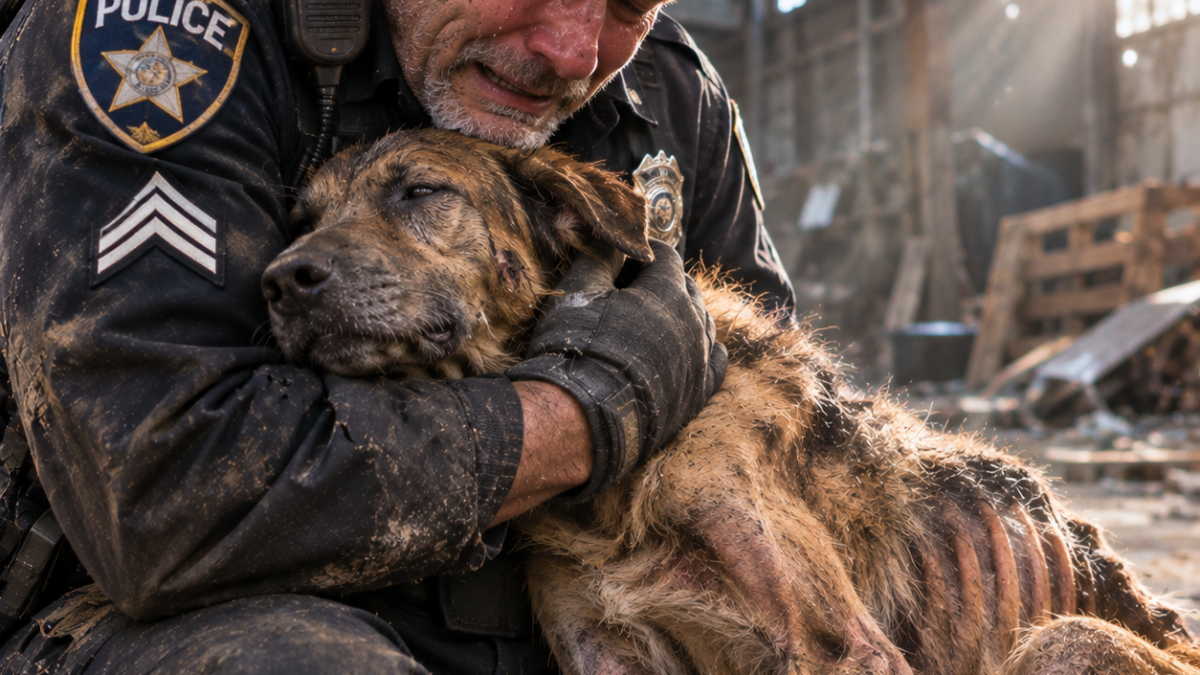
The old warehouse stood near the end of Brown Street, behind a chain-link fence that had been bent open years earlier.
Robert parked beside the curb.
The street was nearly empty.
A few weeds moved in the wind.
Somewhere beyond the buildings, a truck backed toward a loading dock, its warning signal echoing through the industrial district.
The warehouse itself looked abandoned.
Its windows were filmed with dirt.
Several panes were broken.
Rust stained the metal siding.
An old company sign hung crookedly above a loading entrance.
Robert shut off the engine and listened.
Nothing.
He checked the address against the dispatch information.
Then stepped out.
“Seven-Twelve on scene,” he reported.
He walked toward the gate.
A crushed soda can rolled across the pavement.
There was an old shopping cart beside the fence and a pile of soaked cardboard near the loading ramp.
The place smelled of wet concrete, rust, and garbage.
Robert approached the large metal door.
It stood open a few inches.
He stopped.
Listened.
Then heard it.
A small, uneven sound.
Almost too faint to separate from the distant traffic.
He waited.
The sound came again.
A whimper.
Robert had heard animals in distress before.
Dogs frightened by thunderstorms.
Cats trapped beneath porches.
Pets injured along highways.
He recognized the difference between an excited bark and a sound that suggested an animal might be exhausted or hurt.
This was neither loud nor urgent.
It sounded as though the creature making it had almost run out of strength.
Robert moved closer.
“Hello?”
His voice echoed inside.
No response.
“Anybody in there?”
Silence.
Then another soft whimper.
He looked toward the dark opening.
“Hey, buddy.”
The sound stopped.
Robert took a breath.
Then spoke into his radio.
“I’ve located what sounds like an animal inside the warehouse. I’m checking access and requesting assistance if the conditions aren’t safe.”
He examined the immediate entrance.
The building was old, with debris scattered around the floor, but the visible section appeared stable enough for him to investigate cautiously without forcing his way through a dangerous area.
He switched on his flashlight.
Then stepped inside.
He had no reason to believe this would become the most memorable call of his career.
To Robert, it was simply an animal that needed help.
The first thing he noticed was the smell.
Stale water.
Dust.
Old machinery.
Something rotten beneath the shelving.
Robert moved his flashlight slowly across the room.
Broken wooden crates lined one wall.
Rusting equipment stood near the center of the warehouse.
A long conveyor belt sagged beneath years of accumulated debris.
There were patches of shattered glass near the loading entrance.
He moved carefully.
“Hey,” he called. “Where are you?”
The sound came again.
This time, slightly louder.
Robert turned toward the far corner.
There was a couch lying against the wall.
An old one.
Brown upholstery.
One arm torn open.
Stuffing hanging from the cushions.
Something small moved in the darkness beneath it.
Robert stopped.
Then lowered himself carefully.
“Hey, buddy.”
His flashlight revealed a patch of dirty white fur.
At first, he thought it was an old rag.
Then the shape moved.
And he saw an eye.
Only one.
The other was nearly closed.
A medium-sized white dog lay on his side beneath the couch, his body pressed against the concrete.
His fur was tangled.
Dirt clung to his legs.
His ribs stood out beneath his thin coat.
The skin around one eye looked irritated.
His breathing was shallow.
Robert’s throat tightened.
“Oh, boy.”
He set the flashlight where its beam wouldn’t shine directly into the dog’s eyes.
Then spoke softly.
“Hey, sweetheart.”
The animal didn’t bark.
Didn’t growl.
Didn’t attempt to run.
He simply looked toward Robert.
There was something almost unbearable about the expression.
Not because Robert believed he could know the dog’s thoughts.
But because he recognized exhaustion.
The sort of exhaustion that leaves a living creature too weak to protect itself.
Robert moved a little closer.
“It’s okay.”
The dog blinked.
He tried lifting his head.
Couldn’t hold it up.
Then lowered it again.
Robert’s chest tightened.
“How long have you been in here?”
Of course, there was no answer.
He studied the animal’s condition.
The dog was painfully thin.
His hind legs lay awkwardly.
There was no obvious active bleeding, but Robert knew that an animal this weak could have injuries or illnesses he couldn’t identify by looking.
He didn’t pull the dog from beneath the couch.
Didn’t grab his collar.
Didn’t try to force him to stand.
He called dispatch and requested animal-response assistance and veterinary guidance while explaining what he’d found.
Then he crouched beside the couch.
“I’m not going anywhere, buddy.”
The dog watched him.
Robert slowly offered his hand at a comfortable distance.
For a moment, nothing happened.
Then the dog’s nose moved.
He sniffed.
Once.
Twice.
Then, with an effort that made Robert’s eyes fill, he shifted a front paw toward the officer’s hand.
The paw trembled.
The movement was barely an inch.
But it was enough.
Robert placed his fingers gently against the floor beside it.
The dog moved closer.
His paw touched Robert’s hand.
And Robert began crying.
He told me later that he wasn’t prepared for how much that moment affected him.
“I’d seen people do incredible things in twenty-nine years,” he said during our interview. “I’d seen terrible things too. But that little paw just about finished me.”
I asked why.
Robert stared into his coffee.
Then answered:
“Because he didn’t have much strength left. And he used some of it to come toward me.”
I asked Robert what he remembered thinking about retirement while he crouched on that warehouse floor.
He shook his head.
“Nothing.”
“Nothing at all?”
“Mark, I forgot about the ceremony. Forgot about the paperwork. Forgot about everybody waiting at the station.”
He looked toward the interview-room window.
Then continued:
“I was looking at a dog who needed somebody.”
Robert paused.
“And I’d spent twenty-nine years believing that’s what the badge meant.”
I wrote the sentence in my notebook.
He watched me.
“Don’t make me sound better than I am.”
I looked up.
“Why not?”
He smiled faintly.
“Because I wasn’t thinking about a grand act of compassion.”
“What were you thinking?”
He glanced down.
“That I couldn’t leave him lying there.”
The dog tried to rise.
Robert saw the movement and leaned back slightly to give him space.
The animal braced on his front legs.
His body trembled.
For a moment, Robert thought he might stand.
Then his hindquarters failed to support him.
He sank back onto the concrete.
A soft cry escaped his throat.
Robert felt his stomach drop.
“Easy.”
He moved closer.
“Don’t try again, sweetheart.”
The dog looked toward him.
His mouth opened slightly.
He was panting.
Robert noticed how dry and exhausted he seemed.
He didn’t know whether the hind legs were paralyzed.
He didn’t know whether the dog had suffered an injury.
He didn’t know whether disease, starvation, or prolonged weakness was responsible.
He knew only that the animal couldn’t safely walk out.
He needed to be carried or moved with appropriate support.
Robert returned to his radio.
He updated dispatch, confirmed veterinary assistance was being coordinated, and explained that the animal was conscious but severely weakened.
Then he looked at his watch.
His scheduled shift had ended several minutes earlier.
He stared at the display.
For a moment, a strange feeling passed through him.
Twenty-nine years.
10,587 shifts.
And he was technically finished.
He could have called another officer to complete the rescue.
He could have waited outside.
He could have handed the situation over and driven back to the station.
Instead, he looked toward the dog.
The animal’s head rested against the concrete.
His good eye remained open.
Watching.
Robert slipped off his uniform jacket.
He folded it.
Then placed it gently beside the dog.
“Listen, buddy.”
The dog’s ears moved slightly.
“I was supposed to retire today.”
Robert gave a small, humorless laugh.
“Everybody’s probably wondering where I am.”
He leaned closer.
“But I think they can wait a little longer.”
The dog moved his nose toward the jacket.
Sniffed it.
Then settled.
Robert checked the planned route out, took care to support the dog’s body without pulling on his weakened legs, and prepared to carry him once safe transport had been coordinated.
He told me he remembered talking to the animal the entire time.
“Easy.”
“That’s it.”
“I’m right here.”
“Nothing’s going to rush us.”
The dog stiffened briefly when lifted.
A quiet whimper escaped him.
Robert paused.
Adjusted his hold.
Then continued carefully.
The animal’s weight surprised him.
Not because the dog was heavy.
Because he was so light.
Robert could feel bones beneath the matted fur.
The dog should have weighed much more.
His entire body felt fragile.
The officer swallowed.
“Lord, buddy.”
He looked down.
“Who let you get like this?”
The dog rested his head against Robert’s arm.
And the officer started toward the daylight.
Getting out took patience.
Robert kept the dog supported close to his body, moving slowly through the open path.
Broken glass lay near the exit.
An old metal bracket protruded from the floor.
He stepped around debris he had barely noticed on his way in.
The flashlight beam shifted across the warehouse walls.
Outside, the daylight looked impossibly bright.
The dog moved slightly.
Robert stopped.
“Almost there.”
He took another step.
Then another.
At last, he reached the doorway.
Cold air touched his face.
He stepped out beneath the gray sky.
For a moment, the dog lifted his head.
His eyes moved toward the open space.
Toward the sunlight.
Then toward Robert.
The officer stood still.
A thin white dog lay wrapped in his dark uniform jacket, his head resting against the chest of a man who had spent almost three decades wearing that uniform.
Robert looked down.
The animal blinked.
Then rested his chin more comfortably against the jacket.
And Robert felt something he later struggled to describe.
“I can’t tell you he understood I was helping him,” he said.
I looked at him across the table.
“But?”
Robert smiled through tears.
“But he stopped fighting to stay hidden under that couch.”
The arranged animal-response assistance arrived outside, and Robert worked with the responders to move the dog into a suitable vehicle for urgent veterinary care.
He stayed involved through the handoff.
The animal had no visible collar.
No identification tag.
Nothing that told them his name.
Robert kept looking at the small face.
The irritated eye.
The fur tangled around the ears.
The thin legs that couldn’t support him.
“I’ve got you,” he whispered.
Then he followed the transport to the veterinary clinic a few blocks away.
Only after the clinic staff accepted the dog did Robert look at his watch again.
It was forty-seven minutes past the scheduled end of his shift.
The retirement ceremony was already underway.
He stared at the time.
Then looked toward the treatment-room door.
For one second, he imagined Linda waiting at the station.
The cake.
The speeches.
The laughter.
Everybody wondering where he’d gone.
He took out his phone.
And called her.
She answered immediately.
“Robert?”
He closed his eyes.
“Hey, sweetheart.”
“Where are you?”
He hesitated.
Then said:
“I’m at the veterinary clinic.”
There was a pause.
“Why?”
“I found a dog.”
Silence.
Then Linda sighed.
A familiar, affectionate sound.
“Of course you did.”
Robert began laughing.
Then, unexpectedly, crying.
Linda’s voice changed.
“Rob?”
He tried to answer.
Couldn’t.
“Robert, what’s wrong?”
He wiped his eyes.
“Nothing.”
His voice broke.
“There’s just this little white dog.”
Linda waited.
“He’s in pretty bad shape.”
She was quiet for a moment.
Then asked:
“Did you get him help?”
Robert nodded.
“Yes.”
“Then stay until you know he’s okay.”
His throat tightened.
“Everybody’s waiting.”
Linda answered without hesitation.
“They can wait.”
Robert closed his eyes.
Then whispered:
“Thanks.”
She smiled in her voice.
“You’d have done the same thing on your first day.”
Robert looked toward the treatment room.
“Yeah.”
He swallowed.
“I guess I would have.”
Dr. Suzanne Bennett had treated animals in our town for nearly twenty years.
She knew Robert.
Everybody knew Robert.
He’d brought injured strays to her clinic before.
A terrier found beside the highway.
A frightened cat rescued from a shed.
A Labrador whose owner had been taken to the hospital.
But she’d never seen him arrive on the day he was supposed to retire, standing in the waiting room with his eyes red and his uniform jacket missing.
She approached.
“Robert?”
He looked up.
“Hi, Suzanne.”
She glanced toward the treatment room.
“I hear you found a dog.”
He nodded.
“How is he?”
She took a breath.
“Let me tell you what we know so far.”
Robert sat down.
Suzanne pulled a chair beside him.
“The dog is severely underweight and dehydrated. He’s exhausted, and his hind legs are extremely weak.”
Robert swallowed.
“Is he paralyzed?”
“We haven’t found evidence of permanent paralysis in the initial examination, but we need further assessment and supportive care before making conclusions about his mobility.”
Robert looked down.
“He tried to stand.”
“I know.”
“He couldn’t.”
Suzanne nodded.
“His body has been under tremendous strain.”
Robert pressed his hands together.
“Is he going to die?”
The question came out so quietly that Suzanne leaned forward to hear it.
She studied his face.
Then answered carefully.
“He’s very sick, Robert. But he has a chance.”
The officer closed his eyes.
A chance.
After seeing the animal beneath the couch, that was more than he’d expected.
Suzanne continued:
“He’ll need proper nutrition introduced carefully, treatment for dehydration, monitoring for underlying problems, and time to rebuild strength.”
Robert nodded.
“How much time?”
“Recovery could take several weeks, depending on what we find and how he responds.”
“Will he walk again?”
Suzanne looked toward the treatment room.
“We hope so. His legs aren’t showing the signs we’d expect from certain irreversible injuries, but I don’t want to promise more than we know.”
Robert swallowed.
Then whispered:
“Okay.”
Suzanne touched his shoulder.
“You did the right thing bringing him here.”
Robert shook his head.
“Anybody would’ve.”
She looked at him.
“Not everybody would have stopped.”
He lowered his eyes.
For several seconds, neither spoke.
Then Suzanne said:
“There’s something else we need to check.”
Robert looked up.
“What?”
“Identification.”
She smiled gently.
“Let’s see whether somebody’s been missing him.”
The microchip scanner made a small sound.
A technician moved it carefully near the dog’s shoulder.
A number appeared.
She checked it.
Then repeated the scan to confirm the reading.
Suzanne leaned closer.
“Wait.”
The technician looked up.
“There’s a chip.”
Robert stood.
“What?”
Suzanne nodded.
“An implanted microchip.”
He felt his heart jump.
“Does it tell you who owns him?”
“It gives us an identifier we can use to contact the appropriate registry.”
She looked toward the technician.
“Let’s verify the information.”
Robert stood beside the doorway.
For the first time since the warehouse, he felt a different kind of fear.
What if the dog’s owner had abandoned him?
What if the contact details no longer worked?
What if the animal had been missing for years?
What if someone had been waiting for a phone call that would never come?
The technician began checking the registered information.
Suzanne watched the screen.
Then her expression changed.
“Robert.”
He looked up.
“What?”
She turned toward him.
“We may have found his family.”
The officer gripped the back of a chair.
“Where?”
“North side of town.”
She examined the details.
“James and Elizabeth Miller.”
Robert waited.
Suzanne continued:
“The registry lists this dog as missing.”
“How long?”
The technician checked the record.
Then whispered:
“Eight months.”
Robert stared.
Eight months.
He looked toward the treatment room.
The little white dog lay beneath a clean blanket, exhausted but receiving care.
For eight months, he’d been somewhere beyond the reach of the people who loved him.
Robert thought about the warehouse.
The cold concrete.
The broken couch.
The tiny paw reaching toward his hand.
Then he looked at Suzanne.
“Call them.”
His voice broke.
“Please.”
On the north side of town, James Miller was repairing a loose kitchen cupboard when the telephone rang.
He was seventy-eight.
His wife, Elizabeth, was seventy-five.
They had lived in the same small house for more than forty years.
It had a narrow front porch, a modest garden, and a white wooden fence James had repainted so many times that he could no longer remember its original color.
Before the dog disappeared, the house had been full of small routines.
Breakfast at seven.
A short walk at eight.
Lunch near the kitchen window.
And an evening rest beneath the old maple tree.
Their dog had been part of every one of those routines.
Eight months earlier, a violent storm had moved through the neighborhood.
Heavy rain.
Strong wind.
A branch falling near the back fence.
In the confusion, the garden gate had come open.
By the time James noticed, the white dog was gone.
At first, they thought he’d be found before dinner.
Then before midnight.
Then the following morning.
They walked the neighborhood calling his name.
Asked neighbors to check their sheds.
Contacted shelters.
Visited veterinary clinics.
Made posters.
They left a familiar blanket near the porch and kept water available while searching for him.
The first week, James barely slept.
Elizabeth woke whenever she thought she heard scratching at the door.
Every sound outside became a possibility.
Every passing dog made her heart jump.
But the days kept passing.
The weather changed.
Summer gave way to autumn.
Leaves covered the yard.
Then winter arrived.
And still there was no sign of their dog.
Friends began telling them to prepare for the worst.
Not cruelly.
Most people meant well.
But after eight months, hope had become difficult for everyone except James and Elizabeth to understand.
They still kept the old bed beside the fireplace.
They still had his bowl in the kitchen cupboard.
And one of the missing-dog posters remained taped to the front door.
It showed a white dog sitting beside Elizabeth in the garden.
His ears lifted.
His eyes bright.
His tail blurred because he’d been wagging it when James took the photograph.
Beneath the picture were the words:
MISSING DOG — PLEASE CALL IF SEEN.
The corners had curled.
Rain had smudged part of the ink.
James had replaced the poster several times.
Elizabeth could never bring herself to take it down.
She used to say:
“As long as that sign is there, somebody might still recognize him.”
James would nod.
Then look toward the empty bed.
He didn’t always believe they would see the dog again.
But he couldn’t bear being the person who stopped looking.
When the telephone rang that afternoon, Elizabeth was folding towels.
James reached for the receiver.
“Hello?”
A woman introduced herself from Bennett Veterinary Clinic.
She asked whether he was James Miller.
He said yes.
Then she asked whether he’d once registered a white dog with a microchip.
James went completely still.
His hand tightened around the telephone.
“Why?”
The woman answered carefully.
“A white dog was brought to our clinic today. His microchip information is connected to your registration.”
For several seconds, James couldn’t speak.
Elizabeth looked toward him.
“James?”
He raised one hand.
The caller continued:
“We need to confirm identifying details, but we believe we may have located your missing dog.”
James lowered himself into a kitchen chair.
“Eight months,” he whispered.
The woman paused.
Then said:
“I understand.”
He pressed the telephone closer.
“Is he alive?”
“Yes, sir.”
His eyes filled.
“Is he hurt?”
“He’s receiving treatment. He’s very thin and weak, but he’s alive.”
James began crying.
Elizabeth moved toward him.
“James, what is it?”
He covered the receiver.
Looked at his wife.
And managed two words.
“They found him.”
Elizabeth stared.
“What?”
James swallowed.
His voice broke.
“They found our boy.”
The towels slipped from her arms.
For a moment, she didn’t move.
Then she began shaking.
“Where?”
“Bennett’s clinic.”
Elizabeth pressed both hands over her mouth.
James turned back to the telephone.
“Can we come?”
The woman answered:
“Yes. The veterinarian will explain his condition and arrange an appropriate visit.”
James nodded.
Then remembered he needed to speak.
“Thank you.”
His voice cracked.
“Thank you so much.”
He put down the receiver.
Elizabeth was crying.
He tried to stand.
His knees felt weak.
She took his hands.
“James.”
He looked at her.
“Is it really him?”
He shook his head.
“I don’t know yet.”
Then his face crumpled.
“But somebody found a white dog with his chip.”
Elizabeth closed her eyes.
For eight months, she’d imagined this moment.
Now it had arrived, and she was almost too frightened to believe it.
James wrapped his arms around her.
They stood together beside the kitchen table.
Crying.
Then Elizabeth whispered:
“Get the car keys.”
At the clinic, Robert was waiting.
He had expected the couple to be emotional.
He hadn’t expected how difficult it would be to watch them enter.
James wore a brown coat.
Elizabeth carried a folded blue blanket.
Both looked frightened.
Not excited.
Frightened.
As though the world had offered them something too precious to trust.
Suzanne approached.
“Mr. and Mrs. Miller?”
James nodded.
“Yes.”
She introduced herself.
Then Robert.
Elizabeth looked toward the officer.
“Are you the one who found him?”
Robert nodded.
“Yes, ma’am.”
She stared at him.
For a moment, her expression changed.
Then she reached for his hand.
Both of hers trembled.
“Thank you.”
Robert swallowed.
“We’re still making sure he’s okay.”
Elizabeth shook her head.
“Thank you.”
Her voice broke.
“You don’t understand.”
Robert’s eyes filled.
“We thought…”
She couldn’t finish.
James stepped beside her.
He looked toward Robert.
Then said quietly:
“We thought we’d never see him again.”
Robert nodded.
“I know.”
Suzanne led them into a private consultation room.
She explained the dog’s condition.
The severe malnutrition.
The dehydration.
The weakness.
The veterinary care already underway.
And the fact that improvement would take time.
James listened carefully.
Elizabeth held the blue blanket in her lap.
Then asked:
“Can he stand?”
Suzanne answered:
“Not reliably yet.”
Elizabeth’s eyes filled.
“Does he know where he is?”
“He’s very tired, but he’s responsive.”
James swallowed.
“Can he recover?”
Suzanne looked at them both.
“We believe there’s a reasonable possibility of significant improvement with appropriate care, though we need to keep evaluating him.”
Elizabeth nodded.
Then whispered:
“Can we see him?”
Suzanne smiled gently.
“Yes.”
And Robert followed them toward the room where the white dog was resting.
The dog was lying on a thick blanket when Elizabeth entered.
His fur had been cleaned enough for them to see its natural white color beneath the dirt, but it remained tangled in places.
His body looked terribly thin.
One eye was partly closed.
His head rested against the bedding.
A small veterinary monitor stood nearby.
For several seconds, Elizabeth simply stared.
Then her hands began shaking.
“Oh, my baby.”
James stopped beside the doorway.
His face lost all color.
Robert watched the couple.
He had seen many people react to unexpected news during his career.
But something about the silence in that room frightened him.
Elizabeth moved forward slowly.
“Sweetheart?”
The dog opened his better eye.
His ears shifted.
Elizabeth knelt beside the bedding as the veterinary team guided her.
Then she spoke again.
Her voice broke.
“It’s Mama.”
The dog’s head moved.
Barely.
But enough.
Elizabeth began crying.
“Oh, sweetheart.”
She reached toward his cheek.
He sniffed her fingers.
Then, with a small movement that seemed to exhaust him, he pressed his muzzle against her hand.
James covered his mouth.
The dog made a thin sound.
A whimper.
Then his tail moved.
Once.
Slowly.
Against the blanket.
Elizabeth began sobbing.
“It’s him.”
She looked up at James.
“It’s really him.”
Her husband stepped closer.
His hands trembled.
He knelt beside her, slowly and awkwardly, his aging knees protesting the movement.
Then he touched the dog’s shoulder.
“Hey, old boy.”
His voice cracked.
“Did you forget the way home?”
The dog looked toward him.
His tail moved again.
James tried to smile.
Couldn’t.
He rested his forehead against the side of the bedding.
And cried.
For eight months, he’d carried a photograph in his wallet.
For eight months, he’d walked the neighborhood, checked shelters, and listened whenever someone called with a possible sighting.
For eight months, he’d tried to comfort his wife without knowing whether their dog was alive.
Now the little white animal lay before him.
Alive.
Weak.
In need of care.
But alive.
Elizabeth stroked his face.
“Where have you been?”
Of course, the dog couldn’t answer.
He couldn’t tell them where he’d slept.
What he’d eaten.
How he’d survived.
Whether someone had fed him.
Whether he’d been frightened.
Whether the warehouse had sheltered him for days or weeks.
But he could touch Elizabeth’s hand.
He could look toward James.
And he could move his tail.
That was enough to make both of them cry.
Robert had intended to remain near the doorway.
He thought the reunion should belong to the family.
But Elizabeth turned toward him.
“Officer Hol?”
He looked up.
“Yes, ma’am?”
She extended one hand.
Robert approached.
She held his fingers tightly.
“Would you come closer?”
He hesitated.
“I don’t want to interrupt.”
Elizabeth shook her head.
“You brought him here.”
Her voice trembled.
“Please.”
Robert knelt beside them.
The dog lifted his head slightly.
His eye moved toward the familiar uniform.
Robert smiled through tears.
“Hey, buddy.”
The animal made a small sound.
Then moved his nose toward the officer’s hand.
Robert’s face crumpled.
He had spent most of his adult life learning how to remain composed.
He’d delivered difficult news.
Helped frightened children.
Responded to accidents.
Watched families struggle through some of the hardest hours of their lives.
He knew how to speak calmly when everyone else was afraid.
But he couldn’t keep his voice steady.
“Look at you.”
The dog blinked.
Robert touched the uninjured side of his head.
“You’ve got a family, buddy.”
Elizabeth began crying harder.
Robert glanced toward the couple.
“They’ve been looking for you.”
The dog rested his head again.
Robert swallowed.
“Eight months.”
His voice broke.
“Eight whole months.”
James placed his hand on the officer’s shoulder.
“You found him.”
Robert shook his head.
“Somebody heard him.”
James nodded.
“Then you went looking.”
Robert looked down.
For several seconds, he couldn’t speak.
Finally, he whispered:
“Yes, sir.”
James squeezed his shoulder.
“That’s what matters.”
The dog needed continued veterinary care before returning home.
Suzanne explained that his condition required stabilization, careful feeding, and close monitoring.
No one wanted the emotional relief of the reunion to overshadow the seriousness of his health.
James and Elizabeth understood.
They returned to the clinic as often as the staff advised.
They brought a familiar blanket.
Asked questions.
Listened to the treatment instructions.
And began preparing their house for a dog who would not be able to resume his old routines immediately.
Robert visited too.
Not as a police officer.
His last shift had ended.
His badge had been returned.
His retirement was official.
But he kept calling the clinic.
“It’s Robert.”
Suzanne would smile when she heard his voice.
“Hello, Robert.”
“How’s our patient?”
She began giving him updates with the family’s permission.
The first encouraging sign was simple.
The dog ate.
Not a full meal.
Not enough to erase months of poor nutrition.
Just a carefully measured portion appropriate for his condition.
Robert smiled when he heard.
“That’s good.”
Suzanne nodded.
“It is.”
The next day, the dog seemed more alert.
Then he began lifting his head more often.
His irritated eye received treatment.
He drank with assistance as needed.
And slowly, his body began responding to care.
The progress was uneven.
Some days brought clear improvement.
Others reminded everyone how weak he’d become.
But the dog continued fighting in the only way he could.
By eating.
Resting.
Responding.
Allowing people to help him.
And taking one small step toward recovery at a time.
The first time he tried standing with veterinary support, James and Elizabeth were there.
Elizabeth watched with both hands pressed against her chest.
James stood beside her.
The dog braced his front legs.
His hindquarters trembled.
The technician supported him appropriately.
For a moment, he managed to hold part of his weight.
Then his legs weakened.
He was helped back onto the bedding.
Elizabeth began crying.
James looked toward Suzanne.
“Is that bad?”
She shook her head.
“Not necessarily. He’s still recovering from severe weakness. We need to build his strength gradually and watch for any other problem affecting mobility.”
James nodded.
Elizabeth knelt.
Stroked the dog’s head.
“You did so well, sweetheart.”
The dog looked toward her.
His tail moved.
She smiled through tears.
“That’s all right.”
Her voice trembled.
“We have time.”
And those words became the center of his recovery.
We have time.
For eight months, the Millers had been terrified that time was taking their dog farther away.
Now they were learning to measure it differently.
Not by the days he’d been missing.
By the small things he could do again.
Another meal.
Another comfortable night.
Another attempt to stand.
Another morning when he opened his eyes and found familiar people waiting beside him.
After he was medically stable enough, the dog returned home under a carefully planned treatment and rehabilitation arrangement.
Robert offered to drive the Millers.
James insisted he could manage.
Robert smiled.
“I’m retired, Mr. Miller. Apparently I have an unreasonable amount of free time.”
Elizabeth laughed.
It was the first time he’d heard her laugh without immediately crying.
So Robert drove.
The dog traveled safely secured, with suitable bedding to support his weakened body.
Elizabeth sat nearby, speaking softly whenever he stirred.
James followed in their own car.
As they turned onto the Millers’ street, Robert noticed the little houses.
The trimmed hedges.
The old maple trees.
The familiar neighborhood where a dog had vanished eight months earlier.
He slowed near their driveway.
Elizabeth looked toward the front porch.
Then pressed a hand over her mouth.
Robert followed her gaze.
A faded missing-dog poster was still taped beside the door.
PLEASE HELP US FIND OUR DOG.
Below it was a photograph of the same white face.
Healthy.
Bright-eyed.
Looking toward the camera.
Robert swallowed.
The dog stirred.
Elizabeth looked down.
“We’re almost home, sweetheart.”
Her voice broke.
“Almost home.”
James opened the front door.
Elizabeth entered first.
Robert and a trained helper carefully assisted with bringing the dog inside according to the veterinarian’s instructions.
The house smelled of fresh laundry and cinnamon.
A small lamp glowed beside the sofa.
There was a soft bed near the fireplace.
The same bed that had remained empty for eight months.
Elizabeth stood beside it.
Then began crying.
James moved close.
Put an arm around her.
“Liz.”
She shook her head.
“I kept thinking I should put it away.”
He swallowed.
“I know.”
“Every time somebody came over, I wondered whether they thought we were foolish.”
James looked down at the bed.
His eyes filled.
“I couldn’t put it away either.”
Robert stood quietly.
Then looked toward the dog.
The little animal was resting against the supportive bedding prepared for his return.
His head lifted.
He sniffed.
His ears moved.
Something about the room seemed familiar to him.
He looked toward Elizabeth.
Then toward the fireplace.
The dog moved his nose against the blanket.
His tail gave a slow sweep.
Elizabeth knelt nearby.
“That’s your bed, sweetheart.”
She laughed through tears.
“It’s been waiting for you.”
The dog settled.
His head rested comfortably.
And for the first time in eight months, the Millers’ house contained the soft breathing of the animal they had thought they might never see again.
Before Robert left, James stopped him at the front door.
“Officer.”
Robert turned.
“It’s just Robert now.”
James smiled faintly.
“Robert, then.”
He looked toward the living room.
Elizabeth was sitting beside their dog.
Her hand rested against his shoulder.
For a moment, James couldn’t speak.
Then he reached into his wallet.
Robert frowned.
“Mr. Miller—”
James took out some folded bills.
“Please.”
Robert shook his head.
“No, sir.”
“You saved our dog.”
“I helped get him to the veterinarian.”
James held out the money.
“Then let us thank you.”
Robert stepped closer.
“You already have.”
James stared.
Robert looked toward the living room.
“Seeing him home is enough.”
The older man’s face crumpled.
For a moment, he held the money between his fingers.
Then slowly put it away.
He reached for Robert’s hand instead.
Held it tightly.
And whispered:
“We don’t have children, you know.”
Robert looked at him.
James nodded toward the dog.
“That little fellow has been our family for years.”
His voice broke.
“When he disappeared, the house stopped feeling right.”
Robert swallowed.
James continued:
“I watched my wife look out the window every evening.”
Tears ran down his cheeks.
“I didn’t know how to help her.”
He looked toward Robert.
“Now she can sleep without wondering where he is.”
The retired officer’s eyes filled.
He squeezed James’s hand.
Then whispered:
“Take good care of him.”
James nodded.
“For the rest of his life.”
Robert finally returned to the police station after the day’s unexpected events had been handled.
The official farewell gathering had long since passed its scheduled start time.
He expected the building to be mostly empty.
Instead, when he walked through the door, he found his colleagues waiting.
Someone had saved cake.
The coffee had gone cold.
A banner still hung above the conference-room entrance.
HAPPY RETIREMENT, ROBERT!
A younger officer spotted him.
“There he is!”
Several people began applauding.
Robert stopped.
Then laughed.
“Oh, come on.”
His friend Daniel Price approached.
“You were supposed to be back hours ago.”
Robert smiled.
“Got held up.”
Daniel looked at the dirt on his trousers.
Then at his missing uniform jacket, which he’d left for cleaning after its use during the rescue.
“So we heard.”
Robert shook his head.
“You guys didn’t have to wait.”
Daniel looked at him.
“Twenty-nine years, and you think we’re going to leave without saying goodbye?”
Robert’s eyes filled.
He looked toward the room.
The faces he’d known for years.
Officers who’d once been rookies.
Dispatchers who remembered his earliest shifts.
Colleagues who had worked through storms, difficult cases, and long nights beside him.
He swallowed.
Then whispered:
“Thank you.”
The police chief invited him forward.
There were speeches.
Stories.
A few jokes about Robert’s terrible handwriting and his refusal to replace a travel mug with a broken handle.
Then Daniel stood.
He held a small box.
“Before we finish, we have one more thing.”
Robert frowned.
“You already gave me my retirement plaque.”
Daniel smiled.
“This isn’t from the department budget.”
Laughter moved through the room.
He opened the box.
Inside was a small silver pendant in the shape of a dog.
On the back were engraved words:
THE BEST THING I DID ON MY LAST SHIFT.
Robert stared.
His expression changed.
For a moment, he looked confused.
Then he understood.
He put one hand over his mouth.
Daniel’s voice softened.
“We all heard what happened on Brown Street.”
The room became quiet.
Daniel continued:
“You were thirty-two minutes away from being done.”
Robert lowered his eyes.
“And you still took the call.”
His friend paused.
“That little dog had been missing for eight months.”
Someone in the back of the room wiped away tears.
Daniel continued:
“His family got him back today.”
Robert began crying.
Daniel handed him the box.
“And we thought you ought to have something to remember the call that made you late for your own retirement party.”
Robert laughed through tears.
Then shook his head.
“You idiots.”
The room erupted in laughter.
Daniel hugged him.
And Officer Robert Hol, after twenty-nine years of service, stood in the middle of his station holding a tiny silver dog.
He later told me that he had received commendations during his career.
Letters.
Certificates.
Recognition for difficult incidents.
But that little pendant was the one gift he began wearing almost every day.
Not because it proved he was a hero.
Because it reminded him of the white dog beneath the couch.
And of the two people who got to hear his breathing beside their fireplace again.
Six weeks after the rescue, I accompanied Robert to visit the Millers.
By then, I’d heard the story from him, Dr. Bennett, and several of the people involved.
I’d reviewed the timeline.
Confirmed the essential details.
And written more notes than I usually needed for a community feature.
But I wanted to see the dog myself.
Robert drove us to the north side of town on a clear afternoon.
His police uniform was gone.
He wore blue jeans, a gray sweater, and a jacket with a small silver pendant visible near the collar.
I looked toward it.
“You really wear that every day?”
He smiled.
“Most days.”
“Does Linda tease you?”
“Constantly.”
I laughed.
Then asked:
“Do you miss the job?”
Robert considered the question.
“Some parts.”
“What parts?”
“The people.”
He looked toward the road.
“The feeling that I could make somebody’s day a little easier.”
I nodded.
“And the parts you don’t miss?”
He laughed.
“The paperwork.”
I smiled.
“Anything else?”
He was quiet for a moment.
Then said:
“The nights when you go home knowing you couldn’t fix what happened.”
I looked toward him.
He continued:
“You spend enough years responding to emergencies, and you learn that sometimes the best you can do still isn’t enough.”
His hand tightened slightly on the steering wheel.
“That’s hard to carry.”
I nodded.
Robert glanced toward me.
“But that dog…”
His voice softened.
“That dog got another chance.”
Elizabeth opened the front door before we knocked.
“Robert!”
Her face lit up.
She hugged him carefully, then stepped back.
“Come in, come in.”
James appeared from the kitchen.
“Look who’s here!”
He shook Robert’s hand.
Then turned toward me.
“You must be Mark.”
I nodded.
“Thank you for letting me visit.”
James smiled.
“Anyone who’s helping tell this story deserves a cup of coffee.”
I laughed.
Inside, the house felt warm and lived in.
There were books beside the sofa.
A half-finished puzzle on the dining table.
A knitted blanket folded over Elizabeth’s chair.
And near the fireplace stood a large, comfortable dog bed.
The bed wasn’t empty.
A white dog lay on it.
His coat had been brushed.
The worst tangles were gone.
He was still thinner than he should have been, but his ribs were no longer as prominent.
His eyes looked brighter.
His head rested comfortably against the bedding.
Robert stopped.
For a moment, the room went quiet.
Then he whispered:
“Hey, buddy.”
The dog’s head lifted.
His ears moved.
He looked toward Robert.
Then his tail began wagging.
Slowly at first.
Then a little faster.
Robert crouched.
“Look at you.”
The dog moved toward him.
Not quickly.
His hind legs were still regaining strength, and his movements remained careful.
But he stood.
On his own.
Then took several steps across the rug.
Robert’s face crumpled.
“Oh, boy.”
The dog reached him.
Pressed his nose against Robert’s hand.
And wagged his tail.
I watched Robert close his eyes.
His shoulders shook.
For several seconds, he couldn’t speak.
Then he rested one hand gently against the white fur.
“You’re walking.”
His voice broke.
“Look at you walking.”
Elizabeth stood beside the fireplace crying.
James wiped his face.
Robert looked toward them.
“He’s walking.”
Elizabeth nodded.
“He is.”
The dog leaned against Robert.
Then sat carefully beside him.
Robert laughed through tears.
“Okay, buddy.”
He stroked the dog’s head.
“You can rest.”
And the little white dog settled beside the man who had found him beneath the abandoned couch.
Dr. Bennett had been right about one thing.
Recovery took patience.
There had been no miraculous morning when the dog suddenly stood and ran across the garden.
The first weeks involved careful feeding, medical follow-up, and limited activity appropriate for his condition.
His strength returned gradually.
The first time he managed several supported steps, Elizabeth cried.
The first time he walked from his bed to his water bowl without needing help, James called Robert.
The first time he ventured into the garden, both Millers stood nearby watching as though he were performing something extraordinary.
To them, he was.
For eight months, they’d imagined him frightened somewhere in the world.
Then they’d seen him lying in a veterinary clinic, too weak to stand.
Now he could walk into the sunlight.
Sniff the grass.
Look toward the old maple tree.
And return to the house when Elizabeth called.
He wasn’t as fast as he’d once been.
He sometimes needed extra rest.
But he was home.
Alive.
Recovering.
Surrounded by familiar voices.
And that was more than the Millers had dared to imagine six weeks earlier.
During my visit, Elizabeth showed me the missing-dog poster.
She had finally taken it off the front door.
The paper was faded.
The edges curled.
A strip of tape remained stuck across one corner.
She held it carefully.
“People told us to stop putting these up.”
I looked at the photograph.
The dog was healthy.
Bright-eyed.
His coat clean and white.
Elizabeth touched the image.
“I know they meant well.”
I nodded.
She continued:
“But every time I thought about taking the last one down, I imagined somebody seeing him and not knowing where to call.”
Her eyes filled.
“So I left it.”
James moved beside her.
He rested a hand against her shoulder.
“She never stopped looking.”
Elizabeth shook her head.
“Neither did you.”
He smiled sadly.
“We took turns.”
I looked toward the living room.
The dog was resting beside Robert.
His tail moved whenever the retired officer spoke.
Then I asked Elizabeth:
“What do you call him now?”
She smiled.
“We’ve started calling him Hope.”
I looked up.
“Hope?”
She nodded.
“It’s become his little nickname since he came back.”
James laughed softly.
“He still recognizes the name we used before, of course. But Hope seems to fit what happened.”
Elizabeth looked toward her dog.
Then her expression softened.
“For eight months, we kept saying we hoped somebody would find him.”
Her voice trembled.
“Now when I call him Hope, I remember that somebody finally did.”
I swallowed.
Then wrote the name in my notebook.
Hope.
A little white dog.
Eight months missing.
Found beneath an abandoned couch.
And given another chance by an officer who was supposed to be ending his career.
Elizabeth asked whether we’d like to see the garden.
Robert smiled.
“Of course.”
We walked outside.
The afternoon sun rested over the wooden fence.
The maple tree had begun showing the first signs of spring.
A bench stood beneath its branches.
Near the back door was a small sheltered place where the dog liked to rest during warm afternoons.
James opened the door.
Hope followed slowly.
He stopped.
Sniffed the air.
Then stepped onto the grass.
Elizabeth smiled.
“He loves coming out here.”
Robert watched.
Hope walked toward the bench.
Paused beside a patch of flowers.
Then looked back.
His tail moved.
I couldn’t help thinking about the warehouse.
The darkness.
The dirty concrete.
The broken couch.
The animal too weak to stand.
Now the same dog was walking through a garden that smelled of fresh earth and growing things.
I looked toward Robert.
He was watching silently.
Elizabeth approached.
“Robert?”
He turned.
“Yes, ma’am?”
She took his hand.
“I know you’ve probably helped a lot of people in your life.”
He smiled faintly.
“I tried.”
She nodded.
“But I want you to know what you gave us.”
He looked down.
Elizabeth continued:
“For eight months, my husband and I slept badly.”
Her voice shook.
“We listened for noises outside.”
“We checked the road.”
“We called shelters.”
“Sometimes I thought I heard scratching at the door.”
Tears filled her eyes.
“Then I’d open it, and there’d be nothing.”
Robert swallowed.
She looked toward Hope.
“Now I hear him breathing beside the fireplace again.”
Her face crumpled.
“I can walk into the kitchen and find him waiting for breakfast.”
James stood beside her, his eyes wet.
Elizabeth squeezed Robert’s hand.
“You didn’t just bring our dog home.”
She swallowed.
“You brought peace back into this house.”
Robert looked toward Hope.
Then shook his head.
“I just answered a call.”
Elizabeth smiled through tears.
“Sometimes that’s all it takes.”
After that visit, Robert began volunteering at the local animal shelter.
Three mornings a week.
At first, he helped with simple tasks.
Carrying supplies.
Cleaning.
Preparing food.
Walking dogs when staff determined it was appropriate.
Then he began spending time with the animals who struggled around unfamiliar people.
The shy ones.
The older ones.
The dogs who stayed at the back of their kennels while more outgoing animals attracted attention.
Robert told me he recognized something familiar in those quiet corners.
Not because every frightened dog had suffered the same experience as Hope.
He knew better than to assume that.
But because he’d learned how important it could be when someone was willing to wait.
One afternoon, I visited him at the shelter.
He was sitting on a chair near the enclosure of a nervous brown dog.
The animal watched from several feet away.
Robert didn’t reach toward him.
Didn’t call repeatedly.
Didn’t try to make him approach.
He simply sat.
I leaned against the doorway.
“Busy retirement?”
Robert smiled.
“Very.”
I looked toward the dog.
“What are you doing?”
“Giving him company.”
I raised an eyebrow.
“That’s the whole assignment?”
Robert nodded.
“For now.”
The dog shifted slightly.
Then lay down.
Robert smiled.
“See?”
I laughed.
“Looks exhausting.”
“Terribly.”
For a few minutes, we watched the animal rest.
Then Robert said:
“Mark, people sometimes think helping means doing something big.”
I looked toward him.
He continued:
“Sometimes it does.”
He glanced toward the brown dog.
“But sometimes it means showing up again tomorrow.”
I wrote that down too.
When my article was published, people responded from all over our community.
Some shared stories of animals they’d lost.
Others wrote about police officers who had helped their families.
Several people called the shelter to ask about fostering or volunteering.
The story didn’t solve every problem.
It didn’t make the world suddenly kinder.
But it reminded people that small acts of attention can have consequences far beyond the moment in which they happen.
A neighbor heard a faint sound.
Someone called for help.
Dispatch sent the closest available officer.
Robert took the call.
He entered a warehouse.
Found a dog.
Got him veterinary care.
And because the dog had a microchip, a family received the telephone call they’d been waiting eight months to hear.
There was no magic.
No impossible coincidence that required us to ignore the ordinary details.
Just a series of people doing what they could.
And one tired animal whose life changed because those people took him seriously.
Several months later, I returned to James and Elizabeth’s house.
This time, I didn’t bring a notebook.
I brought a printed copy of the article.
Elizabeth made tea.
James cut slices of apple cake.
Hope lay beside the fireplace.
He looked stronger than he had during my previous visit.
His coat had filled out.
He moved more comfortably.
And when Robert arrived a few minutes later, Hope stood and walked toward him, tail wagging.
The officer crouched.
“Hey, old friend.”
The dog pressed his head into Robert’s hand.
Then looked toward Elizabeth.
She smiled.
“Go on, sweetheart.”
Hope returned to his bed.
Robert stood.
James laughed.
“He’s got a busy schedule.”
Robert smiled.
“Eating and sleeping?”
“Exactly.”
Elizabeth carried the tea into the living room.
We sat together for nearly two hours.
Not discussing the warehouse.
Not talking about the eight missing months.
Just ordinary things.
The weather.
Robert’s volunteer work.
A new garden bed James wanted to build.
The difficulty of keeping squirrels away from Elizabeth’s flowers.
At one point, Hope lifted his head and looked toward the kitchen.
Elizabeth laughed.
“Dinner isn’t ready yet.”
The dog wagged his tail.
Then settled again.
I looked around.
A small house.
An elderly couple.
A retired police officer.
A little white dog.
Nothing about the scene would have seemed extraordinary to someone passing outside.
But I knew what the room had looked like when the dog was missing.
I knew about the faded poster.
The empty bed.
The evenings spent watching the road.
And I understood that the most beautiful part of the rescue wasn’t the moment Robert carried Hope into the sunlight.
It was this.
The ordinary afternoon afterward.
The chance for a dog to sleep beside the people who loved him.
And for those people to stop wondering whether he was suffering somewhere beyond their reach.
Before I left, I asked Robert one final question.
“Do you think your career would’ve felt complete without that last call?”
He looked surprised.
Then laughed softly.
“Mark, I retired because I’d done twenty-nine years.”
“I know.”
“I didn’t need a final rescue to make those years matter.”
I nodded.
He looked toward Hope.
The dog was sleeping.
His white fur glowed softly in the afternoon light.
Robert continued:
“But I’m glad I didn’t treat the end of my shift as the end of my responsibility.”
I thought about that.
He smiled.
“For thirty-two minutes, I was still the closest officer.”
Then his expression softened.
“And somebody still needed help.”
I closed my notebook.
There was nothing else I needed to ask.
I still think about Robert Hol whenever I pass an old building or hear a dog barking somewhere beyond a fence.
Not because every sound means an animal is in danger.
Not because every rescue ends happily.
I’ve written enough difficult stories to know it doesn’t.
But because Robert’s last patrol reminded me how easily a life can become invisible.
The dog in that warehouse had been missing for eight months.
His family had been searching.
His photograph had hung on doors and telephone poles.
Yet there he was, hidden beneath an abandoned couch, too weak to stand.
People passed the building.
Cars drove along Brown Street.
Workers came and went from neighboring businesses.
And somewhere inside, a dog lay waiting for someone to notice.
Eventually, someone did.
A neighbor heard him.
Dispatch responded.
And a fifty-two-year-old officer with thirty-two minutes left in a twenty-nine-year career decided that his last call was still worth taking.
I wonder sometimes what Robert expected retirement to feel like.
Freedom, perhaps.
Relief.
A little sadness at leaving the station.
More mornings with Linda.
More time to travel.
He received those things.
But he also received something he hadn’t planned on.
A new purpose.
Three days a week at an animal shelter.
A silver dog pendant.
And the friendship of two elderly people who had almost given up believing their missing companion would come home.
As for Hope, he still has ordinary days.
Meals.
Naps.
Gentle walks.
Warm places beside the fireplace.
And evenings in the garden.
Elizabeth sits on the bench beneath the maple tree.
Hope rests his head against her knee.
Sometimes James comes through the back door and calls:
“Dinner’s ready!”
Elizabeth smiles.
Then looks down at the dog.
“Come on, sweetheart.”
Hope stands.
Slowly, perhaps.
But with the steady confidence of an animal who knows where he belongs.
And together, they walk inside.
The door closes.
The house grows warm.
And the little white dog who once lay forgotten beneath an abandoned couch settles into the home that never stopped waiting for him.
Robert tells people that the best part of police work isn’t always the dramatic moments.
Sometimes it is simply getting someone safely home.
I think he’s right.
Because the most important thing that happened during his last patrol wasn’t that he worked forty-seven minutes beyond the end of his shift.
It wasn’t the applause at his retirement ceremony.
It wasn’t the little silver pendant his colleagues gave him.
It was the moment a severely weakened dog lifted his head, saw a stranger kneeling beside him, and found the strength to place one trembling paw against an open hand.
Robert accepted that small act of trust.
And because he did, two elderly people eventually heard the sound they had missed for eight months.
Their dog’s footsteps on the floor.
I think about that whenever I remember Robert’s story.
Twenty-nine years of service.
10,587 shifts.
Thirty-two minutes left.
One final call.
One frightened animal in the dark.
And a decision to answer.
Robert Hol didn’t know he was about to change a family’s life when he turned his patrol car toward Brown Street. He only knew that something inside the warehouse was crying, and he still had the chance to help.
That is what I hope readers remember.
Sometimes the most meaningful thing we do isn’t the task we spent our whole lives preparing for—it’s the one last act of kindness we choose when we think our work is already finished.








