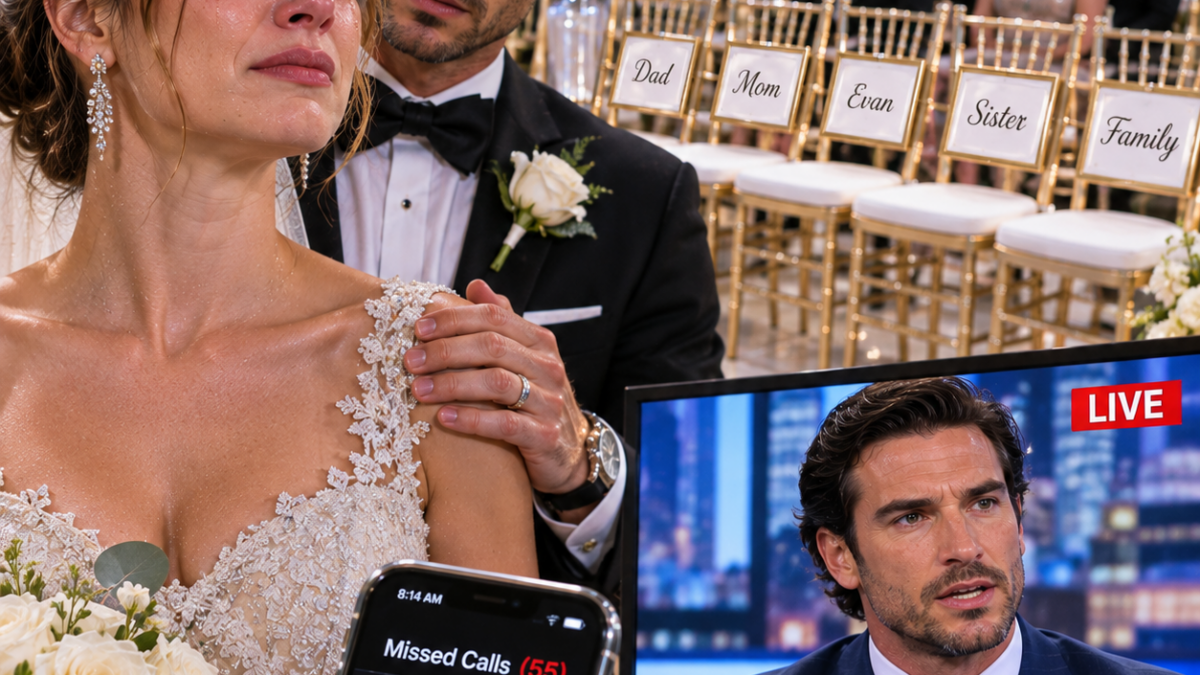
FULL STORY:“YOUR BROTHER’S GRADUATION MATTERS MORE THAN YOUR WEDDING!” My Family Left 10 Front-Row Seats Empty—The Next Morning My Husband Said One Sentence on Live TV and Dad Called 55 Times
FULL STORY CONTINUATION
Dad sighed as though I had misunderstood something obvious.
“Traffic into Chicago is a disaster.”
“Dad, my ceremony is at one.”
“We’re staying in Milwaukee.”
I stared at myself in the mirror.
White dress.
Pinned curls.
Lena’s hands frozen beside my head.
“Why are you in Milwaukee?”
“Evan’s commencement.”
I already knew Evan’s master’s ceremony was that weekend.
It was Saturday morning.
My wedding was Friday afternoon.
For six months, the plan had been simple.
My parents would attend my wedding Friday.
Drive to Milwaukee early Saturday.
Graduation at ten.
Everyone wins.
Apparently that plan had changed.
“His graduation is tomorrow.”
“There’s a department reception tonight.”
My mouth opened.
“Dad.”
“He only gets a master’s degree once.”
“I only get married once.”
“That is unnecessarily dramatic.”
I actually stopped breathing for a second.
Then Mom’s voice appeared in the background.
“Mara, sweetheart, don’t make a scene.”
I looked at Lena.
Her face had changed from confusion to fury.
Mom continued:
“We’ll celebrate you next month.”
“Mom.”
“Have a beautiful ceremony.”
“Mom, are you coming?”
Silence.
Then:
“Your father thinks the roads are too unpredictable.”
“What do you think?”
Another silence.
That answered me.
Dad came back on.
“Your brother worked very hard.”
“And I didn’t?”
“That isn’t what I said.”
“No.”
My voice sounded strangely calm.
“You said his graduation matters more than my wedding.”
“I’m not going to argue semantics.”
“Those were your words.”
“Mara.”
“What?”
“You’ve always needed everything to become a competition with Evan.”
I stared at the phone.
Then something inside me stopped reaching.
Not broke.
Stopped.
There is a difference.
“Okay.”
Dad paused.
“What?”
“I said okay.”
“Good. We’ll take you and Daniel to dinner next month.”
“No.”
“What?”
“I have to finish getting ready.”
I ended the call.
Lena did not move for several seconds.
Then:
“Do you want to stop?”
I looked at my reflection.
“Stop what?”
“The wedding.”
“No.”
“Do you want me to call Daniel?”
“No.”
“Do you want to scream?”
“Maybe later.”
She touched my shoulder.
“Mara.”
“Finish the hair.”
My voice sounded hollow.
“Please.”
So she did.
I did not tell Daniel before the ceremony.
That decision has been criticized by strangers online ever since.
Why didn’t she tell him?
Why did she walk down the aisle alone?
Why didn’t someone fill the seats?
Because there are moments when humiliation feels manageable only if nobody touches it.
I had spent my whole life becoming functional before becoming emotional.
Wedding morning was no different.
At twelve forty-five, the coordinator asked:
“Your family?”
“Not coming.”
Her face changed.
“Do you want us to move guests forward?”
I looked through the chapel doors.
Ten reserved seats.
White ribbons.
Programs.
Empty.
“No.”
“Are you sure?”
“Yes.”
I wanted those seats exactly where they were.
Not as punishment.
Because moving strangers into them would have felt like pretending.
Lena walked me halfway down the aisle.
Then I finished alone.
Daniel saw the empty front row immediately.
His expression changed.
Just once.
Then he looked at me.
Only me.
When I reached him, he whispered:
“What happened?”
“Later.”
He squeezed my hand.
No questions.
The ceremony continued.
We said our vows.
I did not cry until Daniel said:
“I choose you in public, in private, and in every room where you are not present to defend yourself.”
That line had been written weeks earlier.
At the time, it sounded romantic.
On that day, it nearly destroyed me.
My family did not call during the reception.
Not once.
Rachel sent:
Hope it was beautiful. ❤️
I stared at it.
Then:
Did you know?
No answer for nineteen minutes.
Finally:
About what?
That told me yes.
People who truly do not know usually ask:
What happened?
Rachel asked:
About what?
I put my phone away.
Daniel and I danced.
Ate cake.
Laughed with friends.
His mother cried during her toast.
His father welcomed me into the family without mentioning anyone absent.
Not one guest asked publicly why my family was missing.
That was kindness.
Daniel waited until we reached the hotel suite.
Then he loosened his tie.
Sat beside me.
“Tell me.”
So I did.
Not every childhood detail.
Just that morning.
Dad’s words.
Mom’s decision.
Rachel’s silence.
The ten empty chairs.
Daniel did not interrupt.
When I finished, he said:
“Evan’s ceremony is tomorrow?”
“Yes.”
“And they chose a reception tonight over your wedding?”
“Yes.”
Daniel looked toward the window.
Chicago lights below.
Then:
“Did Evan know?”
“I don’t know.”
“Do you want to ask?”
“Not tonight.”
“Okay.”
That was it.
No:
I’m going to destroy them.
No:
How dare they.
No billionaire revenge speech.
He simply wrapped his arms around me.
And let me cry.
The next morning, Daniel had a scheduled live interview.
Northline was announcing a major cross-platform investigative initiative.
The project had taken eighteen months.
Newsrooms in six cities.
Digital investigations.
Documentary partnerships.
Local accountability reporting.
And me.
I had designed much of the editorial framework as an independent consultant before Daniel and I became engaged.
That was one reason we had kept our relationship quiet professionally.
I did not want anyone claiming I had been handed influence through romance.
Every contract predated our engagement.
Every deliverable documented.
The initiative was not publicly branded around me.
Daniel wanted the work to speak first.
At 8:30, he went to the studio.
I remained at the hotel drinking coffee.
Around 9:10, the morning host congratulated him.
“Before we get to the launch, I understand congratulations are also in order. You got married yesterday?”
Daniel smiled.
“Yes.”
“To a journalist?”
“To Mara Vance.”
The host brightened.
“That Mara Vance?”
Daniel laughed.
“Yes.”
Then came the harmless fairy-tale setup.
“Big media executive marries brilliant journalist. Sounds like the perfect newsroom love story.”
Daniel’s smile disappeared slightly.
The host continued:
“Family celebration?”
And that was the moment Daniel made the decision I would later argue with him about.
He looked directly into the camera.
“My wife’s parents chose her brother’s graduation over her wedding.”
The host froze.
Daniel continued, voice calm.
“They left the entire family row empty yesterday because they decided her ceremony could be celebrated later.”
Nobody spoke.
Then:
“They also did not know Mara is the editorial architect behind much of the initiative we’re launching today.”
The host blinked.
Daniel looked at the camera.
“Yesterday, they walked out on the most formidable woman in media.”
Silence.
Then the host whispered:
“Wow.”
The clip hit social media before the interview ended.
I watched it from the hotel bed.
Coffee halfway to my mouth.
“Daniel.”
He was still live.
Could not hear me.
By the time he returned, my phone showed fifty-four missed calls.
Dad.
Mom.
Rachel.
Aunt Karen.
Two cousins.
Three unknown Milwaukee numbers.
Evan.
Then Dad again.
Call fifty-five.
I let it ring.
Daniel walked in still wearing his charcoal suit.
“You shouldn’t have said it.”
He closed the door.
“The host tried to turn our marriage into a fairy tale to soften a segment about newsroom layoffs.”
“That doesn’t mean you had to tell the country my parents skipped the wedding.”
“No.”
He removed his cuff links.
“I said it because I wasn’t going to let anyone use our marriage as a glossy prop while you were sitting upstairs pretending yesterday didn’t hurt.”
I stared at him.
“It’s everywhere.”
“I know.”
I held up my phone.
“Mom’s gardening Instagram has an empty-chair emoji under every photo.”
Daniel winced.
“That part I regret.”
“You think?”
“Yes.”
He sat beside me.
“I won’t say anything else without you.”
I looked at him.
“That would’ve been useful ten minutes ago.”
“Fair.”
The phone rang.
Rachel.
I answered.
“Mara, thank God.”
Her voice shook.
In the background, I heard Daniel’s television interview replaying.
“Tell Daniel to retract it.”
“Retract what?”
“Dad is losing his mind.”
“Did he attend my wedding?”
“Mara.”
“Did you?”
“You know how Dad is.”
That sentence.
The family version of surrender.
On Friday, Rachel explained, Dad had decided the drive south was “too risky.”
Mom supposedly argued.
Briefly.
Then everybody followed him to Milwaukee.
I asked:
“Did you know Friday night?”
Rachel hesitated.
That was enough.
“You were texting me about peonies.”
“Mom said maybe they’d take two cars.”
“But you knew they were considering abandoning the wedding.”
“I didn’t want you panicking.”
“You watched them pack.”
“Mara—”
“And said nothing.”
“Reporters are outside the house.”
“That isn’t my fault.”
“Evan has memes all over campus.”
“I didn’t make them.”
“Daniel has a billion-dollar PR department. Just have them say it was a misunderstanding.”
“It wasn’t.”
Silence.
“It was a choice.”
Rachel started crying.
“If you don’t fix this, Dad said he’ll—”
I hung up.
Not dramatically.
I simply realized I did not need to hear the threat secondhand.
Dad could make it himself.
He did.
Voicemail.
A transcription appeared.
Mara. This circus ends today. Your mother is in tears, and your brother’s reputation is being dragged through the gutter on his first week in engineering. Call your husband off this smear campaign immediately, or you and I will have a conversation you’ll regret for the rest of your life.
Daniel read it.
His jaw hardened.
“I can have legal send a no-contact warning.”
“No.”
“Mara.”
“No.”
“That’s a threat.”
“It’s Dad being Dad.”
Daniel looked at me.
“You know that sentence isn’t comforting, right?”
I almost smiled.
Then an unknown number texted.
Campus ID screenshot.
Mara, it’s Evan. I swear on my life Dad told me you moved the reception to next weekend so I could have my day. I didn’t know until I saw the news. Please pick up.
I read it three times.
Daniel read over my shoulder.
“That changes something.”
“Maybe.”
“Do you believe him?”
“I don’t know.”
By noon, we left through the hotel service entrance and returned to our Lincoln Park brownstone.
The media situation had become absurd.
The phrase GOLDEN BOY DILEMMA trended after an online columnist published an essay about family favoritism.
I hated it.
Not because favoritism wasn’t real.
Because strangers were turning my brother into a symbol before anyone knew whether he had knowingly participated.
Our communications team wanted a statement.
I dictated one.
Short.
Mara Vance has worked independently in journalism and media strategy for more than a decade. Her consulting work related to Northline’s investigative initiative began prior to her engagement and was contracted through standard independent review. Neither Mara nor Daniel will comment further on private family matters.
That was it.
No attack.
No:
My parents are narcissists.
No:
My brother is spoiled.
Nothing.
Daniel asked:
“Certain?”
“Yes.”
“To your father, silence will sound like guilt.”
“He wants an arena.”
I looked at him.
“If I walk into it, he becomes the embattled patriarch defending his family against the billionaire son-in-law.”
Daniel nodded.
“Good point.”
At three, my phone rang.
Evanston number.
Not Milwaukee.
Evan.
“I’m at that Scandinavian bakery on Central.”
His voice sounded exhausted.
“Nobody knows me here.”
“How did you get to Evanston?”
“Train.”
“Why?”
“Because Dad took my phone after I tried calling you from Milwaukee.”
My stomach tightened.
“What?”
“Please, Mara.”
He swallowed.
“Twenty minutes.”
I looked at Daniel.
He didn’t tell me not to go.
“Public place.”
“Yes.”
“Alone.”
“I’m already alone.”
“I’ll be there in thirty.”
The bakery smelled like cardamom and coffee.
Evan sat in the back.
Baseball cap low.
No family.
No father.
For the first time in years, he looked younger than me.
Not golden.
Not protected.
Just twenty-seven and terrified.
I sat.
“Talk.”
He immediately slid his phone across the table.
Screenshots.
Messages from Dad.
Friday afternoon.
Mara moved the reception celebration to next Saturday. Ceremony is tiny and private. She said not to worry about missing it. Focus on graduation.
My chest tightened.
Another:
Do not call Mara tonight. She’s overwhelmed and doesn’t want family drama before the ceremony.
Another sent to Mom and Rachel:
Mara knows we’re staying for Evan’s department reception. She understands.
I stared.
“Why didn’t you question this?”
Evan looked sick.
“I did.”
He showed me his response.
I thought her wedding was Friday?
Dad:
Ceremony yes. Main family celebration rescheduled. Mara insisted.
I looked at him.
“And you believed him.”
“Yes.”
“Why?”
Evan’s eyes filled.
“Because I’m an idiot?”
“That isn’t an answer.”
“Because Dad has spent my whole life telling me you don’t care about family events.”
My stomach dropped.
“What?”
Evan stared at the table.
“He says you think you’re above us.”
I almost laughed.
“He told me you skipped my undergraduate graduation because you had a deadline.”
“I was in the hospital.”
Evan looked up.
“What?”
“Appendicitis.”
His face emptied.
“Dad said you were working.”
“I sent you flowers from a hospital bed.”
“I thought you were just…”
He stopped.
“Jesus.”
I sat back.
Then:
“What else?”
Evan hesitated.
“Remember my high-school championship?”
“I remember missing my fellowship dinner for it because Dad insisted.”
“He told me you chose the game because you knew how important it was to me.”
I laughed bitterly.
“He threatened not to attend my fellowship ceremony if I didn’t come.”
Evan went pale.
We sat in silence.
Two siblings comparing childhood for the first time without our father interpreting it.
It was ugly.
Dad had not merely favored Evan.
He had used each of us differently.
He told me family meant sacrificing for Evan.
He told Evan my sacrifices proved how naturally I wanted to support him.
When I eventually became resentful, Dad told Evan I was jealous.
When Evan expected support, Dad told me he was entitled.
Then stood between us translating every misunderstanding.
That did not erase the favoritism.
Evan received more.
Attention.
Money.
Celebrations.
Protection.
But he had also been fed a version of me designed to make that imbalance feel normal.
I asked:
“Did you know about the wedding seats?”
“No.”
“Rachel?”
“She knew we were staying.”
“Mom?”
“Yes.”
That hurt.
Evan rubbed his hands over his face.
“I should’ve called you directly.”
“Yes.”
“I should’ve checked.”
“Yes.”
“I’m sorry.”
I believed him.
Not because he cried.
Because he did not explain the apology away.
Then he said:
“I’m not going back to Dad’s house tonight.”
“Why?”
“When I confronted him this morning, he said Daniel had manipulated you against the family.”
“That sounds like Dad.”
“I told him the texts prove he lied.”
“What did he say?”
Evan laughed once.
“He said he was protecting both of us.”
Of course.
Evan asked if he could release the screenshots publicly.
“No.”
He stared.
“Why?”
“Because then this becomes bigger.”
“But people think I knowingly stole your wedding day.”
“I know.”
“So let me prove—”
“You don’t owe the internet your private messages to Dad.”
His face tightened.
“Mara.”
“We issue one clarification.”
“From me?”
“Yes.”
“You write it.”
He looked surprised.
“No.”
“Why?”
“Because I am not going to become Dad in reverse.”
He needed to speak for himself.
Evan nodded.
That evening, he posted:
I learned only after my sister’s wedding that our father had misrepresented her plans to me. I believed she had moved the family reception and knew we would remain in Wisconsin for my graduation events. Mara deserved better. I should have contacted her directly instead of relying on someone else to speak for her. I am sorry. Please stop targeting my school and employer.
No excuses.
No attack on Dad.
The tone changed online almost immediately.
Not completely.
The internet never gives up a villain once it has made merchandise.
But enough.
Dad called seventeen times that evening.
I answered the eighteenth.
“Mara.”
“What?”
“You met Evan behind my back.”
“He is twenty-seven.”
“He is my son.”
“He is also an adult.”
“You are turning the children against me.”
I closed my eyes.
“There are no children in this conversation.”
“Don’t get clever.”
“Dad, did you tell Evan I moved the reception?”
Silence.
“Mara.”
“Yes or no?”
“I simplified the situation.”
I almost laughed.
“Did you tell Mom and Rachel I understood you were skipping my wedding?”
“I knew you’d become emotional.”
“So you lied.”
“I managed a conflict.”
“No.”
My voice stayed calm.
“You created one.”
He raised his voice.
“You have always resented your brother.”
“I resent being expected to disappear for him.”
“That’s the same thing.”
“No.”
“You made his graduation into a national joke.”
“You told me his graduation was more important than my wedding.”
“I was frustrated!”
“You hung up on me.”
“Because you were being difficult.”
There it was.
Difficult.
Dad’s favorite word when I expected reciprocity.
I looked across the room.
Daniel was reading but clearly listening.
I said:
“Did Mom know you lied to Evan?”
Dad became quiet.
That answered me too.
“Dad.”
“I am not discussing your mother.”
“Of course.”
“You need to tell Daniel to retract his comments.”
“No.”
“Then you are choosing your husband over your family.”
I almost smiled.
“Interesting.”
“What?”
“That is exactly what you accused me of not doing for eight years.”
Silence.
“Goodbye, Dad.”
“Mara, don’t you dare—”
I ended the call.
My hand shook afterward.
Daniel closed his book.
“You okay?”
“No.”
“Want me to say something?”
“No.”
“Good.”
I looked at him.
He smiled.
“I’m learning.”
Mom called the next morning.
I did not answer.
Then Rachel.
Then Mom again.
Finally, I answered Mom.
She was crying.
Not loud.
Controlled.
“Mara.”
“Hi, Mom.”
“I am so sorry.”
I said nothing.
“Your father told us you knew.”
“Rachel suspected I didn’t.”
“I know.”
“Did you?”
Mom hesitated.
“I wanted to believe him.”
That was not the same as no.
“Mom.”
“I knew it didn’t sound like you.”
“Then why didn’t you call?”
“Your father was already furious.”
There it was.
Again.
Dad’s anger as weather.
Everyone planned around it.
Nobody asked whether the house should have been built differently.
“He told me if we split up and some of us went to Chicago, we were making Evan feel second-best.”
My chest tightened.
“And what did making me feel?”
She started crying harder.
“I didn’t think.”
“No.”
“You did.”
I sat.
“You weighed the consequences.”
“Dad angry.”
“Evan disappointed.”
“Me hurt.”
“And you chose the hurt you thought I would absorb quietly.”
Mom whispered:
“Yes.”
That honesty hurt more than any excuse.
But it was the first useful thing she said.
Rachel came to see me two days later.
No invitation.
She stood on the brownstone steps holding a paper bag from the bakery.
“Peace pastry.”
I almost laughed.
“That’s not a thing.”
“It is now.”
I let her in.
She cried before sitting.
“I knew.”
“I know.”
“Friday night.”
“I know.”
“Dad said maybe he’d drive separately in the morning.”
“I know.”
“I told myself if I warned you, you would call him and everything would explode.”
“So instead you let me walk past ten empty chairs.”
Her face folded.
“Yes.”
“Why?”
“Because you always recover.”
That sentence stopped me.
Rachel continued.
“You’re Mara.”
“You fix things.”
“You have Daniel.”
“You have a career.”
“You’re strong.”
“And Evan…”
She stopped.
“What?”
“He needs Dad more.”
I stared.
There it was.
The adult version of childhood favoritism.
You can hurt Mara.
She survives.
Protect the person who seems needier.
I said:
“Being capable is not consent to be neglected.”
Rachel cried.
“I know that now.”
“Do you?”
“Yes.”
I believed she was beginning to.
Not finished.
Beginning.
For a week, Dad escalated.
Not publicly.
Privately.
Emails.
Texts.
Voicemails.
He accused Daniel of orchestrating a smear campaign.
Threatened to sue Northline for reputational harm.
Nathan, Daniel’s counsel, reviewed everything.
“Does he have a claim?”
“No.”
“Would he file anyway?”
“Possibly.”
Daniel looked at me.
“Your call.”
That mattered.
My call.
Not his.
I said:
“No threats back.”
Dad’s attorney sent one letter.
Northline replied with the video transcript.
Dad’s own text.
The public statement clarifying Evan’s misunderstanding.
And one sentence:
Northline Media Group will not make further public comment regarding private family matters.
That ended the legal theater.
Dad had wanted a battle large enough to make himself the victim.
We gave him silence.
Silence starved the performance.
Then something unexpected happened.
My professional life became part of the story.
Not because of Dad.
Because Daniel had called me the mastermind behind the initiative.
Reporters wanted proof.
Was Mara Vance secretly handed a multimillion-dollar media project by her billionaire husband?
Had Northline concealed nepotism?
That criticism was fair enough to answer.
So we released the timeline.
My consulting agreement.
Signed fourteen months before Daniel proposed.
Independent committee approval.
Deliverables.
External review.
Invoices.
Editorial memos.
No inflated payment.
No hidden equity.
No retroactive title.
The initiative had been built by a team.
I had been one important part.
That transparency changed the conversation.
An industry journal ran a headline:
THE WOMAN BEHIND NORTHLINE’S LOCAL INVESTIGATIVE RESET WAS ALREADY THERE BEFORE THE RING.
I sent it to Daniel.
He replied:
Less romantic, much better.
Exactly.
Dad hated that too.
Because suddenly the world knew something he had never bothered to learn.
What I actually did.
For years, he told relatives I “worked in media.”
As though I wrote captions.
At Thanksgiving once, he introduced Evan as:
“My engineer.”
Then me as:
“Mara does journalism.”
He did not know the name of my fellowship.
The investigation I won an award for.
The initiative I designed.
Not because those things were secret.
Because he had never asked.
Two weeks after the wedding, Aunt Karen called.
“I had no idea.”
“About what?”
“Your work.”
I laughed.
“The internet did?”
“No.”
“Then why didn’t you?”
Silence.
Families often confuse familiarity with knowledge.
They assume because they have known you longest, they know you best.
Sometimes they stopped looking years ago.
Evan visited Chicago.
Alone.
Daniel made dinner.
Nothing fancy.
Pasta.
Wine.
For the first hour, Evan looked like he expected Daniel to interrogate him.
Daniel asked about engineering.
That relaxed him.
After dinner, Evan apologized to Daniel.
“For what?”
“For my family missing your wedding.”
Daniel looked at me.
Then Evan.
“You don’t owe me that apology.”
“But—”
“Mara does.”
I could have kissed him again.
Evan turned toward me.
“I’m sorry.”
“I know.”
“I mean it.”
“I know.”
He looked frustrated.
“You don’t have to make this easy.”
“I’m not.”
He frowned.
“What does that mean?”
“It means I believe you didn’t know.”
He exhaled.
“But?”
“But you benefited from the family dynamic for years.”
He looked down.
“Yes.”
“You let Dad frame everything around you.”
“Yes.”
“You didn’t ask why my things kept moving.”
“No.”
That honesty mattered.
“I’m sorry for that too.”
I nodded.
“Thank you.”
We didn’t hug.
Not then.
But we started speaking directly afterward.
That was new.
No Dad as translator.
No Mom.
No Rachel.
Just brother and sister.
Evan told me something later that evening.
He had declined a job offer Dad arranged.
“Why?”
“Because I don’t know if I earned it.”
My chest tightened.
“That’s a bad reason to decline.”
He looked at me.
“What?”
“Connections don’t automatically invalidate competence.”
“You of all people are telling me that?”
“Yes.”
“Why?”
“Because Dad’s favoritism is his responsibility.”
I leaned forward.
“You don’t have to punish yourself to prove you’re not his favorite.”
Evan stared.
Then laughed weakly.
“Therapy?”
“Journalism.”
“Same thing?”
“No.”
He accepted another role months later.
Without Dad’s involvement.
Good salary.
No family introduction.
He sounded proud when he told me.
I was proud too.
That did not erase childhood.
It gave adulthood a chance.
Mom and Dad’s marriage changed after the wedding.
I did not cause it.
The empty chairs exposed something that already existed.
Mom had spent decades protecting Dad’s temper.
Rachel had.
Evan had.
Me too.
When the family stopped absorbing it automatically, Dad became furious.
Then confused.
Then lonely.
Mom began therapy.
That shocked all of us.
Dad called therapy:
“Professional complaining.”
Mom went anyway.
Six months later, she moved into the guest room.
Not divorce.
Boundary.
Dad suddenly discovered that anger did not automatically make everyone rearrange themselves.
He did not like the lesson.
He came to Chicago seven months after the wedding.
Unannounced.
Daniel was at work.
I was home.
Dad stood on the doorstep.
Older somehow.
“Can I come in?”
I almost said no.
Then:
“Ten minutes.”
He entered.
No hug.
We sat in the study.
He looked around.
“You’ve done well.”
I laughed.
“What?”
“You’ve never said that.”
His face changed.
“I’ve said I’m proud of you.”
“When?”
He opened his mouth.
Closed it.
Exactly.
Then he looked toward the floor.
“I was wrong about the wedding.”
That was not enough.
But it was a start.
“What were you wrong about?”
He bristled.
Even then, specificity felt like humiliation to him.
“I should have attended.”
“Why didn’t you?”
“Because Evan’s graduation—”
“No.”
I stopped him.
“You could have done both.”
He knew.
“I didn’t want him feeling second to you.”
There it was.
“Why?”
Dad rubbed his hands together.
“Because you never needed me the way he did.”
I stared.
“Dad.”
“You were always independent.”
“I learned to be.”
“You never asked for much.”
“Because when I did, you were busy with Evan.”
He looked up.
The sentence landed.
I continued.
“You keep using my independence as evidence that neglect didn’t hurt me.”
His face tightened.
“I didn’t neglect you.”
“You skipped my wedding.”
Silence.
“After telling me directly that his graduation mattered more.”
“I was angry.”
“At what?”
“You.”
“Why?”
“Because you wouldn’t understand.”
“Try me.”
He stood.
Then sat again.
Finally:
“I thought Daniel changed the hierarchy.”
I blinked.
“What hierarchy?”
“He was wealthy.”
“Dad.”
“I knew he was more successful than I was.”
There it was.
Not Evan.
Not traffic.
Not graduation.
Not fully.
Dad had learned before the wedding that Daniel was Northline’s owner.
Someone had told him two weeks earlier.
He had not mentioned it.
Suddenly my marriage to Daniel threatened something deeper.
Dad had spent his life as the accomplished man in the family.
The engineer.
Business owner.
Provider.
Evan followed him.
I had always been the odd career.
Then I married someone whose success made Dad feel small.
And instead of processing that feeling, he framed my wedding as less important.
I stared at him.
“You punished me because my husband is rich?”
“No.”
“You just described exactly that.”
“I felt you were choosing a world where we didn’t matter.”
My anger rose.
“So you proved your importance by not showing up?”
His eyes closed.
“Yes.”
That was the first truly honest answer he gave me.
Ugly.
But honest.
Then he said:
“I told Evan the reception moved because I knew he would leave Milwaukee if he knew.”
I swallowed.
“You deliberately lied.”
“Yes.”
“To Mom too?”
“Mostly.”
“What does mostly mean?”
“She suspected.”
“Rachel?”
“She knew we might not go.”
I nodded.
Dad looked miserable.
“I wanted one weekend where Evan wasn’t compared to your husband.”
I almost laughed.
“No one was comparing them.”
“I was.”
There it was again.
His private insecurity had become family policy.
I sat back.
“Dad, I can’t fix how you feel standing next to Daniel.”
“I know.”
“No.”
I shook my head.
“I don’t think you do.”
He looked at me.
“You kept treating me like I was participating in a competition I didn’t enter.”
Silence.
“I am not asking you to think Daniel is better than you.”
“I don’t.”
“Good.”
“I’m asking you to stop making me smaller so you feel larger.”
His face changed.
I had never spoken to him that way.
Not because I lacked the words.
Because daughters learn which truths cost too much.
That day, I decided to pay.
Dad stood.
“I should go.”
I nodded.
At the door, he stopped.
“I am sorry.”
I looked at him.
“I believe you regret it.”
“That isn’t the same?”
“No.”
He nodded slowly.
“No.”
Then left.
Progress sometimes begins with realizing sorry and repair are different words.
For our first wedding anniversary, Daniel asked what I wanted.
“Ten chairs.”
He laughed.
“What?”
“I’m serious.”
We rented the same small chapel room for one hour.
Not a vow renewal.
Nothing public.
Just family and closest friends.
Mom came.
Rachel came.
Evan came.
Sophie flew in from London.
Dad did not.
His choice.
Again.
But this time, the chairs were not reserved for people who had already shown me they might not come.
We invited.
People answered.
That mattered.
Mom sat in the first row.
She cried before anything even started.
Sophie whispered:
“She’s been crying since O’Hare.”
Rachel laughed.
Evan looked nervous.
Daniel and I read one paragraph from our vows.
Then lunch.
No media.
No photographers.
No billionaire story.
Just people who showed up.
When I looked at the first row, every chair was occupied.
I did not think:
They repaired the wedding.
They couldn’t.
I thought:
This is what showing up looks like when nobody is being forced.
Better.
Dad sent flowers.
No card at first.
Then a separate envelope arrived.
One handwritten line:
I know flowers are not attendance. I am working on understanding why I still couldn’t come.
That line made me cry.
Because it was the first time Dad admitted the problem was inside him.
Not traffic.
Not Evan.
Not me.
Him.
He began therapy two months later.
Mom did not force him.
Evan didn’t.
I certainly didn’t.
He told me after six sessions.
“I hate it.”
“Good.”
“That isn’t supportive.”
“Neither was skipping my wedding.”
He laughed unexpectedly.
Small.
Then:
“I owe you more than an apology.”
“Yes.”
“What?”
“Consistency.”
He looked confused.
“That’s all?”
“It’s harder than a speech.”
I was right.
Dad started calling without needing something.
At first it was awkward.
“How are you?”
“Fine.”
“How’s Daniel?”
“Fine.”
“Work?”
“Fine.”
Twenty seconds of torture.
Eventually, he learned how to ask follow-up questions.
I learned how to answer without waiting for the hidden request.
Months passed.
Then years.
Our relationship became smaller than the one I had wanted as a child.
But more real.
He stopped pretending he understood my career.
Started asking.
He read my work.
He attended a panel in Chicago.
Sat in the back.
Afterward, he said:
“I didn’t understand half of it.”
“That’s okay.”
“But you were good.”
Late praise still reaches old wounds.
I had to learn how to accept it without turning it into proof the past had disappeared.
Both things could exist.
He had failed me badly.
He was trying now.
Rachel repaired things differently.
She became almost aggressively honest.
If Mom said:
“Don’t tell Mara yet,” Rachel called me within five minutes.
Once she phoned:
“Dad is considering inviting everyone except you to Thanksgiving because he thinks Daniel makes him uncomfortable.”
I burst out laughing.
“What?”
“I’m telling you immediately because apparently I have a transparency addiction now.”
“What did you say?”
“That if you’re not invited, I’m not going.”
My chest tightened.
“You didn’t have to do that.”
“Yes.”
She paused.
“I did.”
Dad invited everyone.
Daniel sat beside him at dinner.
Awkward.
Civil.
That was enough.
Evan and I became surprisingly close.
Not childhood close.
Adult close.
He called when he was promoted.
I called when Northline’s initiative won an industry award.
He married three years later.
His fiancée, Julia, asked me to give a reading.
Dad attended the wedding.
Of course.
I wondered whether that would hurt.
It did.
Then Dad came to me before the ceremony.
“I know.”
I looked at him.
“What?”
“That being here doesn’t undo not being there for you.”
My throat tightened.
“Thank you.”
He nodded.
Then went to sit down.
That acknowledgment prevented resentment from poisoning Evan’s day.
Growth.
At the reception, Evan gave a toast.
He looked at me.
“When I graduated, I thought that weekend was about me.”
He paused.
“I didn’t understand how much our family had rearranged itself around making sure I never felt second.”
The room quieted.
Dad stared at the table.
Evan continued.
“My sister paid the price for that more times than I knew.”
I shook my head slightly.
He ignored me.
“Mara, I’m sorry.”
Then he smiled.
“And thank you for not making my wedding about the internet.”
Laughter.
Good.
He had learned.
So had I.
Daniel never apologized for the live-TV statement.
Not exactly.
He apologized for making it without asking me.
That difference mattered.
“I regret taking the choice from you.”
“Good.”
“Do I regret saying your family missed the wedding?”
“No.”
“You’re impossible.”
“Yes.”
We made a rule.
Neither of us used the other’s private pain publicly without permission.
Even if accurate.
Especially if accurate.
Media people should know better.
We learned personally.
The clip still resurfaces occasionally.
Every anniversary season.
Some account reposts:
BILLIONAIRE HUSBAND DESTROYS IN-LAWS ON LIVE TV.
I hate that headline.
Daniel did not destroy anybody.
Dad’s own decision did enough damage.
One sentence merely removed privacy.
That difference changed how I think about viral stories.
Public humiliation feels like justice from far away.
Up close, it splashes onto everyone.
Mom.
Rachel.
Evan.
People who were guilty of different things.
Not equal things.
The internet flattened them into villains.
Real families are rarely that simple.
Dad and I eventually gave one interview together.
Years later.
Not about the wedding specifically.
A documentary about family favoritism.
The producer asked him:
“Did you love your son more?”
Dad looked at me.
Then answered:
“No.”
I expected anger.
Instead, he continued.
“But I protected him more.”
The interviewer waited.
“Why?”
“Because I thought Mara could handle disappointment.”
My eyes filled.
Dad said:
“I confused resilience with immunity.”
That phrase stayed with me.
Resilience with immunity.
Exactly.
Strong children get injured by a strange reward.
People trust them with more pain.
“She’ll be fine.”
“She understands.”
“She’s mature.”
“She has her own life.”
Eventually, being capable becomes the reason nobody shows up.
Dad looked at the camera.
“I was proud that Mara didn’t need me.”
His voice broke.
“I should have asked whether she wanted me anyway.”
I cried.
Not quietly.
The documentary kept the moment.
I allowed it.
My choice this time.
After filming, Dad said:
“I wish I could do the wedding again.”
“No.”
He looked surprised.
“Why not?”
“Because then you might fix it.”
“That’s bad?”
“I don’t need a rewritten past.”
I smiled.
“I need you to keep showing up now.”
He nodded.
That became our agreement.
Mom changed too.
She stopped using Dad’s temper as an explanation.
That was enormous.
One Christmas, he snapped at her for changing dinner time.
She said:
“Thomas, you can be angry without everybody reorganizing themselves.”
Entire table went silent.
Dad looked at her.
Then laughed.
“Therapy has ruined this family.”
Mom smiled.
“Finally.”
We laughed.
I almost cried.
Sophie, the youngest, claimed she had warned us all for years.
She had.
We ignored her.
At sixteen, she once said:
“Dad treats Evan like family and Mara like infrastructure.”
Brutal.
Accurate.
We had laughed.
Years later, I reminded her.
She said:
“I was a visionary.”
Impossible child.
My marriage remained private in ways people found surprising.
Daniel’s wealth made us public occasionally.
Our work did too.
But at home, he was still the man who left coffee beside my laptop and forgot socks next to the laundry hamper.
Billionaires apparently do not develop supernatural laundry skills.
Disappointing.
The best thing about Daniel was never his money.
It was that he did not require me to shrink when I succeeded.
When my work received more attention than his during one launch, he looked delighted.
That felt almost foreign at first.
Then normal.
That is what healthy love does.
It makes respect boring.
Northline’s initiative grew.
Not because I was a “mastermind.”
I hated that word too.
Teams built it.
Editors.
Reporters.
Data journalists.
Producers.
Local partners.
I became executive director of investigative strategy two years later.
Through a process so formal even Dad could not claim nepotism with a straight face.
Independent committee.
Outside review.
Board approval.
Daniel recused himself.
When I got the job, Dad texted:
Proud of you. I read the announcement twice so I could explain what you actually do.
I laughed.
Then cried.
Again.
Late changes still count.
The ten empty chairs became a symbol I never wanted.
People sent photographs.
Empty-chair art.
Essays.
Therapists referenced it.
One nonprofit asked to use an empty chair in a campaign about emotional neglect.
I said no.
That was my wedding.
Not a logo.
Some pain can teach without becoming merchandise.
I learned boundaries everywhere.
I kept one wedding photograph, though.
Daniel and me at the altar.
Behind us, blurred.
The front row.
Empty.
At first, I hated the photo.
Then one day, years later, I noticed something else.
Second row.
Lena.
Daniel’s parents.
My coworkers.
Friends.
People leaning forward.
Smiling.
Crying.
The photograph did not show only who was missing.
It showed who came.
Trauma narrows the frame.
Healing widens it.
I framed that photo.
Not because of the empty chairs.
Because of everyone behind them.
On our fifth anniversary, Dad came to Chicago.
No ceremony.
No cameras.
Dinner at our house.
He handed me a small envelope.
Inside was the original hotel reservation confirmation he had made for my wedding weekend.
He had kept it.
“Why?”
“I don’t know.”
He looked ashamed.
“Maybe because it proved I had intended to go.”
I stared.
Then:
“Dad.”
“I know.”
“Intentions don’t sit in chairs.”
He nodded.
“I know.”
Then he tore the paper in half.
Not dramatic.
No applause.
Put it in the trash.
We ate dinner.
That was enough.
Evan eventually admitted something else.
Growing up as the favorite had damaged him too.
Not in the same way.
But differently.
He became terrified of failure.
If Dad sacrificed everyone else for him, then Evan had better deserve it.
Every game mattered.
Every grade.
Every promotion.
When he earned his master’s, he barely slept for weeks beforehand.
“I thought if I failed, Dad would realize he chose wrong.”
That broke my heart.
Favoritism does not create one winner and one loser.
It creates distorted relationships around both.
Again:
That did not make our experiences equal.
It made the system unhealthy in more than one direction.
We could acknowledge both without erasing mine.
When Evan’s first child was born, he called me from the hospital.
“I need you to promise something.”
“What?”
“If I ever start doing what Dad did, tell me.”
“Define what Dad did.”
“Everything becoming about one kid.”
I smiled.
“You have one kid.”
“Future planning.”
“Fine.”
“Promise?”
“Yes.”
Then:
“But if you punish your future second child because you’re terrified of favoritism, I will also tell you.”
He groaned.
“You are exhausting.”
“Family tradition.”
Dad eventually sold his engineering company.
At retirement dinner, he invited all of us.
In his speech, he thanked Mom.
Then each child.
When he reached me, he said:
“Mara taught me that strength is not the same thing as not needing anyone.”
I looked down.
He continued:
“I learned that too late.”
No excuses.
No joke.
Just truth.
He did not mention the wedding.
He didn’t need to.
Everyone at our table knew.
After dinner, he hugged me.
Not the stiff Vance-family side hug.
A real one.
“I’m sorry.”
“I know.”
“I know you know.”
I smiled.
“Good.”
Healing becomes strangely repetitive near the end.
The same words.
Less pain inside them each time.
Mom once asked whether I would have forgiven Dad if he had never apologized.
I thought.
“Yes.”
She looked surprised.
“Why?”
“Because I needed peace.”
“Would you have let him back into my life?”
“No.”
That distinction matters.
Forgiveness is internal.
Access is relational.
One does not automatically buy the other.
Dad earned access back slowly.
Phone call by phone call.
Holiday by holiday.
No dramatic restoration.
Consistency.
Exactly what I told him.
Rachel did too.
She became the sibling most likely to say the uncomfortable thing first.
A family gift.
At a dinner years later, Dad began:
“I just think Evan—”
Rachel interrupted.
“Nope.”
Dad blinked.
“What?”
“Finish that sentence carefully.”
Everyone laughed.
Dad included.
The old system could no longer operate invisibly.
Too many people recognized it.
That is how family patterns end.
Not because one confrontation permanently cures everyone.
Because eventually the room learns to notice.
I stopped counting who attended what.
That was another part of healing.
For two years, every family event triggered arithmetic.
Dad drove three hours for Evan.
Did he drive three hours for me?
Mom spent this much on Rachel.
Did she spend the same on me?
Fairness matters.
But obsessive accounting can become another prison.
I learned to ask a simpler question:
Do I feel respected now?
Usually, yes.
When no, I said it.
That worked better than keeping a mental ledger from 1998.
I still remember my wedding morning perfectly.
Lena’s hands in my hair.
The swish of Dad’s windshield wipers.
His voice:
“Your brother’s graduation is more important than your wedding.”
For years, I wished I had said something brilliant.
I didn’t.
I said:
“Okay.”
At the time, that felt weak.
Now I think it saved me.
I did not beg.
Did not bargain.
Did not spend my wedding morning proving why I deserved attendance.
I accepted the information.
Then married the man I loved.
Sometimes the strongest response to somebody announcing your place in their hierarchy is believing them.
Then deciding whether you still want to live inside it.
Daniel says the most important moment happened when I walked down the aisle.
Not his television interview.
Not the viral clip.
Not Dad’s fifty-five calls.
“Why?”
“You had nobody beside you.”
“That’s depressing.”
“No.”
He smiles.
“You were hurt and still walked toward your own life.”
Daniel is embarrassingly sentimental when nobody is recording.
Do not tell the shareholders.
He was partly right.
I walked past empty chairs.
But I did not walk toward emptiness.
I walked toward Daniel.
Toward friends.
Toward work I loved.
Toward a life where one person’s disappointment would no longer determine whether I celebrated myself.
I could not see all of that then.
I only saw the front row.
That is what pain does.
It puts absence in focus.
The next morning, Daniel made the absence public.
I was furious.
Then grateful.
Then furious again.
Eventually, I settled somewhere more mature.
He should have asked.
He was also defending me.
Both true.
Relationships become healthier when you stop forcing every event into one moral category.
Right.
Wrong.
Hero.
Villain.
He made a choice from love that violated my privacy.
We addressed both parts.
That is marriage too.
Dad’s threat voicemail became another internet artifact.
Someone leaked a partial transcription months later.
We never identified who.
People framed it as proof he was abusive.
I hated that too.
Dad had behaved badly.
Repeatedly.
But reducing a whole human being to his worst voicemail is something journalism taught me not to do.
Context is not excuse.
Complexity is not absolution.
It is simply honesty.
I could tell the truth about him without pretending he had never carried me when I was sick.
Helped me move apartments.
Taught me to ride a bike.
Called every snowstorm in college.
Humans are dangerous partly because love and harm can come from the same hands.
That is why boundaries matter more than labels.
The title people gave our story was usually:
FAMILY SKIPS DAUGHTER’S WEDDING FOR GOLDEN BOY SON—THEN LEARNS WHO SHE MARRIED.
Wrong.
The most important discovery was not who Daniel was.
If Daniel had been a schoolteacher, Dad still should have come.
If I had worked at a local paper forever, Mom still should have called.
If Evan had become an astronaut, there was still time to attend my ceremony Friday and his graduation Saturday.
Money did not make my hurt legitimate.
Daniel’s status simply made the family’s dismissal publicly embarrassing.
That is not the same as justice.
I never wanted my value to depend on marrying a billionaire.
I spent years proving it didn’t.
That was why our only public statement emphasized my work timeline.
Not:
Look how successful Mara is.
But:
Her career existed before this marriage.
Because one old family wound can easily become a new sexist story.
Woman overlooked by family until powerful husband validates her.
No.
Daniel loved me.
Defended me.
Sometimes too publicly.
But he did not create my value.
That was mine before I ever met him.
The same way my father’s failure to see it did not remove it.
The phrase Daniel used on television—
the most formidable woman in media
—still embarrasses me.
I tease him.
“Formidable?”
“It was accurate.”
“Dramatic.”
“I was on television.”
“You’re supposed to be media trained.”
“I own the media company.”
“That is not better.”
He laughs.
Then kisses me.
We are boring people most evenings.
Thank God.
My phone has never shown fifty-four missed calls from family again.
Family group chat handles crises now.
Sometimes badly.
But nobody uses twelve different relatives to pressure one person.
We established a rule.
If Dad is angry at someone, he speaks to that person.
No recruiting.
No triangulation.
Rachel invented the word Vance NATO for the old system.
“An attack on Dad is an attack on all.”
She is ridiculous.
Also correct.
Vance NATO dissolved.
One Thanksgiving, Dad became irritated because Sophie planned to leave dinner early.
Old pattern rising.
“You only come home twice a year.”
Sophie looked at me.
I looked at Rachel.
Rachel looked at Evan.
Dad stopped.
“What?”
Evan smiled.
“Vance NATO.”
Dad groaned.
“I hate therapy vocabulary.”
Sophie left at seven.
Nobody died.
More progress.
The ten wedding chairs stayed with the venue for years.
I know because Lena asked once.
“Want to buy one?”
“Why would I want a chair?”
“Symbolism.”
“No.”
“Healthy.”
“Yes.”
I did not need a physical reminder.
My body remembered enough.
Instead, for our tenth anniversary, Daniel and I donated to a Chicago organization supporting young journalists whose families could not afford travel to fellowship ceremonies.
Why?
Because at twenty-six, I had stood on a fellowship stage without Dad while he watched Evan play junior varsity soccer.
I did not need to redo that day either.
I could make it easier for somebody else to have people there.
That felt better than keeping a chair.
Dad donated too.
Anonymously.
I found out from the director because accounting recognized the surname.
I asked him.
He became embarrassed.
“I didn’t want credit.”
That was new.
“Why did you donate?”
He looked at me.
“You know why.”
I did.
No speech needed.
The first time Dad met one of the fellows, she told him:
“My parents couldn’t afford the flight until this program helped.”
Dad looked at me afterward.
His eyes were wet.
“I missed yours.”
“Yes.”
“I know.”
Old wound.
New behavior.
Both.
My parents never became perfect.
Mom still avoids conflict sometimes.
Dad still gets loud when uncomfortable.
Rachel still tries to keep everyone happy.
Evan sometimes assumes help will appear because it always used to.
I still overfunction.
Family patterns do not vanish.
They become visible.
Visible patterns can be interrupted.
Invisible ones run the house.
That is the difference.
If I tell the story now, I usually start with the empty front row.
Not Daniel’s television moment.
Because that was the truth before anyone knew who I married.
Ten seats.
White ribbons.
Programs untouched.
A bride walking past them.
That image contains the whole old family system.
My milestones could be moved.
Delayed.
Celebrated later.
My brother’s could not.
Then a funny thing happened.
The seats stayed empty.
But I kept walking.
The world did not end because my family failed to show up.
That discovery gave me more power than any viral clip.
Dad once asked:
“What would you have done if Daniel hadn’t said anything publicly?”
I thought.
“Probably taken longer.”
“To do what?”
“To stop making excuses for you.”
He looked down.
“I wish I hadn’t needed public humiliation to learn.”
“So do I.”
“But?”
I smiled.
“You learned.”
He nodded.
That is enough sometimes.
Not ideal.
Enough.
The morning after my wedding, Dad believed Daniel had humiliated him.
For months, he focused on that.
Then therapy slowly shifted the question.
Why had one truthful sentence humiliated him?
Because the truth was humiliating.
That was the point he had spent years avoiding.
Consequences often feel unfair when someone has spent a lifetime treating silence as part of the arrangement.
My silence ended.
So did the arrangement.
Mom told me years later that she kept the wedding outfit.
She had packed a navy dress.
Shoes.
Pearl earrings.
Everything.
It sat in the trunk while they drove to Milwaukee.
That detail hurt more than expected.
She had been ready.
“What happened?”
She looked ashamed.
“Your father said if I went to Chicago alone, I was choosing you against him.”
I stared.
“And?”
“I chose the marriage.”
The honesty hurt.
Then she added:
“I thought marriages required that.”
“Do you still?”
“No.”
Good.
She donated the dress.
I was glad.
I never asked whether Dad regretted Evan’s graduation.
That would have been cruel.
Evan deserved celebration.
The problem was never that they attended.
The problem was the false choice Dad created.
Healthy families do not need one child diminished to celebrate another.
That lesson changed all of us.
When Rachel earned a major professional certification, everybody showed up.
When Sophie opened a gallery exhibition in London, Dad flew.
When Evan made partner at his engineering firm, I gave the toast.
No comparisons.
We learned.
Late.
Still.
On the tenth anniversary of the viral interview, the same morning show invited Daniel back.
The producer jokingly asked whether he wanted to revisit “the famous wedding story.”
He said:
“No.”
I watched from home.
The host looked surprised.
Daniel continued:
“My wife has spent ten years doing work far more important than the worst decision her family ever made.”
I cried.
That was the apology I didn’t know I still needed.
He had once made my pain public because he wanted people to see me.
Now he understood that sometimes seeing me meant letting the pain become smaller than the rest of my life.
After the segment, he came home.
I said:
“Good answer.”
He smiled.
“Media training.”
“Finally.”
Dad watched too.
He texted:
He’s right.
Then:
I’m sorry that our worst day ever followed you so long.
I replied:
It doesn’t define me anymore.
He wrote:
Good.
That was all.
I am forty-three now.
Still married.
Still in media.
Still occasionally introduced as Daniel’s wife by people who should know better.
I correct them when necessary.
Sometimes Daniel corrects them first.
Professionally, Northline became only part of my career.
I launched an independent investigative studio with two partners.
Daniel invested nothing.
By mutual agreement.
When we became profitable, Dad sent flowers.
Card:
No useful advice. Just proud.
Perfect.
Evan has two children.
He is obsessive about not favoring either.
Almost comically.
If one gets a blue cup, the other gets a blue cup.
I told him:
“You’re going to create a different disorder.”
He laughed.
“I’m working on it.”
Again.
Visibility.
Rachel became the family truth-teller.
Sophie remains the family chaos agent.
Mom hosts smaller holidays.
Dad washes dishes.
That may be the most unbelievable ending.
Sometimes I still dream about the wedding.
I walk down the aisle.
The front row empty.
But in the dream, I stop.
Look at the chairs.
Then keep going.
No panic.
No crying.
Just movement.
My therapist says repetition can become integration.
Daniel says:
“You walked toward me.”
Both probably true.
I used to think the cruelest sentence Dad ever said was:
“Your brother’s graduation is more important than your wedding.”
It wasn’t.
The cruelest idea underneath it was:
You will understand.
Because I always had.
Mara will understand.
Mara is strong.
Mara is independent.
Mara has her career.
Mara can be celebrated later.
Strength became the reason my needs were postponed.
That is a dangerous compliment.
Eventually, I learned to answer:
“No.”
Not angrily.
Not dramatically.
Simply:
No.
I understand what you’re asking.
I am not agreeing.
That distinction changed everything.
The morning Daniel’s television interview went viral, my phone showed fifty-four missed calls.
I thought they were calling because suddenly I had married someone powerful enough to embarrass them.
Some were.
But the calls became something else over time.
Rachel called because guilt finally became heavier than avoidance.
Evan called because he discovered the story he had been given about me was false.
Mom called because protecting Dad had finally cost more than confronting him.
Dad called because the hierarchy he thought he controlled had suddenly become visible to everyone.
The fifty-fifth call felt like a crisis.
It became the first crack.
I do not thank the internet.
I do not thank humiliation.
I do not thank Dad for teaching me boundaries.
People love saying trauma made you stronger.
I was strong before.
Trauma made me tired.
Healing made me more honest about where I spent that strength.
That is different.
I thank Lena for finishing my hair.
Daniel for waiting until I could speak.
Evan for showing me the texts instead of protecting Dad.
Rachel for eventually choosing honesty over peacekeeping.
Mom for learning that marriage does not require complicity.
Dad for doing the harder work after the apology.
And myself for walking past those chairs.
Especially that.
If you had asked me on my wedding day what justice would look like, I might have said:
Dad embarrassed.
Mom ashamed.
Everyone forced to understand my worth.
I was hurt.
Hurt imagines justice as reversal.
Years later, justice looked different.
Dad in the back row of one of my panels, listening.
Mom calling before making family plans.
Rachel telling me uncomfortable things immediately.
Evan inviting me without checking whether Dad approved.
Daniel asking before mentioning something private.
Ten chairs no longer controlling the room.
That was better.
My family did not discover my worth because I married a billionaire.
They discovered how little they knew about me because their worst decision forced them to finally look.
Some liked what they saw.
Some were ashamed.
So was I, occasionally.
Then we started again with fewer myths.
That was the real story.
Dad had told me:
“A wedding can always be celebrated later.”
He was wrong.
That wedding could not.
The empty front row happened once.
The call happened once.
The choice happened once.
You cannot recreate a missed milestone.
That is why showing up matters.
But you can build different years afterward.
That is what we did.
Not rewrite.
Continue.
The original front-row programs are still in a box somewhere.
Lena saved one.
She offered it to me once.
“No.”
“Sure?”
“Yes.”
“What do you want me to do with it?”
“Recycle it.”
She laughed.
“Brutal.”
“No.”
I smiled.
“Practical.”
The wedding program had already done its job.
I did not need to preserve evidence of absence forever.
My life had become full enough.
Dad called last week.
No crisis.
No request.
No argument.
“Mara.”
“Yeah?”
“Your mother says your new documentary premieres Thursday.”
“It does.”
“What time?”
“Seven.”
“Chicago?”
“Yes.”
Pause.
“Can I come?”
I smiled.
“Of course.”
“Front row?”
I laughed.
“No.”
“Too soon?”
“Forever.”
He laughed too.
Then:
“Any seat is fine.”
That sentence would have sounded meaningless to anyone else.
To me, it contained fifteen years.
Thursday night, he came.
Mom beside him.
Rachel.
Evan.
Sophie on a video call because international flights remain inconvenient no matter how much family therapy you’ve completed.
Daniel squeezed my hand.
I looked at the row.
Full.
Not because anyone owed me.
Because they chose to come.
That is the only attendance worth having.
My father once believed my brother’s graduation mattered more than my wedding because he had spent years assigning value to us as though love were a ranking system.
I spent years accepting that ranking because arguing felt desperate.
Then the ranking became visible.
Ten empty chairs.
One live interview.
Fifty-four missed calls.
One brother carrying screenshots into a bakery.
One mother admitting she had chosen her husband’s anger over her daughter’s hurt.
One father finally confessing that the entire decision had less to do with traffic than his own pride.
The truth was uglier than the original excuse.
It was also something we could finally work with.
Daniel once said they had walked out on the most formidable woman in media.
I still think he was being dramatic.
But he was right about one thing.
They walked out.
And I did not chase them.
That was new.
I married the man I loved.
Did my work.
Answered the calls I chose to answer.
Rejected the story that my brother’s success required my absence.
And eventually, even Dad understood that family celebrations are not a competition for scarce love.
The wedding happened without them.
The marriage grew without their approval.
My career existed without their understanding.
And my worth survived every empty chair.
That is what I know now.
The thing my family missed was not only a ceremony.
They missed the moment I stopped arranging my life around being the daughter who would always understand.
And once that version of me disappeared, nobody—not Dad, not Mom, not Rachel, not even Evan—could bring her back by saying they had meant well.
They had to learn how to love the woman who finally expected them to show up.
Years later, Dad asked me what I remembered most about my wedding day, probably expecting me to say the empty front row.
I told him the truth.
“I remember reaching the end of the aisle.”
Because the chairs were empty.
The vows were not.
The room was not.
My future was not.
And once I understood that, the emptiness behind me stopped feeling like the whole story.
My family skipped my wedding because they believed I would always make room for their choices. They were wrong. I kept walking—and eventually, if they wanted a place in my life, they had to learn how to walk toward me too.








