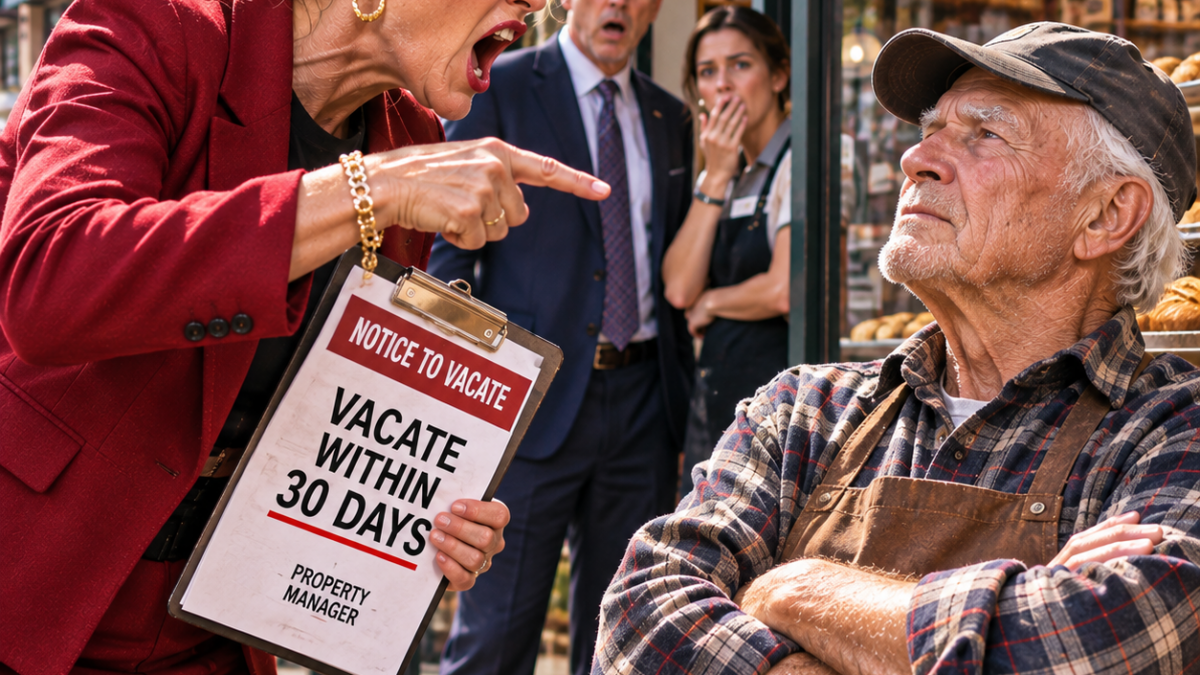
FULL STORY:“YOU HAVE 30 DAYS TO VACATE—THIS SHOP DOESN’T BELONG TO YOU!” Property Manager Karen Tried to Evict My 74-Year-Old Grandpa—Then She Learned He Owned the Entire Shopping Center
PART2
I worked at Clifford’s Repair the summer after my freshman year of college.
Mostly counter duty.
I was nineteen and still believed ringing up appliance repairs would be an easy summer job.
It was not.
People form emotional relationships with appliances.
A woman once spent fifteen minutes explaining that her mixer had made every birthday cake her three children had eaten.
A retired teacher brought in a twenty-six-year-old vacuum cleaner and said:
“My wife bought it.”
His wife had been dead nine years.
Grandpa fixed it for twenty dollars less than he normally charged.
He never said why.
The shop itself looked like it had stopped evolving sometime around 2002.
Old cash register.
Pegboard walls.
Metal shelves.
Yellow repair tickets.
Every finished job labeled in Grandpa’s tiny block handwriting.
In back were two long benches.
A drill press.
A grinder.
Bins of belts and bearings.
And a parts cabinet with approximately two hundred drawers.
Only two human beings understood that cabinet.
Grandpa.
And Nolan.
Nolan Mercer was thirty-four.
He had worked with Grandpa eleven years.
He had also been deaf since birth.
Grandpa handled mechanical work.
Nolan handled electronics.
Circuit boards.
Controls.
Modern appliances.
Things with tiny components that made Grandpa put on reading glasses and complain that manufacturers had “declared war on fingers.”
Nolan could look at a board for ten minutes and identify a resistor or capacitor everybody else had missed.
Customers would arrive after a big-box service center told them their appliance was dead.
Nolan sometimes repaired it for thirty dollars.
He communicated however worked.
American Sign Language.
Writing.
Lip reading if he could clearly see your face.
A little speech with people he knew.
Grandpa signed fluently.
I knew enough to hold ordinary conversations.
Once I asked Nolan whether my signing had improved.
He signed:
YES.
I felt proud.
Then he added:
YOU STILL HAVE AN ACCENT.
I asked what kind.
He finger-spelled:
TOURIST.
Then there was Frank.
Frank did not work there.
Nobody really knew why Frank was there.
He was seventy-one.
Retired auto mechanic.
Vietnam veteran.
Grandpa’s friend for roughly thirty-five years.
He kept a folding chair beside the front window.
Nobody else sat in it.
He arrived most mornings with a thermos and a library book.
He could spend four hours reading without speaking.
Then suddenly say something so dark Grandma would stare at him and whisper:
“Jesus, Frank.”
That summer he read books about Andrew Carnegie, the Panama Canal, and the history of indoor plumbing.
He called the plumbing book:
“The most underrated war mankind ever won.”
That was our normal.
Then our longtime property manager retired.
He had worked with the center for years.
Knew Grandpa personally.
Sometimes brought broken lawn equipment into the shop.
My dad’s primary contact at the management company was Stuart Brennan, one of the senior managers.
Stuart had known our family so long that he attended my high-school graduation party.
When the old on-site manager retired, the company hired Karen Bell.
Dad mentioned her at Sunday dinner.
“Stuart says she came from a larger operation.”
Grandpa kept eating mashed potatoes.
“Good.”
Dad looked surprised.
“Good?”
“The slot lights outside Building C are on the wrong timer.”
That was what Grandpa expected from a property manager.
Lighting.
Leaks.
Snow removal.
Parking-lot striping.
Things that actually belonged to property management.
Karen came into our shop during her second week.
Mid-forties.
Professional clothes.
Leather folder.
Expensive-looking watch.
She entered slowly.
Looked at our shelves.
Made a note.
Then approached Grandpa.
“You must be Clifford.”
Grandpa looked up.
“Yes.”
“I’m Karen.”
“The new property manager.”
“I’m going through every unit so I understand everybody’s situation.”
“Okay.”
She opened the folder.
“You’ve been here a long time.”
“Since 1994.”
“And the previous manager had an arrangement with you?”
Grandpa considered.
“He brought me lawnmowers.”
Karen smiled.
Not warmly.
“I mean financially.”
“What was the understanding?”
Grandpa answered literally.
“The understanding is it’s my space.”
She wrote something down.
“All right.”
“We’ll talk more.”
Then left.
At the time, none of us understood how badly those two people had misunderstood each other.
Grandpa believed:
She knows the family owns the center.
She is asking how this particular owner-reserved unit works.
Karen believed:
This elderly man has occupied a valuable storefront for decades without rent because some old manager gave him a special arrangement.
The rent roll did show our unit at:
$0.00
Beside that number was an internal code.
Owner reserved.
The management agreement also contained an exhibit identifying the space as excluded from normal leasing inventory.
Karen apparently decided both were obsolete remnants nobody had cleaned up.
That assumption mattered because a regional cell-phone chain had contacted the company looking for a storefront near the grocery entrance.
They were willing to pay serious rent.
Our location was perfect.
Karen saw:
Zero revenue.
Old repair shop.
Elderly operator.
Prime position.
To her, the solution was obvious.
Remove Grandpa.
Install new tenant.
Increase income.
Probably look excellent on her first performance review.
She never stopped long enough to ask why a man running a tiny repair shop had occupied premium commercial space without rent for more than thirty years.
That should have been question number one.
Instead, question number one became:
How do I get him out?
The Nolan incident happened about a week later.
Tuesday morning.
Busy.
I was behind the counter helping an older man with a cordless drill that would not hold a charge.
A woman in her fifties waited while I hunted for her coffee maker.
Frank was reading about the Panama Canal.
Nolan came out front.
He looked at Grandpa and said:
“Two amp?”
Grandpa turned fully toward him so Nolan could see his face.
“Second drawer.”
“Left side.”
“If none, I’ll order.”
Then Grandpa went into the back.
Nolan returned to his bench.
His workbench faced the wall.
Magnifying lamp down.
Soldering iron in hand.
Karen walked in.
I am almost certain she saw Nolan speaking with Grandpa through the front window before entering.
She walked past me.
Straight to Nolan.
“Excuse me.”
No response.
“Is Clifford here?”
Nolan kept working.
“Excuse me?”
Louder.
Still nothing.
Because, obviously, he could not hear her.
Karen turned toward us.
“He can hear me.”
Nobody answered.
Frank slowly lowered his book.
That should have been a warning.
Frank said:
“He’s a little hard of hearing.”
Completely serious.
Karen turned back.
“Excuse me!”
Nolan reached for tweezers.
Frank said:
“Little louder.”
“He worked around jet engines.”
“Air Force.”
Nolan had never been in the Air Force.
The drill customer looked at me.
“Is she okay?”
“I don’t know.”
Technically true.
Karen raised her voice again.
“Sir!”
People outside slowed near the window.
“I AM THE PROPERTY MANAGER.”
“I NEED YOU TO TURN AROUND.”
Nolan kept working.
Frank turned a page.
“Almost.”
I bit the inside of my cheek.
Then Grandpa came out carrying a box of fuses.
He looked around.
“Why are you shouting?”
Not angry.
Genuinely curious.
Karen turned.
“Your employee has been ignoring me for two full minutes.”
Grandpa looked at Nolan.
Then at Karen.
“He’s deaf.”
“Since birth.”
Karen froze.
Then looked toward Frank.
“He told me he was hard of hearing.”
Frank nodded.
“I said a little.”
“I was rounding.”
The drill customer burst out laughing.
The coffee-maker woman pressed her lips together.
I crouched behind the counter because I was about to lose it.
Grandpa tapped Nolan’s shoulder.
Signed what had happened.
Nolan looked at Karen.
Then at Frank.
Frank gave a tiny wave.
Nolan signed:
HOW LOUD?
Frank held his hands roughly two feet apart, like describing a fish.
Nolan laughed.
Big laugh.
Then he turned toward Karen.
Pointed toward his mouth.
Spoke carefully.
“You can talk to me.”
“Just face me.”
That should have been Karen’s moment.
Apologize.
Laugh at herself.
Move forward.
Instead, she looked at Grandpa.
“I’ll come back when things are less chaotic.”
Then walked out.
She never apologized to Nolan.
Never even looked at him again.
The coffee-maker customer found her appliance, paid, then stopped beside Frank.
“You’re a terrible man.”
Frank nodded.
“Yes, ma’am.”
“Thank you for your business.”
After Karen left, Grandpa looked at Frank.
“That wasn’t nice.”
“No.”
Frank agreed easily.
“She was rude to Nolan.”
Grandpa thought.
Then nodded.
“Still.”
Nolan wrote on his pad:
NEXT TIME TELL HER I WAS AN ASTRONAUT.
Frank said:
“Better benefits.”
We thought the incident was over.
It wasn’t.
The letters started.
First:
Our sidewalk sandwich board violated center signage standards.
Honestly?
Fair.
Grandpa had painted that sign himself years earlier.
It probably violated several modern standards.
He read the letter.
Called the management office.
I heard only his side.
“What section?”
Pause.
“No.”
“I understand you say it violates the standard.”
“I’m asking which standard.”
Pause.
“Can you send me the document?”
Karen did.
Grandpa read it.
Brought the sign inside.
Done.
No argument.
Second notice:
Customer air conditioners stored in the shared rear hallway.
Also technically correct.
Fire-egress issue.
Nolan and I moved them within twenty minutes.
Again:
Done.
That should have told Karen something.
Grandpa was not resisting legitimate management.
He was not some angry old man refusing every rule.
If a rule applied, he followed it.
Then came the third letter.
Karen delivered this one herself.
“I’ve received concerns regarding customer communication.”
Grandpa looked at the page.
“What concerns?”
“Customers should not have to write notes in order to receive service.”
He stared.
“Who complained?”
“I’m not discussing individual complaints.”
“How do I fix it?”
Karen hesitated.
That was the problem.
There was nothing to fix.
Nolan worked primarily in back.
When customers interacted with him, communication was fine.
He signed.
Wrote.
Read lips.
Drew diagrams.
Whatever worked.
Once I watched him explain a failed garage-door controller by drawing the circuit path on notebook paper.
The customer left saying:
“That kid explained more in ten minutes than the manufacturer’s help line did in three hours.”
Karen’s complaint was not about service.
It was ammunition.
After she left, Nolan read the letter.
Then wrote:
SHE WANTS THE SPACE. NOT THE SIGN.
He underlined it.
Grandpa read.
“She can’t have it.”
Then signed the same thing.
Nolan wrote:
DOES SHE KNOW THAT?
Grandpa paused.
“She should.”
That was Clifford’s mistake.
He believed Karen had access to accurate information and therefore would use it.
Engineers tend to believe systems fail when information is missing.
Human systems often fail because people ignore information that interferes with the outcome they already want.
Karen returned Thursday with the real notice.
Thirty days.
Management intended to “re-lease” our unit.
Grandpa should prepare to vacate.
Frank was in his chair.
He looked at Karen.
“Sorry.”
“Are you from the gas company?”
She stared.
“I’m the property manager.”
“We’ve met.”
“Carol?”
“Karen.”
Frank nodded.
“I knew a Carol.”
“Sold me a Buick that caught fire.”
Karen’s eyes narrowed.
“Not on purpose.”
Frank shrugged.
“Hard to say.”
She ignored him.
Addressed Grandpa.
“Your prior arrangement with management is not binding indefinitely.”
“I’m willing to be reasonable regarding move-out timing.”
Grandpa frowned.
“I don’t have an arrangement.”
Karen smiled like he had finally admitted the case.
“Exactly.”
He looked at the letter again.
Then picked up a pen.
Across the bottom of the copy, he wrote:
This space is reserved for the owner. I do not consent to vacating it.
Then signed.
He gave it to me.
“Fax this.”
I did.
Kept the transmission receipt.
That detail mattered later.
Grandma read the notice that night at their kitchen table.
“Cliff.”
“This says thirty days.”
“It’s wrong.”
“I know it’s wrong.”
“That is why you call Curtis.”
“I replied.”
Grandma stared.
“Your son owns part of this shopping center with you.”
“Call him.”
Grandpa considered.
“You think I should?”
“Yes.”
“Now?”
“Yes, Cliff.”
He called Dad.
Read him Karen’s notice.
Dad’s voice changed immediately.
He had me scan both documents.
Karen’s notice.
Grandpa’s handwritten refusal.
Dad emailed Stuart Brennan.
Subject:
URGENT — OWNER RESERVED UNIT / LOCKOUT THREAT
Stuart was away until Monday.
Dad left voicemail.
Emailed again.
Then called the management company office.
Someone said they would alert Karen that ownership had disputed the notice.
That should have ended it.
Saturday morning proved it didn’t.
Grandpa never worked weekends.
Nolan sometimes did.
Not officially.
He liked taking boards home when something bothered him.
Saturday around ten, he stopped by to pick one up.
His key did not work.
New lock.
Locksmith van parked outside.
Front door propped open.
Two shopping-center maintenance workers loading our property onto a hand truck.
Nolan did not yell.
Did not physically intervene.
He took the small silver digital camera he used for photographing circuit boards.
Then started documenting.
Locksmith van.
License plate.
New cylinder.
Workers.
Hand truck.
Boxes.
Work order.
One maintenance worker looked uncomfortable.
Nolan pointed to the clipboard.
The man let him see it.
Nolan photographed the form.
Description:
UNIT VOLUNTARILY SURRENDERED.
ABANDONED CONTENTS AUTHORIZED FOR STORAGE TRANSFER.
Nolan had been standing in the shop less than forty-eight hours earlier when Grandpa explicitly refused to vacate.
He knew immediately.
This was false.
He took out his notepad.
The worker wrote:
KAREN APPROVED. SAID PAPERWORK SETTLED.
Nolan tore off the page.
Kept it.
Then texted me:
LOCKS CHANGED. KAREN MOVING OUR STUFF. GET CLIFF.
I called Grandpa.
Then Dad.
Then Frank because somehow Frank needed to know everything.
Grandpa and I reached the center in less than thirty minutes.
Frank beat us there.
I still have no idea how.
The shop door looked wrong immediately.
Small thing.
New silver lock.
Our keys useless.
Inside, half the shelves had been disturbed.
Some customer repairs gone.
Parts drawers removed.
Back shelf emptied.
We followed the maintenance workers behind the grocery loading dock.
Storage room.
There it was.
Years of somebody’s life placed on pallets.
Customer appliances.
Parts boxes.
Tools.
Reference manuals.
Fixtures.
Shelving.
Tarp pulled halfway over everything.
Grandpa did not ask about the cash register.
Did not check expensive tools.
He walked directly toward one object.
A steel-and-brass test fixture.
About the size of a toaster.
Built in 1983.
That fixture had been part of the development process for Grandpa’s freight-loading latch.
Thousands of prototype cycles.
Experiments.
Adjustments.
The mechanism that eventually became the patent that gave him the money to begin building the shopping center.
The fixture had lived on a shelf in the back of the shop for thirteen years.
Now it lay on its side.
Indicator arm bent.
Gauge glass cracked.
Grandpa picked it up.
Turned it slowly.
Everybody became quiet.
Even Frank.
Grandpa touched the gauge.
“They don’t make this anymore.”
I said:
“Can it be repaired?”
He pointed.
“I can fix the arm.”
Then touched the cracked glass.
“This?”
He shook his head.
“I don’t know.”
For the first time, I saw emotion hit him harder than the eviction notice.
Karen could call the shop non-revenue.
A unit.
A space.
To Grandpa, that fixture represented the years before any shopping center existed.
Before the stores.
Before rental income.
Before grandchildren.
When he was an engineer with a design he hoped would work.
Frank stepped beside him.
No jokes.
He helped clear a flat place on a pallet.
Grandpa set the fixture down carefully.
Then said:
“Who told them this was abandoned?”
I showed him Nolan’s photograph.
VOLUNTARILY SURRENDERED.
He stared.
“But I told her no.”
“Yes.”
“In writing.”
“Yes.”
Grandpa looked confused.
Not cognitively.
Morally.
He genuinely could not understand why somebody would write the opposite of what they had been told.
I called Dad.
He called Stuart.
This time Stuart answered.
I heard Dad say:
“Someone changed Dad’s locks.”
Pause.
“Yes.”
“His shop.”
Another pause.
“No, Stuart.”
“He did not surrender it.”
Then Dad called the family attorney.
The attorney’s instructions were immediate.
“Do not break the new lock.”
“Do not move anything else.”
“Photograph everything.”
“Preserve every email.”
“Keep every work order.”
“Do not argue with Karen.”
“Monday morning.”
That weekend felt wrong.
Grandpa stayed home Sunday instead of stopping by the shop after church.
Grandma watched him at dinner.
He barely ate.
Finally she said:
“You know this is going to get fixed.”
“I know.”
“Then what is it?”
Grandpa looked at his hands.
“They moved customer property.”
“Yes.”
“I’m responsible for that.”
“Insurance exists.”
“They trusted me.”
Grandma reached across the table.
“Cliff.”
He continued.
“And the fixture.”
“We’ll repair it.”
“The gauge might not be replaceable.”
His voice became quiet.
“My father helped machine the first bracket.”
That surprised me.
I had never known.
Grandma knew.
She squeezed his hand.
“This isn’t really about the gauge.”
He looked at her.
She said:
“You spent thirty years building a place where people know exactly where to find you.”
“Then some woman walked in and treated you like you had no right to be there.”
Grandpa stared.
Grandma understood him better than anyone.
Monday morning, we arrived before eight.
Grandpa.
Dad.
Me.
Nolan.
Frank.
Frank brought coffee.
“Nobody invited you,” Dad said.
Frank replied:
“I’m a stakeholder.”
“In what?”
“Entertainment.”
At exactly eight, Stuart Brennan arrived.
Dark suit.
No smile.
Karen stood outside the shop talking on her phone.
She ended the call when she saw him.
Stuart said:
“Conference room.”
Karen looked toward Grandpa.
“This can be resolved quickly.”
Dad said:
“I hope so.”
We used the vacant tax-office meeting room next door.
Stuart sat at the table.
Dad beside him.
Karen across.
Grandpa held the damaged fixture in a cardboard box on his lap.
I stood near the wall.
Nolan beside me.
Frank somehow acquired a chair.
Stuart opened a notebook.
“Karen.”
“Walk me through your decision.”
She did.
Confidently.
“Long-term occupant.”
“No current lease.”
“Zero rent.”
“Repeated compliance concerns.”
“High-value prospective tenant.”
“Thirty-day notice.”
“Refusal to cooperate.”
“Unit secured.”
“Contents transferred for storage.”
Stuart asked:
“Who approved the lock change?”
“I did.”
“Under what authority?”
“Non-revenue unit.”
“Tenant had no valid lease.”
“Vacancy conversion falls within on-site management discretion.”
Stuart nodded slowly.
“The work order says voluntarily surrendered.”
“Yes.”
“Did Mr. Hayes surrender the unit?”
Karen hesitated.
“He refused to cooperate.”
“That’s not what I asked.”
Silence.
“Did he give you keys?”
“No.”
“Did he sign surrender paperwork?”
“No.”
“Did he tell you he was leaving?”
“No.”
Stuart looked at Dad.
Dad slid Grandpa’s written response across the table.
I do not consent to vacating it.
Fax receipt attached.
Stuart looked back at Karen.
“You received this Thursday.”
“Yes.”
“And on Saturday you classified the unit as voluntarily surrendered.”
“He had no valid lease.”
Stuart said:
“Those are separate questions.”
Karen leaned forward.
“There was a major prospective tenant.”
“Regional cell retailer.”
“Market rent on that space is substantial.”
“We are leaving money on the table every month.”
“I was hired to improve performance.”
Stuart said:
“Who told you the space was available for leasing?”
“The rent roll.”
He opened a binder.
Turned it toward her.
“Show me.”
Karen pointed.
Unit 104.
Rent:
$0.
Code:
ORP
“What does ORP mean?”
Karen looked.
“I assumed it was an old internal designation.”
Stuart flipped several pages.
Then opened the management-agreement exhibit.
Unit 104.
OWNER RESERVED PREMISES — EXCLUDED FROM LEASING AUTHORITY.
Karen stared.
Dad leaned forward.
“That document was part of your onboarding package.”
She looked at Stuart.
“Nobody specifically explained the code to me.”
“It’s defined on page one.”
He flipped.
There it was.
ORP — Owner Reserved Premises.
Karen’s confidence changed slightly.
Not gone.
Damaged.
She said:
“I was trying to maximize revenue for the owner.”
Dad gave a humorless laugh.
“For the owner.”
“Yes.”
Dad pointed at Grandpa.
“That’s the owner.”
Karen looked toward him.
Then back at Dad.
“I understand it’s a family business.”
“No.”
Dad shook his head.
“I don’t think you do.”
Stuart turned to the ownership page.
The family LLC.
Managing member:
CLIFFORD HAYES.
Karen read.
Looked at Grandpa.
Then Stuart.
Then Grandpa again.
“You own this?”
Grandpa answered:
“The LLC owns it.”
“The family.”
“I’m managing member.”
Karen swallowed.
“The whole center?”
“Yes.”
Her face changed completely.
Not movie-style horror.
Something quieter.
The moment a person’s internal model of reality collapses.
She looked at Grandpa.
“You told me it was your space.”
“It is.”
Grandma would later say this was the most Clifford response imaginable.
Karen turned toward Stuart.
“Nobody told me.”
Stuart tapped the binder.
“It was flagged.”
“No.”
“I mean personally.”
“Someone should have explained that this tenant was ownership.”
“He isn’t a tenant.”
Dad said.
Karen’s voice sharpened.
“The information was not clear.”
Stuart remained calm.
“Owner reserved.”
“Excluded from leasing authority.”
“Managing member listed by name.”
“What part was unclear?”
She had no answer.
Then she tried another direction.
“I was still acting in the property’s financial interest.”
Dad pointed at the cardboard box in Grandpa’s lap.
“You changed my father’s lock.”
“You removed customer property.”
“You moved equipment.”
“You created a work order saying he voluntarily surrendered a unit after he told you in writing he refused.”
Karen said:
“I acted based on my understanding.”
Dad answered:
“That is the problem.”
Frank had been silent for almost five minutes.
A personal record.
Then he said:
“In fairness, people have taken entire buildings by changing locks before.”
Everyone looked.
Frank continued.
“Usually they bring an army.”
“Romans had paperwork afterward.”
Stuart closed his eyes.
“Frank.”
“Just historical context.”
Grandpa looked at him.
“Not helping.”
“No.”
Frank nodded.
“Sorry.”
He did not look sorry.
Stuart asked Karen for her keys.
She stared.
“What?”
“Your center keys.”
“Access card.”
“Work-order credentials.”
“Turn them over.”
Her face drained.
“Am I being terminated?”
“I said turn over your access.”
“Go back to the management office.”
“You are being placed on administrative leave while the company reviews this incident.”
“This is ridiculous.”
“No.”
Stuart’s voice remained low.
“What would be ridiculous is allowing you continued unsupervised access after an unauthorized lockout involving an owner-reserved unit, false surrender classification, removal of customer property, and physical damage.”
Karen looked at Grandpa.
Almost pleading now.
“I didn’t know.”
Grandpa held the fixture.
“You didn’t ask.”
That was all.
No speech.
No revenge line.
Just the truth.
Karen handed over the keys.
Then left.
Frank watched through the window.
“Wrong storefront.”
Dad said:
“What?”
“She wanted to free one up.”
Frank nodded toward the management office.
“Might have done it.”
We reopened Tuesday.
The management company paid for the locksmith immediately.
Maintenance workers returned everything.
They apologized individually.
Grandpa accepted.
Neither man had known the work order was false.
They had been told the unit was surrendered.
One said:
“I should’ve questioned it when Nolan showed up.”
Grandpa said:
“You had a written order.”
The man looked ashamed.
“So did she.”
Fair point.
Customer repairs were inventoried.
Nothing disappeared.
Several items were scratched.
Management paid claims.
The bent shelving was replaced.
The gate? No gate—sorry, storefront lock was changed back.
New keys.
The old cash register returned exactly where it belonged.
Nolan spent most of Tuesday reassembling the parts cabinet.
At noon, he signed:
SHE ORGANIZED NOTHING CORRECTLY.
Grandpa replied:
YOU’RE VERY JUDGMENTAL.
Nolan pointed toward Drawer 47, where Karen’s movers had mixed resistors with unrelated connectors.
Then signed:
I HAVE EVIDENCE.
Grandpa conceded.
The fixture was harder.
Insurance could assign a dollar value.
Grandpa couldn’t.
It was a prototype tool.
Mostly homemade.
Technically obsolete.
Historically priceless only to us.
Grandpa straightened the indicator arm himself.
The broken gauge became the problem.
He called suppliers.
Nothing.
Searches.
Nothing.
Then Nolan found a used gauge online.
Not identical.
Same basic range.
Similar dimensions.
Manufactured around the same period.
Grandpa bought it immediately.
He came into the shop two Saturdays in a row.
That alone told the family how much the fixture mattered.
He machined a custom bracket.
Adapted the connection.
Calibrated.
Tested.
Adjusted.
The needle sat slightly high.
I asked:
“Is that bad?”
Grandpa said:
“No.”
“You just know it’s high?”
“Yes.”
“How much?”
He gave me an exact number to two decimal places.
Of course.
“Will you fix it?”
“No.”
“Why?”
He looked at the repaired fixture.
“I know what it does now.”
That sentence stayed with me.
Not everything needs to return to exactly what it was before.
Sometimes repair means understanding the new error.
The management company’s internal investigation lasted about a week.
Dad did not participate in deciding Karen’s employment because the company technically employed her.
That distinction mattered.
The property-management firm reviewed:
Her onboarding material.
Access rights.
Work orders.
Emails.
Grandpa’s written refusal.
The false surrender designation.
Customer-property removal.
Lock change.
Lack of authorization from senior management.
Her handling of Nolan’s disability complaint.
The pattern of notices after discovering the cell-phone prospect.
At the end of the week, Karen was terminated.
Not because Grandpa demanded it.
He didn’t.
I asked him whether he wanted her fired.
He said:
“That’s Stuart’s job.”
“Are you angry?”
“Yes.”
“Do you think she should lose her job?”
Grandpa considered.
Then:
“She shouldn’t have that job.”
Different answer.
More precise.
The management-company president sent a formal apology.
Stuart came in personally.
He stood at the counter with Grandpa and Nolan.
“I’m sorry.”
Grandpa said:
“Okay.”
Stuart turned toward Nolan.
Faced him.
Spoke clearly.
“I’m sorry for how you were treated too.”
Nolan watched his face.
Then signed.
Grandpa translated:
“He says thank you.”
Pause.
Then Nolan signed again.
Grandpa smiled.
“He also says Frank lied to Karen.”
Stuart looked toward the window.
Frank raised one hand.
“Allegedly.”
Stuart laughed despite himself.
That mattered.
The next property manager arrived three weeks later.
Name:
Daniel.
Around fifty.
First morning, he walked into Clifford’s Repair.
He introduced himself.
Then asked:
“Mr. Hayes, is there anything the center needs that management has overlooked?”
Grandpa thought.
Daniel probably expected:
Lease concern.
Security.
Parking.
Maintenance.
Grandpa pointed outside.
“The slot lights are on the wrong timer.”
Daniel blinked.
“Which lights?”
“Building C.”
“About eighteen minutes early.”
Daniel wrote it down.
By Friday, they were fixed.
Grandpa told everyone Daniel was:
“The best manager they’ve ever hired.”
Based almost entirely on one lighting timer.
Frank disagreed.
“He hasn’t survived me yet.”
The first time Daniel entered while Nolan was working, Frank looked up from his chair.
His mouth opened.
Grandpa, Nolan, and I all said:
“Frank.”
At exactly the same time.
Frank looked offended.
“I was going to say hello.”
No one believed him.
Life returned.
That should be the end.
It almost is.
But the part that stayed with me was not Karen’s face when she learned Grandpa owned the shopping center.
That is the part people love.
The reveal.
The reversal.
Old man turns out to be rich owner.
Arrogant manager loses job.
Justice.
Satisfying.
But if Grandpa had been an ordinary tenant, Karen still would have been wrong to mark a unit “voluntarily surrendered” after receiving written refusal.
If Nolan had not been the best electronics technician in the center, she still should have looked at him and apologized after learning he was deaf.
If the test fixture had been worthless, she still had no business authorizing removal without proper authority.
Grandpa owning the center did not transform her actions from acceptable to unacceptable.
It only made the consequences arrive faster.
That distinction matters.
People love stories where somebody mistreats a stranger and later discovers:
He’s actually the CEO.
She’s actually the owner.
He’s actually the judge.
She’s actually the billionaire.
But dignity should not depend on a surprise title.
Grandpa deserved respect before Karen knew who he was.
Nolan deserved respect without needing Grandpa beside him.
Maintenance workers deserved accurate instructions.
Customers deserved their property protected.
The management company deserved honest work orders.
None of those principles depended on Grandpa’s net worth.
Still, I understand why the reveal feels satisfying.
Because Karen’s entire strategy depended on an assumption.
Old repairman.
Zero rent.
No lease.
Doesn’t understand business.
Probably confused.
Probably attached to a cheap little shop because he has nowhere else to go.
Easy target.
She never considered:
Maybe the old man does not pay rent because rent would mean paying himself.
Grandpa’s wealth never looked like wealth.
No exotic car.
No custom suits.
No giant office.
He drove an old Ford pickup.
Packed sandwiches.
Fixed neighbors’ appliances.
His watch came from Walmart.
Grandma bought his shirts.
If you saw him sweeping the sidewalk outside Clifford’s Repair, you would assume he worked there.
Which he did.
You would not assume the nail salon, grocery building, dentist office, restaurant strip, and every parking space around them ultimately belonged to an LLC he controlled.
He preferred it that way.
Dad once asked why Grandpa never put an OWNER plaque in the shop.
Grandpa said:
“What would that fix?”
Nothing.
Good answer.
After Karen, the management company suggested putting stronger ownership flags into its internal system.
Grandpa agreed.
Not because he wanted special treatment.
Because confusion had cost everyone money.
The ORP code became more explicit.
OWNER RESERVED — DO NOT LEASE / ALTER WITHOUT MANAGING MEMBER AUTHORIZATION.
Dad joked they should add:
SERIOUSLY, KAREN.
Grandpa did not approve.
Frank wanted it printed.
No.
Grandpa also changed something else.
He started reading management reports more often.
For years, he had let Dad handle nearly everything.
That was sensible.
Dad was better at finance.
Grandpa preferred motors.
But the incident reminded him that delegating authority does not eliminate responsibility.
He began attending one property meeting each quarter.
He asked strange questions.
“Why is Building A using more electricity?”
“Why are the trash pickups on Thursday when restaurants are busiest Wednesday night?”
“Why is the west irrigation valve cycling twice?”
Daniel learned quickly.
Come prepared.
Once an accountant presented a twenty-slide expense forecast.
Grandpa listened.
Then asked:
“Why did parking-lot lighting increase fourteen percent?”
The accountant stared.
Nobody else had noticed.
Turns out a timer malfunction had several banks of lights running in daylight.
Grandpa was delighted.
Not because money was saved.
Because a timer was wrong.
Calibrated.
Grandma was right.
The family LLC eventually expanded.
Not dramatically.
Grandpa refused a proposal to tear down the old building containing his repair shop.
A developer wanted a modern facade and larger units.
Grandpa reviewed the numbers.
Then asked:
“Where would Nolan work?”
Dad said:
“We’d relocate the shop.”
Grandpa shook his head.
“No.”
Dad sighed.
“Dad, that is not a financial analysis.”
“It’s my analysis.”
The building stayed.
Dad complains.
Then admits occupancy remains high.
Sometimes sentimental decisions survive capitalism.
Clifford’s Repair changed too.
Nolan became more involved.
Grandpa eventually made him shop manager, which Nolan found ridiculous because Grandpa still arrived first and left last.
They hired another young technician.
Her name was Maya.
Twenty-six.
Excellent with small appliances.
Terrible at labeling drawers.
Nolan nearly quit after two weeks.
He created a color-coded system.
Maya ignored it.
Grandpa mediated.
Frank said:
“This is why nations collapse.”
Nobody asked him.
Nolan eventually taught Maya basic signing.
She learned fast.
Customers adapted too.
A small sign appeared at the counter:
OUR TECHNICIAN NOLAN IS DEAF. PLEASE FACE HIM WHEN SPEAKING OR USE THE PROVIDED NOTEPAD.
Grandpa hated the wording.
“Why does it say our technician?”
“What?”
“It sounds like he belongs to us.”
I said:
“It’s normal English.”
He considered.
The sign changed:
NOLAN IS DEAF. FACE HIM WHEN SPEAKING. WRITING IS FINE TOO.
Much more Clifford.
One woman saw the sign and asked:
“Does he mind?”
Nolan happened to be nearby.
He signed.
I translated:
“He minds when people scream at the back of his head.”
Frank nearly fell out of his chair laughing.
The Karen story became shop folklore.
Customers retold it badly.
One version had Karen screaming:
“YOU’RE EVICTED!”
She never screamed.
Another said Grandpa waited until she changed the locks and then revealed he owned the center.
Not exactly.
He had told her repeatedly the space was his.
She just did not understand what he meant.
Another version said Dad fired her on the spot.
No.
Her actual employer investigated.
Then terminated her.
Another said Grandpa bought the shopping center with millions from inventing a NASA device.
Freight equipment.
Not NASA.
Frank may have contributed to that version.
He denied everything.
A customer once walked into the shop and said:
“Are you the old guy who owns everything?”
Grandpa looked around.
“No.”
The man seemed disappointed.
“You own the center.”
“The LLC does.”
“Same thing.”
“No.”
Then Grandpa spent ten minutes explaining corporate ownership until the customer regretted asking.
That is Grandpa.
Exactness matters.
On his seventy-sixth birthday, we held dinner at Grandma’s house.
All six children.
Grandkids.
Too many people.
Frank somehow invited himself.
Of course.
Grandma brought out the repaired 1983 fixture.
Grandpa had apparently taken it home temporarily.
She placed it on the dining table.
Everyone stared.
“What are you doing?” Grandpa asked.
Grandma said:
“I want them to see it.”
“It’s dirty.”
“So are half your grandchildren.”
Fair.
She told the younger kids what it was.
Grandpa designed the latch.
The patent.
The sale.
The land.
The first stores.
The repair shop.
Then she said:
“This little ugly thing is one reason your grandfather could buy the property Karen tried to throw him out of.”
The kids laughed.
Grandpa did not.
He touched the new gauge.
“It reads high.”
Grandma looked at me.
I said:
“He knows.”
She rolled her eyes.
Then asked Grandpa:
“Do you wish they never moved it?”
“Yes.”
“Do you wish the gauge never broke?”
“Yes.”
“Do you wish none of the Karen thing happened?”
Grandpa considered longer.
Then:
“Yes.”
Grandma laughed.
I did too.
We had expected wisdom.
Grandpa simply preferred things not to break.
Then he added:
“But we fixed the management agreement.”
There it was.
Engineer.
If failure reveals a weak system, strengthen the system.
That was his version of growth.
Not:
Everything happens for a reason.
Grandpa hates that sentence.
Things happen because people do things.
Bearings fail because lubrication disappears.
Circuits fail because components burn.
Locks get changed because someone authorizes the wrong work order.
Organizations fail when assumptions replace verification.
Reasons can be identified.
Sometimes fixed.
Grandpa’s entire worldview.
A year after Karen left, a rumor spread that the cell-phone chain still wanted our unit.
True.
They approached again.
This time through Stuart.
They offered extremely high rent.
Dad showed Grandpa.
“Financially, this is very attractive.”
Grandpa read the proposal.
“How long?”
“Ten-year lease.”
“Where would the shop go?”
“We could put you in Unit 27.”
“Near the loading dock.”
Larger.
Cheaper retail frontage.
Dad expected resistance.
Grandpa surprised everyone.
“Let me ask Nolan.”
Nolan looked at Unit 27.
Better work space.
Worse customer visibility.
He signed:
FRANK WILL COMPLAIN.
Grandpa translated.
Dad said:
“Frank does not work here.”
Nolan signed:
HE DOES NOT KNOW THAT.
They considered moving.
Seriously.
This is the detail people do not expect.
After fighting so hard to keep the shop, Grandpa was willing to leave.
Why?
Because this time it was his choice.
He had information.
Options.
A legitimate offer.
No threat.
No false notice.
No new lock.
Consent.
Ultimately, they stayed.
The financial difference after renovation costs was less dramatic than it first appeared.
But the discussion proved something.
The conflict had never been about Grandpa refusing change.
It was about somebody else deciding for him.
That is a universal problem.
Karen saw:
$0 rent.
Potential tenant.
Old man.
Inefficiency.
She never saw:
Owner-reserved.
Family history.
Legal authority.
Customer obligations.
An employee whose livelihood depended on the shop.
A prototype fixture with no replacement gauge.
She reduced a situation until the answer she wanted became obvious.
Then treated anything contradicting that answer as an obstacle.
The first legitimate signage notice?
Grandpa complied.
The hallway storage issue?
Complied.
The actual eviction notice?
Refused.
That distinction should have caused Karen to slow down.
Why would a man who calmly obeyed two valid rules suddenly resist a third?
Maybe because the third was not valid.
But by then, she had already decided:
Difficult old tenant.
That label filtered everything afterward.
His statement:
It’s my space.
She heard entitlement.
His written refusal?
Uncooperative tenant.
Zero rent?
Sweetheart deal.
Owner-reserved code?
Legacy junk.
No lease?
Proof.
Every fact became evidence for the story she had already written.
That is confirmation bias with a master key.
Dangerous combination.
The management company added more training after her termination.
Stuart later told Dad that Karen had been competent in previous positions.
That surprised us.
She knew accounting.
Tenant relations.
Vendor negotiations.
Leasing.
She was not generally incompetent.
Which somehow made the story more useful.
Smart people make catastrophic mistakes too.
Sometimes faster because confidence prevents questions.
Karen’s biggest error was not failing to know Grandpa owned the shopping center.
New employees cannot magically know every owner.
Her biggest error was refusing to verify information after multiple signals told her something was unusual.
Zero-rent unit.
Owner-reserved code.
Thirty-year occupancy.
Written claim that the space belonged to him.
Urgent email from ownership family.
Senior manager unavailable.
No surrender document.
No returned keys.
No lease termination signed.
Still she authorized the lock change.
Every warning became something to push through.
That is not a knowledge problem.
That is a judgment problem.
And judgment was exactly what her job required.
Years later, when I became a manager myself—not property management, thankfully—I thought about Karen more than I expected.
New employee makes mistake?
Ask what information they had.
Someone resists an instruction?
Ask why.
A system shows something unusual?
Do not automatically “clean it up.”
Sometimes the weird thing exists for a reason.
I once almost deleted an old project code because nobody seemed to use it.
Then remembered ORP.
I called accounting.
The code was tied to a legacy customer contract still active.
I left it alone.
Grandpa would have been proud.
I told him.
He said:
“Why would you delete something without knowing what it does?”
No praise.
Of course.
Grandma laughed when I complained.
“What did you expect?”
“At least ‘good job.’”
“He loves you.”
“How do you know?”
“He fixed your brakes last month.”
Fair.
That is what love looks like with Clifford.
At eighty, Grandpa reduced his shop schedule.
Four days.
Then three.
Not because he wanted retirement.
Grandma insisted his knees needed fewer concrete-floor hours.
Nolan ran daily operations.
Grandpa still handled odd mechanical projects nobody else wanted.
Frank continued arriving.
Older.
Slower.
Same chair.
One morning a new customer asked:
“Does that gentleman work here?”
Maya looked at Frank.
Then signed toward Nolan.
Nolan laughed.
Maya answered:
“No.”
Frank said:
“Management.”
Nobody corrected him.
Daniel, the new property manager, lasted years.
He learned the family system.
Never assumed.
Never shouted at Nolan.
Occasionally brought broken appliances into the shop.
Grandpa considered that a sign of trust.
When Daniel eventually retired, the management company sent three candidates for Dad and Grandpa to meet.
Grandpa asked each the same question.
“If the rent roll says zero, what do you do?”
First candidate said:
“Review market potential.”
Grandpa frowned.
Second:
“Check the lease.”
Better.
Third:
“Find out why it says zero before doing anything.”
Grandpa nodded.
“That one.”
Dad said:
“There are other qualifications.”
Grandpa replied:
“Still.”
Candidate three got the job.
I do not know whether Grandpa actually influenced the final decision.
I choose to believe he did.
Frank claimed the new manager was selected through:
“The Clifford Zero-Dollar Test.”
Not official.
Should be.
The old prototype fixture remains in the repair shop.
Back shelf.
Same place as before.
Repaired arm.
Replacement gauge.
Slight high reading.
Grandpa refuses to put it behind glass.
“It’s a tool.”
“It’s history,” Grandma says.
“Still a tool.”
Sometimes customers ask what it is.
If Grandpa feels like talking, he explains the freight-latch system.
Twenty minutes minimum.
If he doesn’t, he says:
“Old test equipment.”
Both are true.
One afternoon, I found Nolan cleaning it.
He signed:
CLIFF LOVES THIS MORE THAN PEOPLE.
Grandpa, sitting six feet away, saw.
He signed back:
IT DOESN’T TALK.
Nolan laughed.
Then pointed toward Frank.
NEITHER SHOULD HE.
Frank saw enough to know he was being discussed.
“I object.”
“No one asked,” I said.
Normal day.
And that, more than Karen losing her job, became the ending I liked.
The shop stayed a shop.
No luxury renovation.
No giant OWNER sign.
No plaque saying:
THE MAN YOU TRIED TO EVICT OWNS THE BUILDING.
Grandpa would have hated that.
People still brought broken toasters.
Nolan still repaired boards.
Frank still occupied a chair he did not own.
Grandpa still arrived early.
The grocery store still opened.
Rent checks still flowed through the LLC.
The shopping center kept functioning.
Which meant the crisis did not become the identity of the place.
It became one story.
A warning.
A joke at Sunday dinner.
A revised procedure in a management manual.
That is probably the healthiest form of justice.
Not endlessly reliving the person who hurt you.
Fix the damage.
Fix the system.
Then get back to work.
I once asked Grandpa directly:
“Do you hate Karen?”
He looked confused.
“No.”
“Were you angry?”
“Yes.”
“Still?”
“No.”
“Why not?”
He pointed toward a vacuum motor he was rebuilding.
“She doesn’t work here.”
Simple.
She had no current role in his life.
Therefore no current allocation of attention.
I wish my brain worked that way.
I asked:
“Do you forgive her?”
He tightened a screw.
“She shouldn’t have changed the lock.”
“That’s not what I asked.”
“I know.”
“Then?”
Grandpa thought.
Finally:
“I don’t need anything from her.”
That may have been his version of forgiveness.
Or indifference.
Either way, healthy.
Grandma later told me:
“He was more upset about that gauge than Karen.”
That sounded ridiculous until I understood.
Karen was temporary.
The fixture connected him to his father.
His engineering career.
The invention.
The beginning of the shopping center.
Damage to that object touched something deeper.
But he repaired what he could.
Adapted what he could not.
Then continued using it.
Maybe that is the real metaphor.
Not that arrogant people eventually learn who they are messing with.
Sometimes they never learn.
Not that wealth secretly protects the humble.
It doesn’t always.
Not that being an owner makes you important.
Ownership is paperwork.
The deeper lesson is about repair.
Grandpa spent his life repairing things other people discarded.
The shop.
Machines.
Tools.
Even that old fixture.
Karen looked at his business and saw obsolete space.
Low revenue.
Outdated inventory.
An old man.
A deaf technician.
Nothing scalable.
Nothing impressive.
But value depends on what you measure.
Clifford’s Repair never produced the highest rent in the center.
It produced relationships.
Mrs. Jensen’s mixer.
Mr. Hall’s vacuum.
Nolan’s career.
Frank’s daily chair.
My summer job.
Grandpa’s reason to get dressed every morning.
Some things produce income.
Some produce meaning.
Good owners understand both.
Grandpa did.
Karen did not.
The cell-phone retailer eventually rented another unit at the center.
Two buildings down.
They paid excellent rent.
Their regional manager once brought a broken shop vacuum into Grandpa’s store.
Nobody told him the history.
Grandpa fixed it.
Charged twenty-eight dollars.
Business.
No grudges.
The shopping center continued making money.
The repair shop continued paying no rent.
Technically.
Dad sometimes jokes the opportunity cost is enormous.
Grandpa replies:
“Send me a bill.”
Dad never does.
At their fifty-fifth wedding anniversary, Grandma gave a short speech.
She talked about raising six children.
Grandchildren.
Engineering years.
Shopping center.
Repair shop.
Then she looked at Grandpa.
“Cliff has spent his entire life believing that if something is broken, you should figure out why before you replace it.”
Grandpa said:
“Usually.”
Grandma ignored him.
“He does this with appliances.”
“Cars.”
“Buildings.”
“Sometimes people.”
Frank called:
“Not me.”
Grandma said:
“No, Frank.”
“You’re beyond repair.”
Everyone laughed.
Then she looked at Grandpa.
“And sometimes the smartest thing he knows is when something isn’t broken at all.”
I thought about the repair shop.
Karen had looked at a zero-rent storefront and assumed it needed fixing.
It did not.
The system was functioning exactly as the owner intended.
Her attempt to “fix” it created the failure.
That happens more often than people realize.
Optimization without understanding can be destruction.
Ask any engineer.
Or any seventy-four-year-old man holding a damaged prototype in a cardboard box.
People online would probably call Karen’s firing karma.
Maybe.
Grandpa would call it:
“Management correcting an error.”
Less satisfying title.
More accurate.
She wanted to free up one valuable storefront.
She succeeded in creating exactly one vacancy.
Her own position.
Frank still considers that the funniest part.
Rarely does a workplace-elimination plan achieve its objective so efficiently on the person who designed it.
But if you ask me what I remember most clearly, it is not Karen’s face when Stuart pointed to Grandpa’s name on the ownership page.
It is Grandpa standing in the storage room on Saturday.
Holding the damaged fixture.
Looking at the cracked gauge.
Quiet.
That was the moment this stopped being funny.
The moment I understood property is not only land and leases.
A small repair shop can contain thirty years of somebody’s life.
A shelf can hold a piece of his father.
A bench can hold eleven years of friendship between two technicians.
A folding chair can belong emotionally to a retired mechanic who does not pay a cent for it.
A tiny storefront can matter far beyond its market rent.
Karen saw square footage.
Grandpa saw his place.
That is why Monday mattered.
Not because a rich old man revealed himself.
Because somebody who had been treated as disposable proved he had never been disposable at all.
And the irony is that Grandpa never needed the shopping center to establish that.
Even if he had owned nothing but the tools on his bench, Karen still should have checked the paperwork before changing his lock.
She still should have listened when he said no.
She still should have faced Nolan when speaking.
She still should not have written “voluntarily surrendered” when the written record said the exact opposite.
Authority does not become competence because somebody hands you keys.
A zero on a rent roll is not an invitation to invent your own explanation.
An old man who speaks simply is not necessarily confused.
And if somebody tells you, “This is my space,” it may be worth asking exactly what he means before you hire a locksmith.
Because sometimes he means the little repair shop.
And sometimes he means the entire shopping center.








