FULL STORY:“WE SENT $1,000 FOR MOM’S HEAT—SO WHY WAS SHE FREEZING?” I Found My 82-Year-Old Mother Sleeping in a Winter Coat With 5% Propane Left—At Christmas, My Sister Put the Truth on the Table
FULL STORY CONTINUATION
I stood in Mom’s kitchen holding the receipt.
“Why?”
“She has enough trouble.”
“Mom, your propane tank is nearly empty.”
“I can manage.”
“No, you cannot.”
Her mouth tightened.
That expression had raised four children.
“You don’t need to start a family war.”
“I’m asking where the money went.”
Mom looked toward the window.
“Mark’s back has been bad.”
Pam’s husband, Mark, had undergone spinal surgery in September.
Construction work.
Thirty-four years lifting things nobody should lift alone.
He had been out since Labor Day.
Workers’ compensation was delayed.
Then short-term disability paperwork got tangled.
They had medical bills.
A truck payment.
A mortgage.
Two adult children who still seemed to believe their parents owned a private bank.
I knew all of that.
What I did not know was why my mother was sitting inside a fifty-eight-degree house because of it.
“Pam told me propane was higher this year,” Mom said.
“It is higher.”
I held up the receipt.
“But not enough to explain this.”
“She said she’d order more.”
“When?”
Mom did not answer.
“When was the last time she checked the tank?”
“I don’t know.”
I took out my phone.
“Don’t call her.”
“I’m not.”
At 10:40 a.m., I called the Harvey co-op.
The woman who answered recognized Mom’s account immediately.
Small town.
“Margaret Harlow?”
“Yes.”
“I’m her daughter Ellen.”
“What can I do?”
“How much propane has been delivered this heating season?”
Keyboard.
“One delivery October sixth. Two hundred gallons.”
“Nothing since?”
“No.”
“Was another one scheduled?”
“No.”
I closed my eyes.
“What’s the current price?”
“Two-oh-nine.”
“How soon can you get a truck out?”
“Let me check.”
Snow removal had slowed deliveries.
But Mom was elderly and nearly out.
Priority.
Before two that afternoon, a co-op truck backed beside the house.
The driver filled 375 gallons, bringing the 500-gallon tank to the safe eighty-percent level.
$783.75.
I paid with my credit card.
Then I did something Pam later told everyone was the unforgivable part.
I took control of the propane account.
Not Mom’s bank account.
Not her Social Security.
Not her farm.
The propane.
I registered the tank for automatic keep-full service.
The co-op would monitor consumption and schedule deliveries before the level became dangerous.
Bills would come to me.
My brothers could send their annual contributions directly to the account or to me.
No more relying on someone remembering.
No more sending cash into one sibling’s checking account and hoping heat appeared at the other end.
When the furnace came alive, the soft thump traveled through the floor.
Mom looked down.
Then the blower started.
Warm air pushed from the vent beside the kitchen cabinet.
An hour later, Mom stood.
Unbuttoned the brown coat.
Hung it beside the door.
She put both hands above the register.
“I’d almost forgotten how nice warmth feels.”
That sentence made me angrier than anything Pam could have said.
I went into the bathroom and cried where Mom couldn’t see.
Then I texted my brothers.
Mom has propane again. Starting next October, send your contributions to me. We’ll discuss everything at Christmas.
Dean called immediately.
He was sitting in a snowplow beside Highway 52.
“What happened?”
“Tank was at five percent.”
Silence.
“What?”
“She had one 200-gallon delivery in October.”
“We sent seven-fifty.”
“With Pam’s share, it should’ve been a thousand.”
Another silence.
“You paid?”
“Yes.”
“How much?”
“Seven eighty-four.”
“I’ll send you my third.”
“No.”
“Ellen.”
“Later.”
He swore softly.
“Is Mom okay?”
“Warm now.”
“Did you call Pam?”
“No.”
“Why?”
“Mom asked me not to.”
Dean exhaled.
“You’re better than I am.”
“No.”
“I’m delaying it.”
Rob called that evening from his pickup.
Cattle bawling behind him.
He had spent the day hauling hay.
I told him the same thing.
His first question:
“Was there a leak?”
“No.”
“Bad regulator?”
“No.”
“Then what?”
“Only one delivery.”
He became quiet.
Rob had the slowest temper in the family.
Which meant when he stopped speaking, you paid attention.
“How much did we send?”
“You know how much.”
“I want to hear you say it.”
“Seven hundred fifty from us.”
“And Pam?”
“Supposedly another two-fifty.”
“Supposedly?”
“I don’t know yet.”
“Jesus.”
“Do not call her.”
“I didn’t say I would.”
“You were thinking it loudly.”
Rob sighed.
“What does Mom say?”
“That Pam has enough trouble.”
“Mom would defend a burglar if he mentioned lower-back pain.”
I almost laughed.
That was true.
Pam called Thursday.
Apparently the co-op had sent an automated account-change notice.
No hello.
“You changed Mom’s propane account.”
“Yes.”
“Without asking me.”
“I asked Mom.”
That was technically true.
Mom had said:
“Do what you think you need to.”
Not enthusiastic authorization.
Enough.
Pam said:
“I’ve handled that account for six years.”
“And Mom had five percent fuel.”
“You don’t know what you’re talking about.”
“I know she was sleeping in a coat.”
Silence.
Then:
“Propane is expensive.”
“I know. I bought 375 gallons.”
“You had no right to come in here and take over.”
“Pam, it’s Mom’s heat.”
“I was going to order.”
“When?”
“This week.”
“The forecast was thirty-one below.”
“I said I was handling it.”
“You weren’t.”
Her voice changed.
Sharp.
“You love this.”
“What?”
“Being the competent one.”
I stopped.
There it was.
Not propane.
Our old family roles.
Ellen fixes things.
Pam takes care of Mom.
Rob works.
Dean keeps peace.
Every family writes job descriptions nobody signs.
“I did not enjoy finding Mom freezing.”
“She was not freezing.”
“Her house was fifty-eight degrees.”
“That’s not freezing.”
“She is eighty-two.”
“She’s tougher than you think.”
“Why was there no second delivery?”
Silence.
“Pam.”
“Mark hasn’t worked since September.”
“I know.”
“You have no idea what things cost.”
I almost laughed.
“I paid the propane bill yesterday.”
“That isn’t what I meant.”
“Then what did you mean?”
She said nothing.
I heard her breathing.
Then:
“You always think the worst of me.”
She hung up.
We did not speak again for eleven weeks.
The smart thing would have been to leave it alone until Christmas.
I did not.
Not entirely.
Because once you see one number that doesn’t make sense, the others start asking for attention.
I called the co-op again.
This time I asked Mom to authorize them to provide me copies of prior delivery histories.
Six years.
Nothing secret.
Her own account.
Mom sighed when I brought the form.
“You’re digging.”
“Yes.”
“Your father hated digging.”
“Dad hid receipts in a coffee can.”
“That was filing.”
“It was Folgers.”
She almost smiled.
Then signed.
The first two years looked normal.
After Dad died, we had switched to the sibling contribution system.
Year one:
October delivery.
January delivery.
March top-off.
Total close to our contributions plus a little Mom paid herself.
Year two:
Similar.
Year three:
Smaller second delivery.
Mom paid an additional $212 directly in February.
Year four:
Our sibling contributions totaled what should have been $1,000.
The co-op received only $720 from Pam toward Mom’s account.
Mom paid another $314 herself later.
Year five:
Only $650 from Pam.
Mom added $427 from checking.
Then this winter.
Two hundred gallons.
About $360 at the October price.
Nothing else.
I spread the papers across Mom’s kitchen table.
She stared at them.
“Those numbers can’t be right.”
“They’re from the co-op.”
“I gave Pam money too.”
My head lifted.
“What money?”
“Sometimes.”
“How much?”
Mom became defensive.
“Not much.”
“Mom.”
She looked embarrassed.
“Two hundred one year.”
“Which year?”
“I don’t remember.”
“Another time?”
“Maybe.”
My stomach tightened.
We had been sending money to Pam for Mom’s heat.
Mom had then been giving Pam additional money when propane “ran short.”
The woman receiving the heating fund had sometimes asked the person we were trying to protect to cover the shortage.
“How much have you given her?”
“I don’t keep track of everything I do for my children.”
“That isn’t what I asked.”
Mom stood.
Conversation over.
“I’m making coffee.”
“Mom.”
“Ellen.”
Same tone.
I let it go.
For then.
I called Rob.
Not Pam.
Rob listened.
Then:
“How far back?”
“Three winters with unexplained shortages.”
“How much?”
“I don’t know because Mom gave Pam money too.”
His voice dropped.
“Mom gave her money?”
“Yes.”
“Why?”
“Because Pam told her propane cost more.”
“Was it more?”
“Yes.”
“Enough?”
“No.”
Rob swore.
Then stopped.
“I’m coming Sunday.”
“Why?”
“Because I want to look Mom in the face.”
He came.
Dean came too.
We sat at the kitchen table.
Mom baked cinnamon rolls.
Apparently she believed carbs were a conflict-resolution technique.
Rob laid out the receipts.
“Mom.”
She looked at the pan.
“Eat before they get cold.”
“Mom.”
Her shoulders dropped.
“What?”
“How much money did you give Pam for propane over the last three years?”
“I don’t know.”
Dean said gently:
“Guess.”
She looked at him.
Maybe because he sounded most like Dad.
“Five hundred.”
I felt my chest tighten.
“Total?”
She nodded.
Then:
“Maybe seven.”
Rob sat back.
“Jesus, Mom.”
“She needed help.”
“That was your heating money.”
“No.”
“She never said it like that.”
“How did she say it?”
Mom wiped the table though nothing was there.
“She’d tell me things were tight.”
“Then she’d say propane had gone up.”
“And?”
“I’d write her a check.”
Rob asked:
“Did she tell you we had already sent money?”
Mom’s eyes filled.
“I knew.”
We all went quiet.
“You knew?” I asked.
She nodded.
“Then why?”
“Because she is my daughter.”
I looked at her coat hanging beside the kitchen door.
The same coat she’d slept in.
“And we’re your children too.”
“I know.”
“You protected Pam by letting us believe the propane was covered.”
Her eyes filled.
“I didn’t want you angry at her.”
Dean said:
“Mom, we aren’t angry because she needed help.”
Rob looked at him.
“I’m pretty angry.”
Dean ignored him.
“We’re angry because you were cold.”
Mom’s lips trembled.
“You all have your own problems.”
I reached across the table.
“Keeping you warm is not a problem.”
That was when she cried.
Small.
Quiet.
The way eighty-two-year-old mothers cry when they are embarrassed by needing anything from the children they once fed.
I moved beside her.
“You did not fail because you needed propane.”
“I should be able to take care of myself.”
“You are taking care of yourself.”
“I’m old.”
“Yes.”
She glared through tears.
“Careful.”
I laughed.
So did Dean.
Even Rob.
Tension loosened.
Then Mom said:
“Don’t call Pam.”
Rob groaned.
“Mom.”
“Christmas.”
I looked at him.
He knew the promise.
We waited.
But Pam did not wait quietly.
She called Dean.
Then Rob.
Not me.
Her version:
I had embarrassed her.
Taken control.
Convinced Mom she was incompetent.
Accused Pam of stealing.
I had not accused her yet.
Rob told her that.
“You’re missing the point.”
“What point?”
“Mom was cold.”
“She refused to turn the thermostat up.”
That was new.
Rob asked:
“Why?”
“She worries about money.”
“Why would she worry if the account had a thousand dollars?”
Silence.
Then Pam said:
“Ask Ellen. She knows everything.”
Rob replied:
“That is what we’re trying to do.”
Pam hung up.
Mark called me unexpectedly.
Her husband.
His voice sounded tired.
“I’m not asking you to forgive anything.”
“Okay.”
“I just want to say Pam’s been under pressure.”
“I know.”
“My disability payments didn’t start until December.”
“I’m sorry.”
“We were two months behind.”
I waited.
He continued.
“I didn’t know she used money meant for Margaret.”
That mattered.
“Are you sure?”
“Yes.”
“She told me she borrowed from savings.”
“Whose savings?”
“Ours.”
“You didn’t have savings?”
Silence.
“Not much.”
Then:
“I would never have let Margaret sit cold.”
I believed him.
Maybe because shame is difficult to fake in the specific way Mark carried it.
“Do you know how much she used?”
“No.”
“Has she told you?”
“No.”
“She won’t talk about it.”
“Then why are you calling me?”
“Because she’s scared to come to Christmas.”
I almost laughed.
“Mom was scared to turn her thermostat above fifty-eight.”
Mark went silent.
“That’s fair.”
“Tell Pam to come.”
“She thinks you’re going to humiliate her.”
“I’m going to ask what happened.”
“Same thing to Pam.”
That was probably true.
I spent February and March doing something that made my brothers call me obsessive.
I made a spreadsheet.
Every October contribution I could verify.
Every propane payment.
Every delivery.
Mom’s checks where we could identify them.
I did not have Pam’s bank records.
Didn’t want them.
This was not a criminal investigation.
I needed enough to answer one question:
Was this winter an emergency mistake?
Or a pattern?
By Christmas, the unexplained difference across four heating seasons was approximately $2,680.
Not tens of thousands.
Not an inheritance.
Two thousand six hundred eighty dollars.
Small enough to sound petty if you said it quickly.
Large enough to buy a lot of warmth.
Mom had also covered about $740 herself during those years.
The numbers weren’t perfect.
Cash had been involved once.
A refund credit another year.
Still, the pattern was clear.
Money sent for propane did not consistently reach the propane account.
I told Rob.
He said:
“So she stole from Mom.”
“No.”
“What would you call it?”
“I’ll call it what she calls it after she explains.”
Rob hated that answer.
Dean liked it.
“You’ve been watching lawyers on television.”
“No.”
“I work in insurance.”
“Worse.”
Christmas came late that year.
Snow still sat along the north side of the machine shed.
The roads were muddy where sunlight reached.
Mom started cooking two days early.
Ham.
Scalloped potatoes.
Green beans.
Kuchen.
Family traditions survive conflict because nobody wants to be the person who cancels dessert.
Rob arrived first.
His wife stayed home because one of the calves was sick.
Dean came next.
He brought coffee and a lemon pie nobody needed.
Mom wore blue slacks and a cream sweater.
No winter coat.
That alone felt like victory.
The thermostat read seventy.
The keep-full monitor showed Mom’s tank at sixty-two percent.
I checked.
Of course I did.
Rob caught me.
“Stop.”
“I’m looking.”
“You’re becoming weird.”
“I’ve always been weird.”
“Fair.”
Noon.
Pam hadn’t arrived.
12:20.
Nothing.
Mom checked the window.
“She’ll come.”
12:45.
A silver Subaru turned into the driveway.
Pam.
Alone.
Mark had stayed home.
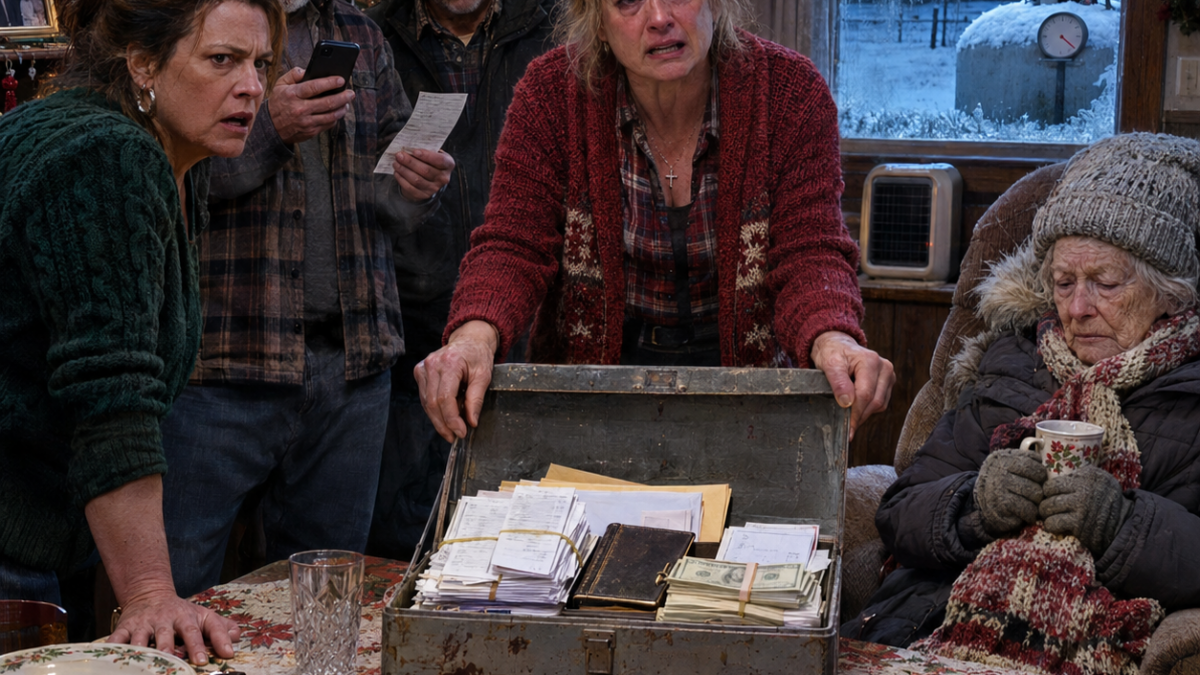
She walked in carrying Dad’s old metal cashbox.
Gray steel.
Dented corner.
He used it for farm receipts and seed invoices.
None of us had seen it since he died.
Pam set it on the kitchen table.
Right in front of Rob.
Conversation stopped.
Even the oven seemed loud.
Pam looked at Mom.
Then me.
Long breath.
“Before anybody calls me a thief, you need to see what I’ve been hiding.”
Rob set down his coffee.
“Then open it.”
Mom whispered:
“Rob.”
“No, Mom.”
Pam unlocked the box.
Inside were envelopes.
Receipts.
Canceled checks.
Medical bills.
Loan notices.
A small blue notebook.
And cash.
Not much.
She pushed the notebook toward us.
“This started three years ago.”
I opened it.
Dates.
Amounts.
Mom propane.
Mark medical.
Mortgage.
Groceries.
Repay.
Borrow.
Repay.
Over and over.
Not accounting.
Confession in handwriting.
Pam sat.
“Mark’s first back injury was three years ago.”
We knew.
Not surgery.
Earlier injury.
He missed six weeks.
Pam continued.
“We were behind.”
Her hands shook.
“Mom had propane money sitting in my account.”
Rob said:
“Not Mom’s money.”
Pam looked at him.
“I know.”
“Do you?”
“Yes.”
She wiped her eyes.
“I used three hundred dollars.”
“Without asking us.”
“Yes.”
“Did you ask Mom?”
Pam looked at Mom.
“Sort of.”
I said:
“What does sort of mean?”
“I told her we were struggling.”
“And she offered money?”
“Mom always offers.”
“That isn’t the same as telling her you were taking the propane fund.”
Pam shook her head.
“No.”
There it was.
No excuse.
Just no.
She continued.
“I replaced some of it after Christmas.”
I checked the old co-op statement.
That explained the smaller late delivery.
“Then the next year?”
Pam stared at the notebook.
“Mark’s hours got cut.”
Rob leaned back.
“Oh, come on.”
“I know.”
“Again?”
“I was going to replace it.”
“You keep saying that like it makes it okay.”
“I know it doesn’t.”
Dean finally spoke.
“How much total?”
Pam pushed an envelope toward him.
“I calculated $2,612.”
My spreadsheet said roughly $2,680.
Close.
Rob noticed my face.
“You got?”
“About sixty-eight dollars more.”
Pam nodded.
“There were two credits I wasn’t sure how to count.”
This was not somebody inventing numbers on the spot.
She had done the work.
Inside the envelope was a cashier’s check.
$2,612.
Payable to Margaret Harlow.
Mom pushed it away.
“I don’t want it.”
Pam began crying.
“Mom.”
“You need it.”
“No.”
Mom’s voice sharpened.
“You need it more than I do.”
That was the exact problem.
Pam covered her face.
“I almost let you freeze.”
Mom looked down.
No one spoke.
Pam whispered:
“I know.”
Then came this winter.
Mark’s surgery.
No income for months.
The October contributions arrived.
Rob.
Dean.
Me.
Pam had no $250 share.
She did not tell us.
Instead, she took enough from our $750 to pay for only 200 gallons.
The remaining money covered their overdue mortgage payment and prescription bills.
She told herself she would replace it in November.
Workers’ compensation would arrive.
It didn’t.
December.
Still delayed.
By January, she had no replacement money.
Mom’s tank was falling.
Pam knew.
That was the part I could not understand.
“You knew the gauge was low?”
“Yes.”
“How low?”
“Fifteen percent when I checked after New Year.”
My stomach turned.
“And you did nothing?”
“I called for pricing.”
“That isn’t doing something.”
“I didn’t have money.”
“Call us.”
She looked at me.
“I couldn’t.”
“Why?”
“Because then I had to tell you.”
Rob slapped his palm against the table.
“So you preferred Mom freezing to admitting you used the money?”
Pam flinched.
“No.”
“That is exactly what happened.”
Mom said:
“Rob.”
He stood.
“No.”
His chair scraped backward.
“I feed cattle at thirty below. I know what cold does.”
His voice broke unexpectedly.
“She is eighty-two years old.”
Pam began crying harder.
“I know.”
“You lived twelve miles away.”
“I know.”
“You let Ellen drive from Bismarck because nobody could reach Mom.”
“I was at Mark’s appointment that day.”
“That is not the point.”
Dean stood.
“Rob.”
“I’m not hitting anybody.”
“I know. Sit anyway.”
Rob walked to the kitchen window.
Did not sit.
I asked the question everyone had avoided.
“Why didn’t Mom answer the phone?”
Mom looked embarrassed.
“The cordless phone died.”
“Why?”
“I forgot to put it back.”
That simple.
No dark scheme.
Just an old woman forgetting to charge a phone.
The terror of those two unanswered evenings had been an accident.
The lack of heat was not.
I turned back to Pam.
“You told Mom propane was expensive.”
“It was.”
“You made it sound like our money had been spent on propane.”
Pam nodded.
“Yes.”
“You let her turn down the thermostat because she thought she was costing us too much.”
“Yes.”
I looked at the coat by the door.
Pam followed my eyes.
Her shoulders collapsed.
“I came by the Monday before Ellen found her.”
Mom looked at Pam.
I had not known that.
“What happened?”
“The house was sixty-one.”
My voice went quiet.
“You saw her in the coat?”
Pam nodded.
My hands went cold.
“Then why didn’t you call us?”
She cried.
“Because I was ashamed.”
I stared.
There are moments when someone’s explanation is understandable and still not enough.
That was one.
“Pam.”
“I know.”
“No.”
I shook my head.
“You keep saying you know.”
She looked at me.
“If you knew, you would have called.”
That landed.
She stopped defending herself.
Mom finally spoke.
“This is partly my fault.”
All four of us said:
“No.”
At the same time.
Mom looked annoyed.
“I am still allowed to have opinions in my own kitchen.”
Dean smiled despite himself.
She continued.
“I knew Pam was struggling.”
“You did not know the propane account was that low,” I said.
“No.”
“Did you know she’d used our contributions?”
“Some.”
Rob turned.
“Mom.”
“Don’t.”
She pointed at him.
“I knew she borrowed before.”
“How much?”
“I didn’t ask.”
“Why?”
“Because when you have four children, you don’t make them explain every bad year.”
Rob stared.
Mom continued.
“I told her she could use some money if she needed it.”
Pam shook her head.
“You told me I could ask.”
Mom looked at her.
Pam wiped her face.
“You never told me to take the propane money.”
That mattered.
Pam could have let Mom accept blame.
She didn’t.
“No,” Mom said quietly.
“I didn’t.”
Then Pam opened another envelope.
More documents.
Home-equity notice.
Medical bills.
Credit cards.
Mark’s disability approval.
Their financial situation was worse than any of us knew.
Almost $18,000 in medical and household debt.
Three missed mortgage payments before Mark’s benefits started.
Pam had been juggling everything.
Not living extravagantly.
No new car.
No vacations.
No hidden shopping habit.
Desperation.
Again:
Explanation.
Not permission.
Dean said:
“Why didn’t you ask us?”
Pam laughed through tears.
“Because look at Rob.”
Rob turned.
“What?”
“You would have given me money and hated me for needing it.”
“That is not true.”
Pam looked at him.
“Really?”
Rob opened his mouth.
Closed it.
Families know exactly where the honest answer lives.
Pam turned toward me.
“And Ellen would’ve made a spreadsheet.”
I held up my hands.
“I did.”
For one second, everyone laughed.
Even Pam.
Then she cried again.
“That’s why.”
She looked around.
“I was tired of being the one who needed help.”
I understood that more than I wanted to.
Dad had always called Pam his soft-hearted girl.
I was responsible.
Rob was strong.
Dean was steady.
Pam was caring.
After Dad died, she became the child closest to Mom.
Doctor appointments.
Groceries.
Pharmacy.
Church rides.
Snow checks.
She did more day-to-day caregiving than the rest of us.
That was true.
It was also true that we had turned closeness into unpaid responsibility without discussing what it cost.
Pam had handled Mom’s life because she was nearby.
We sent money once a year and felt responsible.
Maybe that was part of how resentment began.
Still, no resentment justified risking Mom’s health.
Both things could be true.
Rob finally returned to the table.
He pointed at the cashier’s check.
“Where did that come from?”
Pam looked down.
“We sold Mark’s fishing boat.”
Mark loved that boat.
Sixteen-foot Lund.
He had owned it almost twenty years.
Mom gasped.
“You didn’t.”
“We did.”
“You need that money.”
Pam shook her head.
“No.”
Her voice steadied.
“This isn’t about whether you need it.”
She looked at us.
“It wasn’t mine.”
That was the first sentence that sounded like responsibility instead of shame.
I pushed the check back toward her.
“Mom decides what happens to repayment.”
Pam nodded.
Mom said:
“I don’t want your boat money.”
Pam began to protest.
I stopped both.
“Not today.”
They looked at me.
“We are not solving three years in ten minutes because ham is getting cold.”
Dean nodded.
“Best thing Ellen’s said all day.”
“Thank you.”
“We decide systems today.”
Rob groaned.
“Here comes the spreadsheet.”
“Yes.”
First:
The propane account remained in my name for billing and monitoring.
Mom remained the property owner and account beneficiary.
Automatic keep-full service stayed.
Tank monitor alerts went to me and Dean.
Why Dean?
Because Rob admitted he would check the app twelve times a day.
He was removed from consideration.
Second:
Beginning every September, the four of us would send our heating contribution directly to a dedicated account used only for Mom’s propane and essential winter utilities.
No money through a sibling’s household checking account.
Not mine either.
Direct.
Transparent.
Third:
Mom would stop giving money secretly to any of us.
She hated that one.
“I can give my money to whoever I want.”
“Yes,” I said.
“But if you give a child more than five hundred dollars while simultaneously telling the rest of us you can’t afford heat, we get to ask questions.”
She glared.
Dean said:
“That seems fair.”
Mom glared at him too.
Fourth:
Pam would no longer handle Mom’s heating money.
Not punishment.
Boundary.
She could still help Mom.
Groceries.
Appointments.
Visits.
But money she had misused would not pass through her hands.
Pam nodded before anyone finished saying it.
“Agreed.”
Fifth:
We needed to share the caregiving load.
That one surprised Pam.
I said:
“You’ve been doing too much.”
Her eyes filled.
Rob looked uncomfortable.
Dean looked at his coffee.
I continued.
“Money did not disappear because we asked too much of you.”
Pam nodded.
“But we did ask too much.”
Silence.
“We sent $250 and called it helping.”
Rob rubbed his face.
I continued.
“You handled Mom’s appointments.”
“Groceries.”
“Prescription pickups.”
“Storm checks.”
“Everything because you’re closest.”
Pam whispered:
“Mostly.”
“So that changes too.”
Rob said:
“I can take the farm repairs.”
Dean:
“I’ll handle medical transport when county work isn’t insane.”
I said:
“I’ll handle utilities, insurance paperwork, and schedule coordination.”
Pam stared.
“What do I do?”
Mom said:
“Visit me.”
We all looked at her.
She smiled.
“Imagine that.”
Pam started crying again.
So did I.
The ham nearly burned.
Dean saved it.
Rob claimed that made him head of family crisis operations.
Nobody agreed.
We ate.
Awkwardly at first.
Pam sat across from me.
Mom between Dean and Rob.
The cashier’s check stayed beside Dad’s old cashbox.
Halfway through dinner, Mom served kuchen.
Nobody had room.
Everyone ate it anyway.
Family tradition.
After dessert, Mark arrived.
He had driven himself slowly.
Still walked with a cane.
He stood in the kitchen doorway.
“I figured I should show my face.”
Rob said:
“Probably.”
“Rob.”
Mom again.
Mark looked at me.
“I’m sorry.”
“You didn’t know?”
“Not until January.”
“You knew before Christmas.”
“Yes.”
“Why didn’t you call us?”
He looked at Pam.
“She asked me not to.”
I raised an eyebrow.
He nodded.
“I know.”
At least everybody had learned the phrase.
Then he said:
“I should’ve called anyway.”
That mattered.
He put another envelope beside the cashier’s check.
Repayment plan.
Not fancy.
$200 per month beginning in June until the full amount we could document was repaid.
Pam had calculated $2,612.
My records suggested $2,680.
Mark had written:
We will repay $2,700.
Rob picked it up.
“You don’t have to round up.”
Mark looked at him.
“Yes, we do.”
Mom protested.
Nobody listened.
For once.
Later, when everyone left, Pam remained.
Mom had gone to bed.
The brothers drove home.
Mark waited in the car because his back hurt.
Pam and I stood beside the kitchen sink.
“You hate me.”
“No.”
She looked surprised.
“I was furious.”
“Still am, a little.”
“But I don’t hate you.”
She stared at her hands.
“I hated you.”
That startled me.
“When?”
“January.”
“Why?”
“Because you came in and fixed everything in four hours.”
I said nothing.
“You drove from Bismarck.”
“Called one company.”
“Paid with your card.”
“Changed the account.”
“Texted everybody.”
She gave a bitter laugh.
“You made it look so easy.”
“It was easy because I wasn’t living your life.”
Her eyes lifted.
That was the sentence she needed.
She leaned against the counter.
“I was drowning.”
“I know.”
“No.”
“You don’t.”
“So tell me.”
For the next hour, she did.
Mark’s surgery.
Insurance fights.
Bills.
His anger at needing help.
Her fear of foreclosure.
Mom calling for rides.
Grocery trips.
Dad’s death still hitting her because she was the one inside the farmhouse most often.
Every room reminded her of him.
Then our annual checks arrived.
Money sitting in her account.
One transfer.
She would replace it.
Then another.
Each time, the line got easier to cross.
Not because she stopped loving Mom.
Because rationalization works slowly.
It’s temporary.
Mom has enough.
They won’t know.
I do more than everyone anyway.
I’ll pay it back.
Until one January afternoon she stood inside Mom’s cold house and still did not call us.
“That was the moment,” she whispered.
“What?”
“When I knew I had become someone I didn’t like.”
“Then why didn’t you call?”
“Because admitting it meant it was real.”
I understood.
Still not enough.
But understood.
“Your misery makes me happy” was not this story.
There was no villain laughing over an old woman freezing.
That would have been easier.
Pam loved Mom.
Pam also endangered her.
People want those statements to cancel each other.
They don’t.
Love does not automatically produce good behavior.
Sometimes love mixed with shame, pride, secrecy, and financial panic produces terrible decisions.
That was harder to forgive than simple greed because there was no clean monster to reject.
Just my sister.
Who had failed badly.
Mom accepted the repayment plan on one condition.
Half the money would go into an emergency household account.
Half would go back to Pam and Mark once his work situation stabilized.
We objected.
Mom said:
“My money.”
She won.
Partly.
The actual diverted propane funds were repaid to Mom.
Later, separately, Mom chose to give some money to Pam.
Transparent.
Written.
No secrets.
That distinction mattered.
Generosity is different when everyone knows what it is.
Mark returned to work part-time in May.
Full-time by August.
They sold the boat.
Used some money to pay debts.
Not all.
We did not rescue everything.
Rob wanted to.
Then remembered Christmas.
Helping without creating another hidden system required discipline.
Pam and Mark entered a debt-management plan.
They refinanced nothing against Mom’s property.
Important.
No family loans without paperwork.
Painfully adult.
Mom’s propane tank never fell below twenty-eight percent again.
I know because I checked.
Too often at first.
The co-op app became my morning newspaper.
Dean texted once:
Tank 61%. You can live your life.
I replied:
No.
He sent an eye-roll emoji.
At fifty-eight, I learned siblings can still annoy you with emojis.
October came.
First autumn after the Christmas confrontation.
I created a family group message.
Propane contribution due Sept 15. $250 each. Direct account info attached.
Rob paid in eleven minutes.
Dean in twenty.
Pam waited three days.
Then $250 arrived.
No comment.
I texted:
Received. Thank you.
She replied:
You’re welcome.
Simple.
Something about that small transaction made me emotional.
Not because of the money.
Because it was clean.
No story around it.
No shame.
No private borrowing.
$250 from sister.
For Mom.
Where it belonged.
The first automatic delivery came November 19.
Mom called me furious.
“They came when I still had thirty-one percent.”
“Yes.”
“They’re wasting money.”
“No.”
“They put in two hundred seventy gallons.”
“Yes.”
“I could have waited.”
“Mom.”
“Propane doesn’t spoil.”
“Neither do you.”
“What does that mean?”
“I don’t know. It sounded good.”
She hung up on me.
Ten minutes later, she called back.
“House is seventy-one.”
“Good.”
“Too warm.”
“Put on a T-shirt.”
She laughed.
That laugh told me we were okay.
Pam became more reliable with Mom after Christmas, not less.
I worried she might withdraw out of shame.
She didn’t.
She visited.
But she stopped managing everything.
Rob replaced the back steps.
Dean started taking Mom to Fargo for the appointments that required longer drives.
I began coming every other weekend instead of waiting for emergencies.
We discovered something uncomfortable:
Pam had been right about one thing.
We had left too much on her.
Not the money.
Never the money.
But caregiving.
Distance gave the rest of us plausible innocence.
We called Mom.
Sent checks.
Asked:
“Everything okay?”
Mom always said yes.
Pam saw the actual work.
Expired milk.
Snow at the steps.
Medication refills.
Appointments.
A toilet that wouldn’t stop running.
The loneliness that arrives at four in the afternoon during winter when darkness comes early and the person you married is no longer sitting across the room.
We had outsourced Mom emotionally.
Pam had then blurred that burden with financial entitlement.
Both needed correcting.
The following Christmas felt different.
Pam arrived early.
That alone caused Rob to look outside for signs of apocalypse.
She brought kuchen from a bakery.
Mom tasted it.
“Mine is better.”
Pam said:
“Obviously.”
No cashbox.
No confrontation.
Mark came.
Walking normally.
The propane tank was at forty-six percent.
I knew.
Nobody asked.
At dinner, Mom said:
“Last year was terrible.”
Pam looked down.
Mom continued:
“But it got you all here.”
Dean smiled.
“Mom, please don’t turn near-hypothermia into a family-reunion strategy.”
She laughed.
“I’m just saying.”
Rob said:
“Next year use a group text.”
Mom shook her head.
“No one reads those.”
True.
Pam’s final repayment came the following November.
$200.
She texted me:
That’s the last one.
I checked the emergency account.
Correct.
Then:
I know this doesn’t undo anything.
I stared at the message.
Typed.
Deleted.
Typed again.
Finally:
No. But finishing matters.
She replied:
Thank you.
I did not say:
I forgive you.
Not then.
Forgiveness had already started in smaller ways.
Answering her calls.
Having coffee.
Laughing.
Letting her bring Mom to appointments without wondering whether every errand hid something.
Trust did not return because we declared it.
It returned because boring things happened correctly over time.
That is how trust usually comes back.
Quietly.
Mom turned eighty-four.
We held the birthday at the farm.
Seventeen people.
Grandchildren.
Great-grandchildren.
Casseroles.
Too much cake.
Someone asked why there was a little digital propane monitor mounted near the mudroom.
Mom pointed at me.
“Because Ellen is insane.”
I said:
“Because Margaret enjoys experimenting with frostbite.”
Everyone laughed.
Pam did too.
Then she said:
“She’s right.”
The room went slightly quiet.
Pam continued:
“I messed up.”
No details.
No dramatic confession.
Just ownership.
Mom touched her arm.
Then conversation moved on.
That mattered more than a speech.
The brown winter coat still hangs beside Mom’s kitchen door.
She wears it outside.
Normal use.
For a while, I hated seeing it.
It reminded me of her sleeping in the recliner.
Then winter came again.
Mom put it on to feed birds.
I realized the coat had existed before that terrible morning.
It did not belong to the memory.
Objects do not have to remain evidence forever.
Sometimes they get to become coats again.
Dad’s old recliner eventually broke.
The footrest jammed.
Rob wanted to repair it.
Mom said:
“Throw it out.”
We all stared.
Dad had loved that chair.
Mom shrugged.
“He was dead, not holy.”
Dean nearly choked laughing.
We bought her a new recliner.
Heated.
She complained the heat was “ridiculous.”
Then used it every day.
The farm changed slowly.
We installed better storm windows.
Insulated the attic.
Replaced the old thermostat with a simple programmable one.
Not a complicated smart-home system.
Mom threatened to disown me when I suggested one.
The propane use dropped.
Heat became less expensive.
Not cheap.
North Dakota does not believe in cheap January.
But manageable.
One winter morning, the co-op called me.
“Your mother’s tank monitor is showing unusual consumption.”
My stomach immediately tightened.
Leak?
Furnace problem?
I called Mom.
No answer.
For three seconds, I was back in that first January.
Then Pam called.
“I’m here.”
I almost cried from relief.
“What happened?”
“Mom turned the thermostat to seventy-eight.”
In the background, Mom shouted:
“I was cold!”
Pam laughed.
I laughed.
No emergency.
Just an eighty-five-year-old woman finally willing to admit she wanted heat.
Progress.
That became the deeper change.
Mom stopped treating comfort like selfishness.
She had grown up during years when money was scarce.
Dad had been careful.
Turn down the thermostat.
Wear another sweater.
Don’t waste fuel.
Those habits become morality if you repeat them long enough.
Even with money available, Mom felt guilty using it.
Pam’s lies had fed directly into that old fear.
“Propane costs more.”
Mom heard:
You are expensive.
So she used less.
That hurt me.
Not because Pam invented Mom’s fear.
Because she knew enough to use it.
Pam admitted that later.
“I knew she’d turn it down rather than ask.”
That sentence was one of the hardest.
Intent matters.
She had not wanted Mom harmed.
But she had counted on Mom’s self-denial to hide the shortage.
That was a serious betrayal.
We did not soften it.
Mark once asked whether I still considered Pam a thief.
We were alone near the machine shed.
I thought.
“No.”
He nodded.
Then:
“Do you think she stole?”
“Yes.”
He looked surprised.
“What’s the difference?”
“She did something dishonest.”
I watched snow slide from the roof.
“I don’t think dishonesty is her identity.”
Mark said nothing.
Neither did I.
That distinction helped me keep my sister without pretending nothing happened.
Rob took longer.
Much longer.
For almost two years, he never let Pam pay for anything around Mom without making a comment.
“Make sure that actually goes where it’s supposed to.”
“Rob.”
Usually Dean.
Sometimes me.
Pam tolerated it at first.
Then one Christmas she finally snapped.
“I paid it back.”
Rob said:
“Doesn’t change what happened.”
“No.”
She stood.
“But if you’re going to punish me for the rest of my life, just say that.”
Silence.
Mom left the room.
Smart woman.
Rob looked at Pam.
His face changed.
“I found Mom cold.”
“No.”
“Ellen did.”
“But I pictured it.”
He swallowed.
“Every time I look at you.”
Pam started crying.
“I know.”
“I wanted to drive over and…”
He stopped.
“Do what?”
“I don’t know.”
He sat.
“I was scared.”
That was it.
Not only anger.
Fear.
Rob had almost lost Dad suddenly to a heart attack years earlier.
Finding out Mom had been vulnerable while he was less than an hour away made him feel he had failed.
Anger had been easier.
Pam sat opposite him.
“I’m sorry.”
“I know.”
Then Rob surprised all of us.
“I’m tired of being mad.”
No hug.
Not yet.
But he stopped making the comments.
Trust returned one sibling at a time.
Dean had always been easiest.
Middle-child diplomacy.
He forgave earlier.
But his forgiveness had a flaw.
He avoided conflict.
At Christmas, he had been the one calming everyone.
Later, he admitted:
“I should’ve asked harder questions years ago.”
“Why you?”
“Because Pam called me when she was struggling.”
I looked at him.
“When?”
“The winter before Mark’s surgery.”
“What did she say?”
“That money was tight.”
“Did she ask for money?”
“No.”
“What did you do?”
“Told her everyone was struggling.”
He stared at the table.
“I think she was trying to ask.”
Maybe.
Maybe not.
Families can turn hindsight into false certainty.
I told him:
“You are not responsible for what she chose later.”
He nodded.
“Neither is she responsible for us not helping enough before.”
Fair.
That was why the family survived.
Nobody got to convert explanation into innocence.
Nobody got to convert anger into permanent punishment either.
Mom reached eighty-seven.
Still at the farm.
Against medical advice.
Against everyone’s preference.
Against reason.
She had help now.
Cleaner once a week.
Meal delivery during winter storms.
Emergency alert pendant she claimed never to wear but somehow always had around her neck when we arrived.
The farm stayed home because we made it safer instead of using every problem as proof she had to leave.
Pam continued living closest.
She became the sibling who visited most.
Again.
But this time, the rest of us did not pretend that meant she had to carry everything.
Shared calendar.
Rotations.
Direct billing.
Transparent accounts.
Simple systems.
Boring systems.
Boring saved us.
One afternoon, Mom handed me Dad’s old metal cashbox.
“The one Pam brought?”
“Yes.”
“I don’t want it.”
“What should I do?”
“Burn it.”
“It’s metal.”
“Then be creative.”
I laughed.
Inside were the old heating records.
Pam’s notebook.
Copies of repayment receipts.
Mom’s checks.
The cashier’s check stub.
Evidence of a family failure.
I asked Pam if she wanted the notebook.
“No.”
“You sure?”
“Yes.”
“What do we do with it?”
She thought.
“Keep it until Mom’s gone.”
“Then?”
“Throw it away.”
I nodded.
Not everything needs to become a family heirloom.
Mom died at eighty-nine.
Not in winter.
June.
Warm morning.
Window open.
Birds outside.
She had been declining for several months.
All four of us were with her during the final week.
Pam slept at the farm.
Rob handled outdoor work.
Dean coordinated hospice supplies.
I handled medication charts and insurance.
Old roles.
Different now because we chose them.
Mom died in the new heated recliner.
She would have hated the poetry of that.
After the funeral, we cleaned the house.
Brown winter coat.
Pam held it.
“What do we do with this?”
Nobody answered.
Rob finally said:
“Donate it.”
Pam touched the sleeve.
“I can’t.”
I understood.
She had been carrying that image longer than any of us.
Mom asleep in it because Pam had not ordered propane.
I said:
“Then keep it.”
Pam shook her head.
“No.”
She folded it carefully.
We donated it to the church winter-clothing drive.
Someone else would wear it because they needed warmth.
That felt right.
Then the cashbox.
We sat at Mom’s kitchen table.
Same seats as Christmas years before.
Rob opened it.
Pam’s notebook on top.
He looked at her.
“You ready?”
She nodded.
He fed the pages into the woodstove.
Not all financial records.
Important account documents had already been archived where necessary.
The notebook.
The shame ledger.
One page after another.
Borrow $300.
Repay $150.
Mom propane.
Mortgage.
Medical.
The fire curled the paper.
Pam cried quietly.
So did Rob.
Dean put one hand on her shoulder.
I watched.
No speech.
When the last page burned, Rob said:
“That doesn’t mean it didn’t happen.”
Pam nodded.
“I know.”
“It means we don’t need the notebook anymore.”
She looked at him.
Then they hugged.
Years late.
Still in time.
Mom’s estate was uncomplicated.
The farm went equally among the four of us.
She had changed her will years earlier so no one sibling controlled the property.
Smart.
We leased the land.
Kept the house.
Shared family place.
Not forever, maybe.
For now.
The propane account stayed in my name until the following fall.
The first time the co-op called asking whether the farmhouse still needed keep-full service, I could barely speak.
“Yes.”
Then:
“Actually, no.”
The house would be used seasonally.
We drained lines.
Winterized.
Kept minimal heat.
The same tank that had once frightened me became an ordinary utility again.
Every October, the group chat still lights up.
Rob:
PROPANE TAX DUE.
Dean:
Mom is dead, genius.
Rob:
Farm still needs heat.
Pam:
Send it directly. Ellen will audit you.
Me:
Correct.
We laugh.
Dark humor is one of the ways families prove the wound has scarred rather than remained open.
People sometimes ask why we didn’t call the police on Pam.
There was no dramatic reason.
Mom did not want that.
We were dealing with a few thousand dollars diverted within a family arrangement, much of it complicated by Mom’s own voluntary help and poor recordkeeping.
Could we have turned it into something uglier?
Probably.
Would that have made Mom warmer?
No.
We chose repayment.
Transparency.
Loss of financial control.
Shared caregiving.
Accountability inside the family.
That was the justice the situation needed.
Not every betrayal requires a courtroom.
Some require a bank statement placed in the middle of a kitchen table where everyone finally agrees to stop lying.
But I also reject the version where Pam was simply a victim of circumstances.
She wasn’t.
She lied.
Repeatedly.
She used money for a purpose we had not authorized.
She let Mom believe heating costs had consumed funds that never reached the co-op.
Worst of all, she saw Mom’s house at sixty-one degrees, knew why, and stayed silent because admitting the truth frightened her more than Mom’s discomfort did.
That choice mattered.
We never erased it.
Forgiveness that requires pretending harm did not happen is only another lie.
What changed was that Pam eventually stopped asking us to minimize it.
At first:
“Propane was expensive.”
“Mark was sick.”
“You all left everything on me.”
Later:
“I used the money.”
“I lied.”
“I saw Mom cold.”
“I should have called.”
“I was wrong.”
Those sentences rebuilt trust more effectively than the cashier’s check.
Money repaid the account.
Truth repaid something else.
The Christmas cashbox became family legend too.
Grandchildren heard a sanitized version.
“Aunt Pam once borrowed money she shouldn’t have.”
Pam corrected them when they were older.
“I didn’t borrow it.”
They looked surprised.
“What?”
“I took it without asking properly.”
“Why tell them that?” I asked later.
“Because ‘borrowed’ makes me sound better.”
I stared.
Pam smiled.
“Look at me growing.”
I laughed.
She had.
Mark eventually bought another fishing boat.
Smaller.
Used.
Pam paid cash.
The first time they took it out, she sent a picture.
Mark holding a walleye.
Caption:
THIS ONE DOES NOT BELONG TO MOM.
I laughed so hard I called her.
“Too soon.”
“It has been six years.”
“Still.”
She laughed.
That was my sister again.
Not before the betrayal.
After it.
Different.
More honest.
The winter I found Mom in her coat changed the way I think about family money.
People say:
“It’s only family.”
As if that means rules are unnecessary.
I think the opposite now.
The more love matters, the clearer money should be.
Direct payments.
Shared records.
Written expectations.
Not because you distrust everyone.
Because secrecy creates pressure love should not have to carry.
Pam’s mistake began partly because our system depended on unspoken trust and one overwhelmed person.
Her dishonesty was hers.
The bad design was all of ours.
We fixed both.
It also changed how I think about elderly parents.
We had asked Mom:
“Are you okay?”
She always said yes.
Wrong question.
The right questions were:
“What is the thermostat set to?”
“How much propane is left?”
“Do you have enough medication?”
“When is your next appointment?”
“What is hard right now?”
Older parents protect children too.
Sometimes by hiding exactly what the children need to know.
Love can conceal danger from both directions.
You have to ask better questions.
I still remember walking into that silent farmhouse.
The clock.
Frost.
Brown coat.
Dad’s recliner.
Fifty-eight degrees.
I thought my anger at Pam would last forever.
It didn’t.
Fear lasted longer.
For years, every unanswered call from Mom made my heart race.
Even after we had systems.
Even after Pam changed.
Trauma does not consult spreadsheets.
Eventually that faded too.
The line that stayed with me most was not anything Pam said at Christmas.
It was Mom, one hour after the furnace restarted.
Standing beside the kitchen register.
Hands above warm air.
“I’d almost forgotten how nice warmth feels.”
An eighty-two-year-old woman should not forget warmth because her children cannot tell each other the truth.
That became my line.
Any time somebody wanted to avoid an uncomfortable conversation later, I asked:
“What does avoiding it cost?”
Usually less than cold.
Sometimes more.
Worth asking.
Years later, when we sold part of the farm equipment, the four of us sat at the same table.
Money.
Again.
Rob said:
“Direct deposit.”
Dean:
“Shared spreadsheet.”
Pam raised both hands.
“I have been rehabilitated.”
I said:
“Systems are not insults.”
She smiled.
“I know.”
That was the final proof.
She no longer treated transparency as punishment.
Neither did the rest of us.
I once asked Pam whether she remembered the exact moment she realized I had changed the account.
“Yes.”
“What did you feel?”
“Rage.”
I laughed.
“Really?”
“Absolute rage.”
“Why?”
“Because you took away the place where I could hide the problem.”
That was one of the most honest things she ever said.
The account change did more than ensure fuel.
It removed discretion.
No more waiting.
No more borrowing.
No more covering.
The co-op saw the tank.
I saw the bill.
The system acted.
Pam’s secret stopped having room to breathe.
Sometimes boundaries feel cruel to the person whose unhealthy freedom they remove.
That does not make the boundary wrong.
I had felt guilty changing the account without telling her.
For about twelve hours.
Then I remembered Mom’s cold fingers.
Guilt vanished.
You do not need consensus to stop an immediate safety problem.
You need clarity.
Warm the house first.
Discuss feelings later.
That became another family saying.
Whenever someone overcomplicated a practical crisis, Dean said:
“Propane first.”
Meaning:
Solve the danger.
Then argue.
Useful philosophy.
The story people prefer is simple.
Three siblings send money.
Greedy sister steals it.
Old mother freezes.
Truth exposed at Christmas.
Justice.
But our family was not that simple.
Pam was wrong.
Also overwhelmed.
Mom was harmed.
Also complicit in hiding Pam’s struggle.
The rest of us were generous.
Also distant.
Mark was innocent of the original decision.
Also stayed quiet too long after learning it.
Rob’s anger was justified.
Also sometimes cruel.
I solved the propane problem.
Also enjoyed being the competent one more than I liked admitting.
Families rarely contain one innocent person and one villain.
They contain people with histories.
Weaknesses.
Excuses.
Love.
Bad decisions.
The goal is not always deciding who deserves exile.
Sometimes it is deciding what can never happen again.
Mom never slept in a winter coat indoors again.
That is the only ending I need.
She complained about heat bills.
Complained about automatic deliveries.
Complained when we insulated too much and the upstairs bedroom became “stuffy.”
Wonderful.
Let her complain.
Complaints require enough comfort to notice imperfections.
Pam never handled Mom’s money again.
She did something harder.
She remained close without controlling it.
She visited because she loved Mom.
Not because she was the designated manager.
Their relationship improved.
Mom stopped asking her for every small errand because we divided them.
Pam stopped feeling invisible.
Again:
None of that excused what happened.
It explained what needed repair around the wrongdoing.
Justice without repair can stop bad behavior.
Repair without justice can excuse it.
We needed both.
If I could return to that January morning, I would do almost everything the same.
Call the co-op.
Pay the bill.
Keep-full service.
Account in my name.
Notify my brothers.
Wait to confront Pam until we had records.
I would change one thing.
I would tell Mom sooner:
“You are allowed to need us.”
Because that was underneath her silence.
She thought warmth was an indulgence if one child was struggling financially.
She thought motherhood required being the person who always gave.
Even at eighty-two.
Even while shivering.
That idea had to end too.
At the final Christmas Mom hosted, she was eighty-eight.
Weak.
But determined.
We begged to order food.
She refused.
Ham.
Potatoes.
Kuchen.
Halfway through dinner, she looked around.
“Remember the Christmas with the cashbox?”
Pam groaned.
“Mother.”
Mom laughed.
“I thought Rob was going to explode.”
“I almost did.”
Dean said:
“I saved the ham.”
No one cared.
He still mentions it.
Mom looked at Pam.
Then at me.
“You girls scared me.”
“Us?”
“Yes.”
“I thought you’d stop speaking forever.”
Pam reached across the table.
Took my hand.
“No.”
I squeezed hers.
Mom smiled.
“I worried for nothing.”
I looked at her.
“No.”
“You worried because we gave you reasons.”
She considered that.
Then nodded.
“Fair.”
That was Mom.
She could accept correction when you gave her enough time.
Usually several years.
After Mom died, I found a note inside her recipe box.
Her handwriting.
Folded behind the kuchen recipe.
It read:
Ellen worries too much. Rob gets mad too fast. Dean thinks every fight can be fixed with coffee. Pam carries things until she drops them. Remind them they are all mine.
I sat on the kitchen floor and cried.
Then laughed.
Because she had all four of us perfectly.
At the bottom:
Also, do not let them turn the heat below 68.
That became the line we framed.
Not the cashbox.
Not the propane receipts.
Mom’s final rule.
The old farmhouse thermostat now stays at sixty-eight when the house is occupied.
Seventy when Pam visits because she claims she has “earned luxury.”
Rob complains.
Dean brings coffee.
I check the propane app.
Some family roles survive reform.
That is okay.
If you ask me where the missing propane money went, the answer is easy.
Medical bills.
Mortgage arrears.
Groceries.
A frightened sister trying to keep her own household from collapsing.
If you ask me whether that made it acceptable, the answer is equally easy.
No.
The money had a purpose.
Our mother’s heat.
Pam crossed that line.
Then crossed another when she lied.
Then another when she saw Mom cold and stayed silent.
Those facts matter.
So does what she did next.
She came to Christmas.
Brought the records.
Admitted it.
Sold something she loved.
Repaid the money.
Accepted losing control of the account.
And spent years proving the truth mattered more than protecting her pride.
That is why she is still my sister.
Not because family means unlimited forgiveness.
Because accountability gave us something honest enough to rebuild.
That January afternoon, after the propane truck left, I watched Mom remove her winter coat.
She hung it beside the door.
Her house warmed one degree at a time.
Fifty-nine.
Sixty-one.
Sixty-four.
Sixty-seven.
Seventy.
I remember thinking heat was incredibly simple.
Fuel enters a tank.
Furnace ignites.
Warm air moves.
Family is harder.
Money moves.
Trust moves.
Shame interferes.
People hide.
People protect.
Sometimes the system fails quietly until somebody walks into a cold room and finally looks at the gauge.
Pam thought changing the propane account meant I had taken something away from her.
I had.
I took away the ability to hide a shortage.
But I also took away a burden none of us should have left on one sibling.
Years later, she admitted:
“Losing that account was a relief.”
“After you stopped being furious?”
“Much later.”
“How much later?”
“Maybe three years.”
I laughed.
Still progress.
Every October, I once sent $250 and assumed that made me a good daughter.
It helped.
But money was never the whole responsibility.
The real lesson wasn’t:
Never trust your sister.
It was:
Never make one person carry a family obligation so quietly that nobody can see when she starts failing under it.
And never let shame become more important than asking for help.
Most of all:
Never let an eighty-two-year-old woman sit inside a freezing farmhouse because everybody is too proud to tell the truth.
Pam placed Dad’s metal cashbox on the Christmas table believing she was about to lose three siblings.
Instead, she lost something else.
Secrecy.
Control over Mom’s heating money.
The right to hide behind vague explanations.
Those losses were necessary.
In return, over time, she got something better.
Help.
Not rescue.
Help.
A family willing to share the work she had been carrying and still hold her accountable for what she had done with the money.
That was our justice.
Not humiliation.
Not exile.
Warmth.
Repayment.
Transparency.
And the promise that Mom would never again have to choose between protecting one child and turning up the thermostat.
The last winter Mom lived at the farm, temperatures fell below thirty again.
I called.
She answered immediately.
“Ellen, don’t start.”
“Tank?”
“Forty-three percent.”
“Thermostat?”
“Seventy-two.”
I blinked.
“Seventy-two?”
“I’m eighty-eight.”
She sounded offended.
“I have earned two extra degrees.”
I laughed.
“Yes, ma’am.”
“Pam is bringing soup.”
“Good.”
“And before you ask, she is not paying the propane bill.”
I laughed harder.
Mom did too.
That is the memory I choose now.
Not the coat.
Not the frost.
Not five percent.
Mom warm.
Pam coming up the driveway.
The account full.
The truth no longer hiding anywhere.
Because the most important thing I did that terrible January morning wasn’t paying $784 for propane.
It was making sure that from then on, nobody in our family could ever confuse love with secrecy strongly enough to leave our mother cold again.








