FULL STORY:They Beat Me Unconscious, Then Told Police I Was the Violent One—But My Husband’s Face Changed When the Doctor Found What Was Under My Collar
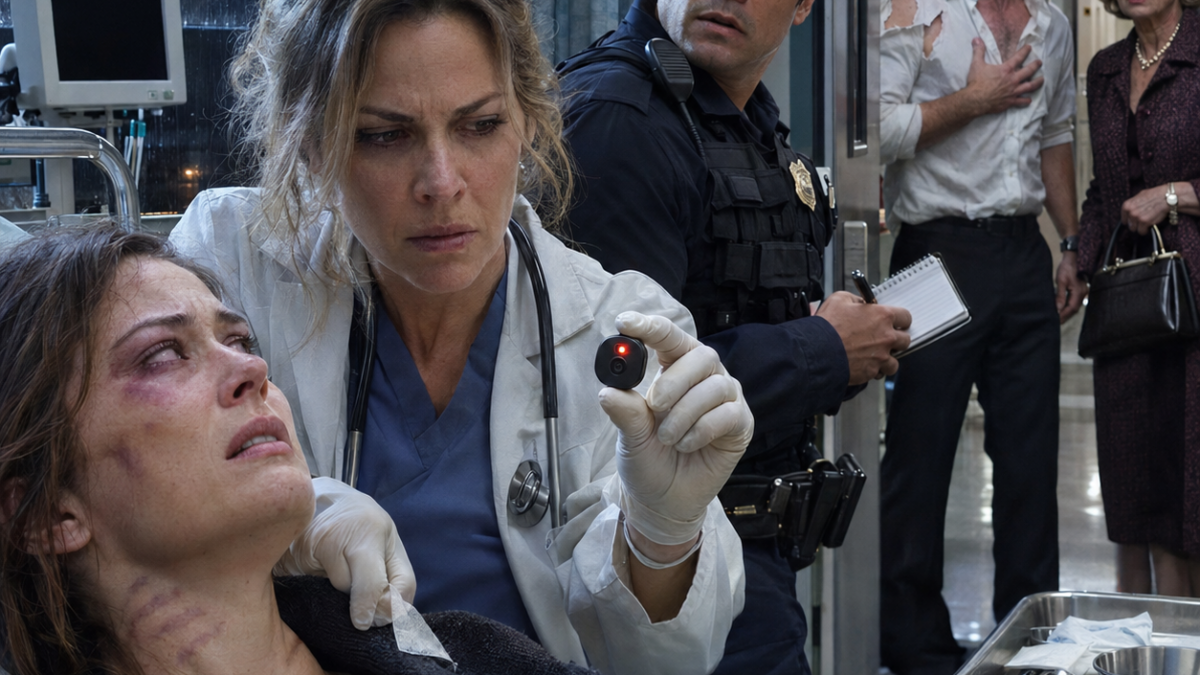
Officer Reyes didn’t immediately look at Colin.
That was the first thing I noticed.
He kept his attention on me, watching how difficult it was for me to speak, while Dr. Morris instructed a nurse to move my stretcher away from the open emergency entrance.
Rain had soaked through my clothing.
I was shaking so violently that my teeth began chattering.
Somewhere behind me, Gwendolyn was still talking.
She was using the same voice she used at charity fundraisers and company dinners.
Soft.
Concerned.
Perfectly controlled.
“Officer, she has a documented history of instability. My son has been desperately trying to protect her from herself.”
I wanted to tell her to shut up.
I wanted to sit upright and describe every lie she’d helped create.
But a wave of pain moved through my chest when I tried to take a full breath.
Dr. Morris noticed immediately.
“Don’t force yourself to talk,” she said. “Your medical care comes first.”
I nodded.
Reyes bent slightly so I could see him without lifting my head.
“We can take your statement after the doctors assess you. Are you telling me your husband injured you?”
I managed one word.
“Yes.”
“Did his mother participate?”
I looked toward Gwendolyn.
She stood beside Colin, holding a tissue against her cheek despite the absence of tears.
“Yes.”
Reyes nodded.
“Thank you. We’ll need to investigate.”
He didn’t promise an arrest.
He didn’t say the recorder proved anything.
He didn’t announce that he’d solved the entire case.
And because he didn’t, I trusted him a little more.
He turned toward another officer.
“Please keep the parties separated. Document their statements independently.”
Colin’s voice rose immediately.
“Why are you treating me like a criminal?”
Reyes looked at him.
“Sir, we need to establish what happened.”
“I already told you!”
“Then we’ll document your account.”
“My wife is mentally ill!”
I closed my eyes.
There it was again.
The phrase they’d spent months preparing.
Mentally ill.
Not injured.
Not frightened.
Not a woman asking for help.
An unstable woman whose words could be dismissed before anyone considered whether they were true.
I felt the stretcher begin moving.
As the automatic doors opened, Colin called after me.
“I love you, Evelyn! Please stop doing this to us!”
His voice sounded broken.
Convincing.
Almost beautiful in its desperation.
I had loved that voice once.
Now I knew how easily he could make it lie.
The doors closed between us.
And I finally let myself cry.
My name is Evelyn Whitmore.
I was thirty-nine years old when my husband tried to take my company, my reputation, and very nearly my life.
Before that night, I had spent most of my adult years believing that intelligence and preparation could protect me from almost anything.
I had been wrong.
Not because intelligence was useless.
Not because preparation didn’t matter.
But because I had underestimated what happened when the people closest to you decided that your trust was something they could exploit.
My father, Charles Whitmore, founded Whitmore Technologies before I was born.
He started with three engineers in a rented office above a printing shop.
By the time I was old enough to understand what he did, the company was producing specialized enterprise software.
By the time I graduated college, it had expanded into cybersecurity, infrastructure monitoring, and corporate data systems.
Eventually, it became one of the most respected privately held technology companies in the region.
My father never called it an empire.
He hated that word.
“Empires are built to conquer people,” he’d say. “A company should be built to solve problems.”
I used to roll my eyes.
He’d laugh.
Then he’d make me explain exactly what I disagreed with.
That was how we argued.
Not loudly.
Not cruelly.
We asked questions.
We challenged assumptions.
And when one of us was wrong, we admitted it.
I didn’t realize how rare that kind of relationship was until I married Colin.
Dad had been dead for eleven months when everything collapsed.
Cancer took him after a difficult illness that seemed to shrink a man I’d always considered indestructible.
During his final weeks, he worried less about money than about the people who depended on his company.
He knew employees by name.
He remembered whose spouse had undergone surgery.
Whose daughter had graduated.
Which engineer had recently become a father.
He could walk through a development team meeting and explain why a software problem mattered to a customer, then spend twenty minutes asking a junior employee about her first project.
I had spent years studying him.
Sometimes trying to become like him.
Sometimes trying to prove I could be different.
When he died, the board appointed me chief executive in accordance with the company’s governance arrangements.
His estate left me a controlling ownership interest.
The company was valued at hundreds of millions of dollars, with estimates approaching a billion depending on the assumptions used.
Financially, I was fortunate beyond anything I could have imagined as a child.
Emotionally, I felt as though someone had removed the foundation beneath my feet.
And Colin knew it.
He knew exactly when I was most vulnerable.
I met Colin Whitmore at a technology-industry fundraiser five years earlier.
His surname was Hartley then.
Colin Hartley.
He later took my surname after we married, something he’d presented as a romantic gesture.
He told me he wanted us to share one name and one future.
At the time, I thought it was beautiful.
Later, I wondered whether he’d understood exactly how much power and recognition the Whitmore name carried.
Colin was handsome, confident, and charming.
He knew how to make people feel important.
At dinners, he remembered names and introduced strangers with carefully chosen compliments.
He could tell a story that made an entire table laugh.
When he spoke to me, he listened with an attentiveness I hadn’t experienced in years.
He asked about my research.
My career.
My father.
The difficult decisions involved in building secure software.
He seemed genuinely fascinated.
And because he appeared to value the part of my life that mattered most to me, I trusted him.
For the first two years, our relationship seemed wonderful.
He brought me coffee when I worked late.
Planned vacations around my schedule.
Surprised me with thoughtful gifts.
He knew I loved old bookstores and quiet restaurants.
He understood that I sometimes became absorbed in work.
Or at least he pretended to.
We married in a small ceremony attended by family and close friends.
My father walked me down the aisle.
I still have the photograph.
Dad smiling.
Colin holding my hand.
Me looking happier than I knew how to describe.
Sometimes I wish I could speak to the woman in that photograph.
Not to tell her never to marry.
Not to warn her that love is dangerous.
But to remind her that someone who loves you doesn’t need to control what you own.
And that a person’s kindness matters most when they don’t get what they want.
Colin didn’t change overnight.
That was what made the truth so difficult to recognize.
The first signs were small.
He started asking detailed questions about the company’s voting structure.
I explained what I could.
Then he wanted to know why certain shares were held through trusts.
Why the board had independent directors.
Why I couldn’t simply appoint him to a senior role.
I told him that executive positions required qualifications and board approval.
He laughed.
“Sweetheart, I’m not asking for a job. I’m trying to understand our future.”
Our future.
He used that phrase often.
At first, I found it reassuring.
After Dad became seriously ill, Colin began attending more family meetings.
He offered to organize paperwork.
Help with appointments.
Communicate with attorneys.
He was attentive in public.
And whenever I became exhausted, he encouraged me to rest.
But he also began telling people I was overwhelmed.
Then emotionally fragile.
Then unable to handle stress.
The descriptions grew stronger as Dad’s condition worsened.
I didn’t notice the pattern immediately.
I was too busy trying to keep my father comfortable while running a large company.
When Dad died, Colin stepped into every silence.
He answered calls.
Screened messages.
Told relatives I needed privacy.
Explained to friends that I wasn’t ready to see them.
Sometimes I appreciated the help.
Other times I felt strangely isolated.
When I questioned him, he’d look hurt.
“Evelyn, I’m protecting you.”
I wanted to believe him.
So I did.
Gwendolyn Hartley, Colin’s mother, became a constant presence after the funeral.
She had always been impeccably dressed.
Even at breakfast, she looked ready to attend a formal luncheon.
Her silver-blonde hair was carefully styled.
Her jewelry was understated but expensive.
And she possessed a talent for delivering insults in a tone that made them sound like concern.
“You look exhausted, darling. Are you sure you’re making sensible decisions?”
Or:
“Grief does strange things to the mind.”
Or:
“Charles would never have wanted you to carry so much responsibility.”
At first, I mistook those remarks for awkward attempts at sympathy.
Then they became more pointed.
She began asking whether I was sleeping.
Whether I was taking medication.
Whether I had considered stepping back from the company.
Whenever I disagreed, she sighed.
“Your father could be stubborn too.”
She made it sound like an inherited illness.
I didn’t realize until much later that she was gathering material for a story.
A story in which I was unstable.
Overwhelmed.
Unreliable.
And increasingly incapable of managing the company I’d spent years helping build.
Three weeks before the hospital, I found the first document.
It was a scanned psychiatric report stored in a restricted corporate document repository.
The file was labeled as part of an executive continuity review.
I had never authorized that review.
And I had certainly never undergone the psychiatric examination described in the report.
At first, I thought the file had been uploaded incorrectly.
Then I opened it.
My name appeared across the top.
Evelyn Whitmore.
The report claimed I had experienced severe episodes of paranoia, emotional instability, and impaired judgment.
It described consultations that had never occurred.
Medication I had never been prescribed.
Behavior that had never been documented by any legitimate clinician who had evaluated me.
The signature belonged to a psychiatrist I didn’t recognize.
My stomach tightened.
I checked the document metadata available to me.
Then the access history.
Then related files.
There were references to capacity proceedings.
Corporate succession contingencies.
Temporary management authority.
And proposed restrictions on my ability to make decisions involving company assets.
I sat at my desk for nearly an hour, staring at the screen.
The documents weren’t merely insulting.
They were dangerous.
If someone could persuade a court or the board that I lacked capacity to manage my affairs, they might gain leverage over personal decisions and corporate control.
Not automatically.
Not without legal challenges.
But the attempt itself could destabilize the company, damage my reputation, and interfere with my authority.
I opened another file.
Colin’s name appeared.
Then Gwendolyn’s.
For several seconds, I couldn’t move.
I looked at the signature block.
Read it again.
Then again.
My husband.
My mother-in-law.
The two people who had been telling everyone they wanted to protect me.
I felt physically ill.
I didn’t confront Colin immediately.
That decision may have saved my life.
Or it may have made the danger worse.
I’ve replayed it many times.
But at the time, I understood something fundamental.
If those documents were fraudulent, confronting the people involved before securing the evidence could give them an opportunity to conceal what they’d done.
So I called my attorney.
Her name was Rebecca Sloan.
She had worked with my father for years and knew our corporate structure better than almost anyone outside the board.
When I told her what I’d found, she became very quiet.
“Evelyn, don’t alter anything.”
“I haven’t.”
“Don’t delete anything.”
“I won’t.”
“And don’t confront anyone yet.”
I swallowed.
“Rebecca.”
“Yes?”
“My husband’s name is on these files.”
A pause.
Then she said gently, “I know.”
I stared at the screen.
“I don’t understand.”
“We’ll work through that. First, we need to preserve the records properly.”
I nodded.
My throat tightened.
“Do you think I’m imagining this?”
Her answer came immediately.
“No.”
I began crying.
Not because she’d solved the problem.
Because she was the first person I’d spoken to who hadn’t suggested my grief made me unreliable.
Rebecca continued.
“I’m not going to make conclusions before we verify the documents. But what you’ve described is serious, and we’re going to examine it carefully.”
I took a breath.
“Okay.”
She asked me to send the relevant references through a secure channel.
Then she arranged for independent forensic preservation.
The original systems were not casually altered.
We documented what had been found, preserved relevant logs where authorized, and created verified copies under counsel’s direction.
I had built the company’s cybersecurity division ten years earlier.
I knew what a trustworthy forensic process required.
And I knew the difference between possessing information and preserving evidence that could survive legal scrutiny.
That distinction was going to matter.
The deeper we looked, the more disturbing the pattern became.
The suspicious reports were only part of it.
There were proposed resolutions concerning executive authority.
Draft documents relating to my father’s trust and company shares.
Correspondence discussing how to present concerns about my mental capacity to the board.
And records of attempted access to restricted materials.
Some activity appeared to involve accounts used by people who had no legitimate reason to review those documents.
Other activity required further investigation.
Rebecca refused to speculate.
So did I.
We weren’t going to claim every suspicious event was proof of a conspiracy.
We would verify what we could.
Preserve the rest.
And allow the relevant authorities and independent specialists to examine it.
But the overall direction was becoming difficult to ignore.
Colin and Gwendolyn wanted me removed from control.
And they were attempting to construct a medical explanation for why that removal would supposedly be necessary.
I remembered every time Gwendolyn had told me I looked tired.
Every time Colin had suggested I was forgetting things.
Every conversation in which they described my grief as instability.
The memories rearranged themselves into something terrifying.
They weren’t simply commenting on my condition.
They were preparing other people to believe a false story about it.
The first time Colin physically intimidated me, it happened in our kitchen.
I had refused to sign a document appointing him to an expanded advisory role involving my father’s estate.
He stood across from me with the papers in his hand.
“Why are you making this difficult?”
I looked up.
“Because Rebecca needs to review it.”
He sighed.
“Your lawyer doesn’t need to approve every decision in our marriage.”
“This concerns the trust.”
“Our trust.”
“No, Colin. The structure established by my father.”
His expression changed.
“You always do that.”
“Do what?”
“Act like I’m an outsider.”
I took a breath.
“I’m asking for legal review.”
He stepped closer.
“I’m your husband.”
“I know.”
“Then trust me.”
I looked directly at him.
“Trust doesn’t require signing something I haven’t fully reviewed.”
For a moment, he stared.
Then he struck the counter with the flat of his hand.
Hard enough to make the glasses rattle.
I flinched.
His eyes changed.
He noticed.
Then he smiled.
A slow, satisfied smile.
“See?” he said softly. “You’re getting emotional again.”
I stared at him.
He reached for my wrist.
I pulled away.
He let go.
Then his voice became gentle.
“Sweetheart, you’re exhausted. Let’s not fight.”
I remember standing there, feeling confused.
He had frightened me.
Then behaved as though I had created the problem.
And because I was already exhausted by grief and work, I let the conversation end.
That was the first time I understood how easily someone could make you question your own reaction.
It wasn’t the last.
Over the following days, Colin’s behavior became more aggressive.
He questioned whom I called.
Asked why I met with Rebecca.
Complained when I worked late.
Once, he insisted that I show him my phone.
I refused.
He told me that married people shouldn’t keep secrets.
I reminded him that my attorney’s communications were confidential.
He accused me of paranoia.
The word stopped me cold.
Paranoia.
It appeared repeatedly in the forged psychiatric report.
I looked at him.
He smiled.
“What?”
“Why did you use that word?”
He frowned.
“What word?”
“Paranoia.”
He shrugged.
“Because you’re acting paranoid.”
I studied his face.
He looked completely comfortable.
For a moment, I wanted to shout that I knew what he was doing.
That I’d seen the documents.
That Rebecca was preserving everything.
That I understood the plan.
Instead, I took a breath.
“I’ve had a difficult week.”
His expression softened.
“There. See? That’s all I’m saying.”
He stepped closer.
Kissed my forehead.
Then walked away.
I stood in the hallway for a long time after he left.
My husband had just used a medical accusation that appeared in documents I believed were fraudulent.
And he had done it with the casual certainty of someone who thought the groundwork was already complete.
Rebecca urged me to consider my immediate safety.
I listened.
But I hesitated.
Leaving the house felt like surrendering everything at once.
It was the home where my father had attended our first Christmas dinner after the wedding.
The home where Colin and I had imagined raising children.
The home I’d renovated room by room during the happiest years of our marriage.
I knew that a house wasn’t worth my safety.
Intellectually, I knew.
But emotionally, leaving meant admitting that the marriage I believed I had was gone.
I wasn’t ready.
Rebecca didn’t shame me.
She explained my options.
Suggested a safety plan.
Encouraged me not to confront Colin privately.
And told me to contact emergency services immediately if I felt in danger.
I agreed.
Then I made another decision.
I began documenting conversations where it was lawful to do so, with legal advice about recording and evidence preservation.
I carried a small recording device.
Not because I expected to capture a dramatic confession.
Because I no longer trusted Colin or Gwendolyn to describe events truthfully afterward.
The device was small enough to conceal beneath my clothing.
I practiced turning it on.
Checked its operation.
And arranged for secure preservation of the relevant material.
I never imagined it would become the central piece of evidence in an emergency room.
But the night Colin invited his mother to dinner, something in his manner frightened me.
His smile was too deliberate.
His questions too careful.
And Gwendolyn was unusually interested in whether I intended to attend the next board meeting.
I turned on the recorder before sitting down.
Then walked into the dining room.
Dinner began almost pleasantly.
Colin had ordered food from one of my favorite restaurants.
Gwendolyn brought flowers.
The dining table was set with our wedding china.
I remember thinking how strange it was that people could prepare such a beautiful room for such an ugly conversation.
We ate.
Talked about the weather.
Discussed an upcoming charity event.
Then Gwendolyn placed her fork down.
“Evelyn, darling, we need to talk about the company.”
I felt my stomach tighten.
“What about it?”
She smiled.
“Your responsibilities.”
I looked toward Colin.
He was watching me.
Gwendolyn continued.
“You’ve been under tremendous stress since Charles died.”
“I’ve had support from the board.”
“Of course. But even the strongest people have limits.”
I took a slow breath.
“What’s your point?”
Colin leaned forward.
“We think you should take a leave.”
I stared.
“From my own company?”
“Temporarily.”
“For what reason?”
He sighed.
“Your health.”
I looked at him.
“What health issue?”
Gwendolyn’s expression grew sympathetic.
“Sweetheart, denial is often part of the problem.”
I felt my pulse rise.
I kept my hands in my lap.
“Are you suggesting I’m mentally incompetent?”
Colin looked almost relieved.
“See? You’re turning a caring conversation into an accusation.”
I stared at him.
He continued.
“We’ve spoken with professionals.”
My chest tightened.
“Which professionals?”
“People who understand these situations.”
“Names, Colin.”
His expression hardened.
“Don’t start interrogating me.”
I looked toward Gwendolyn.
She lifted her glass.
“Your father would have wanted you protected.”
Something inside me went cold.
I set down my fork.
“Don’t use my father to justify this.”
Gwendolyn’s smile disappeared.
“Excuse me?”
“My father built that company. I helped build its cybersecurity division. And he trusted me to lead it.”
Colin leaned back.
“Here we go.”
I looked at him.
“What?”
“The grand speech about your father.”
I stared.
He shook his head.
“Every time anyone questions you, you hide behind Charles.”
I felt tears rise.
Not because I couldn’t defend myself.
Because he knew exactly where to strike.
Dad had been gone less than a year.
His office still smelled faintly of his cologne.
His handwriting remained on the notes I’d kept beside my desk.
And Colin was turning my grief into a weapon.
I took a breath.
“I’m not signing anything tonight.”
Gwendolyn placed her glass down.
“Evelyn, be reasonable.”
“No.”
Colin stood.
I looked up.
He moved toward the sideboard and picked up a folder.
Then returned to the table.
He placed it in front of me.
“Just read it.”
I opened the folder.
Inside were documents relating to temporary management authority and restrictions on my decision-making role.
Some referred to the same questionable medical claims Rebecca and I had already identified.
I stared at the pages.
Then looked at Colin.
“Where did you get these?”
He smiled.
“People are concerned about you.”
“Who prepared them?”
“That’s not important.”
“It is to me.”
His expression hardened.
“You’re being difficult.”
I closed the folder.
“I’m not signing.”
Gwendolyn leaned forward.
“You don’t seem to understand how serious this is.”
I looked directly at her.
“I understand perfectly.”
Then I stood.
The chair scraped against the floor.
Colin moved immediately.
“Sit down.”
I looked at him.
“No.”
He stepped between me and the doorway.
And the pleasant dinner ended.
“Move, Colin.”
My voice sounded calmer than I felt.
He stood in the doorway, one hand resting against the frame.
“Sit down, Evelyn.”
“I said I’m not signing.”
“And I said we’re not finished talking.”
Gwendolyn remained seated.
She folded her napkin with maddening precision.
“Don’t make another scene, darling.”
I looked at her.
“I’m leaving the room.”
Colin stepped closer.
“You don’t walk away from me.”
I held his gaze.
“I’m not asking permission.”
For one moment, his expression became almost blank.
Then he grabbed my arm.
Hard.
I pulled back instinctively.
“Let go.”
He tightened his grip.
“Stop fighting.”
“Colin, you’re hurting me.”
Gwendolyn sighed.
“Honestly, Evelyn, must everything become a performance?”
I looked toward her.
“Tell him to let me go.”
She studied me.
Then smiled.
“You really don’t understand your situation.”
Cold fear moved through my chest.
I looked back at Colin.
His grip tightened again.
“You’ve been making everyone miserable for months,” he said.
“Let go.”
“You think this company belongs to you alone?”
“My father left me control of it.”
“Your father left you a fortune you don’t know how to manage.”
I stared.
He leaned closer.
“And I’ve spent years cleaning up your messes.”
I could barely believe what I was hearing.
He had never managed the company.
He hadn’t written a line of its software.
Hadn’t led a product team.
Hadn’t negotiated with our customers.
And yet he spoke as though he were entitled to everything my father had built.
“Colin,” I said, “you need to release my arm.”
Instead, he shoved me backward.
I struck the edge of a chair.
Pain shot through my hip.
I stumbled.
Then caught myself against the table.
Gwendolyn stood.
For one brief second, I thought she might intervene.
Instead, she looked toward the hallway.
“Be careful,” she told her son. “The staff will be back tomorrow morning.”
I stared at her.
The staff.
Not my safety.
Not whether I was injured.
The staff.
I tried to move around Colin.
He blocked me.
Then he grabbed my shoulders and pushed me back again.
“Stop resisting.”
I remember looking at his face.
The man I’d once loved.
The man who had held my hand beside my father’s hospital bed.
The man who had promised I would never have to face grief alone.
And seeing something utterly unfamiliar.
Not anger alone.
Determination.
He had decided what he wanted.
And he had decided my refusal was an obstacle to be removed.
“Please,” I whispered.
For the first time that evening, my voice shook.
“Don’t do this.”
He looked at me.
Then tightened his jaw.
“You should’ve signed.”
The next moments broke apart in my memory.
The edge of the dining table.
A sharp pain across my ribs.
The floor.
My own breathing.
Gwendolyn’s voice somewhere above me.
I remember trying to get up.
I remember Colin grabbing me again.
And I remember the terrible pressure around my throat.
I couldn’t draw enough air.
My vision narrowed.
I heard Gwendolyn move closer.
Then she whispered the words I would later hear again on the recording.
“Not the face this time.”
The room tilted.
And everything went black.
I didn’t remember being transported to St. Matthew’s.
I didn’t remember who called emergency services.
I didn’t remember the first moments after I lost consciousness.
Those gaps frightened me.
But later, they also taught me something important.
Not remembering an event doesn’t mean the event didn’t happen.
And being unable to describe every minute doesn’t make the facts you do remember worthless.
I had injuries.
There were medical records.
There were witnesses to different parts of the aftermath.
There was physical evidence.
And there was the recording device.
The truth didn’t depend on my ability to reconstruct every second perfectly.
When Dr. Morris returned to my hospital room, I was warm enough to stop shaking.
My breathing still hurt.
A nurse had explained that the medical team was evaluating my fractured ribs, neck injuries, and possible complications associated with the pressure applied to my throat.
I had undergone imaging and further assessment.
Dr. Morris sat beside me.
“Evelyn, I need to ask you a few questions.”
I nodded.
“Do you feel safe with your husband?”
I looked at her.
Then shook my head.
“Has he hurt you before?”
I hesitated.
There had been intimidation.
Grabbing.
Shoving.
Threats.
A steady escalation I’d tried desperately not to recognize.
“Yes,” I whispered.
Her expression remained calm.
“Thank you for telling me.”
I looked away.
She continued.
“Do you want him or his mother to have access to your medical information?”
“No.”
“Would you like us to document that preference?”
I nodded.
“Yes.”
She explained the hospital’s procedures for protecting patient privacy and addressing unwanted visitors.
Then she asked whether there was someone I trusted who could help me.
“Rebecca.”
“Who is Rebecca?”
“My attorney.”
Dr. Morris nodded.
“Would you like help contacting her?”
I began crying.
“Yes.”
The word barely came out.
She handed a tissue to me.
Then waited.
For a moment, I wanted to apologize for crying.
That had become a habit during my marriage.
Whenever Colin frightened me, I apologized.
Whenever Gwendolyn criticized me, I apologized.
Whenever I reacted to something cruel, they called the reaction evidence that I was unstable.
Now I was lying in a hospital bed with documented injuries, and part of me still wanted to apologize for taking up someone’s time.
Dr. Morris seemed to notice.
“Evelyn,” she said gently, “you don’t need to make yourself seem calm for me to take your injuries seriously.”
I stared at her.
Then cried harder.
Because for months, calm had become a performance I believed I needed to maintain just to be believed.
And I was exhausted.
Rebecca arrived before dawn.
She entered the room carrying a leather briefcase, her hair pulled into a hurried knot.
The moment she saw me, she stopped.
Her face changed.
Not professionally.
Not carefully.
For one second, she looked devastated.
Then she crossed the room.
“Oh, Evelyn.”
I tried to sit upright.
Pain moved through my ribs.
She immediately raised a hand.
“Don’t.”
I sank back against the pillows.
She sat beside me.
For a moment, neither of us spoke.
Then I whispered, “He knows.”
Rebecca studied me.
“Knows what?”
“That I was going to stop him.”
She looked down.
I continued.
“I wouldn’t sign.”
She took my hand.
“I’m glad you called for help.”
“I didn’t call.”
She paused.
I looked at her.
“I don’t remember getting here.”
Her eyes filled.
“That’s all right. We don’t need to solve every question this morning.”
I swallowed.
“The recorder.”
“I know.”
“Did they get it?”
Rebecca nodded.
“Hospital staff identified it, and the officers documented how it was found. We’ll coordinate through the proper process about the recording and the other evidence.”
I closed my eyes.
“Is everything backed up?”
“The records we preserved before tonight remain secured.”
I started crying again.
Rebecca squeezed my hand.
“Evelyn, listen to me.”
I looked at her.
“You did the right thing by preserving what you found and asking for help.”
I swallowed.
“But I should have left sooner.”
She shook her head.
“Right now, your job isn’t to judge every decision you made before tonight. Your job is to recover.”
I looked away.
She continued.
“We can deal with the company. We can deal with the legal issues. We can deal with Colin and Gwendolyn through the appropriate channels.”
Her voice softened.
“But first, we deal with you.”
For the first time since waking in the rain, I believed I might survive not only the injuries but the life that would follow them.
Officer Reyes returned later that morning.
He wasn’t alone.
A detective accompanied him.
They asked whether I felt able to provide a statement.
The medical team had to approve what I could reasonably manage, and the interview was kept limited.
I told them about the dinner.
The documents.
The argument.
The intimidation.
Colin blocking the doorway.
The assault.
And the last words I’d heard before losing consciousness.
Gwendolyn’s whisper.
Not the face this time.
The detective wrote the phrase down.
Then looked at me.
“Are you certain those were the words?”
“Yes.”
“Do you remember who said them?”
“His mother.”
He nodded.
“Thank you.”
I explained that I had been investigating suspicious documents involving claims about my mental health.
I told them Rebecca had preserved relevant files.
I explained that the recorder might contain statements made before I lost consciousness.
But I didn’t claim to know every second it captured.
I had not listened to the complete recording.
And I wasn’t going to invent certainty just because I wanted Colin punished.
Reyes asked about the device.
I explained that I’d worn it after consulting my attorney about evidence preservation.
He nodded.
“The recording will need to be reviewed for content and admissibility under the applicable rules.”
“I understand.”
He continued.
“We’re also reviewing the physical evidence, medical findings, and independent accounts.”
I nodded.
Then asked the question that had been burning in my chest.
“Are Colin and Gwendolyn still here?”
Reyes paused.
“They’re no longer in this treatment area.”
I swallowed.
“Are they allowed to see me?”
“Your medical team has documented that you don’t want contact. We’ll coordinate safety concerns with hospital security.”
I closed my eyes.
“Thank you.”
The detective leaned forward.
“Evelyn, I know you want answers. But this investigation may take time.”
I nodded.
“I’m not asking you to rush.”
He waited.
I continued.
“I’m asking you not to assume I’m lying because my husband says I’m unstable.”
His expression remained serious.
“We’ll follow the evidence.”
For the first time, that sentence sounded like a promise I could trust.
The recording didn’t solve every question.
That was important.
It captured parts of the dinner conversation.
Colin demanding that I sign documents.
Gwendolyn describing my supposed instability.
My refusal.
The escalation.
Voices.
Sounds consistent with the physical struggle.
And the statement about avoiding injuries to my face.
The recording was disturbing.
But it wasn’t a magical device that instantly convicted two people.
Investigators had to establish its authenticity, review its contents, evaluate the applicable recording laws, and compare it with other evidence.
The medical records mattered.
So did the physical evidence.
So did the documents Rebecca had preserved.
And so did the inconsistencies between what Colin told the police and what could be verified.
I learned those details gradually.
Not from one dramatic announcement.
Through calls.
Interviews.
Requests for information.
And the slow, difficult work of people doing their jobs.
There were moments when I wanted everything finished immediately.
I wanted Colin exposed.
Gwendolyn held accountable.
The lies erased.
I wanted to wake up in a world where everyone knew exactly what had happened.
But justice rarely moves at the speed of fear.
And recovery doesn’t either.
For the first few days, I couldn’t stop thinking about the rain.
I remembered the cold water running into my eyes.
The pavement beneath the stretcher.
Colin crying beside the police cruiser.
Gwendolyn’s hand on his shoulder.
Their voices.
Their certainty.
The way they spoke about me as though I weren’t lying nearby, injured and conscious enough to hear.
I wondered how many people had believed them.
The officers?
The emergency staff?
The first responders?
A stranger passing through the parking lot?
I imagined my father’s company hearing the story.
Evelyn Whitmore had another episode.
Her husband tried to protect her.
She’s no longer capable of running the business.
The thought made me panic.
One afternoon, while Rebecca sat beside my bed, I said, “What if the board believes them?”
She looked up.
“We’re addressing the governance issues.”
“What if they remove me?”
“There are procedures. Your ownership rights don’t vanish because someone makes an allegation.”
I swallowed.
“But Colin has the documents.”
“He has documents we’re challenging.”
I looked at her.
“Rebecca, he knows people.”
“So do you.”
I shook my head.
“That’s not what I mean.”
She leaned forward.
“Evelyn, listen carefully. We’re not going to fight a financial fraud allegation with gossip or influence. We’re going to use the records, the governing documents, independent review, and the legal process.”
I stared at her.
Then nodded.
She continued.
“Your father spent decades building a company with checks and balances. Colin doesn’t become its owner merely by claiming you’re unwell.”
My eyes filled.
“Dad would have known what to do.”
Rebecca’s expression softened.
“Your father built those safeguards partly because he knew no one person should be able to take control without scrutiny.”
I looked toward the window.
Then whispered, “I miss him.”
Rebecca took my hand.
“I know.”
And that was the moment my grief finally broke through the fear.
I hadn’t only been fighting Colin.
I’d been trying to preserve the last great thing my father had entrusted to me.
The company wasn’t just valuable.
It was full of his history.
His work.
His values.
The people he’d spent his life employing.
And the future he’d wanted me to help shape.
I couldn’t bear the thought of losing it to the two people who had mocked my grief while using it against me.
I was discharged when the medical team determined it was safe, with instructions for follow-up care and monitoring.
I didn’t return to the house.
Rebecca helped coordinate a safe place for me to stay.
My closest friend, Natalie Brooks, came to collect me.
Natalie had known me since college.
She worked in corporate finance, had two teenagers, and possessed a talent for identifying nonsense before most people finished speaking.
When she entered my hospital room, she stopped.
Then covered her mouth.
“Oh, Evelyn.”
I looked away.
“Don’t.”
She crossed the room.
“Don’t what?”
“Look at me like that.”
Her eyes filled.
“Like what?”
“Like I’m broken.”
Natalie sat beside me.
Then said quietly, “You look hurt.”
I swallowed.
She continued.
“And I’m angry about that. But I don’t think you’re broken.”
I stared at her.
Then started crying.
She hugged me carefully.
I couldn’t remember the last time someone had touched me without making me afraid of what might happen next.
The first night away from Colin was terrible.
I had expected relief.
Instead, I felt exposed.
Every sound startled me.
The elevator.
A car door.
Someone talking loudly in the corridor.
I couldn’t sleep.
Whenever I closed my eyes, I remembered his hand around my throat.
I woke from one nightmare so frightened that I reached for my phone before remembering I was no longer in our house.
At 3:12 in the morning, I called Natalie.
She answered immediately.
“Evelyn?”
I began crying.
“I can’t sleep.”
“Okay.”
“I’m sorry.”
“Stop apologizing.”
I tried to breathe.
She remained on the line.
Then asked, “Do you want me to come over?”
I hesitated.
“Yes.”
Twenty minutes later, she arrived carrying tea, a blanket, and a bag of cookies.
I stared at her.
“It’s three in the morning.”
She shrugged.
“Cookies don’t know that.”
I laughed.
Then cried again.
She sat beside me until sunrise.
We didn’t discuss the company.
Didn’t discuss Colin.
Didn’t try to solve the legal case.
We watched a ridiculous cooking competition and made fun of the contestants who insisted that every dessert needed edible gold.
For a few hours, I wasn’t a billionaire heiress.
I wasn’t a chief executive.
I wasn’t an injured woman at the center of an investigation.
I was Evelyn.
Sitting beside my best friend.
Trying to remember what ordinary safety felt like.
The company situation became public faster than I wanted.
Not every detail.
But enough.
There were rumors about my health.
Questions about my absence.
Speculation concerning executive authority.
And people who believed that wealth made personal suffering some kind of public entertainment.
I hated it.
I hated seeing my name discussed by strangers.
I hated reading suggestions that I had suffered a breakdown.
Most of all, I hated realizing how much preparation had gone into making those rumors seem plausible.
Rebecca helped arrange an independent review of the questionable corporate records.
The board was informed through appropriate channels.
The company’s general counsel began examining the suspicious documents and access history.
External forensic specialists assessed the preserved records.
And I made a decision that frightened me.
I would not attempt to hide what had happened merely to protect the company’s image.
I didn’t owe the public every private detail.
But I also wasn’t going to allow Colin and Gwendolyn to define my absence as proof of incapacity.
A carefully prepared statement explained that I was recovering from injuries, that allegations of document fraud and unauthorized attempts to alter corporate authority were under investigation, and that the company’s established governance procedures remained in effect.
It did not pretend the case had already been decided.
It did not disclose confidential medical information.
It did not accuse people of crimes beyond what could responsibly be stated.
It simply corrected the most dangerous false impression.
I was receiving medical care.
I was working with counsel.
And nobody had lawfully taken ownership of my father’s company merely because they claimed I was unable to lead it.
That mattered.
The board meeting took place several weeks later.
I attended remotely at first because I was still recovering.
Rebecca sat beside me.
My company’s general counsel was present.
So were the independent directors.
I looked at their faces on the screen.
People I’d known for years.
People who had worked with my father.
Some looked worried.
Others uncomfortable.
One older director, Martin Ellis, spoke first.
“Evelyn, before we discuss business, I want to say we’re relieved you’re recovering.”
I swallowed.
“Thank you.”
He nodded.
“We’re aware of the allegations and the ongoing reviews. We won’t make judgments beyond the verified information.”
I felt my shoulders relax slightly.
The meeting wasn’t easy.
There were questions about continuity.
Information security.
Management responsibilities.
Financial exposure.
The potential misuse of company records.
And the safeguards needed while I recovered.
I answered what I could.
Where I didn’t know something, I said so.
Where an independent specialist needed to assess the matter, I deferred to that process.
I didn’t need to pretend nothing had happened.
I needed to demonstrate that the company could continue operating responsibly.
At one point, another director asked whether I was prepared to delegate certain day-to-day responsibilities temporarily.
I hesitated.
A month earlier, I might have heard that as an attempt to remove me.
Now I considered the question.
I was still injured.
Still exhausted.
Still struggling with sleep.
My company needed stable management.
And I needed to recover.
“Yes,” I said. “Within the authority and oversight already established by the board.”
Martin nodded.
“That sounds sensible.”
I looked toward Rebecca.
She gave me a small encouraging smile.
Then I returned to the screen.
“I won’t let this situation become an excuse for disregarding the company’s governance structure. But I also won’t pretend I can personally handle every operational decision while recovering.”
Silence.
Then Martin said, “Your father would have appreciated that distinction.”
My eyes filled.
I looked down.
For a moment, I couldn’t speak.
Then I whispered, “Thank you.”
The forensic findings arrived in stages.
Some supported what I’d feared.
The suspicious psychiatric reports were not supported by legitimate clinical records establishing the conclusions they claimed.
The purported signatures and document origins required additional review, and investigators identified discrepancies inconsistent with normal record creation.
Access logs showed attempts to reach sensitive corporate files from accounts associated with individuals connected to Colin’s efforts.
Draft documents described proposed changes to management authority that had not been approved through the company’s required procedures.
The evidence didn’t mean every allegation was automatically proven.
But it provided a documented basis for further action.
And it undermined the story Colin and Gwendolyn had been constructing.
I remember the day Rebecca called me with one of the major findings.
I was sitting beside a window, watching rain move across the street.
“Evelyn.”
“Yes?”
“We have independent confirmation that several of the medical documents presented as authentic contain serious inconsistencies.”
I closed my eyes.
“Are you sure?”
“The forensic review supports that conclusion. There will still be legal steps, but the findings are significant.”
I began crying.
Rebecca waited.
Then she said, “Evelyn?”
“Yes?”
“You’re allowed to feel relieved.”
I laughed through tears.
“I don’t know how.”
She softened her voice.
“Then just let yourself cry.”
So I did.
The criminal investigation involving the assault proceeded separately from the corporate and civil matters.
Colin’s account was examined.
Gwendolyn’s statements were compared with other evidence.
The recording was evaluated.
Medical findings were reviewed.
Investigators spoke with people who had information about the dinner and its aftermath.
There were difficult days.
Days when I worried the process would collapse.
Days when the pain in my ribs returned after doing too much.
Days when I woke convinced Colin was standing outside my door.
But the case continued.
And slowly, the certainty Colin had displayed outside St. Matthew’s began to look less like power and more like a man who had believed he could control the story simply by telling it first.
He had torn his own shirt.
Cried in front of officers.
Described me as dangerous.
Repeated accusations about my mental health.
But those actions didn’t erase physical evidence.
They didn’t make false documents authentic.
They didn’t explain away contradictory statements.
And they didn’t prevent investigators from examining what had actually happened.
The first time I saw Colin again was during a formal legal proceeding.
He wore a dark suit.
His hair was perfectly styled.
His expression was solemn.
Gwendolyn sat nearby, dressed in black, looking like a grieving mother at a funeral.
For a moment, I felt the same fear that had seized me in the dining room.
My breathing shortened.
My hands became cold.
Rebecca noticed.
She leaned closer.
“Evelyn.”
I looked at her.
“You don’t have to look at him.”
I nodded.
I turned toward the front of the room.
Colin was no longer standing between me and an exit.
He wasn’t controlling my phone.
He wasn’t demanding signatures across our dining table.
He was one person involved in a legal process where evidence and procedure mattered.
And I had people beside me.
I took a slow breath.
Then another.
When the proceeding began, I listened carefully.
There were legal arguments.
Documents.
Disputed accounts.
References to the medical records and preserved digital material.
Nothing happened as quickly as it would in a movie.
No attorney suddenly produced a secret recording that made everyone gasp and immediately ended the case.
The truth emerged through the patient comparison of evidence.
At one point, Colin’s version of the events surrounding the assault was examined against the documented injuries and other available information.
His explanations faced serious questions.
Gwendolyn’s account was scrutinized separately.
And the supposed medical evidence of my instability became a matter of verification rather than unquestioned fact.
I watched quietly.
For years, Colin had made me feel that disagreeing with him was dangerous.
Now he could not simply tell me to stop speaking.
That alone felt extraordinary.
Eventually, the proceedings reached their respective resolutions.
The assault case resulted in legal accountability for Colin’s conduct, based on the evidence considered through the criminal process.
Gwendolyn’s role was addressed according to the evidence and the charges applicable to her.
The fraudulent-document allegations and attempts to interfere with corporate authority were handled through separate legal and corporate procedures.
I won’t pretend the outcome erased everything.
It didn’t.
There were financial costs.
Legal fees.
Damage to relationships.
Months of uncertainty.
And emotional injuries that couldn’t be measured on a balance sheet.
But the central outcome was clear.
Colin and Gwendolyn did not obtain control of Whitmore Technologies.
Their claims about my mental incapacity did not become a lawful basis for taking my inheritance.
The company’s governance safeguards remained in place.
And the evidence preserved through Rebecca’s work helped expose the attempts to undermine my authority.
I had protected the company.
Not alone.
Not through some dramatic act of technological genius that made the entire legal system unnecessary.
But by recognizing suspicious activity, preserving evidence properly, involving qualified professionals, and refusing to allow false claims to replace verified facts.
That was how my father had taught me to solve problems.
And, in the end, it was how I began rebuilding my life.
The divorce was painful.
More painful than I expected.
Not because I wanted Colin back.
I didn’t.
But ending the marriage meant letting go of the man I’d believed I’d married.
The Colin who brought me coffee during late nights.
The Colin who stood beside my father’s hospital bed.
The Colin who held me while I cried after the funeral.
I had to accept that those memories existed alongside the man who later hurt me.
For a while, I struggled with that contradiction.
I wanted every good memory to become false.
Every tender moment to have been a performance.
Because that would have made the loss easier to understand.
But human relationships aren’t always that simple.
I couldn’t know exactly what Colin had felt during every earlier moment.
What I knew was what he’d eventually chosen to do.
And that was enough to make the marriage unsafe.
I didn’t need to rewrite every happy memory to justify leaving.
I only needed to recognize that love, whatever he had once claimed to feel, did not give him the right to hurt me or steal my company.
Months after the hospital, I returned to my father’s office.
Not the corporate headquarters.
His smaller private office at the older Whitmore Technologies building.
We had kept it mostly unchanged.
The same desk.
The same bookshelf.
A framed photograph of the original nine employees.
A small brass clock.
And a whiteboard covered in faded notes from one of his last product-development meetings.
I stood in the doorway for a long time.
Then went inside.
I sat in his chair.
The leather creaked beneath me.
I looked at the photograph on the desk.
Dad standing beside me at my college graduation.
His arm around my shoulders.
His smile enormous.
I picked it up.
“Hi, Dad.”
My voice broke immediately.
I laughed through tears.
“I’m sorry.”
The word escaped automatically.
Then I stopped.
Why was I apologizing?
Because I’d trusted Colin?
Because I’d been hurt?
Because I hadn’t discovered the plan sooner?
Because the company had endured a frightening period?
I looked at my father’s face.
And remembered something he’d said when I was twenty-four.
I’d made a serious mistake during an early software project.
Not a catastrophic one.
But enough to delay a customer deployment.
I was devastated.
I went to his office expecting disappointment.
Instead, he asked me what had gone wrong.
I explained.
Then he asked what I intended to do about it.
I outlined the recovery plan.
He listened.
When I finished, he said, “Good. Now stop wasting energy pretending you’re the first person who’s ever been wrong.”
I’d stared at him.
He smiled.
“Evelyn, accountability means correcting what you can. It doesn’t mean punishing yourself forever.”
I looked down at the photograph.
Then whispered, “I’m trying, Dad.”
For a long time, I sat there.
Crying.
Remembering.
Missing him.
Then I placed the photograph back on the desk.
And opened the folder I’d brought with me.
It contained the company’s updated security and governance review.
There was work to do.
Not the frantic work of defending myself against Colin.
Real work.
Building stronger systems.
Supporting employees.
Improving controls.
Helping the business move forward.
I opened my notebook.
And began.
One of the first changes I made after resuming more of my responsibilities was to strengthen the separation between personal relationships and corporate authority.
My father had already established important protections.
But the attempted fraud had revealed weaknesses in access controls, document review, and internal communication.
We addressed them.
Sensitive governance documents received additional oversight.
Access privileges were reviewed.
Changes to executive authority required clear independent verification.
Staff received better guidance on reporting suspicious requests.
And the cybersecurity team worked with legal and compliance personnel to improve evidence-preservation procedures.
I didn’t make the changes because I wanted to become suspicious of everyone.
I made them because trustworthy organizations shouldn’t depend on the personal judgment of a single leader.
Even a capable one.
Especially a capable one.
People make mistakes.
People experience grief.
People become ill.
And sometimes people close to them act dishonestly.
Good governance exists so that no one person can quietly turn those vulnerabilities into control.
That was something my father had believed.
And I intended to carry it forward.
One afternoon, Martin Ellis came to my office.
He stood beside the window, looking down at the city.
“Your father would be pleased.”
I smiled faintly.
“About what?”
“The improvements.”
I looked toward the documents on my desk.
“They were overdue.”
“Perhaps.”
He turned toward me.
“But you handled the situation responsibly.”
I swallowed.
“I made mistakes.”
“Of course.”
I looked up.
He smiled.
“Your father made plenty.”
I laughed.
Martin continued.
“He used to say that the most dangerous executive was the one who thought success meant never needing help.”
I smiled sadly.
“That sounds like Dad.”
Martin nodded.
Then his expression grew serious.
“Evelyn, I hope you understand something.”
“What?”
“The company isn’t your father’s memory.”
I stared.
He continued.
“It’s part of what he built. Part of what he left behind. But you don’t have to spend the rest of your life proving your love for him by carrying every responsibility alone.”
My eyes filled.
I looked away.
Martin waited.
Then he said quietly, “You can lead it and still have a life.”
I swallowed.
For months, I’d felt as though protecting Whitmore Technologies was the only thing keeping me connected to Dad.
I had almost forgotten that he wanted more for me than a successful company.
He wanted me to be happy.
Safe.
Loved.
Free to make choices that belonged to me.
And I knew he would never have wanted his legacy used as a reason to remain in danger.
I looked back at Martin.
“Thank you.”
He nodded.
Then smiled.
“Now go home before midnight for once.”
I laughed.
“I’ll try.”
Recovery wasn’t a straight line.
There were good weeks.
Then difficult nights.
I attended counseling.
Followed up with medical professionals.
Worked with legal counsel to maintain appropriate boundaries.
And gradually began trusting myself again.
Sometimes, ordinary things triggered memories.
A man’s voice raised unexpectedly.
A hand moving too quickly near my face.
The smell of the dining room flowers.
Cold rain against a window.
At first, those reminders frightened me.
I worried they meant Colin had permanently changed who I was.
But with time and support, I learned to understand them differently.
My body had experienced danger.
It sometimes reacted before my thoughts caught up.
That didn’t mean I was incapable.
It didn’t mean I was mentally unstable.
It meant I was recovering from something frightening.
And recovery required patience.
I began taking walks in the morning.
Not for fitness goals.
Not because a trainer assigned them.
Simply because I liked being outside when the city was still quiet.
Sometimes Natalie joined me.
Sometimes I walked alone.
I returned to cooking.
Reading.
Visiting friends.
I started attending small social gatherings again.
And slowly, the world expanded beyond the hospital, the legal proceedings, and the company.
I didn’t forget what happened.
I simply stopped allowing it to occupy every hour.
The first anniversary of my father’s death arrived on a cold November morning.
I visited his grave with flowers.
The sky was pale gray.
The wind moved through the trees.
I stood beside the headstone for a long time.
Then I sat on a nearby bench.
“Dad,” I whispered, “I have a lot to tell you.”
I smiled through tears.
I told him about the company.
The investigation.
The documents.
The safeguards we’d improved.
I told him about the employees who’d helped keep the business steady while I recovered.
About Martin.
Rebecca.
Natalie.
The people who had stood beside me when my marriage collapsed.
Then I told him something I’d been afraid to admit.
“I thought losing Colin meant I’d failed.”
My voice shook.
“I thought if I had been smarter, I would’ve seen everything.”
I looked down.
“But I’m beginning to understand that trusting someone isn’t a crime.”
The wind moved softly through the grass.
I continued.
“And being hurt doesn’t mean I’m unfit to lead the company.”
I wiped my eyes.
“I know you trusted me.”
For a moment, I couldn’t speak.
Then I whispered, “I’m learning to trust myself again.”
I placed the flowers beside his headstone.
Stood.
And walked back toward my car.
Not because my grief was finished.
Because I had a life to return to.
Two years after the night at St. Matthew’s, I stood on the stage of Whitmore Technologies’ annual company meeting.
The auditorium was filled with employees.
Engineers.
Designers.
Security specialists.
Customer-support staff.
Financial analysts.
Administrative teams.
People who had helped build the company my father began in a rented office thirty-five years earlier.
I looked across the audience.
For a moment, I saw Dad sitting in the front row.
Not literally.
Just a memory.
The way he used to fold his hands.
Lean forward.
Listen carefully.
I smiled.
Then began speaking.
I talked about the company’s performance.
New products.
Customer relationships.
Security improvements.
The work still ahead.
I thanked the teams who had carried additional responsibilities during a difficult period.
Then I paused.
“I also want to say something about trust.”
The room grew quiet.
I took a breath.
“Trust isn’t pretending problems don’t exist. It’s building systems and relationships strong enough to address them honestly.”
I looked across the audience.
“It’s asking difficult questions.”
A few people nodded.
“It’s making sure no one person is above accountability.”
I swallowed.
“And it’s understanding that the people who need help aren’t automatically incapable of helping others.”
For a moment, my voice trembled.
I let it.
I wasn’t going to apologize for having emotions.
Not anymore.
I continued.
“My father believed technology mattered because of what it allowed people to accomplish. He built this company around the idea that good systems should protect people, not take away their choices.”
I looked toward his photograph on the screen.
“And I intend to honor that.”
When I finished, the audience applauded.
I smiled.
Not because I needed their approval to feel worthy.
But because we had made it through a difficult period without surrendering the principles that mattered.
The company was still ours.
Still operating.
Still employing people.
Still building things that made a difference.
And for the first time in years, I could imagine its future without seeing Colin standing somewhere in the background.
That evening, I returned home.
Not to the house where Colin had attacked me.
I’d eventually sold it.
I couldn’t live there comfortably again, and I didn’t need to force myself.
My new home was smaller.
Warmer.
Filled with sunlight.
There were bookshelves along the living room wall, photographs of my father, and a little garden outside the kitchen window.
Natalie had helped me choose the furniture.
Rebecca had recommended a locksmith.
And I’d spent an absurd amount of time deciding which shade of blue belonged in the bedroom.
I loved it.
Every corner felt chosen.
Not inherited from a marriage.
Not designed to impress strangers.
Mine.
I set my keys beside the door.
Removed my shoes.
And walked into the kitchen.
Rain had begun falling outside.
I stopped.
For a moment, I remembered St. Matthew’s.
The cold water.
The pavement.
The pain in my chest.
Colin’s voice.
Gwendolyn’s lies.
My heart quickened.
Then I looked around.
My kitchen.
My home.
The soft light above the counter.
A book waiting on the table.
My phone resting beside a vase of flowers.
There was no Colin.
No Gwendolyn.
No one waiting to demand signatures.
No one telling me that disagreeing meant I was unstable.
I took a slow breath.
Then another.
The rain continued.
And I realized that I no longer needed to be afraid of every storm.
I made tea.
Sat beside the window.
And watched the city lights appear.
Sometimes people ask whether I feel victorious.
I never know how to answer.
There was nothing victorious about waking up injured in the rain.
Nothing triumphant about discovering that my husband and mother-in-law had tried to exploit my grief and undermine my control of my father’s company.
Nothing satisfying about months of medical treatment, legal proceedings, and difficult nights.
I wouldn’t wish those experiences on anyone.
But there were things I was grateful for.
Dr. Morris taking my injuries seriously.
Officer Reyes refusing to accept a confident story without investigation.
Rebecca preserving the evidence.
Natalie answering the phone at three in the morning.
The directors who respected the company’s governance process.
The employees who continued doing their jobs during a time of uncertainty.
And the people who reminded me that I was more than the worst thing that had happened to me.
The recording device mattered.
The digital evidence mattered.
The medical records mattered.
But none of them replaced the courage required to tell the truth and accept help.
That was the part I’d underestimated.
I had spent years believing my greatest strength was my ability to anticipate problems before they happened.
Now I understood that strength could also mean admitting I hadn’t seen something coming.
That I was frightened.
That I needed support.
And that I could still make meaningful decisions even while recovering.
On the second anniversary of my father’s death, I opened the final letter he’d left me.
It wasn’t a secret document.
Not an unexpected legal revelation.
Just a personal note I’d read dozens of times.
His familiar handwriting filled one page.
He told me he was proud of the woman I’d become.
He reminded me that a company could be rebuilt if circumstances changed.
That financial success wasn’t the same as happiness.
And that he hoped I would never confuse responsibility with the obligation to carry everything alone.
I sat with the letter in my hands.
Then read the final sentence again.
Evelyn, whatever happens, don’t forget that your life belongs to you.
I smiled through tears.
For a long time, I’d thought those words referred to choosing my career.
Whether to marry.
Whether to have children.
How to spend the fortune he left behind.
Now they meant something deeper.
My life belonged to me.
Not Colin.
Not Gwendolyn.
Not the people who tried to diagnose me through forged documents.
Not the strangers who believed whatever story reached them first.
And not even the company my father had worked so hard to build.
I could love that company.
Protect it.
Lead it.
And still choose a life beyond it.
I folded the letter carefully.
Placed it beside his photograph.
Then went outside.
The garden was damp from the rain.
The evening air smelled of soil and fresh leaves.
I stood beneath the porch light, listening to the quiet.
And for the first time, I thought about Colin without feeling that I needed to prove something to him.
He had tried to convince the world that I was incapable of managing my own life.
He had tried to use my father’s legacy as a means of controlling me.
He had hurt me and then tried to transform himself into the victim.
But the evidence had been examined.
The legal processes had moved forward.
The company remained under its lawful governance.
And I had built a home where I no longer needed permission to feel safe.
I couldn’t erase what happened.
I couldn’t recover every month of peace I’d lost.
But I could decide what happened next.
And I was no longer interested in spending the rest of my life defined by the people who tried to destroy it.
I looked toward the dark sky.
Then whispered, “We made it, Dad.”
The words felt right.
Not because I had won some grand battle.
Because I was still here.
Still thinking.
Still working.
Still loving people.
Still capable of happiness.
And still free to choose my own future.
That night outside St. Matthew’s, Colin had stood in the rain pretending to cry while officers listened to his story.
He believed the torn shirt, the false medical documents, and his mother’s practiced concern would be enough.
He believed that if he could make me appear unstable, nobody would look carefully at what he’d done.
What he failed to understand was that truth does not become less important because the person telling it is injured, frightened, or struggling to speak.
And evidence does not become worthless because someone powerful would prefer that it disappear.
The little recorder beneath my collar helped expose what happened in that dining room.
The preserved files helped reveal what had been happening inside the company.
But the most important decision I made came afterward.
I stopped trying to protect the reputation of a marriage that had become dangerous.
I stopped apologizing for needing help.
And I stopped believing that my father’s greatest gift was the fortune he’d left me.
It wasn’t.
His greatest gift was the belief that I could think for myself, stand by the truth, and build something worthwhile without surrendering my dignity.
Colin wanted my father’s billion-dollar company.
Gwendolyn wanted the power that came with controlling it.
They tried to take both by convincing everyone that I was too unstable to defend myself.
But they overlooked the one thing that mattered most.
I did not need to be perfectly composed, physically unharmed, or believed by everyone immediately to deserve protection, justice, and control over my own life.
And once I understood that, there was nothing left for them to take from me.








