FULL STORY:The Rescue Team Had Searched for Two Hours—Then a Golden Dog Struck the Wall Three Times and Changed Everything
FULL STORY CONTINUATION
The passage narrowed immediately.
I turned sideways.
My shoulder scraped rough metal.
The beam from my flashlight caught rusted framing, old brick, and remnants of ductwork that looked decades older than anything shown on the current building plans.
The dog moved ahead with astonishing confidence.
No hesitation.
No confused sniffing.
He knew exactly where he was going.
“Easy.”
I whispered.
Mostly to myself.
He stopped.
Looked at me.
Then continued.
The air changed.
Warmer.
That detail caught my attention first.
In damaged structures, air movement matters.
A draft can mean an opening.
A temperature difference can mean another chamber.
I crawled farther.
Then saw it.
A thin crack running through an old wall.
Barely wider than my finger in places.
Warm air leaked through.
The dog stood directly in front of it.
And suddenly I understood what we had missed.
This was an old ventilation conduit.
Probably original to the building.
Something from the 1930s.
Sealed off or renovated around decades earlier.
Not listed on our current plans.
Not obvious from the exterior.
The dog had found a route the building drawings had forgotten.
I moved toward the crack.
Before I touched it, the structure trembled.
Only slightly.
But inside that narrow shaft, even a small movement feels enormous.
Dust dropped from above.
A piece of old mortar struck my shoulder.
I froze.
The dog jumped backward.
Then something happened that erased every thought about my own fear.
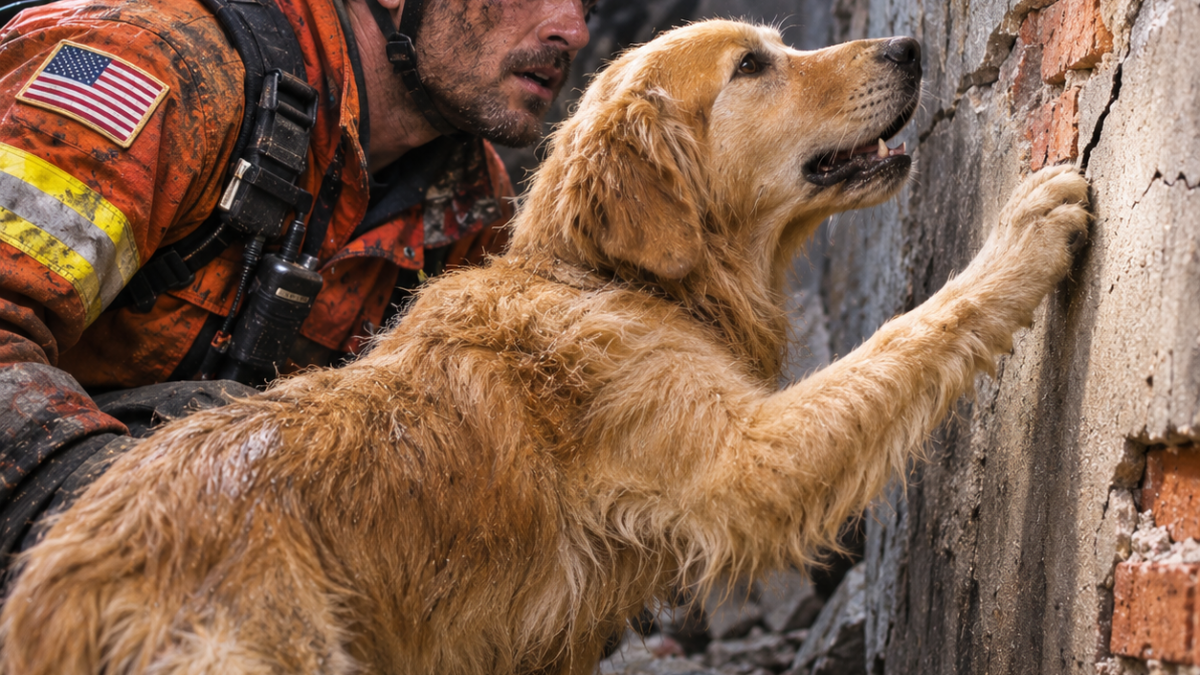
He stepped toward the wall.
Raised one paw.
And struck the bricks.
Three times.
Tap. Tap. Tap.
He stopped.
I stared.
For a second there was nothing.
Then, from behind the wall:
Tap. Tap. Tap.
So faint I almost thought I imagined it.
The dog moved in place excitedly.
No bark.
No panic.
He hit the wall again.
Three times.
Tap. Tap. Tap.
A pause.
Then the answer.
Three knocks from the other side.
My skin went cold.
Someone was alive behind that wall.
And the dog knew it.
More than that—
the pattern was established.
A signal.
Not random scratching.
Communication.
I crouched in that tiny shaft, staring at him.
His eyes were bright.
Alert.
Focused.
There are moments in rescue work when your understanding of the situation changes instantly.
One second, I was following a dog into an unknown ventilation shaft.
The next, I understood that he had been communicating with the trapped family.
For how long?
I did not know yet.
But the answer would later stay with me for years.
Almost the entire two hours.
I moved closer to the crack.
“Hello!”
No answer.
I pressed my ear near the opening.
“Can you hear me?”
Nothing.
The dog struck three times.
Tap. Tap. Tap.
The answer came back.
Then something else.
A voice.
Faint.
Too faint to understand.
My pulse jumped.
I grabbed my radio.
“Mark, David, get to the rear of the building.”
Static.
Then Mark.
“Where?”
“Near the old exterior vent.”
“What vent?”
“Exactly.”
I almost laughed from adrenaline.
“There’s an old ventilation conduit behind the rear wall. Not on the plans.”
Sarah’s voice cut in.
“James, do not move farther until I see it.”
“Bring hydraulic cutters.”
“What?”
“And the electric saw.”
“James—”
“I have contact.”
Silence.
I continued.
“The family is on the other side.”
Mark answered first.
“You’re sure?”
The dog hit the wall.
Three knocks.
Three came back.
I held my radio closer.
“Did you hear that?”
Another pause.
Then Mark:
“We’re coming.”
Sarah said:
“Do not touch that wall.”
“I’m not.”
“Foundations are still moving.”
“I know.”
“The conduit could collapse.”
“I know.”
“James.”
I looked at the dog.
He was scratching lightly near the bottom of the wall.
Not digging wildly.
Carefully removing loose fragments.
Almost as though he understood that violent movement might make things worse.
“We have people alive.”
I said.
Sarah exhaled through the radio.
“Five minutes.”
Five minutes inside an unstable shaft feels like an hour.
I kept calling.
“Hello?”
A voice eventually answered.
Weak.
Male.
“We hear you.”
My throat tightened.
“My name is James.”
I pressed closer.
“Are there three of you?”
“Yes.”
“Thomas?”
“Yes.”
“Emily?”
“Yes.”
“And Lily?”
A smaller voice answered.
“I’m here.”
I closed my eyes for half a second.
Children change the emotional temperature of every rescue.
You train yourself not to let that affect decisions.
You never fully succeed.
“Hi, Lily.”
“Hi.”
Her voice was tiny.
Frightened.
But clear.
“We’re coming to get you.”
The building creaked.
I hated the promise the second I made it.
We would try.
That was the honest version.
But sometimes frightened children need something simpler.
The dog pressed closer to the wall.
“Is this your dog?”
A little silence.
Then Lily:
“Benji.”
The golden dog turned his head at the sound.
“His name is Benji?”
“Yes.”
“He’s my Benji.”
Her voice grew stronger.
“I knew he’d find us.”
I looked at him.
Benji.
Small golden dog.
Dust across his coat.
Scraped paws I had not yet properly noticed.
Standing between us like he had been assigned to this rescue by someone far smarter than the rest of us.
“How did Benji get out?”
I asked.
Thomas answered.
“There was a small opening.”
“He squeezed through.”
“He kept leaving.”
“Then coming back.”
“Barking.”
“And scratching.”
Lily interrupted.
“He knocks.”
I swallowed.
“Yes.”
“I noticed.”
“He told us you were coming.”
That sentence hit me harder than the collapse.
A child trapped in darkness had interpreted her dog’s repeated return as a promise.
And maybe she had been right.
Mark appeared behind me first.
Then David.
Sarah followed.
“This is insane.”
she muttered after seeing the conduit.
“You’re welcome.”
I replied.
She ignored me.
Engineers are good at that.
She moved carefully along the shaft.
Flashlight.
Hands.
Measurements.
She examined the wall.
Then the crack.
Then the framing.
“Old exterior lining.”
she said.
“Not load-bearing?”
I asked.
“Not this section.”
Relief.
Then she added:
“But the surrounding structure is unstable.”
There it was.
Always another problem.
“If we’re precise…”
she continued.
“We can cut this.”
“How long?”
“Ten minutes.”
“Too long.”
“Then nine if everyone stops talking.”
Fair.
She pointed.
“Here.”
Then lower.
“And here.”
“We widen this section only.”
“No smashing.”
“No impact.”
“Slow cut.”
I nodded.
Benji scratched at the lower edge.
Sarah looked down.
“Is he helping?”
“I think he thinks we’re slow.”
“Smart dog.”
We needed him back.
At least several feet.
The saw would be dangerous.
I crouched.
“Benji.”
He looked at me.
“Back.”
Nothing.
I gestured.
“Come here.”
He stayed beside the crack.
Lily’s voice came faintly from behind the wall.
“Benji?”
His ears lifted.
“Benji, come back.”
He glanced at the crack.
Then at me.
But he refused to leave.
I laughed despite the fear.
“This dog does not take orders from me.”
Thomas called:
“He won’t go far.”
“Not if Lily’s there.”
Sarah was preparing the saw.
“We need him out of the cutting zone.”
I reached toward Benji.
“Listen, buddy.”
He stared.
“You’ve already done more than us.”
“Back up.”
No movement.
I pointed.
“Back.”
Finally, David took a strip of cloth from his kit and moved slowly toward him.
Benji stepped back perhaps three feet.
No farther.
His eyes remained fixed on the wall.
“Good enough?”
I asked.
Sarah measured.
“Barely.”
“Don’t let him move forward.”
David nodded.
Sarah started the saw.
The sound inside the shaft was brutal.
Metal screaming against metal.
Everyone wore protection, but the vibration still traveled through bone.
Benji flinched.
Then held his ground.
Behind the wall, Lily cried out.
I pressed close to the crack.
“Lily!”
“I’m okay!”
“It’s loud because we’re making an opening.”
“Okay.”
“Cover your ears if you can.”
A pause.
Then:
“Benji doesn’t like it.”
I looked back.
He certainly did not.
His body was tense.
But he did not run.
Sarah made the first cut.
Stopped.
Checked the wall.
“Movement?”
Mark inspected.
“Nothing new.”
Second cut.
Then the entire building gave a slight shift.
Not violent.
Not dramatic.
Almost worse.
A low groan moved through the structure.
Dust poured down.
“Stop!”
Sarah shouted.
Saw off.
Everyone froze.
A small section of masonry fell somewhere beyond the wall.
Benji jumped backward.
Then immediately stepped forward again.
No barking.
No retreat.
He stared at me.
I know animals do not speak human languages.
But I also know expressions.
His said:
Hurry.
Sarah put one hand against the wall.
Waited.
Ten seconds.
Twenty.
“Stable enough.”
she finally said.
“Continue.”
She cut with unbelievable precision.
I stayed near the crack.
“Thomas?”
“Yes.”
“Everyone still okay?”
“Yes.”
“Emily?”
“I’m here.”
“Lily?”
“Here.”
“Any injuries getting worse?”
“No.”
“Can you move your legs?”
Thomas answered.
“Yes.”
“Emily?”
“Yes.”
“Lily?”
“I can move.”
Good.
The trapped space had protected them.
Somehow.
But I still did not understand how.
“James.”
Sarah said.
“Two more cuts.”
I nodded.
Benji moved forward.
David blocked him gently.
“Not yet, buddy.”
The dog whined once.
First sound I had heard from him inside the conduit.
Then Lily called through the wall:
“Benji.”
He became still.
She said:
“Good boy.”
His tail moved.
Once.
I looked at David.
David looked at me.
Neither of us said anything.
Last cut.
The metal panel loosened.
Sarah held one side.
Mark took the other.
“Slow.”
They pulled.
A section shifted inward.
For the first time, my flashlight passed through.
And I saw them.
Thomas first.
He was seated awkwardly against broken brick.
One arm around Emily.
Emily was curled against him.
And between them—
Lily.
Small.
Dusty face.
Wide eyes.
They occupied a cavity so narrow that I still do not fully understand how all three remained relatively unharmed.
Brick movement had created a pocket.
Not comfortable.
Not safe.
But survivable.
For two hours they had sat in darkness with damaged structure surrounding them.
Lily saw us.
Then immediately looked past me.
“Benji!”
That was it.
David released him.
The dog launched himself through the opening.
Straight to Lily.
She wrapped both arms around his neck.
Benji licked her hands.
Face.
Hair.
Everywhere.
Not wildly.
Almost systematically.
As if he was checking.
Alive.
Here.
Safe.
Lily began crying.
Not screaming.
Silent tears pouring down her face as she pressed her forehead against his.
“I told you.”
she whispered.
“I knew you’d come back.”
I looked away for a second.
Rescuers learn how to work around emotion.
Sometimes you need one second.
Then back to work.
“Thomas.”
I said.
“We’re getting you out first.”
He shook his head.
“Lily.”
“Lily comes after we know the opening stays stable.”
He wanted to argue.
Emily touched his arm.
“Go.”
He nodded.
Thomas turned onto his stomach.
Crawled toward us.
The opening was narrow.
Mark guided one shoulder.
I took his arm.
“Slow.”
“That’s it.”
“Keep coming.”
He emerged into the shaft.
Big man.
Strong.
Covered in dust.
And crying.
Not a little.
His entire face had collapsed with relief.
He grabbed my forearm.
“James.”
“You’re okay.”
He shook his head.
“You don’t understand.”
“What?”
“Benji.”
He looked through the opening.
“For two hours, we heard him.”
“He’d leave.”
“Then come back.”
“Sometimes barking.”
“Sometimes scratching.”
“Then the knocks.”
His voice broke.
“Every time Lily started crying, he’d hit the wall.”
“Three times.”
“We started answering.”
He pressed one hand over his face.
“He was telling us someone was still out there.”
I could not answer.
Because I knew.
Emily came next.
She moved slowly.
The moment she cleared the opening and tried to stand, her legs gave way.
David caught her.
“Easy.”
“I’m fine.”
she insisted.
“You don’t need to prove that.”
David said.
“We’ve got you.”
Her hands shook violently.
She turned immediately.
“Lily.”
“She’s coming.”
I moved closer to the opening.
“Lily.”
“Yes?”
“Your turn.”
“I have Benji.”
“I see that.”
“He comes with me.”
I almost smiled.
“Absolutely.”
The dog stayed pressed to her.
Getting both through the opening together would be awkward.
But nobody was going to separate them at that moment unless safety demanded it.
“Let Benji go ahead.”
“No.”
“Lily.”
“He stays with me.”
Thomas called from behind us:
“Sweetheart, let Benji go first.”
“No!”
Panic entered her voice.
Benji turned and licked her cheek.
Then stepped toward the opening himself.
Lily reluctantly loosened her grip.
He crawled through.
Stopped immediately on our side.
Turned.
Waited.
I reached toward Lily.
“See?”
“He isn’t leaving.”
She nodded.
Crawled.
I guided her shoulders.
Mark supported the opening.
Sarah watched the structure.
“Slow.”
“Keep coming.”
Lily emerged.
The second her feet cleared, Benji pushed against her legs.
She dropped to her knees and grabbed him again.
He did not bark.
Not once.
He simply looked around.
At Lily.
Emily.
Thomas.
Me.
Mark.
David.
Then back toward the opening.
As if counting.
Checking.
Nobody left behind.
“Move.”
Sarah ordered.
“We’re done here.”
She did not need to tell us twice.
The building had already given us more time than I trusted.
We moved through the ventilation conduit carefully.
Thomas behind Mark.
Emily supported by David.
Lily crawling where necessary.
Benji beside her.
Sometimes he moved ahead.
Then stopped.
Turned back.
Waited.
Exactly as he had done with me.
Once, near the exit, he looked backward for several seconds.
I wondered if he was checking the tunnel one last time.
Then he followed Lily outside.
Fresh air.
It is impossible to describe what fresh air means after being inside a damaged building.
Even dirty city air feels pure.
Emergency lights flashed.
Medical staff moved toward us.
Someone shouted:
“Family out!”
Others repeated it.
Three civilians.
Alive.
Dog.
Alive.
We transferred everyone toward medical evaluation.
Thomas resisted being separated from Emily.
Emily resisted being separated from Lily.
Lily absolutely refused to be separated from Benji.
The paramedic looked at me.
“Dog needs to move.”
I looked at Lily’s face.
“No.”
The medic understood.
“Fine.”
They examined them together.
Scrapes.
Bruises.
Dust irritation.
Exhaustion.
No catastrophic injuries.
Lily appeared, astonishingly, to be in the best physical condition of the three.
“She was in the middle.”
Emily explained.
“We kept her between us.”
Benji had stayed close too.
That protective cavity had done what no one outside could have predicted.
Then someone noticed blood.
“Whose?”
Thomas looked around.
Emily checked Lily.
Nothing.
Then I looked down.
Benji’s paws.
The pads were scraped raw in places.
Small streaks of blood.
Dust embedded in fur.
The dog had spent nearly two hours moving through broken material.
Scratching.
Clearing loose debris.
Striking walls.
Running back and forth through a passage that could have injured him with every trip.
Lily saw it.
“Benji.”
Her voice broke.
She lifted one paw gently.
He licked her fingers.
As though she were the one who needed reassurance.
I sat on the pavement.
Not gracefully.
My legs simply decided they were done.
Benji walked toward me.
Lily was still beside the paramedic.
The dog came close.
Then lowered his head onto my knees.
For a moment, I did not move.
His coat was dusty.
Warm.
I could feel his breathing.
I placed one hand against the side of his head.
“You’re a hero, Benji.”
He looked up.
Tail moved once.
Only once.
The simplest response imaginable.
I swear it felt like:
I was just doing my job.
Except he had no job.
No training.
No rescue designation.
No radio.
No helmet.
No thermal camera.
No map.
He had only one thing we had underestimated.
He knew where his family was.
And he refused to let them disappear alone.
Once things settled enough to breathe, we started reconstructing what had happened.
The family had been near the rear interior section when the building shifted.
A failure involving the old ventilation system and surrounding structure caused bricks and materials to move in a way that created the protective cavity.
Pure chance.
Architecture.
Physics.
Call it whatever you want.
A small pocket formed.
Large enough for Thomas, Emily, and Lily.
The direct routes became blocked.
The old ventilation conduit remained partially accessible.
Benji somehow found an opening.
He squeezed out.
Then began searching.
At first, Thomas and Emily thought he had run away.
Lily refused to believe it.
“He’ll come back.”
she told them.
He did.
Again and again.
He would disappear through the small opening.
Then return.
Sometimes with dust covering more of his coat.
Sometimes barking from somewhere outside.
Then, later, he began the knocking.
Three strikes.
Thomas did not know whether Benji invented the pattern intentionally or simply repeated something that got a response.
It did not matter.
The result was the same.
Tap. Tap. Tap.
They answered.
Tap. Tap. Tap.
A conversation without words.
One side:
We’re still here.
The other:
So am I.
Thomas told me later that there was one moment when Emily started to panic badly.
The structure had moved.
Dust filled their cavity.
Lily began crying.
Thomas himself was close to losing control.
Then—
three knocks.
Benji.
Lily stopped crying immediately.
“See?”
she whispered.
“He’s still outside.”
Thomas said that sentence changed everything.
Not because it guaranteed rescue.
It didn’t.
But trapped people do not always need certainty.
Sometimes they need a reason to survive the next five minutes.
Then another five.
Benji kept giving them that.
The next day, authorities closed the building completely for renovation and deeper structural evaluation.
Engineers discovered more about the forgotten ventilation route.
It had been part of an older system dating back decades.
Alterations over the years had hidden it from current plans.
The failure had forced pressure and debris in ways no modern blueprint predicted.
The cavity where the family survived was an accidental consequence of that movement.
And Benji had found the one route that connected it to us.
We had equipment.
Plans.
Training.
Radios.
Engineering knowledge.
Experience.
And we were still searching.
Benji had scent.
Memory.
Loyalty.
And an absolute refusal to give up.
Together, that was enough.
People sometimes misunderstand rescue stories afterward.
They want one hero.
One dramatic action.
One person who saves everyone.
Real rescue rarely works that way.
Sarah’s structural judgment mattered.
If she had cut the wrong section, we could have made the situation worse.
Mark and David brought equipment and helped stabilize the extraction.
Medical staff assessed the family.
Everyone played a part.
But none of us would have been standing beside that forgotten conduit when we were if Benji had not come looking for us.
That was the truth.
He found the route.
He made contact.
He maintained it.
Then he led us back.
I visited the family briefly afterward.
Not for a ceremony.
Not for publicity.
I simply wanted to see them when the dust was gone.
Lily opened the door with Benji beside her.
The first thing she said was:
“His paws are better.”
Not hello.
Not come in.
His paws.
I crouched.
Benji recognized me.
Tail.
One wag.
Apparently that was our language now.
Lily hugged him.
She did that constantly.
Her mother smiled.
“She sleeps with both arms around him.”
Lily looked offended.
“He likes it.”
Thomas laughed.
“I don’t think he has a choice.”
Benji lay down at Lily’s feet.
Choice or not, he did not appear bothered.
Thomas asked me:
“Did you know what he was doing when you followed him?”
“No.”
“Not at first.”
“What made you follow?”
That question stayed with me.
Why had I?
Because he kept stopping.
Because he looked back.
Because his behavior did not feel random.
Because rescue work trains you to notice anomalies.
Because sometimes you simply decide one small thing is worth investigating.
“I think he asked me to.”
I said.
Thomas smiled.
“That sounds right.”
Lily asked:
“Were you scared?”
Children ask direct questions adults soften.
“Yes.”
Her eyes widened.
“You were?”
“Very.”
“But you’re a rescuer.”
“Rescuers get scared.”
She considered that.
“Benji was scared too.”
I looked at him.
“How do you know?”
“He jumped when the wall moved.”
She hugged him.
“But he stayed.”
There it was.
Perhaps the best definition of courage anyone gave me that year.
Not absence of fear.
He jumped.
But he stayed.
Later, back at the station, someone asked whether Benji had special training.
No.
Nothing.
No search-and-rescue certification.
No disaster-response background.
No professional handler.
He was simply Lily’s dog.
Golden fur.
Quick eyes.
Loyal heart.
That answer disappointed some people.
They wanted him to be a hidden working dog.
It would make the story easier to explain.
But sometimes instinct and attachment are enough.
Dogs know their people.
They recognize distress.
They follow scent.
They repeat behavior that works.
And sometimes those ordinary abilities line up with an extraordinary situation.
That does not make what happened less remarkable.
It makes it more.
I kept thinking about the three knocks.
Out of everything that happened, that was what remained with me.
Not the saw.
Not the collapsing structure.
Not the moment we opened the wall.
Three soft knocks.
A paw against brick.
It was almost nothing.
Barely audible.
And yet behind that wall, it meant:
Don’t give up.
On our side, it meant:
Someone is alive.
The same sound carried two different kinds of hope.
There are louder forms of courage.
Sirens.
Shouts.
Heavy machinery.
People running toward danger.
Then there is quiet courage.
A small dog returning to a dark cavity over and over.
Scraped paws.
Dusty fur.
Three knocks.
No audience.
No understanding of medals or headlines.
Only family.
Lily continued holding Benji close every night after the rescue.
Thomas told me she sometimes woke and touched him just to make sure he was there.
Benji apparently tolerated this with the patience of a dog who had already accepted that his human required additional supervision.
Emily said he became even more attached afterward.
That did not surprise me.
Some experiences change animals too.
For our rescue crew, the story became one of those calls you never forget.
Not because it had the worst injuries.
It didn’t.
Thank God.
Not because it involved the most complex equipment.
It didn’t.
We had harder operations before and after.
We remembered it because of what we almost missed.
An old ventilation conduit.
A tiny crack.
Warm air.
A golden dog.
Three knocks.
Sometimes the difference between finding someone and losing them is not a spectacular technological breakthrough.
Sometimes it is noticing what does not fit.
I thought a lot afterward about the moment Benji first appeared.
If I had ignored him?
Maybe another rescuer would have followed.
Maybe he would have barked until someone did.
Maybe the family still would have been found.
Maybe.
Rescue work is full of maybes.
I try not to live there.
What happened is simpler.
He came.
He looked at me.
He ran.
He waited.
I followed.
That was enough.
People later called him heroic.
He was.
But I do not think Benji understood the concept.
Heroism is a human label.
Benji understood:
Lily is inside.
My family is inside.
I can get out.
I can go back.
Someone needs to follow me.
That was probably his entire world.
And perhaps that is why his courage was so pure.
There was nothing in it for him except bringing his people home.
If you had seen him afterward, you might not have understood what he had done.
Small golden dog.
Scraped paws healing.
Lying beside a little girl.
No dramatic scars.
No special vest.
No indication that he had crawled through a forgotten ventilation shaft while an unstable building shifted above him.
He looked ordinary.
That is something I have learned again and again.
Extraordinary things often come in ordinary forms.
The family survived with bruises and scratches.
That fact remains almost unbelievable to me.
Given the structure.
The time.
The instability.
They were fortunate.
But fortune alone did not bring us to that wall.
Benji did.
I once asked Sarah what would have happened if the old ventilation cavity had collapsed another way.
She looked at me.
“You don’t want that answer.”
She was right.
There are alternate endings rescuers learn not to study too closely.
We work with the one that happened.
Three people walked out.
One dog ran beside them.
That is enough.
What stayed with Sarah was different.
She told me:
“I keep thinking about how carefully he scratched.”
“What?”
“The wall.”
“He wasn’t digging wildly.”
“He cleared loose debris.”
I remembered.
She was right.
“He probably learned fast that scratching harder made things fall.”
Maybe.
Maybe not.
Again, we should be cautious about turning instinct into human reasoning.
But whatever the mechanism, his behavior helped rather than hurt.
That mattered.
Mark remembered Benji refusing to move away from the cutting zone.
David remembered the single whine when Lily called.
Everyone carried a different piece of the same story.
Mine remained the knocking.
Always the knocking.
Months later, I passed another old building during an unrelated call.
I saw a metal ventilation grille.
Immediately:
Tap. Tap. Tap.
Memory is strange like that.
One sound becomes attached forever to one night.
I smiled before I realized I was doing it.
A coworker asked:
“What?”
“Nothing.”
But it wasn’t nothing.
It was Lily’s voice saying:
“I knew he’d find us.”
I have spent years around people at their most frightened.
And one thing I know is that hope does not always look impressive.
Sometimes it is a firefighter arriving.
Sometimes a doctor’s voice.
Sometimes a phone call.
Sometimes a crack in a wall.
Sometimes a dog returning when everyone thought he might run away.
The form does not matter.
What matters is that someone believes they are no longer alone.
Benji gave that family exactly that.
For almost two hours, Thomas and Emily could not see us.
They did not know whether rescue teams were getting closer.
They did not know whether the building would shift again.
Lily was frightened.
The darkness made time impossible to measure.
But every time Benji returned—
there was evidence of outside life.
Movement.
Sound.
Connection.
And later:
three knocks.
The next time someone tells you animals do not understand enough to matter in emergencies, I will not argue.
I do not need to.
I remember a small golden dog standing in a forgotten ventilation conduit.
I remember the way he looked at me.
I remember him moving left and turning back because the crack was wider there.
I remember his paws.
Raw.
Bloody.
I remember Lily saying:
“He’s my Benji.”
And I remember the answer behind the wall.
Tap. Tap. Tap.
That is enough evidence for me that whatever he understood, it was enough.
There was no special equipment attached to his collar.
No radio.
No thermal camera.
No structural plans.
No formal rescue training.
Only his senses.
His attachment.
His persistence.
And a heart that apparently could not accept leaving his family alone in the dark.
In the end, that was precisely what we needed.
I sometimes think about the line between instinct and choice.
Humans like to believe courage requires conscious understanding.
Maybe it does.
Maybe not.
Benji saw danger.
He moved through it anyway.
He found his people.
Left them.
Returned.
Left again.
Found us.
Led me back.
Stayed while saws cut into the wall.
Then returned to Lily the moment the opening was large enough.
Whatever word you want to use—
instinct.
loyalty.
love.
heroism.
The outcome does not change.
A family survived.
The operation lasted roughly two hours.
For us, it was two hours of searching.
For the family, two hours trapped in darkness.
For Benji, two hours of moving between worlds.
Inside.
Outside.
Family.
Rescuers.
Again.
Again.
Again.
By the time he finally rested his head on my knees beside the ambulance, his work was done.
He did not celebrate.
He did not know everyone was staring.
His tail moved once.
That was all.
If I could return to the exact moment I first saw him in that dark passage, I would notice his paws sooner.
I would understand sooner what he had already been through.
But perhaps that is part of why the story matters.
We did not know.
We followed anyway.
Sometimes trust comes before understanding.
And if I could speak to Lily inside that cavity before we opened the wall, I would tell her:
You were right.
When everyone else wondered where Benji had gone—
you knew.
He was coming back.
He kept coming back until someone followed him.
Years from now, Lily may remember different details.
The darkness.
Her parents holding her.
The sound of the saw.
The first beam of our flashlight.
Benji jumping into her arms.
I hope what she remembers most is not fear.
I hope she remembers that she was never abandoned.
Because that is what Benji spent two hours proving.
Thomas once told me that after they were home, he caught Lily tapping three times on the bedroom wall.
Benji lifted his head.
Walked over.
Sat beside her.
Thomas asked what she was doing.
Lily said:
“Just making sure he remembers.”
I asked:
“What did Benji do?”
Thomas smiled.
“He put his paw on her leg.”
Nothing more.
He remembered enough.
That image stays with me almost as strongly as the rescue itself.
A safe house.
A bedroom.
No collapsing walls.
No emergency lights.
A child tapping three times.
A dog beside her.
The signal that once meant:
Are you still there?
Now meaning:
We’re still together.
That is the part people sometimes miss when they call a dog heroic.
Heroism is not only the dramatic act.
Sometimes it is presence repeated until fear loses.
Benji did not knock once.
He kept knocking.
He did not return once.
He kept returning.
He did not find us and then stop.
He stayed until every member of his family was out.
After we brought Lily through the opening, Benji looked back.
I have replayed that moment often.
At first, I thought he was simply disoriented.
Later, after hearing what he had been doing, I understood it differently.
He was checking.
Was anyone still inside?
Everyone here?
Family accounted for?
Then he moved.
That is what rescuers do too.
Count.
Check.
Nobody left.
Maybe that is why I felt such a strange connection to him.
For one night, Benji was part of our team.
He simply did not know it.
There are rescue calls that teach you new technical procedures.
Others teach you caution.
Others teach you humility.
Benji taught me humility.
We had plans.
Tools.
Experience.
He had found what we could not.
Not because we were incompetent.
Because the world always contains information our systems miss.
Old structures.
Forgotten spaces.
Small clues.
Animals who know routes humans do not.
Good rescuers remember that.
The moment you believe your tools show you everything is the moment you stop truly searching.
Sarah later told younger engineers about the old conduit when discussing legacy buildings.
Mark mentioned the case during rescue training when talking about unconventional access routes.
I talked about it less.
Not because it mattered less to me.
Because some experiences feel cheapened if you turn them into speeches too quickly.
For a long time, I simply carried Benji’s three knocks with me.
Eventually, I learned how to tell the story without my throat tightening.
Mostly.
The part where Lily says:
“It’s my Benji.”
Still gets me.
Every time.
Because children have a way of reducing enormous events to the only truth that matters.
Not hero.
Not rescue dog.
Not miracle.
My Benji.
Family.
That was his entire reason.
Sometimes the greatest hope comes from the least expected place.
People say that often enough that it becomes a cliché.
Then one day you are crawling through a ventilation shaft that has not appeared on a building plan in decades, following a dusty golden dog into darkness.
And the cliché becomes fact.
Sometimes the loudest message is not a siren.
It is a paw against brick.
Three soft taps.
Pause.
Three taps back.
And sometimes two hours that feel endless become a story people remember for years.
Not because of tragedy.
Because everyone came home.
Thomas.
Emily.
Lily.
And Benji.
Especially Benji.
The last image I carry from that day is not the collapsed building.
It is not the saw cutting metal.
It is not even the family emerging.
It is Benji beside the ambulance.
His injured paws finally still.
His head resting across my knees.
I scratched gently behind one dusty ear.
“You’re a hero.”
I whispered.
He looked at me.
Then moved his tail once.
No barking.
No excitement.
Nothing dramatic.
As if heroism were the most ordinary thing in the world.
As if keeping your family from being alone were simply what love required.
Maybe, to Benji, it was.
And maybe that is why none of us who were there that night will ever forget him.








